EP1151983A1 - Process for continuously producing tetracyclododecene compound - Google Patents
Process for continuously producing tetracyclododecene compound Download PDFInfo
- Publication number
- EP1151983A1 EP1151983A1 EP00974907A EP00974907A EP1151983A1 EP 1151983 A1 EP1151983 A1 EP 1151983A1 EP 00974907 A EP00974907 A EP 00974907A EP 00974907 A EP00974907 A EP 00974907A EP 1151983 A1 EP1151983 A1 EP 1151983A1
- Authority
- EP
- European Patent Office
- Prior art keywords
- norbornenes
- reaction
- methyl
- reactor
- tetracyclododecenes
- Prior art date
- Legal status (The legal status is an assumption and is not a legal conclusion. Google has not performed a legal analysis and makes no representation as to the accuracy of the status listed.)
- Granted
Links
- 0 *C(C(*)C1C2)C2C2C1C1C=CC2C1 Chemical compound *C(C(*)C1C2)C2C2C1C1C=CC2C1 0.000 description 1
- AYTYXRKXLBENDF-UHFFFAOYSA-N CC(C(C1)C2N)=CC1C2(N)I Chemical compound CC(C(C1)C2N)=CC1C2(N)I AYTYXRKXLBENDF-UHFFFAOYSA-N 0.000 description 1
Images
Classifications
-
- C—CHEMISTRY; METALLURGY
- C07—ORGANIC CHEMISTRY
- C07C—ACYCLIC OR CARBOCYCLIC COMPOUNDS
- C07C13/00—Cyclic hydrocarbons containing rings other than, or in addition to, six-membered aromatic rings
- C07C13/28—Polycyclic hydrocarbons or acyclic hydrocarbon derivatives thereof
- C07C13/32—Polycyclic hydrocarbons or acyclic hydrocarbon derivatives thereof with condensed rings
- C07C13/62—Polycyclic hydrocarbons or acyclic hydrocarbon derivatives thereof with condensed rings with more than three condensed rings
- C07C13/66—Polycyclic hydrocarbons or acyclic hydrocarbon derivatives thereof with condensed rings with more than three condensed rings the condensed ring system contains only four rings
-
- C—CHEMISTRY; METALLURGY
- C07—ORGANIC CHEMISTRY
- C07C—ACYCLIC OR CARBOCYCLIC COMPOUNDS
- C07C2/00—Preparation of hydrocarbons from hydrocarbons containing a smaller number of carbon atoms
- C07C2/02—Preparation of hydrocarbons from hydrocarbons containing a smaller number of carbon atoms by addition between unsaturated hydrocarbons
- C07C2/50—Diels-Alder conversion
-
- C—CHEMISTRY; METALLURGY
- C07—ORGANIC CHEMISTRY
- C07C—ACYCLIC OR CARBOCYCLIC COMPOUNDS
- C07C2603/00—Systems containing at least three condensed rings
- C07C2603/56—Ring systems containing bridged rings
- C07C2603/86—Ring systems containing bridged rings containing four rings
Definitions
- the present invention relates to a process for a continuous preparation of tetracyclododecenes, more particularly, the invention relates to a process for preparing highly purified tetracyclododecenes (may be abbreviated hereafter as TCD), which can be a raw material of cycloolefin (co)polymers possessing excellent characters concerning their optical property, high transparency, heat resistance, and oil absorbency, from an inexpensive raw material of crude dicyclopentadiene (DCPD) in a stable, continuous, and longstanding process.
- TCD highly purified tetracyclododecenes
- Cycloolefin (co)polymers are the focus of industrial attention as polymers that possess excellent characters concerning the optical property, high transparency, heat resistance, and oil absorbency. Cycloolefins represented by TCD are a useful raw material for polymer. These cycloolefins are generally prepared using organometallic complex catalysts. A polymerization method is roughly classified into two: one is a single polymerization of cycloolefins polymerized at their olefinic site, or the copolymerization with lower alpha-olefins using Ziegler catalysts or metallocene catalysts. The other is known as the metathesis polymerization that employs the carbene-type catalysts.
- a typical method is mixing cyclopentadiene (may be called CPD hereafter), dicyclopendtadiene (may be called DCPD hereafter), or a mixture thereof, with norbornene and ethylene, in a heated condition, yielding a reaction mixture containing tetracyclododecenes and norbornenes. This is followed by the recovery and circulation of norbomenes in the reaction mixture.
- CPD cyclopentadiene
- DCPD dicyclopendtadiene
- a method of preparing tetracyclododecenes, accompanied with the processes of recovery and circulative re-use of generated norbornenes, is reported, for example, in Japan Open H06-9437.
- This patent proposes a use of DCPD having the purity higher than a specific value as a raw material, and a circulative re-use of recovered norbomenes generated in the reaction, since the industrially available crude DCPD contains a large amount of impurities.
- the raw material DCPD of high purity mentioned in the above patent is likely to bring about a high cost for the raw material naturally, therefore, rarely adopted in the industrial production.
- the present inventors investigated processes that employ crude DCPD as a raw material, and found that a continuous, longstanding operation of producing TCDs involves a possibility of unstable reaction condition due to the impurities present in crude DCPD employed. This leads to inability to continue the operation in an extreme case.
- the present invention proposes a production method of TCDs using inexpensive crude DCPD as a raw material in a stable, continuous, and longstanding process.
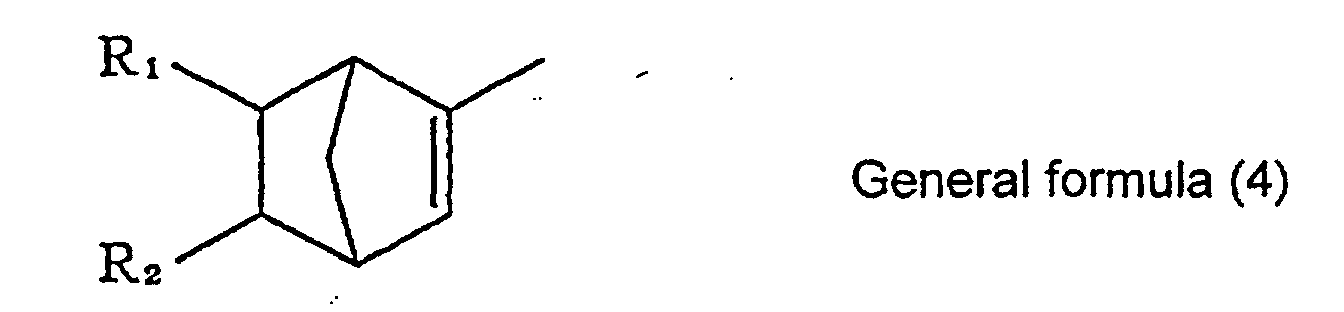
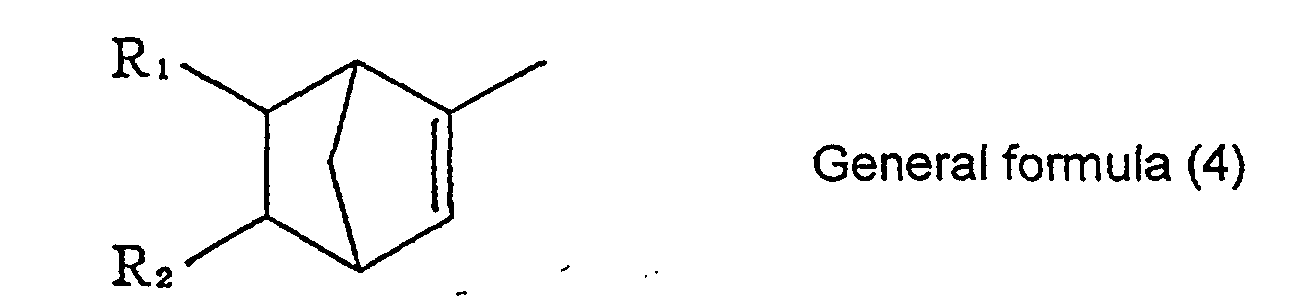
- the first item of the present invention relates to a continuous method involving the processes of 1 to 4 that are shown below, for the production of tetracyclododecenes shown by the general formula (3), characterized by inclusion of a process of removing at least a part of 2-methyl-2-norbornenes shown by the general formula (4), which may be contained in the obtained reaction mixture.
- the second item of the present invention relates to a continuous production method of tetracyclododecenes shown by the general formula (3) characterized by inclusion of the following processes of 1 to 7.
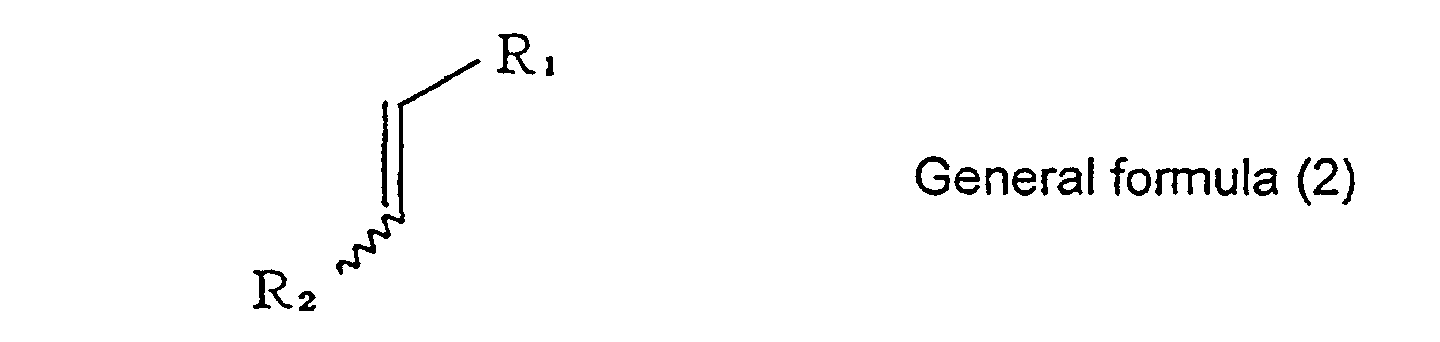
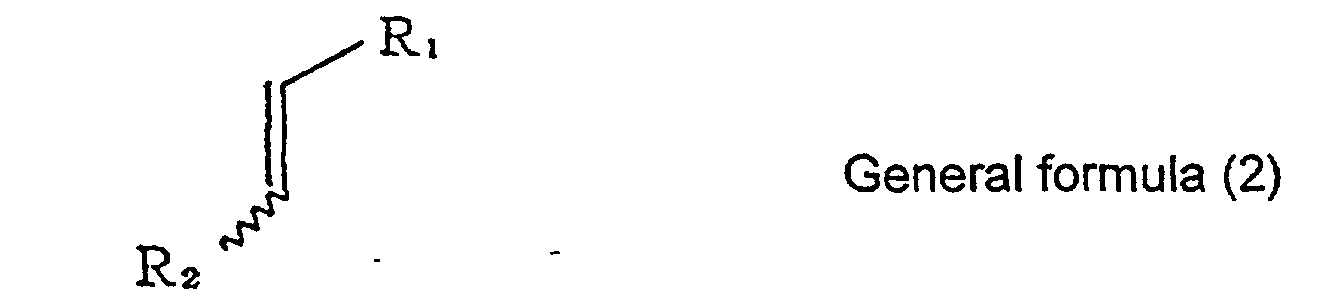
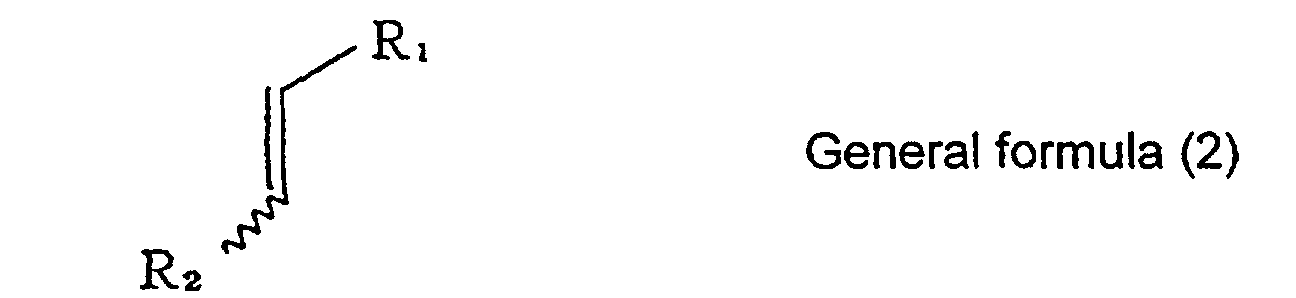
- the olefin shown by the general formula (2) in the present invention is precisely taken to mean ethylene, propylene, 1-butene, trans-2-butene, and cis-2-butene.
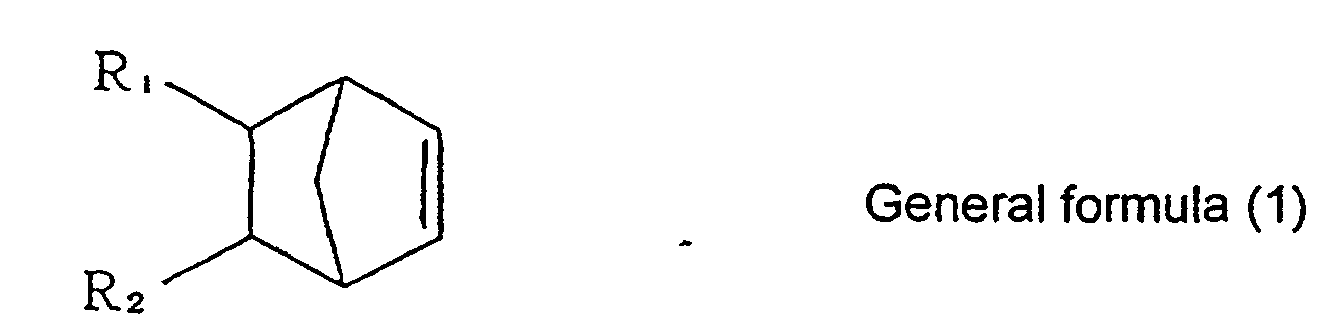
- the 2-norbomenes (may be called as alkyl-norbomenes hereafter) shown by the general formula (2) in the present invention are precisely taken to mean 2-norbomene, 5-methyl-2-norbornene (methyl-norbornene), 5-ethyl-2-norbornene (ethyl-norbomene), and 5,6-dimethyl-2-norbomene (dimethylnorbornene).
- the endo form and the exo form of these compounds may be included in this category if they exist.
- the tetracyclododecenes shown by the general formula (3) are precisely taken to mean tetracyclododecene (1,4:5,8-dimethano-1,2,3,4,4a,5,8,8a-octa hydronaphthalene),methyltetracyclododecene(2-methyl-1,4:5,8-dimethano-1,2,3 ,4,4a,5,8,8a-octahydro-naphthalene),ethyltetracyclododecene((2-ethyl-1,4:5,8-dimethano-1,2,3,4,4a,5,8,8a-octahydronaphthalene),and dimethyltetracyclododecene(2,3-dimethyl-1,4:5,8-dimethano-1,2,3,4,4a,5,8,8a-octahydro naphthalene).
- the steric isomers of these compounds such as the
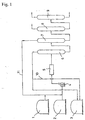
- Figure 1 illustrates a process flow exhibiting a preferred embodiment of the present invention.
- the feed line of norbomenes necessary at the initiation of the reaction is omitted, and Number 1 means a solvent vessel.
- Number 1 means a solvent vessel.
- the purpose of using solvents lies in the decrease in the concentration of each component in the reaction system leading to reduced generation of heavy-end, which is a byproduct, and especially in the prevention of solidification of the circulating 2-norbomenes when they are employed in the reaction system.
- the boiling point of the employed solvent is close to that of 2-norbornenes.
- aromatic and aliphatic hydrocarbons having a carbon number of 6 to 8 are preferred.
- the hydrocarbon solvent is precisely taken to mean benzene, toluene, xylene, cyclohexane, methylcyclohexane, and dimethylcyclohexane.
- alicyclic or branched aliphatic hydrocarbons are particularly preferred because of their safety to human bodies and the environment. They include preferably, for example, iso-hexane, iso-heptane, iso-octane, cyclohexane, methylcyclohexane, dimethylcyclohexane, and ethylcyclopentane.
- iso-hexane iso-heptane
- iso-octane is taken to mean hexane, heptane, and octane that possess a hydrocarbon branch or branches larger than or equal to the methyl group. They may be employed regardless of the substituted position or their isomeric form.
- the preferred examples include 2-methylpentane, 3-methylpentane, 2,3-dimethylbutane, 2-methylhexane, 3-methylhexane, 2,3-dimethylpentane, 2,4-dimethylpentane, 2,2,3-trimethylbutane, 2-methylheptane, 3-methylheptane, 4-methylheptane, 2,3-dimethylhexane, 2,4-dimethylhexane, 2,5-dimethylhexane, 2,2,3-trimethylpentane, 2,2,4-trimethylpentane, 2,3,4-trimethylpentane, and 2,3,3-trimethylpentane. They may be employed regardless of the relative position of substitution for any two methyl-groups.
- the distillation condenser In a process employing a solvent and intended to recover 2-norbornenes together with the solvent, it is possible to use water for cooling the distillation condenser (not shown in Figure 1). Water or seawater may be used.
- the temperature of the cooling medium is generally set to 0-95 degrees centigrade depending on the species and the amount of the solvent. Since the boiling point of 2-norbomenes is 95 degrees, loss of 2-norbornenes into the exhaust gas is possible depending on the distillation pressure. From this viewpoint, the distillation pressure at the top of a distillation tower is preferably set to 10-200 KPa, more preferably to 10-100 KPa, while the preferred temperature of the cooling medium is 0-80 degrees, although it depends on the species and the amount of used solvent. Note that a solvent lost in the exhaust gas at the time of distillation may be substituted in the solvent vessel with a supplement in a proper amount.
- Alkylnorbomenes which are heavier than 2-norbornenes, are still liquid at room temperature, therefore, not needed to employ a solvent for preventing solidification of the reaction system. In such cases addition of solvent is not required in the process flow, as is necessary for 2-norbomenes. Naturally it is still possible to employ a solvent in these- occasions.
- the preferred solvent is one that can be recovered together with the component intended for the circulative re-use in the process, preferably of 2-norbornenes or an olefin, more preferably 2-norbomenes. For this reason preferred are solvents having boiling points close to 2-norbornenes, usually solvents having the identical carbon number to 2-norbornenes.
- Number 2 in Figure 1 means a vessel for crude dicyclopentadiene.
- DCPD decomposes to CPD.
- Crude DCPD is Industrially obtained with ease. Therefore, crude DCPD may be used in place of CPD as is explained below.
- the present invention is characterized by the use of inexpensive crude DCPD as a raw material, which may be accepted if the purity of DCPD is higher than 70% by weight. Use of DCPD with the purity lower than that value will bring about a very low production efficiency in the TCD production, and would be non-economical. As is explained below, CPD may also become a raw material, and crude DCPD gives no harm when it contains CPD. Therefore, the above purity is concluded to relate to the content of both DCPD and CPD in a mixture.
- crude CPD may be used as a raw material.
- CPD is produced usually by the heat decomposition of DCPD.
- many of impurities existent in crude DCPD are similarly decomposed by heat to yield hydrocarbons, which are identical or close to CPD in the carbon number. Therefore, products of DCPD decomposed by heat may be simply called as the crude CPD, which contains many impurities similar to the crude DCPD.
- the crude CPD employed in the present invention has the purity higher than 70% by weight similar to the crude DCPD.
- Number 3 in Figure 1 points a vessel for an olefin. More precisely, it is for storing ethylene, propylene, 1-butene, trans-2-butene, or cis-2-butene.
- the molar ratio of employed olefin to dicyclopentadiene (converting 2 moles of cyclopentadiene to one mole of dicyclopentadiene) is 0.5-50, preferably 1-40, more preferably 1.2-30.
- norbornenes are generated in an amount smaller than the norbornenes consumed during the production period of tetracyclododecenes, making it difficult to circulate a stationary amount in the reaction system. Addition of an olefin in large excess is also not preferred as a large amount of energies are consumed in recovering the olefin.
- dicyclopentadiene and/or cyclopentadiene are introduced into the reactor 5 by the transfer pump 4.
- An olefin is first pressured by a pressuring pump (not shown in the flow), and introduced into the reactor 5.
- the molar feed ratio of norbornenes to dicyclopentadiene is 1-20, preferably 1.5-15, more preferably 2-10.
- the molar amount of supplied cyclopentadiene and/or dicyclopentadiene is calculated based on the molar amount of dicyclopentadiene (for example, 2 moles of cyclopentadiene are equivalent to 1 mole of dicyclopentadiene).
- the production reaction of tetracyclododecenes is carried out in the reactor 5 employing the above compounds as the raw material.
- Any of the complete mixing type or the piston flow type can be employed for the reactor 5.
- the commercial product of the piston type reactor there are Static Mixer made by Noritake Company, Thruzer Mixer made by Sumitomo Heavy Machines, and Sukeya Mixer made by Sakura Industry.
- the reactor 5 accommodates to the single step type or the multi-step type of more than 2 steps.
- the complete mixing type reactor and the piston type flow reactor may be employed in parallel or in series.
- the LHSV (liquid hourly space velocity) in the reactor 5 is set to 0.5-10, preferably 0.7-8, more preferably 1-6. With the LHSV larger than 10, the reaction yields a large amount of unreacted components, which prevents the effective production. With the LHSV smaller than 0.5, the reaction produces a large amount of heavy products leading to a decreased efficiency for the raw materials, and decrease in the productivity per hour.
- the pressure necessary for the reaction is 1-50 MPa, preferably 2-40 MPa, and more preferably 3-10 MPa.
- the favorable reaction temperature is 170-280 degrees centigrade, preferably 180-270 degrees, and more preferably 200-260 degrees. In a condition using dicyclopentadiene as a raw material, the reaction at above 100 degrees causes facile decomposition of dicyclopentadiene to cyclopentadiene, and thus is favorable.
- an olefin having relatively low boiling point is dissolved sufficiently in the liquid phase containing norbornenes, cyclopentadiene and/or dicyclopentadiene.
- a solvent employed in the reaction system, it is preferred that the olefin is dissolved in the solvent sufficiently.
- the dissolved state of an olefin depends on the molar mixing ratio of norbornenes, dicyclopentadiene and/or cyclopentadiene, and an olefin.
- 2-norbomenes are the targeted products, and 2-methyl-2-norbornenes are the main byproduct.
- 2-methyl-2-norbornenes are the main byproduct.
- the byproduct 2-methyl-2-norbomenes may contaminate the norbomenes obtained in the recovery by distillation.
- the by-produced 2-methyl-2-norbornenes may be circulated in the reaction system in accompany.
- a process of discharging at least a part of 2-methyl-2-norbornenes out of the reaction system is to be added, so that the accumulation of them in the reactor 5 is prevented.
- it is necessary to execute a removing operation of 2-methyl-2-norbornenes in the processes succeeding the reaction so that the discharged amount from the reactor 5 per unit time becomes equal to or larger than the introduced amount of 2-methyl-2-norbornenes per unit time.
- 2-methyl-2-norbornenes defined by the general formula (4) are taken to mean 2,5-dimethyl-2-norbornene, 2,6-dimethyl-2-norbornene, 5-ethyl-2-methyl-2-norbomene, and 6-ethyl-2-methyl-2-norbornene.
- the reaction mixture discharged out of the reactor 5 is introduced into the first distillation tower 6, and adjusted to a pressure of 0.1-1 MPa.
- the distillation condition is set to a pressure within 100-1000 KPa and a temperature of 25-45 degrees at the top and a pressure within 100-1000 KPa and a temperature of 25-100 degrees at the bottom freely. Pressurization at a little higher than the ordinary pressure facilitates the condensation of the top gas by inexpensive seawater or the industrial water.
- the olefin separated by said process may be circulated again to the reactor 5. Any method may be employed for the circulation of an olefin into the reaction system. They may be sent back to the olefin vessel, or introduced to the reactor 5 indirectly through the line 10 using a pressurization pump (not shown in the process flow) on necessity.
- a pressurization pump not shown in the process flow
- the circulative re-use of an olefin combined with the recovery process helps to increase the reaction yield per olefin.
- the reaction mixture contains the unreacted cyclopentadiene, when it is employed as a raw material, as well as the cyclopentadiene produced by the decomposition of dicyclopentadiene.
- Cyclopentadiene is usable again as a reacting raw material. It may easily creep into the olefin fraction obtained after the distillation since its boiling point is close to those of olefins. For the reason, the re-use of an olefin as a raw material through the separation and recollection corresponds at the same time to the re-use of accompanying cyclopentadiene as a raw material, and is quite welcome.
- the reaction mixture removed of an olefin is discharged from the bottom of the first distillation tower 6, and led into the second distillation tower 7.
- norbornenes, or norbornenes containing a solvent when the solvent is used in the reaction are separated and recovered.
- This fraction is circulated to the reactor 5 for the re-use via the line 11.
- the distillation condition is set up so that the reaction mixture discharged from the bottom of the second distillation tower 7 contains 2-methyl-2-norbornenes shown by the general formula (4).
- the distillation condition for the second distillation tower 7 is set to 0.1-200 KPa at the top, preferably 1-100 KPa under a temperature of 35-96 degrees centigrade, and 0.1-200 KPa at the bottom, preferably 1-100 KPa under a temperature of 40-190 degrees.
- the distillation towers are filled up with various fillers in order to raise the distillation efficiency and equipped with the refluxing device.
- the number of theoretical plates in each distillation tower is set to 1-100 plates, preferably 2-50 plates, and more preferably 3-30 plates.
- the reflux ratio is determined according to the separation status of each tower, but a value of 1-50 is appropriate.
- Norbornenes, or mixtures of norbornenes and a solvent in case of using the solvent in the reaction are discharged from the top of the second distillation tower 7.
- the discharged norbornenes, or the mixtures of norbornenes and a solvent in case of using the solvent in the reaction are circulated to the reactor 5 for the re-use as a raw material via the line 11.
- the circulated norbornenes (may be called as the circulating norbornenes hereafter) are mixed either with the solvent supplied from the solvent vessel 1, or dicyclopentadiene supplied from the dicyclopentadiene vessel 2, and conveyed to the reactor 5 by the liquid transfer pump 4.
- the reaction mixture extracted of norbomenes is discharged from the bottom of the second distillation tower 7, and sent to the third distillation tower 8.
- the bottom flow contains a large portion of the previously mentioned 2-methyl-2-norbornenes, while the top flow does not.
- the operation condition of the second distillation tower 7 must be set up so as to prevent the contamination of the 2-methyl-2-norbornenes in the circulating flow entering the reactor 5. It is repeatedly stressed that the amount of 2-methyl-2-norbornenes per unit time coming out of the reactor 5 must be controlled so as to level off or exceed the amount of 2-methyl-2-norbornenes per unit time entering the reactor 5. This is achieved by optimizing the operation condition for the second distillation tower 7 in the processes following the reaction.
- the unreacted dicyclopentadiene is separated from the top of the third distillation tower 8.
- the pressure at the position is preferably less than 50 KPa.
- the separated dicyclopentadiene may be re-used as a raw material.
- 2-methyl-2-norbomenes are extracted from the top of the third distillation tower 8 together with DCPD or the like, and at least a part of 2-methyl-2-norbomes is disposed out of the system.
- the reaction mixture removed of the unreacted dicyclopentadiene is discharged from the bottom of the third distillation tower 8, and sent to the fourth distillation tower 9.
- the targeted product tetracyclododecenes are extracted from the top of the fourth distillation tower 9, and the heavy end containing the heavier compounds than tetracyclododecenes is discharged from the bottom.
- the operation condition of the fourth distillation tower 9 is set preferably to a pressure of less than 30 KPa and a temperature of less than 200 degrees centigrade.
- oxidation inhibitors or polymerization inhibitors to the raw material is allowed in this reaction.
- phenolic compounds such as hydroquinone, 2,6-di-t-butylphenol, 2,6-di-t-butylcresol, 4-methoxyphenol, and hydroxylamines such as N, N-dimethylhydroxylamine or N, N-diethylhydroxylamine.
- hydroxylamines such as N, N-dimethylhydroxylamine or N, N-diethylhydroxylamine.
- the necessary amount of them against the total raw material fed into the reactor is usually 10-10,000 ppm(wt), preferably 50-5,000 ppm(wt). Addition to the product tetracyclododecenes is also allowable.
- Fig.1 illustrates a process flow for a preferred embodiment of the present invention.
- 1 denotes the vessel for solvent
- 2 the vessel for dicyclopentadiene
- 3 the vessel for an olefin
- 4 the transfer pump
- 5 the reactor
- 6 the first distillation tower
- 7 the second distillation tower
- 8 the third distillation tower
- 9 the fourth distillation tower.
- Numbers 10 and 11 are the lines for recovering and circulating an olefin or 2-norbornenes respectively.
- a continuous preparation of tetracyclododecenes was carried out employing the equipment in Figure 1.
- a mixed raw material comprising 2-norbornenes/ethylcyclopentane (solvent) mixed in a ratio (wt) of 85/15 was introduced into the reactor 5, reacted with commercially available dicyclopentadiene and ethylene.
- the purity of the initially fed norbornenes was 99.7 wt%.
- the continuous operation of the reaction was set up at the LHSV of 2h-1 arid the temperature of the reactor 5 in 230 degrees and the pressure of 5MPa. After the reaction, the reaction mixture was transferred to the first distillation tower 6. It was treated for continuous distillation at the tower 6 having theoretical plates of 20 under a pressure of 400 KPa. Ethylene was separated continuously from the top of the tower, pressurized by the pump (not shown in the figure), and sent back to the reactor 5 via the line 10 for the circulative use.
- the reaction mixture discharged from the bottom of the first distillation tower 6 was sent to the second distillation tower 7 having theoretical plates of 10 for the distillation under a condition comprising the pressure in 20 KPa and the temperature at the top of the tower in 35-43 degrees.
- a mixture of norbornenes and ethylcyclopentane was obtained from the top of the tower. From I hour onward after the start of the continuous reaction, the reaction mixture contained 2-methyl-2-norbomenes in 0.36 wt% against the contained norbomenes. This figure did not change substantially during the longstanding operation of this continuous operation.
- the recovered liquid substance extracted from the top of the second distillation tower 7 was mixed with the raw material dicyclopentadiene via the line 11, and fed continuously into the reactor 5 with the help of the liquid transfer pump 4 for the re-use.
- the distillation condition of the second distillation tower 7 was set up so that the discharged product from the bottom contained 2-methyl-2-norbornenes in the amount of which corresponds to 20wt% of those produced by the reaction.
- the reaction mixture coming out of the bottom of the second distillation tower 7 is sent to the third distillation tower 8, extracted of dicyclopentadiene from its top.
- the reaction mixture was discharged from its bottom and sent to the fourth distillation tower 9.
- the product tetracyclododecenes were obtained from the top of the fourth distillation tower 9 with the purity of 97.0 wt%. All these operations were conducted continuously in a stable condition for more than 250 days without exhibiting any periodical changes.
- the conversion of dicyclopentadiene was 92%, and the yield of tetracyclododecenes having the purity of 97.0 wt% was 75% (based on the fed dicyclopentadiene).
- the continuous reaction in EXAMPLE 1 was repeated except that the product coming out of the bottom of the second distillation tower 7 was controlled so that it did not contain 2-methyl-2-norbornenes.
- the distillation condition of the second distillation tower 7 was set up so that the most part of 2-methyl-2-norbornenes generated in the reactor 5 crept into the fraction of 2-norbornenes, which was extracted from the top of the second distillation tower 7. Then the fraction was sent back to the reactor 5 as the circulating norbornenes.
- the content of 2-methyl-2-norbornenes in the circulating norbornenes was shown to increase gradually but obviously from 0.36 wt % at 1 hour after the start of the continuous reaction to 5 wt % after 1 day. As the increase was noted to proceed still, the operation was stopped at this point.
Landscapes
- Chemical & Material Sciences (AREA)
- Organic Chemistry (AREA)
- Organic Low-Molecular-Weight Compounds And Preparation Thereof (AREA)
Abstract
Description


Claims (2)
- A method of preparing continuously tetracyclododecenes shown by a general formula (3), characterized by inclusion of the following processes of 1 to 4, and by inclusion of a process of removing from a reaction system at least a part of 2-methyl-2-norbornenes shown by a general formula (4), which are contained in a reaction mixture:1) a process of feeding 2-norbornenes shown by a general formula (1), crude cyclopentadiene and/or dicyclopentadiene, and an olefin shown by a general formula (2) continuously into a reactor for a reaction (where R1 and R2 in these formulae are identical or different functional groups, and are any of a hydrogen atom, a methyl group, or an ethyl group),


 2) a process of separating 2-norbornenes from the reaction mixture by distillation,3) a process of circulating at least a part of separated 2-norbornenes to the reactor,4) a process of isolating tetracyclododecenes from the reaction mixture.
 - A method of preparing continuously tetracyclododecenes shown by a general formula (3), characterized by inclusion of the following processes of 1 to 7:1) a process of feeding 2-norbornenes shown by a general formula (1), cyclopentadiene and/or dicyclopentadiene, and an olefin shown by a general formula (2) continuously into a reactor for a reaction (where R1 and R2 in these formulae are identical or different functional groups, and are any of a hydrogen atom, a methyl group, or an ethyl group),


 2) a process of separating an olefin shown by the general formula (2) from a reaction mixture,3) a process of circulating at least a part of an olefin separated in said process of 2 to the reactor,4) a process of separating 2-norbornenes from the reaction mixture succeeding said process of 2,5) a process of circulating at least a part of 2-norbornenes separated in said process of 4 to the reactor,6) a process of separating and removing 2-methyl-2-norbornenes form the reaction mixture succeeding said process of 4,7) a process of isolating tetracyclododecenes from the reaction mixture succeeding said process of 6.
Applications Claiming Priority (3)
| Application Number | Priority Date | Filing Date | Title |
|---|---|---|---|
| JP31970699 | 1999-11-10 | ||
| JP31970699 | 1999-11-10 | ||
| PCT/JP2000/007933 WO2001034541A1 (en) | 1999-11-10 | 2000-11-10 | Process for continuously producing tetracyclododecene compound |
Publications (3)
| Publication Number | Publication Date |
|---|---|
| EP1151983A1 true EP1151983A1 (en) | 2001-11-07 |
| EP1151983A4 EP1151983A4 (en) | 2005-02-16 |
| EP1151983B1 EP1151983B1 (en) | 2009-02-25 |
Family
ID=18113280
Family Applications (1)
| Application Number | Title | Priority Date | Filing Date |
|---|---|---|---|
| EP00974907A Expired - Lifetime EP1151983B1 (en) | 1999-11-10 | 2000-11-10 | Process for continuously producing tetracyclododecene compound |
Country Status (6)
| Country | Link |
|---|---|
| US (1) | US6465703B1 (en) |
| EP (1) | EP1151983B1 (en) |
| JP (1) | JP4422938B2 (en) |
| DE (1) | DE60041635D1 (en) |
| TW (1) | TWI282782B (en) |
| WO (1) | WO2001034541A1 (en) |
Family Cites Families (6)
| Publication number | Priority date | Publication date | Assignee | Title |
|---|---|---|---|---|
| US4320239A (en) * | 1981-02-13 | 1982-03-16 | The B. F. Goodrich Company | Reaction products of an olefin, a norbornene and a cyclopentadiene |
| JP2904881B2 (en) | 1989-07-10 | 1999-06-14 | 三井化学株式会社 | Method for producing tetracyclododecene |
| JP3128333B2 (en) | 1992-06-08 | 2001-01-29 | 株式会社クラレ | Flexible suede-like artificial leather and method for producing the same |
| JPH069437A (en) | 1992-06-22 | 1994-01-18 | Mitsui Petrochem Ind Ltd | Production of tetracyclododecene |
| JPH10287592A (en) * | 1997-04-10 | 1998-10-27 | Nippon Zeon Co Ltd | Crude tetracyclododecene mixture, method for producing the same, method for producing purified tetracyclododecene, and apparatus for producing the same |
| WO2000001742A1 (en) * | 1998-07-02 | 2000-01-13 | Nippon Petrochemicals Company, Limited | Tetracyclododecene compositions and process for producing the same |
-
2000
- 2000-11-10 JP JP2001536492A patent/JP4422938B2/en not_active Expired - Fee Related
- 2000-11-10 DE DE60041635T patent/DE60041635D1/en not_active Expired - Lifetime
- 2000-11-10 WO PCT/JP2000/007933 patent/WO2001034541A1/en not_active Ceased
- 2000-11-10 US US09/869,785 patent/US6465703B1/en not_active Expired - Lifetime
- 2000-11-10 EP EP00974907A patent/EP1151983B1/en not_active Expired - Lifetime
-
2001
- 2001-04-23 TW TW090109687A patent/TWI282782B/en not_active IP Right Cessation
Non-Patent Citations (2)
| Title |
|---|
| No further relevant documents disclosed * |
| See also references of WO0134541A1 * |
Also Published As
| Publication number | Publication date |
|---|---|
| TWI282782B (en) | 2007-06-21 |
| US6465703B1 (en) | 2002-10-15 |
| WO2001034541A1 (en) | 2001-05-17 |
| JP4422938B2 (en) | 2010-03-03 |
| DE60041635D1 (en) | 2009-04-09 |
| EP1151983B1 (en) | 2009-02-25 |
| EP1151983A4 (en) | 2005-02-16 |
Similar Documents
| Publication | Publication Date | Title |
|---|---|---|
| JP2000506183A (en) | Method for synthesizing norbornene and norbornene-substituted derivatives | |
| US6441259B1 (en) | Process for the continuous preparation of tetracyclododecens | |
| JP3113428B2 (en) | Method for producing tetracyclododecenes | |
| EP1151983B1 (en) | Process for continuously producing tetracyclododecene compound | |
| US6734332B1 (en) | Process for enriching cis or trans-isomers in an olefin stream | |
| JP4471322B2 (en) | Continuous process for the production of tetracyclododecenes | |
| JPWO2001034540A1 (en) | Continuous production method for tetracyclododecenes | |
| EP1016682B1 (en) | Tetracyclododecene compositions and process for producing the same | |
| JP4526142B2 (en) | Method for simultaneous production of norbornene and high purity tetracyclododecene | |
| KR100691411B1 (en) | Continuous production method of tetracyclododecenes | |
| US3565963A (en) | Process for the manufacture of high purity cyclopentene | |
| US3751518A (en) | Integrated continuous process for olefin production | |
| US6093865A (en) | Production of alkenyl bridged ring compounds | |
| US3235614A (en) | Process for the production of exo-dicyclopentadiene | |
| US3766283A (en) | Preparation of norbornenes | |
| KR100691414B1 (en) | Continuous production method of tetracyclododecenes | |
| EP0005527A2 (en) | Process for the preparation of substituted norbornene derivatives and norbornene derivatives | |
| JP4184767B2 (en) | Process for producing bicyclo [2.2.1] heptenes | |
| JP2001278817A (en) | Method for continuous production of tetracyclododecenes | |
| JPWO2001034541A1 (en) | Continuous production method for tetracyclododecenes | |
| JP4524028B2 (en) | Process for producing ethylidenetetracyclododecene | |
| JP4054513B2 (en) | Method for producing tetracyclododecene derivative | |
| JP4365905B2 (en) | Method for producing tetracyclododecene | |
| JP2002173452A (en) | Method for producing norbornene-based monomer | |
| JP2003081889A (en) | Method for producing 1,4-methano-1,4,4a, 9a-tetrahydrofluorene |
Legal Events
| Date | Code | Title | Description |
|---|---|---|---|
| PUAI | Public reference made under article 153(3) epc to a published international application that has entered the european phase |
Free format text: ORIGINAL CODE: 0009012 |
|
| 17P | Request for examination filed |
Effective date: 20010725 |
|
| AK | Designated contracting states |
Kind code of ref document: A1 Designated state(s): AT BE CH CY DE DK ES FI FR GB GR IE IT LI LU MC NL PT SE TR |
|
| RBV | Designated contracting states (corrected) |
Designated state(s): DE FR GB |
|
| A4 | Supplementary search report drawn up and despatched |
Effective date: 20050105 |
|
| GRAP | Despatch of communication of intention to grant a patent |
Free format text: ORIGINAL CODE: EPIDOSNIGR1 |
|
| RAP1 | Party data changed (applicant data changed or rights of an application transferred) |
Owner name: NIPPON OIL CORPORATION |
|
| GRAS | Grant fee paid |
Free format text: ORIGINAL CODE: EPIDOSNIGR3 |
|
| GRAA | (expected) grant |
Free format text: ORIGINAL CODE: 0009210 |
|
| AK | Designated contracting states |
Kind code of ref document: B1 Designated state(s): DE FR GB |
|
| REG | Reference to a national code |
Ref country code: GB Ref legal event code: FG4D |
|
| REF | Corresponds to: |
Ref document number: 60041635 Country of ref document: DE Date of ref document: 20090409 Kind code of ref document: P |
|
| PLBE | No opposition filed within time limit |
Free format text: ORIGINAL CODE: 0009261 |
|
| STAA | Information on the status of an ep patent application or granted ep patent |
Free format text: STATUS: NO OPPOSITION FILED WITHIN TIME LIMIT |
|
| 26N | No opposition filed |
Effective date: 20091126 |
|
| PGFP | Annual fee paid to national office [announced via postgrant information from national office to epo] |
Ref country code: FR Payment date: 20101123 Year of fee payment: 11 |
|
| PGFP | Annual fee paid to national office [announced via postgrant information from national office to epo] |
Ref country code: DE Payment date: 20101104 Year of fee payment: 11 |
|
| PGFP | Annual fee paid to national office [announced via postgrant information from national office to epo] |
Ref country code: GB Payment date: 20101110 Year of fee payment: 11 |
|
| GBPC | Gb: european patent ceased through non-payment of renewal fee |
Effective date: 20111110 |
|
| REG | Reference to a national code |
Ref country code: FR Ref legal event code: ST Effective date: 20120731 |
|
| REG | Reference to a national code |
Ref country code: DE Ref legal event code: R119 Ref document number: 60041635 Country of ref document: DE Effective date: 20120601 |
|
| PG25 | Lapsed in a contracting state [announced via postgrant information from national office to epo] |
Ref country code: GB Free format text: LAPSE BECAUSE OF NON-PAYMENT OF DUE FEES Effective date: 20111110 |
|
| PG25 | Lapsed in a contracting state [announced via postgrant information from national office to epo] |
Ref country code: FR Free format text: LAPSE BECAUSE OF NON-PAYMENT OF DUE FEES Effective date: 20111130 |
|
| PG25 | Lapsed in a contracting state [announced via postgrant information from national office to epo] |
Ref country code: DE Free format text: LAPSE BECAUSE OF NON-PAYMENT OF DUE FEES Effective date: 20120601 |