EP1150693B1 - Compositions immunogenes utilisables comme vaccins - Google Patents
Compositions immunogenes utilisables comme vaccins Download PDFInfo
- Publication number
- EP1150693B1 EP1150693B1 EP00905141A EP00905141A EP1150693B1 EP 1150693 B1 EP1150693 B1 EP 1150693B1 EP 00905141 A EP00905141 A EP 00905141A EP 00905141 A EP00905141 A EP 00905141A EP 1150693 B1 EP1150693 B1 EP 1150693B1
- Authority
- EP
- European Patent Office
- Prior art keywords
- compositions according
- hiv
- cells
- expressing
- receptors
- Prior art date
- Legal status (The legal status is an assumption and is not a legal conclusion. Google has not performed a legal analysis and makes no representation as to the accuracy of the status listed.)
- Expired - Lifetime
Links
Classifications
-
- C—CHEMISTRY; METALLURGY
- C07—ORGANIC CHEMISTRY
- C07K—PEPTIDES
- C07K14/00—Peptides having more than 20 amino acids; Gastrins; Somatostatins; Melanotropins; Derivatives thereof
- C07K14/005—Peptides having more than 20 amino acids; Gastrins; Somatostatins; Melanotropins; Derivatives thereof from viruses
-
- A—HUMAN NECESSITIES
- A61—MEDICAL OR VETERINARY SCIENCE; HYGIENE
- A61K—PREPARATIONS FOR MEDICAL, DENTAL OR TOILETRY PURPOSES
- A61K39/00—Medicinal preparations containing antigens or antibodies
- A61K39/12—Viral antigens
-
- A—HUMAN NECESSITIES
- A61—MEDICAL OR VETERINARY SCIENCE; HYGIENE
- A61K—PREPARATIONS FOR MEDICAL, DENTAL OR TOILETRY PURPOSES
- A61K39/00—Medicinal preparations containing antigens or antibodies
- A61K39/12—Viral antigens
- A61K39/21—Retroviridae, e.g. equine infectious anemia virus
-
- A—HUMAN NECESSITIES
- A61—MEDICAL OR VETERINARY SCIENCE; HYGIENE
- A61K—PREPARATIONS FOR MEDICAL, DENTAL OR TOILETRY PURPOSES
- A61K47/00—Medicinal preparations characterised by the non-active ingredients used, e.g. carriers or inert additives; Targeting or modifying agents chemically bound to the active ingredient
- A61K47/50—Medicinal preparations characterised by the non-active ingredients used, e.g. carriers or inert additives; Targeting or modifying agents chemically bound to the active ingredient the non-active ingredient being chemically bound to the active ingredient, e.g. polymer-drug conjugates
- A61K47/51—Medicinal preparations characterised by the non-active ingredients used, e.g. carriers or inert additives; Targeting or modifying agents chemically bound to the active ingredient the non-active ingredient being chemically bound to the active ingredient, e.g. polymer-drug conjugates the non-active ingredient being a modifying agent
- A61K47/62—Medicinal preparations characterised by the non-active ingredients used, e.g. carriers or inert additives; Targeting or modifying agents chemically bound to the active ingredient the non-active ingredient being chemically bound to the active ingredient, e.g. polymer-drug conjugates the non-active ingredient being a modifying agent the modifying agent being a protein, peptide or polyamino acid
- A61K47/64—Drug-peptide, drug-protein or drug-polyamino acid conjugates, i.e. the modifying agent being a peptide, protein or polyamino acid which is covalently bonded or complexed to a therapeutically active agent
- A61K47/6425—Drug-peptide, drug-protein or drug-polyamino acid conjugates, i.e. the modifying agent being a peptide, protein or polyamino acid which is covalently bonded or complexed to a therapeutically active agent the peptide or protein in the drug conjugate being a receptor, e.g. CD4, a cell surface antigen, i.e. not a peptide ligand targeting the antigen, or a cell surface determinant, i.e. a part of the surface of a cell
-
- A—HUMAN NECESSITIES
- A61—MEDICAL OR VETERINARY SCIENCE; HYGIENE
- A61K—PREPARATIONS FOR MEDICAL, DENTAL OR TOILETRY PURPOSES
- A61K47/00—Medicinal preparations characterised by the non-active ingredients used, e.g. carriers or inert additives; Targeting or modifying agents chemically bound to the active ingredient
- A61K47/50—Medicinal preparations characterised by the non-active ingredients used, e.g. carriers or inert additives; Targeting or modifying agents chemically bound to the active ingredient the non-active ingredient being chemically bound to the active ingredient, e.g. polymer-drug conjugates
- A61K47/69—Medicinal preparations characterised by the non-active ingredients used, e.g. carriers or inert additives; Targeting or modifying agents chemically bound to the active ingredient the non-active ingredient being chemically bound to the active ingredient, e.g. polymer-drug conjugates the conjugate being characterised by physical or galenical forms, e.g. emulsion, particle, inclusion complex, stent or kit
- A61K47/6901—Conjugates being cells, cell fragments, viruses, ghosts, red blood cells or viral vectors
-
- A—HUMAN NECESSITIES
- A61—MEDICAL OR VETERINARY SCIENCE; HYGIENE
- A61K—PREPARATIONS FOR MEDICAL, DENTAL OR TOILETRY PURPOSES
- A61K47/00—Medicinal preparations characterised by the non-active ingredients used, e.g. carriers or inert additives; Targeting or modifying agents chemically bound to the active ingredient
- A61K47/50—Medicinal preparations characterised by the non-active ingredients used, e.g. carriers or inert additives; Targeting or modifying agents chemically bound to the active ingredient the non-active ingredient being chemically bound to the active ingredient, e.g. polymer-drug conjugates
- A61K47/69—Medicinal preparations characterised by the non-active ingredients used, e.g. carriers or inert additives; Targeting or modifying agents chemically bound to the active ingredient the non-active ingredient being chemically bound to the active ingredient, e.g. polymer-drug conjugates the conjugate being characterised by physical or galenical forms, e.g. emulsion, particle, inclusion complex, stent or kit
- A61K47/6905—Medicinal preparations characterised by the non-active ingredients used, e.g. carriers or inert additives; Targeting or modifying agents chemically bound to the active ingredient the non-active ingredient being chemically bound to the active ingredient, e.g. polymer-drug conjugates the conjugate being characterised by physical or galenical forms, e.g. emulsion, particle, inclusion complex, stent or kit the form being a colloid or an emulsion
- A61K47/6911—Medicinal preparations characterised by the non-active ingredients used, e.g. carriers or inert additives; Targeting or modifying agents chemically bound to the active ingredient the non-active ingredient being chemically bound to the active ingredient, e.g. polymer-drug conjugates the conjugate being characterised by physical or galenical forms, e.g. emulsion, particle, inclusion complex, stent or kit the form being a colloid or an emulsion the form being a liposome
-
- A—HUMAN NECESSITIES
- A61—MEDICAL OR VETERINARY SCIENCE; HYGIENE
- A61P—SPECIFIC THERAPEUTIC ACTIVITY OF CHEMICAL COMPOUNDS OR MEDICINAL PREPARATIONS
- A61P31/00—Antiinfectives, i.e. antibiotics, antiseptics, chemotherapeutics
-
- A—HUMAN NECESSITIES
- A61—MEDICAL OR VETERINARY SCIENCE; HYGIENE
- A61P—SPECIFIC THERAPEUTIC ACTIVITY OF CHEMICAL COMPOUNDS OR MEDICINAL PREPARATIONS
- A61P31/00—Antiinfectives, i.e. antibiotics, antiseptics, chemotherapeutics
- A61P31/12—Antivirals
- A61P31/14—Antivirals for RNA viruses
- A61P31/18—Antivirals for RNA viruses for HIV
-
- A—HUMAN NECESSITIES
- A61—MEDICAL OR VETERINARY SCIENCE; HYGIENE
- A61P—SPECIFIC THERAPEUTIC ACTIVITY OF CHEMICAL COMPOUNDS OR MEDICINAL PREPARATIONS
- A61P37/00—Drugs for immunological or allergic disorders
-
- A—HUMAN NECESSITIES
- A61—MEDICAL OR VETERINARY SCIENCE; HYGIENE
- A61P—SPECIFIC THERAPEUTIC ACTIVITY OF CHEMICAL COMPOUNDS OR MEDICINAL PREPARATIONS
- A61P37/00—Drugs for immunological or allergic disorders
- A61P37/02—Immunomodulators
- A61P37/04—Immunostimulants
-
- C—CHEMISTRY; METALLURGY
- C07—ORGANIC CHEMISTRY
- C07K—PEPTIDES
- C07K14/00—Peptides having more than 20 amino acids; Gastrins; Somatostatins; Melanotropins; Derivatives thereof
- C07K14/435—Peptides having more than 20 amino acids; Gastrins; Somatostatins; Melanotropins; Derivatives thereof from animals; from humans
- C07K14/705—Receptors; Cell surface antigens; Cell surface determinants
- C07K14/70503—Immunoglobulin superfamily
- C07K14/70514—CD4
-
- A—HUMAN NECESSITIES
- A61—MEDICAL OR VETERINARY SCIENCE; HYGIENE
- A61K—PREPARATIONS FOR MEDICAL, DENTAL OR TOILETRY PURPOSES
- A61K39/00—Medicinal preparations containing antigens or antibodies
- A61K2039/51—Medicinal preparations containing antigens or antibodies comprising whole cells, viruses or DNA/RNA
- A61K2039/515—Animal cells
- A61K2039/5156—Animal cells expressing foreign proteins
-
- A—HUMAN NECESSITIES
- A61—MEDICAL OR VETERINARY SCIENCE; HYGIENE
- A61K—PREPARATIONS FOR MEDICAL, DENTAL OR TOILETRY PURPOSES
- A61K39/00—Medicinal preparations containing antigens or antibodies
- A61K2039/555—Medicinal preparations containing antigens or antibodies characterised by a specific combination antigen/adjuvant
- A61K2039/55511—Organic adjuvants
- A61K2039/55555—Liposomes; Vesicles, e.g. nanoparticles; Spheres, e.g. nanospheres; Polymers
-
- A—HUMAN NECESSITIES
- A61—MEDICAL OR VETERINARY SCIENCE; HYGIENE
- A61K—PREPARATIONS FOR MEDICAL, DENTAL OR TOILETRY PURPOSES
- A61K39/00—Medicinal preparations containing antigens or antibodies
-
- C—CHEMISTRY; METALLURGY
- C12—BIOCHEMISTRY; BEER; SPIRITS; WINE; VINEGAR; MICROBIOLOGY; ENZYMOLOGY; MUTATION OR GENETIC ENGINEERING
- C12N—MICROORGANISMS OR ENZYMES; COMPOSITIONS THEREOF; PROPAGATING, PRESERVING, OR MAINTAINING MICROORGANISMS; MUTATION OR GENETIC ENGINEERING; CULTURE MEDIA
- C12N2710/00—MICROORGANISMS OR ENZYMES; COMPOSITIONS THEREOF; PROPAGATING, PRESERVING, OR MAINTAINING MICROORGANISMS; MUTATION OR GENETIC ENGINEERING; CULTURE MEDIA dsDNA viruses
- C12N2710/00011—Details
- C12N2710/14011—Baculoviridae
- C12N2710/14111—Nucleopolyhedrovirus, e.g. autographa californica nucleopolyhedrovirus
- C12N2710/14141—Use of virus, viral particle or viral elements as a vector
- C12N2710/14143—Use of virus, viral particle or viral elements as a vector viral genome or elements thereof as genetic vector
-
- C—CHEMISTRY; METALLURGY
- C12—BIOCHEMISTRY; BEER; SPIRITS; WINE; VINEGAR; MICROBIOLOGY; ENZYMOLOGY; MUTATION OR GENETIC ENGINEERING
- C12N—MICROORGANISMS OR ENZYMES; COMPOSITIONS THEREOF; PROPAGATING, PRESERVING, OR MAINTAINING MICROORGANISMS; MUTATION OR GENETIC ENGINEERING; CULTURE MEDIA
- C12N2740/00—Reverse transcribing RNA viruses
- C12N2740/00011—Details
- C12N2740/10011—Retroviridae
- C12N2740/16011—Human Immunodeficiency Virus, HIV
- C12N2740/16111—Human Immunodeficiency Virus, HIV concerning HIV env
- C12N2740/16122—New viral proteins or individual genes, new structural or functional aspects of known viral proteins or genes
-
- C—CHEMISTRY; METALLURGY
- C12—BIOCHEMISTRY; BEER; SPIRITS; WINE; VINEGAR; MICROBIOLOGY; ENZYMOLOGY; MUTATION OR GENETIC ENGINEERING
- C12N—MICROORGANISMS OR ENZYMES; COMPOSITIONS THEREOF; PROPAGATING, PRESERVING, OR MAINTAINING MICROORGANISMS; MUTATION OR GENETIC ENGINEERING; CULTURE MEDIA
- C12N2740/00—Reverse transcribing RNA viruses
- C12N2740/00011—Details
- C12N2740/10011—Retroviridae
- C12N2740/16011—Human Immunodeficiency Virus, HIV
- C12N2740/16111—Human Immunodeficiency Virus, HIV concerning HIV env
- C12N2740/16134—Use of virus or viral component as vaccine, e.g. live-attenuated or inactivated virus, VLP, viral protein
-
- Y—GENERAL TAGGING OF NEW TECHNOLOGICAL DEVELOPMENTS; GENERAL TAGGING OF CROSS-SECTIONAL TECHNOLOGIES SPANNING OVER SEVERAL SECTIONS OF THE IPC; TECHNICAL SUBJECTS COVERED BY FORMER USPC CROSS-REFERENCE ART COLLECTIONS [XRACs] AND DIGESTS
- Y02—TECHNOLOGIES OR APPLICATIONS FOR MITIGATION OR ADAPTATION AGAINST CLIMATE CHANGE
- Y02A—TECHNOLOGIES FOR ADAPTATION TO CLIMATE CHANGE
- Y02A50/00—TECHNOLOGIES FOR ADAPTATION TO CLIMATE CHANGE in human health protection, e.g. against extreme weather
- Y02A50/30—Against vector-borne diseases, e.g. mosquito-borne, fly-borne, tick-borne or waterborne diseases whose impact is exacerbated by climate change
Definitions
- compositions immunogens which may be used, in particular, as vaccines, in mammals, against infectious diseases.
- the pathologies targeted in accordance with the invention are of the cell-dependent type, that is to say that the infectious process develops after the binding, whether or not followed by the fusion, of the pathogen to a mammalian target cell.
- CD4 receptor and chemokine receptors like CCR5 and CXCR4 are conserved regions of the envelope of the virus.
- the proposed system is obtained by merging simian fibroblasts, modified to express the envelope functional group of a primary isolate of HIV-1 (P168), with human neuroblastomas expressing the CD4 receptor and the co-receiver CCR5, then fixing the complex formed, 4 to 5 hours after the beginning of the merger, with formaldehyde.
- simian fibroblasts modified to express the envelope functional group of a primary isolate of HIV-1 (P168)
- human neuroblastomas expressing the CD4 receptor and the co-receiver CCR5 then fixing the complex formed, 4 to 5 hours after the beginning of the merger, with formaldehyde.
- such complex was shown to be able to form antibodies neutralizers against infectious isolates of HIV from a very wide range of subtypes.
- the inventors By controlling the progress of the merger and the conditions for carrying out the fixation, the inventors have obtained complexes at a stage where the epitopes of interest, including epitopes in the vicinity of those involved in the merger, are exposed so particularly satisfactory and must be preserved in their natural conformation. Properties immunogens evidenced in such complexes in then make prime candidates for the development of vaccines, with the considerable advantage of being can be used in humans when, for the preparation of complexes, appropriate products.
- such systems are of general application for any type of agent pathogen with an infectious process involving a liaison stage, whether or not merger with the target cells.
- the purpose of the invention is therefore to provide immunogenic compositions and vaccine compositions, usable in mammals, against pathologies infectious, dependent on a cellular infection.
- said first means are autologous cells of mammals. These are healthy cells from mammal to be vaccinated, particularly of humans by example, total PBMCs, lymphocytes or isolated macrophages.
- said first means are vectors expressing the target receptor (s) on their surface.
- vectors include, for example, viral vectors such as baculovirus , Semliki forest virus (SFV), or yeasts such as Saccharomyces cerevisae .
- said first means are liposomes carrying on their surface the target receptor or receptors correctly presented, thus mimicking the target cells.
- transmembrane receptors at one or more passages targets will be included in the liposomes from receptors expressed in large quantities, thanks to expression vectors, on the surface of cells (10 6 to 10 7 / cell) or insect, yeast or mammal.
- the passage of cell receptors to liposomes is done after isolation of cell membranes, their treatment with an appropriate detergent according to protocols defined by JL Rigaud (see reference below) and finally their inclusion in the appropriate membranes.
- the second means implemented are those expressing at least the regions of the infectious pathogen capable of binding to target cells and to fuse with these cells.
- Second means implemented according to the invention thus consist of cells previously transformed with a vector carrying at least one binding region to at least one target receptor.
- viral vectors as envisaged above, namely baculovirus , SFV, or yeasts such as Saccharomyces cerevisae .
- the second means consist of by the viral vectors themselves.
- the second means are infected cells producing the agents pathogens or consist of pathogens infectious themselves.
- the pathogens mentioned above may be viruses, and especially retroviruses, bacteria, mycobacteria, or parasites such as Plasmodium sp, Leishmania sp, Trypanosoma cruzi and Trypanosoma brucei.
- the invention is of interest particularly in the case of HIV, this term being used in the description and claims for identify both the isolates of the different strains human or animal, as well as the virus with a natural or recombinant envelope, if applicable mutated.
- the invention thus aims in particular at immunogenic compositions in which said preparations are obtained by incubation of first means expressing the CD4 receptor and / or co-receptors of HIV, with second means expressing at least the conserved regions of gp120 envelope proteins or gp160.
- envelope protein such as used in the description and claims encompasses both the natural protein and the recombinant proteins as known to the human profession, or mutated proteins. These last ones present the advantage of allowing the identification of the sites of the envelope involved in the recognition by the antibodies, as they are produced after their fusion with the target receptors.
- the first implemented means consist of cells autologous mammals as noted above. These cells are stimulated so as to express, in sufficient quantity for the desired interaction, the CD4 receptor and / or CD4 co-receptors, such as CCR5, CXCR4, the protein band 3 or other proteins transmembrane. Stimulation is performed by example with PHA and / or IL2.
- said first means are viral vectors expressing at their surface CD4 and / or HIV co-receptors.
- viral vectors include baculovirus , SFV, or yeasts such as Saccharomyces cerevisiae .
- said first means are liposomes expressing at their surface the CD4 receptor and / or co-receptors as indicated above. These liposomes can thus comprise the CD4 receptor and / or HIV co-receptors.
- compositions comprising advantageously one of the first means considered above, the second means implemented express less conserved regions of envelope proteins gp120 or gp160.
- These second means consist of cells previously transformed with a vector viral envelope of HIV, or at least regions conserved gp120 or gp160 proteins. It's about advantageously viral vectors as envisaged above.
- the second means consist of by the viral vectors themselves.
- the second means are infected cells producing HIV or are constituted by the HIV virus itself.
- a fusogenic virus originating from primary isolates.
- gp120 or gp160 proteins or proteins comprising at least the conserved regions of gp120 protein or gp160 are in natural form, or in form recombinant, or in mutated form.
- said second means are constituted by such proteins and include therefore a soluble monomeric gp120, where appropriate under recombinant form or an oligomer of gp120 or gp160, also if necessary in recombinant form. he can these are also the parts of these proteins comprising at least the conserved regions.
- the second means comprise an antibody monoclonal anti-co-receptor.
- This is for example of monoclonal antibody 17b, 48d or CG10. This provision allows access to epitopes of interest at neighborhood of the co-receptor binding site on the gp120.
- compositions of this type are present in molecular form and include CD4 soluble as the first means, the monomeric gp120 soluble as a second means, and a monoclonal antibody as defined above, or an Fab fragment of such an antibody.
- Incubation of the first and second means is made to form a complex in which the first means are engaged in a merger process with the second means.
- a most preferred fixing agent in this respect is 2,2'-dithiopyridine (aldidrithiol-2 or abbreviated as AT-2)
- agents may be used in particular when looking for applications in research, such as example formalin.
- Fixing is carried out for durations different ways of studying the effects of kinetics of fixation on the immobilization of epitopes presented.
- the preparations obtained are recovered, washed and suspended in a suitable buffer.
- the animal is then evaluated on the best melting and fixing time to induce the best immune response and generate the antibodies that prevent infection.
- the invention aims as new products the antigenic complexes resulting from the melting steps and fixation.
- compositions immunogens defined above are also included in the field of the invention. This process includes the implementation of said first and second means, their fusion and their fixation, as defined above.
- compositions of the invention allowed to put in evidence of their high immunogenicity.
- mice transgenic CD4 +, CXCR5 +, or rabbits showed high levels of antibodies.
- These antibodies are thus characterized by that they are able to recognize, according to a reaction antigen-antibody type, an infectious pathogen and thereby inhibit its infectivity.
- purified sera and antibodies are capable of inhibiting the infectivity of a broad spectrum of primary HIV isolates.
- compositions vaccines characterized in that they contain a effective amount of immunogenic compositions such as defined above with a vehicle, inert, acceptable for administration to a mammal, in combination with if necessary with an adjuvant.
- an adjuvant capable of increasing immune reactions of the mammalian organism to to vaccinate mention may be made of mineral adjuvants such as aluminum phosphate, oily adjuvants as incomplete Freund's adjuvant, adjuvants of origin bacterial as the complete adjuvant of Freund.
- mineral adjuvants such as aluminum phosphate, oily adjuvants as incomplete Freund's adjuvant, adjuvants of origin bacterial as the complete adjuvant of Freund.
- a particularly preferred adjuvant is constituted by the adjuvant Ribi.
- the vaccine composition is administered by injectable route, or orally, with a booster 3 months after the injection.
- the vaccine compositions are administered in a quantity and according to a protocol allowing confer on the host an immunity to the antigens of the infectious pathogen.
- AT-2 is added at a rate of 600 to 1000 ⁇ m, in solution in PBS. Fixation is carried out at 4 ° C for a time as recommended by Rossio et al, JVI, 1998, 72 , 7992, or 1 to 12 h.
- the formed cell complexes are washed with PBS, recovered and resuspended at 10 6 to 10 8 cell complex / 0.1 ml in PBS / (DM 50 10%) to store at -80 ° C.
- the frozen immunogen is thawed and washed several times, then put in the presence of the same amount an adjuvant, for example Ribi (R-700 or R-730).
- an adjuvant for example Ribi (R-700 or R-730).
- a baculovirus system carrying the CD4 and CCRS and / or CXCR4 receptors on its surface is used, on the other hand the Vaccinia virus or the Semliki forest virus carrying gp120 monomer or oligomer of gp120 and gp41.
- a baculovirus system is used to express proteins in its own membrane (Boublick et al, Biotechnology, 1995, 13: 1079-84).
- high-expression vectors such as Vaccinia virus, baculovirus , or Saccharomyces cerevisae are used to obtain 10 ° to 10 7 receptor copies per cell.
- An immunogenic composition is used according to Example 3, previously tested on the animal for evaluate its ability to produce an antibody response. This composition is washed several times in PBS, suspended in physiological saline, then added to this composition, as an adjuvant, Ribi.
- the preparation is injected at a rate of 0.05 ml to 1 ml to experimental animals (mouse, monkey, man, depending on the case). A reminder 4 to 6 months more later.
- Bac-CCR5 introduction into this oligonucleotide of a StuI site (created thanks to the degeneracy of the genetic code) and an XbaI site for the reintegration of the mutated fragment in the original plasmid.
- the amplified EcoRI-XbaI fragment is cloned in an EcoRI-XbaI pUC vector and then sequence.
- the mutated fragment is then reinserted into the original EcoRI-XbaI plasmid.
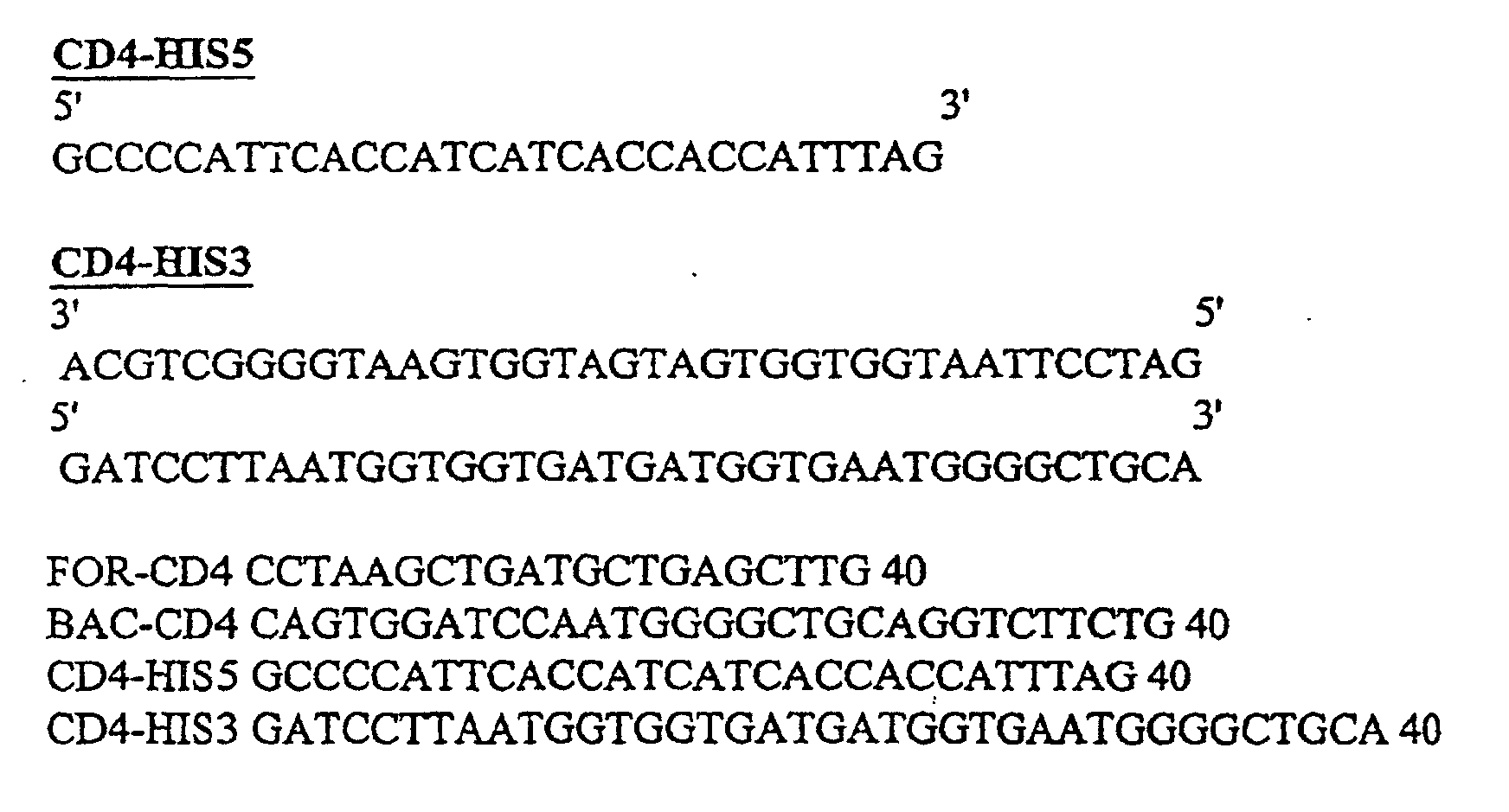
- the plasmid thus modified is cut with StuI and Xba and then ligated with the StuI-XbaI DNA fragment described below. This fragment provides 6 Histidine codons and a Stop TAA codon.
- An Eco RI site is added upstream to clone the paired oligonucleotides into a vector pUC intermediate and thus be able to check the sequence.
- the C-terminal region of the plasmid is verified by sequencing, after a PCR step *.
- CMTMR is a fluorescent derivative of chloromethyl that diffuses freely through the membranes of living cells. Once inside the cell, the slightly thiol-reactive probe undergoes what must be a glutathione-S-transferase-mediated reaction to produce fluorescent dye adducts that are impermeable to the membrane. Staining of the cells with CMTMR gives a strong fluorescence which results from the reaction with proteins in perinuclear regions, ER and Golgi, which are immobile, as well as at a lower fluorescence due to the fluorescent glutathione adduct (PM ⁇ 600 Da) in the cytosol that is able to diffuse through small fusion pores. 1.
- the cytoplasmic fluorescent probe CMTMR (5- (and -6 -) - (((4-chloromethyl) benzoyl) amino) tetramethylrhodamine (Molecular Probes cat # C-2927, ex / em 541/565 nm) is solubilized a concentration of 10 mM in DMSO. Aliquots of 10 or 20 ⁇ l are taken and stored at -20 ° C. A dilution of CMTMR (1: 500) in DMEM supplemented with 10% heat-inactivated FCS was prepared 100 ⁇ / ml penicillin, 100 ⁇ g / ml streptomycin (D10).
- the medium is removed from the target cells (on the microwells) and 1 ml of a solution is spread diluted from CMTMR.
- the samples are incubated at 37 ° C for 45-60 min.
- We replace the coloring solution with 1ml of D10 and continue incubation for 15 to 30 minutes min more.
Landscapes
- Health & Medical Sciences (AREA)
- Life Sciences & Earth Sciences (AREA)
- Chemical & Material Sciences (AREA)
- General Health & Medical Sciences (AREA)
- Medicinal Chemistry (AREA)
- Animal Behavior & Ethology (AREA)
- Veterinary Medicine (AREA)
- Immunology (AREA)
- Public Health (AREA)
- Pharmacology & Pharmacy (AREA)
- Organic Chemistry (AREA)
- Virology (AREA)
- Engineering & Computer Science (AREA)
- Bioinformatics & Cheminformatics (AREA)
- Epidemiology (AREA)
- General Chemical & Material Sciences (AREA)
- Molecular Biology (AREA)
- Proteomics, Peptides & Aminoacids (AREA)
- Nuclear Medicine, Radiotherapy & Molecular Imaging (AREA)
- Chemical Kinetics & Catalysis (AREA)
- Cell Biology (AREA)
- Communicable Diseases (AREA)
- Microbiology (AREA)
- Biophysics (AREA)
- Genetics & Genomics (AREA)
- Hematology (AREA)
- Oncology (AREA)
- Mycology (AREA)
- Gastroenterology & Hepatology (AREA)
- Biochemistry (AREA)
- AIDS & HIV (AREA)
- Tropical Medicine & Parasitology (AREA)
- Dispersion Chemistry (AREA)
- Toxicology (AREA)
- Zoology (AREA)
- Medicines Containing Antibodies Or Antigens For Use As Internal Diagnostic Agents (AREA)
- Medicines That Contain Protein Lipid Enzymes And Other Medicines (AREA)
- Medicines Containing Material From Animals Or Micro-Organisms (AREA)
Description
- incubation de premiers moyens, exprimant le et/ou les récepteurs cibles d'un agent pathogène infectieux tel que défini ci-dessus, avec des seconds moyens exprimant au moins les régions de l'agent pathogène reconnaissant lesdites cibles, dans des conditions permettant l'interaction des premiers et seconds moyens de manière à former un complexe, cette étape d'incubation étant réalisée selon des durées différentes, afin de conduire à des complexes correspondant à différents stades de fusion et présentant donc des expositions et conformations différentes d'épitopes nouvellement démasqués, et
- mise en contact des complexes formés avec un agent fixateur, pendant des durées différentes, de manière à fixer des complexes avec différentes expositions et conformations des épitopes contre lesquels on souhaite former des anticorps,


- culture cellulaire
- calcéine AM (Molecular Probe, INC) 1µg/ml(∼2,5 mM) (50µg de calcéine / 20 µl de DMSO, stocké à -20°C)
- DMSO (diméthyl sulfoxyde)
- RPMI ou DMEM
- PBS pH 7,4 (Dulb PBS de Gibco BRL)
- centrifugation avec IEC Central MO4R
La coloration des cellules avec CMTMR donne une vive fluorescence qui résulte de la réaction avec les protéines dans les régions périnucléaires, ER et Golgi, qui sont immobiles, ainsi qu'à une plus faible fluorescence due au produit d'addition du glutathion fluorescent (PM ∼ 600 Da) dans le cytosol qui est capable de diffuser à travers les petits pores de fusion. 1. On solubilise la sonde fluorescente cytoplasmique CMTMR (5-(et -6-)-(((4-chlorométhyl) benzoyl) amino) tetraméthylrhodamine) (Moleculer Probes cat # C-2927, ex/em 541/565 nm) à une concentration de 10 mM dans DMSO.
On prélève des quantités aliquotes de 10 ou 20 µl, qu'on stocke à -20°C. On prépare une dilution de CMTMR (1:500) dans du DMEM supplémenté avec 10% de SVF inactivé par la chaleur 100 u/ml de pénicilline, 100 µg/ml de streptomycine (D10).
Pour observer les cellules colorées avec la calcéine, on utilise le FITC (excitateur : BP 470-490 ; prisme DM 505; émetteur : BA 515-550) et pour CMTMR, on utilise de la rhodamine (excitateur : BP 530-550, prisme DM 570, émetteur BA 590). On évite ainsi le débordement qui se produit lorsqu'on observe la fluorescence des colorants. On réunit les images avec 6-10 filtres différents choisis au hasard pour chaque échantillon.
Claims (21)
- Compositions immunogènes, caractérisées en ce qu'elles sont élaborées à partir de préparations obtenues parlesdits premiers et seconds moyens étant tolérés par les mammifères.incubation de premiers moyens exprimant le et/ou les récepteurs cibles d'un agent pathogène infectieux, provoquant des infections chez un mammifère par liaison puis fusion avec des cellules cibles, avec des seconds moyens exprimant au moins les régions de l'agent pathogène reconnaissant lesdites cibles, dans des conditions permettant l'interaction des premiers et seconds moyens de manière à former un complexe, cette étape d'incubation étant réalisée selon des durées différentes, afin de conduire à des complexes correspondant à différents stades de fusion, etmise en contact des complexes formés avec un agent fixateur, pendant des durées différentes, de manière à fixer des complexes avec différentes expositions et conformations des épitopes contre lesquels on souhaite former des anticorps,
- Compositions selon la revendication 1, caractérisées en ce que les premiers moyens sont des cellules autologues de mammifères, en particulier des cellules humaines saines prélevées chez un patient à vacciner.
- Compositions selon la revendication 1, caractérisées en ce que les premiers moyens sont des vecteurs exprimant le ou les récepteurs cibles à leur surface.
- Compositions selon la revendication 1, caractérisées en ce que les premiers moyens sont des liposomes portant le ou les récepteurs cibles à leur surface, notamment portant à leur surface les vecteurs tels que définis dans la revendication 3.
- Compositions selon l'une quelconque des revendications 1 à 4, caractérisées en ce que les seconds moyens sont des cellules préalablement transformées par un vecteur portant au moins une région de liaison à au moins un récepteur, notamment par un vecteur viral.
- Compositions selon l'une quelconque des revendications 1 à 4 caractérisées en ce que les seconds moyens sont constitués par des vecteurs viraux portant au moins ne région de liaison à au moins un récepteur cible.
- Compositions selon l'une quelconque des revendications 1 à 4, caractérisées en ce que les seconds moyens sont des cellules infectées produisant les agents pathogènes ou sont constitués par les agents pathogènes infectieux.
- Compositions selon l'une quelconque des revendications 1 à 7, caractérisées en ce que lesdits agents pathogènes sont des virus, et notamment des rétrovirus, des bactéries, des mycobactéries, ou des parasites comme Plasmodium sp, Leishmania sp, Trypanosoma cruzi et Trypanosoma brucei.
- Compositions selon la revendication 8, caractérisées en ce que l'agent pathogène est VIH.
- Compositions selon l'une quelconque des revendications 1 à 7 en combinaison avec la revendication 9, caractérisées en ce que lesdites préparations sont obtenues par incubation de premiers moyens exprimant le récepteur CD4 et/ou des co-récepteurs du VIH, avec des seconds moyens exprimant au moins les régions conservées des protéines d'enveloppe gp120 ou gp160.
- Compositions selon la revendication 10, caractérisées en ce que les premiers moyens mis en oeuvre sont constitués par des cellules autologues de mammifères stimulées de manière à exprimer, en quantité suffisante pour l'interaction recherchée, le récepteur CD4 et/ou des co-récepteurs de VIH.
- Compositions selon la revendication 10, caractérisées en ce que les premiers moyens sont des vecteurs viraux exprimant à leur surface CD4 et/ou des co-récepteurs de VIH, tels que le baculovirus, le virus de la forêt de Semliki ou encore des levures comme Saccharomyces cerevisae.
- Compositions selon la revendication 10, caractérisées en ce que les premiers moyens sont des liposomes exprimant à leur surface le récepteur CD4 et/ou des co-récepteurs du VIH, ladite expression étant assurée par des vecteurs viraux.
- Compositions selon l'une quelconque des revendications 10 à 13, caractérisées en ce que les seconds moyens sont constitués par des cellules préalablement transformées avec un vecteur viral comportant au moins les régions conservées des protéines d'enveloppe gp120 ou gp160, ou sont constitués par de tels vecteurs viraux.
- Compositions selon l'une quelconque des revendications 10 à 13, caractérisées en ce que les seconds moyens sont des cellules infectées produisant VIH ou sont constitués par le virus VIH lui-même,
- Compositions selon l'une quelconque des revendications 10 à 13, caractérisées en ce que les seconds moyens sont constitués par les protéines d'enveloppe gp120 ou gp160, sous forme naturelle ou recombinante, ou par au moins les régions conservées de telles protéines.
- Compositions selon l'une quelconque des revendications 10 à 16, caractérisées en ce que l'un des co-récepteurs du VIH est remplacé par un anticorps monoclonal.
- Compositions selon la revendication 17, caractérisées en ce qu'elles comprennent comme premier moyen du CD4 soluble et comme second moyen de la gp120 soluble, le cas échéant sous forme recombinante, ainsi qu'un anticorps monoclonal dirigé contre la zone de la gp120 qui se fixe sur les co-récepteurs.
- Compositions selon l'une quelconque des revendications 1 à 18, caractérisées en ce que les préparations, après incubation, sont fixées avec de l'aldidrithiol-2.
- Sérums et anticorps formés contre les compositions selon l'une quelconque des revendications 1 à 19.
- Compositions vaccinales, contre une pathologie infectieuse, destinées à un mammifère, caractérisées en ce qu'elles renferment une quantité efficace d'une composition immunogène selon l'une quelconque des revendications 1 à 19, avec un véhicule inerte, acceptable pour l'administration à un mammifère, avec le cas échéant un adjuvant.
Applications Claiming Priority (3)
| Application Number | Priority Date | Filing Date | Title |
|---|---|---|---|
| FR9901794A FR2789590B1 (fr) | 1999-02-15 | 1999-02-15 | Compositions immunogenes utilisables comme vaccins |
| FR9901794 | 1999-02-15 | ||
| PCT/FR2000/000375 WO2000047216A1 (fr) | 1999-02-15 | 2000-02-15 | Compositions immunogenes utilisables comme vaccins |
Publications (2)
| Publication Number | Publication Date |
|---|---|
| EP1150693A1 EP1150693A1 (fr) | 2001-11-07 |
| EP1150693B1 true EP1150693B1 (fr) | 2004-03-24 |
Family
ID=9542021
Family Applications (1)
| Application Number | Title | Priority Date | Filing Date |
|---|---|---|---|
| EP00905141A Expired - Lifetime EP1150693B1 (fr) | 1999-02-15 | 2000-02-15 | Compositions immunogenes utilisables comme vaccins |
Country Status (8)
| Country | Link |
|---|---|
| EP (1) | EP1150693B1 (fr) |
| JP (1) | JP5555399B2 (fr) |
| AT (1) | ATE262340T1 (fr) |
| AU (1) | AU2677500A (fr) |
| CA (1) | CA2360292A1 (fr) |
| DE (1) | DE60009269T2 (fr) |
| FR (1) | FR2789590B1 (fr) |
| WO (1) | WO2000047216A1 (fr) |
Family Cites Families (3)
| Publication number | Priority date | Publication date | Assignee | Title |
|---|---|---|---|---|
| DK0699077T3 (da) * | 1993-05-07 | 2002-01-21 | Bio Merieux Inc | Immunogele HIV-komplekser |
| AU1750497A (en) * | 1996-01-17 | 1997-08-11 | Progenics Pharmaceuticals, Inc. | Compounds capable of inhibiting hiv-1 infection |
| BR9912732A (pt) * | 1998-08-03 | 2001-11-27 | Univ Montana | Estrutura molecular isolada, vìrus envelopadorecombinante, formilação de vacina, anticorpomonoclonal, anti-soro policlonal, geléia, espuma,creme ou unguento contraceptivo, amostras desangue de mamìfero e de humano, kit, linhagemcelular, processos de tratamento ou deprevenção de infecção por um vìrus em sujeito, detratamento ou de prevenção de infecção por hivem um humano, de inibição de infecção por um vìrusem uma amostra de sangue, de inibição de infecçãopor hiv em uma amostra de sangue humano, dedescontaminação de ferramentas cirúrgicas oudentais, de monitoração de produto de anticorpopara a estrutura molecular, de produção de umimunógeno para uso em uma vacina para otratamento ou a prevenção de infecção por umvìrus, e de produção de um imunólogeno para usoem uma vacina para o tratamento ou a prevençãode infecção por hiv, estrutura reticulada,anticorpo monoclonal para a estrutura, dedescontaminação de ferramentas cirúrgicas oudentais, processo de seleção de uma estruturamolecular para eficácia de vacina, mamìfero,complexo de proteìna isolado, formulação devacina, processos de imunização de um animal paraum vìrus, e de preparação de um complexo deproteìna, células fixadas, processos depurificação de um complexo de proteìna e detratamento de um hospedeiro que tem sidoexposto a um vìrus, ou de prevenção de infecçãode um hospedeiro pelo citado vìrus, e composição. |
-
1999
- 1999-02-15 FR FR9901794A patent/FR2789590B1/fr not_active Expired - Fee Related
-
2000
- 2000-02-15 EP EP00905141A patent/EP1150693B1/fr not_active Expired - Lifetime
- 2000-02-15 WO PCT/FR2000/000375 patent/WO2000047216A1/fr not_active Ceased
- 2000-02-15 AU AU26775/00A patent/AU2677500A/en not_active Abandoned
- 2000-02-15 CA CA002360292A patent/CA2360292A1/fr not_active Abandoned
- 2000-02-15 JP JP2000598168A patent/JP5555399B2/ja not_active Expired - Fee Related
- 2000-02-15 DE DE60009269T patent/DE60009269T2/de not_active Expired - Lifetime
- 2000-02-15 AT AT00905141T patent/ATE262340T1/de not_active IP Right Cessation
Also Published As
| Publication number | Publication date |
|---|---|
| DE60009269T2 (de) | 2005-02-24 |
| FR2789590B1 (fr) | 2003-01-17 |
| JP2002536416A (ja) | 2002-10-29 |
| WO2000047216A1 (fr) | 2000-08-17 |
| JP5555399B2 (ja) | 2014-07-23 |
| CA2360292A1 (fr) | 2000-08-17 |
| FR2789590A1 (fr) | 2000-08-18 |
| ATE262340T1 (de) | 2004-04-15 |
| DE60009269D1 (de) | 2004-04-29 |
| EP1150693A1 (fr) | 2001-11-07 |
| AU2677500A (en) | 2000-08-29 |
Similar Documents
| Publication | Publication Date | Title |
|---|---|---|
| CA2370563C (fr) | Vaccin anti-vih-1 comprenant tout ou partie de la proteine tat de vih-1 | |
| EP1309860B1 (fr) | Procede de criblage de peptides utilisables en immunotherapie | |
| CA2224413C (fr) | Immunovecteurs utilisables pour le transport intracellulaire et intranucleaire | |
| CA2640793C (fr) | Domaine peptidique necessaire a l'interaction entre l'enveloppe d'un virus appartenant au groupe d'interference de herv-w et un recepteur hasct | |
| FR2732346A1 (fr) | Proteines mutees, codees par un gene env mute de lentivirus, fragments peptidiques inclus dans lesdites proteines, vecteurs d'expression exprimant lesdites proteines mutees et leurs applications | |
| EP1735344B1 (fr) | Composition de vaccin comprenant un ligand cmh de classe ii couple a un antigene, procede de preparation et utilisations | |
| WO2000047216A1 (fr) | Compositions immunogenes utilisables comme vaccins | |
| US7803555B2 (en) | Methods and compositions for use in the treatment of filovirus mediated disease conditions | |
| CA2561163A1 (fr) | Antigene tat stabilise et ses applications pour la vaccination anti-vih | |
| FR2799974A1 (fr) | Complexe deglycosyle proteine env/cd4 et son utilisation pour la vaccination contre le vih | |
| EP1368478A2 (fr) | Polypeptide induisant des anticorps neutralisant le vih | |
| EP1159427B1 (fr) | Mutants de la gp120 et leurs applications biologiques | |
| US20040076640A1 (en) | Vaccine compositions against infectious pathologies for mammals | |
| JP2002536416A5 (fr) | ||
| FR2803303A1 (fr) | Glycoproteine d'enveloppe du vih modifiee chimiquement | |
| FR2614025A1 (fr) | Peptides susceptibles d'etre reconnus par des anticorps induits contre des retrovirus d'immunodeficience humaine (virus hiv) leurs applications au diagnostic des infections dues a certains de ces virus et, le cas echeant, a la vaccination contre le sida | |
| FR2777007A1 (fr) | Mutants de glycoproteines d'enveloppes de retrovirus et leurs applications biologiques | |
| EP1442124A1 (fr) | ANTIGENE POLYPEPTIDIQUE FORMANT UNE STRUCTURE MIMANT L'ETAT INTERMEDIAIRE DE gp41 | |
| FR2698271A1 (fr) | Vaccin contre le virus de la leucémie bovine, nouveau peptide immunogène et kit de vaccination. | |
| FR2692269A1 (fr) | Peptides immunogènes et/ou neutralisants de vif de souche WO et leurs applications au diagnostic et à la prévention de l'immunodéficience féline. | |
| FR2696188A1 (fr) | Molécule CD4 de chat, séquence nucléique codant pour cette molécule et leurs applications. |
Legal Events
| Date | Code | Title | Description |
|---|---|---|---|
| PUAI | Public reference made under article 153(3) epc to a published international application that has entered the european phase |
Free format text: ORIGINAL CODE: 0009012 |
|
| 17P | Request for examination filed |
Effective date: 20010912 |
|
| AK | Designated contracting states |
Kind code of ref document: A1 Designated state(s): AT BE CH CY DE DK ES FI FR GB GR IE IT LI LU MC NL PT SE |
|
| AX | Request for extension of the european patent |
Free format text: AL;LT;LV;MK;RO;SI |
|
| 17Q | First examination report despatched |
Effective date: 20020913 |
|
| GRAP | Despatch of communication of intention to grant a patent |
Free format text: ORIGINAL CODE: EPIDOSNIGR1 |
|
| GRAS | Grant fee paid |
Free format text: ORIGINAL CODE: EPIDOSNIGR3 |
|
| GRAA | (expected) grant |
Free format text: ORIGINAL CODE: 0009210 |
|
| AK | Designated contracting states |
Kind code of ref document: B1 Designated state(s): AT BE CH CY DE DK ES FI FR GB GR IE IT LI LU MC NL PT SE |
|
| PG25 | Lapsed in a contracting state [announced via postgrant information from national office to epo] |
Ref country code: IT Free format text: LAPSE BECAUSE OF FAILURE TO SUBMIT A TRANSLATION OF THE DESCRIPTION OR TO PAY THE FEE WITHIN THE PRESCRIBED TIME-LIMIT;WARNING: LAPSES OF ITALIAN PATENTS WITH EFFECTIVE DATE BEFORE 2007 MAY HAVE OCCURRED AT ANY TIME BEFORE 2007. THE CORRECT EFFECTIVE DATE MAY BE DIFFERENT FROM THE ONE RECORDED. Effective date: 20040324 Ref country code: IE Free format text: LAPSE BECAUSE OF FAILURE TO SUBMIT A TRANSLATION OF THE DESCRIPTION OR TO PAY THE FEE WITHIN THE PRESCRIBED TIME-LIMIT Effective date: 20040324 Ref country code: AT Free format text: LAPSE BECAUSE OF FAILURE TO SUBMIT A TRANSLATION OF THE DESCRIPTION OR TO PAY THE FEE WITHIN THE PRESCRIBED TIME-LIMIT Effective date: 20040324 Ref country code: FI Free format text: LAPSE BECAUSE OF FAILURE TO SUBMIT A TRANSLATION OF THE DESCRIPTION OR TO PAY THE FEE WITHIN THE PRESCRIBED TIME-LIMIT Effective date: 20040324 |
|
| REG | Reference to a national code |
Ref country code: GB Ref legal event code: FG4D Free format text: NOT ENGLISH |
|
| REG | Reference to a national code |
Ref country code: CH Ref legal event code: EP |
|
| REG | Reference to a national code |
Ref country code: IE Ref legal event code: FG4D Free format text: FRENCH |
|
| REF | Corresponds to: |
Ref document number: 60009269 Country of ref document: DE Date of ref document: 20040429 Kind code of ref document: P |
|
| REG | Reference to a national code |
Ref country code: CH Ref legal event code: NV Representative=s name: ISLER & PEDRAZZINI AG |
|
| PG25 | Lapsed in a contracting state [announced via postgrant information from national office to epo] |
Ref country code: GR Free format text: LAPSE BECAUSE OF FAILURE TO SUBMIT A TRANSLATION OF THE DESCRIPTION OR TO PAY THE FEE WITHIN THE PRESCRIBED TIME-LIMIT Effective date: 20040624 Ref country code: DK Free format text: LAPSE BECAUSE OF FAILURE TO SUBMIT A TRANSLATION OF THE DESCRIPTION OR TO PAY THE FEE WITHIN THE PRESCRIBED TIME-LIMIT Effective date: 20040624 Ref country code: SE Free format text: LAPSE BECAUSE OF FAILURE TO SUBMIT A TRANSLATION OF THE DESCRIPTION OR TO PAY THE FEE WITHIN THE PRESCRIBED TIME-LIMIT Effective date: 20040624 |
|
| PG25 | Lapsed in a contracting state [announced via postgrant information from national office to epo] |
Ref country code: ES Free format text: LAPSE BECAUSE OF FAILURE TO SUBMIT A TRANSLATION OF THE DESCRIPTION OR TO PAY THE FEE WITHIN THE PRESCRIBED TIME-LIMIT Effective date: 20040705 |
|
| GBT | Gb: translation of ep patent filed (gb section 77(6)(a)/1977) |
Effective date: 20040714 |
|
| LTIE | Lt: invalidation of european patent or patent extension |
Effective date: 20040324 |
|
| REG | Reference to a national code |
Ref country code: IE Ref legal event code: FD4D |
|
| PLBE | No opposition filed within time limit |
Free format text: ORIGINAL CODE: 0009261 |
|
| STAA | Information on the status of an ep patent application or granted ep patent |
Free format text: STATUS: NO OPPOSITION FILED WITHIN TIME LIMIT |
|
| PG25 | Lapsed in a contracting state [announced via postgrant information from national office to epo] |
Ref country code: CY Free format text: LAPSE BECAUSE OF FAILURE TO SUBMIT A TRANSLATION OF THE DESCRIPTION OR TO PAY THE FEE WITHIN THE PRESCRIBED TIME-LIMIT Effective date: 20050215 Ref country code: LU Free format text: LAPSE BECAUSE OF NON-PAYMENT OF DUE FEES Effective date: 20050215 |
|
| PG25 | Lapsed in a contracting state [announced via postgrant information from national office to epo] |
Ref country code: MC Free format text: LAPSE BECAUSE OF NON-PAYMENT OF DUE FEES Effective date: 20050228 |
|
| 26N | No opposition filed |
Effective date: 20041228 |
|
| REG | Reference to a national code |
Ref country code: CH Ref legal event code: PCAR Free format text: ISLER & PEDRAZZINI AG;POSTFACH 1772;8027 ZUERICH (CH) |
|
| PG25 | Lapsed in a contracting state [announced via postgrant information from national office to epo] |
Ref country code: PT Free format text: LAPSE BECAUSE OF NON-PAYMENT OF DUE FEES Effective date: 20040824 |
|
| PGFP | Annual fee paid to national office [announced via postgrant information from national office to epo] |
Ref country code: DE Payment date: 20140227 Year of fee payment: 15 Ref country code: NL Payment date: 20140227 Year of fee payment: 15 Ref country code: CH Payment date: 20140319 Year of fee payment: 15 |
|
| PGFP | Annual fee paid to national office [announced via postgrant information from national office to epo] |
Ref country code: FR Payment date: 20140228 Year of fee payment: 15 Ref country code: BE Payment date: 20140227 Year of fee payment: 15 |
|
| PGFP | Annual fee paid to national office [announced via postgrant information from national office to epo] |
Ref country code: GB Payment date: 20140320 Year of fee payment: 15 |
|
| PG25 | Lapsed in a contracting state [announced via postgrant information from national office to epo] |
Ref country code: BE Free format text: LAPSE BECAUSE OF NON-PAYMENT OF DUE FEES Effective date: 20150228 |
|
| REG | Reference to a national code |
Ref country code: DE Ref legal event code: R119 Ref document number: 60009269 Country of ref document: DE |
|
| REG | Reference to a national code |
Ref country code: NL Ref legal event code: V1 Effective date: 20150901 |
|
| PG25 | Lapsed in a contracting state [announced via postgrant information from national office to epo] |
Ref country code: NL Free format text: LAPSE BECAUSE OF NON-PAYMENT OF DUE FEES Effective date: 20150901 |
|
| REG | Reference to a national code |
Ref country code: CH Ref legal event code: PL |
|
| GBPC | Gb: european patent ceased through non-payment of renewal fee |
Effective date: 20150215 |
|
| PG25 | Lapsed in a contracting state [announced via postgrant information from national office to epo] |
Ref country code: CH Free format text: LAPSE BECAUSE OF NON-PAYMENT OF DUE FEES Effective date: 20150228 Ref country code: LI Free format text: LAPSE BECAUSE OF NON-PAYMENT OF DUE FEES Effective date: 20150228 |
|
| REG | Reference to a national code |
Ref country code: FR Ref legal event code: ST Effective date: 20151030 |
|
| PG25 | Lapsed in a contracting state [announced via postgrant information from national office to epo] |
Ref country code: GB Free format text: LAPSE BECAUSE OF NON-PAYMENT OF DUE FEES Effective date: 20150215 Ref country code: DE Free format text: LAPSE BECAUSE OF NON-PAYMENT OF DUE FEES Effective date: 20150901 |
|
| PG25 | Lapsed in a contracting state [announced via postgrant information from national office to epo] |
Ref country code: FR Free format text: LAPSE BECAUSE OF NON-PAYMENT OF DUE FEES Effective date: 20150302 |