EP1150262A2 - Bezahlung von netzwerkbasierten Handelsgeschäften mit Hilfe eines Mobiltelefons - Google Patents
Bezahlung von netzwerkbasierten Handelsgeschäften mit Hilfe eines Mobiltelefons Download PDFInfo
- Publication number
- EP1150262A2 EP1150262A2 EP01106296A EP01106296A EP1150262A2 EP 1150262 A2 EP1150262 A2 EP 1150262A2 EP 01106296 A EP01106296 A EP 01106296A EP 01106296 A EP01106296 A EP 01106296A EP 1150262 A2 EP1150262 A2 EP 1150262A2
- Authority
- EP
- European Patent Office
- Prior art keywords
- customer
- deliverable
- mobile phone
- merchant
- merchant system
- Prior art date
- Legal status (The legal status is an assumption and is not a legal conclusion. Google has not performed a legal analysis and makes no representation as to the accuracy of the status listed.)
- Ceased
Links
Images



Classifications
-
- G—PHYSICS
- G06—COMPUTING OR CALCULATING; COUNTING
- G06Q—INFORMATION AND COMMUNICATION TECHNOLOGY [ICT] SPECIALLY ADAPTED FOR ADMINISTRATIVE, COMMERCIAL, FINANCIAL, MANAGERIAL OR SUPERVISORY PURPOSES; SYSTEMS OR METHODS SPECIALLY ADAPTED FOR ADMINISTRATIVE, COMMERCIAL, FINANCIAL, MANAGERIAL OR SUPERVISORY PURPOSES, NOT OTHERWISE PROVIDED FOR
- G06Q20/00—Payment architectures, schemes or protocols
- G06Q20/04—Payment circuits
-
- G—PHYSICS
- G06—COMPUTING OR CALCULATING; COUNTING
- G06Q—INFORMATION AND COMMUNICATION TECHNOLOGY [ICT] SPECIALLY ADAPTED FOR ADMINISTRATIVE, COMMERCIAL, FINANCIAL, MANAGERIAL OR SUPERVISORY PURPOSES; SYSTEMS OR METHODS SPECIALLY ADAPTED FOR ADMINISTRATIVE, COMMERCIAL, FINANCIAL, MANAGERIAL OR SUPERVISORY PURPOSES, NOT OTHERWISE PROVIDED FOR
- G06Q20/00—Payment architectures, schemes or protocols
- G06Q20/30—Payment architectures, schemes or protocols characterised by the use of specific devices or networks
- G06Q20/32—Payment architectures, schemes or protocols characterised by the use of specific devices or networks using wireless devices
- G06Q20/326—Payment applications installed on the mobile devices
-
- G—PHYSICS
- G06—COMPUTING OR CALCULATING; COUNTING
- G06Q—INFORMATION AND COMMUNICATION TECHNOLOGY [ICT] SPECIALLY ADAPTED FOR ADMINISTRATIVE, COMMERCIAL, FINANCIAL, MANAGERIAL OR SUPERVISORY PURPOSES; SYSTEMS OR METHODS SPECIALLY ADAPTED FOR ADMINISTRATIVE, COMMERCIAL, FINANCIAL, MANAGERIAL OR SUPERVISORY PURPOSES, NOT OTHERWISE PROVIDED FOR
- G06Q20/00—Payment architectures, schemes or protocols
- G06Q20/08—Payment architectures
- G06Q20/12—Payment architectures specially adapted for electronic shopping systems
-
- G—PHYSICS
- G06—COMPUTING OR CALCULATING; COUNTING
- G06Q—INFORMATION AND COMMUNICATION TECHNOLOGY [ICT] SPECIALLY ADAPTED FOR ADMINISTRATIVE, COMMERCIAL, FINANCIAL, MANAGERIAL OR SUPERVISORY PURPOSES; SYSTEMS OR METHODS SPECIALLY ADAPTED FOR ADMINISTRATIVE, COMMERCIAL, FINANCIAL, MANAGERIAL OR SUPERVISORY PURPOSES, NOT OTHERWISE PROVIDED FOR
- G06Q20/00—Payment architectures, schemes or protocols
- G06Q20/08—Payment architectures
- G06Q20/16—Payments settled via telecommunication systems
-
- G—PHYSICS
- G06—COMPUTING OR CALCULATING; COUNTING
- G06Q—INFORMATION AND COMMUNICATION TECHNOLOGY [ICT] SPECIALLY ADAPTED FOR ADMINISTRATIVE, COMMERCIAL, FINANCIAL, MANAGERIAL OR SUPERVISORY PURPOSES; SYSTEMS OR METHODS SPECIALLY ADAPTED FOR ADMINISTRATIVE, COMMERCIAL, FINANCIAL, MANAGERIAL OR SUPERVISORY PURPOSES, NOT OTHERWISE PROVIDED FOR
- G06Q20/00—Payment architectures, schemes or protocols
- G06Q20/22—Payment schemes or models
- G06Q20/24—Credit schemes, i.e. "pay after"
-
- G—PHYSICS
- G06—COMPUTING OR CALCULATING; COUNTING
- G06Q—INFORMATION AND COMMUNICATION TECHNOLOGY [ICT] SPECIALLY ADAPTED FOR ADMINISTRATIVE, COMMERCIAL, FINANCIAL, MANAGERIAL OR SUPERVISORY PURPOSES; SYSTEMS OR METHODS SPECIALLY ADAPTED FOR ADMINISTRATIVE, COMMERCIAL, FINANCIAL, MANAGERIAL OR SUPERVISORY PURPOSES, NOT OTHERWISE PROVIDED FOR
- G06Q20/00—Payment architectures, schemes or protocols
- G06Q20/30—Payment architectures, schemes or protocols characterised by the use of specific devices or networks
- G06Q20/32—Payment architectures, schemes or protocols characterised by the use of specific devices or networks using wireless devices
- G06Q20/322—Aspects of commerce using mobile devices [M-devices]
- G06Q20/3229—Use of the SIM of a M-device as secure element
-
- G—PHYSICS
- G06—COMPUTING OR CALCULATING; COUNTING
- G06Q—INFORMATION AND COMMUNICATION TECHNOLOGY [ICT] SPECIALLY ADAPTED FOR ADMINISTRATIVE, COMMERCIAL, FINANCIAL, MANAGERIAL OR SUPERVISORY PURPOSES; SYSTEMS OR METHODS SPECIALLY ADAPTED FOR ADMINISTRATIVE, COMMERCIAL, FINANCIAL, MANAGERIAL OR SUPERVISORY PURPOSES, NOT OTHERWISE PROVIDED FOR
- G06Q20/00—Payment architectures, schemes or protocols
- G06Q20/38—Payment protocols; Details thereof
- G06Q20/42—Confirmation, e.g. check or permission by the legal debtor of payment
-
- G—PHYSICS
- G06—COMPUTING OR CALCULATING; COUNTING
- G06Q—INFORMATION AND COMMUNICATION TECHNOLOGY [ICT] SPECIALLY ADAPTED FOR ADMINISTRATIVE, COMMERCIAL, FINANCIAL, MANAGERIAL OR SUPERVISORY PURPOSES; SYSTEMS OR METHODS SPECIALLY ADAPTED FOR ADMINISTRATIVE, COMMERCIAL, FINANCIAL, MANAGERIAL OR SUPERVISORY PURPOSES, NOT OTHERWISE PROVIDED FOR
- G06Q20/00—Payment architectures, schemes or protocols
- G06Q20/38—Payment protocols; Details thereof
- G06Q20/42—Confirmation, e.g. check or permission by the legal debtor of payment
- G06Q20/425—Confirmation, e.g. check or permission by the legal debtor of payment using two different networks, one for transaction and one for security confirmation
Definitions
- the invention concerns a commercial transaction scheme, and in particular the payment process of such a transaction scheme. Also concerned are systems, computer program products, and computer program elements implementing aspects of such a commercial transaction scheme.
- a commercial transaction in its broadest sense comprises three basic activities.
- a customer selects and orders goods or services. This step or sequence of steps is referred to as ordering process.
- ordering process After the completion of the ordering process, there is usually a service rendered or some goods delivered by a 'merchant' (herein referred to as delivery process) and there is some money or other consideration to be paid by the 'customer' for these services or goods, referred to as payment process.
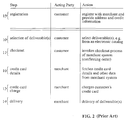
- a network-based commercial transaction follows the patterns shown in Figure 1 or Figure 2. Either the customer has to register once (which includes the one-time disclosure of credit-card details) and then whenever the customer returns to a merchant's system identify itself to the system (e.g., by logging in or sending a cookie), or the customer has to provide credit card details every time he enters into a transaction with the merchant.
- a first step 10 the customer selects one or more deliverables. This can be done by browsing an online catalog, for example. Then, the customer invokes a checkout process - step 11 in Figure 1 - of the merchant's system. In step 12, the customer now needs to disclose credit card details and other data, such as the delivery address, to the merchant. In subsequent step 13, the merchant charges the customer's credit card account. Finally, the deliverable(s) are dispatched by the merchant to the customer (step 14 in Figure 1).
- the network-based commercial transaction scheme illustrated in Figure 1 is a transaction scheme without pre-registration.
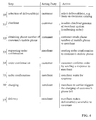
- FIG. 2 A very similar scheme is illustrated in Figure 2.
- This scheme is different from the one described in connection with Figure 1 in that it comprises a separate one-time registration step 15.
- This registration step 15 is usually carried out just once, preferably when ordering a deliverable for the first time.
- the customer registers with the merchant and provides address information and credit-card details to the merchant.
- Steps 10, 11, 13, and 14 are the same as in Figure 1. Since the customer has already registered all the necessary information with the merchant in step 15, the merchant simply needs to fetch this information from the merchant system, as depicted by step 16. This is a typical example of a network-based commercial transaction scheme with pre-registration.
- Mobile telephone systems are very widely used communication systems that are to a large extent independent from the internet and other networks. There is a secure payment process in place that allows the carriers to bill their customers for the usage of the mobile phone.
- the global system for mobile (GSM) communications is one particular example of a very popular mobile telephone system.
- GSM system is a digital-based system created to provide a network which allows customers to use their GSM phones in many countries.
- the GSM network is implemented by a number of different carriers in different countries. Each carrier has it's own customers, in respect of whom the carrier holds private information relating to names, addresses, billing information, call destinations, and methods of paying bills.
- the carriers are independently administrated and are responsible for their customers for billing purposes. In other words, there exists a well established and secure payment process between the carriers and their customers.
- a transaction scheme is proposed that ties together the existing mobile telephone infrastructure and the fixed network (e.g., the internet) to solve the problems identified in the introductory portion of this specification.
- a method for enabling a customer having access to a customer system and a mobile phone with associated phone number, to order a deliverable that is offered by a merchant system at a certain price The merchant system is accessed through the customer system and a network and an action is performed on the customer system to order the deliverable.
- the phone number of the mobile phone is used to send an order confirmation for the deliverable to the mobile phone.
- the ordering of the deliverable is confirmed using the mobile phone to transmit a response to the merchant system or to a carrier system.
- a phone bill issued by the carrier system for the mobile phone is charged with the certain price and the deliverable are made available to the customer.
- a method for ordering a deliverable that is offered by a merchant system at a certain price is provided.
- the merchant system is accessed through a customer system and network.
- the deliverable is displayed to a customer on the customer system and an action is performed on the customer system to order the deliverable.
- the phone number of a mobile phone (43; 73) of the customer is sent to the merchant system and an order confirmation for the deliverable is received on the mobile phone.
- the ordering of the deliverable is confirmed using the mobile phone by transmitting a response to the merchant system or to a carrier system.
- the deliverable is obtained by the customer.
- a method for processing by a merchant system the order of a customer for a deliverable that is offered by this merchant system at a certain price whereby the customer has access to a customer system and a mobile phone with an associated phone number.
- the customer system is enabled to display the deliverable and to allow the customer to order the deliverable at the merchant system via the customer system and a network.
- An order confirmation for the deliverable is sent to the mobile phone using the phone number and an order confirmation or payment confirmation is received from a carrier system. Then, the deliverable is made available to the customer.
- transaction information and the phone number of the mobile phone are obtained for the ordering of the deliverable from the merchant system.
- An order confirmation for the deliverable is sent to the mobile phone using the phone number and an order confirmation for the deliverable is received through the mobile phone.
- a phone bill maintained by the carrier system for the mobile phone is charged with the certain price and an order confirmation or payment confirmation is sent to the merchant system.
- a merchant system for offering a deliverable via a network to a potential customer. Also provided is, in accordance with a preferred embodiment of the present invention, a carrier system for handling the payment process part of a commercial transaction between a customer, using a customer system and a mobile phone, and a merchant system.
- the drawbacks of known systems and schemes are avoided by the schemes and systems as claimed in the attached claims.
- the present invention allows to implement a more secure marketplace for commercial transactions.
- a customer system is a network-attachable device that has some computing capabilities. Examples are: personal computers (PCs), workstations, servers, laptops, personal digital assistants (PDAs), network computers, and so forth. Other examples are WAP phones, palm pilots, belt computers, pocket computers, wrist watches with integrated computer, electronic wallets, car computers, etc.
- the network connection is either established via some cable or fiber, or by means of an infrared or RF link.
- a customer system can also be an aggregation of several devices. This customer system is suited for operation by a customer desiring to obtain some service or to buy some goods via a network.
- the customer system may be a general purpose device especially programmed to perform the steps of the present invention, or a device equipped with appropriate software that controls the device to perform these steps.
- a customer system may comprise a database entertaining a list of transactions, a call-in unit that connects to a telephone network, and other devices or units.
- a merchant system is a network-attachable system or aggregation of systems, which are employed by the merchant, or by somebody on behalf of the merchant, in order to offer services and/or goods via a network.
- Such a merchant system has computing capabilities.
- a merchant system may comprise, for example: personal computers (PCs), workstations, laptops, network computers, servers, and so forth.
- a merchant system may comprise a database entertaining an electronic (online) catalog, acall-in unit that connects to a telephone network, and other devices or units.
- the merchant system is programmed to perform the steps of the present invention. For this purpose, the merchant system may be equipped with appropriate software that controls the system to perform these steps.
- the word 'deliverable' is herein used as a synonym for goods, products, articles, items, subscriptions, services, etc. It subsumes everything - tangible as well as intangible - that either can be delivered (e.g., via a network or through conventional distribution channels, such as regular mail or courier), or that can be made accessible, such as a database, or some collection of digitized art. Examples are: effects, furnishings, furniture, gear, movables, possessions, property, commodities, merchandise, stock, stuff, wares, articles, subscriptions, newspapers, journals, printed media, equipment, softcopies, digitized images, videos, audio streams, software, currency, and so forth.
- the word 'network' is herein used as a synonym for computer networks and communication networks of any kind. When referring to networks, wireless, fiber-based, or cable-based networks are meant.
- a 'merchant' is a legal entity or person that directly or indirectly offers, sells, or lends one or more deliverables.
- Typical examples of merchants are: agents, dealers, suppliers, distributors, representatives, retailers, salespersons, shopkeepers, tradespersons, vendors, warehouses, licensors, manufacturers, broker, bank, financial institutions, agency, and so forth.
- a 'customer' is a legal entity or person that directly or indirectly wishes to accept, buy, lease, or borrow one or more deliverables. Typical examples are: buyers, clients, consumers, prospects, purchasers, shoppers, readers, subscribers, licensees.
- mobile phone is used to subsume analog and digital phones that connect to a wireless channel. Examples are: handportables, GSM phones, cellular phones, Smartphones, Featurephones, transportables, satellite phones, and so forth.
- the present invention changes the current network-based commercial schemes. Instead of using a credit card, it is proposed to utilize the existing mobile phone network infrastructure to do order confirmation and billing.
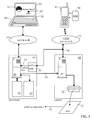
- FIG. 5 Another embodiment of the present invention is schematically depicted in Figure 5.
- the customer uses a customer system 40, such as a portable computer, that is connected to a network 44 (e.g., the internet).
- the customer system 40 comprises a keyboard 91 and a display 92.
- the customer has a mobile phone 43 with a subscriber identity module (SIM) 54 card.
- SIM subscriber identity module
- a SIM card is a credit-card or mini sized card which holds a microprocessor chip which stores information such as the mobile phone number.
- the SIM card 54 can be inserted into the mobile phone 54 to make it live, as indicated by arrows in Figure 5.
- the mobile phone 43 after being activated, connects via a mobile telephone network 53 (e.g., a GSM network) and to a fixed telephone network 56 (e.g., a public switched telephone network; PSTN) and a carrier system 48.
- the mobile telephone network 53 and the fixed telephone network 56 are arranged such that the fixed telephone network 56 can be reached from the mobile phone 43.
- the mobile phone 43 has access to the services offered by the fixed telephone network 56.
- the carrier system 48 just comprises a server 49 and a printer 50.
- the merchant system 45 comprises a server 46, a database 47 with an online catalog, and a database 58 with a list of open transactions.
- the merchant system 45 is linked to the network 44.
- the merchant system 45 in the present embodiment has a call-in unit 55 that is connected to the fixed telephone network 56. Note that the call-in unit 55 might also be connected to the mobile network directly.
- the customer accesses the merchant system 45 through the customer system 40 and the network 44.
- the merchant system 45 offers an online catalog with various items together with a price for each item.
- the deliverable 41 is displayed on the display of the customer system 40.
- the customer now performs an action on the customer system 40 in order to select the deliverable 41. This can be done by a left-mouse-click on the radio button 42 that is also displayed. If this is the only deliverable the customer wants to obtain, or if there are no other deliverables available, the selection process may be finished.
- the merchant system 45 may thus proceed to an order confirmation process.
- the customer may invoke a checkout process prior to the confirmation process. This is usually done by clicking on a button to submit the order, or by having the customer confirm that the selection of deliverables was completed.
- the merchant system 45 needs to obtain the phone number of the customer's mobile phone 43. If the mobile phone number has been registered with the merchant system 45 in a pre-registration step, the merchant system 45 can fetch this phone number from a memory inside the server 46, for example. If no mobile phone number has been pre-registered, the customer needs to provide this number to the merchant system 45. This can be done via the customer system 44 or via the mobile phone 43.
- the merchant system 45 provides the customer with a confirmation address.
- this confirmation address is a special call-in phone number provided by the merchant system 45.
- the merchant system 45 has acall-in unit 55 that is connected to the fixed telephone network 56.
- the customer confirms the order by dialing this special call-in number with the mobile phone 43.
- a connection is established from the mobile phone 43 via a wireless channel to a base station.
- the base station feeds the call into the fixed telephone network 56.
- the server 46 monitors the incoming call indications ("caller ID").
- the merchant system 45 keeps a list of open transactions and the respective mobile phone numbers of the associated customers in database 58.
- the server 46 compares the customer's response (received from the call-in unit 55 via link 59) with the entries in the database 58. Once the customer's response (e.g., the customer's caller ID) is matched with an entry in the database 58, the merchant system 45 considers the open transaction associated with the mobile phone 43 to be successfully closed (confirmed). The merchant system 45 triggers the charging of the amount due to the customer via the mobile phone carrier's billing system where the customer is uniquely identified through the mobile phone number. For this purpose, the server 46 may connect to the server 49, e.g., via a leased line 57.
- the carrier system 48 comprises a printer 50 that is controlled by a billing software residing on the server 49.
- the billing software sends a print job to the printer 50 to generate a bill 51.
- This bill 51 is sent to the customer by regular mail, as schematically depicted by the arrow 52.
- the billing software may comprise an accrual module which collects all items that need to be bill on a per-customer basis. At the end of an accounting period, e.g. at the end of each month, the bill may be created, printed, and send to the customer. This approach is acceptable if the deliverables are not too expensive. For more expensive deliverables, it is appropriate to issue a bill right away. Delivery of the deliverable may even be conditioned on the payment of the bill.
- the carrier may also subcontract/outsource the bill handling procedures to a trusted party. The present scheme remains more or less the same, except for the fact that the necessary information needs to be forwarded to the respective trusted party.
- Payment of open bills can be accepted via bank account, credit card, cash, check, and wire transfer.
- the carrier and/or merchant can specify a credit limit for some or all of their customers.
- the merchant system 45 makes the deliverable 41 available to the customer. Depending on the kind of deliverable, there are many different ways to actually do this. If the deliverable is a tangible item, then it is prepared for shipment and delivered to the customer by mail of courier. Likewise, the customer may pick it up. When the deliverable is an intangible item, the server 46 may simply make it available for download by the customer system 40 (pull approach), or the server 46 may send it to the customer system 40 (push approach).
- the merchant system 45 and/or the carrier system 48 may comprise hardware modules, software modules or hardware and software modules that perform the various steps of the present scheme.
- the carrier system handled the payment process mainly.
- the carrier system can also carry out certain of the transaction closure steps.
- the merchant system may forward the details of an open transaction to the carrier system.
- the carrier closes the transaction with the customer as described above.
- the carrier system needs a special call-in number and a call-in unit that is able to monitor incoming calls.
- the call-in unit recognizes the caller ID and notifies the carrier system's server.
- the open transactions are stored in a database in the carrier system.
- the server compares the caller ID with the entries in this database to complete a transaction.
- the server If the server is able to match the caller ID with an entry in the database, the customer's order is deemed to be completed and the payment process is initiated. As part of this payment process, the carrier directly charges the amount due to the customer's phone bill. The carrier system also notifies the merchant system of the successful completion of the transaction and credits the merchant's account with the amount due. The merchant makes the deliverable(s) available to the customer.
- the merchant can send a GSM short message service (SMS) message to the customer system containing an order ID (which is displayed to the customer on the customer system's screen or on the mobile phone display) and the confirmation phone number to dial.
- SMS is the ability to send and receive text messages to and from mobile phones.
- the text can comprise of words or numbers or an alphanumeric combination.
- the customer can then match the order ID contained in the GSM SMS received to the order ID displayed.
- the customer can confirm the order by calling the merchant or carrier from the GSM phone.
- the merchant system transmits (as part of the checkout process) a Web page containing a checkout applet that can communicate locally with the customer's mobile phone (for example, using the Bluetooth protocol).
- the customer would confirm the order through the applet and the applet causes the mobile phone to prepare the confirmation call. The customer would then just have to initiate the call.
- the customer could send a GSM SMS or an e-mail to the merchant system.
- FIG. 6 Yet another embodiment is illustrated in Figure 6.
- the customer uses a customer system 70, such as a personal computer with a touch screen 93, that is connected to a network 74 (e.g., the world wide web).
- a network 74 e.g., the world wide web.
- the customer has a mobile phone 73 with a SIM card 74.
- the mobile phone 73 connects via a mobile telephone network 73 (e.g., a GSM network) and to a fixed telephone network 86 (e.g., a PSTN) and a carrier system 78.
- the mobile telephone network 83 and the fixed telephone network 86 are arranged such that the fixed telephone network 86 can be reached from the mobile phone 73.
- the carrier system 78 just comprises a server 79, a database 88, and a billing module 80.
- the carrier system 78 in the present embodiment is connected via a link 89 to a call-in unit 85 that is connected to the mobile telephone network 83.
- the merchant system 75 comprises a server 76, a database 77 with an online catalog.
- the merchant system 75 is linked to the network 74 (e.g., via a modem).
- the customer accesses the merchant system 75 through the customer system 70 and the network 74.
- the merchant system 75 offers an online catalog with various items together with a price for each item.
- the deliverable 71 is displayed on the display 93 of the customer system 70.
- the customer now performs an action on the customer system 70 in order to select the deliverable 71. This can be done by touching the radio button 72 that is also displayed on the touch screen 93. If this is the only deliverable the customer wants to obtain, or if there are no other deliverables available, the selection process may be finished.
- An order confirmation process may thus follow.
- the customer may invoke a checkout process prior to the confirmation process. This is usually done by clicking on a button to submit the order, or by having the customer confirm that the selection of deliverables was completed.
- the carrier system 78 needs to obtain the phone number of the customer's mobile phone 73. If the mobile phone number has been registered with the merchant system 75 and/or the carrier system 78 in a pre-registration step, the carrier system 78 can fetch this phone number from a memory inside the server 76 or 79, for example. If no mobile phone number has been pre-registered, the customer needs to provide this number to the merchant system 75 or carrier system 78. This can be done via the customer system 70 or via the mobile phone 73.
- the merchant system 75 forwards the details of an open transaction, e.g., the order identifier (order ID) and a unique transaction number, to the carrier system 78.
- order ID order identifier
- the merchant system 75 assigns an order ID for each deliverable 71 or set of deliverables ordered a particular customer. This information can be exchanged via a dedicated line 87, for example.
- the carrier system 78 can be linked via the network 74 to the merchant system 75.
- the carrier system 78 keeps a list of open transactions and the respective mobile phone numbers of the associated customers in database 88.
- the server 79 compares the customer's response (received from the call-in unit 85 via link 89) with the entries in the database 88.
- the carrier system 78 considers the open transaction associated with the mobile phone 73 to be successfully closed (confirmed).
- the carrier system 78 needs to provide the customer with a confirmation address.
- this confirmation address is a special call-in phone number (e.g., a special GSM service number).
- the carrier system 78 generates a GSM SMS message with the order ID and a unique transaction number. This SMS is send to the customer's mobile phone 73. The customer receives this SMS on the mobile phone 73.
- the customer then returns the received SMS message to the special call-in phone number provided that he wants to complete the ordering process he initiated for the deliverable 71.
- the billing module 80 generates a so-called online-bill 81.
- This bill is not printed and delivered through a conventional mail system. It is delivered to the customer as an electronic document, preferably in an encrypted fashion.
- the online-bill 81 is delivered via a link 82 and the network 74 to the customer's system 70.
- the customer can pay the bill using an online-banking software, for example. All this can be done within minutes or even seconds. The remainder is the same as above.
- the above embodiments can be modified by implementing a housekeeping process that checks the database for transactions that are older than a pre-defined expiry age.
- this is schematically illustrated by the symbol 90.
- the housekeeping process goes through the database 88 to find entries that have expired. These entries are then flushed/removed. This allows to remove open transactions that have not been confirmed by the customer within a predefined period of time.
- the expiry time can be anything between seconds, hours and even days.
- the housekeeping process avoids the database to be filled up and it provides for additional security because any open transaction might be misused if somebody manages to break into the carrier's system.
- the merchant system 75 and/or the carrier system 78 may comprise hardware modules, software modules or hardware and software modules that perform the various steps of the present scheme.
- the customer can send the GSM SMS message received from the carrier to another special service number to abort the transaction.
- the carrier may entertain two special service numbers: one for transaction confirmation, the other for transaction abort.
- the carrier or merchant system may send aGSM SMS message with a "receipt" to the customer's mobile phone once the transaction has been successfully concluded. The customer can store this "receipt" away.
- Another improvement would be to send a GSM SMS to the customer's mobile phone with details about the bill. This gives the customer to review what he just has order, together with the price and probably the mode and terms of payment.
- GSM SMS It is also possible to send a GSM SMS to the customer once the delivery process has been initiated or completed. If the deliverable is some online content, e.g., an online document, then the customer could receive a user ID and password via a GSM SMS.
- some online content e.g., an online document
- the customer's GSM SIM card is employed to provide for a transaction scheme that is very convenient.
- a SIM card is employed that contains a specific SIM application.
- the merchant system or the carrier system (depending on which embodiment of the invention is implemented) sends a special GSM SMS message containing order details (e.g., a special call-in number and/or an order ID) to the customer's mobile phone.
- order details e.g., a special call-in number and/or an order ID
- the customer's SIM card sits in the phone and intercepts this SMS message, extracts the order details from the SMS message, and interactively obtains the customer's consent to the order process. This can be done using the keypad and screen of the GSM phone, for example.
- the SIM card automatically sends off a GSM SMS message to either the merchant system or the carrier (or it initiates the confirmation call).
- WAP wireless application protocol
- the merchant system may use the push feature of WAP to push a wireless markup language (WML) deck (script applet) to the customer's WAP-enabled GSM phone.
- WML wireless markup language
- script applet contains the order ID and asks the customer to confirm the order.
- the merchant system forwards the details of an open transaction to a third-party company that specializes in transaction capturing.
- the customer is registered with that company and provided it with the credit card details (or account details for direct debit or something similar).
- the preferred implementation of the present invention is the case where the merchant system transfers an open transaction to a GSM carrier.
- the GSM carrier then sends a GSM SMS message, containing the merchant's order ID and a unique transaction ID, to the customer's GSM phone.
- the customer confirms the order by sending the SMS message on to a special service number entertained by the GSM carrier.
- the GSM carrier charges the amount due to the customer's phone bill, notifies the merchant of the customer's confirmation, and credits the merchant's account with the amount due.
- the authentication of customers is an interesting issue that needs to be considered in light of the present invention.
- the present schemes are based on the assumption that there is one customer per mobile phone, namely the owner. In other words, it is not envisaged to "share" a mobile phone with another person since this would give the other person the opportunity to order deliverables on behalf of the owner.
- protection against misuse is obtained by requiring the user of a mobile phone to type in a short PIN before the phone be used.
- This PIN may be combined with the key stored in the mobile phone to form a composite key, which could be used for authentication.
- Such an embodiment can be designed around a SIM card which offers a mechanism for authentication via a PIN.
- This PIN is required as authorization before or while using a mobile phone in connection with the present transaction schemes. This inhibits unauthorized usage of the mobile phone.
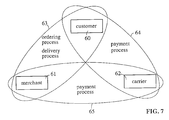
- Figure 7 a simplified representation of the scheme, according to the present invention, is given.
- the order confirmation process is assumed to be part of the payment process.
- Figure 7 is a generalized representation of a transaction scheme, according to the present invention, where the customer 60, merchant 61, and carrier 62 interact with each other.
- the ellipse 63 indicates that the customer 60 and merchant 61 interaction concentrates on the ordering process and the delivery process.
- the payment process is between the customer 60 and carrier 62 (ellipse 64) on one hand, and between the carrier 62 and merchant 61 on the other hand (ellipse 65).
- the ordering process comprises the following activities/actions: (1) the customer 60 contacts the merchant 61 through the customer system and a network; (2) the customer 60 performs an action on the customer system in order to select the deliverable(s); (3) in an optional step, the customer 60 invokes a checkout process. (4) the merchant 61 obtains the phone number of the customer's mobile phone; and (5) the merchant 61 or carrier 62 provides the customer 60 with a confirmation address (e.g., a special phone call-in number).
- a confirmation address e.g., a special phone call-in number
- the payment process comprises the following activities/actions: (1) the customer 60 confirms the order by using the mobile phone and the confirmation address; (2) the carrier 62 monitors the incoming call indications ("caller ID") on a phone line associated with the confirmation phone number or the incoming e-mails (note that this is a variation of the scheme presented in Figures 4 and 5 where the merchant system monitors incoming calls).
- the carrier 62 may receive a list of open transactions and the respective mobile phone numbers or e-mail addresses of the associated customers from the merchant 61. This information is kept by the carrier 62 in a database; (3) the carrier 62 triggers the charging of the amount due to the customer 60 via the carrier's billing system.
- the payment process comprises the following activities/actions: (1) the carrier 62 notifies the merchant 61 of the successful transaction and credits the merchant's account with the amount due.
- the delivery process (ellipse 63), comprises the following activities/actions: (1) the merchant 61 makes the deliverable available to the customer 60.
- a mobile phone such as a GSM phone
- PIN-protected personal identification number
- Each mobile phone is thus uniquely identified and its owner is known (the exception being customers using prepaid SIM cards for their GSM phones).
- the customer already has a contractual relationship with a carrier for billing purposes.
- billing standards e.g., the TAP3 standard introduced by the GSM Association
- TAP3 standard introduced by the GSM Association
- the customer is in control of the payment process again as he has to give consent for each and every payment.
- the customer is dealing with an organization he is already familiar with (the carrier) and which serves as a neutral third party (in most cases).
- the merchant deals with a known organization as well (again, the carrier) and can rely on the customer being verified and probably even having a certain credit limit granted by the carrier.
- a GSM-based scheme has the advantage over other mobile telephone systems that the data transmission between the transmitters and the GSM units is encrypted. Without encryption, eavesdropping is very simple in a wireless network (e.g., previous analog mobile phone systems).
- Mobile telephone networks are implemented by a number of different carriers Each carrier has it's own customers, in respect of whom the carrier holds private information relating to names, addresses, billing information, methods of paying bills, etc. Thus, a distinction should be made in connection with the herein described transaction schemes between the information which the carrier shares with the merchant system or other parties involved, and the information which is generally private as between the customer, and the carrier.
- Carriers have two methods to differentiate themselves in the marketplace; selling basic telephone services at a lower price point, or by providing new (probably fee-based) services that are viewed as added value by their customers.
- the present invention is a good example for such a service that can be offered by a carrier. Consumers and businesses want 'easy to understand and use' products that satisfy their complex needs and are easily accessible. The growth of the internet and the new commercial transaction schemes presented herein are good examples of these market forces at work.
- the invention is not restricted to internet payment schemes. It can essentially be used for every process where a confirmed and authenticated transaction is required.
- the present invention can be realized in hardware, software, or a combination of hardware and software. Any kind of computer system or other apparatus adapted for carrying out the methods described herein is suited.
- a typical combination of hardware and software could be a general purpose computer system with a computer program that, when being loaded and executed, controls the computer system such that it carries out the methods described herein.
- the present invention can also be embedded in a computer program product, which comprises all the features enabling the implementation of the methods described herein, and which - when loaded in a computer system - is able to carry out these methods.
Landscapes
- Business, Economics & Management (AREA)
- Accounting & Taxation (AREA)
- Engineering & Computer Science (AREA)
- General Business, Economics & Management (AREA)
- Strategic Management (AREA)
- Physics & Mathematics (AREA)
- General Physics & Mathematics (AREA)
- Theoretical Computer Science (AREA)
- Finance (AREA)
- Computer Networks & Wireless Communication (AREA)
- Computer Security & Cryptography (AREA)
- Financial Or Insurance-Related Operations Such As Payment And Settlement (AREA)
- Telephonic Communication Services (AREA)
Priority Applications (1)
| Application Number | Priority Date | Filing Date | Title |
|---|---|---|---|
| EP01106296A EP1150262A3 (de) | 2000-04-26 | 2001-03-15 | Bezahlung von netzwerkbasierten Handelsgeschäften mit Hilfe eines Mobiltelefons |
Applications Claiming Priority (3)
| Application Number | Priority Date | Filing Date | Title |
|---|---|---|---|
| EP00108820 | 2000-04-26 | ||
| EP00108820 | 2000-04-26 | ||
| EP01106296A EP1150262A3 (de) | 2000-04-26 | 2001-03-15 | Bezahlung von netzwerkbasierten Handelsgeschäften mit Hilfe eines Mobiltelefons |
Publications (2)
| Publication Number | Publication Date |
|---|---|
| EP1150262A2 true EP1150262A2 (de) | 2001-10-31 |
| EP1150262A3 EP1150262A3 (de) | 2004-08-11 |
Family
ID=26070857
Family Applications (1)
| Application Number | Title | Priority Date | Filing Date |
|---|---|---|---|
| EP01106296A Ceased EP1150262A3 (de) | 2000-04-26 | 2001-03-15 | Bezahlung von netzwerkbasierten Handelsgeschäften mit Hilfe eines Mobiltelefons |
Country Status (1)
| Country | Link |
|---|---|
| EP (1) | EP1150262A3 (de) |
Cited By (17)
| Publication number | Priority date | Publication date | Assignee | Title |
|---|---|---|---|---|
| WO2003071461A1 (en) * | 2002-02-25 | 2003-08-28 | Hiroshi Tatsuki | Charging method, information system, and program |
| WO2004040493A1 (ja) * | 2002-10-30 | 2004-05-13 | Oki Electric Industry Co., Ltd. | Fax受発注決済システム |
| US20040117312A1 (en) * | 2002-12-17 | 2004-06-17 | Elena Lialiamou | Messaging services for pre-pay users |
| WO2004079610A1 (ja) * | 2003-03-06 | 2004-09-16 | Bitwallet,Inc | 決済処理サーバ |
| EP1504588A4 (de) * | 2002-04-28 | 2005-10-26 | Paycool Int Ltd | System, durch das ein telekom-betreiber finanztransaktionsdienste bereitstellen kann, und verfahren zur implementierung solcher transaktionen |
| WO2006000021A1 (en) * | 2004-06-25 | 2006-01-05 | Ian Charles Ogilvy | A transaction processing method, apparatus and system |
| US7103356B2 (en) | 2001-12-11 | 2006-09-05 | Bally Wulff Holding Gmbh & Co. Kg | Method of operating a money game means |
| US7200577B2 (en) | 2002-05-01 | 2007-04-03 | America Online Incorporated | Method and apparatus for secure online transactions |
| NL1032244C2 (nl) * | 2006-07-28 | 2008-01-29 | Sharewire B V | Werkwijze, computerprogramma, computerprogrammaproduct en inrichting voor het vanaf ten minste één server via een datanetwerk laden van software. |
| EP1956547A1 (de) * | 2007-02-09 | 2008-08-13 | E-Group Services Kft. | System, Verfahren und Computerprogramm zur Eingabe von Information in Bezug auf einen Dienst oder ein Produkt, das von einem Benutzer online ausgewählt wird in eine tragbare, drahtlose, kommunikationsfähige Kurzstreckenvorrichtung |
| WO2013156128A1 (en) * | 2012-04-16 | 2013-10-24 | Takeall Sa | Method of providing real-time mobile supplier-to-customer communications and transactions and corresponding system architecture |
| GB2514327A (en) * | 2013-03-26 | 2014-11-26 | Antix Labs Ltd | Multi-device transaction method for digital content |
| DE102014101540A1 (de) * | 2014-02-07 | 2015-08-13 | Contnet AG | Identifizierung von Nutzer-Endgeräten in Kommunikationsnetzwerken |
| CN105187448A (zh) * | 2015-09-30 | 2015-12-23 | 宇龙计算机通信科技(深圳)有限公司 | 一种服务处理方法及服务设备 |
| US10043174B1 (en) * | 2014-06-13 | 2018-08-07 | Intuit Inc. | Bitcoin transaction using text message |
| CN112435093A (zh) * | 2020-11-24 | 2021-03-02 | 广州易尊网络科技股份有限公司 | 一种电子订单的异步处理方法及装置 |
| US12386641B2 (en) | 2023-04-28 | 2025-08-12 | T-Mobile Usa, Inc. | Virtual assistant for facilitating actions in omnichannel telecommunications environment |
Citations (2)
| Publication number | Priority date | Publication date | Assignee | Title |
|---|---|---|---|---|
| US5727163A (en) | 1995-03-30 | 1998-03-10 | Amazon.Com, Inc. | Secure method for communicating credit card data when placing an order on a non-secure network |
| US5960411A (en) | 1997-09-12 | 1999-09-28 | Amazon.Com, Inc. | Method and system for placing a purchase order via a communications network |
Family Cites Families (2)
| Publication number | Priority date | Publication date | Assignee | Title |
|---|---|---|---|---|
| JPH10254960A (ja) * | 1997-03-11 | 1998-09-25 | Hitachi Ltd | 電子商取引方法 |
| HU223427B1 (hu) * | 1997-09-17 | 2004-06-28 | FOTEX Találmányi Iroda Kft. | Eljárás bankkártya vagy más, bankszámla fölött rendelkezési jogot adó eszköz felhasználása jogosságának biztosítására |
-
2001
- 2001-03-15 EP EP01106296A patent/EP1150262A3/de not_active Ceased
Patent Citations (2)
| Publication number | Priority date | Publication date | Assignee | Title |
|---|---|---|---|---|
| US5727163A (en) | 1995-03-30 | 1998-03-10 | Amazon.Com, Inc. | Secure method for communicating credit card data when placing an order on a non-secure network |
| US5960411A (en) | 1997-09-12 | 1999-09-28 | Amazon.Com, Inc. | Method and system for placing a purchase order via a communications network |
Cited By (22)
| Publication number | Priority date | Publication date | Assignee | Title |
|---|---|---|---|---|
| US7103356B2 (en) | 2001-12-11 | 2006-09-05 | Bally Wulff Holding Gmbh & Co. Kg | Method of operating a money game means |
| WO2003071461A1 (en) * | 2002-02-25 | 2003-08-28 | Hiroshi Tatsuki | Charging method, information system, and program |
| EP1504588A4 (de) * | 2002-04-28 | 2005-10-26 | Paycool Int Ltd | System, durch das ein telekom-betreiber finanztransaktionsdienste bereitstellen kann, und verfahren zur implementierung solcher transaktionen |
| US7908227B2 (en) | 2002-05-01 | 2011-03-15 | Aol Inc. | Method and apparatus for secure online transactions |
| US7200577B2 (en) | 2002-05-01 | 2007-04-03 | America Online Incorporated | Method and apparatus for secure online transactions |
| WO2004040493A1 (ja) * | 2002-10-30 | 2004-05-13 | Oki Electric Industry Co., Ltd. | Fax受発注決済システム |
| US20040117312A1 (en) * | 2002-12-17 | 2004-06-17 | Elena Lialiamou | Messaging services for pre-pay users |
| US8265663B2 (en) * | 2002-12-17 | 2012-09-11 | Nokia Corporation | Messaging services for pre-pay users |
| WO2004079610A1 (ja) * | 2003-03-06 | 2004-09-16 | Bitwallet,Inc | 決済処理サーバ |
| WO2006000021A1 (en) * | 2004-06-25 | 2006-01-05 | Ian Charles Ogilvy | A transaction processing method, apparatus and system |
| US8543500B2 (en) | 2004-06-25 | 2013-09-24 | Ian Charles Ogilvy | Transaction processing method, apparatus and system |
| NL1032244C2 (nl) * | 2006-07-28 | 2008-01-29 | Sharewire B V | Werkwijze, computerprogramma, computerprogrammaproduct en inrichting voor het vanaf ten minste één server via een datanetwerk laden van software. |
| EP1956547A1 (de) * | 2007-02-09 | 2008-08-13 | E-Group Services Kft. | System, Verfahren und Computerprogramm zur Eingabe von Information in Bezug auf einen Dienst oder ein Produkt, das von einem Benutzer online ausgewählt wird in eine tragbare, drahtlose, kommunikationsfähige Kurzstreckenvorrichtung |
| WO2013156128A1 (en) * | 2012-04-16 | 2013-10-24 | Takeall Sa | Method of providing real-time mobile supplier-to-customer communications and transactions and corresponding system architecture |
| GB2514327A (en) * | 2013-03-26 | 2014-11-26 | Antix Labs Ltd | Multi-device transaction method for digital content |
| DE102014101540A1 (de) * | 2014-02-07 | 2015-08-13 | Contnet AG | Identifizierung von Nutzer-Endgeräten in Kommunikationsnetzwerken |
| DE102014101540B4 (de) * | 2014-02-07 | 2016-04-14 | Contnet AG | Identifizierung von Nutzer-Endgeräten in Kommunikationsnetzwerken |
| US10043174B1 (en) * | 2014-06-13 | 2018-08-07 | Intuit Inc. | Bitcoin transaction using text message |
| CN105187448A (zh) * | 2015-09-30 | 2015-12-23 | 宇龙计算机通信科技(深圳)有限公司 | 一种服务处理方法及服务设备 |
| WO2017054287A1 (zh) * | 2015-09-30 | 2017-04-06 | 宇龙计算机通信科技(深圳)有限公司 | 一种服务处理方法及服务设备 |
| CN112435093A (zh) * | 2020-11-24 | 2021-03-02 | 广州易尊网络科技股份有限公司 | 一种电子订单的异步处理方法及装置 |
| US12386641B2 (en) | 2023-04-28 | 2025-08-12 | T-Mobile Usa, Inc. | Virtual assistant for facilitating actions in omnichannel telecommunications environment |
Also Published As
| Publication number | Publication date |
|---|---|
| EP1150262A3 (de) | 2004-08-11 |
Similar Documents
| Publication | Publication Date | Title |
|---|---|---|
| US20010037264A1 (en) | Payment for network-based commercial transactions using a mobile phone | |
| US7275685B2 (en) | Method for electronic payment | |
| EP1301912B1 (de) | Transaktionsbearbeitungssystem | |
| US7379920B2 (en) | System and method for facilitating electronic financial transactions using a mobile telecommunication device | |
| AU2009322877B2 (en) | Mobile barcode generation and payment | |
| CN102473272B (zh) | 用于处理移动电话之间的购买交易的系统和方法 | |
| US20020181710A1 (en) | Mobile transaction system and method | |
| EP1150262A2 (de) | Bezahlung von netzwerkbasierten Handelsgeschäften mit Hilfe eines Mobiltelefons | |
| US20020107007A1 (en) | Method for wireless telephony payment and an apparatus therefor | |
| US20030119554A1 (en) | Method and arrangement for performing a cashless payment transaction | |
| HK1047813A1 (zh) | 利用電子資金傳送網路處理互聯網付款的方法和系統 | |
| RS50747B (sr) | Sistem i postupak za kupovinu robe i servisa kroz pristupne tačke mreže podataka preko tačke prodajne mreže | |
| JP2002298041A (ja) | 決済方法、決済用情報処理方法、決済用情報処理システム及びプログラム | |
| US20050154649A1 (en) | System and method for telephone-based authenticated authorization of transactions | |
| AU2006277397A1 (en) | Electronic settlement system, method therefor, settlement server used therein, communication terminal, and program | |
| KR20030082090A (ko) | 전자 지불 결제 방법 및 시스템 | |
| JP5097310B2 (ja) | 商品購入代金の決済システム及びその方法 | |
| CA2313832A1 (en) | Secure communication | |
| KR100476660B1 (ko) | 유무선 통신망을 이용한 실시간 인증의 전자금융거래서비스방법 및 서비스 시스템 | |
| JP4616448B2 (ja) | 電子決済システム及びそれを用いた電子決済方法 | |
| JP2002288574A (ja) | 電子決済サービスシステム | |
| JP2002074192A (ja) | ネットワーク販売システム | |
| AU2002349173B2 (en) | System and method for facilitating electronic financial transactions using a mobile telecommunication device | |
| JP2002245387A (ja) | 電子商取引システムと代金決済システム | |
| JP2001117981A (ja) | インターネットにおける安全な販売・清算方法 |
Legal Events
| Date | Code | Title | Description |
|---|---|---|---|
| PUAI | Public reference made under article 153(3) epc to a published international application that has entered the european phase |
Free format text: ORIGINAL CODE: 0009012 |
|
| AK | Designated contracting states |
Kind code of ref document: A2 Designated state(s): AT BE CH CY DE DK ES FI FR GB GR IE IT LI LU MC NL PT SE TR |
|
| AX | Request for extension of the european patent |
Free format text: AL;LT;LV;MK;RO;SI |
|
| PUAL | Search report despatched |
Free format text: ORIGINAL CODE: 0009013 |
|
| AK | Designated contracting states |
Kind code of ref document: A3 Designated state(s): AT BE CH CY DE DK ES FI FR GB GR IE IT LI LU MC NL PT SE TR |
|
| AX | Request for extension of the european patent |
Extension state: AL LT LV MK RO SI |
|
| 17P | Request for examination filed |
Effective date: 20050125 |
|
| AKX | Designation fees paid |
Designated state(s): DE FR GB IT |
|
| STAA | Information on the status of an ep patent application or granted ep patent |
Free format text: STATUS: THE APPLICATION HAS BEEN REFUSED |
|
| 18R | Application refused |
Effective date: 20071021 |