EP1149316B1 - Improved angular brightness microprismatic retroreflective film or sheeting incorporating a syndiotactic vinyl aromatic polymer - Google Patents
Improved angular brightness microprismatic retroreflective film or sheeting incorporating a syndiotactic vinyl aromatic polymer Download PDFInfo
- Publication number
- EP1149316B1 EP1149316B1 EP99925656A EP99925656A EP1149316B1 EP 1149316 B1 EP1149316 B1 EP 1149316B1 EP 99925656 A EP99925656 A EP 99925656A EP 99925656 A EP99925656 A EP 99925656A EP 1149316 B1 EP1149316 B1 EP 1149316B1
- Authority
- EP
- European Patent Office
- Prior art keywords
- film
- syndiotactic
- vinyl aromatic
- weight
- polymer
- Prior art date
- Legal status (The legal status is an assumption and is not a legal conclusion. Google has not performed a legal analysis and makes no representation as to the accuracy of the status listed.)
- Expired - Lifetime
Links
- 229920000642 polymer Polymers 0.000 title claims description 64
- 229920002554 vinyl polymer Polymers 0.000 title claims description 35
- 229920010524 Syndiotactic polystyrene Polymers 0.000 claims description 53
- 239000000463 material Substances 0.000 claims description 34
- 229920006126 semicrystalline polymer Polymers 0.000 claims description 19
- 239000000178 monomer Substances 0.000 claims description 18
- 239000003963 antioxidant agent Substances 0.000 claims description 13
- JLBJTVDPSNHSKJ-UHFFFAOYSA-N 4-Methylstyrene Chemical group CC1=CC=C(C=C)C=C1 JLBJTVDPSNHSKJ-UHFFFAOYSA-N 0.000 claims description 11
- 229920001576 syndiotactic polymer Polymers 0.000 claims description 10
- 230000003078 antioxidant effect Effects 0.000 claims description 8
- 125000003011 styrenyl group Chemical group [H]\C(*)=C(/[H])C1=C([H])C([H])=C([H])C([H])=C1[H] 0.000 claims description 4
- 229920001568 phenolic resin Polymers 0.000 claims description 2
- 239000005011 phenolic resin Substances 0.000 claims description 2
- KXGFMDJXCMQABM-UHFFFAOYSA-N 2-methoxy-6-methylphenol Chemical compound [CH]OC1=CC=CC([CH])=C1O KXGFMDJXCMQABM-UHFFFAOYSA-N 0.000 claims 1
- 239000011358 absorbing material Substances 0.000 claims 1
- -1 polyethylene Polymers 0.000 description 71
- 230000003287 optical effect Effects 0.000 description 20
- PPBRXRYQALVLMV-UHFFFAOYSA-N Styrene Natural products C=CC1=CC=CC=C1 PPBRXRYQALVLMV-UHFFFAOYSA-N 0.000 description 18
- 239000004417 polycarbonate Substances 0.000 description 17
- 229920000515 polycarbonate Polymers 0.000 description 17
- 238000010276 construction Methods 0.000 description 13
- 238000000034 method Methods 0.000 description 13
- 230000000052 comparative effect Effects 0.000 description 10
- 239000011256 inorganic filler Substances 0.000 description 10
- 229910003475 inorganic filler Inorganic materials 0.000 description 10
- PXHVJJICTQNCMI-UHFFFAOYSA-N Nickel Chemical compound [Ni] PXHVJJICTQNCMI-UHFFFAOYSA-N 0.000 description 8
- 229910052799 carbon Inorganic materials 0.000 description 8
- 229920001577 copolymer Polymers 0.000 description 8
- 229920005989 resin Polymers 0.000 description 8
- 239000011347 resin Substances 0.000 description 8
- 239000000126 substance Substances 0.000 description 8
- 125000001424 substituent group Chemical group 0.000 description 8
- 239000000654 additive Substances 0.000 description 7
- 238000005259 measurement Methods 0.000 description 7
- 229920002223 polystyrene Polymers 0.000 description 7
- 239000004793 Polystyrene Substances 0.000 description 6
- 230000000694 effects Effects 0.000 description 6
- 238000012545 processing Methods 0.000 description 6
- 238000010791 quenching Methods 0.000 description 6
- 239000004743 Polypropylene Substances 0.000 description 5
- 125000004432 carbon atom Chemical group C* 0.000 description 5
- 239000000203 mixture Substances 0.000 description 5
- 229920000139 polyethylene terephthalate Polymers 0.000 description 5
- 239000005020 polyethylene terephthalate Substances 0.000 description 5
- 229920001155 polypropylene Polymers 0.000 description 5
- 230000000171 quenching effect Effects 0.000 description 5
- 229920002292 Nylon 6 Polymers 0.000 description 4
- 239000006096 absorbing agent Substances 0.000 description 4
- 230000008901 benefit Effects 0.000 description 4
- 238000005266 casting Methods 0.000 description 4
- 238000000113 differential scanning calorimetry Methods 0.000 description 4
- 229920001519 homopolymer Polymers 0.000 description 4
- 239000004611 light stabiliser Substances 0.000 description 4
- 229910052759 nickel Inorganic materials 0.000 description 4
- 239000002516 radical scavenger Substances 0.000 description 4
- 125000000391 vinyl group Chemical group [H]C([*])=C([H])[H] 0.000 description 4
- 229940123457 Free radical scavenger Drugs 0.000 description 3
- 239000006057 Non-nutritive feed additive Substances 0.000 description 3
- 239000004698 Polyethylene Substances 0.000 description 3
- 229920006125 amorphous polymer Polymers 0.000 description 3
- 150000001721 carbon Chemical group 0.000 description 3
- 238000000576 coating method Methods 0.000 description 3
- 238000002425 crystallisation Methods 0.000 description 3
- 230000008025 crystallization Effects 0.000 description 3
- 238000009826 distribution Methods 0.000 description 3
- 238000004519 manufacturing process Methods 0.000 description 3
- 238000002844 melting Methods 0.000 description 3
- 230000008018 melting Effects 0.000 description 3
- 238000012986 modification Methods 0.000 description 3
- 230000004048 modification Effects 0.000 description 3
- 229920000573 polyethylene Polymers 0.000 description 3
- 239000011112 polyethylene naphthalate Substances 0.000 description 3
- 229920002959 polymer blend Polymers 0.000 description 3
- 239000002243 precursor Substances 0.000 description 3
- WSSSPWUEQFSQQG-UHFFFAOYSA-N 4-methyl-1-pentene Chemical compound CC(C)CC=C WSSSPWUEQFSQQG-UHFFFAOYSA-N 0.000 description 2
- KAKZBPTYRLMSJV-UHFFFAOYSA-N Butadiene Chemical compound C=CC=C KAKZBPTYRLMSJV-UHFFFAOYSA-N 0.000 description 2
- NLZUEZXRPGMBCV-UHFFFAOYSA-N Butylhydroxytoluene Chemical compound CC1=CC(C(C)(C)C)=C(O)C(C(C)(C)C)=C1 NLZUEZXRPGMBCV-UHFFFAOYSA-N 0.000 description 2
- RRHGJUQNOFWUDK-UHFFFAOYSA-N Isoprene Chemical compound CC(=C)C=C RRHGJUQNOFWUDK-UHFFFAOYSA-N 0.000 description 2
- TWRXJAOTZQYOKJ-UHFFFAOYSA-L Magnesium chloride Chemical compound [Mg+2].[Cl-].[Cl-] TWRXJAOTZQYOKJ-UHFFFAOYSA-L 0.000 description 2
- 239000004696 Poly ether ether ketone Substances 0.000 description 2
- 239000004952 Polyamide Substances 0.000 description 2
- 150000001412 amines Chemical class 0.000 description 2
- 238000013459 approach Methods 0.000 description 2
- 238000000149 argon plasma sintering Methods 0.000 description 2
- 229910021538 borax Inorganic materials 0.000 description 2
- 230000015556 catabolic process Effects 0.000 description 2
- 239000011248 coating agent Substances 0.000 description 2
- 239000003086 colorant Substances 0.000 description 2
- 150000001875 compounds Chemical class 0.000 description 2
- 238000006731 degradation reaction Methods 0.000 description 2
- 235000014113 dietary fatty acids Nutrition 0.000 description 2
- ZJIPHXXDPROMEF-UHFFFAOYSA-N dihydroxyphosphanyl dihydrogen phosphite Chemical class OP(O)OP(O)O ZJIPHXXDPROMEF-UHFFFAOYSA-N 0.000 description 2
- 239000000194 fatty acid Substances 0.000 description 2
- 229930195729 fatty acid Natural products 0.000 description 2
- 230000001965 increasing effect Effects 0.000 description 2
- PQXKHYXIUOZZFA-UHFFFAOYSA-M lithium fluoride Chemical compound [Li+].[F-] PQXKHYXIUOZZFA-UHFFFAOYSA-M 0.000 description 2
- 238000011068 loading method Methods 0.000 description 2
- 239000000314 lubricant Substances 0.000 description 2
- 230000007246 mechanism Effects 0.000 description 2
- 238000000465 moulding Methods 0.000 description 2
- 239000002667 nucleating agent Substances 0.000 description 2
- JRZJOMJEPLMPRA-UHFFFAOYSA-N olefin Natural products CCCCCCCC=C JRZJOMJEPLMPRA-UHFFFAOYSA-N 0.000 description 2
- 239000002245 particle Substances 0.000 description 2
- 239000002530 phenolic antioxidant Substances 0.000 description 2
- 230000000704 physical effect Effects 0.000 description 2
- 229920001627 poly(4-methyl styrene) Polymers 0.000 description 2
- 229920003207 poly(ethylene-2,6-naphthalate) Polymers 0.000 description 2
- 229920003229 poly(methyl methacrylate) Polymers 0.000 description 2
- 229920002647 polyamide Polymers 0.000 description 2
- 229920001707 polybutylene terephthalate Polymers 0.000 description 2
- 229920000728 polyester Polymers 0.000 description 2
- 229920002530 polyetherether ketone Polymers 0.000 description 2
- 239000002952 polymeric resin Substances 0.000 description 2
- 230000008569 process Effects 0.000 description 2
- 230000005855 radiation Effects 0.000 description 2
- 238000012552 review Methods 0.000 description 2
- 238000007789 sealing Methods 0.000 description 2
- 235000010339 sodium tetraborate Nutrition 0.000 description 2
- 238000003786 synthesis reaction Methods 0.000 description 2
- 229920003002 synthetic resin Polymers 0.000 description 2
- 229920001169 thermoplastic Polymers 0.000 description 2
- 239000004416 thermosoftening plastic Substances 0.000 description 2
- KGRVJHAUYBGFFP-UHFFFAOYSA-N 2,2'-Methylenebis(4-methyl-6-tert-butylphenol) Chemical compound CC(C)(C)C1=CC(C)=CC(CC=2C(=C(C=C(C)C=2)C(C)(C)C)O)=C1O KGRVJHAUYBGFFP-UHFFFAOYSA-N 0.000 description 1
- ZSSVCEUEVMALRD-UHFFFAOYSA-N 2-[4,6-bis(2,4-dimethylphenyl)-1,3,5-triazin-2-yl]-5-(octyloxy)phenol Chemical compound OC1=CC(OCCCCCCCC)=CC=C1C1=NC(C=2C(=CC(C)=CC=2)C)=NC(C=2C(=CC(C)=CC=2)C)=N1 ZSSVCEUEVMALRD-UHFFFAOYSA-N 0.000 description 1
- WMJBVALTYVXGHW-UHFFFAOYSA-N 3,3-diphenylprop-2-enoic acid Chemical class C=1C=CC=CC=1C(=CC(=O)O)C1=CC=CC=C1 WMJBVALTYVXGHW-UHFFFAOYSA-N 0.000 description 1
- PZRWFKGUFWPFID-UHFFFAOYSA-N 3,9-dioctadecoxy-2,4,8,10-tetraoxa-3,9-diphosphaspiro[5.5]undecane Chemical compound C1OP(OCCCCCCCCCCCCCCCCCC)OCC21COP(OCCCCCCCCCCCCCCCCCC)OC2 PZRWFKGUFWPFID-UHFFFAOYSA-N 0.000 description 1
- SQWMFGXXTYTJKY-UHFFFAOYSA-N 4-methoxy-2,6-diphenylphenol Chemical compound C=1C(OC)=CC(C=2C=CC=CC=2)=C(O)C=1C1=CC=CC=C1 SQWMFGXXTYTJKY-UHFFFAOYSA-N 0.000 description 1
- NLHHRLWOUZZQLW-UHFFFAOYSA-N Acrylonitrile Chemical compound C=CC#N NLHHRLWOUZZQLW-UHFFFAOYSA-N 0.000 description 1
- 229920002799 BoPET Polymers 0.000 description 1
- OKTJSMMVPCPJKN-UHFFFAOYSA-N Carbon Chemical compound [C] OKTJSMMVPCPJKN-UHFFFAOYSA-N 0.000 description 1
- 229920013683 Celanese Polymers 0.000 description 1
- MHAJPDPJQMAIIY-UHFFFAOYSA-N Hydrogen peroxide Chemical compound OO MHAJPDPJQMAIIY-UHFFFAOYSA-N 0.000 description 1
- JHWNWJKBPDFINM-UHFFFAOYSA-N Laurolactam Chemical compound O=C1CCCCCCCCCCCN1 JHWNWJKBPDFINM-UHFFFAOYSA-N 0.000 description 1
- VVQNEPGJFQJSBK-UHFFFAOYSA-N Methyl methacrylate Chemical compound COC(=O)C(C)=C VVQNEPGJFQJSBK-UHFFFAOYSA-N 0.000 description 1
- 238000005481 NMR spectroscopy Methods 0.000 description 1
- 229920000571 Nylon 11 Polymers 0.000 description 1
- 229920000299 Nylon 12 Polymers 0.000 description 1
- 229920003189 Nylon 4,6 Polymers 0.000 description 1
- 229920000572 Nylon 6/12 Polymers 0.000 description 1
- GFLIYGDOQWRMTI-UHFFFAOYSA-N OP(O)OP(O)O.C(CCCCCCC)C(O)(C(CO)(CO)CO)CCCCCCCC Chemical compound OP(O)OP(O)O.C(CCCCCCC)C(O)(C(CO)(CO)CO)CCCCCCCC GFLIYGDOQWRMTI-UHFFFAOYSA-N 0.000 description 1
- 229910019142 PO4 Inorganic materials 0.000 description 1
- 239000002033 PVDF binder Substances 0.000 description 1
- JKIJEFPNVSHHEI-UHFFFAOYSA-N Phenol, 2,4-bis(1,1-dimethylethyl)-, phosphite (3:1) Chemical compound CC(C)(C)C1=CC(C(C)(C)C)=CC=C1OP(OC=1C(=CC(=CC=1)C(C)(C)C)C(C)(C)C)OC1=CC=C(C(C)(C)C)C=C1C(C)(C)C JKIJEFPNVSHHEI-UHFFFAOYSA-N 0.000 description 1
- 239000004642 Polyimide Substances 0.000 description 1
- 239000004721 Polyphenylene oxide Substances 0.000 description 1
- 229920001328 Polyvinylidene chloride Polymers 0.000 description 1
- 229910000831 Steel Inorganic materials 0.000 description 1
- 239000007983 Tris buffer Substances 0.000 description 1
- 238000005299 abrasion Methods 0.000 description 1
- 150000001242 acetic acid derivatives Chemical class 0.000 description 1
- 229920006397 acrylic thermoplastic Polymers 0.000 description 1
- 150000001336 alkenes Chemical class 0.000 description 1
- 125000000217 alkyl group Chemical group 0.000 description 1
- XAGFODPZIPBFFR-UHFFFAOYSA-N aluminium Chemical compound [Al] XAGFODPZIPBFFR-UHFFFAOYSA-N 0.000 description 1
- 229910052782 aluminium Inorganic materials 0.000 description 1
- 230000003466 anti-cipated effect Effects 0.000 description 1
- 239000002216 antistatic agent Substances 0.000 description 1
- 125000003118 aryl group Chemical group 0.000 description 1
- 230000009286 beneficial effect Effects 0.000 description 1
- WPYMKLBDIGXBTP-UHFFFAOYSA-N benzoic acid Chemical compound OC(=O)C1=CC=CC=C1 WPYMKLBDIGXBTP-UHFFFAOYSA-N 0.000 description 1
- 150000008366 benzophenones Chemical class 0.000 description 1
- 150000001565 benzotriazoles Chemical class 0.000 description 1
- 229920006233 biaxially oriented polyamide Polymers 0.000 description 1
- 229920006378 biaxially oriented polypropylene Polymers 0.000 description 1
- 239000011127 biaxially oriented polypropylene Substances 0.000 description 1
- 230000015572 biosynthetic process Effects 0.000 description 1
- 230000000903 blocking effect Effects 0.000 description 1
- 150000001642 boronic acid derivatives Chemical class 0.000 description 1
- CREMABGTGYGIQB-UHFFFAOYSA-N carbon carbon Chemical compound C.C CREMABGTGYGIQB-UHFFFAOYSA-N 0.000 description 1
- 239000011203 carbon fibre reinforced carbon Substances 0.000 description 1
- 150000004649 carbonic acid derivatives Chemical class 0.000 description 1
- 150000007942 carboxylates Chemical class 0.000 description 1
- 238000006555 catalytic reaction Methods 0.000 description 1
- 239000003795 chemical substances by application Substances 0.000 description 1
- 238000013329 compounding Methods 0.000 description 1
- 230000006835 compression Effects 0.000 description 1
- 238000007906 compression Methods 0.000 description 1
- 238000000748 compression moulding Methods 0.000 description 1
- 238000001816 cooling Methods 0.000 description 1
- 239000003431 cross linking reagent Substances 0.000 description 1
- YWJUZWOHLHBWQY-UHFFFAOYSA-N decanedioic acid;hexane-1,6-diamine Chemical compound NCCCCCCN.OC(=O)CCCCCCCCC(O)=O YWJUZWOHLHBWQY-UHFFFAOYSA-N 0.000 description 1
- 230000003247 decreasing effect Effects 0.000 description 1
- 238000013461 design Methods 0.000 description 1
- 238000001514 detection method Methods 0.000 description 1
- 238000011161 development Methods 0.000 description 1
- 230000018109 developmental process Effects 0.000 description 1
- 150000001993 dienes Chemical class 0.000 description 1
- ZMUCVNSKULGPQG-UHFFFAOYSA-N dodecanedioic acid;hexane-1,6-diamine Chemical compound NCCCCCCN.OC(=O)CCCCCCCCCCC(O)=O ZMUCVNSKULGPQG-UHFFFAOYSA-N 0.000 description 1
- 238000004049 embossing Methods 0.000 description 1
- 238000005516 engineering process Methods 0.000 description 1
- 230000002708 enhancing effect Effects 0.000 description 1
- 230000007613 environmental effect Effects 0.000 description 1
- 239000003344 environmental pollutant Substances 0.000 description 1
- 230000005281 excited state Effects 0.000 description 1
- 238000001125 extrusion Methods 0.000 description 1
- 150000004665 fatty acids Chemical class 0.000 description 1
- 239000012467 final product Substances 0.000 description 1
- 239000003063 flame retardant Substances 0.000 description 1
- 150000004820 halides Chemical class 0.000 description 1
- 125000004836 hexamethylene group Chemical class [H]C([H])([*:2])C([H])([H])C([H])([H])C([H])([H])C([H])([H])C([H])([H])[*:1] 0.000 description 1
- BHEPBYXIRTUNPN-UHFFFAOYSA-N hydridophosphorus(.) (triplet) Chemical compound [PH] BHEPBYXIRTUNPN-UHFFFAOYSA-N 0.000 description 1
- 150000004679 hydroxides Chemical class 0.000 description 1
- 230000005606 hygroscopic expansion Effects 0.000 description 1
- 239000005457 ice water Substances 0.000 description 1
- 238000005286 illumination Methods 0.000 description 1
- 238000007654 immersion Methods 0.000 description 1
- 238000010348 incorporation Methods 0.000 description 1
- 230000003993 interaction Effects 0.000 description 1
- 238000010030 laminating Methods 0.000 description 1
- ZLNQQNXFFQJAID-UHFFFAOYSA-L magnesium carbonate Chemical compound [Mg+2].[O-]C([O-])=O ZLNQQNXFFQJAID-UHFFFAOYSA-L 0.000 description 1
- 239000001095 magnesium carbonate Substances 0.000 description 1
- 229910000021 magnesium carbonate Inorganic materials 0.000 description 1
- 229910001629 magnesium chloride Inorganic materials 0.000 description 1
- 239000000395 magnesium oxide Substances 0.000 description 1
- CPLXHLVBOLITMK-UHFFFAOYSA-N magnesium oxide Inorganic materials [Mg]=O CPLXHLVBOLITMK-UHFFFAOYSA-N 0.000 description 1
- GVALZJMUIHGIMD-UHFFFAOYSA-H magnesium phosphate Chemical compound [Mg+2].[Mg+2].[Mg+2].[O-]P([O-])([O-])=O.[O-]P([O-])([O-])=O GVALZJMUIHGIMD-UHFFFAOYSA-H 0.000 description 1
- 239000004137 magnesium phosphate Substances 0.000 description 1
- 229960002261 magnesium phosphate Drugs 0.000 description 1
- 229910000157 magnesium phosphate Inorganic materials 0.000 description 1
- 235000010994 magnesium phosphates Nutrition 0.000 description 1
- AXZKOIWUVFPNLO-UHFFFAOYSA-N magnesium;oxygen(2-) Chemical compound [O-2].[Mg+2] AXZKOIWUVFPNLO-UHFFFAOYSA-N 0.000 description 1
- FPYJFEHAWHCUMM-UHFFFAOYSA-N maleic anhydride Chemical compound O=C1OC(=O)C=C1 FPYJFEHAWHCUMM-UHFFFAOYSA-N 0.000 description 1
- 239000011159 matrix material Substances 0.000 description 1
- 239000000155 melt Substances 0.000 description 1
- 238000007578 melt-quenching technique Methods 0.000 description 1
- 150000004767 nitrides Chemical class 0.000 description 1
- 238000005457 optimization Methods 0.000 description 1
- 125000004817 pentamethylene group Chemical class [H]C([H])([*:2])C([H])([H])C([H])([H])C([H])([H])C([H])([H])[*:1] 0.000 description 1
- 238000005191 phase separation Methods 0.000 description 1
- 125000001997 phenyl group Chemical group [H]C1=C([H])C([H])=C(*)C([H])=C1[H] 0.000 description 1
- 235000021317 phosphate Nutrition 0.000 description 1
- AQSJGOWTSHOLKH-UHFFFAOYSA-N phosphite(3-) Chemical class [O-]P([O-])[O-] AQSJGOWTSHOLKH-UHFFFAOYSA-N 0.000 description 1
- 150000003013 phosphoric acid derivatives Chemical class 0.000 description 1
- OJMIONKXNSYLSR-UHFFFAOYSA-N phosphorous acid Chemical compound OP(O)O OJMIONKXNSYLSR-UHFFFAOYSA-N 0.000 description 1
- 150000003053 piperidines Chemical class 0.000 description 1
- 229920003023 plastic Polymers 0.000 description 1
- 239000004033 plastic Substances 0.000 description 1
- 231100000719 pollutant Toxicity 0.000 description 1
- 229920001596 poly (chlorostyrenes) Polymers 0.000 description 1
- 229920003197 poly( p-chlorostyrene) Polymers 0.000 description 1
- 229920001620 poly(3-methyl styrene) Polymers 0.000 description 1
- 229920000090 poly(aryl ether) Polymers 0.000 description 1
- 229920002493 poly(chlorotrifluoroethylene) Polymers 0.000 description 1
- 229920001608 poly(methyl styrenes) Polymers 0.000 description 1
- 229920002492 poly(sulfone) Polymers 0.000 description 1
- 229920001083 polybutene Polymers 0.000 description 1
- 229920001896 polybutyrate Polymers 0.000 description 1
- 239000005023 polychlorotrifluoroethylene (PCTFE) polymer Substances 0.000 description 1
- 229920006393 polyether sulfone Polymers 0.000 description 1
- 229920001721 polyimide Polymers 0.000 description 1
- 229920006254 polymer film Polymers 0.000 description 1
- 238000010094 polymer processing Methods 0.000 description 1
- 238000006116 polymerization reaction Methods 0.000 description 1
- 239000004926 polymethyl methacrylate Substances 0.000 description 1
- 229920000098 polyolefin Polymers 0.000 description 1
- 229920001955 polyphenylene ether Polymers 0.000 description 1
- 229920006380 polyphenylene oxide Polymers 0.000 description 1
- 229920006295 polythiol Polymers 0.000 description 1
- 229920002635 polyurethane Polymers 0.000 description 1
- 239000004814 polyurethane Substances 0.000 description 1
- 229920002620 polyvinyl fluoride Polymers 0.000 description 1
- 239000005033 polyvinylidene chloride Substances 0.000 description 1
- 229920002981 polyvinylidene fluoride Polymers 0.000 description 1
- 238000004321 preservation Methods 0.000 description 1
- 150000003254 radicals Chemical class 0.000 description 1
- 230000010076 replication Effects 0.000 description 1
- 150000003873 salicylate salts Chemical class 0.000 description 1
- 150000003839 salts Chemical class 0.000 description 1
- 150000004760 silicates Chemical class 0.000 description 1
- 239000004328 sodium tetraborate Substances 0.000 description 1
- 241000894007 species Species 0.000 description 1
- 238000001228 spectrum Methods 0.000 description 1
- 238000003892 spreading Methods 0.000 description 1
- 230000007480 spreading Effects 0.000 description 1
- 239000010959 steel Substances 0.000 description 1
- KKEYFWRCBNTPAC-UHFFFAOYSA-L terephthalate(2-) Chemical compound [O-]C(=O)C1=CC=C(C([O-])=O)C=C1 KKEYFWRCBNTPAC-UHFFFAOYSA-L 0.000 description 1
- ISXSCDLOGDJUNJ-UHFFFAOYSA-N tert-butyl prop-2-enoate Chemical compound CC(C)(C)OC(=O)C=C ISXSCDLOGDJUNJ-UHFFFAOYSA-N 0.000 description 1
- 238000010998 test method Methods 0.000 description 1
- 150000003568 thioethers Chemical class 0.000 description 1
- 150000003918 triazines Chemical class 0.000 description 1
- BSVBQGMMJUBVOD-UHFFFAOYSA-N trisodium borate Chemical compound [Na+].[Na+].[Na+].[O-]B([O-])[O-] BSVBQGMMJUBVOD-UHFFFAOYSA-N 0.000 description 1
- 229920001567 vinyl ester resin Polymers 0.000 description 1
- XLYOFNOQVPJJNP-UHFFFAOYSA-N water Substances O XLYOFNOQVPJJNP-UHFFFAOYSA-N 0.000 description 1
- XOOUIPVCVHRTMJ-UHFFFAOYSA-L zinc stearate Chemical class [Zn+2].CCCCCCCCCCCCCCCCCC([O-])=O.CCCCCCCCCCCCCCCCCC([O-])=O XOOUIPVCVHRTMJ-UHFFFAOYSA-L 0.000 description 1
Images
Classifications
-
- G—PHYSICS
- G02—OPTICS
- G02B—OPTICAL ELEMENTS, SYSTEMS OR APPARATUS
- G02B5/00—Optical elements other than lenses
- G02B5/12—Reflex reflectors
- G02B5/122—Reflex reflectors cube corner, trihedral or triple reflector type
-
- G—PHYSICS
- G02—OPTICS
- G02B—OPTICAL ELEMENTS, SYSTEMS OR APPARATUS
- G02B5/00—Optical elements other than lenses
- G02B5/12—Reflex reflectors
- G02B5/122—Reflex reflectors cube corner, trihedral or triple reflector type
- G02B5/124—Reflex reflectors cube corner, trihedral or triple reflector type plural reflecting elements forming part of a unitary plate or sheet
-
- Y—GENERAL TAGGING OF NEW TECHNOLOGICAL DEVELOPMENTS; GENERAL TAGGING OF CROSS-SECTIONAL TECHNOLOGIES SPANNING OVER SEVERAL SECTIONS OF THE IPC; TECHNICAL SUBJECTS COVERED BY FORMER USPC CROSS-REFERENCE ART COLLECTIONS [XRACs] AND DIGESTS
- Y10—TECHNICAL SUBJECTS COVERED BY FORMER USPC
- Y10T—TECHNICAL SUBJECTS COVERED BY FORMER US CLASSIFICATION
- Y10T428/00—Stock material or miscellaneous articles
- Y10T428/24—Structurally defined web or sheet [e.g., overall dimension, etc.]
- Y10T428/24355—Continuous and nonuniform or irregular surface on layer or component [e.g., roofing, etc.]
-
- Y—GENERAL TAGGING OF NEW TECHNOLOGICAL DEVELOPMENTS; GENERAL TAGGING OF CROSS-SECTIONAL TECHNOLOGIES SPANNING OVER SEVERAL SECTIONS OF THE IPC; TECHNICAL SUBJECTS COVERED BY FORMER USPC CROSS-REFERENCE ART COLLECTIONS [XRACs] AND DIGESTS
- Y10—TECHNICAL SUBJECTS COVERED BY FORMER USPC
- Y10T—TECHNICAL SUBJECTS COVERED BY FORMER US CLASSIFICATION
- Y10T428/00—Stock material or miscellaneous articles
- Y10T428/24—Structurally defined web or sheet [e.g., overall dimension, etc.]
- Y10T428/24479—Structurally defined web or sheet [e.g., overall dimension, etc.] including variation in thickness
Definitions
- the present invention pertains to retroreflective film or sheeting, and more specifically to retroreflective film or sheeting comprising a microreplicated cube-corner (microprismatic) pattern.
- Retroreflective film or sheeting utilizing microprismatic reflecting elements is used extensively in signing applications, including signing for traffic control.
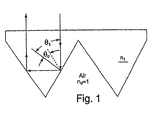
- Microprismatic retroreflectors typically comprise a sheet having a generally planar front surface and an array of cube corner elements protruding from the back surface.
- Cube corner elements comprise interconnected, generally trihedral structures, each of which has approximately mutually perpendicular lateral faces meeting to form a single corner, and thus are characterized as cube-corners.
- the retroreflector is arranged with the front surface disposed generally toward the anticipated location of both incident light and intended observers.
- TIR total internal reflection
- microprismatics reflect light back toward a light source with high efficiency.
- microprismatics can spread the retroreflected light into a zone or "cone of light" determined by the particular cube-corner optical design. This enables detection of reflected light at an observation angle other than zero degrees, with zero degrees defined as the vector of perfect retroreflection.
- the combination of the cube-corner optical geometry and a material of construction having a high index of refraction serves to maximize entrance angularity, which is to say, to maximize the entrance angle, or angle of incidence, up to which good retroreflective performance is observed.
- Angle of incidence refers to the angle made by the vector of incident light with a vector normal to the planar front surface of the film or sheeting.
- U.S. 3,817,596 seeks to diffuse the retroreflected light by comprising the retroreflector of two types of optical cube-corner elements, the first variety having three reflecting planes positioned such that lines normal thereto intersect each other at right angles, and a second variety having three reflecting planes positioned such that lines normal thereto intersect in a skewed manner while optical axes thereof intersect each other at right angles.
- U.S. 4,775,219 (Appledorn, et al.) provides retroreflective articles which may be individually tailored so as to distribute light retroreflected by the articles into a desired pattern or divergence profile. This is accomplished by forming the three lateral faces of the reflecting elements by three intersecting sets of parallel V-shaped grooves, with at least one of the sets including, in a repeating pattern, a groove side angle that differs from another groove side angle of the same set.
- PCT Appl. No. 96/30786 seeks to redistribute light within the retroreflected cone by texturing a surface of the retroreflective sheeting which is in the path of the light, in order to decrease the high degree of variation within the cone due to the diffraction phenomena discussed in the Stamm patent.
- PC Polycarbonate
- ⁇ c critical angle
- microprismatic retroreflective materials of the prior art have shortcomings in optical brightness when viewed at wider observational angles or from intermediate distances. Also, the three polymer types from which they are most frequently manufactured are relatively expensive, and are subject to dimensional instability when exposed to moisture. Many other well-known polymeric materials which might otherwise be used in microprismatic retroreflective materials lack sufficient resistance to one or more of the factors involved in "weathering", such as ultraviolet light, heat, moisture, and abrasion.
- the present invention is a microprismatic retroreflective film or sheeting, and a signing material comprising said microprismatic retroreflective film or sheeting.
- a microprismatic retroreflective film or sheeting which has at least one microprismatic surface, whereby the material of the microprisms comprises a syndiotactic polymer derived from a vinyl aromatic monomer.
- the polymer is a transparent semicrystalline polymer. More preferably, the semicrystalline polymer is a syndiotactic vinyl aromatic polymer having at least 80% by weight of styrene moieties; and most preferably, the semicrystalline polymer is a syndiotactic polystyrene copolymer.
- the microprismatic retroreflective film or sheeting comprises a transparent semicrystalline polymer comprising a syndiotactic vinyl aromatic polymer comprising at least 80% by weight of styrene moieties and further comprising at least 5% by weight of para-methylstyrene moieties.
- a signing material comprising the microprismatic retroreflective film or sheeting, which has enhanced retroreflected brightness with respect to comparable signing material comprising a microprismatic retroreflective film or sheeting consisting of polycarbonate.
- the signing material comprising the microprismatic retroreflective film or sheeting, has enhanced retroreflected brightness, at entrance angles greater than about 30°, or at observation angles greater than about 0.20, with respect to comparable signing material comprising a microprismatic retroreflective film or sheeting consisting of polycarbonate.
- Each pseudoasymmetric carbon atom can exist in one of two distinguishable configurations. Depending upon the configurations of such carbon atoms when the corresponding vinyl monomers are added to a growing polymer chain, the resultant chain can be atactic, isotactic, or syndiotactic.
- a pseudosymmetric carbon atom of a head-to-tail backbone that carries the substituents X and Y. If the polymer backbone is oriented so that the bonds between the main chain carbon atoms form a planar zigzag pattern, then each X and Y substituent will lie either above or below the plane defined by said backbone. If all X substituents lie to one side of the backbone while all Y substituents lie to the other side, then the polymer chain is said to have an isotactic configuration. If the X and Y substituents are randomly distributed above and below the backbone, then the polymer chain is said to have an atactic configuration.
- the polymer is said to have a syndiotactic configuration.
- the side groups of a syndiotactic polymer chain are arranged in a symmetrical and recurring fashion above and below the backbone when the backbone is arranged so as to lie in a single plane.
- phenyl groups are configured alternately above and below the plane defined by the zigzag pattern of the fully extended carbon-carbon main chain. Syndiotacticity is described in Rudin, "The Elements of Polymer Science and Engineering", Academic Press, pages 128-132 (1982).
- Syndiotactic vinyl aromatic polymers have been used to make various articles that exhibit good dimensional stability, thermal stability, and/or moisture resistance.
- the use of syndiotactic polystyrene in overlay films, for example has been described in Assignee's copending application U.S. Patent No. 5,981,076.
- the use of syndiotactic vinyl aromatic polymers in release liners, including release liners having a microreplicated texture or pattern thereon, has been described in Assignee's copending application, having US Patent No. 6,326,072.
- Syndiotactic polystyrene has two significant similarities to polycarbonate as a material of construction for a microprismatic retroreflective film or sheet.
- sPS has a high isotropic index of refraction, n, of 1.585. This is nearly identical to the isotropic index of refraction of polycarbonate, which is 1.586.
- sPS can be processed into films and sheets having very high transparencies.
- crystallites of sPS can be organized into larger structures called spherulites, as is the case for other well-known semicrystalline polymers such as polyethylene, polypropylene (PP), and polyethylene terephthalate (PET).
- PP polypropylene
- PET polyethylene terephthalate
- semicrystalline polymers tend to be opaque, translucent, or hazy, there are many exceptions to this generalization.
- transparent semicrystalline polymers include, but are not limited to, poly-4-methyl-1-pentene, nucleated or biaxially oriented PP, biaxially oriented PET, biaxially oriented polyethylene naphthalate (PEN), biaxially oriented polyamide 6, oriented films of polyethylene, and certain constructions (especially films) of polyvinylidene chloride, polyvinylidene fluoride, polyvinyl fluoride, polychlorotrifluoroethylene, poly ethylene-alt-chlorotrifuoroethylene, polyamides (such as nylon 6, nylon 11, nylon 12, nylon 4/6, nylon 6/6, nylon 6/9, nylon 6/10, nylon 6/12, and nylon 6/T), polyaryl ethers (such as polyphenylene ether and the ring-substituted polyphenylene oxides), polyetheretherketone (PEEK), and thermoplastic polyesters (
- the amount of the incident light refracted must be significant.
- the fraction of light refracted will depend on the amount of crystallinity present, as well as on the difference in refractive indices and the size of crystalline entities.
- a semicrystalline polymer can remain transparent because of any one of at least three factors: (1) its crystalline refractive index very closely matches its amorphous refractive index; (2) the size of its crystalline entities is smaller than the wavelengths of visible light; or (3) the total amount of crystallinity present is too small to result in a substantial amount of refraction.
- factors (1) its crystalline refractive index very closely matches its amorphous refractive index; (2) the size of its crystalline entities is smaller than the wavelengths of visible light; or (3) the total amount of crystallinity present is too small to result in a substantial amount of refraction.
- poly-4-methyl-1-pentene remains transparent largely because its crystalline refractive index is a nearly perfect match for the refractive index of its amorphous phase.
- Nucleated polypropylene derives its transparency from the fact that nucleating agents simultaneously create so many centers for crystalline growth upon cooling that no individual crystalline entity can achieve a size on the order of the wavelengths of visible light.
- Biaxially oriented polypropylene film is manufactured by stretching a precursor film which is considerably less transparent than the finished film.
- Biaxially oriented polyethylene terephthalate film is typically manufactured by stretching a transparent and nearly completely non-crystalline precursor film at conditions which, while resulting in a large amount of crystallinity, do not allow the crystalline entities to grow to a size large enough to refract visible light.
- Many of the other polymer films mentioned above owe transparency to the conditions at which the molten polymer from which they are made is "quenched", or rapidly cooled, such that both the amount and the size of crystalline entities is kept to a minimum.
- any transparent semicrystalline polymer retains some finite propensity to refract light, unless all of its crystalline entities are significantly smaller than optical wavelengths, or the refractive index of its crystalline phase is a precise match to its amorphous refractive index.
- almost all transparent semicrystalline polymer constructions differ from purely amorphous polymer constructions in their ability to refract, or "scatter", small amounts of the light incident upon them.
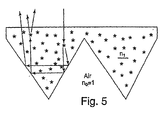
- sPS as a material of construction for microprismatic retroreflective film or sheeting has been found to result in novel cube-corner articles that combine the advantages of a high index of refraction polymer with that of a slightly diffuse reflector, since the crystalline entities scatter some of the light impinging the cube-comer elements.
- sPS microprismatics can be made with a range of crystalline character, resulting in a wide range of optical properties. In one extreme case, sPS microprismatics can be made to have large crystalline entities and be highly crystalline, thus having an opaque appearance. However, sPS microprismatics having low levels of crystallinity are very clear.
- the preferred sPS retroreflective articles of the present invention are generally characterized as having a high degree of transparency, normally required for retroreflection, and are further believed to have a distribution (in terms of both size and density) of crystalline structures.
- the resulting combination of good transparency, high index of refraction, and a small but non-zero amount of light scattering makes sPS an ideal material for increasing retroreflective brightness at wider observation angles.
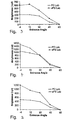
- sPS in spite of having an index of refraction not quite equal to that of polycarbonate, provides superior performance at high entrance angles. These phenomena are illustrated in FIGS. 2, 3, and 4.
- FIGS. 2 and 3 the brightness of sPS microprismatics far exceeds that obtained for PC at observation angles of 0.33° and 0.5° and this superiority is maintained over the entire accessible range of entrance angles. Data (not shown) obtained at many observation angles indicates that this situation persists at all observation angles larger than 0.33°.
- FIG. 4 shows that, for the smallest experimentally accessible observation angle of 0.2°, the sPS material underperforms PC for entrance angles below about 30°, but for larger entrance angles, the brightness of the sPS microprismatic meets or exceeds that of the PC.
- FIGS. 4 shows that, for the smallest experimentally accessible observation angle of 0.2°, the sPS material underperforms PC for entrance angles below about 30°, but for larger entrance angles, the brightness of the sPS microprismatic meets or exceeds that of the PC.
- any of the aforementioned semi-crystalline polymers which can be formed into transparent articles could be made to provide optical advantages similar to those detailed in this invention.
- One skilled in the art of polymer processing will appreciate that, through the use of nucleating agents, stretch-orientation, melt-quenching, or other techniques for manipulating the size and amount of crystalline entities, additional semicrystalline polymers not listed above may also be made to provide similar benefits.
- additional semicrystalline polymers not listed above may also be made to provide similar benefits.
- its combination of high index of refraction, good processing characteristics, thermal stability, hydrophobicity, and dimensional stability with respect to both temperature and humidity makes sPS a preferred cube-corner retroreflective material.
- sPS is a member of the broader class of syndiotactic vinyl aromatic polymers, and such resins useful in the instant invention can have a wide range of compositional characteristics, such as molecular weight and its distribution, monomer and comonomer identity, comonomer content, level of syndiotacticity, grafting or long chain branching, and the like.
- Syndiotactic vinyl aromatic polymers useful in the current invention include, but are not limited to, the syndiotactic varieties of poly(styrene), poly(alkyl styrene)s, poly (aryl styrene)s, poly(styrene halide)s, poly(alkoxy styrene)s, poly(vinyl ester benzoate), poly(vinyl naphthalene), poly(vinylstyrene), and poly(acenaphthalene), as well as the hydrogenated polymers and mixtures or copolymers containing these structural units.
- poly(alkyl styrene)s include the isomers of the following: poly(methylstyrene), poly(ethylstyrene), poly(propylstyrene), and poly(butylstyrene).
- poly(aryl styrene)s include the isomers of poly(phenylstyrene).
- examples include the isomers of the following: poly(chlorostyrene), poly(bromostyrene), and poly(fluorostyrene).
- poly(alkoxy styrene)s include the isomers of the following: poly(methoxystyrene) and poly(ethoxystyrene).
- preferable styrene group polymers are: polystyrene, poly(p-methyl styrene), poly(m-methyl styrene), poly(p-tertiary butyl styrene), poly(p-chlorostyrene), poly(m-chlorostyrene), poly(p-fluorostyrene), and copolymers of styrene and p-methylstyrene.
- polystyrene, poly(p-fluorostyrene), poly(p-methylstyrene) and copolymers of styrene and p-methylstyrene are most preferred.
- Syndiotacticity can be qualitatively and quantitatively determined by NMR analysis using the carbon isotope method ( 13 C-NMR).
- the tacticity as determined by the 13 C-NMR method can be indicated in terms of either the weight percent of a polymer which has a syndiotactic configuration or in terms of the proportions of structural units (diads and pentads) continuously connected to each other in the syndiotactic configuration.
- preferred syndiotactic polymers of the invention include about 20 to 100, preferably 30 to 98, more preferably 85 to 95, percent by weight of syndiotactic chain segments.
- preferred syndiotactic polymers have a syndiotacticity such that the proportion of the racemic diad is at least 75%, preferably at least 85%; and the proportion of racemic pentad is at least 30%, preferably at least 50%.
- the syndiotactic vinyl aromatic polymer may be grafted, copolymerized, or blended with various other monomeric or polymeric species to impart desired properties to the microprismatic retroreflective film or sheeting.
- the microprismatic retroreflective film or sheeting may comprise a polymer blend of a syndiotactic vinyl aromatic polymer and optionally, other kinds of syndiotactic and/or nonsyndiotactic polymers. Care must be taken in formulating such blends that the film or sheeting not be opacified via phase separation of the blend.
- polystyrene may be selected from among polyolefins such as polyethylene, polypropylene, polybutene, or polypentene; polyesters such as polyethylene terephthalate, polybutylene terephthalate, or polyethylene naphthalate; polyamides, polythioethers, polysulfones, polyurethanes, polyethersulfones, polyimides, halogenated vinyl polymers such as those sold under the tradename TEFLONTM, combinations of these, and the like.
- polymer blends preferably 0.01 to 50 parts by weight of other kinds of polymer(s) may be used per 100 parts by weight of syndiotactic vinyl aromatic polymer(s).
- a syndiotactic polystyrene may be blended with varying amounts of isotactic or atactic polystyrene.
- syndiotactic polystyrene polymer used in the present invention may be derived substantially entirely from unsubstituted styrene monomer, varying amounts of other copolymerizable monomers, some of which may contain alkyl, aryl, and other substituents, are more preferably incorporated into the polymer. Incorporation of a comonomer into a polymer serves both to slow the rate of crystallization from the melt, and limit the size of the crystallites.
- a preferred syndiotactic polystyrenic copolymer may be derived from monomers comprising about 100 parts by weight of styrene monomer and up to about 20 parts by weight of one or more other copolymerizable monomers, which may or may not possess pseudoasymmetry.
- Such other monomers in addition to the monomers for the homopolymers listed above in defining the syndiotactic vinyl aromatic polymers group, include olefin monomers, such as ethylene, propylene, butenes, pentenes, hexenes octenes and decenes; diene monomers such as butadiene and isoprene; cyclic olefin monomers; cyclic diene monomers; or polar vinyl monomers, such as methyl methacrylate, maleic anhydride, and acrylonitrile.
- olefin monomers such as ethylene, propylene, butenes, pentenes, hexenes octenes and decenes
- diene monomers such as butadiene and isoprene
- cyclic olefin monomers such as butadiene and isoprene
- cyclic olefin monomers such as methyl methacrylate, maleic an
- a particularly preferred syndiotactic polystyrenic copolymer is derived from 100 parts by weight styrene and 1 to 20, preferably 5 to 15, parts by weight paramethylstyrene. Incorporating such amounts of paramethylstyrene monomer into the polystyrene copolymer has been found to improve the transparency of the resulting microprismatic retroreflective film or sheeting.
- One example of a particularly preferred vinyl aromatic, syndiotactic polystyrenic polymer derived from 100 parts by weight styrene and 7 parts by weight of paramethylstyrene is commercially available under the trade designation QUESTRATM 406 from Dow Chemical Company.
- the molecular weight of the vinyl aromatic, syndiotactic polymer utilized in the films and sheeting of the present invention is not critical in many applications. Polymers having molecular weights within a wide range may be used with beneficial results. Generally, the weight average molecular weight (M w ) may be at least 10,000, preferably 50,000 to 3,000,000, and more preferably 50,000 to about 400,000. Likewise, the molecular weight distribution is not critical in many applications, and may be narrow or broad. For example, the ratio of M w :M n may be 1.0 to 10, wherein M n is the number average molecular weight.
- the microprismatic retroreflective film or sheeting of the present invention may optionally comprise one or more additives to enhance the physical properties of the film or sheeting.
- the film or sheeting may comprise colorants, inorganic fillers, ultraviolet ("UV") absorbers, light stabilizers, free radical scavengers, antioxidants, anti-static agents, processing aids such as antiblocking agents, lubricants, cross-linking agents, other additives and combinations thereof.
- Colorants typically are added at about 0.01 to 0.5 weight percent, based upon 100 parts by weight of the syndiotactic polymer.
- UVA additives UV absorbing additives and/or other compounds that act as excited state quenchers, hydroperoxide decomposers, or free radical scavengers.
- Hindered-amine light stabilizers HALS
- UVA additives act by absorbing radiation in the UV region of the spectrum.
- HALS behave by quenching radicals generated within the polymer matrix during exposure to UV radiation.
- UV absorbers typically are added at about 0.5 to 2.0 weight percent based upon 100 parts by weight of the syndiotactic polymer.
- suitable UV absorbers include derivatives of benzotriazole such as TINUVINTM 327, 328, 900, and 1130, and TINUVIN-PTM, available from Ciba-Geigy Corporation, Ardsley, New York; chemical derivatives of benzophenone such as UVINULTM M40, 408, and D-50, available from BASF Corporation, Clifton, New Jersey; SYNTASETM 230, 800, and 1200 available from Neville-Synthese Organics, Inc., Pittsburgh, Pennsylvania; chemical derivatives of diphenylacrylate such as UVINULTM N35, and 539, also available from BASF Corporation of Clifton, New Jersey; oxanilides such as Sanduvor VSU, available from Sandoz Corp.; triazines such as Cyasorb UV 1164, available from Cytac Industries; and salicylate derivatives.
- Light stabilizers that may be used include hindered amines, which are typically used at about 0.5 to 2.0 weight percent, based upon 100 parts by weight of the syndiotactic polymer.
- hindered amine light stabilizers include TINUVINTM 144, 292, 622, and 770, and CHIMASSORBTM 944 all available from the Ciba-Geigy Corp., Ardsley, New York, and 2,2,6,6-tetraalkyl piperidine compounds.
- Free radical scavengers may also be used, typically, at about 0.01 to 0.5 weight percent, based upon 100 parts by weight of the syndiotactic polymer.
- Suitable antioxidants include phosphorous antioxidants, including monophosphites and diphosphites, and phenolic antioxidants.
- Suitable monophosphites for use in the microprismatic retroreflective film or sheeting of the present invention include, but are not limited to, tris(2,4-tert-butyl-phenyl)phosphite) and tris(mono- or di-nonylphenyl)phosphite.
- Diphosphite antioxidants suitable for use in the present invention include, but are not limited to, distearylpentaerythritol diphosphite, and dioctylpentaerythritol diphosphite.
- phenolic antioxidants include 2,6-ditertbutyl-4-methylphenol, 2,6-diphenyl-4-methoxyphenol and 2,2'-methylenbis(6-tertbutyl-4-methylphenol).
- hindered phenolic resins such as IRGANOXTM 1010, 1076, 1035, 1425, or MD-1024, or IRGAFOSTM 168, commercially available from the Ciba-Geigy Corp., Ardsley, New York.
- the microprismatic retroreflective film or sheeting contains an amount of the IRGANOXTM 1425 antioxidant effective to enhance the transparency of the film or sheeting.
- This antioxidant has a melting point of about 260°C, which is about the same as the melting point of a syndiotactic polystyrene polymer. This material is believed to enhance transparency by reducing the rate of crystallinity of the syndiotactic polystyrene as the polymer solidifies from a molten state.
- this antioxidant be present in an amount of from about 0.0001 to 2 parts by weight, more preferably, from about 0.001 to 1 parts by weight, and most preferably, from about 0.01 to 0.5 parts by weight per 100 parts by weight of the syndiotactic vinyl aromatic polymer.
- processing aids typically no more than one part by weight per 100 parts by weight of the syndiotactic vinyl aromatic polymer, may be added to improve the polymer's processability.
- Useful processing aids include fatty acid esters, or fatty acid amides available from Glyco Inc., Norwalk, Connecticut, metallic stearates available from Henkel Corp., Hoboken, New Jersey, or WAX ETM available from Hoechst Celanese Corporation, Somerville, New Jersey.
- the syndiotactic vinyl aromatic polymer may also contain substances such as flame retardants that optimize the overall properties of the resultant film or sheeting.
- Inorganic fillers suitable for use in the microprismatic retroreflective films or sheeting of the present invention include, for example, oxides, hydroxides, sulfides, nitrides, halides, carbonates, acetates, phosphates, phosphites, organic carboxylates, silicates, titanates or borates of the group IA, IIA, IVA, VIA, VIIA, VIII, IB, IIB, IIIB or IVB elements, as well as hydrated compounds thereof.
- suitable inorganic fillers comprising a group IA element include lithium fluoride and borax (the hydrate salt of sodium borate).
- Suitable inorganic fillers comprising a group ILA element include magnesium carbonate, magnesium phosphate, magnesium oxide and magnesium chloride.
- Other suitable inorganic fillers comprising the aforementioned group elements are disclosed in U.S. Patent 5,188,930 (Funaki et al.), incorporated herein by reference.
- inorganic fillers will be governed by the effects they may have on the optical performance of the microprismatic retroreflective film or sheeting. It will be apparent to one skilled in the art that refractive index, particle size, and loading level all have a potential impact on optical performance of the present invention, which will serve to limit the use of inorganic fillers.
- particulate inorganic fillers could be added to high index of refraction amorphous polymers, such as polycarbonate, polymethyl methacrylate, or atactic polystyrene, to yield a similar refractive effect to that described above for unfilled semicrystalline sPS.
- particulate inorganic fillers of appropriate particle sizes and at appropriate loading levels, could be used as optically reacting elements in a manner similar to that of the crystalline entities in sPS.
- particulate inorganic fillers could be used in a semicrystalline polymer such as sPS to augment or optimize the refractive effect described herein. Additionally, such an effect may also be achieved by combining sPS, or other transparent semicrystalline polymer, with an appropriate amount of an appropriately dispersed incompatible polymer, in the form of a polymer blend.
- Neat (unfilled and unblended) sPS, or copolymers thereof provides several other advantageous properties that further differentiates its utility (both optically and in ease of processing) in the retroreflective articles detailed herein and these are discussed below.
- sPS has an inherently low surface energy (29.4 dynes/cm), which allows for its removal, with a minimum of effort, from the tooling used for microreplication. This property can be further improved by the use of lubricants and additives well known in the art for the purpose of aiding mold release. Failure of polymers to release cleanly and easily from tooling or molds typically employed in commercial microreplication processing has severely limited the utility of many other amorphous and semi-crystalline polymers.
- sPS has a low coefficient of hygroscopic expansion (CHE) and good thermal stability, which render an sPS microprismatic film dimensionally stable when exposed to extremes of environmental temperature and humidity.
- CHE hygroscopic expansion
- sPS microprismatic film with a UV blocking coating, as disclosed in U.S. patent No. US 5,981,076 (Ojeda) (which is incorporated herein by reference), or laminating a transparent UV absorber loaded overlay film (see, U.S. Pat. 4,895,428 (Nelson et al.)) to the microprismatic film or sheeting, further enhances its utility by protecting it from the environment and UV degradation.
- the former is more preferred in commercial practice as it simplifies the manufacturing process and reduces the cost of the final product.
- Microprismatic retroreflective film and sheeting of the present invention may be fabricated using any one of a number of processing techniques (molding, embossing, casting, etc.), and any of the various forms of microprismatic optical tooling disclosed in the art may be utilized.
- the thickness of the microprismatic retroreflective film or sheeting is not limited, but must be accommodated by the process conditions. That is, sheets of different thicknesses will require differing quenching conditions to achieve the same levels of crystalline entity size and degree of crystallinity. In some applications, it will be desirable for the retroreflective film or sheeting to be flexible, and in other cases, rigidity will be required by the intended application. These and processing equipment capabilities will determine optimum thickness.
- a backing or sealing film may be applied to the microprismatic sheeting by heat sealing at discrete locations in a grid-like pattern to prevent the entry of foreign substances (moisture, air-borne pollutants, dirt, etc.) that can reduce the efficacy of the cube-corner film.
- This film also serves to preserve the air layer adjacent to the cube-corners, thus permitting TIR without the need for metallizing the cube-corner elements.
- PC retroreflective cube-corner film was compression molded using microstructured nickel tooling.
- the microstructured nickel tooling utilized contains microcube prism recesses of approximately 88 micrometers (0.0035 inch).
- the microcube recesses were formed as matched pairs of cube comer elements with the optical axis canted or tilted 8.15 degrees away from the primary groove, as generally illustrated in U.S. Pat No. 4,588,258 (Hoopman).
- the nickel tooling thickness was approximately 508 micrometers (0.020 inch).
- An isotropic, 500 ⁇ m thick PC (Bayer 2407) melt-cast specimen was placed in the molding device between the microstructured nickel tooling and a polished steel plate, to provide an embossed (patterned) surface and an opposing smooth surface.
- the specimen was prepared using platen temperatures of 400 °F (204 °C), and a pressure of 25 kpsi for 2 minutes. The pressed specimen was then immediately quenched by rapid immersion into ice water.
- Angular brightness measurements were obtained on unsealed specimens using the method described in U.S. Pat. No. 5,138,488 (Szczech), according to U.S. Federal Test Method Standard 370, using an orientation angle of 0°.
- the angular brightness data is presented in Table I, and plotted as the curves labelled "PC" in FIGS. 2-4.
- Syndiotactic polystyrene (sPS) cube-corner film was prepared by compression molding a 250 ⁇ m thick melt-cast specimen by the procedures described in Comparative Example C1, with the exception that the platen temperatures were 500 °F (260 °C).
- the sPS resin used reportedly had a weight-averaged molecular weight of 275,000, and contained 14% para-methylstyrene (pMS) as a comonomer.
- the resin was obtained from the Dow Chemical Company (Midland, MI).
- the melt-cast specimen exhibited an onset temperature for crystallization, T c (onset), of 198°C, a peak temperature for crystallization, T c (peak), of 193°C, and a melting point peak temperature, T m , of 243°C, as measured by differential scanning calorimetry (DSC).
- sPS cube-corner film was prepared in a manner similar to Example 1.
- the sPS resin used (Questra 406 - Dow Chemical Company - Midland, MI) reportedly had a weight-averaged molecular weight of 325,000, and contained 7% pMS as a comonomer.
- DSC measurements on the melt-cast specimens indicated a T c (onset) of 197°C, T c (peak) of 185°C, and a T m of 247°C.
- sPS cube-corner films were prepared in a manner similar to Example 1.
- the sPS resins used were sPS homopolymer (Example C2) and an sPS copolymer containing 4% pMS (Example C3).
- the resins were obtained from the Dow Chemical Company (Midland, MI), and each reportedly had a weight-averaged molecular weight of 275,000.
- DSC measurements on the melt-cast specimens of Example C2 indicated a T c (onset) of 230°C, T c (peak) of 226°C, and a T m of 263°C.
- DSC measurements on the melt-cast specimens of Example C3 indicated a T c (onset) of 217°C, T c (peak) of 212°C, and a T m of 254°C.
Landscapes
- Physics & Mathematics (AREA)
- General Physics & Mathematics (AREA)
- Optics & Photonics (AREA)
- Manufacture Of Macromolecular Shaped Articles (AREA)
- Optical Elements Other Than Lenses (AREA)
- Compositions Of Macromolecular Compounds (AREA)
- Laminated Bodies (AREA)
Applications Claiming Priority (3)
| Application Number | Priority Date | Filing Date | Title |
|---|---|---|---|
| US09/240,342 US6274221B2 (en) | 1999-01-29 | 1999-01-29 | Angular brightness microprismatic retroreflective film or sheeting incorporating a syndiotactic vinyl aromatic polymer |
| US240342 | 1999-01-29 | ||
| PCT/US1999/010935 WO2000045200A1 (en) | 1999-01-29 | 1999-05-18 | Improved angular brightness microprismatic retroreflective film or sheeting incorporating a syndiotactic vinyl aromatic polymer |
Publications (2)
| Publication Number | Publication Date |
|---|---|
| EP1149316A1 EP1149316A1 (en) | 2001-10-31 |
| EP1149316B1 true EP1149316B1 (en) | 2002-12-11 |
Family
ID=22906145
Family Applications (1)
| Application Number | Title | Priority Date | Filing Date |
|---|---|---|---|
| EP99925656A Expired - Lifetime EP1149316B1 (en) | 1999-01-29 | 1999-05-18 | Improved angular brightness microprismatic retroreflective film or sheeting incorporating a syndiotactic vinyl aromatic polymer |
Country Status (10)
| Country | Link |
|---|---|
| US (1) | US6274221B2 (enExample) |
| EP (1) | EP1149316B1 (enExample) |
| JP (1) | JP2002535734A (enExample) |
| KR (1) | KR100606311B1 (enExample) |
| CN (1) | CN1161626C (enExample) |
| AU (1) | AU4190199A (enExample) |
| BR (1) | BR9916982A (enExample) |
| CA (1) | CA2355369A1 (enExample) |
| DE (1) | DE69904512T2 (enExample) |
| WO (1) | WO2000045200A1 (enExample) |
Families Citing this family (48)
| Publication number | Priority date | Publication date | Assignee | Title |
|---|---|---|---|---|
| US5910854A (en) | 1993-02-26 | 1999-06-08 | Donnelly Corporation | Electrochromic polymeric solid films, manufacturing electrochromic devices using such solid films, and processes for making such solid films and devices |
| US5668663A (en) | 1994-05-05 | 1997-09-16 | Donnelly Corporation | Electrochromic mirrors and devices |
| US6891563B2 (en) | 1996-05-22 | 2005-05-10 | Donnelly Corporation | Vehicular vision system |
| US6326613B1 (en) | 1998-01-07 | 2001-12-04 | Donnelly Corporation | Vehicle interior mirror assembly adapted for containing a rain sensor |
| US6172613B1 (en) | 1998-02-18 | 2001-01-09 | Donnelly Corporation | Rearview mirror assembly incorporating vehicle information display |
| US6124886A (en) | 1997-08-25 | 2000-09-26 | Donnelly Corporation | Modular rearview mirror assembly |
| US8294975B2 (en) | 1997-08-25 | 2012-10-23 | Donnelly Corporation | Automotive rearview mirror assembly |
| US6445287B1 (en) | 2000-02-28 | 2002-09-03 | Donnelly Corporation | Tire inflation assistance monitoring system |
| US8288711B2 (en) | 1998-01-07 | 2012-10-16 | Donnelly Corporation | Interior rearview mirror system with forwardly-viewing camera and a control |
| US6690268B2 (en) | 2000-03-02 | 2004-02-10 | Donnelly Corporation | Video mirror systems incorporating an accessory module |
| US6477464B2 (en) | 2000-03-09 | 2002-11-05 | Donnelly Corporation | Complete mirror-based global-positioning system (GPS) navigation solution |
| US6329925B1 (en) | 1999-11-24 | 2001-12-11 | Donnelly Corporation | Rearview mirror assembly with added feature modular display |
| US6693517B2 (en) | 2000-04-21 | 2004-02-17 | Donnelly Corporation | Vehicle mirror assembly communicating wirelessly with vehicle accessories and occupants |
| WO2007053710A2 (en) | 2005-11-01 | 2007-05-10 | Donnelly Corporation | Interior rearview mirror with display |
| US7370983B2 (en) | 2000-03-02 | 2008-05-13 | Donnelly Corporation | Interior mirror assembly with display |
| US7195381B2 (en) | 2001-01-23 | 2007-03-27 | Donnelly Corporation | Vehicle interior LED lighting system |
| US7167796B2 (en) | 2000-03-09 | 2007-01-23 | Donnelly Corporation | Vehicle navigation system for use with a telematics system |
| WO2001079340A1 (en) * | 2000-04-13 | 2001-10-25 | 3M Innovative Properties Company | Light stable articles |
| US7255451B2 (en) | 2002-09-20 | 2007-08-14 | Donnelly Corporation | Electro-optic mirror cell |
| US7581859B2 (en) | 2005-09-14 | 2009-09-01 | Donnelly Corp. | Display device for exterior rearview mirror |
| WO2006124682A2 (en) | 2005-05-16 | 2006-11-23 | Donnelly Corporation | Vehicle mirror assembly with indicia at reflective element |
| US6918674B2 (en) | 2002-05-03 | 2005-07-19 | Donnelly Corporation | Vehicle rearview mirror system |
| US7329013B2 (en) | 2002-06-06 | 2008-02-12 | Donnelly Corporation | Interior rearview mirror system with compass |
| WO2003105099A1 (en) | 2002-06-06 | 2003-12-18 | Donnelly Corporation | Interior rearview mirror system with compass |
| US7310177B2 (en) | 2002-09-20 | 2007-12-18 | Donnelly Corporation | Electro-optic reflective element assembly |
| WO2004026633A2 (en) | 2002-09-20 | 2004-04-01 | Donnelly Corporation | Mirror reflective element assembly |
| US20040082947A1 (en) | 2002-10-25 | 2004-04-29 | The Regents Of The University Of Michigan | Ablation catheters |
| BRPI0407979A (pt) | 2003-03-04 | 2006-03-07 | Valspar Sourcing Inc | sistema de gerenciamento de eletrorevestimento |
| US7289037B2 (en) | 2003-05-19 | 2007-10-30 | Donnelly Corporation | Mirror assembly for vehicle |
| US7446924B2 (en) | 2003-10-02 | 2008-11-04 | Donnelly Corporation | Mirror reflective element assembly including electronic component |
| US7308341B2 (en) | 2003-10-14 | 2007-12-11 | Donnelly Corporation | Vehicle communication system |
| KR20130008643A (ko) * | 2004-12-28 | 2013-01-22 | 쓰리엠 이노베이티브 프로퍼티즈 컴파니 | 불소- 또는 규소-함유 프리즘을 갖는 프리즘 역반사 물품 |
| US7195360B2 (en) * | 2004-12-28 | 2007-03-27 | 3M Innovative Properties Company | Prismatic retroreflective article and method |
| GB0504959D0 (en) † | 2005-03-10 | 2005-04-20 | Rue International De La Ltd | Security device based on customised microprism film |
| US20070064098A1 (en) * | 2005-09-19 | 2007-03-22 | Available For Licensing | Systems and methods for 3D rendering |
| JP2008249963A (ja) * | 2007-03-30 | 2008-10-16 | Nippon Carbide Ind Co Inc | 再帰反射シート |
| DE102007015747A1 (de) | 2007-03-30 | 2008-10-02 | Erich Utsch Ag | Lichtleiteranordnung zur Ausleuchtung eines an einem Kfz befestigten retroreflektierenden Kfz-Kennzeichenschilds, Montagevorrichtung mit einer solchen Lichtleiteranordnung sowie beleuchtete retroreflektierende Kfz-Kennzeichen...... |
| US7547105B2 (en) * | 2007-07-16 | 2009-06-16 | 3M Innovative Properties Company | Prismatic retroreflective article with cross-linked image layer and method of making same |
| DE102007036468A1 (de) | 2007-07-23 | 2009-01-29 | Evonik Röhm Gmbh | Heckelement für ein Kraftfahrzeug umfassend eine Beleuchtungseinheit |
| US8154418B2 (en) | 2008-03-31 | 2012-04-10 | Magna Mirrors Of America, Inc. | Interior rearview mirror system |
| US9487144B2 (en) | 2008-10-16 | 2016-11-08 | Magna Mirrors Of America, Inc. | Interior mirror assembly with display |
| JP2010205513A (ja) * | 2009-03-02 | 2010-09-16 | Toppan Printing Co Ltd | El素子、並びにそれを用いた表示装置、ディスプレイ装置、及び液晶ディスプレイ装置 |
| DE102009028937A1 (de) | 2009-08-27 | 2011-03-03 | Evonik Röhm Gmbh | Schild für KFZ-Kennzeichen umfassend mindestens eine transluzente, retroreflektierende Schicht |
| JP6074128B2 (ja) * | 2010-04-15 | 2017-02-01 | デクセリアルズ株式会社 | 光学体およびその製造方法、日射遮蔽部材、窓材、内装部材ならびに建具 |
| US9230459B2 (en) | 2012-11-29 | 2016-01-05 | Dell Products L.P. | Ambience reflective display frame |
| US20160011346A1 (en) | 2014-07-14 | 2016-01-14 | Sergiy Vasylyev | High incidence angle retroreflective sheeting |
| CN111247460A (zh) | 2017-08-29 | 2020-06-05 | 艾利丹尼森公司 | 用于基于投影机的显示系统的回射片 |
| CN113646669B (zh) | 2019-02-08 | 2023-09-01 | 艾利丹尼森公司 | 柔性逆反射片材 |
Family Cites Families (39)
| Publication number | Priority date | Publication date | Assignee | Title |
|---|---|---|---|---|
| US3810804A (en) | 1970-09-29 | 1974-05-14 | Rowland Dev Corp | Method of making retroreflective material |
| US3684348A (en) | 1970-09-29 | 1972-08-15 | Rowland Dev Corp | Retroreflective material |
| US3712706A (en) | 1971-01-04 | 1973-01-23 | American Cyanamid Co | Retroreflective surface |
| US3712716A (en) | 1971-04-09 | 1973-01-23 | Stanford Research Inst | Eye tracker |
| JPS5320837B1 (enExample) | 1971-07-07 | 1978-06-29 | ||
| US4025159A (en) | 1976-02-17 | 1977-05-24 | Minnesota Mining And Manufacturing Company | Cellular retroreflective sheeting |
| US4332847A (en) | 1979-09-20 | 1982-06-01 | Relfexite Corporation | Method for compression molding of retroreflective sheeting and sheeting produced thereby |
| US4244683A (en) | 1979-09-20 | 1981-01-13 | Reflexite Corporation | Apparatus for compression molding of retroreflective sheeting |
| US4601861A (en) | 1982-09-30 | 1986-07-22 | Amerace Corporation | Methods and apparatus for embossing a precision optical pattern in a resinous sheet or laminate |
| US4486363A (en) | 1982-09-30 | 1984-12-04 | Amerace Corporation | Method and apparatus for embossing a precision optical pattern in a resinous sheet |
| US4588258A (en) | 1983-09-12 | 1986-05-13 | Minnesota Mining And Manufacturing Company | Cube-corner retroreflective articles having wide angularity in multiple viewing planes |
| JPS62187708A (ja) | 1985-11-11 | 1987-08-17 | Idemitsu Kosan Co Ltd | スチレン系重合体の製造法 |
| US4775219A (en) | 1986-11-21 | 1988-10-04 | Minnesota Mining & Manufacturing Company | Cube-corner retroreflective articles having tailored divergence profiles |
| US5270442A (en) | 1988-01-13 | 1993-12-14 | Idemitsu Kosan Co., Ltd. | Styrene-based polymer moldings |
| US4895428A (en) | 1988-07-26 | 1990-01-23 | Minnesota Mining And Manufacturing Company | High efficiency retroreflective material |
| US5145950A (en) | 1988-08-31 | 1992-09-08 | Idemitsu Kosan Co., Ltd. | Method of storing food or plant materials by wrapping with a stretched syndiotactic polystyrene film |
| US5089353A (en) | 1988-10-14 | 1992-02-18 | Kuraray Co., Ltd. | Multi-layer material having gas barrier properties |
| US5082717A (en) | 1988-12-16 | 1992-01-21 | Idemitsu Petrochemical Co., Ltd. | Styrene-based resin composite material |
| US5273830A (en) | 1988-12-16 | 1993-12-28 | Idemitsu Petrochemical Co., Ltd. | Magnetic recording medium comprising a syndiotactic styrene-based polymer substrate, a magnetic layer and a backcoat lubricating layer each layer containing a curable phosphazine compound |
| US5127158A (en) | 1989-09-06 | 1992-07-07 | Idemitsu Kosan Co., Ltd. | Process for producing a printed circuit board with a syndiotactic polystyrene support |
| US5476899A (en) | 1989-09-14 | 1995-12-19 | Idemitsu Kosan Co., Ltd. | Process for produce a readily slidable film |
| US5219940A (en) | 1989-10-13 | 1993-06-15 | Idemitsu Kosan Co., Ltd. | Styrene polymer composition |
| US5138488A (en) | 1990-09-10 | 1992-08-11 | Minnesota Mining And Manufacturing Company | Retroreflective material with improved angularity |
| JP3080671B2 (ja) | 1991-02-07 | 2000-08-28 | 出光石油化学株式会社 | 積層体 |
| US5699188A (en) * | 1995-06-26 | 1997-12-16 | Minnesota Mining And Manufacturing Co. | Metal-coated multilayer mirror |
| EP0755972B1 (en) * | 1995-07-24 | 1999-09-15 | Rohm And Haas Company | Styrenic polymer composition |
| CN1068822C (zh) * | 1995-07-28 | 2001-07-25 | 日本碳化物工业株式会社 | 微棱镜母型的制造方法 |
| US5706132A (en) | 1996-01-19 | 1998-01-06 | Minnesota Mining And Manufacturing Company | Dual orientation retroreflective sheeting |
| US5783120A (en) * | 1996-02-29 | 1998-07-21 | Minnesota Mining And Manufacturing Company | Method for making an optical film |
| CA2198971A1 (en) | 1996-03-06 | 1997-09-06 | Idemitsu Petrochemical Company Limited | A method for manufacturing thermo-plastic sheets bearing embossed patterns thereon and an apparatus therefor |
| US5784197A (en) * | 1996-04-01 | 1998-07-21 | Minnesota Mining And Manufacturing Company | Ultra-flexible retroreflective sheeting with coated back surface |
| US5882796A (en) * | 1996-04-01 | 1999-03-16 | Minnesota Mining And Manufacturing Company | Bonded structured retroreflective sheeting |
| US5754338A (en) * | 1996-04-01 | 1998-05-19 | Minnesota Mining And Manufacturing Company | Structured retroreflective sheeting having a rivet-like connection |
| US5910858A (en) * | 1996-04-01 | 1999-06-08 | Minnesota Mining And Manufacturing Company | Retroreflective sheeting with coated back surface |
| ATE209098T1 (de) | 1996-06-26 | 2001-12-15 | Idemitsu Petrochemical Co | Verfahren zum musterprägen einer folie und vorrichtung zur musterprägung |
| US5808794A (en) * | 1996-07-31 | 1998-09-15 | Weber; Michael F. | Reflective polarizers having extended red band edge for controlled off axis color |
| US5932626A (en) * | 1997-05-09 | 1999-08-03 | Minnesota Mining And Manufacturing Company | Optical product prepared from high index of refraction brominated monomers |
| KR20010013165A (ko) * | 1997-05-30 | 2001-02-26 | 그래햄 이. 테일러 | 장쇄 분지 신디오택틱 비닐 방향족 중합체 |
| US6024455A (en) * | 1998-01-13 | 2000-02-15 | 3M Innovative Properties Company | Reflective article with concealed retroreflective pattern |
-
1999
- 1999-01-29 US US09/240,342 patent/US6274221B2/en not_active Expired - Lifetime
- 1999-05-18 KR KR1020017009568A patent/KR100606311B1/ko not_active Expired - Fee Related
- 1999-05-18 CA CA002355369A patent/CA2355369A1/en not_active Abandoned
- 1999-05-18 BR BR9916982-7A patent/BR9916982A/pt not_active Application Discontinuation
- 1999-05-18 EP EP99925656A patent/EP1149316B1/en not_active Expired - Lifetime
- 1999-05-18 DE DE69904512T patent/DE69904512T2/de not_active Expired - Fee Related
- 1999-05-18 WO PCT/US1999/010935 patent/WO2000045200A1/en not_active Ceased
- 1999-05-18 JP JP2000596398A patent/JP2002535734A/ja not_active Withdrawn
- 1999-05-18 CN CNB998159204A patent/CN1161626C/zh not_active Expired - Fee Related
- 1999-05-18 AU AU41901/99A patent/AU4190199A/en not_active Abandoned
Also Published As
| Publication number | Publication date |
|---|---|
| JP2002535734A (ja) | 2002-10-22 |
| AU4190199A (en) | 2000-08-18 |
| KR20010101867A (ko) | 2001-11-15 |
| CN1161626C (zh) | 2004-08-11 |
| CA2355369A1 (en) | 2000-08-03 |
| BR9916982A (pt) | 2001-11-27 |
| EP1149316A1 (en) | 2001-10-31 |
| DE69904512D1 (de) | 2003-01-23 |
| WO2000045200A1 (en) | 2000-08-03 |
| DE69904512T2 (de) | 2003-11-13 |
| CN1334926A (zh) | 2002-02-06 |
| KR100606311B1 (ko) | 2006-07-28 |
| US20010008679A1 (en) | 2001-07-19 |
| US6274221B2 (en) | 2001-08-14 |
Similar Documents
| Publication | Publication Date | Title |
|---|---|---|
| EP1149316B1 (en) | Improved angular brightness microprismatic retroreflective film or sheeting incorporating a syndiotactic vinyl aromatic polymer | |
| CN1040694C (zh) | 柔性立方角逆向反光薄片 | |
| US8297761B2 (en) | Retroreflective articles comprising olefinic seal films | |
| EP0875008B1 (en) | Dual orientation retroreflective sheeting | |
| US9746592B2 (en) | Multi-layer sealing films | |
| US10094960B2 (en) | Retroreflective sheeting including a low elastic modulus layer | |
| US20200319384A1 (en) | Retroreflective sheeting including a solvent-based topcoat | |
| KR102275227B1 (ko) | 실질적으로 무정형인 중합체성 층을 포함하는 재귀반사성 시트류 | |
| EP2694573A2 (en) | Films including triazine-based ultraviolet absorbers | |
| KR100901672B1 (ko) | 위상차판 | |
| CA2526469C (en) | Retroreflective article comprising a microstructured adhesive layer | |
| JP2022040205A (ja) | 微細構造化物品上のバリア要素 | |
| KR20060060922A (ko) | 재귀반사시트 |
Legal Events
| Date | Code | Title | Description |
|---|---|---|---|
| PUAI | Public reference made under article 153(3) epc to a published international application that has entered the european phase |
Free format text: ORIGINAL CODE: 0009012 |
|
| 17P | Request for examination filed |
Effective date: 20010823 |
|
| AK | Designated contracting states |
Kind code of ref document: A1 Designated state(s): BE DE FR GB IT NL |
|
| GRAG | Despatch of communication of intention to grant |
Free format text: ORIGINAL CODE: EPIDOS AGRA |
|
| 17Q | First examination report despatched |
Effective date: 20011206 |
|
| GRAG | Despatch of communication of intention to grant |
Free format text: ORIGINAL CODE: EPIDOS AGRA |
|
| GRAG | Despatch of communication of intention to grant |
Free format text: ORIGINAL CODE: EPIDOS AGRA |
|
| GRAH | Despatch of communication of intention to grant a patent |
Free format text: ORIGINAL CODE: EPIDOS IGRA |
|
| GRAH | Despatch of communication of intention to grant a patent |
Free format text: ORIGINAL CODE: EPIDOS IGRA |
|
| GRAA | (expected) grant |
Free format text: ORIGINAL CODE: 0009210 |
|
| AK | Designated contracting states |
Kind code of ref document: B1 Designated state(s): BE DE FR GB IT NL |
|
| PG25 | Lapsed in a contracting state [announced via postgrant information from national office to epo] |
Ref country code: NL Free format text: LAPSE BECAUSE OF FAILURE TO SUBMIT A TRANSLATION OF THE DESCRIPTION OR TO PAY THE FEE WITHIN THE PRESCRIBED TIME-LIMIT Effective date: 20021211 Ref country code: IT Free format text: LAPSE BECAUSE OF FAILURE TO SUBMIT A TRANSLATION OF THE DESCRIPTION OR TO PAY THE FEE WITHIN THE PRESCRIBED TIME-LIMIT;WARNING: LAPSES OF ITALIAN PATENTS WITH EFFECTIVE DATE BEFORE 2007 MAY HAVE OCCURRED AT ANY TIME BEFORE 2007. THE CORRECT EFFECTIVE DATE MAY BE DIFFERENT FROM THE ONE RECORDED. Effective date: 20021211 Ref country code: FR Free format text: LAPSE BECAUSE OF FAILURE TO SUBMIT A TRANSLATION OF THE DESCRIPTION OR TO PAY THE FEE WITHIN THE PRESCRIBED TIME-LIMIT Effective date: 20021211 Ref country code: BE Free format text: LAPSE BECAUSE OF FAILURE TO SUBMIT A TRANSLATION OF THE DESCRIPTION OR TO PAY THE FEE WITHIN THE PRESCRIBED TIME-LIMIT Effective date: 20021211 |
|
| REG | Reference to a national code |
Ref country code: GB Ref legal event code: FG4D |
|
| REF | Corresponds to: |
Ref document number: 69904512 Country of ref document: DE Date of ref document: 20030123 |
|
| NLV1 | Nl: lapsed or annulled due to failure to fulfill the requirements of art. 29p and 29m of the patents act | ||
| PLBE | No opposition filed within time limit |
Free format text: ORIGINAL CODE: 0009261 |
|
| STAA | Information on the status of an ep patent application or granted ep patent |
Free format text: STATUS: NO OPPOSITION FILED WITHIN TIME LIMIT |
|
| EN | Fr: translation not filed | ||
| 26N | No opposition filed |
Effective date: 20030912 |
|
| PGFP | Annual fee paid to national office [announced via postgrant information from national office to epo] |
Ref country code: DE Payment date: 20070702 Year of fee payment: 9 |
|
| PGFP | Annual fee paid to national office [announced via postgrant information from national office to epo] |
Ref country code: GB Payment date: 20070525 Year of fee payment: 9 |
|
| GBPC | Gb: european patent ceased through non-payment of renewal fee |
Effective date: 20080518 |
|
| PG25 | Lapsed in a contracting state [announced via postgrant information from national office to epo] |
Ref country code: DE Free format text: LAPSE BECAUSE OF NON-PAYMENT OF DUE FEES Effective date: 20081202 |
|
| PG25 | Lapsed in a contracting state [announced via postgrant information from national office to epo] |
Ref country code: GB Free format text: LAPSE BECAUSE OF NON-PAYMENT OF DUE FEES Effective date: 20080518 |