EP1136853B1 - Two-dimensional photonic crystal waveguides and wavelength demultiplexers - Google Patents
Two-dimensional photonic crystal waveguides and wavelength demultiplexers Download PDFInfo
- Publication number
- EP1136853B1 EP1136853B1 EP01106812A EP01106812A EP1136853B1 EP 1136853 B1 EP1136853 B1 EP 1136853B1 EP 01106812 A EP01106812 A EP 01106812A EP 01106812 A EP01106812 A EP 01106812A EP 1136853 B1 EP1136853 B1 EP 1136853B1
- Authority
- EP
- European Patent Office
- Prior art keywords
- photonic crystal
- waveguide
- light
- slab
- electromagnetic radiation
- Prior art date
- Legal status (The legal status is an assumption and is not a legal conclusion. Google has not performed a legal analysis and makes no representation as to the accuracy of the status listed.)
- Expired - Lifetime
Links
- 239000004038 photonic crystal Substances 0.000 title claims description 79
- 230000007547 defect Effects 0.000 claims description 75
- 230000005670 electromagnetic radiation Effects 0.000 claims description 59
- 239000000463 material Substances 0.000 claims description 33
- 230000000737 periodic effect Effects 0.000 claims description 13
- 238000009826 distribution Methods 0.000 claims description 6
- 230000001902 propagating effect Effects 0.000 claims description 6
- 239000013307 optical fiber Substances 0.000 claims description 3
- 239000004065 semiconductor Substances 0.000 claims description 3
- 229910052710 silicon Inorganic materials 0.000 claims description 3
- 229910052782 aluminium Inorganic materials 0.000 claims description 2
- 229910052787 antimony Inorganic materials 0.000 claims description 2
- 229910052785 arsenic Inorganic materials 0.000 claims description 2
- 238000006243 chemical reaction Methods 0.000 claims description 2
- 229910052733 gallium Inorganic materials 0.000 claims description 2
- 229910052732 germanium Inorganic materials 0.000 claims description 2
- 229910052738 indium Inorganic materials 0.000 claims description 2
- 229910010272 inorganic material Inorganic materials 0.000 claims description 2
- 239000011147 inorganic material Substances 0.000 claims description 2
- 229910052757 nitrogen Inorganic materials 0.000 claims description 2
- 239000011368 organic material Substances 0.000 claims description 2
- 229910052698 phosphorus Inorganic materials 0.000 claims description 2
- 230000003287 optical effect Effects 0.000 description 9
- 238000000034 method Methods 0.000 description 8
- 238000001020 plasma etching Methods 0.000 description 6
- 239000000758 substrate Substances 0.000 description 6
- 239000013078 crystal Substances 0.000 description 5
- VYPSYNLAJGMNEJ-UHFFFAOYSA-N Silicium dioxide Chemical compound O=[Si]=O VYPSYNLAJGMNEJ-UHFFFAOYSA-N 0.000 description 4
- 238000010276 construction Methods 0.000 description 4
- 239000000835 fiber Substances 0.000 description 3
- 238000004458 analytical method Methods 0.000 description 2
- 229910052681 coesite Inorganic materials 0.000 description 2
- 238000004891 communication Methods 0.000 description 2
- 229910052906 cristobalite Inorganic materials 0.000 description 2
- 230000001419 dependent effect Effects 0.000 description 2
- 238000000609 electron-beam lithography Methods 0.000 description 2
- 238000004519 manufacturing process Methods 0.000 description 2
- 239000012528 membrane Substances 0.000 description 2
- 229920002120 photoresistant polymer Polymers 0.000 description 2
- 230000008569 process Effects 0.000 description 2
- 230000000644 propagated effect Effects 0.000 description 2
- 238000011160 research Methods 0.000 description 2
- 238000012552 review Methods 0.000 description 2
- 239000000377 silicon dioxide Substances 0.000 description 2
- 229910052682 stishovite Inorganic materials 0.000 description 2
- 229910052905 tridymite Inorganic materials 0.000 description 2
- 229910001218 Gallium arsenide Inorganic materials 0.000 description 1
- XUIMIQQOPSSXEZ-UHFFFAOYSA-N Silicon Chemical compound [Si] XUIMIQQOPSSXEZ-UHFFFAOYSA-N 0.000 description 1
- 238000003491 array Methods 0.000 description 1
- 230000015572 biosynthetic process Effects 0.000 description 1
- 230000008878 coupling Effects 0.000 description 1
- 238000010168 coupling process Methods 0.000 description 1
- 238000005859 coupling reaction Methods 0.000 description 1
- 238000010586 diagram Methods 0.000 description 1
- 230000000694 effects Effects 0.000 description 1
- 230000005684 electric field Effects 0.000 description 1
- 238000010894 electron beam technology Methods 0.000 description 1
- 238000005530 etching Methods 0.000 description 1
- 239000012212 insulator Substances 0.000 description 1
- 238000002488 metal-organic chemical vapour deposition Methods 0.000 description 1
- 238000005459 micromachining Methods 0.000 description 1
- 239000000203 mixture Substances 0.000 description 1
- 238000012986 modification Methods 0.000 description 1
- 230000004048 modification Effects 0.000 description 1
- 229910021421 monocrystalline silicon Inorganic materials 0.000 description 1
- 230000035699 permeability Effects 0.000 description 1
- 230000005855 radiation Effects 0.000 description 1
- 239000010703 silicon Substances 0.000 description 1
- 238000001228 spectrum Methods 0.000 description 1
- 230000002269 spontaneous effect Effects 0.000 description 1
- 230000036962 time dependent Effects 0.000 description 1
- 230000009466 transformation Effects 0.000 description 1
- 238000001039 wet etching Methods 0.000 description 1
Images


Classifications
-
- B—PERFORMING OPERATIONS; TRANSPORTING
- B82—NANOTECHNOLOGY
- B82Y—SPECIFIC USES OR APPLICATIONS OF NANOSTRUCTURES; MEASUREMENT OR ANALYSIS OF NANOSTRUCTURES; MANUFACTURE OR TREATMENT OF NANOSTRUCTURES
- B82Y20/00—Nanooptics, e.g. quantum optics or photonic crystals
-
- G—PHYSICS
- G02—OPTICS
- G02B—OPTICAL ELEMENTS, SYSTEMS OR APPARATUS
- G02B6/00—Light guides; Structural details of arrangements comprising light guides and other optical elements, e.g. couplings
- G02B6/10—Light guides; Structural details of arrangements comprising light guides and other optical elements, e.g. couplings of the optical waveguide type
- G02B6/12—Light guides; Structural details of arrangements comprising light guides and other optical elements, e.g. couplings of the optical waveguide type of the integrated circuit kind
- G02B6/122—Basic optical elements, e.g. light-guiding paths
- G02B6/1225—Basic optical elements, e.g. light-guiding paths comprising photonic band-gap structures or photonic lattices
-
- G—PHYSICS
- G02—OPTICS
- G02B—OPTICAL ELEMENTS, SYSTEMS OR APPARATUS
- G02B6/00—Light guides; Structural details of arrangements comprising light guides and other optical elements, e.g. couplings
- G02B6/10—Light guides; Structural details of arrangements comprising light guides and other optical elements, e.g. couplings of the optical waveguide type
- G02B6/12—Light guides; Structural details of arrangements comprising light guides and other optical elements, e.g. couplings of the optical waveguide type of the integrated circuit kind
- G02B6/12007—Light guides; Structural details of arrangements comprising light guides and other optical elements, e.g. couplings of the optical waveguide type of the integrated circuit kind forming wavelength selective elements, e.g. multiplexer, demultiplexer
Definitions
- This invention relates to a photonic crystal for use as a ultrasmall optical circuit device, and more particularly, to a two-dimensional photonic crystal having a two-dimensional periodic distribution of refractive index. It further relates to a waveguide having a light or electromagnetic radiation outlet/inlet port created by introducing a line defect and a point defect in such photonic crystal, and a wavelength demultiplexer.
- wavelength demultiplexers With the recent advance of wavelength multiplexing communication systems, wavelength demultiplexers, multiplexers and filters become more important.
- the optical branching/inserting device for wavelength multiplexing communication systems also known as optical add/drop multiplexing device, has a function of taking a signal of a certain channel out of multiplexed signals or add the same to an empty channel.
- General constructions include array waveguide diffraction grating and fiber grating types.
- the array waveguide diffraction grating is a kind of diffraction grating having an array of a plurality of optical waveguides of different length in which the difference in length between waveguides creates a wavelength-dependent slope of wavefront so that upon input of wavelength-multiplexed light, the light is demultiplexed in terms of wavelength into different waveguides to produce outputs (see Journal of IEICE, pp. 746-749, 1999, for example).
- the fiber grating type only signals of a specific wavelength are taken out of the drop port or introduced from the add port by Bragg reflection at the fiber grating.
- the photonic crystal is a crystal having a periodic distribution of refractive index therein, which enables to establish novel optical characteristics using an artificial periodic structure.
- photonic crystal having a three-dimensional periodicity referred to as a 3D photonic crystal, hereinafter
- a full bandgap that prohibits propagation of light in all directions can be formed. This enables local confinement of light, control of spontaneous emission light, and formation of a waveguide by the introduction of a line defect, indicating a possibility to realize an ultrasmall optical circuit.
- Reference 1 suggests that an ultrasmall light demultiplexer can be formed by branching a waveguide formed by introducing a line defect into a 3D photonic crystal, but does not illustrate any specific structure.
- a refractive index periodicity structure of 2D photonic crystal is formed by arranging cylindrical holes in a high refractive index material in a square or triangular lattice pattern. Alternatively, it is formed by arranging cylinders of a high refractive index material in a low refractive index material in a square lattice pattern. Photonic bandgaps are formed from these periodicity structures whereby the propagation of in-plane light is controlled. By introducing a line defect into this periodic structure, a waveguide can be created. See, for example, Physical Review Letters, vol. 77, pp. 3787-3790, 1996, and Reference 2.
- Reference 2 relates to the array of cylinders of a high refractive index material in a square lattice pattern. It is noted that although the propagation of light in the in-plane direction can be controlled by a bandgap as previously described, the propagation of light in upward and downward directions cannot be controlled by the periodic structure. Analysis is thus made on a straight waveguide and a 90° bend branch configuration and branch configuration on the assumption that the height is infinite.
- a waveguide can be created by forming the high refractive index material as a slab, and providing low refractive index layers above and below the slab so as to confine light by total reflection.
- Optical multiplexers and demultiplexers using a super-prism based on self-organized 3D crystal have also been studied. See, for example, Applied Physics Letters, vol. 74, pp. 1212-1214, 1999 and 0 plus E, December 1999, pp. 1560-1565. They are not combined with waveguides, and only the function of an independent device is investigated.
- a photonic crystal waveguide is able to deliver a light output with wavelength selectivity in a certain wavelength region or receive a light input with wavelength selectivity, it becomes possible to realize an optical circuit having a light demultiplexing/multiplexing function of much smaller size than conventional devices. Also, if light or electromagnetic radiation in a 2D photonic crystal waveguide can be guided to the orthogonal direction, a steric light or electromagnetic radiation circuit can be obtained.
- a two-dimensional photonic crystal waveguide is known.
- This photonic crystal comprises a two-dimensional structure based on a slab form of a slab material haying a higher index than air and in which an array material is periodically arrayed, wherein a waveguide is created by forming a line defect, and an one point defect is disposed adjacent the waveguide to act as disorder in the periodic array, and which functions as light outlet/inlet port for in plane trapping/coupling a selected wavelength in or out both waveguides.
- a photonic crystal device comprising a waveguide and one defect which functions as in plane radiation outlet/inlet port is known, i.e. a resonator formed by a single cavity 710 between two waveguides.
- An object of the invention is to provide a construction capable of guiding or receiving light or electromagnetic radiation propagating through a 2D photonic crystal waveguide in a direction orthogonal to the plane thereof, the construction being effective for forming a light or electromagnetic radiation waveguide or a light or electromagnetic radiation multiplexer/demultiplexer.
- a photonic crystal waveguide of the invention comprising a 2D photonic crystal structure based on a slab formed of a material having a higher refractive index than air, in which a material having a lower refractive index than the slab material is periodically arrayed to provide a refractive index distribution
- a photonic crystal waveguide is created by forming a line defect, which functions as a waveguide, in the periodic array of photonic crystal, and at least one point defect is disposed adjacent the photonic crystal waveguide to act as a disorder in the periodic array of photonic crystal.
- the point defect functions as a light or electromagnetic radiation outlet/inlet port for trapping light or electromagnetic radiation of a selected wavelength among light or electromagnetic radiation propagating through the waveguide and radiating it, or trapping light or electromagnetic radiation of a selected wavelength from the exterior and introducing it into the waveguide.
- the waveguide and the point defect according to the invention can transport, receive and deliver not only light, but also electromagnetic radiation having a character approximate to light.
- the point defect becomes a disordered site in the 2D photonic crystal structure based on a slab formed of a material having a higher refractive index than air, in which a material having a lower refractive index than the slab material is periodically arrayed to provide a refractive index distribution.
- FIG. 1 there is illustrated a waveguide/wavelength demultiplexer according to a first embodiment of the invention in which a point defect is disposed adjacent to a two-dimensional photonic crystal slab waveguide for delivering light or electromagnetic radiation of a selected wavelength in an orthogonal direction.
- a point defect is disposed adjacent to a two-dimensional photonic crystal slab waveguide for delivering light or electromagnetic radiation of a selected wavelength in an orthogonal direction.
- directions parallel and orthogonal to a major surface of the two-dimensional photonic crystal slab are referred to as in-plane and orthogonal directions, respectively.
- the photonic crystal used herein is a 2D photonic crystal having a bandgap in an in-plane direction due to a 2D periodic distribution of refractive index, and is structured such that cylindrical holes 16 are arrayed in a slab material 11 in a triangular lattice pattern as shown in FIG. 1.
- Incident light or electromagnetic radiation 13 ( ⁇ 1, ⁇ 2, ... ⁇ i, 7) within the crystal, is prevented by the bandgap from propagating in the in-plane direction, and confined in the orthogonal direction due to total reflection by upper and lower low refractive index materials.
- a line defect 12 is incorporated in the photonic crystal by linearly removing some of the cylindrical holes 16 arrayed in the triangular lattice pattern.
- a guided mode exists to form a waveguide.
- the material of which the photonic crystal slab structure is formed is desirably a material having a high refractive index because of the need to confine light or electromagnetic radiation in upward and downward directions.
- an InGaAsP slab is used in the illustrated embodiment, there may be used GaAs, a material containing one or more elements selected from among In, Ga, Al, Sb, As, Ge, Si, P, N, and O, an inorganic material such as Si, especially an inorganic semiconductor material, or an organic material.
- the material used as the slab should desirably have a higher refractive index as mentioned above, specifically higher than air, preferably at least 2.0, and more preferably at least 3.0.
- the cylindrical holes 16 are arrayed in a pattern of triangular lattices 16a as shown in FIG. 3, although it is possible to use a photonic crystal in which the cylindrical holes 16 are arrayed in a pattern of square lattices 16b so that a photonic bandgap is present and a defect 12 is linearly incorporated as shown in FIG. 4. It is noted that FIGS. 3 and 4 each are a plan view of a portion of the photonic crystal-constructing slab.
- light or electromagnetic radiation can propagate through a defect waveguide in the 2D photonic crystal.
- a defect waveguide in the 2D photonic crystal.
- the wavelength range in which light or electromagnetic radiation can be transported at a low loss is relatively wide.
- light or electromagnetic radiation in a wavelength region including the wavelengths of several channels can be transported through the waveguide.
- a point defect 14 is disposed in proximity to the waveguide as shown in FIG. 1, light or electromagnetic radiation of a selected wavelength is trapped within the defect. While resonating within the defect, the light or electromagnetic radiation 15 is radiated in upward and downward directions having a low Q factor due to the slab shape.
- the point defect By designing the point defect so as to trap only the wavelength of a particular channel in the wavelength region, the point defect functions not only as the light or electromagnetic radiation outlet/inlet port, but also as a demultiplexer, multiplexer or filter for taking out light or electromagnetic radiation of the selected wavelength ( ⁇ i).
- the in-plane guided light or electromagnetic radiation can be guided in the orthogonal direction, enabling to form a branching or redirecting path within a minute region.
- light or electromagnetic radiation of a selected wavelength incoming in the orthogonal direction can be guided to the in-plane waveguide.
- FIG. 1 light or electromagnetic radiation is radiated in upward and downward directions because the defect lacks vertical asymmetry.
- Vertical asymmetry can be incorporated in the defect so that light or electromagnetic radiation is radiated in either one of upward and downward directions.
- the method of incorporating asymmetry is, for example, by tailoring the shape of the point defect 14 from cylinder to cone as shown in FIG. 5, or by changing the diameter of the point defect 14 between upper and lower levels of the slab 11 as shown in FIG. 6. It is noted that FIGS. 5 and 6 each are a cross-sectional view of a point defect-surrounding portion.
- FIG. 2 there is illustrated a second embodiment of the invention wherein two point defects 21 and 22 are disposed adjacent to the linear waveguide. Since the wavelength of light or electromagnetic radiation 22, 23 to be trapped or radiated is controlled by the size of each defect, two wavelengths ( ⁇ i, ⁇ j) in the region of incident light or electromagnetic radiation ( ⁇ 1, ⁇ 2, ..., ⁇ i, ⁇ j, ...) can be delivered through the respective point defects. The light or electromagnetic radiation other than the trapped and radiated ones is guided through the linear waveguide. Although a two-channel wavelength demultiplexer is illustrated in this embodiment, a multi-channel wavelength demultiplexer can be formed by increasing the number of defects.
- FIG. 7 illustrates the concept of a multiplexer/demultiplexer according to a third embodiment of the present invention.
- Light or electromagnetic radiation 31 of a certain wavelength region propagates through the photonic crystal waveguide, is trapped by point defects 32 to 34 and delivered in the orthogonal direction.
- the light or electromagnetic radiation is introduced into optical fibers 35 to 37 disposed above the point defects and used as signals.
- the optical fibers are preferably located above the point defects with a sufficient spacing not to cause the photonic crystal structure to be disordered.
- the photonic crystal structure may be integrated with semiconductor devices having a photoelectric conversion function, for example, photodiode arrays 45 to 47 as shown in FIG. 8.
- semiconductor devices having a photoelectric conversion function for example, photodiode arrays 45 to 47 as shown in FIG. 8.
- an InP layer 52 serving as a buffer layer and a layer of a high refractive index material, typically an InGaAsP layer 53 are formed by crystal growth. Crystal growth is preferably carried out by the MOCVD method and at 590 to 650°C.
- a photoresist 54 for electron beam patterning is coated as shown in FIG. 10, which is exposed and developed into a resist pattern as shown in FIG. 11.
- Image exposure with electron beams is employed herein since the lattice constant of the photonic crystal is as small as about 0.5 ⁇ m at most even on the assumption that the light or electromagnetic radiation to be transported has a wavelength in the infrared region.
- cylindrical holes and defects are formed in the InGaAsP slab by reactive ion etching (RIE) using the resist as a mask.
- RIE reactive ion etching
- the RIE uses a gas mixture of H 2 and CH 4 , for example.
- the resist is then removed as shown in FIG. 13.
- the InGaAsP slab is processed into a membrane as shown in FIG. 14. This is done by wet etching so as to effect selective etching of the InP layer.
- Si silicon
- the SOI substrate includes a Si substrate 61 serving as a base and a single crystal Si layer 63 stacked thereon with a SiO 2 layer 62 interposed therebetween.
- a structure having a SiO 2 layer and a Si layer grown on a Si substrate is also employable.
- a photoresist 64 for electron beam patterning is coated as shown in FIG. 16, which is exposed and developed into a resist pattern as shown in FIG. 17.
- cylindrical holes and defects are formed in the Si layer 63 by reactive ion etching (RIE) using the resist 64 as a mask.
- RIE reactive ion etching
- the RIE uses SF 6 gas.
- the resist is removed as shown in FIG. 19.
- the oxide film layer below the photonic crystal is etched with an aqueous HF solution, leaving a membrane as shown in FIG. 20.
- the photonic crystal slab was formed of InGaAsP.
- the photonic crystal has a lattice constant "a,” the holes have a radius r of 0.29a, and the slab has a thickness t of 0.6a.
- ⁇ is a permeability
- ⁇ is a dielectric constant
- the wavelength of light or electromagnetic radiation to be propagated is set to be 1.55 ⁇ m
- f 0.275 (c/a) corresponding to the center of the range of 0.27 to 0.28 (c/a) is 1.55 ⁇ m
- "a" is computed to be 0.42625 ⁇ m from 0.275x1.55 ⁇ m.
- FIG. 23 shows the frequency and intensity of light or electromagnetic radiation radiated from each point defect in the embodiment of FIG. 2 wherein point defects of different size are disposed adjacent to the waveguide.
- the Q value of the defects is approximately 500 in either case.
- a waveguide created by introducing a line defect and a point defect in the 2D photonic crystal has a function of transmitting light or electromagnetic radiation into and out of the point defect and a function as a wavelength demultiplexer/multiplexer of the plane output type.
- a wavelength demultiplexer fabricated by providing a point defect in proximity to a 2D photonic crystal waveguide according to the invention is able to input and output light or electromagnetic radiation in the orthogonal direction despite the 2D photonic crystal structure. Since light or electromagnetic radiation of a selected wavelength can be input or output from the point defect in a demultiplexed manner, there can be realized an ultrasmall wavelength demultiplexer. This also enables relatively easy realization of a steric ultrasmall light or electromagnetic circuit.
Landscapes
- Physics & Mathematics (AREA)
- Engineering & Computer Science (AREA)
- Optics & Photonics (AREA)
- Microelectronics & Electronic Packaging (AREA)
- General Physics & Mathematics (AREA)
- Chemical & Material Sciences (AREA)
- Nanotechnology (AREA)
- Life Sciences & Earth Sciences (AREA)
- Biophysics (AREA)
- Crystallography & Structural Chemistry (AREA)
- Optical Integrated Circuits (AREA)
Description
- This invention relates to a photonic crystal for use as a ultrasmall optical circuit device, and more particularly, to a two-dimensional photonic crystal having a two-dimensional periodic distribution of refractive index. It further relates to a waveguide having a light or electromagnetic radiation outlet/inlet port created by introducing a line defect and a point defect in such photonic crystal, and a wavelength demultiplexer.
- With the recent advance of wavelength multiplexing communication systems, wavelength demultiplexers, multiplexers and filters become more important.
- The optical branching/inserting device for wavelength multiplexing communication systems, also known as optical add/drop multiplexing device, has a function of taking a signal of a certain channel out of multiplexed signals or add the same to an empty channel. General constructions include array waveguide diffraction grating and fiber grating types. The array waveguide diffraction grating is a kind of diffraction grating having an array of a plurality of optical waveguides of different length in which the difference in length between waveguides creates a wavelength-dependent slope of wavefront so that upon input of wavelength-multiplexed light, the light is demultiplexed in terms of wavelength into different waveguides to produce outputs (see Journal of IEICE, pp. 746-749, 1999, for example). In the fiber grating type, only signals of a specific wavelength are taken out of the drop port or introduced from the add port by Bragg reflection at the fiber grating.
- In the prior art wavelength multiplexers/demultiplexers of the array waveguide diffraction grating type, however, the radius of curvature must be kept significantly large in order to reduce a bend loss, resulting in a very large device size.
- Many proposals were then made based on the concept of forming an ultrasmall optical multiplexer/demultiplexer using photonic crystal. These proposals are described in, for example, Applied Physics Letters, vol. 75, pp. 3739-3741, 1999 (Reference 1) and Physical Review Letters, vol. 80, pp. 960-963, 1998 (Reference 2).
- The photonic crystal is a crystal having a periodic distribution of refractive index therein, which enables to establish novel optical characteristics using an artificial periodic structure.
- One of the important features of the photonic crystal is the presence of a photonic bandgap. In photonic crystal having a three-dimensional periodicity (referred to as a 3D photonic crystal, hereinafter), a full bandgap that prohibits propagation of light in all directions can be formed. This enables local confinement of light, control of spontaneous emission light, and formation of a waveguide by the introduction of a line defect, indicating a possibility to realize an ultrasmall optical circuit.
- Reference 1 suggests that an ultrasmall light demultiplexer can be formed by branching a waveguide formed by introducing a line defect into a 3D photonic crystal, but does not illustrate any specific structure.
- Active studies have been made on a photonic crystal having a two-dimensional periodic structure (referred to as a 2D photonic crystal, hereinafter), because its fabrication is relatively easy. Reference 2 describes the analytic results of a demultiplexer using a branched waveguide.
- A refractive index periodicity structure of 2D photonic crystal is formed by arranging cylindrical holes in a high refractive index material in a square or triangular lattice pattern. Alternatively, it is formed by arranging cylinders of a high refractive index material in a low refractive index material in a square lattice pattern. Photonic bandgaps are formed from these periodicity structures whereby the propagation of in-plane light is controlled. By introducing a line defect into this periodic structure, a waveguide can be created. See, for example, Physical Review Letters, vol. 77, pp. 3787-3790, 1996, and Reference 2.
- Reference 2 relates to the array of cylinders of a high refractive index material in a square lattice pattern. It is noted that although the propagation of light in the in-plane direction can be controlled by a bandgap as previously described, the propagation of light in upward and downward directions cannot be controlled by the periodic structure. Analysis is thus made on a straight waveguide and a 90° bend branch configuration and branch configuration on the assumption that the height is infinite.
- However, since it is impossible for an actual device to have an infinite height, light must be confined within a finite height.
- On the other hand, where cylindrical holes are formed in a high refractive index material, a waveguide can be created by forming the high refractive index material as a slab, and providing low refractive index layers above and below the slab so as to confine light by total reflection.
- However, no research has been made on multiplexers and demultiplexers of such a structure. Also, no research has been made on the 90° bend branch configuration and branch configuration of guiding light propagating in the in-plane direction to the orthogonal direction or guiding light from the orthogonal direction to the in-plane direction.
- Optical multiplexers and demultiplexers using a super-prism based on self-organized 3D crystal have also been studied. See, for example, Applied Physics Letters, vol. 74, pp. 1212-1214, 1999 and 0 plus E, December 1999, pp. 1560-1565. They are not combined with waveguides, and only the function of an independent device is investigated.
- If a photonic crystal waveguide is able to deliver a light output with wavelength selectivity in a certain wavelength region or receive a light input with wavelength selectivity, it becomes possible to realize an optical circuit having a light demultiplexing/multiplexing function of much smaller size than conventional devices. Also, if light or electromagnetic radiation in a 2D photonic crystal waveguide can be guided to the orthogonal direction, a steric light or electromagnetic radiation circuit can be obtained.
- From US-A-5,784,400 (Figures 11, 12) a two-dimensional photonic crystal waveguide is known. This photonic crystal comprises a two-dimensional structure based on a slab form of a slab material haying a higher index than air and in which an array material is periodically arrayed, wherein a waveguide is created by forming a line defect, and an one point defect is disposed adjacent the waveguide to act as disorder in the periodic array, and which functions as light outlet/inlet port for in plane trapping/coupling a selected wavelength in or out both waveguides.
- From WO-A-98/57207 (Figure 8) a photonic crystal device comprising a waveguide and one defect which functions as in plane radiation outlet/inlet port is known, i.e. a resonator formed by a single cavity 710 between two waveguides.
- An object of the invention is to provide a construction capable of guiding or receiving light or electromagnetic radiation propagating through a 2D photonic crystal waveguide in a direction orthogonal to the plane thereof, the construction being effective for forming a light or electromagnetic radiation waveguide or a light or electromagnetic radiation multiplexer/demultiplexer.
- The above and other objects are attained by the invention which is defined by:
- (1) A two-dimensional photonic crystal waveguide as defined in independent claim 1 and dependent claims 2 to 9; and,
- (2) A photonic crystal wavelength demultiplexer as defined in claims 10 to 13 and which comprises the above two-dimensional photonic crystal waveguide.
- In the 2D photonic crystal waveguide of the invention comprising a 2D photonic crystal structure based on a slab formed of a material having a higher refractive index than air, in which a material having a lower refractive index than the slab material is periodically arrayed to provide a refractive index distribution, a photonic crystal waveguide is created by forming a line defect, which functions as a waveguide, in the periodic array of photonic crystal, and at least one point defect is disposed adjacent the photonic crystal waveguide to act as a disorder in the periodic array of photonic crystal. The point defect functions as a light or electromagnetic radiation outlet/inlet port for trapping light or electromagnetic radiation of a selected wavelength among light or electromagnetic radiation propagating through the waveguide and radiating it, or trapping light or electromagnetic radiation of a selected wavelength from the exterior and introducing it into the waveguide.
- The waveguide and the point defect according to the invention can transport, receive and deliver not only light, but also electromagnetic radiation having a character approximate to light.
- Where a point defect is formed in proximity to the waveguide formed by the line defect, introduction and removal of light or electromagnetic radiation into and out of the point defect becomes possible so that a light or electromagnetic radiation inlet/outlet port is available. The point defect becomes a disordered site in the 2D photonic crystal structure based on a slab formed of a material having a higher refractive index than air, in which a material having a lower refractive index than the slab material is periodically arrayed to provide a refractive index distribution.
-
- FIG. 1 is a schematic perspective view showing a 2D photonic crystal slab waveguide having one point defect according to one embodiment of the invention.
- FIG. 2 is a schematic perspective view showing a 2D photonic crystal slab waveguide having two point defects according to another embodiment of the invention.
- FIG. 3 is a schematic plan view showing the triangular lattice pattern of the 2D photonic crystal slab waveguide of FIG. 1.
- FIG. 4 is a schematic plan view showing the square lattice pattern of the 2D photonic crystal slab waveguide
- FIG. 5 is a fragmentary cross-sectional view of another form of point defect.
- FIG. 6 is a fragmentary cross-sectional view of a further form of point defect.
- FIG. 7 is a schematic perspective view of a surface output type wavelength demultiplexer according to the invention.
- FIG. 8 is a schematic perspective view of another surface output type wavelength demultiplexer according to the invention.
- FIGS. 9 to 14 are cross-sectional views showing successive steps of a process of fabricating a 2D photonic crystal InGaAsP slab waveguide.
- FIGS. 15 to 20 are cross-sectional views showing successive steps of another process of fabricating a 2D photonic crystal InGaAsP slab waveguide.
- FIG. 21 is a perspective view showing dimensions associated with a 2D photonic crystal.
- FIG. 22 is a graph showing the frequency and intensity of light or electromagnetic radiation radiated in the orthogonal direction from the point defect disposed adjacent to the 2D photonic crystal slab waveguide of FIG. 1.
- FIG. 23 is a graph showing the frequency and intensity of light or electromagnetic radiation radiated in the orthogonal direction from the two point defects disposed adjacent to the 2D photonic crystal slab waveguide of FIG. 2.
- Referring to FIG. 1, there is illustrated a waveguide/wavelength demultiplexer according to a first embodiment of the invention in which a point defect is disposed adjacent to a two-dimensional photonic crystal slab waveguide for delivering light or electromagnetic radiation of a selected wavelength in an orthogonal direction. Throughout the specification, directions parallel and orthogonal to a major surface of the two-dimensional photonic crystal slab are referred to as in-plane and orthogonal directions, respectively.
- First, the photonic crystal and the waveguide are described. The photonic crystal used herein is a 2D photonic crystal having a bandgap in an in-plane direction due to a 2D periodic distribution of refractive index, and is structured such that
cylindrical holes 16 are arrayed in aslab material 11 in a triangular lattice pattern as shown in FIG. 1. - Incident light or electromagnetic radiation 13 (λ1, λ2, ... λi, ...) within the crystal, is prevented by the bandgap from propagating in the in-plane direction, and confined in the orthogonal direction due to total reflection by upper and lower low refractive index materials.
- As shown in FIG. 1, a
line defect 12 is incorporated in the photonic crystal by linearly removing some of thecylindrical holes 16 arrayed in the triangular lattice pattern. In theline defect 12, a guided mode exists to form a waveguide. - The material of which the photonic crystal slab structure is formed is desirably a material having a high refractive index because of the need to confine light or electromagnetic radiation in upward and downward directions. Although an InGaAsP slab is used in the illustrated embodiment, there may be used GaAs, a material containing one or more elements selected from among In, Ga, Al, Sb, As, Ge, Si, P, N, and O, an inorganic material such as Si, especially an inorganic semiconductor material, or an organic material.
- The material used as the slab should desirably have a higher refractive index as mentioned above, specifically higher than air, preferably at least 2.0, and more preferably at least 3.0.
- In the illustrated embodiment, the
cylindrical holes 16 are arrayed in a pattern oftriangular lattices 16a as shown in FIG. 3, although it is possible to use a photonic crystal in which thecylindrical holes 16 are arrayed in a pattern ofsquare lattices 16b so that a photonic bandgap is present and adefect 12 is linearly incorporated as shown in FIG. 4. It is noted that FIGS. 3 and 4 each are a plan view of a portion of the photonic crystal-constructing slab. - Next, the light or electromagnetic radiation outlet/inlet port is described. As previously described, light or electromagnetic radiation can propagate through a defect waveguide in the 2D photonic crystal. In a linear waveguide, the wavelength range in which light or electromagnetic radiation can be transported at a low loss is relatively wide. Then light or electromagnetic radiation in a wavelength region including the wavelengths of several channels can be transported through the waveguide. By contrast, once a
point defect 14 is disposed in proximity to the waveguide as shown in FIG. 1, light or electromagnetic radiation of a selected wavelength is trapped within the defect. While resonating within the defect, the light orelectromagnetic radiation 15 is radiated in upward and downward directions having a low Q factor due to the slab shape. - By designing the point defect so as to trap only the wavelength of a particular channel in the wavelength region, the point defect functions not only as the light or electromagnetic radiation outlet/inlet port, but also as a demultiplexer, multiplexer or filter for taking out light or electromagnetic radiation of the selected wavelength (λi). With this configuration, the in-plane guided light or electromagnetic radiation can be guided in the orthogonal direction, enabling to form a branching or redirecting path within a minute region. Inversely, light or electromagnetic radiation of a selected wavelength incoming in the orthogonal direction can be guided to the in-plane waveguide.
- By appropriately setting the spacing between the waveguide and the point defect, it becomes possible to control the proportion of light or electromagnetic radiation of a selected wavelength to be trapped and radiated. It is then possible to form with ease a light or electromagnetic radiation circuit for taking out or branching a predetermined proportion of light or electromagnetic radiation.
- In the embodiment of FIG. 1, light or electromagnetic radiation is radiated in upward and downward directions because the defect lacks vertical asymmetry. Vertical asymmetry can be incorporated in the defect so that light or electromagnetic radiation is radiated in either one of upward and downward directions. The method of incorporating asymmetry is, for example, by tailoring the shape of the
point defect 14 from cylinder to cone as shown in FIG. 5, or by changing the diameter of thepoint defect 14 between upper and lower levels of theslab 11 as shown in FIG. 6. It is noted that FIGS. 5 and 6 each are a cross-sectional view of a point defect-surrounding portion. - Referring to FIG. 2, there is illustrated a second embodiment of the invention wherein two
point defects electromagnetic radiation - FIG. 7 illustrates the concept of a multiplexer/demultiplexer according to a third embodiment of the present invention. Light or
electromagnetic radiation 31 of a certain wavelength region propagates through the photonic crystal waveguide, is trapped bypoint defects 32 to 34 and delivered in the orthogonal direction. - The light or electromagnetic radiation is introduced into
optical fibers 35 to 37 disposed above the point defects and used as signals. The optical fibers are preferably located above the point defects with a sufficient spacing not to cause the photonic crystal structure to be disordered. - Alternatively, the photonic crystal structure may be integrated with semiconductor devices having a photoelectric conversion function, for example,
photodiode arrays 45 to 47 as shown in FIG. 8. With this construction, light or electromagnetic radiation delivered from thepoint defects 42 to 44 in the orthogonal direction can be directly converted into electrical signals within very small areas. - Now it is described how to fabricate a photonic crystal waveguide/wavelength demultiplexer according to one embodiment of the invention.
- First of all, as shown in FIG. 9, on an
InP substrate 51, for example, anInP layer 52 serving as a buffer layer and a layer of a high refractive index material, typically anInGaAsP layer 53 are formed by crystal growth. Crystal growth is preferably carried out by the MOCVD method and at 590 to 650°C. - Next, to form a triangular lattice pattern of circular holes and point defects, a
photoresist 54 for electron beam patterning is coated as shown in FIG. 10, which is exposed and developed into a resist pattern as shown in FIG. 11. Image exposure with electron beams is employed herein since the lattice constant of the photonic crystal is as small as about 0.5 µm at most even on the assumption that the light or electromagnetic radiation to be transported has a wavelength in the infrared region. - Next, as shown in FIG. 12, cylindrical holes and defects are formed in the InGaAsP slab by reactive ion etching (RIE) using the resist as a mask. The RIE uses a gas mixture of H2 and CH4, for example.
- The resist is then removed as shown in FIG. 13. In order to provide air layers having a low refractive index above and below the.slab, the InGaAsP slab is processed into a membrane as shown in FIG. 14. This is done by wet etching so as to effect selective etching of the InP layer.
- Although InGaAsP is used as the high refractive index material in the above example, silicon (Si) is also useful because it has a high refractive index and can be processed by micro-machining. The fabrication method using Si as the slab material is described below.
- First, there is furnished a silicon-on-insulator (SOI) substrate as shown in FIG. 15. The SOI substrate includes a
Si substrate 61 serving as a base and a singlecrystal Si layer 63 stacked thereon with a SiO2 layer 62 interposed therebetween. Instead of the SOI substrate, a structure having a SiO2 layer and a Si layer grown on a Si substrate is also employable. Next, aphotoresist 64 for electron beam patterning is coated as shown in FIG. 16, which is exposed and developed into a resist pattern as shown in FIG. 17. - Next, as shown in FIG. 18, cylindrical holes and defects are formed in the
Si layer 63 by reactive ion etching (RIE) using the resist 64 as a mask. The RIE uses SF6 gas. Then the resist is removed as shown in FIG. 19. The oxide film layer below the photonic crystal is etched with an aqueous HF solution, leaving a membrane as shown in FIG. 20. - Illustrative examples of the invention are described below together with their characteristics.
- First described is a photonic crystal. The photonic crystal slab was formed of InGaAsP. For example, as shown in FIG. 21, the photonic crystal has a lattice constant "a," the holes have a radius r of 0.29a, and the slab has a thickness t of 0.6a.
- On the slab provided with a line defect and a point defect, analysis was conducted by the finite-difference time-domain (FDTD) method, with the results shown below. It is understood that the FDTD method is a method of directly solving the time-dependent rotational equation among the Maxwell's equations, which is briefly explained below.
- In an isotropic medium, the Maxwell's equations is described as follows.
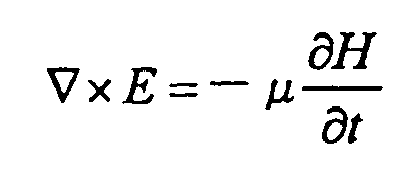
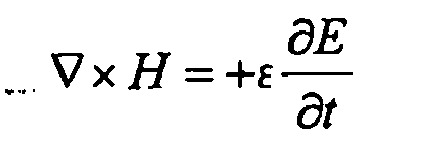
- Herein, µ is a permeability, ε is a dielectric constant.
- From these equations, the following six difference equations are obtained.
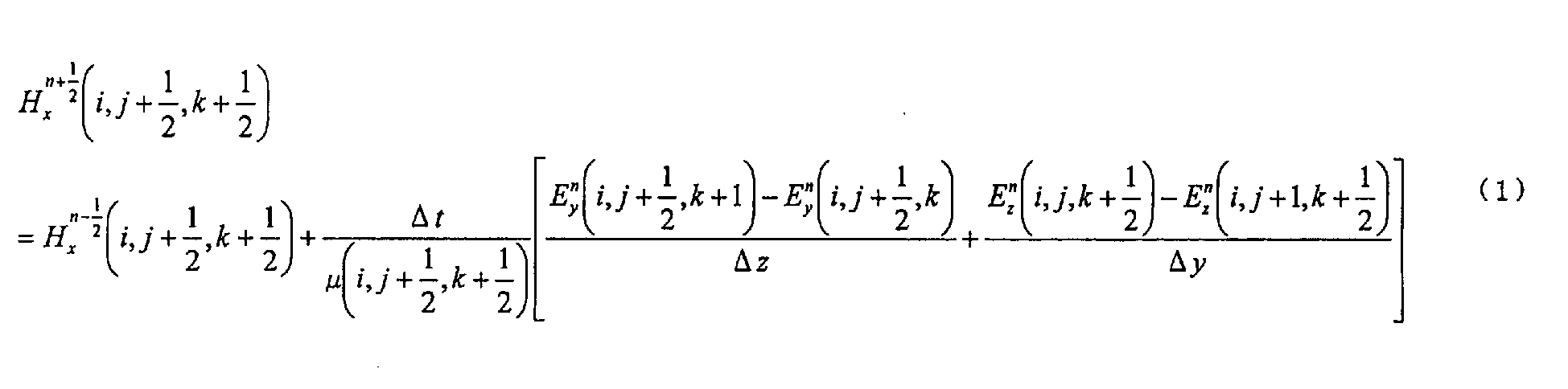


- Using the above six equations, the way of propagation of light or electromagnetic radiation through the photonic crystal slab can be analyzed. By observing an electric field above the defect and conducting Fourier transformation, its frequency spectrum is obtainable.
- First described is a linear waveguide with a cylindrical hole corresponding to one period removed. As long as the normalized frequency f is in the range of 0.27 to 0.28 (c/a), light or electromagnetic radiation can propagate through a waveguide without a loss. The lattice constant is determined so that the wavelength of light or electromagnetic radiation to be propagated may meet this condition. In this example, the wavelength of light or electromagnetic radiation to be propagated is set to be 1.55 µm, f = 0.275 (c/a) corresponding to the center of the range of 0.27 to 0.28 (c/a) is 1.55 µm, then "a" is computed to be 0.42625 µm from 0.275x1.55 µm.
- FIG. 22 shows the frequency and intensity of light or electromagnetic radiation radiated in the orthogonal direction from the point defect disposed adjacent to the waveguide. It is understood that the point defect is provided by changing the radius of one cylindrical hole to 0.56a. It is seen from the diagram that light or electromagnetic radiation at the normalized frequency f = 0.273 (c/a) is radiated in upward and downward directions. The Q value is approximately 500.
- FIG. 23 shows the frequency and intensity of light or electromagnetic radiation radiated from each point defect in the embodiment of FIG. 2 wherein point defects of different size are disposed adjacent to the waveguide. In this example, the point defects are cylindrical holes having a radius of 0.56a and 0.58a. It is seen that light or electromagnetic radiation at the frequency f = 0.2729 (c/a) and f = 0.2769 (c/a) is radiated. The Q value of the defects is approximately 500 in either case.
- It is confirmed from these results that a waveguide created by introducing a line defect and a point defect in the 2D photonic crystal has a function of transmitting light or electromagnetic radiation into and out of the point defect and a function as a wavelength demultiplexer/multiplexer of the plane output type.
- A wavelength demultiplexer fabricated by providing a point defect in proximity to a 2D photonic crystal waveguide according to the invention is able to input and output light or electromagnetic radiation in the orthogonal direction despite the 2D photonic crystal structure. Since light or electromagnetic radiation of a selected wavelength can be input or output from the point defect in a demultiplexed manner, there can be realized an ultrasmall wavelength demultiplexer. This also enables relatively easy realization of a steric ultrasmall light or electromagnetic circuit.
- Although some preferred embodiments have been described, many modifications and variations may be made thereto in light of the above teachings. It is therefore to be understood that the invention may be practiced otherwise than as specifically described without departing from the scope of the appended claims.
Claims (13)
- A two-dimensional photonic crystal waveguide comprising
a two-dimensional photonic crystal structure based on a slab formed of a slab material(11) having a higher refractive index than air, in which an array material having a lower refractive index than said slab material is periodically arrayed in the major plane of the slab to provide a refractive index distribution,
a photonic crystal waveguide created by forming a line defect (12) in the periodic array of the photonic crystal, the line defect (12) functioning as a waveguide, and
at least one point defect (14, 21, 22, 32-34, 42-44) formed in the periodic array of the photonic crystal, and disposed adjacent said line defect (12) to act as a disorder in the periodic array of photonic crystal,
wherein said point defect (14, 21, 22, 32-34, 42-44) functions as a light or electromagnetic radiation outlet/inlet port for trapping light or electromagnetic radiation (15, 24, 25, 31) of a selected wavelength among light or electromagnetic radiation (15, 24, 25, 31) propagating through the waveguide and radiating it upward and/or downward the major plane of the slab, or trapping light or electromagnetic radiation (15, 24, 25, 31) of a selected wavelength upwardly and/or downwardly incident into the major plane of the slab and introducing it into the waveguide. - The two-dimensional photonic crystal waveguide of claim 1 wherein the light or electromagnetic radiation outlet/inlet port is to radiate or introduce the light or electromagnetic radiation (15, 24, 25, 31) propagating in a direction orthogonal to the slab surface.
- The two-dimensional photonic crystal waveguide of claim 1 wherein the wavelength of light or electromagnetic radiation (15, 24, 25, 31) radiated or introduced by said point defect (14, 21, 22, 32-34, 42-44) differs depending on the shape of said point defect (14, 21, 22, 32-34, 42-44).
- The two-dimensional photonic crystal waveguide of claim 1 wherein the array of the array material is formed by filling cylindrical holes (16) in the slab with the lower refractive index material.
- The two-dimensional photonic crystal waveguide of claim 1 wherein the array of the array material is a triangular lattice array (16a).
- The two-dimensional photonic crystal waveguide of claim 1 wherein said point defect (14, 21, 22, 32-34, 42-44) is configured so as to be asymmetric on opposite sides with respect to the slab surface by tailoring from cylinder to cone or by changing the diameter between upper and lower levels.
- The two-dimensional photonic crystal waveguide of claim 1 wherein said slab material has a refractive index of at least 2.0.
- The two-dimensional photonic crystal waveguide of claim 7 wherein said slab material is an inorganic material containing at least one element selected from the group consisting of In, Ga, Al, Sb, As, Ge, Si, P, N and O or an organic material.
- The two-dimensional photonic crystal waveguide of claim 1 wherein the array material is air.
- A photonic crystal wavelength demultiplexer comprising the two-dimensional photonic crystal waveguide of claim 1.
- The photonic crystal wavelength demultiplexer of claim 10 wherein there are included a plurality of point defects (14, 21, 22, 32-34, 42-44) which are disposed along and adjacent the line defect (12) and wavelength of light or electromagnetic radiation (15, 24, 25, 31) radiated or trapped by each point defect (14, 21, 22, 32-34, 42-44) differs.
- The photonic crystal wavelength demultiplexer of claim 10, further comprising an optical fiber (35 - 37) disposed in proximity to the point defect.
- The photonic crystal wavelength demultiplexer of claim 10, further comprising a semiconductor device (45 - 47) having a photoelectric conversion function disposed in proximity to the point defect (14, 21, 22, 32-34, 42-44).
Applications Claiming Priority (2)
| Application Number | Priority Date | Filing Date | Title |
|---|---|---|---|
| JP2000084869A JP3925769B2 (en) | 2000-03-24 | 2000-03-24 | Two-dimensional photonic crystal and multiplexer / demultiplexer |
| JP2000084869 | 2000-03-24 |
Publications (2)
| Publication Number | Publication Date |
|---|---|
| EP1136853A1 EP1136853A1 (en) | 2001-09-26 |
| EP1136853B1 true EP1136853B1 (en) | 2006-09-13 |
Family
ID=18601287
Family Applications (1)
| Application Number | Title | Priority Date | Filing Date |
|---|---|---|---|
| EP01106812A Expired - Lifetime EP1136853B1 (en) | 2000-03-24 | 2001-03-19 | Two-dimensional photonic crystal waveguides and wavelength demultiplexers |
Country Status (5)
| Country | Link |
|---|---|
| US (1) | US6738551B2 (en) |
| EP (1) | EP1136853B1 (en) |
| JP (1) | JP3925769B2 (en) |
| CA (1) | CA2341815C (en) |
| DE (1) | DE60122957T2 (en) |
Cited By (1)
| Publication number | Priority date | Publication date | Assignee | Title |
|---|---|---|---|---|
| CN103176328A (en) * | 2013-04-11 | 2013-06-26 | 青岛大学 | Two-dimensional silicon substrate photonic crystal line-defect slow optical waveguide device |
Families Citing this family (120)
| Publication number | Priority date | Publication date | Assignee | Title |
|---|---|---|---|---|
| US20020027655A1 (en) * | 2000-09-04 | 2002-03-07 | Shigeo Kittaka | Optical device and spectroscopic and polarization separating apparatus using the same |
| EP1219984B1 (en) * | 2000-12-27 | 2007-07-11 | Nippon Telegraph and Telephone Corporation | Photonic crystal waveguide |
| US6560006B2 (en) * | 2001-04-30 | 2003-05-06 | Agilent Technologies, Inc. | Two-dimensional photonic crystal slab waveguide |
| JP3846228B2 (en) * | 2001-06-07 | 2006-11-15 | 日本電気株式会社 | Waveguide |
| US7292749B2 (en) | 2001-10-17 | 2007-11-06 | Danmarks Tekniske Universitet | System for electromagnetic field conversion |
| JP3729134B2 (en) * | 2002-01-29 | 2005-12-21 | 松下電器産業株式会社 | Dual wavelength semiconductor laser light source for optical pickup |
| US7233729B2 (en) * | 2002-03-06 | 2007-06-19 | Pirelli & C. S.P.A. | Method for guiding an electromagnetic radiation, in particular in an integrated optical device |
| JP3739328B2 (en) * | 2002-03-13 | 2006-01-25 | 株式会社日立製作所 | Photonic crystal element |
| JP2004006567A (en) * | 2002-03-26 | 2004-01-08 | Japan Science & Technology Corp | Point defect three-dimensional photonic crystal optical resonator |
| JP3459827B2 (en) * | 2002-03-26 | 2003-10-27 | 科学技術振興事業団 | Two-dimensional photonic crystal optical multiplexer / demultiplexer |
| JP3721142B2 (en) * | 2002-03-26 | 2005-11-30 | 独立行政法人科学技術振興機構 | Two-dimensional photonic crystal point defect interference optical resonator and optical reflector |
| US6947649B2 (en) * | 2002-05-31 | 2005-09-20 | Matsushita Electric Industrial Co., Ltd. | Method of adjusting the index of refraction of photonic crystals with laser micromachining to tune transmissions within the bandgap and structure |
| JP2004012780A (en) | 2002-06-06 | 2004-01-15 | Seiko Epson Corp | Optical multiplexer / demultiplexer, optical communication device, and optical communication system |
| KR100890868B1 (en) * | 2002-06-27 | 2009-03-27 | 주식회사 케이티 | Photonic waveguide color dispersion compensation device combined with a resonator |
| US20060153500A1 (en) * | 2002-08-14 | 2006-07-13 | Javier Marti Sendra | Coupling system between dielectric optical guides and planar photonic crystal guides |
| US6999669B2 (en) * | 2002-08-19 | 2006-02-14 | Georgia Tech Research Corporation | Photonic crystals |
| JP2004093787A (en) * | 2002-08-30 | 2004-03-25 | Seiko Epson Corp | Optical switch, optical communication device, and optical communication system |
| US6934441B2 (en) * | 2003-09-09 | 2005-08-23 | Battelle Memorial Institute | Wavelength separation devices incorporating multi-barrier photonic heterostructures |
| US6940637B2 (en) * | 2002-09-09 | 2005-09-06 | Battelle Memorial Institute | Multi-barrier photonic heterostructures |
| JP4569942B2 (en) | 2002-09-26 | 2010-10-27 | 三菱電機株式会社 | Optical active device |
| JP3568943B2 (en) * | 2002-12-06 | 2004-09-22 | 独立行政法人 科学技術振興機構 | Two-dimensional photonic crystal slab with local three-dimensional structure |
| JP3682289B2 (en) | 2002-12-06 | 2005-08-10 | 独立行政法人科学技術振興機構 | Two-dimensional photonic crystal optical multiplexer / demultiplexer using boundary reflection |
| JP3692354B2 (en) * | 2002-12-26 | 2005-09-07 | 独立行政法人科学技術振興機構 | Electromagnetic frequency filter |
| JP2004233476A (en) | 2003-01-29 | 2004-08-19 | Nec Corp | Photonic crystal optical circuit and its control method |
| JP4236092B2 (en) | 2003-01-31 | 2009-03-11 | Tdk株式会社 | 2D photonic crystal |
| US7263259B2 (en) * | 2003-02-07 | 2007-08-28 | Zetetic Institute | Multiple-source arrays fed by guided-wave structures and resonant guided-wave structure cavities |
| JP3847261B2 (en) | 2003-02-10 | 2006-11-22 | 国立大学法人京都大学 | Resonator and wavelength multiplexer / demultiplexer in two-dimensional photonic crystal |
| US6873777B2 (en) | 2003-03-10 | 2005-03-29 | Japan Aviation Electronics Industry Limited | Two-dimensional photonic crystal device |
| JP4171326B2 (en) * | 2003-03-17 | 2008-10-22 | 国立大学法人京都大学 | Resonator and wavelength multiplexer / demultiplexer in two-dimensional photonic crystal |
| JP4020312B2 (en) * | 2003-03-17 | 2007-12-12 | 国立大学法人京都大学 | Wavelength multiplexer / demultiplexer and wavelength monitor using two-dimensional photonic crystal |
| CN100337132C (en) | 2003-03-26 | 2007-09-12 | Tdk株式会社 | Two-dimensional photonic crystal, and waveguide and resonator using the same |
| JP4097568B2 (en) | 2003-06-18 | 2008-06-11 | 日本航空電子工業株式会社 | Optical recording device |
| US7310468B2 (en) | 2003-07-18 | 2007-12-18 | Nippon Sheet Glass Company Limited | Photonic crystal waveguide, homogeneous medium waveguide, and optical device |
| JP4228808B2 (en) | 2003-07-23 | 2009-02-25 | 株式会社日立製作所 | Microspectrometer and microchemical system |
| JP4538718B2 (en) * | 2003-08-28 | 2010-09-08 | アルプス電気株式会社 | Two-dimensional photonic crystal slab and two-dimensional photonic crystal waveguide |
| CN100426025C (en) | 2003-08-29 | 2008-10-15 | 国立大学法人京都大学 | Two-dimensional photonic crystal resonator |
| JP4063740B2 (en) * | 2003-08-29 | 2008-03-19 | 国立大学法人京都大学 | Two-dimensional photonic crystal having air bridge structure and manufacturing method thereof |
| JP3763826B2 (en) | 2003-08-29 | 2006-04-05 | 独立行政法人科学技術振興機構 | 2D photonic crystal multiplexer / demultiplexer |
| WO2005022222A1 (en) * | 2003-08-29 | 2005-03-10 | Kyoto University | Two-dimensional photonic crystal with air bridge structure and manufacturing method for the crystal |
| US7343059B2 (en) | 2003-10-11 | 2008-03-11 | Hewlett-Packard Development Company, L.P. | Photonic interconnect system |
| FR2861854B1 (en) * | 2003-10-30 | 2006-01-13 | Centre Nat Rech Scient | FREQUENCY SELECTIVE LIGHT COUPLING-DECOUPLING DEVICE |
| US7965901B2 (en) * | 2003-10-31 | 2011-06-21 | Hewlett-Packard Development Company, L.P. | Hard imaging methods and devices and optical scanning systems |
| US7964925B2 (en) * | 2006-10-13 | 2011-06-21 | Hewlett-Packard Development Company, L.P. | Photodiode module and apparatus including multiple photodiode modules |
| JP4398275B2 (en) * | 2003-11-25 | 2010-01-13 | 株式会社リコー | Light control element |
| CN100546096C (en) * | 2003-12-08 | 2009-09-30 | 松下电器产业株式会社 | Splitters and Combiners |
| JP4130799B2 (en) | 2003-12-24 | 2008-08-06 | 三星電子株式会社 | Multi-beam semiconductor laser |
| US7440658B2 (en) * | 2004-03-03 | 2008-10-21 | Japan Science And Technology Agency | Photonic crystal coupling defect waveguide |
| JP4025738B2 (en) | 2004-03-05 | 2007-12-26 | 国立大学法人京都大学 | 2D photonic crystal |
| JP3881666B2 (en) | 2004-03-25 | 2007-02-14 | 国立大学法人京都大学 | Photonic crystal having heterostructure and optical device using the same |
| US6990259B2 (en) * | 2004-03-29 | 2006-01-24 | Sru Biosystems, Inc. | Photonic crystal defect cavity biosensor |
| EP1585087B1 (en) * | 2004-03-30 | 2009-09-02 | Canon Kabushiki Kaisha | Display element, image observation system having display element, and image projection system |
| JP3830962B2 (en) * | 2004-05-20 | 2006-10-11 | 松下電器産業株式会社 | Photonic crystal device |
| KR101266334B1 (en) * | 2004-08-19 | 2013-05-22 | 더 유니버시티 오브 아크론 | Photonic crystal, conjugated polymers suitable for photonic crystals, and a method for synthesizing conjugated polymers |
| JP4297358B2 (en) | 2004-08-30 | 2009-07-15 | 国立大学法人京都大学 | Two-dimensional photonic crystal and optical device using the same |
| JP4534036B2 (en) * | 2004-09-08 | 2010-09-01 | 国立大学法人京都大学 | Optical head and optical recording / reproducing apparatus |
| JP3926838B2 (en) * | 2004-11-15 | 2007-06-06 | 松下電器産業株式会社 | Optical waveguide device |
| JP4743902B2 (en) * | 2004-11-16 | 2011-08-10 | キヤノン株式会社 | Color light source device, color light source system, data projector and laser beam printer |
| JP4923234B2 (en) | 2004-12-28 | 2012-04-25 | 国立大学法人京都大学 | Two-dimensional photonic crystal and optical device using the same |
| JP2006184618A (en) | 2004-12-28 | 2006-07-13 | Kyoto Univ | Two-dimensional photonic crystal and optical functional device using the same |
| WO2006080532A1 (en) * | 2005-01-31 | 2006-08-03 | Kyoto University | Two-dimensional photonic crystal |
| US7228042B2 (en) * | 2005-03-04 | 2007-06-05 | International Business Machines Corporation | Method and apparatus for resonant coupling in photonic crystal circuits |
| JP2006251063A (en) | 2005-03-08 | 2006-09-21 | Japan Aviation Electronics Industry Ltd | Optical connector, optical coupling method, and optical element |
| US7389023B2 (en) * | 2005-03-15 | 2008-06-17 | Hewlett-Packard Development Company, L.P. | Method and apparatus for forming a photonic crystal |
| JP4669923B2 (en) | 2005-03-18 | 2011-04-13 | 国立大学法人京都大学 | Polarization mode converter |
| JP2006276388A (en) * | 2005-03-29 | 2006-10-12 | Alps Electric Co Ltd | Photonic crystal slab, photonic crystal waveguide and optical device |
| US7570849B2 (en) * | 2005-06-21 | 2009-08-04 | Hewlett-Packard Development Company, L.P. | Integrated circuit device having optically coupled layers |
| JP2007003969A (en) * | 2005-06-27 | 2007-01-11 | Japan Aviation Electronics Industry Ltd | Optical element |
| WO2007050058A1 (en) * | 2005-10-25 | 2007-05-03 | Georgia Tech Research Corporation | Spatial separation of optical frefquency components using photonic crystals |
| JP4684861B2 (en) * | 2005-11-14 | 2011-05-18 | キヤノン株式会社 | Waveguide and device having the same |
| JP4689441B2 (en) * | 2005-11-14 | 2011-05-25 | キヤノン株式会社 | Waveguide and device having the same |
| JP4621920B2 (en) * | 2006-01-18 | 2011-02-02 | 国立大学法人京都大学 | Two-dimensional photonic crystal manufacturing method |
| JP4900572B2 (en) | 2006-03-20 | 2012-03-21 | 国立大学法人京都大学 | 2D photonic crystal |
| JP4769658B2 (en) * | 2006-07-31 | 2011-09-07 | キヤノン株式会社 | Resonator |
| TWI331231B (en) * | 2006-08-04 | 2010-10-01 | Au Optronics Corp | Color filter and frbricating method thereof |
| JP4385137B2 (en) | 2006-08-28 | 2009-12-16 | 国立大学法人京都大学 | Polarization-independent two-dimensional photonic crystal multiplexer / demultiplexer |
| CN100430758C (en) * | 2006-09-05 | 2008-11-05 | 友达光电股份有限公司 | Color filter and manufacturing method thereof |
| JP2008233769A (en) * | 2007-03-23 | 2008-10-02 | Tohoku Univ | Optical filter device and manufacturing method thereof |
| JP5272173B2 (en) | 2007-03-26 | 2013-08-28 | 国立大学法人京都大学 | 2D photonic crystal |
| US20100279886A1 (en) * | 2007-04-03 | 2010-11-04 | University Of Rochester | Two-dimensional photonic bandgap structures for ultrahigh-sensitivity biosensing |
| US8059924B1 (en) * | 2007-09-13 | 2011-11-15 | Lawrence Livermore National Security, Llc | Multiplexed photonic membranes and related detection methods for chemical and/or biological sensing applications |
| JPWO2009107427A1 (en) * | 2008-02-28 | 2011-06-30 | 日本電気株式会社 | Optical waveguide |
| US7991289B2 (en) * | 2008-03-28 | 2011-08-02 | Raytheon Company | High bandwidth communication system and method |
| US8986558B2 (en) | 2008-09-01 | 2015-03-24 | Japan Science And Technology Agency | Plasma etching method, plasma etching device, and method for producing photonic crystal |
| US8830450B2 (en) | 2009-12-02 | 2014-09-09 | Lawrence Livermore National Security, Llc | Methods and systems for Raman and optical cross-interrogation in flow-through silicon membranes |
| US8947657B2 (en) | 2008-09-08 | 2015-02-03 | Lawrence Livermore National Security, Llc | Methods for isolation and viability assessment of biological organisms |
| WO2010102643A1 (en) * | 2009-03-11 | 2010-09-16 | MAX-PLANCK-Gesellschaft zur Förderung der Wissenschaften e.V. | Tunable optical guided-mode filter device |
| CA3030271C (en) | 2009-10-08 | 2021-08-17 | Delos Living, Llc | Led lighting system |
| EP3567416A1 (en) * | 2009-10-12 | 2019-11-13 | The Trustees of Columbia University in the City of New York | Photonic crystal spectrometer |
| US8786852B2 (en) * | 2009-12-02 | 2014-07-22 | Lawrence Livermore National Security, Llc | Nanoscale array structures suitable for surface enhanced raman scattering and methods related thereto |
| CN102540329B (en) * | 2012-01-31 | 2013-01-23 | 中国科学院长春光学精密机械与物理研究所 | Two-dimensional side coupling photonic crystal waveguide single-channel system |
| JP2013160623A (en) * | 2012-02-03 | 2013-08-19 | Tokyo Institute Of Technology | Light measuring apparatus |
| US9395304B2 (en) | 2012-03-01 | 2016-07-19 | Lawrence Livermore National Security, Llc | Nanoscale structures on optical fiber for surface enhanced Raman scattering and methods related thereto |
| CN102636842A (en) * | 2012-04-19 | 2012-08-15 | 中国振华集团云科电子有限公司 | Photonic crystal filter with three frequency points |
| JP2015534701A (en) | 2012-08-28 | 2015-12-03 | デロス リビング エルエルシーDelos Living Llc | Systems, methods, and articles for promoting wellness associated with living environments |
| USD758372S1 (en) | 2013-03-13 | 2016-06-07 | Nagrastar Llc | Smart card interface |
| US9888283B2 (en) | 2013-03-13 | 2018-02-06 | Nagrastar Llc | Systems and methods for performing transport I/O |
| CN105359013A (en) * | 2013-05-01 | 2016-02-24 | 康宁股份有限公司 | Random air line rod |
| US10712722B2 (en) | 2014-02-28 | 2020-07-14 | Delos Living Llc | Systems and articles for enhancing wellness associated with habitable environments |
| CN104597631B (en) * | 2014-09-29 | 2018-09-18 | 欧阳征标 | A kind of three port photocirculator of broadband introducing triangle guide post |
| CN104950384B (en) * | 2014-09-29 | 2020-11-13 | 欧阳征标 | Circular hole square lattice photonic crystal low-refractive index double-compensated scattering cylindrical right-angle waveguide |
| WO2016115230A1 (en) | 2015-01-13 | 2016-07-21 | Delos Living Llc | Systems, methods and articles for monitoring and enhancing human wellness |
| USD864968S1 (en) | 2015-04-30 | 2019-10-29 | Echostar Technologies L.L.C. | Smart card interface |
| WO2017058770A2 (en) | 2015-09-29 | 2017-04-06 | Chromation Inc. | Nanostructure based article, optical sensor and analytical instrument and method of forming same |
| CN109313075B (en) | 2016-05-10 | 2020-10-30 | 施罗玛蒂奥尼有限公司 | Integration of Optical Components in Folded Optical Paths |
| CN105891949B (en) * | 2016-05-20 | 2019-03-29 | 上海大学 | Preparation method based on laser ablation air column 2 D photon crystal |
| CN105911646B (en) * | 2016-06-13 | 2018-08-21 | 南京邮电大学 | A kind of wavelength-division mould based on photonic crystal divides hybrid multiplex demultiplexer and method |
| US11338107B2 (en) | 2016-08-24 | 2022-05-24 | Delos Living Llc | Systems, methods and articles for enhancing wellness associated with habitable environments |
| EP3674760B1 (en) * | 2017-08-24 | 2024-07-10 | National University Corporation Yokohama National University | Light deflection device |
| US11668481B2 (en) | 2017-08-30 | 2023-06-06 | Delos Living Llc | Systems, methods and articles for assessing and/or improving health and well-being |
| EP3850458A4 (en) | 2018-09-14 | 2022-06-08 | Delos Living, LLC | Systems and methods for air remediation |
| CN109669240B (en) * | 2019-01-04 | 2020-10-02 | 深圳大学 | A photonic crystal waveguide hexapole split-mode interference FANO resonance structure |
| US11844163B2 (en) | 2019-02-26 | 2023-12-12 | Delos Living Llc | Method and apparatus for lighting in an office environment |
| US11169426B2 (en) | 2019-03-19 | 2021-11-09 | Analog Devices, Inc. | Liquid crystal waveguide with sub-aperture light coupling |
| WO2020198183A1 (en) | 2019-03-25 | 2020-10-01 | Delos Living Llc | Systems and methods for acoustic monitoring |
| WO2022019143A1 (en) * | 2020-07-20 | 2022-01-27 | 日本碍子株式会社 | Optical scanning element |
| WO2022076438A1 (en) | 2020-10-06 | 2022-04-14 | Chromation Inc. | Systems and methods to redistribute field of view in spectroscopy |
| JP7599638B2 (en) * | 2021-02-01 | 2024-12-16 | 国立大学法人東京科学大学 | Topological vertical coupler |
| CN113376738B (en) * | 2021-05-25 | 2022-06-17 | 太原理工大学 | A funnel-shaped photonic crystal waveguide structure for unidirectional transmission of light waves |
| DE102022106271A1 (en) * | 2022-03-17 | 2023-09-21 | Ams-Osram International Gmbh | OPTOELECTRONIC MODULE AND METHOD FOR OPERATING AN OPTOELECTRONIC MODULE |
| JPWO2024176971A1 (en) * | 2023-02-24 | 2024-08-29 |
Family Cites Families (6)
| Publication number | Priority date | Publication date | Assignee | Title |
|---|---|---|---|---|
| JPH08505707A (en) | 1993-01-08 | 1996-06-18 | マサチユセツツ・インスチチユート・オブ・テクノロジー | Low loss light and optoelectronic integrated circuits |
| US5784400A (en) * | 1995-02-28 | 1998-07-21 | Massachusetts Institute Of Technology | Resonant cavities employing two dimensionally periodic dielectric materials |
| US6101300A (en) * | 1997-06-09 | 2000-08-08 | Massachusetts Institute Of Technology | High efficiency channel drop filter with absorption induced on/off switching and modulation |
| JPH11218627A (en) * | 1998-02-02 | 1999-08-10 | Nippon Telegr & Teleph Corp <Ntt> | Photonic crystal waveguide and method of manufacturing the same |
| JPH11330619A (en) * | 1998-05-18 | 1999-11-30 | Nippon Telegr & Teleph Corp <Ntt> | Optical device |
| US6468823B1 (en) * | 1999-09-30 | 2002-10-22 | California Institute Of Technology | Fabrication of optical devices based on two dimensional photonic crystal structures and apparatus made thereby |
-
2000
- 2000-03-24 JP JP2000084869A patent/JP3925769B2/en not_active Expired - Lifetime
-
2001
- 2001-03-19 DE DE60122957T patent/DE60122957T2/en not_active Expired - Lifetime
- 2001-03-19 EP EP01106812A patent/EP1136853B1/en not_active Expired - Lifetime
- 2001-03-23 US US09/814,728 patent/US6738551B2/en not_active Expired - Lifetime
- 2001-03-23 CA CA002341815A patent/CA2341815C/en not_active Expired - Fee Related
Non-Patent Citations (1)
| Title |
|---|
| ALONGKARN CHUTINAN & AL., APPLIED PHYSIC LETTERS, vol. 75, no. 24, 13 December 1999 (1999-12-13), pages 3739 - 3741, XP000893576 * |
Cited By (2)
| Publication number | Priority date | Publication date | Assignee | Title |
|---|---|---|---|---|
| CN103176328A (en) * | 2013-04-11 | 2013-06-26 | 青岛大学 | Two-dimensional silicon substrate photonic crystal line-defect slow optical waveguide device |
| CN103176328B (en) * | 2013-04-11 | 2015-04-08 | 青岛大学 | Two-dimensional silicon substrate photonic crystal line-defect slow optical waveguide device |
Also Published As
| Publication number | Publication date |
|---|---|
| CA2341815C (en) | 2005-06-28 |
| DE60122957T2 (en) | 2007-09-06 |
| CA2341815A1 (en) | 2001-09-24 |
| JP2001272555A (en) | 2001-10-05 |
| US20020009277A1 (en) | 2002-01-24 |
| DE60122957D1 (en) | 2006-10-26 |
| JP3925769B2 (en) | 2007-06-06 |
| EP1136853A1 (en) | 2001-09-26 |
| US6738551B2 (en) | 2004-05-18 |
Similar Documents
| Publication | Publication Date | Title |
|---|---|---|
| US6738551B2 (en) | Two-dimensional photonic crystal, and multiplexer/demultiplexer using the same | |
| JP3847261B2 (en) | Resonator and wavelength multiplexer / demultiplexer in two-dimensional photonic crystal | |
| EP2513693B1 (en) | Photonic integrated circuit having a waveguide-grating coupler | |
| CA2248042C (en) | Optical diffraction grating | |
| US6873777B2 (en) | Two-dimensional photonic crystal device | |
| KR101333418B1 (en) | A polarization diversity grating coupler comprising a two dimensional grating | |
| Niemi et al. | Wavelength-division demultiplexing using photonic crystal waveguides | |
| US20030081924A1 (en) | System and method for providing integrated optical waveguide device | |
| JP3459827B2 (en) | Two-dimensional photonic crystal optical multiplexer / demultiplexer | |
| US20030016915A1 (en) | Hetero-structure photonic bandgap materials | |
| WO2005064371A1 (en) | Optical coupling device | |
| EP1722253B1 (en) | Two-dimensional photonic crystal and optical multiplexer/demultiplexer employing it | |
| EP1521987B1 (en) | Photonic crystal waveguide | |
| CN100391061C (en) | Two-dimensional photonic crystal resonator and channel add-drop filter | |
| US20060018594A1 (en) | Optical delay circuit, integrated optical device, and method of manufacturing integrated optical device | |
| US7269310B2 (en) | Optical connector, optical coupling method and optical element | |
| US7110641B2 (en) | Device for directional and wavelength-selective optical coupling | |
| KR20060123753A (en) | Frequency Selective Optocoupler-Separator Device | |
| US6650796B2 (en) | Waveguide optical frequency router | |
| EP1151331A1 (en) | Optical components | |
| JP2001059917A (en) | Waveguide type optical multiplexer / demultiplexer |
Legal Events
| Date | Code | Title | Description |
|---|---|---|---|
| PUAI | Public reference made under article 153(3) epc to a published international application that has entered the european phase |
Free format text: ORIGINAL CODE: 0009012 |
|
| AK | Designated contracting states |
Kind code of ref document: A1 Designated state(s): AT BE CH CY DE DK ES FI FR GB GR IE IT LI LU MC NL PT SE TR Kind code of ref document: A1 Designated state(s): DE FR GB |
|
| AX | Request for extension of the european patent |
Free format text: AL;LT;LV;MK;RO;SI |
|
| 17P | Request for examination filed |
Effective date: 20020131 |
|
| AKX | Designation fees paid |
Free format text: DE FR GB |
|
| 17Q | First examination report despatched |
Effective date: 20020515 |
|
| GRAP | Despatch of communication of intention to grant a patent |
Free format text: ORIGINAL CODE: EPIDOSNIGR1 |
|
| GRAS | Grant fee paid |
Free format text: ORIGINAL CODE: EPIDOSNIGR3 |
|
| GRAA | (expected) grant |
Free format text: ORIGINAL CODE: 0009210 |
|
| RAP1 | Party data changed (applicant data changed or rights of an application transferred) |
Owner name: TDK CORPORATION Owner name: KANSAI TECHNOLOGY LICENSING ORGANIZATION CO., LTD. |
|
| AK | Designated contracting states |
Kind code of ref document: B1 Designated state(s): DE FR GB |
|
| REG | Reference to a national code |
Ref country code: GB Ref legal event code: FG4D |
|
| REF | Corresponds to: |
Ref document number: 60122957 Country of ref document: DE Date of ref document: 20061026 Kind code of ref document: P |
|
| ET | Fr: translation filed | ||
| PLBE | No opposition filed within time limit |
Free format text: ORIGINAL CODE: 0009261 |
|
| STAA | Information on the status of an ep patent application or granted ep patent |
Free format text: STATUS: NO OPPOSITION FILED WITHIN TIME LIMIT |
|
| 26N | No opposition filed |
Effective date: 20070614 |
|
| REG | Reference to a national code |
Ref country code: GB Ref legal event code: 732E |
|
| REG | Reference to a national code |
Ref country code: FR Ref legal event code: TQ |
|
| REG | Reference to a national code |
Ref country code: GB Ref legal event code: 732E Free format text: REGISTERED BETWEEN 20090910 AND 20090916 |
|
| REG | Reference to a national code |
Ref country code: FR Ref legal event code: TP |
|
| PGFP | Annual fee paid to national office [announced via postgrant information from national office to epo] |
Ref country code: GB Payment date: 20130313 Year of fee payment: 13 Ref country code: FR Payment date: 20130325 Year of fee payment: 13 |
|
| GBPC | Gb: european patent ceased through non-payment of renewal fee |
Effective date: 20140319 |
|
| REG | Reference to a national code |
Ref country code: FR Ref legal event code: ST Effective date: 20141128 |
|
| PG25 | Lapsed in a contracting state [announced via postgrant information from national office to epo] |
Ref country code: FR Free format text: LAPSE BECAUSE OF NON-PAYMENT OF DUE FEES Effective date: 20140331 Ref country code: GB Free format text: LAPSE BECAUSE OF NON-PAYMENT OF DUE FEES Effective date: 20140319 |
|
| PGFP | Annual fee paid to national office [announced via postgrant information from national office to epo] |
Ref country code: DE Payment date: 20150310 Year of fee payment: 15 |
|
| REG | Reference to a national code |
Ref country code: DE Ref legal event code: R082 Ref document number: 60122957 Country of ref document: DE Representative=s name: PATENTANWAELTE WEICKMANN & WEICKMANN, DE Ref country code: DE Ref legal event code: R082 Ref document number: 60122957 Country of ref document: DE Representative=s name: WEICKMANN & WEICKMANN PATENTANWAELTE - RECHTSA, DE |
|
| REG | Reference to a national code |
Ref country code: DE Ref legal event code: R082 Ref document number: 60122957 Country of ref document: DE Representative=s name: WEICKMANN & WEICKMANN PATENTANWAELTE - RECHTSA, DE Ref country code: DE Ref legal event code: R081 Ref document number: 60122957 Country of ref document: DE Owner name: JAPAN SCIENCE AND TECHNOLOGY AGENCY, KAWAGUCHI, JP Free format text: FORMER OWNER: KYOTO UNIVERSITY, KYOTO-SHI, KYOTO, JP |
|
| REG | Reference to a national code |
Ref country code: DE Ref legal event code: R119 Ref document number: 60122957 Country of ref document: DE |
|
| PG25 | Lapsed in a contracting state [announced via postgrant information from national office to epo] |
Ref country code: DE Free format text: LAPSE BECAUSE OF NON-PAYMENT OF DUE FEES Effective date: 20161001 |