EP1132131A1 - Method for preparing heteropolyacid catalyst and method for producing methacrylic acid - Google Patents
Method for preparing heteropolyacid catalyst and method for producing methacrylic acid Download PDFInfo
- Publication number
- EP1132131A1 EP1132131A1 EP01302171A EP01302171A EP1132131A1 EP 1132131 A1 EP1132131 A1 EP 1132131A1 EP 01302171 A EP01302171 A EP 01302171A EP 01302171 A EP01302171 A EP 01302171A EP 1132131 A1 EP1132131 A1 EP 1132131A1
- Authority
- EP
- European Patent Office
- Prior art keywords
- ammonium
- catalyst
- process according
- acid
- nitrate
- Prior art date
- Legal status (The legal status is an assumption and is not a legal conclusion. Google has not performed a legal analysis and makes no representation as to the accuracy of the status listed.)
- Withdrawn
Links
Classifications
-
- B—PERFORMING OPERATIONS; TRANSPORTING
- B01—PHYSICAL OR CHEMICAL PROCESSES OR APPARATUS IN GENERAL
- B01J—CHEMICAL OR PHYSICAL PROCESSES, e.g. CATALYSIS OR COLLOID CHEMISTRY; THEIR RELEVANT APPARATUS
- B01J31/00—Catalysts comprising hydrides, coordination complexes or organic compounds
- B01J31/02—Catalysts comprising hydrides, coordination complexes or organic compounds containing organic compounds or metal hydrides
-
- C—CHEMISTRY; METALLURGY
- C07—ORGANIC CHEMISTRY
- C07C—ACYCLIC OR CARBOCYCLIC COMPOUNDS
- C07C51/00—Preparation of carboxylic acids or their salts, halides or anhydrides
- C07C51/16—Preparation of carboxylic acids or their salts, halides or anhydrides by oxidation
- C07C51/21—Preparation of carboxylic acids or their salts, halides or anhydrides by oxidation with molecular oxygen
- C07C51/25—Preparation of carboxylic acids or their salts, halides or anhydrides by oxidation with molecular oxygen of unsaturated compounds containing no six-membered aromatic ring
- C07C51/252—Preparation of carboxylic acids or their salts, halides or anhydrides by oxidation with molecular oxygen of unsaturated compounds containing no six-membered aromatic ring of propene, butenes, acrolein or methacrolein
-
- B—PERFORMING OPERATIONS; TRANSPORTING
- B01—PHYSICAL OR CHEMICAL PROCESSES OR APPARATUS IN GENERAL
- B01J—CHEMICAL OR PHYSICAL PROCESSES, e.g. CATALYSIS OR COLLOID CHEMISTRY; THEIR RELEVANT APPARATUS
- B01J23/00—Catalysts comprising metals or metal oxides or hydroxides, not provided for in group B01J21/00
- B01J23/002—Mixed oxides other than spinels, e.g. perovskite
-
- B—PERFORMING OPERATIONS; TRANSPORTING
- B01—PHYSICAL OR CHEMICAL PROCESSES OR APPARATUS IN GENERAL
- B01J—CHEMICAL OR PHYSICAL PROCESSES, e.g. CATALYSIS OR COLLOID CHEMISTRY; THEIR RELEVANT APPARATUS
- B01J27/00—Catalysts comprising the elements or compounds of halogens, sulfur, selenium, tellurium, phosphorus or nitrogen; Catalysts comprising carbon compounds
- B01J27/14—Phosphorus; Compounds thereof
- B01J27/186—Phosphorus; Compounds thereof with arsenic, antimony, bismuth, vanadium, niobium, tantalum, polonium, chromium, molybdenum, tungsten, manganese, technetium or rhenium
- B01J27/188—Phosphorus; Compounds thereof with arsenic, antimony, bismuth, vanadium, niobium, tantalum, polonium, chromium, molybdenum, tungsten, manganese, technetium or rhenium with chromium, molybdenum, tungsten or polonium
-
- B—PERFORMING OPERATIONS; TRANSPORTING
- B01—PHYSICAL OR CHEMICAL PROCESSES OR APPARATUS IN GENERAL
- B01J—CHEMICAL OR PHYSICAL PROCESSES, e.g. CATALYSIS OR COLLOID CHEMISTRY; THEIR RELEVANT APPARATUS
- B01J27/00—Catalysts comprising the elements or compounds of halogens, sulfur, selenium, tellurium, phosphorus or nitrogen; Catalysts comprising carbon compounds
- B01J27/14—Phosphorus; Compounds thereof
- B01J27/186—Phosphorus; Compounds thereof with arsenic, antimony, bismuth, vanadium, niobium, tantalum, polonium, chromium, molybdenum, tungsten, manganese, technetium or rhenium
- B01J27/188—Phosphorus; Compounds thereof with arsenic, antimony, bismuth, vanadium, niobium, tantalum, polonium, chromium, molybdenum, tungsten, manganese, technetium or rhenium with chromium, molybdenum, tungsten or polonium
- B01J27/19—Molybdenum
-
- B—PERFORMING OPERATIONS; TRANSPORTING
- B01—PHYSICAL OR CHEMICAL PROCESSES OR APPARATUS IN GENERAL
- B01J—CHEMICAL OR PHYSICAL PROCESSES, e.g. CATALYSIS OR COLLOID CHEMISTRY; THEIR RELEVANT APPARATUS
- B01J27/00—Catalysts comprising the elements or compounds of halogens, sulfur, selenium, tellurium, phosphorus or nitrogen; Catalysts comprising carbon compounds
- B01J27/14—Phosphorus; Compounds thereof
- B01J27/186—Phosphorus; Compounds thereof with arsenic, antimony, bismuth, vanadium, niobium, tantalum, polonium, chromium, molybdenum, tungsten, manganese, technetium or rhenium
- B01J27/195—Phosphorus; Compounds thereof with arsenic, antimony, bismuth, vanadium, niobium, tantalum, polonium, chromium, molybdenum, tungsten, manganese, technetium or rhenium with vanadium, niobium or tantalum
- B01J27/198—Vanadium
- B01J27/199—Vanadium with chromium, molybdenum, tungsten or polonium
-
- B—PERFORMING OPERATIONS; TRANSPORTING
- B01—PHYSICAL OR CHEMICAL PROCESSES OR APPARATUS IN GENERAL
- B01J—CHEMICAL OR PHYSICAL PROCESSES, e.g. CATALYSIS OR COLLOID CHEMISTRY; THEIR RELEVANT APPARATUS
- B01J27/00—Catalysts comprising the elements or compounds of halogens, sulfur, selenium, tellurium, phosphorus or nitrogen; Catalysts comprising carbon compounds
- B01J27/24—Nitrogen compounds
- B01J27/25—Nitrates
-
- B—PERFORMING OPERATIONS; TRANSPORTING
- B01—PHYSICAL OR CHEMICAL PROCESSES OR APPARATUS IN GENERAL
- B01J—CHEMICAL OR PHYSICAL PROCESSES, e.g. CATALYSIS OR COLLOID CHEMISTRY; THEIR RELEVANT APPARATUS
- B01J2523/00—Constitutive chemical elements of heterogeneous catalysts
Definitions
- This invention relates to a method for preparing heteropolyacid catalyst and method for producing methacrylic acid. More particularly, the invention relates to a method for preparing heteropolyacid catalyst containing heteropolyacid formed of molybdophosphoric acid and/or molybdovanadophosphoric acid, or a salt of the heteropolyacid, which is suitable for use in preparation of unsaturated carboxylic acid through vapor phase oxidation of unsaturated aldehyde; and also to a method for producing methacrylic acid through vapor phase oxidation or vapor phase oxydehydrogenation of methacrolein, isobutyl aldehyde and/or isobutyric acid in the presence of said heteropolyacid catalyst.
- heteropolyacid catalyst whose chief component is a heteropolyacid composed of phosphorus-molybdenum or phosphorus-molybdenum-vanadium, or a salt thereof, for producing methacrylic acid through vapor phase oxidation of methacrolein, isobutyl aldehyde and/or isobutyric acid.
- heteropolyacid catalysts various methods have been proposed. For example, Official Gazettes of Sho 57(1982)-12830A, Sho 57-171443A, Sho 57-171444A and Sho 57-177347A teach that preparation of heteropolyacid catalyst in the presence of a nitrogen-containing heterocyclic compound improves the catalytic performance. Specifically, in those prior art heteropolyacid catalysts are prepared by dissolving or dispersing a nitrogen-containing heterocyclic compound in water together with raw materials containing such constituent elements as phosphorus, molybdenum, vanadium and the like, concentrating the solution or dispersion under thorough stirring, drying the concentrate and calcining the same.
- heteropolyacid catalysts which are prepared in the presence of a nitrogen-containing heterocyclic compound, however, are inferior in selectivity and activity for reaction and in catalytic life, compared to oxidation catalysts conventionally used for making acrylic acid from acrolein, where they are used, for example, in production of methacrylic acid from methacrolein, isobutyl aldehyde and/or isobutyric acid.
- those heteropolyacid catalysts must be used in large quantities and brings about rise in production costs.
- An object of the present invention is to provide a method for preparing heteropolyacid catalyst excelling in performance, life and furthermore in strength which is of particular importance for industrial use, over those heteropolyacid catalysts which are prepared by the conventional method.
- Another object of the invention is to provide a method for producing methacrylic acid through vapor phase oxidation or vapor phase oxydehydrogenation of methacrolein, isobutyl aldehyde and/or isobutyric acid, using a catalyst prepared in accordance with the novel method of the invention.
- a method for preparing a heteropolyacid catalyst containing a heteropolyacid composed of molybdophosphoric acid and/or molybdovanadophosphoric acid, or a salt of the heteropolyacid in the presence of a nitrogen-containing heterocyclic compound comprises preparing an aqueous solution or aqueous dispersion which
- a method for producing methacrylic acid comprises vapor-phase oxidation or oxydehydrogenation of methacrolein, isobutyl aldehyde and/or isobutyric acid, characterized in that a heteropolyacid catalyst which is obtained by the above-described method is used as the catalyst.
- the method of the invention comprises dissolving or uniformly dispersing the raw materials containing the heteropolyacid catalyst-constituting elements such as phosphorus, molybdenum, vanadium and the like and a nitrogen-containing heterocyclic compound in water, concentrating the resultant aqueous solution or dispersion, drying the concentrate and calcining the same.
- the characteristic feature of the invention resides in that the nitrogen-containing heterocyclic compound, ammonium ions and nitrate anions are present in said aqueous solution or dispersion, and in that the ammonium ion content and nitrate anion content are adjusted to fall within the earlier-specified ranges. It is whereby made possible to prepare a heteropolyacid catalyst excelling in performance, life and strength.
- any heteropolyacid catalyst it is possible to prepare any heteropolyacid catalyst, as long as it contains a heteropolyacid composed of molybdophosphoric acid and/or molybdovanadophosphoric acid or a salt of such heteropolyacid.
- the heteropolyacid catalyst for example, can be expressed by the following general formula: P a Mo b V c X d O x (wherein P, Mo and V are phosphorus, molybdenum and vanadium, respectively; X represents at least one metal element capable of constituting a heteropolyacid salt, which is selected from alkali metals (potassium, rubidium, cesium and the like), alkaline earth metals, copper, silver, zirconium, niobium, zinc, magnesium, selenium, tellurium, arsenic, antimony, germanium, iron, nickel and silicon; O is oxygen, a, b, c, d and x signify atomic ratios of P, Mo, V, X and O, respectively, where b is 12, a is 0.1-3, c is 0-6, d is 0.05-5, and x is a numerical value determined by valency of each element).
- nitrogen-containing heterocyclic compound any of those known may be used.
- pyridine, piperidine, piperazine, pyrimidine, quinoline, isoquinoline and alkyl derivatives of the foregoing may be named.
- Use of these compounds in the form of inorganic salts such as nitrate, sulfate, chloride and the like is recommended, for prevention of generation of odor at the time of the catalyst preparation and recovery and reuse of these compounds.
- the use rate of such a nitrogen-containing heterocyclic compound can be suitably selected within a range of 1-50% by weight based on the weight of oxides of the raw materials containing the catalyst-constituting elements.
- the raw materials containing the catalyst-constituting elements are subject to no particular limitation, but any of those generally used for preparation of heteropolyacid catalysts may be used.
- molybdenum material ammonium molybdates such as ammonium paramolybdate, ammonium dimolybdate and the like, molybdic acid, molybdenum trioxide, etc. can be used.
- vanadium material vanadium pentoxide, ammonium metavanadate, sodium metavanadate, vanadyl oxalate, vanadyl sulfate and the like can be used.
- phosphorus material orthophosphoric acid, disodium hydrogenphosphate, ammonium phosphate and the like can be used. It is also permissible to use a raw material containing more than one element, such as molybdophosphoric acid, molybdovanadophosphoric acid and the like.
- ammonia or ammonium salts are useful as source for ammonium ion supply.
- ammonium salts besides ammonium nitrate, ammonium carbonate, ammonium hydrogencarbonate, ammonium acetate and the like, those raw materials containing catalyst-constituting elements, such as ammonium molybdate, ammonium phosphate, ammonium metavanadate and the like may be named.
- nitric acid As supply source of nitrate anions, nitric acid, ammonium nitrate or nitric acid salts which serve as the raw materials containing catalyst-constituting elements may be named.
- the composition of said aqueous solution or dispersion is so adjusted that (1) nitrate anions and ammonium ions should be present in the solution or dispersion; (2) the ammonium ion content should not exceed 1.7 mols per mol of the nitrate anion content (i.e., 0 ⁇ ammonium ions / nitrate anions ⁇ 1.7 in terms of molar ratio); and (3) the ammonium ion content should not exceed 10 mols per 12 mols of molybdenum atom content (i.e., 0 ⁇ ammonium ions / 12 molybdenum atoms ⁇ 10 in terms of molar ratio).
- the molar ratio between the ammonium ion content and nitrate anion content is more than 0 but not more than 1.7, preferably 0.1-1.5. When this value exceeds 1.7, the intended heteropolyacid catalyst cannot be obtained. Where no ammonium ion is contained, moldability is objectionably impaired.
- the ammonium ion content per 12 mols of molybdenum atoms is more than 0 but not more than 10, preferably 0.2-9, inter alia , 2-9. When this value exceeds 10, the intended heteropolyacid catalyst cannot be obtained.
- the raw materials containing the catalyst-constituting elements and supply source of nitrate anions or that of ammonium ions are to be suitably selected.
- ammonium paramolybdate (NH 4 ) 6 [Mo 7 O 24 ] ⁇ 4H 2 O
- the ammonium ion content per 12 molybdenum atoms of said raw material itself is 10.29.
- the ammonium ion content as a whole can be adjusted to fall within the specified range.
- the intended heteropolyacid catalyst is obtained when the nitrate anion content and ammonium ion content are adjusted to the specified ranges is not yet clear.
- the adjustment acting in concert with the presence of a nitrogen-containing heterocyclic compound, renders the pH, viscosity and particle size in the slurried condition, or reactivity of the involved substances, their oxidation-reduction conditions, etc. accompanying thereto, very favorable.
- the aqueous solution or dispersion obtained as above is then concentrated under heating and stirring, and the resulting concentrate is subsequently dried and calcined.
- the drying and calcining conditions of the concentrate are subject to no critical limitations, but those generally used in preparation of heteropolyacid catalysts can be used. More specifically, the concentrate is dried at temperatures ranging 100-300°C, and normally after being molded, calcined at temperatures ranging 200-600°C.
- the calcining may also be carried out in such a manner that it is conducted at 200-600°C in an inert gas such as gaseous nitrogen and then further at 100-400°C in the air.
- Conditions for carrying out the vapor phase oxidation or oxidehydrogenation reaction of methacrolein, isobutyl aldehyde and/or isobutyric acid in the presence of the catalyst of the present invention are not critical, but those generally used for this type of reaction may be adopted.
- a gaseous mixture of 1-10 volume % of methacrolein, 1-10 volume times thereof of molecular oxygen and inert gas such as nitrogen, carbon dioxide steam and the like (of those, steam is particularly advantageous because it inhibits formation of side-products and improves yield of the object product) as diluent is introduced onto the catalyst at a temperature within a range of 200-400°C and under a pressure ranging from normal to 1 MPa, at a space velocity of 100-5,000 h -1 (STP).
- the starting methacrolein is not necessarily required to be pure.
- a methacrolein-containing gas obtained from a catalytic reaction of isobutylene or tertiary butanol may be used as the methacrolein. This embodiment is particularly recommendable for an industrial process.
- a heteropolyacid catalyst excelling in performance, life and strength can be prepared, and by using this heteropolyacid catalyst, methacrylic acid can be produced at high yield.
- aqueous mixture containing pyridine, nitrate anions and ammonium ions was obtained, the ammonium ions / nitrate anions (molar ratio) being 1.00 and the ammonium ions / 12 molybdenum atoms (molar ratio) being 8.49.
- This aqueous mixture was concentrated under heating and stirring, and the resulting clay-like substance was molded into a columns of each 5 mm in diameter and 6 mm in height, which were dried at 250°C and calcined in a gaseous nitrogen stream at 430°C for 4 hours, and then in an air stream at 400°C for 2 hours.
- the catalyst was found to have a composition composed mainly of molybdovanadophosphoric acid and its partial metal salt.
- Example 1 was repeated except that the amount of the ammonium paramolybdate was changed to 600 g and that of the molybdenum trioxide, to 518 g. The results are shown in Table 1.
- Example 1 was repeated except that the amount of the ammonium paramolybdate was changed to 150 g, and that of the molybdenum trioxide, to 884 g. The results are shown in Table 1.
- Example 1 was repeated except that the amount of the nitric acid was changed from 400 g to 250 g. The results are shown in Table 1.
- Example 1 was repeated except that the amount of the nitric acid was changed from 400 g to 750 g. The results are shown in Table 1.
- Example 1 was repeated except that the pyridine was replaced with the same amount of piperidine. The results are shown in Table 1.
- Example 1 was repeated except that the pyridine was replaced with the same amount of piperazine. The results are shown in Table 1.
- Example 1 was repeated except that no ammonium paramolybdate was used, the amount of molybdenum trioxide was changed to 1007 g and 265 g of aqueous ammonia (28% by weight) was added simultaneously with the pyridine. The results are shown in Table 1.
- Example 1 was repeated except that the amount of the ammonium paramolybdate was changed to 1236 g and that no ammonium trioxide was used. The results are shown in Table 1.
- Example 1 was repeated except that the amount of the nitric acid was changed from 400 g to 150 g. The results are shown in Table 1.
Landscapes
- Chemical & Material Sciences (AREA)
- Organic Chemistry (AREA)
- Engineering & Computer Science (AREA)
- Materials Engineering (AREA)
- Chemical Kinetics & Catalysis (AREA)
- Oil, Petroleum & Natural Gas (AREA)
- Organic Low-Molecular-Weight Compounds And Preparation Thereof (AREA)
- Catalysts (AREA)
- Low-Molecular Organic Synthesis Reactions Using Catalysts (AREA)
Abstract
by a method in which material comprising the catalyst-constituting elements is mixed with the nitrogen-containing heterocyclic compound in the presence of water; and
Description
- This invention relates to a method for preparing heteropolyacid catalyst and method for producing methacrylic acid. More particularly, the invention relates to a method for preparing heteropolyacid catalyst containing heteropolyacid formed of molybdophosphoric acid and/or molybdovanadophosphoric acid, or a salt of the heteropolyacid, which is suitable for use in preparation of unsaturated carboxylic acid through vapor phase oxidation of unsaturated aldehyde; and also to a method for producing methacrylic acid through vapor phase oxidation or vapor phase oxydehydrogenation of methacrolein, isobutyl aldehyde and/or isobutyric acid in the presence of said heteropolyacid catalyst.
- It is well known to use heteropolyacid catalyst whose chief component is a heteropolyacid composed of phosphorus-molybdenum or phosphorus-molybdenum-vanadium, or a salt thereof, for producing methacrylic acid through vapor phase oxidation of methacrolein, isobutyl aldehyde and/or isobutyric acid.
- Concerning preparation of heteropolyacid catalysts, various methods have been proposed. For example, Official Gazettes of Sho 57(1982)-12830A, Sho 57-171443A, Sho 57-171444A and Sho 57-177347A teach that preparation of heteropolyacid catalyst in the presence of a nitrogen-containing heterocyclic compound improves the catalytic performance. Specifically, in those prior art heteropolyacid catalysts are prepared by dissolving or dispersing a nitrogen-containing heterocyclic compound in water together with raw materials containing such constituent elements as phosphorus, molybdenum, vanadium and the like, concentrating the solution or dispersion under thorough stirring, drying the concentrate and calcining the same.
- Those heteropolyacid catalysts which are prepared in the presence of a nitrogen-containing heterocyclic compound, however, are inferior in selectivity and activity for reaction and in catalytic life, compared to oxidation catalysts conventionally used for making acrylic acid from acrolein, where they are used, for example, in production of methacrylic acid from methacrolein, isobutyl aldehyde and/or isobutyric acid. In consequence, those heteropolyacid catalysts must be used in large quantities and brings about rise in production costs.
- An object of the present invention, therefore, is to provide a method for preparing heteropolyacid catalyst excelling in performance, life and furthermore in strength which is of particular importance for industrial use, over those heteropolyacid catalysts which are prepared by the conventional method.
- Another object of the invention is to provide a method for producing methacrylic acid through vapor phase oxidation or vapor phase oxydehydrogenation of methacrolein, isobutyl aldehyde and/or isobutyric acid, using a catalyst prepared in accordance with the novel method of the invention.
- We have discovered that the above objects can be accomplished by adjusting, in the occasion of preparing a solution or dispersion of raw materials, which contain the elements constituting the intended heteropolyacid catalyst, and a nitrogen-containing heterocyclic acid in water, the ammonium ion content and nitrate anion content of said solution or dispersion to fall within specific ranges. This invention is completed based on this knowledge.
- According to the invention, thus a method for preparing a heteropolyacid catalyst containing a heteropolyacid composed of molybdophosphoric acid and/or molybdovanadophosphoric acid, or a salt of the heteropolyacid in the presence of a nitrogen-containing heterocyclic compound is provided, which method comprises preparing an aqueous solution or aqueous dispersion which
- (1) contains the nitrogen-containing heterocyclic compound, nitrate anions and ammonium ions,
- (2) the ammonium ion content not exceeding 1.7 mols per
mol of the nitrate anion content,
and - (3) the ammonium ion content not exceeding 10 mols per 12 mols of the molybdenum atom content, by mixing raw materials containing the catalyst-constituting elements with a nitrogen-containing heterocyclic compound in the presence of water, then drying and calcining the same.
-
- Again according to the present invention, a method for producing methacrylic acid is provided, which method comprises vapor-phase oxidation or oxydehydrogenation of methacrolein, isobutyl aldehyde and/or isobutyric acid, characterized in that a heteropolyacid catalyst which is obtained by the above-described method is used as the catalyst.
- The method of the invention comprises dissolving or uniformly dispersing the raw materials containing the heteropolyacid catalyst-constituting elements such as phosphorus, molybdenum, vanadium and the like and a nitrogen-containing heterocyclic compound in water, concentrating the resultant aqueous solution or dispersion, drying the concentrate and calcining the same. The characteristic feature of the invention resides in that the nitrogen-containing heterocyclic compound, ammonium ions and nitrate anions are present in said aqueous solution or dispersion, and in that the ammonium ion content and nitrate anion content are adjusted to fall within the earlier-specified ranges. It is whereby made possible to prepare a heteropolyacid catalyst excelling in performance, life and strength.
- According to the method of the invention, it is possible to prepare any heteropolyacid catalyst, as long as it contains a heteropolyacid composed of molybdophosphoric acid and/or molybdovanadophosphoric acid or a salt of such heteropolyacid. The heteropolyacid catalyst, for example, can be expressed by the following general formula:
- As nitrogen-containing heterocyclic compound, any of those known may be used. For example, pyridine, piperidine, piperazine, pyrimidine, quinoline, isoquinoline and alkyl derivatives of the foregoing may be named. Use of these compounds in the form of inorganic salts such as nitrate, sulfate, chloride and the like is recommended, for prevention of generation of odor at the time of the catalyst preparation and recovery and reuse of these compounds. The use rate of such a nitrogen-containing heterocyclic compound can be suitably selected within a range of 1-50% by weight based on the weight of oxides of the raw materials containing the catalyst-constituting elements.
- The raw materials containing the catalyst-constituting elements are subject to no particular limitation, but any of those generally used for preparation of heteropolyacid catalysts may be used. For example, as molybdenum material, ammonium molybdates such as ammonium paramolybdate, ammonium dimolybdate and the like, molybdic acid, molybdenum trioxide, etc. can be used. As vanadium material, vanadium pentoxide, ammonium metavanadate, sodium metavanadate, vanadyl oxalate, vanadyl sulfate and the like can be used. As phosphorus material, orthophosphoric acid, disodium hydrogenphosphate, ammonium phosphate and the like can be used. It is also permissible to use a raw material containing more than one element, such as molybdophosphoric acid, molybdovanadophosphoric acid and the like.
- As source for ammonium ion supply, ammonia or ammonium salts are useful. As examples of ammonium salts, besides ammonium nitrate, ammonium carbonate, ammonium hydrogencarbonate, ammonium acetate and the like, those raw materials containing catalyst-constituting elements, such as ammonium molybdate, ammonium phosphate, ammonium metavanadate and the like may be named.
- As supply source of nitrate anions, nitric acid, ammonium nitrate or nitric acid salts which serve as the raw materials containing catalyst-constituting elements may be named.
- According to the method of the invention, in preparing an aqueous solution or dispersion of such raw materials containing the catalyst-constituting elements and heterocyclic compound by mixing said raw materials containing the catalyst-constituting elements with a nitrogen-containing heterocyclic compound in the presence of water, the composition of said aqueous solution or dispersion is so adjusted that (1) nitrate anions and ammonium ions should be present in the solution or dispersion; (2) the ammonium ion content should not exceed 1.7 mols per mol of the nitrate anion content (i.e., 0 < ammonium ions / nitrate anions ≦ 1.7 in terms of molar ratio); and (3) the ammonium ion content should not exceed 10 mols per 12 mols of molybdenum atom content (i.e., 0 < ammonium ions / 12 molybdenum atoms ≦ 10 in terms of molar ratio).
- The molar ratio between the ammonium ion content and nitrate anion content is more than 0 but not more than 1.7, preferably 0.1-1.5. When this value exceeds 1.7, the intended heteropolyacid catalyst cannot be obtained. Where no ammonium ion is contained, moldability is objectionably impaired. The ammonium ion content per 12 mols of molybdenum atoms is more than 0 but not more than 10, preferably 0.2-9, inter alia, 2-9. When this value exceeds 10, the intended heteropolyacid catalyst cannot be obtained.
- For adjusting the molar ratio of ammonium ions / nitrate anions and that of ammonium ions / molybdenum to fall within the above-specified ranges, the raw materials containing the catalyst-constituting elements and supply source of nitrate anions or that of ammonium ions are to be suitably selected. For example, where ammonium paramolybdate, (NH4)6[Mo7O24]·4H2O, is used as the molybdenum material, the ammonium ion content per 12 molybdenum atoms of said raw material itself is 10.29. Therefore, by concurrent use of other molybdenum materials such as molybdenum trioxide, molybdophosphoric acid and the like which do not contain ammonium ions, the ammonium ion content as a whole can be adjusted to fall within the specified range.
- The reason why the intended heteropolyacid catalyst is obtained when the nitrate anion content and ammonium ion content are adjusted to the specified ranges is not yet clear. Presumably, the adjustment, acting in concert with the presence of a nitrogen-containing heterocyclic compound, renders the pH, viscosity and particle size in the slurried condition, or reactivity of the involved substances, their oxidation-reduction conditions, etc. accompanying thereto, very favorable.
- The aqueous solution or dispersion obtained as above is then concentrated under heating and stirring, and the resulting concentrate is subsequently dried and calcined. The drying and calcining conditions of the concentrate are subject to no critical limitations, but those generally used in preparation of heteropolyacid catalysts can be used. More specifically, the concentrate is dried at temperatures ranging 100-300°C, and normally after being molded, calcined at temperatures ranging 200-600°C. The calcining may also be carried out in such a manner that it is conducted at 200-600°C in an inert gas such as gaseous nitrogen and then further at 100-400°C in the air.
- Conditions for carrying out the vapor phase oxidation or oxidehydrogenation reaction of methacrolein, isobutyl aldehyde and/or isobutyric acid in the presence of the catalyst of the present invention are not critical, but those generally used for this type of reaction may be adopted. For example, in vapor phase oxidation of methacrolein, a gaseous mixture of 1-10 volume % of methacrolein, 1-10 volume times thereof of molecular oxygen and inert gas such as nitrogen, carbon dioxide steam and the like (of those, steam is particularly advantageous because it inhibits formation of side-products and improves yield of the object product) as diluent, is introduced onto the catalyst at a temperature within a range of 200-400°C and under a pressure ranging from normal to 1 MPa, at a space velocity of 100-5,000 h-1 (STP). The starting methacrolein is not necessarily required to be pure. For example, a methacrolein-containing gas obtained from a catalytic reaction of isobutylene or tertiary butanol may be used as the methacrolein. This embodiment is particularly recommendable for an industrial process.
- According to the invention, a heteropolyacid catalyst excelling in performance, life and strength can be prepared, and by using this heteropolyacid catalyst, methacrylic acid can be produced at high yield.
- Hereinafter the present invention is explained more specifically, referring to working Examples, it being understood that the invention is not limited thereto. In the following Examples and Comparative Examples, the conversion, selectivity and one-pass yield have the following definitions.
- To 2,800 ml of 60°C water, 900 g of ammonium paramolybdate, 273 g of molybdenum trioxide and 68.2 g of ammonium matavanadate were added and stirred, followed by further addition of 280 g of pyridine and 87.4 g of phosphoric acid (85% by weight), and a solution of 400 g of nitric acid (65% by weight), 136.4 g of cesium nitrate and 14.1 g of copper nitrate as dissolved in 1,000 ml of water, by the order stated, under continual stirring. Whereby an aqueous mixture containing pyridine, nitrate anions and ammonium ions was obtained, the ammonium ions / nitrate anions (molar ratio) being 1.00 and the ammonium ions / 12 molybdenum atoms (molar ratio) being 8.49. This aqueous mixture was concentrated under heating and stirring, and the resulting clay-like substance was molded into a columns of each 5 mm in diameter and 6 mm in height, which were dried at 250°C and calcined in a gaseous nitrogen stream at 430°C for 4 hours, and then in an air stream at 400°C for 2 hours. Thus obtained catalyst contained the metal elements excluding oxygen at the atomic ratios of: P : Mo : V : Cu : Cs = 1.3 : 12 : 1 : 0.1 : 1.2. Upon X-ray diffraction (per cathode Cu-Kα) measurement, the catalyst was found to have a composition composed mainly of molybdovanadophosphoric acid and its partial metal salt.
- Fifty (50) ml of above catalyst was filled in a U-shaped stainless steel tube of 25 mm in inner diameter. The tube was immersed in a molten salt bath of 280°C, and into which a gaseous mixture of the following composition, which was obtained by vapor phase oxidation of isobutylene in the presence of a multi-elementary catalyst composed of oxides of molybdenum, cobalt, bismuth, iron and the like, was introduced:
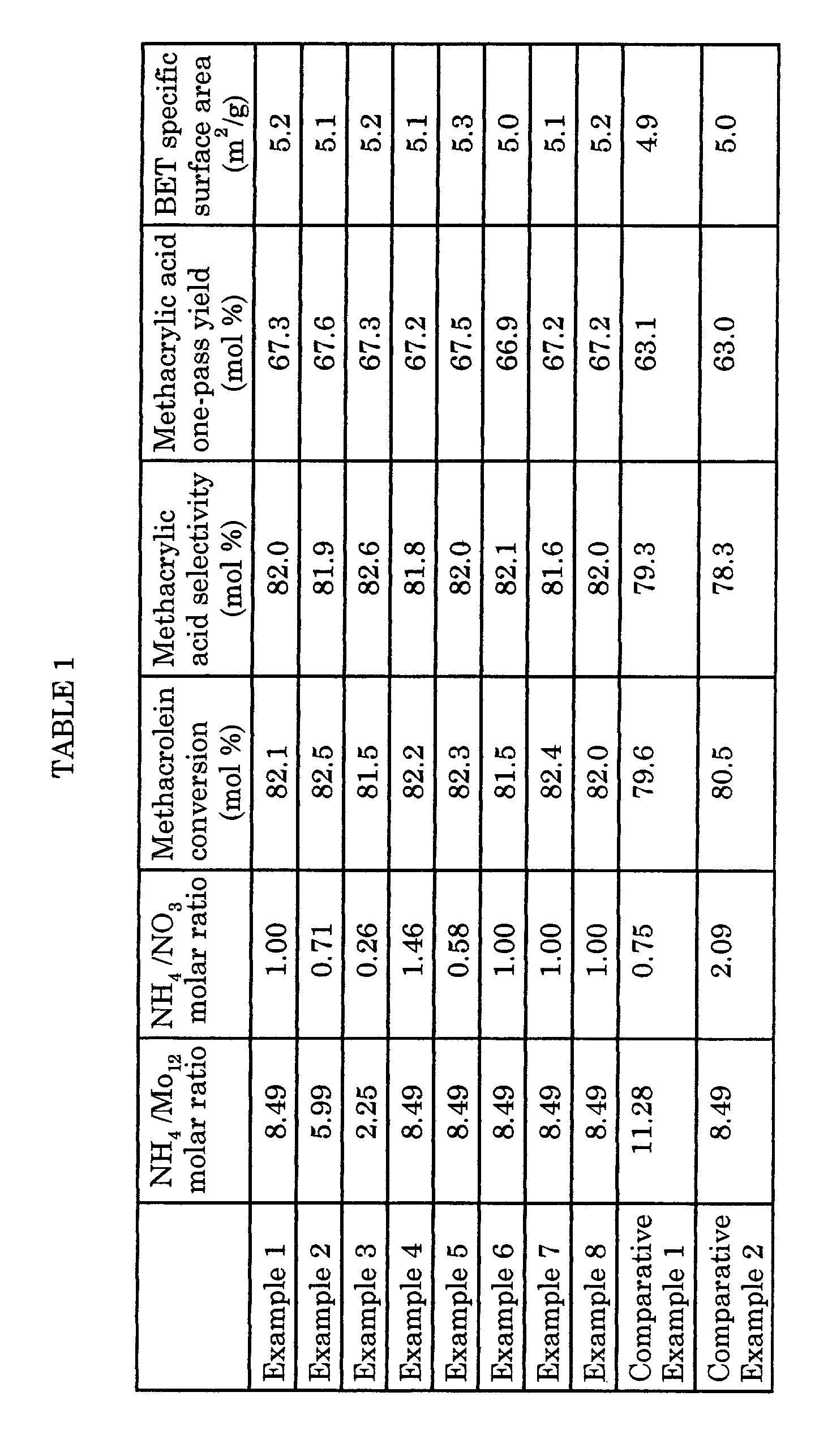
methacrolein 3.5 volume % isobutylene 0.04 volume % methacrylic acid + acetic acid 0.24 volume % steam 20.0 volume % oxygen 9.0 volume % inert gases mainly of nitrogen and carbon dioxide 67.22 volume % - The results are shown in Table 1, together with the ammonium ions /12 molybdenum atoms (NH4 / Mo12) and the ammonium ions / nitrate anions (NH4 / NO3) in the aqueous mixture, and the BET specific surface area of the catalyst.
- Example 1 was repeated except that the amount of the ammonium paramolybdate was changed to 600 g and that of the molybdenum trioxide, to 518 g. The results are shown in Table 1.
- Example 1 was repeated except that the amount of the ammonium paramolybdate was changed to 150 g, and that of the molybdenum trioxide, to 884 g. The results are shown in Table 1.
- Example 1 was repeated except that the amount of the nitric acid was changed from 400 g to 250 g. The results are shown in Table 1.
- Example 1 was repeated except that the amount of the nitric acid was changed from 400 g to 750 g. The results are shown in Table 1.
- Example 1 was repeated except that the pyridine was replaced with the same amount of piperidine. The results are shown in Table 1.
- Example 1 was repeated except that the pyridine was replaced with the same amount of piperazine. The results are shown in Table 1.
- Example 1 was repeated except that no ammonium paramolybdate was used, the amount of molybdenum trioxide was changed to 1007 g and 265 g of aqueous ammonia (28% by weight) was added simultaneously with the pyridine. The results are shown in Table 1.
- Example 1 was repeated except that the amount of the ammonium paramolybdate was changed to 1236 g and that no ammonium trioxide was used. The results are shown in Table 1.
- Example 1 was repeated except that the amount of the nitric acid was changed from 400 g to 150 g. The results are shown in Table 1.
Claims (12)
- A process for preparing a heteropolyacid catalyst comprising molybdophosphoric acid and/or molybdovanadophosphoric acid, and/or a salt thereof, which process comprises:(a) preparing an aqueous solution or aqueous dispersion which(1) contains a nitrogen-containing heterocyclic compound, nitrate ions and ammonium ions,(2) has an ammonium ion content of 1.7 mols or less per mol of nitrate anion content, and(3) has an ammonium ion content of 10 mols or less per 12 mols of molybdenum atom content, by a method in which material comprising the catalyst-constituting elements is mixed with the nitrogen-containing heterocyclic compound in the presence of water; and(b) drying and calcining said solution or dispersion.
- A process according to claim 1, in which the heteropolyacid catalyst is of formula,
where b is 12, a is from 0.1 to 3, c is from 0 to 6 and d is from 0.05 to 5, and x is a numerical value determined by the valency of each element. - A process according to claim 1 or claim 2, in which the nitrogen-containing heterocyclic compound is selected from pyridine, piperidine, piperazine, pyrimidine, quinoline, isoquinoline and their alkyl derivatives.
- A process according to any one of claims 1 to 3, in which a source for supplying ammonium ions and/or a source for supplying nitrate anions is mixed with material containing the catalyst-constituting elements and a nitrogen-containing heterocyclic compound in the presence of water.
- A process according to claim 4, in which the ammonium ion-supplying source comprises ammonia and/or an ammonium salt.
- A process according to claim 5, in which the ammonium salt comprises ammonium nitrate, ammonium carbonate, ammonium hydrogencarbonate and/or ammonium acetate.
- A process according to any one of claims 4 to 6, in which the nitrate anion-supplying source comprises nitric acid and/or ammonium nitrate.
- A process according to any one of the preceding claims, in which a molybdenum compound not containing ammonium ions and, optionally, a molybdenum compound containing ammonium ions are used as material(s) containing the catalyst-constituting element(s).
- A process according to any one of the preceding claims, in which the calcination is conducted at a temperature of from 200 to 600°C.
- A process according to any one of the preceding claims, in which the calcination is conducted in an inert gas at a temperature of from 200 to 600°C and further at from 100 to 400°C in air.
- A process comprising producing methacrylic acid through vapor phase oxidation or vapor phase oxidehydrogenation of methacrolein, isobutyl aldehyde and/or isobutyric acid, in which a heteropolyacid catalyst obtainable by a process according to any one of the preceding claims is used as the catalyst.
- Use of a heteropolyacid catalyst obtainable by a process according to any one of claims 1 to 10 in a process for the preparation of unsaturated carboxylic acid through vapor phase oxidation of unsaturated aldehyde.
Applications Claiming Priority (2)
| Application Number | Priority Date | Filing Date | Title |
|---|---|---|---|
| JP2000062225 | 2000-03-07 | ||
| JP2000062225A JP3767309B2 (en) | 2000-03-07 | 2000-03-07 | Method for producing heteropolyacid catalyst and method for producing methacrylic acid |
Publications (1)
| Publication Number | Publication Date |
|---|---|
| EP1132131A1 true EP1132131A1 (en) | 2001-09-12 |
Family
ID=18582263
Family Applications (1)
| Application Number | Title | Priority Date | Filing Date |
|---|---|---|---|
| EP01302171A Withdrawn EP1132131A1 (en) | 2000-03-07 | 2001-03-07 | Method for preparing heteropolyacid catalyst and method for producing methacrylic acid |
Country Status (6)
| Country | Link |
|---|---|
| US (2) | US6458740B2 (en) |
| EP (1) | EP1132131A1 (en) |
| JP (1) | JP3767309B2 (en) |
| KR (1) | KR101052454B1 (en) |
| SG (1) | SG90237A1 (en) |
| TW (1) | TW592812B (en) |
Cited By (5)
| Publication number | Priority date | Publication date | Assignee | Title |
|---|---|---|---|---|
| EP1192992A1 (en) * | 2000-09-27 | 2002-04-03 | Nippon Shokubai Co., Ltd | Method for reactivating catalyst for methacrylic acid preparation |
| WO2003039745A1 (en) * | 2001-11-02 | 2003-05-15 | California Institute Of Technology | Polyoxometallate catalysts and method for the production of carboxylic acids by catalysed partial oxidation of alkanes |
| EP1595600A4 (en) * | 2003-02-20 | 2007-03-21 | Nippon Kayaku Kk | Catalyst for methacrylic acid production and process for producing the same |
| KR101052454B1 (en) | 2000-03-07 | 2011-07-28 | 스미또모 가가꾸 가부시끼가이샤 | Method for producing heteropolyacid catalyst and method for producing methacrylic acid |
| EP2275204A4 (en) * | 2008-04-16 | 2011-09-28 | Nippon Kayaku Kk | Catalyst for producing acrolein and acrylic acid through glycerin dehydration and production method of same |
Families Citing this family (19)
| Publication number | Priority date | Publication date | Assignee | Title |
|---|---|---|---|---|
| JP3763246B2 (en) * | 2000-04-06 | 2006-04-05 | 住友化学株式会社 | Method for regenerating heteropolyacid catalyst and method for producing methacrylic acid |
| KR100477894B1 (en) * | 2002-06-04 | 2005-03-18 | 한국과학기술연구원 | A preparation method of heteropolyacid catalyst and preparation method of metacrylic acid using thereof |
| WO2004004900A1 (en) * | 2002-07-05 | 2004-01-15 | Mitsubishi Rayon Co., Ltd. | Process for producing catalysts for the production of methacrylic acid |
| KR100557640B1 (en) * | 2004-01-09 | 2006-03-10 | 주식회사 엘지화학 | Novel heteropolyacid catalyst and preparation method thereof |
| US7732367B2 (en) * | 2005-07-25 | 2010-06-08 | Saudi Basic Industries Corporation | Catalyst for methacrolein oxidation and method for making and using same |
| US7851397B2 (en) | 2005-07-25 | 2010-12-14 | Saudi Basic Industries Corporation | Catalyst for methacrolein oxidation and method for making and using same |
| KR100790215B1 (en) * | 2006-08-29 | 2008-01-02 | 주식회사 효성 | Purification Method of High Purity Heteropoly Acid Catalyst |
| WO2008066079A1 (en) | 2006-12-01 | 2008-06-05 | Nippon Shokubai Co., Ltd. | Method for producing acrylic acid |
| KR100954049B1 (en) * | 2007-06-13 | 2010-04-20 | 주식회사 엘지화학 | Method for preparing heteropolyacid catalyst |
| JP2010099596A (en) * | 2008-10-24 | 2010-05-06 | Arkema France | Catalyst for manufacturing acrolein and acrylic acid by dehydration reaction of glycerin and method of manufacturing this catalyst |
| JP5362370B2 (en) * | 2009-01-14 | 2013-12-11 | 三菱レイヨン株式会社 | Method for producing catalyst for synthesis of methacrylic acid |
| JP5626583B2 (en) * | 2010-01-28 | 2014-11-19 | 三菱レイヨン株式会社 | Catalyst for producing methacrylic acid, method for producing the same, and method for producing methacrylic acid |
| CN102553624B (en) * | 2012-01-05 | 2013-10-16 | 中国科学院过程工程研究所 | Preparation method of catalyst for synthesizing methacrylic acid |
| CN112871193B (en) * | 2019-11-29 | 2022-01-28 | 中国科学院大连化学物理研究所 | Catalyst for preparing methylacrolein by oxidizing isobutene, preparation and application |
| WO2021145233A1 (en) * | 2020-01-14 | 2021-07-22 | 株式会社日本触媒 | Method for producing acrylic acid |
| CN111778390A (en) * | 2020-07-08 | 2020-10-16 | 辽宁石化职业技术学院 | Purification method for producing vanadium pentoxide by sodium roasting |
| CN117384027A (en) * | 2023-10-16 | 2024-01-12 | 润泰化学(泰兴)有限公司 | A method for preparing isooctanoic acid by self-condensation and oxidation of n-butyraldehyde |
| CN117757077B (en) * | 2024-01-09 | 2024-07-16 | 广州盛泰诺新材料科技有限公司 | Preparation method of high-activity single-end hydroxyl silicone oil |
| CN118620113B (en) * | 2024-05-24 | 2025-01-24 | 海南师范大学 | A polyvinylphosphoric acid type phosphomolybdicvanadium heteropolyacid catalyst, its preparation method and its application in deep oxidation desulfurization with low oxygen-sulfur ratio |
Citations (3)
| Publication number | Priority date | Publication date | Assignee | Title |
|---|---|---|---|---|
| FR1601082A (en) * | 1968-02-28 | 1970-08-10 | Molybdenum based catalyst for oxidative hyd - roxylation of org compds | |
| JPS5349234A (en) * | 1976-10-18 | 1978-05-04 | Hitachi Ltd | Solid electrolyte |
| EP0064371A1 (en) * | 1981-04-24 | 1982-11-10 | Sumitomo Chemical Company, Limited | Heteropoly acids and their production and use |
Family Cites Families (10)
| Publication number | Priority date | Publication date | Assignee | Title |
|---|---|---|---|---|
| JPS5712830A (en) | 1980-06-26 | 1982-01-22 | Nippon Shokubai Kagaku Kogyo Co Ltd | Oxidation catalyst and its preparation |
| JPS6035178B2 (en) | 1981-04-17 | 1985-08-13 | 株式会社日本触媒 | Oxidation catalyst and its preparation method |
| JPS6035179B2 (en) | 1981-04-22 | 1985-08-13 | 株式会社日本触媒 | Oxidation catalyst and its preparation method |
| US4419270A (en) | 1980-06-26 | 1983-12-06 | Nippon Shokubai Kagaku Kogyo Co. Ltd. | Oxidation catalyst |
| JPS6033539B2 (en) | 1981-04-16 | 1985-08-03 | 株式会社日本触媒 | Oxidation catalyst and its preparation method |
| JPS59115750A (en) * | 1982-12-22 | 1984-07-04 | Nippon Shokubai Kagaku Kogyo Co Ltd | Catalyst for synthesis of methacrylic acid |
| DE3508649A1 (en) * | 1985-03-12 | 1986-09-18 | Röhm GmbH, 6100 Darmstadt | HETEROPOLYSIC ACID H (DOWN ARROW) 8 (DOWN ARROW) PMO (DOWN ARROW) 1 (DOWN ARROW) (DOWN ARROW) 0 (DOWN ARROW) VO (DOWN ARROW) 3 (DOWN ARROW) (9 DOWN ARROW) THEIR ANHYDRIDE PMO (DOWN ARROW) 1 (DOWN ARROW) (DOWN ARROW) 0 (DOWN ARROW) VO (DOWN ARROW) 3 (DOWN ARROW) (DOWN ARROW) 5 (DOWN ARROW) AND THEIR USE |
| EP1464393A1 (en) * | 1999-02-19 | 2004-10-06 | Nippon Shokubai Co., Ltd. | Catalyst for producing phthalic anhydride |
| JP3767309B2 (en) | 2000-03-07 | 2006-04-19 | 住友化学株式会社 | Method for producing heteropolyacid catalyst and method for producing methacrylic acid |
| JP3763246B2 (en) * | 2000-04-06 | 2006-04-05 | 住友化学株式会社 | Method for regenerating heteropolyacid catalyst and method for producing methacrylic acid |
-
2000
- 2000-03-07 JP JP2000062225A patent/JP3767309B2/en not_active Expired - Fee Related
-
2001
- 2001-03-05 US US09/797,683 patent/US6458740B2/en not_active Expired - Fee Related
- 2001-03-06 KR KR1020010011446A patent/KR101052454B1/en not_active Expired - Fee Related
- 2001-03-06 TW TW090105114A patent/TW592812B/en not_active IP Right Cessation
- 2001-03-07 EP EP01302171A patent/EP1132131A1/en not_active Withdrawn
- 2001-03-07 SG SG200101355A patent/SG90237A1/en unknown
-
2002
- 2002-05-29 US US10/155,987 patent/US6624326B2/en not_active Expired - Fee Related
Patent Citations (3)
| Publication number | Priority date | Publication date | Assignee | Title |
|---|---|---|---|---|
| FR1601082A (en) * | 1968-02-28 | 1970-08-10 | Molybdenum based catalyst for oxidative hyd - roxylation of org compds | |
| JPS5349234A (en) * | 1976-10-18 | 1978-05-04 | Hitachi Ltd | Solid electrolyte |
| EP0064371A1 (en) * | 1981-04-24 | 1982-11-10 | Sumitomo Chemical Company, Limited | Heteropoly acids and their production and use |
Non-Patent Citations (1)
| Title |
|---|
| DATABASE WPI Section Ch Week 197824, Derwent World Patents Index; Class A14, AN 1978-42922A, XP002170772 * |
Cited By (10)
| Publication number | Priority date | Publication date | Assignee | Title |
|---|---|---|---|---|
| KR101052454B1 (en) | 2000-03-07 | 2011-07-28 | 스미또모 가가꾸 가부시끼가이샤 | Method for producing heteropolyacid catalyst and method for producing methacrylic acid |
| EP1192992A1 (en) * | 2000-09-27 | 2002-04-03 | Nippon Shokubai Co., Ltd | Method for reactivating catalyst for methacrylic acid preparation |
| US6664206B2 (en) | 2000-09-27 | 2003-12-16 | Nippon Shokubai Co., Ltd. | Method for reactivating catalyst for methacrylic acid preparation |
| WO2003039745A1 (en) * | 2001-11-02 | 2003-05-15 | California Institute Of Technology | Polyoxometallate catalysts and method for the production of carboxylic acids by catalysed partial oxidation of alkanes |
| US6914029B2 (en) | 2001-11-02 | 2005-07-05 | California Institute Of Technology | Polyoxometallate catalysts and catalytic processes |
| EP1595600A4 (en) * | 2003-02-20 | 2007-03-21 | Nippon Kayaku Kk | Catalyst for methacrylic acid production and process for producing the same |
| CN100457264C (en) * | 2003-02-20 | 2009-02-04 | 日本化药株式会社 | Catalyst for preparing methacrylic acid and its preparation method |
| US7825061B2 (en) | 2003-02-20 | 2010-11-02 | Nippon Kayaku Kabushiki Kaisha | Catalyst for producing methacrylic acid and preparation method thereof |
| EP2374538A1 (en) * | 2003-02-20 | 2011-10-12 | Nippon Kayaku Kabushiki Kaisha | Process for producting an heterophosphoromolybdic catalyst using cesium acetate as an additive |
| EP2275204A4 (en) * | 2008-04-16 | 2011-09-28 | Nippon Kayaku Kk | Catalyst for producing acrolein and acrylic acid through glycerin dehydration and production method of same |
Also Published As
| Publication number | Publication date |
|---|---|
| KR101052454B1 (en) | 2011-07-28 |
| US6458740B2 (en) | 2002-10-01 |
| JP2001246260A (en) | 2001-09-11 |
| US20010029233A1 (en) | 2001-10-11 |
| TW592812B (en) | 2004-06-21 |
| US6624326B2 (en) | 2003-09-23 |
| US20020193246A1 (en) | 2002-12-19 |
| SG90237A1 (en) | 2002-07-23 |
| KR20010088410A (en) | 2001-09-26 |
| JP3767309B2 (en) | 2006-04-19 |
Similar Documents
| Publication | Publication Date | Title |
|---|---|---|
| US6458740B2 (en) | Method for preparing heteropolyacid catalyst and method for producing methacrylic acid | |
| EP0043100B1 (en) | Oxidation catalyst and process for preparation thereof | |
| US4146574A (en) | Process for preparing heteropoly-acids | |
| EP0427508B1 (en) | method for production of acrylic acid | |
| EP1223163B1 (en) | Method for producing acrylonitrile, catalyst for use therein and the method for preparing the same | |
| US6673733B2 (en) | Method for regenerating heteropolyacid catalyst and method for producing methacrylic acid | |
| US4467113A (en) | Process for producing methacrylic acid | |
| US20100240925A1 (en) | Methods for making unsaturated acids using catalysts for methacrolein oxidation | |
| EP0006248A1 (en) | A process for producing methacrylic acid and a catalyst | |
| EP1223162B1 (en) | Method for producing acrylonitrile, catalyst for use therein and the method for preparing the same | |
| US5166119A (en) | Preparation of catalysts for producing methacrolein and methacrylic acid | |
| US4874738A (en) | Catalyst for ammoxidation of paraffins | |
| US5976482A (en) | Process for production of prussic acid | |
| CN119702028B (en) | Catalysts and preparation methods for the selective oxidation of propylene to acrolein and acrylic acid. | |
| US4918214A (en) | Ammoxidation of paraffins and catalysts therefrom | |
| JPS6033539B2 (en) | Oxidation catalyst and its preparation method | |
| KR20000071830A (en) | Catalysts for methacrylic acid production and process for producing methacrylic acid | |
| JPH0133097B2 (en) | ||
| EP0083189A2 (en) | Process for preparation of acrylonitrile or methacrylonitrile | |
| JPS615043A (en) | Production of methacrylic acid | |
| JPS6035179B2 (en) | Oxidation catalyst and its preparation method | |
| JPH0463139A (en) | Catalyst for production of methacrylic acid | |
| US6268529B1 (en) | Method for the manufacture of acrylic acid | |
| JPS6035180B2 (en) | Oxidation catalyst and its preparation method | |
| JPH0622679B2 (en) | Method for preparing catalyst for methacrylic acid production |
Legal Events
| Date | Code | Title | Description |
|---|---|---|---|
| PUAI | Public reference made under article 153(3) epc to a published international application that has entered the european phase |
Free format text: ORIGINAL CODE: 0009012 |
|
| AK | Designated contracting states |
Kind code of ref document: A1 Designated state(s): AT BE CH CY DE DK ES FI FR GB GR IE IT LI LU MC NL PT SE TR Kind code of ref document: A1 Designated state(s): DE FR |
|
| AX | Request for extension of the european patent |
Free format text: AL;LT;LV;MK;RO;SI |
|
| 17P | Request for examination filed |
Effective date: 20020225 |
|
| AKX | Designation fees paid |
Free format text: DE FR |
|
| 17Q | First examination report despatched |
Effective date: 20031229 |
|
| RAP1 | Party data changed (applicant data changed or rights of an application transferred) |
Owner name: SUMITOMO CHEMICAL CO., LTD. |
|
| STAA | Information on the status of an ep patent application or granted ep patent |
Free format text: STATUS: THE APPLICATION IS DEEMED TO BE WITHDRAWN |
|
| 18D | Application deemed to be withdrawn |
Effective date: 20141001 |