EP1130004A1 - Oxide having perovskite structure, barium titanate, and manufacturing method therefor, dielectric ceramic, and ceramic electronic component - Google Patents
Oxide having perovskite structure, barium titanate, and manufacturing method therefor, dielectric ceramic, and ceramic electronic component Download PDFInfo
- Publication number
- EP1130004A1 EP1130004A1 EP01104864A EP01104864A EP1130004A1 EP 1130004 A1 EP1130004 A1 EP 1130004A1 EP 01104864 A EP01104864 A EP 01104864A EP 01104864 A EP01104864 A EP 01104864A EP 1130004 A1 EP1130004 A1 EP 1130004A1
- Authority
- EP
- European Patent Office
- Prior art keywords
- oxide
- powder
- barium titanate
- perovskite structure
- dielectric ceramic
- Prior art date
- Legal status (The legal status is an assumption and is not a legal conclusion. Google has not performed a legal analysis and makes no representation as to the accuracy of the status listed.)
- Granted
Links
- 229910002113 barium titanate Inorganic materials 0.000 title claims abstract description 73
- JRPBQTZRNDNNOP-UHFFFAOYSA-N barium titanate Chemical compound [Ba+2].[Ba+2].[O-][Ti]([O-])([O-])[O-] JRPBQTZRNDNNOP-UHFFFAOYSA-N 0.000 title claims abstract description 72
- 239000000919 ceramic Substances 0.000 title claims description 61
- 238000004519 manufacturing process Methods 0.000 title claims description 21
- 239000000843 powder Substances 0.000 claims abstract description 84
- GWEVSGVZZGPLCZ-UHFFFAOYSA-N Titan oxide Chemical compound O=[Ti]=O GWEVSGVZZGPLCZ-UHFFFAOYSA-N 0.000 claims abstract description 64
- 239000002245 particle Substances 0.000 claims abstract description 59
- AYJRCSIUFZENHW-UHFFFAOYSA-L barium carbonate Chemical compound [Ba+2].[O-]C([O-])=O AYJRCSIUFZENHW-UHFFFAOYSA-L 0.000 claims abstract description 40
- QVGXLLKOCUKJST-UHFFFAOYSA-N atomic oxygen Chemical compound [O] QVGXLLKOCUKJST-UHFFFAOYSA-N 0.000 claims abstract description 38
- 239000001301 oxygen Substances 0.000 claims abstract description 38
- 229910052760 oxygen Inorganic materials 0.000 claims abstract description 38
- 125000002887 hydroxy group Chemical group [H]O* 0.000 claims abstract description 37
- 239000013078 crystal Substances 0.000 claims abstract description 16
- 238000002156 mixing Methods 0.000 claims abstract description 8
- 239000011812 mixed powder Substances 0.000 claims abstract description 7
- 229910044991 metal oxide Inorganic materials 0.000 claims description 15
- BVKZGUZCCUSVTD-UHFFFAOYSA-L Carbonate Chemical compound [O-]C([O-])=O BVKZGUZCCUSVTD-UHFFFAOYSA-L 0.000 claims description 12
- 238000010304 firing Methods 0.000 claims description 7
- 239000004020 conductor Substances 0.000 claims description 6
- 229910052774 Proactinium Inorganic materials 0.000 claims description 2
- 238000010438 heat treatment Methods 0.000 abstract description 31
- 230000003247 decreasing effect Effects 0.000 abstract description 7
- 230000005621 ferroelectricity Effects 0.000 abstract description 6
- 239000003985 ceramic capacitor Substances 0.000 description 17
- 239000007858 starting material Substances 0.000 description 12
- IJGRMHOSHXDMSA-UHFFFAOYSA-N Atomic nitrogen Chemical compound N#N IJGRMHOSHXDMSA-UHFFFAOYSA-N 0.000 description 10
- 238000011156 evaluation Methods 0.000 description 10
- 239000000203 mixture Substances 0.000 description 9
- 238000001035 drying Methods 0.000 description 8
- 238000003786 synthesis reaction Methods 0.000 description 8
- 230000008016 vaporization Effects 0.000 description 8
- 239000000463 material Substances 0.000 description 7
- 239000007789 gas Substances 0.000 description 6
- 230000015572 biosynthetic process Effects 0.000 description 5
- 238000009413 insulation Methods 0.000 description 5
- 239000003960 organic solvent Substances 0.000 description 5
- BQCADISMDOOEFD-UHFFFAOYSA-N Silver Chemical compound [Ag] BQCADISMDOOEFD-UHFFFAOYSA-N 0.000 description 4
- 229910052757 nitrogen Inorganic materials 0.000 description 4
- 229910052709 silver Inorganic materials 0.000 description 4
- 239000004332 silver Substances 0.000 description 4
- UFHFLCQGNIYNRP-UHFFFAOYSA-N Hydrogen Chemical compound [H][H] UFHFLCQGNIYNRP-UHFFFAOYSA-N 0.000 description 3
- 239000000654 additive Substances 0.000 description 3
- 238000006243 chemical reaction Methods 0.000 description 3
- 238000000354 decomposition reaction Methods 0.000 description 3
- 230000001747 exhibiting effect Effects 0.000 description 3
- 239000001257 hydrogen Substances 0.000 description 3
- 229910052739 hydrogen Inorganic materials 0.000 description 3
- 238000007747 plating Methods 0.000 description 3
- 230000001603 reducing effect Effects 0.000 description 3
- 238000005245 sintering Methods 0.000 description 3
- 239000002002 slurry Substances 0.000 description 3
- LFQSCWFLJHTTHZ-UHFFFAOYSA-N Ethanol Chemical compound CCO LFQSCWFLJHTTHZ-UHFFFAOYSA-N 0.000 description 2
- -1 alkoxide compounds Chemical class 0.000 description 2
- 239000012298 atmosphere Substances 0.000 description 2
- 239000011230 binding agent Substances 0.000 description 2
- 239000003990 capacitor Substances 0.000 description 2
- 230000015556 catabolic process Effects 0.000 description 2
- 238000006731 degradation reaction Methods 0.000 description 2
- 229910001873 dinitrogen Inorganic materials 0.000 description 2
- 230000000694 effects Effects 0.000 description 2
- 239000011521 glass Substances 0.000 description 2
- 230000007062 hydrolysis Effects 0.000 description 2
- 238000006460 hydrolysis reaction Methods 0.000 description 2
- 238000001027 hydrothermal synthesis Methods 0.000 description 2
- 229910052748 manganese Inorganic materials 0.000 description 2
- 238000000034 method Methods 0.000 description 2
- 239000012299 nitrogen atmosphere Substances 0.000 description 2
- 238000003303 reheating Methods 0.000 description 2
- 229910052710 silicon Inorganic materials 0.000 description 2
- 238000002411 thermogravimetry Methods 0.000 description 2
- 229910052692 Dysprosium Inorganic materials 0.000 description 1
- 229910052688 Gadolinium Inorganic materials 0.000 description 1
- 229910052689 Holmium Inorganic materials 0.000 description 1
- 229910018054 Ni-Cu Inorganic materials 0.000 description 1
- 229910018481 Ni—Cu Inorganic materials 0.000 description 1
- 238000003991 Rietveld refinement Methods 0.000 description 1
- ATJFFYVFTNAWJD-UHFFFAOYSA-N Tin Chemical compound [Sn] ATJFFYVFTNAWJD-UHFFFAOYSA-N 0.000 description 1
- 238000002441 X-ray diffraction Methods 0.000 description 1
- 125000005595 acetylacetonate group Chemical group 0.000 description 1
- 230000000996 additive effect Effects 0.000 description 1
- 150000004703 alkoxides Chemical class 0.000 description 1
- 229910045601 alloy Inorganic materials 0.000 description 1
- 239000000956 alloy Substances 0.000 description 1
- 239000011575 calcium Substances 0.000 description 1
- AOWKSNWVBZGMTJ-UHFFFAOYSA-N calcium titanate Chemical compound [Ca+2].[O-][Ti]([O-])=O AOWKSNWVBZGMTJ-UHFFFAOYSA-N 0.000 description 1
- 150000004649 carbonic acid derivatives Chemical class 0.000 description 1
- 239000011248 coating agent Substances 0.000 description 1
- 238000000576 coating method Methods 0.000 description 1
- 150000001875 compounds Chemical class 0.000 description 1
- 229910052802 copper Inorganic materials 0.000 description 1
- RKTYLMNFRDHKIL-UHFFFAOYSA-N copper;5,10,15,20-tetraphenylporphyrin-22,24-diide Chemical compound [Cu+2].C1=CC(C(=C2C=CC([N-]2)=C(C=2C=CC=CC=2)C=2C=CC(N=2)=C(C=2C=CC=CC=2)C2=CC=C3[N-]2)C=2C=CC=CC=2)=NC1=C3C1=CC=CC=C1 RKTYLMNFRDHKIL-UHFFFAOYSA-N 0.000 description 1
- 239000003989 dielectric material Substances 0.000 description 1
- NKZSPGSOXYXWQA-UHFFFAOYSA-N dioxido(oxo)titanium;lead(2+) Chemical compound [Pb+2].[O-][Ti]([O-])=O NKZSPGSOXYXWQA-UHFFFAOYSA-N 0.000 description 1
- 238000007606 doctor blade method Methods 0.000 description 1
- 229910052749 magnesium Inorganic materials 0.000 description 1
- 229910052759 nickel Inorganic materials 0.000 description 1
- 150000002894 organic compounds Chemical class 0.000 description 1
- 229910052761 rare earth metal Inorganic materials 0.000 description 1
- 230000009257 reactivity Effects 0.000 description 1
- 239000000344 soap Substances 0.000 description 1
- 229910000679 solder Inorganic materials 0.000 description 1
- 239000006104 solid solution Substances 0.000 description 1
- 239000000243 solution Substances 0.000 description 1
- VEALVRVVWBQVSL-UHFFFAOYSA-N strontium titanate Chemical compound [Sr+2].[O-][Ti]([O-])=O VEALVRVVWBQVSL-UHFFFAOYSA-N 0.000 description 1
- 238000002076 thermal analysis method Methods 0.000 description 1
- 238000009834 vaporization Methods 0.000 description 1
- 229910052726 zirconium Inorganic materials 0.000 description 1
Images
Classifications
-
- C—CHEMISTRY; METALLURGY
- C04—CEMENTS; CONCRETE; ARTIFICIAL STONE; CERAMICS; REFRACTORIES
- C04B—LIME, MAGNESIA; SLAG; CEMENTS; COMPOSITIONS THEREOF, e.g. MORTARS, CONCRETE OR LIKE BUILDING MATERIALS; ARTIFICIAL STONE; CERAMICS; REFRACTORIES; TREATMENT OF NATURAL STONE
- C04B35/00—Shaped ceramic products characterised by their composition; Ceramics compositions; Processing powders of inorganic compounds preparatory to the manufacturing of ceramic products
- C04B35/622—Forming processes; Processing powders of inorganic compounds preparatory to the manufacturing of ceramic products
- C04B35/626—Preparing or treating the powders individually or as batches ; preparing or treating macroscopic reinforcing agents for ceramic products, e.g. fibres; mechanical aspects section B
- C04B35/62605—Treating the starting powders individually or as mixtures
- C04B35/62625—Wet mixtures
- C04B35/6264—Mixing media, e.g. organic solvents
-
- C—CHEMISTRY; METALLURGY
- C04—CEMENTS; CONCRETE; ARTIFICIAL STONE; CERAMICS; REFRACTORIES
- C04B—LIME, MAGNESIA; SLAG; CEMENTS; COMPOSITIONS THEREOF, e.g. MORTARS, CONCRETE OR LIKE BUILDING MATERIALS; ARTIFICIAL STONE; CERAMICS; REFRACTORIES; TREATMENT OF NATURAL STONE
- C04B35/00—Shaped ceramic products characterised by their composition; Ceramics compositions; Processing powders of inorganic compounds preparatory to the manufacturing of ceramic products
- C04B35/01—Shaped ceramic products characterised by their composition; Ceramics compositions; Processing powders of inorganic compounds preparatory to the manufacturing of ceramic products based on oxide ceramics
- C04B35/46—Shaped ceramic products characterised by their composition; Ceramics compositions; Processing powders of inorganic compounds preparatory to the manufacturing of ceramic products based on oxide ceramics based on titanium oxides or titanates
- C04B35/462—Shaped ceramic products characterised by their composition; Ceramics compositions; Processing powders of inorganic compounds preparatory to the manufacturing of ceramic products based on oxide ceramics based on titanium oxides or titanates based on titanates
- C04B35/465—Shaped ceramic products characterised by their composition; Ceramics compositions; Processing powders of inorganic compounds preparatory to the manufacturing of ceramic products based on oxide ceramics based on titanium oxides or titanates based on titanates based on alkaline earth metal titanates
- C04B35/468—Shaped ceramic products characterised by their composition; Ceramics compositions; Processing powders of inorganic compounds preparatory to the manufacturing of ceramic products based on oxide ceramics based on titanium oxides or titanates based on titanates based on alkaline earth metal titanates based on barium titanates
-
- B—PERFORMING OPERATIONS; TRANSPORTING
- B32—LAYERED PRODUCTS
- B32B—LAYERED PRODUCTS, i.e. PRODUCTS BUILT-UP OF STRATA OF FLAT OR NON-FLAT, e.g. CELLULAR OR HONEYCOMB, FORM
- B32B18/00—Layered products essentially comprising ceramics, e.g. refractory products
-
- B—PERFORMING OPERATIONS; TRANSPORTING
- B82—NANOTECHNOLOGY
- B82Y—SPECIFIC USES OR APPLICATIONS OF NANOSTRUCTURES; MEASUREMENT OR ANALYSIS OF NANOSTRUCTURES; MANUFACTURE OR TREATMENT OF NANOSTRUCTURES
- B82Y30/00—Nanotechnology for materials or surface science, e.g. nanocomposites
-
- C—CHEMISTRY; METALLURGY
- C01—INORGANIC CHEMISTRY
- C01G—COMPOUNDS CONTAINING METALS NOT COVERED BY SUBCLASSES C01D OR C01F
- C01G23/00—Compounds of titanium
- C01G23/003—Titanates
- C01G23/006—Alkaline earth titanates
-
- C—CHEMISTRY; METALLURGY
- C04—CEMENTS; CONCRETE; ARTIFICIAL STONE; CERAMICS; REFRACTORIES
- C04B—LIME, MAGNESIA; SLAG; CEMENTS; COMPOSITIONS THEREOF, e.g. MORTARS, CONCRETE OR LIKE BUILDING MATERIALS; ARTIFICIAL STONE; CERAMICS; REFRACTORIES; TREATMENT OF NATURAL STONE
- C04B35/00—Shaped ceramic products characterised by their composition; Ceramics compositions; Processing powders of inorganic compounds preparatory to the manufacturing of ceramic products
- C04B35/01—Shaped ceramic products characterised by their composition; Ceramics compositions; Processing powders of inorganic compounds preparatory to the manufacturing of ceramic products based on oxide ceramics
- C04B35/46—Shaped ceramic products characterised by their composition; Ceramics compositions; Processing powders of inorganic compounds preparatory to the manufacturing of ceramic products based on oxide ceramics based on titanium oxides or titanates
- C04B35/462—Shaped ceramic products characterised by their composition; Ceramics compositions; Processing powders of inorganic compounds preparatory to the manufacturing of ceramic products based on oxide ceramics based on titanium oxides or titanates based on titanates
- C04B35/465—Shaped ceramic products characterised by their composition; Ceramics compositions; Processing powders of inorganic compounds preparatory to the manufacturing of ceramic products based on oxide ceramics based on titanium oxides or titanates based on titanates based on alkaline earth metal titanates
- C04B35/468—Shaped ceramic products characterised by their composition; Ceramics compositions; Processing powders of inorganic compounds preparatory to the manufacturing of ceramic products based on oxide ceramics based on titanium oxides or titanates based on titanates based on alkaline earth metal titanates based on barium titanates
- C04B35/4682—Shaped ceramic products characterised by their composition; Ceramics compositions; Processing powders of inorganic compounds preparatory to the manufacturing of ceramic products based on oxide ceramics based on titanium oxides or titanates based on titanates based on alkaline earth metal titanates based on barium titanates based on BaTiO3 perovskite phase
-
- C—CHEMISTRY; METALLURGY
- C04—CEMENTS; CONCRETE; ARTIFICIAL STONE; CERAMICS; REFRACTORIES
- C04B—LIME, MAGNESIA; SLAG; CEMENTS; COMPOSITIONS THEREOF, e.g. MORTARS, CONCRETE OR LIKE BUILDING MATERIALS; ARTIFICIAL STONE; CERAMICS; REFRACTORIES; TREATMENT OF NATURAL STONE
- C04B35/00—Shaped ceramic products characterised by their composition; Ceramics compositions; Processing powders of inorganic compounds preparatory to the manufacturing of ceramic products
- C04B35/622—Forming processes; Processing powders of inorganic compounds preparatory to the manufacturing of ceramic products
- C04B35/626—Preparing or treating the powders individually or as batches ; preparing or treating macroscopic reinforcing agents for ceramic products, e.g. fibres; mechanical aspects section B
-
- C—CHEMISTRY; METALLURGY
- C04—CEMENTS; CONCRETE; ARTIFICIAL STONE; CERAMICS; REFRACTORIES
- C04B—LIME, MAGNESIA; SLAG; CEMENTS; COMPOSITIONS THEREOF, e.g. MORTARS, CONCRETE OR LIKE BUILDING MATERIALS; ARTIFICIAL STONE; CERAMICS; REFRACTORIES; TREATMENT OF NATURAL STONE
- C04B35/00—Shaped ceramic products characterised by their composition; Ceramics compositions; Processing powders of inorganic compounds preparatory to the manufacturing of ceramic products
- C04B35/622—Forming processes; Processing powders of inorganic compounds preparatory to the manufacturing of ceramic products
- C04B35/626—Preparing or treating the powders individually or as batches ; preparing or treating macroscopic reinforcing agents for ceramic products, e.g. fibres; mechanical aspects section B
- C04B35/62605—Treating the starting powders individually or as mixtures
- C04B35/62645—Thermal treatment of powders or mixtures thereof other than sintering
- C04B35/62655—Drying, e.g. freeze-drying, spray-drying, microwave or supercritical drying
-
- C—CHEMISTRY; METALLURGY
- C04—CEMENTS; CONCRETE; ARTIFICIAL STONE; CERAMICS; REFRACTORIES
- C04B—LIME, MAGNESIA; SLAG; CEMENTS; COMPOSITIONS THEREOF, e.g. MORTARS, CONCRETE OR LIKE BUILDING MATERIALS; ARTIFICIAL STONE; CERAMICS; REFRACTORIES; TREATMENT OF NATURAL STONE
- C04B35/00—Shaped ceramic products characterised by their composition; Ceramics compositions; Processing powders of inorganic compounds preparatory to the manufacturing of ceramic products
- C04B35/622—Forming processes; Processing powders of inorganic compounds preparatory to the manufacturing of ceramic products
- C04B35/626—Preparing or treating the powders individually or as batches ; preparing or treating macroscopic reinforcing agents for ceramic products, e.g. fibres; mechanical aspects section B
- C04B35/62605—Treating the starting powders individually or as mixtures
- C04B35/62645—Thermal treatment of powders or mixtures thereof other than sintering
- C04B35/62675—Thermal treatment of powders or mixtures thereof other than sintering characterised by the treatment temperature
-
- C—CHEMISTRY; METALLURGY
- C04—CEMENTS; CONCRETE; ARTIFICIAL STONE; CERAMICS; REFRACTORIES
- C04B—LIME, MAGNESIA; SLAG; CEMENTS; COMPOSITIONS THEREOF, e.g. MORTARS, CONCRETE OR LIKE BUILDING MATERIALS; ARTIFICIAL STONE; CERAMICS; REFRACTORIES; TREATMENT OF NATURAL STONE
- C04B35/00—Shaped ceramic products characterised by their composition; Ceramics compositions; Processing powders of inorganic compounds preparatory to the manufacturing of ceramic products
- C04B35/622—Forming processes; Processing powders of inorganic compounds preparatory to the manufacturing of ceramic products
- C04B35/626—Preparing or treating the powders individually or as batches ; preparing or treating macroscopic reinforcing agents for ceramic products, e.g. fibres; mechanical aspects section B
- C04B35/62605—Treating the starting powders individually or as mixtures
- C04B35/62645—Thermal treatment of powders or mixtures thereof other than sintering
- C04B35/6268—Thermal treatment of powders or mixtures thereof other than sintering characterised by the applied pressure or type of atmosphere, e.g. in vacuum, hydrogen or a specific oxygen pressure
-
- H—ELECTRICITY
- H01—ELECTRIC ELEMENTS
- H01G—CAPACITORS; CAPACITORS, RECTIFIERS, DETECTORS, SWITCHING DEVICES, LIGHT-SENSITIVE OR TEMPERATURE-SENSITIVE DEVICES OF THE ELECTROLYTIC TYPE
- H01G4/00—Fixed capacitors; Processes of their manufacture
- H01G4/002—Details
- H01G4/018—Dielectrics
- H01G4/06—Solid dielectrics
- H01G4/08—Inorganic dielectrics
- H01G4/12—Ceramic dielectrics
-
- H—ELECTRICITY
- H01—ELECTRIC ELEMENTS
- H01G—CAPACITORS; CAPACITORS, RECTIFIERS, DETECTORS, SWITCHING DEVICES, LIGHT-SENSITIVE OR TEMPERATURE-SENSITIVE DEVICES OF THE ELECTROLYTIC TYPE
- H01G4/00—Fixed capacitors; Processes of their manufacture
- H01G4/002—Details
- H01G4/018—Dielectrics
- H01G4/06—Solid dielectrics
- H01G4/08—Inorganic dielectrics
- H01G4/12—Ceramic dielectrics
- H01G4/1209—Ceramic dielectrics characterised by the ceramic dielectric material
- H01G4/1218—Ceramic dielectrics characterised by the ceramic dielectric material based on titanium oxides or titanates
- H01G4/1227—Ceramic dielectrics characterised by the ceramic dielectric material based on titanium oxides or titanates based on alkaline earth titanates
-
- H—ELECTRICITY
- H01—ELECTRIC ELEMENTS
- H01G—CAPACITORS; CAPACITORS, RECTIFIERS, DETECTORS, SWITCHING DEVICES, LIGHT-SENSITIVE OR TEMPERATURE-SENSITIVE DEVICES OF THE ELECTROLYTIC TYPE
- H01G4/00—Fixed capacitors; Processes of their manufacture
- H01G4/30—Stacked capacitors
-
- B—PERFORMING OPERATIONS; TRANSPORTING
- B32—LAYERED PRODUCTS
- B32B—LAYERED PRODUCTS, i.e. PRODUCTS BUILT-UP OF STRATA OF FLAT OR NON-FLAT, e.g. CELLULAR OR HONEYCOMB, FORM
- B32B2311/00—Metals, their alloys or their compounds
- B32B2311/22—Nickel or cobalt
-
- C—CHEMISTRY; METALLURGY
- C01—INORGANIC CHEMISTRY
- C01P—INDEXING SCHEME RELATING TO STRUCTURAL AND PHYSICAL ASPECTS OF SOLID INORGANIC COMPOUNDS
- C01P2002/00—Crystal-structural characteristics
- C01P2002/30—Three-dimensional structures
- C01P2002/34—Three-dimensional structures perovskite-type (ABO3)
-
- C—CHEMISTRY; METALLURGY
- C01—INORGANIC CHEMISTRY
- C01P—INDEXING SCHEME RELATING TO STRUCTURAL AND PHYSICAL ASPECTS OF SOLID INORGANIC COMPOUNDS
- C01P2002/00—Crystal-structural characteristics
- C01P2002/70—Crystal-structural characteristics defined by measured X-ray, neutron or electron diffraction data
- C01P2002/77—Crystal-structural characteristics defined by measured X-ray, neutron or electron diffraction data by unit-cell parameters, atom positions or structure diagrams
-
- C—CHEMISTRY; METALLURGY
- C01—INORGANIC CHEMISTRY
- C01P—INDEXING SCHEME RELATING TO STRUCTURAL AND PHYSICAL ASPECTS OF SOLID INORGANIC COMPOUNDS
- C01P2004/00—Particle morphology
- C01P2004/60—Particles characterised by their size
- C01P2004/62—Submicrometer sized, i.e. from 0.1-1 micrometer
-
- C—CHEMISTRY; METALLURGY
- C01—INORGANIC CHEMISTRY
- C01P—INDEXING SCHEME RELATING TO STRUCTURAL AND PHYSICAL ASPECTS OF SOLID INORGANIC COMPOUNDS
- C01P2004/00—Particle morphology
- C01P2004/60—Particles characterised by their size
- C01P2004/64—Nanometer sized, i.e. from 1-100 nanometer
-
- C—CHEMISTRY; METALLURGY
- C04—CEMENTS; CONCRETE; ARTIFICIAL STONE; CERAMICS; REFRACTORIES
- C04B—LIME, MAGNESIA; SLAG; CEMENTS; COMPOSITIONS THEREOF, e.g. MORTARS, CONCRETE OR LIKE BUILDING MATERIALS; ARTIFICIAL STONE; CERAMICS; REFRACTORIES; TREATMENT OF NATURAL STONE
- C04B2235/00—Aspects relating to ceramic starting mixtures or sintered ceramic products
- C04B2235/02—Composition of constituents of the starting material or of secondary phases of the final product
- C04B2235/30—Constituents and secondary phases not being of a fibrous nature
- C04B2235/32—Metal oxides, mixed metal oxides, or oxide-forming salts thereof, e.g. carbonates, nitrates, (oxy)hydroxides, chlorides
- C04B2235/3205—Alkaline earth oxides or oxide forming salts thereof, e.g. beryllium oxide
- C04B2235/3215—Barium oxides or oxide-forming salts thereof
-
- C—CHEMISTRY; METALLURGY
- C04—CEMENTS; CONCRETE; ARTIFICIAL STONE; CERAMICS; REFRACTORIES
- C04B—LIME, MAGNESIA; SLAG; CEMENTS; COMPOSITIONS THEREOF, e.g. MORTARS, CONCRETE OR LIKE BUILDING MATERIALS; ARTIFICIAL STONE; CERAMICS; REFRACTORIES; TREATMENT OF NATURAL STONE
- C04B2235/00—Aspects relating to ceramic starting mixtures or sintered ceramic products
- C04B2235/02—Composition of constituents of the starting material or of secondary phases of the final product
- C04B2235/30—Constituents and secondary phases not being of a fibrous nature
- C04B2235/32—Metal oxides, mixed metal oxides, or oxide-forming salts thereof, e.g. carbonates, nitrates, (oxy)hydroxides, chlorides
- C04B2235/3231—Refractory metal oxides, their mixed metal oxides, or oxide-forming salts thereof
- C04B2235/3232—Titanium oxides or titanates, e.g. rutile or anatase
-
- C—CHEMISTRY; METALLURGY
- C04—CEMENTS; CONCRETE; ARTIFICIAL STONE; CERAMICS; REFRACTORIES
- C04B—LIME, MAGNESIA; SLAG; CEMENTS; COMPOSITIONS THEREOF, e.g. MORTARS, CONCRETE OR LIKE BUILDING MATERIALS; ARTIFICIAL STONE; CERAMICS; REFRACTORIES; TREATMENT OF NATURAL STONE
- C04B2235/00—Aspects relating to ceramic starting mixtures or sintered ceramic products
- C04B2235/02—Composition of constituents of the starting material or of secondary phases of the final product
- C04B2235/50—Constituents or additives of the starting mixture chosen for their shape or used because of their shape or their physical appearance
- C04B2235/54—Particle size related information
- C04B2235/5409—Particle size related information expressed by specific surface values
-
- C—CHEMISTRY; METALLURGY
- C04—CEMENTS; CONCRETE; ARTIFICIAL STONE; CERAMICS; REFRACTORIES
- C04B—LIME, MAGNESIA; SLAG; CEMENTS; COMPOSITIONS THEREOF, e.g. MORTARS, CONCRETE OR LIKE BUILDING MATERIALS; ARTIFICIAL STONE; CERAMICS; REFRACTORIES; TREATMENT OF NATURAL STONE
- C04B2235/00—Aspects relating to ceramic starting mixtures or sintered ceramic products
- C04B2235/02—Composition of constituents of the starting material or of secondary phases of the final product
- C04B2235/50—Constituents or additives of the starting mixture chosen for their shape or used because of their shape or their physical appearance
- C04B2235/54—Particle size related information
- C04B2235/5418—Particle size related information expressed by the size of the particles or aggregates thereof
- C04B2235/5445—Particle size related information expressed by the size of the particles or aggregates thereof submicron sized, i.e. from 0,1 to 1 micron
-
- C—CHEMISTRY; METALLURGY
- C04—CEMENTS; CONCRETE; ARTIFICIAL STONE; CERAMICS; REFRACTORIES
- C04B—LIME, MAGNESIA; SLAG; CEMENTS; COMPOSITIONS THEREOF, e.g. MORTARS, CONCRETE OR LIKE BUILDING MATERIALS; ARTIFICIAL STONE; CERAMICS; REFRACTORIES; TREATMENT OF NATURAL STONE
- C04B2235/00—Aspects relating to ceramic starting mixtures or sintered ceramic products
- C04B2235/02—Composition of constituents of the starting material or of secondary phases of the final product
- C04B2235/50—Constituents or additives of the starting mixture chosen for their shape or used because of their shape or their physical appearance
- C04B2235/54—Particle size related information
- C04B2235/5418—Particle size related information expressed by the size of the particles or aggregates thereof
- C04B2235/5454—Particle size related information expressed by the size of the particles or aggregates thereof nanometer sized, i.e. below 100 nm
-
- C—CHEMISTRY; METALLURGY
- C04—CEMENTS; CONCRETE; ARTIFICIAL STONE; CERAMICS; REFRACTORIES
- C04B—LIME, MAGNESIA; SLAG; CEMENTS; COMPOSITIONS THEREOF, e.g. MORTARS, CONCRETE OR LIKE BUILDING MATERIALS; ARTIFICIAL STONE; CERAMICS; REFRACTORIES; TREATMENT OF NATURAL STONE
- C04B2235/00—Aspects relating to ceramic starting mixtures or sintered ceramic products
- C04B2235/65—Aspects relating to heat treatments of ceramic bodies such as green ceramics or pre-sintered ceramics, e.g. burning, sintering or melting processes
- C04B2235/658—Atmosphere during thermal treatment
- C04B2235/6582—Hydrogen containing atmosphere
-
- C—CHEMISTRY; METALLURGY
- C04—CEMENTS; CONCRETE; ARTIFICIAL STONE; CERAMICS; REFRACTORIES
- C04B—LIME, MAGNESIA; SLAG; CEMENTS; COMPOSITIONS THEREOF, e.g. MORTARS, CONCRETE OR LIKE BUILDING MATERIALS; ARTIFICIAL STONE; CERAMICS; REFRACTORIES; TREATMENT OF NATURAL STONE
- C04B2235/00—Aspects relating to ceramic starting mixtures or sintered ceramic products
- C04B2235/65—Aspects relating to heat treatments of ceramic bodies such as green ceramics or pre-sintered ceramics, e.g. burning, sintering or melting processes
- C04B2235/658—Atmosphere during thermal treatment
- C04B2235/6583—Oxygen containing atmosphere, e.g. with changing oxygen pressures
- C04B2235/6584—Oxygen containing atmosphere, e.g. with changing oxygen pressures at an oxygen percentage below that of air
-
- C—CHEMISTRY; METALLURGY
- C04—CEMENTS; CONCRETE; ARTIFICIAL STONE; CERAMICS; REFRACTORIES
- C04B—LIME, MAGNESIA; SLAG; CEMENTS; COMPOSITIONS THEREOF, e.g. MORTARS, CONCRETE OR LIKE BUILDING MATERIALS; ARTIFICIAL STONE; CERAMICS; REFRACTORIES; TREATMENT OF NATURAL STONE
- C04B2235/00—Aspects relating to ceramic starting mixtures or sintered ceramic products
- C04B2235/70—Aspects relating to sintered or melt-casted ceramic products
- C04B2235/96—Properties of ceramic products, e.g. mechanical properties such as strength, toughness, wear resistance
-
- C—CHEMISTRY; METALLURGY
- C04—CEMENTS; CONCRETE; ARTIFICIAL STONE; CERAMICS; REFRACTORIES
- C04B—LIME, MAGNESIA; SLAG; CEMENTS; COMPOSITIONS THEREOF, e.g. MORTARS, CONCRETE OR LIKE BUILDING MATERIALS; ARTIFICIAL STONE; CERAMICS; REFRACTORIES; TREATMENT OF NATURAL STONE
- C04B2237/00—Aspects relating to ceramic laminates or to joining of ceramic articles with other articles by heating
- C04B2237/30—Composition of layers of ceramic laminates or of ceramic or metallic articles to be joined by heating, e.g. Si substrates
- C04B2237/40—Metallic
- C04B2237/405—Iron metal group, e.g. Co or Ni
-
- C—CHEMISTRY; METALLURGY
- C04—CEMENTS; CONCRETE; ARTIFICIAL STONE; CERAMICS; REFRACTORIES
- C04B—LIME, MAGNESIA; SLAG; CEMENTS; COMPOSITIONS THEREOF, e.g. MORTARS, CONCRETE OR LIKE BUILDING MATERIALS; ARTIFICIAL STONE; CERAMICS; REFRACTORIES; TREATMENT OF NATURAL STONE
- C04B2237/00—Aspects relating to ceramic laminates or to joining of ceramic articles with other articles by heating
- C04B2237/50—Processing aspects relating to ceramic laminates or to the joining of ceramic articles with other articles by heating
- C04B2237/70—Forming laminates or joined articles comprising layers of a specific, unusual thickness
- C04B2237/704—Forming laminates or joined articles comprising layers of a specific, unusual thickness of one or more of the ceramic layers or articles
-
- Y—GENERAL TAGGING OF NEW TECHNOLOGICAL DEVELOPMENTS; GENERAL TAGGING OF CROSS-SECTIONAL TECHNOLOGIES SPANNING OVER SEVERAL SECTIONS OF THE IPC; TECHNICAL SUBJECTS COVERED BY FORMER USPC CROSS-REFERENCE ART COLLECTIONS [XRACs] AND DIGESTS
- Y10—TECHNICAL SUBJECTS COVERED BY FORMER USPC
- Y10T—TECHNICAL SUBJECTS COVERED BY FORMER US CLASSIFICATION
- Y10T428/00—Stock material or miscellaneous articles
- Y10T428/24—Structurally defined web or sheet [e.g., overall dimension, etc.]
- Y10T428/24802—Discontinuous or differential coating, impregnation or bond [e.g., artwork, printing, retouched photograph, etc.]
- Y10T428/24917—Discontinuous or differential coating, impregnation or bond [e.g., artwork, printing, retouched photograph, etc.] including metal layer
-
- Y—GENERAL TAGGING OF NEW TECHNOLOGICAL DEVELOPMENTS; GENERAL TAGGING OF CROSS-SECTIONAL TECHNOLOGIES SPANNING OVER SEVERAL SECTIONS OF THE IPC; TECHNICAL SUBJECTS COVERED BY FORMER USPC CROSS-REFERENCE ART COLLECTIONS [XRACs] AND DIGESTS
- Y10—TECHNICAL SUBJECTS COVERED BY FORMER USPC
- Y10T—TECHNICAL SUBJECTS COVERED BY FORMER US CLASSIFICATION
- Y10T428/00—Stock material or miscellaneous articles
- Y10T428/25—Web or sheet containing structurally defined element or component and including a second component containing structurally defined particles
- Y10T428/252—Glass or ceramic [i.e., fired or glazed clay, cement, etc.] [porcelain, quartz, etc.]
-
- Y—GENERAL TAGGING OF NEW TECHNOLOGICAL DEVELOPMENTS; GENERAL TAGGING OF CROSS-SECTIONAL TECHNOLOGIES SPANNING OVER SEVERAL SECTIONS OF THE IPC; TECHNICAL SUBJECTS COVERED BY FORMER USPC CROSS-REFERENCE ART COLLECTIONS [XRACs] AND DIGESTS
- Y10—TECHNICAL SUBJECTS COVERED BY FORMER USPC
- Y10T—TECHNICAL SUBJECTS COVERED BY FORMER US CLASSIFICATION
- Y10T428/00—Stock material or miscellaneous articles
- Y10T428/26—Web or sheet containing structurally defined element or component, the element or component having a specified physical dimension
- Y10T428/263—Coating layer not in excess of 5 mils thick or equivalent
- Y10T428/264—Up to 3 mils
- Y10T428/265—1 mil or less
Definitions
- the present invention relates to an oxide having a perovskite structure, barium titanate, and a manufacturing method therefor, dielectric ceramic, and ceramic electronic component.
- An oxide having a perovskite structure for example, barium titanate, has been used as a dielectric material for electronic components such as capacitors. Recently, it is required that the oxide having the perovskite structure is a powder having a smaller particle diameter.
- oxides having the perovskite structure for example, barium titanate having not only higher dielectric constant, but also smaller particle diameter, have been required.
- barium titanate having a particle diameter of 0.2 ⁇ m or less has been produced by wet methods such as hydrolysis and hydrothermal synthesis.
- objects of the present invention are to provide a manufacturing method for an oxide having the perovskite structure, for example, barium titanate, having a small particle diameter, having small amounts of OH groups, having a large c/a axial ratio, and exhibiting sufficient ferroelectricity and to provide an oxide having the perovskite structure, for example, barium titanate, produced by the aforementioned manufacturing method, a dielectric ceramic produced using a powder made of such an oxide, and a laminated ceramic electronic component produced using such a dielectric ceramic.
- a manufacturing method for an oxide having a perovskite structure according to the present invention comprises steps of preparing a metallic oxide powder having a specific surface area of 10 m 2 /g or more and preparing a metallic carbonate powder, mixing the metallic oxide powder and the metallic carbonate powder, and heat-treating the resulting mixed powder at a partial pressure of oxygen of 2 ⁇ 10 3 Pa or less.
- At least two kinds of metallic oxide powders and metallic carbonate powders may be used, respectively.
- the present invention also relates to an oxide having the perovskite structure.
- This oxide is preferably a powder having a particle diameter of 0.03 to 0.2 ⁇ m and an amount of OH groups in a crystal lattice may be less than 0.2% by weight.
- a measured value of a c/a axial ratio in the crystal lattice of this oxide indicated by x and a theoretical value of the c/a axial ratio indicated by k of this oxide are preferably in a relationship fulfilling the condition represented by the formula x ⁇ 1 + (k - 1) ⁇ 0.3.
- the aforementioned oxide having the perovskite structure can be synthesized with advantage by, for example, the aforementioned manufacturing method.
- the manufacturing method for the oxide having the perovskite structure according to the present invention is specifically applied to a manufacturing method for barium titanate.
- the specific manufacturing method for barium titanate is composed of steps of preparing a TiO 2 powder having a specific surface area of 10 m 2 /g or more and preparing a BaCO 3 powder, mixing the TiO 2 powder and the BaCO 3 powder, and heat-treating the resulting mixed powder.
- a heat-treating temperature within the range 700 to 1,100°C may be applied.
- a heat-treating temperature within the range 600 to 1,100°C may be applied.
- the present invention also relates to barium titanate.
- This barium titanate is preferably a powder having a particle diameter of 0.03 to 0.2 ⁇ m and an amount of OH groups in a crystal lattice may be less than 0.2% by weight.
- a c/a axial ratio of this barium titanate is preferably 1.0033 or more.
- the aforementioned barium titanate can be synthesized with advantage by, for example, the aforementioned manufacturing method.
- the present invention also relates to a dielectric ceramic produced by firing the aforementioned powder made of the oxide having the perovskite structure or barium titanate.
- the present invention also relates to a ceramic electronic component including the aforementioned dielectric ceramic and electrodes facing to each other with the dielectric ceramic therebetween.
- the present invention also relates to a laminated ceramic electronic component including a laminate composed of a plurality of laminated dielectric ceramic layers and an internal conductor formed along a specified interface between the dielectric ceramic layers.
- the aforementioned dielectric ceramic layers are made of a dielectric ceramic according to the present invention.
- the dielectric ceramic layer may be made of a dielectric ceramic produced by firing a powder, having a particle diameter of 0.03 to 0.1 ⁇ m, made of an oxide having the perovskite structure or barium titanate and the thickness of the dielectric ceramic layer is preferably 1 ⁇ m or less.
- a plurality of external electrodes arranged at positions different from each other on the end face of the aforementioned laminate are further provided and a plurality of internal conductors are formed with an end edge thereof being exposed on the end face of the laminate so as to be electrically connected to one of the external electrodes, respectively.
- the configuration of this laminated ceramic electronic component may be applied to, for example, monolithic ceramic capacitors.
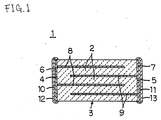
- Fig. 1 is a sectional view of a monolithic ceramic capacitor 1 according to an embodiment of the present invention.
- Fig. 1 is a sectional view of a monolithic ceramic capacitor 1 as an example of a laminated ceramic electronic component according to the present invention.
- the monolithic ceramic capacitor 1 is provided with a laminate 3 including a plurality of laminated dielectric ceramic layers 2 and a first external electrode 6 and a second external electrode 7 formed on a first end face 4 and a second end face 5, respectively, of the laminate 3.
- First internal electrodes 8 and second internal electrodes 9 are alternately arranged as internal conductors in the laminate 3.
- the first internal electrodes 8 are formed along a plurality of specified interfaces between the dielectric ceramic layers 2, each edge thereof being exposed on the first end face 4 so as to be electrically connected to the first external electrode 6.
- the second internal electrodes 9 are formed along a plurality of specified interfaces between the dielectric ceramic layers 2, each edge thereof being exposed on the second end face 5 so as to be electrically connected to the second external electrode 7.
- the external electrodes 6 and 7 may be coated with first plating layers 10 and 11, respectively, made of Ni, Cu, Ni-Cu alloy, etc., and second plating layers 12 and 13 made of solder, tin, etc., may be formed on the first plating layers 10 and 11, respectively.
- the laminate 3 thereof is provided with the dielectric ceramic layers 2 composed of the dielectric ceramic produced by firing the powder made of the oxide having the perovskite structure according to the present invention.
- This oxide having the perovskite structure will be explained below in details.
- a conductive paste primarily containing Ni may be used.
- the external electrodes 6 and 7 may be formed, for example, by steps of coating a silver paste containing B 2 O 3 -Li 2 O-SiO 2 -BaO glass frit and baking the silver paste in reducing atmosphere.
- the internal electrodes 8 and 9 and for the external electrodes 6 and 7 are not specifically limited to the aforementioned materials.
- the external electrodes 6 and 7 may be formed of the same materials as those used for forming the internal electrodes 8 and 9.
- the oxide having the perovskite structure can be produced by steps of mixing at least one kind of metallic oxide powder having a specific surface area of 10 m 2 /g or more and at least one kind of metallic carbonate powder and thereafter heat-treating the resulting mixed powder at a partial pressure of oxygen of 2 x 10 3 Pa or less.
- the aforementioned amount of the OH groups was determined by the thermogravimetric analysis of a sample after the synthesis based on the loss on heating at a temperature of 150° or more.
- the heat treatment In order to produce a small particle diameter of oxide having the perovskite structure by heat treatment at a lower temperature, it is preferable to perform the heat treatment at a partial pressure of oxygen of 2 ⁇ 10 3 Pa or less, and more preferably at 2 ⁇ 10 2 Pa or less. When the partial pressure of oxygen exceeds 2 ⁇ 10 3 Pa, a particle diameter of the produced oxide having the perovskite structure is increased so that it is not preferable.
- a metallic oxide as an elemental material, having a specific surface area of 10 m 2 /g or more, and more preferably of 15 m 2 /g or more.
- specific surface area of the metallic oxide is less than 10 m 2 /g, reactivity of the metallic oxide is not sufficient. Therefore, in synthesis of the targeted oxide having the perovskite structure, a higher temperature may be necessary for the heat treatment and a particle diameter of the synthesized oxide having the perovskite structure may be increased so that it is not preferable.
- the temperature and the time of the heat treatment are not specifically limited.
- the optimal conditions of the temperature and the time of the heat treatment are preferably predetermined based on a thermal analysis at a low partial pressure of oxygen, etc.
- barium titanate is synthesized using TiO 2 and BaCO 3
- the partial pressure of oxygen is 2 ⁇ 10 3 Pa or less and exceeds 2 ⁇ 10 2 Pa and the temperature of the heat treatment is less than 700°C
- the partial pressure of oxygen is 2 ⁇ 10 2 Pa or less and the temperature of the heat treatment is less than 600°C
- the synthesis reaction of barium titanate is not sufficiently proceeded and the c/a axial ratio is not increased.
- the temperature of the heat treatment exceeds 1,100°C at either of the aforementioned partial pressure of oxygen, the growth of the particles and the sintering of the particles with each other in the synthesized barium titanate are occurred so as to increase particle diameters.
- the temperature of the heat treatment is preferably within the range 700°C to 1,100°C, and when particle pressure of oxygen is 2 ⁇ 10 2 Pa or less, the temperature of the heat treatment is preferably within the range 600°C to 1,100°C.
- the particle diameter of the produced oxide having the perovskite structure is increased, although the c/a axial ratio is further increased.
- the oxide powder having the perovskite structure and having the particle diameter of 0.03 to 0.2 ⁇ m can be produced.
- the oxide having a perovskite structure in which the amount of the OH groups in the crystal lattice is less than 0.2% by weight, can be produced.
- the amount of the OH groups in the crystal lattice is 0.2% by weight or more in the oxide having the perovskite structure, further heat treatment may be required for the use as a dielectric ceramic, or in an electronic component produced using this oxide, a short circuit and degradation in other reliabilities may be occurred.
- the measured value of the c/a axial ratio in the crystal lattice of this oxide indicated by x and a theoretical value of the c/a axial ratio indicated by k of this oxide can be in a relationship fulfilling the condition represented by the formula x ⁇ 1 + (k - 1) ⁇ 0.3.
- the c/a axial ratio can be 1.0033 or more.
- the oxide having the perovskite structure according to the present invention is not limited to the oxide in which a ratio of metallic atoms contained in the metallic carbonate (A) to atoms contained in the metallic oxide (B), that is, an atomic ratio A/B, is 1.
- the oxide having the perovskite structure may has varied atomic ratios A/B of, for example, 0.95 to 1.05.
- this atomic ratio A/B is preferably within the range 1.000 to 1.035 so as to produce the oxide having a non-reducing property and the perovskite structure.
- the dielectric ceramic produced by firing the aforementioned oxide powder having the perovskite structure may be a dielectric ceramic produced with Ca, rare-earth elements, additives, for example, Zr, Mn, Mg, Si, Gd, Dy, Ho, and Er, or sintering promoters composed of, for example, Mg, Mn, and Si, being added to the aforementioned oxide having the perovskite structure in accordance with required properties.
- oxide having the perovskite structure according to the present invention barium titanate synthesized using TiO 2 and BaCO 3 was taken as an example, although the present invention can be applied to synthesis of oxides having the perovskite structure, for example, calcium titanate, strontium titanate, lead titanate, and lead zirconate, using combinations of other metallic oxides and metallic carbonates, and to synthesis of mixtures and solid solutions thereof.
- barium titanate is synthesized using TiO 2 and BaCO 3 .
- a BaCO 3 powder and a TiO 2 powder having a specific surface area of 30 m 2 /g were prepared.
- the resulting mixture was subjected to a step of vaporizing and drying, and thereafter, was heat-treated at 800°C for 5 hours in a batch furnace controlled at a pressure of 1 ⁇ 10 2 Pa, 1 ⁇ 10 3 Pa, 1 ⁇ 10 4 Pa, and at an atmospheric pressure, that is, 2 ⁇ 10 1 Pa, 2 ⁇ 10 2 Pa, 2 ⁇ 10 3 Pa, and 2 ⁇ 10 4 Pa in terms of a partial pressure of oxygen, respectively, so as to produce barium titanate powders.
- Sample Nos. 1 to 3 heat-treated at partial pressures of oxygen of 2 ⁇ 10 1 Pa, 2 ⁇ 10 2 Pa, and 2 ⁇ 10 3 Pa, respectively, indicate that barium titanate powders having particle diameters of 0.03 to 0.2 ⁇ m, amounts of OH groups of less than 0.2% by weight, and c/a axial ratios of 1.0033 or more could be produced.
- Sample No. 4 heat-treated at a partial pressure of oxygen of 2 ⁇ 10 4 Pa exceeding 2 ⁇ 10 3 Pa indicates that the particle was grown to have a particle diameter exceeding 0.2 ⁇ m.
- the resulting mixture was subjected to a step of vaporizing and drying, and thereafter, was heat-treated at 800°C for 5 hours in a batch furnace controlled at a pressure of 1 ⁇ 10 3 Pa, that is, 2 ⁇ 10 2 Pa in terms of a partial pressure of oxygen, so as to produce barium titanate powders.
- Sample No. 5 using TiO 2 powder having a specific surface area of 5 m 2 /g being less than 10 m 2 /g indicates that the particle was grown to have a particle diameter exceeding 0.2 ⁇ m.
- a BaCO 3 powder and a TiO 2 powder having a specific surface area of 30 m 2 /g were prepared.
- the resulting mixture was subjected to a step of vaporizing and drying, and thereafter, was heat-treated in a batch furnace controlled at a pressure of 1 ⁇ 10 3 Pa, that is, 2 ⁇ 10 2 Pa in terms of a partial pressure of oxygen, at a temperature of 500°C, 600°C, 700°C, 800°C, 900°C, 1,000°C, 1,100°C, and 1,200°C, for 5 hours, so as to produce barium titanate powders.
- Sample Nos. 11 to 16 heat-treated at temperatures of 600°C, 700°C, 800°C, 900°C, 1,000°C, and 1,100°C, respectively, indicate that barium titanate powders having particle diameters of 0.03 to 0.2 ⁇ m, amounts of OH groups of less than 0.2% by weight, and c/a axial ratios of 1.0033 or more could be produced.
- Sample No. 10 heat-treated at a temperature of 500°C being less than 600°C indicates that the synthesis reaction was not completed as shown in Table 3 with blank columns "Particle Diameter”, “Amount of OH Group”, and "c/a Axial Ratio".
- Sample No. 17 heat-treated at a temperature of 1,200°C exceeding 1,100°C indicates that the particle was grown to have a particle diameter exceeding 0.2 ⁇ m.
- a BaCO 3 powder and a TiO 2 powder having a specific surface area of 30 m 2 /g were prepared.
- the resulting mixture was subjected to a step of vaporizing and drying, and thereafter, was heat-treated in a batch furnace controlled at a pressure of 1 ⁇ 10 4 Pa, that is, 2 ⁇ 10 3 Pa in terms of a partial pressure of oxygen, at temperatures of 600°C, 700°C, 800°C, 900°C, 1,000°C, 1,100°C, and 1,200°C for 5 hours so as to produce barium titanate powders.
- Example 3 the heat treatment was performed at a partial pressure of oxygen of 2 ⁇ 10 2 Pa, although in this Example 4, the heat treatment was performed at a partial pressure of oxygen of 2 ⁇ 10 3 Pa exceeding 2 ⁇ 10 2 Pa.
- Sample No. 18 heat-treated at a temperature of 600°C being less than 700°C indicates that the synthesis reaction was not completed similarly to that in Sample No. 10 as shown in Table 3.
- Sample No. 24 heat-treated at a temperature of 1,200°C exceeding 1,100°C indicates that the particle was grown to have a particle diameter exceeding 0.2 ⁇ m.
- a BaCO 3 powder and a TiO 2 powder having a specific surface area of 30 m 2 /g were prepared.
- the resulting mixture was subjected to a step of vaporizing and drying, and thereafter, was heat-treated at 800°C for 5 hours in a batch furnace, in which atmospheric gas had been replaced by nitrogen gas and a partial pressure of oxygen was controlled to be 1 Pa, so as to produce a barium titanate powder of Sample No. 25.
- the aforementioned mixture subjected to a step of vaporizing and drying was heat-treated at 800°C for 5 hours in a batch furnace, in which atmospheric gas had been replaced by a mixed gas containing 95% of nitrogen and 5% of hydrogen and a partial pressure of oxygen was controlled to be 1 ⁇ 10 -7 Pa, so as to produce a barium titanate powder of Sample No. 26.
- barium titanate powders having particle diameters of 0.03 to 0.2 ⁇ m, amounts of OH groups of less than 0.2% by weight, and c/a axial ratios of 1.0033 or more could be produced.
- the TiO 2 powder made of TiO 2 of anatase phase was used, although a TiO 2 powder made of TiO 2 of rutile phase or TiO 2 of a mixture of anatase phase and rutile phase may be used so as to produce a similar effect.
- the BaCO 3 powder having a specific surface area of 7 m 2 /g was used, although since BaCO 3 is decomposed during the reaction and Ba atoms generated by the decomposition diffuse into the particle of TiO 2 so as to synthesize BaTiO 3 , in the case in which a BaCO 3 powder having a greater specific surface area is used and in the case in which a BaCO 3 powder having a smaller specific surface area is used, similar effects may be produced.
- a BaCO 3 powder and a TiO 2 powder having a specific surface area of 30 m 2 /g were prepared.
- the resulting mixture was subjected to a step of vaporizing and drying, and thereafter, was heat-treated in a batch furnace controlled at a pressure of 1 ⁇ 10 -1 Pa, that is, 2 x 10 -2 Pa in terms of a partial pressure of oxygen, at a temperature of 900°C for 5 hours so as to produce a barium titanate powder.
- barium titanate powders of Sample Nos. 12 to 14 as shown in Table 3 were also prepared.
- Sample Nos. 12 to 14 and 27 had particle diameters within the range 0.03 to 0.1 ⁇ m.
- Each barium titanate powder of Sample Nos. 12 to 14 and 27 was dispersed into an organic solvent, and 0.02 mol of Dy, 0.015 mol of Mg, 0.005 mol of Mn, and 0.03 mol of a Si sintering promoter relative to 1 mol of barium titanate were added thereto, respectively, as alkoxide compounds soluble into the organic solvent.
- the aforementioned additives might be added as compounds such as an acetylacetonato or a metallic soap other than an alkoxide so as to become soluble into the organic solvent.
- the organic solvent was removed from the slurry produced as described above by vaporization and drying, and other organic compounds were removed by further heat treatment.
- an organic solvent for example, ethanol
- the resulting ceramic slurries were sheet molded by a doctor blade method being applied so as to produce rectangular ceramic green sheets of 1.5 ⁇ m in thickness.
- the green sheets were screen printed with a conductive paste primarily containing Ni so as to form conductive paste films corresponding to internal electrodes 8 and 9 as shown in Fig. 1.
- a plurality of green sheets were laminated with sides thereof, on which the aforementioned conductive paste films had been drawn out, being in two rows in a staggered configuration so as to produce a green laminate.
- the laminate was heated to a temperature of 350°C in nitrogen atmosphere so as to burn the binder, and thereafter, was fired in a reducing atmosphere composed of H 2 -N 2 -H 2 O gas having a partial pressure of oxygen of 10 -3 to 10 -6 Pa at a temperature of 1050°C for 2 hours so as to produce a sintered laminate as a laminate 3 as shown in Fig. 1.
- outer dimensions thereof were 5.0 mm in width, 5.7 mm in length, and 2.4 mm in thickness and a thickness of a dielectric ceramic layer intervening between the first internal electrode and the second internal electrode was 1.0 ⁇ m.
- the total number of effective dielectric ceramic layers were 100 and an area of a counter electrode per one layer was 16.3 ⁇ 10 -6 m 2 .
- a capacitance, a dielectric loss, and a resistivity were determined.
- the capacitance (C) and the dielectric loss (tan ⁇ ) were measured using an automatic bridge type measuring apparatus based on JIS 5102. Insulation resistances at 25°C were determined using an insulation resistance tester with application of 10 V of direct-current voltage for 2 minutes and the resistivity ⁇ was calculated from the insulation resistance.
- each monolithic ceramic capacitor according to Sample Nos. 12 to 14 and 27 exhibits preferable electric properties.
- the thickness of the dielectric ceramic layers were as small as 1.0 ⁇ m as described above, failure rates of the samples produced in the Example 6 were as small as 0.8% or less.
- the oxide having the perovskite structure or barium titanate of the present invention can be produced, in which the particle diameter is as small as 0.03 to 0.2 ⁇ m, the amount of OH groups in a crystal lattice is less than 0.2% by weight, and a measured value of the c/a axial ratio of the oxide indicated by x and a theoretical value of the c/a axial ratio indicated by k of the oxide are in a relationship fulfilling the condition represented by the formula x ⁇ 1 + (k - 1) ⁇ 0.3, and furthermore, barium titanate has a c/a axial ratio of as large as 1.0033 or more and exhibits sufficient ferroelectricity.
- this oxide having the perovskite structure for example, barium titanate
- ceramic electronic components having high dielectric constants and exhibiting high performances for example, laminated ceramic electronic components such as monolithic ceramic capacitors, can be produced at a relatively low firing temperature.
- the thickness of dielectric ceramic layers can be further decreased.
- a more fine powder for example, of 0.03 to 0.1 ⁇ m in particle diameter, made of the oxide having the perovskite structure or barium titanate, even when the thickness of the ceramic layer is decreased to, for example, 1 ⁇ m or less, the laminated ceramic electronic component can be produced with high reliability and with no problem. Therefore, when the present invention is applied to the monolithic ceramic capacitor, miniaturized and large capacitance of monolithic ceramic capacitor can be easily produced.
Landscapes
- Engineering & Computer Science (AREA)
- Chemical & Material Sciences (AREA)
- Ceramic Engineering (AREA)
- Manufacturing & Machinery (AREA)
- Organic Chemistry (AREA)
- Materials Engineering (AREA)
- Inorganic Chemistry (AREA)
- Structural Engineering (AREA)
- Power Engineering (AREA)
- Physics & Mathematics (AREA)
- Thermal Sciences (AREA)
- Microelectronics & Electronic Packaging (AREA)
- Nanotechnology (AREA)
- Crystallography & Structural Chemistry (AREA)
- General Physics & Mathematics (AREA)
- Condensed Matter Physics & Semiconductors (AREA)
- Life Sciences & Earth Sciences (AREA)
- Environmental & Geological Engineering (AREA)
- General Life Sciences & Earth Sciences (AREA)
- Geology (AREA)
- Composite Materials (AREA)
- Ceramic Capacitors (AREA)
- Compositions Of Oxide Ceramics (AREA)
- Inorganic Compounds Of Heavy Metals (AREA)
Abstract
Description
- The present invention relates to an oxide having a perovskite structure, barium titanate, and a manufacturing method therefor, dielectric ceramic, and ceramic electronic component.
- An oxide having a perovskite structure, for example, barium titanate, has been used as a dielectric material for electronic components such as capacitors. Recently, it is required that the oxide having the perovskite structure is a powder having a smaller particle diameter.
- For example, in a monolithic ceramic capacitor, miniaturization and an increase in capacitance have been attempted by decreasing a thickness of a dielectric ceramic layer, and for such a purpose, oxides having the perovskite structure, for example, barium titanate having not only higher dielectric constant, but also smaller particle diameter, have been required. Hitherto, barium titanate having a particle diameter of 0.2 µm or less has been produced by wet methods such as hydrolysis and hydrothermal synthesis.
- In barium titanate synthesized by a conventional wet method, however, there are problems in that 0.2 to 3% by weight of OH groups remain in a particle, and in spite of small particle diameter, the crystal system is a cubic system or a tetragonal system in which a ratio of a axis to c axis in the crystal lattice, that is, a c/a axial ratio (x), is small so as not to fulfill a relationship represented by the formula x ≥ 1 + (k - 1) × 0.3, where k indicates a theoretical value of the c/a axial ratio and in barium titanate, k = 1.011 and x ≥ 1.0033, and therefore sufficient ferroelectricity for a capacitor material is not exhibited.
- In order to solve the aforementioned problems, hitherto, it has been attempted to produce barium titanate having a large c/a axial ratio and exhibiting sufficient ferroelectricity by reheating the synthesized barium titanate for removal of OH groups.
- Since cavities are, however, generated at places where OH groups were present and the growth of particles of barium titanate occurs during the reheating, it encounters a problem that it becomes difficult to produce barium titanate having a particle diameter of as small as 0.2 µm or less. At the same time, in laminated ceramic electronic components using such a barium titanate, for example, monolithic ceramic capacitors, when the thickness of dielectric ceramic layer thereof is decreased to several µm or less, it also encounters problems of occurrence of a short circuit and degradation in other reliabilities.
- Accordingly, objects of the present invention are to provide a manufacturing method for an oxide having the perovskite structure, for example, barium titanate, having a small particle diameter, having small amounts of OH groups, having a large c/a axial ratio, and exhibiting sufficient ferroelectricity and to provide an oxide having the perovskite structure, for example, barium titanate, produced by the aforementioned manufacturing method, a dielectric ceramic produced using a powder made of such an oxide, and a laminated ceramic electronic component produced using such a dielectric ceramic.
- A manufacturing method for an oxide having a perovskite structure according to the present invention comprises steps of preparing a metallic oxide powder having a specific surface area of 10 m2/g or more and preparing a metallic carbonate powder, mixing the metallic oxide powder and the metallic carbonate powder, and heat-treating the resulting mixed powder at a partial pressure of oxygen of 2 × 10³ Pa or less.
- Herein, at least two kinds of metallic oxide powders and metallic carbonate powders may be used, respectively.
- The present invention also relates to an oxide having the perovskite structure. This oxide is preferably a powder having a particle diameter of 0.03 to 0.2 µm and an amount of OH groups in a crystal lattice may be less than 0.2% by weight.
- A measured value of a c/a axial ratio in the crystal lattice of this oxide indicated by x and a theoretical value of the c/a axial ratio indicated by k of this oxide are preferably in a relationship fulfilling the condition represented by the formula x ≥ 1 + (k - 1) × 0.3.
- The aforementioned oxide having the perovskite structure can be synthesized with advantage by, for example, the aforementioned manufacturing method.
- The manufacturing method for the oxide having the perovskite structure according to the present invention is specifically applied to a manufacturing method for barium titanate.
- The specific manufacturing method for barium titanate is composed of steps of preparing a TiO2 powder having a specific surface area of 10 m2/g or more and preparing a BaCO3 powder, mixing the TiO2 powder and the BaCO3 powder, and heat-treating the resulting mixed powder.
- In the case in which the aforementioned step of heat-treating is performed at a partial pressure of oxygen of 2 × 10³ Pa or less and exceeding 2 × 10² Pa, a heat-treating temperature within the range 700 to 1,100°C may be applied. In the case in which the aforementioned heat-treating is performed at a partial pressure of oxygen of 2 × 10² Pa or less, a heat-treating temperature within the range 600 to 1,100°C may be applied.
- The present invention also relates to barium titanate. This barium titanate is preferably a powder having a particle diameter of 0.03 to 0.2 µm and an amount of OH groups in a crystal lattice may be less than 0.2% by weight.
- A c/a axial ratio of this barium titanate is preferably 1.0033 or more.
- The aforementioned barium titanate can be synthesized with advantage by, for example, the aforementioned manufacturing method.
- The present invention also relates to a dielectric ceramic produced by firing the aforementioned powder made of the oxide having the perovskite structure or barium titanate.
- The present invention also relates to a ceramic electronic component including the aforementioned dielectric ceramic and electrodes facing to each other with the dielectric ceramic therebetween.
- The present invention also relates to a laminated ceramic electronic component including a laminate composed of a plurality of laminated dielectric ceramic layers and an internal conductor formed along a specified interface between the dielectric ceramic layers. Herein, the aforementioned dielectric ceramic layers are made of a dielectric ceramic according to the present invention.
- In the laminated ceramic electronic component according to the present invention, the dielectric ceramic layer may be made of a dielectric ceramic produced by firing a powder, having a particle diameter of 0.03 to 0.1 µm, made of an oxide having the perovskite structure or barium titanate and the thickness of the dielectric ceramic layer is preferably 1 µm or less.
- In the aforementioned laminated ceramic electronic component according to a specific embodiment, a plurality of external electrodes arranged at positions different from each other on the end face of the aforementioned laminate are further provided and a plurality of internal conductors are formed with an end edge thereof being exposed on the end face of the laminate so as to be electrically connected to one of the external electrodes, respectively. The configuration of this laminated ceramic electronic component may be applied to, for example, monolithic ceramic capacitors.
- Fig. 1 is a sectional view of a monolithic
ceramic capacitor 1 according to an embodiment of the present invention. - Fig. 1 is a sectional view of a monolithic
ceramic capacitor 1 as an example of a laminated ceramic electronic component according to the present invention. - The monolithic
ceramic capacitor 1 is provided with alaminate 3 including a plurality of laminated dielectricceramic layers 2 and a firstexternal electrode 6 and a second external electrode 7 formed on a first end face 4 and asecond end face 5, respectively, of thelaminate 3. - First internal electrodes 8 and second
internal electrodes 9 are alternately arranged as internal conductors in thelaminate 3. The first internal electrodes 8 are formed along a plurality of specified interfaces between the dielectricceramic layers 2, each edge thereof being exposed on the first end face 4 so as to be electrically connected to the firstexternal electrode 6. The secondinternal electrodes 9 are formed along a plurality of specified interfaces between the dielectricceramic layers 2, each edge thereof being exposed on thesecond end face 5 so as to be electrically connected to the second external electrode 7. - If necessary, the
external electrodes 6 and 7 may be coated withfirst plating layers 10 and 11, respectively, made of Ni, Cu, Ni-Cu alloy, etc., and second platinglayers 12 and 13 made of solder, tin, etc., may be formed on thefirst plating layers 10 and 11, respectively. - In the aforementioned monolithic
ceramic capacitor 1, thelaminate 3 thereof is provided with the dielectricceramic layers 2 composed of the dielectric ceramic produced by firing the powder made of the oxide having the perovskite structure according to the present invention. This oxide having the perovskite structure will be explained below in details. - So as to form the
internal electrodes 8 and 9, for example, a conductive paste primarily containing Ni may be used. - The
external electrodes 6 and 7 may be formed, for example, by steps of coating a silver paste containing B2O3-Li2O-SiO2-BaO glass frit and baking the silver paste in reducing atmosphere. - Materials for the
internal electrodes 8 and 9 and for theexternal electrodes 6 and 7 are not specifically limited to the aforementioned materials. For example, theexternal electrodes 6 and 7 may be formed of the same materials as those used for forming theinternal electrodes 8 and 9. - According to the present invention, the oxide having the perovskite structure can be produced by steps of mixing at least one kind of metallic oxide powder having a specific surface area of 10 m2/g or more and at least one kind of metallic carbonate powder and thereafter heat-treating the resulting mixed powder at a partial pressure of oxygen of 2 x 10³ Pa or less.
- As described above, by decreasing the partial pressure of oxygen during the heat treatment, decomposition of the metallic carbonate as an elemental material is occurred at a lower temperature so that a highly reactive oxide is synthesized. The resulting highly reactive oxide reacts with a metallic oxide having been added beforehand so as to produce an oxide having the perovskite structure. In this reaction, the OH group is not involved in reaction processes in contrast to hydrolysis and hydrothermal synthesis. Therefore, OH groups present in a crystal lattice after the synthesis are limited to OH groups having been contained in the metallic carbonate as the elemental material and the metallic oxide so that the amount of the OH groups can be controlled to be 0.2% by weight or less.
- The aforementioned amount of the OH groups was determined by the thermogravimetric analysis of a sample after the synthesis based on the loss on heating at a temperature of 150° or more.
- In order to produce a small particle diameter of oxide having the perovskite structure by heat treatment at a lower temperature, it is preferable to perform the heat treatment at a partial pressure of oxygen of 2 × 10³ Pa or less, and more preferably at 2 × 10² Pa or less. When the partial pressure of oxygen exceeds 2 × 10³ Pa, a particle diameter of the produced oxide having the perovskite structure is increased so that it is not preferable.
- In order to produce a smaller particle diameter of oxide having the perovskite structure, it is preferable to use a metallic oxide, as an elemental material, having a specific surface area of 10 m2/g or more, and more preferably of 15 m2/g or more. When the specific surface area of the metallic oxide is less than 10 m2/g, reactivity of the metallic oxide is not sufficient. Therefore, in synthesis of the targeted oxide having the perovskite structure, a higher temperature may be necessary for the heat treatment and a particle diameter of the synthesized oxide having the perovskite structure may be increased so that it is not preferable.
- Since the decomposition temperature of the metallic carbonate varies due to the kind of the metallic carbonate, the way of combining the metallic carbonate and the metallic oxide, or the partial pressure of oxygen, the temperature and the time of the heat treatment are not specifically limited. The optimal conditions of the temperature and the time of the heat treatment are preferably predetermined based on a thermal analysis at a low partial pressure of oxygen, etc.
- For example, in the case in which barium titanate is synthesized using TiO2 and BaCO3, when the partial pressure of oxygen is 2 × 10³ Pa or less and exceeds 2 × 10² Pa and the temperature of the heat treatment is less than 700°C, and when the partial pressure of oxygen is 2 × 10² Pa or less and the temperature of the heat treatment is less than 600°C, the synthesis reaction of barium titanate is not sufficiently proceeded and the c/a axial ratio is not increased. On the other hand, when the temperature of the heat treatment exceeds 1,100°C at either of the aforementioned partial pressure of oxygen, the growth of the particles and the sintering of the particles with each other in the synthesized barium titanate are occurred so as to increase particle diameters.
- Therefore, when the partial pressure of oxygen is 2 × 10³ Pa or less and exceeds 2 × 10² Pa, the temperature of the heat treatment is preferably within the range 700°C to 1,100°C, and when particle pressure of oxygen is 2 × 10² Pa or less, the temperature of the heat treatment is preferably within the range 600°C to 1,100°C.
- When the heat treatments are performed under the same conditions of the particle diameter of used metallic oxide powder and the partial pressure of oxygen, accompanying increase in the temperature of the heat treatment, the particle diameter of the produced oxide having the perovskite structure is increased, although the c/a axial ratio is further increased.
- According to the manufacturing method of the present invention as explained above, the oxide powder having the perovskite structure and having the particle diameter of 0.03 to 0.2 µm can be produced.
- According to the manufacturing method of the present invention, the oxide having a perovskite structure, in which the amount of the OH groups in the crystal lattice is less than 0.2% by weight, can be produced. When the amount of the OH groups in the crystal lattice is 0.2% by weight or more in the oxide having the perovskite structure, further heat treatment may be required for the use as a dielectric ceramic, or in an electronic component produced using this oxide, a short circuit and degradation in other reliabilities may be occurred.
- In the oxide having the perovskite structure produced by the manufacturing method of the present invention, the measured value of the c/a axial ratio in the crystal lattice of this oxide indicated by x and a theoretical value of the c/a axial ratio indicated by k of this oxide can be in a relationship fulfilling the condition represented by the formula x ≥ 1 + (k - 1) × 0.3. In particular, in barium titanate, the c/a axial ratio can be 1.0033 or more. When the condition represented by the aforementioned formula is not fulfilled in the oxide, or the c/a axial ratio is less than 1.0033 in barium titanate, due to the shortage of ferroelectricity for the use as an electronic component, further heat treatment is required so as to increase the c/a axial ratio, and therefore, the growth of particle is occurred.
- The oxide having the perovskite structure according to the present invention is not limited to the oxide in which a ratio of metallic atoms contained in the metallic carbonate (A) to atoms contained in the metallic oxide (B), that is, an atomic ratio A/B, is 1. In accordance with the purpose of the use, the oxide having the perovskite structure may has varied atomic ratios A/B of, for example, 0.95 to 1.05. In particular, this atomic ratio A/B is preferably within the range 1.000 to 1.035 so as to produce the oxide having a non-reducing property and the perovskite structure.
- The dielectric ceramic produced by firing the aforementioned oxide powder having the perovskite structure may be a dielectric ceramic produced with Ca, rare-earth elements, additives, for example, Zr, Mn, Mg, Si, Gd, Dy, Ho, and Er, or sintering promoters composed of, for example, Mg, Mn, and Si, being added to the aforementioned oxide having the perovskite structure in accordance with required properties. In the above description, as the oxide having the perovskite structure according to the present invention, barium titanate synthesized using TiO2 and BaCO3 was taken as an example, although the present invention can be applied to synthesis of oxides having the perovskite structure, for example, calcium titanate, strontium titanate, lead titanate, and lead zirconate, using combinations of other metallic oxides and metallic carbonates, and to synthesis of mixtures and solid solutions thereof.
- The present invention will be explained below using specific examples according to an embodiment in which barium titanate is synthesized using TiO2 and BaCO3.
- As starting materials, a BaCO3 powder and a TiO2 powder having a specific surface area of 30 m2/g were prepared.
- These starting materials were weighed so that a ratio Ba/Ti on a mole basis becomes 1.00, and were wet mixed.
- The resulting mixture was subjected to a step of vaporizing and drying, and thereafter, was heat-treated at 800°C for 5 hours in a batch furnace controlled at a pressure of 1 × 10² Pa, 1 × 10³ Pa, 1 × 10⁴ Pa, and at an atmospheric pressure, that is, 2 × 101 Pa, 2 × 10² Pa, 2 × 10³ Pa, and 2 × 10⁴ Pa in terms of a partial pressure of oxygen, respectively, so as to produce barium titanate powders.
- Regarding the resulting barium titanate powders, particle diameters were measured by the observation using an electron microscope, amounts of OH groups were determined by the thermogravimetric analysis, and furthermore, c/a axial ratios were determined by X-ray diffraction analysis and Rietveld analysis. The results thereof and the results of total evaluations are shown in Table 1.
Sample No. Specific Surface Area of TiO2 (m2/g) Partial Pressure of Oxygen (Pa) Temperature of Heat Treatment (°C) Particle Diameter (nm) Amount of OH Group (wt%) c/a Axial Ratio Evaluation 1 30 2 × 101 800 53 0.05 1.005 ○ 2 2 × 10² 54 0.06 1.005 ○ 3 2 × 10³ 65 0.08 1.006 ○ 4 2 × 10⁴ 210 0.08 1.009 × - As shown in Table 1, Sample Nos. 1 to 3 heat-treated at partial pressures of oxygen of 2 × 101 Pa, 2 × 10² Pa, and 2 × 10³ Pa, respectively, indicate that barium titanate powders having particle diameters of 0.03 to 0.2 µm, amounts of OH groups of less than 0.2% by weight, and c/a axial ratios of 1.0033 or more could be produced.
- On the other hand, Sample No. 4 heat-treated at a partial pressure of oxygen of 2 × 10⁴ Pa exceeding 2 × 10³ Pa indicates that the particle was grown to have a particle diameter exceeding 0.2 µm.
- As starting materials, a BaCO3 powder and TiO2 powders having specific surface areas of 5 m2/g, 10 m2/g, 15 m2/g, 20 m2/g, and 30 m2/g, respectively, were prepared.
- These starting materials were weighed so that a ratio Ba/Ti on a mole basis becomes 1.00, and were wet mixed.
- The resulting mixture was subjected to a step of vaporizing and drying, and thereafter, was heat-treated at 800°C for 5 hours in a batch furnace controlled at a pressure of 1 × 10³ Pa, that is, 2 × 10² Pa in terms of a partial pressure of oxygen, so as to produce barium titanate powders.
- Regarding the resulting barium titanate powders, particle diameters, amounts of OH groups, and c/a axial ratios were determined in a manner similar to that in the Example 1. The results thereof and the results of total evaluations are shown in Table 2.
Sample No. Specific Surface Area of TiO2 (m2/g) Partial Pressure of Oxygen (Pa) Temperature of Heat Treatment (°C) Particle Diameter (nm) Amount of OH Group (wt%) c/a Axial Ratio Evaluation 5 5 2 x 10² 800 361 0.06 1.009 × 6 10 181 0.06 1.008 ○ 7 15 121 0.05 1.007 ○ 8 20 90 0.05 1.006 ○ 9 30 54 0.06 1.005 ○ - As shown in Table 2, Sample Nos. 6 to 9 using TiO2 powders having specific surface areas of 10 m2/g, 15 m2/g, 20 m2/g, and 30 m2/g, respectively, indicate that barium titanate powders having particle diameters of 0.03 to 0.2 µm, amounts of OH groups of less than 0.2% by weight, and c/a axial ratios of 1.0033 or more could be produced.
- On the other hand, Sample No. 5 using TiO2 powder having a specific surface area of 5 m2/g being less than 10 m2/g indicates that the particle was grown to have a particle diameter exceeding 0.2 µm.
- As starting materials, a BaCO3 powder and a TiO2 powder having a specific surface area of 30 m2/g were prepared.
- These starting materials were weighed so that a ratio Ba/Ti on a mole basis becomes 1.00, and were wet mixed.
- The resulting mixture was subjected to a step of vaporizing and drying, and thereafter, was heat-treated in a batch furnace controlled at a pressure of 1 × 10³ Pa, that is, 2 × 10² Pa in terms of a partial pressure of oxygen, at a temperature of 500°C, 600°C, 700°C, 800°C, 900°C, 1,000°C, 1,100°C, and 1,200°C, for 5 hours, so as to produce barium titanate powders.
- Regarding the resulting barium titanate powders, particle diameters, amounts of OH groups, and c/a axial ratios were determined in a manner similar to that in the Example 1. The results thereof and the results of total evaluations are shown in Table 3.
Sample No. Specific Surface Area of TiO2 (m2/g) Partial Pressure of Oxygen (Pa) Temperature of Heat Treatment (°C) Particle Diameter (nm) Amount of OH Group (wt%) c/a Axial Ratio Evaluation 10 30 2 × 10² 500 -- -- -- × 11 600 43 0.18 1.004 ○ 12 700 45 0.10 1.004 ○ 13 800 54 0.06 1.005 ○ 14 900 74 0.05 1.006 ○ 15 1000 110 0.04 1.007 ○ 16 1100 164 0.04 1.008 ○ 17 1200 246 0.04 1.009 × - As shown in Table 3, Sample Nos. 11 to 16 heat-treated at temperatures of 600°C, 700°C, 800°C, 900°C, 1,000°C, and 1,100°C, respectively, indicate that barium titanate powders having particle diameters of 0.03 to 0.2 µm, amounts of OH groups of less than 0.2% by weight, and c/a axial ratios of 1.0033 or more could be produced.
- On the contrary, Sample No. 10 heat-treated at a temperature of 500°C being less than 600°C indicates that the synthesis reaction was not completed as shown in Table 3 with blank columns "Particle Diameter", "Amount of OH Group", and "c/a Axial Ratio".
- On the other hand, Sample No. 17 heat-treated at a temperature of 1,200°C exceeding 1,100°C indicates that the particle was grown to have a particle diameter exceeding 0.2 µm.
- As starting materials, a BaCO3 powder and a TiO2 powder having a specific surface area of 30 m2/g were prepared.
- These starting materials were weighed so that a ratio Ba/Ti on a mole basis becomes 1.00, and were wet mixed.
- The resulting mixture was subjected to a step of vaporizing and drying, and thereafter, was heat-treated in a batch furnace controlled at a pressure of 1 × 10⁴ Pa, that is, 2 × 10³ Pa in terms of a partial pressure of oxygen, at temperatures of 600°C, 700°C, 800°C, 900°C, 1,000°C, 1,100°C, and 1,200°C for 5 hours so as to produce barium titanate powders.
- Regarding the resulting barium titanate powders, particle diameters, amounts of OH groups, and c/a axial ratios were determined in a manner similar to that in the Example 1. The results thereof and the results of total evaluations are shown in Table 4.
Sample No. Specific Surface Area of TiO2 (m2/g) Partial Pressure of Oxygen (Pa) Temperature of Heat Treatment (°c) Particle Diameter (nm) Amount of OH Group (wt%) c/a Axial Ratio Evaluation 18 30 2 × 10³ 600 -- -- -- × 19 700 54 0.12 1.005 ○ 20 800 65 0.08 1.006 ○ 21 900 88 0.06 1.006 ○ 22 1000 132 0.06 1.007 ○ 23 1100 198 0.05 1.008 ○ 24 1200 298 0.05 1.009 × - In the aforementioned Example 3, the heat treatment was performed at a partial pressure of oxygen of 2 × 10² Pa, although in this Example 4, the heat treatment was performed at a partial pressure of oxygen of 2 × 10³ Pa exceeding 2 × 10² Pa.
- As shown in Table 4, Sample Nos. 19 to 23 heat-treated at temperatures of 700°C, 800°C, 900°C, 1,000°C, and 1,100°C, respectively, indicate that barium titanate powders having particle diameters of 0.03 to 0.2 µm, amounts of OH groups of less than 0.2% by weight, and c/a axial ratios of 1.0033 or more could be produced.
- On the contrary, Sample No. 18 heat-treated at a temperature of 600°C being less than 700°C indicates that the synthesis reaction was not completed similarly to that in Sample No. 10 as shown in Table 3.
- On the other hand, Sample No. 24 heat-treated at a temperature of 1,200°C exceeding 1,100°C indicates that the particle was grown to have a particle diameter exceeding 0.2 µm.
- As starting materials, a BaCO3 powder and a TiO2 powder having a specific surface area of 30 m2/g were prepared.
- These starting materials were weighed so that a ratio Ba/Ti on a mole basis becomes 1.00, and were wet mixed.
- The resulting mixture was subjected to a step of vaporizing and drying, and thereafter, was heat-treated at 800°C for 5 hours in a batch furnace, in which atmospheric gas had been replaced by nitrogen gas and a partial pressure of oxygen was controlled to be 1 Pa, so as to produce a barium titanate powder of Sample No. 25.
- Furthermore, the aforementioned mixture subjected to a step of vaporizing and drying was heat-treated at 800°C for 5 hours in a batch furnace, in which atmospheric gas had been replaced by a mixed gas containing 95% of nitrogen and 5% of hydrogen and a partial pressure of oxygen was controlled to be 1 × 10⁻⁷ Pa, so as to produce a barium titanate powder of Sample No. 26.
- Regarding the resulting barium titanate powders, particle diameters, amounts of OH groups, and c/a axial ratios were determined in a manner similar to that in the Example 1. The results thereof and the results of total evaluations are shown in Table 5.
Sample No. Specific Surface Area of TiO2 (m2/g) Partial Pressure of Oxygen (Pa) Temperature of Heat Treatment (°C) Particle Diameter (nm) Amount of OH Group (wt%) c/a Axial Ratio Evaluation 25 30 nitrogen /1 800 58 0.05 1.005 ○ 26 mixed gas of nitrogen and hydrogen /1×10-7 55 0.04 1.005 ○ - As shown in Table 5, in the case in which the heat treatment was performed after nitrogen gas had been introduced and in the case in which the heat treatment was performed after a mixed gas containing nitrogen and hydrogen had been introduced, barium titanate powders having particle diameters of 0.03 to 0.2 µm, amounts of OH groups of less than 0.2% by weight, and c/a axial ratios of 1.0033 or more could be produced.
- In the Examples 1 to 5 explained in the above description, the TiO2 powder made of TiO2 of anatase phase was used, although a TiO2 powder made of TiO2 of rutile phase or TiO2 of a mixture of anatase phase and rutile phase may be used so as to produce a similar effect.
- In the Examples 1 to 5, the BaCO3 powder having a specific surface area of 7 m2/g was used, although since BaCO3 is decomposed during the reaction and Ba atoms generated by the decomposition diffuse into the particle of TiO2 so as to synthesize BaTiO3, in the case in which a BaCO3 powder having a greater specific surface area is used and in the case in which a BaCO3 powder having a smaller specific surface area is used, similar effects may be produced.
- As starting materials, a BaCO3 powder and a TiO2 powder having a specific surface area of 30 m2/g were prepared.
- These starting materials were weighed so that a ratio Ba/Ti on a mole basis becomes 1.01, and were wet mixed.
- The resulting mixture was subjected to a step of vaporizing and drying, and thereafter, was heat-treated in a batch furnace controlled at a pressure of 1 × 10⁻¹ Pa, that is, 2 x 10⁻² Pa in terms of a partial pressure of oxygen, at a temperature of 900°C for 5 hours so as to produce a barium titanate powder.
- Regarding the resulting barium titanate powder of Sample No. 27, a particle diameter, an amount of OH groups, and a c/a axial ratio were determined in a manner similar to that in the Example 1. The results thereof are shown in Table 6.
Sample No. Specific Surface Area of TiO2 (m2/g) Partial Pressure of Oxygen (Pa) Temperature of Heat Treatment (°C) Particle Diameter (nm) Amount of OH Group (wt%) c/a Axial Ratio 27 30 2 × 10⁻² 900 70 0.05 1.007 - Furthermore, barium titanate powders of Sample Nos. 12 to 14 as shown in Table 3 were also prepared.
- Sample Nos. 12 to 14 and 27 had particle diameters within the range 0.03 to 0.1 µm.
- Each barium titanate powder of Sample Nos. 12 to 14 and 27 was dispersed into an organic solvent, and 0.02 mol of Dy, 0.015 mol of Mg, 0.005 mol of Mn, and 0.03 mol of a Si sintering promoter relative to 1 mol of barium titanate were added thereto, respectively, as alkoxide compounds soluble into the organic solvent.
- It was confirmed that the aforementioned additives might be added as compounds such as an acetylacetonato or a metallic soap other than an alkoxide so as to become soluble into the organic solvent.
- The organic solvent was removed from the slurry produced as described above by vaporization and drying, and other organic compounds were removed by further heat treatment.
- A polyvinylbutylal binder solution and an organic solvent, for example, ethanol, were added to the barium titanate powder samples to which each additive had been added as described above, and ceramic slurries were produced by wet mixing using a ball mill.
- The resulting ceramic slurries were sheet molded by a doctor blade method being applied so as to produce rectangular ceramic green sheets of 1.5 µm in thickness.
- The green sheets were screen printed with a conductive paste primarily containing Ni so as to form conductive paste films corresponding to
internal electrodes 8 and 9 as shown in Fig. 1. - A plurality of green sheets were laminated with sides thereof, on which the aforementioned conductive paste films had been drawn out, being in two rows in a staggered configuration so as to produce a green laminate.
- The laminate was heated to a temperature of 350°C in nitrogen atmosphere so as to burn the binder, and thereafter, was fired in a reducing atmosphere composed of H2-N2-H2O gas having a partial pressure of oxygen of 10-3 to 10-6 Pa at a temperature of 1050°C for 2 hours so as to produce a sintered laminate as a
laminate 3 as shown in Fig. 1. - Both end faces of this laminate were coated with a silver paste containing B2O3-Li2O-SiO2-BaO glass frit and the silver paste was baked in nitrogen atmosphere at a temperature of 600°C so as to form external electrodes corresponding to
external electrodes 6 and 7 as shown in Fig. 1. - In monolithic ceramic capacitors according to Sample Nos. 12 to 14 and 27 produced as described above, outer dimensions thereof were 5.0 mm in width, 5.7 mm in length, and 2.4 mm in thickness and a thickness of a dielectric ceramic layer intervening between the first internal electrode and the second internal electrode was 1.0 µm. The total number of effective dielectric ceramic layers were 100 and an area of a counter electrode per one layer was 16.3 × 10⁻⁶ m2.
- Regarding each resulting monolithic ceramic capacitor, a capacitance, a dielectric loss, and a resistivity were determined. The capacitance (C) and the dielectric loss (tan δ) were measured using an automatic bridge type measuring apparatus based on JIS 5102. Insulation resistances at 25°C were determined using an insulation resistance tester with application of 10 V of direct-current voltage for 2 minutes and the resistivity ρ was calculated from the insulation resistance.
- Regarding the resulting monolithic ceramic capacitors, average lives were evaluated. That is, high temperature load tests applying 6 V of direct-current voltage at a temperature of 150°C were performed. During this high temperature load tests, variations with time of the insulation resistances of monolithic ceramic capacitors according to the samples were measured, and when the value of the insulation resistance (R) had become 105 Ω or less, that point was regarded as the time of occurrence of failure. The time lapsed until the failure had occurred was regarded as a life and an average value thereof was regarded as an average life.
- Failure rates were determined from the number of samples, electrical properties of which could not be evaluated as described above.
- Results of the aforementioned electrical properties and failure rates are shown in Table 7.
Sample NO. Temperature of Heat Treatment (°C) Capacitance (µF) Dielectric Loss tan δ (%) Resistivity ρ log ρ (Ωcm) Average life (hr) Failure Rate (%) 12 1050 25.4 3.8 12.4 61.7 0.8 13 1050 27.4 3.5 12.8 63.9 0.6 14 1050 29.2 3.3 12.9 70.1 0.2 27 1050 31.8 2.5 13.0 72.5 0.2 - As shown in Table 7, each monolithic ceramic capacitor according to Sample Nos. 12 to 14 and 27 exhibits preferable electric properties. In the monolithic ceramic capacitors, even though the thickness of the dielectric ceramic layers were as small as 1.0 µm as described above, failure rates of the samples produced in the Example 6 were as small as 0.8% or less.
- As described above, according to the manufacturing method for the oxide having the perovskite structure or barium titanate of the present invention, the oxide having the perovskite structure or barium titanate can be produced, in which the particle diameter is as small as 0.03 to 0.2 µm, the amount of OH groups in a crystal lattice is less than 0.2% by weight, and a measured value of the c/a axial ratio of the oxide indicated by x and a theoretical value of the c/a axial ratio indicated by k of the oxide are in a relationship fulfilling the condition represented by the formula x ≥ 1 + (k - 1) × 0.3, and furthermore, barium titanate has a c/a axial ratio of as large as 1.0033 or more and exhibits sufficient ferroelectricity.
- Therefore, by using this oxide having the perovskite structure, for example, barium titanate, ceramic electronic components having high dielectric constants and exhibiting high performances, for example, laminated ceramic electronic components such as monolithic ceramic capacitors, can be produced at a relatively low firing temperature.
- Furthermore, in the case in which the present invention is more specifically applied to a laminated ceramic electronic component including a laminate having a configuration in which a plurality of dielectric ceramic layers and a plurality of internal conductors are laminated, for example, a monolithic ceramic capacitor, the thickness of dielectric ceramic layers can be further decreased. In particular, by using a more fine powder, for example, of 0.03 to 0.1 µm in particle diameter, made of the oxide having the perovskite structure or barium titanate, even when the thickness of the ceramic layer is decreased to, for example, 1 µm or less, the laminated ceramic electronic component can be produced with high reliability and with no problem. Therefore, when the present invention is applied to the monolithic ceramic capacitor, miniaturized and large capacitance of monolithic ceramic capacitor can be easily produced.
Claims (18)
- A manufacturing method for an oxide having a perovskite structure, comprising the steps of:preparing a metallic oxide powder having a specific surface area of 10 m2/g or more and preparing a metallic carbonate powder;mixing said metallic oxide powder and said metallic carbonate powder; andheat-treating the resulting mixed powder at a partial pressure of oxygen of 2 × 10³ Pa or less.
- An oxide having a perovskite structure, wherein said oxide is a powder synthesized by a manufacturing method according to Claim 1 and having a particle diameter of 0.03 to 0.2 µm.
- An oxide having a perovskite structure, wherein said oxide is synthesized by a manufacturing method according to Claim 1 and the amount of OH groups in a crystal lattice of said oxide is less than 0.2% by weight.
- An oxide having a perovskite structure according to Claim 2 or 3, wherein the observed value x of the ratio of the a axis to the c axis in the crystal lattice (hereafter abbreviated as c/a axial ratio) of said oxide and the theoretical value k of the c/a axial ratio of said oxide satisfy the condition represented by the formula x ≥ 1 + (k - 1) × 0.3.
- An oxide having a perovskite structure, wherein the amount of OH groups in a crystal lattice of said oxide is less than 0.2% by weight and said oxide is a powder having a particle diameter of 0.03 to 0.2 µm.
- An oxide having a perovskite structure according to Claim 5, wherein the observed value x of the c/a axial ratio of said oxide and the theoretical value k of the c/a axial ratio of said oxide satisfy the condition represented by the formula x ≥ 1 + (k - 1) × 0.3.
- A manufacturing method for barium titanate, comprising the steps of:preparing a TiO2 powder having a specific surface area of 10 m2/g or more and preparing a BaCO3 powder;mixing said TiO2 powder and said BaCO3 powder; andheat-treating the resulting mixed powder at a partial pressure of oxygen of 2 × 10³ Pa or less and exceeding 2 × 10² Pa and at a temperature in the range of 700 to 1,100°C.
- A manufacturing method for barium titanate, comprising steps of:preparing a TiO2 powder having a specific surface area of 10 m2/g or more and preparing a BaCO3 powder;mixing said TiO2 powder and said BaCO3 powder; andheat-treating the resulting mixed powder at a partial pressure of oxygen of 2 x 10² Pa or less and at a temperature in the range of 600 to 1,100°C.
- Barium titanate, wherein said barium titanate is a powder synthesized by a manufacturing method according to Claim 7 or 8 and having a particle diameter of 0.03 to 0.2 µm.
- Barium titanate, wherein said barium titanate is a powder synthesized by a manufacturing method according to Claim 7 or 8 and the amount of OH groups in a crystal lattice of said barium titanate is less than 0.2% by weight.
- Barium titanate according to Claim 9 or 10, wherein the c/a axial ratio thereof is 1.0033 or more.
- Barium titanate, wherein the amount of OH groups in the crystal lattice of said barium titanate is less than 0.2% by weight and said barium titanate is a powder having a particle diameter of 0.03 to 0.2 µm.
- Barium titanate according to Claim 12, wherein the c/a axial ratio thereof is 1.0033 or more.
- A dielectric ceramic, produced by firing a powder comprising an oxide having a perovskite structure or barium titanate according to one of Claims 2 to 6 and 9 to 13.
- A ceramic electronic component, including:a dielectric ceramic according to Claim 14; andelectrodes facing each other with said dielectric ceramic therebetween.
- A laminated ceramic electronic component, including a laminate comprising:a plurality of laminated dielectric ceramic layers; andinternal conductors, each being formed along a specified interface between said dielectric ceramic layers, wherein said dielectric ceramic layer comprises a dielectric ceramic according to Claim 14.
- A laminated ceramic electronic component according to Claim 16, wherein said dielectric ceramic layer comprises a dielectric ceramic produced by firing a powder comprising an oxide having a perovskite structure or barium titanate, and having the particle diameter of 0.03 to 0.1 µm, the thickness of said dielectric ceramic layer being 1 µm or less.
- A laminated ceramic electronic component according to Claim 16 or 17, further comprising a plurality of external electrodes arranged at different positions on the end faces of said laminate, wherein each of said internal conductors is exposed to one of said end faces so as to be electrically connected to one of said external electrodes.
Priority Applications (1)
| Application Number | Priority Date | Filing Date | Title |
|---|---|---|---|
| EP02017222A EP1264809A3 (en) | 2000-03-02 | 2001-02-28 | Oxide having perovskite structure, barium titanate, and manufacturing method therefor, dielectric ceramic, and ceramic electronic component |
Applications Claiming Priority (4)
| Application Number | Priority Date | Filing Date | Title |
|---|---|---|---|
| JP2000057078 | 2000-03-02 | ||
| JP2000057078 | 2000-03-02 | ||
| JP2001015461A JP3780851B2 (en) | 2000-03-02 | 2001-01-24 | Barium titanate, production method thereof, dielectric ceramic and ceramic electronic component |
| JP2001015461 | 2001-01-24 |
Related Child Applications (1)
| Application Number | Title | Priority Date | Filing Date |
|---|---|---|---|
| EP02017222A Division EP1264809A3 (en) | 2000-03-02 | 2001-02-28 | Oxide having perovskite structure, barium titanate, and manufacturing method therefor, dielectric ceramic, and ceramic electronic component |
Publications (2)
| Publication Number | Publication Date |
|---|---|
| EP1130004A1 true EP1130004A1 (en) | 2001-09-05 |
| EP1130004B1 EP1130004B1 (en) | 2004-01-02 |
Family
ID=26586603
Family Applications (2)
| Application Number | Title | Priority Date | Filing Date |
|---|---|---|---|
| EP01104864A Expired - Lifetime EP1130004B1 (en) | 2000-03-02 | 2001-02-28 | Manufacturing method for oxide having perovskite structure |
| EP02017222A Withdrawn EP1264809A3 (en) | 2000-03-02 | 2001-02-28 | Oxide having perovskite structure, barium titanate, and manufacturing method therefor, dielectric ceramic, and ceramic electronic component |
Family Applications After (1)
| Application Number | Title | Priority Date | Filing Date |
|---|---|---|---|
| EP02017222A Withdrawn EP1264809A3 (en) | 2000-03-02 | 2001-02-28 | Oxide having perovskite structure, barium titanate, and manufacturing method therefor, dielectric ceramic, and ceramic electronic component |
Country Status (7)
| Country | Link |
|---|---|
| US (1) | US6485701B2 (en) |
| EP (2) | EP1130004B1 (en) |
| JP (1) | JP3780851B2 (en) |
| KR (1) | KR100418599B1 (en) |
| CN (1) | CN1134381C (en) |
| DE (1) | DE60101641T2 (en) |
| TW (3) | TWI301477B (en) |
Cited By (5)
| Publication number | Priority date | Publication date | Assignee | Title |
|---|---|---|---|---|
| EP1708212A3 (en) * | 2005-03-29 | 2006-12-06 | Samsung Electro-Mechanics Co., Ltd. | Method for manufacturing dielectric ceramic powder, and multilayer ceramic capacitor obtained by using the ceramic powder |
| WO2009121679A1 (en) * | 2008-04-04 | 2009-10-08 | Evonik Degussa Gmbh | A method to produce barium titanate powder from pyrogenic titanium dioxide |
| EP1415955A4 (en) * | 2001-07-04 | 2010-09-08 | Showa Denko Kk | Barium titanate and its production method |
| CN113121222A (en) * | 2021-04-02 | 2021-07-16 | 深圳先进电子材料国际创新研究院 | Barium titanate powder preparation method |
| CN113830829A (en) * | 2021-09-30 | 2021-12-24 | 西安交通大学 | Flaky bismuth titanate strontium barium template crystal grain and preparation method thereof |
Families Citing this family (43)
| Publication number | Priority date | Publication date | Assignee | Title |
|---|---|---|---|---|
| US6832735B2 (en) * | 2002-01-03 | 2004-12-21 | Nanoproducts Corporation | Post-processed nanoscale powders and method for such post-processing |
| JP3391268B2 (en) * | 1998-01-20 | 2003-03-31 | 株式会社村田製作所 | Dielectric ceramic and its manufacturing method, and multilayer ceramic electronic component and its manufacturing method |
| JP4660935B2 (en) * | 2001-02-05 | 2011-03-30 | 株式会社村田製作所 | Method for producing barium titanate-based ceramic powder having tetragonal perovskite structure |
| JP4830216B2 (en) * | 2001-06-15 | 2011-12-07 | 株式会社村田製作所 | Method for producing oxide powder having perovskite structure, oxide powder having perovskite structure, dielectric ceramic and ceramic electronic component |
| JP3858717B2 (en) * | 2002-02-13 | 2006-12-20 | 松下電器産業株式会社 | Ceramic capacitor and manufacturing method thereof |
| US20040121153A1 (en) * | 2002-12-20 | 2004-06-24 | Sridhar Venigalla | High tetragonality barium titanate-based compositions and methods of forming the same |
| KR100711427B1 (en) * | 2003-03-24 | 2007-04-24 | 다이요 유덴 가부시키가이샤 | Method for producing ceramic powder having perovskite structure, Ceramic powder and ceramic electronic component having perovskite structure, manufacturing method thereof, multilayer ceramic capacitor and manufacturing method thereof |
| JP4141298B2 (en) * | 2003-03-24 | 2008-08-27 | 太陽誘電株式会社 | Method for producing dielectric ceramic powder having perovskite structure, method for producing ceramic electronic component, and method for producing multilayer ceramic capacitor |
| TW200500320A (en) | 2003-04-25 | 2005-01-01 | Sumitomo Chemical Co | Barium titanate powder and fabricating method thereof |
| CA2427722C (en) | 2003-04-29 | 2007-11-13 | Ebrahim Bagherzadeh | Preparation of catalyst and use for high yield conversion of methane to ethylene |
| JP4539042B2 (en) * | 2003-08-25 | 2010-09-08 | Tdk株式会社 | Method for producing oxide powder having perovskite structure |
| JP3908715B2 (en) | 2003-10-24 | 2007-04-25 | Tdk株式会社 | Multilayer ceramic capacitor |
| JP4547945B2 (en) * | 2004-03-11 | 2010-09-22 | Tdk株式会社 | Electronic component, dielectric ceramic composition and method for producing the same |
| WO2005092796A2 (en) * | 2004-03-25 | 2005-10-06 | Showa Denko K.K. | Titanium-containing perovskite compound and production method thereof |
| KR100616542B1 (en) | 2004-03-31 | 2006-08-29 | 삼성전기주식회사 | Manufacturing Method of Dielectric Oxide Powder and Dielectric Oxide Powder and Multilayer Ceramic Capacitor |
| EP1637502A1 (en) * | 2004-09-14 | 2006-03-22 | Kerr-McGee Pigments GmbH | Finely divided earth alkali metal titanates and method for their production using particles of titanium oxide hydrate |
| JP2006096585A (en) * | 2004-09-28 | 2006-04-13 | Kyocera Corp | Dielectric porcelain and manufacturing method thereof |
| JP2006096567A (en) * | 2004-09-28 | 2006-04-13 | Tdk Corp | Method for producing perovskite-structure oxide powder |
| JP5057643B2 (en) * | 2004-09-28 | 2012-10-24 | 京セラ株式会社 | Manufacturing method of sintered barium titanate |
| JP2006117446A (en) * | 2004-10-19 | 2006-05-11 | Tokyo Institute Of Technology | Barium titanate powder and method for producing the same |
| JP5025100B2 (en) * | 2005-06-27 | 2012-09-12 | 京セラ株式会社 | Method for producing barium titanate powder |
| KR100633723B1 (en) * | 2005-08-04 | 2006-10-13 | 한화석유화학 주식회사 | Method for producing barium titanate |
| JP5140925B2 (en) * | 2005-12-28 | 2013-02-13 | パナソニック株式会社 | Manufacturing method of barium titanate powder and multilayer ceramic capacitor using the same |
| JP4788960B2 (en) * | 2006-03-10 | 2011-10-05 | Tdk株式会社 | Ceramic powder, dielectric paste using the same, multilayer ceramic electronic component, and manufacturing method thereof |
| JP4827011B2 (en) * | 2006-03-10 | 2011-11-30 | Tdk株式会社 | Ceramic powder, dielectric paste using the same, multilayer ceramic electronic component, and manufacturing method thereof |
| JP4938340B2 (en) * | 2006-04-05 | 2012-05-23 | 株式会社富士セラミックス | Piezoelectric ceramics obtained by sintering nano-sized barium titanate powder having dielectric and piezoelectric properties, and method for producing the same |
| JP2008115042A (en) * | 2006-11-06 | 2008-05-22 | Matsushita Electric Ind Co Ltd | Method for producing barium titanate powder, barium titanate powder and multilayer ceramic capacitor using the same |
| JP2009114034A (en) * | 2007-11-07 | 2009-05-28 | Tdk Corp | Method for producing barium titanate |
| KR101119974B1 (en) | 2008-04-17 | 2012-02-22 | 티디케이가부시기가이샤 | Method for producing dielectric particle |
| JP4525788B2 (en) * | 2008-04-17 | 2010-08-18 | Tdk株式会社 | Dielectric particle manufacturing method |
| JP5330126B2 (en) * | 2009-07-06 | 2013-10-30 | 株式会社デンソー | Ceramic materials and capacitors |
| KR101471651B1 (en) * | 2009-07-09 | 2014-12-11 | 가부시키가이샤 무라타 세이사쿠쇼 | Method for producing complex oxide powder, and complex oxide powder |
| JP5062244B2 (en) * | 2009-10-13 | 2012-10-31 | Tdk株式会社 | Dielectric powder |
| KR20120099979A (en) * | 2011-03-02 | 2012-09-12 | 삼성전기주식회사 | Method of manufacturing ceramic powder having perovskite structure and ceramic powder having perovskite structure manufactured using the same |
| CA2869627C (en) * | 2012-04-06 | 2018-06-12 | Ngk Spark Plug Co., Ltd. | Sintered oxide compact and circuit board using same |
| JP2012184161A (en) * | 2012-04-16 | 2012-09-27 | Panasonic Corp | Method for producing barium titanate powder, and laminated ceramic capacitor using the same |
| CN102674830B (en) * | 2012-05-25 | 2014-11-05 | 贵州红星发展股份有限公司 | Alkaline earth metal titanate containing low free alkaline earth metal oxide and preparation method for alkaline earth metal titanate |
| TWI471884B (en) * | 2012-10-09 | 2015-02-01 | Murata Manufacturing Co | Laminated ceramic electronic parts and manufacturing method thereof |
| JP6610143B2 (en) | 2015-10-06 | 2019-11-27 | 富士通株式会社 | Quartz crystal resonator and crystal resonator adjustment method |
| KR102348835B1 (en) * | 2015-11-26 | 2022-01-06 | 한국전기연구원 | Non Pb based piezoelectric ceramics production process through the atmosphere control |
| KR102908320B1 (en) * | 2019-12-18 | 2026-01-05 | 삼성전기주식회사 | Manufacturing method of dielectric ceramic composition and dielectric ceramic composition manufactured by the same |
| CN112899889B (en) * | 2021-01-22 | 2022-06-21 | 清华大学深圳国际研究生院 | Preparation method of titanate fiber membrane |
| CN112919529A (en) * | 2021-03-31 | 2021-06-08 | 成渝钒钛科技有限公司 | Method for preparing barium titanate by utilizing titanium-containing blast furnace slag |
Citations (3)
| Publication number | Priority date | Publication date | Assignee | Title |
|---|---|---|---|---|
| US4293514A (en) * | 1976-11-26 | 1981-10-06 | Ngk Insulators, Ltd. | Method of producing honeycomb structural bodies consisting of barium titanate series ceramics having a positive temperature coefficient of electric resistance |
| EP0085941A2 (en) * | 1982-02-04 | 1983-08-17 | Matsushita Electric Industrial Co., Ltd. | Ceramic composition of high dielectric constant |
| EP0258077A1 (en) * | 1986-07-25 | 1988-03-02 | Compagnie Europeenne De Composants Electroniques Lcc | Temperature-stable dielectric ceramic composition based on barium titanate, and capacitor using this composition |
Family Cites Families (5)
| Publication number | Priority date | Publication date | Assignee | Title |
|---|---|---|---|---|
| JPH0816026B2 (en) * | 1987-03-28 | 1996-02-21 | 住友電気工業株式会社 | Manufacturing method of superconducting material |
| US5445806A (en) * | 1989-08-21 | 1995-08-29 | Tayca Corporation | Process for preparing fine powder of perovskite-type compound |
| IT1270828B (en) * | 1993-09-03 | 1997-05-13 | Chon Int Co Ltd | PROCESS FOR THE SYNTHESIS OF CRYSTAL CERAMIC POWDERS OF PEROVSKITE COMPOUNDS |
| DE4334454A1 (en) * | 1993-10-09 | 1995-04-13 | Philips Patentverwaltung | Substituted barium-neodyn-titanium perovskite Dielectric, ceramic composition, capacitor and microwave component |
| DE19902151B4 (en) * | 1998-01-20 | 2005-03-10 | Murata Manufacturing Co | Process for the preparation of a dielectric ceramic and barium titanate powder for such a process |
-
2001
- 2001-01-24 JP JP2001015461A patent/JP3780851B2/en not_active Expired - Lifetime
- 2001-02-28 EP EP01104864A patent/EP1130004B1/en not_active Expired - Lifetime
- 2001-02-28 DE DE60101641T patent/DE60101641T2/en not_active Expired - Lifetime
- 2001-02-28 EP EP02017222A patent/EP1264809A3/en not_active Withdrawn
- 2001-02-28 CN CNB011108851A patent/CN1134381C/en not_active Expired - Lifetime
- 2001-02-28 KR KR10-2001-0010384A patent/KR100418599B1/en not_active Expired - Lifetime
- 2001-03-01 US US09/797,350 patent/US6485701B2/en not_active Expired - Lifetime
- 2001-03-02 TW TW093137854A patent/TWI301477B/en not_active IP Right Cessation
- 2001-03-02 TW TW090104899A patent/TWI248924B/en not_active IP Right Cessation
- 2001-03-02 TW TW094134573A patent/TWI306091B/en not_active IP Right Cessation
Patent Citations (3)
| Publication number | Priority date | Publication date | Assignee | Title |
|---|---|---|---|---|
| US4293514A (en) * | 1976-11-26 | 1981-10-06 | Ngk Insulators, Ltd. | Method of producing honeycomb structural bodies consisting of barium titanate series ceramics having a positive temperature coefficient of electric resistance |
| EP0085941A2 (en) * | 1982-02-04 | 1983-08-17 | Matsushita Electric Industrial Co., Ltd. | Ceramic composition of high dielectric constant |
| EP0258077A1 (en) * | 1986-07-25 | 1988-03-02 | Compagnie Europeenne De Composants Electroniques Lcc | Temperature-stable dielectric ceramic composition based on barium titanate, and capacitor using this composition |
Non-Patent Citations (3)
| Title |
|---|
| CHANG-TAI X ET AL: "Preparation of BaTiO3 by the Hydrothermal Method", JOURNAL OF THE EUROPEAN CERAMIC SOCIETY,GB,ELSEVIER SCIENCE PUBLISHERS, BARKING, ESSEX, vol. 15, no. 12, 1995, pages 1171 - 1176, XP004047276, ISSN: 0955-2219 * |
| JOHN WANG ET AL: "Ultrafine barium titanate powders via microemulsion processing routes", JOURNAL OF THE AMERICAN CERAMIC SOCIETY, APRIL 1999, AMERICAN CERAMIC SOC, USA, vol. 82, no. 4, pages 873 - 881, XP002169403, ISSN: 0002-7820 * |
| UREK S ET AL: "The hydrothermal synthesis of BaTiO3 fine particles from hydroxide-Alkoxide precursors", JOURNAL OF THE EUROPEAN CERAMIC SOCIETY,GB,ELSEVIER SCIENCE PUBLISHERS, BARKING, ESSEX, vol. 18, no. 4, 1 April 1998 (1998-04-01), pages 279 - 286, XP004111319, ISSN: 0955-2219 * |
Cited By (7)
| Publication number | Priority date | Publication date | Assignee | Title |
|---|---|---|---|---|
| EP1415955A4 (en) * | 2001-07-04 | 2010-09-08 | Showa Denko Kk | Barium titanate and its production method |
| EP1708212A3 (en) * | 2005-03-29 | 2006-12-06 | Samsung Electro-Mechanics Co., Ltd. | Method for manufacturing dielectric ceramic powder, and multilayer ceramic capacitor obtained by using the ceramic powder |
| US7791859B2 (en) | 2005-03-29 | 2010-09-07 | Samsung Electro-Mechanics Co., Ltd. | Method for manufacturing dielectric ceramic powder, and multilayer ceramic capacitor obtained by using the ceramic powder |
| WO2009121679A1 (en) * | 2008-04-04 | 2009-10-08 | Evonik Degussa Gmbh | A method to produce barium titanate powder from pyrogenic titanium dioxide |
| EP2108620A1 (en) | 2008-04-04 | 2009-10-14 | Evonik Degussa GmbH | A method to produce barium titanate powder from pyrogenic titanium dioxide |
| CN113121222A (en) * | 2021-04-02 | 2021-07-16 | 深圳先进电子材料国际创新研究院 | Barium titanate powder preparation method |
| CN113830829A (en) * | 2021-09-30 | 2021-12-24 | 西安交通大学 | Flaky bismuth titanate strontium barium template crystal grain and preparation method thereof |
Also Published As
| Publication number | Publication date |
|---|---|
| TWI301477B (en) | 2008-10-01 |
| US20010026865A1 (en) | 2001-10-04 |
| EP1264809A3 (en) | 2003-08-06 |
| TWI248924B (en) | 2006-02-11 |
| US6485701B2 (en) | 2002-11-26 |
| EP1264809A2 (en) | 2002-12-11 |
| TW200624404A (en) | 2006-07-16 |
| TW200517356A (en) | 2005-06-01 |
| TWI306091B (en) | 2009-02-11 |
| DE60101641T2 (en) | 2004-06-17 |
| KR100418599B1 (en) | 2004-02-11 |
| CN1134381C (en) | 2004-01-14 |
| DE60101641D1 (en) | 2004-02-05 |
| JP2001316114A (en) | 2001-11-13 |
| CN1311173A (en) | 2001-09-05 |
| KR20010087238A (en) | 2001-09-15 |
| EP1130004B1 (en) | 2004-01-02 |
| JP3780851B2 (en) | 2006-05-31 |
Similar Documents
| Publication | Publication Date | Title |
|---|---|---|
| EP1130004B1 (en) | Manufacturing method for oxide having perovskite structure | |
| KR100278416B1 (en) | Dielectric Ceramic, Method for Producing the Same, Laminated Ceramic Electronic Element, and Method for Producing the Same | |
| JP3760364B2 (en) | Dielectric porcelain composition and electronic component | |
| EP0977217B1 (en) | Dielectric ceramic composition and laminated ceramic capacitor | |
| JP3934352B2 (en) | Multilayer ceramic chip capacitor and manufacturing method thereof | |
| KR100264646B1 (en) | Dielectric ceramic composition and monolithic ceramic capacitor using the same | |
| KR100271099B1 (en) | Dielectric ceramic composition and monolithic ceramic capacitor using same | |
| JP3878778B2 (en) | Dielectric porcelain composition and electronic component | |
| KR100307681B1 (en) | Dielectric ceramic composition, Laminated ceramic capacitor and Method for producing the laminate ceramic capacitor | |
| JP5077362B2 (en) | Dielectric ceramic and multilayer ceramic capacitor | |
| KR20070118556A (en) | Electronic component, dielectric ceramic composition and method of manufacturing the same | |
| KR20070118551A (en) | Electronic component, dielectric ceramic composition and manufacturing method thereof | |
| KR20070096897A (en) | Electronic component, dielectric ceramic composition and method of manufacturing the same | |
| CN105359236B (en) | Laminated ceramic capacitor | |
| JP3146967B2 (en) | Non-reducing dielectric ceramic and multilayer ceramic electronic component using the same | |
| US7239501B2 (en) | Dielectric ceramic composition and laminated ceramic capacitor | |
| EP1786005B1 (en) | Dielectric ceramic composition, electronic device, and multilayer ceramic capacitor | |
| EP1792881A1 (en) | Dielectric ceramic composition, electronic device, and multilayer ceramic capacitor | |
| JP3603607B2 (en) | Dielectric ceramic, multilayer ceramic capacitor and method of manufacturing multilayer ceramic capacitor | |
| JP7037945B2 (en) | Ceramic capacitors and their manufacturing methods | |
| KR100374471B1 (en) | Dielectric Ceramic Material and Monolithic Ceramic Electronic Element | |
| EP1669334A1 (en) | Electronic device, dielectric ceramic composition and production method of the same | |
| JP2009096671A (en) | Dielectric ceramic and multi-layer ceramic capacitor | |
| JP7262640B2 (en) | ceramic capacitor | |
| JP3146966B2 (en) | Non-reducing dielectric ceramic and multilayer ceramic electronic component using the same |
Legal Events
| Date | Code | Title | Description |
|---|---|---|---|
| PUAI | Public reference made under article 153(3) epc to a published international application that has entered the european phase |
Free format text: ORIGINAL CODE: 0009012 |
|
| 17P | Request for examination filed |
Effective date: 20010228 |
|
| AK | Designated contracting states |
Kind code of ref document: A1 Designated state(s): AT BE CH CY DE DK ES FI FR GB GR IE IT LI LU MC NL PT SE TR |
|
| AX | Request for extension of the european patent |
Free format text: AL;LT;LV;MK;RO;SI |
|
| 17Q | First examination report despatched |
Effective date: 20020301 |
|
| AKX | Designation fees paid |
Free format text: DE FR GB |
|
| GRAH | Despatch of communication of intention to grant a patent |
Free format text: ORIGINAL CODE: EPIDOS IGRA |
|
| RTI1 | Title (correction) |
Free format text: MANUFACTURING METHOD FOR OXIDE HAVING PEROVSKITE STRUCTURE |
|
| GRAS | Grant fee paid |
Free format text: ORIGINAL CODE: EPIDOSNIGR3 |
|
| GRAA | (expected) grant |
Free format text: ORIGINAL CODE: 0009210 |
|
| AK | Designated contracting states |
Kind code of ref document: B1 Designated state(s): DE FR GB |
|
| REG | Reference to a national code |
Ref country code: GB Ref legal event code: FG4D |
|
| REF | Corresponds to: |
Ref document number: 60101641 Country of ref document: DE Date of ref document: 20040205 Kind code of ref document: P |
|
| ET | Fr: translation filed | ||
| PLBE | No opposition filed within time limit |
Free format text: ORIGINAL CODE: 0009261 |
|
| STAA | Information on the status of an ep patent application or granted ep patent |
Free format text: STATUS: NO OPPOSITION FILED WITHIN TIME LIMIT |
|
| 26N | No opposition filed |
Effective date: 20041005 |
|
| REG | Reference to a national code |
Ref country code: FR Ref legal event code: PLFP Year of fee payment: 16 |
|
| REG | Reference to a national code |
Ref country code: FR Ref legal event code: PLFP Year of fee payment: 17 |
|
| REG | Reference to a national code |
Ref country code: FR Ref legal event code: PLFP Year of fee payment: 18 |
|
| PGFP | Annual fee paid to national office [announced via postgrant information from national office to epo] |
Ref country code: GB Payment date: 20200219 Year of fee payment: 20 Ref country code: DE Payment date: 20200219 Year of fee payment: 20 |
|
| PGFP | Annual fee paid to national office [announced via postgrant information from national office to epo] |
Ref country code: FR Payment date: 20200219 Year of fee payment: 20 |
|
| REG | Reference to a national code |
Ref country code: DE Ref legal event code: R071 Ref document number: 60101641 Country of ref document: DE |
|
| REG | Reference to a national code |
Ref country code: GB Ref legal event code: PE20 Expiry date: 20210227 |
|
| PG25 | Lapsed in a contracting state [announced via postgrant information from national office to epo] |
Ref country code: GB Free format text: LAPSE BECAUSE OF EXPIRATION OF PROTECTION Effective date: 20210227 |