EP1127724A1 - Verfahren zur Überbrückung partieller Schwergängigkeit an verfahrbaren Flächen - Google Patents
Verfahren zur Überbrückung partieller Schwergängigkeit an verfahrbaren Flächen Download PDFInfo
- Publication number
- EP1127724A1 EP1127724A1 EP01102206A EP01102206A EP1127724A1 EP 1127724 A1 EP1127724 A1 EP 1127724A1 EP 01102206 A EP01102206 A EP 01102206A EP 01102206 A EP01102206 A EP 01102206A EP 1127724 A1 EP1127724 A1 EP 1127724A1
- Authority
- EP
- European Patent Office
- Prior art keywords
- force
- automatic
- electric drive
- routine
- stiffness
- Prior art date
- Legal status (The legal status is an assumption and is not a legal conclusion. Google has not performed a legal analysis and makes no representation as to the accuracy of the status listed.)
- Granted
Links
- 238000000034 method Methods 0.000 title claims abstract description 14
- 230000006870 function Effects 0.000 claims description 22
- 238000012544 monitoring process Methods 0.000 claims description 9
- 230000003044 adaptive effect Effects 0.000 claims description 3
- 238000010586 diagram Methods 0.000 description 6
- 230000006978 adaptation Effects 0.000 description 2
- 230000001960 triggered effect Effects 0.000 description 2
- 238000001514 detection method Methods 0.000 description 1
- 238000006073 displacement reaction Methods 0.000 description 1
- 230000007704 transition Effects 0.000 description 1
- 238000011144 upstream manufacturing Methods 0.000 description 1
Images

Classifications
-
- B—PERFORMING OPERATIONS; TRANSPORTING
- B60—VEHICLES IN GENERAL
- B60J—WINDOWS, WINDSCREENS, NON-FIXED ROOFS, DOORS, OR SIMILAR DEVICES FOR VEHICLES; REMOVABLE EXTERNAL PROTECTIVE COVERINGS SPECIALLY ADAPTED FOR VEHICLES
- B60J7/00—Non-fixed roofs; Roofs with movable panels, e.g. rotary sunroofs
- B60J7/02—Non-fixed roofs; Roofs with movable panels, e.g. rotary sunroofs of sliding type, e.g. comprising guide shoes
- B60J7/04—Non-fixed roofs; Roofs with movable panels, e.g. rotary sunroofs of sliding type, e.g. comprising guide shoes with rigid plate-like element or elements, e.g. open roofs with harmonica-type folding rigid panels
- B60J7/057—Driving or actuating arrangements e.g. manually operated levers or knobs
- B60J7/0573—Driving or actuating arrangements e.g. manually operated levers or knobs power driven arrangements, e.g. electrical
-
- E—FIXED CONSTRUCTIONS
- E05—LOCKS; KEYS; WINDOW OR DOOR FITTINGS; SAFES
- E05F—DEVICES FOR MOVING WINGS INTO OPEN OR CLOSED POSITION; CHECKS FOR WINGS; WING FITTINGS NOT OTHERWISE PROVIDED FOR, CONCERNED WITH THE FUNCTIONING OF THE WING
- E05F15/00—Power-operated mechanisms for wings
- E05F15/60—Power-operated mechanisms for wings using electrical actuators
- E05F15/603—Power-operated mechanisms for wings using electrical actuators using rotary electromotors
- E05F15/665—Power-operated mechanisms for wings using electrical actuators using rotary electromotors for vertically-sliding wings
- E05F15/689—Power-operated mechanisms for wings using electrical actuators using rotary electromotors for vertically-sliding wings specially adapted for vehicle windows
- E05F15/695—Control circuits therefor
-
- E—FIXED CONSTRUCTIONS
- E05—LOCKS; KEYS; WINDOW OR DOOR FITTINGS; SAFES
- E05Y—INDEXING SCHEME ASSOCIATED WITH SUBCLASSES E05D AND E05F, RELATING TO CONSTRUCTION ELEMENTS, ELECTRIC CONTROL, POWER SUPPLY, POWER SIGNAL OR TRANSMISSION, USER INTERFACES, MOUNTING OR COUPLING, DETAILS, ACCESSORIES, AUXILIARY OPERATIONS NOT OTHERWISE PROVIDED FOR, APPLICATION THEREOF
- E05Y2900/00—Application of doors, windows, wings or fittings thereof
- E05Y2900/50—Application of doors, windows, wings or fittings thereof for vehicles
- E05Y2900/53—Type of wing
- E05Y2900/542—Roof panels
-
- E—FIXED CONSTRUCTIONS
- E05—LOCKS; KEYS; WINDOW OR DOOR FITTINGS; SAFES
- E05Y—INDEXING SCHEME ASSOCIATED WITH SUBCLASSES E05D AND E05F, RELATING TO CONSTRUCTION ELEMENTS, ELECTRIC CONTROL, POWER SUPPLY, POWER SIGNAL OR TRANSMISSION, USER INTERFACES, MOUNTING OR COUPLING, DETAILS, ACCESSORIES, AUXILIARY OPERATIONS NOT OTHERWISE PROVIDED FOR, APPLICATION THEREOF
- E05Y2900/00—Application of doors, windows, wings or fittings thereof
- E05Y2900/50—Application of doors, windows, wings or fittings thereof for vehicles
- E05Y2900/53—Type of wing
- E05Y2900/55—Windows
-
- G—PHYSICS
- G05—CONTROLLING; REGULATING
- G05B—CONTROL OR REGULATING SYSTEMS IN GENERAL; FUNCTIONAL ELEMENTS OF SUCH SYSTEMS; MONITORING OR TESTING ARRANGEMENTS FOR SUCH SYSTEMS OR ELEMENTS
- G05B2219/00—Program-control systems
- G05B2219/30—Nc systems
- G05B2219/42—Servomotor, servo controller kind till VSS
- G05B2219/42272—Total movement is divided in several zones with different protection parameters
Definitions
- the invention relates to a method for partial monitoring Stiffness on movable surfaces, such as window panes or sunroofs.
- movable surfaces such as window panes or sunroofs.
- These components provided in the motor vehicle are in increasingly equipped with electric drives, one Allow remote control of these areas.
- Stiffness occurs when For example, wind deflectors arranged upstream from sunroofs when the Driving speed are subject to increased air resistance and in this Situation an actuation of a sunroof takes place.
- electric drives for actuating Window surfaces or sunroofs were manual bridging functions provided with which driven at a point of stiffness movable surfaces were moved by hand over the stiffness point. Manual intervention by the operator directs the operator when operating one Motor vehicle and can lead to critical driving situations in which the Driver cannot give his undivided attention to traffic.
- reference runs burden the electric drive unnecessarily as it is only a calibration function to have. Reference runs are also time consuming and during the Reference runs are far from all the conditions that arise later in operation the window panes or sunroofs can occur.
- an automatic Bypass function applied to adjust the speed curve.
- the automatic control ensures that only in the narrow limited area of the transition point identified as such which Release force is increased by a certain amount. If a one time Increasing the trigger power by a certain amount is not sufficient to To overcome the stiffness point, the automatic Bridging function step by step in several start-up routines up to one Maximum value increased. Is with a below the maximum release force lying trigger force overcoming the stiffness takes place, so the release force required to overcome the obstacle in one adaptive storage unit can be stored.
- the maximum value of the release force can be preset on the automatic bypass function so that Depending on the application, certain maximum triggering forces are provided or can be approved. Also the increments with which the release force can be raised gradually within the startup routine, can be variable at the automatic bypass function can be selected.
- the gradual increase in the triggering force can, for example, in one first drive onto an obstacle and then reverse the drive embed. If the obstacle is outside the area in which the The point of binding is localized, the drive reverses; lies the Binding point within the path window, the trigger force is only for the area where the binding point is located. After multiple Approach and impact on the obstacle is gradual Increase the release force in the area of the travel window until the maximum specified trigger force is reached.
- the obstacle representing the binding point will be without Reversing the electric drive can be overcome Adapt the speed adaptation to the changed conditions, the obstacle just overcoming trigger force, or the speed adaptation in one Memory that is assigned to the automatic bridging function is stored become.
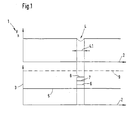
- FIG. 1 shows both that which arises Drop in speed on the electric drive, as well as through the passage of one Stiffness range 4.1 triggered trigger force increase.
- the speed / displacement diagram contained in FIG. 1 is the speed curve 1 plotted over path 2.
- the stiffness area to be overcome 4.1 there is a drop in speed; not in a discrete place of the Travel path 2, but extending over a travel path area 4.1.
- the force that is required to overcome the stiffness range 4.1 gradually increased until the driven surface to be moved, for example a window pane or a sliding roof smooth the area of difficulty 4.1 happen without the electric drive reversing.
- the triggering force 3 is over the path 2 plotted, the one shown in the upper diagram of FIG. 1 Binding range 4.1 is transferred to the lower diagram.
- the automatic bypass function Stiffness range 4.1 there is a gradual increase in Release force, then restarting the stiffness area 4.1 with increased release force.
- the increase in the release force is limited in the set maximum permissible value of the trigger force, which at the automatic bridging function is specified.
- the maximum value for the Tripping force is in the lower diagram according to FIG. 1 with reference number 9 identified.
- the Run through start-up routines 15, 19 see FIG. 2) until n is necessary Tripping force increasing steps are processed.
- In an adaptive Storage system can be the predetermined trigger force value 5 by that Overwrite the value for the release force that is currently traversing the surface can overcome the binding area 4.1.
- the speed of an electric drive can be partial Difficulties, such as those with wind deflectors Sunroofs can occur, adjust.
- the actual circumstances Adapted speed values can be stored in the storage system.
- a first Pinch query 13 is run. Is this state the one to be traversed? Detected area, the position of the stiffness area 4.1 is saved, the timer is set and the electric drive reverses. This is done by the pinch parameter memory 14, from which in the in the state machine 10 also contains monitoring module 12 is branched. There will brought about a first increase in clamping force 16, which is then triggered of the electric drive within the first startup routine 15 onto the surface is transmitted. It is monitored whether within the first startup routine 15 the Electric drive run is terminated normally, or whether a new one Pinching situation has occurred. If the engine run ends normally, the Increasing the clamping force at position 16 in the monitoring module was taken back again.
- the run is within the first startup routine 15 to be run of the electric drive has not ended normally, is a new one Pinching situation occurred.
- the renewed pinching situation is indicated by a repeated query 19 verified within the monitoring module 12; the second pinch query 17 with a positive result causes a new one Clamping force increase at position 18, so that now after unsuccessful Execution of the first start-up routine 15 with the second start-up routine 19 increased value for the clamping force to be applied can be run through.
- the shape is checked 21 as to whether the electric drive is running has ended normally, or if there is another pinching situation. Thereafter, the repeated increase in clamping force 18 is withdrawn before is branched to the start or destination point 11.
- the Monitoring module 12 In addition to the two start-up routines 15, 19, which have different heights The trigger forces can be monitored, the Monitoring module 12, for example, whether a previously set Engine downtime of 10 seconds, for example, is exceeded or not. If so, the system also branches to the start or destination query point 11 and the automatic bypass function is reset. A reset of the automatic bridging function also occurs when the query 25 the control of the electric drive a reversal of direction on electric drive has occurred. If a reversal of rotation occurs moves the approaching surface - be it a window pane or a sunroof - into their open position back. Also in the closed position of each moving surface is the automatic bridging function 10 reset.
- a sequence of the automatic bypass function according to the diagram 2 is roughly as follows:
- the reverses electric drive by means of the automatic bridging function an increase in the release force, which is, for example, as F> 100 N.
- an increase in the release force which is, for example, as F> 100 N.
- the surface to be traversed is restarted in the Difficulty when running through the first startup routine 15. It comes again to a pinching situation, is carried out by running through the second Startup routine 19 a second start with a gradual increase in Release force to the obstacle, representing the binding area 4.1 overcome.
- These attempts are made with a gradual increase in Release force until the gradually increased release force predeterminable maximum value of the trigger force 9 (see FIG. 1) assumes. Can The obstacle will eventually be overcome, the trigger force stored and assigned to that path area 4.1 on which the Stability range 4.1 has found.
- Adapted force threshold to be overcome for the release force adjust so that the electric drive that drives the surface to be moved speed and release force is adapted to the stiffness range 4.1 and the route sections 2 to be covered with predetermined ones Trigger force 5 passes through and upon detection of the previously stored Stability range 4.1 of the electric drive with a step increased Tripping force is operated.
Landscapes
- Engineering & Computer Science (AREA)
- Mechanical Engineering (AREA)
- Power-Operated Mechanisms For Wings (AREA)
- Window Of Vehicle (AREA)
Abstract
Description
- Fig. 1
- den Drehzahlverlauf des elektrischen Antriebes mit einer zu überwindenden Schwergängigkeitsstelle
- Fig. 2
- die Darstellung der Überbrückungsfunktion als Zustandsautomat.
- 1
- Drehzahlverlauf
- 2
- Wegverlauf
- 3
- Kraftschwelle
- 4
- Schwergängigkeitsstelle
- 4.1
- Schwergängigkeitsbereich
- 5
- vorgegebene Auslösekraft
- 6
- erste Erhöhung der Auslösekraft
- 7
- zweite Erhöhung der Auslösekraft
- 8
- n-te Erhöhung der Auslösekraft
- 9
- Maximalwert der Auslösekraft
- 10
- Zustandsautomat
- 11
- Start und Ziel
- 12
- Überwachungsbaustein
- 13
- erste Einklemmabfrage
- 14
- Einklemmparameterspeicher
- 15
- erste Anlaufroutine
- 16
- Klemmkrafterhöhung
- 17
- zweite Einklemmabfrage
- 18
- nochmalige Krafterhöhung
- 19
- zweite Anlaufroutine
- 20
- erste Motorlaufabfrage
- 21
- zweite Motorlaufabfrage
- 22
- Rücksetzer
- 23
- Rücksetzer
- 24
- Zeitfensterüberwachungs-Abfrage
- 25
- Drehrichtungsumkehr Antrieb
Claims (10)
- Verfahren zur Überbrückung partieller Schwergängigkeiten an verfahrbaren Flächen, wobei diese Flächen in Führungen aufgenommen sind und mittels elektrischer Antriebsmotoren verfahrbar sind, an deren Ansteuerung eine Überbrückungsfunktion vorgesehen ist, dadurch gekennzeichnet, daß mittels einer automatisch arbeitenden Steuerung (10) eine automatische Überwachungsfunktion geschaffen wird und daß innerhalb eines Schwergängigkeitsbereiches (4.1) die Auslösekraft in einem oder mehreren Schritten variiert wird.
- Verfahren gemäß Anspruch 1, dadurch gekennzeichnet, daß durch die automatisch arbeitende Steuerung (10) eine Erhöhung der Auslösekraft an der Position des Schwergängigkeitsbereiches erzielt wird.
- Verfahren gemäß Anspruch 1, dadurch gekennzeichnet, daß durch die automatische Steuerung (10) am elektrischen Antrieb der zu verfahrenden Fläche die Drehzahl verändert wird.
- Verfahren gemäß Anspruch 1, dadurch gekennzeichnet, daß die automatisch arbeitende Steuerung (10) zur schrittweisen Erhöhung der Auslösekraft (16, 18) eine erste Anlaufroutine (15) sowie eine zweite Anlaufroutine (19) enthält.
- Verfahren gemäß Anspruch 1, dadurch gekennzeichnet, daß an der automatischen Steuerung (10) eine Schließkraftbegrenzung (24, 25) vorgesehen ist.
- Verfahren gemäß Anspruch 1, dadurch gekennzeichnet, daß der Überwachungsbaustein (12) zum Start- und Zielpunkt (11) zurückverzweigt, nach dem eine vorgebbare Zeitspanne verstrichen ist oder am elektrischen Antrieb eine Drehrichtungsumkehr eingetreten ist.
- Verfahren gemäß Anspruch 4, dadurch gekennzeichnet, daß bei aufeinander folgenden Durchläufen der ersten Anlaufroutine (15) und der zweiten Anlaufroutine (19) pro Durchlauf die Auslösekraft bis zum Erreichen der gesetzten maximalen Auslösekraft gesteigert wird, wobei dieser den Schwergängigkeitsbereich (4.1) überwindende Wert in einem adaptiven Speicher abgelegt wird.
- Verfahren gemäß Anspruch 1, dadurch gekennzeichnet, daß die automatische Überbrückungsfunktion zurückgesetzt wird, wenn die zu verfahrende Fläche ihre jeweilige Schließposition erreicht hat.
- Verfahren gemäß Anspruch 1, dadurch gekennzeichnet, daß die automatische Überbrückungsfunktion zurückgesetzt wird, wenn die Stillstandszeit des elektrischen Antriebes eine vorgegebene Zeitspanne überschreitet.
- Verfahren gemäß Anspruch 1, dadurch gekennzeichnet, daß die automatische Überbrückungsfunktion zurückgesetzt wird, wenn die Gegenrichtung des elektrischen Antriebes angesteuert wird.
Applications Claiming Priority (2)
| Application Number | Priority Date | Filing Date | Title |
|---|---|---|---|
| DE10008040 | 2000-02-22 | ||
| DE10008040A DE10008040A1 (de) | 2000-02-22 | 2000-02-22 | Verfahren zur Überbrückung partieller Schwergängigkeit an verfahrbaren Flächen |
Publications (2)
| Publication Number | Publication Date |
|---|---|
| EP1127724A1 true EP1127724A1 (de) | 2001-08-29 |
| EP1127724B1 EP1127724B1 (de) | 2006-05-03 |
Family
ID=7631832
Family Applications (1)
| Application Number | Title | Priority Date | Filing Date |
|---|---|---|---|
| EP01102206A Expired - Lifetime EP1127724B1 (de) | 2000-02-22 | 2001-01-31 | Verfahren zur Überbrückung partieller Schwergängigkeit an verfahrbaren Flächen |
Country Status (4)
| Country | Link |
|---|---|
| US (2) | US6498450B2 (de) |
| EP (1) | EP1127724B1 (de) |
| DE (2) | DE10008040A1 (de) |
| ES (1) | ES2261281T3 (de) |
Families Citing this family (3)
| Publication number | Priority date | Publication date | Assignee | Title |
|---|---|---|---|---|
| US6873127B2 (en) * | 2002-05-10 | 2005-03-29 | Wayne-Dalton Corp. | Method and device for adjusting an internal obstruction force setting for a motorized garage door operator |
| DE102008054249A1 (de) * | 2008-10-24 | 2010-04-29 | Dr.Ing.H.C.F.Porsche Aktiengesellschaft | Verfahren zum Schließen einer einklemmüberwachten Fahrzeugöffnung |
| DE102012003481A1 (de) * | 2012-02-21 | 2013-08-22 | Audi Ag | Verfahren zum Betätigen einer Klappe eines Kraftfahrzeugs |
Citations (3)
| Publication number | Priority date | Publication date | Assignee | Title |
|---|---|---|---|---|
| EP0479045A2 (de) * | 1990-10-04 | 1992-04-08 | Robert Bosch Gmbh | Vorrichtung zum Betreiben von elektromotorisch angetriebenen Teilen |
| DE19619971A1 (de) * | 1995-05-16 | 1997-01-02 | Nedap Nv | Schiebedachsteuerung mit inkrementeller Positionsbestimmung mit dynamischer Nullstellung |
| EP0900679A2 (de) * | 1997-09-04 | 1999-03-10 | Robert Bosch Gmbh | Elektromotorischer Antrieb |
Family Cites Families (3)
| Publication number | Priority date | Publication date | Assignee | Title |
|---|---|---|---|---|
| US5051672A (en) * | 1989-04-28 | 1991-09-24 | Kabushiki Kaisha Riken | Automatic window/door system |
| US6064165A (en) * | 1992-04-22 | 2000-05-16 | Nartron Corporation | Power window or panel controller |
| JP2000274142A (ja) * | 1999-03-23 | 2000-10-03 | Koito Mfg Co Ltd | パワーウインドの安全装置 |
-
2000
- 2000-02-22 DE DE10008040A patent/DE10008040A1/de not_active Withdrawn
-
2001
- 2001-01-31 EP EP01102206A patent/EP1127724B1/de not_active Expired - Lifetime
- 2001-01-31 ES ES01102206T patent/ES2261281T3/es not_active Expired - Lifetime
- 2001-01-31 DE DE50109657T patent/DE50109657D1/de not_active Expired - Lifetime
- 2001-02-20 US US09/788,951 patent/US6498450B2/en not_active Expired - Lifetime
- 2001-04-06 US US09/827,989 patent/US20020021099A1/en not_active Abandoned
Patent Citations (3)
| Publication number | Priority date | Publication date | Assignee | Title |
|---|---|---|---|---|
| EP0479045A2 (de) * | 1990-10-04 | 1992-04-08 | Robert Bosch Gmbh | Vorrichtung zum Betreiben von elektromotorisch angetriebenen Teilen |
| DE19619971A1 (de) * | 1995-05-16 | 1997-01-02 | Nedap Nv | Schiebedachsteuerung mit inkrementeller Positionsbestimmung mit dynamischer Nullstellung |
| EP0900679A2 (de) * | 1997-09-04 | 1999-03-10 | Robert Bosch Gmbh | Elektromotorischer Antrieb |
Also Published As
| Publication number | Publication date |
|---|---|
| DE50109657D1 (de) | 2006-06-08 |
| US20020021099A1 (en) | 2002-02-21 |
| DE10008040A1 (de) | 2001-09-13 |
| US20010022504A1 (en) | 2001-09-20 |
| ES2261281T3 (es) | 2006-11-16 |
| US6498450B2 (en) | 2002-12-24 |
| EP1127724B1 (de) | 2006-05-03 |
Similar Documents
| Publication | Publication Date | Title |
|---|---|---|
| DE3303590A1 (de) | Elektromotorisch angetriebener fensterheber mit einer sicherheitsschaltung | |
| WO2008080666A1 (de) | Vorrichtung und verfahren zur ansteuerung einer antriebseinheit einer wischanlage | |
| EP1259406A1 (de) | Scheibenwischervorrichtung zum wischen von scheiben | |
| EP0812754A2 (de) | Hydraulische Servosteuerung, insbesondere hydraulische Servolenkung für Kraftfahrzeuge | |
| DE4138194A1 (de) | Verfahren und vorrichtung zur erfassung der position und bewegungsrichtung translatorisch und/oder rotatorisch bewegter aggregate | |
| DE19838144A1 (de) | Verfahren zum Nachweisen eines Hindernisses für ein Fenster mit elektrischem Fensterheber | |
| EP1127724A1 (de) | Verfahren zur Überbrückung partieller Schwergängigkeit an verfahrbaren Flächen | |
| DE19811151A1 (de) | Verfahren zum Ansteuern eines elektrischen Antriebs | |
| DE19615581B4 (de) | Verfahren zum Schutz von mechanischen und durch einen Elektromotor angetriebenen Komponentenin Fahrzeugen vor Beschädigung | |
| DE4204017C1 (en) | Control arrangement for folding roof of vehicle - has counter circuit ascertaining timed intervals between end position switches operated sequentially | |
| DE112018001091T5 (de) | Antriebsvorrichtung für einen Öffnungs- und Schließkörper | |
| DE10126682B4 (de) | Verfahren zur Steuerung eines Fensters sowie einer Fensterjalousie eines Kraftfahrzeugs | |
| DE102006033022A1 (de) | Verfahren und Vorrichtung zum Schutz gegen Einklemmen bei einem motorbetriebenen Schließsystem | |
| DE60107113T2 (de) | Verfahren zur steuerung eines wischermotors | |
| WO2003038968A1 (de) | Verfahren zur überwachung des reversiervorgangs von elektrisch betätigbaren aggregaten | |
| CH693913A5 (de) | Verfahren zur Steuerung eines Schlitzverschlusses. | |
| EP1148606B1 (de) | Verfahren zur Detektierung des Informationsverlustes eines Mikroprozessors | |
| EP1727694B1 (de) | Steuerverfahren und steuervorrichtung f r kraftfahrzeuge mit einem aufklappbaren dach | |
| DE19615441C1 (de) | Verfahren zum Betrieb eines elektrischen Motorantriebs | |
| DE2161789C3 (de) | Einrichtung für den intermittierenden Betrieb eines Scheibenwischers | |
| EP1388448B1 (de) | Verfahren zum Bewegen eines mehrteiligen Schiebedaches für ein Kraftfahrzeug | |
| EP1931542A1 (de) | Verfahren zum wischen einer scheibe sowie scheibenwischvorrichtung, insbesondere für ein kraftfahrzeug | |
| DE19823376A1 (de) | Antriebseinheit für Verstelleinrichtungen in Kraftfahrzeugen | |
| DE3936880A1 (de) | Scheibenwischeranlage fuer kraftfahrzeuge | |
| DE10344129B4 (de) | Verfahren zum Einstellen der Leerlaufdrehzahl einer Brennkraftmaschine |
Legal Events
| Date | Code | Title | Description |
|---|---|---|---|
| PUAI | Public reference made under article 153(3) epc to a published international application that has entered the european phase |
Free format text: ORIGINAL CODE: 0009012 |
|
| AK | Designated contracting states |
Kind code of ref document: A1 Designated state(s): DE ES FR GB IT SE Kind code of ref document: A1 Designated state(s): AT BE CH CY DE DK ES FI FR GB GR IE IT LI LU MC NL PT SE TR |
|
| AX | Request for extension of the european patent |
Free format text: AL;LT;LV;MK;RO;SI |
|
| 17P | Request for examination filed |
Effective date: 20020228 |
|
| AKX | Designation fees paid |
Free format text: DE ES FR GB IT SE |
|
| GRAP | Despatch of communication of intention to grant a patent |
Free format text: ORIGINAL CODE: EPIDOSNIGR1 |
|
| GRAS | Grant fee paid |
Free format text: ORIGINAL CODE: EPIDOSNIGR3 |
|
| GRAA | (expected) grant |
Free format text: ORIGINAL CODE: 0009210 |
|
| AK | Designated contracting states |
Kind code of ref document: B1 Designated state(s): DE ES FR GB IT SE |
|
| PG25 | Lapsed in a contracting state [announced via postgrant information from national office to epo] |
Ref country code: IT Free format text: LAPSE BECAUSE OF FAILURE TO SUBMIT A TRANSLATION OF THE DESCRIPTION OR TO PAY THE FEE WITHIN THE PRESCRIBED TIME-LIMIT;WARNING: LAPSES OF ITALIAN PATENTS WITH EFFECTIVE DATE BEFORE 2007 MAY HAVE OCCURRED AT ANY TIME BEFORE 2007. THE CORRECT EFFECTIVE DATE MAY BE DIFFERENT FROM THE ONE RECORDED. Effective date: 20060503 |
|
| REG | Reference to a national code |
Ref country code: GB Ref legal event code: FG4D Free format text: NOT ENGLISH |
|
| REF | Corresponds to: |
Ref document number: 50109657 Country of ref document: DE Date of ref document: 20060608 Kind code of ref document: P |
|
| PG25 | Lapsed in a contracting state [announced via postgrant information from national office to epo] |
Ref country code: SE Free format text: LAPSE BECAUSE OF FAILURE TO SUBMIT A TRANSLATION OF THE DESCRIPTION OR TO PAY THE FEE WITHIN THE PRESCRIBED TIME-LIMIT Effective date: 20060803 |
|
| GBT | Gb: translation of ep patent filed (gb section 77(6)(a)/1977) |
Effective date: 20060824 |
|
| ET | Fr: translation filed | ||
| REG | Reference to a national code |
Ref country code: ES Ref legal event code: FG2A Ref document number: 2261281 Country of ref document: ES Kind code of ref document: T3 |
|
| PLBE | No opposition filed within time limit |
Free format text: ORIGINAL CODE: 0009261 |
|
| STAA | Information on the status of an ep patent application or granted ep patent |
Free format text: STATUS: NO OPPOSITION FILED WITHIN TIME LIMIT |
|
| 26N | No opposition filed |
Effective date: 20070206 |
|
| REG | Reference to a national code |
Ref country code: FR Ref legal event code: PLFP Year of fee payment: 16 |
|
| REG | Reference to a national code |
Ref country code: FR Ref legal event code: PLFP Year of fee payment: 17 |
|
| REG | Reference to a national code |
Ref country code: FR Ref legal event code: PLFP Year of fee payment: 18 |
|
| PGFP | Annual fee paid to national office [announced via postgrant information from national office to epo] |
Ref country code: ES Payment date: 20200219 Year of fee payment: 20 Ref country code: GB Payment date: 20200127 Year of fee payment: 20 Ref country code: DE Payment date: 20200324 Year of fee payment: 20 Ref country code: IT Payment date: 20200122 Year of fee payment: 20 |
|
| PGFP | Annual fee paid to national office [announced via postgrant information from national office to epo] |
Ref country code: FR Payment date: 20200123 Year of fee payment: 20 |
|
| REG | Reference to a national code |
Ref country code: DE Ref legal event code: R071 Ref document number: 50109657 Country of ref document: DE |
|
| REG | Reference to a national code |
Ref country code: GB Ref legal event code: PE20 Expiry date: 20210130 |
|
| PG25 | Lapsed in a contracting state [announced via postgrant information from national office to epo] |
Ref country code: GB Free format text: LAPSE BECAUSE OF EXPIRATION OF PROTECTION Effective date: 20210130 |
|
| REG | Reference to a national code |
Ref country code: ES Ref legal event code: FD2A Effective date: 20210604 |
|
| PG25 | Lapsed in a contracting state [announced via postgrant information from national office to epo] |
Ref country code: ES Free format text: LAPSE BECAUSE OF EXPIRATION OF PROTECTION Effective date: 20210201 |