EP1127460B1 - Algorithm for fast forward and fast rewind of mpeg streams - Google Patents
Algorithm for fast forward and fast rewind of mpeg streams Download PDFInfo
- Publication number
- EP1127460B1 EP1127460B1 EP99946825A EP99946825A EP1127460B1 EP 1127460 B1 EP1127460 B1 EP 1127460B1 EP 99946825 A EP99946825 A EP 99946825A EP 99946825 A EP99946825 A EP 99946825A EP 1127460 B1 EP1127460 B1 EP 1127460B1
- Authority
- EP
- European Patent Office
- Prior art keywords
- file
- frames
- media client
- request
- media
- Prior art date
- Legal status (The legal status is an assumption and is not a legal conclusion. Google has not performed a legal analysis and makes no representation as to the accuracy of the status listed.)
- Expired - Lifetime
Links
- 239000000872 buffer Substances 0.000 claims abstract description 58
- 230000003139 buffering effect Effects 0.000 claims abstract description 12
- 230000007246 mechanism Effects 0.000 claims description 20
- 238000000034 method Methods 0.000 claims description 11
- 230000004044 response Effects 0.000 claims description 5
- 230000007704 transition Effects 0.000 abstract description 24
- 230000001934 delay Effects 0.000 abstract description 6
- 230000002452 interceptive effect Effects 0.000 description 4
- 238000010586 diagram Methods 0.000 description 3
- 239000000463 material Substances 0.000 description 3
- 230000005540 biological transmission Effects 0.000 description 2
- 230000000694 effects Effects 0.000 description 2
- 238000005516 engineering process Methods 0.000 description 2
- 230000006855 networking Effects 0.000 description 2
- 238000004088 simulation Methods 0.000 description 2
- 208000031361 Hiccup Diseases 0.000 description 1
- 230000006837 decompression Effects 0.000 description 1
- 239000002360 explosive Substances 0.000 description 1
- 238000011093 media selection Methods 0.000 description 1
- 238000012986 modification Methods 0.000 description 1
- 230000004048 modification Effects 0.000 description 1
- 238000012545 processing Methods 0.000 description 1
- 238000012546 transfer Methods 0.000 description 1
- 239000002699 waste material Substances 0.000 description 1
Images

Classifications
-
- H—ELECTRICITY
- H04—ELECTRIC COMMUNICATION TECHNIQUE
- H04N—PICTORIAL COMMUNICATION, e.g. TELEVISION
- H04N21/00—Selective content distribution, e.g. interactive television or video on demand [VOD]
- H04N21/40—Client devices specifically adapted for the reception of or interaction with content, e.g. set-top-box [STB]; Operations thereof
- H04N21/43—Processing of content or additional data, e.g. demultiplexing additional data from a digital video stream; Elementary client operations, e.g. monitoring of home network or synchronising decoder's clock; Client middleware
- H04N21/44—Processing of video elementary streams, e.g. splicing a video clip retrieved from local storage with an incoming video stream or rendering scenes according to encoded video stream scene graphs
- H04N21/44016—Processing of video elementary streams, e.g. splicing a video clip retrieved from local storage with an incoming video stream or rendering scenes according to encoded video stream scene graphs involving splicing one content stream with another content stream, e.g. for substituting a video clip
-
- H—ELECTRICITY
- H04—ELECTRIC COMMUNICATION TECHNIQUE
- H04N—PICTORIAL COMMUNICATION, e.g. TELEVISION
- H04N21/00—Selective content distribution, e.g. interactive television or video on demand [VOD]
- H04N21/20—Servers specifically adapted for the distribution of content, e.g. VOD servers; Operations thereof
- H04N21/23—Processing of content or additional data; Elementary server operations; Server middleware
- H04N21/234—Processing of video elementary streams, e.g. splicing of video streams or manipulating encoded video stream scene graphs
- H04N21/23424—Processing of video elementary streams, e.g. splicing of video streams or manipulating encoded video stream scene graphs involving splicing one content stream with another content stream, e.g. for inserting or substituting an advertisement
-
- H—ELECTRICITY
- H04—ELECTRIC COMMUNICATION TECHNIQUE
- H04N—PICTORIAL COMMUNICATION, e.g. TELEVISION
- H04N21/00—Selective content distribution, e.g. interactive television or video on demand [VOD]
- H04N21/20—Servers specifically adapted for the distribution of content, e.g. VOD servers; Operations thereof
- H04N21/23—Processing of content or additional data; Elementary server operations; Server middleware
- H04N21/238—Interfacing the downstream path of the transmission network, e.g. adapting the transmission rate of a video stream to network bandwidth; Processing of multiplex streams
-
- H—ELECTRICITY
- H04—ELECTRIC COMMUNICATION TECHNIQUE
- H04N—PICTORIAL COMMUNICATION, e.g. TELEVISION
- H04N21/00—Selective content distribution, e.g. interactive television or video on demand [VOD]
- H04N21/20—Servers specifically adapted for the distribution of content, e.g. VOD servers; Operations thereof
- H04N21/23—Processing of content or additional data; Elementary server operations; Server middleware
- H04N21/238—Interfacing the downstream path of the transmission network, e.g. adapting the transmission rate of a video stream to network bandwidth; Processing of multiplex streams
- H04N21/2387—Stream processing in response to a playback request from an end-user, e.g. for trick-play
-
- H—ELECTRICITY
- H04—ELECTRIC COMMUNICATION TECHNIQUE
- H04N—PICTORIAL COMMUNICATION, e.g. TELEVISION
- H04N21/00—Selective content distribution, e.g. interactive television or video on demand [VOD]
- H04N21/60—Network structure or processes for video distribution between server and client or between remote clients; Control signalling between clients, server and network components; Transmission of management data between server and client, e.g. sending from server to client commands for recording incoming content stream; Communication details between server and client
- H04N21/63—Control signaling related to video distribution between client, server and network components; Network processes for video distribution between server and clients or between remote clients, e.g. transmitting basic layer and enhancement layers over different transmission paths, setting up a peer-to-peer communication via Internet between remote STB's; Communication protocols; Addressing
- H04N21/637—Control signals issued by the client directed to the server or network components
- H04N21/6377—Control signals issued by the client directed to the server or network components directed to server
-
- H—ELECTRICITY
- H04—ELECTRIC COMMUNICATION TECHNIQUE
- H04N—PICTORIAL COMMUNICATION, e.g. TELEVISION
- H04N21/00—Selective content distribution, e.g. interactive television or video on demand [VOD]
- H04N21/60—Network structure or processes for video distribution between server and client or between remote clients; Control signalling between clients, server and network components; Transmission of management data between server and client, e.g. sending from server to client commands for recording incoming content stream; Communication details between server and client
- H04N21/65—Transmission of management data between client and server
- H04N21/658—Transmission by the client directed to the server
-
- H—ELECTRICITY
- H04—ELECTRIC COMMUNICATION TECHNIQUE
- H04N—PICTORIAL COMMUNICATION, e.g. TELEVISION
- H04N21/00—Selective content distribution, e.g. interactive television or video on demand [VOD]
- H04N21/60—Network structure or processes for video distribution between server and client or between remote clients; Control signalling between clients, server and network components; Transmission of management data between server and client, e.g. sending from server to client commands for recording incoming content stream; Communication details between server and client
- H04N21/65—Transmission of management data between client and server
- H04N21/658—Transmission by the client directed to the server
- H04N21/6587—Control parameters, e.g. trick play commands, viewpoint selection
-
- H—ELECTRICITY
- H04—ELECTRIC COMMUNICATION TECHNIQUE
- H04N—PICTORIAL COMMUNICATION, e.g. TELEVISION
- H04N7/00—Television systems
- H04N7/16—Analogue secrecy systems; Analogue subscription systems
- H04N7/173—Analogue secrecy systems; Analogue subscription systems with two-way working, e.g. subscriber sending a programme selection signal
- H04N7/17309—Transmission or handling of upstream communications
- H04N7/17318—Direct or substantially direct transmission and handling of requests
Definitions
- the present invention generally pertains to transport of MPEG video streams from a network server to a media client. More particularly, the present technique for efficiently performing fast forward and fast rewind operations in response to a user's request.
- the technique uses buffering and interim transport of MPEG video files contained in these streams to avoid network delays associated with transition between files.
- Transporting video and audio material typically involves transferring video files from a server over a network which services a number of individual media clients.
- ITV servers for example, use a collection of computing, storage, and communications equipment to transfer these files when providing interactive video services.
- a particular interactive service may require more than one server in order to be implemented, or a server may implement more than one service.
- the servers generate compressed audio and video streams in standard formats that require decompression only at the location of the media client. Consumers' remote control button-press signals are carried back to the server for interpretation by the service application.
- the media client can view a movie or other type of video much in the same fashion as one would operate a standard VCR.
- an express file represents a shortened version of the normal play file such that only the frames corresponding to fast forward (or fast rewind) play of the movie are stored in the express file.
- MPEG stream data therefore can include normal play, reverse express, and forward express files which are abbreviated herein as 1X, RX, and FX files, respectively.
- the idea behind using express files is to save on network and disk bandwidth. Since one frame for every n frames is actually shown to the user during display of fast forward and fast rewind video, it is a waste of bandwidth to ship all the data to the client, including the frames that will be discarded. Express files are therefore built by scanning the normal play file, and selecting every nth frame.
- express files may store in them only the I-frames that appear in the normal play file.
- I-frames contain information resulting from intraframe coding techniques which exploit the spatial redundancy existing between pictures.
- the choice of the value of n will therefore be limited to the size of the group of pictures of the normal play file.
- each video file has an associated database file with a record for the other video files.
- the 1X file has a database file with a 1X-FX record, and a 1X-RX record.
- the database files contain the necessary link information for transition between files.
- Each record of the file contains fields carrying link pointers to the other database files.
- the link pointers in the database files are indexed by the frame number of each stream.
- the link information guarantees the display of the appropriate sequence of frames, it does not guarantee that the frames will be displayed at the correct time. Simply put, although the correct frames are selected, these frames may experience significant delays before being displayed due to network delays. An undesirable "hiccup" on the screen of the media client is the result of such a delay.
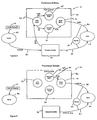
- an exemplary video transport system is illustrated at 10.
- a transport controller 20, a buffering system 30, and a counter 40 allow the video transport system 10 to deliver MPEG stream data 80 from a network server 50 to a media client 60 in response to one or media requests 61 from the media client 60.
- the media request 61 sets the delivery state of the video transport system 10 to either continuous delivery or transitional delivery.
- the presently preferred implementation is in software in which the buffering system and counter are data structures maintained by the client.
- the present invention generally uses the continuous delivery state as an opportunity to write MPEG stream data 80 to a population buffer 35 in the buffering system 30 for later retrieval during transitional delivery.
- Continuous delivery means that the media client has not made a request since the video transport system 10 began delivering the last requested file, whereas transitional delivery means that the media client has requested delivery of a different file from the one currently being delivered.
- the video transport system 10 therefore operates in the continuous delivery state when delivering 1X, FX, or RX files to the media client 60.
- the video transport system 10 operates in the transitional delivery state.
- the video transport system 10 therefore enables the delivery of the above mentioned files as well as efficient execution of the following file transitions: FX-1X, 1X-FX, RX-FX, RX-1X, FX-RX, and 1X-RX.
- the MPEG stream data 80 comprises one of the above files, whereas during transitional delivery the MPEG stream data 80 comprises a current file, interim I-frames to be discussed below, and a subsequent requested file.
- the counter 40 tracks the number of I-frames delivered to the media client 60. While the content of data actually received by the media client 60 may vary as requests are made, the video transport system 10 guarantees that countable I-frames are contained in such data. The counter 40, therefore, tracks I-frames delivered during both continuous delivery and transitional delivery. Thus, as 1X and FX files are delivered to the media client 60, counter 40 increments with each I-frame, and as RX files are delivered to the media client 60, counter 40 decrements with each I-frame. Through additional counter adjustment to be described below, the video transport system 10 can also execute more complex file transitions. The transport controller 20 can therefore route the MPEG stream data 80 from the server 50 to the media client 60, based on the delivery state and the counter 40.
- the buffering system 30 stores MPEG stream data 80.
- the client maintains a plurality of buffer spaces that function as a play buffer, a fast forward buffer and a fast rewind buffer.
- the play buffer contains the frame data that corresponds to the normal play file (the 1X file).
- the fast forward buffer contains data that is relevant to fast forward playing. This data is continuously cached to facilitate the switch to fast forward.
- the fast rewind buffer contains data that is relevant to fast rewind playing. This data is continuously cached to facilitate the switch to fast rewind.
- the buffering system 30 has a buffer write mechanism 33 for storing the MPEG stream data 80 in either a transport buffer 34, a population buffer 35, or both, depending on the delivery state of the video transport system 10 and the file.
- the buffering system 30 also has a buffer read mechanism 31 for reading MPEG stream data 80 from the transport buffer 34, and for reading interim I-frames 70 from the population buffer 35. Note that these interim I-frames 70 are stored during continuous delivery.
- the buffer read mechanism 31 can also deliver data to the media client 60, and the data can be stored in and retrieved from buffers 34 and 35 as either I-frames or complete files. It is important to note that if desired, the media client software can perform the data retrieval functions. Other commonly known techniques can also be used to effect storage and retrieval of buffered data.
- the transport controller 20 effects delivery of data to the media client 60 by routing 1X and RX files through the transport buffer 34, and FX files directly to the medial client 60.
- the media request 61 comprises a request to deliver an FX file
- the MPEG stream data 80 comprises the FX file
- the transport controller 20 routes I-frames contained in the FX file to the buffer write mechanism 33 for storage, and directly to the media client 60 for viewing.
- the transport controller 20 routes the complete 1X file to the buffer write mechanism 33 for storage and viewing by way of transport buffer 34 and buffer read mechanism 31.
- the transport controller 20 routes I-frames contained in the RX file to the buffer write mechanism 33 for storage and viewing by way of transport buffer 34 and buffer read mechanism 31.
- Transitional delivery typically involves delivery of interim I-frames 70 until the requested file is available. If the media request 61 comprises a request to transition from delivery of an FX file to delivery of a 1X file, however, the transport controller 20 delivers interim I-frames 70' contained in the MPEG stream data 80 directly to the media client 60 in slow motion speed without accessing data contained in the population buffer 35. During all other transitions, the buffer read mechanism 31 delivers interim I-frames 70 contained in the population buffer 35 to the client 60 until the requested file is available. Interim delivery of buffered MPEG stream data allows the video transport system 10 to avoid the common problems associated with networking delays.
- the MPEG stream data 80 comprises both the 1X file and the FX file.
- the buffer read mechanism 31 delivers the interim I-frames 70 contained in the population buffer 35 to the media client 60 in fast forward speed until the FX file is available. Fast forward speed simulation is required for the 1X-FX and 1X-RX transitions, while slow motion simulation is required for FX-1X and RX-1X transitions.
- the transport controller 20 uses the counter 40 to select a start location in the requested file. Whenever the video transport system 10 is transitioning to or from the delivery of an RX file, the transport controller 20 adjusts the counter 40 in relation to the number of interim I-frames 70 delivered to the media client 60 from the population buffer 35. This adjustment is due to multiple delivery of the same frames. Specifically, when the media request 61 is a request to transition to delivery of an RX file, the transport controller 20 reduces the value of the counter 40 by the number of interim I-frames 70 delivered, and when the media request 61 is a request to transition from delivery of an RX file, the transport controller 20 increases the value of the counter 40 by the number of interim I-frames 70 delivered. No counter adjustment is necessary for the FX-1X and 1X-FX transitions.
Landscapes
- Engineering & Computer Science (AREA)
- Multimedia (AREA)
- Signal Processing (AREA)
- Business, Economics & Management (AREA)
- Marketing (AREA)
- Television Signal Processing For Recording (AREA)
- Two-Way Televisions, Distribution Of Moving Picture Or The Like (AREA)
Applications Claiming Priority (3)
| Application Number | Priority Date | Filing Date | Title |
|---|---|---|---|
| US166558 | 1998-10-05 | ||
| US09/166,558 US6097422A (en) | 1998-10-05 | 1998-10-05 | Algorithm for fast forward and fast rewind of MPEG streams |
| PCT/US1999/020678 WO2000021294A1 (en) | 1998-10-05 | 1999-09-08 | Algorithm for fast forward and fast rewind of mpeg streams |
Publications (3)
| Publication Number | Publication Date |
|---|---|
| EP1127460A1 EP1127460A1 (en) | 2001-08-29 |
| EP1127460A4 EP1127460A4 (en) | 2003-07-16 |
| EP1127460B1 true EP1127460B1 (en) | 2006-01-11 |
Family
ID=22603823
Family Applications (1)
| Application Number | Title | Priority Date | Filing Date |
|---|---|---|---|
| EP99946825A Expired - Lifetime EP1127460B1 (en) | 1998-10-05 | 1999-09-08 | Algorithm for fast forward and fast rewind of mpeg streams |
Country Status (6)
| Country | Link |
|---|---|
| US (1) | US6097422A (enExample) |
| EP (1) | EP1127460B1 (enExample) |
| JP (1) | JP4127969B2 (enExample) |
| CN (1) | CN1134982C (enExample) |
| DE (1) | DE69929449T2 (enExample) |
| WO (1) | WO2000021294A1 (enExample) |
Families Citing this family (19)
| Publication number | Priority date | Publication date | Assignee | Title |
|---|---|---|---|---|
| US20010034786A1 (en) * | 2000-03-15 | 2001-10-25 | Ibm | Method ane system for streaming media data in heterogeneous environments |
| JP2003532345A (ja) * | 2000-04-25 | 2003-10-28 | コーニンクレッカ フィリップス エレクトロニクス エヌ ヴィ | ビデオ再生速度を切り替えるときに画像表示遷移をマスキングする方法 |
| DE60144335D1 (de) * | 2000-08-31 | 2011-05-12 | Goldpocket Interactive Inc | Systeme und verfahren für die interaktion mit benutzern in einem kommunikationsnetzwerk |
| US6766376B2 (en) | 2000-09-12 | 2004-07-20 | Sn Acquisition, L.L.C | Streaming media buffering system |
| US7346698B2 (en) * | 2000-12-20 | 2008-03-18 | G. W. Hannaway & Associates | Webcasting method and system for time-based synchronization of multiple, independent media streams |
| GB0104785D0 (en) * | 2001-02-27 | 2001-04-18 | Pace Micro Tech Plc | MPEG decoder video in the form of cue and/or review streams of data |
| US6738980B2 (en) | 2001-11-15 | 2004-05-18 | Industrial Technology Research Institute | Methods and systems for video streaming with VCR functionality |
| US20030185301A1 (en) * | 2002-04-02 | 2003-10-02 | Abrams Thomas Algie | Video appliance |
| US7212574B2 (en) | 2002-04-02 | 2007-05-01 | Microsoft Corporation | Digital production services architecture |
| US20030185302A1 (en) * | 2002-04-02 | 2003-10-02 | Abrams Thomas Algie | Camera and/or camera converter |
| KR100978172B1 (ko) | 2002-06-21 | 2010-08-25 | 톰슨 라이센싱 | 이동 무선 상호연동 환경에서의 저장된 비디오 스트리밍을위한 지속 감소 네트워크 qos 요구 조건 |
| KR100555427B1 (ko) * | 2002-12-24 | 2006-02-24 | 엘지전자 주식회사 | 비디오 재생 장치 및 지능형 스킵 방법 |
| DE10353564A1 (de) * | 2003-11-14 | 2005-06-16 | Deutsche Thomson-Brandt Gmbh | Verfahren zur abschnittsweisen, diskontinuierlichen Übertragung von Daten in einem Netzwerk verteilter Stationen sowie Netzwerkteilnehmerstation als Anforderungsgerät bei der Durchführung eines solchen Verfahrens als auch Netzwerkteilnehmerstation als Quellgerät bei der Durchführung eines solchen Verfahrens |
| US8055783B2 (en) | 2005-08-22 | 2011-11-08 | Utc Fire & Security Americas Corporation, Inc. | Systems and methods for media stream processing |
| KR100884400B1 (ko) * | 2007-01-23 | 2009-02-17 | 삼성전자주식회사 | 영상처리장치 및 그 방법 |
| US9363579B2 (en) | 2010-12-22 | 2016-06-07 | Google Inc. | Video player with assisted seek |
| CN102136289B (zh) * | 2010-12-30 | 2013-03-13 | 华为技术有限公司 | 一种媒体内容的存储方法、读取方法、装置和系统 |
| CN105025357B (zh) * | 2015-06-05 | 2018-06-08 | 北京中电兴发科技有限公司 | 一种视频倒放的方法 |
| CN114650452B (zh) * | 2022-02-28 | 2024-09-24 | 北京中交兴路信息科技有限公司 | 车载视频的倒播方法、装置、电子设备及介质 |
Family Cites Families (19)
| Publication number | Priority date | Publication date | Assignee | Title |
|---|---|---|---|---|
| US5371532A (en) * | 1992-05-15 | 1994-12-06 | Bell Communications Research, Inc. | Communications architecture and method for distributing information services |
| JP3149098B2 (ja) * | 1992-11-26 | 2001-03-26 | 日本電信電話株式会社 | ディジタル動画情報ファイルの多重読み取り方法 |
| US5440334A (en) * | 1993-02-01 | 1995-08-08 | Explore Technology, Inc. | Broadcast video burst transmission cyclic distribution apparatus and method |
| US5442390A (en) * | 1993-07-07 | 1995-08-15 | Digital Equipment Corporation | Video on demand with memory accessing and or like functions |
| JP3038668B2 (ja) * | 1993-09-20 | 2000-05-08 | 富士通株式会社 | ビデオ情報配信システム |
| JPH07183884A (ja) * | 1993-12-22 | 1995-07-21 | Fujitsu Ltd | 情報分配システム |
| US5461415A (en) * | 1994-03-15 | 1995-10-24 | International Business Machines Corporation | Look-ahead scheduling to support video-on-demand applications |
| US5453779A (en) * | 1994-03-15 | 1995-09-26 | International Business Machines Corporation | Scheduling policies with grouping for providing VCR control functions in a video server |
| US5521630A (en) * | 1994-04-04 | 1996-05-28 | International Business Machines Corporation | Frame sampling scheme for video scanning in a video-on-demand system |
| US5720037A (en) * | 1994-06-16 | 1998-02-17 | Lucent Technologies Inc. | Multimedia on-demand server |
| US5606359A (en) * | 1994-06-30 | 1997-02-25 | Hewlett-Packard Company | Video on demand system with multiple data sources configured to provide vcr-like services |
| US5815634A (en) * | 1994-09-30 | 1998-09-29 | Cirrus Logic, Inc. | Stream synchronization method and apparatus for MPEG playback system |
| JP2985703B2 (ja) * | 1995-01-19 | 1999-12-06 | 日本ビクター株式会社 | 画像圧縮記録媒体再生装置 |
| US5517257A (en) * | 1995-03-28 | 1996-05-14 | Microsoft Corporation | Video control user interface for interactive television systems and method for controlling display of a video movie |
| US5724646A (en) * | 1995-06-15 | 1998-03-03 | International Business Machines Corporation | Fixed video-on-demand |
| US5659539A (en) * | 1995-07-14 | 1997-08-19 | Oracle Corporation | Method and apparatus for frame accurate access of digital audio-visual information |
| US5909238A (en) * | 1995-07-25 | 1999-06-01 | Canon Kabushiki Kaisha | Image transmission system with billing based on the kind of MPEG frame transmitted |
| US5732217A (en) * | 1995-12-01 | 1998-03-24 | Matsushita Electric Industrial Co., Ltd. | Video-on-demand system capable of performing a high-speed playback at a correct speed |
| US5928327A (en) * | 1996-08-08 | 1999-07-27 | Wang; Pong-Sheng | System and process for delivering digital data on demand |
-
1998
- 1998-10-05 US US09/166,558 patent/US6097422A/en not_active Expired - Fee Related
-
1999
- 1999-09-08 DE DE69929449T patent/DE69929449T2/de not_active Expired - Lifetime
- 1999-09-08 CN CNB998116521A patent/CN1134982C/zh not_active Expired - Fee Related
- 1999-09-08 JP JP2000575304A patent/JP4127969B2/ja not_active Expired - Fee Related
- 1999-09-08 EP EP99946825A patent/EP1127460B1/en not_active Expired - Lifetime
- 1999-09-08 WO PCT/US1999/020678 patent/WO2000021294A1/en not_active Ceased
Also Published As
| Publication number | Publication date |
|---|---|
| CN1321395A (zh) | 2001-11-07 |
| WO2000021294A1 (en) | 2000-04-13 |
| EP1127460A4 (en) | 2003-07-16 |
| JP2002527957A (ja) | 2002-08-27 |
| US6097422A (en) | 2000-08-01 |
| JP4127969B2 (ja) | 2008-07-30 |
| DE69929449T2 (de) | 2006-08-10 |
| EP1127460A1 (en) | 2001-08-29 |
| DE69929449D1 (de) | 2006-04-06 |
| CN1134982C (zh) | 2004-01-14 |
Similar Documents
| Publication | Publication Date | Title |
|---|---|---|
| EP1127460B1 (en) | Algorithm for fast forward and fast rewind of mpeg streams | |
| EP0812112B1 (en) | System and method for indexing between trick play and normal play video streams in a video delivery system | |
| Chen et al. | Support for fully interactive playout in disk-array-based video server | |
| EP0676898B1 (en) | Frame sampling scheme for video scanning in a video-on-demand system | |
| JP4150503B2 (ja) | フォーマット化されたデジタルデータの連続ストリームにおけるランダムアクセス及び時間基準の機能を実施する方法及び装置 | |
| US7286748B2 (en) | Sharing live advanced streaming format indexed files | |
| US5828370A (en) | Video delivery system and method for displaying indexing slider bar on the subscriber video screen | |
| EP1239674B1 (en) | Recording broadcast data | |
| EP1496696B1 (en) | A recording and reproducing system for image data with recording position information and a recording and reproducing method therefor | |
| US20020161739A1 (en) | Multimedia contents providing system and a method thereof | |
| JPH11505095A (ja) | データ処理システム | |
| US11388448B2 (en) | Method and apparatus for archiving media content | |
| US8185926B1 (en) | System and method for providing media stream related applications | |
| Jadav et al. | Designing and implementing high-performance media-on-demand servers | |
| US7739716B2 (en) | Network AV system | |
| EP0777228A2 (en) | Data storage/transfer apparatus and method | |
| US20040086262A1 (en) | Video data reproducing system and method | |
| JPH09149354A (ja) | ビデオ・オン・デマンドシステム | |
| JP4461875B2 (ja) | 映像配信システム及び方法 | |
| EP1534005A2 (en) | Method and apparatus for recording broadcast data | |
| Ghandeharizadeh et al. | Scalable video browsing techniques for intranet video servers | |
| CA2342316C (en) | Frame sampling scheme for video in video-on-demand system | |
| Freeman | A continuous media transport protocol |
Legal Events
| Date | Code | Title | Description |
|---|---|---|---|
| PUAI | Public reference made under article 153(3) epc to a published international application that has entered the european phase |
Free format text: ORIGINAL CODE: 0009012 |
|
| 17P | Request for examination filed |
Effective date: 20010502 |
|
| AK | Designated contracting states |
Kind code of ref document: A1 Designated state(s): AT BE CH CY DE DK ES FI FR GB GR IE IT LI LU MC NL PT SE |
|
| RAP1 | Party data changed (applicant data changed or rights of an application transferred) |
Owner name: MATSUSHITA ELECTRIC CORPORATION OF AMERICA |
|
| A4 | Supplementary search report drawn up and despatched |
Effective date: 20030530 |
|
| RIC1 | Information provided on ipc code assigned before grant |
Ipc: 7H 04N 7/24 B Ipc: 7H 04N 7/173 B Ipc: 7H 04N 7/10 A |
|
| RBV | Designated contracting states (corrected) |
Designated state(s): DE FR GB |
|
| 17Q | First examination report despatched |
Effective date: 20041123 |
|
| GRAP | Despatch of communication of intention to grant a patent |
Free format text: ORIGINAL CODE: EPIDOSNIGR1 |
|
| GRAS | Grant fee paid |
Free format text: ORIGINAL CODE: EPIDOSNIGR3 |
|
| GRAA | (expected) grant |
Free format text: ORIGINAL CODE: 0009210 |
|
| AK | Designated contracting states |
Kind code of ref document: B1 Designated state(s): DE FR GB |
|
| REF | Corresponds to: |
Ref document number: 69929449 Country of ref document: DE Date of ref document: 20060406 Kind code of ref document: P |
|
| ET | Fr: translation filed | ||
| REG | Reference to a national code |
Ref country code: FR Ref legal event code: CD |
|
| PLBE | No opposition filed within time limit |
Free format text: ORIGINAL CODE: 0009261 |
|
| STAA | Information on the status of an ep patent application or granted ep patent |
Free format text: STATUS: NO OPPOSITION FILED WITHIN TIME LIMIT |
|
| 26N | No opposition filed |
Effective date: 20061012 |
|
| PGFP | Annual fee paid to national office [announced via postgrant information from national office to epo] |
Ref country code: DE Payment date: 20100929 Year of fee payment: 12 |
|
| PGFP | Annual fee paid to national office [announced via postgrant information from national office to epo] |
Ref country code: GB Payment date: 20110926 Year of fee payment: 13 Ref country code: FR Payment date: 20111005 Year of fee payment: 13 |
|
| GBPC | Gb: european patent ceased through non-payment of renewal fee |
Effective date: 20120908 |
|
| REG | Reference to a national code |
Ref country code: FR Ref legal event code: ST Effective date: 20130531 |
|
| PG25 | Lapsed in a contracting state [announced via postgrant information from national office to epo] |
Ref country code: GB Free format text: LAPSE BECAUSE OF NON-PAYMENT OF DUE FEES Effective date: 20120908 Ref country code: DE Free format text: LAPSE BECAUSE OF NON-PAYMENT OF DUE FEES Effective date: 20130403 |
|
| PG25 | Lapsed in a contracting state [announced via postgrant information from national office to epo] |
Ref country code: FR Free format text: LAPSE BECAUSE OF NON-PAYMENT OF DUE FEES Effective date: 20121001 |
|
| REG | Reference to a national code |
Ref country code: DE Ref legal event code: R119 Ref document number: 69929449 Country of ref document: DE Effective date: 20130403 |