EP1125253B2 - Shading 3-dimensional computer generated images - Google Patents
Shading 3-dimensional computer generated images Download PDFInfo
- Publication number
- EP1125253B2 EP1125253B2 EP99954171.7A EP99954171A EP1125253B2 EP 1125253 B2 EP1125253 B2 EP 1125253B2 EP 99954171 A EP99954171 A EP 99954171A EP 1125253 B2 EP1125253 B2 EP 1125253B2
- Authority
- EP
- European Patent Office
- Prior art keywords
- polygon
- edge
- bounding box
- rectangular
- rectangular area
- Prior art date
- Legal status (The legal status is an assumption and is not a legal conclusion. Google has not performed a legal analysis and makes no representation as to the accuracy of the status listed.)
- Expired - Lifetime
Links
Images




Classifications
-
- G—PHYSICS
- G06—COMPUTING OR CALCULATING; COUNTING
- G06T—IMAGE DATA PROCESSING OR GENERATION, IN GENERAL
- G06T15/00—Three-dimensional [3D] image rendering
-
- G—PHYSICS
- G06—COMPUTING OR CALCULATING; COUNTING
- G06T—IMAGE DATA PROCESSING OR GENERATION, IN GENERAL
- G06T1/00—General purpose image data processing
- G06T1/60—Memory management
-
- G—PHYSICS
- G06—COMPUTING OR CALCULATING; COUNTING
- G06T—IMAGE DATA PROCESSING OR GENERATION, IN GENERAL
- G06T11/00—Two-dimensional [2D] image generation
- G06T11/40—Filling planar surfaces by adding surface attributes, e.g. adding colours or textures
Definitions
- This invention relates to the shading of 3-dimensional computer generated images and to a method and apparatus for performing this.
- each object in a scene to be viewed is defined as a set of surfaces which are infinite.
- Each elementary area of the screen in which an image is to be displayed has a ray projected through it from a viewpoint into the 3-dimensional scene. The location of the intersection of the projected ray with each surface is then determined. From these intersections it is then possible to determine whether any intersected surface is visible at that elementary area. The elementary area is then shaded for display in dependence on the result of the determination.
- the system can be implemented in a pipeline type processor comprising a number of cells, each of which can perform an intersection calculation with a surface. Thus a large number of surface intersections can be computed simultaneously. Each cell is loaded with a set of coefficients defining a surface for which it is to perform the intersection test.
- a further improvement which is described in our British Patent No. 2298111 sub-divides the image plane into sub-regions or tiles.
- the processing may be optimised by using a regular tile size across the whole of the image plane wherein the tile boundaries may intercept with objects but with no edge clipping being necessary.
- a set of tiles can then be selected which define a bounding box for a particular object and, in order to render that particular object, only the tiles within that particular bounding box needs to be processed.
- a display list of the surfaces which fall within that tile is used to define objects within the bounding box.
- a method and an apparatus for shading 3-dimensional computer images in accordance with the invention are claimed in claim 1 and 3.
- occlusion processing for digital object video image generation involves dividing a display screen into a predetermined hierarchy of regions.
- An object in a database is subdivided to provide data pieces corresponding to the highest of the hierarchy of regions.
- a predetermined test is performed on each of the pieces of the object to reveal information as to whether it is to be displayed within each of the regions.
- Updated hierarchy information is developed for each region in which an object piece occludes any other piece.
- Each object piece that is occluded in a region of the hierarchy are deleted from the hierarchy.
- the object is further subdivided in correspondence to a next lower region of the hierarchy for each of the pieces that is partial occluded. The processes are repeated until for each object in the database of objects.
- edges of triangles can be defined by infinite surfaces which are perpendicular to the viewing point.
- four surfaces are required, one for the face and three for the edges, one per edge.
- FIG. 3 A preferred embodiment of the invention is shown in Figure 3 .
- a polygon setup unit 2 which receives vertex data defining triangles and supplies the facing surface data for the triangles to respective ones of the set of 32 surface processors 4.
- a surface processor 4 it supplies three sets of edge data to each one of three arrays of edge processors 6.
- These each comprise a depth evaluation unit which determine whether or not the value for the edge surface they are processing is positive or negative for each of 32 particular pixel locations.
- the outputs of each of these is a positive or negative sign bit and these sign bits for the three surfaces is supplied to the appropriate surface processor for that triangle.
- the edge processors operate in the x direction, i.e., along a scan line in an image and, in a system which uses an array of 32 surface processors 4, will typically operate in a tile based system processing blocks of 32 x 32 pixels.
- the input value to each edge processor will therefore be equivalent to By + C.
- Table 1 shows the arithmetic operation involved in calculating the position of a transition point from inside to outside (positive to negative depth) of an edge.
- Table 1 - Inaccurate Non-Restoring Division in an Edge Processor A
- C Operation Shift A left 4 (16 x A)
- the sign of the additions/subtractions which are performed by the edge processor are used to calculate the transition point or edge. Once this pixel position has been determined, it can be then used to create a mask for a whole line of the-tile. This mask represents a positive/negative depth value for each pixel within the line.
- the operation may be pipelined using the arrays of depth processors referred to above so that an edge mask for a line of pixels within a tile can be created every clock cycle.
- the y coefficient for the edge equation is accumulated into constant C before the edge is processed. This allows an edge mask for a complete tile of 32 x 32 pixels to be generated over 32 clock cycles where h is the height of the tile.
- rendering of the screen on a tile by tile basis requires objects to be clipped to tile boundaries, and therefore data defining the intersections with tile boundaries has to be defined (see Figure 4 ).
- a bounding box defines a rectangular area within the screen which contains the object.
- Figure 4 shows a tiled region of the screen with an object represented by a number of triangles within it.
- a bounding box for a particular object can be aligned to tile boundaries so that a list of tiles within the bounding box can then be obtained.
- This list of tiles is a subset of all the tiles within the screen and approximates the tiles which intersect with the object.
- the object parameters coordinates, shading data, etc.
- the present rendering system operates on a tile by tile basis, processing the objects for each tile before progressing onto the subsequent one.
- the data structure is therefore used to identify the objects which must be processed for each tile.
- Figure 5 a list of tiles within the screen is created in a region or tile array 30. Each tile is defined by x and y limits.
- a' list of pointers to objects which must be processed for that tile is generated as an object list 32.
- the bounding box idea is used to create a list of tiles (with object lists) that the object pointer, which is created when data is written to memory, must be added to.
- the hardware needs to identify the tail of each object list so that an address for the object pointer to be written to can be derived.
- the most simple method of doing this is to store a tail pointer which points to the next free location on the list. This can be a header in the object list.
- An enhancement of this is to use a cache which can be a smaller size.
- the cache stores a sub-set of the tail pointers.
- a miss upon the cache results in multiple tail pointers being read in and predicting the tiles which the object traverses.
- This increases the efficiency of the cache.
- This also enables multiple images to be tiled at the same time by interleaving the object data and changing the cache contents. This switching involves storing the contents of the tail pointer cache, adjusting the area of memory linked to the cache and the area of memory used for storing objects.
- the effect of the context is now changed. That is to say, the cache is invalidated and a different set of data is now available to be tiled.
- To switch context back is the reverse operation and involves storage of the new context, the reversion of cache and object memory locations, and the invalidation of current cache.
- object data is received from the application program in the form of triangles, fans, strips and points. Initially the object data is all converted into strips, in a conversion unit 40. These are efficient in their memory usage.
- the converter 40 comprises a converter 42 for converting fans and faces to strips and converter 44 for points and lines to strips.
- the strip data is then provided to a bounding box generator 46 which calculates the bounding box for each triangle within the strip, and the bounding box for the whole strip. If the bounding box intersects with the 'screen area the object data is written to memory via local read/write arbiter 48, starting from the next available location. Otherwise the system moves on to the next strip.
- the address which this data is written to is passed down the pipeline.
- a region generator 50 receives the bounding box information and generates a mask and tile identity for each tile within the bounding box for the whole strip.
- the tile identity is used to access a tail pointer cache 52 to read the next available pointer location. If this is the last address within the block, a new pointer block is allocated for this tile, and a link from the current block to the new one is generated.
- a write request to a free address for the pointer, with the object address, and the mask for that object is placed into a queue.
- the tail pointer for the tile is then updated through the cache with the next available pointer.
- the requests are sorted by page address, by the pointer sorter 54. These are written into the memory in a first access. This reduces the number of page breaks to the memory.
- DRAM Dynamic RAM
- This is structured in pages and accesses which traverse pages. This is because there is a performance cost due to closing the current page and opening a new page.
- writing a pointer to the same object into multiple lists involves a large number of page transitions as each list may be on a different page.
- the addresses are essentially sequential and it is therefore desirable to write as many pointers within the same list at the same time as there is address coherency between pointers, this may be achieved by storing a number of pointers (e.g. over a range of objects) and sorting them into page groups before writing them to memory. This greatly reduces the number of page transitions and therefore increases the efficiency of the system.
- Another aspect of object coherency can be used. Since generally a group of triangles will be used to represent a larger object such as a tea-pot or sphere or animal, etc., there will be a large amount of commonality between triangles, i.e., the triangles will share vertices between them. By comparing the vertices against each other, it is possible to convert triangles to strips. A strip takes up less area of memory as only one or two vertices are required to define a new triangle and only one pointer is then required to point to all the objects in the strip.
- FIG. 6 there is illustrated a triangle and a bounding box, this being the shaded portion.
- the region within which it falls covers a 5 x 5 array of tiles and it would be necessary to process it 25 times.
- the image is first processed using a bounding box, to define the region which holds the range of x,y coordinates used by the triangle, it can be shown that the triangle only needs to be processed 12 times, i.e., it covers 12 tiles.
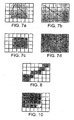
- FIGS 7a-d Other examples of triangles which do not cover the whole of the rectangular bounding box required to process them are shown in Figures 7a-d .
- the most extreme example of these is Figure 7d in which the triangle shown only in fact falls in the 12 tiles illustrated in Figure 8 . It will be preferable to process only this set of tiles in order to render that triangle.
- the calculation of the minimal set of tiles to represent a triangle begins with the crude rectangular bounding box calculation. If the bounding box is only a single tile in either height or width, there is clearly no further optimisation that can be performed. Otherwise the set will be reduced by consideration of each edge of the triangle in turn.
- An edge can then be considered to be an infinitely long line which divides the space into two halves.
- Sub-spaces on either side of the edge are described as being inside or outside the edge using the edge processors described above with the inside sub-space being the one that contains the triangle to which the edge belongs.
- the triangle has its corners at the intersections of the edge lines and the surface is the intersection of the inside sub-spaces of the three edges.
- any tile that lies entirely on the outside of an edge is not part of the minimal set because the triangle would not be visible in that tile. If an edge is entirely horizontal or vertical it need not be considered since all the tiles in the rectangular bounding box already lie wholly or partly inside the edge.
- the valuation of mx + c at the corner of a tile will give a value that is greater than, less than or equal to the y coordinate of that point.
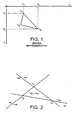
- the comparison of the two values will indicate whether the point lies on the inside or outside of the edge. The interpretation.of this result depends on the orientation of the edge as given in the table in Figure 9 .
- each tile in the rectangular bounding box must be processed in this way to decide whether or not it should be excluded from the minimal set.
- test point at the corner of a tile is also the test point for a larger rectangular set of tiles.
- knowing that the tile marked where the test point is outside an edge means that all the shaded tiles must also be outside that edge.
- the test point is at the bottom right, it is most efficient to process the tiles of the rectangular bounding box from right to left and from bottom to top, in all there is a large number of tiles may be excluded from the minimal set with the minimum number of tests.
- the order of processing would be changed accordingly.
Landscapes
- Engineering & Computer Science (AREA)
- Physics & Mathematics (AREA)
- General Physics & Mathematics (AREA)
- Theoretical Computer Science (AREA)
- Computer Graphics (AREA)
- Image Generation (AREA)
- Apparatus For Radiation Diagnosis (AREA)
- Image Analysis (AREA)
Priority Applications (1)
| Application Number | Priority Date | Filing Date | Title |
|---|---|---|---|
| DE69916646.2T DE69916646T3 (de) | 1998-11-06 | 1999-11-08 | Schattierung von 3-dimensionalen rechnererzeugten Bildern |
Applications Claiming Priority (3)
| Application Number | Priority Date | Filing Date | Title |
|---|---|---|---|
| GB9824414 | 1998-11-06 | ||
| GB9824414A GB2343603B (en) | 1998-11-06 | 1998-11-06 | Shading 3-dimensional computer generated images |
| PCT/GB1999/003707 WO2000028483A1 (en) | 1998-11-06 | 1999-11-08 | Shading 3-dimensional computer generated images |
Publications (3)
| Publication Number | Publication Date |
|---|---|
| EP1125253A1 EP1125253A1 (en) | 2001-08-22 |
| EP1125253B1 EP1125253B1 (en) | 2004-04-21 |
| EP1125253B2 true EP1125253B2 (en) | 2014-07-16 |
Family
ID=10842018
Family Applications (1)
| Application Number | Title | Priority Date | Filing Date |
|---|---|---|---|
| EP99954171.7A Expired - Lifetime EP1125253B2 (en) | 1998-11-06 | 1999-11-08 | Shading 3-dimensional computer generated images |
Country Status (7)
| Country | Link |
|---|---|
| US (1) | US6798410B1 (https=) |
| EP (1) | EP1125253B2 (https=) |
| JP (1) | JP4499292B2 (https=) |
| AT (1) | ATE265074T1 (https=) |
| DE (1) | DE69916646T3 (https=) |
| GB (1) | GB2343603B (https=) |
| WO (1) | WO2000028483A1 (https=) |
Families Citing this family (64)
| Publication number | Priority date | Publication date | Assignee | Title |
|---|---|---|---|---|
| EP1287494B1 (en) | 2000-06-08 | 2007-03-14 | Imagination Technologies Limited | Tiling and compression for rendering 3d images |
| US8692844B1 (en) | 2000-09-28 | 2014-04-08 | Nvidia Corporation | Method and system for efficient antialiased rendering |
| US7295200B2 (en) * | 2000-11-07 | 2007-11-13 | F. Poszat Hu, Llc | Computer generated hologram display system |
| JP4541533B2 (ja) * | 2000-11-24 | 2010-09-08 | パナソニック株式会社 | 描画装置 |
| GB2378108B (en) | 2001-07-24 | 2005-08-17 | Imagination Tech Ltd | Three dimensional graphics system |
| GB2416100B (en) | 2002-03-26 | 2006-04-12 | Imagination Tech Ltd | 3D computer graphics rendering system |
| GB0307095D0 (en) * | 2003-03-27 | 2003-04-30 | Imagination Tech Ltd | Improvements to a tiling system for 3d rendered graphics |
| US8775997B2 (en) | 2003-09-15 | 2014-07-08 | Nvidia Corporation | System and method for testing and configuring semiconductor functional circuits |
| US8768642B2 (en) | 2003-09-15 | 2014-07-01 | Nvidia Corporation | System and method for remotely configuring semiconductor functional circuits |
| US8732644B1 (en) | 2003-09-15 | 2014-05-20 | Nvidia Corporation | Micro electro mechanical switch system and method for testing and configuring semiconductor functional circuits |
| US8711161B1 (en) | 2003-12-18 | 2014-04-29 | Nvidia Corporation | Functional component compensation reconfiguration system and method |
| US7567248B1 (en) * | 2004-04-28 | 2009-07-28 | Mark William R | System and method for computing intersections between rays and surfaces |
| WO2005116930A1 (en) * | 2004-05-24 | 2005-12-08 | Koninklijke Philips Electronics N.V. | Tile based graphics rendering |
| US20050264554A1 (en) * | 2004-05-25 | 2005-12-01 | Deming James L | Tile based rendering of smooth points using polygons |
| US7505043B2 (en) * | 2004-08-30 | 2009-03-17 | Qualcomm Incorporated | Cache efficient rasterization of graphics data |
| US8723231B1 (en) | 2004-09-15 | 2014-05-13 | Nvidia Corporation | Semiconductor die micro electro-mechanical switch management system and method |
| US8711156B1 (en) | 2004-09-30 | 2014-04-29 | Nvidia Corporation | Method and system for remapping processing elements in a pipeline of a graphics processing unit |
| US20060187229A1 (en) * | 2004-12-08 | 2006-08-24 | Xgi Technology Inc. (Cayman) | Page based rendering in 3D graphics system |
| JP4566772B2 (ja) * | 2005-02-14 | 2010-10-20 | キヤノン株式会社 | 画像処理装置、画像処理方法、及びプログラム |
| JP4283785B2 (ja) * | 2005-05-10 | 2009-06-24 | 株式会社マーキュリーシステム | 立体視画像生成装置およびプログラム |
| US8427496B1 (en) | 2005-05-13 | 2013-04-23 | Nvidia Corporation | Method and system for implementing compression across a graphics bus interconnect |
| GB0524804D0 (en) | 2005-12-05 | 2006-01-11 | Falanx Microsystems As | Method of and apparatus for processing graphics |
| US20080273031A1 (en) * | 2005-12-08 | 2008-11-06 | Xgi Technology Inc. (Cayman) | Page based rendering in 3D graphics system |
| US8698811B1 (en) | 2005-12-15 | 2014-04-15 | Nvidia Corporation | Nested boustrophedonic patterns for rasterization |
| US8390645B1 (en) | 2005-12-19 | 2013-03-05 | Nvidia Corporation | Method and system for rendering connecting antialiased line segments |
| US9117309B1 (en) | 2005-12-19 | 2015-08-25 | Nvidia Corporation | Method and system for rendering polygons with a bounding box in a graphics processor unit |
| US8928676B2 (en) * | 2006-06-23 | 2015-01-06 | Nvidia Corporation | Method for parallel fine rasterization in a raster stage of a graphics pipeline |
| US8477134B1 (en) | 2006-06-30 | 2013-07-02 | Nvidia Corporation | Conservative triage of polygon status using low precision edge evaluation and high precision edge evaluation |
| KR100762811B1 (ko) * | 2006-07-20 | 2007-10-02 | 삼성전자주식회사 | 하프 플레인 에지 함수를 이용한 타일 비닝 방법 및 시스템 |
| US7843468B2 (en) * | 2006-07-26 | 2010-11-30 | Nvidia Corporation | Accellerated start tile search |
| GB2442266B (en) | 2006-09-29 | 2008-10-22 | Imagination Tech Ltd | Improvements in memory management for systems for generating 3-dimensional computer images |
| US8427487B1 (en) | 2006-11-02 | 2013-04-23 | Nvidia Corporation | Multiple tile output using interface compression in a raster stage |
| US8482567B1 (en) | 2006-11-03 | 2013-07-09 | Nvidia Corporation | Line rasterization techniques |
| US9965886B2 (en) | 2006-12-04 | 2018-05-08 | Arm Norway As | Method of and apparatus for processing graphics |
| GB2461821B (en) | 2007-09-12 | 2010-06-30 | Imagination Tech Ltd | Methods and systems for generating 3-dimensional computer images |
| US8724483B2 (en) | 2007-10-22 | 2014-05-13 | Nvidia Corporation | Loopback configuration for bi-directional interfaces |
| US8063903B2 (en) * | 2007-11-09 | 2011-11-22 | Nvidia Corporation | Edge evaluation techniques for graphics hardware |
| GB0723536D0 (en) * | 2007-11-30 | 2008-01-09 | Imagination Tech Ltd | Multi-core geometry processing in a tile based rendering system |
| US8059119B2 (en) * | 2007-12-05 | 2011-11-15 | Stmicroelectronics S.R.L. | Method for detecting border tiles or border pixels of a primitive for tile-based rendering |
| US8780123B2 (en) | 2007-12-17 | 2014-07-15 | Nvidia Corporation | Interrupt handling techniques in the rasterizer of a GPU |
| US9064333B2 (en) | 2007-12-17 | 2015-06-23 | Nvidia Corporation | Interrupt handling techniques in the rasterizer of a GPU |
| US8681861B2 (en) | 2008-05-01 | 2014-03-25 | Nvidia Corporation | Multistandard hardware video encoder |
| US8923385B2 (en) | 2008-05-01 | 2014-12-30 | Nvidia Corporation | Rewind-enabled hardware encoder |
| GB0823254D0 (en) * | 2008-12-19 | 2009-01-28 | Imagination Tech Ltd | Multi level display control list in tile based 3D computer graphics system |
| GB0823468D0 (en) | 2008-12-23 | 2009-01-28 | Imagination Tech Ltd | Display list control stream grouping in tile based 3D computer graphics systems |
| GB0900700D0 (en) | 2009-01-15 | 2009-03-04 | Advanced Risc Mach Ltd | Methods of and apparatus for processing graphics |
| US20110063305A1 (en) | 2009-09-16 | 2011-03-17 | Nvidia Corporation | Co-processing techniques on heterogeneous graphics processing units |
| US9530189B2 (en) | 2009-12-31 | 2016-12-27 | Nvidia Corporation | Alternate reduction ratios and threshold mechanisms for framebuffer compression |
| US9331869B2 (en) | 2010-03-04 | 2016-05-03 | Nvidia Corporation | Input/output request packet handling techniques by a device specific kernel mode driver |
| US9058685B2 (en) * | 2010-03-11 | 2015-06-16 | Broadcom Corporation | Method and system for controlling a 3D processor using a control list in memory |
| GB201004675D0 (en) | 2010-03-19 | 2010-05-05 | Imagination Tech Ltd | Memory management system |
| US9171350B2 (en) | 2010-10-28 | 2015-10-27 | Nvidia Corporation | Adaptive resolution DGPU rendering to provide constant framerate with free IGPU scale up |
| US9317948B2 (en) | 2012-11-16 | 2016-04-19 | Arm Limited | Method of and apparatus for processing graphics |
| US9591309B2 (en) | 2012-12-31 | 2017-03-07 | Nvidia Corporation | Progressive lossy memory compression |
| US9607407B2 (en) | 2012-12-31 | 2017-03-28 | Nvidia Corporation | Variable-width differential memory compression |
| GB2506706B (en) | 2013-04-02 | 2014-09-03 | Imagination Tech Ltd | Tile-based graphics |
| US9710894B2 (en) | 2013-06-04 | 2017-07-18 | Nvidia Corporation | System and method for enhanced multi-sample anti-aliasing |
| US10204391B2 (en) | 2013-06-04 | 2019-02-12 | Arm Limited | Method of and apparatus for processing graphics |
| US9659393B2 (en) | 2013-10-07 | 2017-05-23 | Intel Corporation | Selective rasterization |
| GB2526598B (en) * | 2014-05-29 | 2018-11-28 | Imagination Tech Ltd | Allocation of primitives to primitive blocks |
| US9832388B2 (en) | 2014-08-04 | 2017-11-28 | Nvidia Corporation | Deinterleaving interleaved high dynamic range image by using YUV interpolation |
| EP3070677B1 (en) | 2015-03-20 | 2021-07-28 | Samsung Electronics Co., Ltd. | Method and apparatus for tile-based rendering |
| GB2546810B (en) | 2016-02-01 | 2019-10-16 | Imagination Tech Ltd | Sparse rendering |
| GB2553744B (en) | 2016-04-29 | 2018-09-05 | Advanced Risc Mach Ltd | Graphics processing systems |
Citations (4)
| Publication number | Priority date | Publication date | Assignee | Title |
|---|---|---|---|---|
| WO1990006561A1 (en) † | 1988-12-05 | 1990-06-14 | Rediffusion Simulation Limited | Image generator |
| GB2251770A (en) † | 1991-01-09 | 1992-07-15 | Du Pont Pixel Systems | Graphics accelerator system using parallel processed pixel patches |
| WO1997006512A2 (en) † | 1995-08-04 | 1997-02-20 | Microsoft Corporation | Method and system for rendering graphical objects to image chunks and combining image layers into a display image |
| WO1998029838A1 (en) † | 1996-12-30 | 1998-07-09 | Cirrus Logic, Inc. | Tiled linear host texture storage |
Family Cites Families (9)
| Publication number | Priority date | Publication date | Assignee | Title |
|---|---|---|---|---|
| US4825391A (en) * | 1987-07-20 | 1989-04-25 | General Electric Company | Depth buffer priority processing for real time computer image generating systems |
| JPH04220782A (ja) * | 1990-12-20 | 1992-08-11 | Fujitsu Ltd | 三次元画像表示処理方法 |
| US5509110A (en) * | 1993-04-26 | 1996-04-16 | Loral Aerospace Corporation | Method for tree-structured hierarchical occlusion in image generators |
| GB2336983B (en) * | 1995-01-31 | 2000-01-19 | Videologic Ltd | Improvements relating to computer 3D rendering systems |
| US5886701A (en) * | 1995-08-04 | 1999-03-23 | Microsoft Corporation | Graphics rendering device and method for operating same |
| US5808617A (en) * | 1995-08-04 | 1998-09-15 | Microsoft Corporation | Method and system for depth complexity reduction in a graphics rendering system |
| US5990904A (en) * | 1995-08-04 | 1999-11-23 | Microsoft Corporation | Method and system for merging pixel fragments in a graphics rendering system |
| JPH1054581A (ja) * | 1996-08-12 | 1998-02-24 | Corona Corp | 空気調和機 |
| AU5580799A (en) * | 1998-08-20 | 2000-03-14 | Apple Computer, Inc. | Graphics processor with pipeline state storage and retrieval |
-
1998
- 1998-11-06 GB GB9824414A patent/GB2343603B/en not_active Expired - Lifetime
-
1999
- 1999-11-08 JP JP2000581598A patent/JP4499292B2/ja not_active Expired - Lifetime
- 1999-11-08 WO PCT/GB1999/003707 patent/WO2000028483A1/en not_active Ceased
- 1999-11-08 US US09/831,238 patent/US6798410B1/en not_active Expired - Lifetime
- 1999-11-08 EP EP99954171.7A patent/EP1125253B2/en not_active Expired - Lifetime
- 1999-11-08 AT AT99954171T patent/ATE265074T1/de not_active IP Right Cessation
- 1999-11-08 DE DE69916646.2T patent/DE69916646T3/de not_active Expired - Lifetime
Patent Citations (4)
| Publication number | Priority date | Publication date | Assignee | Title |
|---|---|---|---|---|
| WO1990006561A1 (en) † | 1988-12-05 | 1990-06-14 | Rediffusion Simulation Limited | Image generator |
| GB2251770A (en) † | 1991-01-09 | 1992-07-15 | Du Pont Pixel Systems | Graphics accelerator system using parallel processed pixel patches |
| WO1997006512A2 (en) † | 1995-08-04 | 1997-02-20 | Microsoft Corporation | Method and system for rendering graphical objects to image chunks and combining image layers into a display image |
| WO1998029838A1 (en) † | 1996-12-30 | 1998-07-09 | Cirrus Logic, Inc. | Tiled linear host texture storage |
Non-Patent Citations (4)
| Title |
|---|
| "Computer graphics", 1990, ADDISON-WESLEY, article FOLEY J.D, ET AL.: "Computer graphics second edition", pages: 668 - 672 † |
| COX M., BHANDARI N.: "Architectural implications of hardware-accelerated bucket rendering on the PC", PROC.OF THE SIGGRAPH/EUROGRAPHICS WORKSHOP ON GRAPHICSHARDWARE, 3 August 1997 (1997-08-03) - 4 August 1997 (1997-08-04), NEW YORK, NY, USA, pages 25 - 34 † |
| OLANO M., GREER T.: "Triangle scan conversion using 2D homogeneous coordinates", PROC.OF THE SIGGRAPH/EUROGRAPHICS WORKSHOP ON GRAPHICSHARDWARE, 3 August 1997 (1997-08-03) - 4 August 1997 (1997-08-04), NEW YORK, NY, USA, pages 89 - 95 † |
| PINEDA, J.: "A parallel algorithm fo polygon rasterization", PROC.OF SIGGRAPH'88, COMPUTER GRAPHICS, vol. 22, no. 4, 1 August 1988 (1988-08-01) - 5 August 1988 (1988-08-05), NEW YORK, NY, USA, pages 17 - 20 † |
Also Published As
| Publication number | Publication date |
|---|---|
| GB2343603A (en) | 2000-05-10 |
| ATE265074T1 (de) | 2004-05-15 |
| EP1125253B1 (en) | 2004-04-21 |
| DE69916646T2 (de) | 2005-03-03 |
| JP2002529871A (ja) | 2002-09-10 |
| EP1125253A1 (en) | 2001-08-22 |
| US6798410B1 (en) | 2004-09-28 |
| DE69916646T3 (de) | 2014-10-16 |
| GB9824414D0 (en) | 1998-12-30 |
| WO2000028483A1 (en) | 2000-05-18 |
| DE69916646D1 (de) | 2004-05-27 |
| GB2343603B (en) | 2003-04-02 |
| JP4499292B2 (ja) | 2010-07-07 |
Similar Documents
| Publication | Publication Date | Title |
|---|---|---|
| EP1125253B2 (en) | Shading 3-dimensional computer generated images | |
| EP1127337B2 (en) | Shading 3-dimensional computer generated images | |
| Sramek et al. | Fast ray-tracing of rectilinear volume data using distance transforms | |
| EP1081655B1 (en) | System and method for rendering using ray tracing | |
| Weiler et al. | Hidden surface removal using polygon area sorting | |
| US6552723B1 (en) | System, apparatus and method for spatially sorting image data in a three-dimensional graphics pipeline | |
| EP0610004B1 (en) | Image generating apparatus and method of generating an image | |
| JP4521167B2 (ja) | グラフィックオブジェクトを画像チャンクにレンダリングして、画像層を表示画像に組み合わせる方法及びシステム | |
| US6762756B2 (en) | Graphics processor, system and method for generating screen pixels in raster order utilizing a single interpolator | |
| US6323874B1 (en) | System and method for rendering an image | |
| US7167171B2 (en) | Methods and apparatuses for a polygon binning process for rendering | |
| US6433782B1 (en) | Data processor apparatus and shading apparatus | |
| US5701405A (en) | Method and apparatus for directly evaluating a parameter interpolation function used in rendering images in a graphics system that uses screen partitioning | |
| JPH05114032A (ja) | 3次元グラフイツクスにおけるシヤドウ・テスト方法 | |
| EP1125252B1 (en) | Shading and texturing 3-dimensional computer generated images | |
| Van Gelder et al. | Rapid exploration of curvilinear grids using direct volume rendering | |
| WO2002001501A2 (en) | Ray-tracing method and system for determining visible parts of surfaces | |
| US5402533A (en) | Method and apparatus for approximating a signed value between two endpoint values in a three-dimensional image rendering device | |
| Weiler et al. | Hardware-software-balanced resampling for the interactive visualization of unstructured grids | |
| US5706479A (en) | Method and apparatus for dynamically detecting overflow of a multi-layer buffer | |
| US5926183A (en) | Efficient rendering utilizing user defined rooms and windows | |
| US7372466B2 (en) | Image processing apparatus and method of same | |
| US6795072B1 (en) | Method and system for rendering macropixels in a graphical image | |
| JPH09305791A (ja) | 立体画像生成装置および立体画像生成方法 | |
| Bruijns | Quadratic Bezier triangles as drawing primitives |
Legal Events
| Date | Code | Title | Description |
|---|---|---|---|
| PUAI | Public reference made under article 153(3) epc to a published international application that has entered the european phase |
Free format text: ORIGINAL CODE: 0009012 |
|
| 17P | Request for examination filed |
Effective date: 20010504 |
|
| AK | Designated contracting states |
Kind code of ref document: A1 Designated state(s): AT BE CH CY DE DK ES FI FR GB GR IE IT LI LU MC NL PT SE |
|
| 17Q | First examination report despatched |
Effective date: 20020117 |
|
| GRAP | Despatch of communication of intention to grant a patent |
Free format text: ORIGINAL CODE: EPIDOSNIGR1 |
|
| GRAS | Grant fee paid |
Free format text: ORIGINAL CODE: EPIDOSNIGR3 |
|
| GRAA | (expected) grant |
Free format text: ORIGINAL CODE: 0009210 |
|
| AK | Designated contracting states |
Kind code of ref document: B1 Designated state(s): AT BE CH CY DE DK ES FI FR GR IE IT LI LU MC NL PT SE |
|
| PG25 | Lapsed in a contracting state [announced via postgrant information from national office to epo] |
Ref country code: NL Free format text: LAPSE BECAUSE OF FAILURE TO SUBMIT A TRANSLATION OF THE DESCRIPTION OR TO PAY THE FEE WITHIN THE PRESCRIBED TIME-LIMIT Effective date: 20040421 Ref country code: LI Free format text: LAPSE BECAUSE OF FAILURE TO SUBMIT A TRANSLATION OF THE DESCRIPTION OR TO PAY THE FEE WITHIN THE PRESCRIBED TIME-LIMIT Effective date: 20040421 Ref country code: IT Free format text: LAPSE BECAUSE OF FAILURE TO SUBMIT A TRANSLATION OF THE DESCRIPTION OR TO PAY THE FEE WITHIN THE PRESCRIBED TIME-LIMIT;WARNING: LAPSES OF ITALIAN PATENTS WITH EFFECTIVE DATE BEFORE 2007 MAY HAVE OCCURRED AT ANY TIME BEFORE 2007. THE CORRECT EFFECTIVE DATE MAY BE DIFFERENT FROM THE ONE RECORDED. Effective date: 20040421 Ref country code: FI Free format text: LAPSE BECAUSE OF FAILURE TO SUBMIT A TRANSLATION OF THE DESCRIPTION OR TO PAY THE FEE WITHIN THE PRESCRIBED TIME-LIMIT Effective date: 20040421 Ref country code: CY Free format text: LAPSE BECAUSE OF FAILURE TO SUBMIT A TRANSLATION OF THE DESCRIPTION OR TO PAY THE FEE WITHIN THE PRESCRIBED TIME-LIMIT Effective date: 20040421 Ref country code: CH Free format text: LAPSE BECAUSE OF FAILURE TO SUBMIT A TRANSLATION OF THE DESCRIPTION OR TO PAY THE FEE WITHIN THE PRESCRIBED TIME-LIMIT Effective date: 20040421 Ref country code: BE Free format text: LAPSE BECAUSE OF FAILURE TO SUBMIT A TRANSLATION OF THE DESCRIPTION OR TO PAY THE FEE WITHIN THE PRESCRIBED TIME-LIMIT Effective date: 20040421 Ref country code: AT Free format text: LAPSE BECAUSE OF FAILURE TO SUBMIT A TRANSLATION OF THE DESCRIPTION OR TO PAY THE FEE WITHIN THE PRESCRIBED TIME-LIMIT Effective date: 20040421 |
|
| REG | Reference to a national code |
Ref country code: CH Ref legal event code: EP |
|
| REG | Reference to a national code |
Ref country code: IE Ref legal event code: FG4D |
|
| REF | Corresponds to: |
Ref document number: 69916646 Country of ref document: DE Date of ref document: 20040527 Kind code of ref document: P |
|
| PG25 | Lapsed in a contracting state [announced via postgrant information from national office to epo] |
Ref country code: SE Free format text: LAPSE BECAUSE OF FAILURE TO SUBMIT A TRANSLATION OF THE DESCRIPTION OR TO PAY THE FEE WITHIN THE PRESCRIBED TIME-LIMIT Effective date: 20040721 Ref country code: GR Free format text: LAPSE BECAUSE OF FAILURE TO SUBMIT A TRANSLATION OF THE DESCRIPTION OR TO PAY THE FEE WITHIN THE PRESCRIBED TIME-LIMIT Effective date: 20040721 Ref country code: DK Free format text: LAPSE BECAUSE OF FAILURE TO SUBMIT A TRANSLATION OF THE DESCRIPTION OR TO PAY THE FEE WITHIN THE PRESCRIBED TIME-LIMIT Effective date: 20040721 |
|
| PG25 | Lapsed in a contracting state [announced via postgrant information from national office to epo] |
Ref country code: ES Free format text: LAPSE BECAUSE OF FAILURE TO SUBMIT A TRANSLATION OF THE DESCRIPTION OR TO PAY THE FEE WITHIN THE PRESCRIBED TIME-LIMIT Effective date: 20040801 |
|
| NLV1 | Nl: lapsed or annulled due to failure to fulfill the requirements of art. 29p and 29m of the patents act | ||
| PGFP | Annual fee paid to national office [announced via postgrant information from national office to epo] |
Ref country code: MC Payment date: 20041027 Year of fee payment: 6 |
|
| REG | Reference to a national code |
Ref country code: CH Ref legal event code: PL |
|
| PGFP | Annual fee paid to national office [announced via postgrant information from national office to epo] |
Ref country code: IE Payment date: 20041111 Year of fee payment: 6 |
|
| PGFP | Annual fee paid to national office [announced via postgrant information from national office to epo] |
Ref country code: LU Payment date: 20041116 Year of fee payment: 6 |
|
| PG25 | Lapsed in a contracting state [announced via postgrant information from national office to epo] |
Ref country code: LU Free format text: LAPSE BECAUSE OF NON-PAYMENT OF DUE FEES Effective date: 20041130 |
|
| ET | Fr: translation filed | ||
| PLBI | Opposition filed |
Free format text: ORIGINAL CODE: 0009260 |
|
| PLBQ | Unpublished change to opponent data |
Free format text: ORIGINAL CODE: EPIDOS OPPO |
|
| PLAX | Notice of opposition and request to file observation + time limit sent |
Free format text: ORIGINAL CODE: EPIDOSNOBS2 |
|
| 26 | Opposition filed |
Opponent name: FALANX MICROSYSTEMS AS Effective date: 20050118 |
|
| PLAF | Information modified related to communication of a notice of opposition and request to file observations + time limit |
Free format text: ORIGINAL CODE: EPIDOSCOBS2 |
|
| PLAF | Information modified related to communication of a notice of opposition and request to file observations + time limit |
Free format text: ORIGINAL CODE: EPIDOSCOBS2 |
|
| PG25 | Lapsed in a contracting state [announced via postgrant information from national office to epo] |
Ref country code: IE Free format text: LAPSE BECAUSE OF NON-PAYMENT OF DUE FEES Effective date: 20051108 |
|
| PLBB | Reply of patent proprietor to notice(s) of opposition received |
Free format text: ORIGINAL CODE: EPIDOSNOBS3 |
|
| PG25 | Lapsed in a contracting state [announced via postgrant information from national office to epo] |
Ref country code: MC Free format text: LAPSE BECAUSE OF NON-PAYMENT OF DUE FEES Effective date: 20051130 |
|
| REG | Reference to a national code |
Ref country code: IE Ref legal event code: MM4A |
|
| PG25 | Lapsed in a contracting state [announced via postgrant information from national office to epo] |
Ref country code: PT Free format text: LAPSE BECAUSE OF NON-PAYMENT OF DUE FEES Effective date: 20040921 |
|
| PLAB | Opposition data, opponent's data or that of the opponent's representative modified |
Free format text: ORIGINAL CODE: 0009299OPPO |
|
| R26 | Opposition filed (corrected) |
Opponent name: ARM NORWAY AS Effective date: 20050118 |
|
| APBM | Appeal reference recorded |
Free format text: ORIGINAL CODE: EPIDOSNREFNO |
|
| APBP | Date of receipt of notice of appeal recorded |
Free format text: ORIGINAL CODE: EPIDOSNNOA2O |
|
| APAH | Appeal reference modified |
Free format text: ORIGINAL CODE: EPIDOSCREFNO |
|
| APBQ | Date of receipt of statement of grounds of appeal recorded |
Free format text: ORIGINAL CODE: EPIDOSNNOA3O |
|
| APBU | Appeal procedure closed |
Free format text: ORIGINAL CODE: EPIDOSNNOA9O |
|
| RIC2 | Information provided on ipc code assigned after grant |
Ipc: G06T 11/40 20060101AFI20140217BHEP |
|
| PUAH | Patent maintained in amended form |
Free format text: ORIGINAL CODE: 0009272 |
|
| STAA | Information on the status of an ep patent application or granted ep patent |
Free format text: STATUS: PATENT MAINTAINED AS AMENDED |
|
| 27A | Patent maintained in amended form |
Effective date: 20140716 |
|
| AK | Designated contracting states |
Kind code of ref document: B2 Designated state(s): AT BE CH CY DE DK ES FI FR GR IE IT LI LU MC NL PT SE |
|
| REG | Reference to a national code |
Ref country code: DE Ref legal event code: R102 Ref document number: 69916646 Country of ref document: DE |
|
| REG | Reference to a national code |
Ref country code: DE Ref legal event code: R102 Ref document number: 69916646 Country of ref document: DE Effective date: 20140716 |
|
| REG | Reference to a national code |
Ref country code: FR Ref legal event code: PLFP Year of fee payment: 17 |
|
| REG | Reference to a national code |
Ref country code: FR Ref legal event code: PLFP Year of fee payment: 18 |
|
| REG | Reference to a national code |
Ref country code: FR Ref legal event code: PLFP Year of fee payment: 19 |
|
| PGFP | Annual fee paid to national office [announced via postgrant information from national office to epo] |
Ref country code: DE Payment date: 20181120 Year of fee payment: 20 |
|
| PGFP | Annual fee paid to national office [announced via postgrant information from national office to epo] |
Ref country code: FR Payment date: 20181123 Year of fee payment: 20 |
|
| REG | Reference to a national code |
Ref country code: DE Ref legal event code: R071 Ref document number: 69916646 Country of ref document: DE |