EP1125245B1 - Image description system and method - Google Patents
Image description system and method Download PDFInfo
- Publication number
- EP1125245B1 EP1125245B1 EP99971950A EP99971950A EP1125245B1 EP 1125245 B1 EP1125245 B1 EP 1125245B1 EP 99971950 A EP99971950 A EP 99971950A EP 99971950 A EP99971950 A EP 99971950A EP 1125245 B1 EP1125245 B1 EP 1125245B1
- Authority
- EP
- European Patent Office
- Prior art keywords
- image
- descriptions
- image object
- relationships
- description
- Prior art date
- Legal status (The legal status is an assumption and is not a legal conclusion. Google has not performed a legal analysis and makes no representation as to the accuracy of the status listed.)
- Expired - Lifetime
Links
Images




Classifications
-
- G—PHYSICS
- G06—COMPUTING OR CALCULATING; COUNTING
- G06F—ELECTRIC DIGITAL DATA PROCESSING
- G06F16/00—Information retrieval; Database structures therefor; File system structures therefor
- G06F16/90—Details of database functions independent of the retrieved data types
- G06F16/93—Document management systems
-
- G—PHYSICS
- G06—COMPUTING OR CALCULATING; COUNTING
- G06F—ELECTRIC DIGITAL DATA PROCESSING
- G06F16/00—Information retrieval; Database structures therefor; File system structures therefor
- G06F16/50—Information retrieval; Database structures therefor; File system structures therefor of still image data
- G06F16/51—Indexing; Data structures therefor; Storage structures
-
- G—PHYSICS
- G06—COMPUTING OR CALCULATING; COUNTING
- G06F—ELECTRIC DIGITAL DATA PROCESSING
- G06F16/00—Information retrieval; Database structures therefor; File system structures therefor
- G06F16/70—Information retrieval; Database structures therefor; File system structures therefor of video data
- G06F16/71—Indexing; Data structures therefor; Storage structures
-
- G—PHYSICS
- G06—COMPUTING OR CALCULATING; COUNTING
- G06F—ELECTRIC DIGITAL DATA PROCESSING
- G06F16/00—Information retrieval; Database structures therefor; File system structures therefor
- G06F16/70—Information retrieval; Database structures therefor; File system structures therefor of video data
- G06F16/78—Retrieval characterised by using metadata, e.g. metadata not derived from the content or metadata generated manually
- G06F16/783—Retrieval characterised by using metadata, e.g. metadata not derived from the content or metadata generated manually using metadata automatically derived from the content
- G06F16/7837—Retrieval characterised by using metadata, e.g. metadata not derived from the content or metadata generated manually using metadata automatically derived from the content using objects detected or recognised in the video content
-
- G—PHYSICS
- G06—COMPUTING OR CALCULATING; COUNTING
- G06F—ELECTRIC DIGITAL DATA PROCESSING
- G06F16/00—Information retrieval; Database structures therefor; File system structures therefor
- G06F16/70—Information retrieval; Database structures therefor; File system structures therefor of video data
- G06F16/78—Retrieval characterised by using metadata, e.g. metadata not derived from the content or metadata generated manually
- G06F16/783—Retrieval characterised by using metadata, e.g. metadata not derived from the content or metadata generated manually using metadata automatically derived from the content
- G06F16/7844—Retrieval characterised by using metadata, e.g. metadata not derived from the content or metadata generated manually using metadata automatically derived from the content using original textual content or text extracted from visual content or transcript of audio data
-
- G—PHYSICS
- G06—COMPUTING OR CALCULATING; COUNTING
- G06V—IMAGE OR VIDEO RECOGNITION OR UNDERSTANDING
- G06V10/00—Arrangements for image or video recognition or understanding
- G06V10/40—Extraction of image or video features
-
- G—PHYSICS
- G06—COMPUTING OR CALCULATING; COUNTING
- G06V—IMAGE OR VIDEO RECOGNITION OR UNDERSTANDING
- G06V20/00—Scenes; Scene-specific elements
- G06V20/30—Scenes; Scene-specific elements in albums, collections or shared content, e.g. social network photos or video
Definitions
- the present invention relates to techniques for describing multimedia information, and more specifically, to techniques which describe image information and the content of such information.
- multimedia content is not true for multimedia content, as no generally recognized description of this material exists.
- multimedia databases which permit users to search for pictures using characteristics such as color, texture and shape information of video objects embedded in the picture.
- characteristics such as color, texture and shape information of video objects embedded in the picture.
- the need to search for multimedia content is not limited to databases, but extends to other applications, such as digital broadcast television and multimedia telephony.
- MPEG-7 Motion Pictures Expert Group's
- the MPEG-7 standard has the objective of specifying a standard set of descriptors as well as structures (referred to as "description schemes") for the descriptors and their relationships to describe various types of multimedia information.
- MPEG-7 also proposes to standardize ways to define other descriptors as well as “description schemes” for the descriptors and their relationships. This description, i.e. the combination of descriptors and description schemes, shall be associated with the content itself, to allow fast and efficient searching and filtering for material of a user's interest.
- MPEG-7 also proposes to standardize a language to specify description schemes, i.e. a Description Definition Language ("DDL”), and the schemes for binary encoding the descriptions of multimedia content.
- DDL Description Definition Language
- MPEG is soliciting proposals for techniques which will optimally implement the necessary description schemes for future integration into the MPEG-7 standard.
- three different multimedia-application arrangements can be considered. These are the distributed processing scenario, the content-exchange scenario, and the format which permits the personalized viewing of multimedia content.
- a description scheme must provide the ability to interchange descriptions of multimedia material independently of any platform, any vendor, and any application, which will enable the distributed processing of multimedia content.
- the standardization of interoperable content descriptions will mean that data from a variety of sources can be plugged into a variety of distributed applications, such as multimedia processors, editors, retrieval systems, filtering agents, etc. Some of these applications may be provided by third parties, generating a sub-industry of providers of multimedia tools that can work with the standardized descriptions of the multimedia data.
- a user should be permitted to access various content providers' web sites to download content and associated indexing data, obtained by some low-level or high-level processing, and proceed to access several tool providers' web sites to download tools (e.g. Java applets) to manipulate the heterogeneous data descriptions in particular ways, according to the user's personal interests.
- An example of such a multimedia tool will be a video editor.
- a MPEG-7 compliant video editor will be able to manipulate and process video content from a variety of sources if the description associated with each video is MPEG-7 compliant.
- Each video may come with varying degrees of description detail, such as camera motion, scene cuts, annotations, and object segmentations.
- a second scenario that will greatly benefit from an interoperable content-description standard is the exchange of multimedia content among heterogeneous multimedia databases.
- MPEG-7 aims to provide the means to express, exchange, translate, and reuse existing descriptions of multimedia material.
- multimedia players and viewers that employ the description schemes must provide the users with innovative capabilities such as multiple views of the data configured by the user.
- the user should be able to change the display's configuration without requiring the data to be downloaded again in a different format from the content broadcaster.
- the present invention constitutes a description scheme (DS) for images, wherein simple but powerful structures representing generic image data are utilized.
- DS description scheme
- the description scheme of the present invention can be used with any type of standard which describes image content
- a preferred embodiment of the invention is used with the MPEG-7 standard.
- DDL Description Definition Language
- a preferred embodiment utilizes the extensible Markup Language (XML), which is a streamlined subset of SGML (Standard Generalized Markup Language, ISO 8879) developed specifically for World Wide Web applications.
- SGML allows documents to be self-describing, in the sense that they describe their own grammar by specifying the tag set used in the document and the structural relationships that those tags represent.
- XML retains the key SGML advantages in a language that is designed to be vastly easier to learn, use, and implement than full SGML.
- a complete description of XML can be found at the World Wide Web Consortium's web page on XML, at http:llwww.w3.org/XML/ .
- the primary components of a characterization of an image using the description scheme of the present invention are objects, feature classifications, object hierarchies, entity-relation graphs, multiple levels of abstraction, code downloading, and modality transcoding, all of which will be described in additional detail below.
- an image document is represented by a set of objects and relationships among objects.
- Each object may have one or more associated features, which are generally grouped into the following categories: media features, visual features, and semantic features.
- Each feature can include descriptors that can facilitate code downloading by pointing to external extraction and similarity matching code. Relationships among objects can be described by object hierarchies and entity-relation graphs.
- Object hierarchies can also include the concept of multiple levels of abstraction.
- Modality transcoding allows user terminals having different capabilities (such as palmpilots, cellular telephones, or different types of personal computers (PC's), for example) to receive the same image content in different resolutions and/or different modalities.
- a preferred embodiment of the image description system of the present invention is used with the MPEG-7 standard.
- this preferred embodiment uses objects as the fundamental entity in describing various levels of image content, which can be defined along different dimensions.
- objects can be used to describe image regions or groups of image regions.
- High-level objects can in turn be used to describe groups of primitive objects based on semantics or visual features.
- different types of features can be used in connection with different levels of objects. For instance, visual features can be applied to objects corresponding to physical components in the image content, whereas semantic features can be applied to any level of object.
- the image description system of the present invention provides flexibility, extensibility, scalability and convenience of use.
- the present invention allows portions of the image description system to be instantiated, uses efficient categorization of features and clustering of objects by way of a clustering hierarchy, and also supports efficient linking, embedding and downloading of external feature descriptors and execution code.
- the present invention also provides extensibility by permitting elements defined in the description scheme to be used to derive new elements for different domains.
- Scalability is provided by the present invention's capability to define multiple abstraction levels based on any arbitrary set of criteria using object hierarchies. These criteria can be specified in terms of visual features (size and color, for example), semantic relevance (relevance to user interest profile, for example) and/or service quality (media features, for example).
- the present invention is convenient to use because it specifies a minimal set of components: namely, objects, feature classes, object hierarchies, and entity-relation graphs. Additional objects and features can be added in a modular and flexible way. In addition, different types of object hierarchies and entity-relation graphs can each be defined in a similar fashion.
- an image is represented as a set of image objects, which are related to one another by object hierarchies and entity-relation graphs. These objects can have multiple features which can be linked to external extraction and similarity matching code. These features are categorized into media, visual, and semantic features, for example.
- Image objects can be organized in multiple different object hierarchies. Non-hierarchical relationships among two or more objects can be described using one or more different entity-relation graphs. For objects contained in large images, multiple levels of abstraction in clustering and viewing such objects can be implemented using object hierarchies. These multiple levels of abstraction in clustering and viewing such images can be based on media, visual, and/or semantic features, for example.
- One example of a media feature includes modality transcoding, which permits users having different terminal specifications to access the same image content in satisfactory modalities and resolutions.
- Figs. 1A, 1B and 1C depict an exemplary description of an exemplary image in accordance with the image description system of the present invention.
- Fig. 1A depicts an exemplary set of image objects and exemplary corresponding object features for those objects. More specifically, Fig. 1A depicts image object 1 (i.e., O1) 2 ("Person A"), 02 6 ("Person B") and 03 4 ("People") contained in 00 8 (i.e., the overall exemplary photograph), as well as exemplary features 10 for the exemplary photograph depicted.
- Fig. 1 B depicts an exemplary spatial object hierarchy for the image objects depicted in Fig.
- Fig. 1A depicts an exemplary entity-relation (E-R) graph for the image objects depicted in Fig. 1A , wherein O1 2 ("Person A”) is characterized as being located to the left of, and shaking hands with, 02 6 ("Person B").
- E-R entity-relation
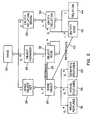
- Fig. 2 depicts an exemplary graphical representation of the image description system of the present invention, utilizing the conventional Unified Modeling Language (UML) format and notation.
- UML Unified Modeling Language
- the diamond-shaped symbols depicted in Fig. 2 represent the composition relationship.
- the range associated with each element represents the frequency in that composition relationship.
- the nomenclature "0...*” denotes "greater than or equal to 0;” the nomenclature “1...*” denotes "greater than or equal to 1.”
- an image element 22 which represents an image description, includes an image object set element 24 ( ⁇ image_object_set>), and may also include one or more object hierarchy elements 26 ( ⁇ object_hierarchy>) and one or more entity-relation graphs 28 ( ⁇ entity_relation_graph>).
- Each image object set element 24 includes one or more image object elements 30.
- Each image object element 30 may include one or more features, such as media feature elements 36, visual feature elements 38 and/or semantic feature elements 40.
- Each object hierarchy element 26 contains an object node element 32, each of which may in turn contain one or more additional object node elements 32.
- Each entity-relation graph 28 contains one or more entity relation elements 34.
- Each entity relation element 34 in turn contains a relation element 44, and may also contain one or more entity node elements 42.
- An object hierarchy element 26 is a special case of an entity-relation graph 28, wherein the entities are related by containment relationships.
- the preferred embodiment of the image description system of the present invention includes object hierarchy elements 26 in addition to entity relationship graphs 28, because an object hierarchy element 26 is a more efficient structure for retrieval than is an entity relationship graph 28.
- an object hierarchy element 26 is the most natural way of defining composite objects, and MPEG-4 objects are constructed using hierarchical structures.
- the image description system of the present invention separates the definition of the objects from the structures that describe relationships among the objects.
- the same object may appear in different object hierarchies 26 and entity-relation graphs 28. This avoids the undesirable duplication of features for objects that appear in more than one object hierarchy 26 and/or entity-relation graph 28.
- an object can be defined without the need for it to be included in any relational structure, such as an object hierarchy 26 or entity-relation graph 28, so that the extraction of objects and relations among objects can be performed at different stages, thereby permitting distributed processing of the image content.
- an image object 30 refers to one or more arbitrary regions of an image, and therefore can be either continuous or discontinuous in space.
- O1 2 ("Person A")
- 02 6 ("Person B")
- 00 8 i.e., the photograph
- 03 4 is an example of an object composed of multiple regions separated from one another in space.
- a global object contains features that are common to an entire image, whereas a local object contains only features of a particular section of that image.
- 00 8 is a global object representing the entire image depicted
- O1 2, 02 4 and 03 4 are each local objects representing a person or persons contained within the overall image.
- visual objects which are objects defined by visual features such as color or texture; media objects; semantic objects; and objects defined by a combination of semantic, visual, and media features.
- visual objects which are objects defined by visual features such as color or texture
- media objects semantic objects
- objects defined by a combination of semantic, visual, and media features an object's type is determined by the features used to describe that object.
- new types of objects can be added as necessary.
- different types of objects may be derived from these generic objects by utilizing inheritance relationships, which are supported by the MPEG-7 standard.
- the set of all image object elements 30 ( ⁇ image_object>) described in an image is contained within the image object set element 24 ( ⁇ image_object_set>).
- Each image object element 30 can have a unique identifier within an image description.
- the identifier and the object type (e.g., local or global) are expressed as attributes of the object element ID and type, respectively.
- An exemplary implementation of an exemplary set of objects to describe the image depicted in Figs. 1A, 1B and 1C is shown below listed in XML. In all XML listings shown below, the text appearing between the characters " ⁇ !-" and "-->" denotes comments to the XML code:
- image objects 30 may for example contain three feature class elements that group features together according to the information conveyed by those features.
- feature class elements include media features 36 ( ⁇ img_pbj_media_features>), visual features 38 ( ⁇ img_obj_visual_features>), and semantic features 40 ( ⁇ img_obj_media features>).
- Table 1 below denotes an exemplary list of features for each of these feature classes.
- Each feature element contained in the feature classes in an image object element 30 will include descriptors in accordance with the MPEG-7 standard.
- Table 2 below denotes exemplary descriptors that may be associated with certain of the exemplary visual features denoted in Table 1. Specific descriptors such as those denoted in Table 2 may also contain links to external extraction and similarity matching code.
- Tables 1 and 2 denote exemplary features and descriptors, the image description system of the present invention may include, in an extensible and modular fashion, any number of features and descriptors for each object.
- Table 2 Exemplary Visual Features and Associated Descriptors.
- the XML example shown below denotes an example of how features and descriptors can be defined to be included in an image object 30.
- the below example defines the exemplary features 10 associated with the global object O0 depicted in Figs. 1A, 1B and 1C , namely, two semantic features ("where" and "when"), one media feature ("file format”), and one visual feature ("color” with a "color histogram” descriptor).
- An object can be described by different concepts ( ⁇ concept>) in each of the semantic categories as shown in the example below.
- the object hierarchy element 26 can be used to organize the image objects 30 in the image object set 24, based on different criteria such as media features 36, visual features 38, semantic features 40, or any combinations thereof.
- Each object hierarchy element 26 constitutes a tree of object nodes 32 which reference image object elements 30 in the image object set 24 via link 33.
- An object hierarchy 26 involves a containment relation from one or more child nodes to a parent node.
- This containment relation may be of numerous different types, depending on the particular object features being utilized, such as media features 36, visual features 38 and/or semantic features 40, for example.
- the spatial object hierarchy depicted in Fig. 1B describes a visual containment, because it is created in connection with a visual feature, namely spatial position.
- Figs. 3A and 3B depict two additional exemplary object hierarchies. Specifically, Fig. 3A depicts an exemplary hierarchy for the image objects depicted in Fig. 1A , based on the "who" semantic feature as denoted in Table 1.
- Fig. 3A depicts an exemplary hierarchy for the image objects depicted in Fig. 1A , based on the "who" semantic feature as denoted in Table 1.
- Fig. 3A 03 4 ("People") is shown to contain O1 2 ("Person A") and 02 6 ("Person B”).
- Fig. 3B depicts an exemplary hierarchy based on exemplary color and shape visual features such as those denoted in Table 1.
- 07 46 could for example be defined to be the corresponding region of an object satisfying certain specified color and shape constraints.
- Fig. 3B depicts 07 46 ("Skin Tone & Shape") as containing 04 48 (“Face Region 1") and 06 50 (“Face Region 2").
- Object hierarchies 26 combining different features can also be constructed to satisfy the requirements of a broad range of application systems.
- each object hierarchy element 26 contains a tree of object nodes (ONs) 32.
- the object hierarchies also may include optional string attribute types. If such string attribute types are present, a thesaurus can provide the values of these string attribute types so that applications can determine the types of hierarchies which exist.
- Every object node 32 ( ⁇ objec_node>) references an image object 30 in the image object set 24 via link 33.
- Image objects 30 also can reference back to the object nodes 32 referencing them via link 33. This bi-directional linking mechanism permits efficient transversal from image objects 30 in the image object set 24 to the corresponding object nodes 32 in the object hierarchy 26, and vice versa.
- Each object node 32 references an image object 30 through an attribute (object_ref) by using a unique identifier of the image object.
- Each object node 32 may also contain a unique identifier in the form of an attribute. These unique identifiers for the object nodes 32 enable the objects 30 to reference back to the object nodes which reference them using another attribute (object_node_ref).
- object_node_ref An exemplary XML implementation of the exemplary spatial object hierarchy depicted in Fig. 1B is expressed below.
- Object hierarchies 26 can also be used to build clustering hierarchies and to generate multiple levels of abstraction. In describing relatively large images, such as satellite photograph images for example, a problem normally arises in describing and retrieving, in an efficient and scalable manner, the many objects normally contained in such images. Clustering hierarchies can be used in connection with the image description system of the present invention to provide a solution to this problem.
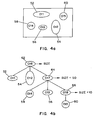
- Figs. 4A and 4B depict an exemplary use of a clustering hierarchy scheme wherein objects are clustered hierarchically based on their respective size ( ⁇ size>).
- Fig. 4A depicts a representation of a relatively large image, such as a satellite photograph image for example, wherein objects O11 52, 012 54, 013 56, 014 58 and O15 60 represent image objects of varying size, such as lakes on the earth's surface for example, contained in the large image.
- Fig. 4B represents an exemplary size-based clustering hierarchy for the objects depicted in Fig. 4A , wherein objects O11 52, O12 54, O13 56, 014 58 and O15 60 represent the objects depicted in Fig.
- objects 016 62, O17 64 and O18 56 represent objects which specify the size-based criteria for the cluster hierarchy depicted in Fig. 4B .
- objects 016 62, 017 64 and 018 56 may for example represent intermediate nodes 32 of an object hierarchy 26, which intermediate nodes are represented as image objects 30. These objects include the criteria, conditions and constraints related to the size feature used for grouping the objects together in the depicted cluster hierarchy.
- objects 016 62, O17 64 and O18 56 are used to form a clustering hierarchy having three hierarchical levels based on size.
- Object 016 62 represents the size criteria which forms the clustering hierarchy.
- Object 017 64 represents a second level of size criteria of less than 50 units, wherein such units may represent pixels for example; object O18 56 represents a third level of size criteria of less than 10 units.
- objects O11 52, 012 54, 013 56, 014 58 and O15 60 are each characterized as having a specified size of a certain number of units.
- objects 013 56, 014 58 and O15 60 are each characterized as having a specified size of less than 50 units
- object O15 60 is characterized as having a specified size of less than 10 units.
- Figs. 4A and 4B depict an example of a single clustering hierarchy based on only a single set of criteria, namely size
- multiple clustering hierarchies using different criteria involving multiple features may also be used for any image.
- clustering hierarchies may group together objects based on any combination of media, visual, and/or semantic features. This procedure is similar to the procedure used to cluster images together in visual information retrieval engines.
- Each object contained within the overall large image is assigned an image object 30 in the object set 24, and may also be assigned certain associated features such as media features 36, visual features 38 or semantic features 40.
- the intermediate nodes 32 of the object hierarchy 26 are represented as image objects 30, and also include the criteria, conditions and constraints related to one or more features used for grouping the objects together at that particular level.
- An image description may include any number of clustering hierarchies.
- the exemplary clustering hierarchy depicted in Figs. 4A and 4B is expressed in an exemplary XML implementation below.
- FIG. 4A As depicted in the multiple clustering hierarchy example of Figs. 4A and 4B , and as denoted in Table 3 below, there are defined three levels of abstraction based on the size of the objects depicted.
- This multi-level abstraction scheme provides a scalable method for retrieving and viewing objects in the image depicted in Fig. 4A .
- Such an approach can also be used to represent multiple abstraction levels based on other features, such as various semantic classes for example.
- Table 3 Objects in Each Abstraction Level Abstraction Level Objects 1 011,012 2 011,012,013,014 3 O11, O12, O13, O14, O15 Additional XML embodiments of the exemplary clustering hierarchies and multiple levels of abstraction depicted in Figs. 4A and 4B are included in Appendix A.
- the image description system of the present invention also utilizes entity-relation (E-R) graphs 28 for the specification of more complex relationships among objects.
- An entity-relation graph 28 is a graph of one or more entity nodes 42 and the relationships among them.
- Table 4 below denotes several different exemplary types of such relationships, as well as specific examples of each. Table 4: Examples of relation types and relations.
- Entity-relation graphs can be of any general structure, and can also be customized for any particular application by utilizing various inheritance relationships.
- the exemplary entity-relation graph depicted in Fig. 1C describes an exemplary spatial relationship, namely "Left Of", and an exemplary semantic relationship, namely "Shaking Hands With", between objects O1 2 and 02 6 depicted in Fig. 1A .
- An entity-relation graph 28 includes one or more sets of entity-relation elements 34 ( ⁇ entity_relation>), and also contains two optional attributes, namely a unique identifier ID and a string type to describe the binding expressed by the entity relation graph 28. Values for such types could for example be provided by a thesaurus.
- Each entity relation element 34 contains one relation element 44 ( ⁇ relation>), and may also contain one or more entity node elements 42 ( ⁇ entity_node>) and one or more entity-relation elements 34.
- the relation element 44 contains the specific relationship being described.
- Each entity node element 42 references an image object 30 in the image object set 24 via link 43, by utilizing an attribute, namely object_ref.
- image objects 30 also can reference back to the entity nodes 42 referencing the image objects 30 by utilizing an attribute (entity_code_ref).
- the entity-relation graph 28 contains two entity relations 34 between object O1 2 ("Person A") and object 02 6 ("Person B").
- the first such entity relation 34 describes the spatial relation 44 regarding how object O1 2 is positioned with respect to (i.e., to the "Left Of") object 02 6.
- the second such entity relation 34 depicted in Fig. 1 C describes the semantic relation 44 of how object O1 2 is "Shaking Hand With" object 02 6.
- An exemplary XML implementation of the entity-relation graph example depicted in Fig. 1C is shown below:
- entity-relation elements 34 may also include one or more other entity-relation elements 34, as depicted in Fig. 2 .
- This allows the creation of efficient nested graphs of entity relationships, such as those utilized in the Synchronized Multimedia Integration Language (SMIL), which synchronizes different media documents by using a series of nested parallel sequential relationships.
- SMIL Synchronized Multimedia Integration Language
- An object hierarchy 26 is a particular type of entity-relation graph 28 and therefore can be implemented using an entity-relation graph 28, wherein entities are related by containment relationships. Containment relationships are topological relationships such as those denoted in Table 4. To illustrate that an object hierarchy 26 is a particular type of an entity-relation graph 28, the exemplary object hierarchy 26 depicted in Fig. 1B is expressed below in XML as an entity-relation graph 28.
- Fig. 1B The exemplary hierarchy depicted in Fig. 1B describes how object 00 8 (the overall photograph) spatially contains objects O1 2 ("Person A") and 02 6 ("Person B").
- applications may implement hierarchies utilizing either the convenience of the comprehensive structure of an entity-relation graph 28, or alternatively by utilizing the efficiency of object hierarchies 26.
- the image description system of the present invention may also contain links to extraction and similarity matching code in order to facilitate code downloading, as illustrated in the XML example below. These links provide a mechanism for efficient searching and filtering of image content from different sources using proprietary descriptors.
- Each image descriptor in the image description system of the present invention may include a descriptor value and a code element, which contain information regarding the extraction and similarity matching code for that particular descriptor.
- the code elements may also include pointers to the executable files ( ⁇ location>), as well as the description of the input parameters ( ⁇ input_parameters>) and output parameters ( ⁇ output_parameters>) for executing the code.
- Information about the type of code namely, extraction code or similarity matching code
- the code language such as Java or C for example
- the code version are defined as particular attributes of the code element.
- the exemplary XML implementation set forth below provides a description of a so-called Tamura texture feature, as set forth in H. Tamura, S. Mori, and T. Yamawaki, "Textual Features Corresponding to Visual Perception," IEEE Transactions on Systems, Man and Cybernetics, Vol. 8, No. 6, June 1978 .
- the Tamura texture feature provides the specific feature values (namely, coarseness, contrast, and directionality) and also links to external code for feature extraction and similarity matching.
- additional information about input and output parameters is also provided. Such a description could for example be generated by a search engine in response to a texture query from a meta search engine.
- the meta search engine could then use the code to extract the same feature descriptor from the results received from other search engines, in order to generate a homogeneous list of results for a user.
- the extraction and similarity matching code but not the specific feature values, is included. If necessary in such instances, filtering agents may be used to extract feature values for processing.
- the exemplary XML implementation shown below also illustrates the way in which the XML language enables externally defined description schemes for descriptors to be imported and combined into the image description system of the present invention.
- an external descriptor for the Croma Key shape feature is imported into the image description by using XML namespaces.
- new features, types of features, and image descriptors can be conveniently included in an extensible and modular way.
- the image description system of the present invention also supports modality transcoding.
- modality transcoding in connection with both local and global objects. This modality transcoding transcodes the media modality, resolution, and location of transcoded versions of the image objects in question, or alternatively links to external transcoding code.
- the image descriptor in question also can point to code for transcoding an image object into different modalities and resolutions, in order to satisfy the requirements of different user terminals.
- the exemplary XML implementation shown below illustrates providing an audio transcoded version for an image object.
- Fig. 5 depicts a block diagram of an exemplary computer system for implementing the image description system of the present invention.
- the computer system depicted includes a computer processor section 402 which receives digital data representing image content, via image input interface 404 for example.
- the digital image data can be transferred to the processor section 402 from a remote source via a bidirectional communications input/output (I/O) port 406.
- the image content can also be transferred to the processor section 402 from non-volatile computer media 408, such as any of the optical data storage or magnetic storage systems well known in the art.
- the processor section 402 provides data to an image display system 410, which generally includes appropriate interface circuitry and a high resolution monitor, such as a standard SVGA monitor and video card which are commonly employed in conventional personal computer systems and workstations for example.
- a user input device such as a keyboard and digital pointing device a mouse, trackball, light pen or touch screen for example
- the exemplary computer system of Fig. 5 will also normally include volatile and non volatile computer memory 414, which can be accessed by the processor section 402 during processing operations.
- Fig. 6 depicts a flow chart diagram which further illustrates the processing operations undertaken by the computer system depicted in Fig. 5 for purposes of implementing the image description system of the present invention.
- Digital image data 310 is applied to the computer system via link 311.
- the computer system under the control of suitable application software, performs image object extraction in block 320, in which image objects 30 and associated features, such as media features 36, visual features 38 and semantic features 40 for example, are generated.
- Image object extraction 320 may take the form of a fully automatic processing operation, a semi-automatic processing operation, or a substantially manual operation in which objects are defined primarily through user interaction, such as via user input device 412 for example.
- image object extraction 320 consists of two subsidiary operations, namely image segmentation as depicted by block 325, and feature extraction and annotation as depicted by block 326.
- image segmentation 325 any region tracking technique which partitions digital images into regions that share one or more common characteristics may be employed.
- feature extraction and annotation step 326 any technique which generates features from segmented regions may be employed.
- a region-based clustering and searching subsystem is suitable for automated image segmentation and feature extraction.
- An image object segmentation system is an example of a semi-automated image segmentation and feature extraction system. Manual segmentation and feature extraction could alternatively be employed.
- image segmentation 325 may for example generate image objects 30, and feature extraction and annotation 326 may for example generate the features associated with the image objects 30, such as media features 36, visual features 38 and semantic features 40, for example.
- the object extraction processing 320 generates an image object set 24, which contains one or more image objects 30.
- the image objects 30 of the image object set 24 may then be provided via links 321, 322 and 324 for further processing in the form of object hierarchy construction and extraction processing as depicted in block 330, and/or entity relation graph generation processing as depicted in block 336.
- object hierarchy construction and extraction 330 and entity relation graph generation 336 take place in parallel and via link 327.
- image objects 30 of the image object set 24 may be directed to bypass object hierarchy construction and extraction 330 and entity relation graph generation 336, via link 323.
- the object hierarchy construction and extraction 330 thus generates one or more object hierarchies 26, and the entity relation graph generation 336 thus generates one or more entity relation graphs 28.
- the processor section 402 then merges the image object set 24, object hierarchies 26 and entity relation graphs 28 into an image description record for the image content in question.
- the image description record may then be stored directly in database storage 340, or alternatively may first be subjected to compression by binary encoder 360 via links 342 and 361, or to encoding by description definition language encoding (using XML for example) by XML encoder 350 via links 341 and 351.
- XML encoder 350 via links 341 and 351.
- the architecture of the system 100 includes a client computer 110 and a server computer 120.
- the server computer 120 includes a display interface 130, a query dispatcher 140, a performance database 150, query translators 160, 161, 165, target search engines 170, 171, 175, and multimedia content description systems 200, 201, 205, which will be described in further detail below.
- metasearch engines act as gateways linking users automatically and transparently to multiple text-based search engines.
- the system of Fig. 7 grows upon the architecture of such metasearch engines and is designed to intelligently select and interface with multiple on-line multimedia search engines by ranking their performance for different classes of user queries. Accordingly, the query dispatcher 140, query translators 160, 161, 165, and display interface 130 of commercially available metasearch engines may be employed in the present invention.
- the dispatcher 140 selects the target search engines to be queried by consulting the performance database 150 upon receiving a user query.
- This database 150 contains performance scores of past query successes and failures for each supported search option.
- the query dispatcher only selects search engines 170, 171, 175 that are able to satisfy the user's query, e.g. a query seeking color information will trigger color enabled search engines.
- Search engines 170, 171, 175 may for example be arranged in a client-server relationship, such as search engine 170 and associated client 172.
- the query translators 160, 161, 165 translate the user query to suitable scripts conforming to the interfaces of the selected search engines.
- the display component 130 uses the performance scores to merge the results from each search engine, and presents them to the user.
- search queries may be made either by descriptions of multimedia content generated by the present invention, or by example or sketch.
- Each search engine 170, 171, 175 employs a description scheme, for example the description schemes described below, to describe the contents of multimedia information accessible by the search engine and to implement the search.
- the dispatcher 140 will match the query description, through the multimedia content description system 200, employed by each search engine 170, 171, 175 to ensure the satisfaction of the user preferences in the query. It will then select the target search engines 170, 171, 175 to be queried by consulting the performance database 150. If for example the user wants to search by color and one search engine does not support any color descriptors, it will not be useful to query that particular search engine.
- the query translators 160, 161, 165 will adapt the query description to descriptions conforming to each selected search engine. This translation will also be based on the description schemes available from each search engine. This task may require executing extraction code for standard descriptors or downloaded extraction code from specific search engines to transform descriptors. For example, if the user specifies the color feature of an object using a color coherence of 166 bins, the query translator will translate it to the specific color descriptors used by each search engine, e.g. color coherence and color histogram of x bins.
- the query interface Before displaying the results to the user, the query interface will merge the results from each search option by translating all the result descriptions into a homogeneous one for comparison and ranking. Again, similarity code for standard descriptors or downloaded similarity code from search engines may need to be executed. User preferences will determine how the results are displayed to the user.
- a description system 200 which, in accordance with the present invention, is employed by each search engine 170, 171, 175 is now described.
- XML is used to describe multimedia content.
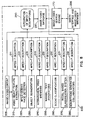
- the description system 200 advantageously includes several multimedia processing, analysis and annotation sub-systems 210, 220, 230, 240, 250, 260, 270, 280 to generate a rich variety of descriptions for a collection of multimedia items 205. Each subsystem is described in turn.
- the first subsystem 210 is a region-based clustering and searching system which extracts visual features such as color, texture, motion, shape, and size for automatically segmented regions of a video sequence.
- the system 210 decomposes video into separate shots by scene change detection, which may be either abrupt or transitional (e.g. dissolve, fade in/out, wipe).
- scene change detection e.g. dissolve, fade in/out, wipe.
- the system 210 estimates both global motion (i.e. the motion of dominant background) and camera motion, and then segments, detects, and tracks regions across the frames in the shot computing different visual features for each region.
- the description generated by this system is a set of regions with visual and motion features, and the camera motion.
- a complete description of the region-based clustering and searching system 210 is contained in co-pending PCT Application Serial No. PCT/US98/09124, filed May 5, 1998 , entitled "An Algorithm and System Architecture for Object-Oriented Content-Based Video Search" .
- a "video clip” shall refer to a sequence of frames of video information having one or more video objects having identifiable attributes, such as, by way of example and not of limitation, a baseball player swinging a bat, a surfboard moving across the ocean, or a horse running across a prairie.
- a "video object” is a contiguous set of pixels that is homogeneous in one or more features of interest, e.g., texture, color, motion or shape.
- a video object is formed by one or more video regions which exhibit consistency in at least one feature. For example a shot of a person (the person is the "object” here) walking would be segmented into a collection of adjoining regions differing in criteria such as shape, color and texture, but all the regions may exhibit consistency in their motion attribute.
- the second subsystem 220 is an MPEG domain face detection system, which efficiently and automatically detects faces directly in the MPEG compressed domain.
- the human face is an important subject in images and video. It is ubiquitous in news, documentaries, movies, etc., providing key information to the viewer for the understanding of the video content.
- This system provides a set of regions with face labels.
- a complete description of the system 220 is contained in PCT Application Serial No. PCT/US 97/20024, filed November 4, 1997 , entitled "A Highly Efficient System for Automatic Face Region Detection in MPEG Video".
- the third subsystem 230 is a video object segmentation system in which automatic segmentation is integrated with user input to track semantic objects in video sequences.
- the system allows users to define an approximate object boundary by using a tracing interface. Given the approximate object boundary, the system automatically refines the boundary and tracks the movement of the object in subsequent frames of the video.
- the system is robust enough to handle many real-world situations that are difficult to model using existing approaches, including complex objects, fast and intermittent motion, complicated backgrounds, multiple moving objects and partial occlusion.
- the description generated by this system is a set of semantic objects with the associated regions and features that can be manually annotated with text.
- a complete description of the system 230 is contained in U.S. Patent Application Serial No. 09/405,555, filed September 24, 1998 , entitled "An Active System and Algorithm for Semantic Video Object Segmentation".
- the fourth subsystem 240 is a hierarchical video browsing system that parsers compressed MPEG video streams to extract shot boundaries, moving objects, object features, and camera motion, and. It also generates a hierarchical shot-based browsing interface for intuitive visualization and editing of videos.
- a complete description of the system 240 is contained in PCT Application Serial No. PCT/US 97/08266, filed May 16, 1997 , entitled "A Method and Architecture for Indexing and Editing Compressed Video Over the World Wide Web".
- the fifth subsystem 250 is the entry of manual text annotations. It is often desirable to integrate visual features and textual features for scene classification. For images from on-line news sources, e.g. Clarinet, there is often textual information in the form of captions or articles associated with each image. This textual information can be included in the descriptions.
- the sixth subsystem 260 is a system for high-level semantic classification of images and video shots based on low-level visual features.
- the core of the system consists of various machine learning techniques such as rule induction, clustering and nearest neighbor classification.
- the system is being used to classify images and video scenes into high level semantic scene classes such as ⁇ nature landscape ⁇ , ⁇ city/suburb ⁇ , ⁇ indoor ⁇ , and ⁇ outdoor ⁇ .
- the system focuses on machine learning techniques because we have found that the fixed set of rules that might work well with one corpus may not work well with another corpus, even for the same set of semantic scene classes. Since the core of the system is based on machine learning techniques, the system can be adapted to achieve high performance for different corpora by training the system with examples from each corpus.
- the description generated by this system is a set of text annotations to indicate the scene class for each image or each keyframe associated with the shots of a video sequence.
- a complete description of the system 260 is contained in S. Paek et al., "Integration of Visual and Text based Approaches for the Content Labeling and Classification of Photographs," ACM SIGIR'99 Workshop on Multimedia Indexing and Retrieval. Berkeley, C A (1999 ).
- the seventh subsystem 270 is a model based image classification system. Many automatic image classification systems are based on a pre-defined set of classes in which class-specific algorithms are used to perform classification.
- the system 270 allows users to define their own classes and provide examples that are used to automatically learn visual models.
- the visual models are based on automatically segmented regions, their associated visual features, and their spatial relationships. For example, the user may build a visual model of a portrait in which one person wearing a blue suit is seated on a brown sofa, and a second person is standing to the right of the seated person.
- the system uses a combination of lazy-learning, decision trees and evolution programs during classification.
- the description generated by this system is a set of text annotations, i.e. the user defined classes, for each image.
- subsystems 280 may be added to the multimedia content description system 200, such as a subsystems from collaborators used to generate descriptions or parts of descriptions, for example.
- the image and video content 205 may be a database of still images or moving video, a buffer receiving content from a browser interface 206, or a receptacle for live image or video transmission.
- the subsystems 210, 220, 230, 240, 250, 260, 270, 280 operate on the image and video content 205 to generate descriptions 211, 221, 231, 241, 251, 261, 271, 281 that include low level visual features of automatically segmented regions, user defined semantic objects, high level scene properties, classifications and associated textual information, as described above.
- the subsystems i.e., the region-based clustering and searching subsystem 210 and the video object segmentation system 230 may implement the entire description generation process, while the remaining subsystems implement only portions of the process and may be called on by the subsystems 210, 230 during processing. In a similar manner, the subsystems 210 and 230 may be called on by each other for specific tasks in the process.
- ANNEX B XML for Example of indexing hierarchy and multi-abstraction levels in Figure 3
Landscapes
- Engineering & Computer Science (AREA)
- Theoretical Computer Science (AREA)
- General Physics & Mathematics (AREA)
- Physics & Mathematics (AREA)
- Multimedia (AREA)
- Databases & Information Systems (AREA)
- General Engineering & Computer Science (AREA)
- Data Mining & Analysis (AREA)
- Library & Information Science (AREA)
- Software Systems (AREA)
- Business, Economics & Management (AREA)
- General Business, Economics & Management (AREA)
- Information Retrieval, Db Structures And Fs Structures Therefor (AREA)
- Image Analysis (AREA)
- Television Signal Processing For Recording (AREA)
- Compression Or Coding Systems Of Tv Signals (AREA)
- Television Systems (AREA)
- Processing Or Creating Images (AREA)
- Management Or Editing Of Information On Record Carriers (AREA)
- Alarm Systems (AREA)
- Traffic Control Systems (AREA)
- Burglar Alarm Systems (AREA)
- Closed-Circuit Television Systems (AREA)
Applications Claiming Priority (7)
| Application Number | Priority Date | Filing Date | Title |
|---|---|---|---|
| US10746398P | 1998-11-06 | 1998-11-06 | |
| US107463P | 1998-11-06 | ||
| US11802799P | 1999-02-01 | 1999-02-01 | |
| US11802099P | 1999-02-01 | 1999-02-01 | |
| US118027P | 1999-02-01 | ||
| US118020P | 1999-02-01 | ||
| PCT/US1999/026127 WO2000028467A1 (en) | 1998-11-06 | 1999-11-05 | Image description system and method |
Publications (3)
| Publication Number | Publication Date |
|---|---|
| EP1125245A1 EP1125245A1 (en) | 2001-08-22 |
| EP1125245A4 EP1125245A4 (en) | 2004-04-14 |
| EP1125245B1 true EP1125245B1 (en) | 2012-01-04 |
Family
ID=27380312
Family Applications (2)
| Application Number | Title | Priority Date | Filing Date |
|---|---|---|---|
| EP99971950A Expired - Lifetime EP1125245B1 (en) | 1998-11-06 | 1999-11-05 | Image description system and method |
| EP99960214A Expired - Lifetime EP1147655B1 (en) | 1998-11-06 | 1999-11-05 | Video description system and method |
Family Applications After (1)
| Application Number | Title | Priority Date | Filing Date |
|---|---|---|---|
| EP99960214A Expired - Lifetime EP1147655B1 (en) | 1998-11-06 | 1999-11-05 | Video description system and method |
Country Status (6)
| Country | Link |
|---|---|
| EP (2) | EP1125245B1 (https=) |
| JP (2) | JP2002532918A (https=) |
| KR (2) | KR100697106B1 (https=) |
| AT (2) | ATE528912T1 (https=) |
| AU (2) | AU1713500A (https=) |
| WO (2) | WO2000028725A2 (https=) |
Families Citing this family (41)
| Publication number | Priority date | Publication date | Assignee | Title |
|---|---|---|---|---|
| US7185049B1 (en) | 1999-02-01 | 2007-02-27 | At&T Corp. | Multimedia integration description scheme, method and system for MPEG-7 |
| US6546135B1 (en) * | 1999-08-30 | 2003-04-08 | Mitsubishi Electric Research Laboratories, Inc | Method for representing and comparing multimedia content |
| CN1401188B (zh) * | 2000-10-17 | 2011-06-08 | 皇家菲利浦电子有限公司 | Mpeg-7样品的二进制格式 |
| GB0107140D0 (en) * | 2001-03-21 | 2001-05-09 | Nokia Oyj | Management and distribution of electronic media |
| US7254570B2 (en) | 2001-03-21 | 2007-08-07 | Nokia Corporation | Query resolution system and service |
| US6904454B2 (en) | 2001-03-21 | 2005-06-07 | Nokia Corporation | Method and apparatus for content repository with versioning and data modeling |
| US7353236B2 (en) | 2001-03-21 | 2008-04-01 | Nokia Corporation | Archive system and data maintenance method |
| US7734997B2 (en) * | 2001-05-29 | 2010-06-08 | Sony Corporation | Transport hint table for synchronizing delivery time between multimedia content and multimedia content descriptions |
| US6870956B2 (en) | 2001-06-14 | 2005-03-22 | Microsoft Corporation | Method and apparatus for shot detection |
| US7231394B2 (en) * | 2001-07-17 | 2007-06-12 | Sony Corporation | Incremental bottom-up construction of data documents |
| US7274741B2 (en) | 2002-11-01 | 2007-09-25 | Microsoft Corporation | Systems and methods for generating a comprehensive user attention model |
| US7116716B2 (en) | 2002-11-01 | 2006-10-03 | Microsoft Corporation | Systems and methods for generating a motion attention model |
| US7164798B2 (en) | 2003-02-18 | 2007-01-16 | Microsoft Corporation | Learning-based automatic commercial content detection |
| CN100483404C (zh) * | 2003-05-12 | 2009-04-29 | 皇家飞利浦电子股份有限公司 | 用于搜索媒体对象的方法 |
| US7667717B2 (en) * | 2003-06-12 | 2010-02-23 | Microsoft Corporation | System and method for displaying images utilizing multi-blending |
| KR100447299B1 (ko) * | 2003-07-03 | 2004-09-07 | 주식회사 휴맥스 | 디지털 방송 프로그램 정보 송신 및 수신방법 |
| US7400761B2 (en) | 2003-09-30 | 2008-07-15 | Microsoft Corporation | Contrast-based image attention analysis framework |
| US7471827B2 (en) | 2003-10-16 | 2008-12-30 | Microsoft Corporation | Automatic browsing path generation to present image areas with high attention value as a function of space and time |
| US7600015B2 (en) * | 2004-06-28 | 2009-10-06 | Nokia Corporation | User confirmation in data downloading |
| US9053754B2 (en) | 2004-07-28 | 2015-06-09 | Microsoft Technology Licensing, Llc | Thumbnail generation and presentation for recorded TV programs |
| US7986372B2 (en) | 2004-08-02 | 2011-07-26 | Microsoft Corporation | Systems and methods for smart media content thumbnail extraction |
| US7773813B2 (en) | 2005-10-31 | 2010-08-10 | Microsoft Corporation | Capture-intention detection for video content analysis |
| US8180826B2 (en) | 2005-10-31 | 2012-05-15 | Microsoft Corporation | Media sharing and authoring on the web |
| US8196032B2 (en) | 2005-11-01 | 2012-06-05 | Microsoft Corporation | Template-based multimedia authoring and sharing |
| US7599918B2 (en) | 2005-12-29 | 2009-10-06 | Microsoft Corporation | Dynamic search with implicit user intention mining |
| KR100641791B1 (ko) * | 2006-02-14 | 2006-11-02 | (주)올라웍스 | 디지털 데이터에 대한 태깅 방법 및 시스템 |
| US7925105B2 (en) | 2006-03-14 | 2011-04-12 | Seiko Epson Corporation | Image transfer and motion picture clipping process using outline of image |
| KR100961444B1 (ko) | 2007-04-23 | 2010-06-09 | 한국전자통신연구원 | 멀티미디어 콘텐츠를 검색하는 방법 및 장치 |
| CN101286351B (zh) * | 2008-05-23 | 2011-02-23 | 广州视源电子科技有限公司 | 生成流媒体增值描述文件及插播多媒体信息的方法、系统 |
| CN102609958A (zh) * | 2012-01-19 | 2012-07-25 | 北京三星通信技术研究有限公司 | 视频对象提取的方法及设备 |
| EP3059734A1 (en) * | 2015-02-17 | 2016-08-24 | Alcatel Lucent | Encoder/decoder |
| WO2016195557A1 (en) | 2015-06-03 | 2016-12-08 | Volvo Construction Equipment Ab | A method and system for predicting a risk for rollover of a working machine |
| US11294957B2 (en) * | 2016-02-11 | 2022-04-05 | Carrier Corporation | Video searching using multiple query terms |
| EP3239896B1 (en) | 2016-04-28 | 2018-11-28 | Joanneum Research Forschungsgesellschaft mbH | Data structure for describing an image sequence, and methods for extracting and matching these data structures |
| WO2020197257A1 (ko) | 2019-03-25 | 2020-10-01 | 김현진 | 가시적 표현 요소를 이용한 번역 방법 및 그 장치 |
| CN109934852B (zh) * | 2019-04-01 | 2022-07-12 | 重庆理工大学 | 一种基于对象属性关系图的视频描述方法 |
| US11182408B2 (en) * | 2019-05-21 | 2021-11-23 | Microsoft Technology Licensing, Llc | Generating and applying an object-level relational index for images |
| KR102807431B1 (ko) * | 2020-01-22 | 2025-05-15 | 삼성전자 주식회사 | 스토리를 생성하는 전자 장치 및 그의 동작 방법 |
| CN113343982B (zh) * | 2021-06-16 | 2023-07-25 | 北京百度网讯科技有限公司 | 多模态特征融合的实体关系提取方法、装置和设备 |
| CN114238526B (zh) * | 2022-02-23 | 2022-06-07 | 浙江大华技术股份有限公司 | 图像聚档方法、电子设备及存储介质 |
| CN119227816B (zh) * | 2024-12-03 | 2025-04-18 | 江西师范大学 | 一种基于大语言模型的图像描述文本生成方法 |
Family Cites Families (14)
| Publication number | Priority date | Publication date | Assignee | Title |
|---|---|---|---|---|
| US5579444A (en) * | 1987-08-28 | 1996-11-26 | Axiom Bildverarbeitungssysteme Gmbh | Adaptive vision-based controller |
| US5144685A (en) * | 1989-03-31 | 1992-09-01 | Honeywell Inc. | Landmark recognition for autonomous mobile robots |
| JP2837514B2 (ja) * | 1990-06-19 | 1998-12-16 | 富士通株式会社 | 画像編集装置 |
| JPH04220086A (ja) * | 1990-12-19 | 1992-08-11 | Ricoh Co Ltd | 画像データ管理方法および画像データ管理装置 |
| JPH05144685A (ja) * | 1991-11-21 | 1993-06-11 | Elna Co Ltd | 固体電解コンデンサ |
| JPH05250241A (ja) * | 1992-03-06 | 1993-09-28 | Nippon Telegr & Teleph Corp <Ntt> | ファイル装置 |
| US5555354A (en) * | 1993-03-23 | 1996-09-10 | Silicon Graphics Inc. | Method and apparatus for navigation within three-dimensional information landscape |
| JP3303543B2 (ja) * | 1993-09-27 | 2002-07-22 | インターナショナル・ビジネス・マシーンズ・コーポレーション | マルチメディア・セグメントを構成してプレイする方法、および2つ以上のマルチメディア・ストーリーをハイパーストーリーとして構成してプレイする方法 |
| US5485568A (en) * | 1993-10-08 | 1996-01-16 | Xerox Corporation | Structured image (Sl) format for describing complex color raster images |
| CA2117846C (en) * | 1993-10-20 | 2001-02-20 | Allen Reiter | Computer method and storage structure for storing and accessing multidimensional data |
| US5821945A (en) * | 1995-02-03 | 1998-10-13 | The Trustees Of Princeton University | Method and apparatus for video browsing based on content and structure |
| US5841900A (en) * | 1996-01-11 | 1998-11-24 | Xerox Corporation | Method for graph-based table recognition |
| JP3265198B2 (ja) * | 1996-09-20 | 2002-03-11 | 松下電送システム株式会社 | 構造化文書作成装置、構造化文書作成方法、通信装置、および通信方法 |
| JPH10187515A (ja) * | 1996-12-25 | 1998-07-21 | Nec Corp | ダウンロード装置 |
-
1999
- 1999-11-05 WO PCT/US1999/026126 patent/WO2000028725A2/en not_active Ceased
- 1999-11-05 WO PCT/US1999/026127 patent/WO2000028467A1/en not_active Ceased
- 1999-11-05 AT AT99960214T patent/ATE528912T1/de not_active IP Right Cessation
- 1999-11-05 EP EP99971950A patent/EP1125245B1/en not_active Expired - Lifetime
- 1999-11-05 EP EP99960214A patent/EP1147655B1/en not_active Expired - Lifetime
- 1999-11-05 AU AU17135/00A patent/AU1713500A/en not_active Abandoned
- 1999-11-05 JP JP2000581801A patent/JP2002532918A/ja active Pending
- 1999-11-05 JP JP2000581582A patent/JP4382288B2/ja not_active Expired - Fee Related
- 1999-11-05 AT AT99971950T patent/ATE540364T1/de active
- 1999-11-05 AU AU12434/00A patent/AU1243400A/en not_active Abandoned
- 1999-11-05 KR KR1020017005771A patent/KR100697106B1/ko not_active Expired - Fee Related
- 1999-11-05 KR KR1020017005773A patent/KR100734964B1/ko not_active Expired - Fee Related
Also Published As
| Publication number | Publication date |
|---|---|
| EP1147655A2 (en) | 2001-10-24 |
| KR100697106B1 (ko) | 2007-03-21 |
| JP4382288B2 (ja) | 2009-12-09 |
| AU1243400A (en) | 2000-05-29 |
| JP2002529863A (ja) | 2002-09-10 |
| EP1125245A4 (en) | 2004-04-14 |
| EP1125245A1 (en) | 2001-08-22 |
| KR20020006624A (ko) | 2002-01-23 |
| KR100734964B1 (ko) | 2007-07-03 |
| WO2000028725A2 (en) | 2000-05-18 |
| WO2000028467A1 (en) | 2000-05-18 |
| ATE528912T1 (de) | 2011-10-15 |
| JP2002532918A (ja) | 2002-10-02 |
| AU1713500A (en) | 2000-05-29 |
| EP1147655B1 (en) | 2011-10-12 |
| ATE540364T1 (de) | 2012-01-15 |
| KR20020006623A (ko) | 2002-01-23 |
| WO2000028725A3 (en) | 2000-07-13 |
| EP1147655A4 (en) | 2004-04-14 |
Similar Documents
| Publication | Publication Date | Title |
|---|---|---|
| EP1125245B1 (en) | Image description system and method | |
| US7254285B1 (en) | Image description system and method | |
| US8370869B2 (en) | Video description system and method | |
| US7653635B1 (en) | Systems and methods for interoperable multimedia content descriptions | |
| Salembier et al. | MPEG-7 multimedia description schemes | |
| Li et al. | Multimedia content description in the InfoPyramid | |
| US7506024B2 (en) | Multimedia integration description scheme, method and system for MPEG-7 | |
| Paek et al. | Self-describing schemes for interoperable MPEG-7 multimedia content descriptions | |
| Vakali et al. | Mpeg-7 based description schemes for multi-level video content classification | |
| Chang et al. | Exploring image functionalities in WWW applications development of image/video search and editing engines | |
| Spaniol et al. | Imagesemantics: user-generated metadata, content based retrieval & beyond | |
| Klippgen et al. | The Use of Metadata for the Rendering of Personalized Video Delivery. | |
| Di Bono et al. | WP9: A review of data and metadata standards and techniques for representation of multimedia content | |
| MXPA01004561A (en) | Systems and methods for interoperable multimediacontent descriptions | |
| Paek et al. | Proposal Id: P480 Proposal for MPEG-7 Image Description Scheme Name | |
| Smith et al. | Interoperable Content-based Access of Multimedia in Digital Libraries | |
| Chang | MPEG-7: standard metadata for multimedia content | |
| Kao | Parallel and Distributed Multimedia Database Systems | |
| González-Conejero et al. | Legal multimedia management and semantic annotation for improved search and retrieval | |
| Divakaran | Management of Multimedia Semantics Using MPEG-7 | |
| Lindley et al. | The FRAMES Project: Reuse of Video Information using the World Wide Web | |
| Choi et al. | Multimedia data parsing and reassembling for the zCAS (Collaborative-works Assistant System) under group environments |
Legal Events
| Date | Code | Title | Description |
|---|---|---|---|
| PUAI | Public reference made under article 153(3) epc to a published international application that has entered the european phase |
Free format text: ORIGINAL CODE: 0009012 |
|
| 17P | Request for examination filed |
Effective date: 20010507 |
|
| AK | Designated contracting states |
Kind code of ref document: A1 Designated state(s): AT BE CH CY DE DK ES FI FR GB GR IE IT LI LU MC NL PT SE |
|
| A4 | Supplementary search report drawn up and despatched |
Effective date: 20040301 |
|
| RIC1 | Information provided on ipc code assigned before grant |
Ipc: 7G 06F 17/30 A |
|
| 17Q | First examination report despatched |
Effective date: 20080228 |
|
| GRAP | Despatch of communication of intention to grant a patent |
Free format text: ORIGINAL CODE: EPIDOSNIGR1 |
|
| GRAS | Grant fee paid |
Free format text: ORIGINAL CODE: EPIDOSNIGR3 |
|
| GRAA | (expected) grant |
Free format text: ORIGINAL CODE: 0009210 |
|
| AK | Designated contracting states |
Kind code of ref document: B1 Designated state(s): AT BE CH CY DE DK ES FI FR GB GR IE IT LI LU MC NL PT SE |
|
| REG | Reference to a national code |
Ref country code: GB Ref legal event code: FG4D |
|
| REG | Reference to a national code |
Ref country code: CH Ref legal event code: EP |
|
| REG | Reference to a national code |
Ref country code: AT Ref legal event code: REF Ref document number: 540364 Country of ref document: AT Kind code of ref document: T Effective date: 20120115 |
|
| REG | Reference to a national code |
Ref country code: IE Ref legal event code: FG4D |
|
| REG | Reference to a national code |
Ref country code: DE Ref legal event code: R096 Ref document number: 69943967 Country of ref document: DE Effective date: 20120301 |
|
| REG | Reference to a national code |
Ref country code: NL Ref legal event code: VDEP Effective date: 20120104 |
|
| PG25 | Lapsed in a contracting state [announced via postgrant information from national office to epo] |
Ref country code: NL Free format text: LAPSE BECAUSE OF FAILURE TO SUBMIT A TRANSLATION OF THE DESCRIPTION OR TO PAY THE FEE WITHIN THE PRESCRIBED TIME-LIMIT Effective date: 20120104 Ref country code: BE Free format text: LAPSE BECAUSE OF FAILURE TO SUBMIT A TRANSLATION OF THE DESCRIPTION OR TO PAY THE FEE WITHIN THE PRESCRIBED TIME-LIMIT Effective date: 20120104 |
|
| PG25 | Lapsed in a contracting state [announced via postgrant information from national office to epo] |
Ref country code: FI Free format text: LAPSE BECAUSE OF FAILURE TO SUBMIT A TRANSLATION OF THE DESCRIPTION OR TO PAY THE FEE WITHIN THE PRESCRIBED TIME-LIMIT Effective date: 20120104 Ref country code: GR Free format text: LAPSE BECAUSE OF FAILURE TO SUBMIT A TRANSLATION OF THE DESCRIPTION OR TO PAY THE FEE WITHIN THE PRESCRIBED TIME-LIMIT Effective date: 20120405 Ref country code: PT Free format text: LAPSE BECAUSE OF FAILURE TO SUBMIT A TRANSLATION OF THE DESCRIPTION OR TO PAY THE FEE WITHIN THE PRESCRIBED TIME-LIMIT Effective date: 20120504 |
|
| REG | Reference to a national code |
Ref country code: AT Ref legal event code: MK05 Ref document number: 540364 Country of ref document: AT Kind code of ref document: T Effective date: 20120104 |
|
| PG25 | Lapsed in a contracting state [announced via postgrant information from national office to epo] |
Ref country code: CY Free format text: LAPSE BECAUSE OF FAILURE TO SUBMIT A TRANSLATION OF THE DESCRIPTION OR TO PAY THE FEE WITHIN THE PRESCRIBED TIME-LIMIT Effective date: 20120104 |
|
| PG25 | Lapsed in a contracting state [announced via postgrant information from national office to epo] |
Ref country code: SE Free format text: LAPSE BECAUSE OF FAILURE TO SUBMIT A TRANSLATION OF THE DESCRIPTION OR TO PAY THE FEE WITHIN THE PRESCRIBED TIME-LIMIT Effective date: 20120104 Ref country code: DK Free format text: LAPSE BECAUSE OF FAILURE TO SUBMIT A TRANSLATION OF THE DESCRIPTION OR TO PAY THE FEE WITHIN THE PRESCRIBED TIME-LIMIT Effective date: 20120104 |
|
| PLBE | No opposition filed within time limit |
Free format text: ORIGINAL CODE: 0009261 |
|
| STAA | Information on the status of an ep patent application or granted ep patent |
Free format text: STATUS: NO OPPOSITION FILED WITHIN TIME LIMIT |
|
| PG25 | Lapsed in a contracting state [announced via postgrant information from national office to epo] |
Ref country code: IT Free format text: LAPSE BECAUSE OF FAILURE TO SUBMIT A TRANSLATION OF THE DESCRIPTION OR TO PAY THE FEE WITHIN THE PRESCRIBED TIME-LIMIT Effective date: 20120104 |
|
| 26N | No opposition filed |
Effective date: 20121005 |
|
| PG25 | Lapsed in a contracting state [announced via postgrant information from national office to epo] |
Ref country code: AT Free format text: LAPSE BECAUSE OF FAILURE TO SUBMIT A TRANSLATION OF THE DESCRIPTION OR TO PAY THE FEE WITHIN THE PRESCRIBED TIME-LIMIT Effective date: 20120104 |
|
| REG | Reference to a national code |
Ref country code: DE Ref legal event code: R097 Ref document number: 69943967 Country of ref document: DE Effective date: 20121005 |
|
| PG25 | Lapsed in a contracting state [announced via postgrant information from national office to epo] |
Ref country code: ES Free format text: LAPSE BECAUSE OF FAILURE TO SUBMIT A TRANSLATION OF THE DESCRIPTION OR TO PAY THE FEE WITHIN THE PRESCRIBED TIME-LIMIT Effective date: 20120415 |
|
| REG | Reference to a national code |
Ref country code: CH Ref legal event code: PL |
|
| GBPC | Gb: european patent ceased through non-payment of renewal fee |
Effective date: 20121105 |
|
| PG25 | Lapsed in a contracting state [announced via postgrant information from national office to epo] |
Ref country code: LI Free format text: LAPSE BECAUSE OF NON-PAYMENT OF DUE FEES Effective date: 20121130 Ref country code: CH Free format text: LAPSE BECAUSE OF NON-PAYMENT OF DUE FEES Effective date: 20121130 |
|
| REG | Reference to a national code |
Ref country code: IE Ref legal event code: MM4A |
|
| REG | Reference to a national code |
Ref country code: FR Ref legal event code: ST Effective date: 20130731 |
|
| PG25 | Lapsed in a contracting state [announced via postgrant information from national office to epo] |
Ref country code: IE Free format text: LAPSE BECAUSE OF NON-PAYMENT OF DUE FEES Effective date: 20121105 |
|
| PG25 | Lapsed in a contracting state [announced via postgrant information from national office to epo] |
Ref country code: FR Free format text: LAPSE BECAUSE OF NON-PAYMENT OF DUE FEES Effective date: 20121130 Ref country code: GB Free format text: LAPSE BECAUSE OF NON-PAYMENT OF DUE FEES Effective date: 20121105 |
|
| PG25 | Lapsed in a contracting state [announced via postgrant information from national office to epo] |
Ref country code: MC Free format text: LAPSE BECAUSE OF NON-PAYMENT OF DUE FEES Effective date: 20121130 |
|
| PG25 | Lapsed in a contracting state [announced via postgrant information from national office to epo] |
Ref country code: LU Free format text: LAPSE BECAUSE OF NON-PAYMENT OF DUE FEES Effective date: 20121105 |
|
| PGFP | Annual fee paid to national office [announced via postgrant information from national office to epo] |
Ref country code: DE Payment date: 20141201 Year of fee payment: 16 |
|
| REG | Reference to a national code |
Ref country code: DE Ref legal event code: R119 Ref document number: 69943967 Country of ref document: DE |
|
| PG25 | Lapsed in a contracting state [announced via postgrant information from national office to epo] |
Ref country code: DE Free format text: LAPSE BECAUSE OF NON-PAYMENT OF DUE FEES Effective date: 20160601 |