EP1125065B1 - Molekularpumpe - Google Patents
Molekularpumpe Download PDFInfo
- Publication number
- EP1125065B1 EP1125065B1 EP99948619A EP99948619A EP1125065B1 EP 1125065 B1 EP1125065 B1 EP 1125065B1 EP 99948619 A EP99948619 A EP 99948619A EP 99948619 A EP99948619 A EP 99948619A EP 1125065 B1 EP1125065 B1 EP 1125065B1
- Authority
- EP
- European Patent Office
- Prior art keywords
- supports
- support
- pump according
- elements
- pump
- Prior art date
- Legal status (The legal status is an assumption and is not a legal conclusion. Google has not performed a legal analysis and makes no representation as to the accuracy of the status listed.)
- Expired - Lifetime
Links
- 239000004020 conductor Substances 0.000 claims abstract description 4
- 239000002305 electric material Substances 0.000 claims abstract 8
- 229910052451 lead zirconate titanate Inorganic materials 0.000 claims abstract 3
- INHCSSUBVCNVSK-UHFFFAOYSA-L lithium sulfate Inorganic materials [Li+].[Li+].[O-]S([O-])(=O)=O INHCSSUBVCNVSK-UHFFFAOYSA-L 0.000 claims abstract 3
- NKZSPGSOXYXWQA-UHFFFAOYSA-N dioxido(oxo)titanium;lead(2+) Chemical compound [Pb+2].[O-][Ti]([O-])=O NKZSPGSOXYXWQA-UHFFFAOYSA-N 0.000 claims abstract 2
- HFGPZNIAWCZYJU-UHFFFAOYSA-N lead zirconate titanate Chemical compound [O-2].[O-2].[O-2].[O-2].[O-2].[Ti+4].[Zr+4].[Pb+2] HFGPZNIAWCZYJU-UHFFFAOYSA-N 0.000 claims abstract 2
- 239000010453 quartz Substances 0.000 claims abstract 2
- VYPSYNLAJGMNEJ-UHFFFAOYSA-N silicon dioxide Inorganic materials O=[Si]=O VYPSYNLAJGMNEJ-UHFFFAOYSA-N 0.000 claims abstract 2
- 239000000463 material Substances 0.000 claims description 15
- 239000002033 PVDF binder Substances 0.000 claims description 11
- 229920002981 polyvinylidene fluoride Polymers 0.000 claims description 11
- 239000011248 coating agent Substances 0.000 claims description 10
- 238000000576 coating method Methods 0.000 claims description 10
- 230000000694 effects Effects 0.000 claims description 4
- 230000001133 acceleration Effects 0.000 claims description 3
- 238000001816 cooling Methods 0.000 claims description 3
- 229920001577 copolymer Polymers 0.000 claims description 3
- FCYVWWWTHPPJII-UHFFFAOYSA-N 2-methylidenepropanedinitrile Chemical compound N#CC(=C)C#N FCYVWWWTHPPJII-UHFFFAOYSA-N 0.000 claims 1
- 229910007358 Li2SO4H2O Inorganic materials 0.000 claims 1
- 229920001166 Poly(vinylidene fluoride-co-trifluoroethylene) Polymers 0.000 claims 1
- 230000005489 elastic deformation Effects 0.000 claims 1
- 239000012799 electrically-conductive coating Substances 0.000 claims 1
- 229920001038 ethylene copolymer Polymers 0.000 claims 1
- 239000011810 insulating material Substances 0.000 claims 1
- LJCNRYVRMXRIQR-OLXYHTOASA-L potassium sodium L-tartrate Chemical compound [Na+].[K+].[O-]C(=O)[C@H](O)[C@@H](O)C([O-])=O LJCNRYVRMXRIQR-OLXYHTOASA-L 0.000 claims 1
- 235000011006 sodium potassium tartrate Nutrition 0.000 claims 1
- BFKJFAAPBSQJPD-UHFFFAOYSA-N tetrafluoroethene Chemical group FC(F)=C(F)F BFKJFAAPBSQJPD-UHFFFAOYSA-N 0.000 claims 1
- 229920000642 polymer Polymers 0.000 abstract description 2
- 150000003839 salts Chemical class 0.000 abstract 1
- RBTVSNLYYIMMKS-UHFFFAOYSA-N tert-butyl 3-aminoazetidine-1-carboxylate;hydrochloride Chemical compound Cl.CC(C)(C)OC(=O)N1CC(N)C1 RBTVSNLYYIMMKS-UHFFFAOYSA-N 0.000 abstract 1
- 239000007789 gas Substances 0.000 description 22
- 238000005086 pumping Methods 0.000 description 22
- IJGRMHOSHXDMSA-UHFFFAOYSA-N Atomic nitrogen Chemical compound N#N IJGRMHOSHXDMSA-UHFFFAOYSA-N 0.000 description 10
- 230000007423 decrease Effects 0.000 description 6
- 230000006835 compression Effects 0.000 description 5
- 238000007906 compression Methods 0.000 description 5
- 238000009792 diffusion process Methods 0.000 description 5
- 229910052751 metal Inorganic materials 0.000 description 5
- 239000002184 metal Substances 0.000 description 5
- 229910052757 nitrogen Inorganic materials 0.000 description 5
- 238000011109 contamination Methods 0.000 description 4
- 230000010349 pulsation Effects 0.000 description 4
- 230000005611 electricity Effects 0.000 description 3
- XLYOFNOQVPJJNP-UHFFFAOYSA-N water Substances O XLYOFNOQVPJJNP-UHFFFAOYSA-N 0.000 description 3
- 230000033228 biological regulation Effects 0.000 description 2
- 230000003247 decreasing effect Effects 0.000 description 2
- 238000006073 displacement reaction Methods 0.000 description 2
- 230000005281 excited state Effects 0.000 description 2
- 239000012530 fluid Substances 0.000 description 2
- 238000010438 heat treatment Methods 0.000 description 2
- 238000003754 machining Methods 0.000 description 2
- 238000000034 method Methods 0.000 description 2
- 230000010287 polarization Effects 0.000 description 2
- 229910000838 Al alloy Inorganic materials 0.000 description 1
- 230000003416 augmentation Effects 0.000 description 1
- 239000003990 capacitor Substances 0.000 description 1
- 238000009833 condensation Methods 0.000 description 1
- 230000005494 condensation Effects 0.000 description 1
- 239000000470 constituent Substances 0.000 description 1
- 230000005684 electric field Effects 0.000 description 1
- 238000001704 evaporation Methods 0.000 description 1
- 230000008020 evaporation Effects 0.000 description 1
- 229930195733 hydrocarbon Natural products 0.000 description 1
- 150000002430 hydrocarbons Chemical class 0.000 description 1
- 238000009434 installation Methods 0.000 description 1
- 239000012212 insulator Substances 0.000 description 1
- 239000000314 lubricant Substances 0.000 description 1
- 230000010355 oscillation Effects 0.000 description 1
- 229920001296 polysiloxane Polymers 0.000 description 1
Images


Classifications
-
- F—MECHANICAL ENGINEERING; LIGHTING; HEATING; WEAPONS; BLASTING
- F04—POSITIVE - DISPLACEMENT MACHINES FOR LIQUIDS; PUMPS FOR LIQUIDS OR ELASTIC FLUIDS
- F04D—NON-POSITIVE-DISPLACEMENT PUMPS
- F04D33/00—Non-positive-displacement pumps with other than pure rotation, e.g. of oscillating type
-
- F—MECHANICAL ENGINEERING; LIGHTING; HEATING; WEAPONS; BLASTING
- F04—POSITIVE - DISPLACEMENT MACHINES FOR LIQUIDS; PUMPS FOR LIQUIDS OR ELASTIC FLUIDS
- F04D—NON-POSITIVE-DISPLACEMENT PUMPS
- F04D19/00—Axial-flow pumps
- F04D19/02—Multi-stage pumps
- F04D19/04—Multi-stage pumps specially adapted to the production of a high vacuum, e.g. molecular pumps
Definitions
- the present invention relates to a molecular vacuum pump for evacuating a gas from an enclosure and thus creating in this enclosure a high vacuum which is generally between 10 Pa and 10 -6 Pa (0.1 mbar and 10 -8 mbar) and preferably between 1 Pa and 10 -4 Pa (10 -2 and 10 -6 mbar).
- a diffusion pump by the fact that use is made of fluids to evaporate there, such as hydrocarbons and silicones, the vapors of which serve as a pumping motor, problems of contamination of the enclosure, in which the vacuum must be created, occur by the backscattering of vapors from the pump into the enclosure. In addition, this evaporation and condensation of these fluids results in very high energy and water consumption.
- a diffusion pump must be strongly throttled to operate at a pressure greater than or equal to 10 -3 mbar in the enclosure under penalty of strong pressure oscillations and significant contamination of the vacuum chamber. In general, this constriction strongly limits the volumetric flow rate of the pump.
- One of the essential aims of the present invention is to propose a molecular pump which makes it possible to remedy the disadvantages of these types of existing pumps.
- the invention offers a pump with the characteristics stated to claim 1.
- the above elements cooperate with means for subjecting them to a vibration having a component oriented towards the outlet opening.
- the aforementioned element comprises a piezoelectric material fixed on the aforementioned support and covered, on its opposite face to that oriented towards the support, by a conductive coating of electricity, means being provided for applying to this element a alternating electrical voltage, so as to subject this material piezoelectric strain in a direction transverse to the support and, therefore, to the above coating a vibration corresponding.
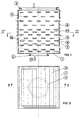
- Figure 1 is a schematic sectional view longitudinal, along line I-I of FIG. 2, with partial breaks, of a first embodiment of the pump according to the invention.
- Figure 2 is a cross section along the line II-II of figure 1.
- Figure 3 is, on a larger scale, a sectional view transverse of an essential part of the pump following this first embodiment.
- FIG. 4 represents a variant of the form of realization shown in figure 3.
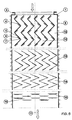
- Figure 5 is a schematic view in longitudinal section similar to Figure 1 of a second embodiment of the pump according to the invention.
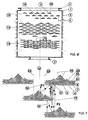
- Figure 6 is a schematic view similar to Figures 1 and 5 of a third embodiment of the pump according to the invention.
- Figure 7 is, on a larger scale, a detail view of part of Figure 6.
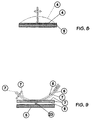
- Figure 8 is a detail view of a first variant embodiments according to the preceding figures.
- Figure 9 is a detail view of a second variant embodiments according to the preceding figures.
- the invention relates to a new type of vacuum pump mainly intended for pumping in a pressure zone between 10 Pa and 10 -6 Pa (0.1 mbar and 10 -8 mbar). It is therefore a pump operating in a so-called molecular regime, that is to say a pump for which the collisions of the molecules with the walls of the pump strongly dominate the collisions between the molecules.
- FIG. 1 A first embodiment of such a pump has been shown in Figures 1 and 2. It includes a box or carcass waterproof metal 1 having, at one of its sides, an opening input 2 intended to be connected to an enclosure, not shown, in which it is necessary to create a high vacuum. An exit opening 3 intended to be connected to a discharge pump, also not shown, is provided on the opposite side of this box 1.
- these elements 4 are such as to allow to involve the gas molecules, coming from the above-mentioned enclosure, and coming into contact with the elements 4, a speed the result of which is oriented towards the outlet opening 3.
- These elements 4 constitute the active parts of the pump and are placed in successive stages. They allow gas to be pumped from inlet opening 2 to outlet opening 3 in increasing the gas pressure from stage to stage. This is obtained in subjecting, on each stage, the molecules of the gas to a sequence of deceleration followed by acceleration by elements 4 of the latter to the elements of the next floor.
- the molecular pump according to the invention must have a high pumping speed on stages near inlet opening 2 and lower pumping speed on the floors located near the outlet opening 3 where the pressure will be the highest.
- stage gas pressure To allow the stage gas pressure to be increased by stage, so the pumping speed must decrease in proportion, this which translates, in practice, by a passage section 10 for the gas from one floor to the other decreasing towards the exit opening 3.
- the aforementioned elements 4 are mounted on a fixed support 5, on the side of the latter, oriented towards the opening of aforementioned outlet 3 and are made in such a way as to be able to cooperate with means 9 for subjecting them to vibration having a component oriented towards the outlet opening 3.
- means are provided to maintain the support supra 5 at a significantly reduced temperature, for example at the ambient temperature.
- the support 5 and the box 1 are made in one heating material, in particular metal, and are connected in a way conductive heat between them to a cooling circuit 8 powered for example by water surrounding the box 1.
- Each element 4 comprises a vibrating member 6 which, in the embodiment shown in Figure 1, is formed by a layer of piezoelectric material fixed on the metal support 5 and covered, on its face opposite to that facing the support 5, by a coating formed of an electrically conductive material 7.
- Means 9, formed by a voltage generator alternative electrical, including sinusoidal, are provided for allow the piezoelectric material layer 6 to undergo a deformation in a direction transverse to the support 5 and, by Consequently, at the above-mentioned coating 7, a corresponding vibration.
- the coating surface 7 subjected to this vibration transverse thus communicates a speed to the gas molecules essentially in the direction of pumping and actually plays the role of the rotor of a turbomolecular pump.
- support 5 must be fixed relative to the pump frame, that is to say relative to the box 1 of the latter, while the surface 7 alone can be vibrated transverse under the effect of the intermediate layer 6 which is therefore preferably made of a piezoelectric material.
- the vibration frequency and the amplitude thereof are linked by the fact that the speed of movement of the surface 7 must less reach a speed of the order of the so-called "thermal" speed of gas molecules under pumping conditions.
- the operating principle may vary.
- the vibrating member 6 could be, for example, a setting device magnetic vibration comprising an electromagnet, or a device electrostatic in which the support 5 and the surface 7 form together a capacitor subjected to an alternating electric voltage or a magnetostrictive transducer.
- polymeric piezoelectric materials and in particular the aforementioned polymers are particularly advantageous insofar as their low acoustic impedance (4.10 6 kgm -2 s -1 ) and their low density make it possible to vibrate the surface 7 without communicating this vibration to the support 5 maintained at a relatively reduced temperature.
- the characteristic dimension between two stages is preferably a few centimeters at most, while for a pressure of 1 Pa (0.01 mbar), this dimension changes to a few mm. and will even more reduced for pressures of the order of 10 Pa (0.1 mbar).
- the sealed box 1, in which are arranged the vibrating elements 4 has a cross section square or rectangular, as shown clearly in Figure 2, and the metal supports 5 are arranged in successive stages and in staggered in this box.
- These supports consist of blades extending parallel to each other between two opposite walls of the box 1.
- these blades forming the supports 5 are cooled by thermal contact with these walls of the box 1.
- These blades are located in planes parallel to each other, each of these planes determining a floor. In each stage the blades are located at a certain distance from each other to allow gas to flow from one floor to the other.
- each of the support blades 5 is coated with a piezoelectric PVDF film which is plugged into a oscillating circuit 9, as shown in more detail in FIGS. 3 and 4, allowing this film to vibrate preferably at a frequency close to of its resonant frequency.
- this oscillating circuit comprises a generator of alternating electric voltage 9 'which is connected, of a part, to the conductive coating 7 deposited on the piezoelectric film 6 and, on the other hand, to the metal support 5.
- PVDF film can either be directly in contact with support 5 if the latter is electrically conductive, i.e. beforehand coated with a conductive film if the support 5 is not a conductor of electricity.
- Figure 5 shows a second embodiment of a preferred configuration of the vibrating elements 4 in the box 1.
- the first stages of the pump that is to say those close to the inlet opening 2 are inclined by relative to the longitudinal axis of the box 1 at an angle of about 45 ° so increase the pumping speed.
- Figure 6 relates to a third configuration preferred shape and arrangement of supports 5 and vibrating elements 4.
- FIG. 7 represents a detail of this same Fig.
- the supports 5 are staggered and have a cross section transverse having substantially the shape of an isosceles triangle whose vertex is oriented towards the entrance opening 2.
- the inclination of the oblique lateral sides 16 of these supports are such as to allow a maximum reflection of the molecules of gas striking these sides towards the base 17 of the supports provided with the vibrating element 7, as shown by the arrows 18.
- the distance between the supports 5 is maximum in order to create a passage 10 which is maximum for molecules reflected by a stage towards the following stage of vibrating elements. In the following areas the floors get closer and closer one of the other and the passage sections 10 become more reduced.
- the height of the triangular supports 5 also decreases and the sides obliques 16 have a concave shape whose curvature is fixed in depending on the opening of passage 10 so that a maximum molecules are transmitted to the next floor.
- FIG. 6 and 7 An important feature of the configuration shown in Figures 6 and 7 is the presence of vibrating elements 19 similar to elements 4 and partially covering the oblique lateral sides 16 of supports 5.
- these elements 19 consist of a layer intermediate 21 preferably made of a piezoelectric material covered with a conductive coating 20, and partially face the elements 4 of the previous floor.
- These elements 19 make it possible to communicate kinetic energy to molecules in a series successive collisions with these vibrating elements rather than during of a single collision while bringing the molecules substantially towards the passage 10 allowing access to the next floor.
- the kinetic energy of the excited molecules decreases during collisions with the parts of the oblique sides 16 not covered by the elements 19, thus causing an increase in pressure at this stage (P2) with respect to the pressure prevailing in the preceding stage (P1).
- the essential advantage of this configuration is to allow to communicate the kinetic energy necessary to pump the molecules in several stages, which has the practical consequence of allow to work with values of the product of the pulsation and the amplitude of the vibration less than 500 m / s.
- the base of the triangle could have a shape curved, both concave and convex.
- the vibrating element 4 could possibly undergo, during its vibration, a deformation amplified and alternately go from a concave or flat shape to a convex or concave shape, so as to obtain an increase the amplitude of the vibration.
- the vibrating element could be formed by a flexible blade held by its two ends in the support 5 in order to be able to undergo, under the effect of the oscillating circuit 9, a deformation of a substantially flat position, in the rest state, in a bent position, in the excited state, as shown in Figure 8.
- the vibrating element 4 could consist of a piezoelectric blade fixed at a point 23 to the support 5 and undergo, under the effect of the oscillating circuit 9, a displacement between a rest position and a deformed position, somewhat of the same way as a bimetallic strip.
- a piezoelectric blade fixed at a point 23 to the support 5 and undergo, under the effect of the oscillating circuit 9, a displacement between a rest position and a deformed position, somewhat of the same way as a bimetallic strip.
- This example concerns a molecular pump of the type such as shown in figure 6 and includes 30 superimposed horizontal stages in which the supports 5 of the vibrating elements 4 are mounted in staggered.
- Each of these supports 5 has the dimensions following cross-sections: 700 mm x 15 mm and are distributed in a box of rectangular horizontal section of 700 mm x 600 mm.
- Each floor consists of 20 rectangular supports 5 of triangular appearance arranged in a similar manner to that of FIG. 6.
- a PVDF film 6 partially facing the PVDF films 20 fixed on a part of the sides 16 of the supports 5 of the next stage.
- Piezoelectric films which are excited at a frequency close to their resonance frequency of the order of 10 MHz make it possible to achieve a compression ratio of 2 from one stage to the other of the pump for a gas formed from 'nitrogen. This makes it possible to obtain a maximum compression ratio of 10 9 for the aforementioned 30 stages of the pump.
- the nominal pumping speed is 24,000 I / s for nitrogen at 25 ° C and the maximum mass flow rate reached is 24 mbar.litre.sec -1 or 86.4 mbar.m 3 / h.
- the support of a stage could be formed by a perforated plate on the face thereof, oriented towards the outlet opening 3, the vibrating elements are fixed.
- the elements may be constituted by very varied means.
- box 1 can be placed in different positions, for example with the inlet opening 2 facing downwards or towards the side.
- This box 1 could also have other geometries than a prismatic shape. So it could for example present a cylindrical shape with circular section.
Landscapes
- Engineering & Computer Science (AREA)
- Mechanical Engineering (AREA)
- General Engineering & Computer Science (AREA)
- Reciprocating Pumps (AREA)
- Fluid-Driven Valves (AREA)
- Transition And Organic Metals Composition Catalysts For Addition Polymerization (AREA)
- Structures Of Non-Positive Displacement Pumps (AREA)
- Electron Beam Exposure (AREA)
- Applications Or Details Of Rotary Compressors (AREA)
- Non-Positive Displacement Air Blowers (AREA)
Claims (13)
- Molekularpumpe, welche dazu dient, ein Gas aus einem Behältnis abzusaugen und dadurch in diesem letzteren ein hohes Vakuum zu erzeugen, und welche umfasst: ein ausgesprochen dichtes Gehäuse (1), das auf einer Seite eine Eintrittsöffnung (2), die für den Anschluss an das oben erwähnte Behältnis bestimmt ist, und auf der der oben erwähnten Seite gegenüber liegenden Seite eine Austrittsöffnung (3) aufweist, für die Durchleitung des Gases bestimmte Bauteile (4), welche zwischen diesen zwei Öffnungen (2) und (3) in einem gewissen Abstand voneinander auf in dem oben genannten Gehäuse (1) befestigten Halterungen (5) angeordnet sind, dadurch gekennzeichnet, dass die besagten Bauteile (4) auf den festen Halterungen (5) von der Seite dieser letzteren zur Austrittsöffnung (3) hin gerichtet dergestalt montiert sind, dass mit diesen Halterungen eine Folge von Dipolen festgelegt wird, deren aktive Teile, die von diesen Bauteilen gebildet werden, ebenfalls zur Austrittsöffnung gerichtet sind, und dass dadurch ermöglicht wird, den Gasmolekülen, die von dem oben genannten Behältnis kommen und mit diesen Bauteilen in Kontakt geraten, eine Beschleunigung in Richtung auf die Austrittsöffnung zu erteilen.
- Pumpe nach Anspruch 1, dadurch gekennzeichnet, dass die vorganannten Bauteile (4) mit Mitteln (9) zusammen wirken, welche es ermöglichen, dass diese in eine Schwingung versetzt werden, die eine auf die Austrittsöffnung zeigende Komponente aufweist.
- Pumpe nach einem der Ansprüche 1 und 2, dadurch gekennzeichnet, dass die Halterung (5) aus einem wärmespendenden und wärmeleitenden Material gefertigt und an einen Kühlkreislauf angeschlossen ist, wodurch diese Halterung (5) den kalten Teil eines Dipols bildet, und dass das Bauteil (4) von diesem kalten Teil durch einen Dämmstoff getrennt ist und den warmen Teil des Dipols bildet.
- Pumpe nach einem beliebigen der Ansprüche 1 bis 3, dadurch gekennzeichnet, dass die vorgenannten Bauteile (4) in der Form der Fünf auf dem Würfel angeordnet sind.
- Pumpe nach Anspruch 4, dadurch gekennzeichnet, dass Mittel vorhanden sind, um die vorgenannte Halterung (5) auf einer merklich niedrigen Temperatur, beispielsweise auf Umgebungstemperatur, zu halten.
- Pumpe nach Anspruch 5, dadurch gekennzeichnet, dass die Halterung (5) und das Gehäuse (1) aus einem wärmespendenden Material gefertigt und miteinander leitend verbunden sind, wobei die vorgenannten Mittel, die zur Aufrechterhaltung der relativ niedrigen Temperatur der Halterung dienen, einen Kühlkreislauf (8) umfassen, der das oben genannte Gehäuse (1) umgibt.
- Pumpe nach einem beliebigen der Ansprüche 4 bis 6, dadurch gekennzeichnet, dass das vorgenannte Bauteil (4) ein piezoelektrisches Material (6) enthält, welches an der vorgenannten Halterung (5) befestigt und auf der Seite, die der zur Halterung hin gerichteten Seite gegenüber liegt, mit einem elektrisch leitenden Überzug (7) bedeckt ist, wobei Mittel (9) vorhanden sind, um an dieses Bauteil (4) eine elektrische Wechselspannung in der Weise anzulegen, so dass dieses piezoelektrische Material (6) eine Verformung in einer zur Halterung (5) quer verlaufenden Richtung erfährt und folglich der oben genannte Überzug (7) in eine entsprechende Schwingung versetzt wird.
- Pumpe nach Anspruch 7, dadurch gekennzeichnet, dass die mit der Halterung in Kontakt befindliche Fläche des piezoelektrischen Materials (6) und der Überzug (7) auf Masse liegen.
- Pumpe nach einem der Ansprüche 7 oder 8, dadurch gekennzeichnet, dass das piezoelektrische Material (6) Bestandteil eines biegsamen Blattes ist, welches auf die Halterung montiert ist und eine elastische Verformung unter der Wirkung der oben genannten elektrischen Wechselspannung erleiden kann.
- Pumpe nach einem beliebigen der Ansprüche 4 bis 9, dadurch gekennzeichnet, dass die Halterungen (5) in der Form wie die Fünf auf dem Würfel angeordnet sind und in Querrichtung einen Querschnitt aufweisen, der die Form eines gleichschenkeligen Dreiecks hat, dessen Gipfel in Richtung auf diejenige Seite des Gehäuses (1) gerichtet ist, in welcher sich die Eintrittsöffnung (2) befindet, wobei die schrägen Seitenkanten (16) dieser Halterungen (5) dergestalt geneigt sind, dass sie eine Reflexion der auf diese Seiten prallenden Moleküle zur Basis (17) der Halterungen (5) der vorhergehenden Stufe ermöglichen.
- Pumpe nach Anspruch 10, dadurch gekennzeichnet, dass die schrägen Kanten (16) der Halterungen (5) wenigstens teilweise konkav sind.
- Pumpe nach einem beliebigen der Ansprüche 4 bis 11, dadurch gekennzeichnet, dass die Seiten (16) der Halterungen (5) einer bestimmten Stufe, die zu den Halterungen (5) einer vorausgehenden Stufe hin gerichtet sind, teilweise mit Bauteilen (19) bedeckt sind, welche in eine solche Schwingung versetzt werden können, die eine Komponente aufweist, welche auf die Bauteile (4), die auf der Seite (17) der Halterungen der auf die Austrittsöffnung (3) zeigenden vorausgehenden Stufe vorhanden sind, gerichtet ist, und zwar dergestalt, dass ermöglicht wird, dass die Moleküle durch eine Reihe von Mehrfachstößen mit den schwingenden Flächen (7) der Bauteile (4) und (19), auf die sie vor ihrem Weitertransport zur folgenden Stufe stoßen, einen Gewinn an kinetischer Energie erfahren.
- Pumpe nach einem beliebigen der Ansprüche 7 bis 11, dadurch gekennzeichnet, dass das piezoelektrische Material (6) aus Quarz, Rochettesalz (NaKC4H4O6NH2O), Lithiumsulfat (Li2SO4H2O), Bleimetaniobat (PbNb2O6), Bleititanat (PT), Bleititanzirkonat (PZT), Polyvinylidenfluorid (PVDF), Kopolymer von Polyvinylidenfluorid und Tetrafluorethylen (P(VDF-TeFE)) oder Kopolymer von Vinylidenzyanid und Vinylazetat (P(VDCN-VAC)). besteht.
Priority Applications (1)
| Application Number | Priority Date | Filing Date | Title |
|---|---|---|---|
| EP99948619A EP1125065B1 (de) | 1998-10-20 | 1999-10-15 | Molekularpumpe |
Applications Claiming Priority (4)
| Application Number | Priority Date | Filing Date | Title |
|---|---|---|---|
| EP98203502A EP0995908A1 (de) | 1998-10-20 | 1998-10-20 | Molekularpumpe |
| EP98203502 | 1998-10-20 | ||
| EP99948619A EP1125065B1 (de) | 1998-10-20 | 1999-10-15 | Molekularpumpe |
| PCT/BE1999/000127 WO2000023715A1 (fr) | 1998-10-20 | 1999-10-15 | Pompe moleculaire |
Publications (2)
| Publication Number | Publication Date |
|---|---|
| EP1125065A1 EP1125065A1 (de) | 2001-08-22 |
| EP1125065B1 true EP1125065B1 (de) | 2002-07-17 |
Family
ID=8234232
Family Applications (2)
| Application Number | Title | Priority Date | Filing Date |
|---|---|---|---|
| EP98203502A Withdrawn EP0995908A1 (de) | 1998-10-20 | 1998-10-20 | Molekularpumpe |
| EP99948619A Expired - Lifetime EP1125065B1 (de) | 1998-10-20 | 1999-10-15 | Molekularpumpe |
Family Applications Before (1)
| Application Number | Title | Priority Date | Filing Date |
|---|---|---|---|
| EP98203502A Withdrawn EP0995908A1 (de) | 1998-10-20 | 1998-10-20 | Molekularpumpe |
Country Status (12)
| Country | Link |
|---|---|
| US (1) | US6612816B1 (de) |
| EP (2) | EP0995908A1 (de) |
| JP (1) | JP2002527683A (de) |
| AT (1) | ATE220765T1 (de) |
| AU (1) | AU763828B2 (de) |
| CA (1) | CA2347169A1 (de) |
| DE (1) | DE69902187T2 (de) |
| DK (1) | DK1125065T3 (de) |
| ES (1) | ES2181480T3 (de) |
| PT (1) | PT1125065E (de) |
| WO (1) | WO2000023715A1 (de) |
| ZA (1) | ZA200104022B (de) |
Cited By (1)
| Publication number | Priority date | Publication date | Assignee | Title |
|---|---|---|---|---|
| US7083398B2 (en) | 2002-10-04 | 2006-08-01 | Varian S.P.A. | Vibrating pumping stage for molecular vacuum pumps, and molecular vacuum pump with vibrating pumping stages |
Families Citing this family (45)
| Publication number | Priority date | Publication date | Assignee | Title |
|---|---|---|---|---|
| US10541070B2 (en) | 2016-04-25 | 2020-01-21 | Haier Us Appliance Solutions, Inc. | Method for forming a bed of stabilized magneto-caloric material |
| US10274231B2 (en) | 2016-07-19 | 2019-04-30 | Haier Us Appliance Solutions, Inc. | Caloric heat pump system |
| US10295227B2 (en) * | 2016-07-19 | 2019-05-21 | Haier Us Appliance Solutions, Inc. | Caloric heat pump system |
| US10281177B2 (en) | 2016-07-19 | 2019-05-07 | Haier Us Appliance Solutions, Inc. | Caloric heat pump system |
| US10443585B2 (en) | 2016-08-26 | 2019-10-15 | Haier Us Appliance Solutions, Inc. | Pump for a heat pump system |
| US10386096B2 (en) | 2016-12-06 | 2019-08-20 | Haier Us Appliance Solutions, Inc. | Magnet assembly for a magneto-caloric heat pump |
| US11009282B2 (en) | 2017-03-28 | 2021-05-18 | Haier Us Appliance Solutions, Inc. | Refrigerator appliance with a caloric heat pump |
| US10527325B2 (en) | 2017-03-28 | 2020-01-07 | Haier Us Appliance Solutions, Inc. | Refrigerator appliance |
| US10451320B2 (en) | 2017-05-25 | 2019-10-22 | Haier Us Appliance Solutions, Inc. | Refrigerator appliance with water condensing features |
| US10422555B2 (en) | 2017-07-19 | 2019-09-24 | Haier Us Appliance Solutions, Inc. | Refrigerator appliance with a caloric heat pump |
| US10451322B2 (en) | 2017-07-19 | 2019-10-22 | Haier Us Appliance Solutions, Inc. | Refrigerator appliance with a caloric heat pump |
| US10520229B2 (en) | 2017-11-14 | 2019-12-31 | Haier Us Appliance Solutions, Inc. | Caloric heat pump for an appliance |
| US11022348B2 (en) | 2017-12-12 | 2021-06-01 | Haier Us Appliance Solutions, Inc. | Caloric heat pump for an appliance |
| US10551095B2 (en) | 2018-04-18 | 2020-02-04 | Haier Us Appliance Solutions, Inc. | Magneto-caloric thermal diode assembly |
| US10648704B2 (en) | 2018-04-18 | 2020-05-12 | Haier Us Appliance Solutions, Inc. | Magneto-caloric thermal diode assembly |
| US10641539B2 (en) | 2018-04-18 | 2020-05-05 | Haier Us Appliance Solutions, Inc. | Magneto-caloric thermal diode assembly |
| US10876770B2 (en) | 2018-04-18 | 2020-12-29 | Haier Us Appliance Solutions, Inc. | Method for operating an elasto-caloric heat pump with variable pre-strain |
| US10782051B2 (en) | 2018-04-18 | 2020-09-22 | Haier Us Appliance Solutions, Inc. | Magneto-caloric thermal diode assembly |
| US10830506B2 (en) | 2018-04-18 | 2020-11-10 | Haier Us Appliance Solutions, Inc. | Variable speed magneto-caloric thermal diode assembly |
| US10648706B2 (en) | 2018-04-18 | 2020-05-12 | Haier Us Appliance Solutions, Inc. | Magneto-caloric thermal diode assembly with an axially pinned magneto-caloric cylinder |
| US10648705B2 (en) | 2018-04-18 | 2020-05-12 | Haier Us Appliance Solutions, Inc. | Magneto-caloric thermal diode assembly |
| US10557649B2 (en) | 2018-04-18 | 2020-02-11 | Haier Us Appliance Solutions, Inc. | Variable temperature magneto-caloric thermal diode assembly |
| US10989449B2 (en) | 2018-05-10 | 2021-04-27 | Haier Us Appliance Solutions, Inc. | Magneto-caloric thermal diode assembly with radial supports |
| US11054176B2 (en) | 2018-05-10 | 2021-07-06 | Haier Us Appliance Solutions, Inc. | Magneto-caloric thermal diode assembly with a modular magnet system |
| US11015842B2 (en) | 2018-05-10 | 2021-05-25 | Haier Us Appliance Solutions, Inc. | Magneto-caloric thermal diode assembly with radial polarity alignment |
| US10684044B2 (en) | 2018-07-17 | 2020-06-16 | Haier Us Appliance Solutions, Inc. | Magneto-caloric thermal diode assembly with a rotating heat exchanger |
| US11092364B2 (en) | 2018-07-17 | 2021-08-17 | Haier Us Appliance Solutions, Inc. | Magneto-caloric thermal diode assembly with a heat transfer fluid circuit |
| US10788034B2 (en) | 2018-08-10 | 2020-09-29 | Frore Systems Inc. | Mobile phone and other compute device cooling architecture |
| US11464140B2 (en) | 2019-12-06 | 2022-10-04 | Frore Systems Inc. | Centrally anchored MEMS-based active cooling systems |
| US12089374B2 (en) | 2018-08-10 | 2024-09-10 | Frore Systems Inc. | MEMS-based active cooling systems |
| US11274860B2 (en) | 2019-01-08 | 2022-03-15 | Haier Us Appliance Solutions, Inc. | Mechano-caloric stage with inner and outer sleeves |
| US11168926B2 (en) | 2019-01-08 | 2021-11-09 | Haier Us Appliance Solutions, Inc. | Leveraged mechano-caloric heat pump |
| US11193697B2 (en) | 2019-01-08 | 2021-12-07 | Haier Us Appliance Solutions, Inc. | Fan speed control method for caloric heat pump systems |
| US11149994B2 (en) | 2019-01-08 | 2021-10-19 | Haier Us Appliance Solutions, Inc. | Uneven flow valve for a caloric regenerator |
| US11112146B2 (en) | 2019-02-12 | 2021-09-07 | Haier Us Appliance Solutions, Inc. | Heat pump and cascaded caloric regenerator assembly |
| US11015843B2 (en) | 2019-05-29 | 2021-05-25 | Haier Us Appliance Solutions, Inc. | Caloric heat pump hydraulic system |
| KR102677216B1 (ko) * | 2019-10-30 | 2024-06-24 | 프로리 시스템스 인코포레이티드 | Mems 기반 기류 시스템 |
| US11796262B2 (en) | 2019-12-06 | 2023-10-24 | Frore Systems Inc. | Top chamber cavities for center-pinned actuators |
| US12193192B2 (en) | 2019-12-06 | 2025-01-07 | Frore Systems Inc. | Cavities for center-pinned actuator cooling systems |
| US11510341B2 (en) | 2019-12-06 | 2022-11-22 | Frore Systems Inc. | Engineered actuators usable in MEMs active cooling devices |
| US12029005B2 (en) | 2019-12-17 | 2024-07-02 | Frore Systems Inc. | MEMS-based cooling systems for closed and open devices |
| US12033917B2 (en) | 2019-12-17 | 2024-07-09 | Frore Systems Inc. | Airflow control in active cooling systems |
| US11765863B2 (en) | 2020-10-02 | 2023-09-19 | Frore Systems Inc. | Active heat sink |
| US12167564B2 (en) | 2021-03-02 | 2024-12-10 | Frore Systems Inc. | Integration of airjets into computing devices |
| WO2022187160A1 (en) | 2021-03-02 | 2022-09-09 | Frore Systems Inc. | Exhaust blending for piezoelectric cooling systems |
Family Cites Families (14)
| Publication number | Priority date | Publication date | Assignee | Title |
|---|---|---|---|---|
| US3374941A (en) * | 1964-06-30 | 1968-03-26 | American Standard Inc | Air blower |
| US3554669A (en) * | 1968-12-04 | 1971-01-12 | Gen Electric | Electric-fluid energy converter |
| DE3067101D1 (en) * | 1979-05-07 | 1984-04-26 | Piezo Electric Prod | Solid state blower |
| US4498851A (en) * | 1980-05-02 | 1985-02-12 | Piezo Electric Products, Inc. | Solid state blower |
| US4595338A (en) * | 1983-11-17 | 1986-06-17 | Piezo Electric Products, Inc. | Non-vibrational oscillating blade piezoelectric blower |
| US4780062A (en) * | 1985-10-09 | 1988-10-25 | Murata Manufacturing Co., Ltd. | Piezoelectric fan |
| DE3925749C1 (de) * | 1989-08-03 | 1990-10-31 | Fraunhofer-Gesellschaft Zur Foerderung Der Angewandten Forschung Ev, 8000 Muenchen, De | |
| US5192197A (en) * | 1991-11-27 | 1993-03-09 | Rockwell International Corporation | Piezoelectric pump |
| SG44800A1 (en) * | 1993-12-28 | 1997-12-19 | Westonbridge Int Ltd | A micropump |
| WO1996018823A1 (en) * | 1994-12-15 | 1996-06-20 | The Whitaker Corporation | Metal enforced pvdf vibrational fan |
| US6071087A (en) * | 1996-04-03 | 2000-06-06 | The United States Of America As Represented By The Administrator Of The National Aeronautics And Space Administration | Ferroelectric pump |
| US6042345A (en) * | 1997-04-15 | 2000-03-28 | Face International Corporation | Piezoelectrically actuated fluid pumps |
| US6074178A (en) * | 1997-04-15 | 2000-06-13 | Face International Corp. | Piezoelectrically actuated peristaltic pump |
| US6106245A (en) * | 1997-10-09 | 2000-08-22 | Honeywell | Low cost, high pumping rate electrostatically actuated mesopump |
-
1998
- 1998-10-20 EP EP98203502A patent/EP0995908A1/de not_active Withdrawn
-
1999
- 1999-10-15 CA CA002347169A patent/CA2347169A1/fr not_active Abandoned
- 1999-10-15 DK DK99948619T patent/DK1125065T3/da active
- 1999-10-15 AU AU61839/99A patent/AU763828B2/en not_active Ceased
- 1999-10-15 AT AT99948619T patent/ATE220765T1/de not_active IP Right Cessation
- 1999-10-15 WO PCT/BE1999/000127 patent/WO2000023715A1/fr not_active Ceased
- 1999-10-15 DE DE69902187T patent/DE69902187T2/de not_active Expired - Fee Related
- 1999-10-15 US US09/830,022 patent/US6612816B1/en not_active Expired - Fee Related
- 1999-10-15 ES ES99948619T patent/ES2181480T3/es not_active Expired - Lifetime
- 1999-10-15 JP JP2000577413A patent/JP2002527683A/ja active Pending
- 1999-10-15 EP EP99948619A patent/EP1125065B1/de not_active Expired - Lifetime
- 1999-10-15 PT PT99948619T patent/PT1125065E/pt unknown
-
2001
- 2001-05-17 ZA ZA200104022A patent/ZA200104022B/xx unknown
Cited By (1)
| Publication number | Priority date | Publication date | Assignee | Title |
|---|---|---|---|---|
| US7083398B2 (en) | 2002-10-04 | 2006-08-01 | Varian S.P.A. | Vibrating pumping stage for molecular vacuum pumps, and molecular vacuum pump with vibrating pumping stages |
Also Published As
| Publication number | Publication date |
|---|---|
| AU6183999A (en) | 2000-05-08 |
| ES2181480T3 (es) | 2003-02-16 |
| WO2000023715A1 (fr) | 2000-04-27 |
| DE69902187D1 (de) | 2002-08-22 |
| EP0995908A1 (de) | 2000-04-26 |
| ATE220765T1 (de) | 2002-08-15 |
| EP1125065A1 (de) | 2001-08-22 |
| DK1125065T3 (da) | 2002-11-04 |
| AU763828B2 (en) | 2003-07-31 |
| ZA200104022B (en) | 2002-05-17 |
| JP2002527683A (ja) | 2002-08-27 |
| DE69902187T2 (de) | 2003-03-06 |
| CA2347169A1 (fr) | 2000-04-27 |
| PT1125065E (pt) | 2002-12-31 |
| US6612816B1 (en) | 2003-09-02 |
Similar Documents
| Publication | Publication Date | Title |
|---|---|---|
| EP1125065B1 (de) | Molekularpumpe | |
| EP1669609B1 (de) | Partialdruckregelung von Gas zur Optimierung eines Verfahrens | |
| WO2017137455A1 (fr) | Absorbeur acoustique, paroi acoustique et procede de conception et fabrication | |
| FR2525410A1 (fr) | Moteur piezo-electrique | |
| FR2610405A1 (fr) | Transducteur de pression a resonateur et son procede de fabrication | |
| FR2965068A1 (fr) | Dispositif a membrane deformable par actionnement a temps de reponse reduit | |
| FR3059659A1 (fr) | Dispositif de transmission d'un mouvement et d'une force entre deux zones isolees l'une de l'autre | |
| FR2493984A1 (fr) | Transducteur de pression a element vibrant | |
| EP2693052A1 (de) | Pumpe, die in einem Substrat ausgeführt ist | |
| FR2925978A1 (fr) | Procede et dispositif de separation d'une structure. | |
| EP3509214A1 (de) | Mikro- oder nanomechanische vorrichtung zur detektion von partikeln | |
| WO2016092020A1 (fr) | Hydrophone piezoelectrique a perforations, antenne comprenant une pluralite d'hydrophones et procede de realisation de l'hydrophone | |
| EP2315001B1 (de) | Vorrichtung zur Gaserkennung | |
| EP3037381A1 (de) | Vorrichtung zur umwandlung einer bewegung aus der ebene in eine bewegung in der ebene bzw. umgekehrt | |
| EP1144873B1 (de) | Vakuumpumpe | |
| FR2684835A1 (fr) | Dispositif resonateur piezoelectrique a quartz. | |
| EP2279406B1 (de) | Vorrichtung und Verfahren zur Erkennung von Elementen in einem Fluidmedium mittels Lambwellen | |
| WO2004102796A1 (fr) | Resonateurs integres et base de temps incorporant de tels resonateurs | |
| FR2633547A1 (fr) | Procede de microperforation de pellicules thermoplastiques par ultrasons | |
| FR2504265A1 (fr) | Dispositif de mesure de la pression d'un gaz | |
| FR2758388A1 (fr) | Procede et appareil pour detecter a distance une pression, une force, une temperature, une densite, une vibration, une viscosite et une vitesse du son dans un fluide | |
| EP0326776B1 (de) | Piezoelektrisch erregte mechanische Schwingeinrichtung und deren Anwendung bei einem Laserkreisel | |
| EP3910344A1 (de) | Detektionsvorrichtung mit piezoresistivem wandler | |
| FR2775396A1 (fr) | Moteur piezoelectrique | |
| FR3033552B1 (fr) | Procede de fabrication d'un micro-generateur mecano-electrique flexible et micro-generateur correspondant |
Legal Events
| Date | Code | Title | Description |
|---|---|---|---|
| PUAI | Public reference made under article 153(3) epc to a published international application that has entered the european phase |
Free format text: ORIGINAL CODE: 0009012 |
|
| 17P | Request for examination filed |
Effective date: 20010522 |
|
| AK | Designated contracting states |
Kind code of ref document: A1 Designated state(s): AT BE CH CY DE DK ES FI FR GB GR IE IT LI LU MC NL PT SE |
|
| AX | Request for extension of the european patent |
Free format text: AL;LT;LV;MK;RO;SI |
|
| GRAG | Despatch of communication of intention to grant |
Free format text: ORIGINAL CODE: EPIDOS AGRA |
|
| 17Q | First examination report despatched |
Effective date: 20011031 |
|
| GRAG | Despatch of communication of intention to grant |
Free format text: ORIGINAL CODE: EPIDOS AGRA |
|
| GRAH | Despatch of communication of intention to grant a patent |
Free format text: ORIGINAL CODE: EPIDOS IGRA |
|
| GRAH | Despatch of communication of intention to grant a patent |
Free format text: ORIGINAL CODE: EPIDOS IGRA |
|
| GRAA | (expected) grant |
Free format text: ORIGINAL CODE: 0009210 |
|
| AK | Designated contracting states |
Kind code of ref document: B1 Designated state(s): AT BE CH CY DE DK ES FI FR GB GR IE IT LI LU MC NL PT SE |
|
| REF | Corresponds to: |
Ref document number: 220765 Country of ref document: AT Date of ref document: 20020815 Kind code of ref document: T |
|
| REG | Reference to a national code |
Ref country code: GB Ref legal event code: FG4D Free format text: NOT ENGLISH |
|
| REG | Reference to a national code |
Ref country code: CH Ref legal event code: EP |
|
| REG | Reference to a national code |
Ref country code: IE Ref legal event code: FG4D Free format text: FRENCH |
|
| REF | Corresponds to: |
Ref document number: 69902187 Country of ref document: DE Date of ref document: 20020822 |
|
| GBT | Gb: translation of ep patent filed (gb section 77(6)(a)/1977) |
Effective date: 20021003 |
|
| PG25 | Lapsed in a contracting state [announced via postgrant information from national office to epo] |
Ref country code: CY Free format text: LAPSE BECAUSE OF FAILURE TO SUBMIT A TRANSLATION OF THE DESCRIPTION OR TO PAY THE FEE WITHIN THE PRESCRIBED TIME-LIMIT Effective date: 20021031 |
|
| REG | Reference to a national code |
Ref country code: GR Ref legal event code: EP Ref document number: 20020403412 Country of ref document: GR |
|
| REG | Reference to a national code |
Ref country code: PT Ref legal event code: SC4A Free format text: AVAILABILITY OF NATIONAL TRANSLATION Effective date: 20021016 |
|
| REG | Reference to a national code |
Ref country code: ES Ref legal event code: FG2A Ref document number: 2181480 Country of ref document: ES Kind code of ref document: T3 |
|
| REG | Reference to a national code |
Ref country code: CH Ref legal event code: NV Representative=s name: ISLER & PEDRAZZINI AG |
|
| PG25 | Lapsed in a contracting state [announced via postgrant information from national office to epo] |
Ref country code: MC Free format text: LAPSE BECAUSE OF NON-PAYMENT OF DUE FEES Effective date: 20030501 |
|
| PLBE | No opposition filed within time limit |
Free format text: ORIGINAL CODE: 0009261 |
|
| STAA | Information on the status of an ep patent application or granted ep patent |
Free format text: STATUS: NO OPPOSITION FILED WITHIN TIME LIMIT |
|
| 26N | No opposition filed |
Effective date: 20030422 |
|
| PGFP | Annual fee paid to national office [announced via postgrant information from national office to epo] |
Ref country code: PT Payment date: 20031009 Year of fee payment: 5 |
|
| PGFP | Annual fee paid to national office [announced via postgrant information from national office to epo] |
Ref country code: ES Payment date: 20031010 Year of fee payment: 5 |
|
| PGFP | Annual fee paid to national office [announced via postgrant information from national office to epo] |
Ref country code: GR Payment date: 20031023 Year of fee payment: 5 |
|
| PGFP | Annual fee paid to national office [announced via postgrant information from national office to epo] |
Ref country code: FI Payment date: 20031024 Year of fee payment: 5 |
|
| PGFP | Annual fee paid to national office [announced via postgrant information from national office to epo] |
Ref country code: DK Payment date: 20031027 Year of fee payment: 5 |
|
| PGFP | Annual fee paid to national office [announced via postgrant information from national office to epo] |
Ref country code: SE Payment date: 20031028 Year of fee payment: 5 Ref country code: IE Payment date: 20031028 Year of fee payment: 5 |
|
| PGFP | Annual fee paid to national office [announced via postgrant information from national office to epo] |
Ref country code: AT Payment date: 20031031 Year of fee payment: 5 |
|
| PGFP | Annual fee paid to national office [announced via postgrant information from national office to epo] |
Ref country code: LU Payment date: 20031103 Year of fee payment: 5 |
|
| PGFP | Annual fee paid to national office [announced via postgrant information from national office to epo] |
Ref country code: CH Payment date: 20031105 Year of fee payment: 5 |
|
| PG25 | Lapsed in a contracting state [announced via postgrant information from national office to epo] |
Ref country code: LU Free format text: LAPSE BECAUSE OF NON-PAYMENT OF DUE FEES Effective date: 20041015 Ref country code: IE Free format text: LAPSE BECAUSE OF NON-PAYMENT OF DUE FEES Effective date: 20041015 Ref country code: FI Free format text: LAPSE BECAUSE OF NON-PAYMENT OF DUE FEES Effective date: 20041015 Ref country code: AT Free format text: LAPSE BECAUSE OF NON-PAYMENT OF DUE FEES Effective date: 20041015 |
|
| PG25 | Lapsed in a contracting state [announced via postgrant information from national office to epo] |
Ref country code: SE Free format text: LAPSE BECAUSE OF NON-PAYMENT OF DUE FEES Effective date: 20041016 Ref country code: ES Free format text: LAPSE BECAUSE OF NON-PAYMENT OF DUE FEES Effective date: 20041016 |
|
| PG25 | Lapsed in a contracting state [announced via postgrant information from national office to epo] |
Ref country code: LI Free format text: LAPSE BECAUSE OF NON-PAYMENT OF DUE FEES Effective date: 20041031 Ref country code: CH Free format text: LAPSE BECAUSE OF NON-PAYMENT OF DUE FEES Effective date: 20041031 |
|
| PG25 | Lapsed in a contracting state [announced via postgrant information from national office to epo] |
Ref country code: DK Free format text: LAPSE BECAUSE OF NON-PAYMENT OF DUE FEES Effective date: 20041101 |
|
| PGFP | Annual fee paid to national office [announced via postgrant information from national office to epo] |
Ref country code: GB Payment date: 20041206 Year of fee payment: 6 |
|
| PGFP | Annual fee paid to national office [announced via postgrant information from national office to epo] |
Ref country code: NL Payment date: 20041210 Year of fee payment: 6 |
|
| PGFP | Annual fee paid to national office [announced via postgrant information from national office to epo] |
Ref country code: FR Payment date: 20041213 Year of fee payment: 6 Ref country code: DE Payment date: 20041213 Year of fee payment: 6 |
|
| PG25 | Lapsed in a contracting state [announced via postgrant information from national office to epo] |
Ref country code: PT Free format text: LAPSE BECAUSE OF NON-PAYMENT OF DUE FEES Effective date: 20050415 |
|
| PG25 | Lapsed in a contracting state [announced via postgrant information from national office to epo] |
Ref country code: GR Free format text: LAPSE BECAUSE OF NON-PAYMENT OF DUE FEES Effective date: 20050504 |
|
| EUG | Se: european patent has lapsed | ||
| REG | Reference to a national code |
Ref country code: DK Ref legal event code: EBP |
|
| REG | Reference to a national code |
Ref country code: CH Ref legal event code: PL |
|
| REG | Reference to a national code |
Ref country code: PT Ref legal event code: MM4A Free format text: LAPSE DUE TO NON-PAYMENT OF FEES Effective date: 20050415 |
|
| REG | Reference to a national code |
Ref country code: IE Ref legal event code: MM4A |
|
| PG25 | Lapsed in a contracting state [announced via postgrant information from national office to epo] |
Ref country code: IT Free format text: LAPSE BECAUSE OF NON-PAYMENT OF DUE FEES Effective date: 20051015 Ref country code: GB Free format text: LAPSE BECAUSE OF NON-PAYMENT OF DUE FEES Effective date: 20051015 |
|
| REG | Reference to a national code |
Ref country code: ES Ref legal event code: FD2A Effective date: 20041016 |
|
| PG25 | Lapsed in a contracting state [announced via postgrant information from national office to epo] |
Ref country code: NL Free format text: LAPSE BECAUSE OF NON-PAYMENT OF DUE FEES Effective date: 20060501 |
|
| PG25 | Lapsed in a contracting state [announced via postgrant information from national office to epo] |
Ref country code: DE Free format text: LAPSE BECAUSE OF NON-PAYMENT OF DUE FEES Effective date: 20060503 |
|
| GBPC | Gb: european patent ceased through non-payment of renewal fee |
Effective date: 20051015 |
|
| PG25 | Lapsed in a contracting state [announced via postgrant information from national office to epo] |
Ref country code: FR Free format text: LAPSE BECAUSE OF NON-PAYMENT OF DUE FEES Effective date: 20060630 |
|
| NLV4 | Nl: lapsed or anulled due to non-payment of the annual fee |
Effective date: 20060501 |
|
| REG | Reference to a national code |
Ref country code: FR Ref legal event code: ST Effective date: 20060630 |
|
| PGFP | Annual fee paid to national office [announced via postgrant information from national office to epo] |
Ref country code: BE Payment date: 20111202 Year of fee payment: 13 |
|
| BERE | Be: lapsed |
Owner name: *VANDEN BRANDE PIERRE Effective date: 20121031 Owner name: *WEYMEERSCH ALAIN Effective date: 20121031 |
|
| PG25 | Lapsed in a contracting state [announced via postgrant information from national office to epo] |
Ref country code: BE Free format text: LAPSE BECAUSE OF NON-PAYMENT OF DUE FEES Effective date: 20121031 |