EP1122906A2 - Verfahren und Netzwerkelement zum Verkehrsschutz in Transportnetzwerken mit WDM-Faseroptik - Google Patents
Verfahren und Netzwerkelement zum Verkehrsschutz in Transportnetzwerken mit WDM-Faseroptik Download PDFInfo
- Publication number
- EP1122906A2 EP1122906A2 EP01400221A EP01400221A EP1122906A2 EP 1122906 A2 EP1122906 A2 EP 1122906A2 EP 01400221 A EP01400221 A EP 01400221A EP 01400221 A EP01400221 A EP 01400221A EP 1122906 A2 EP1122906 A2 EP 1122906A2
- Authority
- EP
- European Patent Office
- Prior art keywords
- network
- ring
- traffic
- network elements
- path
- Prior art date
- Legal status (The legal status is an assumption and is not a legal conclusion. Google has not performed a legal analysis and makes no representation as to the accuracy of the status listed.)
- Withdrawn
Links
- 238000000034 method Methods 0.000 title claims abstract description 28
- 239000000835 fiber Substances 0.000 title abstract description 16
- 230000007246 mechanism Effects 0.000 claims abstract description 33
- 230000003287 optical effect Effects 0.000 claims abstract description 29
- 230000005540 biological transmission Effects 0.000 claims description 6
- 238000012423 maintenance Methods 0.000 claims description 5
- 230000007547 defect Effects 0.000 claims description 3
- 239000013307 optical fiber Substances 0.000 claims description 3
- 238000005516 engineering process Methods 0.000 claims description 2
- 238000004590 computer program Methods 0.000 claims 3
- 238000004891 communication Methods 0.000 claims 1
- 230000000875 corresponding effect Effects 0.000 description 9
- 230000004048 modification Effects 0.000 description 3
- 238000012986 modification Methods 0.000 description 3
- 230000001360 synchronised effect Effects 0.000 description 2
- 238000001514 detection method Methods 0.000 description 1
- 238000010586 diagram Methods 0.000 description 1
- 230000000694 effects Effects 0.000 description 1
- 230000001902 propagating effect Effects 0.000 description 1
- 230000001052 transient effect Effects 0.000 description 1
Images


Classifications
-
- H—ELECTRICITY
- H04—ELECTRIC COMMUNICATION TECHNIQUE
- H04Q—SELECTING
- H04Q11/00—Selecting arrangements for multiplex systems
- H04Q11/0001—Selecting arrangements for multiplex systems using optical switching
- H04Q11/0062—Network aspects
-
- H—ELECTRICITY
- H04—ELECTRIC COMMUNICATION TECHNIQUE
- H04J—MULTIPLEX COMMUNICATION
- H04J14/00—Optical multiplex systems
- H04J14/02—Wavelength-division multiplex systems
- H04J14/0278—WDM optical network architectures
- H04J14/0283—WDM ring architectures
-
- H—ELECTRICITY
- H04—ELECTRIC COMMUNICATION TECHNIQUE
- H04J—MULTIPLEX COMMUNICATION
- H04J14/00—Optical multiplex systems
- H04J14/02—Wavelength-division multiplex systems
- H04J14/0287—Protection in WDM systems
- H04J14/0289—Optical multiplex section protection
- H04J14/0291—Shared protection at the optical multiplex section (1:1, n:m)
-
- H—ELECTRICITY
- H04—ELECTRIC COMMUNICATION TECHNIQUE
- H04L—TRANSMISSION OF DIGITAL INFORMATION, e.g. TELEGRAPHIC COMMUNICATION
- H04L41/00—Arrangements for maintenance, administration or management of data switching networks, e.g. of packet switching networks
- H04L41/06—Management of faults, events, alarms or notifications
- H04L41/0677—Localisation of faults
-
- H—ELECTRICITY
- H04—ELECTRIC COMMUNICATION TECHNIQUE
- H04L—TRANSMISSION OF DIGITAL INFORMATION, e.g. TELEGRAPHIC COMMUNICATION
- H04L41/00—Arrangements for maintenance, administration or management of data switching networks, e.g. of packet switching networks
- H04L41/08—Configuration management of networks or network elements
- H04L41/0803—Configuration setting
- H04L41/0806—Configuration setting for initial configuration or provisioning, e.g. plug-and-play
-
- H—ELECTRICITY
- H04—ELECTRIC COMMUNICATION TECHNIQUE
- H04L—TRANSMISSION OF DIGITAL INFORMATION, e.g. TELEGRAPHIC COMMUNICATION
- H04L41/00—Arrangements for maintenance, administration or management of data switching networks, e.g. of packet switching networks
- H04L41/06—Management of faults, events, alarms or notifications
- H04L41/0654—Management of faults, events, alarms or notifications using network fault recovery
-
- H—ELECTRICITY
- H04—ELECTRIC COMMUNICATION TECHNIQUE
- H04Q—SELECTING
- H04Q11/00—Selecting arrangements for multiplex systems
- H04Q11/0001—Selecting arrangements for multiplex systems using optical switching
- H04Q11/0062—Network aspects
- H04Q2011/0079—Operation or maintenance aspects
- H04Q2011/0083—Testing; Monitoring
-
- H—ELECTRICITY
- H04—ELECTRIC COMMUNICATION TECHNIQUE
- H04Q—SELECTING
- H04Q11/00—Selecting arrangements for multiplex systems
- H04Q11/0001—Selecting arrangements for multiplex systems using optical switching
- H04Q11/0062—Network aspects
- H04Q2011/0088—Signalling aspects
-
- H—ELECTRICITY
- H04—ELECTRIC COMMUNICATION TECHNIQUE
- H04Q—SELECTING
- H04Q11/00—Selecting arrangements for multiplex systems
- H04Q11/0001—Selecting arrangements for multiplex systems using optical switching
- H04Q11/0062—Network aspects
- H04Q2011/009—Topology aspects
- H04Q2011/0092—Ring
Definitions
- the present invention relates to a method for the protection of traffic (voice/data, in general, "information") in WDM-based fiber optic transport networks, namely Optical Transport Networks (OTNs).
- traffic voice/data, in general, "information”
- OTNs Optical Transport Networks
- the method according to the present invention is applicable to ring topology networks.
- the telecommunications networks and in particular the fiber optic networks, must be provided with protection means against possible failures in network elements.
- a fault may arise from a fiber break, or from a degrade of the fiber itself or the connector thereof, or from failure in the optical interface or another component of a network element.
- the main object of the present invention is therefore to provide a traffic protection mechanism for fiber-optic transport networks. This and further objects are achieved by a method characterized by the steps set forth in claim 1 and by a device having the characteristics set forth in claim 5. All the claims are considered as an integral part of the present description.
- the method for the protection of a WDM-based ring-topology optical transport network applies to a network comprising network elements joined by spans wherein optical paths are installed.
- the method comprises the steps of: i) defining a network architecture; ii) defining configuration data of the network elements; iii) defining criteria triggering the protection mechanism; iv) defining a mechanism state machine and a protocol for exchanging information between the network elements, the protocol comprising a set of messages and both the syntax and semantics thereof; v) defining a method for traffic re-routing; and vi) defining a set of operator commands for network maintenance.
- said step i) comprises the step of defining a network wherein the whole capacity is evenly splitted between working capacity and protection capacity; said step ii) comprises the steps of providing each network element with a ring network map, a traffic map with path characteristics and bit rate of each path; said step iii) comprises the step of considering as triggering criteria the defects at OMS section level or the network element failures; said step iv) comprises the step of defining as state machine and protocol fundamentally those described in ITU-T G.841; and said step vi) comprises the step of defining as operator commands those described in ITU-T G.841, wherein the terms and concepts which are specific for SDH transmissions are replaced by those corresponding to OTN networks.
- MS-SPRING Multiplex Section Shared Protection Ring
- SDH telecommunication networks for instance, a shared protection mechanism is implemented, which mechanism allows for the automatic traffic restoration should a signal fail or apparatus fail occur.
- the MS-SPRING networks perform the automatic traffic restoration by means of a synchronized rerouting of said traffic, which is performed at every ring node if necessary.
- This operation is controlled by a protocol consisting in messages which are continuously exchanged between the adjacent nodes.
- Said protocol and the operations that it implies in connection with the various bit patterns are defined by many international Standards, issued by ANSI, ITU-T and ETSI. See, for instance, the ITU-T Recommendation G.841, October 1998 which is considered as incorporated herein for reference. It should be noted that any reference to such a Recommendation which will be done herebelow or in the attached claims automatically covers also the corresponding Recommendations issued by other organizations.
- Such a protection technique requires for each network element to be provided, at the inside thereof, with a device, an APS (Automatic Protection Switch) controller.
- the APS controller according to the received inputs (signal or apparatus failures which are locally detected, received protocol messages and external commands) evolves and determinate the outputs (protocol messages to be transmitted and traffic protection actions performed through re-routing).
- the protection in the MS-SPRING is implemented according to a technique termed "Bridge and Switch", that substantially consists in rerouting, through a proper modification of the internal connections of the network elements, the traffic, by transferring it from the working capacity to the protection capacity when the working capacity is not available.
- the bridge action substantially causes a node to transmit the same traffic both over the working capacity and over the protection capacity, whereas the switching action corresponds to a selection of the traffic traveling over the protection capacity instead of the traffic traveling over the working capacity.
- the standards define two different types of MS-SPRING protection mechanisms: the classic algorithm and the transoceanic one, the latter being especially fit for circular networks involving distances between nodes on the order of thousands of kilometers.
- the two algorithms allow the achievement of the same result in terms of traffic protection, still utilizing different rerouting methods.
- the mechanism is characterized by the following variables: i) network architecture, ii) configuration data of the network elements; iii) mechanism triggering criteria; iv) mechanism state machine with corresponding transient rules for passing from a state to another state and information exchange protocol (syntax and semantics); v) traffic rerouting method; and vi) set of operator commands for maintenance.
- the solution to the WDM network protection problem therefore consists in the definition of such variables.
- the present invention relates to a traffic protection method in WDM-based fiber optic telecommunications networks comprising nodes joined by spans.
- the information traffic protection on said telecommunications networks is performed through the definition of a number of working channels and a number of spare channels which are used for protecting the traffic which is normally carried on a working channel, and traffic switching operations between said working channel and protection channel, said switching operations being controlled by protection words exchanged between the nodes of said telecommunications network.
- each fiber pair houses a bi-directional Optical Multiplex Section (OMS) which in turn contains a number M of Optical Channels (OCs) each at a different wavelength and which is able to transport STM-N SDH frames.
- OMS Optical Multiplex Section
- OCs Optical Channels
- the proposed solution for the OTN networks is similar to the MS-SPRING mechanisms already known and standardized for the SDH synchronous transmission which are set forth in the aforesaid ITU-T Recommendation G.841.
- the triggering criteria be the defects at OMS section level or the node failures
- the state machine and the protocol be the one described in the ITU-T Recommendation G.841, 10/98, sections 7.2.3, 7.2.5 and 7.2.6
- the commands be those described in the ITU-T Recommendation G.841, 10/98, section 7.2.4, where all the terms and concepts peculiar to the SDH transmission are replaced by the corresponding ones peculiar to OTN networks.
- Such a replacement is anyway believed to be within the common knowledge of a person skilled in the art.
- Such a replacement for instance relates to K1 and K2 bytes which are the SDH hoverhead bytes used for transporting the above mentioned protocol and should be replaced by the terms through which corresponding structures for the optical network supervision system can be defined.
- a further similarity for instance relates to the alarms which contribute to the detection of protection mechanism triggering criteria - Signal Fail and Signal Degrade, which in OTN can be different from the various LOS, LOF, MS-AIS, EXBER, well known in the SDH domain.
- the present invention contemplates the use of protection mechanisms similar to the protection mechanisms used in the MS-SPRINGs as far as both the network architecture, the mechanism triggering criteria, the information exchange protocol and the operator commands are concerned, but which differ as to traffic rerouting method and data for configuring the network elements.
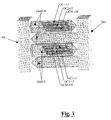
- the protected path (PATH1) is indicated by a continuous bold line
- the spare path (PATH2) is indicated by a short-dash bold line
- the re-routed path is indicated by a longer-dash bold line
- the working fiber is indicated by the thin external circular line
- the spare fiber is indicated by the thin internal circular line.
- the re-routing step according to the present invention comprises a network element re-programming step which is "dynamic”, namely it is carried out according to the bit rate, as it will become clear below.
- a protected optical path (PATH1) and a low-priority path (PATH2) connect the same node pair A and E and are allocated on the same wavelength ⁇ 1, in the working and protection capacities, respectively, but follow different routes.
- PATH1 carries a 2,5 Gbit/s signal.
- the two termination nodes of the channel itself perform the Bridge and Switch operation to reroute the signal over the alternate route, utilizing the same ⁇ 1 on protection capacity.
- nodes A, B, C, D and E that normally carry the 2,5 Gbit/s low-priority optical path on the wavelength ⁇ 1 to be reconfigured in terms of bit rate so as to enable them to transport a 10Gbit/s signal of the protected optical path on the same ⁇ 1.
- each network element in order to carry out the protection mechanism for a WDM ring, it is necessary to provide each network element with information such as the ring map and the characteristics of the optical channels, as well as the bit rate of every optical path, so that every node knows at which bit rate each wavelength is to be configured according to the rerouting activity.
- a node that receives a protocol message from another node in a first instance reads the ring map to locate the failure (or the command) which resulted in the message issue. Afterwards it makes a relation between the last event and the current state by means of the above rules and decides the next state. Then it consults the traffic map to understand which paths are to be rerouted and the bit rate of the paths to be rerouted. Then it performs the rerouting through Bridge & Switch and goes to the new state machine.
Landscapes
- Engineering & Computer Science (AREA)
- Computer Networks & Wireless Communication (AREA)
- Signal Processing (AREA)
- Small-Scale Networks (AREA)
- Optical Communication System (AREA)
- Air Bags (AREA)
- Aiming, Guidance, Guns With A Light Source, Armor, Camouflage, And Targets (AREA)
- Road Paving Structures (AREA)
Applications Claiming Priority (2)
| Application Number | Priority Date | Filing Date | Title |
|---|---|---|---|
| ITMI200140 | 2000-02-01 | ||
| IT2000MI000140A IT1316316B1 (it) | 2000-02-01 | 2000-02-01 | Metodo di protezione del traffico in reti di trasporto in fibra otticain tecnologia wdm |
Publications (2)
| Publication Number | Publication Date |
|---|---|
| EP1122906A2 true EP1122906A2 (de) | 2001-08-08 |
| EP1122906A3 EP1122906A3 (de) | 2005-11-09 |
Family
ID=11443843
Family Applications (1)
| Application Number | Title | Priority Date | Filing Date |
|---|---|---|---|
| EP01400221A Withdrawn EP1122906A3 (de) | 2000-02-01 | 2001-01-29 | Verfahren und Netzwerkelement zum Verkehrsschutz in Transportnetzwerken mit WDM-Faseroptik |
Country Status (4)
| Country | Link |
|---|---|
| US (1) | US7054558B2 (de) |
| EP (1) | EP1122906A3 (de) |
| JP (1) | JP2001274823A (de) |
| IT (1) | IT1316316B1 (de) |
Cited By (2)
| Publication number | Priority date | Publication date | Assignee | Title |
|---|---|---|---|---|
| WO2010048813A1 (zh) * | 2008-10-27 | 2010-05-06 | 华为技术有限公司 | 线路环保护方法、系统和设备 |
| CN117134953A (zh) * | 2023-08-14 | 2023-11-28 | 中国电信股份有限公司技术创新中心 | Sdh业务共享风险确定方法、装置及相关设备 |
Families Citing this family (10)
| Publication number | Priority date | Publication date | Assignee | Title |
|---|---|---|---|---|
| US7113481B2 (en) * | 2001-10-10 | 2006-09-26 | Alcatel | Informed dynamic path protection for optical networks |
| US7433593B1 (en) * | 2002-06-28 | 2008-10-07 | Ciena Corporation | Switching algorithm for optical fiber networks |
| US20050196169A1 (en) * | 2004-03-03 | 2005-09-08 | Fujitsu Limited | System and method for communicating traffic between optical rings |
| US7570844B2 (en) * | 2005-01-18 | 2009-08-04 | Doron Handelman | Photonic integrated circuit device and elements thereof |
| EP2211432B1 (de) * | 2007-11-15 | 2017-01-04 | NGK Spark Plug Co., Ltd. | Zündkerze für einen verbrennungsmotor |
| JP6269088B2 (ja) * | 2014-01-16 | 2018-01-31 | 富士通株式会社 | 冗長パス提供方法および伝送装置 |
| CN108063985B (zh) * | 2016-11-07 | 2020-11-17 | 中兴通讯股份有限公司 | 一种数据收发方法和装置 |
| CN108429626B (zh) * | 2017-02-13 | 2021-05-25 | 中国移动通信集团贵州有限公司 | 网络拓扑的呈现方法、装置和系统 |
| US10972309B2 (en) * | 2017-04-20 | 2021-04-06 | Sino-Telecom Technology Co., Inc. | Method and device for automatically discovering cross-node service topology on transoceanic multiple section shared protection ring |
| CN115499730A (zh) * | 2021-06-18 | 2022-12-20 | 中兴通讯股份有限公司 | 光信号的接收装置、终端及系统 |
Family Cites Families (4)
| Publication number | Priority date | Publication date | Assignee | Title |
|---|---|---|---|---|
| US6205158B1 (en) * | 1997-12-19 | 2001-03-20 | Nortel Networks Limited | Network architectures with transparent transport capabilities |
| JP3753866B2 (ja) * | 1998-07-01 | 2006-03-08 | 株式会社日立製作所 | 自己救済型光ネットワーク |
| JP2000049731A (ja) * | 1998-07-28 | 2000-02-18 | Fujitsu Ltd | Sdh伝送システム及びsdh伝送装置並びにsdh伝送システムにおける回線切り替え制御方法 |
| US6246667B1 (en) * | 1998-09-02 | 2001-06-12 | Lucent Technologies Inc. | Backwards-compatible failure restoration in bidirectional multiplex section-switched ring transmission systems |
-
2000
- 2000-02-01 IT IT2000MI000140A patent/IT1316316B1/it active
-
2001
- 2001-01-22 JP JP2001012726A patent/JP2001274823A/ja not_active Withdrawn
- 2001-01-29 EP EP01400221A patent/EP1122906A3/de not_active Withdrawn
- 2001-01-30 US US09/771,664 patent/US7054558B2/en not_active Expired - Fee Related
Non-Patent Citations (3)
| Title |
|---|
| "Recommendation G.841 - Types and characteristics of SDH network protection architectures", ITU-T RECOMMENDATION G. 841, October 1998 (1998-10-01), pages 1 - 50 |
| GHANI N ET AL.: "CHANNEL PROVISIONING FOR HIGHER LAYER PROTOCOLS IN WDM NETWORKS", PROCEEDINGS OF THE SPIE, SPIE, vol. 3843, 1999, pages 22 - 32 |
| MANCHESTER J ET AL.: "IEEE COMMUNICATIONS MAGAZINE", vol. 37, August 1999, IEEE SERVICE CENTER, article "THE EVOLUTION OF TRANSPORT NETWORK SURVIVABILITY", pages: 44 - 51 |
Cited By (2)
| Publication number | Priority date | Publication date | Assignee | Title |
|---|---|---|---|---|
| WO2010048813A1 (zh) * | 2008-10-27 | 2010-05-06 | 华为技术有限公司 | 线路环保护方法、系统和设备 |
| CN117134953A (zh) * | 2023-08-14 | 2023-11-28 | 中国电信股份有限公司技术创新中心 | Sdh业务共享风险确定方法、装置及相关设备 |
Also Published As
| Publication number | Publication date |
|---|---|
| US20010021049A1 (en) | 2001-09-13 |
| ITMI20000140A1 (it) | 2001-08-01 |
| ITMI20000140A0 (it) | 2000-02-01 |
| IT1316316B1 (it) | 2003-04-10 |
| JP2001274823A (ja) | 2001-10-05 |
| EP1122906A3 (de) | 2005-11-09 |
| US7054558B2 (en) | 2006-05-30 |
Similar Documents
| Publication | Publication Date | Title |
|---|---|---|
| JP4305804B2 (ja) | メッシュネットワークにおいてパス修復情報をシグナリングする方法および装置 | |
| CA2270597C (en) | Path-based restoration for mesh networks | |
| US5903370A (en) | System for an optical domain | |
| US7352966B2 (en) | Method and apparatus for capacity-efficient restoration in an optical communication system | |
| US6088141A (en) | Self-healing network | |
| US5884017A (en) | Method and system for optical restoration tributary switching in a fiber network | |
| US6775477B2 (en) | Optical communication network and protection methods | |
| EP0848873B1 (de) | Optisches uebertragungssystem | |
| Doverspike et al. | Fast restoration in a mesh network of optical cross-connects | |
| JP2001520830A (ja) | 光双方向ラインスイッチ形リングデータ通信システムの方法および装置 | |
| WO1997024900A9 (en) | Method and system for optical restoration tributary switching in a fiber network | |
| JPH1084375A (ja) | リングネットワークにおけるエラーなし交換技術 | |
| CA2318046A1 (en) | Self-healing optical network | |
| US7054558B2 (en) | Method for traffic protection in WDM fiber optic transport networks | |
| US20040076114A1 (en) | Method and apparatus for shared protection in an optical transport network ring based on the ODU management | |
| JP2004140789A (ja) | 2×2スイッチ機能を使用した予備用光スイッチを用いたネットワークノード | |
| JP2000307620A (ja) | Wdmネットワーク及びwdmネットワーク装置 | |
| EP1122903B1 (de) | Verfahren zur Identifizierung der aktuellen Route von Pfaden in Nachrichtenübertragungsnetzwerken des Types MS-SPRING | |
| KR20020048979A (ko) | 통신 보호를 위한 방법 및 시스템 | |
| JP3354116B2 (ja) | 波長多重光通信網 | |
| US7433593B1 (en) | Switching algorithm for optical fiber networks | |
| JP3541206B2 (ja) | データ伝送装置内のデータ保護方法 | |
| CA2310901A1 (en) | Method of recovering failed unidirectional broadcast paths in telecommunications transoceanic ms-sp rings | |
| Mas et al. | Fault localization at the WDM layer | |
| Hasegawa | Naoya Henmi |
Legal Events
| Date | Code | Title | Description |
|---|---|---|---|
| PUAI | Public reference made under article 153(3) epc to a published international application that has entered the european phase |
Free format text: ORIGINAL CODE: 0009012 |
|
| AK | Designated contracting states |
Kind code of ref document: A2 Designated state(s): AT BE CH CY DE DK ES FI FR GB GR IE IT LI LU MC NL PT SE TR |
|
| AX | Request for extension of the european patent |
Free format text: AL;LT;LV;MK;RO;SI |
|
| 17P | Request for examination filed |
Effective date: 20041129 |
|
| PUAL | Search report despatched |
Free format text: ORIGINAL CODE: 0009013 |
|
| AK | Designated contracting states |
Kind code of ref document: A3 Designated state(s): AT BE CH CY DE DK ES FI FR GB GR IE IT LI LU MC NL PT SE TR |
|
| AX | Request for extension of the european patent |
Extension state: AL LT LV MK RO SI |
|
| AKX | Designation fees paid |
Designated state(s): AT BE CH CY DE DK ES FI FR GB GR IE IT LI LU MC NL PT SE TR |
|
| 17Q | First examination report despatched |
Effective date: 20070212 |
|
| RAP1 | Party data changed (applicant data changed or rights of an application transferred) |
Owner name: ALCATEL LUCENT |
|
| RAP1 | Party data changed (applicant data changed or rights of an application transferred) |
Owner name: ALCATEL LUCENT |
|
| STAA | Information on the status of an ep patent application or granted ep patent |
Free format text: STATUS: THE APPLICATION IS DEEMED TO BE WITHDRAWN |
|
| 18D | Application deemed to be withdrawn |
Effective date: 20120801 |