EP1118375A2 - Catalyst for purifying exhaust gas - Google Patents
Catalyst for purifying exhaust gas Download PDFInfo
- Publication number
- EP1118375A2 EP1118375A2 EP01101060A EP01101060A EP1118375A2 EP 1118375 A2 EP1118375 A2 EP 1118375A2 EP 01101060 A EP01101060 A EP 01101060A EP 01101060 A EP01101060 A EP 01101060A EP 1118375 A2 EP1118375 A2 EP 1118375A2
- Authority
- EP
- European Patent Office
- Prior art keywords
- catalyst
- purifying
- exhaust gas
- perovskite type
- complex oxide
- Prior art date
- Legal status (The legal status is an assumption and is not a legal conclusion. Google has not performed a legal analysis and makes no representation as to the accuracy of the status listed.)
- Withdrawn
Links
- 239000003054 catalyst Substances 0.000 title claims abstract description 109
- 229910052751 metal Inorganic materials 0.000 claims abstract description 15
- 229910052737 gold Inorganic materials 0.000 claims abstract description 7
- 229910052741 iridium Inorganic materials 0.000 claims abstract description 7
- 229910052763 palladium Inorganic materials 0.000 claims abstract description 7
- 229910052703 rhodium Inorganic materials 0.000 claims abstract description 7
- 229910052709 silver Inorganic materials 0.000 claims abstract description 7
- GWEVSGVZZGPLCZ-UHFFFAOYSA-N Titan oxide Chemical compound O=[Ti]=O GWEVSGVZZGPLCZ-UHFFFAOYSA-N 0.000 claims description 22
- 229910052783 alkali metal Inorganic materials 0.000 claims description 14
- 229910052784 alkaline earth metal Inorganic materials 0.000 claims description 14
- 229910052697 platinum Inorganic materials 0.000 claims description 14
- 150000001340 alkali metals Chemical class 0.000 claims description 13
- 150000001342 alkaline earth metals Chemical class 0.000 claims description 13
- PNEYBMLMFCGWSK-UHFFFAOYSA-N aluminium oxide Inorganic materials [O-2].[O-2].[O-2].[Al+3].[Al+3] PNEYBMLMFCGWSK-UHFFFAOYSA-N 0.000 claims description 13
- 229910052809 inorganic oxide Inorganic materials 0.000 claims description 5
- 229910052748 manganese Inorganic materials 0.000 claims description 5
- VYPSYNLAJGMNEJ-UHFFFAOYSA-N Silicium dioxide Chemical compound O=[Si]=O VYPSYNLAJGMNEJ-UHFFFAOYSA-N 0.000 claims description 4
- MCMNRKCIXSYSNV-UHFFFAOYSA-N Zirconium dioxide Chemical compound O=[Zr]=O MCMNRKCIXSYSNV-UHFFFAOYSA-N 0.000 claims description 4
- 229910052742 iron Inorganic materials 0.000 claims description 4
- 229910052759 nickel Inorganic materials 0.000 claims description 4
- 229910052684 Cerium Inorganic materials 0.000 claims description 3
- 229910052693 Europium Inorganic materials 0.000 claims description 3
- 229910052688 Gadolinium Inorganic materials 0.000 claims description 3
- 229910052779 Neodymium Inorganic materials 0.000 claims description 3
- 229910052777 Praseodymium Inorganic materials 0.000 claims description 3
- 229910052772 Samarium Inorganic materials 0.000 claims description 3
- 229910052746 lanthanum Inorganic materials 0.000 claims description 3
- 239000002184 metal Substances 0.000 claims description 3
- 229910052727 yttrium Inorganic materials 0.000 claims description 3
- 229910008593 TiyO3 Inorganic materials 0.000 claims description 2
- 229910052796 boron Inorganic materials 0.000 claims description 2
- 239000000377 silicon dioxide Substances 0.000 claims description 2
- GQPLMRYTRLFLPF-UHFFFAOYSA-N Nitrous Oxide Chemical compound [O-][N+]#N GQPLMRYTRLFLPF-UHFFFAOYSA-N 0.000 description 80
- 239000001272 nitrous oxide Substances 0.000 description 40
- FGIUAXJPYTZDNR-UHFFFAOYSA-N potassium nitrate Chemical compound [K+].[O-][N+]([O-])=O FGIUAXJPYTZDNR-UHFFFAOYSA-N 0.000 description 30
- BASFCYQUMIYNBI-UHFFFAOYSA-N platinum Chemical compound [Pt] BASFCYQUMIYNBI-UHFFFAOYSA-N 0.000 description 29
- 239000007789 gas Substances 0.000 description 20
- 239000011572 manganese Substances 0.000 description 16
- 238000000034 method Methods 0.000 description 16
- 239000010936 titanium Substances 0.000 description 15
- XLYOFNOQVPJJNP-UHFFFAOYSA-N water Substances O XLYOFNOQVPJJNP-UHFFFAOYSA-N 0.000 description 15
- 238000005342 ion exchange Methods 0.000 description 11
- 239000000203 mixture Substances 0.000 description 11
- 239000000843 powder Substances 0.000 description 10
- 229910002422 La(NO3)3·6H2O Inorganic materials 0.000 description 9
- MIVBAHRSNUNMPP-UHFFFAOYSA-N manganese(II) nitrate Inorganic materials [Mn+2].[O-][N+]([O-])=O.[O-][N+]([O-])=O MIVBAHRSNUNMPP-UHFFFAOYSA-N 0.000 description 9
- 239000007787 solid Substances 0.000 description 9
- 229910052700 potassium Inorganic materials 0.000 description 8
- GRYLNZFGIOXLOG-UHFFFAOYSA-N Nitric acid Chemical class O[N+]([O-])=O GRYLNZFGIOXLOG-UHFFFAOYSA-N 0.000 description 7
- 230000000694 effects Effects 0.000 description 7
- 238000003756 stirring Methods 0.000 description 7
- ZLMJMSJWJFRBEC-UHFFFAOYSA-N Potassium Chemical compound [K] ZLMJMSJWJFRBEC-UHFFFAOYSA-N 0.000 description 6
- 150000001242 acetic acid derivatives Chemical class 0.000 description 6
- 125000005588 carbonic acid salt group Chemical group 0.000 description 6
- 230000003197 catalytic effect Effects 0.000 description 6
- UFMZWBIQTDUYBN-UHFFFAOYSA-N cobalt dinitrate Chemical compound [Co+2].[O-][N+]([O-])=O.[O-][N+]([O-])=O UFMZWBIQTDUYBN-UHFFFAOYSA-N 0.000 description 6
- 238000011068 loading method Methods 0.000 description 6
- 238000002156 mixing Methods 0.000 description 6
- 239000011591 potassium Substances 0.000 description 6
- 238000006722 reduction reaction Methods 0.000 description 6
- 239000000243 solution Substances 0.000 description 6
- CURLTUGMZLYLDI-UHFFFAOYSA-N Carbon dioxide Chemical compound O=C=O CURLTUGMZLYLDI-UHFFFAOYSA-N 0.000 description 5
- PXHVJJICTQNCMI-UHFFFAOYSA-N Nickel Chemical compound [Ni] PXHVJJICTQNCMI-UHFFFAOYSA-N 0.000 description 5
- KDLHZDBZIXYQEI-UHFFFAOYSA-N Palladium Chemical compound [Pd] KDLHZDBZIXYQEI-UHFFFAOYSA-N 0.000 description 5
- IXSUHTFXKKBBJP-UHFFFAOYSA-L azanide;platinum(2+);dinitrite Chemical compound [NH2-].[NH2-].[Pt+2].[O-]N=O.[O-]N=O IXSUHTFXKKBBJP-UHFFFAOYSA-L 0.000 description 5
- 239000013078 crystal Substances 0.000 description 5
- 239000000446 fuel Substances 0.000 description 5
- 229910017604 nitric acid Inorganic materials 0.000 description 5
- 238000000746 purification Methods 0.000 description 5
- UGFAIRIUMAVXCW-UHFFFAOYSA-N Carbon monoxide Chemical compound [O+]#[C-] UGFAIRIUMAVXCW-UHFFFAOYSA-N 0.000 description 4
- 239000011575 calcium Substances 0.000 description 4
- 239000001569 carbon dioxide Substances 0.000 description 4
- 229910002092 carbon dioxide Inorganic materials 0.000 description 4
- 229910002091 carbon monoxide Inorganic materials 0.000 description 4
- 238000002485 combustion reaction Methods 0.000 description 4
- 230000000052 comparative effect Effects 0.000 description 4
- 239000010931 gold Substances 0.000 description 4
- 229930195733 hydrocarbon Natural products 0.000 description 4
- 150000002430 hydrocarbons Chemical class 0.000 description 4
- SCVFZCLFOSHCOH-UHFFFAOYSA-M potassium acetate Chemical compound [K+].CC([O-])=O SCVFZCLFOSHCOH-UHFFFAOYSA-M 0.000 description 4
- 239000010948 rhodium Substances 0.000 description 4
- 239000011734 sodium Substances 0.000 description 4
- XEEYBQQBJWHFJM-UHFFFAOYSA-N Iron Chemical compound [Fe] XEEYBQQBJWHFJM-UHFFFAOYSA-N 0.000 description 3
- 229910003205 Nd(NO3)3·6H2O Inorganic materials 0.000 description 3
- 229910002852 Sm(NO3)3·6H2O Inorganic materials 0.000 description 3
- 239000002250 absorbent Substances 0.000 description 3
- 230000002745 absorbent Effects 0.000 description 3
- QVGXLLKOCUKJST-UHFFFAOYSA-N atomic oxygen Chemical compound [O] QVGXLLKOCUKJST-UHFFFAOYSA-N 0.000 description 3
- AHKZTVQIVOEVFO-UHFFFAOYSA-N oxide(2-) Chemical compound [O-2] AHKZTVQIVOEVFO-UHFFFAOYSA-N 0.000 description 3
- 239000001301 oxygen Substances 0.000 description 3
- 229910052760 oxygen Inorganic materials 0.000 description 3
- 238000001556 precipitation Methods 0.000 description 3
- OYPRJOBELJOOCE-UHFFFAOYSA-N Calcium Chemical compound [Ca] OYPRJOBELJOOCE-UHFFFAOYSA-N 0.000 description 2
- DGAQECJNVWCQMB-PUAWFVPOSA-M Ilexoside XXIX Chemical compound C[C@@H]1CC[C@@]2(CC[C@@]3(C(=CC[C@H]4[C@]3(CC[C@@H]5[C@@]4(CC[C@@H](C5(C)C)OS(=O)(=O)[O-])C)C)[C@@H]2[C@]1(C)O)C)C(=O)O[C@H]6[C@@H]([C@H]([C@@H]([C@H](O6)CO)O)O)O.[Na+] DGAQECJNVWCQMB-PUAWFVPOSA-M 0.000 description 2
- RTAQQCXQSZGOHL-UHFFFAOYSA-N Titanium Chemical compound [Ti] RTAQQCXQSZGOHL-UHFFFAOYSA-N 0.000 description 2
- 230000003213 activating effect Effects 0.000 description 2
- -1 alkali metal salts Chemical class 0.000 description 2
- 229910052788 barium Inorganic materials 0.000 description 2
- DSAJWYNOEDNPEQ-UHFFFAOYSA-N barium atom Chemical compound [Ba] DSAJWYNOEDNPEQ-UHFFFAOYSA-N 0.000 description 2
- 229910052791 calcium Inorganic materials 0.000 description 2
- 239000011651 chromium Substances 0.000 description 2
- 239000010949 copper Substances 0.000 description 2
- 238000001035 drying Methods 0.000 description 2
- 238000011156 evaluation Methods 0.000 description 2
- 238000010438 heat treatment Methods 0.000 description 2
- 150000002500 ions Chemical group 0.000 description 2
- 239000011777 magnesium Substances 0.000 description 2
- 239000010955 niobium Substances 0.000 description 2
- 230000033116 oxidation-reduction process Effects 0.000 description 2
- 239000008188 pellet Substances 0.000 description 2
- 235000011056 potassium acetate Nutrition 0.000 description 2
- 239000010944 silver (metal) Substances 0.000 description 2
- 239000002002 slurry Substances 0.000 description 2
- 229910052708 sodium Inorganic materials 0.000 description 2
- 229910052712 strontium Inorganic materials 0.000 description 2
- CIOAGBVUUVVLOB-UHFFFAOYSA-N strontium atom Chemical compound [Sr] CIOAGBVUUVVLOB-UHFFFAOYSA-N 0.000 description 2
- 239000000758 substrate Substances 0.000 description 2
- 230000002195 synergetic effect Effects 0.000 description 2
- 229910052719 titanium Inorganic materials 0.000 description 2
- VYZAMTAEIAYCRO-UHFFFAOYSA-N Chromium Chemical compound [Cr] VYZAMTAEIAYCRO-UHFFFAOYSA-N 0.000 description 1
- RYGMFSIKBFXOCR-UHFFFAOYSA-N Copper Chemical compound [Cu] RYGMFSIKBFXOCR-UHFFFAOYSA-N 0.000 description 1
- 229910002554 Fe(NO3)3·9H2O Inorganic materials 0.000 description 1
- WHXSMMKQMYFTQS-UHFFFAOYSA-N Lithium Chemical compound [Li] WHXSMMKQMYFTQS-UHFFFAOYSA-N 0.000 description 1
- FYYHWMGAXLPEAU-UHFFFAOYSA-N Magnesium Chemical compound [Mg] FYYHWMGAXLPEAU-UHFFFAOYSA-N 0.000 description 1
- PWHULOQIROXLJO-UHFFFAOYSA-N Manganese Chemical compound [Mn] PWHULOQIROXLJO-UHFFFAOYSA-N 0.000 description 1
- ZOKXTWBITQBERF-UHFFFAOYSA-N Molybdenum Chemical compound [Mo] ZOKXTWBITQBERF-UHFFFAOYSA-N 0.000 description 1
- BQCADISMDOOEFD-UHFFFAOYSA-N Silver Chemical compound [Ag] BQCADISMDOOEFD-UHFFFAOYSA-N 0.000 description 1
- ATJFFYVFTNAWJD-UHFFFAOYSA-N Tin Chemical compound [Sn] ATJFFYVFTNAWJD-UHFFFAOYSA-N 0.000 description 1
- 238000010521 absorption reaction Methods 0.000 description 1
- 239000007864 aqueous solution Substances 0.000 description 1
- 239000002585 base Substances 0.000 description 1
- 239000000969 carrier Substances 0.000 description 1
- 238000010531 catalytic reduction reaction Methods 0.000 description 1
- GWXLDORMOJMVQZ-UHFFFAOYSA-N cerium Chemical compound [Ce] GWXLDORMOJMVQZ-UHFFFAOYSA-N 0.000 description 1
- 150000003841 chloride salts Chemical class 0.000 description 1
- 229910052804 chromium Inorganic materials 0.000 description 1
- 239000011248 coating agent Substances 0.000 description 1
- 238000000576 coating method Methods 0.000 description 1
- 229910017052 cobalt Inorganic materials 0.000 description 1
- 239000010941 cobalt Substances 0.000 description 1
- GUTLYIVDDKVIGB-UHFFFAOYSA-N cobalt atom Chemical compound [Co] GUTLYIVDDKVIGB-UHFFFAOYSA-N 0.000 description 1
- 230000006835 compression Effects 0.000 description 1
- 238000007906 compression Methods 0.000 description 1
- 229910052802 copper Inorganic materials 0.000 description 1
- 238000000354 decomposition reaction Methods 0.000 description 1
- 230000007547 defect Effects 0.000 description 1
- 239000006185 dispersion Substances 0.000 description 1
- OGPBJKLSAFTDLK-UHFFFAOYSA-N europium atom Chemical compound [Eu] OGPBJKLSAFTDLK-UHFFFAOYSA-N 0.000 description 1
- 238000001704 evaporation Methods 0.000 description 1
- 230000008020 evaporation Effects 0.000 description 1
- UIWYJDYFSGRHKR-UHFFFAOYSA-N gadolinium atom Chemical compound [Gd] UIWYJDYFSGRHKR-UHFFFAOYSA-N 0.000 description 1
- PCHJSUWPFVWCPO-UHFFFAOYSA-N gold Chemical compound [Au] PCHJSUWPFVWCPO-UHFFFAOYSA-N 0.000 description 1
- GKOZUEZYRPOHIO-UHFFFAOYSA-N iridium atom Chemical compound [Ir] GKOZUEZYRPOHIO-UHFFFAOYSA-N 0.000 description 1
- FZLIPJUXYLNCLC-UHFFFAOYSA-N lanthanum atom Chemical compound [La] FZLIPJUXYLNCLC-UHFFFAOYSA-N 0.000 description 1
- 229910052744 lithium Inorganic materials 0.000 description 1
- 229910052749 magnesium Inorganic materials 0.000 description 1
- 229910000473 manganese(VI) oxide Inorganic materials 0.000 description 1
- 238000004519 manufacturing process Methods 0.000 description 1
- 239000002923 metal particle Substances 0.000 description 1
- 150000002739 metals Chemical class 0.000 description 1
- 229910052750 molybdenum Inorganic materials 0.000 description 1
- 239000011733 molybdenum Substances 0.000 description 1
- QEFYFXOXNSNQGX-UHFFFAOYSA-N neodymium atom Chemical compound [Nd] QEFYFXOXNSNQGX-UHFFFAOYSA-N 0.000 description 1
- KBJMLQFLOWQJNF-UHFFFAOYSA-N nickel(II) nitrate Inorganic materials [Ni+2].[O-][N+]([O-])=O.[O-][N+]([O-])=O KBJMLQFLOWQJNF-UHFFFAOYSA-N 0.000 description 1
- 229910052758 niobium Inorganic materials 0.000 description 1
- GUCVJGMIXFAOAE-UHFFFAOYSA-N niobium atom Chemical compound [Nb] GUCVJGMIXFAOAE-UHFFFAOYSA-N 0.000 description 1
- 230000001590 oxidative effect Effects 0.000 description 1
- 239000002245 particle Substances 0.000 description 1
- 229910001414 potassium ion Inorganic materials 0.000 description 1
- PUDIUYLPXJFUGB-UHFFFAOYSA-N praseodymium atom Chemical compound [Pr] PUDIUYLPXJFUGB-UHFFFAOYSA-N 0.000 description 1
- 238000010298 pulverizing process Methods 0.000 description 1
- 230000003578 releasing effect Effects 0.000 description 1
- MHOVAHRLVXNVSD-UHFFFAOYSA-N rhodium atom Chemical compound [Rh] MHOVAHRLVXNVSD-UHFFFAOYSA-N 0.000 description 1
- 229910052701 rubidium Inorganic materials 0.000 description 1
- IGLNJRXAVVLDKE-UHFFFAOYSA-N rubidium atom Chemical compound [Rb] IGLNJRXAVVLDKE-UHFFFAOYSA-N 0.000 description 1
- 150000003839 salts Chemical class 0.000 description 1
- KZUNJOHGWZRPMI-UHFFFAOYSA-N samarium atom Chemical compound [Sm] KZUNJOHGWZRPMI-UHFFFAOYSA-N 0.000 description 1
- VSZWPYCFIRKVQL-UHFFFAOYSA-N selanylidenegallium;selenium Chemical compound [Se].[Se]=[Ga].[Se]=[Ga] VSZWPYCFIRKVQL-UHFFFAOYSA-N 0.000 description 1
- 239000004332 silver Substances 0.000 description 1
- 238000001179 sorption measurement Methods 0.000 description 1
- 229910052715 tantalum Inorganic materials 0.000 description 1
- GUVRBAGPIYLISA-UHFFFAOYSA-N tantalum atom Chemical compound [Ta] GUVRBAGPIYLISA-UHFFFAOYSA-N 0.000 description 1
- JBQYATWDVHIOAR-UHFFFAOYSA-N tellanylidenegermanium Chemical compound [Te]=[Ge] JBQYATWDVHIOAR-UHFFFAOYSA-N 0.000 description 1
- WFKWXMTUELFFGS-UHFFFAOYSA-N tungsten Chemical compound [W] WFKWXMTUELFFGS-UHFFFAOYSA-N 0.000 description 1
- 229910052721 tungsten Inorganic materials 0.000 description 1
- 239000010937 tungsten Substances 0.000 description 1
- LEONUFNNVUYDNQ-UHFFFAOYSA-N vanadium atom Chemical compound [V] LEONUFNNVUYDNQ-UHFFFAOYSA-N 0.000 description 1
- VWQVUPCCIRVNHF-UHFFFAOYSA-N yttrium atom Chemical compound [Y] VWQVUPCCIRVNHF-UHFFFAOYSA-N 0.000 description 1
Images


Classifications
-
- B—PERFORMING OPERATIONS; TRANSPORTING
- B01—PHYSICAL OR CHEMICAL PROCESSES OR APPARATUS IN GENERAL
- B01D—SEPARATION
- B01D53/00—Separation of gases or vapours; Recovering vapours of volatile solvents from gases; Chemical or biological purification of waste gases, e.g. engine exhaust gases, smoke, fumes, flue gases, aerosols
- B01D53/34—Chemical or biological purification of waste gases
- B01D53/92—Chemical or biological purification of waste gases of engine exhaust gases
- B01D53/94—Chemical or biological purification of waste gases of engine exhaust gases by catalytic processes
- B01D53/9445—Simultaneously removing carbon monoxide, hydrocarbons or nitrogen oxides making use of three-way catalysts [TWC] or four-way-catalysts [FWC]
- B01D53/945—Simultaneously removing carbon monoxide, hydrocarbons or nitrogen oxides making use of three-way catalysts [TWC] or four-way-catalysts [FWC] characterised by a specific catalyst
-
- B—PERFORMING OPERATIONS; TRANSPORTING
- B01—PHYSICAL OR CHEMICAL PROCESSES OR APPARATUS IN GENERAL
- B01D—SEPARATION
- B01D53/00—Separation of gases or vapours; Recovering vapours of volatile solvents from gases; Chemical or biological purification of waste gases, e.g. engine exhaust gases, smoke, fumes, flue gases, aerosols
- B01D53/34—Chemical or biological purification of waste gases
- B01D53/92—Chemical or biological purification of waste gases of engine exhaust gases
- B01D53/94—Chemical or biological purification of waste gases of engine exhaust gases by catalytic processes
- B01D53/9404—Removing only nitrogen compounds
- B01D53/9409—Nitrogen oxides
- B01D53/9413—Processes characterised by a specific catalyst
- B01D53/9422—Processes characterised by a specific catalyst for removing nitrogen oxides by NOx storage or reduction by cyclic switching between lean and rich exhaust gases (LNT, NSC, NSR)
-
- B—PERFORMING OPERATIONS; TRANSPORTING
- B01—PHYSICAL OR CHEMICAL PROCESSES OR APPARATUS IN GENERAL
- B01D—SEPARATION
- B01D53/00—Separation of gases or vapours; Recovering vapours of volatile solvents from gases; Chemical or biological purification of waste gases, e.g. engine exhaust gases, smoke, fumes, flue gases, aerosols
- B01D53/34—Chemical or biological purification of waste gases
- B01D53/92—Chemical or biological purification of waste gases of engine exhaust gases
- B01D53/94—Chemical or biological purification of waste gases of engine exhaust gases by catalytic processes
- B01D53/944—Simultaneously removing carbon monoxide, hydrocarbons or carbon making use of oxidation catalysts
-
- B—PERFORMING OPERATIONS; TRANSPORTING
- B01—PHYSICAL OR CHEMICAL PROCESSES OR APPARATUS IN GENERAL
- B01J—CHEMICAL OR PHYSICAL PROCESSES, e.g. CATALYSIS OR COLLOID CHEMISTRY; THEIR RELEVANT APPARATUS
- B01J23/00—Catalysts comprising metals or metal oxides or hydroxides, not provided for in group B01J21/00
- B01J23/002—Mixed oxides other than spinels, e.g. perovskite
-
- B—PERFORMING OPERATIONS; TRANSPORTING
- B01—PHYSICAL OR CHEMICAL PROCESSES OR APPARATUS IN GENERAL
- B01J—CHEMICAL OR PHYSICAL PROCESSES, e.g. CATALYSIS OR COLLOID CHEMISTRY; THEIR RELEVANT APPARATUS
- B01J23/00—Catalysts comprising metals or metal oxides or hydroxides, not provided for in group B01J21/00
- B01J23/16—Catalysts comprising metals or metal oxides or hydroxides, not provided for in group B01J21/00 of arsenic, antimony, bismuth, vanadium, niobium, tantalum, polonium, chromium, molybdenum, tungsten, manganese, technetium or rhenium
- B01J23/32—Manganese, technetium or rhenium
- B01J23/34—Manganese
-
- B—PERFORMING OPERATIONS; TRANSPORTING
- B01—PHYSICAL OR CHEMICAL PROCESSES OR APPARATUS IN GENERAL
- B01J—CHEMICAL OR PHYSICAL PROCESSES, e.g. CATALYSIS OR COLLOID CHEMISTRY; THEIR RELEVANT APPARATUS
- B01J23/00—Catalysts comprising metals or metal oxides or hydroxides, not provided for in group B01J21/00
- B01J23/38—Catalysts comprising metals or metal oxides or hydroxides, not provided for in group B01J21/00 of noble metals
- B01J23/54—Catalysts comprising metals or metal oxides or hydroxides, not provided for in group B01J21/00 of noble metals combined with metals, oxides or hydroxides provided for in groups B01J23/02 - B01J23/36
- B01J23/56—Platinum group metals
- B01J23/63—Platinum group metals with rare earths or actinides
-
- B—PERFORMING OPERATIONS; TRANSPORTING
- B01—PHYSICAL OR CHEMICAL PROCESSES OR APPARATUS IN GENERAL
- B01J—CHEMICAL OR PHYSICAL PROCESSES, e.g. CATALYSIS OR COLLOID CHEMISTRY; THEIR RELEVANT APPARATUS
- B01J23/00—Catalysts comprising metals or metal oxides or hydroxides, not provided for in group B01J21/00
- B01J23/38—Catalysts comprising metals or metal oxides or hydroxides, not provided for in group B01J21/00 of noble metals
- B01J23/54—Catalysts comprising metals or metal oxides or hydroxides, not provided for in group B01J21/00 of noble metals combined with metals, oxides or hydroxides provided for in groups B01J23/02 - B01J23/36
- B01J23/56—Platinum group metals
- B01J23/64—Platinum group metals with arsenic, antimony, bismuth, vanadium, niobium, tantalum, polonium, chromium, molybdenum, tungsten, manganese, technetium or rhenium
- B01J23/656—Manganese, technetium or rhenium
- B01J23/6562—Manganese
-
- B—PERFORMING OPERATIONS; TRANSPORTING
- B01—PHYSICAL OR CHEMICAL PROCESSES OR APPARATUS IN GENERAL
- B01J—CHEMICAL OR PHYSICAL PROCESSES, e.g. CATALYSIS OR COLLOID CHEMISTRY; THEIR RELEVANT APPARATUS
- B01J23/00—Catalysts comprising metals or metal oxides or hydroxides, not provided for in group B01J21/00
- B01J23/70—Catalysts comprising metals or metal oxides or hydroxides, not provided for in group B01J21/00 of the iron group metals or copper
- B01J23/76—Catalysts comprising metals or metal oxides or hydroxides, not provided for in group B01J21/00 of the iron group metals or copper combined with metals, oxides or hydroxides provided for in groups B01J23/02 - B01J23/36
- B01J23/83—Catalysts comprising metals or metal oxides or hydroxides, not provided for in group B01J21/00 of the iron group metals or copper combined with metals, oxides or hydroxides provided for in groups B01J23/02 - B01J23/36 with rare earths or actinides
-
- B—PERFORMING OPERATIONS; TRANSPORTING
- B01—PHYSICAL OR CHEMICAL PROCESSES OR APPARATUS IN GENERAL
- B01J—CHEMICAL OR PHYSICAL PROCESSES, e.g. CATALYSIS OR COLLOID CHEMISTRY; THEIR RELEVANT APPARATUS
- B01J23/00—Catalysts comprising metals or metal oxides or hydroxides, not provided for in group B01J21/00
- B01J23/70—Catalysts comprising metals or metal oxides or hydroxides, not provided for in group B01J21/00 of the iron group metals or copper
- B01J23/89—Catalysts comprising metals or metal oxides or hydroxides, not provided for in group B01J21/00 of the iron group metals or copper combined with noble metals
- B01J23/8933—Catalysts comprising metals or metal oxides or hydroxides, not provided for in group B01J21/00 of the iron group metals or copper combined with noble metals also combined with metals, or metal oxides or hydroxides provided for in groups B01J23/02 - B01J23/36
- B01J23/894—Catalysts comprising metals or metal oxides or hydroxides, not provided for in group B01J21/00 of the iron group metals or copper combined with noble metals also combined with metals, or metal oxides or hydroxides provided for in groups B01J23/02 - B01J23/36 with rare earths or actinides
-
- B—PERFORMING OPERATIONS; TRANSPORTING
- B01—PHYSICAL OR CHEMICAL PROCESSES OR APPARATUS IN GENERAL
- B01J—CHEMICAL OR PHYSICAL PROCESSES, e.g. CATALYSIS OR COLLOID CHEMISTRY; THEIR RELEVANT APPARATUS
- B01J23/00—Catalysts comprising metals or metal oxides or hydroxides, not provided for in group B01J21/00
- B01J23/70—Catalysts comprising metals or metal oxides or hydroxides, not provided for in group B01J21/00 of the iron group metals or copper
- B01J23/89—Catalysts comprising metals or metal oxides or hydroxides, not provided for in group B01J21/00 of the iron group metals or copper combined with noble metals
- B01J23/8933—Catalysts comprising metals or metal oxides or hydroxides, not provided for in group B01J21/00 of the iron group metals or copper combined with noble metals also combined with metals, or metal oxides or hydroxides provided for in groups B01J23/02 - B01J23/36
- B01J23/8986—Catalysts comprising metals or metal oxides or hydroxides, not provided for in group B01J21/00 of the iron group metals or copper combined with noble metals also combined with metals, or metal oxides or hydroxides provided for in groups B01J23/02 - B01J23/36 with manganese, technetium or rhenium
-
- B—PERFORMING OPERATIONS; TRANSPORTING
- B01—PHYSICAL OR CHEMICAL PROCESSES OR APPARATUS IN GENERAL
- B01D—SEPARATION
- B01D2255/00—Catalysts
- B01D2255/10—Noble metals or compounds thereof
- B01D2255/102—Platinum group metals
- B01D2255/1021—Platinum
-
- B—PERFORMING OPERATIONS; TRANSPORTING
- B01—PHYSICAL OR CHEMICAL PROCESSES OR APPARATUS IN GENERAL
- B01D—SEPARATION
- B01D2255/00—Catalysts
- B01D2255/10—Noble metals or compounds thereof
- B01D2255/102—Platinum group metals
- B01D2255/1023—Palladium
-
- B—PERFORMING OPERATIONS; TRANSPORTING
- B01—PHYSICAL OR CHEMICAL PROCESSES OR APPARATUS IN GENERAL
- B01D—SEPARATION
- B01D2255/00—Catalysts
- B01D2255/10—Noble metals or compounds thereof
- B01D2255/102—Platinum group metals
- B01D2255/1025—Rhodium
-
- B—PERFORMING OPERATIONS; TRANSPORTING
- B01—PHYSICAL OR CHEMICAL PROCESSES OR APPARATUS IN GENERAL
- B01D—SEPARATION
- B01D2255/00—Catalysts
- B01D2255/10—Noble metals or compounds thereof
- B01D2255/102—Platinum group metals
- B01D2255/1028—Iridium
-
- B—PERFORMING OPERATIONS; TRANSPORTING
- B01—PHYSICAL OR CHEMICAL PROCESSES OR APPARATUS IN GENERAL
- B01D—SEPARATION
- B01D2255/00—Catalysts
- B01D2255/10—Noble metals or compounds thereof
- B01D2255/104—Silver
-
- B—PERFORMING OPERATIONS; TRANSPORTING
- B01—PHYSICAL OR CHEMICAL PROCESSES OR APPARATUS IN GENERAL
- B01D—SEPARATION
- B01D2255/00—Catalysts
- B01D2255/10—Noble metals or compounds thereof
- B01D2255/106—Gold
-
- B—PERFORMING OPERATIONS; TRANSPORTING
- B01—PHYSICAL OR CHEMICAL PROCESSES OR APPARATUS IN GENERAL
- B01D—SEPARATION
- B01D2255/00—Catalysts
- B01D2255/20—Metals or compounds thereof
- B01D2255/202—Alkali metals
-
- B—PERFORMING OPERATIONS; TRANSPORTING
- B01—PHYSICAL OR CHEMICAL PROCESSES OR APPARATUS IN GENERAL
- B01D—SEPARATION
- B01D2255/00—Catalysts
- B01D2255/20—Metals or compounds thereof
- B01D2255/204—Alkaline earth metals
-
- B—PERFORMING OPERATIONS; TRANSPORTING
- B01—PHYSICAL OR CHEMICAL PROCESSES OR APPARATUS IN GENERAL
- B01D—SEPARATION
- B01D2255/00—Catalysts
- B01D2255/20—Metals or compounds thereof
- B01D2255/206—Rare earth metals
- B01D2255/2063—Lanthanum
-
- B—PERFORMING OPERATIONS; TRANSPORTING
- B01—PHYSICAL OR CHEMICAL PROCESSES OR APPARATUS IN GENERAL
- B01D—SEPARATION
- B01D2255/00—Catalysts
- B01D2255/20—Metals or compounds thereof
- B01D2255/206—Rare earth metals
- B01D2255/2068—Neodymium
-
- B—PERFORMING OPERATIONS; TRANSPORTING
- B01—PHYSICAL OR CHEMICAL PROCESSES OR APPARATUS IN GENERAL
- B01D—SEPARATION
- B01D2255/00—Catalysts
- B01D2255/20—Metals or compounds thereof
- B01D2255/207—Transition metals
- B01D2255/20707—Titanium
-
- B—PERFORMING OPERATIONS; TRANSPORTING
- B01—PHYSICAL OR CHEMICAL PROCESSES OR APPARATUS IN GENERAL
- B01D—SEPARATION
- B01D2255/00—Catalysts
- B01D2255/20—Metals or compounds thereof
- B01D2255/207—Transition metals
- B01D2255/2073—Manganese
-
- B—PERFORMING OPERATIONS; TRANSPORTING
- B01—PHYSICAL OR CHEMICAL PROCESSES OR APPARATUS IN GENERAL
- B01D—SEPARATION
- B01D2255/00—Catalysts
- B01D2255/20—Metals or compounds thereof
- B01D2255/207—Transition metals
- B01D2255/20738—Iron
-
- B—PERFORMING OPERATIONS; TRANSPORTING
- B01—PHYSICAL OR CHEMICAL PROCESSES OR APPARATUS IN GENERAL
- B01D—SEPARATION
- B01D2255/00—Catalysts
- B01D2255/20—Metals or compounds thereof
- B01D2255/207—Transition metals
- B01D2255/20746—Cobalt
-
- B—PERFORMING OPERATIONS; TRANSPORTING
- B01—PHYSICAL OR CHEMICAL PROCESSES OR APPARATUS IN GENERAL
- B01D—SEPARATION
- B01D2255/00—Catalysts
- B01D2255/20—Metals or compounds thereof
- B01D2255/207—Transition metals
- B01D2255/20753—Nickel
-
- B—PERFORMING OPERATIONS; TRANSPORTING
- B01—PHYSICAL OR CHEMICAL PROCESSES OR APPARATUS IN GENERAL
- B01J—CHEMICAL OR PHYSICAL PROCESSES, e.g. CATALYSIS OR COLLOID CHEMISTRY; THEIR RELEVANT APPARATUS
- B01J23/00—Catalysts comprising metals or metal oxides or hydroxides, not provided for in group B01J21/00
- B01J23/38—Catalysts comprising metals or metal oxides or hydroxides, not provided for in group B01J21/00 of noble metals
- B01J23/54—Catalysts comprising metals or metal oxides or hydroxides, not provided for in group B01J21/00 of noble metals combined with metals, oxides or hydroxides provided for in groups B01J23/02 - B01J23/36
- B01J23/66—Silver or gold
-
- B—PERFORMING OPERATIONS; TRANSPORTING
- B01—PHYSICAL OR CHEMICAL PROCESSES OR APPARATUS IN GENERAL
- B01J—CHEMICAL OR PHYSICAL PROCESSES, e.g. CATALYSIS OR COLLOID CHEMISTRY; THEIR RELEVANT APPARATUS
- B01J23/00—Catalysts comprising metals or metal oxides or hydroxides, not provided for in group B01J21/00
- B01J23/38—Catalysts comprising metals or metal oxides or hydroxides, not provided for in group B01J21/00 of noble metals
- B01J23/54—Catalysts comprising metals or metal oxides or hydroxides, not provided for in group B01J21/00 of noble metals combined with metals, oxides or hydroxides provided for in groups B01J23/02 - B01J23/36
- B01J23/66—Silver or gold
- B01J23/68—Silver or gold with arsenic, antimony, bismuth, vanadium, niobium, tantalum, polonium, chromium, molybdenum, tungsten, manganese, technetium or rhenium
- B01J23/688—Silver or gold with arsenic, antimony, bismuth, vanadium, niobium, tantalum, polonium, chromium, molybdenum, tungsten, manganese, technetium or rhenium with manganese, technetium or rhenium
-
- B—PERFORMING OPERATIONS; TRANSPORTING
- B01—PHYSICAL OR CHEMICAL PROCESSES OR APPARATUS IN GENERAL
- B01J—CHEMICAL OR PHYSICAL PROCESSES, e.g. CATALYSIS OR COLLOID CHEMISTRY; THEIR RELEVANT APPARATUS
- B01J2523/00—Constitutive chemical elements of heterogeneous catalysts
-
- Y—GENERAL TAGGING OF NEW TECHNOLOGICAL DEVELOPMENTS; GENERAL TAGGING OF CROSS-SECTIONAL TECHNOLOGIES SPANNING OVER SEVERAL SECTIONS OF THE IPC; TECHNICAL SUBJECTS COVERED BY FORMER USPC CROSS-REFERENCE ART COLLECTIONS [XRACs] AND DIGESTS
- Y02—TECHNOLOGIES OR APPLICATIONS FOR MITIGATION OR ADAPTATION AGAINST CLIMATE CHANGE
- Y02A—TECHNOLOGIES FOR ADAPTATION TO CLIMATE CHANGE
- Y02A50/00—TECHNOLOGIES FOR ADAPTATION TO CLIMATE CHANGE in human health protection, e.g. against extreme weather
- Y02A50/20—Air quality improvement or preservation, e.g. vehicle emission control or emission reduction by using catalytic converters
-
- Y—GENERAL TAGGING OF NEW TECHNOLOGICAL DEVELOPMENTS; GENERAL TAGGING OF CROSS-SECTIONAL TECHNOLOGIES SPANNING OVER SEVERAL SECTIONS OF THE IPC; TECHNICAL SUBJECTS COVERED BY FORMER USPC CROSS-REFERENCE ART COLLECTIONS [XRACs] AND DIGESTS
- Y02—TECHNOLOGIES OR APPLICATIONS FOR MITIGATION OR ADAPTATION AGAINST CLIMATE CHANGE
- Y02T—CLIMATE CHANGE MITIGATION TECHNOLOGIES RELATED TO TRANSPORTATION
- Y02T10/00—Road transport of goods or passengers
- Y02T10/10—Internal combustion engine [ICE] based vehicles
- Y02T10/12—Improving ICE efficiencies
-
- Y—GENERAL TAGGING OF NEW TECHNOLOGICAL DEVELOPMENTS; GENERAL TAGGING OF CROSS-SECTIONAL TECHNOLOGIES SPANNING OVER SEVERAL SECTIONS OF THE IPC; TECHNICAL SUBJECTS COVERED BY FORMER USPC CROSS-REFERENCE ART COLLECTIONS [XRACs] AND DIGESTS
- Y10—TECHNICAL SUBJECTS COVERED BY FORMER USPC
- Y10S—TECHNICAL SUBJECTS COVERED BY FORMER USPC CROSS-REFERENCE ART COLLECTIONS [XRACs] AND DIGESTS
- Y10S502/00—Catalyst, solid sorbent, or support therefor: product or process of making
- Y10S502/525—Perovskite
Definitions
- the present invention relates to a catalyst, for purifying an exhaust gas, used for the purification of the exhaust gas emitted from internal combustion engines of automobiles and the like and, more specifically, it relates to a catalyst for purifying an exhaust gas with a notably improved NO x purifying performance at high temperature.
- Lean burn engines ordinarily burn fuel under conditions with a "lean" air/fuel (A/F) ratio (air excess), and for limited periods burn fuel under stoichiometric (theoretical air/fuel ratio) to rich (fuel excess) conditions.
- A/F air/fuel
- stoichiometric theoretical air/fuel ratio
- hydrocarbons (HC) and carbon monoxide (CO) in an exhaust gas are efficiently removed by combustion due to the effect of the oxidizing atmosphere and catalyst at the lean end, while NO x is occuluded in the absorbent at the lean end and temporarily released under stoichiometric to rich conditions, and is purified by reduction due to the effect of the temporary reducing atmosphere and the catalyst.
- Alkali metals or alkaline earth metals have conventionally been used as the NO x absorbents of NO x purifying catalysts of an absorption-reduction type, and the catalysts for purifying an exhaust gas are constructed by loading a catalyst component such as platinum and a carbonic acid salt or acetic acid salt of an alkali metal or alkaline earth metal on a carrier such as ⁇ -alumina.
- a catalyst component such as platinum and a carbonic acid salt or acetic acid salt of an alkali metal or alkaline earth metal
- a carrier such as ⁇ -alumina.
- NO x purifying catalysts of the absorption-reduction type carrying alkali metal salts or alkaline earth metal salts using carbonic acid salts or acetic acid salts still have room for an improved NO x purifying performance at catalytic temperatures that are above approximately 500°C.
- catalysts comprising conventional complex oxides of perovskite type are used for purification of exhaust gas emitted from internal combustion engines of automobile engines and the like, and are thus still need a higher NO x purifying efficiency.
- a catalyst for purifying an exhaust gas characterized in that at least one catalyst component from among platinum (Pt), palladium (Pd), rhodium (Rh), gold (Au), silver (Ag) and iridium (Ir) is carried on a complex oxide of the perovskite type comprising at least two different metal elements.
- this invention is a catalyst comprising a catalyst component such as platinum directly carried on a specific complex oxide of the perovskite type. While the reason for the high NO x purifying performance of such a catalyst is not fully understood, it is theorized to be as follows.
- Complex oxides of the perovskite type comprising at least two different metal elements generally produce distortion in crystals due to the difference in atomic radii of the metal elements contained therein, and it is believed that the structural oxygen defects of this crystal distortion have an activating effect on NO x , and that the activating effect works synergistically with the effect of the catalyst component such as platinum. This synergistic effect is believed to become significant when a catalyst component such as platinum is directly carried on the complex oxide of perovskite type.
- Fig. 1 is a graph showing a comparison of different catalysts in terms of the relationship between exhaust gas temperature and NO x purifying efficiency.
- Fig. 2 is a graph showing a comparison of different catalysts in terms of the relationship between exhaust gas temperature and NO x purifying efficiency.
- Fig. 3 is a graph showing a comparison of different catalysts in terms of the relationship between exhaust gas temperature and NO x purifying efficiency.
- Fig. 4 is a schematic view showing configurations of the catalyst of prior art.
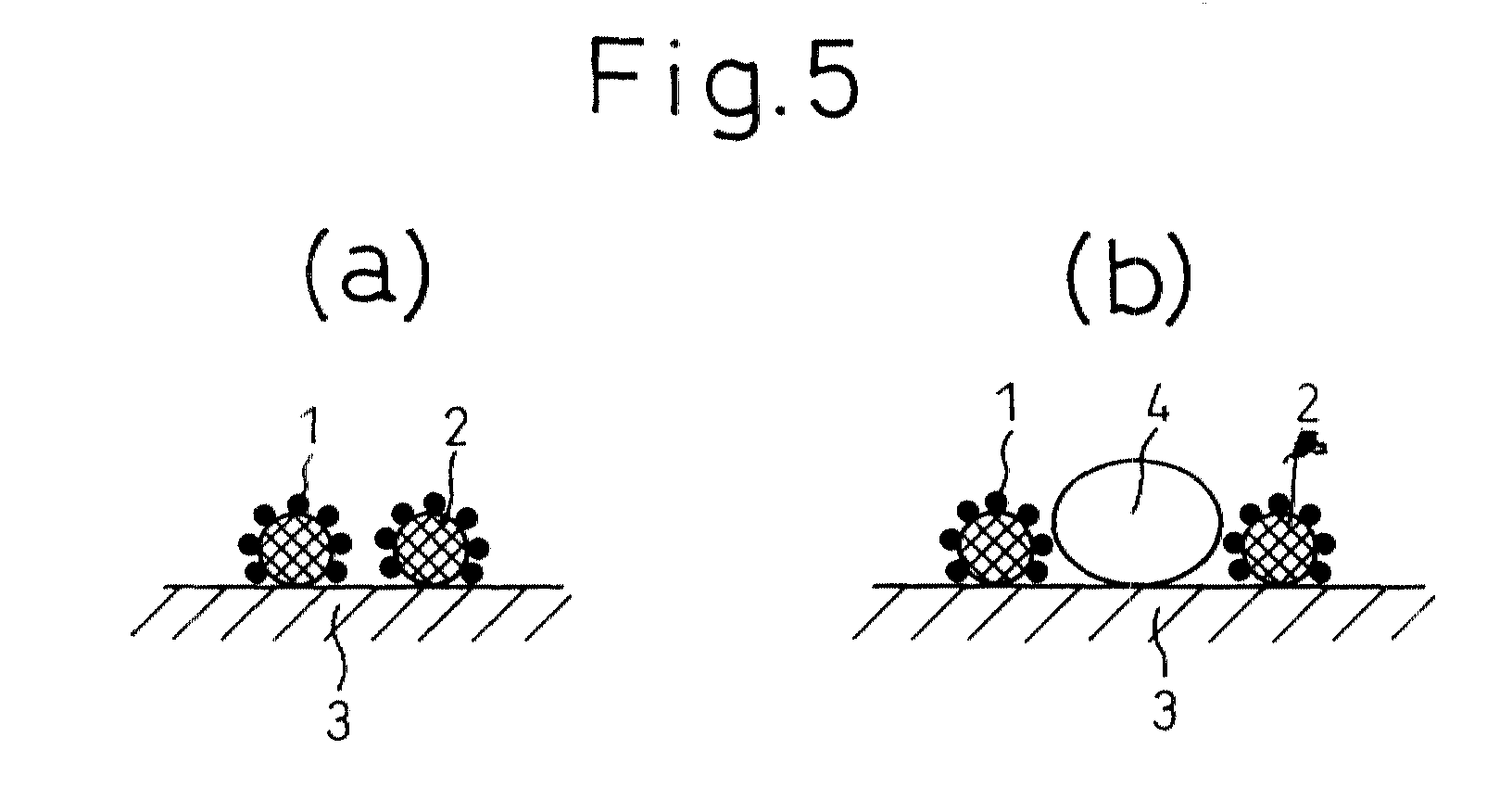
- Fig. 5 is a schematic view showing configurations of the catalyst according to this invention.
- the complex oxide of the perovskite type in the catalyst of this invention comprises at least two different metal elements.
- the metal elements may be any selected from among s-block metal elements, d-block metal elements, p-block metal elements and f-block metal elements, which are specifically, sodium (Na), potassium (K), calcium (Ca), barium (Ba), strontium (Sr), lanthanum (La), yttrium (Y), cerium (Ce), praseodymium (Pr), neodymium (Nd), samarium (Sm), europium (Eu), gadolinium (Gd), titanium (Ti), tin (Sn), zirconium (Zr), manganese (Mn), iron (Fe), cobalt (Co), nickel (Ni), chromium (Cr), niobium (Nb), copper (Cu), vanadium (V), molybdenum (Mo), tungsten (W), zinc (Zn), tantalum (
- the complex oxide of perovskite type in the catalyst of this invention is a specific complex oxide of the perovskite type comprising K and having the structural formula La 1- x K x BO 3 (wherein B is at least one from among Mn, Co, Fe and Ni), wherein 0 ⁇ x ⁇ 1, preferably 0.05 ⁇ x ⁇ 1, more preferably 0.1 ⁇ x ⁇ 0.5, even more preferably 0.1 ⁇ x ⁇ 0.4, and most preferably 0.2 ⁇ x ⁇ 0.4.
- the complex oxide of the perovskite type in the catalyst of this invention is a specific complex oxide of the perovskite type comprising K and having the structural formula A 1-x K x B 1-y Ti y O 3 (wherein A is at least one from among La, Ce, Pr, Nd, Sm, Eu, Gd and Y, and B is at least one from among Mn, Co, Fe and Ni), wherein preferably A is La, 0 ⁇ x ⁇ 1, preferably 0.05 ⁇ x ⁇ 1, more preferably 0.1 ⁇ x ⁇ 0.5, even more preferably 0.1 ⁇ x ⁇ 0.4 and most preferably 0.2 ⁇ x ⁇ 0.4, and 0 ⁇ y ⁇ 1, preferably 0.05 ⁇ y ⁇ 1, more preferably 0.1 ⁇ y ⁇ 0.5, even more preferably 0.1 ⁇ y ⁇ 0.4 and most preferably 0.2 ⁇ y ⁇ 0.4.
- the alkali metals or alkaline earth metals may be converted to nitric acid salts under lean conditions or to carbonic acid salts under rich conditions. These salts undergo decomposition at temperatures over about 500°C, and it is believed that this accounts for the lower high-temperature NO x absorption performance of alkali metals or alkaline earth metals carried in the form of such carbonic acid salts or acetic acid salts.
- oxygen absorbing-releasing effect of these specific complex oxides of perovskite type can act synergistically with the catalytic effect of the catalyst components such as platinum, while also functioning as NO x absorbents at high temperature, thereby providing high NO x purifying performance at high temperatures.
- Such complex oxides of the perovskite type can be prepared, for example, by first mixing a prescribed proportion of a powder of the nitric acid salts, acetic acid salts, chlorides, etc. of the elements to be included, or mixing as an aqueous solution and drying, and then heating in air at 400-1000°C.
- the catalyst of this invention has at least one catalyst component from among Pt, Pd, Rh, Au, Ag and Ir carried on the above-mentioned complex oxide of the perovskite type.
- the loading may be accomplished by precipitation, adsorption, ion-exchange, -reducing precipitation, evaporation to dryness, etc., selected from among methods that allow metal particles to be carried on a carrier.
- the catalyst component is preferably carried in an amount of 0.1-10 g, and preferably 0.3-4 g, with respect to 100 g of the complex oxide of the perovskite type by mass.
- the catalyst component is preferably carried after adjusting the complex oxide of the perovskite type to a particle size of 0.05-20 ⁇ m by pulverization or the like. This results in more uniform dispersion of the catalyst component on the complex oxide of the perovskite type.
- an alkali metal or alkaline earth metal is further carried onto the complex oxide of the perovskite type on which the catalyst component has been carried.
- alkali metals there may be mentioned lithium (Li), sodium (Na), potassium (K), rubidium (Rb), etc.
- alkaline earth metals there may be mentioned magnesium (Mg), calcium (Ca), strontium (Sr), barium (Ba), etc.
- alkali metals and alkaline earth metals can exhibit satisfactory NO x absorbing performance in catalytic temperature regions of up to approximately 500°C, and their use in combination with complex oxides of the perovskite type can therefore further widen the temperature region for NO x purification.
- alkali metals and alkaline earth metals may be carried by a precipitation method using the carbonic acid salts or acetic acid salts of the metals.
- the loading amount for these alkali metals and alkaline earth metals is preferably 0.01-2 moles, and more preferably 0.05-0.5 mole, as the number of moles of the alkali metal or alkaline earth metal based on 100 g of the complex oxide of the perovskite type by mass.
- At least one inorganic oxide selected from among alumina, titania, zirconia and silica is mixed with the complex oxide of the perovskite type on which the catalytic component has been carried. This increases the total amount of catalyst, and raises the catalytic efficiency for exhaust gas.
- the mixing may be accomplished, for example, by mechanical mixing of the inorganic oxide such as alumina with the complex oxide of perovskite type on which the catalyst component has been carried, or by mixing them together in slurry form.
- the amount of the inorganic oxide is preferably 10-250 g, and more preferably 50-200 g, with respect to 100 g of the complex oxide of perovskite type by mass.
- the loading of the alkali metal or alkaline earth metal may also be accomplished after mixing the inorganic oxide such as alumina with the complex oxide of the perovskite type on which the catalyst component has been carried.
- the catalyst of this invention may be carried on a honeycomb substrate by wash coating or the like, according to a common method.
- the configurations of the catalyst of the prior art and those according to this invention are schematically compared in Fig. 4 and Fig. 5 respectively.
- the catalyst component (1) is directly carried on the complex oxide (2) of perovskite type, and the complex oxide (2) may be supported on a substrate (3).
- the catalyst component (1) is carried on a carrier (4) such as alumina, and the complex oxide (2) of perovskite type is carried on or mixed with the carrier (4).
- a 50 g portion of the obtained complex oxide powder was dispersed and stirred in 300 cc of ion-exchange water and, after adding an aqueous nitric acid solution of dinitrodiammineplatinum to 2 g in terms of Pt, the water was evaporated off and the mixture was dried at 120°C for 2 hours, after which it was fired at 500°C for one hour to obtain the catalyst of this invention.
- a catalyst of this invention was obtained by the same method as Example 1, except that 30.31 g of La(NO 3 ) 3 ⁇ 6H 2 O, 3.03 g of KNO 3 and 29.1 g of Co(NO 3 ) 2 ⁇ 6H 2 O were used.
- the complex oxide of the perovskite type in the catalyst had the structure La 0.7 K 0.3 CoO 3 .
- a catalyst of this invention was obtained by the same method as Example 1, except that 21.65 g of La(NO 3 ) 3 ⁇ 6H 2 O, 5.05 g of KNO 3 and 29.1 g of Co(NO 3 ) 2 ⁇ 6H 2 O were used.
- the complex oxide of the perovskite type in the catalyst had the structure La 0.5 K 0.5 CoO 3 .
- a catalyst of this invention was obtained by the same method as Example 1, except that 30.31 g of La(NO 3 ) 3 ⁇ 6H 2 O, 3.03 g of KNO 3 and 28.7 g of Mn(NO 3 ) 2 ⁇ 6H 2 O were used.
- the complex oxide of the perovskite type in the catalyst had the structure La 0.7 K 0.3 MnO 3 .
- a catalyst of this invention was obtained by the same method as Example 1, except that 30.31 g of La(NO 3 ) 3 ⁇ 6H 2 O, 3.03 g of KNO 3 and 40.4 g of Fe(NO 3 ) 3 ⁇ 9H 2 O were used.
- the complex oxide of the perovskite type in the catalyst had the structure La 0.7 K 0.3 FeO 3 .
- a catalyst of this invention was obtained by the same method as Example 1, except that 30.31 g of La(NO 3 ) 3 ⁇ 6H 2 O, 3.03 g of KNO 3 and 29.1 g of Ni(NO 3 ) 2 ⁇ 6H 2 O were used.
- the complex oxide of the perovskite type in the catalyst had the structure La 0.7 K 0.3 NiO 3 .
- a 50 g portion of the obtained complex oxide powder was dispersed and stirred in 300 cc of ion-exchange water, and after adding an aqueous nitric acid solution of dinitrodiammineplatinum to 2 g in terms of Pt, the water was evaporated off and the mixture was dried at 120°C for 2 hours, after which it was fired at 500°C for one hour to obtain the catalyst of this invention.
- a catalyst of this invention was obtained by the same method as Example 7, except that 76.0 g of La(NO 3 ) 3 ⁇ 6H 2 O, 7.6 g of KNO 3 , 50.4 g of Mn (NO 3 ) 2 ⁇ 6H 2 O and titania sol containing 6 g of solid portion were used.
- the complex oxide of the perovskite type in the catalyst had the structure La 0.7 K 0.3 Mn 0.7 Ti 0.3 O 3 .
- a catalyst of this invention was obtained by the same method as Example 7, except that 76.0 g of La(NO 3 ) 3 ⁇ 6H 2 O, 7.6 g of KNO 3 , 36.0 g of Mn(NO 3 ) 2 ⁇ 6H 2 O and titania sol containing 10 g of solid portion were used.
- the complex oxide of the perovskite type in the catalyst had the structure La 0.7 K 0.3 Mn 0.5 Ti 0.5 O 3 .
- a catalyst of this invention was obtained by the same method as Example 7, except that 100.0 g of Sm(NO 3 ) 3 ⁇ 6H 2 O, 2.5 g of KNO 3 , 50.4 g of Mn(NO 3 ) 2 ⁇ 6H 2 O and titania sol containing 6 g of solid portion were used.
- the complex oxide of the perovskite type in the catalyst had the structure Sm 0.9 K 0.1 Mn 0.7 Ti 0.3 O 3 .
- a catalyst of this invention was obtained by the same method as Example 7, except that 78.0 g of Sm(NO 3 ) 3 ⁇ 6H 2 O, 7.6 g of KNO 3 , 50.4 g of Mn(NO 3 ) 2 ⁇ 6H 2 O and titania sol containing 6 g of solid portion were used.
- the complex oxide of the perovskite type in the catalyst had the structure Sm 0.7 K 0.3 Mn 0.7 Ti 0.3 O 3 .
- a catalyst of this invention was obtained by the same method as Example 7, except that 55.6 g of Sm(NO 3 ) 3 ⁇ 6H 2 O, 12.6 g of KNO 3 , 50.4 g of Mn(NO 3 ) 2 ⁇ 6H 2 O and titania sol containing 6 g of solid portion were used.
- the complex oxide of the perovskite type in the catalyst had the structure Sm 0.5 K 0.5 Mn 0.7 Ti 0.3 O 3 .
- a catalyst of this invention was obtained by the same method as Example 7, except that 98.6 g of Nd(NO 3 ) 3 ⁇ 6H 2 O, 2.5 g of KNO 3 , 50.4 g of Mn(NO 3 ) 2 ⁇ 6H 2 O and titania sol containing 6 g of solid portion were used.
- the complex oxide of the perovskite type in the catalyst had the structure Nd 0.9 K 0.1 Mn 0.7 Ti 0.3 O 3 .
- a catalyst of this invention was obtained by the same method as Example 7, except that 76.7 g of Nd(NO 3 ) 3 ⁇ 6H 2 O, 7.6 g of KNO 3 , 50.4 g of Mn(NO 3 ) 2 ⁇ 6H 2 O and titania sol containing 6 g of solid portion were used.
- the complex oxide of the perovskite type in the catalyst had the structure Nd 0.7 K 0.3 Mn 0.7 Ti 0.3 O 3 .
- a catalyst of this invention was obtained by the same method as Example 7, except that 54.8 g of Nd(NO 3 ) 3 ⁇ 6H 2 O, 12.6 g of KNO 3 , 50.4 g of Mn(NO 3 ) 2 ⁇ 6H 2 O and titania sol containing 6 g of solid portion were used.
- the complex oxide of the perovskite type in the catalyst had the structure Nd 0.5 K 0.5 Mn 0.7 Ti 0.3 O 3 .
- a 50 g portion of the complex oxide of the perovskite type having the structure Nd 0.7 K 0.3 Mn 0.7 Ti 0.3 O 3 produced in Example 14 was dispersed and stirred in 300 cc of ion-exchange water, and after adding an aqueous nitric acid solution of dinitrodiammineplatinum to 2.67 g in terms of Pt, the water was evaporated off and the mixture was dried at 120°C for 2 hours, after which it was fired at 500°C for one hour.
- Example 14 20 g each of this ⁇ -alumina powder and the complex oxide of perovskite type Nd 0.7 K 0.3 Mn 0.7 Ti 0.3 O 3 prior to Pt loading used in Example 14 was dispersed and stirred in 500 cc of ion-exchange water to make a uniform slurry which was then filtered and dried to obtain a catalyst for comparison.
- Each of the obtained catalysts was compression molded and pulverized to make pellets with a diameter of 0.5-1.7 mm.
- Each pellet catalyst was exposed to an atmosphere which switched between the lean and rich model gas atmospheres described below every 2 minutes while measuring the NO x purifying performance in the lean atmosphere and determining the NO x purifying efficiency according to the formula given below.
- the amount of catalyst used for the evaluation test was 2 g in all cases, and platinum was contained in each catalyst at 0.385 wt%.
- a catalyst for purifying an exhaust gas, comprising:
Landscapes
- Chemical & Material Sciences (AREA)
- Engineering & Computer Science (AREA)
- Chemical Kinetics & Catalysis (AREA)
- Materials Engineering (AREA)
- Organic Chemistry (AREA)
- Health & Medical Sciences (AREA)
- Combustion & Propulsion (AREA)
- Biomedical Technology (AREA)
- Environmental & Geological Engineering (AREA)
- Analytical Chemistry (AREA)
- General Chemical & Material Sciences (AREA)
- Oil, Petroleum & Natural Gas (AREA)
- Catalysts (AREA)
- Exhaust Gas Treatment By Means Of Catalyst (AREA)
- Exhaust Gas After Treatment (AREA)
Abstract
Description
- The present invention relates to a catalyst, for purifying an exhaust gas, used for the purification of the exhaust gas emitted from internal combustion engines of automobiles and the like and, more specifically, it relates to a catalyst for purifying an exhaust gas with a notably improved NOx purifying performance at high temperature.
- Reduction of total carbon dioxide (CO2) emissions and nitrous oxide (NOx) production from internal combustion engines of automobiles and the like have become worldwide issues from the standpoint of protecting the earth's environment. Some measures being taken include the development of "lean burn" engines for improved mileage and the development of NOx purifying catalysts of an absorption-reduction type that provide conventional three-way catalysts with the additional function of absorbing NOx in a lean atmosphere for purification of the exhaust gas, and a certain degree of success has thereby been achieved against the aforementioned problems.
- Lean burn engines ordinarily burn fuel under conditions with a "lean" air/fuel (A/F) ratio (air excess), and for limited periods burn fuel under stoichiometric (theoretical air/fuel ratio) to rich (fuel excess) conditions.
- The hydrocarbons (HC) and carbon monoxide (CO) in an exhaust gas are efficiently removed by combustion due to the effect of the oxidizing atmosphere and catalyst at the lean end, while NOx is occuluded in the absorbent at the lean end and temporarily released under stoichiometric to rich conditions, and is purified by reduction due to the effect of the temporary reducing atmosphere and the catalyst.
- Alkali metals or alkaline earth metals have conventionally been used as the NOx absorbents of NOx purifying catalysts of an absorption-reduction type, and the catalysts for purifying an exhaust gas are constructed by loading a catalyst component such as platinum and a carbonic acid salt or acetic acid salt of an alkali metal or alkaline earth metal on a carrier such as γ-alumina. Such catalysts for purifying an exhaust gas are described, for example, in Japanese Unexamined Patent Publications No. 9-248458, No. 10-33984 and No. 10-128114.
- On the other hand, specific complex oxides of the perovskite type are known to have the effect of decomposing NOx into N2 and O2, and NOx catalytic reduction type catalysts comprising specific complex oxides of the perovskite type carried on carriers are described, for example, in Japanese Unexamined Patent Publications No. 5-261289, No. 5-245372 and No. 6-315634.
- Nevertheless, NOx purifying catalysts of the absorption-reduction type carrying alkali metal salts or alkaline earth metal salts using carbonic acid salts or acetic acid salts still have room for an improved NOx purifying performance at catalytic temperatures that are above approximately 500°C.
- Also, catalysts comprising conventional complex oxides of perovskite type are used for purification of exhaust gas emitted from internal combustion engines of automobile engines and the like, and are thus still need a higher NOx purifying efficiency.
- It is therefore an object of the present invention to provide an improved catalyst for purifying an exhaust gas that can exhibit excellent NOx purifying performance even at catalytic temperatures exceeding approximately 500°C.
- The aforementioned object is achieved by a catalyst for purifying an exhaust gas characterized in that at least one catalyst component from among platinum (Pt), palladium (Pd), rhodium (Rh), gold (Au), silver (Ag) and iridium (Ir) is carried on a complex oxide of the perovskite type comprising at least two different metal elements.
- That is, this invention is a catalyst comprising a catalyst component such as platinum directly carried on a specific complex oxide of the perovskite type. While the reason for the high NOx purifying performance of such a catalyst is not fully understood, it is theorized to be as follows.
- Complex oxides of the perovskite type comprising at least two different metal elements generally produce distortion in crystals due to the difference in atomic radii of the metal elements contained therein, and it is believed that the structural oxygen defects of this crystal distortion have an activating effect on NOx, and that the activating effect works synergistically with the effect of the catalyst component such as platinum. This synergistic effect is believed to become significant when a catalyst component such as platinum is directly carried on the complex oxide of perovskite type.
- Fig. 1 is a graph showing a comparison of different catalysts in terms of the relationship between exhaust gas temperature and NOx purifying efficiency.
- Fig. 2 is a graph showing a comparison of different catalysts in terms of the relationship between exhaust gas temperature and NOx purifying efficiency.
- Fig. 3 is a graph showing a comparison of different catalysts in terms of the relationship between exhaust gas temperature and NOx purifying efficiency.
- Fig. 4 is a schematic view showing configurations of the catalyst of prior art.
- Fig. 5 is a schematic view showing configurations of the catalyst according to this invention.
- The complex oxide of the perovskite type in the catalyst of this invention comprises at least two different metal elements. Here, the metal elements may be any selected from among s-block metal elements, d-block metal elements, p-block metal elements and f-block metal elements, which are specifically, sodium (Na), potassium (K), calcium (Ca), barium (Ba), strontium (Sr), lanthanum (La), yttrium (Y), cerium (Ce), praseodymium (Pr), neodymium (Nd), samarium (Sm), europium (Eu), gadolinium (Gd), titanium (Ti), tin (Sn), zirconium (Zr), manganese (Mn), iron (Fe), cobalt (Co), nickel (Ni), chromium (Cr), niobium (Nb), copper (Cu), vanadium (V), molybdenum (Mo), tungsten (W), zinc (Zn), tantalum (Ta), etc.
- According to a preferred embodiment, the complex oxide of perovskite type in the catalyst of this invention is a specific complex oxide of the perovskite type comprising K and having the structural formula La1- xKxBO3 (wherein B is at least one from among Mn, Co, Fe and Ni), wherein 0 ≤ x < 1, preferably 0.05 < x < 1, more preferably 0.1 < x < 0.5, even more preferably 0.1 < x < 0.4, and most preferably 0.2 < x < 0.4.
- According to another preferred embodiment, the complex oxide of the perovskite type in the catalyst of this invention is a specific complex oxide of the perovskite type comprising K and having the structural formula A1-xKxB1-yTiyO3 (wherein A is at least one from among La, Ce, Pr, Nd, Sm, Eu, Gd and Y, and B is at least one from among Mn, Co, Fe and Ni), wherein preferably A is La, 0 ≤ x < 1, preferably 0.05 < x < 1, more preferably 0.1 < x < 0.5, even more preferably 0.1 < x < 0.4 and most preferably 0.2 < x < 0.4, and 0 ≤ y < 1, preferably 0.05 < y < 1, more preferably 0.1 < y < 0.5, even more preferably 0.1 < y < 0.4 and most preferably 0.2 < y < 0.4.
- It was found that such specific complex oxides of the perovskite type can provide higher NOx purifying performance at high temperature. The reason for this is not completely understood but is thought to be as follows.
- Complex oxides of the perovskite type having the structural formulas given above have a portion of their crystal lattice substituted with specific elements and, therefore, in addition to the aforementioned crystal distortions due to differences in atomic radii, the crystal structure is also more unstable. It is believed that the structural metal atoms undergo valency changes with changes in the temperature or atmosphere, and can therefore absorb or release oxygen, producing a synergistic effect with the effect of the platinum, etc.
- It is also attributed to the fact that elements at the B site of complex oxides of perovskite type having the aforementioned structure exhibit an oxidation-reduction effect, and that this oxidation-reduction effect becomes particularly notable especially when a portion of the B site atoms are replaced with titanium.
- Another possible reason that may be set forth is the following.
- In conventional NOx purifying catalysts of absorption-reduction type carrying carbonic acid salts or acetic acid salts of alkali metals or alkaline earth metals, the alkali metals or alkaline earth metals may be converted to nitric acid salts under lean conditions or to carbonic acid salts under rich conditions. These salts undergo decomposition at temperatures over about 500°C, and it is believed that this accounts for the lower high-temperature NOx absorption performance of alkali metals or alkaline earth metals carried in the form of such carbonic acid salts or acetic acid salts.
- In contrast, while the aforementioned complex oxides of the perovskite type, according to this invention, which contain potassium are stable even at high temperatures, at least some of the potassium can be released in positive ion form from the complex oxides of perovskite type at high temperatures, and it is thought that the remaining negative ions act as base sites for NOx and that the negatively ionized NOx molecules become trapped by the positive potassium ions.
- Thus, it is believed that the oxygen absorbing-releasing effect of these specific complex oxides of perovskite type can act synergistically with the catalytic effect of the catalyst components such as platinum, while also functioning as NOx absorbents at high temperature, thereby providing high NOx purifying performance at high temperatures.
- Such complex oxides of the perovskite type can be prepared, for example, by first mixing a prescribed proportion of a powder of the nitric acid salts, acetic acid salts, chlorides, etc. of the elements to be included, or mixing as an aqueous solution and drying, and then heating in air at 400-1000°C.
- The catalyst of this invention has at least one catalyst component from among Pt, Pd, Rh, Au, Ag and Ir carried on the above-mentioned complex oxide of the perovskite type. The loading may be accomplished by precipitation, adsorption, ion-exchange, -reducing precipitation, evaporation to dryness, etc., selected from among methods that allow metal particles to be carried on a carrier.
- The catalyst component is preferably carried in an amount of 0.1-10 g, and preferably 0.3-4 g, with respect to 100 g of the complex oxide of the perovskite type by mass.
- The catalyst component is preferably carried after adjusting the complex oxide of the perovskite type to a particle size of 0.05-20 µm by pulverization or the like. This results in more uniform dispersion of the catalyst component on the complex oxide of the perovskite type.
- According to a preferred embodiment, an alkali metal or alkaline earth metal is further carried onto the complex oxide of the perovskite type on which the catalyst component has been carried. As alkali metals there may be mentioned lithium (Li), sodium (Na), potassium (K), rubidium (Rb), etc., and as alkaline earth metals there may be mentioned magnesium (Mg), calcium (Ca), strontium (Sr), barium (Ba), etc.
- These alkali metals and alkaline earth metals can exhibit satisfactory NOx absorbing performance in catalytic temperature regions of up to approximately 500°C, and their use in combination with complex oxides of the perovskite type can therefore further widen the temperature region for NOx purification.
- These alkali metals and alkaline earth metals may be carried by a precipitation method using the carbonic acid salts or acetic acid salts of the metals.
- The loading amount for these alkali metals and alkaline earth metals is preferably 0.01-2 moles, and more preferably 0.05-0.5 mole, as the number of moles of the alkali metal or alkaline earth metal based on 100 g of the complex oxide of the perovskite type by mass.
- According to a preferred embodiment, at least one inorganic oxide selected from among alumina, titania, zirconia and silica is mixed with the complex oxide of the perovskite type on which the catalytic component has been carried. This increases the total amount of catalyst, and raises the catalytic efficiency for exhaust gas.
- The mixing may be accomplished, for example, by mechanical mixing of the inorganic oxide such as alumina with the complex oxide of perovskite type on which the catalyst component has been carried, or by mixing them together in slurry form. The amount of the inorganic oxide is preferably 10-250 g, and more preferably 50-200 g, with respect to 100 g of the complex oxide of perovskite type by mass.
- The loading of the alkali metal or alkaline earth metal may also be accomplished after mixing the inorganic oxide such as alumina with the complex oxide of the perovskite type on which the catalyst component has been carried.
- For use of the catalyst for purifying an exhaust gas of this invention as a common honeycomb-type catalyst, the catalyst of this invention may be carried on a honeycomb substrate by wash coating or the like, according to a common method.
- The configurations of the catalyst of the prior art and those according to this invention are schematically compared in Fig. 4 and Fig. 5 respectively. In this invention, the catalyst component (1) is directly carried on the complex oxide (2) of perovskite type, and the complex oxide (2) may be supported on a substrate (3). In the prior art, the catalyst component (1) is carried on a carrier (4) such as alumina, and the complex oxide (2) of perovskite type is carried on or mixed with the carrier (4).
- After dissolving and stirring 38.97 g of La (NO3)3·6H2O, 1.01 g of KNO3 and 29.1 g of Co(NO3)2·6H2O in 300 cc of ion-exchange water, the water was evaporated off and the mixture was dried at 120°C for 2 hours, calcined at 480°C for one hour and then fired at 850°C for 10 hours to obtain a powder of the complex oxide of the perovskite type La0.9K0.1CoO3.
- A 50 g portion of the obtained complex oxide powder was dispersed and stirred in 300 cc of ion-exchange water and, after adding an aqueous nitric acid solution of dinitrodiammineplatinum to 2 g in terms of Pt, the water was evaporated off and the mixture was dried at 120°C for 2 hours, after which it was fired at 500°C for one hour to obtain the catalyst of this invention.
- A catalyst of this invention was obtained by the same method as Example 1, except that 30.31 g of La(NO3)3·6H2O, 3.03 g of KNO3 and 29.1 g of Co(NO3)2·6H2O were used. The complex oxide of the perovskite type in the catalyst had the structure La0.7K0.3CoO3.
- A catalyst of this invention was obtained by the same method as Example 1, except that 21.65 g of La(NO3)3·6H2O, 5.05 g of KNO3 and 29.1 g of Co(NO3)2·6H2O were used. The complex oxide of the perovskite type in the catalyst had the structure La0.5K0.5CoO3.
- A catalyst of this invention was obtained by the same method as Example 1, except that 30.31 g of La(NO3)3·6H2O, 3.03 g of KNO3 and 28.7 g of Mn(NO3)2·6H2O were used. The complex oxide of the perovskite type in the catalyst had the structure La0.7K0.3MnO3.
- A catalyst of this invention was obtained by the same method as Example 1, except that 30.31 g of La(NO3)3·6H2O, 3.03 g of KNO3 and 40.4 g of Fe(NO3)3·9H2O were used. The complex oxide of the perovskite type in the catalyst had the structure La0.7K0.3FeO3.
- A catalyst of this invention was obtained by the same method as Example 1, except that 30.31 g of La(NO3)3·6H2O, 3.03 g of KNO3 and 29.1 g of Ni(NO3)2·6H2O were used. The complex oxide of the perovskite type in the catalyst had the structure La0.7K0.3NiO3.
- After dissolving and stirring 76.0 g of La(NO3)3·6H2O, 7.6 g of KNO3, 64.8 g of Mn(NO3)2·6H2O and titania sol containing 2 g of solid portion in 500 cc of ion-exchange water, the water was evaporated off and the mixture was dried at 120°C for 2 hours, calcined at 480°C for one hour and then fired at 850°C for 10 hours to obtain a powder of the complex oxide of the perovskite type La0.7K0.3Mn0.9Ti0.1O3.
- A 50 g portion of the obtained complex oxide powder was dispersed and stirred in 300 cc of ion-exchange water, and after adding an aqueous nitric acid solution of dinitrodiammineplatinum to 2 g in terms of Pt, the water was evaporated off and the mixture was dried at 120°C for 2 hours, after which it was fired at 500°C for one hour to obtain the catalyst of this invention.
- A catalyst of this invention was obtained by the same method as Example 7, except that 76.0 g of La(NO3)3·6H2O, 7.6 g of KNO3, 50.4 g of Mn (NO3)2·6H2O and titania sol containing 6 g of solid portion were used. The complex oxide of the perovskite type in the catalyst had the structure La0.7K0.3Mn0.7Ti0.3O3.
- A catalyst of this invention was obtained by the same method as Example 7, except that 76.0 g of La(NO3)3·6H2O, 7.6 g of KNO3, 36.0 g of Mn(NO3)2·6H2O and titania sol containing 10 g of solid portion were used. The complex oxide of the perovskite type in the catalyst had the structure La0.7K0.3Mn0.5Ti0.5O3.
- A catalyst of this invention was obtained by the same method as Example 7, except that 100.0 g of Sm(NO3)3·6H2O, 2.5 g of KNO3, 50.4 g of Mn(NO3)2·6H2O and titania sol containing 6 g of solid portion were used. The complex oxide of the perovskite type in the catalyst had the structure Sm0.9K0.1Mn0.7Ti0.3O3.
- A catalyst of this invention was obtained by the same method as Example 7, except that 78.0 g of Sm(NO3)3·6H2O, 7.6 g of KNO3, 50.4 g of Mn(NO3)2·6H2O and titania sol containing 6 g of solid portion were used. The complex oxide of the perovskite type in the catalyst had the structure Sm0.7K0.3Mn0.7Ti0.3O3.
- A catalyst of this invention was obtained by the same method as Example 7, except that 55.6 g of Sm(NO3)3·6H2O, 12.6 g of KNO3, 50.4 g of Mn(NO3)2·6H2O and titania sol containing 6 g of solid portion were used. The complex oxide of the perovskite type in the catalyst had the structure Sm0.5K0.5Mn0.7Ti0.3O3.
- A catalyst of this invention was obtained by the same method as Example 7, except that 98.6 g of Nd(NO3)3·6H2O, 2.5 g of KNO3, 50.4 g of Mn(NO3)2·6H2O and titania sol containing 6 g of solid portion were used. The complex oxide of the perovskite type in the catalyst had the structure Nd0.9K0.1Mn0.7Ti0.3O3.
- A catalyst of this invention was obtained by the same method as Example 7, except that 76.7 g of Nd(NO3)3·6H2O, 7.6 g of KNO3, 50.4 g of Mn(NO3)2·6H2O and titania sol containing 6 g of solid portion were used. The complex oxide of the perovskite type in the catalyst had the structure Nd0.7K0.3Mn0.7Ti0.3O3.
- A catalyst of this invention was obtained by the same method as Example 7, except that 54.8 g of Nd(NO3)3·6H2O, 12.6 g of KNO3, 50.4 g of Mn(NO3)2·6H2O and titania sol containing 6 g of solid portion were used. The complex oxide of the perovskite type in the catalyst had the structure Nd0.5K0.5Mn0.7Ti0.3O3.
- A 50 g portion of the complex oxide of the perovskite type having the structure Nd0.7K0.3Mn0.7Ti0.3O3 produced in Example 14 was dispersed and stirred in 300 cc of ion-exchange water, and after adding an aqueous nitric acid solution of dinitrodiammineplatinum to 2.67 g in terms of Pt, the water was evaporated off and the mixture was dried at 120°C for 2 hours, after which it was fired at 500°C for one hour. Next, 16.7 g of γ-alumina was mixed with the Pt-carried complex oxide of the perovskite type, and after redispersion and stirring in 300 cc of ion-exchange water, the mixture was filtered and dried to obtain a catalyst of this invention.
- After dispersing and stirring 50 g of γ-alumina powder in 300 cc of ion-exchange water, an aqueous nitric acid solution of dinitrodiammineplatinum was added to 2 g in terms of Pt, and after stirring for one hour the mixture was filtered and dried and then fired at 300°C for one hour to obtain Pt-carried γ-alumina powder.
- Next, 7.4 g of potassium acetate was dissolved in 500 cc of ion-exchange water, and the aforementioned Pt-carried oxide was dispersed in the solution and stirred while heating, the mixture was evaporated to dryness, and then after further drying at 120°C for 2 hours, it was fired at 500°C for 2 hours to obtain a catalyst for comparison.
- After dispersing and stirring 50 g of γ-alumina powder in 300 cc of ion-exchange water, an aqueous nitric acid solution of dinitrodiammineplatinum was added to 4 g in terms of Pt, and after stirring for one hour the mixture was filtered and dried and then fired at 300°C for one hour to obtain Pt-carried γ-alumina powder.
- Next, 20 g each of this γ-alumina powder and the complex oxide of perovskite type Nd0.7K0.3Mn0.7Ti0.3O3 prior to Pt loading used in Example 14 was dispersed and stirred in 500 cc of ion-exchange water to make a uniform slurry which was then filtered and dried to obtain a catalyst for comparison.
- Each of the obtained catalysts was compression molded and pulverized to make pellets with a diameter of 0.5-1.7 mm.
- Each pellet catalyst was exposed to an atmosphere which switched between the lean and rich model gas atmospheres described below every 2 minutes while measuring the NOx purifying performance in the lean atmosphere and determining the NOx purifying efficiency according to the formula given below.
- The amount of catalyst used for the evaluation test was 2 g in all cases, and platinum was contained in each catalyst at 0.385 wt%.
- Rich gas composition:
O2 + 5% H2O (remainder: N2) - Lean gas composition:
O2 + 5% H2O (remainder: N2) - Four atmosphere temperatures were used, 400°C, 500°C, 600°C and 700°C, and the results for the NOx purifying efficiency at each temperature are shown in Figs. 1 to 3.
- By comparing the NOx purifying efficiency for Examples 1 to 16 with Comparative Example 1 it is seen that the catalysts containing specific potassium-containing complex oxides of perovskite type had a notably higher NOx purifying efficiency at 600°C and 700°C than the catalyst on which potassium was carried using potassium acetate.
- By comparing the NOx purifying efficiency for Examples 1 to 16 with Comparative Example 2 it is seen that the catalysts with platinum carried on the complex oxide of the perovskite type had notably higher NOx purifying efficiency than the catalyst comprising the platinum-carried γ-alumina and complex oxide of the perovskite type. This demonstrates that loading platinum onto complex oxides of the perovskite type is effective for purification of NOx.
- By comparing the NOx purifying efficiency for Examples 1 to 6 with Examples 7 to 15, it is seen that replacement of a portion of the B sites with Ti results in a further improvement in the NOx efficiency.
- As explained above, it is possible to provide catalysts for purifying an exhaust gas that have a high NOx purifying efficiency even at high temperatures exceeding approximately 500°C.
- A catalyst, for purifying an exhaust gas, comprising:
- at least one catalyst component from among Pt, Pd, Rh, Au, Ag and Ir, and a complex oxide of the perovskite type comprising at least two different metal elements,
- wherein said catalyst component is carried on said complex oxide.
-
Claims (13)
- A catalyst, for purifying an exhaust gas, characterized in that at least one catalyst component from among Pt, Pd, Rh, Au, Ag and Ir is carried on a complex oxide of the perovskite type comprising at least two different metal elements.
- A catalyst, for purifying an exhaust gas, characterized in that at least one catalyst component from among Pt, Pd, Rh, Au, Ag and Ir is carried on a complex oxide of the perovskite type represented by the structural formula: La1-xKxBO3 (wherein B is at least one from among Mn, Co, Fe and Ni, and 0 ≤ x < 1).
- A catalyst, for purifying an exhaust gas, characterized in that at least one catalyst component from among Pt, Pd, Rh, Au, Ag and Ir is carried on a complex oxide of the perovskite type represented by the structural formula: A1-xKxB1-yTiyO3 (wherein A is at least one from among La, Ce, Pr, Nd, Sm, Eu, Gd and Y, B is at least one from among Mn, Co, Fe and Ni, 0 ≤ x < 1 and 0 ≤ y < 1).
- The catalyst, for purifying an exhaust gas, according to any one of claims 1 to 3, wherein at least one metal from among alkali metals and alkaline earth metals is further carried on said complex oxide.
- The catalyst, for purifying an exhaust gas, according to any one of claims 1 to 4, wherein at least one inorganic oxide from among alumina, titania, zirconia and silica is mixed with said complex oxide.
- The catalyst for purifying an exhaust gas according to claim 2, wherein 0.05 < x < 1.
- The catalyst for purifying an exhaust gas according to claim 2, wherein 0.1 < x < 0.5.
- The catalyst for purifying an exhaust gas according to claim 2, wherein 0.1 < x < 0.4.
- The catalyst for purifying an exhaust gas according to claim 2, wherein 0.2 < x < 0.4.
- The catalyst for purifying an exhaust gas according to claim 3, wherein 0.05 < x < 1 and 0.05 < y < 1.
- The catalyst for purifying an exhaust gas according to claim 3, wherein 0.1 < x < 0.5 and 0.1 < y < 0.5.
- The catalyst for purifying an exhaust gas according to claim 3, wherein 0.1 < x < 0.4 and 0.1 < y < 0.4.
- The catalyst for purifying an exhaust gas according to claim 3, wherein 0.2 < x < 0.4 and 0.2 < y < 0.4.
Priority Applications (1)
| Application Number | Priority Date | Filing Date | Title |
|---|---|---|---|
| EP05019559A EP1609521B1 (en) | 2000-01-19 | 2001-01-18 | Catalyst for purifying exhaust gas |
Applications Claiming Priority (4)
| Application Number | Priority Date | Filing Date | Title |
|---|---|---|---|
| JP2000014116 | 2000-01-19 | ||
| JP2000014116 | 2000-01-19 | ||
| JP2000372909 | 2000-12-07 | ||
| JP2000372909A JP2001269578A (en) | 2000-01-19 | 2000-12-07 | Exhaust gas purification catalyst |
Related Child Applications (1)
| Application Number | Title | Priority Date | Filing Date |
|---|---|---|---|
| EP05019559A Division EP1609521B1 (en) | 2000-01-19 | 2001-01-18 | Catalyst for purifying exhaust gas |
Publications (2)
| Publication Number | Publication Date |
|---|---|
| EP1118375A2 true EP1118375A2 (en) | 2001-07-25 |
| EP1118375A3 EP1118375A3 (en) | 2001-09-12 |
Family
ID=26583997
Family Applications (2)
| Application Number | Title | Priority Date | Filing Date |
|---|---|---|---|
| EP01101060A Withdrawn EP1118375A3 (en) | 2000-01-19 | 2001-01-18 | Catalyst for purifying exhaust gas |
| EP05019559A Expired - Lifetime EP1609521B1 (en) | 2000-01-19 | 2001-01-18 | Catalyst for purifying exhaust gas |
Family Applications After (1)
| Application Number | Title | Priority Date | Filing Date |
|---|---|---|---|
| EP05019559A Expired - Lifetime EP1609521B1 (en) | 2000-01-19 | 2001-01-18 | Catalyst for purifying exhaust gas |
Country Status (4)
| Country | Link |
|---|---|
| US (1) | US6569803B2 (en) |
| EP (2) | EP1118375A3 (en) |
| JP (1) | JP2001269578A (en) |
| DE (1) | DE60131787T2 (en) |
Cited By (9)
| Publication number | Priority date | Publication date | Assignee | Title |
|---|---|---|---|---|
| WO2008004687A1 (en) | 2006-07-03 | 2008-01-10 | Toyota Jidosha Kabushiki Kaisha | Exhaust gas purifying catalyst |
| US7338917B2 (en) | 2004-03-30 | 2008-03-04 | Honda Motor Co., Ltd. | Purification catalyst for exhaust gas |
| WO2009129356A3 (en) * | 2008-04-16 | 2010-03-04 | Basf Catalysts Llc | Stabilized iridium and ruthenium catalysts for treating exhaust gas |
| CN101837291A (en) * | 2009-03-16 | 2010-09-22 | 通用汽车环球科技运作公司 | Sulfur tolerant perovskite supported catalyst |
| EP1829609A4 (en) * | 2004-12-24 | 2011-04-20 | Dowa Electronics Materials Co Ltd | CATALYST OF COMBUSTION OF PARTICULATE MATTER AND FILTER |
| RU2467794C1 (en) * | 2008-10-31 | 2012-11-27 | Мицубиси Хэви Индастриз, Лтд. | Catalyst for cleaning exhaust gas and exhaust gas cleaning apparatus using said catalyst |
| US8530372B2 (en) | 2009-07-22 | 2013-09-10 | Basf Corporation | Oxygen storage catalyst with decreased ceria reduction temperature |
| CN110270349A (en) * | 2019-07-29 | 2019-09-24 | 宜兴国际环保城科技发展有限公司 | A kind of composite catalyst for landfill leachate treatment |
| WO2020193678A1 (en) * | 2019-03-27 | 2020-10-01 | Forschungszentrum Jülich GmbH | Redox-stable perovskite for storage of nitrogen oxides from offgases |
Families Citing this family (41)
| Publication number | Priority date | Publication date | Assignee | Title |
|---|---|---|---|---|
| JP4573320B2 (en) * | 2000-09-08 | 2010-11-04 | 昭和電工株式会社 | Nitrous oxide decomposition catalyst, production method thereof, and decomposition method of nitrous oxide |
| JP4397155B2 (en) * | 2001-09-27 | 2010-01-13 | 東京濾器株式会社 | Exhaust gas purification catalyst and method for producing the catalyst |
| US20030092567A1 (en) * | 2001-11-12 | 2003-05-15 | Masakazu Tanaka | Ceramic catalyst body |
| JP3968418B2 (en) | 2002-03-22 | 2007-08-29 | 独立行政法人産業技術総合研究所 | Composite oxide having n-type thermoelectric properties |
| EP1378288A3 (en) * | 2002-04-18 | 2004-01-14 | Ford Global Technologies, LLC, A subsidary of Ford Motor Company | Platinum-group-metal free catalytic washcoats for particulate exhaust gas filter applications |
| KR100488779B1 (en) * | 2002-05-27 | 2005-05-12 | 현대자동차주식회사 | Method for manufacturing low precious metal loading Pd only three way catalyst |
| KR100461112B1 (en) * | 2002-05-28 | 2004-12-13 | 현대자동차주식회사 | High Performance, Low precious metal loading Pd only Three way Catalyst |
| JP2004041868A (en) * | 2002-07-09 | 2004-02-12 | Daihatsu Motor Co Ltd | Exhaust gas purifying catalyst |
| AU2003281203A1 (en) * | 2002-07-09 | 2004-01-23 | Cataler Corporation | Catalyst for clarifying exhaust gas |
| JP4311918B2 (en) * | 2002-07-09 | 2009-08-12 | ダイハツ工業株式会社 | Method for producing perovskite complex oxide |
| JP2004041867A (en) * | 2002-07-09 | 2004-02-12 | Daihatsu Motor Co Ltd | Exhaust gas purification catalyst |
| JP4316323B2 (en) * | 2002-10-04 | 2009-08-19 | 独立行政法人石油天然ガス・金属鉱物資源機構 | Hydrocarbon reforming catalyst and method for producing the same |
| US7071141B2 (en) * | 2002-10-24 | 2006-07-04 | Ford Global Technologies, Llc | Perovskite catalyst system for lean burn engines |
| JP4221496B2 (en) * | 2003-03-26 | 2009-02-12 | 独立行政法人産業技術総合研究所 | Composite oxide having n-type thermoelectric properties |
| JP3843091B2 (en) * | 2003-08-25 | 2006-11-08 | 本田技研工業株式会社 | Exhaust gas purification catalyst, method for producing the same, and exhaust gas purification catalyst device for vehicles |
| JP2005066559A (en) * | 2003-08-28 | 2005-03-17 | Mitsubishi Heavy Ind Ltd | Exhaust gas treatment catalyst and exhaust gas treatment method |
| JP3843090B2 (en) * | 2003-09-12 | 2006-11-08 | 本田技研工業株式会社 | Exhaust gas purification catalyst, method for producing the same, and exhaust gas purification catalyst device for vehicles |
| WO2005042669A1 (en) * | 2003-10-30 | 2005-05-12 | Japan Science And Technology Agency | Electroluminescent material and electroluminescent element using the same |
| JP3912377B2 (en) * | 2003-12-25 | 2007-05-09 | 日産自動車株式会社 | Method for producing exhaust gas purification catalyst powder |
| US20050153836A1 (en) * | 2004-01-13 | 2005-07-14 | Yuichi Matsuo | Purification catalyst for exhaust gas, production method therefor, and purification catalyst device for exhaust gas |
| JP4204487B2 (en) * | 2004-01-21 | 2009-01-07 | 本田技研工業株式会社 | Exhaust gas purification catalyst, production method thereof, and exhaust gas purification catalyst device for vehicle |
| JP4547930B2 (en) * | 2004-02-17 | 2010-09-22 | 日産自動車株式会社 | Catalyst, catalyst preparation method and exhaust gas purification catalyst |
| JP4547935B2 (en) * | 2004-02-24 | 2010-09-22 | 日産自動車株式会社 | Exhaust gas purification catalyst, exhaust gas purification catalyst, and catalyst manufacturing method |
| JP4513384B2 (en) * | 2004-03-31 | 2010-07-28 | 日産自動車株式会社 | High heat-resistant exhaust gas purification catalyst and method for producing the same |
| JP5200315B2 (en) * | 2004-12-22 | 2013-06-05 | 日産自動車株式会社 | Exhaust gas purification catalyst and method for producing exhaust gas purification catalyst |
| US7704486B2 (en) * | 2005-02-16 | 2010-04-27 | Basf Corporation | Precious metal water-gas shift catalyst with oxide support modified with rare earth elements |
| JP4778724B2 (en) * | 2005-05-02 | 2011-09-21 | 株式会社キャタラー | Hydrogen sulfide generation suppression catalyst |
| US20090246602A1 (en) * | 2005-09-26 | 2009-10-01 | Yuko Sawaki | Microparticle-Supported Carbon Particle, Method for Production Thereof, and Fuel Cell Electrode |
| WO2007034946A1 (en) * | 2005-09-26 | 2007-03-29 | Hitachi Maxell, Ltd. | Particulate carbon carrying fine particle thereon, process for production thereof, and electrodes for fuel cells |
| JP2007224747A (en) * | 2006-02-21 | 2007-09-06 | Mitsubishi Motors Corp | Diesel engine exhaust gas purification filter and exhaust gas purification device |
| EP2010317A4 (en) * | 2006-04-12 | 2012-08-29 | Very Small Particle Company Ltd | Sulfur resistant emissions catalyst |
| EP2037519A4 (en) | 2006-06-13 | 2012-12-26 | Toyota Motor Co Ltd | PEROXICITY OXIDE FINE PARTICLE, PEROVSKITE COATED PARTICLE, CATALYTIC MATERIAL, CATALYTIC MATERIAL FOR OXYGEN REDUCTION, CATALYTIC MATERIAL FOR FUEL CELL, AND ELECTRODE FOR FUEL CELL |
| JP4875410B2 (en) | 2006-06-13 | 2012-02-15 | トヨタ自動車株式会社 | Fine particle-supporting carbon particles, method for producing the same, and fuel cell electrode |
| CN101460243B (en) * | 2006-07-05 | 2012-11-21 | 卡塔勒公司 | Catalyst for purifying exhaust gas and process for producing the same |
| EP2218501A4 (en) * | 2007-10-23 | 2014-01-29 | Cataler Corp | Exhaust gas purification catalyst |
| US20110010986A1 (en) * | 2008-01-16 | 2011-01-20 | Jose Antonio Alarco | Fuel additive |
| CN103028327A (en) * | 2012-12-13 | 2013-04-10 | 天津大学 | Application of La1-xSrxCo0.8Fe0.2O3 Catalyst |
| KR101807128B1 (en) * | 2015-07-06 | 2017-12-07 | 현대자동차 주식회사 | Method of preparation of perovskite catalyst |
| US9962654B2 (en) * | 2016-02-16 | 2018-05-08 | GM Global Technology Operations LLC | Perovskite based oxygen storage materials |
| CN107684927B (en) * | 2016-08-03 | 2020-07-28 | 万华化学集团股份有限公司 | Catalyst for preparing chlorine by hydrogen chloride oxidation and preparation method and application thereof |
| US10946362B1 (en) | 2017-02-24 | 2021-03-16 | University Of South Florida | Perovskite oxides for thermochemical conversion of carbon dioxide |
Family Cites Families (43)
| Publication number | Priority date | Publication date | Assignee | Title |
|---|---|---|---|---|
| JPS4845484A (en) * | 1971-10-13 | 1973-06-29 | ||
| US3884837A (en) | 1973-07-02 | 1975-05-20 | Bell Telephone Labor Inc | Catalyst containing a perovskite-like manganite |
| US3897367A (en) * | 1973-10-10 | 1975-07-29 | Du Pont | Metal oxide catalytic compositions |
| US4049583A (en) * | 1974-04-25 | 1977-09-20 | E. I. Du Pont De Nemours And Company | Metal oxide catalytic compositions having perovskite crystal structures and containing metals of the platinum group |
| CA1066686A (en) * | 1974-04-25 | 1979-11-20 | Alan Lauder | Metal oxide catalytic compositions |
| US4162235A (en) * | 1976-06-17 | 1979-07-24 | Johnson, Matthey & Co., Limited | Catalysts |
| US4134852A (en) * | 1977-09-02 | 1979-01-16 | The International Nickel Company, Inc. | Process for preparing mixed metal oxide catalysts |
| JPS58156350A (en) * | 1982-03-12 | 1983-09-17 | Matsushita Electric Ind Co Ltd | Apparatus for purifying exhaust gas |
| JPS59162948A (en) * | 1983-03-07 | 1984-09-13 | Toyota Motor Corp | Catalyst for purifying exhaust gas |
| JPH0649146B2 (en) * | 1985-06-07 | 1994-06-29 | 松下電器産業株式会社 | Oxidation catalyst |
| US6287432B1 (en) * | 1987-03-13 | 2001-09-11 | The Standard Oil Company | Solid multi-component membranes, electrochemical reactor components, electrochemical reactors and use of membranes, reactor components, and reactor for oxidation reactions |
| JPS63302950A (en) * | 1987-06-03 | 1988-12-09 | Nissan Motor Co Ltd | Waste gas purifying catalyst |
| US4812300A (en) * | 1987-07-13 | 1989-03-14 | Sri-International | Selective perovskite catalysts to oxidize ammonia to nitric oxide |
| JPH01168343A (en) * | 1987-12-22 | 1989-07-03 | Toyota Central Res & Dev Lab Inc | Exhaust gas purifying catalyst |
| JPH0815553B2 (en) * | 1988-09-09 | 1996-02-21 | 松下電器産業株式会社 | Exhaust gas purification catalyst |
| JPH0290947A (en) * | 1988-09-26 | 1990-03-30 | Toyota Central Res & Dev Lab Inc | Method for manufacturing exhaust gas purification catalyst |
| US5057482A (en) * | 1988-12-15 | 1991-10-15 | Matsushita Electric Industrial Co., Ltd. | Catalytic composite for purifying exhaust gases and a method for preparing the same |
| EP0455491A3 (en) | 1990-05-03 | 1992-03-18 | Sakai Chemical Industry Co., Ltd., | Catalysts and methods for denitrization |
| CN1022542C (en) * | 1990-07-26 | 1993-10-27 | 北京大学 | Perovskite Rare Earth Composite Oxide Combustion Catalyst |
| CN1060793A (en) * | 1990-10-22 | 1992-05-06 | 华东化工学院 | Non-precious metal three-way catalyst |
| JPH04346837A (en) * | 1991-05-23 | 1992-12-02 | Matsushita Electric Ind Co Ltd | Catalyst for purification of exhaust gas |
| JP2558568B2 (en) | 1992-01-20 | 1996-11-27 | 財団法人石油産業活性化センター | Catalyst for catalytic reduction of nitrogen oxides |
| JP2838336B2 (en) | 1991-09-12 | 1998-12-16 | 工業技術院長 | Catalyst for catalytic reduction of nitrogen oxides |
| EP0532024B1 (en) * | 1991-09-12 | 1998-08-12 | Sakai Chemical Industry Co., Ltd., | Catalyst for catalytic reduction of nitrogen oxide |
| JP3144880B2 (en) * | 1992-02-14 | 2001-03-12 | ダイハツ工業株式会社 | Method for producing three-way catalyst with excellent low-temperature activity |
| JP2618319B2 (en) | 1992-12-14 | 1997-06-11 | 財団法人石油産業活性化センター | Catalyst structure for catalytic reduction of nitrogen oxides |
| JPH07136518A (en) * | 1993-11-22 | 1995-05-30 | Nissan Motor Co Ltd | Exhaust gas purification catalyst |
| US6355093B1 (en) * | 1993-12-08 | 2002-03-12 | Eltron Research, Inc | Two component-three dimensional catalysis |
| JPH07308578A (en) * | 1994-05-20 | 1995-11-28 | Daihatsu Motor Co Ltd | Exhaust gas purifying catalyst |
| US5559073A (en) * | 1994-09-26 | 1996-09-24 | Beijing Huaxia Environmental Protection Company | Pollution control catalyst with mutual protective distributed-active-combinations each including noble-metal-atoms stably structured and protected therein |
| JPH0986928A (en) * | 1994-10-04 | 1997-03-31 | Nissan Motor Co Ltd | A-site deficient perovskite composite oxide and catalyst using the same |
| US6060420A (en) * | 1994-10-04 | 2000-05-09 | Nissan Motor Co., Ltd. | Composite oxides of A-site defect type perovskite structure as catalysts |
| JPH09103678A (en) * | 1995-10-11 | 1997-04-22 | Hino Motors Ltd | Exhaust gas-purifying catalyst and its manufacture |
| JPH09248458A (en) | 1996-03-18 | 1997-09-22 | Toyota Central Res & Dev Lab Inc | Exhaust gas purification catalyst and exhaust gas purification method |
| US5977017A (en) * | 1996-04-10 | 1999-11-02 | Catalytic Solutions, Inc. | Perovskite-type metal oxide compounds |
| JP3508969B2 (en) | 1996-07-24 | 2004-03-22 | トヨタ自動車株式会社 | Exhaust gas purification catalyst and exhaust gas purification method |
| US6248688B1 (en) * | 1996-09-27 | 2001-06-19 | Engelhard Corporation | Catalyst composition containing oxygen storage components |
| JP3977883B2 (en) * | 1996-10-03 | 2007-09-19 | 株式会社日立製作所 | Exhaust gas purification catalyst for internal combustion engine |
| JP3430823B2 (en) | 1996-10-29 | 2003-07-28 | トヨタ自動車株式会社 | Exhaust gas purification catalyst |
| JP4092441B2 (en) | 1997-02-24 | 2008-05-28 | 日産自動車株式会社 | Exhaust gas purification catalyst |
| KR100326747B1 (en) | 1998-03-09 | 2002-03-13 | 하나와 요시카즈 | Device for Purifying Oxygen Rich Exhaust Gas |
| US6013599A (en) * | 1998-07-15 | 2000-01-11 | Redem Corporation | Self-regenerating diesel exhaust particulate filter and material |
| US6146549A (en) * | 1999-08-04 | 2000-11-14 | Eltron Research, Inc. | Ceramic membranes for catalytic membrane reactors with high ionic conductivities and low expansion properties |
-
2000
- 2000-12-07 JP JP2000372909A patent/JP2001269578A/en active Pending
-
2001
- 2001-01-16 US US09/759,144 patent/US6569803B2/en not_active Expired - Lifetime
- 2001-01-18 DE DE60131787T patent/DE60131787T2/en not_active Expired - Lifetime
- 2001-01-18 EP EP01101060A patent/EP1118375A3/en not_active Withdrawn
- 2001-01-18 EP EP05019559A patent/EP1609521B1/en not_active Expired - Lifetime
Non-Patent Citations (1)
| Title |
|---|
| None * |
Cited By (15)
| Publication number | Priority date | Publication date | Assignee | Title |
|---|---|---|---|---|
| DE102005013888B4 (en) * | 2004-03-30 | 2013-03-28 | Honda Motor Co., Ltd. | Purification catalyst for exhaust gas |
| US7338917B2 (en) | 2004-03-30 | 2008-03-04 | Honda Motor Co., Ltd. | Purification catalyst for exhaust gas |
| EP1829609A4 (en) * | 2004-12-24 | 2011-04-20 | Dowa Electronics Materials Co Ltd | CATALYST OF COMBUSTION OF PARTICULATE MATTER AND FILTER |
| US8999878B2 (en) | 2006-07-03 | 2015-04-07 | Toyota Jidosha Kabushiki Kaisha | Exhaust gas purifying catalyst |
| EP2050497A4 (en) * | 2006-07-03 | 2011-03-16 | Toyota Motor Co Ltd | CATALYST FOR THE PURIFICATION OF EXHAUST GASES |
| WO2008004687A1 (en) | 2006-07-03 | 2008-01-10 | Toyota Jidosha Kabushiki Kaisha | Exhaust gas purifying catalyst |
| WO2009129356A3 (en) * | 2008-04-16 | 2010-03-04 | Basf Catalysts Llc | Stabilized iridium and ruthenium catalysts for treating exhaust gas |
| RU2467794C1 (en) * | 2008-10-31 | 2012-11-27 | Мицубиси Хэви Индастриз, Лтд. | Catalyst for cleaning exhaust gas and exhaust gas cleaning apparatus using said catalyst |
| US9174170B2 (en) | 2008-10-31 | 2015-11-03 | Mitsubishi Heavy Industries, Ltd. | Exhaust gas treating catalyst and exhaust gas purification apparatus using the same |
| US9308498B2 (en) | 2008-10-31 | 2016-04-12 | Mitsubishi Heavy Industries, Ltd. | Exhaust gas treating catalyst and exhaust gas purification apparatus using the same |
| CN101837291A (en) * | 2009-03-16 | 2010-09-22 | 通用汽车环球科技运作公司 | Sulfur tolerant perovskite supported catalyst |
| US8530372B2 (en) | 2009-07-22 | 2013-09-10 | Basf Corporation | Oxygen storage catalyst with decreased ceria reduction temperature |
| WO2020193678A1 (en) * | 2019-03-27 | 2020-10-01 | Forschungszentrum Jülich GmbH | Redox-stable perovskite for storage of nitrogen oxides from offgases |
| CN110270349A (en) * | 2019-07-29 | 2019-09-24 | 宜兴国际环保城科技发展有限公司 | A kind of composite catalyst for landfill leachate treatment |
| CN110270349B (en) * | 2019-07-29 | 2022-03-25 | 黔南高新区绿色化工技术研究院有限公司 | Composite catalyst for landfill leachate treatment |
Also Published As
| Publication number | Publication date |
|---|---|
| US20010016554A1 (en) | 2001-08-23 |
| DE60131787T2 (en) | 2008-11-13 |
| EP1609521B1 (en) | 2007-12-05 |
| US6569803B2 (en) | 2003-05-27 |
| DE60131787D1 (en) | 2008-01-17 |
| JP2001269578A (en) | 2001-10-02 |
| EP1118375A3 (en) | 2001-09-12 |
| EP1609521A2 (en) | 2005-12-28 |
| EP1609521A3 (en) | 2006-01-04 |
Similar Documents
| Publication | Publication Date | Title |
|---|---|---|
| US6569803B2 (en) | Catalyst for purifying exhaust gas | |
| USRE44802E1 (en) | Cerium-zirconium composite metal oxide | |
| US8187995B2 (en) | Cerium/zirconium-base composite oxide, method for producing the same, oxygen storage/release component using said cerium-zirconium-base composite oxide, exhaust gas purification catalyst, and exhaust gas purification method using the same | |
| JP3429967B2 (en) | Oxygen storage cerium-based composite oxide | |
| US6350421B1 (en) | Nitrogen oxide storage material and nitrogen oxide storing catalyst prepared therefrom | |
| US6069111A (en) | Catalysts for the purification of exhaust gas and method of manufacturing thereof | |
| JP2005066559A (en) | Exhaust gas treatment catalyst and exhaust gas treatment method | |
| EP1516855B1 (en) | Cerium-zirconium composite metal oxide with a cerium oxide core surrounded by zirconium oxide | |
| JP3956733B2 (en) | Cerium-zirconium composite metal oxide for exhaust gas purification catalyst | |
| JP6087784B2 (en) | Oxygen storage / release material and exhaust gas purification catalyst containing the same | |
| EP2493594B1 (en) | Oxygen adsorbent based on lanthanoide oxysulfate, method for producing it, and exhaust gas purifying catalyst containing it | |
| JP3296141B2 (en) | Exhaust gas purification catalyst and method for producing the same | |
| JPH0586259B2 (en) | ||
| JP7262975B2 (en) | Ceria-Zirconia Composite Oxygen Absorption-Desorption Material and Exhaust Gas Purification Catalyst | |
| JP3246295B2 (en) | Exhaust gas purification catalyst and method for producing the same | |
| JP4852793B2 (en) | Exhaust gas purification device and exhaust gas purification catalyst for internal combustion engine | |
| JPH1157477A (en) | Exhaust gas purification catalyst and method of using the same | |
| JP5190797B2 (en) | Composite oxide catalyst, diesel particulate filter using the same, and method for producing composite oxide catalyst | |
| JP5585805B2 (en) | PM oxidation catalyst and production method thereof | |
| JP4123644B2 (en) | Exhaust gas purification catalyst | |
| JP3309711B2 (en) | Exhaust gas purification catalyst and method for producing the same | |
| JP3885376B2 (en) | Exhaust gas purification catalyst and method of using the same | |
| JP3885339B2 (en) | Exhaust gas purification catalyst, method for producing the same, and method for using the same | |
| JP2004321986A (en) | Exhaust gas purification catalyst | |
| JP2002052342A (en) | Exhaust gas purification catalyst |
Legal Events
| Date | Code | Title | Description |
|---|---|---|---|
| PUAI | Public reference made under article 153(3) epc to a published international application that has entered the european phase |
Free format text: ORIGINAL CODE: 0009012 |
|
| 17P | Request for examination filed |
Effective date: 20010118 |
|
| AK | Designated contracting states |
Kind code of ref document: A2 Designated state(s): DE FR GB Kind code of ref document: A2 Designated state(s): AT BE CH CY DE DK ES FI FR GB GR IE IT LI LU MC NL PT SE TR |
|
| AX | Request for extension of the european patent |
Free format text: AL;LT;LV;MK;RO;SI |
|
| PUAL | Search report despatched |
Free format text: ORIGINAL CODE: 0009013 |
|
| AK | Designated contracting states |
Kind code of ref document: A3 Designated state(s): AT BE CH CY DE DK ES FI FR GB GR IE IT LI LU MC NL PT SE TR |
|
| AX | Request for extension of the european patent |
Free format text: AL;LT;LV;MK;RO;SI |
|
| AKX | Designation fees paid |
Free format text: DE FR GB |
|
| 17Q | First examination report despatched |
Effective date: 20050223 |
|
| 17Q | First examination report despatched |
Effective date: 20050223 |
|
| STAA | Information on the status of an ep patent application or granted ep patent |
Free format text: STATUS: THE APPLICATION IS DEEMED TO BE WITHDRAWN |
|
| 18D | Application deemed to be withdrawn |
Effective date: 20070710 |