EP1117339B1 - Device for causing a stricture of a body passageway - Google Patents
Device for causing a stricture of a body passageway Download PDFInfo
- Publication number
- EP1117339B1 EP1117339B1 EP99952973A EP99952973A EP1117339B1 EP 1117339 B1 EP1117339 B1 EP 1117339B1 EP 99952973 A EP99952973 A EP 99952973A EP 99952973 A EP99952973 A EP 99952973A EP 1117339 B1 EP1117339 B1 EP 1117339B1
- Authority
- EP
- European Patent Office
- Prior art keywords
- energy
- probe
- body passageway
- injury
- delivering
- Prior art date
- Legal status (The legal status is an assumption and is not a legal conclusion. Google has not performed a legal analysis and makes no representation as to the accuracy of the status listed.)
- Expired - Lifetime
Links
Images




Classifications
-
- A—HUMAN NECESSITIES
- A61—MEDICAL OR VETERINARY SCIENCE; HYGIENE
- A61B—DIAGNOSIS; SURGERY; IDENTIFICATION
- A61B18/00—Surgical instruments, devices or methods for transferring non-mechanical forms of energy to or from the body
- A61B18/04—Surgical instruments, devices or methods for transferring non-mechanical forms of energy to or from the body by heating
- A61B18/12—Surgical instruments, devices or methods for transferring non-mechanical forms of energy to or from the body by heating by passing a current through the tissue to be heated, e.g. high-frequency current
- A61B18/14—Probes or electrodes therefor
- A61B18/1492—Probes or electrodes therefor having a flexible, catheter-like structure, e.g. for heart ablation
-
- A—HUMAN NECESSITIES
- A61—MEDICAL OR VETERINARY SCIENCE; HYGIENE
- A61B—DIAGNOSIS; SURGERY; IDENTIFICATION
- A61B18/00—Surgical instruments, devices or methods for transferring non-mechanical forms of energy to or from the body
- A61B2018/00005—Cooling or heating of the probe or tissue immediately surrounding the probe
- A61B2018/00011—Cooling or heating of the probe or tissue immediately surrounding the probe with fluids
- A61B2018/00029—Cooling or heating of the probe or tissue immediately surrounding the probe with fluids open
-
- A—HUMAN NECESSITIES
- A61—MEDICAL OR VETERINARY SCIENCE; HYGIENE
- A61B—DIAGNOSIS; SURGERY; IDENTIFICATION
- A61B18/00—Surgical instruments, devices or methods for transferring non-mechanical forms of energy to or from the body
- A61B2018/00053—Mechanical features of the instrument of device
- A61B2018/00059—Material properties
- A61B2018/00089—Thermal conductivity
- A61B2018/00101—Thermal conductivity low, i.e. thermally insulating
-
- A—HUMAN NECESSITIES
- A61—MEDICAL OR VETERINARY SCIENCE; HYGIENE
- A61B—DIAGNOSIS; SURGERY; IDENTIFICATION
- A61B18/00—Surgical instruments, devices or methods for transferring non-mechanical forms of energy to or from the body
- A61B2018/00315—Surgical instruments, devices or methods for transferring non-mechanical forms of energy to or from the body for treatment of particular body parts
- A61B2018/00505—Urinary tract
-
- A—HUMAN NECESSITIES
- A61—MEDICAL OR VETERINARY SCIENCE; HYGIENE
- A61B—DIAGNOSIS; SURGERY; IDENTIFICATION
- A61B18/00—Surgical instruments, devices or methods for transferring non-mechanical forms of energy to or from the body
- A61B2018/00315—Surgical instruments, devices or methods for transferring non-mechanical forms of energy to or from the body for treatment of particular body parts
- A61B2018/00553—Sphincter
-
- A—HUMAN NECESSITIES
- A61—MEDICAL OR VETERINARY SCIENCE; HYGIENE
- A61B—DIAGNOSIS; SURGERY; IDENTIFICATION
- A61B18/00—Surgical instruments, devices or methods for transferring non-mechanical forms of energy to or from the body
- A61B2018/00636—Sensing and controlling the application of energy
- A61B2018/00666—Sensing and controlling the application of energy using a threshold value
- A61B2018/00678—Sensing and controlling the application of energy using a threshold value upper
-
- A—HUMAN NECESSITIES
- A61—MEDICAL OR VETERINARY SCIENCE; HYGIENE
- A61B—DIAGNOSIS; SURGERY; IDENTIFICATION
- A61B18/00—Surgical instruments, devices or methods for transferring non-mechanical forms of energy to or from the body
- A61B2018/00636—Sensing and controlling the application of energy
- A61B2018/00696—Controlled or regulated parameters
- A61B2018/00702—Power or energy
-
- A—HUMAN NECESSITIES
- A61—MEDICAL OR VETERINARY SCIENCE; HYGIENE
- A61B—DIAGNOSIS; SURGERY; IDENTIFICATION
- A61B18/00—Surgical instruments, devices or methods for transferring non-mechanical forms of energy to or from the body
- A61B2018/00636—Sensing and controlling the application of energy
- A61B2018/00773—Sensed parameters
- A61B2018/00791—Temperature
-
- A—HUMAN NECESSITIES
- A61—MEDICAL OR VETERINARY SCIENCE; HYGIENE
- A61B—DIAGNOSIS; SURGERY; IDENTIFICATION
- A61B18/00—Surgical instruments, devices or methods for transferring non-mechanical forms of energy to or from the body
- A61B2018/00636—Sensing and controlling the application of energy
- A61B2018/00773—Sensed parameters
- A61B2018/00791—Temperature
- A61B2018/00815—Temperature measured by a thermistor
Definitions
- This invention relates generally to the field of endoscopic medical procedures, and more specifically to the use of endoscopic probes for treating body passageway dysfunctions.
- Urinary incontinence or, more specifically, urinary stress incontinence afflicts a large number of people. Although not life threatening, urinary incontinence has a dramatic negative impact on the quality of life. Vesicoureteral reflux is a congenital condition that afflicts one in one hundred children. In the more severe forms, reduced, or complete loss of kidney function can occur, and it can be life threatening.
- Urinary incontinence results from dysfunctional urinary sphincter(s).
- the dysfunction of the sphincter(s) can be caused by disease, complications from urological procedures, or result from trauma to the pelvic region.
- the dysfunction of the sphincter(s) can also be caused by neurological or sphincter muscle dysfunction. In all cases, the sphincter is unable to retain urine in the bladder as normal.
- Vesicoureteral reflux is similar to stress incontinence in that the vesicoureteric junction functions like a sphincter.
- the vesicoureteric junction is at the junction of the ureter and the bladder.
- the ureter joins the bladder through the muscularis mucosea of the bladder in an oblique fashion.
- the muscularis mucosea contracts closing the ureter.
- the vesicoureteric junction acts as a check valve and prevents urine from flowing back into the kidney during bladder contraction during micturition.
- the ureter joins the bladder through the muscularis mucosea of the bladder in a perpendicular fashion.
- the ureter remains open allowing the urine to flow back in the ureter.
- the backwards flow of urine and the associated pressurisation of the ureter and kidney result in dilation of the ureter and scarring of the kidney.
- Interventional treatment of this condition consists of surgery and injection of bulking agents. Mild cases of reflux can be managed with medication.
- WO 95/10798 discloses a multiple electrode array for ablating tissue that carries at least two electrode segments spaced circumferentially and insulated from each other.
- WO 95/17131 discloses an elongated catheter body for implantation in the human heart.
- the body comprises an ablation electrode adapted to be connected to the hear and an ultrasonic transducer assembly.
- US 5,626,576 discloses an electrosurgical device for the resolution of an occlusive deposit within a lumen of the body and a method of using such a device.
- the present invention is an improvement over other modalities such as surgical implants, or injectable tissue bulking agents for treating these conditions.
- This invention provides for a cost effective, minimally invasive, permanent treatment for urinary incontinence and vesicoureteral reflux without the need for implantation of foreign or autologous material.
- this invention provides for bulking of a body passageway without introduction of bulking agents by causing disruption of epithelium lining the interior wall of the body passageway and injury to the submucosa to trigger a healing response that results in hyperplasia of the submucosa and stricture formation in the body passageway.
- Devices according to the present invention as defined in the claims are used to form chronic stricture in a body passageway by the application of energy (e.g. RF energy) to create an injury to the wall of the body passageway and hyperplasia of the submucosa at the site of injury during the healing response.
- energy e.g. RF energy
- the hyperplasia of the submucosa at the site of the wound creates a stricture of the body passageway.
- use of the invention involves inserting an energy-delivering probe into a body passageway and applying energy to a segment of the wall of the body passageway sufficient to create an injury to the wall, hyperplasia of the tissue adjacent the wall, and stricture of the body passageway.
- Body passageways in which creation of a stricture may be desirable according to the present invention are the urethra, the ureters, the bile ducts, the esophagus, the rectum, veins and arteries, for example.
- An endoscope can be used to insert the energy-delivering probe according to the invention into the body passageway.
- the probe can have a focused energy emitter (pre-shaped to the desired shape of the injury) for applying the energy to the wall of the body passageway.
- the energy can be delivered to the wall in the form of heat.
- the energy emitter can be a radio-frequency emitter (RF).
- the injury caused to the wall by the probe may be a bum or an abrasion. However the injury is caused, it results in a healing response that in turn results in hyperplasia at the site of the injury and stricture of the body passageway.
- the probe also has a channel which is offset from the energy emitter. The channel is adapted to be used for delivering an agent, such as a cooling fluid, a drug, or any other therapeutic solution, to the site of the injury.
- incontinence is treated by causing a stricture of the urethra.
- the energy can be applied to a segment of the urethral wall proximal to the urethral sphincter.
- vesicouretal reflux is treated by causing a stricture of the ureter.
- the energy can be applied to a segment of the ureteral wall at the vesicoureteric junction.
- gastro-esophageal reflux is treated by causing a stricture of the esophagus.
- This invention generally provides for an apparatus for forming a stricture in a body passageway. Stricture of a body passageway is desirable whenever there is a need to gain a better control over the passage of fluids within the body passageway. Varying degrees of stricture may be used with the apparatus of the invention to obtain a gamut of treatment results.
- a stricture is a narrowing of a body passageway that decreases the flow or intermittently stops the passage of fluids within it upon contraction or relaxation of the surrounding tissue or the pressure of fluid within it, but does not result in a permanent occlusion of the body passageway.
- a stricture may be used, for example, in a body passageway of the urinary tract to cure or alleviate the symptoms of urinary incontinence and to preserve kidney function in persons (e.g., children) afflicted by vesicoureteral reflux.
- a stricture can also be formed in body passageways other than the urinary tract such as, the bile duct, the vascular system, and the digestive system, for example.
- a stricture may be used in veins, for example, to treat tumors by decreasing or stopping blood flow to benign or cancerous neoplasms.
- Strictures in arteries may be used, for example, in by-pass heart surgery, liver transplant or kidney transplant.
- Strictures in the rectum may be used to treat fecal incontinence.
- Strictures in the esophagus at the gastro-esophageal junction may be used to treat gastro-esophageal reflux.
- a stricture may create a valve action, open and shut, within the body passageway upon contraction or relaxation of the smooth muscle cells surrounding the body passageway or by the variation of pressure within the body passageway.
- a shut position the supple and compliant wall of the body passageway is collapsed and pressed against the non-compliant, fibrous hyperplasic mass forming the stricture.
- an open position the wall of the body passageway opposite the stricture is extended and is not in contact with the hyperplasic mass.
- Preferred body passageways for treatment with the apparatus of the present invention are lined with epithelium cells.
- the epithelium such as the urothelium in the urinary tract or the endothelium in the vascular system, belongs to a category of cells that are continuously replicating to replace destroyed cells. Smooth muscle cells that populate the submucosa are in normal condition quiescent, stable cells that show a low level of replication. However, in response to stimuli, such as following injury, these cells can undergo rapid division. This rapid cell division can lead to hyperplasia at the site of the injury. De-epithelization can be such an injury stimulating hyperplasia.
- Hyperplasia is an increase in the number of cells in a tissue, such as the submucosa, which results in an increase in volume of body tissue. It is a response of connective tissue cells that occurs during wound healing. Hyperplasia is stimulated by growth factors released from the injured cells. Hyperplasia is best induced when the extracellular matrix of the epithelium and the basal membrane have been destroyed sufficiently to expose the cells of the submucosa to growth factors released from injured cells.
- the epithelium has a modulating effect on the mitotic cycle of the muscle cells in the submucosa such that the preservation of the epithelium will prevent hyperplasia of the muscle cells underlying the intact epithelium even if adjacent tissue is de-epithelized and injured.
- the degree of stricture formation is proportional to the degree of injury, and that the stricture morphology is hyperplasia of muscle cells in the submucosa.
- Hyperplasia is generally an undesirable result of wound healing. For example, if it occurs in the skin, it would leave scars. However, it can be advantageously induced in the body passageways of the urinary tract, for example, to assist in preventing the unwanted urine flow such as in the treatment of urinary incontinence or vesicoureteral reflux.
- An injury-causing probe such as an energy-emitting probe, is introduced into the body passageway via an endoscope.
- Access to the urethra is direct, as it directly communicates with the exterior of the body. Access to the ureter is achieved via the urethra and bladder. Access to veins and arteries is percutaneous. Access to the bile duct may be percutaneous or through the upper gastro intestinal tract, i.e. through the mouth, the esophagus, the stomach and the duodenum. Access to the rectum is direct. Access to the esophagus is achieved through the mouth. Methods to monitor the positioning of the probe within the body passageway are well known in the art. In preferred embodiments, positioning of the probe in the body passageway may be monitored by the use of an endoscope, fluoroscopy or other locating and positioning devices.
- the probe is positioned at the location of the desired bulking, energy is applied to create an injury in the wall of the body passageway, such that a radial segment of the epithelium covering the wall along a circumferential portion of the body passageway, i.e., radial or arcuate segment, is destroyed and removed, exposing the submucosa.
- the remaining radial segment, within the same circumferential portion of the body passageway, is preferably left un-injured by the probe.
- the preservation of the epithelium in the complementary radial segment within the same circumferential portion of the body passageway will insure that the hyperplasia occurring during the wound healing process does not result in an occlusion of the body passageway by adhesion of the opposite surfaces of the wall.
- the nature of the injury created at the site of the desired bulking is of a type where the extracellular matrix is denatured and where stimulating growth factors are released from the injured cells.
- stimulating growth factors may be provided to the site of the injury by direct application using the cooling channel of the probe or by parenteral oral mode of administration. Injuries such as bums created by heating or freezing would be suitable. Also, injuries created by an abrasion, are suitable for the methods.
- the injury is created as a bum by the application of heat from an RF probe.
- the injury can take a variety of sizes and shapes as long as the shape of the resulting hyperplasia be conducive of a valve action within the body passageway, i.e., constricting the body passageway in a relaxed or contracted state of the body passageway (as shown in FIG. 8A) and unobstructing the body passageway in a expanded state of the body passageway (as shown in FIG. 8B).
- Both the size and shape of the injury are controlled by the size and shape of the energy emitting zone of the energy emitter on the outer surface of the probe.
- the depth of the injury can be controlled by the amount of energy delivered to the surface of the wall of the body passageway.
- the shape of the injury is an arcuate quadrangular segment.
- a quadrangular shape is any polygonal shape having four sides and four corners including, but not limited to, squares, rectangles, losanges, and trapezia.
- the shape of the injury is an arcuate rectangular segment.
- the shape of the injury is a continuous segment.
- the shape of the injury is a series of proximate, non-contiguous segments.
- the shape of the injury is a series of proximate, non-contiguous segments on alternate, opposite sides of the wall of the body passageway.
- the procedure may be repeated after the first injury has completely healed, i.e., after total epithelization of the hyperplasic mass at the site of the injury.
- a subsequent injury can then be caused to a new portion of the body passageway adjacent to the prior site of injury, either within the same circumferential portion, or along the longitudinal axis of the body passageway.
- the subsequent injury can also be repeated at the same location as the prior injury, or at a location overlapping the prior injury until the desired bulking is reached.
- the size of the injury in the case of the urethra or the ureters for example can be about 0.2-1mm in depth, about 4-20mm in length over about a 30 to 180 degree angle.
- the size of the wound is 0.4 to 0.8mm in depth, 8 to 12mm in length, and 60 to 120 degree angle.
- the size of the wound is 1mm in depth, 10mm in length over a 60 degree angle.
- the length of the injury can be 3-5cm, the depth and width being as described above.
- the shape of the desired stricture within the body passageway may easily be designed and controlled by the manner in which and the location at which the wall is injured. Design of injury to attain a specific stricture pattern is well within the reach of a skilled artisan.
- the present invention is not to be limited by the above-described specific stricture patterns.
- a probe designed to carry out the above described treatment can be used through the working channel of an endoscope.
- the probe can be flexible to facilitate the positioning within the body passageway, such as in the ureter, or the oesophagus for example.
- the diameter of the probe is 6 to 10 French (2mm to 3.3mm) or about that size for body passageways of the urinary tract.
- the diameter of the probe is 30-40 French (10mm to 13.3mm) or about that size for body passageway of the gastrointestinal tract.
- the distal end of the probe is fitted with an energy emitter.
- the distal end of the probe may be an expandable balloon with an energy emitter fitted onto a portion of its outer surface.
- the distal end also includes a thermistor or thermal sensor to ensure the controlled delivery of sufficient energy to create an injury to the epithelium as described above.
- the probe also includes a channel for delivering an agent, preferably a cooling channel for the delivery of cooling fluid, to the site of injury.
- the cooling channel may also be used for delivery of drugs, such as, but not limited to, anaesthetics, antibiotics, antiseptics, growth factors and pharmaceutical compositions thereof, to the site of the injury.
- the size and shape of the energy emitter at the periphery of the probe can be preformed to correspond to the desired size and shape of the injury.
- the size of the energy emitter at the periphery of the probe may be defined and measured by two parameters: a height (h) and an arc ( ⁇ ).
- the height (h) is measured by the distance separating the two most extreme points following a line parallel to the longitudinal axis of the probe.
- the arc is measured by the angle formed by two planes intersecting along the central axis of the probe and each passing by the most extreme lateral points of the energy emitter at the peripheral surface of the probe.
- the energy emitter at the periphery of the probe has an arcuate quadrangular shape.
- energy emitter at the periphery of the probe has an arcuate rectangular shape.
- the energy emitter has a shape of a continuous segment.
- the energy emitter has a shape of a series of proximate, non-contiguous segments.
- the energy emitter has a shape of a series of proximate, non-contiguous segments on alternate, opposite sides of the distal end of the probe.
- the remaining circumferential portion of the probe is made of insulating material to prevent injury to the epithelium neighboring the site of the desired injury. Synthetic or natural polymers can be suitable as insulating material for use in the manufacture of the probe.
- Suitable energy emitters include radio-frequency (RF) emitters or electrical heat emitters.
- FIGS. 1A and 1B show two views of an RF emitter suitable to carry out the methods of the present invention.
- FIG. 2 shows a side view of a device featuring a RF emitter at its distal end suitable to carry out the methods of the present invention.
- Examples of emitters that may be suitable or use in the treatments described herein include those described in: US Patent No. 5,122,137 for temperature controlled RF delivering probe; US Patent No. 5,383,876 for a fluid cooled electrosurgical heat delivering probe; US Patent No. 5,380,317 for a localized high intensity light and heat delivering probe; US Patent No. 4,662,368 for a localized heat delivering probe; and US Patent No.
- an RF electrode as shown in FIGS. 1A and 1B can be disposed on the distal end of the device shown in FIG. 2.
- the RF electrode can deliver a suitable level of energy at the site of the desired injury when a temperature of about 45 °C to about 100°C is maintained for a period of about 1 to about 60 seconds.
- the length of time for application of energy varies inversely with the temperature applied at the site of the injury.
- suitable injuries for this invention can be created with the application of 100 °C for about one second.
- Suitable injuries can also be created with the application of 60 °C for about 10 seconds, or even 48 °C for about sixty seconds.
- the injury is created with the application of RF energy that provides 60 °C at the desired site of injury for 10 seconds. It will be apparent to a skilled artisan that many variations as to the temperature and length of time of heat application can result in an injury of the type according to the invention.
- the apparatus of the present invention can apply heat using an RF probe 10 as shown in FIG. 1A with a grounding plate (not shown).
- the probe 10 is made of a shaft 70 having a cooling channel 20 located within the shaft 70, running along the longitudinal axis of the shaft 70.
- An electrode 40 is located at the distal end of shaft 70.
- the electrode 40 comprises a conductive material 80 having an arcuate quadrangular shape at the periphery of the shaft 70.
- the conductive material 80 is in contact with a thermistor 30.
- the thermistor is connected to a RF power supply (not shown) via wires 50 running through a wire channel 90.
- the probe 10 can comprise a temperature sensor (not shown) to permit indirect monitoring of the application of heat to the tissue and thus control the degree of injury to the tissue.
- the sensor would be connected to a control circuit that modulates RF power applied to the electrode according to the signal received from the temperature sensor.
- the control circuit and an RF power supply would alternate between two operating modes. In a first mode, the RF power supply would apply RF power to the electrode. In a second mode, the control circuit would sense a signal from the temperature sensor in the absence of RF signal. The control circuit then would compare the signal from the temperature sensor to a set value (determined by the operator) and modulate the RF power applied to the electrode in accordance with the set value.
- FIG. 1B shows a top view of probe 10 showing the arcuate shape 60 having an arc ⁇ of the electrode 40 at the periphery of the shaft 70.
- FIG. 2 shows the device with a flexible shaft 70 having a radial quadrangular electrode 40 at its distal end and a connector 72 having a port 22 for the cooling channel 20 and a port 92 for the wire channel 90.
- the wire channel 90 is connected to an adapter 94 for connecting wires 50 with an RF power supply (not shown).
- Suitable conductive materials 80 for the electrode 40 are materials that present little ohmic resistance.
- metals such as metal from group VIII and IB or alloy thereof are suitable materials.
- the conductive materials is copper or platinum.
- Suitable materials for the shaft 70 and distal portion of the probe surrounding the electrode are synthetic materials and insulants.
- silicone, rubber, latex, polyurethane, nylon, polyethylene are suitable materials, as well as any other suitable catheter material.
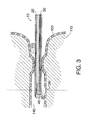
- FIG. 3 shows the probe 10 positioned within the lumen 140 of the urethra of a human female.
- the electrode 40 is located in the proximity of the urethral sphincters 120.
- the probe would be inserted through the penile urethra, the bulbous urethra, and positioned in the prostatic urethra beyond the urethral junction with the prostate duct (not shown).
- an injury 130 to the epithelium 100 of the urethra exposes the submucosa 110.
- the lumen 140 of the urethra is collapsed and folded more or less loosely by the pressure of the surrounding tissues, the submucosa 110 and epithelium 100.
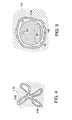
- FIG. 5 which shows a cross-sectional view along the axis shown in FIG. 3
- the probe 10 is located within the lumen 140 of the urethra prior to the application of heat.
- the lumen 140 is shown expanded by the circular shape of the probe 10.
- the electrode 40 is in close proximity of the epithelium 100 of the urethra.
- FIG. 6 which shows a cross-sectional view along the axis shown in FIG. 3, the probe 10 is located within the lumen 140 of the urethra after the application of heat.
- the application of heat has removed a radial segment 60 of epithelium 100 and submucosa 110 at the site of the injury 130.
- the size and shape of the injury 130 correspond to the size and shape of the electrode 40.
- a healing response is triggered that stimulates the cells of the submucosa 110 to divide leading to hyperplasia of the submucosa 150. Cells division continues until the newly grown epithelium 160 has covered the site of injury 130.
- FIGS. 8A and 8B the hyperplasia 150 at the site of injury 130 once the new epithelium 160 has fully regrown protrudes into the lumen 140 of the urethra.
- FIGS. 8A and 8B the hyperplasia 150 at the site of injury 130 once the new epithelium 160 has fully regrown protrudes into the lumen 140 of the urethra.
- FIG. 8A and 8B illustrate the valve action when the urethra is expanded by the pressure of the passage of urine in the lumen 140, as in FIG. 8A, and when the urethra is collapsed by the pressure of the surrounding tissues of the submucosa 110, as in FIG. 8B closing the flow of urine in the lumen.
- the valve action is due to the difference in texture between the hyperplasic mass and the opposite wall of the body passageway. Hyperplasic growth is fibrous in nature and thus non compliant while the remaining of body passageway is compliant. Thus, the hperplasic fibrous mass presses against the compliant opposite wall when the body passageway is collapsed as in Fig. 8B and operate as a valve.
Landscapes
- Health & Medical Sciences (AREA)
- Surgery (AREA)
- Life Sciences & Earth Sciences (AREA)
- Engineering & Computer Science (AREA)
- Heart & Thoracic Surgery (AREA)
- Animal Behavior & Ethology (AREA)
- Otolaryngology (AREA)
- Plasma & Fusion (AREA)
- Physics & Mathematics (AREA)
- Biomedical Technology (AREA)
- Cardiology (AREA)
- Medical Informatics (AREA)
- Molecular Biology (AREA)
- Nuclear Medicine, Radiotherapy & Molecular Imaging (AREA)
- General Health & Medical Sciences (AREA)
- Public Health (AREA)
- Veterinary Medicine (AREA)
- Prostheses (AREA)
- Surgical Instruments (AREA)
- Thermotherapy And Cooling Therapy Devices (AREA)
- Electrotherapy Devices (AREA)
Applications Claiming Priority (3)
| Application Number | Priority Date | Filing Date | Title |
|---|---|---|---|
| US09/164,002 US6156032A (en) | 1998-09-30 | 1998-09-30 | Method for causing a stricture of a body passageway |
| US164002 | 1998-09-30 | ||
| PCT/US1999/022500 WO2000018314A1 (en) | 1998-09-30 | 1999-09-29 | Method and device for causing a stricture of a body passageway |
Publications (2)
| Publication Number | Publication Date |
|---|---|
| EP1117339A1 EP1117339A1 (en) | 2001-07-25 |
| EP1117339B1 true EP1117339B1 (en) | 2007-01-03 |
Family
ID=22592550
Family Applications (1)
| Application Number | Title | Priority Date | Filing Date |
|---|---|---|---|
| EP99952973A Expired - Lifetime EP1117339B1 (en) | 1998-09-30 | 1999-09-29 | Device for causing a stricture of a body passageway |
Country Status (6)
| Country | Link |
|---|---|
| US (1) | US6156032A (enExample) |
| EP (1) | EP1117339B1 (enExample) |
| JP (1) | JP2002525159A (enExample) |
| CA (1) | CA2345247A1 (enExample) |
| DE (1) | DE69934702T2 (enExample) |
| WO (1) | WO2000018314A1 (enExample) |
Families Citing this family (81)
| Publication number | Priority date | Publication date | Assignee | Title |
|---|---|---|---|---|
| US6405732B1 (en) * | 1994-06-24 | 2002-06-18 | Curon Medical, Inc. | Method to treat gastric reflux via the detection and ablation of gastro-esophageal nerves and receptors |
| US6482224B1 (en) * | 1996-08-22 | 2002-11-19 | The Trustees Of Columbia University In The City Of New York | Endovascular flexible stapling device |
| US7317949B2 (en) | 1996-11-08 | 2008-01-08 | Ams Research Corporation | Energy induced bulking and buttressing of tissues for incontinence |
| US6292700B1 (en) | 1999-09-10 | 2001-09-18 | Surx, Inc. | Endopelvic fascia treatment for incontinence |
| US7767452B2 (en) * | 1997-02-20 | 2010-08-03 | Kleinsek Don A | Tissue treatments with adipocyte cells |
| CA2282546C (en) | 1997-03-04 | 2008-04-01 | Vnus Medical Technologies, Inc. | Method and apparatus for treating venous insufficiency using directionally applied energy |
| US9023031B2 (en) | 1997-08-13 | 2015-05-05 | Verathon Inc. | Noninvasive devices, methods, and systems for modifying tissues |
| WO1999035988A1 (en) * | 1998-01-14 | 1999-07-22 | Conway-Stuart Medical, Inc. | Electrosurgical device for sphincter treatment |
| US7165551B2 (en) | 1998-02-19 | 2007-01-23 | Curon Medical, Inc. | Apparatus to detect and treat aberrant myoelectric activity |
| US6645201B1 (en) * | 1998-02-19 | 2003-11-11 | Curon Medical, Inc. | Systems and methods for treating dysfunctions in the intestines and rectum |
| US6790207B2 (en) | 1998-06-04 | 2004-09-14 | Curon Medical, Inc. | Systems and methods for applying a selected treatment agent into contact with tissue to treat disorders of the gastrointestinal tract |
| US7329254B2 (en) | 1998-02-19 | 2008-02-12 | Curon Medical, Inc. | Systems and methods for treating dysfunctions in the intestines and rectum that adapt to the anatomic form and structure of different individuals |
| US6802841B2 (en) * | 1998-06-04 | 2004-10-12 | Curon Medical, Inc. | Systems and methods for applying a selected treatment agent into contact with tissue to treat sphincter dysfunction |
| US6139543A (en) | 1998-07-22 | 2000-10-31 | Endovasix, Inc. | Flow apparatus for the disruption of occlusions |
| US6440124B1 (en) * | 1998-07-22 | 2002-08-27 | Endovasix, Inc. | Flexible flow apparatus and method for the disruption of occlusions |
| US8597290B2 (en) | 1999-07-14 | 2013-12-03 | Mederi Therapeutics | Method for treating fecal incontinence |
| BR0015367A (pt) * | 1999-11-05 | 2002-07-23 | Gerigene Medical Corp | Aumento e reparo de defeitos nos tecidos moles relacionados com a idade |
| US20090074729A2 (en) * | 1999-11-05 | 2009-03-19 | Donald Kleinsek | Augmentation and repair of spincter defects with cells including fibroblasts |
| US20080267923A2 (en) * | 1999-11-05 | 2008-10-30 | Donald Kleinsek | Hair undifferentiated cells |
| US7799325B2 (en) * | 1999-11-05 | 2010-09-21 | Kleinsek Donald A | Removal of hypertrophic scars |
| US20080286242A2 (en) * | 1999-11-05 | 2008-11-20 | Donald Kleinsek | Augmentation and repair of spincter defects with cells including mesenchymal cells |
| US7306591B2 (en) * | 2000-10-02 | 2007-12-11 | Novasys Medical, Inc. | Apparatus and methods for treating female urinary incontinence |
| US20090130066A1 (en) * | 2000-11-06 | 2009-05-21 | Gerigene Medical Corporation | Augmentation and repair of sphincter defects with cells including muscle cells |
| JP3970180B2 (ja) | 2001-03-01 | 2007-09-05 | ボストン サイエンティフィック サイムド, インコーポレイテッド | 蛍光温度センサーを備えたカテーテル |
| US7097644B2 (en) | 2001-03-30 | 2006-08-29 | Ethicon Endo-Surgery, Inc. | Medical device with improved wall construction |
| US6918906B2 (en) | 2001-03-30 | 2005-07-19 | Gary L. Long | Endoscopic ablation system with improved electrode geometry |
| US6607525B2 (en) * | 2001-08-01 | 2003-08-19 | Nicolas Franco | Apparatus and method for treating urinary stress incontinence |
| US7063264B2 (en) * | 2001-12-24 | 2006-06-20 | Digimarc Corporation | Covert variable information on identification documents and methods of making same |
| US7207494B2 (en) | 2001-12-24 | 2007-04-24 | Digimarc Corporation | Laser etched security features for identification documents and methods of making same |
| US7694887B2 (en) | 2001-12-24 | 2010-04-13 | L-1 Secure Credentialing, Inc. | Optically variable personalized indicia for identification documents |
| US7137981B2 (en) | 2002-03-25 | 2006-11-21 | Ethicon Endo-Surgery, Inc. | Endoscopic ablation system with a distally mounted image sensor |
| US7804982B2 (en) | 2002-11-26 | 2010-09-28 | L-1 Secure Credentialing, Inc. | Systems and methods for managing and detecting fraud in image databases used with identification documents |
| US20040116921A1 (en) * | 2002-12-11 | 2004-06-17 | Marshall Sherman | Cold tip rf/ultrasonic ablation catheter |
| US8021359B2 (en) | 2003-02-13 | 2011-09-20 | Coaptus Medical Corporation | Transseptal closure of a patent foramen ovale and other cardiac defects |
| US7257450B2 (en) | 2003-02-13 | 2007-08-14 | Coaptus Medical Corporation | Systems and methods for securing cardiovascular tissue |
| US8021362B2 (en) | 2003-03-27 | 2011-09-20 | Terumo Kabushiki Kaisha | Methods and apparatus for closing a layered tissue defect |
| US7293562B2 (en) | 2003-03-27 | 2007-11-13 | Cierra, Inc. | Energy based devices and methods for treatment of anatomic tissue defects |
| US7972330B2 (en) | 2003-03-27 | 2011-07-05 | Terumo Kabushiki Kaisha | Methods and apparatus for closing a layered tissue defect |
| US7165552B2 (en) | 2003-03-27 | 2007-01-23 | Cierra, Inc. | Methods and apparatus for treatment of patent foramen ovale |
| US7186251B2 (en) | 2003-03-27 | 2007-03-06 | Cierra, Inc. | Energy based devices and methods for treatment of patent foramen ovale |
| JP4382087B2 (ja) | 2003-03-27 | 2009-12-09 | テルモ株式会社 | 卵円孔開存の治療方法および装置 |
| US6939348B2 (en) | 2003-03-27 | 2005-09-06 | Cierra, Inc. | Energy based devices and methods for treatment of patent foramen ovale |
| CA2522551C (en) | 2003-04-16 | 2009-12-22 | Digimarc Corporation | Three dimensional data storage |
| US7311701B2 (en) | 2003-06-10 | 2007-12-25 | Cierra, Inc. | Methods and apparatus for non-invasively treating atrial fibrillation using high intensity focused ultrasound |
| US7294125B2 (en) * | 2003-08-22 | 2007-11-13 | Scimed Life Systems, Inc. | Methods of delivering energy to body portions to produce a therapeutic response |
| US7367975B2 (en) | 2004-06-21 | 2008-05-06 | Cierra, Inc. | Energy based devices and methods for treatment of anatomic tissue defects |
| US7232438B2 (en) | 2004-07-09 | 2007-06-19 | Ethicon Endo-Surgery, Inc. | Ablation device with clear probe |
| US7824408B2 (en) | 2004-08-05 | 2010-11-02 | Tyco Healthcare Group, Lp | Methods and apparatus for coagulating and/or constricting hollow anatomical structures |
| US7473252B2 (en) | 2004-10-07 | 2009-01-06 | Coaptus Medical Corporation | Systems and methods for shrinking and/or securing cardiovascular tissue |
| US7753907B2 (en) * | 2004-10-29 | 2010-07-13 | Boston Scientific Scimed, Inc. | Medical device systems and methods |
| US7625372B2 (en) | 2005-02-23 | 2009-12-01 | Vnus Medical Technologies, Inc. | Methods and apparatus for coagulating and/or constricting hollow anatomical structures |
| AU2006235506B2 (en) | 2005-04-11 | 2011-06-30 | Terumo Kabushiki Kaisha | Methods and apparatus to achieve a closure of a layered tissue defect |
| US20070005049A1 (en) * | 2005-06-30 | 2007-01-04 | Comben Richard H | Apparatus and Method of Treating Urinary Incontinence by Heating Urethra |
| US20070065415A1 (en) * | 2005-09-16 | 2007-03-22 | Kleinsek Donald A | Compositions and methods for the augmentation and repair of defects in tissue |
| US20070142884A1 (en) * | 2005-12-16 | 2007-06-21 | Acoustx Corporation | Methods and apparatuses for treating an esophageal disorder such as gastroesophageal reflux disease |
| US20070142699A1 (en) * | 2005-12-16 | 2007-06-21 | Acoustx Corporation | Methods and implantable apparatuses for treating an esophageal disorder such as gastroesophageal reflux disease |
| DE102006047366A1 (de) * | 2006-10-04 | 2008-04-10 | Celon Ag Medical Instruments | Biegeweicher Katheter zur Hochfrequenztherapie von biologischem Gewebe |
| AU2008245600B2 (en) | 2007-04-27 | 2013-07-04 | Covidien Lp | Systems and methods for treating hollow anatomical structures |
| US9770297B2 (en) | 2008-06-04 | 2017-09-26 | Covidien Lp | Energy devices and methods for treating hollow anatomical structures |
| US20220280236A1 (en) * | 2008-07-01 | 2022-09-08 | Ralph Zipper | System and method for applying controlled dosage light therapy for treatment of body tissue |
| US20220257969A1 (en) * | 2008-07-01 | 2022-08-18 | Ralph Zipper | Method for treating pelvic pain, chronic prostatitis, and or overactive bladder symptoms |
| US20190125448A1 (en) * | 2008-07-01 | 2019-05-02 | Ralph Zipper | System and method for applying controlled dosage light therapy for treatment of body tissue |
| US8795264B2 (en) * | 2008-07-01 | 2014-08-05 | Ralph Zipper | Method for decreasing the size and/or changing the shape of pelvic tissues |
| US8936631B2 (en) | 2010-01-04 | 2015-01-20 | Covidien Lp | Apparatus and methods for treating hollow anatomical structures |
| EP2713870A4 (en) * | 2011-06-03 | 2014-10-22 | Los Angeles Childrens Hospital | ELECTROPHYSIOLOGICAL DIAGNOSIS AND TREATMENT OF ASTHMA |
| US20130006239A1 (en) * | 2011-07-01 | 2013-01-03 | Ellman International, Inc. | Electrosurgical systems and methods |
| WO2013028381A1 (en) | 2011-08-19 | 2013-02-28 | Cook Medical Technologies Llc | Cap for attachment to an endoscope |
| JP2014529427A (ja) | 2011-08-19 | 2014-11-13 | クック・メディカル・テクノロジーズ・リミテッド・ライアビリティ・カンパニーCook Medical Technologies Llc | 焼灼術用キャップ |
| JP6080368B2 (ja) * | 2012-02-29 | 2017-02-15 | フクダ電子株式会社 | カテーテル |
| US8403927B1 (en) | 2012-04-05 | 2013-03-26 | William Bruce Shingleton | Vasectomy devices and methods |
| US9526570B2 (en) | 2012-10-04 | 2016-12-27 | Cook Medical Technologies Llc | Tissue cutting cap |
| EP2967711B1 (en) | 2013-03-15 | 2020-05-06 | Cynosure, LLC | Electrosurgical instruments with multimodes of operation |
| JP2015144750A (ja) * | 2014-02-03 | 2015-08-13 | テルモ株式会社 | 尿道狭窄症の治療方法 |
| CN104983462A (zh) * | 2015-07-02 | 2015-10-21 | 安隽医疗科技(南京)有限公司 | 一种射频消融双极导管以及包含该射频消融双极导管的治疗装置 |
| CN104970881A (zh) * | 2015-07-02 | 2015-10-14 | 安隽医疗科技(南京)有限公司 | 一种射频消融导管以及包含该射频消融导管的治疗装置 |
| US12376898B2 (en) | 2016-07-01 | 2025-08-05 | Cynosure, Llc | Non-invasive, uniform and non-uniform RF methods and systems related applications |
| US12558145B2 (en) | 2016-07-01 | 2026-02-24 | Cynosure, Llc | Non-invasive, uniform and non-uniform RF methods and systems related applications |
| US11896823B2 (en) | 2017-04-04 | 2024-02-13 | Btl Healthcare Technologies A.S. | Method and device for pelvic floor tissue treatment |
| US20190151012A1 (en) * | 2017-11-17 | 2019-05-23 | Sherry Thomas | Method and Apparatus for Treating Female Urinary Incontinence and Fecal Incontinence |
| KR102726940B1 (ko) | 2018-02-07 | 2024-11-05 | 싸이노슈어, 엘엘씨 | 제어된 rf 처리 및 rf 생성기 시스템을 위한 방법 및 장치 |
| USD1005484S1 (en) | 2019-07-19 | 2023-11-21 | Cynosure, Llc | Handheld medical instrument and docking base |
Family Cites Families (12)
| Publication number | Priority date | Publication date | Assignee | Title |
|---|---|---|---|---|
| US4662368A (en) | 1983-06-13 | 1987-05-05 | Trimedyne Laser Systems, Inc. | Localized heat applying medical device |
| US4765331A (en) | 1987-02-10 | 1988-08-23 | Circon Corporation | Electrosurgical device with treatment arc of less than 360 degrees |
| US5242437A (en) | 1988-06-10 | 1993-09-07 | Trimedyne Laser Systems, Inc. | Medical device applying localized high intensity light and heat, particularly for destruction of the endometrium |
| WO1990007303A1 (en) * | 1989-01-06 | 1990-07-12 | Angioplasty Systems, Inc. | Electrosurgical catheter for resolving atherosclerotic plaque |
| US5122137A (en) | 1990-04-27 | 1992-06-16 | Boston Scientific Corporation | Temperature controlled rf coagulation |
| US5681282A (en) * | 1992-01-07 | 1997-10-28 | Arthrocare Corporation | Methods and apparatus for ablation of luminal tissues |
| AU5456494A (en) | 1992-11-13 | 1994-06-08 | American Cardiac Ablation Co., Inc. | Fluid cooled electrosurgical probe |
| NL9301182A (nl) * | 1993-07-05 | 1995-02-01 | Cordis Europ | Catheter met strookvormige elektrode. |
| CA2164860C (en) * | 1993-06-10 | 2005-09-06 | Mir A. Imran | Transurethral radio frequency ablation apparatus |
| WO1995010978A1 (en) * | 1993-10-19 | 1995-04-27 | Ep Technologies, Inc. | Segmented electrode assemblies for ablation of tissue |
| ES2129803T3 (es) * | 1993-12-22 | 1999-06-16 | Sulzer Osypka Gmbh | Cateter de ablacion cardiaca marcado ultrasonicamente. |
| US6056744A (en) * | 1994-06-24 | 2000-05-02 | Conway Stuart Medical, Inc. | Sphincter treatment apparatus |
-
1998
- 1998-09-30 US US09/164,002 patent/US6156032A/en not_active Expired - Lifetime
-
1999
- 1999-09-29 CA CA002345247A patent/CA2345247A1/en not_active Abandoned
- 1999-09-29 DE DE69934702T patent/DE69934702T2/de not_active Expired - Lifetime
- 1999-09-29 EP EP99952973A patent/EP1117339B1/en not_active Expired - Lifetime
- 1999-09-29 WO PCT/US1999/022500 patent/WO2000018314A1/en not_active Ceased
- 1999-09-29 JP JP2000571837A patent/JP2002525159A/ja active Pending
Also Published As
| Publication number | Publication date |
|---|---|
| US6156032A (en) | 2000-12-05 |
| DE69934702D1 (de) | 2007-02-15 |
| EP1117339A1 (en) | 2001-07-25 |
| DE69934702T2 (de) | 2007-11-15 |
| WO2000018314A1 (en) | 2000-04-06 |
| WO2000018314A9 (en) | 2000-08-24 |
| JP2002525159A (ja) | 2002-08-13 |
| CA2345247A1 (en) | 2000-04-06 |
Similar Documents
| Publication | Publication Date | Title |
|---|---|---|
| US6156032A (en) | Method for causing a stricture of a body passageway | |
| US10463426B2 (en) | Method for treating a tubular anatomical structure | |
| JP4571358B2 (ja) | 生体組織治療装置 | |
| CA2384866C (en) | Treatment of tissue by application of energy and drugs | |
| US6692490B1 (en) | Treatment of urinary incontinence and other disorders by application of energy and drugs | |
| US7294125B2 (en) | Methods of delivering energy to body portions to produce a therapeutic response | |
| US8177781B2 (en) | Apparatus and methods for treating female urinary incontinence | |
| US6463331B1 (en) | Application of energy and substances in the treatment of uro-genital disorders | |
| US6425877B1 (en) | Treatment of tissue in the digestive circulatory respiratory urinary and reproductive systems | |
| US6409723B1 (en) | Treating body tissue by applying energy and substances | |
| JPH08508664A (ja) | Bph切除方法及び装置 | |
| PT1335677E (pt) | Sistema e método para tratamento de tecido anormal no esófago humano | |
| EP1281366B1 (en) | Treatment of sphincters with electrosurgery and active substances | |
| Kabalin | Transurethral radio-frequency ablation of the prostate |
Legal Events
| Date | Code | Title | Description |
|---|---|---|---|
| PUAI | Public reference made under article 153(3) epc to a published international application that has entered the european phase |
Free format text: ORIGINAL CODE: 0009012 |
|
| 17P | Request for examination filed |
Effective date: 20010423 |
|
| AK | Designated contracting states |
Kind code of ref document: A1 Designated state(s): AT BE CH CY DE DK ES FI FR GB GR IE IT LI LU MC NL PT SE |
|
| RAP1 | Party data changed (applicant data changed or rights of an application transferred) |
Owner name: BOSTON SCIENTIFIC LIMITED |
|
| 17Q | First examination report despatched |
Effective date: 20030805 |
|
| RBV | Designated contracting states (corrected) |
Designated state(s): BE DE FR GB IE NL |
|
| GRAP | Despatch of communication of intention to grant a patent |
Free format text: ORIGINAL CODE: EPIDOSNIGR1 |
|
| RTI1 | Title (correction) |
Free format text: DEVICE FOR CAUSING A STRICTURE OF A BODY PASSAGEWAY |
|
| GRAS | Grant fee paid |
Free format text: ORIGINAL CODE: EPIDOSNIGR3 |
|
| GRAA | (expected) grant |
Free format text: ORIGINAL CODE: 0009210 |
|
| AK | Designated contracting states |
Kind code of ref document: B1 Designated state(s): BE DE FR GB IE NL |
|
| REG | Reference to a national code |
Ref country code: GB Ref legal event code: FG4D |
|
| REF | Corresponds to: |
Ref document number: 69934702 Country of ref document: DE Date of ref document: 20070215 Kind code of ref document: P |
|
| REG | Reference to a national code |
Ref country code: IE Ref legal event code: FG4D |
|
| ET | Fr: translation filed | ||
| PLBE | No opposition filed within time limit |
Free format text: ORIGINAL CODE: 0009261 |
|
| STAA | Information on the status of an ep patent application or granted ep patent |
Free format text: STATUS: NO OPPOSITION FILED WITHIN TIME LIMIT |
|
| 26N | No opposition filed |
Effective date: 20071005 |
|
| PGFP | Annual fee paid to national office [announced via postgrant information from national office to epo] |
Ref country code: NL Payment date: 20070806 Year of fee payment: 9 Ref country code: BE Payment date: 20070927 Year of fee payment: 9 |
|
| PGFP | Annual fee paid to national office [announced via postgrant information from national office to epo] |
Ref country code: FR Payment date: 20070321 Year of fee payment: 9 |
|
| BERE | Be: lapsed |
Owner name: BOSTON SCIENTIFIC LIMITED Effective date: 20080930 |
|
| PG25 | Lapsed in a contracting state [announced via postgrant information from national office to epo] |
Ref country code: NL Free format text: LAPSE BECAUSE OF NON-PAYMENT OF DUE FEES Effective date: 20090401 |
|
| NLV4 | Nl: lapsed or anulled due to non-payment of the annual fee |
Effective date: 20090401 |
|
| REG | Reference to a national code |
Ref country code: FR Ref legal event code: ST Effective date: 20090529 |
|
| PG25 | Lapsed in a contracting state [announced via postgrant information from national office to epo] |
Ref country code: BE Free format text: LAPSE BECAUSE OF NON-PAYMENT OF DUE FEES Effective date: 20080930 |
|
| PG25 | Lapsed in a contracting state [announced via postgrant information from national office to epo] |
Ref country code: FR Free format text: LAPSE BECAUSE OF NON-PAYMENT OF DUE FEES Effective date: 20080930 |
|
| PGFP | Annual fee paid to national office [announced via postgrant information from national office to epo] |
Ref country code: IE Payment date: 20090724 Year of fee payment: 11 |
|
| PGFP | Annual fee paid to national office [announced via postgrant information from national office to epo] |
Ref country code: GB Payment date: 20090807 Year of fee payment: 11 |
|
| PGFP | Annual fee paid to national office [announced via postgrant information from national office to epo] |
Ref country code: DE Payment date: 20090930 Year of fee payment: 11 |
|
| GBPC | Gb: european patent ceased through non-payment of renewal fee |
Effective date: 20100929 |
|
| REG | Reference to a national code |
Ref country code: DE Ref legal event code: R119 Ref document number: 69934702 Country of ref document: DE Effective date: 20110401 |
|
| PG25 | Lapsed in a contracting state [announced via postgrant information from national office to epo] |
Ref country code: IE Free format text: LAPSE BECAUSE OF NON-PAYMENT OF DUE FEES Effective date: 20100929 Ref country code: DE Free format text: LAPSE BECAUSE OF NON-PAYMENT OF DUE FEES Effective date: 20110401 |
|
| PG25 | Lapsed in a contracting state [announced via postgrant information from national office to epo] |
Ref country code: GB Free format text: LAPSE BECAUSE OF NON-PAYMENT OF DUE FEES Effective date: 20100929 |