EP1112156B1 - Mould with gasket and moulding method for compensating curing shrinkage - Google Patents
Mould with gasket and moulding method for compensating curing shrinkage Download PDFInfo
- Publication number
- EP1112156B1 EP1112156B1 EP99943146A EP99943146A EP1112156B1 EP 1112156 B1 EP1112156 B1 EP 1112156B1 EP 99943146 A EP99943146 A EP 99943146A EP 99943146 A EP99943146 A EP 99943146A EP 1112156 B1 EP1112156 B1 EP 1112156B1
- Authority
- EP
- European Patent Office
- Prior art keywords
- mould
- gasket
- nett
- edge
- compensating
- Prior art date
- Legal status (The legal status is an assumption and is not a legal conclusion. Google has not performed a legal analysis and makes no representation as to the accuracy of the status listed.)
- Expired - Lifetime
Links
- 238000000034 method Methods 0.000 title claims description 16
- 238000000465 moulding Methods 0.000 title claims description 15
- 239000000203 mixture Substances 0.000 claims description 48
- 239000000463 material Substances 0.000 claims description 16
- 230000009969 flowable effect Effects 0.000 claims description 11
- 239000007787 solid Substances 0.000 claims description 8
- 230000004888 barrier function Effects 0.000 claims description 6
- 229920001684 low density polyethylene Polymers 0.000 claims description 5
- 239000004702 low-density polyethylene Substances 0.000 claims description 5
- 239000004800 polyvinyl chloride Substances 0.000 claims description 5
- 239000004743 Polypropylene Substances 0.000 claims description 4
- 238000010438 heat treatment Methods 0.000 claims description 4
- 229920001155 polypropylene Polymers 0.000 claims description 4
- 230000000694 effects Effects 0.000 claims description 3
- 229920003052 natural elastomer Polymers 0.000 claims description 2
- 229920001194 natural rubber Polymers 0.000 claims description 2
- -1 polypropylene Polymers 0.000 claims description 2
- 238000003825 pressing Methods 0.000 claims description 2
- 229920003051 synthetic elastomer Polymers 0.000 claims description 2
- 239000005061 synthetic rubber Substances 0.000 claims description 2
- NIXOWILDQLNWCW-UHFFFAOYSA-N acrylic acid group Chemical group C(C=C)(=O)O NIXOWILDQLNWCW-UHFFFAOYSA-N 0.000 claims 1
- 229920002943 EPDM rubber Polymers 0.000 description 4
- 229920003023 plastic Polymers 0.000 description 4
- 239000004033 plastic Substances 0.000 description 4
- VYPSYNLAJGMNEJ-UHFFFAOYSA-N Silicium dioxide Chemical compound O=[Si]=O VYPSYNLAJGMNEJ-UHFFFAOYSA-N 0.000 description 3
- 239000000853 adhesive Substances 0.000 description 3
- 230000001070 adhesive effect Effects 0.000 description 3
- 239000004411 aluminium Substances 0.000 description 3
- 229910052782 aluminium Inorganic materials 0.000 description 3
- XAGFODPZIPBFFR-UHFFFAOYSA-N aluminium Chemical compound [Al] XAGFODPZIPBFFR-UHFFFAOYSA-N 0.000 description 3
- 238000004519 manufacturing process Methods 0.000 description 3
- 229920000642 polymer Polymers 0.000 description 3
- 229920000915 polyvinyl chloride Polymers 0.000 description 3
- 239000012858 resilient material Substances 0.000 description 3
- VVQNEPGJFQJSBK-UHFFFAOYSA-N Methyl methacrylate Chemical group COC(=O)C(C)=C VVQNEPGJFQJSBK-UHFFFAOYSA-N 0.000 description 2
- 230000008901 benefit Effects 0.000 description 2
- 239000003795 chemical substances by application Substances 0.000 description 2
- 239000003999 initiator Substances 0.000 description 2
- 238000002347 injection Methods 0.000 description 2
- 239000007924 injection Substances 0.000 description 2
- 229910052751 metal Inorganic materials 0.000 description 2
- 239000002184 metal Substances 0.000 description 2
- 229920003229 poly(methyl methacrylate) Polymers 0.000 description 2
- 239000000126 substance Substances 0.000 description 2
- 238000009966 trimming Methods 0.000 description 2
- 238000013022 venting Methods 0.000 description 2
- NOBYOEQUFMGXBP-UHFFFAOYSA-N (4-tert-butylcyclohexyl) (4-tert-butylcyclohexyl)oxycarbonyloxy carbonate Chemical compound C1CC(C(C)(C)C)CCC1OC(=O)OOC(=O)OC1CCC(C(C)(C)C)CC1 NOBYOEQUFMGXBP-UHFFFAOYSA-N 0.000 description 1
- 239000004971 Cross linker Substances 0.000 description 1
- 239000004609 Impact Modifier Substances 0.000 description 1
- 235000021355 Stearic acid Nutrition 0.000 description 1
- 229920006397 acrylic thermoplastic Polymers 0.000 description 1
- PNEYBMLMFCGWSK-UHFFFAOYSA-N aluminium oxide Inorganic materials [O-2].[O-2].[O-2].[Al+3].[Al+3] PNEYBMLMFCGWSK-UHFFFAOYSA-N 0.000 description 1
- 238000006243 chemical reaction Methods 0.000 description 1
- 150000001875 compounds Chemical class 0.000 description 1
- 238000010276 construction Methods 0.000 description 1
- 239000002537 cosmetic Substances 0.000 description 1
- 238000004132 cross linking Methods 0.000 description 1
- 230000007547 defect Effects 0.000 description 1
- 239000006185 dispersion Substances 0.000 description 1
- 238000009826 distribution Methods 0.000 description 1
- 229920001971 elastomer Polymers 0.000 description 1
- 238000001125 extrusion Methods 0.000 description 1
- 239000000945 filler Substances 0.000 description 1
- 239000004615 ingredient Substances 0.000 description 1
- 239000012764 mineral filler Substances 0.000 description 1
- 238000002156 mixing Methods 0.000 description 1
- 238000012806 monitoring device Methods 0.000 description 1
- QIQXTHQIDYTFRH-UHFFFAOYSA-N octadecanoic acid Chemical compound CCCCCCCCCCCCCCCCCC(O)=O QIQXTHQIDYTFRH-UHFFFAOYSA-N 0.000 description 1
- OQCDKBAXFALNLD-UHFFFAOYSA-N octadecanoic acid Natural products CCCCCCCC(C)CCCCCCCCC(O)=O OQCDKBAXFALNLD-UHFFFAOYSA-N 0.000 description 1
- 229920000728 polyester Polymers 0.000 description 1
- 239000004926 polymethyl methacrylate Substances 0.000 description 1
- 229920002635 polyurethane Polymers 0.000 description 1
- 239000004814 polyurethane Substances 0.000 description 1
- 238000002360 preparation method Methods 0.000 description 1
- 238000005086 pumping Methods 0.000 description 1
- 239000010453 quartz Substances 0.000 description 1
- 239000005060 rubber Substances 0.000 description 1
- 238000000926 separation method Methods 0.000 description 1
- 239000000377 silicon dioxide Substances 0.000 description 1
- 239000000243 solution Substances 0.000 description 1
- 239000008117 stearic acid Substances 0.000 description 1
- 239000006188 syrup Substances 0.000 description 1
- 235000020357 syrup Nutrition 0.000 description 1
- ISXSCDLOGDJUNJ-UHFFFAOYSA-N tert-butyl prop-2-enoate Chemical compound CC(C)(C)OC(=O)C=C ISXSCDLOGDJUNJ-UHFFFAOYSA-N 0.000 description 1
- 150000004684 trihydrates Chemical class 0.000 description 1
- 239000002699 waste material Substances 0.000 description 1
Images

Classifications
-
- B—PERFORMING OPERATIONS; TRANSPORTING
- B29—WORKING OF PLASTICS; WORKING OF SUBSTANCES IN A PLASTIC STATE IN GENERAL
- B29C—SHAPING OR JOINING OF PLASTICS; SHAPING OF MATERIAL IN A PLASTIC STATE, NOT OTHERWISE PROVIDED FOR; AFTER-TREATMENT OF THE SHAPED PRODUCTS, e.g. REPAIRING
- B29C39/00—Shaping by casting, i.e. introducing the moulding material into a mould or between confining surfaces without significant moulding pressure; Apparatus therefor
- B29C39/22—Component parts, details or accessories; Auxiliary operations
- B29C39/40—Compensating volume change, e.g. retraction
-
- B—PERFORMING OPERATIONS; TRANSPORTING
- B29—WORKING OF PLASTICS; WORKING OF SUBSTANCES IN A PLASTIC STATE IN GENERAL
- B29C—SHAPING OR JOINING OF PLASTICS; SHAPING OF MATERIAL IN A PLASTIC STATE, NOT OTHERWISE PROVIDED FOR; AFTER-TREATMENT OF THE SHAPED PRODUCTS, e.g. REPAIRING
- B29C33/00—Moulds or cores; Details thereof or accessories therefor
- B29C33/0038—Moulds or cores; Details thereof or accessories therefor with sealing means or the like
-
- B—PERFORMING OPERATIONS; TRANSPORTING
- B29—WORKING OF PLASTICS; WORKING OF SUBSTANCES IN A PLASTIC STATE IN GENERAL
- B29C—SHAPING OR JOINING OF PLASTICS; SHAPING OF MATERIAL IN A PLASTIC STATE, NOT OTHERWISE PROVIDED FOR; AFTER-TREATMENT OF THE SHAPED PRODUCTS, e.g. REPAIRING
- B29C37/00—Component parts, details, accessories or auxiliary operations, not covered by group B29C33/00 or B29C35/00
- B29C37/005—Compensating volume or shape change during moulding, in general
Definitions
- the present invention relates to a mould which may be used for the curing of curable compositions, i.e. compositions which are supplied to a mould in a flowable condition and which are then cured or hardened by chemical reaction e.g. polymerisation or crosslinking, or by heat or a combination thereof.
- curable compositions i.e. compositions which are supplied to a mould in a flowable condition and which are then cured or hardened by chemical reaction e.g. polymerisation or crosslinking, or by heat or a combination thereof.
- Curable compositions often exhibit shrinkage within the mould during the curing process which, if not allowed for, may lead to moulded articles with structural or cosmetic defects. Compensation within the mould to allow for this shrinkage can be effected in a variety of ways.
- a fixed cavity mould may be defined as a mould that closes to a fixed and rigid position and is then prevented from or incapable of any further movement. Hence there is no compensation for moulding composition shrinkage during the curing process after the mould has been filled with the curable composition. Shrinkage compensation can be attained by the pressure controlled addition of further amounts of curable composition to this mould during the curing process until the moulded article has set. This is disclosed in GB 1,323,343 which describes a method of producing a thick-walled cured plastics moulding.
- EP 033 3 456 A1 discloses a process of manufacturing a thin-walled plastics moulding, within a fixed cavity mould in which a pre-heated curable composition is added under pressure to the mould, which itself is pre-heated to a higher temperature than the curable composition. Further curable composition is added, via pressure control, to compensate for shrinkage during the curing whilst the temperature of the mould is contralled such that a linear temperature gradient is maintained, increasing away from the entry point of the curable composition. Hence the setting of the composition progresses through the back to the entry point where the further curable composition is added. This provides a thin-walled plastics moulding of an acceptable quality for kitchen sinks.
- the mould itself may be designed such that it can provide compensation for the shrinkage of the composition during the curing process.
- a compensating mould comprises at least two pieces separated by a compensating annular rubber gasket positioned at the edge of the mould. The separation of the pieces of the mould can be fixed for injection of the curable material to ensure injection of a similar weight of material each time. As the material cures and starts to shrink the separate pieces of the mould are moved closer together to compensate for this shrinkage. Methods of assisting this compensation include providing pneumatic air bags or hydraulic pistons operating on at least one piece of the mould.
- a compensating mould of this type may include a flash cavity around the perimeter of the moulding in order to accommodate the fill and venting fixtures.
- the present invention provides a compensating mould comprising a first, obverse face-forming part and a second, reverse face-forming part, said first and second parts being separated by an outer compensating gasket positioned around the edge of the mould characterised by the presence of an inner nett edge gasket comprising an elongate resilient gasket positioned between the first and second mould parts such that the nett edge gasket is in intimate contact with each of the first and second parts of the mould so that in use the nett edge gasket has an external surface positioned next to an edge of a moulding thereby forming a barrier to the flow of flowable curable composition contained within the mould around at least a part of the edge of the mould.
- the present invention provides a nett edge gasket comprising a resilient elongate material and a support means adapted to support the resilient elongate material within the flash cavity of a compensating mould.
- the present invention provides a process for curing a curable material to form a solid cured article in a compensating mould comprising a first, obverse face-forming part and a second, reverse face-forming part, which process comprises the steps of
- the present invention provides a compensating mould comprising a flash cavity for receiving a part of a curable composition, a first obverse face-forming part and a second reverse face-forming part, said first and second parts being separated by an outer compensating gasket positioned around the edge of the mould characterised by a separate inner resilient nett edge gasket positioned between the first and second mould parts so that the nett edge gasket is in intimate contact with each of the first and second parts of the mould, wherein the seal between the nett edge gasket and the mould parts forms a barrier to the flow of flowable curable composition contained within the mould into the flash cavity.
- the mould comprises a first, obverse face-forming part and a second, reverse face-forming part but each part may be formed from more than one piece which may be secured together and be optionally disassemblable if required.
- the mould may incorporate integral heating means, e.g. in the form of electric heaters, monitoring devices to measure temperature, pressure etc at one or more places in the mould, mould inserts for forming certain shapes within the mould or changing parts of the shape provided by the mould.
- the mould also comprises means for introducing the curable composition into the mould in the form of a fill port adapted to enable flowable compositions to be filled into the mould, preferably by pumping.
- the flowable composition may be added in a predetermined metered amount or may be added until the mould is full.
- the fill port is preferably located at a part of the mould which Is not critical to the appearance of the moulded article, e.g. on the reverse face-forming part of the mould when the obverse face of the moulded article is intended as the "show-face".
- the nett edge gasket is made from a resilient material which is preferably a polymeric material which has some chemical resistance to the curable mixture.
- suitable polymers are natural and synthetic rubbers, for example ethylene propylene diene monomer (EPDM), low density polyethylene (LDPE), polyvinylchloride (PVC) and polypropylene (PP).
- EPDM ethylene propylene diene monomer
- LDPE low density polyethylene
- PVC polyvinylchloride
- PP polypropylene
- the cross sectional shape of the nett gasket may be for example round, square, rectangular, polygonal and may be solid or hollow.
- the nett edge gasket enables a moulding to be formed without any (or with only minimal) flash which would otherwise need to be trimmed from the moulding following its release from the mould.
- the nett edge gasket is preferably positioned within the mould such that an external surface is as close to the trim line as possible around the whate mould. It is preferred that the nett edge gasket is continuous around the mould although it may be interrupted, for example to allow for fill ports, measuring devices or other intrusions into the mould between the two parts of the mould.
- the nett edge gasket is supported by direct connection to the internal surface of the mould pieces, for example by means of an adhesive or by fitting a protrusion or socket provided on either the mould or the gasket into a reciprocal protrusion or socket of the other part
- the nett edge gasket is supported by a permanent or temporary support fixture positioned within the flash cavity.
- the nett edge gasket is fully supported along its length around the inside of the mould.
- the support fixture needs to provide support for the nett edge gasket around the inside of the mould to hold the nett edge gasket in the required position, preferably at the trim line, as described above, during the curing process. It may be attached to an inner surface of the mould, for example via an adhesive or bolts or it may be held by a friction fit between the mould parts or between the compensating gasket and the mould.
- the material of the support may be for example paper based, plastic or metal.
- the support fixture may be rigid or flexible.
- the nett edge gasket may be directly connected to the support fixture, for example by means of lugs, screws, or a tongue and channel arrangement whereby a tongue located on one or other of the gasket or support is held within a channel formed in the other part.
- the tongue may be smooth or may be provided with protrusions or serrations to prevent its inadvertent removal from the channel and thus secure the gasket and support fixture together.
- a channel formed along the length of the gasket may be secured around the base of the support fixture to form a snug fit. It is preferred that the nett edge gasket is secured to the support fixture in a manner which enables it to be detached from the support easily when required so that for example a used gasket may be quickly replaced with a new one.
- the nett edge gasket may be positioned in close proximity to the support fixture so that the gasket and support are not secured together.
- the gasket (or a portion thereof) may be held against the support, e.g. a gasket of 'L' shaped cross section may be positioned as close to the trim line as possible around the mould so that is snugly trapped between the support fixture and one of the mould pieces.
- the support fixture and the nett edge gasket may be a unitary structure made from a resilient material which is preferably a polymeric material which has some chemical resistance to the curable mixture.
- This type of gasket may be made for example by extrusion of a single, suitably shaped elongate piece of rubbery material, e.g. EPDM rubber and has the advantage that it need not be joined to a separate support fixture.
- the unitary gasket/support may be provided with means adapted to secure the gasket and support in the desired position within the mould, e.g. holes to accommodate screws or bolts or a flange to fit around a lip within the mould.
- the nett edge gasket may remain attached to one of the mould pieces, or the support fixture if present, after the cured article has been removed from the mould. This nett edge gasket could then be reused or alternatively removed from the mould piece, or support fixture if present, and replaced by a new nett edge gasket. Alternatively, the nett edge gasket may be designed to become embedded in the curable composition to form an integral part of the cured moulded article at the trim line so that at least a portion of the resilient material of the gasket forms a part of the moulded article.
- Moulding processes of the type described are often used to form articles such as kitchen sinks which generally have a gasket attached to them prior to use, in order to form a seal between the article and a kitchen work surface into which the sink is installed.
- the use of a suitably designed nett edge gasket which is embedded around the edge of the moulded article during moulding may offer the benefit that the gasket is more securely attached to the article than could be achieved by means of an adhesive and of course the manufacturing step of attaching a separate gasket may be avoided.
- the gasket may be designed with a lip or flange on an inwardly facing portion around which the curable composition may flow when the mould is filled and which therefore becomes embedded in the solid cured article, or alternative means by which the nett edge gasket may be physically secured within the moulded article.
- the curable composition may comprise a monomeric compound which is curable within the mould to form a solid polymer.
- a typical moulding composition for manufacturing kitchen sinks comprises a solution of polymethyl methacrylate in methyl methacrylate monomer to form so-called “syrup" containing a high proportion of a mineral filler, e.g. silica, quartz or alumina trihydrate and optionally colourants and/or other decorative ingredients, impact modifiers, mould release agents, polymerisation initiators, polymerisation regulators, cross-linkers etc.
- a mineral filler e.g. silica, quartz or alumina trihydrate
- optionally colourants and/or other decorative ingredients e.g. silica, quartz or alumina trihydrate
- Such compositions are very well known in the art and are described, for example, in GB-A-1493393.
- Other polymers may be used, e.g. polyesters, polyurethanes etc.
- the composition may be cured by the application of heat in a controlled manner. It is common for the mould to be heated in a number of different temperature stages which are normally pre-programmed to provide an ideal heat cycle for the particular composition.
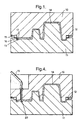
- Figure 1 shows two heatable mould pieces, the reverse face forming part (or backface) (10) and the obverse face forming part (or showface) (11). These are separated by an annular EPDM rubber gasket (12).
- the flash cavity (13) is 30mm high, around the perimeter of the mould.
- the initiated curable composition (14) is added to the space between the mould pieces.
- a nett edge gasket (16) which is formed from LDPE is supported on a support fixture (15), which is a rigid aluminium frame positioned within the flash cavity (13).
- the nett edge gasket (16) is securely but detachably attached to the base of the aluminium frame by means of a serrated channel in the gasket.
- the nett edge gasket is positioned at the trim line (17) of the mould.
- Figure 2 shows an exploded view of the nett edge gasket.
- Figure 4 shows the mould tilted for filling with a filling line (19) and the fill point (20).
- the nett edge gasket (18) material is PVC with an L shaped cross section.
- the base of the L shaped cross section is positioned as dose to the trim line as possible around the whole mould with the nett edge gasket trapped snugly between the rigid aluminium frame (15) and the backface mould piece (10).
- a curable mixture was prepared by mixing UltrastylTM (a formulated dispersion of methylmethacrylate containing about 60% beta crystobalite filler herebyable from ICI Acrylics) with bis-(4 tertiary butyl cyclohexyl) peroxydicarbonate initiator (0.6% by wt, ex Akzo-Nobel) and stearic acid internal mould release agent (15% by wt) and stirred for 20 minutes. The resulting mixture was de-areated with applied vacuum for 10 minutes.
- UltrastylTM a formulated dispersion of methylmethacrylate containing about 60% beta crystobalite filler hereby ICI Acrylics
- bis-(4 tertiary butyl cyclohexyl) peroxydicarbonate initiator (0.6% by wt, ex Akzo-Nobel)
- stearic acid internal mould release agent (15% by wt
- a mould substantially as described in the drawings, was prepared by preheating the two mould pieces to 80°C (showface) and 50°C (backface) respectively.
- the initiated curable mixture was pumped into the mould cavity via a filling line through a low entry point of the backface (as shown in Figure 4) from a dispensing vessel at 1.5 barg pressure. Venting was through a small break in the nett edge gasket which was sealed once the mould cavity was filled as well as the filling line.
- the compensating pressure was applied to the mould by inflating air bags (not shown) fixed between the upper portion of the mould and a rigid frame surrounding the mould assembly so that when the air bags were inflated, they exerted a downwardly directed pressure on the top portion of the mould so that it is forced towards the lower mould portion, the compensating gasket being able to adapt to the increased pressure to maintain a good seal between the mould portions.
- the air bags were pressurised to 2.5 barg prior to the start of a 30 minute curing cycle. After 10 minutes the air bag pressure was increased to 4.5 barg and this pressure was maintained for the rest of curing cycle. After 15 minutes of the curing cycle the temperature of each mould piece was increased to 100°C and this temperature was maintained for the remainder of the curing cycle. The mould pieces were then cooled and the mould opened. The cured article was removed and allowed to cool without dislodging the nett gasket from the support structure.
- a curable composition as described in Example 1 was filled into a prepared mould in which an L-shaped PVC nett edge gasket of the type shown in figure 3 was secured against a metal support.
- the backface was removed from the cured article first to ensure the PVC nett edge gasket remained secured to the cured article.
Landscapes
- Engineering & Computer Science (AREA)
- Mechanical Engineering (AREA)
- Moulds For Moulding Plastics Or The Like (AREA)
- Casting Or Compression Moulding Of Plastics Or The Like (AREA)
- Heating, Cooling, Or Curing Plastics Or The Like In General (AREA)
Applications Claiming Priority (3)
| Application Number | Priority Date | Filing Date | Title |
|---|---|---|---|
| GBGB9819415.2A GB9819415D0 (en) | 1998-09-07 | 1998-09-07 | A mould and apparatus thereof |
| GB9819415 | 1998-09-07 | ||
| PCT/GB1999/002950 WO2000013872A1 (en) | 1998-09-07 | 1999-09-06 | Mould with gasket and moulding method for compensating curing shrinkage |
Publications (2)
| Publication Number | Publication Date |
|---|---|
| EP1112156A1 EP1112156A1 (en) | 2001-07-04 |
| EP1112156B1 true EP1112156B1 (en) | 2003-04-23 |
Family
ID=10838419
Family Applications (1)
| Application Number | Title | Priority Date | Filing Date |
|---|---|---|---|
| EP99943146A Expired - Lifetime EP1112156B1 (en) | 1998-09-07 | 1999-09-06 | Mould with gasket and moulding method for compensating curing shrinkage |
Country Status (7)
| Country | Link |
|---|---|
| EP (1) | EP1112156B1 (https=) |
| JP (1) | JP2002524297A (https=) |
| AU (1) | AU5641799A (https=) |
| DE (1) | DE69907227T2 (https=) |
| ES (1) | ES2198950T3 (https=) |
| GB (1) | GB9819415D0 (https=) |
| WO (1) | WO2000013872A1 (https=) |
Families Citing this family (3)
| Publication number | Priority date | Publication date | Assignee | Title |
|---|---|---|---|---|
| DE202004019143U1 (de) * | 2004-12-10 | 2006-04-20 | Huber & Grimme Bearbeitungssysteme Gmbh | Unterdruckhaltevorrichtung |
| DE102009004694A1 (de) * | 2009-01-12 | 2010-12-23 | Andreas Roll | Gewebekern / Gewebeform |
| DE102018117586A1 (de) * | 2018-06-08 | 2019-12-12 | Bbg Gmbh & Co. Kg | Formenträgersystem |
Family Cites Families (10)
| Publication number | Priority date | Publication date | Assignee | Title |
|---|---|---|---|---|
| US4143852A (en) * | 1976-01-07 | 1979-03-13 | Robert Wiener | Reusable gasket for use in and in combination with a molding apparatus |
| FR2449519A1 (fr) * | 1979-02-23 | 1980-09-19 | Essilor Int | Joint annulaire propre au moulage de lentilles ophtalmiques ou optiques en matiere organique, et procede de mise en oeuvre d'un tel joint |
| US4227673A (en) * | 1979-08-10 | 1980-10-14 | American Optical Corporation | Gasket for casting lenses |
| JPS58187316A (ja) * | 1982-04-28 | 1983-11-01 | Olympus Optical Co Ltd | プラスチツクレンズ成形用金型 |
| US4693446A (en) * | 1985-09-20 | 1987-09-15 | Techna Vision, Inc. | Gasket for molding plastic lenses |
| US4767308A (en) * | 1986-01-21 | 1988-08-30 | Group Lotus Plc | Mould for moulding an article |
| GB8629361D0 (en) * | 1986-12-09 | 1987-01-21 | Shell Int Research | Preparation of fibre-reinforced composites |
| US4839110A (en) * | 1988-03-02 | 1989-06-13 | Sola Usa, Inc. | Method of molding using gated dies |
| US5074773A (en) * | 1990-04-12 | 1991-12-24 | Davidson Textron Inc. | Adjustable gasket alignment block |
| DE9115477U1 (de) * | 1991-12-13 | 1992-02-13 | Röhm GmbH, 64293 Darmstadt | Vorrichtung zur Herstellung von Kunststoffplatten |
-
1998
- 1998-09-07 GB GBGB9819415.2A patent/GB9819415D0/en not_active Ceased
-
1999
- 1999-09-06 DE DE69907227T patent/DE69907227T2/de not_active Expired - Lifetime
- 1999-09-06 JP JP2000568658A patent/JP2002524297A/ja active Pending
- 1999-09-06 AU AU56417/99A patent/AU5641799A/en not_active Abandoned
- 1999-09-06 EP EP99943146A patent/EP1112156B1/en not_active Expired - Lifetime
- 1999-09-06 WO PCT/GB1999/002950 patent/WO2000013872A1/en not_active Ceased
- 1999-09-06 ES ES99943146T patent/ES2198950T3/es not_active Expired - Lifetime
Also Published As
| Publication number | Publication date |
|---|---|
| DE69907227D1 (de) | 2003-05-28 |
| JP2002524297A (ja) | 2002-08-06 |
| AU5641799A (en) | 2000-03-27 |
| DE69907227T2 (de) | 2004-03-25 |
| WO2000013872A1 (en) | 2000-03-16 |
| ES2198950T3 (es) | 2004-02-01 |
| EP1112156A1 (en) | 2001-07-04 |
| GB9819415D0 (en) | 1998-10-28 |
Similar Documents
| Publication | Publication Date | Title |
|---|---|---|
| US5413748A (en) | Method for forming encapsulated glass | |
| US3642975A (en) | Process for forming a stress-free article containing a depression from a polymer | |
| EP0704290B1 (en) | Process for manufacturing thermoplastic resin moldings | |
| CZ286396B6 (en) | Glazing part and process for producing thereof | |
| US6884056B2 (en) | Mold runner for prevention of in-mold coating flow | |
| US20120186103A1 (en) | System and method for printing a pattern on footwear | |
| US5851474A (en) | Injection molding with periodic forces to the material in the mold | |
| US5275547A (en) | Mold assembly with flexible membrane | |
| US5064585A (en) | Process of manufacturing a thin-walled plastics moulding | |
| CZ91593A3 (en) | Device for casting two-color thin-walled plastic shell | |
| EP1112156B1 (en) | Mould with gasket and moulding method for compensating curing shrinkage | |
| US3880970A (en) | Process for producing microcellular shaped pieces of dimensional accuracy, particularly shoe soles | |
| JPS5923552B2 (ja) | 型内被覆装置と方法 | |
| US5814260A (en) | Method of casting-masking-molding thermoplastic resin product | |
| CA1117266A (en) | In-the-mold coating method | |
| GB2189183A (en) | Moulding plastic articles | |
| US4047860A (en) | Press mold for producing microcellular shaped pieces of dimensional accuracy, particularly shoe soles | |
| US5061415A (en) | Process for improving the quality of injection moulded parts | |
| CN1291542A (zh) | 发泡鞋底的冷却定型方法及其模具 | |
| CA2011863A1 (en) | Mold for the preparation of reinforced reaction injection molded parts | |
| US4329134A (en) | In-the-mold coating apparatus and method | |
| WO2014153323A1 (en) | Molding apparatus, molded articles, and methods of molding | |
| GB2299779A (en) | Injection moulding of thermoplastic resin | |
| WO1999001270A1 (en) | Method of casting and producing ath filled acrylic or polymethacrylate based molded articles by using protecting polyethylene foil in the mold | |
| JPH0699456A (ja) | インサート成形品の製造方法とそれに用いる金型装置 |
Legal Events
| Date | Code | Title | Description |
|---|---|---|---|
| PUAI | Public reference made under article 153(3) epc to a published international application that has entered the european phase |
Free format text: ORIGINAL CODE: 0009012 |
|
| 17P | Request for examination filed |
Effective date: 20010126 |
|
| AK | Designated contracting states |
Kind code of ref document: A1 Designated state(s): AT BE CH CY DE DK ES FI FR GB GR IE IT LI LU MC NL PT SE |
|
| 17Q | First examination report despatched |
Effective date: 20020410 |
|
| RAP1 | Party data changed (applicant data changed or rights of an application transferred) |
Owner name: LUCITE INTERNATIONAL UK LIMITED |
|
| GRAH | Despatch of communication of intention to grant a patent |
Free format text: ORIGINAL CODE: EPIDOS IGRA |
|
| GRAH | Despatch of communication of intention to grant a patent |
Free format text: ORIGINAL CODE: EPIDOS IGRA |
|
| GRAA | (expected) grant |
Free format text: ORIGINAL CODE: 0009210 |
|
| AK | Designated contracting states |
Designated state(s): DE ES FR GB IT |
|
| REG | Reference to a national code |
Ref country code: GB Ref legal event code: FG4D |
|
| REF | Corresponds to: |
Ref document number: 69907227 Country of ref document: DE Date of ref document: 20030528 Kind code of ref document: P |
|
| ET | Fr: translation filed | ||
| REG | Reference to a national code |
Ref country code: ES Ref legal event code: FG2A Ref document number: 2198950 Country of ref document: ES Kind code of ref document: T3 |
|
| PLBE | No opposition filed within time limit |
Free format text: ORIGINAL CODE: 0009261 |
|
| STAA | Information on the status of an ep patent application or granted ep patent |
Free format text: STATUS: NO OPPOSITION FILED WITHIN TIME LIMIT |
|
| 26N | No opposition filed |
Effective date: 20040126 |
|
| PGFP | Annual fee paid to national office [announced via postgrant information from national office to epo] |
Ref country code: FR Payment date: 20110928 Year of fee payment: 13 Ref country code: GB Payment date: 20110920 Year of fee payment: 13 |
|
| PGFP | Annual fee paid to national office [announced via postgrant information from national office to epo] |
Ref country code: IT Payment date: 20110927 Year of fee payment: 13 |
|
| GBPC | Gb: european patent ceased through non-payment of renewal fee |
Effective date: 20120906 |
|
| REG | Reference to a national code |
Ref country code: FR Ref legal event code: ST Effective date: 20130531 |
|
| PG25 | Lapsed in a contracting state [announced via postgrant information from national office to epo] |
Ref country code: GB Free format text: LAPSE BECAUSE OF NON-PAYMENT OF DUE FEES Effective date: 20120906 |
|
| PG25 | Lapsed in a contracting state [announced via postgrant information from national office to epo] |
Ref country code: IT Free format text: LAPSE BECAUSE OF NON-PAYMENT OF DUE FEES Effective date: 20120906 Ref country code: FR Free format text: LAPSE BECAUSE OF NON-PAYMENT OF DUE FEES Effective date: 20121001 |
|
| PGFP | Annual fee paid to national office [announced via postgrant information from national office to epo] |
Ref country code: DE Payment date: 20160921 Year of fee payment: 18 |
|
| PGFP | Annual fee paid to national office [announced via postgrant information from national office to epo] |
Ref country code: ES Payment date: 20160916 Year of fee payment: 18 |
|
| REG | Reference to a national code |
Ref country code: DE Ref legal event code: R119 Ref document number: 69907227 Country of ref document: DE |
|
| PG25 | Lapsed in a contracting state [announced via postgrant information from national office to epo] |
Ref country code: DE Free format text: LAPSE BECAUSE OF NON-PAYMENT OF DUE FEES Effective date: 20180404 |
|
| REG | Reference to a national code |
Ref country code: ES Ref legal event code: FD2A Effective date: 20181024 |
|
| PG25 | Lapsed in a contracting state [announced via postgrant information from national office to epo] |
Ref country code: ES Free format text: LAPSE BECAUSE OF NON-PAYMENT OF DUE FEES Effective date: 20170907 |