EP1108771A2 - Lösbare Klebstoffe zum Verbinden von Substraten - Google Patents
Lösbare Klebstoffe zum Verbinden von Substraten Download PDFInfo
- Publication number
- EP1108771A2 EP1108771A2 EP00125465A EP00125465A EP1108771A2 EP 1108771 A2 EP1108771 A2 EP 1108771A2 EP 00125465 A EP00125465 A EP 00125465A EP 00125465 A EP00125465 A EP 00125465A EP 1108771 A2 EP1108771 A2 EP 1108771A2
- Authority
- EP
- European Patent Office
- Prior art keywords
- adhesive
- component
- sealing
- resins
- poly
- Prior art date
- Legal status (The legal status is an assumption and is not a legal conclusion. Google has not performed a legal analysis and makes no representation as to the accuracy of the status listed.)
- Granted
Links
- 239000000853 adhesive Substances 0.000 title claims abstract description 144
- 230000001070 adhesive effect Effects 0.000 title claims abstract description 144
- 239000000758 substrate Substances 0.000 title claims description 80
- 238000005304 joining Methods 0.000 title claims description 19
- 239000000565 sealant Substances 0.000 claims abstract description 84
- 238000007789 sealing Methods 0.000 claims abstract description 81
- 239000007788 liquid Substances 0.000 claims abstract description 13
- 238000004519 manufacturing process Methods 0.000 claims abstract description 8
- 229920005989 resin Polymers 0.000 claims description 29
- 239000011347 resin Substances 0.000 claims description 29
- 238000000034 method Methods 0.000 claims description 23
- 239000004831 Hot glue Substances 0.000 claims description 22
- -1 poly (ethylene butylene) Polymers 0.000 claims description 22
- 229920013639 polyalphaolefin Polymers 0.000 claims description 18
- 239000004743 Polypropylene Substances 0.000 claims description 17
- 229920002725 thermoplastic elastomer Polymers 0.000 claims description 17
- 150000001875 compounds Chemical class 0.000 claims description 14
- 229920001577 copolymer Polymers 0.000 claims description 14
- VXNZUUAINFGPBY-UHFFFAOYSA-N 1-Butene Chemical compound CCC=C VXNZUUAINFGPBY-UHFFFAOYSA-N 0.000 claims description 13
- 229920003023 plastic Polymers 0.000 claims description 13
- 239000004033 plastic Substances 0.000 claims description 13
- 229920002367 Polyisobutene Polymers 0.000 claims description 12
- 239000003921 oil Substances 0.000 claims description 12
- 229920001169 thermoplastic Polymers 0.000 claims description 12
- UFHFLCQGNIYNRP-UHFFFAOYSA-N Hydrogen Chemical compound [H][H] UFHFLCQGNIYNRP-UHFFFAOYSA-N 0.000 claims description 10
- VQTUBCCKSQIDNK-UHFFFAOYSA-N Isobutene Chemical group CC(C)=C VQTUBCCKSQIDNK-UHFFFAOYSA-N 0.000 claims description 10
- 229920001155 polypropylene Polymers 0.000 claims description 10
- 239000004793 Polystyrene Substances 0.000 claims description 9
- 229920001971 elastomer Polymers 0.000 claims description 9
- 239000000945 filler Substances 0.000 claims description 9
- 125000002496 methyl group Chemical group [H]C([H])([H])* 0.000 claims description 9
- 229920002223 polystyrene Polymers 0.000 claims description 9
- 229920001187 thermosetting polymer Polymers 0.000 claims description 9
- 239000004416 thermosoftening plastic Substances 0.000 claims description 9
- 229910052739 hydrogen Inorganic materials 0.000 claims description 8
- 239000001257 hydrogen Substances 0.000 claims description 8
- 239000003381 stabilizer Substances 0.000 claims description 8
- 238000002844 melting Methods 0.000 claims description 7
- 239000000178 monomer Substances 0.000 claims description 7
- PPBRXRYQALVLMV-UHFFFAOYSA-N Styrene Chemical compound C=CC1=CC=CC=C1 PPBRXRYQALVLMV-UHFFFAOYSA-N 0.000 claims description 6
- 238000005227 gel permeation chromatography Methods 0.000 claims description 6
- 230000008018 melting Effects 0.000 claims description 6
- 229920001195 polyisoprene Polymers 0.000 claims description 6
- 229920002635 polyurethane Polymers 0.000 claims description 6
- 239000004814 polyurethane Substances 0.000 claims description 6
- 150000003505 terpenes Chemical class 0.000 claims description 6
- 235000007586 terpenes Nutrition 0.000 claims description 6
- 239000005062 Polybutadiene Substances 0.000 claims description 5
- 239000004820 Pressure-sensitive adhesive Substances 0.000 claims description 5
- 239000004840 adhesive resin Substances 0.000 claims description 5
- 229920006223 adhesive resin Polymers 0.000 claims description 5
- 238000001816 cooling Methods 0.000 claims description 5
- 239000000806 elastomer Substances 0.000 claims description 5
- 230000009969 flowable effect Effects 0.000 claims description 5
- 230000004048 modification Effects 0.000 claims description 5
- 238000012986 modification Methods 0.000 claims description 5
- 238000004525 petroleum distillation Methods 0.000 claims description 5
- 229920003229 poly(methyl methacrylate) Polymers 0.000 claims description 5
- 229920002857 polybutadiene Polymers 0.000 claims description 5
- 239000004926 polymethyl methacrylate Substances 0.000 claims description 5
- GRWFGVWFFZKLTI-IUCAKERBSA-N (-)-α-pinene Chemical compound CC1=CC[C@@H]2C(C)(C)[C@H]1C2 GRWFGVWFFZKLTI-IUCAKERBSA-N 0.000 claims description 4
- MYRTYDVEIRVNKP-UHFFFAOYSA-N 1,2-Divinylbenzene Chemical compound C=CC1=CC=CC=C1C=C MYRTYDVEIRVNKP-UHFFFAOYSA-N 0.000 claims description 4
- LIKMAJRDDDTEIG-UHFFFAOYSA-N 1-hexene Chemical compound CCCCC=C LIKMAJRDDDTEIG-UHFFFAOYSA-N 0.000 claims description 4
- VTYYLEPIZMXCLO-UHFFFAOYSA-L Calcium carbonate Chemical compound [Ca+2].[O-]C([O-])=O VTYYLEPIZMXCLO-UHFFFAOYSA-L 0.000 claims description 4
- NQRYJNQNLNOLGT-UHFFFAOYSA-N Piperidine Chemical compound C1CCNCC1 NQRYJNQNLNOLGT-UHFFFAOYSA-N 0.000 claims description 4
- 229920001328 Polyvinylidene chloride Polymers 0.000 claims description 4
- QQONPFPTGQHPMA-UHFFFAOYSA-N Propene Chemical compound CC=C QQONPFPTGQHPMA-UHFFFAOYSA-N 0.000 claims description 4
- GWEVSGVZZGPLCZ-UHFFFAOYSA-N Titan oxide Chemical compound O=[Ti]=O GWEVSGVZZGPLCZ-UHFFFAOYSA-N 0.000 claims description 4
- XLOMVQKBTHCTTD-UHFFFAOYSA-N Zinc monoxide Chemical compound [Zn]=O XLOMVQKBTHCTTD-UHFFFAOYSA-N 0.000 claims description 4
- 125000003118 aryl group Chemical group 0.000 claims description 4
- 239000006229 carbon black Substances 0.000 claims description 4
- 150000001993 dienes Chemical class 0.000 claims description 4
- FPYJFEHAWHCUMM-UHFFFAOYSA-N maleic anhydride Chemical compound O=C1OC(=O)C=C1 FPYJFEHAWHCUMM-UHFFFAOYSA-N 0.000 claims description 4
- YWAKXRMUMFPDSH-UHFFFAOYSA-N pentene Chemical compound CCCC=C YWAKXRMUMFPDSH-UHFFFAOYSA-N 0.000 claims description 4
- 229920000642 polymer Polymers 0.000 claims description 4
- 229920001296 polysiloxane Polymers 0.000 claims description 4
- 239000005033 polyvinylidene chloride Substances 0.000 claims description 4
- 229920001897 terpolymer Polymers 0.000 claims description 4
- KMOUUZVZFBCRAM-OLQVQODUSA-N (3as,7ar)-3a,4,7,7a-tetrahydro-2-benzofuran-1,3-dione Chemical compound C1C=CC[C@@H]2C(=O)OC(=O)[C@@H]21 KMOUUZVZFBCRAM-OLQVQODUSA-N 0.000 claims description 3
- 239000004698 Polyethylene Substances 0.000 claims description 3
- VYPSYNLAJGMNEJ-UHFFFAOYSA-N Silicium dioxide Chemical compound O=[Si]=O VYPSYNLAJGMNEJ-UHFFFAOYSA-N 0.000 claims description 3
- 229910045601 alloy Inorganic materials 0.000 claims description 3
- 239000000956 alloy Substances 0.000 claims description 3
- 239000000975 dye Substances 0.000 claims description 3
- 239000003822 epoxy resin Substances 0.000 claims description 3
- LNEPOXFFQSENCJ-UHFFFAOYSA-N haloperidol Chemical compound C1CC(O)(C=2C=CC(Cl)=CC=2)CCN1CCCC(=O)C1=CC=C(F)C=C1 LNEPOXFFQSENCJ-UHFFFAOYSA-N 0.000 claims description 3
- 229920001519 homopolymer Polymers 0.000 claims description 3
- 229920001200 poly(ethylene-vinyl acetate) Polymers 0.000 claims description 3
- 239000004417 polycarbonate Substances 0.000 claims description 3
- 229920000515 polycarbonate Polymers 0.000 claims description 3
- 229920000647 polyepoxide Polymers 0.000 claims description 3
- 229920000573 polyethylene Polymers 0.000 claims description 3
- WTARULDDTDQWMU-RKDXNWHRSA-N (+)-β-pinene Chemical compound C1[C@H]2C(C)(C)[C@@H]1CCC2=C WTARULDDTDQWMU-RKDXNWHRSA-N 0.000 claims description 2
- WTARULDDTDQWMU-IUCAKERBSA-N (-)-Nopinene Natural products C1[C@@H]2C(C)(C)[C@H]1CCC2=C WTARULDDTDQWMU-IUCAKERBSA-N 0.000 claims description 2
- OFNISBHGPNMTMS-UHFFFAOYSA-N 3-methylideneoxolane-2,5-dione Chemical compound C=C1CC(=O)OC1=O OFNISBHGPNMTMS-UHFFFAOYSA-N 0.000 claims description 2
- 229920002943 EPDM rubber Polymers 0.000 claims description 2
- VGGSQFUCUMXWEO-UHFFFAOYSA-N Ethene Chemical compound C=C VGGSQFUCUMXWEO-UHFFFAOYSA-N 0.000 claims description 2
- 239000004952 Polyamide Substances 0.000 claims description 2
- 229920002396 Polyurea Polymers 0.000 claims description 2
- WTARULDDTDQWMU-UHFFFAOYSA-N Pseudopinene Natural products C1C2C(C)(C)C1CCC2=C WTARULDDTDQWMU-UHFFFAOYSA-N 0.000 claims description 2
- CIUQDSCDWFSTQR-UHFFFAOYSA-N [C]1=CC=CC=C1 Chemical compound [C]1=CC=CC=C1 CIUQDSCDWFSTQR-UHFFFAOYSA-N 0.000 claims description 2
- 239000006096 absorbing agent Substances 0.000 claims description 2
- XCPQUQHBVVXMRQ-UHFFFAOYSA-N alpha-Fenchene Natural products C1CC2C(=C)CC1C2(C)C XCPQUQHBVVXMRQ-UHFFFAOYSA-N 0.000 claims description 2
- MVNCAPSFBDBCGF-UHFFFAOYSA-N alpha-pinene Natural products CC1=CCC23C1CC2C3(C)C MVNCAPSFBDBCGF-UHFFFAOYSA-N 0.000 claims description 2
- 150000001412 amines Chemical class 0.000 claims description 2
- 229920013640 amorphous poly alpha olefin Polymers 0.000 claims description 2
- 150000001565 benzotriazoles Chemical class 0.000 claims description 2
- 229930006722 beta-pinene Natural products 0.000 claims description 2
- 238000009835 boiling Methods 0.000 claims description 2
- KAKZBPTYRLMSJV-UHFFFAOYSA-N butadiene group Chemical group C=CC=C KAKZBPTYRLMSJV-UHFFFAOYSA-N 0.000 claims description 2
- 229910000019 calcium carbonate Inorganic materials 0.000 claims description 2
- AXCZMVOFGPJBDE-UHFFFAOYSA-L calcium dihydroxide Chemical compound [OH-].[OH-].[Ca+2] AXCZMVOFGPJBDE-UHFFFAOYSA-L 0.000 claims description 2
- 239000000920 calcium hydroxide Substances 0.000 claims description 2
- 229910001861 calcium hydroxide Inorganic materials 0.000 claims description 2
- 238000007334 copolymerization reaction Methods 0.000 claims description 2
- 229910000514 dolomite Inorganic materials 0.000 claims description 2
- 239000010459 dolomite Substances 0.000 claims description 2
- 150000002118 epoxides Chemical class 0.000 claims description 2
- LCWMKIHBLJLORW-UHFFFAOYSA-N gamma-carene Natural products C1CC(=C)CC2C(C)(C)C21 LCWMKIHBLJLORW-UHFFFAOYSA-N 0.000 claims description 2
- 150000002431 hydrogen Chemical class 0.000 claims description 2
- 239000011256 inorganic filler Substances 0.000 claims description 2
- 229910003475 inorganic filler Inorganic materials 0.000 claims description 2
- 229940087305 limonene Drugs 0.000 claims description 2
- WCYWZMWISLQXQU-UHFFFAOYSA-N methyl Chemical compound [CH3] WCYWZMWISLQXQU-UHFFFAOYSA-N 0.000 claims description 2
- 239000012766 organic filler Substances 0.000 claims description 2
- 239000012188 paraffin wax Substances 0.000 claims description 2
- 239000005011 phenolic resin Substances 0.000 claims description 2
- 150000002989 phenols Chemical class 0.000 claims description 2
- AQSJGOWTSHOLKH-UHFFFAOYSA-N phosphite(3-) Chemical class [O-]P([O-])[O-] AQSJGOWTSHOLKH-UHFFFAOYSA-N 0.000 claims description 2
- 229920002647 polyamide Polymers 0.000 claims description 2
- 229920002742 polystyrene-block-poly(ethylene/propylene) -block-polystyrene Polymers 0.000 claims description 2
- 150000003097 polyterpenes Chemical class 0.000 claims description 2
- GRWFGVWFFZKLTI-UHFFFAOYSA-N rac-alpha-Pinene Natural products CC1=CCC2C(C)(C)C1C2 GRWFGVWFFZKLTI-UHFFFAOYSA-N 0.000 claims description 2
- 150000003254 radicals Chemical class 0.000 claims description 2
- 229910052814 silicon oxide Inorganic materials 0.000 claims description 2
- 229920000468 styrene butadiene styrene block copolymer Polymers 0.000 claims description 2
- 229920001935 styrene-ethylene-butadiene-styrene Polymers 0.000 claims description 2
- 150000007970 thio esters Chemical class 0.000 claims description 2
- 239000004408 titanium dioxide Substances 0.000 claims description 2
- 239000011787 zinc oxide Substances 0.000 claims description 2
- NUJOXMJBOLGQSY-UHFFFAOYSA-N manganese dioxide Chemical compound O=[Mn]=O NUJOXMJBOLGQSY-UHFFFAOYSA-N 0.000 claims 2
- JYEUMXHLPRZUAT-UHFFFAOYSA-N 1,2,3-triazine Chemical compound C1=CN=NN=C1 JYEUMXHLPRZUAT-UHFFFAOYSA-N 0.000 claims 1
- CRVPWZYRPKYRCI-UHFFFAOYSA-N 2-methylidenebutanedial Chemical compound O=CC(=C)CC=O CRVPWZYRPKYRCI-UHFFFAOYSA-N 0.000 claims 1
- RSWGJHLUYNHPMX-UHFFFAOYSA-N Abietic-Saeure Natural products C12CCC(C(C)C)=CC2=CCC2C1(C)CCCC2(C)C(O)=O RSWGJHLUYNHPMX-UHFFFAOYSA-N 0.000 claims 1
- KHPCPRHQVVSZAH-HUOMCSJISA-N Rosin Natural products O(C/C=C/c1ccccc1)[C@H]1[C@H](O)[C@@H](O)[C@@H](O)[C@@H](CO)O1 KHPCPRHQVVSZAH-HUOMCSJISA-N 0.000 claims 1
- 150000001252 acrylic acid derivatives Chemical class 0.000 claims 1
- 239000000654 additive Substances 0.000 claims 1
- BRPQOXSCLDDYGP-UHFFFAOYSA-N calcium oxide Chemical compound [O-2].[Ca+2] BRPQOXSCLDDYGP-UHFFFAOYSA-N 0.000 claims 1
- 239000000292 calcium oxide Substances 0.000 claims 1
- ODINCKMPIJJUCX-UHFFFAOYSA-N calcium oxide Inorganic materials [Ca]=O ODINCKMPIJJUCX-UHFFFAOYSA-N 0.000 claims 1
- 150000002790 naphthalenes Chemical class 0.000 claims 1
- 229920006146 polyetheresteramide block copolymer Polymers 0.000 claims 1
- 239000005077 polysulfide Substances 0.000 claims 1
- 229920001021 polysulfide Polymers 0.000 claims 1
- 150000008117 polysulfides Polymers 0.000 claims 1
- 230000003678 scratch resistant effect Effects 0.000 claims 1
- 239000004071 soot Substances 0.000 claims 1
- KHPCPRHQVVSZAH-UHFFFAOYSA-N trans-cinnamyl beta-D-glucopyranoside Natural products OC1C(O)C(O)C(CO)OC1OCC=CC1=CC=CC=C1 KHPCPRHQVVSZAH-UHFFFAOYSA-N 0.000 claims 1
- 239000000463 material Substances 0.000 description 46
- 239000010410 layer Substances 0.000 description 17
- 230000008569 process Effects 0.000 description 14
- 239000002390 adhesive tape Substances 0.000 description 12
- 239000002131 composite material Substances 0.000 description 12
- 239000000203 mixture Substances 0.000 description 12
- 239000011521 glass Substances 0.000 description 11
- 238000012360 testing method Methods 0.000 description 11
- 230000009477 glass transition Effects 0.000 description 9
- 238000000926 separation method Methods 0.000 description 9
- PXHVJJICTQNCMI-UHFFFAOYSA-N Nickel Chemical compound [Ni] PXHVJJICTQNCMI-UHFFFAOYSA-N 0.000 description 8
- 239000011324 bead Substances 0.000 description 8
- 238000000576 coating method Methods 0.000 description 8
- 238000012545 processing Methods 0.000 description 8
- 230000008602 contraction Effects 0.000 description 7
- 238000013461 design Methods 0.000 description 6
- 238000009472 formulation Methods 0.000 description 6
- 239000012943 hotmelt Substances 0.000 description 6
- 239000003973 paint Substances 0.000 description 6
- 239000011701 zinc Substances 0.000 description 6
- 229910052751 metal Inorganic materials 0.000 description 5
- 239000002184 metal Substances 0.000 description 5
- 238000003825 pressing Methods 0.000 description 5
- 238000007639 printing Methods 0.000 description 5
- 230000002787 reinforcement Effects 0.000 description 5
- 239000000126 substance Substances 0.000 description 5
- 229910000831 Steel Inorganic materials 0.000 description 4
- 239000011248 coating agent Substances 0.000 description 4
- 238000010438 heat treatment Methods 0.000 description 4
- 229910052759 nickel Inorganic materials 0.000 description 4
- 239000004800 polyvinyl chloride Substances 0.000 description 4
- 229920000915 polyvinyl chloride Polymers 0.000 description 4
- 239000005060 rubber Substances 0.000 description 4
- 239000010959 steel Substances 0.000 description 4
- RTZKZFJDLAIYFH-UHFFFAOYSA-N Diethyl ether Chemical compound CCOCC RTZKZFJDLAIYFH-UHFFFAOYSA-N 0.000 description 3
- OKKJLVBELUTLKV-UHFFFAOYSA-N Methanol Chemical compound OC OKKJLVBELUTLKV-UHFFFAOYSA-N 0.000 description 3
- XSQUKJJJFZCRTK-UHFFFAOYSA-N Urea Chemical compound NC(N)=O XSQUKJJJFZCRTK-UHFFFAOYSA-N 0.000 description 3
- 125000001931 aliphatic group Chemical group 0.000 description 3
- 230000015572 biosynthetic process Effects 0.000 description 3
- 230000000694 effects Effects 0.000 description 3
- 238000005516 engineering process Methods 0.000 description 3
- 150000002148 esters Chemical class 0.000 description 3
- 239000004744 fabric Substances 0.000 description 3
- 238000005755 formation reaction Methods 0.000 description 3
- 229910010272 inorganic material Inorganic materials 0.000 description 3
- 239000011147 inorganic material Substances 0.000 description 3
- 239000007787 solid Substances 0.000 description 3
- XLYOFNOQVPJJNP-UHFFFAOYSA-N water Substances O XLYOFNOQVPJJNP-UHFFFAOYSA-N 0.000 description 3
- 229920000877 Melamine resin Polymers 0.000 description 2
- 239000002033 PVDF binder Substances 0.000 description 2
- 238000004026 adhesive bonding Methods 0.000 description 2
- 229910052782 aluminium Inorganic materials 0.000 description 2
- 229910052804 chromium Inorganic materials 0.000 description 2
- 229910052802 copper Inorganic materials 0.000 description 2
- 238000004132 cross linking Methods 0.000 description 2
- 238000013016 damping Methods 0.000 description 2
- DOIRQSBPFJWKBE-UHFFFAOYSA-N dibutyl phthalate Chemical compound CCCCOC(=O)C1=CC=CC=C1C(=O)OCCCC DOIRQSBPFJWKBE-UHFFFAOYSA-N 0.000 description 2
- 238000005566 electron beam evaporation Methods 0.000 description 2
- 239000005038 ethylene vinyl acetate Substances 0.000 description 2
- 239000011888 foil Substances 0.000 description 2
- 229910052737 gold Inorganic materials 0.000 description 2
- FFUAGWLWBBFQJT-UHFFFAOYSA-N hexamethyldisilazane Chemical compound C[Si](C)(C)N[Si](C)(C)C FFUAGWLWBBFQJT-UHFFFAOYSA-N 0.000 description 2
- 239000004922 lacquer Substances 0.000 description 2
- 238000005259 measurement Methods 0.000 description 2
- 239000000155 melt Substances 0.000 description 2
- 238000005268 plasma chemical vapour deposition Methods 0.000 description 2
- 238000007747 plating Methods 0.000 description 2
- 229920006324 polyoxymethylene Polymers 0.000 description 2
- 239000011118 polyvinyl acetate Substances 0.000 description 2
- 229920002689 polyvinyl acetate Polymers 0.000 description 2
- 229920002981 polyvinylidene fluoride Polymers 0.000 description 2
- 239000000843 powder Substances 0.000 description 2
- 239000002994 raw material Substances 0.000 description 2
- 238000004064 recycling Methods 0.000 description 2
- 229910052709 silver Inorganic materials 0.000 description 2
- 238000007711 solidification Methods 0.000 description 2
- 230000008023 solidification Effects 0.000 description 2
- 238000001228 spectrum Methods 0.000 description 2
- 238000003860 storage Methods 0.000 description 2
- 239000011269 tar Substances 0.000 description 2
- 238000002207 thermal evaporation Methods 0.000 description 2
- UMGDCJDMYOKAJW-UHFFFAOYSA-N thiourea Chemical compound NC(N)=S UMGDCJDMYOKAJW-UHFFFAOYSA-N 0.000 description 2
- 239000010936 titanium Substances 0.000 description 2
- 238000012546 transfer Methods 0.000 description 2
- FYADHXFMURLYQI-UHFFFAOYSA-N 1,2,4-triazine Chemical compound C1=CN=NC=N1 FYADHXFMURLYQI-UHFFFAOYSA-N 0.000 description 1
- 125000003903 2-propenyl group Chemical group [H]C([*])([H])C([H])=C([H])[H] 0.000 description 1
- WSSSPWUEQFSQQG-UHFFFAOYSA-N 4-methyl-1-pentene Chemical compound CC(C)CC=C WSSSPWUEQFSQQG-UHFFFAOYSA-N 0.000 description 1
- LLLVZDVNHNWSDS-UHFFFAOYSA-N 4-methylidene-3,5-dioxabicyclo[5.2.2]undeca-1(9),7,10-triene-2,6-dione Chemical compound C1(C2=CC=C(C(=O)OC(=C)O1)C=C2)=O LLLVZDVNHNWSDS-UHFFFAOYSA-N 0.000 description 1
- OMIHGPLIXGGMJB-UHFFFAOYSA-N 7-oxabicyclo[4.1.0]hepta-1,3,5-triene Chemical compound C1=CC=C2OC2=C1 OMIHGPLIXGGMJB-UHFFFAOYSA-N 0.000 description 1
- 229920000178 Acrylic resin Polymers 0.000 description 1
- 239000004925 Acrylic resin Substances 0.000 description 1
- 229910018072 Al 2 O 3 Inorganic materials 0.000 description 1
- NLZUEZXRPGMBCV-UHFFFAOYSA-N Butylhydroxytoluene Chemical compound CC1=CC(C(C)(C)C)=C(O)C(C(C)(C)C)=C1 NLZUEZXRPGMBCV-UHFFFAOYSA-N 0.000 description 1
- HVJSRYYUFXWRBI-UHFFFAOYSA-N CCC[NH2]Cc1ccc(C)cc1 Chemical compound CCC[NH2]Cc1ccc(C)cc1 HVJSRYYUFXWRBI-UHFFFAOYSA-N 0.000 description 1
- 239000004709 Chlorinated polyethylene Substances 0.000 description 1
- VYZAMTAEIAYCRO-UHFFFAOYSA-N Chromium Chemical compound [Cr] VYZAMTAEIAYCRO-UHFFFAOYSA-N 0.000 description 1
- 229910002535 CuZn Inorganic materials 0.000 description 1
- KRHYYFGTRYWZRS-UHFFFAOYSA-M Fluoride anion Chemical compound [F-] KRHYYFGTRYWZRS-UHFFFAOYSA-M 0.000 description 1
- 229920002633 Kraton (polymer) Polymers 0.000 description 1
- FYYHWMGAXLPEAU-UHFFFAOYSA-N Magnesium Chemical compound [Mg] FYYHWMGAXLPEAU-UHFFFAOYSA-N 0.000 description 1
- 229910019142 PO4 Inorganic materials 0.000 description 1
- 229930040373 Paraformaldehyde Natural products 0.000 description 1
- ISWSIDIOOBJBQZ-UHFFFAOYSA-N Phenol Chemical compound OC1=CC=CC=C1 ISWSIDIOOBJBQZ-UHFFFAOYSA-N 0.000 description 1
- OAICVXFJPJFONN-UHFFFAOYSA-N Phosphorus Chemical compound [P] OAICVXFJPJFONN-UHFFFAOYSA-N 0.000 description 1
- 229930182556 Polyacetal Natural products 0.000 description 1
- 239000004693 Polybenzimidazole Substances 0.000 description 1
- 229920002614 Polyether block amide Polymers 0.000 description 1
- 239000004642 Polyimide Substances 0.000 description 1
- 239000004721 Polyphenylene oxide Substances 0.000 description 1
- 239000004372 Polyvinyl alcohol Substances 0.000 description 1
- 241001284352 Terminalia buceras Species 0.000 description 1
- BOTDANWDWHJENH-UHFFFAOYSA-N Tetraethyl orthosilicate Chemical compound CCO[Si](OCC)(OCC)OCC BOTDANWDWHJENH-UHFFFAOYSA-N 0.000 description 1
- 229920001807 Urea-formaldehyde Polymers 0.000 description 1
- HCHKCACWOHOZIP-UHFFFAOYSA-N Zinc Chemical compound [Zn] HCHKCACWOHOZIP-UHFFFAOYSA-N 0.000 description 1
- 238000010521 absorption reaction Methods 0.000 description 1
- DHKHKXVYLBGOIT-UHFFFAOYSA-N acetaldehyde Diethyl Acetal Natural products CCOC(C)OCC DHKHKXVYLBGOIT-UHFFFAOYSA-N 0.000 description 1
- 150000001242 acetic acid derivatives Chemical class 0.000 description 1
- 125000002777 acetyl group Chemical class [H]C([H])([H])C(*)=O 0.000 description 1
- 239000003522 acrylic cement Substances 0.000 description 1
- 230000009471 action Effects 0.000 description 1
- 230000004913 activation Effects 0.000 description 1
- 239000002318 adhesion promoter Substances 0.000 description 1
- 239000002313 adhesive film Substances 0.000 description 1
- 150000001298 alcohols Chemical class 0.000 description 1
- 229920000180 alkyd Polymers 0.000 description 1
- XAGFODPZIPBFFR-UHFFFAOYSA-N aluminium Chemical compound [Al] XAGFODPZIPBFFR-UHFFFAOYSA-N 0.000 description 1
- 238000007743 anodising Methods 0.000 description 1
- 238000013459 approach Methods 0.000 description 1
- 239000010426 asphalt Substances 0.000 description 1
- 230000008901 benefit Effects 0.000 description 1
- 239000011230 binding agent Substances 0.000 description 1
- 239000005388 borosilicate glass Substances 0.000 description 1
- DQXBYHZEEUGOBF-UHFFFAOYSA-N but-3-enoic acid;ethene Chemical compound C=C.OC(=O)CC=C DQXBYHZEEUGOBF-UHFFFAOYSA-N 0.000 description 1
- 235000010354 butylated hydroxytoluene Nutrition 0.000 description 1
- 238000004364 calculation method Methods 0.000 description 1
- 239000004202 carbamide Substances 0.000 description 1
- 150000004649 carbonic acid derivatives Chemical class 0.000 description 1
- 239000005018 casein Substances 0.000 description 1
- BECPQYXYKAMYBN-UHFFFAOYSA-N casein, tech. Chemical compound NCCCCC(C(O)=O)N=C(O)C(CC(O)=O)N=C(O)C(CCC(O)=N)N=C(O)C(CC(C)C)N=C(O)C(CCC(O)=O)N=C(O)C(CC(O)=O)N=C(O)C(CCC(O)=O)N=C(O)C(C(C)O)N=C(O)C(CCC(O)=N)N=C(O)C(CCC(O)=N)N=C(O)C(CCC(O)=N)N=C(O)C(CCC(O)=O)N=C(O)C(CCC(O)=O)N=C(O)C(COP(O)(O)=O)N=C(O)C(CCC(O)=N)N=C(O)C(N)CC1=CC=CC=C1 BECPQYXYKAMYBN-UHFFFAOYSA-N 0.000 description 1
- 235000021240 caseins Nutrition 0.000 description 1
- 239000001913 cellulose Substances 0.000 description 1
- 229920002678 cellulose Polymers 0.000 description 1
- 239000004568 cement Substances 0.000 description 1
- CETPSERCERDGAM-UHFFFAOYSA-N ceric oxide Chemical compound O=[Ce]=O CETPSERCERDGAM-UHFFFAOYSA-N 0.000 description 1
- 229910000422 cerium(IV) oxide Inorganic materials 0.000 description 1
- 230000008859 change Effects 0.000 description 1
- 239000003795 chemical substances by application Substances 0.000 description 1
- 229940125904 compound 1 Drugs 0.000 description 1
- 239000004567 concrete Substances 0.000 description 1
- 238000010276 construction Methods 0.000 description 1
- 230000007797 corrosion Effects 0.000 description 1
- 238000005260 corrosion Methods 0.000 description 1
- 230000007423 decrease Effects 0.000 description 1
- 210000003298 dental enamel Anatomy 0.000 description 1
- 238000011161 development Methods 0.000 description 1
- 150000004985 diamines Chemical class 0.000 description 1
- 238000009792 diffusion process Methods 0.000 description 1
- 238000003618 dip coating Methods 0.000 description 1
- 238000007598 dipping method Methods 0.000 description 1
- 239000006185 dispersion Substances 0.000 description 1
- 239000013536 elastomeric material Substances 0.000 description 1
- 238000001017 electron-beam sputter deposition Methods 0.000 description 1
- 238000009713 electroplating Methods 0.000 description 1
- 239000000835 fiber Substances 0.000 description 1
- 229920002313 fluoropolymer Polymers 0.000 description 1
- 239000006260 foam Substances 0.000 description 1
- 239000007789 gas Substances 0.000 description 1
- 239000000499 gel Substances 0.000 description 1
- 239000003292 glue Substances 0.000 description 1
- UQEAIHBTYFGYIE-UHFFFAOYSA-N hexamethyldisiloxane Chemical compound C[Si](C)(C)O[Si](C)(C)C UQEAIHBTYFGYIE-UHFFFAOYSA-N 0.000 description 1
- 229930195733 hydrocarbon Natural products 0.000 description 1
- 150000002430 hydrocarbons Chemical class 0.000 description 1
- 229920002681 hypalon Polymers 0.000 description 1
- 150000003949 imides Chemical class 0.000 description 1
- AMGQUBHHOARCQH-UHFFFAOYSA-N indium;oxotin Chemical compound [In].[Sn]=O AMGQUBHHOARCQH-UHFFFAOYSA-N 0.000 description 1
- 238000009776 industrial production Methods 0.000 description 1
- 238000003780 insertion Methods 0.000 description 1
- 230000037431 insertion Effects 0.000 description 1
- 229920000554 ionomer Polymers 0.000 description 1
- 238000003475 lamination Methods 0.000 description 1
- 229910052745 lead Inorganic materials 0.000 description 1
- 229910052749 magnesium Inorganic materials 0.000 description 1
- 239000011777 magnesium Substances 0.000 description 1
- 230000007246 mechanism Effects 0.000 description 1
- JDSHMPZPIAZGSV-UHFFFAOYSA-N melamine Chemical compound NC1=NC(N)=NC(N)=N1 JDSHMPZPIAZGSV-UHFFFAOYSA-N 0.000 description 1
- 150000001247 metal acetylides Chemical class 0.000 description 1
- 150000002739 metals Chemical class 0.000 description 1
- 239000000025 natural resin Substances 0.000 description 1
- 230000006855 networking Effects 0.000 description 1
- QELJHCBNGDEXLD-UHFFFAOYSA-N nickel zinc Chemical compound [Ni].[Zn] QELJHCBNGDEXLD-UHFFFAOYSA-N 0.000 description 1
- 150000002823 nitrates Chemical class 0.000 description 1
- 150000004767 nitrides Chemical class 0.000 description 1
- 229910052757 nitrogen Inorganic materials 0.000 description 1
- AICOOMRHRUFYCM-ZRRPKQBOSA-N oxazine, 1 Chemical compound C([C@@H]1[C@H](C(C[C@]2(C)[C@@H]([C@H](C)N(C)C)[C@H](O)C[C@]21C)=O)CC1=CC2)C[C@H]1[C@@]1(C)[C@H]2N=C(C(C)C)OC1 AICOOMRHRUFYCM-ZRRPKQBOSA-N 0.000 description 1
- 238000010422 painting Methods 0.000 description 1
- 230000000149 penetrating effect Effects 0.000 description 1
- WXZMFSXDPGVJKK-UHFFFAOYSA-N pentaerythritol Chemical compound OCC(CO)(CO)CO WXZMFSXDPGVJKK-UHFFFAOYSA-N 0.000 description 1
- 229920001568 phenolic resin Polymers 0.000 description 1
- NBIIXXVUZAFLBC-UHFFFAOYSA-K phosphate Chemical compound [O-]P([O-])([O-])=O NBIIXXVUZAFLBC-UHFFFAOYSA-K 0.000 description 1
- 239000010452 phosphate Substances 0.000 description 1
- 229910052698 phosphorus Inorganic materials 0.000 description 1
- 239000011574 phosphorus Substances 0.000 description 1
- 229920003227 poly(N-vinyl carbazole) Polymers 0.000 description 1
- 229920000052 poly(p-xylylene) Polymers 0.000 description 1
- 229920002285 poly(styrene-co-acrylonitrile) Polymers 0.000 description 1
- 229920002037 poly(vinyl butyral) polymer Polymers 0.000 description 1
- 229920000058 polyacrylate Polymers 0.000 description 1
- 229920002239 polyacrylonitrile Polymers 0.000 description 1
- 229920000767 polyaniline Polymers 0.000 description 1
- 229920002480 polybenzimidazole Polymers 0.000 description 1
- 229920001707 polybutylene terephthalate Polymers 0.000 description 1
- 229920000570 polyether Polymers 0.000 description 1
- 229920001721 polyimide Polymers 0.000 description 1
- 229920001470 polyketone Polymers 0.000 description 1
- 238000006116 polymerization reaction Methods 0.000 description 1
- 229920005862 polyol Polymers 0.000 description 1
- 229920000098 polyolefin Polymers 0.000 description 1
- 150000003077 polyols Chemical class 0.000 description 1
- 229920005996 polystyrene-poly(ethylene-butylene)-polystyrene Polymers 0.000 description 1
- 229920000346 polystyrene-polyisoprene block-polystyrene Polymers 0.000 description 1
- 229920001343 polytetrafluoroethylene Polymers 0.000 description 1
- 229920005749 polyurethane resin Polymers 0.000 description 1
- 229920002451 polyvinyl alcohol Polymers 0.000 description 1
- 229920002620 polyvinyl fluoride Polymers 0.000 description 1
- 229920000036 polyvinylpyrrolidone Polymers 0.000 description 1
- 239000001267 polyvinylpyrrolidone Substances 0.000 description 1
- 235000013855 polyvinylpyrrolidone Nutrition 0.000 description 1
- 238000004382 potting Methods 0.000 description 1
- 238000010433 powder painting Methods 0.000 description 1
- 230000002028 premature Effects 0.000 description 1
- 230000000750 progressive effect Effects 0.000 description 1
- 230000005855 radiation Effects 0.000 description 1
- 230000002040 relaxant effect Effects 0.000 description 1
- 230000008439 repair process Effects 0.000 description 1
- 230000002441 reversible effect Effects 0.000 description 1
- 239000001022 rhodamine dye Substances 0.000 description 1
- 239000011435 rock Substances 0.000 description 1
- 239000006120 scratch resistant coating Substances 0.000 description 1
- 239000003566 sealing material Substances 0.000 description 1
- 238000007493 shaping process Methods 0.000 description 1
- 150000004756 silanes Chemical class 0.000 description 1
- 239000005368 silicate glass Substances 0.000 description 1
- LIVNPJMFVYWSIS-UHFFFAOYSA-N silicon monoxide Chemical compound [Si-]#[O+] LIVNPJMFVYWSIS-UHFFFAOYSA-N 0.000 description 1
- 229920002545 silicone oil Polymers 0.000 description 1
- 229920002050 silicone resin Polymers 0.000 description 1
- HUAUNKAZQWMVFY-UHFFFAOYSA-M sodium;oxocalcium;hydroxide Chemical compound [OH-].[Na+].[Ca]=O HUAUNKAZQWMVFY-UHFFFAOYSA-M 0.000 description 1
- 238000004544 sputter deposition Methods 0.000 description 1
- 229910001220 stainless steel Inorganic materials 0.000 description 1
- 230000000638 stimulation Effects 0.000 description 1
- 239000004575 stone Substances 0.000 description 1
- 229920006132 styrene block copolymer Polymers 0.000 description 1
- 229920001909 styrene-acrylic polymer Polymers 0.000 description 1
- 125000003011 styrenyl group Chemical group [H]\C(*)=C(/[H])C1=C([H])C([H])=C([H])C([H])=C1[H] 0.000 description 1
- 150000003457 sulfones Chemical class 0.000 description 1
- 239000002344 surface layer Substances 0.000 description 1
- 238000004381 surface treatment Methods 0.000 description 1
- 238000009864 tensile test Methods 0.000 description 1
- 229910052719 titanium Inorganic materials 0.000 description 1
- 229910052723 transition metal Inorganic materials 0.000 description 1
- 150000003624 transition metals Chemical class 0.000 description 1
- 229910052721 tungsten Inorganic materials 0.000 description 1
- 229920006337 unsaturated polyester resin Polymers 0.000 description 1
- 238000011144 upstream manufacturing Methods 0.000 description 1
- 229920002554 vinyl polymer Polymers 0.000 description 1
- 238000003466 welding Methods 0.000 description 1
- 238000009736 wetting Methods 0.000 description 1
- 239000002023 wood Substances 0.000 description 1
- 229910052725 zinc Inorganic materials 0.000 description 1
Images


Classifications
-
- C—CHEMISTRY; METALLURGY
- C09—DYES; PAINTS; POLISHES; NATURAL RESINS; ADHESIVES; COMPOSITIONS NOT OTHERWISE PROVIDED FOR; APPLICATIONS OF MATERIALS NOT OTHERWISE PROVIDED FOR
- C09J—ADHESIVES; NON-MECHANICAL ASPECTS OF ADHESIVE PROCESSES IN GENERAL; ADHESIVE PROCESSES NOT PROVIDED FOR ELSEWHERE; USE OF MATERIALS AS ADHESIVES
- C09J153/00—Adhesives based on block copolymers containing at least one sequence of a polymer obtained by reactions only involving carbon-to-carbon unsaturated bonds; Adhesives based on derivatives of such polymers
- C09J153/02—Vinyl aromatic monomers and conjugated dienes
-
- B—PERFORMING OPERATIONS; TRANSPORTING
- B29—WORKING OF PLASTICS; WORKING OF SUBSTANCES IN A PLASTIC STATE IN GENERAL
- B29C—SHAPING OR JOINING OF PLASTICS; SHAPING OF MATERIAL IN A PLASTIC STATE, NOT OTHERWISE PROVIDED FOR; AFTER-TREATMENT OF THE SHAPED PRODUCTS, e.g. REPAIRING
- B29C65/00—Joining or sealing of preformed parts, e.g. welding of plastics materials; Apparatus therefor
- B29C65/48—Joining or sealing of preformed parts, e.g. welding of plastics materials; Apparatus therefor using adhesives, i.e. using supplementary joining material; solvent bonding
- B29C65/4805—Joining or sealing of preformed parts, e.g. welding of plastics materials; Apparatus therefor using adhesives, i.e. using supplementary joining material; solvent bonding characterised by the type of adhesives
- B29C65/481—Non-reactive adhesives, e.g. physically hardening adhesives
- B29C65/4815—Hot melt adhesives, e.g. thermoplastic adhesives
-
- B—PERFORMING OPERATIONS; TRANSPORTING
- B29—WORKING OF PLASTICS; WORKING OF SUBSTANCES IN A PLASTIC STATE IN GENERAL
- B29C—SHAPING OR JOINING OF PLASTICS; SHAPING OF MATERIAL IN A PLASTIC STATE, NOT OTHERWISE PROVIDED FOR; AFTER-TREATMENT OF THE SHAPED PRODUCTS, e.g. REPAIRING
- B29C65/00—Joining or sealing of preformed parts, e.g. welding of plastics materials; Apparatus therefor
- B29C65/76—Making non-permanent or releasable joints
-
- B—PERFORMING OPERATIONS; TRANSPORTING
- B29—WORKING OF PLASTICS; WORKING OF SUBSTANCES IN A PLASTIC STATE IN GENERAL
- B29C—SHAPING OR JOINING OF PLASTICS; SHAPING OF MATERIAL IN A PLASTIC STATE, NOT OTHERWISE PROVIDED FOR; AFTER-TREATMENT OF THE SHAPED PRODUCTS, e.g. REPAIRING
- B29C66/00—General aspects of processes or apparatus for joining preformed parts
- B29C66/01—General aspects dealing with the joint area or with the area to be joined
- B29C66/05—Particular design of joint configurations
- B29C66/10—Particular design of joint configurations particular design of the joint cross-sections
- B29C66/11—Joint cross-sections comprising a single joint-segment, i.e. one of the parts to be joined comprising a single joint-segment in the joint cross-section
- B29C66/116—Single bevelled joints, i.e. one of the parts to be joined being bevelled in the joint area
- B29C66/1162—Single bevel to bevel joints, e.g. mitre joints
-
- B—PERFORMING OPERATIONS; TRANSPORTING
- B29—WORKING OF PLASTICS; WORKING OF SUBSTANCES IN A PLASTIC STATE IN GENERAL
- B29C—SHAPING OR JOINING OF PLASTICS; SHAPING OF MATERIAL IN A PLASTIC STATE, NOT OTHERWISE PROVIDED FOR; AFTER-TREATMENT OF THE SHAPED PRODUCTS, e.g. REPAIRING
- B29C66/00—General aspects of processes or apparatus for joining preformed parts
- B29C66/50—General aspects of joining tubular articles; General aspects of joining long products, i.e. bars or profiled elements; General aspects of joining single elements to tubular articles, hollow articles or bars; General aspects of joining several hollow-preforms to form hollow or tubular articles
- B29C66/51—Joining tubular articles, profiled elements or bars; Joining single elements to tubular articles, hollow articles or bars; Joining several hollow-preforms to form hollow or tubular articles
- B29C66/54—Joining several hollow-preforms, e.g. half-shells, to form hollow articles, e.g. for making balls, containers; Joining several hollow-preforms, e.g. half-cylinders, to form tubular articles
-
- B—PERFORMING OPERATIONS; TRANSPORTING
- B29—WORKING OF PLASTICS; WORKING OF SUBSTANCES IN A PLASTIC STATE IN GENERAL
- B29C—SHAPING OR JOINING OF PLASTICS; SHAPING OF MATERIAL IN A PLASTIC STATE, NOT OTHERWISE PROVIDED FOR; AFTER-TREATMENT OF THE SHAPED PRODUCTS, e.g. REPAIRING
- B29C66/00—General aspects of processes or apparatus for joining preformed parts
- B29C66/70—General aspects of processes or apparatus for joining preformed parts characterised by the composition, physical properties or the structure of the material of the parts to be joined; Joining with non-plastics material
- B29C66/73—General aspects of processes or apparatus for joining preformed parts characterised by the composition, physical properties or the structure of the material of the parts to be joined; Joining with non-plastics material characterised by the intensive physical properties of the material of the parts to be joined, by the optical properties of the material of the parts to be joined, by the extensive physical properties of the parts to be joined, by the state of the material of the parts to be joined or by the material of the parts to be joined being a thermoplastic or a thermoset
- B29C66/739—General aspects of processes or apparatus for joining preformed parts characterised by the composition, physical properties or the structure of the material of the parts to be joined; Joining with non-plastics material characterised by the intensive physical properties of the material of the parts to be joined, by the optical properties of the material of the parts to be joined, by the extensive physical properties of the parts to be joined, by the state of the material of the parts to be joined or by the material of the parts to be joined being a thermoplastic or a thermoset characterised by the material of the parts to be joined being a thermoplastic or a thermoset
- B29C66/7392—General aspects of processes or apparatus for joining preformed parts characterised by the composition, physical properties or the structure of the material of the parts to be joined; Joining with non-plastics material characterised by the intensive physical properties of the material of the parts to be joined, by the optical properties of the material of the parts to be joined, by the extensive physical properties of the parts to be joined, by the state of the material of the parts to be joined or by the material of the parts to be joined being a thermoplastic or a thermoset characterised by the material of the parts to be joined being a thermoplastic or a thermoset characterised by the material of at least one of the parts being a thermoplastic
-
- B—PERFORMING OPERATIONS; TRANSPORTING
- B29—WORKING OF PLASTICS; WORKING OF SUBSTANCES IN A PLASTIC STATE IN GENERAL
- B29C—SHAPING OR JOINING OF PLASTICS; SHAPING OF MATERIAL IN A PLASTIC STATE, NOT OTHERWISE PROVIDED FOR; AFTER-TREATMENT OF THE SHAPED PRODUCTS, e.g. REPAIRING
- B29C66/00—General aspects of processes or apparatus for joining preformed parts
- B29C66/70—General aspects of processes or apparatus for joining preformed parts characterised by the composition, physical properties or the structure of the material of the parts to be joined; Joining with non-plastics material
- B29C66/73—General aspects of processes or apparatus for joining preformed parts characterised by the composition, physical properties or the structure of the material of the parts to be joined; Joining with non-plastics material characterised by the intensive physical properties of the material of the parts to be joined, by the optical properties of the material of the parts to be joined, by the extensive physical properties of the parts to be joined, by the state of the material of the parts to be joined or by the material of the parts to be joined being a thermoplastic or a thermoset
- B29C66/739—General aspects of processes or apparatus for joining preformed parts characterised by the composition, physical properties or the structure of the material of the parts to be joined; Joining with non-plastics material characterised by the intensive physical properties of the material of the parts to be joined, by the optical properties of the material of the parts to be joined, by the extensive physical properties of the parts to be joined, by the state of the material of the parts to be joined or by the material of the parts to be joined being a thermoplastic or a thermoset characterised by the material of the parts to be joined being a thermoplastic or a thermoset
- B29C66/7394—General aspects of processes or apparatus for joining preformed parts characterised by the composition, physical properties or the structure of the material of the parts to be joined; Joining with non-plastics material characterised by the intensive physical properties of the material of the parts to be joined, by the optical properties of the material of the parts to be joined, by the extensive physical properties of the parts to be joined, by the state of the material of the parts to be joined or by the material of the parts to be joined being a thermoplastic or a thermoset characterised by the material of the parts to be joined being a thermoplastic or a thermoset characterised by the material of at least one of the parts being a thermoset
-
- C—CHEMISTRY; METALLURGY
- C08—ORGANIC MACROMOLECULAR COMPOUNDS; THEIR PREPARATION OR CHEMICAL WORKING-UP; COMPOSITIONS BASED THEREON
- C08F—MACROMOLECULAR COMPOUNDS OBTAINED BY REACTIONS ONLY INVOLVING CARBON-TO-CARBON UNSATURATED BONDS
- C08F255/00—Macromolecular compounds obtained by polymerising monomers on to polymers of hydrocarbons as defined in group C08F10/00
-
- C—CHEMISTRY; METALLURGY
- C08—ORGANIC MACROMOLECULAR COMPOUNDS; THEIR PREPARATION OR CHEMICAL WORKING-UP; COMPOSITIONS BASED THEREON
- C08F—MACROMOLECULAR COMPOUNDS OBTAINED BY REACTIONS ONLY INVOLVING CARBON-TO-CARBON UNSATURATED BONDS
- C08F287/00—Macromolecular compounds obtained by polymerising monomers on to block polymers
-
- C—CHEMISTRY; METALLURGY
- C09—DYES; PAINTS; POLISHES; NATURAL RESINS; ADHESIVES; COMPOSITIONS NOT OTHERWISE PROVIDED FOR; APPLICATIONS OF MATERIALS NOT OTHERWISE PROVIDED FOR
- C09J—ADHESIVES; NON-MECHANICAL ASPECTS OF ADHESIVE PROCESSES IN GENERAL; ADHESIVE PROCESSES NOT PROVIDED FOR ELSEWHERE; USE OF MATERIALS AS ADHESIVES
- C09J151/00—Adhesives based on graft polymers in which the grafted component is obtained by reactions only involving carbon-to-carbon unsaturated bonds; Adhesives based on derivatives of such polymers
- C09J151/06—Adhesives based on graft polymers in which the grafted component is obtained by reactions only involving carbon-to-carbon unsaturated bonds; Adhesives based on derivatives of such polymers grafted on to homopolymers or copolymers of aliphatic hydrocarbons containing only one carbon-to-carbon double bond
-
- C—CHEMISTRY; METALLURGY
- C09—DYES; PAINTS; POLISHES; NATURAL RESINS; ADHESIVES; COMPOSITIONS NOT OTHERWISE PROVIDED FOR; APPLICATIONS OF MATERIALS NOT OTHERWISE PROVIDED FOR
- C09J—ADHESIVES; NON-MECHANICAL ASPECTS OF ADHESIVE PROCESSES IN GENERAL; ADHESIVE PROCESSES NOT PROVIDED FOR ELSEWHERE; USE OF MATERIALS AS ADHESIVES
- C09J153/00—Adhesives based on block copolymers containing at least one sequence of a polymer obtained by reactions only involving carbon-to-carbon unsaturated bonds; Adhesives based on derivatives of such polymers
- C09J153/02—Vinyl aromatic monomers and conjugated dienes
- C09J153/025—Vinyl aromatic monomers and conjugated dienes modified
-
- B—PERFORMING OPERATIONS; TRANSPORTING
- B29—WORKING OF PLASTICS; WORKING OF SUBSTANCES IN A PLASTIC STATE IN GENERAL
- B29C—SHAPING OR JOINING OF PLASTICS; SHAPING OF MATERIAL IN A PLASTIC STATE, NOT OTHERWISE PROVIDED FOR; AFTER-TREATMENT OF THE SHAPED PRODUCTS, e.g. REPAIRING
- B29C66/00—General aspects of processes or apparatus for joining preformed parts
- B29C66/70—General aspects of processes or apparatus for joining preformed parts characterised by the composition, physical properties or the structure of the material of the parts to be joined; Joining with non-plastics material
- B29C66/71—General aspects of processes or apparatus for joining preformed parts characterised by the composition, physical properties or the structure of the material of the parts to be joined; Joining with non-plastics material characterised by the composition of the plastics material of the parts to be joined
-
- B—PERFORMING OPERATIONS; TRANSPORTING
- B29—WORKING OF PLASTICS; WORKING OF SUBSTANCES IN A PLASTIC STATE IN GENERAL
- B29K—INDEXING SCHEME ASSOCIATED WITH SUBCLASSES B29B, B29C OR B29D, RELATING TO MOULDING MATERIALS OR TO MATERIALS FOR MOULDS, REINFORCEMENTS, FILLERS OR PREFORMED PARTS, e.g. INSERTS
- B29K2023/00—Use of polyalkenes or derivatives thereof as moulding material
- B29K2023/04—Polymers of ethylene
- B29K2023/08—Copolymers of ethylene
- B29K2023/083—EVA, i.e. ethylene vinyl acetate copolymer
-
- B—PERFORMING OPERATIONS; TRANSPORTING
- B29—WORKING OF PLASTICS; WORKING OF SUBSTANCES IN A PLASTIC STATE IN GENERAL
- B29K—INDEXING SCHEME ASSOCIATED WITH SUBCLASSES B29B, B29C OR B29D, RELATING TO MOULDING MATERIALS OR TO MATERIALS FOR MOULDS, REINFORCEMENTS, FILLERS OR PREFORMED PARTS, e.g. INSERTS
- B29K2023/00—Use of polyalkenes or derivatives thereof as moulding material
- B29K2023/10—Polymers of propylene
- B29K2023/12—PP, i.e. polypropylene
-
- B—PERFORMING OPERATIONS; TRANSPORTING
- B29—WORKING OF PLASTICS; WORKING OF SUBSTANCES IN A PLASTIC STATE IN GENERAL
- B29K—INDEXING SCHEME ASSOCIATED WITH SUBCLASSES B29B, B29C OR B29D, RELATING TO MOULDING MATERIALS OR TO MATERIALS FOR MOULDS, REINFORCEMENTS, FILLERS OR PREFORMED PARTS, e.g. INSERTS
- B29K2033/00—Use of polymers of unsaturated acids or derivatives thereof as moulding material
- B29K2033/04—Polymers of esters
- B29K2033/12—Polymers of methacrylic acid esters, e.g. PMMA, i.e. polymethylmethacrylate
-
- B—PERFORMING OPERATIONS; TRANSPORTING
- B29—WORKING OF PLASTICS; WORKING OF SUBSTANCES IN A PLASTIC STATE IN GENERAL
- B29K—INDEXING SCHEME ASSOCIATED WITH SUBCLASSES B29B, B29C OR B29D, RELATING TO MOULDING MATERIALS OR TO MATERIALS FOR MOULDS, REINFORCEMENTS, FILLERS OR PREFORMED PARTS, e.g. INSERTS
- B29K2069/00—Use of PC, i.e. polycarbonates or derivatives thereof, as moulding material
-
- B—PERFORMING OPERATIONS; TRANSPORTING
- B29—WORKING OF PLASTICS; WORKING OF SUBSTANCES IN A PLASTIC STATE IN GENERAL
- B29L—INDEXING SCHEME ASSOCIATED WITH SUBCLASS B29C, RELATING TO PARTICULAR ARTICLES
- B29L2031/00—Other particular articles
- B29L2031/30—Vehicles, e.g. ships or aircraft, or body parts thereof
- B29L2031/3055—Cars
-
- B—PERFORMING OPERATIONS; TRANSPORTING
- B29—WORKING OF PLASTICS; WORKING OF SUBSTANCES IN A PLASTIC STATE IN GENERAL
- B29L—INDEXING SCHEME ASSOCIATED WITH SUBCLASS B29C, RELATING TO PARTICULAR ARTICLES
- B29L2031/00—Other particular articles
- B29L2031/747—Lightning equipment
-
- C—CHEMISTRY; METALLURGY
- C08—ORGANIC MACROMOLECULAR COMPOUNDS; THEIR PREPARATION OR CHEMICAL WORKING-UP; COMPOSITIONS BASED THEREON
- C08L—COMPOSITIONS OF MACROMOLECULAR COMPOUNDS
- C08L2666/00—Composition of polymers characterized by a further compound in the blend, being organic macromolecular compounds, natural resins, waxes or and bituminous materials, non-macromolecular organic substances, inorganic substances or characterized by their function in the composition
- C08L2666/02—Organic macromolecular compounds, natural resins, waxes or and bituminous materials
-
- C—CHEMISTRY; METALLURGY
- C08—ORGANIC MACROMOLECULAR COMPOUNDS; THEIR PREPARATION OR CHEMICAL WORKING-UP; COMPOSITIONS BASED THEREON
- C08L—COMPOSITIONS OF MACROMOLECULAR COMPOUNDS
- C08L2666/00—Composition of polymers characterized by a further compound in the blend, being organic macromolecular compounds, natural resins, waxes or and bituminous materials, non-macromolecular organic substances, inorganic substances or characterized by their function in the composition
- C08L2666/02—Organic macromolecular compounds, natural resins, waxes or and bituminous materials
- C08L2666/24—Graft or block copolymers according to groups C08L51/00, C08L53/00 or C08L55/02; Derivatives thereof
Definitions
- the invention relates to adhesives for releasably connecting Substrates, especially glass-like plastic substrates thermoplastic or thermosetting plastic substrates and their Application for detachable connection of light panes with lamp housings from Vehicle lights or vehicle headlights as well as those using the Adhesives produced vehicle lights or vehicle headlights.
- the invention further relates to a joint connection between a first and a second component, which have adjacent side walls and the over a sealing bed with a removable adhesive sealant are tightly connectable.
- the invention further relates to a method for producing a Joint connection between a first and a second component, in which a removable one on a sealing bed area of the first component Adhesive sealant applied in a liquid state and the two components be put together.
- a first component for example a Headlight housing
- a U-shaped sealing bed on a first Has side wall into which a second component, for example a Cover or cover plate, can be inserted with a second side wall, so that both components can be sealed together.
- a joint connection is known from DT 1 604 736, in which the Sidewall of a first component has a U-shaped sealing bed, in that the side wall of a second component is inserted, one Adhesive sealant after joining through side openings in the Gasket bed is introduced. It is also disadvantageous here that the Adhesive sealant is very difficult to remove without residue.
- Hot melt adhesives can be used, for example, in cartridges or barrel-like ones Containers can be assembled as well as open block goods. In the Using cartridges, the entire adhesive is often heated and heated a hand application device processed. With larger barrel-like containers in a stationary system, a heated stamp with a delivery and delivery line placed on the hot melt adhesive surface and only from the Surface area removed. Only part of the Hot melt adhesive heated. Because the hot melt adhesive is there is not promoted with this type of application technology high Requirements for its flow characteristics.
- the disadvantage here is the inadequate releasability and residual adhesion of the Hot melt adhesive sealant on the substrates after separation from one another.
- the state of the art includes products from Beiersdorf AG, Hamburg, under the Description "Powerstrips" known, the detachable, but pressure sensitive Represent adhesive bonds in the sense of the present invention.
- Powerstrips By the Pulling on a handle in the direction of the adhesive plane can pull it out of the pressure-sensitive adhesive tape can be achieved.
- the substrates and that Adhesive tapes are obtained separately (DE 43 39 604 A and DE 33 31 016 A).
- No. 4,009,793 A proposes a detachable connection of a cover a storage container with heat-activated shrinking tape simple overlap at the ends.
- the tape is around the area to be sealed and the shrinking process is thermal induced.
- This tape is provided with a reinforcement back to the To ensure releasability.
- a particular disadvantage of this teaching is that Impossibility of tightly connecting different bodies if the Surface contour changes from convex to concave curves.
- Another disadvantage results from the fact that a common adhesive tape with very high effort must be removed in order to create a really cohesive To separate the individual components. The last point was therefore no problem to be solved by this document.
- Adhesives that enable detachable connections are also used in another Embodiment described in US 4,305,996 A. It contains a polyol for claimed polyurethane-based materials, which is particularly desirable enables low viscosities of a pressure sensitive adhesive formulated with it.
- the in PSA described in this document should be removable at a peel angle of 180 ° his. This necessarily involves the assembly of an adhesive tape hand in hand.
- a PSA is used as adhesive tape before the actual joining process provided and connected to the substrates by exerting pressure thereon.
- a headlight system has also become known as prior art Ichikoh, Japan, in which a slightly surface-sticky, gel-like material is used. It has a very small module in addition to high one Reversibility and is in a more "classic" U-shaped sealing bed a headlamp for motor vehicles applied. After one Solidification process becomes the lens base in the material pressed in and by means of a number arranged circumferentially Fasteners held in this position. This material allows that after removing the locking elements, the cover plate manually, but with high effort can be released from the composite. To do this, the pulled both substrates themselves. Another disadvantage of this system is the fact that from a Pressure washer shooting through the bond between sealant and substrate cannot be prevented if this area is hit. In terms of the constructive design, this system is concerned around a rubber seal applied as a liquid, which is under a constant The contact pressure must be kept due to the low adhesion to ensure supported sealing function in a positive sense.
- the object of the present invention is to make releasable adhesive connections generate between substrates, with additional mechanical fuses can be used. After the separation process, the individual parts are material separately. This is particularly the sealing of Enclosures and covers by adhesive sealants, the solution being the aforementioned task specifically for lighting devices for motor vehicles suitable is.
- a loosened composite in the sense of the present invention even if microscopic films of Adhesive resin adheres to the substrates. However, these should typically have layer thicknesses of less than 5 ⁇ m, but preferably not be detectable.
- the aforementioned object is achieved by non-pressure-sensitive, residue-free removable due to peeling effect at small peeling angles adhesives flowable at application temperature.
- the essential core of the present invention is a liquid that can be applied Adhesive to create releasable adhesive bonds between substrates generate, using additional mechanical fuses can.
- the substrates are solids made of materials whose Stiffness in the direction of the joint plane is higher than that of the adhesive.
- the liquid adhesive sealant or the flowable adhesive can be relatively easily releasable adhesive bonds between components or generate substrates, with additional mechanical fuses can be used.
- the substrates or components are Solids made of materials whose rigidity is higher in the direction of the joining plane than that of the adhesive.
- the materials used as the substrate are, for example naturally grown raw materials such as wood and fibers and fabrics processable material to modified natural materials such as thermosetting casein, thermoplastic cellulose derivatives such as nitrates, acetates, mixed esters, ether, and around natural inorganic materials such as rocks, artificial manufactured inorganic materials such as concrete, cement, press and Sintered materials and glasses, for example soda lime silicate glasses, borosilicate glasses, Phosphate and quartz glass or enamel.
- modified natural materials such as thermosetting casein, thermoplastic cellulose derivatives such as nitrates, acetates, mixed esters, ether, and around natural inorganic materials such as rocks, artificial manufactured inorganic materials such as concrete, cement, press and Sintered materials and glasses, for example soda lime silicate glasses, borosilicate glasses, Phosphate and quartz glass or enamel.
- Artificial inorganic materials include, for example, metals, Particularly suitable among them are steels and preferably those that are easy to form Steels, in particular St3 to St7, DX 52 to DX 56 and DC 03 to DC 06. These steel surfaces are usually given an inorganic one Surface treatment such as hot-dip coating with Al according to DIN EN 10154, as well as electrolytically applied Zn layers, also as electrolytic zinc-nickel coating according to DIN 16231, DIN 1624, DIN 17163, DIN EN 10152 and SEW 0954 and chromated surfaces with or without Chromated surface Al-plated according to DIN 1624 and DIN 1544 or EN 10139 and EN 140.
- Other organic binders containing coatings can follow, such as lacquers, PVC coatings, which also include foils, electro-dipping paints, water-based Paint systems and powder coatings.
- non-ferrous metals such as Al 99.85 are soft to hard after one Anodizing process and possible painting and PVC foil lamination suitable as well as CuZn alloys of different compositions according to DIN 179, which can then be copper-plated, nickel-plated and / or chrome-plated.
- the suitable metallic substrates also include magnesium and zinc-based ones die castable compositions by electroplating and Wet or powder painting can be modified, for example according to DIN 1725 or DIN 1743.
- Stainless steels with different compositions are also special suitable, which by bright nickel plating or bright chrome plating and Paint coating systems can be modified, for example according to EN 10088-1 or EN 10088-2.
- Suitable corrosion protection lacquers are, for example, from the group of Polyaniline and the Zn-containing paints selected.
- the galvanic deposited substrates are for example Cu, Ni, Cr, Ag, Au as well so-called chemical nickel from galvanic baths with 10% phosphorus, Zn in the modifications "blank”, “yellow”, and “black-olive”, Zn / Ni with approx. 12% Ni in the modifications "yellow” and “black”, Zn / Ni with 2.5 to 15% Pb, aluminum anodized, phosphated or chromated layers.
- the artificial organic substrates are, for example polycondensed thermosets such as phenol, UP, urea and thiourea, Melamine, alkyd, allyl, silicone, polyimide, polybenzimidazole resins, for the polycondensed Thermoplastics around polyamides, carbonates, esters, phenylene oxide, sulfone and polyvinyl acetal and polybutylene terephthalate, ethylene terephthalate and Polyoxymethylene.
- polycondensed thermosets such as phenol, UP, urea and thiourea
- Melamine alkyd
- allyl silicone
- polyimide polybenzimidazole resins
- Thermoplastics around polyamides, carbonates, esters, phenylene oxide, sulfone and polyvinyl acetal and polybutylene terephthalate, ethylene terephthalate and Polyoxymethylene.
- thermoplastic polymers include polyethylene, polypropylene, poly-1-butene, Poly-4-methyl-1-pentene, polyvinyl chloride, polyvinylidene chloride, polyvinylidene fluoride, Polymethyl methacrylate and its copolymers with Maleic anhydride and imides of polyacrylates, polyacrylonitrile, polystyrene, Polyacetal, fluoroplastics, polyvinyl alcohol, polyvinyl acetate, poly-p-xylylene, Polyvinyl carbazole and ionomers and aliphatic polyketones or - ether ketones, polyvinyl pyrrolidone, styrene-acrylonitrile copolymers, cycloolefin copolymers or acrylonitrile-styrene-acrylic ester copolymers in particular suitable.
- adhesion to polyadducts such as epoxy resins is linear and crosslinked polyurethanes and polyureas from sterically hindered Diamines reacted with aliphatic diisocyanates, as well as cyanato ester resins to achieve.
- plastics mentioned can also be used in combination with one another as a so-called “blend” in order to form a suitable substrate.
- substrates are thin surface layers which, due to the modification of the substrate itself by non-coating gases, in this case Ar, N 2 , O 2 and air, when excited, for example, by direct, alternating voltage, medium and high frequency or microwave radiation, UV -Light and laser activation arise.
- Thin layers that are vapor-deposited onto a fabric are also suitable, like layers of metal. These consist of, for example, Al, Cr, steel, Cu, Ag, Au or In, caused by thermal evaporation, electron beam evaporation or Sputtering are generated.
- Dielectric layers suitable as substrates can also be produced by thermal or electron beam evaporation, sputtering and plasma CVD.
- Oxides such as SiO x , Ti x O x , CeO2 and Al 2 O 3 and the fluoride MgF 2 are suitable.
- a suitable conductive coating is the indium tin oxide, produced like the above oxide layers.
- the hard material layers such as nitrides, carbides of the transition metals such as Ti, W and ADLC layers are also suitable substrates.
- dye layers of inorganic dyes and organic separable ones are suitable substrates.
- Substances such as phthalocyanines and rhodamine dyes are suitable substrates.
- Coatings applied to different substrates such as powder or Wet paints or pastes are suitable as substrates after curing.
- This are based, for example, on acrylic resins, chlorosulfonated polyethylene, Epoxy resins, ethylene vinyl acetate resins, melamine formaldehyde resins, chlorinated Polyethylene, phenol-formaldehyde resins, polymethyl methacrylate, Polytetrafluoroethylenes, polyurethane resins, polyvinyl acetate resins, polyvinyl butyral resins, Polyvinyl chloride resins, polyvinylidene chloride resins, polyvinylidene fluoride resins, Polyvinyl fluoride resins, chlorinated rubber resins, cyclo-rubber resins, Block polystyrene block polybutadiene resins, silicone resins, urea formaldehyde resins, unsaturated polyester resins.
- Suitable paints are still based on bitumen, tar and
- the adhesive according to the invention is in a pumpable, predominantly liquid form applied the substrates to be glued. Other substrates can be on the applied flowable adhesive and thereby with this get connected.
- the viscoelastic damping factor tan ( ⁇ ) determined with the aid of a mechanical-dynamic spectrometer is preferably greater than 0.8 and preferably greater than 1.5 when the adhesive is applied. All viscoelastic data of tan ( ⁇ ), G ",
- the application is followed by material hardening of the adhesive to a practical level rubber-elastic solid.
- This adhesive shows great elasticity and high elasticity up to the crack when it is deformed.
- the Material solidification can result from a drop in temperature, chemical Networking or other aggregate formation as well as combinations of these result.
- the adhesive In the service temperature range, the adhesive is above the glass transition temperature of the elastomer phase.
- This glass transition temperature is defined as the maximum of the loss modulus G ", which is attributable to the main dispersion of the elastomer phase.
- / [Pa] ⁇ 10 5 When the glass transition temperature thus defined is exceeded, the complex shear modulus typically drops by approximately two to three decades to approximately
- the adhesion of the adhesive to the suitable one determined in the stimulation test Substrates is less than its maximum tear strength.
- the object of the present invention is to provide the known joining connections, especially the design of the geometry of your sealing bed improve that the adhesive sealant largely residue-free without expensive must be removed beforehand and without risk of tearing.
- the adhesive sealant must form the sides in the same direction not be pulled over undercuts and corners when removing, so that easily and without dismantling the two components can be pulled out of the sealing bed with almost no residue. The danger of There is practically no tearing off.
- the direction of development is the sealing bed with respect to the first side wall by an angle of inclination a inclined.
- the angle of inclination a has a value between 10 ° and 90 °. Due to the slope of the angle of inclination a can be a The two components are centered. Centering can also be done Reach via a centering approach on the second component, which is expedient has a run-on slope for easy insertion of the first component.
- the two are Components connecting means adjacent to each other through the sealing surfaces fixed in position.
- connecting means such as c-shaped springs or clips or also locking hooks, the components can be fixed relatively easily in their position.
- the first strikes Side wall with an end face arranged at its free end against one Inner surface of the second component.
- the end face has conical tips on, against which the inner surface of the second component can be pressed. Through the conical tips can be caused by the shrinkage that occurs with the adhesive sealant Cooling can be counteracted. By pressing the second one afterwards The cone tips can be deformed. During this Pressing process can then simultaneously fix the final position of the second component by means of the connecting means.
- the joint connection according to the invention is special for lighting devices suitable for motor vehicles, since there is a special need for recycling purposes there is a material separation.
- a dissolved is considered to be physically separate Composite in the sense of the present invention, even if still microscopic visible films of adhesive resin adhering to the substrates remain. However, this should typically have layer thicknesses of less than 5 ⁇ m, but preferably not be detectable.
- the hot melt adhesive sealants according to the invention are particularly suitable for Connection of glasses and glass-like plastic substrates with thermoplastic or thermosetting plastic substrates.
- the ones to be added include substrates in the automotive lights and headlights area in particular polypropylene as the housing material, glass and polymethyl methacrylate or polycarbonate and cycloolefin copolymer as material for the Cover plates or diffusion plates or light plates. But also can other plastics can also be used for this. All sealing and Adhesion problems with luminaires is the original or due to the previous shaping process predetermined substrate surface, d. H. this is not significantly modified.
- Vehicle lights or vehicle headlights comprising a lens Glass, glass-like plastic substrate and a lamp housing made of thermoplastic or thermosetting plastic substrate, which are characterized are that the lens and the lamp housing with one Hot melt adhesive sealant, as defined above, are connected.
- Another object of the invention is therefore to so the known methods improve that the adhesive sealant is removed relatively easily and completely can be.
- the Adhesive sealant using a tank melting system with robot guidance on the Seal bed area of the first component applied liquid. This will make one enables easy, quick and even application of the adhesive sealant.
- the subsequent assembly of the two components can be done manually or done automatically.
- the Join the second component and a short cooling phase the second component pressed against the first component and finally by means of connecting means fixed in position.
- cone tips arranged on the end face of the side wall of the first component deform by the second component.
- the final position fixation of the second component by means of Lanyards are made.
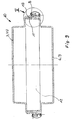
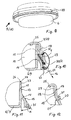
- a joint 5 consists essentially of a first component 6, a second component 7, a sealing bed 8 and an adhesive sealing compound 1.
- the first component 6 is in the form of a housing base 9, for example one Headlight housing 10, formed and has a circumferential first Side wall 11 on.
- a housing interior 12 facing away Outside 13 of the first side wall 11 is a lower sealing bed part 14 with a first sealing surface 15 is arranged.
- the first sealing surface 15 is opposite to the first side wall 11 inclined by an angle of inclination ⁇ , which in the example is 30 ° is.
- the first sealing surface 15 also determines ⁇ with its angle of inclination the course 16 of the sealing bed 8, which thus also around the Inclination angle a is inclined with respect to the first side wall 11.
- the second component 7 is a housing cover or a transparent one Cover plate 17 of the headlight housing 10 is formed and has a circumferential second side wall 18 that of the first side wall 11 of the first Component 6 is adjacent.
- On a housing interior 12 facing Inside 19 of the second side wall 18 is an upper sealing bed part 20 a second sealing surface 21 is arranged.
- the second sealing surface 21 is in the assembled state of the two components 6, 7 at a distance 22 parallel arranged to the first sealing surface 15 and thus also opposite the first Side wall 11 inclined by the angle of inclination ⁇ .
- the two sealing surfaces 15, 21 thus limit that from the lower sealing bed part 14 and the upper one Seal bed part 20 existing seal bed 8.
- the first side wall 11 has the second component 7 or the Cover plate 17 facing free end 23 on an end face 24 which against an inner surface 25 of the second component 7 or the cover plate 17 strikes.
- the end face 24 has conical tips 26, which can be pressed against the inner surface 25 so that they deform and the Support lateral fixation of the two components 6, 7.
- the second side wall 18 on its inside 19 towards the first side wall 11 upstream is a centering lug 27.
- the centering lug has on its An inner bevel 28 of the end facing away from the second component 7 has a run-on slope 28 on, for the correct positioning of the two components 6, 7 against each other contributes.
- the two sealing bed parts 14, 20 have opposite directions Formations 31 into which the ends 32 of the c-shaped connecting means 29 can be used.
- the adhesive sealing compound 1 is used a tank melting system, not shown, with robot guidance on the Sealing bed area of the first component 6, d. H. on the first sealing surface 15 applied liquid.
- the second component 7 is then placed over the first component 6 added so that the end face 24 strikes against the inner surface 25.
- the two components 6, 7 can be joined together manually or automatically.
- the second component 7 After joining the second component 7 and a short cooling phase the second component 7 is pressed against the first component 6 and by means of Connecting means 29, for example c-shaped springs, the ends 32 in the Formations 31 of the sealing bed parts 14, 20 used under tension are finally fixed in position.
- Connecting means 29, for example c-shaped springs By pressing the second one afterwards Component 7 can on the end face 24 of the first side wall 11 of the arranged first conical tips 26 through the second component 7 deform.
- the adhesive sealant 1 can be cooled occurring shrinkage can be counteracted.
- the adhesive or adhesive sealant 1 must have a minimal elongation at break exhibit. This is achieved in a tensile test at a deformation speed of 500 mm / min and a free sample length of 30 mm to 100 mm determined.
- the elongation at break thus determined is in particular more than 300%, preferably more than 800%.
- the relaxation behavior of the adhesive is determined on a sample of 30 mm up to 100 mm free clamping length with a feed of 1900 mm / sec and at an elongation to 300%.
- the adhesive lets in after 10 seconds
- the voltage does not drop below 35% of the maximum voltage and does not below 25% of the maximum voltage after 60 seconds.
- the Voltage drop not less than 50% after 10 seconds and not less than 40% after 120 seconds.
- the adhesive sealant required for the production of such a connection becomes especially provided as a pumpable material and on the adhesive and Sealing area of the substrates applied.
- These are preferably hot-melt adhesive sealants, which behave with very fast setting can be used in the industrial manufacturing process. This will make a simplified manufacturing process of the desired product achieved, and time and device requirements, not immediately for the assembly of the desired Work steps belonging to the product can be reduced to a minimum.
- the adhesive sealant does not transfer any loads that occur during operation higher mechanical stresses from one substrate to another, for one could damage these substrates. Deformations occur in the network preferably in the adhesive sealant, at high and very low Temperatures. On the other hand, the flexibility of the adhesive sealant is so small that in the event of point loads, such as those encountered a bundled jet of water from the nozzle of a pressure washer arises, there is no failure of the bond due to leakage. A good Adhesion to the substrates is required to ensure the tight seal guarantee.
- the release takes place at ambient temperature, in the adhesive sealant is pulled itself.
- one of the adhesive sealants molded or attached to and / or inserted into the outside protruding handles drawn during one or more of the added Parts are fixed.
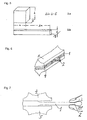
- Fig. 2 shows a stretch test on a test specimen made from the material of example formulation 1.
- Fig. 3 shows a relaxation attempt on a test specimen made from the material of example recipe 1 according to a 300% elongation.
- FIG. 4 shows viscoelastic spectra of the material of example formulation 1 as a function of temperature, determined in the linear viscoelastic range of the deformation.
- FIG. 5 shows an element of a rubber-elastic body before (2.a) and after (2.b) an elongation.
- the transverse contraction number p of a rubber-elastic body is close 0.500. If a caterpillar made of such a material is pulled out of a gap, then there is a strong transverse contraction of the no longer directly with the substrate connected adhesive sealant, see Fig. 6 and 7. In the adjacent The area between the caterpillar and the substrate, which is the foremost crack front, is now to notice a very high tension. This causes this area to fail if continuously pulling on the adhesive sealant bead until the entire Adhesive sealant is detached from the substrate without leaving any residue. In this process, in the progressive crack the value for the adhesive strength of the adhesive sealant exceeded the substrate.
- the transverse contraction must be so large that the adhesive sealant is stretched Condition always has a smaller diameter than possibly existing Constrictions, for example the sealing bed and along the extension path the caterpillar. A large cross contraction is generated by high deformations.
- the material does not tear through cohesively in such a process or necessary for the further progress of the adhesive failure crack Loses voltage, it may be in the range required for the separation operation Don't relax time significantly.
- the adhesive is not yet at very low temperatures, for example at -30 ° C brittle or too hard, otherwise the ability to transfer forces cohesively suddenly increases rapidly without the adhesion increasing to the same extent. A Sufficient cold flexibility is therefore necessary according to the invention.
- a conventional hot melt adhesive sealant can be sufficient for a given Strength at room temperature cannot be processed in tank melting systems.
- resins for the Adhesion to the substrates, thermoplastic elastomers for the cohesive Strength and the melt liquid in combination with, if necessary, partially grafted poly- ⁇ -olefins can have the desired property profile according to the present invention can be obtained.
- Thermoplastic elastomers per se are known in the prior art. This is understood to mean polymers, also called thermoplastic rubbers, which ideally a combination of the properties of elastomers and possess the processing properties of thermoplastics.
- thermoplastic elastomers reversible cleavable crosslinking sites, mostly physical but also chemical type.
- thermoplastic elastomers preferably selected from styrene types, in particular SBS, SIS, SEBS, SEPS and block polystyrene (block poly (ethylene butylene), and block polystyrene (block poly (ethylene butylene) with 1 to 10 block styrene units per molecule, the optionally modified with block polyisoprene or block butadiene units are and made of elastomer alloys, in particular EPDM / PP, NR / PP, EVA / PVDC and NBR / PP as well as made of polyurethanes, polyether esters and Polyether amides.
- the thermoplastic elastomers effect in particular cohesive strength of the hot-melt adhesive sealants according to the invention.
- the cohesive strength can be achieved through the use according to the invention of at least partially grafted thermoplastic elastomers if after processing the hot melt adhesive by this one chemical post-crosslinking takes place.
- cohesive strength significantly improved at elevated temperatures and the Stress relaxation during the separation process of the composite was kept small.
- polystyrene resins require the necessary adhesion to the substrates.
- the poly- ⁇ -olefins particularly preferably have partial crystallinity, so that particularly preferred poly- ⁇ -olefins, in particular polyethylene, polypropylene and / or poly-1-butene have high tacticity in the crystalline region.
- the proportion of the grafted poly- ⁇ -olefins can be up to 50% by weight, in particular 10 to 50 wt .-%, based on the total content of poly- ⁇ -olefins include.
- the proportion of grafted thermoplastic elastomers can, based on the Content of thermoplastic elastomers be 0 to 100 wt .-%.
- the predominantly modified aliphatic resins are particularly responsible for the adhesion to the substrates.
- These are preferably selected from the polymerized monomers of the C 5 to C 9 boiling cut of petroleum distillation, which are not, partially or completely hydrogenated, and natural rosins and their modifications; Terpene resins; Polyterpene resins of ⁇ -pinene, ⁇ -pinene and / or ⁇ -limonene; Resins obtainable by copolymerization of terpene with monomers from the C 5 to C 9 cut of petroleum distillation and terpene phenol resins.
- the polyisobutylenes to be used according to the invention are responsible for the low-temperature flexibility.
- the polyisobutylenes in the context of this invention include, in particular polyisobutylene oils and copolymeric polyisobutylenes.
- polyisobutylenes from the homopolymeric isobutylene, in particular from homopolymers of the isobutylene of average molecular weight, determined by means of gel permeation chromatography in the range from 20,000 to 5,000,000 gx mol -1 , copolymers of isobutylene and a conjugated diene in an amount of 0.3 to 4.5 mol .-% based on the copolymer and / or terpolymers of isobutylene, divinylbenzene in an amount of 0.01 to 4.5 mol .-%. and the conjugated diene mentioned.
- the low-temperature flexibility and the melt viscosity are determined by the oils such as oligomers or polymers of isobutene and 1-butene with an average molecular weight of 200 to 20,000 gx mol -1 by means of gel permeation chromatography, and naphthenic or paraffin-based oils obtained and possibly modified by petroleum distillation favorably influenced in the same molecular weight range.
- the proportion of such oils should be in the range from 0 to 65% by weight, based on the hotmelt adhesive sealant.
- the hot melt adhesive sealants according to the invention can have 0 to 80 % By weight, in particular 15 to 30% by weight, of polyisoprene or polybutadiene, contain in particular grafted polyisoprene or polybutadiene.
- hot melt adhesive sealants according to the invention also other fillers, and in particular aromatic resins and / or stabilizers and adhesion promoters such as contain organofunctional silanes, for example.
- 0 to 50% by weight in particular 0 to 40, is particularly preferred %
- fillers and / or 0 to 25% by weight in particular 0 to 10% by weight aromatic resins and / or stabilizers.
- the fillers can in particular be selected from inorganic Fillers, for example calcium carbonate, calcium hydroxide, dolomite, Titanium dioxide, zinc oxide, silicon oxide, heavy spar and brown stone as well organic fillers, especially carbon black.
- inorganic Fillers for example calcium carbonate, calcium hydroxide, dolomite, Titanium dioxide, zinc oxide, silicon oxide, heavy spar and brown stone as well organic fillers, especially carbon black.
- Stabilizers and light absorbers contained are preferably selected from the group of epoxides, sterically hindered phenols, amines, thioesters, Phosphites as well as triazine, piperidine and benzotriazoles.
- Example recipe 1 Parts by weight material description 0.4 2,6-di-tert-butyl-4-methylphenol Stabilizer: 0.02 Blackblack 101 Filler: Carbon black, dibutyl phthalate absorption 110-115 ml (DPB) / 100 g carbon black 3.0 Vistanex® MM-L80 Softening oils and flexibilizers: Polyisobutylene, molecular weight determined by gel permeation chromatography against polystyrene standards by 830,000 g / mol 30.5 Parapol ®1300 Softening oils and flexibilizers: Polyisobutylene, molecular weight determined by gel permeation chromatography against polystyrene standards by 2100 g / mol 25.0 Kraton® G 1652 Thermoplastic elastomers: Linear s
- Adhesive sealant (1) was applied from a heatable cartridge gun to a plate (4) applied from polypropylene. At the end of the order process, a piece was made Release paper coated with the end of the bead so that the "handle" (2) was formed for later separation of the composite to be produced. Before another polypropylene sheet (3) was used to cool the adhesive sealant placed flat against the first mentioned plate and pressed on the hot mass, so that the distance between them was not less than 1 mm. To the bond was separated by using a "handle” (2) Traction in the direction away from the parting line, but lying in the parting plane, was exercised. One or both substrates (3), (4) were fixed. The hot-melt adhesive sealant (1) could now be removed completely from the parting line pull out and you got back the three components separately.
- the adhesive sealant produced and described according to the above example was conveyed from an open tank melting system and into the sealing bed of a Headlamp consisting of a glass lens and a metal-coated metal die-cast reflector, applied.
- the "handle" was through vertical, slow lifting slightly inclined towards the headlight exterior the delivery nozzle with little further conveyance of the hot-melting ones Adhesive sealant formed by air cooling.
- the next Processing step consisted of joining the reflector with the Glass lens.
- the "handle” can be omitted, for example, if one Device was used as an "opener” that only to release the bond has been associated with the adhesive sealant bead. Exemplary could this is done by piercing the adhesive sealant and one pulled this out of the sealing bed using a hook formed on the "opener". As a result, the bond was subsequently loosened.
Landscapes
- Chemical & Material Sciences (AREA)
- Mechanical Engineering (AREA)
- Engineering & Computer Science (AREA)
- Organic Chemistry (AREA)
- Chemical Kinetics & Catalysis (AREA)
- Medicinal Chemistry (AREA)
- Polymers & Plastics (AREA)
- Health & Medical Sciences (AREA)
- Adhesives Or Adhesive Processes (AREA)
- Lining Or Joining Of Plastics Or The Like (AREA)
- Non-Portable Lighting Devices Or Systems Thereof (AREA)
- Non-Disconnectible Joints And Screw-Threaded Joints (AREA)
- Joining Of Building Structures In Genera (AREA)
- Laminated Bodies (AREA)
Abstract
Description
- Figur 1:
- Eine Darstellung unterschiedlicher Belastungsformen beim Gebrauch einer Klebeverbindung,
- Figur 2:
- einen Dehnversuch an einem Prüfkörper aus dem Material der Beispielrezeptur 1,
- Figur 3:
- einen Relaxationsversuch an einem Prüfkörper aus dem Material der Beispielrezeptur 1 nach einer Dehnung von 300 %,
- Figur 4:
- viskoelastische Spektren des Materials der Beispielrezeptur 1 als Funktion der Temperatur ermittelt im liniear viskoelastischen Bereich der Deformation,
- Figur 5:
- ein Element eines gummielastischen Körpers vor (2.a) und nach (2.b) einer Dehnung,
- Figur 6:
- eine räumliche Darstellung im Ausriss von zwischen zwei Platten applizierter Klebdichtmasse,
- Figur 7:
- eine Seitenansicht der Verbindung von Figur 6 mit teilweise herausgezogener Klebdichtmasse,
- Figur 8:
- eine räumliche Ansicht einer Fügeverbindung in verkleinerter Darstellung,
- Figur 9:
- eine Seitenansicht der Fügeverbindung von Figur 8 im Schnitt ohne Klebdichtmasse,
- Figur 10:
- eine vergrößerte Darstellung der Einzelheit X von Figur 9 mit Klebdichtmasse,
- Figur 11:
- eine Seitenansicht der ersten Seitenwand von dem ersten Bauteil von Figur 10 und
- Figur 12:
- eine Seitenansicht der zweiten Seitenwand von dem zweiten Bauteil von Figur 10.
- dmin
- für die Dicke des Klebdichtstoffes zwischen zwei planparallel angeordneten Substraten
- Fs
- für die Schälkraft und
- FRm
- für die maximale Reißlast steht.
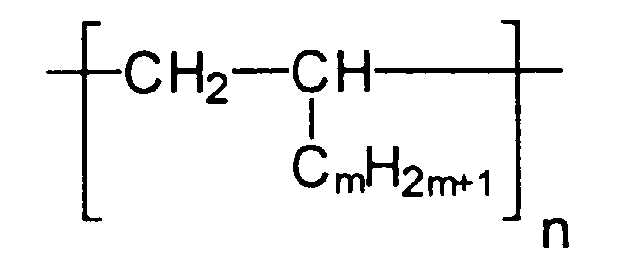
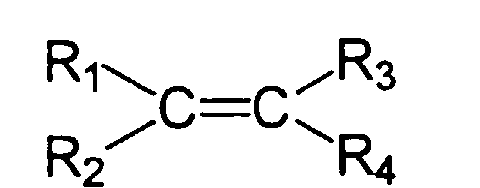
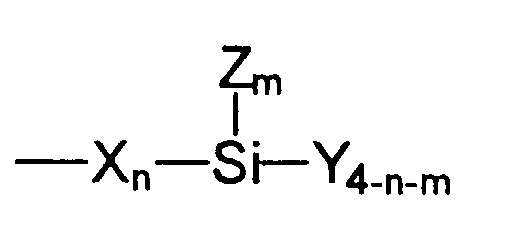
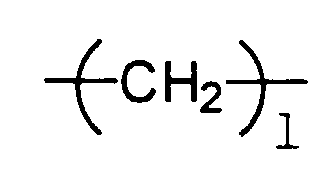


| Beispielsrezeptur 1: | ||
| Gew.-Teile | Stoff | Beschreibung |
| 0,4 | 2,6-Di-tert-butyl-4-methylphenol | Stabilisator: |
| 0,02 | Flammruß 101 | Füllstoff: Ruß, Dibutylphtalatabsorption 110-115 ml (DPB)/100 g Ruß |
| 3,0 | Vistanex® MM-L80 | Weichmachende Oele und Flexibilisatoren: Polyisobutylen, Molekulargewicht durch Gelpermeationschromatographie gegen Polystyrolstandards ermittelt durch 830.000 g/mol |
| 30,5 | Parapol ®1300 | Weichmachende Oele und Flexibilisatoren: Polyisobutylen, Molekulargewicht durch Gelpermeationschromatographie gegen Polystyrolstandards ermittelt durch 2100 g/mol |
| 25,0 | Kraton® G 1652 | Thermoplastische Elastomere: Lineares Styrolblockcopolymer vom S-EB-S-Typ 29 % Styrol |
| 6,0 | Vestoplast ®608 | Poly-α-olefin: Copolymeres Poly-α-olefin mit hohem 1-Butengehalt Erweichungstemperatur (R&K) =90°C, TG = 31°C |
| 15,0 | Escorez ®4401 | Klebrigmachende Harze: |
| Aliphatisches Harz mit aromatischen Gruppen Erweichungspunkt (R&K) = 95 °C | ||
| 5,0 | Hydrogral ®P | Klebrigmachende Harze: Hydriertes, mit Pentaerythrit verestertes Naturharz Erweichungspunkt (R&K) = 109 °C |
| 10,0 | Kreide | Füllstoff: |
| Schälversuch der Klebdichtmasse zwischen Glas und PP mit der Beispielsrezeptur 1 | |
| Dehnung/[%] | 203,8 |
| Linienbreite d. benetzten Oberfläche/[mm] | 24,0 |
| Abzugskraft/[N] | 19,6 |
| Schälkraft Fs/[N/mm] | 0,82 |
| Schälwinkel/[°] | 0 |
| Dehn- und Hystereseversuch mit der Beispielsrezeptur 1 | |
| Reißlast FRm/[N/mm2] | 3,48 |
| bei Dehnung/[%] | 1103 |
| Hysteresearbeit/[J] | 0,062 |
| Viskositätsdaten zu der Beispielrezeptur 1 | |||
| Viskosität η/[Pas] | |||
| Temperatur ζ[°C] | |||
| Schergeschwindigkeit Y/[1/s] | 170 | 190 | 210 |
| 0,056 | 366 | 97 | 31 |
| 0,10 | 347 | 93 | 31 |
| 0,56 | 243 | 77 | 26 |
| 1,0 | 216 | 67 | 23 |
| 5,6 | 124 | 53 | 18 |
| 10 | 61 | 48 | 17 |
| Viskoelastische Daten zu der Beispielsrezeptur 1 | |
| Glastemperatur (G" = max.)/[°C] | -36 |
| tan δ (175°C) /[] | 3,55 |
Claims (34)
- Heißschmelzklebstoff bestehend aus einem nicht-drucksensitiven, durch Schälwirkung bei kleinen Schälwinkeln restfrei entfembaren, bei Applikationstemperatur fließfähigen Klebstoff, dadurch gekennzeichnet, dass dieser neben an sich bekannten Zusätzen, insbesondere Füllstoffen, Stabilisatoren, Farbstoffen, Russ und/oder Feuchtigkeitsabsorbern weiterhina) gegebenenfalls thermoplastische Elastomere, welche gegebenenfalls gepfropft sein können,b) gegebenenfalls gepfropfte Poly-α-olefine, , welche gegebenenfalls gepfropft sein können,c) Polyisobutylen oder weichmachendes Öl,d) Klebeharze unde) Endblockharze enthält.
- Klebstoffe nach Anspruch 1, dadurch gekennzeichnet, dass die thermoplastischen Elastomere ausgewählt sind aus Styroltypen, insbesondere SBS, SIS, SEBS SEPS und Block-Polystyrol-(Block-Poly(Ethylen-Butylen), und Block-Polystyrol-(Block-Poly(Ethylen-Butylen) mit 1 bis 10 Block-Polystyroleinheiten je Molekül, die gegebenenfalls mit Block-Polyisopren oder Block-Butadieneinheiten modifiziert sind; Elastomerlegierungen, insbesondere EPDM/PP, NR/PP, EVA/PVDC und NBR/PP; Polyurethan; Polyetherestem und Polyamiden.
- Klebstoffe nach Anspruch 1, dadurch gekennzeichnet, dass die wenigstens teilweise gepfropften Poly-α-olefine ausgewählt sind aus amorphen Poly-α-olefinen, den Mono-, Co- oder Terpolymere der Monomeren Ethen, Propen, 1-Buten, 1-Penten und 1-Hexen oder einem Poly-α-olefin der allgemeinen Formel (I)mit
 m = 0 bis 15 undn = 5 bis 50000
 - Klebstoffe nach Anspruch 3, dadurch gekennzeichnet, dass die Poly-α -olefine Teilkristallinität aufweisen und insbesondere Polyethylen, Polypropylen und/oder Poly-1-buten umfassen, die in den kristallinen Bereichen hohe Taktizität aufweisen.
- Klebstoffe nach Anspruch 3 oder 4, dadurch gekennzeichnet, dass die Poly-α-olefine mit olefinisch ungesättigten Verbindungen statistisch gepfropft werden, die insbesondere ausgewählt sind aus Maleinsäureanhydrid, Itaconsäureanhydrid, Tetrahydrophthalsäureanhydrid und Verbindungen der allgemeinen Formel (II)wobei
 stehen.R1 für Restea)wobei
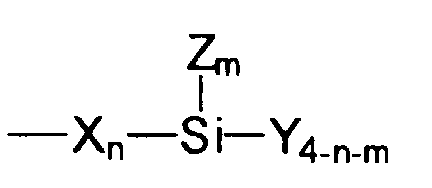 Z für Wasserstoff, einen Methylrest oder einen PhenylrestX füroder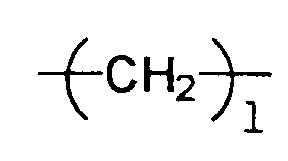
 Y für eine beliebige hydrolisierbare Gruppem für eine ganze Zahl 0, 1 oder 2n für eine ganze Zahl 0, 1 oder 2 undl für eine ganze Zahl 1, 2, 3, 4, 5 oder 6 oderb)k für eine ganze Zahl 0, 1 oder 2
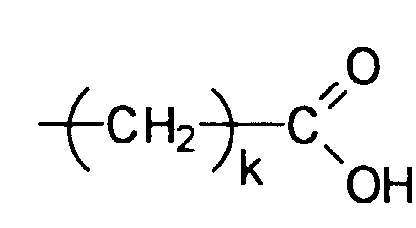 R2 für Wasserstoff oder MethylR3 für einen Rest R1, Wasserstoff oder Methyl undR4 für Wasserstoff oder Methyl
 - Klebstoffe nach Anspruch 1, dadurch gekennzeichnet, dass die Menge an gepfropften Poly-α-olefinen 0 bis 100 Gew.-% bezogen auf den Gesamtgehalt an Poly-α-olefinen beträgt.
- Klebstoffe nach Anspruch 1, dadurch gekennzeichnet, dass die thermoplastischen Elastomere mit olefinisch ungesättigten Verbindungen statistisch gepfropft werden, die insbesondere ausgewählt sind aus Maleinsäureanhydrid, Itaconsäurenahydrid, Tetrahydrophthalsäureanhydrid und Verbindungen der allgemeinen Formel (II).
- Klebstoffe nach Anspruch 1, dadurch gekennzeichnet, dass der Anteil an gepfropften thermoplastischen Elastomeren, bezogen auf den Gesamtgehalt der thermoplastischen Elastomeren 0 bis 100 Gew.-% beträgt.
- Klebstoffe nach Anspruch 1, dadurch gekennzeichnet, dass die Klebeharze ausgewählt sind aus polymerisierten Monomeren des petrochemischen C5 bis C9-Siedeschnitts, die nicht, teilweise oder vollständig hydriert sind und natürlichen Kolophoniumharzen und deren Modifikationen; Terpenharzen; Polyterpenharzen des β-Pinen, α-Pinen und/oder des δ-Limonen; Harzen erhältlich durch Copolymerisation von Terpen mit Monomeren aus dem C5 bis C9-Schnitt der Petroldestillation und Terpenphenolharzen.
- Klebstoffe nach Anspruch 1, dadurch gekennzeichnet, dass diese Polyisobutylene aufweisen, insbesondere ausgewählt aus Homopolymeren des Isobutylens mittleren Molekulargewichts, bestimmt mittels Gelpermeationschromatographie im Bereich von 20.000 bis 5.000.000 g x mol-1, Copolymeren des Isobutylens und eines konjugierten Diens in einer Menge von 0,3 bis 4,5 mol.-% bezogen auf das Copolymer und/oder Terpolymeren des Isobutylens, Divinylbenzols in einer Menge von 0,01 bis 4,5 mol.-%. und dem genannten konjugierten Dien.
- Klebstoffe nach Anspruch 1, dadurch gekennzeichnet, dass die Polyisobutylene oder weichmachenden Öle ausgewählt sind aus Polyisobutylölen, insbesondere Oligomere oder Polymere des iso-Butylens oder 1-Buten und durch Petroldestillation gewonnene, gegebenenfalls modifizierte naphthalen- oder paraffinbasische Öle mit einem mittleren Molekulargewicht, bestimmt durch Gelpermeationschromatographie im Bereich von 200 bis 20 000 g x mol-1.
- Klebstoffe nach einem der Ansprüche 1 bis 11, dadurch
gekennzeichnet, dass sie
f) 0 bis 80 Gew.-%, insbesondere 15 bis 70 Gew.-% Polyisopren oder Polybutadien, insbesondere gepfropftes Polyisopren oder Polybutadien enthalten. - Klebstoffe nach einem der Ansprüche 1 bis 12, dadurch
gekennzeichnet, dass sieg) 0 bis 50 Gew.-%, insbesondere 0 bis 40 Gew.-%, Füllstoffeh) 0 bis 25 Gew.-%, insbesondere 0 bis 10 Gew.-% aromatische Harze und/oder Stabilisatoren enthalten. - Klebstoffe nach Anspruch 13, dadurch gekennzeichnet, dass die Füllstoffe ausgewählt sind aus anorganischen Füllstoffen, insbesondere Calciumcarbonat, Calciumhydroxid, Calciumoxid, Dolomit, Titandioxid, Zinkoxid, Siliciumoxid, Schwerspat und Braunstein und organischen Füllstoffen, insbesondere Ruß.
- Klebstoffe nach Anspruch 13, dadurch gekennzeichnet, dass die Stabilisatoren ausgewählt sind aus der Gruppe der Epoxide, sterisch gehinderten Phenole, Amine, Thioester, Phosphite sowie Triazin-, Piperidin- und Benzotriazole.
- Klebstoffe nach einem der Ansprüche 1 bis 15, dadurch gekennzeichnet, dass sie Klebstoffe auf der Basis von Epoxidharzen, Silkonen, Polysulfiden, Polyurethane, Polyhamstoffe und/oder Acrylaten enthalten.
- Verwendung von Klebstoffen nach einem oder mehreren der Ansprüche 1 bis 16, zur Verbindung von glasartigen Kunststoffsubstraten mit thermoplastischen oder duroplastischen Kunststoffsubstraten.
- Verwendung nach Anspruch 17, dadurch gekennzeichnet, dass die glasartigen Kunststoffsubstrate ausgewählt sind aus Polymethylmethacrylat, Polycarbonat oder Cycloolefincopolymer und insbesondere die thermoplastischen Kunststoffsubstrate ausgewählt sind aus Polypropylen.
- Verwendung nach Anspruch 17 oder 18, dadurch gekennzeichnet, dass man Lichtscheiben oder Streuscheiben mit Lampengehäusen von Fahrzeugleuchten oder Fahrzeugscheinwerfern lösbar verbindet.
- Fügeverbindung zwischen einem ersten Bauteil (6) und einem zweiten Bauteil (7), die einander benachbarte Seitenwände (11, 18) aufweisen und die über ein mit einer entfernbaren Klebdichtmasse (1) versehbares Dichtungsbett (8) dicht miteinander verbindbar sind, dadurch gekennzeichnet, dass die erste Seitenwand (11) eine erste mit ihr verbundene Dichtfläche (15) aufweist, die im zusammengefügten Zustand in einem Abstand (22) etwa parallel zu einer zweiten Dichtfläche (21) verläuft, die mit der zweiten Seitenwand (18) verbunden ist, und dass die beiden Dichtflächen (15, 21) das Dichtungsbett (8) mit einer von den Seitenwänden (11, 18) weggerichteten ebenen Verlaufsrichtung (16) bilden in deren Verlängerung die Klebdichtmasse (1) herausziehbar ist.
- Fügeverbindung nach Anspruch 20, dadurch gekennzeichnet, dass die Verlaufsrichtung (16) des Dichtungsbettes (8) gegenüber der ersten Seitenwand (11) um einen Neigungswinkel (α) geneigt ist.
- Fügeverbindung nach Anspruch 21, dadurch gekennzeichnet, dass der Neigungswinkel (α) zwischen 0° und 180° beträgt.
- Fügeverbindung nach Anspruch 22, dadurch gekennzeichnet, dass der Neigungswinkel (α) zwischen 0° und 90° beträgt.
- Fügeverbindung nach Anspruch 23, dadurch gekennzeichnet, dass der Neigungswinkel (α) ca. 30° beträgt.
- Fügeverbindung nach einem der Ansprüche 20 bis 24, dadurch gekennzeichnet, dass die beiden Bauteile (6, 7) miteinander durch den Dichtflächen (15, 21) benachbarte Verbindungsmittel (29) lagefixiert sind.
- Fügeverbindung nach einem der Ansprüche 20 bis 25, dadurch gekennzeichnet, dass die erste Seitenwand (11) mit einer an ihrem freien Ende (23) angeordneten Stirnfläche (24) gegen eine Innenfläche (25) des zweiten Bauteils (7) anschlägt und das die Stirnfläche (24) kegelige Spitzen (26) aufweist, gegen die die Innenfläche (25) des zweiten Bauteiles (7) drückbar ist.
- Fügeverbindung nach einem der Ansprüche 20 bis 26, dadurch gekennzeichnet, dass das erste Bauteil (6) als ein Scheinwerfergehäuse (10) und das zweite Bauteil (7) als eine Abdeckscheibe (17) eines Fahrzeugscheinwerfers ausgebildet ist.
- Fügeverbindung nach Anspruch 27, dadurch gekennzeichnet, dass die Abdeckscheibe (17) aus einem glasartigen Kunststoffsubstrat und das Scheinwerfergehäuse (10) aus einem thermoplastischen oder duroplastischen Kunststoffsubstrat ausgebildet ist.
- Fügeverbindung nach Anspruch 27, dadurch gekennzeichnet, dass die glasartigen Kunststoffsubstrate ausgewählt sind aus Polymethylmethacrylat, Polycarbonat oder Cycloolefincopolymer und insbesondere die thermoplastischen Kunststoffsubstrate ausgewählt sind aus Polypropylen.
- Fügeverbindung nach einem der Ansprüche 20 bis 29, dadurch gekennzeichnet, dass die Klebdichtmasse (1) aus einem der Klebstoffe nach Anspruch 1 bis 19 ausgebildet ist.
- Verfahren zur Herstellung einer Fügeverbindung (5) zwischen einem ersten Bauteil (6) und einem zweiten Bauteil (7), bei dem auf einen Dichtungsbettbereich des ersten Bauteils (6) eine entfembare Klebdichtmasse (1) in flüssigem Zustand aufgetragen und die beiden Bauteile (6, 7) zusammengefügt werden, dadurch gekennzeichnet, dass zum Entfernen der Klebdichtmasse (1) diese an einem freien Ende erfasst und in Verlängerung einer ebenen von den beiden Bauteilen (6, 7) weggerichteten Verlaufsrichtung (16) des Dichtungsbettes (8) aus diesem nahezu rückstandsfrei herausgezogen wird.
- Verfahren nach Anspruch 31, dadurch gekennzeichnet, dass die Klebdichtmasse (1) mittels einer Tankschmelzanlage mit Roboterführung auf eine am ersten Bauteil (6) angeordnete erste Dichtfläche (15) eines unteren Dichtungsbettteiles (14) des Dichtungsbettes (8) flüssig aufgetragen wird und in einem anschließenden Arbeitsgang die beiden Bauteile (6, 7) zusammengefügt werden.
- Verfahren nach Anspruch 31 oder 32, dadurch gekennzeichnet, dass nach dem Fügen des zweiten Bauteils (7) und einer kurzen Abkühlungsphase das zweite Bauteil (7) gegen das erste Bauteil (6) angedrückt und mittels Verbindungsmitteln (29) endgültig lagefixiert wird.
- Fahrzeugleuchten oder Fahrzeugscheinwerfer umfassend Lichtscheiben oder Streuscheiben, insbesondere mit Kratzfestausrüstung, aus glasartigem Kunststoffsubstrat und Lampengehäuse aus thermoplastischem oder duroplastischem Kunststoffsubstrat, dadurch gekennzeichnet, dass die Lichtscheiben oder Streuscheiben und Lampengehäuse mit einem Klebstoff wie in einem oder mehreren der Ansprüche 1 bis 18 definiert, verbunden sind.
Priority Applications (1)
| Application Number | Priority Date | Filing Date | Title |
|---|---|---|---|
| EP03000902A EP1312461B1 (de) | 1999-11-24 | 2000-11-21 | Fügeverbindung und Verfahren zur Herstellung einer Fügeverbindung |
Applications Claiming Priority (2)
| Application Number | Priority Date | Filing Date | Title |
|---|---|---|---|
| DE19956422A DE19956422A1 (de) | 1999-11-24 | 1999-11-24 | Lösbare Klebstoffe zum Verbinden von Substraten |
| DE19956422 | 1999-11-24 |
Related Child Applications (2)
| Application Number | Title | Priority Date | Filing Date |
|---|---|---|---|
| EP03000902A Division EP1312461B1 (de) | 1999-11-24 | 2000-11-21 | Fügeverbindung und Verfahren zur Herstellung einer Fügeverbindung |
| EP03000902.1 Division-Into | 2003-01-16 |
Publications (3)
| Publication Number | Publication Date |
|---|---|
| EP1108771A2 true EP1108771A2 (de) | 2001-06-20 |
| EP1108771A3 EP1108771A3 (de) | 2002-09-11 |
| EP1108771B1 EP1108771B1 (de) | 2004-05-06 |
Family
ID=7930106
Family Applications (2)
| Application Number | Title | Priority Date | Filing Date |
|---|---|---|---|
| EP00125465A Expired - Lifetime EP1108771B1 (de) | 1999-11-24 | 2000-11-21 | Lösbare Klebstoffe zum Verbinden von Substraten |
| EP03000902A Expired - Lifetime EP1312461B1 (de) | 1999-11-24 | 2000-11-21 | Fügeverbindung und Verfahren zur Herstellung einer Fügeverbindung |
Family Applications After (1)
| Application Number | Title | Priority Date | Filing Date |
|---|---|---|---|
| EP03000902A Expired - Lifetime EP1312461B1 (de) | 1999-11-24 | 2000-11-21 | Fügeverbindung und Verfahren zur Herstellung einer Fügeverbindung |
Country Status (5)
| Country | Link |
|---|---|
| US (2) | US6858667B1 (de) |
| EP (2) | EP1108771B1 (de) |
| AT (1) | ATE266070T1 (de) |
| DE (3) | DE19956422A1 (de) |
| ES (2) | ES2236627T3 (de) |
Cited By (2)
| Publication number | Priority date | Publication date | Assignee | Title |
|---|---|---|---|---|
| WO2008017639A1 (de) * | 2006-08-10 | 2008-02-14 | Tesa Ag | Selbstklebemasse aus hydrierten blockcopolymeren und daraus hergestellte schutzfolie für glatte oberflächen |
| WO2008017641A1 (de) * | 2006-08-10 | 2008-02-14 | Tesa Ag | Selbstklebemasse aus hydrierten blockcopolymeren und daraus hergestellte schutzfolie für glatte und raue oberflächen |
Families Citing this family (30)
| Publication number | Priority date | Publication date | Assignee | Title |
|---|---|---|---|---|
| US7507453B2 (en) * | 2000-10-31 | 2009-03-24 | International Imaging Materials, Inc | Digital decoration and marking of glass and ceramic substrates |
| US20050087290A1 (en) * | 2002-03-08 | 2005-04-28 | Julius Herold | Method for joining transparent plastic substrates |
| WO2005108442A1 (en) * | 2002-10-15 | 2005-11-17 | Exxonmobil Chemical Patents Inc. | Polyolefin adhesive compositions and articles made therefrom |
| US7700707B2 (en) | 2002-10-15 | 2010-04-20 | Exxonmobil Chemical Patents Inc. | Polyolefin adhesive compositions and articles made therefrom |
| US7541402B2 (en) * | 2002-10-15 | 2009-06-02 | Exxonmobil Chemical Patents Inc. | Blend functionalized polyolefin adhesive |
| US7550528B2 (en) | 2002-10-15 | 2009-06-23 | Exxonmobil Chemical Patents Inc. | Functionalized olefin polymers |
| DE10248499A1 (de) * | 2002-10-17 | 2004-05-06 | Siemens Ag | Magnet-Resonanz-Tomographiegerät mit zerstörungsfrei lösbarer Bauteil-Klebeverbindung zwischen Gerätekomponenten |
| US6863944B2 (en) * | 2003-01-27 | 2005-03-08 | Building Materials Investment Corporation | Thermoplastic single ply protective covering |
| US7776603B2 (en) * | 2003-04-01 | 2010-08-17 | Cabot Corporation | Methods of specifying or identifying particulate material |
| US7776602B2 (en) | 2003-04-01 | 2010-08-17 | Cabot Corporation | Methods of providing product consistency |
| US7000457B2 (en) * | 2003-04-01 | 2006-02-21 | Cabot Corporation | Methods to control and/or predict rheological properties |
| US7776604B2 (en) * | 2003-04-01 | 2010-08-17 | Cabot Corporation | Methods of selecting and developing a particulate material |
| DE102004018047A1 (de) * | 2004-04-08 | 2005-11-10 | Tesa Ag | Verfahren zum dauerhaften Verschließen von Löchern insbesondere in Blechen oder in Kunststoffteilen von Automobilkarosserien |
| US7722713B2 (en) * | 2005-05-17 | 2010-05-25 | Cabot Corporation | Carbon blacks and polymers containing the same |
| US8268449B2 (en) * | 2006-02-06 | 2012-09-18 | Brewer Science Inc. | Thermal- and chemical-resistant acid protection coating material and spin-on thermoplastic adhesive |
| US7794832B2 (en) * | 2006-05-18 | 2010-09-14 | Neenah Paper, Inc. | Self-releasing lint tape |
| US20080200011A1 (en) * | 2006-10-06 | 2008-08-21 | Pillalamarri Sunil K | High-temperature, spin-on, bonding compositions for temporary wafer bonding using sliding approach |
| CN101779268B (zh) | 2007-06-25 | 2013-11-06 | 布鲁尔科技公司 | 高温旋涂暂时性粘合组合物 |
| DE102008020880A1 (de) * | 2008-04-25 | 2009-10-29 | Hella Kgaa Hueck & Co. | Fügeverbindung für ein Gehäuse |
| US20110183100A1 (en) * | 2008-05-09 | 2011-07-28 | Lee Dae-Woo | Solvent-free adhesive for waterproof sheet, waterproof sheet and manufacturing method of waterproof sheet using the solvent-free adhesive and construction method using the waterproof sheet |
| US8092628B2 (en) * | 2008-10-31 | 2012-01-10 | Brewer Science Inc. | Cyclic olefin compositions for temporary wafer bonding |
| US8771927B2 (en) * | 2009-04-15 | 2014-07-08 | Brewer Science Inc. | Acid-etch resistant, protective coatings |
| JP2013091774A (ja) * | 2011-10-05 | 2013-05-16 | Canon Inc | エポキシ樹脂組成物 |
| CN102911626B (zh) * | 2012-11-29 | 2015-08-12 | 无锡市万力粘合材料有限公司 | 粘鼠用热熔胶组合物及其制备方法 |
| DE102013206624A1 (de) * | 2013-04-15 | 2014-10-16 | Tesa Se | Haftklebemasse und Verwendung derselben in einem Haftklebstreifen |
| AU2014293082B2 (en) | 2013-07-24 | 2018-05-10 | Dow Global Technologies Llc | Adhesive compositions containing functionalized ethylene/alpha-olefin interpolymers and rosin-based tackifiers |
| EP3074477B1 (de) * | 2013-11-25 | 2017-06-28 | Basell Poliolefine Italia S.r.l. | Heissgeschmolzene klebstoffzusammensetzung auf polyolefinbasis |
| BR112016013719B1 (pt) | 2013-12-26 | 2022-07-12 | Dow Global Technologies Llc | Composição e artigo |
| WO2019210120A1 (en) * | 2018-04-27 | 2019-10-31 | Avery Dennison Corporation | Non-swelling hot melt adhesive |
| CN112292364B (zh) * | 2018-06-25 | 2023-07-28 | 巴斯夫欧洲公司 | 用于形成粘结结合或用于化学锚固的两组分体系 |
Family Cites Families (20)
| Publication number | Priority date | Publication date | Assignee | Title |
|---|---|---|---|---|
| DE1604736A1 (de) | 1966-08-25 | 1971-01-14 | Siemens Ag | Verfahren zum Verbinden von Teilen aus Kunststoff |
| US3987122A (en) | 1972-04-03 | 1976-10-19 | Exxon Research And Engineering Company | Thermoplastic adhesive compositions |
| US4009793A (en) | 1974-07-12 | 1977-03-01 | The Procter & Gamble Company | Tamper-proof closure seal |
| US4024312A (en) | 1976-06-23 | 1977-05-17 | Johnson & Johnson | Pressure-sensitive adhesive tape having extensible and elastic backing composed of a block copolymer |
| US4305996A (en) * | 1980-03-10 | 1981-12-15 | The B. F. Goodrich Company | Hydroxyl-containing liquid polymers and adhesives made therefrom |
| US4461633A (en) | 1982-09-28 | 1984-07-24 | Continental Conveyor & Equipment Co., Inc. | Air filtering machinery with variable speed cleaning |
| DE3331016A1 (de) * | 1983-04-06 | 1984-10-11 | Beiersdorf Ag, 2000 Hamburg | Klebfolie fuer wiederloesbare klebbindungen |
| WO1986002055A1 (fr) | 1984-10-05 | 1986-04-10 | Cod Inter Techniques S.A. | Emballage etanche, procede de fabrication et utilisation de cet emballage |
| DE3925068A1 (de) * | 1989-07-28 | 1991-02-07 | Schmalbach Lubeca | Zwei- oder dreiteiliger behaelter, insb. aus blech |
| US5470622A (en) | 1990-11-06 | 1995-11-28 | Raychem Corporation | Enclosing a substrate with a heat-recoverable article |
| US5516581A (en) | 1990-12-20 | 1996-05-14 | Minnesota Mining And Manufacturing Company | Removable adhesive tape |
| JP2662488B2 (ja) | 1992-12-04 | 1997-10-15 | 株式会社小糸製作所 | 自動車用灯具における前面レンズ脚部とシール溝間のシール構造 |
| DE4339604C2 (de) | 1993-11-20 | 1996-06-05 | Beiersdorf Ag | Verwendung eines Klebfolien-Abschnitts für eine wiederablösbare Verklebung |
| CA2201291A1 (en) | 1994-09-30 | 1996-04-11 | Achilles Chiotis | Silicone sealing material exhibiting high stress relaxation |
| DE19504425A1 (de) * | 1995-02-10 | 1996-08-14 | Hella Kg Hueck & Co | Heißschmelzklebstoffe für Fahrzeugleuchten und Fahrzeugscheinwerfer |
| US5827591A (en) | 1996-10-08 | 1998-10-27 | Tricor Direct, Inc. | Removable adhesive notes for an industrial setting |
| DE19649727A1 (de) | 1996-11-30 | 1998-06-04 | Beiersdorf Ag | Klebeband |
| CN1104480C (zh) | 1997-01-30 | 2003-04-02 | 三井化学株式会社 | 热熔粘合剂组合物 |
| US5870955A (en) | 1997-03-05 | 1999-02-16 | Presstek, Inc. | Lithographic printing system with reusable support surfaces and lithographic constructions for use therewith |
| DE19739114A1 (de) * | 1997-09-06 | 1999-03-11 | Hella Kg Hueck & Co | Scheinwerfer für Fahrzeuge |
-
1999
- 1999-11-24 DE DE19956422A patent/DE19956422A1/de not_active Ceased
-
2000
- 2000-11-20 US US09/715,138 patent/US6858667B1/en not_active Expired - Fee Related
- 2000-11-21 AT AT00125465T patent/ATE266070T1/de not_active IP Right Cessation
- 2000-11-21 EP EP00125465A patent/EP1108771B1/de not_active Expired - Lifetime
- 2000-11-21 DE DE50006316T patent/DE50006316D1/de not_active Expired - Lifetime
- 2000-11-21 EP EP03000902A patent/EP1312461B1/de not_active Expired - Lifetime
- 2000-11-21 ES ES03000902T patent/ES2236627T3/es not_active Expired - Lifetime
- 2000-11-21 ES ES00125465T patent/ES2218050T3/es not_active Expired - Lifetime
- 2000-11-21 DE DE50009245T patent/DE50009245D1/de not_active Expired - Lifetime
-
2002
- 2002-02-07 US US10/067,196 patent/US20020173582A1/en not_active Abandoned
Cited By (3)
| Publication number | Priority date | Publication date | Assignee | Title |
|---|---|---|---|---|
| WO2008017639A1 (de) * | 2006-08-10 | 2008-02-14 | Tesa Ag | Selbstklebemasse aus hydrierten blockcopolymeren und daraus hergestellte schutzfolie für glatte oberflächen |
| WO2008017641A1 (de) * | 2006-08-10 | 2008-02-14 | Tesa Ag | Selbstklebemasse aus hydrierten blockcopolymeren und daraus hergestellte schutzfolie für glatte und raue oberflächen |
| CN101495589B (zh) * | 2006-08-10 | 2011-09-07 | 德莎欧洲公司 | 包含氢化嵌段共聚物的自粘合组合物和由其制备的用于光滑和粗糙表面的保护膜 |
Also Published As
| Publication number | Publication date |
|---|---|
| EP1312461A2 (de) | 2003-05-21 |
| ES2218050T3 (es) | 2004-11-16 |
| ES2236627T3 (es) | 2005-07-16 |
| DE50006316D1 (de) | 2004-06-09 |
| DE19956422A1 (de) | 2001-06-13 |
| ATE266070T1 (de) | 2004-05-15 |
| US6858667B1 (en) | 2005-02-22 |
| EP1108771A3 (de) | 2002-09-11 |
| EP1108771B1 (de) | 2004-05-06 |
| EP1312461A3 (de) | 2003-06-25 |
| US20020173582A1 (en) | 2002-11-21 |
| EP1312461B1 (de) | 2005-01-12 |
| DE50009245D1 (de) | 2005-02-17 |
Similar Documents
| Publication | Publication Date | Title |
|---|---|---|
| EP1108771B1 (de) | Lösbare Klebstoffe zum Verbinden von Substraten | |
| EP0808349B1 (de) | Heissschmelzklebstoffe für fahrzeugleuchten oder fahrzeugscheinwerfer | |
| EP1857515B1 (de) | Maskierung von Fensterflanschen mit einem Klebeband mit einer Selbstklebemasse auf Basis vernetzter Vinylaromatenblockcopolymere | |
| DE60008147T2 (de) | Klebeverbindungsverfahren und -vorrichtung | |
| EP2389256B1 (de) | Verfahren zur korrosionsschutzbehandlung | |
| WO2015036251A1 (de) | Fügeverfahren | |
| DE102013000995A1 (de) | Klebemittel mit Klebstoffblend aus Acrylat und Styrol-Block-Copolymer | |
| EP1425359A1 (de) | Oberflächenschutzfolie für lackierte flächen mit einem kleber auf basis von hydrierten blockcopolymeren | |
| WO2016202994A1 (de) | Klebmasse | |
| EP3611237A1 (de) | Verfahren zur herstellung einer versiegelten falzverbindung | |
| EP1425361B1 (de) | Oberflächenschutzfolie für lackierte flächen mit einem kleber auf basis von hydrierten blockcopolymeren | |
| DE3607218C2 (de) | ||
| EP3649205B1 (de) | Selbstklebendes klebeband mit spaltfestem pet-träger | |
| DE1811742A1 (de) | Abdichtende und haftende Verkittungsmassen | |
| DD298894A5 (de) | Anordnung und verfahren zur montage von fensterscheiben | |
| DE68913577T2 (de) | Dichtstoffe sowie Verfahren zu deren Anbringung. | |
| EP2029686A1 (de) | Klebverbundkörper mit erhöhter haftung | |
| DE102006050345A1 (de) | Vibrationsdämpfendes Gummielement und Verfahren zur Herstellung desselben | |
| DE4444546B4 (de) | Klebeverbindung und -verfahren für Polyethylen- und Polypropylenschäume | |
| EP3931280B1 (de) | Klebeband, umfassend mindestens zwei voneinander verschiedene klebemassen, welche durch eine barriereschicht voneinander getrennt sind | |
| DE3723977A1 (de) | Grundiermasse fuer epdm-dachabdeckungsmaterial | |
| WO2018108387A1 (de) | Verfahren zur herstellung einer klebverbindung zwischen einer klebmasseschicht und einer lse-substratoberfläche | |
| EP1095994A2 (de) | Klebeband und dessen Verwendung zur Abdeckung von Fensterflanschen | |
| WO2008062020A1 (de) | Verfahren zur montage von bauteilen, vorzugsweise für kraftfahrzeuge, verfahren zur vorbehandlung für eine montage eines ersten bauteils, kraftfahrzeug mit zumindest einem ersten und einem zweiten bauteil sowie vorbehandeltes bauteil | |
| DE102008032195A1 (de) | Verfahren zur Korrosionsschutzbehandlung von Metalloberflächen |
Legal Events
| Date | Code | Title | Description |
|---|---|---|---|
| PUAI | Public reference made under article 153(3) epc to a published international application that has entered the european phase |
Free format text: ORIGINAL CODE: 0009012 |
|
| AK | Designated contracting states |
Kind code of ref document: A2 Designated state(s): AT BE CH CY DE DK ES FI FR GB GR IE IT LI LU MC NL PT SE TR |
|
| AX | Request for extension of the european patent |
Free format text: AL;LT;LV;MK;RO;SI |
|
| PUAL | Search report despatched |
Free format text: ORIGINAL CODE: 0009013 |
|
| PUAF | Information related to the publication of a search report (a3 document) modified or deleted |
Free format text: ORIGINAL CODE: 0009199SEPU |
|
| RIC1 | Information provided on ipc code assigned before grant |
Free format text: 7C 09J 151/06 A, 7C 08L 51/06 B, 7C 09J 151/00 B, 7C 09J 123/00 B |
|
| AK | Designated contracting states |
Kind code of ref document: A3 Designated state(s): AT BE CH CY DE DK ES FI FR GB GR IE IT LI LU MC NL PT SE TR |
|
| AX | Request for extension of the european patent |
Free format text: AL;LT;LV;MK;RO;SI |
|
| D17D | Deferred search report published (deleted) | ||
| PUAL | Search report despatched |
Free format text: ORIGINAL CODE: 0009013 |
|
| AX | Request for extension of the european patent |
Free format text: AL;LT;LV;MK;RO;SI |
|
| 17P | Request for examination filed |
Effective date: 20030116 |
|
| RIN1 | Information on inventor provided before grant (corrected) |
Inventor name: ROHRBERG, SIMONE Inventor name: SCHMIDT, STEPHAN |
|
| 17Q | First examination report despatched |
Effective date: 20030328 |
|
| AKX | Designation fees paid |
Designated state(s): AT DE ES FR GB IT |
|
| GRAP | Despatch of communication of intention to grant a patent |
Free format text: ORIGINAL CODE: EPIDOSNIGR1 |
|
| GRAS | Grant fee paid |
Free format text: ORIGINAL CODE: EPIDOSNIGR3 |
|
| GRAA | (expected) grant |
Free format text: ORIGINAL CODE: 0009210 |
|
| AK | Designated contracting states |
Kind code of ref document: B1 Designated state(s): AT DE ES FR GB IT |
|
| REG | Reference to a national code |
Ref country code: GB Ref legal event code: FG4D Free format text: NOT ENGLISH |
|
| REF | Corresponds to: |
Ref document number: 50006316 Country of ref document: DE Date of ref document: 20040609 Kind code of ref document: P |
|
| REG | Reference to a national code |
Ref country code: IE Ref legal event code: FG4D Free format text: GERMAN |
|
| GBT | Gb: translation of ep patent filed (gb section 77(6)(a)/1977) |
Effective date: 20040713 |
|
| REG | Reference to a national code |
Ref country code: ES Ref legal event code: FG2A Ref document number: 2218050 Country of ref document: ES Kind code of ref document: T3 |
|
| RAP2 | Party data changed (patent owner data changed or rights of a patent transferred) |
Owner name: HELLA KGAA HUECK & CO. |
|
| REG | Reference to a national code |
Ref country code: IE Ref legal event code: FD4D |
|
| ET | Fr: translation filed | ||
| PLBE | No opposition filed within time limit |
Free format text: ORIGINAL CODE: 0009261 |
|
| STAA | Information on the status of an ep patent application or granted ep patent |
Free format text: STATUS: NO OPPOSITION FILED WITHIN TIME LIMIT |
|
| 26N | No opposition filed |
Effective date: 20050208 |
|
| PGFP | Annual fee paid to national office [announced via postgrant information from national office to epo] |
Ref country code: GB Payment date: 20051116 Year of fee payment: 6 |
|
| PGFP | Annual fee paid to national office [announced via postgrant information from national office to epo] |
Ref country code: IT Payment date: 20061130 Year of fee payment: 7 |
|
| GBPC | Gb: european patent ceased through non-payment of renewal fee |
Effective date: 20061121 |
|
| PG25 | Lapsed in a contracting state [announced via postgrant information from national office to epo] |
Ref country code: GB Free format text: LAPSE BECAUSE OF NON-PAYMENT OF DUE FEES Effective date: 20061121 |
|
| PG25 | Lapsed in a contracting state [announced via postgrant information from national office to epo] |
Ref country code: IT Free format text: LAPSE BECAUSE OF NON-PAYMENT OF DUE FEES Effective date: 20071121 |
|
| PGFP | Annual fee paid to national office [announced via postgrant information from national office to epo] |
Ref country code: AT Payment date: 20091111 Year of fee payment: 10 Ref country code: ES Payment date: 20091201 Year of fee payment: 10 |
|
| PGFP | Annual fee paid to national office [announced via postgrant information from national office to epo] |
Ref country code: FR Payment date: 20091123 Year of fee payment: 10 |
|
| PGFP | Annual fee paid to national office [announced via postgrant information from national office to epo] |
Ref country code: DE Payment date: 20101117 Year of fee payment: 11 |
|
| REG | Reference to a national code |
Ref country code: FR Ref legal event code: ST Effective date: 20110801 |
|
| PG25 | Lapsed in a contracting state [announced via postgrant information from national office to epo] |
Ref country code: AT Free format text: LAPSE BECAUSE OF NON-PAYMENT OF DUE FEES Effective date: 20101121 |
|
| PG25 | Lapsed in a contracting state [announced via postgrant information from national office to epo] |
Ref country code: FR Free format text: LAPSE BECAUSE OF NON-PAYMENT OF DUE FEES Effective date: 20101130 |
|
| REG | Reference to a national code |
Ref country code: ES Ref legal event code: FD2A Effective date: 20120110 |
|
| PG25 | Lapsed in a contracting state [announced via postgrant information from national office to epo] |
Ref country code: ES Free format text: LAPSE BECAUSE OF NON-PAYMENT OF DUE FEES Effective date: 20101122 |
|
| REG | Reference to a national code |
Ref country code: DE Ref legal event code: R119 Ref document number: 50006316 Country of ref document: DE Effective date: 20130601 |
|
| PG25 | Lapsed in a contracting state [announced via postgrant information from national office to epo] |
Ref country code: DE Free format text: LAPSE BECAUSE OF NON-PAYMENT OF DUE FEES Effective date: 20130601 |