EP1108301B1 - Telekommunikationssystem sowie verfahren zum synchronisieren desselben und zum senden von daten - Google Patents
Telekommunikationssystem sowie verfahren zum synchronisieren desselben und zum senden von daten Download PDFInfo
- Publication number
- EP1108301B1 EP1108301B1 EP99968274A EP99968274A EP1108301B1 EP 1108301 B1 EP1108301 B1 EP 1108301B1 EP 99968274 A EP99968274 A EP 99968274A EP 99968274 A EP99968274 A EP 99968274A EP 1108301 B1 EP1108301 B1 EP 1108301B1
- Authority
- EP
- European Patent Office
- Prior art keywords
- data
- telecommunication system
- quality
- transmission network
- clock signal
- Prior art date
- Legal status (The legal status is an assumption and is not a legal conclusion. Google has not performed a legal analysis and makes no representation as to the accuracy of the status listed.)
- Expired - Lifetime
Links
- 238000000034 method Methods 0.000 title claims description 25
- 230000005540 biological transmission Effects 0.000 claims description 57
- 230000001360 synchronised effect Effects 0.000 claims description 15
- RGNPBRKPHBKNKX-UHFFFAOYSA-N hexaflumuron Chemical compound C1=C(Cl)C(OC(F)(F)C(F)F)=C(Cl)C=C1NC(=O)NC(=O)C1=C(F)C=CC=C1F RGNPBRKPHBKNKX-UHFFFAOYSA-N 0.000 claims 3
- 230000002441 reversible effect Effects 0.000 claims 2
- 230000001747 exhibiting effect Effects 0.000 claims 1
- 238000004891 communication Methods 0.000 description 13
- 238000005516 engineering process Methods 0.000 description 9
- 239000003550 marker Substances 0.000 description 5
- 230000003287 optical effect Effects 0.000 description 3
- 239000013307 optical fiber Substances 0.000 description 3
- 238000012545 processing Methods 0.000 description 3
- 238000011282 treatment Methods 0.000 description 3
- 238000012546 transfer Methods 0.000 description 2
- 230000006978 adaptation Effects 0.000 description 1
- 238000013459 approach Methods 0.000 description 1
- 239000000969 carrier Substances 0.000 description 1
- 238000006243 chemical reaction Methods 0.000 description 1
- 230000000295 complement effect Effects 0.000 description 1
- 230000001419 dependent effect Effects 0.000 description 1
- 238000013461 design Methods 0.000 description 1
- 238000011161 development Methods 0.000 description 1
- 239000000835 fiber Substances 0.000 description 1
- 239000003365 glass fiber Substances 0.000 description 1
- 230000008520 organization Effects 0.000 description 1
- 238000009420 retrofitting Methods 0.000 description 1
- 230000000630 rising effect Effects 0.000 description 1
- 230000001960 triggered effect Effects 0.000 description 1
Images
Classifications
-
- H—ELECTRICITY
- H04—ELECTRIC COMMUNICATION TECHNIQUE
- H04J—MULTIPLEX COMMUNICATION
- H04J3/00—Time-division multiplex systems
- H04J3/02—Details
- H04J3/06—Synchronising arrangements
- H04J3/0635—Clock or time synchronisation in a network
- H04J3/0685—Clock or time synchronisation in a node; Intranode synchronisation
-
- H—ELECTRICITY
- H04—ELECTRIC COMMUNICATION TECHNIQUE
- H04J—MULTIPLEX COMMUNICATION
- H04J3/00—Time-division multiplex systems
- H04J3/02—Details
- H04J3/06—Synchronising arrangements
- H04J3/0635—Clock or time synchronisation in a network
- H04J3/0685—Clock or time synchronisation in a node; Intranode synchronisation
- H04J3/0688—Change of the master or reference, e.g. take-over or failure of the master
-
- H—ELECTRICITY
- H04—ELECTRIC COMMUNICATION TECHNIQUE
- H04J—MULTIPLEX COMMUNICATION
- H04J3/00—Time-division multiplex systems
- H04J3/02—Details
- H04J3/06—Synchronising arrangements
- H04J3/0635—Clock or time synchronisation in a network
- H04J3/0685—Clock or time synchronisation in a node; Intranode synchronisation
- H04J3/0691—Synchronisation in a TDM node
Definitions
- the invention relates to a telecommunication system according to the Preamble of claim 1, to a method for synchronizing a telecommunications system and a method for Sending data from a telecommunication system to at least one Transmission network.
- the invention relates to telecommunications systems, to transfer data across a variety serve different transmission networks.
- telecommunications is a collective name for everyone telecommunications technology transmission through a variety of services in communicating over long distances between human-human, Human machine and machine machine. By growing together of information and communication technology receives the telecommunications a very special meaning.
- the telecommunications is through the transmission technology with cable transmission technology, Voice and data radio, satellite technology, optical fiber technology, Modems, digital exchanges and switching technology and local Nets marked.
- asynchronous can be distinguished from synchronous communication become.
- Under asynchronous communication is in general the temporally completely decoupled exchange of messages between a transmitting and a receiving entity understood. It is not predictable, when a send, and the associated receive operation is triggered.
- Telecommunication networks are characterized by the possibility of bi-and multidirectional data exchange between the participants. This implies that each participant involved with each can communicate with others via the same medium. The easiest The realization of this is the communication of all participants in the baseband. Due to the large number of parallel active participants come here primarily using procedures that provide the participants with the available Assign bandwidth statically in time division multiplex. Due to the rising Use of optical fiber technology, the need for a improved intercontinental data communication and the increased Performance requirements, which is prevailing since the 60s Plesiochron Digital Hierarchy (PDH) increasingly through the Synchronous Digital Hierarchy (SDH) replaced.
- PDH Plesiochron Digital Hierarchy
- SDH Synchronous Digital Hierarchy
- the Plesiochronous Digital Hierarchy multiplexes in PCM form (Pulse code modulation) data available various End systems bitwise into a data stream.
- a hierarchy level is thereby by the number of the base channels multiplexed by it or the scope of the hierarchy level below characterized.
- SONET is the standard adopted by the CCITT Interface family for use in optical networks, i.e. in networks whose transmission medium is a glass fiber.
- SONET enables the connection of terminals for the first time various manufacturers in standardized form as well as the Direct connection of optical multiplexers with digital Crossbar distributors.
- data rates of 51.84 Mbps reached beyond 2.4 Gbps.
- the basic format of SDH transmission is the STM-1 frame (Synchronous transport module).
- the STM-1 frame sits down from a header, the section information, and a Nutz Schemeteil, the container, together.
- the STM frame too All higher hierarchy levels share a fixed transmission time. Since from a transmission rate of 155 Mbps the SDH standard is compatible with the SONET standard SDH compared to PDH a simplified intercontinental data communication. Due to the low compared to the payload Overheads, SDH is also characterized by a very good Efficiency of over 96%.
- Telecommunication systems that connect to standardized Require transmission networks such as PDH, SDH or SONET usually a synchronization to the necessary clock quality to reach at the interface to the transmission network.
- synchronization There are two different types of synchronization.
- the System from an external synchronization source a clock directly fed.
- the clock from the received data stream gained the interface and the system as a synchronization source fed.
- These include the received Data frame in addition to the payload, including additional information, the quality of the clock signal one Describe the remote site.
- Table 1 shows the timing marker bit MA byte according to PDH (ITU G.832, E3).
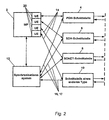
- FIG. 2 shows such a telecommunication system which has a Main processor MP 2 and interface cards 4-10 includes. there owns such a telecommunication system for everyone different interface type own interface card.
- the telecommunication system further includes a synchronization system 12, with both the main processor 2 as well as the interface cards.
- the interface cards as shown by reference numeral 16, each from the transmission network gained clock to the synchronization system 12.
- the synchronization system synchronizes this Telecommunication system under the control of the main processor 2 via connections 17 with one of the interface cards transmitted clock 16.
- the main processor 2 judges on the basis of the connections 14 clock qualities received from the interface cards 4-10, with which of the supplied from the standardized transmission networks Clock signals of the telecommunication system synchronized shall be. As stated above and from Tables 1 to 3, those provided by the different interface types Clock quality information in various formats and even have different value ranges, the treatment must the clock qualities of different interface types in the Main processor 2 is done separately.
- the Main processor via subunits 20, each of which is for editing the clock quality information of an interface type (PDH, SDH, SONET) is provided.
- These different subunits 20 of the Main processors 2 each have a different structure and indicate, due to the different data formats, one each different functionality. Consequently, in the main processor treated the timing qualities separately.
- Telecommunication systems of the aforementioned type have the disadvantage on that in the main processor several algorithms for the different Transmission networks inherent value ranges and formats necessary are. Because of the different existing standards, too is different in different countries, is therefore always an adaptation of the main processor necessary.
- the invention is therefore based on the object, a telecommunication system of the type mentioned above and a method for synchronizing such a telecommunication system and for To provide data transmission from such a telecommunication system, where communication of clock qualities is simplified is.
- Another advantage results from the simplified retrofitting the telecommunications system in the introduction of a new transmission network standard, because the main processor is not standard-dependent Contains elements.
- a telecommunication system created in the conversion of Data in a format that is independent of the formats of the transmission networks is, selects a range of values of the independent format, covering all specific formats. This will be a loss of information regarding the clock quality of individual transmission networks avoided.
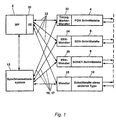
- Fig. 1 is a preferred embodiment of a telecommunication system which, like the one described above, is known Telecommunication system, a main processor 2, multiple interface cards 4-10 and a synchronization system 12 includes. moreover have the interface cards 4-10 transducers 22-28, the Interface-specific timing qualities in a uniform format convert.
- the timing marker converter 22 converts the im Timing marker bit contained information about the clock quality of the PDH transmission network in the uniform format.
- the SSM converter 24, 26 of the SDH interface card 6 and the SONET interface card 8 convert the quality information contained in the SSM data, as shown in Tables 2 and 3, into the uniform format.
- the main processor 2 has a common Subunit 30, the uniformly formatted clock qualities all interface cards, using a single one shared algorithm and sent to the main processor for processing.
- the clock quality becomes four Bits of a byte are stored.
- the decision as to whether the telecommunication system is to be synchronized with a supplied clock comprises selecting the highest quality clock supplied. Alternatively, a supplied clock is selected whose quality is above a threshold value.
- description Timing marker bit (MA byte) Primary reference clock 0 Unknown 1 description
- SSM Z1 byte bits 8-5 DS1 ESF data link code word Primary reference clock 1000 00000100 11111111 Normal, unknown quality 0000 00001000 11111111 Stratum 2 holdover 1110 00001100 11111111 Stratum 3 holdover 0101 00010000 11111111 SONET selftimed 0011 00100010 11111111111 Stratum 4 freerun N / A 00101000 11111111 Unsuitable for synchronization 1111 00110000 11111111 description
Landscapes
- Engineering & Computer Science (AREA)
- Computer Networks & Wireless Communication (AREA)
- Signal Processing (AREA)
- Data Exchanges In Wide-Area Networks (AREA)
- Time-Division Multiplex Systems (AREA)
- Communication Control (AREA)
- Synchronisation In Digital Transmission Systems (AREA)
Description
- Fig. 1
- ein bevorzugtes Ausführungsbeispiel eines erfindungsgemäßen Telekommunikationssystems, und
- Fig. 2
- ein herkömmliches Telekommunikationssystem.
| Beschreibung | Timing-Marker-Bit (MA-Byte) |
| Primärer Referenztakt | 0 |
| Unbekannt | 1 |
| Beschreibung | SSM-Z1-Byte Bits 8-5 | DS1-ESF-Datenverbindungscodewort |
| Primärer Referenztakt | 1000 | 00000100 11111111 |
| Normal, unbekannte Qualität | 0000 | 00001000 11111111 |
| Stratum 2 holdover | 1110 | 00001100 11111111 |
| Stratum 3 holdover | 0101 | 00010000 11111111 |
| SONET selftimed | 0011 | 00100010 11111111 |
| Stratum 4 freerun | N/A | 00101000 11111111 |
| Zur Synchronisation ungeeignet | 1111 | 00110000 11111111 |
| Beschreibung | SSM-S1-Byte, Bits 5-8 |
| G.811 | 0010 |
| Synchronisationsnetzwerk existiert, unbekannte Qualität | 0000 |
| G.812 Transit-Knoten | 0100 |
| G.812 Lokaler Knoten | 1000 |
| SDH SETS | 1011 |
| Für Synchronisation nicht geeignet | 1111 |
Claims (27)
- Telekommunikationssystem zur Übertragung von Daten über wenigstens eines einer Vielzahl verschiedener Übertragungsnetze, wobei dem Telekommunikationssystem aus dem wenigstens einen Übertragungsnetz wenigstens ein Takt als Synchronisationsquelle zugeführt wird, bestehend aus:dadurch gekennzeichnet, daßwenigstens einer Schnittstelleneinheit (4-10) zum Empfangenvon Daten von dem wenigstens einen Übertragungsnetz, die die Qualität des über das wenigstens eine Übertragungsnetz zugeführten Taktes beschreiben, undeiner Einrichtung (2, 30) zur Beurteilung der Qualität des wenigstens einen zugeführten Taktes,
die wenigstens eine Schnittstelleneinheit (4-10) einen Wandler (22-28) umfaßt, der die die Qualität beschreibenden Daten in Nachrichten umwandelt, deren Format von denen der übertragenen Daten unabhängig ist, und diese Nachrichten an die Einrichtung (2, 30) zur Beurteilung sendet. - Telekommunikationssystem nach Anspruch 1,
dadurch gekennzeichnet, daß der Wandler (22-28) so eingerichtet ist, daß er Nachrichten von der Einrichtung (2, 30) zur Beurteilung empfängt und diese in Daten des Formats des wenigstens einen Übertragungsnetzes umwandelt. - Telekommunikationssystem nach Anspruch 1 oder 2,
dadurch gekennzeichnet, daß die Daten Nutzdaten und Zusatzdaten enthalten, wobei die Qualität des Taktes durch die Zusatzdaten beschrieben wird. - Telekommunikationssystem nach einem der Ansprüche 1 bis 3,
dadurch gekennzeichnet, daß die Vielzahl verschiedener Übertragungsnetze wenigstens ein PDH-Übertragungsnetz umfaßt. - Telekommunikationssystem nach einem der Ansprüche 1 bis 4,
dadurch gekennzeichnet, daß die Vielzahl verschiedener Übertragungsnetze wenigstens ein SDH-Übertragungsnetz umfaßt. - Telekoaununikationssystem nach einem der Ansprüche 1 bis 5,
dadurch gekennzeichnet, daß die Vielzahl verschiedener Übertragungsnetze wenigstens ein SONET-Übertragungsnetz umfaßt. - Telekommunikationssystem nach einem der Ansprüche 1 bis 6,
dadurch gekennzeichnet, daß die Nachrichten zur Beschreibung der Qualität Zahlenwerte in einem Wertebereich enthalten. - Telekommunikationssystem nach Anspruch 7,
dadurch gekennzeichnet, daß der Wertebereich wenigstens den Umfang des größten Wertebereiches der übertragenen Daten aufweist. - Telekommunikationssystem nach Anspruch 7,
dadurch gekennzeichnet, daß der Wertebereich 4 Bits eines Bytes umfaßt. - Verfahren zum Betreiben eines Telekommunikationssystems, das mit wenigstens einem einer Vielzahl verschiedener Übertragungsnetze verbunden ist, wobei dem Telekommunikationssystem aus dem wenigstens einen Übertragungsnetz wenigstens ein Takt als Synchronisationsquelle zugeführt wird, wobei das Verfahren die Schritte aufweist:Empfangen von Daten, die die Qualität des zugeführten Taktes beschreiben, aus dem wenigstens einen Übertragungsnetz in einem in dem wenigstens einen Übertragungsnetz verwendeten Format,Umwandeln der Daten in Nachrichten eines Formates, das vom Format der empfangenen Daten unabhängig ist,Beurteilen der Qualität des zugeführten Taktes durch Auswerten der Nachrichten,Entscheiden, ob das Telekommunikationssystem mit dem zugeführten Takt synchronisiert werden soll, undSynchronisieren des Telekommunikationssystems mit dem zugeführten Takt, falls das Telekommunikationssystem mit dem zugeführten Takt synchronisiert werden soll.
- Verfahren nach Anspruch 10, wobei der Schritt des Empfangens von Daten die Schritte des Empfangens von Nutzdaten und des Empfangens von Zusatzdaten umfaßt, wobei die die Qualität des Taktes beschreibenden Daten Zusatzdaten sind.
- Verfahren nach Anspruch 10 oder 11, wobei die Daten Daten eines PDH-Übertragungsnetzes sind.
- Verfahren nach einem der Ansprüche 10 bis 12, wobei die Daten Daten eines SDH-Übertragungsnetzes sind.
- Verfahren nach einem der Ansprüche 10 bis 13, wobei die Daten Daten eines SONET-Übertragungsnetzes sind.
- Verfahren nach einem der Ansprüche 10 bis 14, wobei der Schritt des Umwandelns der Daten in Nachrichten einen Schritt des Umrechnens des Wertes der Qualität des zugeführten Taktes in einen Wert eines unabhängigen Wertebereiches umfaßt.
- Verfahren nach Anspruch 15, wobei der Schritt des Umrechnens ohne Verlust umkehrbar ist.
- Verfahren nach Anspruch 15, wobei der Schritt des Umrechnens das Setzen von vier Bits eines Bytes umfaßt.
- Verfahren nach einem der Ansprüche 10 bis 17, wobei der Schritt des Entscheidens das Auswählen des zugeführten Taktes der höchsten Qualität umfaßt.
- Verfahren nach einem der Ansprüche 10 bis 17, wobei der Schritt des Entscheidens das Auswählen eines zugeführten Taktes umfaßt, dessen Qualität oberhalb eines Schwellwertes liegt.
- Verfahren zum Senden von Daten von einem Telekommunikationssystem in wenigstens eines einer Vielzahl verschiedener Übertragungsnetze, wobei die Daten die Qualität eines Taktes beschreiben, zu dem das Telekommunikationssystem synchronisiert ist, wobei das Verfahren die folgenden Schritte aufweist:Erzeugen einer die Qualität beschreibenden Nachricht in einem Format, das von Formaten der zu sendenden Daten unabhängig ist,Umwandeln der Nachricht in Daten eines in dem wenigstens einen Übertragungsnetz verwendeten Formates, undÜbertragen der Daten in das wenigstens eine Übertragungsnetz.
- Verfahren nach Anspruch 20, wobei die Daten Nutzdaten und Zusatzdaten umfassen und wobei die die Qualität des Taktes beschreibenden Daten Zusatzdaten sind.
- Verfahren nach Anspruch 20 bis 21, wobei die Daten Daten eines PDH-Übertragungsnetzes sind.
- Verfahren nach Anspruch 20 bis 22, wobei die Daten Daten eines SDH-Übertragungsnetzes sind.
- Verfahren nach Anspruch 20 bis 23, wobei die Daten Daten eines SONET-Übertragungsnetzes sind.
- Verfahren nach einem der Ansprüche 20 bis 24, wobei der Schritt des Umwandelns der Nachrichten in Daten einen Schritt des Umrechnens des Wertes der Qualität des zugeführten Taktes in einen Wert eines unabhängigen Wertebereiches umfaßt.
- Verfahren nach Anspruch 25, wobei der Schritt des Umrechnens ohne Verlust umkehrbar ist.
- Verfahren nach Anspruch 25 oder 26, wobei der Schritt des Umrechnens das Setzen von vier Bits eines Bytes umfaßt.
Priority Applications (1)
| Application Number | Priority Date | Filing Date | Title |
|---|---|---|---|
| EP99968274A EP1108301B1 (de) | 1998-08-28 | 1999-08-26 | Telekommunikationssystem sowie verfahren zum synchronisieren desselben und zum senden von daten |
Applications Claiming Priority (4)
| Application Number | Priority Date | Filing Date | Title |
|---|---|---|---|
| EP98116319 | 1998-08-28 | ||
| EP98116319A EP0982888A1 (de) | 1998-08-28 | 1998-08-28 | Telekommunikationssystem sowie Verfahren zum Synchronisieren desselben und zum Senden von Daten |
| PCT/EP1999/006286 WO2000013354A1 (de) | 1998-08-28 | 1999-08-26 | Telekommunikationssystem sowie verfahren zum synchronisieren desselben und zum senden von daten |
| EP99968274A EP1108301B1 (de) | 1998-08-28 | 1999-08-26 | Telekommunikationssystem sowie verfahren zum synchronisieren desselben und zum senden von daten |
Publications (2)
| Publication Number | Publication Date |
|---|---|
| EP1108301A1 EP1108301A1 (de) | 2001-06-20 |
| EP1108301B1 true EP1108301B1 (de) | 2004-10-20 |
Family
ID=8232533
Family Applications (2)
| Application Number | Title | Priority Date | Filing Date |
|---|---|---|---|
| EP98116319A Withdrawn EP0982888A1 (de) | 1998-08-28 | 1998-08-28 | Telekommunikationssystem sowie Verfahren zum Synchronisieren desselben und zum Senden von Daten |
| EP99968274A Expired - Lifetime EP1108301B1 (de) | 1998-08-28 | 1999-08-26 | Telekommunikationssystem sowie verfahren zum synchronisieren desselben und zum senden von daten |
Family Applications Before (1)
| Application Number | Title | Priority Date | Filing Date |
|---|---|---|---|
| EP98116319A Withdrawn EP0982888A1 (de) | 1998-08-28 | 1998-08-28 | Telekommunikationssystem sowie Verfahren zum Synchronisieren desselben und zum Senden von Daten |
Country Status (7)
| Country | Link |
|---|---|
| US (1) | US7286567B1 (de) |
| EP (2) | EP0982888A1 (de) |
| CN (1) | CN1154266C (de) |
| BR (1) | BR9913650A (de) |
| DE (1) | DE59910910D1 (de) |
| ES (1) | ES2229815T3 (de) |
| WO (1) | WO2000013354A1 (de) |
Families Citing this family (4)
| Publication number | Priority date | Publication date | Assignee | Title |
|---|---|---|---|---|
| US20040148437A1 (en) * | 2002-12-12 | 2004-07-29 | Koji Tanonaka | Synchronous network establishing method and apparatus |
| US8909712B2 (en) * | 2003-11-25 | 2014-12-09 | Sap Ag | System and method for a generic mobile synchronization framework |
| CN101299749B (zh) * | 2007-04-30 | 2011-12-07 | 华为技术有限公司 | 网络间的时钟传递方法和时钟传递装置 |
| CN113711511B (zh) * | 2019-07-08 | 2024-05-17 | Abb瑞士股份有限公司 | 支持多时间同步协议的工业设备 |
Family Cites Families (10)
| Publication number | Priority date | Publication date | Assignee | Title |
|---|---|---|---|---|
| GB9114841D0 (en) * | 1991-07-10 | 1991-08-28 | Gpt Ltd | Sdh data transmission timing |
| FI95977C (fi) * | 1994-02-25 | 1996-04-10 | Nokia Telecommunications Oy | Verkkojärjestely |
| FI95976C (fi) * | 1994-02-25 | 1996-04-10 | Nokia Telecommunications Oy | Verkkojärjestely |
| DE4446511A1 (de) * | 1994-12-24 | 1996-06-27 | Sel Alcatel Ag | Synchrones digitales Nachrichtenübertragungssystem mit hierarchischem Synchronisierungsnetz |
| GB9509216D0 (en) * | 1995-05-05 | 1995-06-28 | Plessey Telecomm | Retiming arrangement for SDH data transmission system |
| SE504920C2 (sv) * | 1995-09-29 | 1997-05-26 | Ericsson Telefon Ab L M | Förfarande och system för redundant klockdistribution till telekommunikationsutrustningar i vilka byte av vald klocksignal bland de inkommande klocksignalerna ständigt sker |
| DE19653261A1 (de) * | 1996-12-20 | 1998-06-25 | Alsthom Cge Alcatel | Synchrones digitales Nachrichtenübertragungssystem, Steuerungseinrichtung, Netzelement und zentraler Taktgenerator |
| JP3374054B2 (ja) * | 1997-09-01 | 2003-02-04 | 富士通株式会社 | 伝送装置の同期メッセージ処理方法 |
| US6185247B1 (en) * | 1998-02-27 | 2001-02-06 | Nortel Networks Limited | Method of reducing synchronization rearrangements in synchronous transmission systems |
| US6307869B1 (en) * | 1998-07-07 | 2001-10-23 | Lucent Technologies Inc. | System and method for phase recovery in a synchronous communication system |
-
1998
- 1998-08-28 EP EP98116319A patent/EP0982888A1/de not_active Withdrawn
-
1999
- 1999-08-26 BR BR9913650-3A patent/BR9913650A/pt not_active IP Right Cessation
- 1999-08-26 EP EP99968274A patent/EP1108301B1/de not_active Expired - Lifetime
- 1999-08-26 ES ES99968274T patent/ES2229815T3/es not_active Expired - Lifetime
- 1999-08-26 CN CNB998123994A patent/CN1154266C/zh not_active Expired - Fee Related
- 1999-08-26 DE DE59910910T patent/DE59910910D1/de not_active Expired - Fee Related
- 1999-08-26 US US09/786,063 patent/US7286567B1/en not_active Expired - Lifetime
- 1999-08-26 WO PCT/EP1999/006286 patent/WO2000013354A1/de not_active Ceased
Also Published As
| Publication number | Publication date |
|---|---|
| ES2229815T3 (es) | 2005-04-16 |
| BR9913650A (pt) | 2001-06-05 |
| US7286567B1 (en) | 2007-10-23 |
| DE59910910D1 (de) | 2004-11-25 |
| EP1108301A1 (de) | 2001-06-20 |
| EP0982888A1 (de) | 2000-03-01 |
| WO2000013354A1 (de) | 2000-03-09 |
| CN1324532A (zh) | 2001-11-28 |
| CN1154266C (zh) | 2004-06-16 |
Similar Documents
| Publication | Publication Date | Title |
|---|---|---|
| DE69925548T2 (de) | Übertragung von rahmenbasierten Daten über ein synchrones hierarchisches digitales Netzwerk | |
| DE69637295T2 (de) | Vorrichtung zur anpassung von smallband-sprach-verkehr eines lokalen zugangsnetzwerkes zum übertragen über ein breitband-netzwerk mit asynchronem transfermodus | |
| DE69329433T2 (de) | Vorrichtung und Verfahren zur Übertragung SONET-Zusatzsignalinformation | |
| DE60218284T2 (de) | Verfahren und vorrichtung zum tunneln von daten in einem netzwerk | |
| DE69838157T2 (de) | Transparenter Multiplexer/Demultiplexer | |
| DE69834861T2 (de) | Transparente Übertragung in einem Nachrichtenübertragungssystem | |
| DE69734415T2 (de) | SDH-Desynchronisierer | |
| DE69332983T2 (de) | Einrichtung in einem kommunikationsnetz | |
| EP0429888B1 (de) | Verfahren zur Übertragung eines digitalen Breitbandsignals in einer Untersystemeinheitenkette über ein Netz einer Synchron-Digital-Multiplexhierarchie | |
| DE69224751T2 (de) | Querverbindung eines kommunikationsnetzes | |
| DE69132247T2 (de) | Phasenverriegelte Schleifenanordnung | |
| DE69322291T2 (de) | Verfahren zur bildung einer netzschnittstelle und netzschnittstelle für ein digitales übertragungsnetz | |
| DE60008734T2 (de) | Verfahren und Knoten zur Leitweglenkung von Hochgeschwindigkeitsrahmen in einem maschenartigen Netzwerk sowie zugehörige Sende-Endstation | |
| EP1234396B1 (de) | Multiplexverfahren für gigabit ethernet signale in der synchronen digital hierarchie | |
| DE4104238A1 (de) | Verfahren zum empfang und zur abgabe von rahmenkoepfen von und fuer stm-1-signale in einem rahmenkopf-server eines netzknotens | |
| DE69733006T2 (de) | Kompressionsregelungsverfahren | |
| EP0407851B1 (de) | Verfahren zur Durchschaltung von Multiplexsignalen über Cross-Connectoren | |
| DE60119615T2 (de) | Verfahren und Vorrichtung zum Senden und Empfangen von hochratigen digitalen Signalen über zwei Hochfrequenz-Trägern in einem Funkregeneratorabschnitt | |
| DE69611611T2 (de) | Anordnung zur neu-synchronisation für sdh-nachrichtenübertragungssystem | |
| DE69428434T2 (de) | Verfahren zur steuerung von bedingten verbindungen in einem synchronen digitalen fernmeldesystem | |
| DE60030643T2 (de) | Telekommunikationssystem | |
| EP0982888A1 (de) | Telekommunikationssystem sowie Verfahren zum Synchronisieren desselben und zum Senden von Daten | |
| EP0982890A1 (de) | Telekommunikationssystem sowie Verfahren zum Erzeugen eines Haupttaktes in demselben | |
| DE60025316T2 (de) | Detektion von Fehlern in der vorigen Sektion für eine transparente Untersystemseinheit | |
| DE3335352A1 (de) | Verfahren und anordnung zum einfuegen eines digitalen binaeren schmalbandsignals in ein oder zum abtrennen dieses schmalbandsignals aus einem zeitmultiplexsignal |
Legal Events
| Date | Code | Title | Description |
|---|---|---|---|
| PUAI | Public reference made under article 153(3) epc to a published international application that has entered the european phase |
Free format text: ORIGINAL CODE: 0009012 |
|
| 17P | Request for examination filed |
Effective date: 20010214 |
|
| AK | Designated contracting states |
Kind code of ref document: A1 Designated state(s): AT BE CH CY DE DK ES FI FR GB GR IE IT LI LU MC NL PT SE |
|
| GRAP | Despatch of communication of intention to grant a patent |
Free format text: ORIGINAL CODE: EPIDOSNIGR1 |
|
| RBV | Designated contracting states (corrected) |
Designated state(s): DE ES FR GB |
|
| GRAS | Grant fee paid |
Free format text: ORIGINAL CODE: EPIDOSNIGR3 |
|
| GRAA | (expected) grant |
Free format text: ORIGINAL CODE: 0009210 |
|
| AK | Designated contracting states |
Kind code of ref document: B1 Designated state(s): DE ES FR GB |
|
| REG | Reference to a national code |
Ref country code: GB Ref legal event code: FG4D Free format text: NOT ENGLISH |
|
| REG | Reference to a national code |
Ref country code: IE Ref legal event code: FG4D Free format text: GERMAN |
|
| REF | Corresponds to: |
Ref document number: 59910910 Country of ref document: DE Date of ref document: 20041125 Kind code of ref document: P |
|
| GBT | Gb: translation of ep patent filed (gb section 77(6)(a)/1977) |
Effective date: 20050202 |
|
| REG | Reference to a national code |
Ref country code: ES Ref legal event code: FG2A Ref document number: 2229815 Country of ref document: ES Kind code of ref document: T3 |
|
| REG | Reference to a national code |
Ref country code: IE Ref legal event code: FD4D |
|
| PLBE | No opposition filed within time limit |
Free format text: ORIGINAL CODE: 0009261 |
|
| STAA | Information on the status of an ep patent application or granted ep patent |
Free format text: STATUS: NO OPPOSITION FILED WITHIN TIME LIMIT |
|
| ET | Fr: translation filed | ||
| 26N | No opposition filed |
Effective date: 20050721 |
|
| PGFP | Annual fee paid to national office [announced via postgrant information from national office to epo] |
Ref country code: ES Payment date: 20070830 Year of fee payment: 9 |
|
| PGFP | Annual fee paid to national office [announced via postgrant information from national office to epo] |
Ref country code: DE Payment date: 20070831 Year of fee payment: 9 |
|
| PGFP | Annual fee paid to national office [announced via postgrant information from national office to epo] |
Ref country code: GB Payment date: 20070823 Year of fee payment: 9 |
|
| PGFP | Annual fee paid to national office [announced via postgrant information from national office to epo] |
Ref country code: FR Payment date: 20070812 Year of fee payment: 9 |
|
| REG | Reference to a national code |
Ref country code: FR Ref legal event code: TP |
|
| REG | Reference to a national code |
Ref country code: GB Ref legal event code: 732E Free format text: REGISTERED BETWEEN 20090212 AND 20090218 |
|
| GBPC | Gb: european patent ceased through non-payment of renewal fee |
Effective date: 20080826 |
|
| REG | Reference to a national code |
Ref country code: FR Ref legal event code: ST Effective date: 20090430 |
|
| PG25 | Lapsed in a contracting state [announced via postgrant information from national office to epo] |
Ref country code: FR Free format text: LAPSE BECAUSE OF NON-PAYMENT OF DUE FEES Effective date: 20080901 Ref country code: DE Free format text: LAPSE BECAUSE OF NON-PAYMENT OF DUE FEES Effective date: 20090303 |
|
| REG | Reference to a national code |
Ref country code: ES Ref legal event code: FD2A Effective date: 20080827 |
|
| PG25 | Lapsed in a contracting state [announced via postgrant information from national office to epo] |
Ref country code: GB Free format text: LAPSE BECAUSE OF NON-PAYMENT OF DUE FEES Effective date: 20080826 |
|
| PG25 | Lapsed in a contracting state [announced via postgrant information from national office to epo] |
Ref country code: ES Free format text: LAPSE BECAUSE OF NON-PAYMENT OF DUE FEES Effective date: 20080827 |