EP1107518A2 - Netzwerkknoten zum Vermitteln von digitaler information unterschiedlicher Protokolltypen - Google Patents
Netzwerkknoten zum Vermitteln von digitaler information unterschiedlicher Protokolltypen Download PDFInfo
- Publication number
- EP1107518A2 EP1107518A2 EP00440307A EP00440307A EP1107518A2 EP 1107518 A2 EP1107518 A2 EP 1107518A2 EP 00440307 A EP00440307 A EP 00440307A EP 00440307 A EP00440307 A EP 00440307A EP 1107518 A2 EP1107518 A2 EP 1107518A2
- Authority
- EP
- European Patent Office
- Prior art keywords
- stage
- central
- module
- modules
- network node
- Prior art date
- Legal status (The legal status is an assumption and is not a legal conclusion. Google has not performed a legal analysis and makes no representation as to the accuracy of the status listed.)
- Granted
Links
Images
Classifications
-
- H—ELECTRICITY
- H04—ELECTRIC COMMUNICATION TECHNIQUE
- H04L—TRANSMISSION OF DIGITAL INFORMATION, e.g. TELEGRAPHIC COMMUNICATION
- H04L49/00—Packet switching elements
- H04L49/60—Software-defined switches
- H04L49/604—Hybrid IP/Ethernet switches
-
- H—ELECTRICITY
- H04—ELECTRIC COMMUNICATION TECHNIQUE
- H04L—TRANSMISSION OF DIGITAL INFORMATION, e.g. TELEGRAPHIC COMMUNICATION
- H04L49/00—Packet switching elements
- H04L49/15—Interconnection of switching modules
- H04L49/1515—Non-blocking multistage, e.g. Clos
-
- H—ELECTRICITY
- H04—ELECTRIC COMMUNICATION TECHNIQUE
- H04L—TRANSMISSION OF DIGITAL INFORMATION, e.g. TELEGRAPHIC COMMUNICATION
- H04L49/00—Packet switching elements
- H04L49/15—Interconnection of switching modules
- H04L49/1553—Interconnection of ATM switching modules, e.g. ATM switching fabrics
-
- H—ELECTRICITY
- H04—ELECTRIC COMMUNICATION TECHNIQUE
- H04L—TRANSMISSION OF DIGITAL INFORMATION, e.g. TELEGRAPHIC COMMUNICATION
- H04L49/00—Packet switching elements
- H04L49/60—Software-defined switches
- H04L49/606—Hybrid ATM switches, e.g. ATM&STM, ATM&Frame Relay or ATM&IP
-
- H—ELECTRICITY
- H04—ELECTRIC COMMUNICATION TECHNIQUE
- H04Q—SELECTING
- H04Q11/00—Selecting arrangements for multiplex systems
- H04Q11/04—Selecting arrangements for multiplex systems for time-division multiplexing
- H04Q11/0428—Integrated services digital network, i.e. systems for transmission of different types of digitised signals, e.g. speech, data, telecentral, television signals
- H04Q11/0478—Provisions for broadband connections
-
- H—ELECTRICITY
- H04—ELECTRIC COMMUNICATION TECHNIQUE
- H04L—TRANSMISSION OF DIGITAL INFORMATION, e.g. TELEGRAPHIC COMMUNICATION
- H04L12/00—Data switching networks
- H04L12/64—Hybrid switching systems
- H04L12/6402—Hybrid switching fabrics
-
- H—ELECTRICITY
- H04—ELECTRIC COMMUNICATION TECHNIQUE
- H04L—TRANSMISSION OF DIGITAL INFORMATION, e.g. TELEGRAPHIC COMMUNICATION
- H04L49/00—Packet switching elements
- H04L49/30—Peripheral units, e.g. input or output ports
-
- H—ELECTRICITY
- H04—ELECTRIC COMMUNICATION TECHNIQUE
- H04L—TRANSMISSION OF DIGITAL INFORMATION, e.g. TELEGRAPHIC COMMUNICATION
- H04L49/00—Packet switching elements
- H04L49/45—Arrangements for providing or supporting expansion
Definitions
- the invention is based on a network node Conveying digital information differently Protocol types, with several modules in one Input stage, a central stage and an output stage are arranged, with each module of the input stage with every module of the central level and every module of the Central stage connected to each module of the output stage is.
- the invention also relates to a method for Conveying digital information differently Protocol types in which a corresponding network node is provided.
- SDH synchronous digital hierarchy
- a such SDH switching matrix has three stages, namely an input stage, a central stage and one Output stage.
- Each level contains several modules, whereby each module with several so-called ports for incoming or outgoing information packets. Every module each level is with every module of the adjacent level connected. In this way, incoming information from each of the modules of the input stage to each of the modules of the Output stage to be forwarded.
- ATM asynchronous transfer mode
- IP Internet protocol
- the object of the invention is to provide a network node Conveying digital information differently To create protocol types that require little hardware and therefore requires lower costs.
- This task is the beginning of a network node mentioned type according to the invention solved in that each between the input stage and the central stage as well between the central stage and the output stage one uniform interface is provided that each of the Central level modules to one of the different Protocol types are adapted, and that the interfaces Have means dependent on an information package from its protocol type to a module adapted to it Forwarding the central stage.
- a process of the task mentioned is the object of the invention solved accordingly.
- the invention creates a structure of a network node, which enables information contained in different protocol types is represented, directly and be conveyed without external or additional devices can.
- the structure is three levels and consists of modules for the entrance stage, the central stage and the Output stage. Each module of the entry level is with everyone Module connected to the central level, as is each module the central stage with each module of the output stage connected.
- the Modules of the central level Due to the uniform interfaces, the Modules of the central level according to a uniform connection outside so they are no longer attached to a particular one Protocol type. It is therefore possible in the Central level modules of different protocol types to be provided so that not only SDH traffic but via the associated modules of the central level also ATM traffic or IP traffic can be switched.
- the modules of the input stage recognize the type of protocol to be transferred Information listened to. Depending on the protocol type the information is then sent to a module of the central level forwarded, which also belongs to this protocol type.
- Another advantage of the invention is that the SDH traffic is no longer blocked by ATM or IP traffic will, as has been the case so far. Instead stands for each protocol type has a separate, associated module in the form of an SDH matrix and / or an ATM matrix and / or an IP matrix. This represents one essential advantage of the invention in terms of Transfer rate or speed of the network node according to the invention.
- Another advantage of the invention is that Possibility of the network node according to the invention at any time and can be upgraded or expanded completely flexibly. For this it is only necessary to choose the ones you want to add additional modules. Due to the Uniform interfaces according to the invention can any modules for SDH traffic or for ATM traffic or for IP traffic. Also this advantage results in less hardware effort and the resulting lower costs noticeable.
- Network node gives the further advantage of Invention that the network node is scalable. Only through appropriate additional or exchanged modules can the network node according to the invention as required be expanded or changed.
- Another advantage of the invention is that Standardization of components. especially the Use of the uniform according to the invention Interfaces enable their production in large Quantities. This represents a further reduction in the Development and production costs of the invention Network node.
- the invention also opens up the possibility of Set up network nodes decentrally. This results in increased reliability with reduced effort.
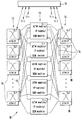
- a network node 10 is shown that has three stages, namely an input stage 12, one Central stage 13 and an output stage 14.
- Die Input stage 12 has a plurality of modules 12-1, 12-2, ..., 12-n provided, the central stage 13 with a Plurality of modules 13-1, 13-2, ..., 13-n and the Output stage 14 with a plurality of modules 14-1, 14-2, ..., 14-n.
- the modules of each level are subsequently simplified with the reference numerals 12-x, 13-x and marked 14-x.
- Each of the modules 12-x of the input stage 12 is with each Module 13-x connected to central stage 13. Is also each of the modules 13-x of the central stage 13 with each of the Module 14-x of the output stage 14 connected.
- Each of the modules 12-x of the input stage 12 is provided with a plurality of ports on the input side where digital information is received.
- Each of the modules 14-x of the output stage 14 is on the output side with a Provide a plurality of ports on which digital information is delivered.
- Each of the modules 13-x of the central stage 13 is for one designed only one specific protocol type. So everyone can of modules 13-x of central stage 13 to the SDH protocol or adapted the ATM protocol or the IP protocol his.
- the modules 13-x of the central stage 13 can thus SDH matrix or an ATM matrix or an IP matrix contain.
- the modules 13-x of the central stage 13 can thus - Depending on the existing protocol type - SDH traffic or ATM traffic or mediate IP traffic.
- modules 13-x of the central stage 13 and the Modules 12-x and 14-x of the input stage 12 and the Output stage 14 are uniform interfaces 15 in the Form of assemblies provided. These interfaces 15 are respectively in the figure for modules 12-x and 14-x Input stage 12 and the output stage 14 shown. It However, it is also necessary that the interfaces 15 also in modules 13-x of central level 13 available. These latter interfaces 15 are not in the figure for reasons of clarity shown.
- the interfaces 15 can also be independent of the Modules as separate interface adapters between the Input stage 12 and the central stage 13 and between the Central stage 13 and the output stage 14 may be present.
- Each the module 13-x of the central stage 13 can therefore against another module exchanged with a different protocol type become. This makes it possible in central level 13, e.g. a module with an SDH matrix against a module with a Exchange IP matrix.
- the interfaces 15 designed as modules are included Means provided to the protocol type of the transmitted Information to show each other. They are also Interfaces 15 are provided with means for the protocol type of the connected modules 13-x of the central stage 13 ascertain. So that it is the interfaces 15 between input stage 12 and central stage 13 possible, Information of a certain protocol type to a module 13-x Central level 13 with the same protocol type forward.
- Each of the modules 12-x and 14-x of the input stage 12 and the Output stage 14 is provided with an ATM / IP matrix 16.
- This ATM / IP matrix 16 is provided Information packages according to the ATM protocol or the IP protocol to convey.
- Is used by one of the modules 12-x of the input stage 12 Information in the form of virtual containers with synchronous content according to the SDH protocol is received this information via the associated interface 15 a corresponding module 13-x of the central level 13 passed, which has an SDH matrix.
- Module 13-x of central stage 13 becomes the information switched on and arrives at an interface 15 which belongs to one of the modules 14-x of the output stage 14.
- interface 15 is the information again processed in order to then via the associated module 14-x Output stage 14 to be output.
- this is Packet first from the ATM / IP matrix 16 of the module 12-x processed. After that, the package from the associated Interface 15 to a corresponding module 13-x Central stage 13 passed, which is an ATM matrix having. From this module 13-x the central stage 13 is the packet is forwarded and arrives at an interface 15 leading to one of the modules 14-x of the output stage 14 heard. From this interface 15 the packet is back processed in order to then via the associated module 14-x Output stage 14 and its ATM / IP matrix 16 output become.
- control system 11 for the Network node 10 provided.
- the control system 11 has Connections to the modules 12-x of the input stage 12 and to the modules 14-x of the output stage 14.
- the modules 13-x the central stage 13 via the interfaces 15 controlled.
- These modules also report their status 13-x on request via interfaces 15 to the modules 14-x of the output stage 14. From there this status is then forwarded to the control system 11.
- routing tables will starting from the modules 12-x of the input stage 12 via the interfaces 15 performed. Also be Test data from the modules 12-x of the input stage 12 to the Module 14-x of output stage 14 sent. These modules 14-x receive the necessary from the control system 11 Information to check the test data. Will the Test data from modules 14-x of output stage 14 correct received, the connection is considered correctly set up.
- interfaces 15 in the form of Interface adapters between the input stage 12 and the central level 13 and between the central level 13 and the output stage 14 is present, so is the control system 11 not with modules 12-x and 14-x of input stage 12 and the output stage 14 connected, but only with the Modules 13-x of the central level 13. The modules 13-x are then controlled directly by the control system 11.
- the decentralized installation increases reliability.
Landscapes
- Engineering & Computer Science (AREA)
- Computer Networks & Wireless Communication (AREA)
- Signal Processing (AREA)
- Data Exchanges In Wide-Area Networks (AREA)
- Communication Control (AREA)
Abstract
Description
Claims (5)
- Netzwerkknoten (10) zum Vermitteln von digitaler Information unterschiedlicher Protokolltypen, mit mehreren Modulen (12-x, 13-x, 14-x), die in einer Eingangsstufe (12), einer Zentralstufe (13) und einer Ausgangsstufe (14) angeordnet sind, wobei jedes Modul (12-x) der Eingangsstufe (12) mit jedem Modul (13-x) der Zentralstufe (13) und jedes Modul (13-x) der Zentralstufe (13) mit jedem Modul (14-x) der Ausgangsstufe (14) verbunden ist, dadurch gekennzeichnet, dass jeweils zwischen der Eingangsstufe (12) und der Zentralstufe (13) sowie zwischen der Zentralstufe (13) und der Ausgangsstufe (14) eine für alle Protokolltypen einheitliche Schnittstelle (15) vorgesehen ist, dass jedes der Module (13-x) der Zentralstufe (13) für einen Protokolltyp ausgelegt ist, und dass die Schnittstellen (15) Mittel aufweisen, um Information in Abhängigkeit vom Protokolltyp an ein daran angepasstes Modul (13-x) der Zentralstufe (13) weiterzuleiten.
- Netzwerkknoten (10) nach Anspruch 1, dadurch gekennzeichnet, dass die Module (13-x) der Zentralstufe (13) austauschbar sind.
- Netzwerkknoten (10) nach einem der Ansprüche 1 oder 2, dadurch gekennzeichnet, dass die Module (12-x, 14-x) der Eingangsstufen (12) und der Ausgangsstufen (14) an mehrere oder sämtliche der unterschiedlichen Protokolltypen angepasst sind.
- Netzwerkknoten (10) nach einem der Ansprüche 1 bis 3, dadurch gekennzeichnet, dass der Netzwerkknoten (10) dezentral aufgebaut ist.
- Verfahren zum Vermitteln von digitaler Information unterschiedlicher Protokolltypen, wobei ein Netzwerkknoten (10) mit mehreren Modulen (12-x, 13-x, 14-x) vorgesehen ist, die in einer Eingangsstufe (12), einer Zentralstufe (13) und einer Ausgangsstufe (14) angeordnet sind, wobei jedes Modul (12-x) der Eingangsstufe (12) mit jedem Modul (13-x) der Zentralstufe (13) und jedes Modul (13-x) der Zentralstufe (13) mit jedem Modul (14-x) der Ausgangsstufe (14) verbunden ist, dadurch gekennzeichnet, dass jeweils zwischen der Eingangsstufe (12) und der Zentralstufe (13) sowie zwischen der Zentralstufe (13) und der Ausgangsstufe (14) eine für alle Protokolltypen einheitliche Schnittstelle (15) vorgesehen ist, dass jedes der Module (13-x) der Zentralstufe (13) für einen Protokolltyp ausgelegt ist, und dass Information von den Schnittstellen (15) in Abhängigkeit vom Protokolltyp an ein daran angepasstes Modul (13-x) der Zentralstufe (13) weitergeleitet wird.
Applications Claiming Priority (2)
| Application Number | Priority Date | Filing Date | Title |
|---|---|---|---|
| DE19959918 | 1999-12-11 | ||
| DE19959918A DE19959918A1 (de) | 1999-12-11 | 1999-12-11 | Netzwerkknoten zum Vermitteln von digitaler Information unterschiedlicher Protokolltypen |
Publications (3)
| Publication Number | Publication Date |
|---|---|
| EP1107518A2 true EP1107518A2 (de) | 2001-06-13 |
| EP1107518A3 EP1107518A3 (de) | 2004-09-08 |
| EP1107518B1 EP1107518B1 (de) | 2007-05-16 |
Family
ID=7932382
Family Applications (1)
| Application Number | Title | Priority Date | Filing Date |
|---|---|---|---|
| EP00440307A Expired - Lifetime EP1107518B1 (de) | 1999-12-11 | 2000-11-24 | Netzwerkknoten zum Vermitteln von digitaler information unterschiedlicher Protokolltypen |
Country Status (4)
| Country | Link |
|---|---|
| US (1) | US6842451B2 (de) |
| EP (1) | EP1107518B1 (de) |
| AT (1) | ATE362680T1 (de) |
| DE (2) | DE19959918A1 (de) |
Families Citing this family (1)
| Publication number | Priority date | Publication date | Assignee | Title |
|---|---|---|---|---|
| US20050213590A1 (en) * | 2004-03-23 | 2005-09-29 | Nokia Corporation | Universal telecommunication node with software-defined exchangeable protocol architecture |
Family Cites Families (6)
| Publication number | Priority date | Publication date | Assignee | Title |
|---|---|---|---|---|
| US4679190A (en) * | 1986-04-28 | 1987-07-07 | International Business Machines Corporation | Distributed voice-data switching on multi-stage interconnection networks |
| IT1259036B (it) * | 1992-07-24 | 1996-03-11 | Italtel Spa | Centrale locale e/o di transito per una rete di comunicazioni a larga banda |
| US5687172A (en) * | 1994-12-30 | 1997-11-11 | Lucent Technologies Inc. | Terabit per second distribution network |
| US5905873A (en) * | 1997-01-16 | 1999-05-18 | Advanced Micro Devices, Inc. | System and method of routing communications data with multiple protocols using crossbar switches |
| US6600741B1 (en) * | 1999-03-25 | 2003-07-29 | Lucent Technologies Inc. | Large combined broadband and narrowband switch |
| US6747971B1 (en) * | 1999-04-20 | 2004-06-08 | Cisco Technology, Inc. | Crosspoint switch with independent schedulers |
-
1999
- 1999-12-11 DE DE19959918A patent/DE19959918A1/de not_active Withdrawn
-
2000
- 2000-11-24 AT AT00440307T patent/ATE362680T1/de not_active IP Right Cessation
- 2000-11-24 EP EP00440307A patent/EP1107518B1/de not_active Expired - Lifetime
- 2000-11-24 DE DE50014332T patent/DE50014332D1/de not_active Expired - Lifetime
- 2000-12-06 US US09/729,776 patent/US6842451B2/en not_active Expired - Lifetime
Also Published As
| Publication number | Publication date |
|---|---|
| EP1107518B1 (de) | 2007-05-16 |
| ATE362680T1 (de) | 2007-06-15 |
| DE50014332D1 (de) | 2007-06-28 |
| DE19959918A1 (de) | 2001-06-13 |
| US20010003524A1 (en) | 2001-06-14 |
| US6842451B2 (en) | 2005-01-11 |
| EP1107518A3 (de) | 2004-09-08 |
Similar Documents
| Publication | Publication Date | Title |
|---|---|---|
| DE69522401T2 (de) | Verfahren und Vorrichtung zur Überlastregelung in einem Paketkommunikationsnetz | |
| EP0276776B1 (de) | Digitales Koppelnetz für Leitungs- und Paketvermittlung und Koppelfeldbaustein hierzu | |
| DE69632240T2 (de) | Verfahren und Anlage zur Kontrolle von Übertragungsgeschwindigkeiten von Quellen in ATM-Netzwerken | |
| DE19532422C1 (de) | Lokales, nach dem asynchronen Transfermodus (ATM) arbeitendes Netzwerk mit wenigstens zwei Ringsystemen | |
| DE19634492B4 (de) | Verfahren zum optimierten Übertragen von ATM-Zellen über Verbindungsabschnitte | |
| DE19757965A1 (de) | Verteiltes Puffersystem für ATM-Schalter | |
| EP0351014B1 (de) | Koppelfeld für ein Vermittlungssystem | |
| DE3714385A1 (de) | Verfahren und schaltungsanordnung zur koppelfeldsteuerung in einem vermittlungssystem | |
| DE19526484A1 (de) | Verfahren, Kommunikationssystem und Konferenzeinheit zur Durchführung von Konferenzen | |
| EP0618703A2 (de) | Verfahren für Punkt-zu-Mehrpunkt-Verbindungen in selbstroutenden ATM-Koppelfeldern | |
| EP0322075B1 (de) | Koppelfeld und Koppelfeldsteuerung für ein Vermittlungssystem | |
| EP0173274B1 (de) | Verfahren und Schaltungsanordnung zur Herstellung und zum Betreiben einer Zeitvielfach-Breitbandverbindung | |
| EP1107518B1 (de) | Netzwerkknoten zum Vermitteln von digitaler information unterschiedlicher Protokolltypen | |
| DE4127244A1 (de) | Hybrider koppelnetzbaustein | |
| EP0732828B1 (de) | Redundanzoptimiertes Kommunikationsnetz für die Übertragung von Nachrichtensignalen | |
| DE19945152C1 (de) | Verfahren und Anordnung zur Meldungskopplung einer zentralen Steuerungseinrichtung mit dezentralen Kommunikationseinrichtungen | |
| DE69433982T2 (de) | Kommunikationssystem mit ATM-Netz und -Demultiplexer | |
| DE60303498T2 (de) | Schalten gemäss der anschlusskennzeichnung | |
| DE3023205A1 (de) | Verbindungseinrichtung fuer ein zeitmultiplex-telefonvermittlungssystem | |
| EP0981230B1 (de) | Koppelvorrichtung mit vollständiger Übertragung des Inhaltes eines Kopffeldes einer Zelle | |
| DE102005024782B3 (de) | Verfahren und Vorrichtung zur Datenübertragung mit einer Bündelung von mehreren Übertragungskanaleinrichtungen | |
| DE19612670C2 (de) | ATM-Vermittlungssystem mit modifizierter Struktur | |
| DE3343280A1 (de) | Nachrichtenvermittlungssystem | |
| EP0581000A2 (de) | Vermittlungsstelle | |
| CH681410A5 (de) |
Legal Events
| Date | Code | Title | Description |
|---|---|---|---|
| PUAI | Public reference made under article 153(3) epc to a published international application that has entered the european phase |
Free format text: ORIGINAL CODE: 0009012 |
|
| AK | Designated contracting states |
Kind code of ref document: A2 Designated state(s): AT BE CH CY DE DK ES FI FR GB GR IE IT LI LU MC NL PT SE TR |
|
| AX | Request for extension of the european patent |
Free format text: AL;LT;LV;MK;RO;SI |
|
| PUAL | Search report despatched |
Free format text: ORIGINAL CODE: 0009013 |
|
| AK | Designated contracting states |
Kind code of ref document: A3 Designated state(s): AT BE CH CY DE DK ES FI FR GB GR IE IT LI LU MC NL PT SE TR |
|
| AX | Request for extension of the european patent |
Extension state: AL LT LV MK RO SI |
|
| 17P | Request for examination filed |
Effective date: 20040803 |
|
| 17Q | First examination report despatched |
Effective date: 20041018 |
|
| AKX | Designation fees paid |
Designated state(s): AT BE CH CY DE DK ES FI FR GB GR IE IT LI LU MC NL PT SE TR |
|
| GRAP | Despatch of communication of intention to grant a patent |
Free format text: ORIGINAL CODE: EPIDOSNIGR1 |
|
| RTI1 | Title (correction) |
Free format text: NETWORK NODE ADAPTED FOR SWITCHING DIGITAL DATA WITH DIFFERENT TYPES OF PROTOCOLS |
|
| RAP1 | Party data changed (applicant data changed or rights of an application transferred) |
Owner name: ALCATEL LUCENT |
|
| GRAS | Grant fee paid |
Free format text: ORIGINAL CODE: EPIDOSNIGR3 |
|
| GRAA | (expected) grant |
Free format text: ORIGINAL CODE: 0009210 |
|
| AK | Designated contracting states |
Kind code of ref document: B1 Designated state(s): AT BE CH CY DE DK ES FI FR GB GR IE IT LI LU MC NL PT SE TR |
|
| PG25 | Lapsed in a contracting state [announced via postgrant information from national office to epo] |
Ref country code: FI Free format text: LAPSE BECAUSE OF FAILURE TO SUBMIT A TRANSLATION OF THE DESCRIPTION OR TO PAY THE FEE WITHIN THE PRESCRIBED TIME-LIMIT Effective date: 20070516 |
|
| REG | Reference to a national code |
Ref country code: GB Ref legal event code: FG4D Free format text: NOT ENGLISH |
|
| REG | Reference to a national code |
Ref country code: CH Ref legal event code: EP |
|
| REG | Reference to a national code |
Ref country code: IE Ref legal event code: FG4D Free format text: LANGUAGE OF EP DOCUMENT: GERMAN |
|
| REF | Corresponds to: |
Ref document number: 50014332 Country of ref document: DE Date of ref document: 20070628 Kind code of ref document: P |
|
| GBT | Gb: translation of ep patent filed (gb section 77(6)(a)/1977) |
Effective date: 20070723 |
|
| PG25 | Lapsed in a contracting state [announced via postgrant information from national office to epo] |
Ref country code: SE Free format text: LAPSE BECAUSE OF FAILURE TO SUBMIT A TRANSLATION OF THE DESCRIPTION OR TO PAY THE FEE WITHIN THE PRESCRIBED TIME-LIMIT Effective date: 20070816 |
|
| PG25 | Lapsed in a contracting state [announced via postgrant information from national office to epo] |
Ref country code: ES Free format text: LAPSE BECAUSE OF FAILURE TO SUBMIT A TRANSLATION OF THE DESCRIPTION OR TO PAY THE FEE WITHIN THE PRESCRIBED TIME-LIMIT Effective date: 20070827 |
|
| ET | Fr: translation filed | ||
| NLV1 | Nl: lapsed or annulled due to failure to fulfill the requirements of art. 29p and 29m of the patents act | ||
| REG | Reference to a national code |
Ref country code: IE Ref legal event code: FD4D |
|
| PG25 | Lapsed in a contracting state [announced via postgrant information from national office to epo] |
Ref country code: PT Free format text: LAPSE BECAUSE OF FAILURE TO SUBMIT A TRANSLATION OF THE DESCRIPTION OR TO PAY THE FEE WITHIN THE PRESCRIBED TIME-LIMIT Effective date: 20071016 Ref country code: IE Free format text: LAPSE BECAUSE OF FAILURE TO SUBMIT A TRANSLATION OF THE DESCRIPTION OR TO PAY THE FEE WITHIN THE PRESCRIBED TIME-LIMIT Effective date: 20070516 Ref country code: DK Free format text: LAPSE BECAUSE OF FAILURE TO SUBMIT A TRANSLATION OF THE DESCRIPTION OR TO PAY THE FEE WITHIN THE PRESCRIBED TIME-LIMIT Effective date: 20070516 Ref country code: NL Free format text: LAPSE BECAUSE OF FAILURE TO SUBMIT A TRANSLATION OF THE DESCRIPTION OR TO PAY THE FEE WITHIN THE PRESCRIBED TIME-LIMIT Effective date: 20070516 |
|
| PLBE | No opposition filed within time limit |
Free format text: ORIGINAL CODE: 0009261 |
|
| STAA | Information on the status of an ep patent application or granted ep patent |
Free format text: STATUS: NO OPPOSITION FILED WITHIN TIME LIMIT |
|
| 26N | No opposition filed |
Effective date: 20080219 |
|
| PG25 | Lapsed in a contracting state [announced via postgrant information from national office to epo] |
Ref country code: GR Free format text: LAPSE BECAUSE OF FAILURE TO SUBMIT A TRANSLATION OF THE DESCRIPTION OR TO PAY THE FEE WITHIN THE PRESCRIBED TIME-LIMIT Effective date: 20070817 |
|
| BERE | Be: lapsed |
Owner name: ALCATEL LUCENT Effective date: 20071130 |
|
| PG25 | Lapsed in a contracting state [announced via postgrant information from national office to epo] |
Ref country code: MC Free format text: LAPSE BECAUSE OF NON-PAYMENT OF DUE FEES Effective date: 20071130 |
|
| PG25 | Lapsed in a contracting state [announced via postgrant information from national office to epo] |
Ref country code: LI Free format text: LAPSE BECAUSE OF NON-PAYMENT OF DUE FEES Effective date: 20071130 Ref country code: CH Free format text: LAPSE BECAUSE OF NON-PAYMENT OF DUE FEES Effective date: 20071130 |
|
| REG | Reference to a national code |
Ref country code: CH Ref legal event code: PL |
|
| PG25 | Lapsed in a contracting state [announced via postgrant information from national office to epo] |
Ref country code: BE Free format text: LAPSE BECAUSE OF NON-PAYMENT OF DUE FEES Effective date: 20071130 |
|
| PG25 | Lapsed in a contracting state [announced via postgrant information from national office to epo] |
Ref country code: AT Free format text: LAPSE BECAUSE OF NON-PAYMENT OF DUE FEES Effective date: 20071124 |
|
| PG25 | Lapsed in a contracting state [announced via postgrant information from national office to epo] |
Ref country code: CY Free format text: LAPSE BECAUSE OF FAILURE TO SUBMIT A TRANSLATION OF THE DESCRIPTION OR TO PAY THE FEE WITHIN THE PRESCRIBED TIME-LIMIT Effective date: 20070516 |
|
| PG25 | Lapsed in a contracting state [announced via postgrant information from national office to epo] |
Ref country code: LU Free format text: LAPSE BECAUSE OF NON-PAYMENT OF DUE FEES Effective date: 20071124 |
|
| PG25 | Lapsed in a contracting state [announced via postgrant information from national office to epo] |
Ref country code: TR Free format text: LAPSE BECAUSE OF FAILURE TO SUBMIT A TRANSLATION OF THE DESCRIPTION OR TO PAY THE FEE WITHIN THE PRESCRIBED TIME-LIMIT Effective date: 20070516 |
|
| REG | Reference to a national code |
Ref country code: GB Ref legal event code: 732E Free format text: REGISTERED BETWEEN 20130926 AND 20131002 |
|
| REG | Reference to a national code |
Ref country code: FR Ref legal event code: GC Effective date: 20131018 |
|
| REG | Reference to a national code |
Ref country code: FR Ref legal event code: RG Effective date: 20141016 |
|
| REG | Reference to a national code |
Ref country code: FR Ref legal event code: CA Effective date: 20150521 |
|
| REG | Reference to a national code |
Ref country code: FR Ref legal event code: CA Effective date: 20150521 |
|
| REG | Reference to a national code |
Ref country code: FR Ref legal event code: PLFP Year of fee payment: 16 |
|
| REG | Reference to a national code |
Ref country code: FR Ref legal event code: PLFP Year of fee payment: 17 |
|
| REG | Reference to a national code |
Ref country code: FR Ref legal event code: PLFP Year of fee payment: 18 |
|
| REG | Reference to a national code |
Ref country code: FR Ref legal event code: PLFP Year of fee payment: 19 |
|
| PGFP | Annual fee paid to national office [announced via postgrant information from national office to epo] |
Ref country code: DE Payment date: 20181113 Year of fee payment: 19 |
|
| PGFP | Annual fee paid to national office [announced via postgrant information from national office to epo] |
Ref country code: IT Payment date: 20181122 Year of fee payment: 19 Ref country code: FR Payment date: 20181011 Year of fee payment: 19 Ref country code: GB Payment date: 20181121 Year of fee payment: 19 |
|
| REG | Reference to a national code |
Ref country code: DE Ref legal event code: R119 Ref document number: 50014332 Country of ref document: DE |
|
| GBPC | Gb: european patent ceased through non-payment of renewal fee |
Effective date: 20191124 |
|
| PG25 | Lapsed in a contracting state [announced via postgrant information from national office to epo] |
Ref country code: DE Free format text: LAPSE BECAUSE OF NON-PAYMENT OF DUE FEES Effective date: 20200603 Ref country code: IT Free format text: LAPSE BECAUSE OF NON-PAYMENT OF DUE FEES Effective date: 20191124 Ref country code: GB Free format text: LAPSE BECAUSE OF NON-PAYMENT OF DUE FEES Effective date: 20191124 Ref country code: FR Free format text: LAPSE BECAUSE OF NON-PAYMENT OF DUE FEES Effective date: 20191130 |