EP1107300A2 - Vorbereitung von Schleifartikeln zur Anwendung im chemisch-mechanischen Polieren - Google Patents
Vorbereitung von Schleifartikeln zur Anwendung im chemisch-mechanischen Polieren Download PDFInfo
- Publication number
- EP1107300A2 EP1107300A2 EP00310703A EP00310703A EP1107300A2 EP 1107300 A2 EP1107300 A2 EP 1107300A2 EP 00310703 A EP00310703 A EP 00310703A EP 00310703 A EP00310703 A EP 00310703A EP 1107300 A2 EP1107300 A2 EP 1107300A2
- Authority
- EP
- European Patent Office
- Prior art keywords
- fixed abrasive
- heating
- abrasive article
- cmp
- abrasive
- Prior art date
- Legal status (The legal status is an assumption and is not a legal conclusion. Google has not performed a legal analysis and makes no representation as to the accuracy of the status listed.)
- Withdrawn
Links
Images


Classifications
-
- B—PERFORMING OPERATIONS; TRANSPORTING
- B24—GRINDING; POLISHING
- B24B—MACHINES, DEVICES, OR PROCESSES FOR GRINDING OR POLISHING; DRESSING OR CONDITIONING OF ABRADING SURFACES; FEEDING OF GRINDING, POLISHING, OR LAPPING AGENTS
- B24B53/00—Devices or means for dressing or conditioning abrasive surfaces
- B24B53/017—Devices or means for dressing, cleaning or otherwise conditioning lapping tools
-
- H—ELECTRICITY
- H10—SEMICONDUCTOR DEVICES; ELECTRIC SOLID-STATE DEVICES NOT OTHERWISE PROVIDED FOR
- H10P—GENERIC PROCESSES OR APPARATUS FOR THE MANUFACTURE OR TREATMENT OF DEVICES COVERED BY CLASS H10
- H10P50/00—Etching of wafers, substrates or parts of devices
-
- B—PERFORMING OPERATIONS; TRANSPORTING
- B24—GRINDING; POLISHING
- B24B—MACHINES, DEVICES, OR PROCESSES FOR GRINDING OR POLISHING; DRESSING OR CONDITIONING OF ABRADING SURFACES; FEEDING OF GRINDING, POLISHING, OR LAPPING AGENTS
- B24B37/00—Lapping machines or devices; Accessories
- B24B37/04—Lapping machines or devices; Accessories designed for working plane surfaces
- B24B37/042—Lapping machines or devices; Accessories designed for working plane surfaces operating processes therefor
-
- B—PERFORMING OPERATIONS; TRANSPORTING
- B24—GRINDING; POLISHING
- B24B—MACHINES, DEVICES, OR PROCESSES FOR GRINDING OR POLISHING; DRESSING OR CONDITIONING OF ABRADING SURFACES; FEEDING OF GRINDING, POLISHING, OR LAPPING AGENTS
- B24B37/00—Lapping machines or devices; Accessories
- B24B37/11—Lapping tools
- B24B37/20—Lapping pads for working plane surfaces
- B24B37/24—Lapping pads for working plane surfaces characterised by the composition or properties of the pad materials
- B24B37/245—Pads with fixed abrasives
Definitions
- the present invention relates to a method of preconditioning a fixed abrasive article containing a plurality of abrasive elements and to a chemical mechanical polishing (CMP) technique using a fixed abrasive article.
- CMP chemical mechanical polishing
- Abrasive articles enjoy utility in a variety of industrial applications for abrading, finishing and polishing a variety of surfaces.
- Typical industrial uses of abrasive articles include polishing a substrate, as in manufacturing magnetic recording media and during various phases in manufacturing semiconductor devices.
- a wafer In manufacturing semiconductor devices, a wafer typically undergoes numerous processing steps, including deposition, patterning and etching. After various processing steps it is necessary to achieve a high level of surface planarity and uniformity to enable accurate photolithographic processing.
- a conventional planarization technique comprises polishing, as by CMP, wherein a wafer carrier assembly is rotated in contact with a polishing pad in a CMP apparatus. The polishing pad is mounted on a rotating/moving turntable or platen driven by an external driving force.
- the wafers are typically mounted on a carrier or polishing head which provides a controllable force, i.e., pressure, pressing the wafers against the rotating polishing pad.
- a controllable force i.e., pressure
- the CMP apparatus effects polishing or rubbing movement between the surface of each thin semiconductor wafer and the polishing pad while dispersing a polishing slurry containing abrasive particles in a reactive solution to effect both chemical activity and mechanical activity while applying a force between the wafer and a polishing pad.
- polishing pads employed in abrasive slurry processing typically comprise a grooved porous polymeric surface, such as polyurethane, and the abrasive slurry varied in accordance with the particular material undergoing CMP. Basically, the abrasive slurry is impregnated into the pores of the polymeric surface while the grooves convey the abrasive slurry to the wafer undergoing CMP.
- a polishing pad for use in CMP slurry processing is disclosed by Krywanczyk et al. in U.S. Patent 5,842,910.
- Typical CMP is performed not only on a silicon wafer itself, but on various dielectric layers, such as silicon oxide, conductive layers, such as aluminum (Al), copper (Cu) and alloys thereof, or a layer containing both conductive and dielectric materials as in damascene processing.
- dielectric layers such as silicon oxide, conductive layers, such as aluminum (Al), copper (Cu) and alloys thereof, or a layer containing both conductive and dielectric materials as in damascene processing.
- a distinctly different type of abrasive article from the above-mentioned abrasive slurry-type polishing pad is a fixed abrasive article, e.g., fixed abrasive polishing sheet or pad.
- a fixed abrasive article typically comprises a backing with a plurality of geometric abrasive composite elements adhered thereto.
- the abrasive elements typically comprise a plurality of abrasive particles in a binder, e.g., a polymeric binder.
- a chemical agent is dispersed to provide the chemical activity, while the mechanical activity is provided by the fixed abrasive elements and abrasive particles exposed by abrasion with the substrate undergoing CMP.
- such fixed abrasive articles do not require the use of a slurry containing loose abrasive particles and advantageously reduce, effluent treatment and dishing as compared to polishing pads that require an abrasive slurry.
- a chemical agent is applied to the pad, the agent depending upon the particular material or materials undergoing CMP.
- the chemical agent does not contain abrasive particles as in abrasive slurry-type CMP operations.
- Fixed abrasive articles are disclosed by Rutherford et al. in U.S. Patent No. 5,692,950, Calhoun in U.S. Patent No. 5,820,450, Haas et al. in U.S. Patent No. 5,453,312 and Hibbard et al. in U.S. Patent No. 5,454,844.
- Fixed abrasive elements are typically formed by filling recesses in an embossed carrier with a slurry comprising a plurality of abrasive grains dispersed in a hardening binder precursor and hardening the binder precursor to form individual abrasive composite elements that are laminated to a backing sheet and the embossed carrier removed.
- Fixed abrasive elements of conventional slurry-less type polishing pads are typically formed in various "positive" geometric configurations, such as a cylindrical, cubical, truncated cylindrical, and truncated pyramidal shapes, as disclosed by Calhoun in U.S. Patent 5,820,450.
- Conventional fixed abrasive articles also comprise "negative" abrasive elements, such as disclosed by Ravipati et al. in U.S. Patent No. 5,014,468.
- conventional practices comprise periodically conditioning the pad surface so that it is maintained in a proper form for CMP.
- Conventional conditioning means comprises a diamond or silicon carbide (SiC) conditioning disk to conditioning the polishing pad. After repeated conditioning operations, the pad is eventually consumed and incapable of polishing at a satisfactory rate and uniformity. At this point, the polishing pad must be replaced. During replacement, the CMP apparatus is unavailable for polishing with an attendant significant decrease in production throughput.
- fixed abrasive pads do not undergo the same type of adverse smoothing as do conventional polymeric polishing pads.
- a fixed abrasive pad has a low contact ratio (area of the tops of abrasive elements/total pad area), such as about 10% to about 25%, e.g., about 18%, and short abrasive elements.
- Periodic pad conditioning with conventional conditioning means would drastically reduce the pad lifetime on a CMP apparatus having a rotating round platen.
- Preconditioning only would be expected to adversely affect the polishing rate and uniformity stability, i.e., wafer-to-wafer uniformity, since preconditioning with conventional diamond or SiC disks would be expected to render the pad surface significantly different from that caused by pad-wafer interactions. Accordingly, conventional practices on fixed abrasive pads do not involve preconditioning, i.e., prior to initial CMP, or even periodic conditioning, after initial CMP. However, the use of fixed abrasive articles, such as polishing pads, disadvantageously results in poor wafer-to-wafer polishing rate stability on a CMP polisher having a rotating round platen or on a polisher with an advanceable polishing sheet at an indexing rate less than 0.5 to 1.0 inch per minute.
- An aspect of the present invention is a method of preconditioning a fixed abrasive article to increase its CMP removal rate.
- Another aspect of the present invention is a method of preconditioning a fixed abrasive article to achieve high wafer-to-wafer CMP rate stability.
- Another aspect of the present invention is a method of CMP semiconductor wafers with a high removal rate and improved wafer-to-wafer polishing rate stability using a fixed abrasive article.
- the foregoing and other aspects are implemented in part by a method of preconditioning a fixed abrasive article comprising a plurality of abrasive elements before initial use in (CMP) a surface of a workpiece, the method comprising heating the fixed abrasive article.
- Another aspect of the present invention is a method of CMP a wafer surface with a fixed abrasive element, the method comprising sequentially: heating to preconditioning the fixed abrasive article; and CMP the wafer surface.
- Another aspect of the present invention is an apparatus comprising: a fixed abrasive element; and means for heating the fixed abrasive element.
- Embodiments include heaters, such as hot water dispensers, and heating elements, such as coils within a supporting platen.
- Embodiments of the present invention comprise preconditioning a fixed abrasive article by heating with hot water at a temperature of about 90°C to about 100°C, thereby significantly increasing the CMP removal rate of the fixed abrasive article when planarizing a wafer surface containing Cu or Cu alloys, as in damascene processing.
- Embodiments of the present invention also include preconditioning by applying hot water to the fixed abrasive element prior to or after mounting in a CMP apparatus.
- the present invention addresses and solves the wafer-to-wafer polishing rate stability and initial slow CMP removal rate problems attendant upon CMP employing conventional fixed abrasive articles, such as fixed abrasive polishing pads or sheets.
- the fixed abrasive polishing pad exhibits an extremely slow polishing rate for periods of up to about 100 minutes.
- An optimal removal rate for CMP removal of a particular material is determined by adjusting the CMP parameters to achieve a desirably high stable removal rate, e.g., about 3,000 ⁇ /min.
- a desirably high stable removal rate e.g., about 3,000 ⁇ /min.
- the removal rate was determined to be undesirably low and unstable, e.g., about 1,500 ⁇ /min.
- thermal preconditioning comprises heating the fixed abrasive article to a suitable temperature, such as at least about 90°C, e.g., about 90°C to about 100°C, for a suitable time, such as about 10 minutes to about 30 minutes, e.g., about 15 minutes to 30 minutes, notably about 20 minutes.
- the fixed abrasive article can be immersed in hot water prior to mounting on the platen of a CMP apparatus.
- hot water can be applied to the pad after it is mounted on a CMP apparatus, as by dispensing hot water onto the fixed abrasive linear sheet rotatable pad, e.g., dispensing through a spray nozzle.
- Other conventional heating means can be employed, such as radiant heating.
- Another embodiment of the present invention comprises initially preconditioning a fixed abrasive article, such as a fixed abrasive polishing sheet or pad, by thermal treatment at an elevated temperature, e.g., at about 90°C or higher, followed by initial CMP of at least one wafer.
- a fixed abrasive article such as a fixed abrasive polishing sheet or pad
- thermal treatment at an elevated temperature, e.g., at about 90°C or higher
- initial CMP of at least one wafer is applicable to CMP various surfaces, including metals, dielectric materials, such as silicon dioxide, as well as surfaces comprising a dielectric material and a metal, such as silicon dioxide and Cu or a Cu alloy.
- the present invention is applicable to any type of CMP employing any type of fixed abrasive element, such as linear sheets and rotatable pads.
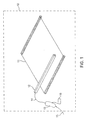
- An embodiment of the present invention is schematically illustrated in Fig. 1 and comprises a conventional fixed abrasive polishing sheet 11, as part of a CMP apparatus indicated by phantom line 10, the details of which are omitted for a clearer understanding of the inventive contribution.
- dispensing means i.e., spray nozzle 12
- Hot water is conveyed through line 14 into spray nozzle 12 from container 13 fed with water through line 15 from a water source (not shown). Water in container 13 is maintained at an elevated temperature, e.g., at about 90°C to about 100°C, by controller 16 and heating element therein (not shown).
- line 14 can be directly connected to a hot water source external to the CMP apparatus 10.
- FIG. 2 Another embodiment of the present invention is schematically illustrated in Fig. 2 and comprises substantially circular fixed abrasive polishing pad 21 designed for rotating motion as part of a CMP apparatus which is illustrated by phantom line 20 for illustrative convenience.
- dispensing means 22 e.g. spray nozzle
- Hot water could be fed directly through line 24 from an external source or, as illustrated, from heated container 23 fed by external water line 25 and maintained at a suitable temperature, e.g., about 90°C to about 100°C, by controller 26.
- FIG. 3 Another embodiment of the present invention is illustrated in Fig. 3 and comprises platen 30, heating element 31 on or within platen 30, and fixed abrasive polishing pad 32.
- Heating in accordance with embodiments of the present invention can be implemented in any conventional manner.
- the underlying platen can comprise channels through which a heated fluid, such as air or water, can be passed.
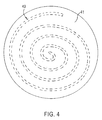
- a heating filament 40 is embedded within platen 41, such as an upper surface thereof.
- a controllable heated liquid or gas is introduced into the interior of the platen to controllably heat the platen. It should be understood that any type of heater can be used to implement the present invention.
- a deformable conductive underpad 50 is positioned on platen 51.
- Underpad 50 comprises a body portion 60 with the top surface 62 and bottom surface 64.
- Body portion 50 preferably comprises a continuous phase matrix material, such as polyurethane or Teflon®.
- a thermally conductive material such as a plurality of thermal conductors 70, is positioned or mixed within a body portion 60.
- Thermal conductors 70 can comprise a material having a relatively high thermal conductivity of at least 0.5W/m°K. Thermal conductors made from carbon fiber are particularly well suited to enhance thermal conductivity while providing adequate resilience and sufficient compressibility of the underpad 51.
- Thermal conductors 70 are preferably strands that extend from approximately the top face 62 through the bottom face 64 of body portion 60.
- a fixed abrasive element was immersed in deionized water at a temperature of 90°C for about 15 minutes.
- the fixed abrasive pad was then mounted in a CMP apparatus and employed to planarize a damascene inlay of Cu.
- An immediate removal rate of 3,000 ⁇ /min was achieved.
- Thermal preconditioning in accordance with the present invention eliminated the 100 minute break-in period typically required for fixed abrasive pads having an initial low polishing rate.
- the present invention is applicable to preconditioning any various types of conventional fixed abrasive articles, such as circular fixed abrasive polishing pads that are rotated, as well as rectangular fixed abrasive sheets which are rotated and indexed.
- Fixed abrasive sheets typically include an upper layer which is an abrasive composite composed of abrasive grains held or embedded in a binder material. Typically, the abrasive grains have a particle size of about 0.1 and about 1,500 microns.
- Such abrasive grains can include silicon oxide, fused aluminum oxide, ceramic aluminum, green silicon carbide, silicon carbide, chromia, alumina zirconia, diamond, iron oxide, ceria, cubic boron nitride, garnet, and combinations thereof.
- the binder may be derived from a precursor which includes an organic polimerizable resin which is cured to form the binder material.
- the lower layer is a backing layer composed of materials such as a polymeric film, paper, cloth or metallic film.
- the present invention significantly enhances the useful life of conventional fixed abrasive articles, such as polishing sheets or pads, increase their initial CMP removal rate and improves wafer-to-wafer uniformity by thermal preconditioning the fixed abrasive articles, thereby significantly increasing production through-put.
- the present invention is applicable to all types of fixed abrasive articles. The present invention, therefore, enjoys utility in various industrial applications, particularly in CMP in the semiconductor industry as well as in the magnetic recording media industry.
Landscapes
- Engineering & Computer Science (AREA)
- Mechanical Engineering (AREA)
- Mechanical Treatment Of Semiconductor (AREA)
- Finish Polishing, Edge Sharpening, And Grinding By Specific Grinding Devices (AREA)
- Grinding-Machine Dressing And Accessory Apparatuses (AREA)
Applications Claiming Priority (2)
| Application Number | Priority Date | Filing Date | Title |
|---|---|---|---|
| US09/454,354 US6832948B1 (en) | 1999-12-03 | 1999-12-03 | Thermal preconditioning fixed abrasive articles |
| US454354 | 1999-12-03 |
Publications (2)
| Publication Number | Publication Date |
|---|---|
| EP1107300A2 true EP1107300A2 (de) | 2001-06-13 |
| EP1107300A3 EP1107300A3 (de) | 2003-10-29 |
Family
ID=23804274
Family Applications (1)
| Application Number | Title | Priority Date | Filing Date |
|---|---|---|---|
| EP00310703A Withdrawn EP1107300A3 (de) | 1999-12-03 | 2000-12-01 | Vorbereitung von Schleifartikeln zur Anwendung im chemisch-mechanischen Polieren |
Country Status (5)
| Country | Link |
|---|---|
| US (1) | US6832948B1 (de) |
| EP (1) | EP1107300A3 (de) |
| JP (1) | JP2001212751A (de) |
| KR (1) | KR20010062114A (de) |
| TW (1) | TW498445B (de) |
Families Citing this family (2)
| Publication number | Priority date | Publication date | Assignee | Title |
|---|---|---|---|---|
| KR100638995B1 (ko) | 2004-11-01 | 2006-10-26 | 동부일렉트로닉스 주식회사 | 화학기계적 연마장치 및 이 장치를 이용한 연마 방법 |
| CN102528651B (zh) * | 2010-12-21 | 2014-10-22 | 中国科学院微电子研究所 | 化学机械抛光设备及其预热方法 |
Family Cites Families (18)
| Publication number | Priority date | Publication date | Assignee | Title |
|---|---|---|---|---|
| US4927432A (en) * | 1986-03-25 | 1990-05-22 | Rodel, Inc. | Pad material for grinding, lapping and polishing |
| US5014468A (en) | 1989-05-05 | 1991-05-14 | Norton Company | Patterned coated abrasive for fine surface finishing |
| US5127196A (en) * | 1990-03-01 | 1992-07-07 | Intel Corporation | Apparatus for planarizing a dielectric formed over a semiconductor substrate |
| US5437754A (en) | 1992-01-13 | 1995-08-01 | Minnesota Mining And Manufacturing Company | Abrasive article having precise lateral spacing between abrasive composite members |
| US5453312A (en) | 1993-10-29 | 1995-09-26 | Minnesota Mining And Manufacturing Company | Abrasive article, a process for its manufacture, and a method of using it to reduce a workpiece surface |
| US5454844A (en) | 1993-10-29 | 1995-10-03 | Minnesota Mining And Manufacturing Company | Abrasive article, a process of making same, and a method of using same to finish a workpiece surface |
| JPH07314302A (ja) * | 1994-05-23 | 1995-12-05 | Sumitomo Electric Ind Ltd | 硬質ウエハ−の研磨方法及び研磨装置 |
| US5958794A (en) | 1995-09-22 | 1999-09-28 | Minnesota Mining And Manufacturing Company | Method of modifying an exposed surface of a semiconductor wafer |
| JPH09150351A (ja) * | 1995-11-28 | 1997-06-10 | Tokyo Seimitsu Co Ltd | 半導体ウェーハの研磨装置 |
| US5643050A (en) * | 1996-05-23 | 1997-07-01 | Industrial Technology Research Institute | Chemical/mechanical polish (CMP) thickness monitor |
| US5692950A (en) | 1996-08-08 | 1997-12-02 | Minnesota Mining And Manufacturing Company | Abrasive construction for semiconductor wafer modification |
| US5993298A (en) * | 1997-03-06 | 1999-11-30 | Keltech Engineering | Lapping apparatus and process with controlled liquid flow across the lapping surface |
| US5842910A (en) | 1997-03-10 | 1998-12-01 | International Business Machines Corporation | Off-center grooved polish pad for CMP |
| JPH10294301A (ja) * | 1997-04-16 | 1998-11-04 | Nippon Steel Corp | 半導体ウェハの研磨方法 |
| US5873769A (en) * | 1997-05-30 | 1999-02-23 | Industrial Technology Research Institute | Temperature compensated chemical mechanical polishing to achieve uniform removal rates |
| US5957750A (en) * | 1997-12-18 | 1999-09-28 | Micron Technology, Inc. | Method and apparatus for controlling a temperature of a polishing pad used in planarizing substrates |
| JP3693483B2 (ja) * | 1998-01-30 | 2005-09-07 | 株式会社荏原製作所 | 研磨装置 |
| JPH11277410A (ja) * | 1998-03-27 | 1999-10-12 | Mitsubishi Materials Silicon Corp | 研磨装置 |
-
1999
- 1999-12-03 US US09/454,354 patent/US6832948B1/en not_active Expired - Fee Related
-
2000
- 2000-11-06 TW TW089123423A patent/TW498445B/zh not_active IP Right Cessation
- 2000-12-01 EP EP00310703A patent/EP1107300A3/de not_active Withdrawn
- 2000-12-04 KR KR1020000072964A patent/KR20010062114A/ko not_active Withdrawn
- 2000-12-04 JP JP2000368747A patent/JP2001212751A/ja active Pending
Also Published As
| Publication number | Publication date |
|---|---|
| US6832948B1 (en) | 2004-12-21 |
| EP1107300A3 (de) | 2003-10-29 |
| TW498445B (en) | 2002-08-11 |
| JP2001212751A (ja) | 2001-08-07 |
| KR20010062114A (ko) | 2001-07-07 |
Similar Documents
| Publication | Publication Date | Title |
|---|---|---|
| US6322427B1 (en) | Conditioning fixed abrasive articles | |
| US6848976B2 (en) | Chemical mechanical polishing with multiple polishing pads | |
| EP1052062A1 (de) | Vorbehandlung eines fixierten Schleifmittels | |
| US6387289B1 (en) | Planarizing machines and methods for mechanical and/or chemical-mechanical planarization of microelectronic-device substrate assemblies | |
| US8133096B2 (en) | Multi-phase polishing pad | |
| US5957750A (en) | Method and apparatus for controlling a temperature of a polishing pad used in planarizing substrates | |
| US6241585B1 (en) | Apparatus and method for chemical mechanical polishing | |
| US20080076330A1 (en) | Chemical mechanical polishing with napped poromeric | |
| US6409580B1 (en) | Rigid polishing pad conditioner for chemical mechanical polishing tool | |
| US20100035515A1 (en) | Chemical mechanical polisher with heater and method | |
| US6386963B1 (en) | Conditioning disk for conditioning a polishing pad | |
| EP1002626B1 (de) | Lineares chemisch-mechanisches Polierwerkzeug mit an Ort und Stelle Verteilung der Polierzusammensetzung und gleichzeitigem konditionieren des Polierkissens | |
| KR100773190B1 (ko) | 가동 연마 시트를 이용한 화학 기계 연마 장치 및 방법 | |
| US6420265B1 (en) | Method for polishing semiconductor device | |
| US20050176251A1 (en) | Polishing pad with releasable slick particles | |
| US6832948B1 (en) | Thermal preconditioning fixed abrasive articles | |
| US6887136B2 (en) | Apparatus and methods for multi-step chemical mechanical polishing | |
| EP1322449A1 (de) | Abrichtvorrichtung für polierkissen und verfahren zu dessen anwendung | |
| US7175515B2 (en) | Static pad conditioner | |
| KR100678303B1 (ko) | 화학 기계적 연마(cmp) 패드 드레서 및 화학 기계적연마(cmp) 장치 | |
| JP2001030156A (ja) | ドレッシング装置、研磨装置および研磨方法 |
Legal Events
| Date | Code | Title | Description |
|---|---|---|---|
| PUAI | Public reference made under article 153(3) epc to a published international application that has entered the european phase |
Free format text: ORIGINAL CODE: 0009012 |
|
| AK | Designated contracting states |
Kind code of ref document: A2 Designated state(s): AT BE CH CY DE DK ES FI FR GB GR IE IT LI LU MC NL PT SE TR |
|
| AX | Request for extension of the european patent |
Free format text: AL;LT;LV;MK;RO;SI |
|
| PUAL | Search report despatched |
Free format text: ORIGINAL CODE: 0009013 |
|
| AK | Designated contracting states |
Kind code of ref document: A3 Designated state(s): AT BE CH CY DE DK ES FI FR GB GR IE IT LI LU MC NL PT SE TR |
|
| AX | Request for extension of the european patent |
Extension state: AL LT LV MK RO SI |
|
| RIC1 | Information provided on ipc code assigned before grant |
Ipc: 7B 24D 3/00 B Ipc: 7B 24B 53/00 B Ipc: 7B 24B 37/04 A |
|
| AKX | Designation fees paid | ||
| REG | Reference to a national code |
Ref country code: DE Ref legal event code: 8566 |
|
| STAA | Information on the status of an ep patent application or granted ep patent |
Free format text: STATUS: THE APPLICATION IS DEEMED TO BE WITHDRAWN |
|
| 18D | Application deemed to be withdrawn |
Effective date: 20040430 |