EP1106122A2 - Trinkglas aus verschiedenen Materialien - Google Patents
Trinkglas aus verschiedenen Materialien Download PDFInfo
- Publication number
- EP1106122A2 EP1106122A2 EP00123844A EP00123844A EP1106122A2 EP 1106122 A2 EP1106122 A2 EP 1106122A2 EP 00123844 A EP00123844 A EP 00123844A EP 00123844 A EP00123844 A EP 00123844A EP 1106122 A2 EP1106122 A2 EP 1106122A2
- Authority
- EP
- European Patent Office
- Prior art keywords
- stem
- foot
- drinking glass
- glass
- glass according
- Prior art date
- Legal status (The legal status is an assumption and is not a legal conclusion. Google has not performed a legal analysis and makes no representation as to the accuracy of the status listed.)
- Granted
Links
- 239000011521 glass Substances 0.000 title claims abstract description 85
- 230000035622 drinking Effects 0.000 title claims abstract description 46
- 239000000463 material Substances 0.000 title claims abstract description 22
- 238000004519 manufacturing process Methods 0.000 claims abstract description 8
- 238000009412 basement excavation Methods 0.000 claims description 18
- 239000002184 metal Substances 0.000 claims description 10
- 238000000034 method Methods 0.000 claims description 10
- 239000000919 ceramic Substances 0.000 claims description 5
- 238000010438 heat treatment Methods 0.000 claims description 4
- 238000000465 moulding Methods 0.000 claims description 3
- 238000007493 shaping process Methods 0.000 abstract 1
- 239000000853 adhesive Substances 0.000 description 7
- 230000001070 adhesive effect Effects 0.000 description 7
- 238000001816 cooling Methods 0.000 description 4
- 230000006378 damage Effects 0.000 description 2
- 239000011343 solid material Substances 0.000 description 2
- 101100327917 Caenorhabditis elegans chup-1 gene Proteins 0.000 description 1
- 229910000831 Steel Inorganic materials 0.000 description 1
- 239000012790 adhesive layer Substances 0.000 description 1
- 238000005422 blasting Methods 0.000 description 1
- 238000011161 development Methods 0.000 description 1
- 238000004090 dissolution Methods 0.000 description 1
- 238000005516 engineering process Methods 0.000 description 1
- 239000004744 fabric Substances 0.000 description 1
- 239000010410 layer Substances 0.000 description 1
- 238000002844 melting Methods 0.000 description 1
- 230000008018 melting Effects 0.000 description 1
- 230000008092 positive effect Effects 0.000 description 1
- 238000012545 processing Methods 0.000 description 1
- 239000007787 solid Substances 0.000 description 1
- 239000010959 steel Substances 0.000 description 1
- 238000005496 tempering Methods 0.000 description 1
- 239000004753 textile Substances 0.000 description 1
- 238000012549 training Methods 0.000 description 1
- 238000005406 washing Methods 0.000 description 1
- XLYOFNOQVPJJNP-UHFFFAOYSA-N water Substances O XLYOFNOQVPJJNP-UHFFFAOYSA-N 0.000 description 1
- 239000002023 wood Substances 0.000 description 1
Images


Classifications
-
- A—HUMAN NECESSITIES
- A47—FURNITURE; DOMESTIC ARTICLES OR APPLIANCES; COFFEE MILLS; SPICE MILLS; SUCTION CLEANERS IN GENERAL
- A47G—HOUSEHOLD OR TABLE EQUIPMENT
- A47G19/00—Table service
- A47G19/22—Drinking vessels or saucers used for table service
- A47G19/2205—Drinking glasses or vessels
- A47G19/2255—Details related to the connection between the liquid containing part and the supporting part
Definitions
- the present invention relates to a drinking glass consisting at least of a chalice, possibly a stem and a foot, in which the chalice, the foot and The optional stem is made of different materials, with the chalice is made of glass.
- a drinking glass consisting at least of a chalice, possibly a stem and a foot, in which the chalice, the foot and The optional stem is made of different materials, with the chalice is made of glass.
- One method of making this drinking glass is also part of the present invention.
- Drinking glasses made from parts made from different materials are composed are known.
- Drinking glasses in which the chalice and the base in glass and the stem in metal are an example of these drinking glasses.
- Another variant is the one-piece version of stem and foot as stem foot, which consists for example of metal and is connected with a glass goblet.
- the drinking glass made with the help of adhesive technology has considerable Disadvantages with regard to its durability or fatigue strength.
- the junction for building up tension At a rapid change in the ambient temperature occurs in the adhesive layer the junction for building up tension.
- the reason for this is a. the mostly different thermal conductivity from different Materials made parts.
- this is made from a glass goblet, Glass base and metal stem existing drinking glass exposed to hot water what when washing, the metal handle heats up because of it higher thermal conductivity faster than the glass components. It stretches accordingly faster than the parts made of glass, which in the Connection point to different expansions and thus to build up Leads to tensions.
- By changing the ambient temperature and the resulting stress loads cause the adhesive bond to tire with the time until a dissolution and finally the complete destruction of the Connection takes place.
- the invention has for its object a drinking glass, the individual Parts made of different materials to propose a high Has durability, as well as a process for producing this glass to specify the time and cost intensive compared to that according to the State of the art method is.
- the drinking glass according to the invention in which the Stalk and foot essentially at least in the area of Junction with a glass part made of materials that one have similar thermal expansion coefficients as the glass used, so that in the course of the manufacturing process of this drinking glass during molding a heated glass mass to a chalice the stem or an upper one Stick adapter while heating its junction from plastic glass is surrounded at the junction and a fabric and / or positive connection is created between the parts to be joined, whereby in the case of a separate glass base, the connection between it and the stem or a lower stem adapter in an analogous manner.
- Both the stem and the foot can be modular, in the way that they consist of several parts and a connection to the glass parts via adapters, such as the stick adapters mentioned above.
- the joints with a glass part made of different materials existing parts of the drinking glass are preferably designed so that the connecting parts merge into each other and the part with the higher one At least one thermal conductivity in the area of the connection point Excavation in the way that this part in the area of the junction an increased elasticity compared to the rest of the part and less Has expansion when heated. It is particularly advantageous here if the excavation extends beyond the area of the joint extends. This will have the positive effect of the levy with regard to increased elasticity and reduced expansion when heated.
- stem and the foot are in one piece are designed as a stem foot and consist of the same material, preferably metal or ceramic.
- the stem and the foot are parts to be connected individually and from different materials.
- the stem can for example in essentially made of metal or ceramic, while the foot in can consist essentially of glass.
- the excavation at the training ground is funnel- or dome-shaped and at least one in the area of the lateral surface Excavation provided at least one slot.
- This elongated hole supports the increase in elasticity due to the excavation and is advantageous with regard to expansion when heated.
- the through the lateral surface of the Excavation formed an outer contour or a cylinder in the direction of Connection point tapered segment.
- At least one part of the Area of the connection point a projection.
- the projection preferably has a square or crowned shape Cross-sectional shape and sits at the end of the stem. The one by the lead realized positive connection increases the durability of the connection and thus the quality of the drinking glass.
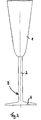
- the 1 shows an embodiment of the drinking glass according to the invention, consisting of the chalice 1, the stem 2 and the foot 3.
- the stem 2 and the Foot 3 are individually manufactured parts that are to be connected.
- the junction of the glass goblet 1 and the stem 2nd is shown, by way of example, shows embodiments of the various Characteristics of the connection or drinking glass.
- the stem 2 the higher compared to the glass Thermal conductivity and is therefore the part in the goblet / stem connection has an excavation 4 in the area of the connection.
- This levy 4 is cylindrical with respect to the longitudinal axis of the stem 2 and Aushebungsground 7 formed funnel-shaped, has accordingly Resemblance to a blind hole. From the handle made of solid material 2 only remains in the area of the connection point due to the excavation 4 annular cross section with the wall thickness s.
- the Stem 2 in the area of the junction is much more elastic and the Possibility to expand inward in the direction of heating Levels 4.
- the extent of the in the connection area falls as Hollow profile trained stem 2 less than this from one Solid handle 2 would be the case.
- the stem 2 has one Projection 6 at the stem end, through which an additional positive Connection between chalice 1 and stem 2 is made.
- the excavation extends so far into the stem 2 that the Raising reason 7 is no longer in the area of the connection point.
- Fig. 1c shows the connection between stem 2 and foot 3.
- the stem 2 has the higher thermal conductivity and for this reason it is in turn the component that has the excavation 5. This is similar to that shown in Fig. Lb Excavation 4. But the stem 2 has no projection 6 in the area of Connection point, so that this connection is only one cohesive acts.
- Fig. 2 shows a further embodiment of the drinking glass. It is because of it characterized in that the stem base 9, consisting of stem 2 and foot 3, in one piece is executed, d. H. Handle 2 and foot 3 are made of the same material, for example ceramic or metal, and do not have to be in a special one Process step are connected. The connection between the stem base 9 and the cup 1 can be made in the manner as above with reference to FIG. 1b has been explained.
- FIG. 3 shows an embodiment of the drinking glass in which the stem is modular.
- the upper handle adapter 10 has the higher one Thermal conductivity and, as described under Figure lb, with Glass goblet 1 connected.
- the lower stem adapter 11 also has one opposite the foot 3 to be connected to it has higher thermal conductivity.
- the Connection takes place in the manner explained above with reference to FIG. 1c.
- Lower and the upper stem adapter (10, 11) are formed at their free end so that they can accommodate a stem centerpiece 12 between them. In the present Embodiment, this stem centerpiece 12 is in one piece and made of wood. Nevertheless, for the modular handle 2 and for the modular assembled foot 3 the most different variations possible. Also the Possibility of modularly designing the stem center piece 12, which is in one piece here to build, with the individual parts from different or the same Material must be taken into account.
Landscapes
- Table Devices Or Equipment (AREA)
- Re-Forming, After-Treatment, Cutting And Transporting Of Glass Products (AREA)
Abstract
Description
- Fig. 1
- eine Seitenansicht eines Ausführungsbeispieles des Trinkglases,
- Fig. 1b
- einen Schnitt in Längsrichtung durch die Verbindungsstelle von Kelch und Stiel des in Fig. 1 gezeigten Trinkglases im Bereich der Einzelheit Z,
- Fig. 1c
- einen Schnitt in Längsrichtung durch die Verbindungsstelle von Fuß und Stiel des in Fig. 1 gezeigten Trinkglases im Bereich der Einzelheit Y,
- Fig. 2
- eine Seitenansicht eines zweiten Ausführungsbeispieles des Trinkglases, und
- Fig. 3
- eine Schnittansicht eines dritten Ausführungsbeispieles des Trinkglases.
Claims (18)
- Trinkglas, mindestens bestehend aus einem Kelch (1), ggf. einem Stiel (2) und einem Fuß (3), wobei der Kelch (1) aus Glas, der Fuß (3) und der optionale Stiel (2) im wesentlichen zumindest im Bereich der Verbindungstelle mit einem Glasteil aus Materialien bestehen, die einen ähnlichen Wärmeausdehnungskoeffizienten wie den des verwendeten Glases haben.
- Trinkglas nach Anspruch 1,dadurch gekennzeichnet, daß der Stiel und/oder der Fuß modular aufgebaut sind.
- Trinkglas nach Anspruch 1 oder 2, dadurch gekennzeichnet, daß die Verbindungsstellen der aus verschiedenen Materialien bestehenden Teile mit einem Glasteil so ausgebildet sind, daß die zu verbindenden Teile ineinander übergehen und jeweils das Teil mit der höheren Wärmeleitfähigkeit im Bereich der Verbindungsstelle mindestens eine Aushebung (4,5) hat in der Art, daß dieses Teil im Bereich der Verbindungsstelle eine gegenüber dem übrigen Teil erhöhte Elastizität und eine geringere Ausdehnung bei Erwärmung aufweist.
- Trinkglas nach Anspruch 1 oder 3, dadurch gekennzeichnet, daß der Stiel (2) und der Fuß (3) einteilig als Stielfuß (8) ausgebildet sind und aus demselben Material bestehen.
- Trinkglas nach einem der Ansprüche 3 oder 4, dadurch gekennzeichnet, daß der Stielfuß (8) im wesentlichen aus Metall besteht.
- Trinkglas nach einem der Ansprüche 3 oder 4, dadurch gekennzeichnet, daß der Stielfuß (8) im wesentlichen aus Keramik besteht.
- Trinkglas nach Anspruch 1 oder 3, dadurch gekennzeichnet, daß der Stiel (2) und der Fuß (3) jeweils einzelne zu verbindende Teile sind und aus verschiedenen Materialien bestehen.
- Trinkglas nach einem der Ansprüche 1, 3 oder 7, dadurch gekennzeichnet, daß der Stiel (2) im wesentlichen aus Metall oder Keramik besteht und der Fuß (3) im wesentlichen aus Glas besteht.
- Trinkglas nach einem der Ansprüche 3 bis 8, dadurch gekennzeichnet, daß mindestens eine Aushebung (4, 5) am Aushebungsgrund (7) trichter- oder kalottenförmig ausgebildet ist.
- Trinkglas nach einem der Ansprüche 3 bis 9, dadurch gekennzeichnet, daß im Bereich der Mantelfläche mindestens einer Aushebung (4,5) mindestens ein Langloch vorgesehen ist.
- Trinkglas nach einem der Ansprüche 3 bis 10, dadurch gekennzeichnet, daß die durch die Mantelfläche der Aushebung (4,5) gebildete Außenkontur einen Zylinder beschreibt.
- Trinkglas nach einem der Ansprüche 3 bis 10, dadurch gekennzeichnet, daß die durch die Mantelfläche der Aushebung (4,5) gebildete Außenkontur ein in Richtung der Verbindungsstelle zulaufendes Kegelsegment beschreibt.
- Trinkglas nach einem der Ansprüche 1 bis 12, dadurch gekennzeichnet, daß mindestens ein Teil im Bereich der Verbindungsstelle einen Vorsprung (6) aufweist.
- Trinkglas nach Anspruch 13, dadurch gekennzeichnet, daß der Vorsprung (6) eine viereckige Querschnittsform aufweist.
- Trinkglas nach Anspruch 13, dadurch gekennzeichnet, daß der Vorsprung (6) eine ballige Querschnittsform aufweist.
- Trinkglas nach einem der Ansprüche 13 bis 15, dadurch gekennzeichnet, daß der Vorsprung (6) am Stielende sitzt.
- Verfahren zum Herstellen eines Trinkglases nach mindestens einem der vorherigen Ansprüche, dadurch gekennzeichnet, daß beim Ausformen einer erhitzten Glasmasse zu einem Kelch (1) der Stiel (2) bzw. ein oberer Stieladapter (10) unter gleichzeitigem Erhitzen seiner Verbindungsstelle vom plastischen Glas an der Verbindungsstelle umgeben wird und eine stoff- und/oder formschlüssige Verbindung zwischen den Fügeteilen entsteht.
- Verfahren nach Anspruch 17 zum Herstellen eines Trinkglases mit gläsernem Fuß, dadurch gekennzeichnet, daß beim Ausformen einer erhitzten Glasmasse zu einem Fuß (3) der Stiel (2) bzw. ein unterer Stieladapter (11) unter gleichzeitigem Erhitzen seiner Verbindungsstelle zum Fuß (3) vom plastischen Glas an der Verbindungsstelle umgeben wird und eine stoff- und/oder formschlüssige Verbindung zwischen den Fügeteilen entsteht.
Applications Claiming Priority (2)
| Application Number | Priority Date | Filing Date | Title |
|---|---|---|---|
| DE19959331 | 1999-12-09 | ||
| DE1999159331 DE19959331B4 (de) | 1999-12-09 | 1999-12-09 | Trinkglas aus verschiedenen Materialien |
Publications (3)
| Publication Number | Publication Date |
|---|---|
| EP1106122A2 true EP1106122A2 (de) | 2001-06-13 |
| EP1106122A3 EP1106122A3 (de) | 2005-08-10 |
| EP1106122B1 EP1106122B1 (de) | 2016-02-24 |
Family
ID=7931973
Family Applications (1)
| Application Number | Title | Priority Date | Filing Date |
|---|---|---|---|
| EP00123844.3A Expired - Lifetime EP1106122B1 (de) | 1999-12-09 | 2000-11-02 | Trinkglas aus verschiedenen Materialien |
Country Status (2)
| Country | Link |
|---|---|
| EP (1) | EP1106122B1 (de) |
| DE (1) | DE19959331B4 (de) |
Cited By (2)
| Publication number | Priority date | Publication date | Assignee | Title |
|---|---|---|---|---|
| WO2016088043A1 (en) | 2014-12-01 | 2016-06-09 | Rona, A.S. | Method for production of glass product with chromatically and/or visually differentiated part, glass product, mainly stemware |
| WO2019122715A1 (fr) * | 2017-12-22 | 2019-06-27 | Arc France | Article de vaisselle ou d'ameublement en verre avec jambe |
Families Citing this family (2)
| Publication number | Priority date | Publication date | Assignee | Title |
|---|---|---|---|---|
| DE202011108176U1 (de) | 2011-11-23 | 2011-12-20 | Andreas Czarnotta | Trinkglas |
| DE202013104185U1 (de) | 2013-09-13 | 2013-09-19 | Vera Purtscher | Modulares Set zur Aufnahme von Speisen und/oder Getränken |
Family Cites Families (13)
| Publication number | Priority date | Publication date | Assignee | Title |
|---|---|---|---|---|
| FR522808A (fr) * | 1920-08-23 | 1921-08-06 | Paul Gabiot | Verre à pied incassable |
| FR539384A (fr) * | 1921-08-01 | 1922-06-24 | Système de pied métallique amovible s'adaptant à tous genres de verre | |
| US2224319A (en) * | 1938-07-07 | 1940-12-10 | Robert M Schroyer | Illuminated drinking vessel |
| GB639392A (en) * | 1943-05-24 | 1950-06-28 | Cie Internationale De Gobeiete | Process and apparatus for welding glass and similar material and products produced by this process |
| DE841619C (de) * | 1949-06-23 | 1952-06-16 | Dagobert Meyerhardt | Schalen, Glaeser und aehnliche Gebrauchs- und Kunstgegenstaende |
| BE502707A (de) * | 1950-04-20 | |||
| DE1886012U (de) * | 1963-10-23 | 1964-01-16 | Josef Bartel | Trinkglas. |
| DE1917499U (de) * | 1965-02-25 | 1965-06-10 | Dick Arne Flodell | Standglas. |
| DE1931977U (de) * | 1965-11-15 | 1966-02-03 | Emde & Simon | Glasgefaess, insbesondere trinkglas oder vase. |
| DE1938641A1 (de) * | 1969-07-30 | 1971-02-11 | Rosenthal Ag | Verfahren und Vorrichtung zum Verbinden von Porzellankoerpern mit Hohlglaskoerpern |
| DE3132064A1 (de) * | 1981-08-13 | 1983-03-03 | Theresienthaler Krystallglas- und Porzellanmanufaktur GmbH, 8372 Zwiesel | Trinkglas sowie verfahren zu dessen herstellung |
| FR2586765A1 (fr) * | 1985-09-05 | 1987-03-06 | Christian Gobillon | Recompenses sportives ayant dans leur composition des pieces detachees en verre ou matiere plastique |
| DE9410968U1 (de) * | 1994-07-12 | 1994-10-27 | Synkrona Ag, Stans | Nutzgefäß mit Halterung zwischen Gefäßteil und Fußelement |
-
1999
- 1999-12-09 DE DE1999159331 patent/DE19959331B4/de not_active Expired - Fee Related
-
2000
- 2000-11-02 EP EP00123844.3A patent/EP1106122B1/de not_active Expired - Lifetime
Cited By (3)
| Publication number | Priority date | Publication date | Assignee | Title |
|---|---|---|---|---|
| WO2016088043A1 (en) | 2014-12-01 | 2016-06-09 | Rona, A.S. | Method for production of glass product with chromatically and/or visually differentiated part, glass product, mainly stemware |
| WO2019122715A1 (fr) * | 2017-12-22 | 2019-06-27 | Arc France | Article de vaisselle ou d'ameublement en verre avec jambe |
| FR3075583A1 (fr) * | 2017-12-22 | 2019-06-28 | Arc France | Article de vaisselle ou d'ameublement en verre avec jambe |
Also Published As
| Publication number | Publication date |
|---|---|
| EP1106122A3 (de) | 2005-08-10 |
| DE19959331B4 (de) | 2006-01-19 |
| EP1106122B1 (de) | 2016-02-24 |
| DE19959331A1 (de) | 2001-08-23 |
Similar Documents
| Publication | Publication Date | Title |
|---|---|---|
| DE69215713T2 (de) | Protheseimplantat mit zentrierenden Widerlager, deren Hinterkanten sich verengen | |
| DE3435243C1 (de) | Femurprothesenteil einer Kniegelenk-Endoprothese | |
| EP0191182B2 (de) | Knochenimplantat | |
| DE3931536A1 (de) | Drehschneidwerkzeug | |
| DE3100192C2 (de) | ||
| DE9321254U1 (de) | Zur Herstellung einer Rohrverbindung dienende Kupplungsvorrichtung | |
| DE2652209A1 (de) | Gegossener rohling fuer ein elevator- verbindungsglied und verfahren zur herstellung eines elevator-verbindungsgliedes | |
| DE3841205A1 (de) | Verfahren zum herstellen von werkstuecken aus metall | |
| DE69105261T2 (de) | Bremstrommel aus Verbundmaterial für ein Kraftfahrzeug und Verfahren zu ihrer Herstellung. | |
| DE69512508T2 (de) | Vorrichtung zum schmieden des aussenrings eines gleichlaufdrehgelenks und verfahren dazu | |
| DE2831470C2 (de) | Verfahren zur Herstellung eines elastischen Kugelgelenks | |
| DE19959331B4 (de) | Trinkglas aus verschiedenen Materialien | |
| DE3822154C2 (de) | Prothetisches Implantat mit einem porösen Kissen und Verfahren zu dessen Herstellung | |
| DE865643C (de) | Gegenstand aus Glas und Verfahren zu seiner Herstellung | |
| DE3717516A1 (de) | Hohlwelle aus einem werkstoff mit geringem elastizitaetsmodul mit durch aufweiten derselben darauf befestigten antriebselementen | |
| DE2348140C3 (de) | Nietverbindung und Verfahren zu deren Herstellung | |
| DE10257831A1 (de) | Verfahren zum Herstellen eines im Bereich einer Lagerfläche mit einem reibungs- und verschleißoptimierten Belag beschichteten Gegenstandes | |
| DE3805404C2 (de) | ||
| CH671083A5 (de) | ||
| DE3728142C2 (de) | ||
| EP1832436A2 (de) | Gummisleeve und Verfahren zur Herstellung desselben | |
| DE102014100942B4 (de) | Verfahren zur Herstellung eines Stielglases | |
| EP3219439A1 (de) | Schleifscheibe | |
| DE3822854A1 (de) | Gelenkprothese fuer ein hueftgelenk | |
| EP3616554A1 (de) | Schmuckstruktur |
Legal Events
| Date | Code | Title | Description |
|---|---|---|---|
| PUAI | Public reference made under article 153(3) epc to a published international application that has entered the european phase |
Free format text: ORIGINAL CODE: 0009012 |
|
| AK | Designated contracting states |
Kind code of ref document: A2 Designated state(s): AT BE CH CY DE DK ES FI FR GB GR IE IT LI LU MC NL PT SE TR |
|
| AX | Request for extension of the european patent |
Free format text: AL;LT;LV;MK;RO;SI |
|
| RAP1 | Party data changed (applicant data changed or rights of an application transferred) |
Owner name: ZWIESEL KRISTALLGLAS AG |
|
| PUAL | Search report despatched |
Free format text: ORIGINAL CODE: 0009013 |
|
| AK | Designated contracting states |
Kind code of ref document: A3 Designated state(s): AT BE CH CY DE DK ES FI FR GB GR IE IT LI LU MC NL PT SE TR |
|
| AX | Request for extension of the european patent |
Extension state: AL LT LV MK RO SI |
|
| 17P | Request for examination filed |
Effective date: 20051014 |
|
| AKX | Designation fees paid |
Designated state(s): DE FR IT |
|
| 17Q | First examination report despatched |
Effective date: 20080725 |
|
| GRAP | Despatch of communication of intention to grant a patent |
Free format text: ORIGINAL CODE: EPIDOSNIGR1 |
|
| INTG | Intention to grant announced |
Effective date: 20150828 |
|
| GRAS | Grant fee paid |
Free format text: ORIGINAL CODE: EPIDOSNIGR3 |
|
| GRAA | (expected) grant |
Free format text: ORIGINAL CODE: 0009210 |
|
| AK | Designated contracting states |
Kind code of ref document: B1 Designated state(s): DE FR IT |
|
| REG | Reference to a national code |
Ref country code: DE Ref legal event code: R096 Ref document number: 50016431 Country of ref document: DE |
|
| REG | Reference to a national code |
Ref country code: FR Ref legal event code: PLFP Year of fee payment: 17 |
|
| REG | Reference to a national code |
Ref country code: DE Ref legal event code: R097 Ref document number: 50016431 Country of ref document: DE |
|
| PLBE | No opposition filed within time limit |
Free format text: ORIGINAL CODE: 0009261 |
|
| STAA | Information on the status of an ep patent application or granted ep patent |
Free format text: STATUS: NO OPPOSITION FILED WITHIN TIME LIMIT |
|
| PGFP | Annual fee paid to national office [announced via postgrant information from national office to epo] |
Ref country code: DE Payment date: 20161121 Year of fee payment: 17 Ref country code: FR Payment date: 20161118 Year of fee payment: 17 |
|
| 26N | No opposition filed |
Effective date: 20161125 |
|
| PGFP | Annual fee paid to national office [announced via postgrant information from national office to epo] |
Ref country code: IT Payment date: 20161123 Year of fee payment: 17 |
|
| REG | Reference to a national code |
Ref country code: DE Ref legal event code: R119 Ref document number: 50016431 Country of ref document: DE |
|
| REG | Reference to a national code |
Ref country code: FR Ref legal event code: ST Effective date: 20180731 |
|
| PG25 | Lapsed in a contracting state [announced via postgrant information from national office to epo] |
Ref country code: FR Free format text: LAPSE BECAUSE OF NON-PAYMENT OF DUE FEES Effective date: 20171130 Ref country code: DE Free format text: LAPSE BECAUSE OF NON-PAYMENT OF DUE FEES Effective date: 20180602 Ref country code: IT Free format text: LAPSE BECAUSE OF NON-PAYMENT OF DUE FEES Effective date: 20171102 |