EP1105568B1 - Apparatus for making structured paper - Google Patents
Apparatus for making structured paper Download PDFInfo
- Publication number
- EP1105568B1 EP1105568B1 EP99957079A EP99957079A EP1105568B1 EP 1105568 B1 EP1105568 B1 EP 1105568B1 EP 99957079 A EP99957079 A EP 99957079A EP 99957079 A EP99957079 A EP 99957079A EP 1105568 B1 EP1105568 B1 EP 1105568B1
- Authority
- EP
- European Patent Office
- Prior art keywords
- lamina
- papermaking belt
- felt
- batting
- layer
- Prior art date
- Legal status (The legal status is an assumption and is not a legal conclusion. Google has not performed a legal analysis and makes no representation as to the accuracy of the status listed.)
- Expired - Lifetime
Links
Images
Classifications
-
- D—TEXTILES; PAPER
- D21—PAPER-MAKING; PRODUCTION OF CELLULOSE
- D21F—PAPER-MAKING MACHINES; METHODS OF PRODUCING PAPER THEREON
- D21F11/00—Processes for making continuous lengths of paper, or of cardboard, or of wet web for fibre board production, on paper-making machines
- D21F11/006—Making patterned paper
-
- D—TEXTILES; PAPER
- D21—PAPER-MAKING; PRODUCTION OF CELLULOSE
- D21F—PAPER-MAKING MACHINES; METHODS OF PRODUCING PAPER THEREON
- D21F7/00—Other details of machines for making continuous webs of paper
- D21F7/08—Felts
- D21F7/083—Multi-layer felts
-
- Y—GENERAL TAGGING OF NEW TECHNOLOGICAL DEVELOPMENTS; GENERAL TAGGING OF CROSS-SECTIONAL TECHNOLOGIES SPANNING OVER SEVERAL SECTIONS OF THE IPC; TECHNICAL SUBJECTS COVERED BY FORMER USPC CROSS-REFERENCE ART COLLECTIONS [XRACs] AND DIGESTS
- Y10—TECHNICAL SUBJECTS COVERED BY FORMER USPC
- Y10T—TECHNICAL SUBJECTS COVERED BY FORMER US CLASSIFICATION
- Y10T428/00—Stock material or miscellaneous articles
- Y10T428/24—Structurally defined web or sheet [e.g., overall dimension, etc.]
- Y10T428/24479—Structurally defined web or sheet [e.g., overall dimension, etc.] including variation in thickness
- Y10T428/24612—Composite web or sheet
-
- Y—GENERAL TAGGING OF NEW TECHNOLOGICAL DEVELOPMENTS; GENERAL TAGGING OF CROSS-SECTIONAL TECHNOLOGIES SPANNING OVER SEVERAL SECTIONS OF THE IPC; TECHNICAL SUBJECTS COVERED BY FORMER USPC CROSS-REFERENCE ART COLLECTIONS [XRACs] AND DIGESTS
- Y10—TECHNICAL SUBJECTS COVERED BY FORMER USPC
- Y10T—TECHNICAL SUBJECTS COVERED BY FORMER US CLASSIFICATION
- Y10T428/00—Stock material or miscellaneous articles
- Y10T428/24—Structurally defined web or sheet [e.g., overall dimension, etc.]
- Y10T428/24802—Discontinuous or differential coating, impregnation or bond [e.g., artwork, printing, retouched photograph, etc.]
- Y10T428/2481—Discontinuous or differential coating, impregnation or bond [e.g., artwork, printing, retouched photograph, etc.] including layer of mechanically interengaged strands, strand-portions or strand-like strips
-
- Y—GENERAL TAGGING OF NEW TECHNOLOGICAL DEVELOPMENTS; GENERAL TAGGING OF CROSS-SECTIONAL TECHNOLOGIES SPANNING OVER SEVERAL SECTIONS OF THE IPC; TECHNICAL SUBJECTS COVERED BY FORMER USPC CROSS-REFERENCE ART COLLECTIONS [XRACs] AND DIGESTS
- Y10—TECHNICAL SUBJECTS COVERED BY FORMER USPC
- Y10T—TECHNICAL SUBJECTS COVERED BY FORMER US CLASSIFICATION
- Y10T442/00—Fabric [woven, knitted, or nonwoven textile or cloth, etc.]
- Y10T442/30—Woven fabric [i.e., woven strand or strip material]
- Y10T442/3179—Woven fabric is characterized by a particular or differential weave other than fabric in which the strand denier or warp/weft pick count is specified
-
- Y—GENERAL TAGGING OF NEW TECHNOLOGICAL DEVELOPMENTS; GENERAL TAGGING OF CROSS-SECTIONAL TECHNOLOGIES SPANNING OVER SEVERAL SECTIONS OF THE IPC; TECHNICAL SUBJECTS COVERED BY FORMER USPC CROSS-REFERENCE ART COLLECTIONS [XRACs] AND DIGESTS
- Y10—TECHNICAL SUBJECTS COVERED BY FORMER USPC
- Y10T—TECHNICAL SUBJECTS COVERED BY FORMER US CLASSIFICATION
- Y10T442/00—Fabric [woven, knitted, or nonwoven textile or cloth, etc.]
- Y10T442/30—Woven fabric [i.e., woven strand or strip material]
- Y10T442/3472—Woven fabric including an additional woven fabric layer
-
- Y—GENERAL TAGGING OF NEW TECHNOLOGICAL DEVELOPMENTS; GENERAL TAGGING OF CROSS-SECTIONAL TECHNOLOGIES SPANNING OVER SEVERAL SECTIONS OF THE IPC; TECHNICAL SUBJECTS COVERED BY FORMER USPC CROSS-REFERENCE ART COLLECTIONS [XRACs] AND DIGESTS
- Y10—TECHNICAL SUBJECTS COVERED BY FORMER USPC
- Y10T—TECHNICAL SUBJECTS COVERED BY FORMER US CLASSIFICATION
- Y10T442/00—Fabric [woven, knitted, or nonwoven textile or cloth, etc.]
- Y10T442/30—Woven fabric [i.e., woven strand or strip material]
- Y10T442/3472—Woven fabric including an additional woven fabric layer
- Y10T442/348—Mechanically needled or hydroentangled
-
- Y—GENERAL TAGGING OF NEW TECHNOLOGICAL DEVELOPMENTS; GENERAL TAGGING OF CROSS-SECTIONAL TECHNOLOGIES SPANNING OVER SEVERAL SECTIONS OF THE IPC; TECHNICAL SUBJECTS COVERED BY FORMER USPC CROSS-REFERENCE ART COLLECTIONS [XRACs] AND DIGESTS
- Y10—TECHNICAL SUBJECTS COVERED BY FORMER USPC
- Y10T—TECHNICAL SUBJECTS COVERED BY FORMER US CLASSIFICATION
- Y10T442/00—Fabric [woven, knitted, or nonwoven textile or cloth, etc.]
- Y10T442/30—Woven fabric [i.e., woven strand or strip material]
- Y10T442/3472—Woven fabric including an additional woven fabric layer
- Y10T442/3602—Three or more distinct layers
-
- Y—GENERAL TAGGING OF NEW TECHNOLOGICAL DEVELOPMENTS; GENERAL TAGGING OF CROSS-SECTIONAL TECHNOLOGIES SPANNING OVER SEVERAL SECTIONS OF THE IPC; TECHNICAL SUBJECTS COVERED BY FORMER USPC CROSS-REFERENCE ART COLLECTIONS [XRACs] AND DIGESTS
- Y10—TECHNICAL SUBJECTS COVERED BY FORMER USPC
- Y10T—TECHNICAL SUBJECTS COVERED BY FORMER US CLASSIFICATION
- Y10T442/00—Fabric [woven, knitted, or nonwoven textile or cloth, etc.]
- Y10T442/30—Woven fabric [i.e., woven strand or strip material]
- Y10T442/3707—Woven fabric including a nonwoven fabric layer other than paper
- Y10T442/3724—Needled
-
- Y—GENERAL TAGGING OF NEW TECHNOLOGICAL DEVELOPMENTS; GENERAL TAGGING OF CROSS-SECTIONAL TECHNOLOGIES SPANNING OVER SEVERAL SECTIONS OF THE IPC; TECHNICAL SUBJECTS COVERED BY FORMER USPC CROSS-REFERENCE ART COLLECTIONS [XRACs] AND DIGESTS
- Y10—TECHNICAL SUBJECTS COVERED BY FORMER USPC
- Y10T—TECHNICAL SUBJECTS COVERED BY FORMER US CLASSIFICATION
- Y10T442/00—Fabric [woven, knitted, or nonwoven textile or cloth, etc.]
- Y10T442/30—Woven fabric [i.e., woven strand or strip material]
- Y10T442/3707—Woven fabric including a nonwoven fabric layer other than paper
- Y10T442/378—Coated, impregnated, or autogenously bonded
Definitions
- the present invention relates to papermaking, and more particularly to a papermaking belt comprising foraminous imprinting layer and a dewatering felt layer.
- Papermaking is a well known art. In papermaking cellulosic fibers and a liquid carrier are mixed together. The liquid carrier is drained away and the resulting embryonic web of cellulosic fibers is dried.
- Drying is typically accomplished in one of two manners, through air drying or conventional drying.
- Through air drying relies upon blowing hot air through the embryonic web.
- Conventional drying relies upon a press felt to remove water from the web by capillary action.
- U.S. Pat. 4,421,600 issued December 20, 1983 to Hostetler discloses an apparatus having two felts, three pressing operations, and a separate woven imprinting fabric. In Hostetler the web is transported on the imprinting fabric through the pressing operations before being delivered to the Yankee dryer.
- Hulit et al. describes three configurations where a nip is formed between two rolls. In each configuration, a paper web is carried on an imprinting fabric having compaction elements defined by knuckles formed at warp and weft crossover points. The imprinting fabric, web and a felt are compressed between the rolls. The web is carried from the nip on the imprinting fabric. In two embodiments, Hulit then transfers the web from the imprinting fabric to a Yankee drying drum. In the third embodiment, Hulit does not use a Yankee drying drum.
- Hulit arrangements have several disadvantages.
- Hulit does not minimize the expense and inconvenience of requiring two separate nips for the configurations relying upon the Yankee drying drum - as most commonly occurs in the art.
- Erikson et al. discloses another two nip configuration.
- the paper is imprinted between a press roll and a lower press roll.
- Erikson et al. dewaters the paper by placing the press felt directly against the paper. This allows the press felt to deform into the areas of the imprinting fabric not supported by knuckles, reducing the differential density effects of the compaction caused by the imprinting fabric.
- Erikson imprints the paper and transfers it to the Yankee at a lower press roll.
- the paper is transferred to the Yankee drying drum at this point.
- the second press drum again imprints the paper.
- the problem presented by Erikson et al. is that at its second nip the imprinting belt is never in registration with the imprinted pattern provided at the first nip.
- A. Gustharsson describes a paper making impression fabric comprising a non woven layer in combination with a support fabric.
- the non woven layer further comprises polymer lands which acts to cuboss the surface of the web paper.
- Ampulski et al. represents a significant improvement over the prior art
- Ampulski et al. still requires a complex two nip system in order to bring the imprinting fabric/paper web combination into contact with the dewatering felts.
- Ampulski requires the press felt loop to be outboard of the imprinting fabric loop. This arrangement creates a very expensive proposition for retrofit to existing machinery, as additional space, drives, etc. are required to add the separate felt loop. As mentioned previously, the cost of installing such an arrangement can be quite significant.
- the present invention provides a web patterning apparatus suitable for making structured paper on a conventional papermaking machine.
- the invention further provides a web patterning apparatus capable of dewatering a paper web using conventional dewatering techniques such as a suction vacuum roll.
- the invention comprises a papermaking belt.
- the belt comprises two lamina joined together in a face to face relationship to form a unitary laminate.
- the first lamina comprises discrete imprinting knuckles forming a paper web contacting surface.
- the paper web contacting surface may include an optional patterned framework disposed thereon.
- the second lamina is a dewatering felt composed of non woven batting.
- the second lamina has a first felt surface and a second felt surface.
- the first felt surface of the second lamina is juxtaposed with and attached to the second surface of the first lamina.
- the second felt surface of the second lamina provides a machine contacting surface of the laminate.
- Batting on the first felt surface of the second lamina extends through the foraminous imprinting member of the first lamina providing a hydraulic connection between the web contacting surface of the first lamina and the second lamina.
- the hydraulic connection is enhanced by needling the batting of the second lamina to the foraminous imprinting member of the first lamina.
- the foraminous imprinting member of the first lamina comprises two layers of interwoven yarns.
- the foraminous imprinting member of the first lamina comprises a jacquard weave or dobby weave.
- the belt 10 of the present invention is preferably an endless belt and carries a web of cellulosic fibers from a forming wire to a drying apparatus, typically a heated drum, such as a Yankee drying drum (not shown).
- a drying apparatus typically a heated drum, such as a Yankee drying drum (not shown).
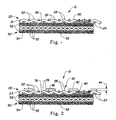
- the belt 10 is a laminate comprising two lamina 20, 50.
- the first lamina 20 comprises a foraminous imprinting member 21 having a paper web contacting surface 22 and a second surface 24.
- the paper web contacting surface 22 may include an optional patterned framework 40 disposed thereon.
- the second lamina 50 is a dewatering felt composed of nonwoven batting 52.
- the second lamina 50 has a first felt surface 56 and a second felt surface 58.
- the second felt surface 58 of the second lamina 50 provides a machine contacting surface 59 of the laminate.
- the first felt surface 56 of the second lamina 50 is juxtaposed with and attached to the second surface 24 of the first lamina 20. Batting 52 on the first felt surface 56 extends through the foraminous imprinting member 21 providing a hydraulic connection between the two laminae 20, 50.
- the two lamina 20, 50 may be attached by needling batting 60, comprising nonwoven batting 52 located near the first felt surface 56, between the first lamina 20 and the second lamina 50 to enhance the hydraulic connection therebetween.
- the first lamina 20 is macroscopically monoplanar.
- the plane of the first lamina 20 defines its X-Y directions. Perpendicular to the X-Y directions and the plane of the first lamina 20 is the Z-direction of the first lamina 20.
- the paper web according to the present invention can be thought of as macroscopically monoplanar and lying in an X-Y plane. Perpendicular to the X-Y directions and the plane of the web is the Z-direction of the paper web.
- machine direction it is meant the direction which is parallel to the principal flow of the paper web through the papermaking apparatus.
- cross machine direction it is meant the direction which is perpendicular to the machine direction and lies within the plane of the belt.
- the first lamina 20 includes a first surface 22 which contacts the paper web that is carried thereon and a second surface 24 which contacts the dewatering felt 50.
- the first lamina 20 comprises a woven fabric comparable to woven fabrics commonly used in the papermaking industry for imprinting belts. Such imprinting belts which are known to be suitable for this purpose are illustrated in commonly assigned U.S. Patents 3,301,746 issued Jan. 31, 1967 to Sanford et al.; 3,905,863 issued Sept. 16, 1975 to Ayers; and 4,239,065 issued Dec. 16, 1982 to Trokhan.
- Woven fabrics typically comprise warp and weft filaments 26 where warp filaments are parallel to the machine direction and weft filament are parallel to the cross machine direction.
- the warp and weft filaments 26 form discontinuous knuckles 28 where the filaments 26 cross over one another in succession. These discontinuous knuckles 28 provide discrete imprinted areas in the paper web during the papermaking process.
- long knuckles is used to define discontinuous knuckles formed as the warp and weft filaments 26 cross over two or more warp and weft filaments 26, respectively.
- the filaments 26 of the woven fabric may be so woven and complimentarily serpentinely configured in at least the Z-direction of the lamina to provide a first grouping or array of coplanar top-surface-plane crossovers of both warp and weft filaments 26; and a predetermined second grouping or array of sub-top-surface crossovers.
- the arrays are interspersed so that portions of the top-surface-plane crossovers define an array of wicker-basket-like cavities in the top surface of the fabric.
- the cavities are disposed in staggered relation in both the machine direction and the cross machine direction such that each cavity spans at least one sub-top-surface crossover.
- a woven fabric having such arrays may be made according to commonly assigned U.S. Patents 4,239,065, issued December 16, 1980 to Trokhan; and 4,191,069, issued March 4, 1980 to Trokhan.
- shed is used to define the number of warp filaments involved in a minimum repeating unit.
- square weave is defined as a weave of n-shed wherein each filament of one set of filaments (e.g., wefts or warps), alternately crosses over one and under n-1 filaments of the other set of filaments (e.g. wefts or warps) and each filament of the other set of filaments alternately passes under one and over n-1 filaments of the first set of filaments.
- the woven fabric for the present invention is required to form and support the paper web and allow water to pass through.
- a preferred woven fabric for the first lamina comprises a "square weave" having a shed of 3 where each warp filament passes over two weft filaments and under one weft filament in succession and each weft filament passes over one warp filament and under two warp filaments in succession.
- a more preferred woven fabric for the first lamina is a "square weave" having a shed of 2 where each warp filament passes over one weft filament and under one weft filament in succession and each weft filament passes over one warp filament and under one warp filament in succession.
- the caliper of the woven fabric may vary, however, in order to facilitate the hydraulic connection between the first and second lamina 20, 50 it is preferred that the caliper of the first lamina range from about 0.011 inch (0.279 mm) to about 0.026 inch (0.660 mm).
- Air permeability is a measure of airflow through the woven fabric at a standard pressure drop across the fabric.
- the standard conditions are standard cubic feet per minute (scfm) at about 0.5 inch of water (cubic meters per second at about 12.7 mm of water).
- the woven fabric of the first lamina have an air permeability greater than 50 scfm (0.024 m 3 /sec) and more preferably an air permeability greater than 300 scfm (0.142 m 3 /sec) and most preferably an air permeability of about 300 scfm (0.024 m 3 /sec) to about 1100 scfm (0.142 m 3 /sec).
- the first lamina 20 may comprise a multi-layer fabric having at least two layers of interwoven yams 70, a paper web facing first layer 72 and a dewatering felt facing second layer 74 opposite the first layer 72.
- Each layer of the interwoven yams is further comprised of interwoven warp and weft yarns 78.
- the first lamina further comprises tie yams 76 interwoven with the respective yams of the paper web facing layer 72 and the dewatering felt facing layer 74.
- Illustrative belts having multiple layers of interwoven yarns are found in commonly assigned U.S. Pat. Nos. 5,496,624 issued March 5, 1996 to Stelljes et al. 5,500,277 issued March 19, 1996 to Trokhan et al. and 5,566,724 issued October 22, 1996 to Trokhan et al.
- the foraminous imprinting member 21 of the first lamina 20 may serve as a reinforcing structure 23 for the belt 10 and provide support for a patterned framework 40 disposed thereon.
- Such framework 40 preferably comprises a cured polymeric photosensitive resin disposed on the paper web contacting surface 22 of the reinforcing structure 23.
- the framework 40 defines a predetermined pattern which imprints a like pattern onto the paper which is carried thereon.
- a particularly preferred pattern for the framework 40 is an essentially continuous network. If the preferred essentially continuous network pattern is selected for the framework 40, discrete deflection conduits 42 will extend between the first surface 22 and the second surface 24 of the first lamina 20. The essentially continuous network surrounds and defines the deflection conduits 42.
- the projected surface area of the continuous network top surface 46 can provide about 5 to about 75 percent of the projected area of the paper web contacting surface 22 of the first lamina 20 and is preferably about 25 percent to about 75 percent of the web contacting surface 22 and still more preferably about 65 percent of the web contacting surface 22.
- the reinforcing structure 23 provides support for the patterned framework 40 and can comprise of various configurations, as previously described. Portions of the reinforcing structure 23 prevent fibers used in papermaking from passing completely through the deflection conduits 42 and thereby reduces the occurrences of pinholes. If one does not wish to use a woven fabric for the reinforcing structure 23, a nonwoven element, screen, net, or a plate having a plurality of holes therethrough may provide adequate strength and support for the framework 40 of the present invention.
- the first lamina 20 having the patterned framework 40 disposed thereon according to the present invention may be made according to any of commonly assigned U.S. Patents: 4,514,345, issued April 30, 1985 to Johnson et al.; 4,528,239, issued July 9, 1985 to Trokhan; 5,098,522, issued March 24, 1992; 5,260,171, issued Nov. 9, 1993 to Smurkoski et al.; 5,275,700, issued Jan. 4, 1994 to Trokhan; 5,328,565, issued July 12, 1994 to Rasch et al.; 5,334,289, issued Aug. 2, 1994 to Trokhan et al.; 5,431,786, issued July 11, 1995 to Rasch et al.; 5,496,624, issued March 5, 1996 to Stelljes, Jr.
- the framework 40 extends outwardly from the knuckles 28 of the reinforcing structure 23 a distance 44 less than about 0.15 millimeters (0.006 inch), more preferably less than about 0.10 millimeters (0.004 inch) and still more preferably less than about 0.05 millimeters (0.002 inch). Still more preferably the patterned framework 40 is approximately coincident the elevation of the knuckles 28 of the reinforcing structure 23.
- the reinforcing structure 23 will contact the paper at top surface knuckles 28 disposed within the deflection conduits 42. This arrangement further compacts the paper at the points coincident the knuckles 28 against the Yankee drying drum, decreasing the X-Y spacing between compacted regions.
- One of the benefits of the present invention is that the imprinting of the paper and transfer to the Yankee occur simultaneously, eliminating the multi-operational steps involving separate compression nips of the prior art. Also, by transferring substantially full contact of the paper to the Yankee - rather than just the imprinted region as occurs in the prior art - full contact drying can be obtained.
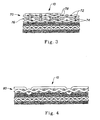
- a belt having a jacquard weave or dobby weave 80 may be utilized as shown in Figure 4. Such a belt may be utilized as an imprinting member 21 or reinforcing structure 23.
- the jacquard weave or dobby weave 80 is reported in the literature to be particularly useful where one does not wish to compress or imprint the paper in a nip, such as typically occurs upon transfer to a Yankee drying drum.
- Illustrative belts having a jacquard weave or dobby weave 80 are found in U.S. Pat. Nos. 5,429,686 issued July 4, 1995 to Chiu et al. and 5,672,248 issued Sept. 30, 1997 to Wendt et al..
- the second lamina 50 is macroscopically monoplanar.
- the plane of the second lamina 50 defines its X-Y directions. Perpendicular to the X-Y directions and the plane of the second lamina 50 is the Z-direction of the second lamina 50.
- a suitable dewatering felt layer for the second lamina 50 comprises a nonwoven batt 52 of natural or synthetic fibers joined, such as by needling, to a secondary base 54 formed of woven filaments 55.
- the secondary base 54 serves as a support structure for the batt of fibers.
- Suitable materials from which the nonwoven batt can be formed include but are not limited to natural fibers such as wool and synthetic fibers such as polyester and nylon.
- the fibers from which the batt 52 is formed can have a denier of between about 3 and about 20 grams per 9000 meters of filament length.
- the second lamina 50 has a surface batting with a denier of less than 5, and preferably less than 3.
- the surface batting on the first felt surface 56 extends through the foraminous first lamina 20 and contacts the paper web during papermaking. This contact enhances the water removal from the first lamina 20 and hence from the web.
- the felt layer 50 can have a layered construction, and can comprise a mixture of fiber types and sizes.
- the layers of felt 50 are formed to promote transport of water received from the web contacting surface 22 of the first lamina 20 away from the first felt surface 56 and toward the second felt surface 58.
- the felt layer 50 can have finer, relatively densely packed fibers disposed adjacent the first felt surface 56.
- the felt layer 50 preferably has a relatively high density and relatively small pore size adjacent the first felt surface 56 as compared to the density and pore size of the felt layer adjacent the second felt surface 58, such that water entering the first surface 56 is drained away toward the second felt surface 58.
- the dewatering felt layer 50 can have a thickness greater than about 2 mm (0.079 inch). In one embodiment the dewatering felt layer 50 can have a thickness of between about 2 mm (0.079 inch) and about 5 mm (0.197 inch). The dewatering felt layer 50 can have a compressibility of at least about 30 percent, and in one embodiment the felt layer 50 can have a compressibility of at least about 40 percent.
- Compressibility is a measure of compactness of the dewatering felt under load. Compaction influences void volume and drainage of the felt. Compaction resistance is a desired property for dewatering felts compressed during the papermaking process. Thickness affects the compaction characteristics of the felt as well as felt wear.
- the thickness and compressibility are measured with a constant rate of compression tester, such as an Instron Model 4502, available from Instron Engineering of Canton, MA.
- the measurements are made between a smooth steel base plate (5.5 inches in diameter, Instron part number T504173) and a circular compression foot (0.987 inches in diameter) centered over the base plate and attached to a gimbaled mounting on a crosshead.
- the crosshead speed is about 0.5 inch per minute.
- the instrument Prior to measuring the thickness and compressibility, the instrument is calibrated in the following manner to determine a correction factor as a function of loading pressure.
- the circular compression foot is moved toward the smooth base until the foot and the base just touch, and no light passes between them. This is considered the zero-load, zero-thickness point.
- the cross head is then moved back 0.500 inch (12.7 mm) to allow for insertion of the sample. (A gap larger than 0.500 inches (12.7 mm) can be used for thicker samples, provided the larger gap is precisely measured and used in place of 0.500 inches (12.7 mm) in determining the correction factors.)
- the instrument is then reset to zero displacement.
- a calibration compression is then done (without the sample in the instrument) at pressures between 0 and 1000 psi 6895 kPa to provide a calibration crosshead displacement at the different pressures.
- the correction factor for that pressure is the calibration crosshead displacement at that pressure minus 0.500 inch (12.7 mm).
- the sample is tested by placing it between the base plate and the compression crosshead and recording load versus crosshead displacement over a range of 0-1000 psi 0-6895 kPa.
- the load is calculated as the force read from the instrument divided by the area of the compression foot.
- Thickness readings of the sample at 1 psi 6.9 kPa and 1000 psi 6895 kPa are calculated by reading the crosshead displacement and applying the corresponding correction factor to obtain the corrected thicknesses at 1 psi 6.9 kPa and 1000 psi 6895 KaPa.
- the thickness of the felt layer 220 is the average of five corrected thickness measurements made at 1 psi.
- the compressibility of the felt layer 220 is 100 times the ratio obtained by dividing the corrected thickness of the felt layer at 1000 psi 6895 kPa by the corrected thickness of the felt layer at 1 psi 6.9 kPa.
- the ratio is determined from an average of five measurements at 1 psi 6.9 kPa and five measurements at 1000 psi 6895 kPa.
- the dewatering felt layer 50 can have an air permeability of between about 5 and about 300 standard cubic feet per minute(scfm) (0.002 m 3 /sec - 0.142 m 3 /sec) with an air permeability of less than 50 scfm (0.24 m 3 /sec) being preferred for use with the present invention.
- Air permeability in scfm is a measure of the number of cubic feet of air per minute that pass through a one square foot area of a felt layer, at a pressure differential across the dewatering felt thickness of about 0.5 inch (12.7 mm) of water.
- the air permeability is measured using a Valmet permeability measuring device (Model Wigo Taifun Type 1000) available from the Valmet Corp. of Helsinki, Finland.
- the dewatering felt layer 50 can have a water holding capacity of at least about 100 milligrams of water per square centimeter of surface area.
- the water holding capacity is a measure of the amount of water that can be contained in a one square centimeter section of the dewatering felt.
- the dewatering felt layer 50 has a water holding capacity of at least about 150 mg/square cm.
- the dewatering felt layer 50 can have a small pore capacity of at least about 10 mg/square cm.
- the small pore capacity is a measure of the amount of water that can be contained in relatively small capillary openings in a one square centimeter section of a dewatering felt.
- relatively small capillary openings it is meant capillary openings having an effective radius of about 75 micrometers or less. Such capillary openings are similar in size to those in a wet paper web.
- the small pore capacity provides an indication of the ability of the dewatering felt to compete for water from a wet paper web.
- the dewatering felt 50 can have a small pore capacity of at least about 25 mg/square cm.
- the felts will have an average pore volume distribution of less than 50 microns.
- the surface batting on the first felt surface 56 extends through the foraminous first lamina 20 and contacts the paper web during papermaking. The contact between the batting of the first felt surface 56 and the paper web provides the hydraulic connection between the web and the two lamina 20, 50.
- the first and second laminae 20, 50 are preferably connected by needling batting 60 from the first felt surface 56 of the second lamina 50 through the foraminous imprinting member 21 or the reinforcing structure 23 of the first lamina 20. As the amount of needled batting 60 is increased, the hydraulic connection is enhanced.
- an alternative means of attaching the first and second lamina 20, 50 involves applying an adhesive to only the discontinuous knuckles 28 on the second surface 24 of the reinforcing structure 23 and pressing the two laminae 20, 50 together.
- adhesive must be applied in limited amounts in order to minimize the blockage of water flow through the first lamina.
- the needling of batting 60 may be limited to areas along edges of the belt 10 in order to minimize damage to the patterned framework 40.
Landscapes
- Paper (AREA)
- Containers And Packaging Bodies Having A Special Means To Remove Contents (AREA)
- Orthopedics, Nursing, And Contraception (AREA)
Applications Claiming Priority (3)
| Application Number | Priority Date | Filing Date | Title |
|---|---|---|---|
| US09/100,624 US7265067B1 (en) | 1998-06-19 | 1998-06-19 | Apparatus for making structured paper |
| US100624 | 1998-06-19 | ||
| PCT/US1999/013076 WO1999066124A1 (en) | 1998-06-19 | 1999-06-09 | Apparatus for making structured paper |
Publications (2)
| Publication Number | Publication Date |
|---|---|
| EP1105568A1 EP1105568A1 (en) | 2001-06-13 |
| EP1105568B1 true EP1105568B1 (en) | 2004-05-06 |
Family
ID=22280702
Family Applications (1)
| Application Number | Title | Priority Date | Filing Date |
|---|---|---|---|
| EP99957079A Expired - Lifetime EP1105568B1 (en) | 1998-06-19 | 1999-06-09 | Apparatus for making structured paper |
Country Status (14)
| Country | Link |
|---|---|
| US (1) | US7265067B1 (enExample) |
| EP (1) | EP1105568B1 (enExample) |
| JP (1) | JP4527283B2 (enExample) |
| KR (1) | KR20010053020A (enExample) |
| CN (1) | CN1305550A (enExample) |
| AT (1) | ATE266118T1 (enExample) |
| AU (1) | AU749725B2 (enExample) |
| BR (1) | BR9911359A (enExample) |
| CA (1) | CA2331357C (enExample) |
| DE (1) | DE69917042T2 (enExample) |
| NZ (1) | NZ507852A (enExample) |
| PE (1) | PE20000929A1 (enExample) |
| WO (1) | WO1999066124A1 (enExample) |
| ZA (1) | ZA200006179B (enExample) |
Families Citing this family (20)
| Publication number | Priority date | Publication date | Assignee | Title |
|---|---|---|---|---|
| WO2001059210A1 (en) * | 2000-02-09 | 2001-08-16 | Astenjohnson Inc. | Tissue embossing felt |
| US6706152B2 (en) | 2001-11-02 | 2004-03-16 | Kimberly-Clark Worldwide, Inc. | Fabric for use in the manufacture of tissue products having visually discernable background texture regions bordered by curvilinear decorative elements |
| EP1440195B1 (en) * | 2001-11-02 | 2011-08-31 | Kimberly-Clark Worldwide, Inc. | Fabric for use in the manufacture of tissue products having visually discernable background texture regions bordered by curvilinear decorative elements |
| US6746570B2 (en) | 2001-11-02 | 2004-06-08 | Kimberly-Clark Worldwide, Inc. | Absorbent tissue products having visually discernable background texture |
| US6790314B2 (en) | 2001-11-02 | 2004-09-14 | Kimberly-Clark Worldwide, Inc. | Fabric for use in the manufacture of tissue products having visually discernable background texture regions bordered by curvilinear decorative elements and method thereof |
| US6787000B2 (en) | 2001-11-02 | 2004-09-07 | Kimberly-Clark Worldwide, Inc. | Fabric comprising nonwoven elements for use in the manufacture of tissue products having visually discernable background texture regions bordered by curvilinear decorative elements and method thereof |
| JP2006214058A (ja) | 2005-02-07 | 2006-08-17 | Ichikawa Co Ltd | 抄紙搬送フェルトおよび該抄紙搬送フェルトを備えた抄紙機のプレス装置 |
| US11252966B2 (en) * | 2014-01-24 | 2022-02-22 | The Procter & Gamble Company | Fibrous structures comprising a surface care composition and methods for making and using same |
| KR102463905B1 (ko) | 2014-09-25 | 2022-11-04 | 쥐피씨피 아이피 홀딩스 엘엘씨 | 다층 크레이핑 벨트를 사용하여 종이 제품을 제조하는 방법 및 다층 크레이핑 벨트를 사용하여 제조된 종이 제품 |
| US10765570B2 (en) | 2014-11-18 | 2020-09-08 | The Procter & Gamble Company | Absorbent articles having distribution materials |
| EP3023084B1 (en) | 2014-11-18 | 2020-06-17 | The Procter and Gamble Company | Absorbent article and distribution material |
| US10517775B2 (en) | 2014-11-18 | 2019-12-31 | The Procter & Gamble Company | Absorbent articles having distribution materials |
| WO2017156203A1 (en) | 2016-03-11 | 2017-09-14 | The Procter & Gamble Company | A three-dimensional substrate comprising a tissue layer |
| US11098450B2 (en) | 2017-10-27 | 2021-08-24 | Albany International Corp. | Methods for making improved cellulosic products using novel press felts and products made therefrom |
| CN107604737B (zh) * | 2017-10-31 | 2019-07-12 | 宿迁市神龙家纺有限公司 | 一种吸湿透气造纸毛毯及其制备方法 |
| CN112154061A (zh) | 2018-05-29 | 2020-12-29 | 何塞·安东尼奥·洛吉奥迪采 | 用于纸张处理的压花组件的改进 |
| DE102018123899A1 (de) * | 2018-09-27 | 2020-04-02 | Voith Patent Gmbh | Maschine und Verfahren zur Herstellung einer Faserstoffbahn |
| GB2626904A (en) * | 2021-11-04 | 2024-08-07 | Procter & Gamble | Web material structuring belt, method for making structured web material and structured web material made by the method |
| DE112022005305T5 (de) * | 2021-11-04 | 2024-08-29 | The Procter & Gamble Company | Bahnmaterialstrukturierungsband, verfahren zum herstellen und verfahren zum verwenden |
| GB2627655A (en) * | 2021-11-04 | 2024-08-28 | Procter & Gamble | Web material structuring belt, method for making structured web material and structured web material made by the method |
Family Cites Families (34)
| Publication number | Priority date | Publication date | Assignee | Title |
|---|---|---|---|---|
| FR394134A (fr) * | 1908-07-15 | 1909-01-15 | Hector Jacomet | Boite à dattes pliante et montée mécaniquement |
| US3301746A (en) | 1964-04-13 | 1967-01-31 | Procter & Gamble | Process for forming absorbent paper by imprinting a fabric knuckle pattern thereon prior to drying and paper thereof |
| US3537954A (en) * | 1967-05-08 | 1970-11-03 | Beloit Corp | Papermaking machine |
| US3772746A (en) * | 1970-01-07 | 1973-11-20 | Orr Felt Co | Method of making papermaker{3 s felt |
| US3905863A (en) | 1973-06-08 | 1975-09-16 | Procter & Gamble | Process for forming absorbent paper by imprinting a semi-twill fabric knuckle pattern thereon prior to final drying and paper thereof |
| IT1083061B (it) | 1977-05-19 | 1985-05-21 | Sasso Luigi | Trasmissione a piu rapporti particolarmente per orditoi |
| US4309246A (en) | 1977-06-20 | 1982-01-05 | Crown Zellerbach Corporation | Papermaking apparatus and method |
| US4239065A (en) | 1979-03-09 | 1980-12-16 | The Procter & Gamble Company | Papermachine clothing having a surface comprising a bilaterally staggered array of wicker-basket-like cavities |
| US4421600A (en) | 1981-07-06 | 1983-12-20 | Crown Zellerbach Corporation | Tri-nip papermaking system |
| US4514345A (en) | 1983-08-23 | 1985-04-30 | The Procter & Gamble Company | Method of making a foraminous member |
| US4528239A (en) | 1983-08-23 | 1985-07-09 | The Procter & Gamble Company | Deflection member |
| WO1992000415A1 (en) | 1990-06-29 | 1992-01-09 | The Procter & Gamble Company | Papermaking belt and method of making the same using differential light transmission techniques |
| US5098522A (en) | 1990-06-29 | 1992-03-24 | The Procter & Gamble Company | Papermaking belt and method of making the same using a textured casting surface |
| US5275700A (en) | 1990-06-29 | 1994-01-04 | The Procter & Gamble Company | Papermaking belt and method of making the same using a deformable casting surface |
| US5260171A (en) | 1990-06-29 | 1993-11-09 | The Procter & Gamble Company | Papermaking belt and method of making the same using a textured casting surface |
| CA2069193C (en) | 1991-06-19 | 1996-01-09 | David M. Rasch | Tissue paper having large scale aesthetically discernible patterns and apparatus for making the same |
| DE69321597T2 (de) | 1992-08-26 | 1999-04-29 | The Procter & Gamble Co., Cincinnati, Ohio | Papiermaschinenbespannung mit semi-kontinuierlichem muster und darauf hergestelltes papier |
| JP3360145B2 (ja) * | 1992-10-08 | 2002-12-24 | 日本製紙株式会社 | 製紙用プレスフエルトおよびその製造方法 |
| US5776307A (en) * | 1993-12-20 | 1998-07-07 | The Procter & Gamble Company | Method of making wet pressed tissue paper with felts having selected permeabilities |
| AU701610B2 (en) | 1993-12-20 | 1999-02-04 | Procter & Gamble Company, The | Wet pressed paper web and method of making the same |
| US5429686A (en) | 1994-04-12 | 1995-07-04 | Lindsay Wire, Inc. | Apparatus for making soft tissue products |
| CA2134594A1 (en) | 1994-04-12 | 1995-10-13 | Kimberly-Clark Worldwide, Inc. | Method for making soft tissue products |
| US5500277A (en) | 1994-06-02 | 1996-03-19 | The Procter & Gamble Company | Multiple layer, multiple opacity backside textured belt |
| US5496624A (en) | 1994-06-02 | 1996-03-05 | The Procter & Gamble Company | Multiple layer papermaking belt providing improved fiber support for cellulosic fibrous structures, and cellulosic fibrous structures produced thereby |
| US5556509A (en) | 1994-06-29 | 1996-09-17 | The Procter & Gamble Company | Paper structures having at least three regions including a transition region interconnecting relatively thinner regions disposed at different elevations, and apparatus and process for making the same |
| US5549790A (en) | 1994-06-29 | 1996-08-27 | The Procter & Gamble Company | Multi-region paper structures having a transition region interconnecting relatively thinner regions disposed at different elevations, and apparatus and process for making the same |
| US6200419B1 (en) * | 1994-06-29 | 2001-03-13 | The Procter & Gamble Company | Paper web having both bulk and smoothness |
| US5629052A (en) | 1995-02-15 | 1997-05-13 | The Procter & Gamble Company | Method of applying a curable resin to a substrate for use in papermaking |
| EP0809729B1 (en) | 1995-02-15 | 2000-10-11 | The Procter & Gamble Company | Method of applying a photosensitive resin to a substrate for use in papermaking |
| US5549967A (en) * | 1995-05-04 | 1996-08-27 | Huyck Licensco, Inc. | Papermakers' press fabric with increased contact area |
| TW338078B (en) * | 1996-07-08 | 1998-08-11 | Scapa Group Plc | Membrane felt for use in yankee machine |
| GB9622303D0 (en) | 1996-10-26 | 1996-12-18 | Scapa Group Plc | Papermakers impression fabric |
| US6146496A (en) * | 1996-11-14 | 2000-11-14 | The Procter & Gamble Company | Drying for patterned paper webs |
| WO2005026592A2 (en) | 2003-09-05 | 2005-03-24 | Alfmeier Präzision AG Baugruppen und Systemlösungen | A system, method and apparatus for reducing frictional forces and for compensating shape memory alloy-actuated valves and valve systems at high temperatures |
-
1998
- 1998-06-19 US US09/100,624 patent/US7265067B1/en not_active Expired - Fee Related
-
1999
- 1999-06-09 WO PCT/US1999/013076 patent/WO1999066124A1/en not_active Ceased
- 1999-06-09 JP JP2000554923A patent/JP4527283B2/ja not_active Expired - Fee Related
- 1999-06-09 CA CA002331357A patent/CA2331357C/en not_active Expired - Fee Related
- 1999-06-09 KR KR1020007014429A patent/KR20010053020A/ko not_active Ceased
- 1999-06-09 DE DE69917042T patent/DE69917042T2/de not_active Expired - Lifetime
- 1999-06-09 NZ NZ507852A patent/NZ507852A/en unknown
- 1999-06-09 AT AT99957079T patent/ATE266118T1/de not_active IP Right Cessation
- 1999-06-09 BR BR9911359-7A patent/BR9911359A/pt not_active IP Right Cessation
- 1999-06-09 CN CN99807329A patent/CN1305550A/zh active Pending
- 1999-06-09 EP EP99957079A patent/EP1105568B1/en not_active Expired - Lifetime
- 1999-06-09 AU AU43385/99A patent/AU749725B2/en not_active Ceased
- 1999-06-14 PE PE1999000524A patent/PE20000929A1/es not_active Application Discontinuation
-
2000
- 2000-10-31 ZA ZA200006179A patent/ZA200006179B/xx unknown
Also Published As
| Publication number | Publication date |
|---|---|
| JP2002518607A (ja) | 2002-06-25 |
| ATE266118T1 (de) | 2004-05-15 |
| ZA200006179B (en) | 2002-10-31 |
| BR9911359A (pt) | 2001-05-08 |
| PE20000929A1 (es) | 2000-11-17 |
| CA2331357C (en) | 2007-09-11 |
| DE69917042T2 (de) | 2004-11-11 |
| NZ507852A (en) | 2003-09-26 |
| AU4338599A (en) | 2000-01-05 |
| AU749725B2 (en) | 2002-07-04 |
| US7265067B1 (en) | 2007-09-04 |
| CN1305550A (zh) | 2001-07-25 |
| KR20010053020A (ko) | 2001-06-25 |
| JP4527283B2 (ja) | 2010-08-18 |
| CA2331357A1 (en) | 1999-12-23 |
| EP1105568A1 (en) | 2001-06-13 |
| DE69917042D1 (de) | 2004-06-09 |
| WO1999066124A1 (en) | 1999-12-23 |
Similar Documents
| Publication | Publication Date | Title |
|---|---|---|
| CA2331357C (en) | Apparatus for making structured paper | |
| EP1212483B1 (en) | Papermaking apparatus and process for removing water from a cellulosic web | |
| CA2798472C (en) | A papermaking belt having increased de-watering capability | |
| EP0698682B1 (en) | Triple layer papermaking fabric providing improved fiber support | |
| US6193839B1 (en) | Method of making wet pressed tissue paper with felts having selected permeabilities | |
| US5709775A (en) | Paper structures having at least three regions including a transition region interconnecting relatively thinner regions disposed at different elevations, and apparatus and process for making the same | |
| US6540880B1 (en) | Apparatus and process for making structured paper and structured paper produced thereby | |
| CA2421210C (en) | Patterned papermachine clothing | |
| US6423186B1 (en) | Apparatus and process for making structured paper and structured paper produced thereby | |
| MXPA00012425A (en) | Apparatus for making structured paper | |
| CA2613110C (en) | Papermaking machine with papermaking belt |
Legal Events
| Date | Code | Title | Description |
|---|---|---|---|
| PUAI | Public reference made under article 153(3) epc to a published international application that has entered the european phase |
Free format text: ORIGINAL CODE: 0009012 |
|
| 17P | Request for examination filed |
Effective date: 20001211 |
|
| AK | Designated contracting states |
Kind code of ref document: A1 Designated state(s): AT BE CH CY DE DK ES FI FR GB GR IE IT LI LU NL PT SE |
|
| 17Q | First examination report despatched |
Effective date: 20020607 |
|
| GRAP | Despatch of communication of intention to grant a patent |
Free format text: ORIGINAL CODE: EPIDOSNIGR1 |
|
| GRAS | Grant fee paid |
Free format text: ORIGINAL CODE: EPIDOSNIGR3 |
|
| GRAA | (expected) grant |
Free format text: ORIGINAL CODE: 0009210 |
|
| AK | Designated contracting states |
Kind code of ref document: B1 Designated state(s): AT BE CH CY DE DK ES FI FR GB GR IE IT LI LU NL PT SE |
|
| PG25 | Lapsed in a contracting state [announced via postgrant information from national office to epo] |
Ref country code: LI Free format text: LAPSE BECAUSE OF FAILURE TO SUBMIT A TRANSLATION OF THE DESCRIPTION OR TO PAY THE FEE WITHIN THE PRESCRIBED TIME-LIMIT Effective date: 20040506 Ref country code: FI Free format text: LAPSE BECAUSE OF FAILURE TO SUBMIT A TRANSLATION OF THE DESCRIPTION OR TO PAY THE FEE WITHIN THE PRESCRIBED TIME-LIMIT Effective date: 20040506 Ref country code: CY Free format text: LAPSE BECAUSE OF FAILURE TO SUBMIT A TRANSLATION OF THE DESCRIPTION OR TO PAY THE FEE WITHIN THE PRESCRIBED TIME-LIMIT Effective date: 20040506 Ref country code: CH Free format text: LAPSE BECAUSE OF FAILURE TO SUBMIT A TRANSLATION OF THE DESCRIPTION OR TO PAY THE FEE WITHIN THE PRESCRIBED TIME-LIMIT Effective date: 20040506 Ref country code: BE Free format text: LAPSE BECAUSE OF FAILURE TO SUBMIT A TRANSLATION OF THE DESCRIPTION OR TO PAY THE FEE WITHIN THE PRESCRIBED TIME-LIMIT Effective date: 20040506 Ref country code: AT Free format text: LAPSE BECAUSE OF FAILURE TO SUBMIT A TRANSLATION OF THE DESCRIPTION OR TO PAY THE FEE WITHIN THE PRESCRIBED TIME-LIMIT Effective date: 20040506 |
|
| REG | Reference to a national code |
Ref country code: GB Ref legal event code: FG4D |
|
| REG | Reference to a national code |
Ref country code: CH Ref legal event code: EP |
|
| PG25 | Lapsed in a contracting state [announced via postgrant information from national office to epo] |
Ref country code: LU Free format text: LAPSE BECAUSE OF NON-PAYMENT OF DUE FEES Effective date: 20040609 Ref country code: IE Free format text: LAPSE BECAUSE OF NON-PAYMENT OF DUE FEES Effective date: 20040609 |
|
| REF | Corresponds to: |
Ref document number: 69917042 Country of ref document: DE Date of ref document: 20040609 Kind code of ref document: P |
|
| REG | Reference to a national code |
Ref country code: IE Ref legal event code: FG4D |
|
| PG25 | Lapsed in a contracting state [announced via postgrant information from national office to epo] |
Ref country code: GR Free format text: LAPSE BECAUSE OF FAILURE TO SUBMIT A TRANSLATION OF THE DESCRIPTION OR TO PAY THE FEE WITHIN THE PRESCRIBED TIME-LIMIT Effective date: 20040806 Ref country code: DK Free format text: LAPSE BECAUSE OF FAILURE TO SUBMIT A TRANSLATION OF THE DESCRIPTION OR TO PAY THE FEE WITHIN THE PRESCRIBED TIME-LIMIT Effective date: 20040806 |
|
| PG25 | Lapsed in a contracting state [announced via postgrant information from national office to epo] |
Ref country code: ES Free format text: LAPSE BECAUSE OF FAILURE TO SUBMIT A TRANSLATION OF THE DESCRIPTION OR TO PAY THE FEE WITHIN THE PRESCRIBED TIME-LIMIT Effective date: 20040817 |
|
| REG | Reference to a national code |
Ref country code: SE Ref legal event code: TRGR |
|
| REG | Reference to a national code |
Ref country code: CH Ref legal event code: PL |
|
| ET | Fr: translation filed | ||
| REG | Reference to a national code |
Ref country code: IE Ref legal event code: MM4A |
|
| PLBE | No opposition filed within time limit |
Free format text: ORIGINAL CODE: 0009261 |
|
| STAA | Information on the status of an ep patent application or granted ep patent |
Free format text: STATUS: NO OPPOSITION FILED WITHIN TIME LIMIT |
|
| 26N | No opposition filed |
Effective date: 20050208 |
|
| PG25 | Lapsed in a contracting state [announced via postgrant information from national office to epo] |
Ref country code: PT Free format text: LAPSE BECAUSE OF NON-PAYMENT OF DUE FEES Effective date: 20041006 |
|
| PGFP | Annual fee paid to national office [announced via postgrant information from national office to epo] |
Ref country code: FR Payment date: 20100617 Year of fee payment: 12 |
|
| PGFP | Annual fee paid to national office [announced via postgrant information from national office to epo] |
Ref country code: IT Payment date: 20100623 Year of fee payment: 12 |
|
| PGFP | Annual fee paid to national office [announced via postgrant information from national office to epo] |
Ref country code: NL Payment date: 20100607 Year of fee payment: 12 |
|
| PGFP | Annual fee paid to national office [announced via postgrant information from national office to epo] |
Ref country code: SE Payment date: 20100604 Year of fee payment: 12 Ref country code: GB Payment date: 20100401 Year of fee payment: 12 Ref country code: DE Payment date: 20100630 Year of fee payment: 12 |
|
| REG | Reference to a national code |
Ref country code: NL Ref legal event code: V1 Effective date: 20120101 |
|
| REG | Reference to a national code |
Ref country code: SE Ref legal event code: EUG |
|
| GBPC | Gb: european patent ceased through non-payment of renewal fee |
Effective date: 20110609 |
|
| PG25 | Lapsed in a contracting state [announced via postgrant information from national office to epo] |
Ref country code: IT Free format text: LAPSE BECAUSE OF NON-PAYMENT OF DUE FEES Effective date: 20110609 |
|
| REG | Reference to a national code |
Ref country code: FR Ref legal event code: ST Effective date: 20120229 |
|
| REG | Reference to a national code |
Ref country code: DE Ref legal event code: R119 Ref document number: 69917042 Country of ref document: DE Effective date: 20120103 |
|
| PG25 | Lapsed in a contracting state [announced via postgrant information from national office to epo] |
Ref country code: DE Free format text: LAPSE BECAUSE OF NON-PAYMENT OF DUE FEES Effective date: 20120103 Ref country code: FR Free format text: LAPSE BECAUSE OF NON-PAYMENT OF DUE FEES Effective date: 20110630 |
|
| PG25 | Lapsed in a contracting state [announced via postgrant information from national office to epo] |
Ref country code: NL Free format text: LAPSE BECAUSE OF NON-PAYMENT OF DUE FEES Effective date: 20120101 |
|
| PG25 | Lapsed in a contracting state [announced via postgrant information from national office to epo] |
Ref country code: GB Free format text: LAPSE BECAUSE OF NON-PAYMENT OF DUE FEES Effective date: 20110609 |
|
| PG25 | Lapsed in a contracting state [announced via postgrant information from national office to epo] |
Ref country code: SE Free format text: LAPSE BECAUSE OF NON-PAYMENT OF DUE FEES Effective date: 20110610 |