EP1103240A1 - Absorbent article - Google Patents
Absorbent article Download PDFInfo
- Publication number
- EP1103240A1 EP1103240A1 EP00309733A EP00309733A EP1103240A1 EP 1103240 A1 EP1103240 A1 EP 1103240A1 EP 00309733 A EP00309733 A EP 00309733A EP 00309733 A EP00309733 A EP 00309733A EP 1103240 A1 EP1103240 A1 EP 1103240A1
- Authority
- EP
- European Patent Office
- Prior art keywords
- parts
- surface sheet
- sparse
- absorbent article
- longitudinal direction
- Prior art date
- Legal status (The legal status is an assumption and is not a legal conclusion. Google has not performed a legal analysis and makes no representation as to the accuracy of the status listed.)
- Granted
Links
Images




Classifications
-
- A—HUMAN NECESSITIES
- A61—MEDICAL OR VETERINARY SCIENCE; HYGIENE
- A61F—FILTERS IMPLANTABLE INTO BLOOD VESSELS; PROSTHESES; DEVICES PROVIDING PATENCY TO, OR PREVENTING COLLAPSING OF, TUBULAR STRUCTURES OF THE BODY, e.g. STENTS; ORTHOPAEDIC, NURSING OR CONTRACEPTIVE DEVICES; FOMENTATION; TREATMENT OR PROTECTION OF EYES OR EARS; BANDAGES, DRESSINGS OR ABSORBENT PADS; FIRST-AID KITS
- A61F13/00—Bandages or dressings; Absorbent pads
- A61F13/15—Absorbent pads, e.g. sanitary towels, swabs or tampons for external or internal application to the body; Supporting or fastening means therefor; Tampon applicators
-
- A—HUMAN NECESSITIES
- A61—MEDICAL OR VETERINARY SCIENCE; HYGIENE
- A61F—FILTERS IMPLANTABLE INTO BLOOD VESSELS; PROSTHESES; DEVICES PROVIDING PATENCY TO, OR PREVENTING COLLAPSING OF, TUBULAR STRUCTURES OF THE BODY, e.g. STENTS; ORTHOPAEDIC, NURSING OR CONTRACEPTIVE DEVICES; FOMENTATION; TREATMENT OR PROTECTION OF EYES OR EARS; BANDAGES, DRESSINGS OR ABSORBENT PADS; FIRST-AID KITS
- A61F13/00—Bandages or dressings; Absorbent pads
- A61F13/15—Absorbent pads, e.g. sanitary towels, swabs or tampons for external or internal application to the body; Supporting or fastening means therefor; Tampon applicators
- A61F13/51—Absorbent pads, e.g. sanitary towels, swabs or tampons for external or internal application to the body; Supporting or fastening means therefor; Tampon applicators characterised by the outer layers of the pads
- A61F13/511—Topsheet, i.e. the permeable cover or layer facing the skin
- A61F13/51121—Topsheet, i.e. the permeable cover or layer facing the skin characterised by the material
-
- A—HUMAN NECESSITIES
- A61—MEDICAL OR VETERINARY SCIENCE; HYGIENE
- A61F—FILTERS IMPLANTABLE INTO BLOOD VESSELS; PROSTHESES; DEVICES PROVIDING PATENCY TO, OR PREVENTING COLLAPSING OF, TUBULAR STRUCTURES OF THE BODY, e.g. STENTS; ORTHOPAEDIC, NURSING OR CONTRACEPTIVE DEVICES; FOMENTATION; TREATMENT OR PROTECTION OF EYES OR EARS; BANDAGES, DRESSINGS OR ABSORBENT PADS; FIRST-AID KITS
- A61F13/00—Bandages or dressings; Absorbent pads
- A61F13/15—Absorbent pads, e.g. sanitary towels, swabs or tampons for external or internal application to the body; Supporting or fastening means therefor; Tampon applicators
- A61F13/51—Absorbent pads, e.g. sanitary towels, swabs or tampons for external or internal application to the body; Supporting or fastening means therefor; Tampon applicators characterised by the outer layers of the pads
- A61F13/511—Topsheet, i.e. the permeable cover or layer facing the skin
- A61F13/51104—Topsheet, i.e. the permeable cover or layer facing the skin the top sheet having a three-dimensional cross-section, e.g. corrugations, embossments, recesses or projections
-
- A—HUMAN NECESSITIES
- A61—MEDICAL OR VETERINARY SCIENCE; HYGIENE
- A61F—FILTERS IMPLANTABLE INTO BLOOD VESSELS; PROSTHESES; DEVICES PROVIDING PATENCY TO, OR PREVENTING COLLAPSING OF, TUBULAR STRUCTURES OF THE BODY, e.g. STENTS; ORTHOPAEDIC, NURSING OR CONTRACEPTIVE DEVICES; FOMENTATION; TREATMENT OR PROTECTION OF EYES OR EARS; BANDAGES, DRESSINGS OR ABSORBENT PADS; FIRST-AID KITS
- A61F13/00—Bandages or dressings; Absorbent pads
- A61F13/15—Absorbent pads, e.g. sanitary towels, swabs or tampons for external or internal application to the body; Supporting or fastening means therefor; Tampon applicators
- A61F13/45—Absorbent pads, e.g. sanitary towels, swabs or tampons for external or internal application to the body; Supporting or fastening means therefor; Tampon applicators characterised by the shape
- A61F13/49—Absorbent pads, e.g. sanitary towels, swabs or tampons for external or internal application to the body; Supporting or fastening means therefor; Tampon applicators characterised by the shape specially adapted to be worn around the waist, e.g. diapers or nappies
- A61F13/495—Absorbent pads, e.g. sanitary towels, swabs or tampons for external or internal application to the body; Supporting or fastening means therefor; Tampon applicators characterised by the shape specially adapted to be worn around the waist, e.g. diapers or nappies with faecal cavity
- A61F2013/4958—Absorbent pads, e.g. sanitary towels, swabs or tampons for external or internal application to the body; Supporting or fastening means therefor; Tampon applicators characterised by the shape specially adapted to be worn around the waist, e.g. diapers or nappies with faecal cavity with a faecal management layer
-
- Y—GENERAL TAGGING OF NEW TECHNOLOGICAL DEVELOPMENTS; GENERAL TAGGING OF CROSS-SECTIONAL TECHNOLOGIES SPANNING OVER SEVERAL SECTIONS OF THE IPC; TECHNICAL SUBJECTS COVERED BY FORMER USPC CROSS-REFERENCE ART COLLECTIONS [XRACs] AND DIGESTS
- Y10—TECHNICAL SUBJECTS COVERED BY FORMER USPC
- Y10T—TECHNICAL SUBJECTS COVERED BY FORMER US CLASSIFICATION
- Y10T428/00—Stock material or miscellaneous articles
- Y10T428/24—Structurally defined web or sheet [e.g., overall dimension, etc.]
- Y10T428/24628—Nonplanar uniform thickness material
- Y10T428/24669—Aligned or parallel nonplanarities
- Y10T428/24694—Parallel corrugations
Definitions
- the present invention relates to an absorbent article, such as a sanitary napkin, a panty liner and a pad for incontinence, and in particular, it relates to an absorbent article in that absorbent property and diffusion property between a surface sheet and an absorbent core are improved to have excellent dry feeling.
- absorbent articles including a sanitary napkin and a panty liner in which a skin contacting surface of a surface sheet is of a corrugated configuration to have peaks and valleys alternately arranged so that the surface sheet to contact the skin directly is improved in dry feeling and soft feeling.
- the corrugated configuration is liable to be resistance against the absorbent article being incurvated in the longitudinal direction. Accordingly, in order to incurvate and deform the absorbent article by pressure from the body upon use, a plurality of creases are necessarily formed on the surface of the peaks to extend in the transverse direction perpendicular to the longitudinal direction. Because the surface sheet is folded at the creases, the surface sheet can be incurvated along the body shape of the user.
- the surface sheet In the parts of the surface sheet where the creases are formed, the surface sheet is in contact with the absorbent core located therebelow, but in the parts where the creases are not formed, an excessive force may be applied to separate the absorbent core and the surface sheet. As a result, in the part where the absorbent core and the surface sheet are separated, the amount of liquid remaining in the surface sheet is increased, so that the surface sheet loses dry feeling and provides the user with uncomfortable wet feeling.
- the surface sheet is often incurvated with irregular curvature radii. That is, in parts where the pressure from the body is concentrated, the curvature radius becomes small to form a large number of creases, whereas in parts where the pressure from the body acts relatively lightly, the curvature radius becomes large to decrease the number of the creases.
- the peaks and valleys are liable to be irregularly creased, there are cases where the peak plugs the valley, and the flow of an excreted liquid is dammed at a part where the surface sheet is bent at an acute angle.
- An object of the invention is to provide an absorbent article in which a surface sheet can be easily incurvated as a whole so that absorbent property and diffusion property between the surface sheet and an absorbent core are improved to have excellent dry feeling.
- an absorbent article comprising an absorbent layer and a liquid-permeable surface sheet placed on a liquid-receiving side of the absorbent layer for introducing excreted liquid from the human body to the absorbent layer, the surface sheet being of a corrugated configuration to have valleys and peaks extending in a longitudinal direction of the article and alternately arranged in a transverse direction perpendicular to the longitudinal direction, wherein
- each peak is formed with sparse parts and dense parts alternately arranged in the longitudinal direction, and the surface sheet has a lower fiber density in the sparse parts than in the dense parts.
- the dense parts may be formed by compressing the peaks intermittently in the longitudinal direction, so that parts that do not receive the compression between the dense parts are the sparse parts.
- the peak is made uneven at the top thereof so that the sparse parts form recessed parts and the dense parts form raised parts.
- the peaks of the corrugated surface sheet can be easily bent due to the presence of the sparse parts having a low fiber density.
- the surface sheet can be incurvated as a whole by bending each peak at the sparse parts. Therefore, the peaks are not forcibly bent at the dense parts, so that the surface sheet and the absorbent core are prevented from locally separating by an excessive force.
- the liquid permeability of the surface sheet and the absorbent core can be prevented from lowering, and an excreted liquid received by the surface sheet can be effectively led to the absorbent core.
- the peaks can be bent at the sparse parts more easily.
- the sparse part has a dimension (w1) in the longitudinal direction of from 1 to 5 mm.
- the sparse part has a depth dimension (d2) from the surface of the dense part toward the absorbent core of from 0.5 to 3 mm.
- the sparse parts are arranged with a pitch (p) in the longitudinal direction of from 3 to 15 mm.
- the sparse parts may be staggered in the longitudinal direction, between two adjacent peaks. That is, the sparse parts may be arranged in such a manner that one sparse part formed on one peak is positioned between two sparse parts formed on another peak adjacent thereto in the transverse direction.
- the sparse parts may be arranged to surround a prescribed region of the surface sheet.
- the sparse parts may be formed as concentrated in a prescribed region of the surface sheet.
- each valley there is provided at least one connecting part to connect between two adjacent peaks.
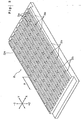
- Fig. 1 is a plan view showing an absorbent article according to one embodiment of the invention
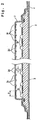
- Fig. 2 is a cross sectional view of Fig. 1 on line II-II (partially omitted)
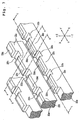
- Fig. 3 is a perspective view showing the fragmentary detail of a surface sheet of the absorbent article shown in Fig. 1.
- a skin contacting part 10 for receiving a liquid excreted from the body is formed at the center of a sanitary napkin (absorbent article) 1.
- the sanitary napkin 1 is constructed to include a surface sheet 2, an absorbent core 3 and a back sheet 4.
- side flaps 5 and 5 are provided on both sides of the skin contacting part 10.
- the surface sheet 2 may be made of any suitable sheet material.
- the sheet material include: nonwoven fabric such as air-through nonwoven fabric, point-bonded nonwoven fabric and spun-bonded nonwoven fabric produced by accumulating synthetic fibers, such as of PE (polyethylene), PET (polyethylene terephthalate), etc., or composite fibers, such as of PE/PET, PE/PP (polypropylene), etc., and making the accumulated fibers into a sheet form by thermal welding; a porous film formed with a number of pores and laminated with a fibrous sheet on the skin contacting side thereof; and a porous fibrous sheet formed with a number of pores.
- nonwoven fabric such as air-through nonwoven fabric, point-bonded nonwoven fabric and spun-bonded nonwoven fabric produced by accumulating synthetic fibers, such as of PE (polyethylene), PET (polyethylene terephthalate), etc., or composite fibers, such as of PE/PET, PE/PP (polypropylene), etc.
- the constituent fibers for the surface sheet 2 preferably have a fineness in a range of from 1.1 to 6.6 dtex. If it is less than 1.1 dtex, the amount of liquid remaining due to the capillary action is increased to give wet feeling to the wearer. If it exceeds 6.6 dtex, hard and rough feeling is given.
- the basis weight (This may be referred to as "Metsuke") of the surface sheet 2 is preferably in a range of from 20 to 120 g/m 2 . If it is less than 20 g/m 2 , the surface sheet cannot provide sufficient elasticity to the corrugated configuration thereof and is liable to lose shape. If it exceeds 120 g/m 2 , it becomes too rigid.
- the adhesion strength between the upper layer (upper sheet) and the lower layer (lower sheet) in CD (Cross Direction) is preferably 0.49 N/inch (50 g/inch) or more, so as to secure the durability upon use.
- the adhesion strength is less than 0.49 N/inch (50 g/inch), there tend to be cases causing a problem in that the upper layer is peeled to float or is broken.
- the strength between the sheets is increased to improve the durability, as described above.
- the finish of the surface sheet thus laminated tends to be stiff.
- the upper and lower layers of a corrugated configuration are adhered and fixed to each other not in the peaks but only at the bottom parts of the valleys, whereby the peaks to come into contact with the skin directly can be finished more softly.
- the surface sheet 2 is made of a multi-layer sheet formed by laminating the plurality of sheets of nonwoven fabric.
- the surface sheet 2 is formed to have a corrugated configuration (i.e., wavy shape), in which valleys 2b having a concave cross section and peaks 2a having a convex cross section extend in the longitudinal (Y) direction and are alternately arranged in the transverse (X) direction.
- the bottom parts of the valleys 2b and the surface of the absorbent core 3 are adhered and fixed to each other at the positions indicated with symbols (x) in Fig. 2.
- the adhesion between the bottom parts of the valleys 2b and the surface of the absorbent core 3 can be conducted, for example, with a hot melt adhesive.
- a hot melt adhesive For application of the hot melt adhesive, use can be made of a silicone roll having the same shape as the peaks 2a and the valleys 2b. The roll is applied with the hot melt adhesive in a bead form, inside the valleys thereof, and is then made in contact with the back surface of the surface sheet 2 (the surface directed to the -Z direction) to mach the wavy shape thereof and is trundled, whereby the adhesive can be transferred to the back surface of the valleys 2b of the surface sheet 2.
- the valleys 2b of the surface sheet 2 can be adhered to the absorbent core 3, while preventing the peaks 2a from adhering to each other.
- the distance H (height in the Z direction) between the top of the peak 2a and the bottom part of the valley 2b is preferably from 1 to 10 mm, and more preferably from 2 to 6 mm.
- the width W between the peaks 2a, 2a or the valleys 2b, 2b arranged alternately is preferably from 1 to 15 mm, and more preferably from 2 to 10 mm.
- sparse parts 2c and dense parts 2d are alternately formed to line with a constant interval in the longitudinal direction.
- the sparse parts 2c are recessed into a concave shape, i.e., lowered than the dense parts 2d in the -Z direction toward the absorbent core 3, and are formed as extending in the transverse (X) direction in a strip form.
- the dense parts 2d are formed by heating and/or compression by the means described later and have a density of fibers per unit volume (hereinafter referred to as a fiber density) higher than that of the sparse parts 2c of the surface sheet 2.
- the pitch p of the sparse parts 2c in the longitudinal direction is preferably from 3 to 15 mm, and more preferably from 3 to 10 mm.
- the depth dimension d2 of the sparse parts 2c in the -Z direction is preferably in a range of from 0.5 to 3 mm from the dense parts 2d (top) of the peak 2a toward the absorbent core 3 from the standpoints of bumpy feeling given to the wearer and separation between the surface sheet 2 and the absorbent core 3.
- the dimension wl of the sparse parts 2c in the longitudinal direction is preferably from 1 to 5 mm.
- the sparse parts 2c preferably have such a shape that when viewed from the longitudinal cross section (the same direction as Fig. 2), the shape from the dense part 2d to the bottom part of the sparse part 2c is not perpendicularly steep-up but forms a curved surface. Owing to such a shape, the dense parts 2d of the surface sheet 2 in contact with the skin are prevented from giving harsh feeling to the wearer. In order to attain the shape, the shape of the edge of the dense part forming part 22c of the lower plate 22 described later is formed to have a taper form (see Fig. 7 and Fig. 8C).
- the center part of the surface sheet 2 is caved with respect to the both ends thereof, whereby the surface sheet 2 is incurvated to a concave form.
- the individual sparse parts 2c are bent and approach each other, so that the surface sheet 2 is incurvated as a whole.
- the peaks 2a of the surface sheet 2 are bent only at the sparse parts 2c, but they are not bent at the dense parts 2d.
- the peaks 2a can be uniformly incurvated by dispersing the pressure from the body to the sparse parts 2c, and therefore, no crease is formed in the dense parts 2d.
- This can prevent the separation of the surface sheet 2 from the surface of the absorbent core 3.
- the permeability (transmissibility) of a liquid from the surface sheet 2, more particularly from the peaks 2a of the surface sheet 2 to the absorbent core 3 is not lost, so that the amount of the liquid remaining in the surface sheet 2 can be made less.
- excellent dry feeling can be obtained, and comfortable feeling can always be given to the wearer.
- a plurality of connecting parts 2e are formed inside one valley 2b with a prescribed pitch P, so as to connect between the adjacent peaks 2a, 2a at both sides of the valley 2b. Due to the presence of the connecting parts 2e, the deformation amount of the surface sheet 2 caused by the pressure from the body can be minimized.
- the elasticity of the connecting parts 2e functions as a restoring force to recover the original state of the surface sheet 2 upon releasing the pressure from the body. Therefore, since the surface sheet 2 has an excellent recovering force, the shape thereof is not lost even when the wearer gets hard exercise.
- the sparse parts 2c may be arranged on the surface sheet 2 in the following manner.
- Figs. 4A, 4B, 4C and 4D are perspective views showing embodiments of arrangements of the sparse parts on the surface sheet, in which Fig. 4A shows the first pattern, Fig. 4B shows the second pattern, Fig. 4C shows the third pattern, and Fig. 4D shows the fourth pattern.
- the peaks 2a extend in the longitudinal (Y) direction of the surface sheet 2, and a plurality of sparse parts 2c are arranged in the transverse (X) direction perpendicular to the peaks 2a.
- the sparse parts 2c form a plurality of bent lines L1 extending parallel to each other and arranged at regular intervals.
- the sparse parts 2c are arranged alternately with respect to the adjacent peaks 2a in the transverse direction. That is, the sparse parts 2c are staggered in the longitudinal direction, between the adjacent peaks 2a in the transverse direction.
- a plurality of bent lines connecting the sparse parts 2c are formed in a polygonal line form. The resistance caused by the arrangement of the peaks 2a can also be relaxed with the bent lines.
- the sparse parts 2c are formed on the peaks 2a inside the prescribed region of the surface sheet 2 in a circular or elliptical form. Owing to such a structure, the dense parts 2d having high liquid permeability are formed inside the region. On the other hand, the sparse parts 2c in the periphery outside the region have higher retaining property of a liquid than the dense parts 2d. It is visually confirmed that the interior of the prescribed region is a part having a high absorbent effect of an excreted liquid. Because the sparse parts 2c inside the region have low liquid permeability, unnecessary diffusion of the excreted liquid can be suppressed.
- the sparse parts 2c are formed as concentrated in a prescribed region (substantially the central part) of the surface sheet 2.
- the surface sheet 2 as a result of concentration of the sparse parts 2c of low permeability in the central part thereof, the retaining ability of an excreted liquid in the central part can be improved.
- the diffusion property of the excreted liquid in the transverse direction of the surface sheet 2 can be improved by surrounding the periphery of the central part with the dense parts 2d having a high fiber density. As a result, the absorption rate to the absorbent core 3 can be increased.
- Figs. 5 and 6 show a mold for producing the surface sheet, in which Fig. 5 shows an upper plate, and Fig. 6 shows a lower plate.
- a plurality of convex ribs 21a having a prescribed length are formed in the longitudinal direction on a press surface 21A of the upper plate 21.
- gaps 21b having a prescribed length are formed between the convex ribs 21a adjacent to each other in the longitudinal (Y) direction.
- the convex ribs 21a are also arranged in the transverse (X) direction, and the distances between the rows adjacent to each other is set at a constant width.
- the gaps 21b are formed as staggered in the longitudinal direction in the rows adjacent to each other.
- ribs 22a On a press surface 22A of the lower plate 22 shown in Fig. 6, on the other hand, there are formed ribs 22a extending in the longitudinal direction and arranged in the transverse direction in rows.
- Fig. 7 is a perspective view showing the detail of the ribs on the lower plate.
- sparse part forming parts 22b As shown in Fig. 7, on the upper surface of the ribs 22a, sparse part forming parts 22b having a concave form, and dense part forming parts 22c having a convex form are alternately formed. That is, the sparse part forming parts 22b are formed at regular intervals.
- the top parts of the dense part forming part 22c are compression parts 22d.
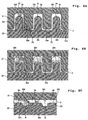
- Figs. 8A, 8B and 8C are cross sectional views showing the state where the upper plate and the lower plate are interfitted to each other, in which Fig. 8A is a cross sectional view in the transverse direction of the dense part forming part of the lower plate (on line a-a in Fig. 7) and the upper plate, Fig. 8B is a cross sectional view in the transverse direction of the sparse part forming part of the lower plate (on line b-b in Fig. 7) and the upper plate, and Fig. 8C is a cross sectional view in the longitudinal direction of the rib of the lower plate (on line c-c in Fig. 7) and the upper plate.
- the convex ribs 21a of the upper plate 21 each is interfitted between the ribs 22a of the lower plate 22.
- the surface sheet 2 having the corrugated configuration can be formed by the ribs 22a and the convex ribs 21a.
- the sparse parts 2c and the dense parts 2d are simultaneously formed alternately on the top parts of the peaks 2a along the longitudinal direction as shown in Figs. 2 and 3. That is, as shown in Figs. 8A and 8C, because the distance d1 between the compression part 22d of the dense part forming part 22c of the lower plate 22 and the bottom between the convex ribs 21a of the upper plate 21 is set at a value smaller than the thickness of the nonwoven fabric (surface sheet), the top parts of the nonwoven fabric (surface sheet) are compressed by the compression parts 22d of the dense part forming part 22c. As a result, the dense parts 2d having a high fiber density can be formed at the top parts of the surface sheet 2. As shown in Figs.
- the distance d2 depth dimension of the sparse part
- the distance d2 depth dimension of the sparse part
- the sparse parts 2c having a low fiber density suffering relatively light compression are formed at the top parts of the surface sheet 2.
- the connecting parts 2e in the valleys 2b of the surface sheet 2 shown in Fig. 2 can be formed by the gaps 21b provided in the upper plate 21, whereby two peaks 2a, 2a at the sides of each valley 2b can be connected to each other.
- the surface sheet having the first pattern (linear array) shown in Fig. 4A can be formed.
- the surface sheet having the second pattern shown in Fig. 4B can be formed.
- the surface sheet having the third pattern shown in Fig. 4C can be formed.
- the sparse part forming parts 22b are concentrated in the central part of the press surface 22A of the lower plate 22, the surface sheet having the fourth pattern shown in Fig. 4D can be formed.
- rollers are employed. That is, the upper plate 21 and the lower plate 22 are formed into an upper roller and a lower roller, respectively, each having a roll form, and when a strip of nonwoven fabric is passed between the upper roller and the lower roller, the surface sheet 2 shown in Fig. 2, Fig. 3 and Figs. 4A to 4D can be continuously formed.
- the nonwoven fabric when the nonwoven fabric is pressed under. the condition where the rollers are heated to a temperature of from 60 to 160°C, the surface sheet 2 having higher stiffness, i.e., difficult to lose the shape thereof, can be formed. It is also possible that the nonwoven fabric before passing between the rollers is subjected to a pre-heating treatment, and examples of the pre-heating treatment include passing through pre-heating rollers or blowing hot air.
- absorbent article of the invention has been described with reference to a sanitary napkin, it may also be embodied in a panty liner, a pad for incontinence and the like.
- the surface sheet can be incurvated and deformed at the sparse parts formed on the peaks, so that the surface sheet is not forcedly bent at the dense parts other than the sparse parts. Therefore, no excessive force is applied between the surface sheet and the absorbent core, and the separation thereof can be prevented. As a result, deterioration of the liquid permeability and the diffusion property between the surface sheet and the absorbent core is prevented to maintain dry feeling of the surface sheet.
Landscapes
- Health & Medical Sciences (AREA)
- Life Sciences & Earth Sciences (AREA)
- General Health & Medical Sciences (AREA)
- Biomedical Technology (AREA)
- Heart & Thoracic Surgery (AREA)
- Vascular Medicine (AREA)
- Epidemiology (AREA)
- Animal Behavior & Ethology (AREA)
- Engineering & Computer Science (AREA)
- Public Health (AREA)
- Veterinary Medicine (AREA)
- Absorbent Articles And Supports Therefor (AREA)
- Orthopedics, Nursing, And Contraception (AREA)
- Laminated Bodies (AREA)
- Nonwoven Fabrics (AREA)
Abstract
Description
- The present invention relates to an absorbent article, such as a sanitary napkin, a panty liner and a pad for incontinence, and in particular, it relates to an absorbent article in that absorbent property and diffusion property between a surface sheet and an absorbent core are improved to have excellent dry feeling.
- There have been some absorbent articles including a sanitary napkin and a panty liner in which a skin contacting surface of a surface sheet is of a corrugated configuration to have peaks and valleys alternately arranged so that the surface sheet to contact the skin directly is improved in dry feeling and soft feeling.
- However, when the direction along which the peaks and valleys extend (i.e., an orientation direction) is identical with the longitudinal direction of the absorbent article, the corrugated configuration is liable to be resistance against the absorbent article being incurvated in the longitudinal direction. Accordingly, in order to incurvate and deform the absorbent article by pressure from the body upon use, a plurality of creases are necessarily formed on the surface of the peaks to extend in the transverse direction perpendicular to the longitudinal direction. Because the surface sheet is folded at the creases, the surface sheet can be incurvated along the body shape of the user.
- In the parts of the surface sheet where the creases are formed, the surface sheet is in contact with the absorbent core located therebelow, but in the parts where the creases are not formed, an excessive force may be applied to separate the absorbent core and the surface sheet. As a result, in the part where the absorbent core and the surface sheet are separated, the amount of liquid remaining in the surface sheet is increased, so that the surface sheet loses dry feeling and provides the user with uncomfortable wet feeling.
- In particular, because the pressure from the body does not act uniformly on the whole surface of the surface sheet, the surface sheet is often incurvated with irregular curvature radii. That is, in parts where the pressure from the body is concentrated, the curvature radius becomes small to form a large number of creases, whereas in parts where the pressure from the body acts relatively lightly, the curvature radius becomes large to decrease the number of the creases.
- Furthermore, because the peaks and valleys are liable to be irregularly creased, there are cases where the peak plugs the valley, and the flow of an excreted liquid is dammed at a part where the surface sheet is bent at an acute angle.
- As described in the foregoing, when creases are irregularly formed on the surface sheet, the part where the surface sheet and the absorbent core are separated and the part where the surface sheet is bent are formed irregularly, and therefore an excreted liquid is insufficiently diffused to cause a problem that the surface sheet has a part exhibiting dry feeling and a part exhibiting no dry feeling.
- An object of the invention is to provide an absorbent article in which a surface sheet can be easily incurvated as a whole so that absorbent property and diffusion property between the surface sheet and an absorbent core are improved to have excellent dry feeling.
- According to the invention, there is provided an absorbent article comprising an absorbent layer and a liquid-permeable surface sheet placed on a liquid-receiving side of the absorbent layer for introducing excreted liquid from the human body to the absorbent layer, the surface sheet being of a corrugated configuration to have valleys and peaks extending in a longitudinal direction of the article and alternately arranged in a transverse direction perpendicular to the longitudinal direction, wherein
- each peak is formed with sparse parts and dense parts alternately arranged in the longitudinal direction, and the surface sheet has a lower fiber density in the sparse parts than in the dense parts.
- For example, the dense parts may be formed by compressing the peaks intermittently in the longitudinal direction, so that parts that do not receive the compression between the dense parts are the sparse parts.
- It is preferred that the peak is made uneven at the top thereof so that the sparse parts form recessed parts and the dense parts form raised parts.
- In the invention, the peaks of the corrugated surface sheet can be easily bent due to the presence of the sparse parts having a low fiber density. In addition, because the sparse parts are formed along the peaks of the corrugated surface sheet, the surface sheet can be incurvated as a whole by bending each peak at the sparse parts. Therefore, the peaks are not forcibly bent at the dense parts, so that the surface sheet and the absorbent core are prevented from locally separating by an excessive force. As a result, the liquid permeability of the surface sheet and the absorbent core can be prevented from lowering, and an excreted liquid received by the surface sheet can be effectively led to the absorbent core.
- If the sparse parts are recessed toward the absorbent core (i.e., lowered than the dense part), the peaks can be bent at the sparse parts more easily.
- In the above, it is preferred that the sparse part has a dimension (w1) in the longitudinal direction of from 1 to 5 mm.
- It is preferred that the sparse part has a depth dimension (d2) from the surface of the dense part toward the absorbent core of from 0.5 to 3 mm.
- It is preferred that the sparse parts are arranged with a pitch (p) in the longitudinal direction of from 3 to 15 mm.
- Owing to the dimensions, a wearer hardly receives uncomfortable feeling due to the unevenness, and the separation of the surface sheet and the absorbent core can be effectively prevented.
- The sparse parts may be staggered in the longitudinal direction, between two adjacent peaks. That is, the sparse parts may be arranged in such a manner that one sparse part formed on one peak is positioned between two sparse parts formed on another peak adjacent thereto in the transverse direction.
- The sparse parts may be arranged to surround a prescribed region of the surface sheet.
- The sparse parts may be formed as concentrated in a prescribed region of the surface sheet.
- In the above, it is also preferred that, in each valley, there is provided at least one connecting part to connect between two adjacent peaks.
- Owing to the structure, soft feeling of the surface sheet can be maintained, and the shape thereof can be prevented from losing.
-
- Fig. 1 is a plan view showing an absorbent article according to one embodiment of the invention;
- Fig. 2 is a partial cross sectional view of Fig. 1 on line II-II;
- Fig. 3 is a perspective view showing the fragmentary detail of a surface sheet of the absorbent article shown in Fig. 1;
- Figs. 4A, 4B, 4C and 4D are perspective views showing embodiments of arrangements of sparse parts on a surface sheet, in which Fig. 4A shows the first pattern, Fig. 4B shows the second pattern, Fig. 4C shows the third pattern, and Fig. 4D shows the fourth pattern;
- Fig. 5 is a perspective view showing an upper plate for producing the surface sheet;
- Fig. 6 is a perspective view showing a lower plate for producing the surface sheet;
- Fig. 7 is an enlarged perspective view showing the fragmentary detail of ribs on the lower plate; and
- Figs. 8A, 8B and 8C are cross sectional views showing the state where the upper plate and the lower plate are interfitted to each other, in which Fig. 8A is a cross sectional view in the transverse direction of a dense part forming part of the lower plate and the upper plate, Fig. 8B is a cross sectional view in the transverse direction of a sparse part forming part of the lower plate and the upper plate, and Fig. 8C is a cross sectional view in the longitudinal direction of the rib of the lower plate (on line c-c in Fig. 7) and the upper plate.
-
- The invention will be described in detail with reference to the drawings.
- Fig. 1 is a plan view showing an absorbent article according to one embodiment of the invention, Fig. 2 is a cross sectional view of Fig. 1 on line II-II (partially omitted), and Fig. 3 is a perspective view showing the fragmentary detail of a surface sheet of the absorbent article shown in Fig. 1.
- As shown in Fig. 1, a
skin contacting part 10 for receiving a liquid excreted from the body is formed at the center of a sanitary napkin (absorbent article) 1. As shown in Fig. 2, thesanitary napkin 1 is constructed to include asurface sheet 2, anabsorbent core 3 and a back sheet 4. On both sides of theskin contacting part 10,side flaps - The
surface sheet 2 may be made of any suitable sheet material. Examples of the sheet material include: nonwoven fabric such as air-through nonwoven fabric, point-bonded nonwoven fabric and spun-bonded nonwoven fabric produced by accumulating synthetic fibers, such as of PE (polyethylene), PET (polyethylene terephthalate), etc., or composite fibers, such as of PE/PET, PE/PP (polypropylene), etc., and making the accumulated fibers into a sheet form by thermal welding; a porous film formed with a number of pores and laminated with a fibrous sheet on the skin contacting side thereof; and a porous fibrous sheet formed with a number of pores. These sheet materials may be used alone as a single-layer sheet or may be used in combination as a multi-layer sheet formed by laminating two or more sheets. The constituent fibers for thesurface sheet 2 preferably have a fineness in a range of from 1.1 to 6.6 dtex. If it is less than 1.1 dtex, the amount of liquid remaining due to the capillary action is increased to give wet feeling to the wearer. If it exceeds 6.6 dtex, hard and rough feeling is given. The basis weight (This may be referred to as "Metsuke") of thesurface sheet 2 is preferably in a range of from 20 to 120 g/m2. If it is less than 20 g/m2, the surface sheet cannot provide sufficient elasticity to the corrugated configuration thereof and is liable to lose shape. If it exceeds 120 g/m2, it becomes too rigid. - In the case where the
surface sheet 2 is a multi-layer sheet formed by adhering the entire surfaces of the plurality of sheets of nonwoven fabric, the adhesion strength between the upper layer (upper sheet) and the lower layer (lower sheet) in CD (Cross Direction) is preferably 0.49 N/inch (50 g/inch) or more, so as to secure the durability upon use. When the adhesion strength is less than 0.49 N/inch (50 g/inch), there tend to be cases causing a problem in that the upper layer is peeled to float or is broken. - When the entire surfaces of the upper layer and the lower layer are adhered, the strength between the sheets is increased to improve the durability, as described above. However, on the other hand, the finish of the surface sheet thus laminated tends to be stiff. In such a case, it is preferred that the upper and lower layers of a corrugated configuration are adhered and fixed to each other not in the peaks but only at the bottom parts of the valleys, whereby the peaks to come into contact with the skin directly can be finished more softly.
- In the
sanitary napkin 1 shown in Fig. 1 to Fig. 3, thesurface sheet 2 is made of a multi-layer sheet formed by laminating the plurality of sheets of nonwoven fabric. Thesurface sheet 2 is formed to have a corrugated configuration (i.e., wavy shape), in whichvalleys 2b having a concave cross section and peaks 2a having a convex cross section extend in the longitudinal (Y) direction and are alternately arranged in the transverse (X) direction. The bottom parts of thevalleys 2b and the surface of theabsorbent core 3 are adhered and fixed to each other at the positions indicated with symbols (x) in Fig. 2. - The adhesion between the bottom parts of the
valleys 2b and the surface of theabsorbent core 3 can be conducted, for example, with a hot melt adhesive. For application of the hot melt adhesive, use can be made of a silicone roll having the same shape as thepeaks 2a and thevalleys 2b. The roll is applied with the hot melt adhesive in a bead form, inside the valleys thereof, and is then made in contact with the back surface of the surface sheet 2 (the surface directed to the -Z direction) to mach the wavy shape thereof and is trundled, whereby the adhesive can be transferred to the back surface of thevalleys 2b of thesurface sheet 2. Thus, only thevalleys 2b of thesurface sheet 2 can be adhered to theabsorbent core 3, while preventing thepeaks 2a from adhering to each other. - As shown in Fig. 3, the distance H (height in the Z direction) between the top of the
peak 2a and the bottom part of thevalley 2b is preferably from 1 to 10 mm, and more preferably from 2 to 6 mm. The width W between thepeaks valleys - On the surface of the
peak 2a,sparse parts 2c anddense parts 2d are alternately formed to line with a constant interval in the longitudinal direction. Thesparse parts 2c are recessed into a concave shape, i.e., lowered than thedense parts 2d in the -Z direction toward theabsorbent core 3, and are formed as extending in the transverse (X) direction in a strip form. Thedense parts 2d are formed by heating and/or compression by the means described later and have a density of fibers per unit volume (hereinafter referred to as a fiber density) higher than that of thesparse parts 2c of thesurface sheet 2. - The pitch p of the
sparse parts 2c in the longitudinal direction is preferably from 3 to 15 mm, and more preferably from 3 to 10 mm. The depth dimension d2 of thesparse parts 2c in the -Z direction is preferably in a range of from 0.5 to 3 mm from thedense parts 2d (top) of thepeak 2a toward theabsorbent core 3 from the standpoints of bumpy feeling given to the wearer and separation between thesurface sheet 2 and theabsorbent core 3. The dimension wl of thesparse parts 2c in the longitudinal direction is preferably from 1 to 5 mm. - The
sparse parts 2c preferably have such a shape that when viewed from the longitudinal cross section (the same direction as Fig. 2), the shape from thedense part 2d to the bottom part of thesparse part 2c is not perpendicularly steep-up but forms a curved surface. Owing to such a shape, thedense parts 2d of thesurface sheet 2 in contact with the skin are prevented from giving harsh feeling to the wearer. In order to attain the shape, the shape of the edge of the densepart forming part 22c of thelower plate 22 described later is formed to have a taper form (see Fig. 7 and Fig. 8C). - In the
sanitary napkin 1 having thesurface sheet 2 with such a configuration, when a pressure from the body is applied from the upper side (+Z) to the lower side (-Z) of thesurface sheet 2, the center part of thesurface sheet 2 is caved with respect to the both ends thereof, whereby thesurface sheet 2 is incurvated to a concave form. At this time, the individualsparse parts 2c are bent and approach each other, so that thesurface sheet 2 is incurvated as a whole. Thepeaks 2a of thesurface sheet 2 are bent only at thesparse parts 2c, but they are not bent at thedense parts 2d. That is, thepeaks 2a can be uniformly incurvated by dispersing the pressure from the body to thesparse parts 2c, and therefore, no crease is formed in thedense parts 2d. This can prevent the separation of thesurface sheet 2 from the surface of theabsorbent core 3. As a result, the permeability (transmissibility) of a liquid from thesurface sheet 2, more particularly from thepeaks 2a of thesurface sheet 2 to theabsorbent core 3 is not lost, so that the amount of the liquid remaining in thesurface sheet 2 can be made less. Thus, excellent dry feeling can be obtained, and comfortable feeling can always be given to the wearer. - In the
surface sheet 2 shown in Fig. 3, a plurality of connectingparts 2e are formed inside onevalley 2b with a prescribed pitch P, so as to connect between theadjacent peaks valley 2b. Due to the presence of the connectingparts 2e, the deformation amount of thesurface sheet 2 caused by the pressure from the body can be minimized. The elasticity of the connectingparts 2e functions as a restoring force to recover the original state of thesurface sheet 2 upon releasing the pressure from the body. Therefore, since thesurface sheet 2 has an excellent recovering force, the shape thereof is not lost even when the wearer gets hard exercise. - The
sparse parts 2c may be arranged on thesurface sheet 2 in the following manner. - Figs. 4A, 4B, 4C and 4D are perspective views showing embodiments of arrangements of the sparse parts on the surface sheet, in which Fig. 4A shows the first pattern, Fig. 4B shows the second pattern, Fig. 4C shows the third pattern, and Fig. 4D shows the fourth pattern.
- In the first pattern (linear array) shown in Fig. 4A, the
peaks 2a extend in the longitudinal (Y) direction of thesurface sheet 2, and a plurality ofsparse parts 2c are arranged in the transverse (X) direction perpendicular to thepeaks 2a. In the first pattern (linear array), thesparse parts 2c form a plurality of bent lines L1 extending parallel to each other and arranged at regular intervals. When thesurface sheet 2 is incurvated to make the center of curvature radius directed to the side of the skin contacting part (+Z side) of thesurface sheet 2, it can be easily bent at the bent lines L1. Thus, the resistance caused by the arrangement of thepeaks 2a can be relaxed. - In the second pattern (staggered array) shown in Fig. 4B, the
sparse parts 2c are arranged alternately with respect to theadjacent peaks 2a in the transverse direction. That is, thesparse parts 2c are staggered in the longitudinal direction, between theadjacent peaks 2a in the transverse direction. In the second pattern, a plurality of bent lines connecting thesparse parts 2c are formed in a polygonal line form. The resistance caused by the arrangement of thepeaks 2a can also be relaxed with the bent lines. - In the third pattern (round array) shown in Fig. 4C, the
sparse parts 2c are formed on thepeaks 2a inside the prescribed region of thesurface sheet 2 in a circular or elliptical form. Owing to such a structure, thedense parts 2d having high liquid permeability are formed inside the region. On the other hand, thesparse parts 2c in the periphery outside the region have higher retaining property of a liquid than thedense parts 2d. It is visually confirmed that the interior of the prescribed region is a part having a high absorbent effect of an excreted liquid. Because thesparse parts 2c inside the region have low liquid permeability, unnecessary diffusion of the excreted liquid can be suppressed. - In the fourth pattern (pattern with dense center and sparse periphery) shown in Fig. 4D, the
sparse parts 2c are formed as concentrated in a prescribed region (substantially the central part) of thesurface sheet 2. In thesurface sheet 2, as a result of concentration of thesparse parts 2c of low permeability in the central part thereof, the retaining ability of an excreted liquid in the central part can be improved. The diffusion property of the excreted liquid in the transverse direction of thesurface sheet 2 can be improved by surrounding the periphery of the central part with thedense parts 2d having a high fiber density. As a result, the absorption rate to theabsorbent core 3 can be increased. - A production process of the surface sheet will be described below.
- Figs. 5 and 6 show a mold for producing the surface sheet, in which Fig. 5 shows an upper plate, and Fig. 6 shows a lower plate.
- As shown in Fig. 5, a plurality of
convex ribs 21a having a prescribed length are formed in the longitudinal direction on apress surface 21A of theupper plate 21. In theupper plate 21,gaps 21b having a prescribed length are formed between theconvex ribs 21a adjacent to each other in the longitudinal (Y) direction. Theconvex ribs 21a are also arranged in the transverse (X) direction, and the distances between the rows adjacent to each other is set at a constant width. Thegaps 21b are formed as staggered in the longitudinal direction in the rows adjacent to each other. - On a
press surface 22A of thelower plate 22 shown in Fig. 6, on the other hand, there are formedribs 22a extending in the longitudinal direction and arranged in the transverse direction in rows. Fig. 7 is a perspective view showing the detail of the ribs on the lower plate. As shown in Fig. 7, on the upper surface of theribs 22a, sparsepart forming parts 22b having a concave form, and densepart forming parts 22c having a convex form are alternately formed. That is, the sparsepart forming parts 22b are formed at regular intervals. The top parts of the densepart forming part 22c arecompression parts 22d. - Figs. 8A, 8B and 8C are cross sectional views showing the state where the upper plate and the lower plate are interfitted to each other, in which Fig. 8A is a cross sectional view in the transverse direction of the dense part forming part of the lower plate (on line a-a in Fig. 7) and the upper plate, Fig. 8B is a cross sectional view in the transverse direction of the sparse part forming part of the lower plate (on line b-b in Fig. 7) and the upper plate, and Fig. 8C is a cross sectional view in the longitudinal direction of the rib of the lower plate (on line c-c in Fig. 7) and the upper plate.
- When the
upper plate 21 and thelower plate 22 are superposed on each other in such a state that the press surfaces 21A and 22A face each other, theconvex ribs 21a of theupper plate 21 each is interfitted between theribs 22a of thelower plate 22. When nonwoven fabric intervenes between the plates as shown in Fig. 8A at this time, thesurface sheet 2 having the corrugated configuration can be formed by theribs 22a and theconvex ribs 21a. - The
sparse parts 2c and thedense parts 2d are simultaneously formed alternately on the top parts of thepeaks 2a along the longitudinal direction as shown in Figs. 2 and 3. That is, as shown in Figs. 8A and 8C, because the distance d1 between thecompression part 22d of the densepart forming part 22c of thelower plate 22 and the bottom between theconvex ribs 21a of theupper plate 21 is set at a value smaller than the thickness of the nonwoven fabric (surface sheet), the top parts of the nonwoven fabric (surface sheet) are compressed by thecompression parts 22d of the densepart forming part 22c. As a result, thedense parts 2d having a high fiber density can be formed at the top parts of thesurface sheet 2. As shown in Figs. 8B and 8C, on the other hand, the distance d2 (depth dimension of the sparse part) between the bottom between theconvex ribs 21a of theupper plate 21 and the sparsepart forming part 22b of thelower plate 22 is set at a value larger than the distance dl on the side of the dense part forming part 21c. Therefore, thesparse parts 2c having a low fiber density suffering relatively light compression are formed at the top parts of thesurface sheet 2. - In addition, the connecting
parts 2e in thevalleys 2b of thesurface sheet 2 shown in Fig. 2 can be formed by thegaps 21b provided in theupper plate 21, whereby twopeaks valley 2b can be connected to each other. - In the
lower plate 22 shown in Fig. 7, since the sparsepart forming parts 22b are formed with a constant pitch p in the longitudinal direction, the surface sheet having the first pattern (linear array) shown in Fig. 4A can be formed. When the sparsepart forming parts 22b on theribs 22a are formed alternately (staggered pattern), the surface sheet having the second pattern shown in Fig. 4B can be formed. When the sparsepart forming parts 22b are formed in theribs 22a on thepress surface 22A of thelower plate 22 in a circular or elliptical form, the surface sheet having the third pattern shown in Fig. 4C can be formed. Furthermore, when the sparsepart forming parts 22b are concentrated in the central part of thepress surface 22A of thelower plate 22, the surface sheet having the fourth pattern shown in Fig. 4D can be formed. - In order to mass-produce the surface sheet, rollers are employed. That is, the
upper plate 21 and thelower plate 22 are formed into an upper roller and a lower roller, respectively, each having a roll form, and when a strip of nonwoven fabric is passed between the upper roller and the lower roller, thesurface sheet 2 shown in Fig. 2, Fig. 3 and Figs. 4A to 4D can be continuously formed. - At this time, when the nonwoven fabric is pressed under. the condition where the rollers are heated to a temperature of from 60 to 160°C, the
surface sheet 2 having higher stiffness, i.e., difficult to lose the shape thereof, can be formed. It is also possible that the nonwoven fabric before passing between the rollers is subjected to a pre-heating treatment, and examples of the pre-heating treatment include passing through pre-heating rollers or blowing hot air. - While the absorbent article of the invention has been described with reference to a sanitary napkin, it may also be embodied in a panty liner, a pad for incontinence and the like.
- As has been described in detail, according to the invention, the surface sheet can be incurvated and deformed at the sparse parts formed on the peaks, so that the surface sheet is not forcedly bent at the dense parts other than the sparse parts. Therefore, no excessive force is applied between the surface sheet and the absorbent core, and the separation thereof can be prevented. As a result, deterioration of the liquid permeability and the diffusion property between the surface sheet and the absorbent core is prevented to maintain dry feeling of the surface sheet.
- Here, "comprises/comprising" when used in this specification is taken to specify the presence of stated features, integers, steps or components but does not preclude the presence or addition of one or more other features, integers, steps, components or groups thereof.
- Although various exemplary embodiments have been shown and described, the invention is not limited to the embodiments shown. Therefore, the scope of the invention is intended to be limited solely by the scope of the claims that follow.
Claims (10)
- An absorbent article comprising an absorbent layer and a liquid-permeable surface sheet placed on a liquid-receiving side of the absorbent layer for introducing excreted liquid from the human body to the absorbent layer, the surface sheet being of a corrugated configuration to have valleys and peaks extending in a longitudinal direction of the article and alternately arranged in a transverse direction perpendicular to the longitudinal direction, wherein
each peak is formed with sparse parts and dense parts alternately arranged in the longitudinal direction, and the surface sheet has a lower fiber density in the sparse parts than in the dense parts. - The absorbent article as set forth in claim 1, wherein the dense parts are formed by compressing the peaks intermittently in the longitudinal direction, so that parts that do not receive the compression between the dense parts are the sparse parts.
- The absorbent article as set forth in claim 2, wherein the peak is made uneven at the top thereof so that the sparse parts form recessed parts and the dense parts form raised parts.
- The absorbent article as set forth in claim 3, wherein the sparse part has a dimension (w1) in the longitudinal direction of from 1 to 5 mm.
- The absorbent article as set forth in claim 4, wherein the sparse part has a depth dimension (d2) from the surface of the dense part toward the absorbent core of from 0.5 to 3 mm.
- The absorbent article as set forth in claim 5, wherein the sparse parts are arranged with a pitch (p) in the longitudinal direction of from 3 to 15 mm.
- The absorbent article as set forth in claim 6, wherein the sparse parts are staggered in the longitudinal direction, between two adjacent peaks.
- The absorbent article as set forth in claim 1, wherein the sparse parts are arranged to surround a prescribed region of the surface sheet.
- The absorbent article as set forth in claim 1, wherein the sparse parts are formed as concentrated in a prescribed region of the surface sheet.
- The absorbent article as set forth in claim 1, wherein in each valley, there is provided at least one connecting part to connect between two adjacent peaks.
Applications Claiming Priority (2)
| Application Number | Priority Date | Filing Date | Title |
|---|---|---|---|
| JP32394399A JP3727207B2 (en) | 1999-11-15 | 1999-11-15 | Absorbent articles |
| JP32394399 | 1999-11-15 |
Publications (2)
| Publication Number | Publication Date |
|---|---|
| EP1103240A1 true EP1103240A1 (en) | 2001-05-30 |
| EP1103240B1 EP1103240B1 (en) | 2005-10-05 |
Family
ID=18160374
Family Applications (1)
| Application Number | Title | Priority Date | Filing Date |
|---|---|---|---|
| EP00309733A Expired - Lifetime EP1103240B1 (en) | 1999-11-15 | 2000-11-03 | Absorbent article |
Country Status (13)
| Country | Link |
|---|---|
| US (1) | US6436082B1 (en) |
| EP (1) | EP1103240B1 (en) |
| JP (1) | JP3727207B2 (en) |
| KR (1) | KR100729583B1 (en) |
| CN (1) | CN1140240C (en) |
| AU (1) | AU771303B2 (en) |
| BR (1) | BR0005401B1 (en) |
| CA (1) | CA2325294C (en) |
| DE (1) | DE60022965T2 (en) |
| ID (1) | ID28374A (en) |
| MY (1) | MY125482A (en) |
| SG (1) | SG89357A1 (en) |
| TW (1) | TW474171U (en) |
Cited By (4)
| Publication number | Priority date | Publication date | Assignee | Title |
|---|---|---|---|---|
| EP1250901A1 (en) * | 2001-04-20 | 2002-10-23 | The Procter & Gamble Company | Self-bonded corrugated fibrous web |
| WO2005000177A1 (en) * | 2003-06-12 | 2005-01-06 | Mcneil-Ppc, Inc. | Fluid management article having body-faceable protrusions |
| US7427434B2 (en) | 2001-04-20 | 2008-09-23 | The Procter & Gamble Company | Self-bonded corrugated fibrous web |
| ITUB20153482A1 (en) * | 2015-09-08 | 2015-12-08 | Fameccanica Data Spa | THREE-DIMENSIONAL COMPOSITE TAPE, PROCEDURE AND APPARATUS FOR ITS PRODUCTION |
Families Citing this family (33)
| Publication number | Priority date | Publication date | Assignee | Title |
|---|---|---|---|---|
| JP3748743B2 (en) * | 1999-10-04 | 2006-02-22 | ユニ・チャーム株式会社 | Absorbent article and manufacturing method thereof |
| JP3693570B2 (en) * | 2000-12-25 | 2005-09-07 | ユニ・チャーム株式会社 | Body fluid absorbent article |
| US20020104148A1 (en) * | 2001-02-07 | 2002-08-08 | Silverman Sidney I. | Male personal hygiene system |
| IL152340A (en) | 2001-02-23 | 2007-12-03 | Yoshinori Tanaka | Cleaning article |
| JP3926587B2 (en) * | 2001-07-12 | 2007-06-06 | ユニ・チャーム株式会社 | Absorbent articles |
| US6753455B2 (en) * | 2001-10-26 | 2004-06-22 | Paragon Trade Brands, Inc. | Absorbent core attachment |
| US7132585B2 (en) * | 2002-12-05 | 2006-11-07 | Uni-Charm Corporation | Absorbent article with liquid acquisition layer |
| JP4430338B2 (en) | 2003-05-27 | 2010-03-10 | ユニ・チャーム株式会社 | Absorbent articles |
| JP3950098B2 (en) * | 2003-09-30 | 2007-07-25 | 大王製紙株式会社 | Absorbent articles |
| JP4554276B2 (en) * | 2004-05-27 | 2010-09-29 | ユニ・チャーム株式会社 | Sanitary napkin |
| US20060178652A1 (en) * | 2005-02-09 | 2006-08-10 | Miller Robert A Iii | Incontinence pad and apparel formed therewith |
| JP5065037B2 (en) * | 2005-10-07 | 2012-10-31 | 大王製紙株式会社 | Absorbent article and method for manufacturing absorbent article |
| JP4627035B2 (en) * | 2005-12-20 | 2011-02-09 | 花王株式会社 | Three-dimensional perforated sheet and method for producing the same |
| JP5328089B2 (en) | 2006-06-23 | 2013-10-30 | ユニ・チャーム株式会社 | Multilayer nonwoven fabric and method for producing multilayer nonwoven fabric |
| JP4972500B2 (en) * | 2007-09-05 | 2012-07-11 | 花王株式会社 | Absorbent articles |
| JP5103100B2 (en) * | 2007-09-05 | 2012-12-19 | 花王株式会社 | Manufacturing method of surface sheet |
| JP5099752B2 (en) * | 2007-05-24 | 2012-12-19 | 花王株式会社 | Manufacturing method of surface sheet |
| CN101674793B (en) * | 2007-05-24 | 2013-10-02 | 花王株式会社 | Surface sheet for absorptive article, method of producing surface sheet, and absorptive article |
| KR101515518B1 (en) | 2007-08-28 | 2015-04-27 | 가오 가부시키가이샤 | Shaped sheet and absorbent article utilizing the same |
| JP5394654B2 (en) * | 2007-12-28 | 2014-01-22 | 花王株式会社 | Shaped sheet and absorbent article using the same |
| TW200936108A (en) * | 2008-02-29 | 2009-09-01 | Chen-Cheng Huang | Thin-layer with liquid diversion function |
| TW201225934A (en) * | 2010-12-27 | 2012-07-01 | zhen-zheng Huang | Thin laminate with flow guiding effect |
| US8657596B2 (en) * | 2011-04-26 | 2014-02-25 | The Procter & Gamble Company | Method and apparatus for deforming a web |
| KR101385620B1 (en) | 2013-12-23 | 2014-04-15 | 주식회사 그린스텝코퍼레이션 | Sanitary napkins with the improved absorption factor |
| JP2017510397A (en) | 2014-03-06 | 2017-04-13 | ザ プロクター アンド ギャンブル カンパニー | 3D substrate |
| WO2015134371A1 (en) | 2014-03-06 | 2015-09-11 | The Procter & Gamble Company | Multi-component topsheets |
| WO2015134375A1 (en) | 2014-03-06 | 2015-09-11 | The Procter & Gamble Company | Multi-component topsheets |
| KR101730786B1 (en) | 2014-04-30 | 2017-04-27 | 킴벌리-클라크 월드와이드, 인크. | Absorbent article including a fluid distributing structure |
| CN104523373B (en) * | 2014-11-04 | 2019-03-19 | 福建恒安集团有限公司 | Triple staged rear leakage prevention sanitary napkins of the collapse non-woven fabrics of fiber containing super water-absorbent |
| US10973702B2 (en) | 2015-08-26 | 2021-04-13 | The Procter & Gamble Company | Absorbent articles having three dimensional substrates and indicia |
| EP3478235B1 (en) | 2016-07-01 | 2020-10-14 | The Procter and Gamble Company | Absorbent articles with improved topsheet dryness |
| US10617575B2 (en) * | 2017-03-13 | 2020-04-14 | Tredegar Film Products Corporation | Activated composite web for absorptive devices |
| WO2020089980A1 (en) * | 2018-10-29 | 2020-05-07 | ユニ・チャーム株式会社 | Sanitary tampon |
Citations (3)
| Publication number | Priority date | Publication date | Assignee | Title |
|---|---|---|---|---|
| DE1879601U (en) * | 1962-04-05 | 1963-09-26 | Gustaf Emanuel Ekberg | DIAPER. |
| US5268213A (en) * | 1992-01-20 | 1993-12-07 | Uni-Charm Corporation | Liquid-permeable topsheet for body fluid absorbent articles |
| US5906879A (en) * | 1997-04-30 | 1999-05-25 | Kimberly-Clark Worldwide, Inc. | Ultra resilient three-dimensional nonwoven fiber material and process for producing the same |
Family Cites Families (4)
| Publication number | Priority date | Publication date | Assignee | Title |
|---|---|---|---|---|
| US5167654A (en) * | 1990-01-12 | 1992-12-01 | Chicopee | Disposable urine and fecal waste containment product |
| US5514120A (en) * | 1991-12-18 | 1996-05-07 | Minnesota Mining And Manufacturing Company | Liquid management member for absorbent articles |
| US5527300A (en) * | 1994-08-31 | 1996-06-18 | Kimberly-Clark Corporation | Absorbent article with high capacity surge management component |
| US6290685B1 (en) * | 1998-06-18 | 2001-09-18 | 3M Innovative Properties Company | Microchanneled active fluid transport devices |
-
1999
- 1999-11-15 JP JP32394399A patent/JP3727207B2/en not_active Expired - Fee Related
-
2000
- 2000-11-02 MY MYPI20005132A patent/MY125482A/en unknown
- 2000-11-03 EP EP00309733A patent/EP1103240B1/en not_active Expired - Lifetime
- 2000-11-03 DE DE60022965T patent/DE60022965T2/en not_active Expired - Lifetime
- 2000-11-07 US US09/707,392 patent/US6436082B1/en not_active Expired - Fee Related
- 2000-11-07 SG SG200006323A patent/SG89357A1/en unknown
- 2000-11-08 CA CA002325294A patent/CA2325294C/en not_active Expired - Fee Related
- 2000-11-10 TW TW089219555U patent/TW474171U/en not_active IP Right Cessation
- 2000-11-13 AU AU71578/00A patent/AU771303B2/en not_active Ceased
- 2000-11-14 KR KR1020000067329A patent/KR100729583B1/en not_active Expired - Fee Related
- 2000-11-14 BR BRPI0005401-1A patent/BR0005401B1/en not_active IP Right Cessation
- 2000-11-15 ID IDP20000986D patent/ID28374A/en unknown
- 2000-11-15 CN CNB001329642A patent/CN1140240C/en not_active Expired - Lifetime
Patent Citations (3)
| Publication number | Priority date | Publication date | Assignee | Title |
|---|---|---|---|---|
| DE1879601U (en) * | 1962-04-05 | 1963-09-26 | Gustaf Emanuel Ekberg | DIAPER. |
| US5268213A (en) * | 1992-01-20 | 1993-12-07 | Uni-Charm Corporation | Liquid-permeable topsheet for body fluid absorbent articles |
| US5906879A (en) * | 1997-04-30 | 1999-05-25 | Kimberly-Clark Worldwide, Inc. | Ultra resilient three-dimensional nonwoven fiber material and process for producing the same |
Cited By (9)
| Publication number | Priority date | Publication date | Assignee | Title |
|---|---|---|---|---|
| EP1250901A1 (en) * | 2001-04-20 | 2002-10-23 | The Procter & Gamble Company | Self-bonded corrugated fibrous web |
| WO2002085274A1 (en) * | 2001-04-20 | 2002-10-31 | The Procter & Gamble Company | Self-bonded corrugated fibrous web |
| US7427434B2 (en) | 2001-04-20 | 2008-09-23 | The Procter & Gamble Company | Self-bonded corrugated fibrous web |
| WO2005000177A1 (en) * | 2003-06-12 | 2005-01-06 | Mcneil-Ppc, Inc. | Fluid management article having body-faceable protrusions |
| AU2004251052B2 (en) * | 2003-06-12 | 2011-04-07 | Johnson & Johnson Consumer Inc. | Fluid management article having body-faceable protrusions |
| US8388593B2 (en) | 2003-06-12 | 2013-03-05 | Mcneil-Ppc, Inc. | Fluid management article having body-faceable protrusions |
| ITUB20153482A1 (en) * | 2015-09-08 | 2015-12-08 | Fameccanica Data Spa | THREE-DIMENSIONAL COMPOSITE TAPE, PROCEDURE AND APPARATUS FOR ITS PRODUCTION |
| EP3141229A1 (en) * | 2015-09-08 | 2017-03-15 | Fameccanica.Data S.p.A. | A three-dimensional composite tape, method and apparatus for its production |
| US10414123B2 (en) | 2015-09-08 | 2019-09-17 | Fameccanica.Data S.P.A. | Three-dimensional composite tape, method and apparatus for its production |
Also Published As
| Publication number | Publication date |
|---|---|
| JP2001137284A (en) | 2001-05-22 |
| AU771303B2 (en) | 2004-03-18 |
| DE60022965D1 (en) | 2005-11-10 |
| US6436082B1 (en) | 2002-08-20 |
| CA2325294C (en) | 2005-12-06 |
| KR20010051664A (en) | 2001-06-25 |
| EP1103240B1 (en) | 2005-10-05 |
| MY125482A (en) | 2006-08-30 |
| TW474171U (en) | 2002-01-21 |
| CA2325294A1 (en) | 2001-05-15 |
| BR0005401B1 (en) | 2008-11-18 |
| ID28374A (en) | 2001-05-17 |
| KR100729583B1 (en) | 2007-06-19 |
| DE60022965T2 (en) | 2006-07-27 |
| JP3727207B2 (en) | 2005-12-14 |
| CN1140240C (en) | 2004-03-03 |
| SG89357A1 (en) | 2002-06-18 |
| CN1295827A (en) | 2001-05-23 |
| BR0005401A (en) | 2001-08-07 |
| AU7157800A (en) | 2001-05-17 |
Similar Documents
| Publication | Publication Date | Title |
|---|---|---|
| EP1103240B1 (en) | Absorbent article | |
| JP3748743B2 (en) | Absorbent article and manufacturing method thereof | |
| TWI480030B (en) | Surface sheet for absorbent articles and a method for producing the same, and an absorbent article using the same | |
| AU772862B2 (en) | Absorbent article | |
| TW567063B (en) | Porous sheet, absorbent article using porous sheet and its manufacturing method | |
| JP3732339B2 (en) | Sanitary napkin | |
| CN201029993Y (en) | absorbent article | |
| JP3611761B2 (en) | Absorbent articles | |
| JP4416490B2 (en) | Absorbent articles | |
| AU777170B2 (en) | Absorbent article | |
| JP3288920B2 (en) | Method for producing liquid-permeable topsheet of body fluid-absorbing article | |
| TW201019915A (en) | Absorbent article | |
| JPH11358A (en) | Method for producing absorbent article for absorbent article and absorbent article | |
| CN1689540B (en) | absorbent article | |
| CN100522122C (en) | Surface sheets for absorption articles and absorption articles with the same | |
| JP4204518B2 (en) | Absorbent article surface sheet | |
| JP5254570B2 (en) | Absorbent articles | |
| JP3288919B2 (en) | Liquid permeable surface sheet for body fluid absorbent articles | |
| JP4108050B2 (en) | 3D sheet | |
| JP4467405B2 (en) | Sanitary napkin | |
| CN1132561C (en) | Cloth for covering surface of sbsorbing articles | |
| JP3998655B2 (en) | Absorbent article surface sheet | |
| KR20190032397A (en) | A laminated nonwoven fabric for a liquid-permeable sheet of an absorbent article and a laminated nonwoven fabric for use of the laminated nonwoven fabric as a liquid-permeable sheet of an absorbent article |
Legal Events
| Date | Code | Title | Description |
|---|---|---|---|
| PUAI | Public reference made under article 153(3) epc to a published international application that has entered the european phase |
Free format text: ORIGINAL CODE: 0009012 |
|
| AK | Designated contracting states |
Kind code of ref document: A1 Designated state(s): DE FR GB NL SE |
|
| AX | Request for extension of the european patent |
Free format text: AL;LT;LV;MK;RO;SI |
|
| 17P | Request for examination filed |
Effective date: 20011116 |
|
| AKX | Designation fees paid |
Free format text: DE FR GB NL SE |
|
| 17Q | First examination report despatched |
Effective date: 20040219 |
|
| RAP1 | Party data changed (applicant data changed or rights of an application transferred) |
Owner name: UNI-CHARM CORPORATION |
|
| GRAP | Despatch of communication of intention to grant a patent |
Free format text: ORIGINAL CODE: EPIDOSNIGR1 |
|
| GRAS | Grant fee paid |
Free format text: ORIGINAL CODE: EPIDOSNIGR3 |
|
| GRAA | (expected) grant |
Free format text: ORIGINAL CODE: 0009210 |
|
| AK | Designated contracting states |
Kind code of ref document: B1 Designated state(s): DE FR GB NL SE |
|
| REG | Reference to a national code |
Ref country code: GB Ref legal event code: FG4D |
|
| REF | Corresponds to: |
Ref document number: 60022965 Country of ref document: DE Date of ref document: 20051110 Kind code of ref document: P |
|
| REG | Reference to a national code |
Ref country code: SE Ref legal event code: TRGR |
|
| ET | Fr: translation filed | ||
| PLBE | No opposition filed within time limit |
Free format text: ORIGINAL CODE: 0009261 |
|
| STAA | Information on the status of an ep patent application or granted ep patent |
Free format text: STATUS: NO OPPOSITION FILED WITHIN TIME LIMIT |
|
| 26N | No opposition filed |
Effective date: 20060706 |
|
| PGFP | Annual fee paid to national office [announced via postgrant information from national office to epo] |
Ref country code: SE Payment date: 20141111 Year of fee payment: 15 |
|
| PGFP | Annual fee paid to national office [announced via postgrant information from national office to epo] |
Ref country code: NL Payment date: 20141010 Year of fee payment: 15 |
|
| REG | Reference to a national code |
Ref country code: FR Ref legal event code: PLFP Year of fee payment: 16 |
|
| REG | Reference to a national code |
Ref country code: NL Ref legal event code: MM Effective date: 20151201 |
|
| PG25 | Lapsed in a contracting state [announced via postgrant information from national office to epo] |
Ref country code: SE Free format text: LAPSE BECAUSE OF NON-PAYMENT OF DUE FEES Effective date: 20151104 |
|
| PG25 | Lapsed in a contracting state [announced via postgrant information from national office to epo] |
Ref country code: NL Free format text: LAPSE BECAUSE OF NON-PAYMENT OF DUE FEES Effective date: 20151201 |
|
| REG | Reference to a national code |
Ref country code: FR Ref legal event code: PLFP Year of fee payment: 17 |
|
| REG | Reference to a national code |
Ref country code: FR Ref legal event code: PLFP Year of fee payment: 18 |
|
| REG | Reference to a national code |
Ref country code: FR Ref legal event code: PLFP Year of fee payment: 19 |
|
| PGFP | Annual fee paid to national office [announced via postgrant information from national office to epo] |
Ref country code: DE Payment date: 20181023 Year of fee payment: 19 |
|
| PGFP | Annual fee paid to national office [announced via postgrant information from national office to epo] |
Ref country code: FR Payment date: 20181011 Year of fee payment: 19 Ref country code: GB Payment date: 20181031 Year of fee payment: 19 |
|
| REG | Reference to a national code |
Ref country code: DE Ref legal event code: R119 Ref document number: 60022965 Country of ref document: DE |
|
| GBPC | Gb: european patent ceased through non-payment of renewal fee |
Effective date: 20191103 |
|
| PG25 | Lapsed in a contracting state [announced via postgrant information from national office to epo] |
Ref country code: FR Free format text: LAPSE BECAUSE OF NON-PAYMENT OF DUE FEES Effective date: 20191130 Ref country code: DE Free format text: LAPSE BECAUSE OF NON-PAYMENT OF DUE FEES Effective date: 20200603 Ref country code: GB Free format text: LAPSE BECAUSE OF NON-PAYMENT OF DUE FEES Effective date: 20191103 |