EP1101832B1 - Verfahren zur kombinatorischen Herstellung einer Biblithek von Materialien - Google Patents
Verfahren zur kombinatorischen Herstellung einer Biblithek von Materialien Download PDFInfo
- Publication number
- EP1101832B1 EP1101832B1 EP00124345A EP00124345A EP1101832B1 EP 1101832 B1 EP1101832 B1 EP 1101832B1 EP 00124345 A EP00124345 A EP 00124345A EP 00124345 A EP00124345 A EP 00124345A EP 1101832 B1 EP1101832 B1 EP 1101832B1
- Authority
- EP
- European Patent Office
- Prior art keywords
- substrate
- spray
- process according
- planar substrate
- spraying
- Prior art date
- Legal status (The legal status is an assumption and is not a legal conclusion. Google has not performed a legal analysis and makes no representation as to the accuracy of the status listed.)
- Expired - Lifetime
Links
- 239000000463 material Substances 0.000 title claims description 48
- 238000000034 method Methods 0.000 title claims description 38
- 238000004519 manufacturing process Methods 0.000 title claims description 13
- 239000000758 substrate Substances 0.000 claims description 80
- 239000007921 spray Substances 0.000 claims description 35
- 239000000203 mixture Substances 0.000 claims description 24
- 238000005507 spraying Methods 0.000 claims description 15
- 239000000843 powder Substances 0.000 claims description 10
- 239000011159 matrix material Substances 0.000 claims description 8
- 238000005118 spray pyrolysis Methods 0.000 claims description 8
- 150000001875 compounds Chemical class 0.000 claims description 7
- 239000000725 suspension Substances 0.000 claims description 6
- 229910052768 actinide Inorganic materials 0.000 claims description 3
- 150000001255 actinides Chemical class 0.000 claims description 3
- 229910052747 lanthanoid Inorganic materials 0.000 claims description 3
- 150000002602 lanthanoids Chemical class 0.000 claims description 3
- 239000000243 solution Substances 0.000 claims description 3
- 239000000839 emulsion Substances 0.000 claims description 2
- 230000005284 excitation Effects 0.000 claims description 2
- 230000000737 periodic effect Effects 0.000 claims description 2
- 239000002270 dispersing agent Substances 0.000 description 13
- 229910052751 metal Inorganic materials 0.000 description 11
- 239000002184 metal Substances 0.000 description 11
- 239000006185 dispersion Substances 0.000 description 9
- -1 Ethyliden Chemical class 0.000 description 7
- 229910052760 oxygen Inorganic materials 0.000 description 7
- 239000001301 oxygen Substances 0.000 description 7
- 239000007787 solid Substances 0.000 description 7
- 150000002739 metals Chemical class 0.000 description 6
- 125000002496 methyl group Chemical group [H]C([H])([H])* 0.000 description 6
- 238000012360 testing method Methods 0.000 description 6
- 238000002360 preparation method Methods 0.000 description 5
- 238000007669 thermal treatment Methods 0.000 description 5
- IJGRMHOSHXDMSA-UHFFFAOYSA-N Atomic nitrogen Chemical compound N#N IJGRMHOSHXDMSA-UHFFFAOYSA-N 0.000 description 4
- UFHFLCQGNIYNRP-UHFFFAOYSA-N Hydrogen Chemical compound [H][H] UFHFLCQGNIYNRP-UHFFFAOYSA-N 0.000 description 4
- 239000000919 ceramic Substances 0.000 description 4
- 238000000576 coating method Methods 0.000 description 4
- 229910052739 hydrogen Inorganic materials 0.000 description 4
- 239000001257 hydrogen Substances 0.000 description 4
- 239000000126 substance Substances 0.000 description 4
- 238000002604 ultrasonography Methods 0.000 description 4
- MYMOFIZGZYHOMD-UHFFFAOYSA-N Dioxygen Chemical compound O=O MYMOFIZGZYHOMD-UHFFFAOYSA-N 0.000 description 3
- QVGXLLKOCUKJST-UHFFFAOYSA-N atomic oxygen Chemical compound [O] QVGXLLKOCUKJST-UHFFFAOYSA-N 0.000 description 3
- 239000011248 coating agent Substances 0.000 description 3
- 239000002131 composite material Substances 0.000 description 3
- 230000009969 flowable effect Effects 0.000 description 3
- 150000002431 hydrogen Chemical class 0.000 description 3
- 239000007788 liquid Substances 0.000 description 3
- 229910052755 nonmetal Inorganic materials 0.000 description 3
- 150000002843 nonmetals Chemical class 0.000 description 3
- 239000002245 particle Substances 0.000 description 3
- XLYOFNOQVPJJNP-UHFFFAOYSA-N water Substances O XLYOFNOQVPJJNP-UHFFFAOYSA-N 0.000 description 3
- QTBSBXVTEAMEQO-UHFFFAOYSA-M Acetate Chemical compound CC([O-])=O QTBSBXVTEAMEQO-UHFFFAOYSA-M 0.000 description 2
- OKTJSMMVPCPJKN-UHFFFAOYSA-N Carbon Chemical compound [C] OKTJSMMVPCPJKN-UHFFFAOYSA-N 0.000 description 2
- BDAGIHXWWSANSR-UHFFFAOYSA-M Formate Chemical compound [O-]C=O BDAGIHXWWSANSR-UHFFFAOYSA-M 0.000 description 2
- 238000000889 atomisation Methods 0.000 description 2
- 230000003197 catalytic effect Effects 0.000 description 2
- 230000000694 effects Effects 0.000 description 2
- 125000001495 ethyl group Chemical group [H]C([H])([H])C([H])([H])* 0.000 description 2
- 125000000219 ethylidene group Chemical group [H]C(=[*])C([H])([H])[H] 0.000 description 2
- 150000001247 metal acetylides Chemical class 0.000 description 2
- 150000004767 nitrides Chemical class 0.000 description 2
- 229910052757 nitrogen Inorganic materials 0.000 description 2
- HNJBEVLQSNELDL-UHFFFAOYSA-N pyrrolidin-2-one Chemical compound O=C1CCCN1 HNJBEVLQSNELDL-UHFFFAOYSA-N 0.000 description 2
- 239000012266 salt solution Substances 0.000 description 2
- 238000004544 sputter deposition Methods 0.000 description 2
- KZNICNPSHKQLFF-UHFFFAOYSA-N succinimide Chemical compound O=C1CCC(=O)N1 KZNICNPSHKQLFF-UHFFFAOYSA-N 0.000 description 2
- QGZKDVFQNNGYKY-UHFFFAOYSA-O Ammonium Chemical compound [NH4+] QGZKDVFQNNGYKY-UHFFFAOYSA-O 0.000 description 1
- XBDQKXXYIPTUBI-UHFFFAOYSA-M Propionate Chemical compound CCC([O-])=O XBDQKXXYIPTUBI-UHFFFAOYSA-M 0.000 description 1
- XBDQKXXYIPTUBI-UHFFFAOYSA-N Propionic acid Chemical compound CCC(O)=O XBDQKXXYIPTUBI-UHFFFAOYSA-N 0.000 description 1
- CIUQDSCDWFSTQR-UHFFFAOYSA-N [C]1=CC=CC=C1 Chemical class [C]1=CC=CC=C1 CIUQDSCDWFSTQR-UHFFFAOYSA-N 0.000 description 1
- 150000001298 alcohols Chemical class 0.000 description 1
- 150000001338 aliphatic hydrocarbons Chemical class 0.000 description 1
- 229910052783 alkali metal Inorganic materials 0.000 description 1
- 150000001340 alkali metals Chemical class 0.000 description 1
- 125000002947 alkylene group Chemical group 0.000 description 1
- 239000000956 alloy Substances 0.000 description 1
- 229910045601 alloy Inorganic materials 0.000 description 1
- 150000001408 amides Chemical class 0.000 description 1
- 150000001412 amines Chemical class 0.000 description 1
- 150000004945 aromatic hydrocarbons Chemical class 0.000 description 1
- 230000015572 biosynthetic process Effects 0.000 description 1
- 125000004432 carbon atom Chemical group C* 0.000 description 1
- 150000007942 carboxylates Chemical class 0.000 description 1
- 239000012876 carrier material Substances 0.000 description 1
- 239000000084 colloidal system Substances 0.000 description 1
- 238000010924 continuous production Methods 0.000 description 1
- 230000007547 defect Effects 0.000 description 1
- 238000000151 deposition Methods 0.000 description 1
- 230000008021 deposition Effects 0.000 description 1
- 238000009826 distribution Methods 0.000 description 1
- 150000002148 esters Chemical class 0.000 description 1
- RTZKZFJDLAIYFH-UHFFFAOYSA-N ether Substances CCOCC RTZKZFJDLAIYFH-UHFFFAOYSA-N 0.000 description 1
- 150000002170 ethers Chemical class 0.000 description 1
- 239000004744 fabric Substances 0.000 description 1
- 239000007789 gas Substances 0.000 description 1
- 239000011521 glass Substances 0.000 description 1
- 239000002241 glass-ceramic Substances 0.000 description 1
- 150000008282 halocarbons Chemical class 0.000 description 1
- 238000007210 heterogeneous catalysis Methods 0.000 description 1
- XLYOFNOQVPJJNP-UHFFFAOYSA-M hydroxide Chemical compound [OH-] XLYOFNOQVPJJNP-UHFFFAOYSA-M 0.000 description 1
- 238000005470 impregnation Methods 0.000 description 1
- 125000005439 maleimidyl group Chemical group C1(C=CC(N1*)=O)=O 0.000 description 1
- 230000000873 masking effect Effects 0.000 description 1
- 238000003801 milling Methods 0.000 description 1
- 238000000465 moulding Methods 0.000 description 1
- 150000002828 nitro derivatives Chemical class 0.000 description 1
- 239000006259 organic additive Substances 0.000 description 1
- 239000003960 organic solvent Substances 0.000 description 1
- 230000035515 penetration Effects 0.000 description 1
- 238000005240 physical vapour deposition Methods 0.000 description 1
- 229920000233 poly(alkylene oxides) Polymers 0.000 description 1
- 239000011148 porous material Substances 0.000 description 1
- 238000001556 precipitation Methods 0.000 description 1
- 238000004886 process control Methods 0.000 description 1
- 230000002035 prolonged effect Effects 0.000 description 1
- 239000010453 quartz Substances 0.000 description 1
- 239000002994 raw material Substances 0.000 description 1
- 239000004065 semiconductor Substances 0.000 description 1
- 238000000926 separation method Methods 0.000 description 1
- VYPSYNLAJGMNEJ-UHFFFAOYSA-N silicon dioxide Inorganic materials O=[Si]=O VYPSYNLAJGMNEJ-UHFFFAOYSA-N 0.000 description 1
- 238000005245 sintering Methods 0.000 description 1
- 239000002904 solvent Substances 0.000 description 1
- 229960002317 succinimide Drugs 0.000 description 1
- BDHFUVZGWQCTTF-UHFFFAOYSA-M sulfonate Chemical compound [O-]S(=O)=O BDHFUVZGWQCTTF-UHFFFAOYSA-M 0.000 description 1
- 125000000999 tert-butyl group Chemical group [H]C([H])([H])C(*)(C([H])([H])[H])C([H])([H])[H] 0.000 description 1
- 238000004154 testing of material Methods 0.000 description 1
- 238000009736 wetting Methods 0.000 description 1
Classifications
-
- B—PERFORMING OPERATIONS; TRANSPORTING
- B01—PHYSICAL OR CHEMICAL PROCESSES OR APPARATUS IN GENERAL
- B01J—CHEMICAL OR PHYSICAL PROCESSES, e.g. CATALYSIS OR COLLOID CHEMISTRY; THEIR RELEVANT APPARATUS
- B01J19/00—Chemical, physical or physico-chemical processes in general; Their relevant apparatus
- B01J19/0046—Sequential or parallel reactions, e.g. for the synthesis of polypeptides or polynucleotides; Apparatus and devices for combinatorial chemistry or for making molecular arrays
-
- C—CHEMISTRY; METALLURGY
- C23—COATING METALLIC MATERIAL; COATING MATERIAL WITH METALLIC MATERIAL; CHEMICAL SURFACE TREATMENT; DIFFUSION TREATMENT OF METALLIC MATERIAL; COATING BY VACUUM EVAPORATION, BY SPUTTERING, BY ION IMPLANTATION OR BY CHEMICAL VAPOUR DEPOSITION, IN GENERAL; INHIBITING CORROSION OF METALLIC MATERIAL OR INCRUSTATION IN GENERAL
- C23C—COATING METALLIC MATERIAL; COATING MATERIAL WITH METALLIC MATERIAL; SURFACE TREATMENT OF METALLIC MATERIAL BY DIFFUSION INTO THE SURFACE, BY CHEMICAL CONVERSION OR SUBSTITUTION; COATING BY VACUUM EVAPORATION, BY SPUTTERING, BY ION IMPLANTATION OR BY CHEMICAL VAPOUR DEPOSITION, IN GENERAL
- C23C4/00—Coating by spraying the coating material in the molten state, e.g. by flame, plasma or electric discharge
- C23C4/01—Selective coating, e.g. pattern coating, without pre-treatment of the material to be coated
-
- B—PERFORMING OPERATIONS; TRANSPORTING
- B01—PHYSICAL OR CHEMICAL PROCESSES OR APPARATUS IN GENERAL
- B01J—CHEMICAL OR PHYSICAL PROCESSES, e.g. CATALYSIS OR COLLOID CHEMISTRY; THEIR RELEVANT APPARATUS
- B01J2219/00—Chemical, physical or physico-chemical processes in general; Their relevant apparatus
- B01J2219/00274—Sequential or parallel reactions; Apparatus and devices for combinatorial chemistry or for making arrays; Chemical library technology
- B01J2219/00277—Apparatus
- B01J2219/00351—Means for dispensing and evacuation of reagents
- B01J2219/00436—Maskless processes
- B01J2219/00443—Thin film deposition
-
- B—PERFORMING OPERATIONS; TRANSPORTING
- B01—PHYSICAL OR CHEMICAL PROCESSES OR APPARATUS IN GENERAL
- B01J—CHEMICAL OR PHYSICAL PROCESSES, e.g. CATALYSIS OR COLLOID CHEMISTRY; THEIR RELEVANT APPARATUS
- B01J2219/00—Chemical, physical or physico-chemical processes in general; Their relevant apparatus
- B01J2219/00274—Sequential or parallel reactions; Apparatus and devices for combinatorial chemistry or for making arrays; Chemical library technology
- B01J2219/00277—Apparatus
- B01J2219/00479—Means for mixing reactants or products in the reaction vessels
- B01J2219/00484—Means for mixing reactants or products in the reaction vessels by shaking, vibrating or oscillating of the reaction vessels
- B01J2219/00486—Means for mixing reactants or products in the reaction vessels by shaking, vibrating or oscillating of the reaction vessels by sonication or ultrasonication
-
- B—PERFORMING OPERATIONS; TRANSPORTING
- B01—PHYSICAL OR CHEMICAL PROCESSES OR APPARATUS IN GENERAL
- B01J—CHEMICAL OR PHYSICAL PROCESSES, e.g. CATALYSIS OR COLLOID CHEMISTRY; THEIR RELEVANT APPARATUS
- B01J2219/00—Chemical, physical or physico-chemical processes in general; Their relevant apparatus
- B01J2219/00274—Sequential or parallel reactions; Apparatus and devices for combinatorial chemistry or for making arrays; Chemical library technology
- B01J2219/00277—Apparatus
- B01J2219/00497—Features relating to the solid phase supports
- B01J2219/00527—Sheets
-
- B—PERFORMING OPERATIONS; TRANSPORTING
- B01—PHYSICAL OR CHEMICAL PROCESSES OR APPARATUS IN GENERAL
- B01J—CHEMICAL OR PHYSICAL PROCESSES, e.g. CATALYSIS OR COLLOID CHEMISTRY; THEIR RELEVANT APPARATUS
- B01J2219/00—Chemical, physical or physico-chemical processes in general; Their relevant apparatus
- B01J2219/00274—Sequential or parallel reactions; Apparatus and devices for combinatorial chemistry or for making arrays; Chemical library technology
- B01J2219/00583—Features relative to the processes being carried out
- B01J2219/00585—Parallel processes
-
- B—PERFORMING OPERATIONS; TRANSPORTING
- B01—PHYSICAL OR CHEMICAL PROCESSES OR APPARATUS IN GENERAL
- B01J—CHEMICAL OR PHYSICAL PROCESSES, e.g. CATALYSIS OR COLLOID CHEMISTRY; THEIR RELEVANT APPARATUS
- B01J2219/00—Chemical, physical or physico-chemical processes in general; Their relevant apparatus
- B01J2219/00274—Sequential or parallel reactions; Apparatus and devices for combinatorial chemistry or for making arrays; Chemical library technology
- B01J2219/00583—Features relative to the processes being carried out
- B01J2219/0059—Sequential processes
-
- B—PERFORMING OPERATIONS; TRANSPORTING
- B01—PHYSICAL OR CHEMICAL PROCESSES OR APPARATUS IN GENERAL
- B01J—CHEMICAL OR PHYSICAL PROCESSES, e.g. CATALYSIS OR COLLOID CHEMISTRY; THEIR RELEVANT APPARATUS
- B01J2219/00—Chemical, physical or physico-chemical processes in general; Their relevant apparatus
- B01J2219/00274—Sequential or parallel reactions; Apparatus and devices for combinatorial chemistry or for making arrays; Chemical library technology
- B01J2219/00583—Features relative to the processes being carried out
- B01J2219/00596—Solid-phase processes
-
- B—PERFORMING OPERATIONS; TRANSPORTING
- B01—PHYSICAL OR CHEMICAL PROCESSES OR APPARATUS IN GENERAL
- B01J—CHEMICAL OR PHYSICAL PROCESSES, e.g. CATALYSIS OR COLLOID CHEMISTRY; THEIR RELEVANT APPARATUS
- B01J2219/00—Chemical, physical or physico-chemical processes in general; Their relevant apparatus
- B01J2219/00274—Sequential or parallel reactions; Apparatus and devices for combinatorial chemistry or for making arrays; Chemical library technology
- B01J2219/00583—Features relative to the processes being carried out
- B01J2219/00603—Making arrays on substantially continuous surfaces
- B01J2219/00605—Making arrays on substantially continuous surfaces the compounds being directly bound or immobilised to solid supports
-
- B—PERFORMING OPERATIONS; TRANSPORTING
- B01—PHYSICAL OR CHEMICAL PROCESSES OR APPARATUS IN GENERAL
- B01J—CHEMICAL OR PHYSICAL PROCESSES, e.g. CATALYSIS OR COLLOID CHEMISTRY; THEIR RELEVANT APPARATUS
- B01J2219/00—Chemical, physical or physico-chemical processes in general; Their relevant apparatus
- B01J2219/00274—Sequential or parallel reactions; Apparatus and devices for combinatorial chemistry or for making arrays; Chemical library technology
- B01J2219/00583—Features relative to the processes being carried out
- B01J2219/00603—Making arrays on substantially continuous surfaces
- B01J2219/00605—Making arrays on substantially continuous surfaces the compounds being directly bound or immobilised to solid supports
- B01J2219/00612—Making arrays on substantially continuous surfaces the compounds being directly bound or immobilised to solid supports the surface being inorganic
-
- B—PERFORMING OPERATIONS; TRANSPORTING
- B01—PHYSICAL OR CHEMICAL PROCESSES OR APPARATUS IN GENERAL
- B01J—CHEMICAL OR PHYSICAL PROCESSES, e.g. CATALYSIS OR COLLOID CHEMISTRY; THEIR RELEVANT APPARATUS
- B01J2219/00—Chemical, physical or physico-chemical processes in general; Their relevant apparatus
- B01J2219/00274—Sequential or parallel reactions; Apparatus and devices for combinatorial chemistry or for making arrays; Chemical library technology
- B01J2219/00583—Features relative to the processes being carried out
- B01J2219/00603—Making arrays on substantially continuous surfaces
- B01J2219/00605—Making arrays on substantially continuous surfaces the compounds being directly bound or immobilised to solid supports
- B01J2219/00614—Delimitation of the attachment areas
- B01J2219/00621—Delimitation of the attachment areas by physical means, e.g. trenches, raised areas
-
- B—PERFORMING OPERATIONS; TRANSPORTING
- B01—PHYSICAL OR CHEMICAL PROCESSES OR APPARATUS IN GENERAL
- B01J—CHEMICAL OR PHYSICAL PROCESSES, e.g. CATALYSIS OR COLLOID CHEMISTRY; THEIR RELEVANT APPARATUS
- B01J2219/00—Chemical, physical or physico-chemical processes in general; Their relevant apparatus
- B01J2219/00274—Sequential or parallel reactions; Apparatus and devices for combinatorial chemistry or for making arrays; Chemical library technology
- B01J2219/00583—Features relative to the processes being carried out
- B01J2219/00603—Making arrays on substantially continuous surfaces
- B01J2219/00639—Making arrays on substantially continuous surfaces the compounds being trapped in or bound to a porous medium
- B01J2219/00641—Making arrays on substantially continuous surfaces the compounds being trapped in or bound to a porous medium the porous medium being continuous, e.g. porous oxide substrates
-
- B—PERFORMING OPERATIONS; TRANSPORTING
- B01—PHYSICAL OR CHEMICAL PROCESSES OR APPARATUS IN GENERAL
- B01J—CHEMICAL OR PHYSICAL PROCESSES, e.g. CATALYSIS OR COLLOID CHEMISTRY; THEIR RELEVANT APPARATUS
- B01J2219/00—Chemical, physical or physico-chemical processes in general; Their relevant apparatus
- B01J2219/00274—Sequential or parallel reactions; Apparatus and devices for combinatorial chemistry or for making arrays; Chemical library technology
- B01J2219/00583—Features relative to the processes being carried out
- B01J2219/00603—Making arrays on substantially continuous surfaces
- B01J2219/00659—Two-dimensional arrays
-
- B—PERFORMING OPERATIONS; TRANSPORTING
- B01—PHYSICAL OR CHEMICAL PROCESSES OR APPARATUS IN GENERAL
- B01J—CHEMICAL OR PHYSICAL PROCESSES, e.g. CATALYSIS OR COLLOID CHEMISTRY; THEIR RELEVANT APPARATUS
- B01J2219/00—Chemical, physical or physico-chemical processes in general; Their relevant apparatus
- B01J2219/00274—Sequential or parallel reactions; Apparatus and devices for combinatorial chemistry or for making arrays; Chemical library technology
- B01J2219/0068—Means for controlling the apparatus of the process
- B01J2219/00702—Processes involving means for analysing and characterising the products
-
- B—PERFORMING OPERATIONS; TRANSPORTING
- B01—PHYSICAL OR CHEMICAL PROCESSES OR APPARATUS IN GENERAL
- B01J—CHEMICAL OR PHYSICAL PROCESSES, e.g. CATALYSIS OR COLLOID CHEMISTRY; THEIR RELEVANT APPARATUS
- B01J2219/00—Chemical, physical or physico-chemical processes in general; Their relevant apparatus
- B01J2219/00274—Sequential or parallel reactions; Apparatus and devices for combinatorial chemistry or for making arrays; Chemical library technology
- B01J2219/00718—Type of compounds synthesised
- B01J2219/00745—Inorganic compounds
-
- B—PERFORMING OPERATIONS; TRANSPORTING
- B01—PHYSICAL OR CHEMICAL PROCESSES OR APPARATUS IN GENERAL
- B01J—CHEMICAL OR PHYSICAL PROCESSES, e.g. CATALYSIS OR COLLOID CHEMISTRY; THEIR RELEVANT APPARATUS
- B01J2219/00—Chemical, physical or physico-chemical processes in general; Their relevant apparatus
- B01J2219/00274—Sequential or parallel reactions; Apparatus and devices for combinatorial chemistry or for making arrays; Chemical library technology
- B01J2219/00718—Type of compounds synthesised
- B01J2219/00745—Inorganic compounds
- B01J2219/0075—Metal based compounds
-
- C—CHEMISTRY; METALLURGY
- C40—COMBINATORIAL TECHNOLOGY
- C40B—COMBINATORIAL CHEMISTRY; LIBRARIES, e.g. CHEMICAL LIBRARIES
- C40B40/00—Libraries per se, e.g. arrays, mixtures
- C40B40/18—Libraries containing only inorganic compounds or inorganic materials
-
- C—CHEMISTRY; METALLURGY
- C40—COMBINATORIAL TECHNOLOGY
- C40B—COMBINATORIAL CHEMISTRY; LIBRARIES, e.g. CHEMICAL LIBRARIES
- C40B60/00—Apparatus specially adapted for use in combinatorial chemistry or with libraries
- C40B60/14—Apparatus specially adapted for use in combinatorial chemistry or with libraries for creating libraries
Definitions
- the invention relates to a method for the combinatorial production of a library of materials in the form of a two-dimensional matrix in the surface region of a flat substrate.
- WO 98/47613 discloses a number of methods by means of which sputtering, CVD or PVD techniques can be used to generate libraries of potentially interesting materials.
- this application relates to the use of suitable masking techniques which enable a defined deposition of at least 2 components (present as separate substrates) on a substrate, thereby obtaining composite materials.
- the method can generate complete libraries of materials of different composition by generating gradients on the sputtered substrate.
- the described methods have a number of disadvantages.
- continuous compact libraries are generated on a substrate, which can only be subsequently tested separately by mechanical separation for desired properties.
- sample amounts produced by these substrate coating techniques are very small (a few milligrams than thin layers on substrates), so that a defined treatment such as sintering or treatment with certain media (liquids, gases), especially in the reproduction of process parameters or the scaling out of sample quantities.
- a defined treatment such as sintering or treatment with certain media (liquids, gases), especially in the reproduction of process parameters or the scaling out of sample quantities.
- Another disadvantage of the sputtering process is that the morphology of the materials produced can differ greatly in terms of crystallinity and grain size from materials produced by conventional, that is to say by spraying, precipitation or impregnation techniques.
- a success of this combinatorial method is uncertain, because material properties such as hardness, ionic conductivity, thermal conductivity, dielectric constant, electrical conductivity, thermoelectric force, magnetic properties, porosity, inter alia, highly on the crystallinity, the crystallographic nature of the crystallites or the fineness of the particles, depend on the defects and grain boundaries and other parameters that are strongly influenced by the manufacturing parameters.
- Another problem with the manufacturing techniques described is the testing of a useful property of the material without the influence of the substrate, which is difficult due to the small amount of material and film thickness. For special applications, such as electronic or magnetic properties, it is of great interest to produce carrier-free substrates and to test the materials thus obtained for their useful properties.
- the object of the present invention is to provide a process for the combinatorial production of a library of materials in the form of a two-dimensional matrix in the surface region of a planar substrate, which avoids the disadvantages of the known processes and permits simplified process control.
- the materials obtained should be prepared and examined as practically as possible, so that special, caused by the combinatorial production process effects are suppressed.
- the object is achieved by a method according to claim 1 for the combinatorial production of a library of materials in the form of a two-dimensional matrix in the surface region of a planar substrate, wherein at least two different sprayable material components from at least two spray nozzles, spaced from the substrate and from each other and preferably in are directed substantially perpendicular to the sheet substrate, are sprayed on the same side of the substrate, so that in different substrate compositions are obtained wherein the substrate is thermally treated during or after spraying, the spray nozzles being arranged to overlap the spray cones on the surface of the substrate to yield areas of different composition.
- the planar substrate is preferably arranged horizontally and is sprayed vertically from above, with the spray nozzles preferably being in a plane parallel to the planar substrate.
- the spray nozzles are usually rigidly arranged.
- library of materials means that a variety of different composite materials are produced on a substrate. Preferably, at least 10, more preferably at least 100 different materials are formed on the substrate.
- surface area means that the materials are formed, for example, on a sheet substrate, wherein the sprayable material components do not penetrate into the substrate. This is the case, for example, with smooth ceramic or plastic substrates in which, for example, the sprayable material components are received in depressions.
- the material is formed in the uppermost layer of the sheet substrate, i. in the surface area.
- the penetration depth of the sprayable material components is preferably at most 1000 .mu.m, in particular at most 100 .mu.m.
- sheet-like substrate means a substrate which extends substantially more strongly in two spatial directions than in the third spatial direction.
- the sheet substrate need not be flat, for example, it may be a series of bowls or depressions on or in a plate.
- it may be a spotting plate or a corresponding plate having recesses at regular intervals.
- the exact configuration of the flat substrate is not limited. It is also possible to separate off individual sections (matrix elements) on the planar substrate in another suitable manner.
- substantially perpendicular means that, starting from a planar substrate or from a substrate having a principal plane, the spray jet is directed in the direction perpendicular to the planar substrate.
- the central axis of the spray cone should be substantially perpendicular to the flat substrate.
- the deviation from the vertical is at most 10 degrees, preferably at most 5 degrees, particularly preferably at most 2 degrees.
- the orientation of the spray is not changed, i. the spray nozzle is rigid.
- the spray cones of the individual spray nozzles or the respective sprayed areas of the substrate preferably overlap at least partially, so that different amounts of the components are applied to different areas of the substrate.
- planar substrate is subdivided into individual defined locations, which are spatially separated from one another.
- the substrate may be thermally treated during or after spraying.
- a so-called “spray pyrolysis” is carried out, as described for example in US 3,796,793, EP-A-0 011 265 or DE-A-28 02 814.
- spray pyrolysis For special embodiments of spray pyrolysis, reference may be made to these documents.
- the processes described in the literature for the production of multimetal oxide-containing and ceramic composites by spray pyrolysis describe the production of as homogeneous as possible compositions and not the generation of gradients along the substrate surface, as preferred according to the invention.
- the method according to the invention allows a considerably simplified production of material libraries, for example, the use of masks in spray pyrolysis for generating the desired libraries is eliminated.
- the invention also relates to a method for combinatorial testing of the resulting libraries of materials, in which individual defined sites of the substrate are examined for a desired property by physical and / or chemical methods and then the composition of the defined sites of the substrate for which the desired Property was found is being parsed.
- the basic idea of the spray pyrolysis process according to the invention using two or more media sources is that sprayed by means of two or more spray or atomizing nozzles different material components or media (such as metal salt solutions or dispersions of oxidic or metallic colloids) on a substrate with defined sample locations are first generated by the spray process on the substrate, a matrix of unknown composition. By dividing the substrate into individual defined locations, individual samples are obtained which can be tested separately for their useful properties. Only after successful testing for the desired physical or chemical property is an analysis of the composition of the requirements fulfilling materials.
- the procedure is such that two or more, e.g. to 10, in particular 3 to 5, atomizing nozzles, which may all contain different components, is sprayed onto a substrate with defined locations (such as small dishes, depressions, matrix elements).
- the choice of the nozzle shape results in the overlapping distribution of the different components on the substrate and thus the composition of the different samples.
- the different intergral compositions on the defined substrate sites result from the different wetting and deposits by the different components, which can be controlled by the nozzle cone and the nozzle shape.
- the Components are applied to the substrate in a timely manner, thus producing materials with a specific layer sequence of components. Such materials are for example for applications in the sensor or in the electronics of interest.
- the spraying preferably takes place in the vertical direction from above.
- the sprayable material components are selected from solutions, emulsions, suspensions and powders of elements of groups IB, IIB, IIIB, IVB, VB, VIB.
- the method preferably sprays as components metal salt solutions, dispersions, suspensions and / or powders Powders include metal powders as well as oxides, carbides or nitrides, for example water, paraffins or mixtures of solvents with suitable dispersants such as organic additives Paraffins are particularly useful when exposed to air or water If dispersions / susp Preferably, the particles contained in the dispersion / suspension should preferably be smaller than 10 micrometers, more preferably smaller than 50 micrometers, in order to avoid clogging of the nozzles.
- Particularly homogeneous layers having different compositions are obtained by the spray pyrolysis process according to the invention when the individual media to be atomized are atomized into particularly finely divided droplets. This is possible, for example, by atomization by means of ultrasound (ultrasound excitation).
- the process according to the invention it is advantageous to convert finely divided powders into stable dispersions or suspensions.
- the highest possible volume fractions of solid should be at the same time low viscosity of the dispersions or suspensions to be sprayed be used. Volume contents of preferably 20 to 50% by volume, particularly preferably 30 to 40% by volume, are obtained when suitable dispersants are used.
- dispersants of the formula I have (R 1 ) x -A - [(BO) n -Z] y (I) a very broad spectrum of activity.
- the compounds (I) are alkylene oxide or polyalkylene oxide derivatives having radicals (R 1 ) x -A- and -Z as terminating groups.
- the dispersants of the general formula (I) are used according to the invention for the dispersion of finely divided solids in a flowable medium (dispersant).
- Such solids are preferably oxidic or non-oxidic inorganic powders and metal powders.
- Finely divided means that the average particle sizes are generally 0.1 to 10 microns.
- Flowable media include liquids that are liquid at room temperature, such as water or organic solvents such as alcohols, ethers, ether alcohols, esters, aliphatic and aromatic hydrocarbons, halogenated hydrocarbons, amines, amides and nitro compounds. It is also possible to use mixtures of these substances.
- the preparations used according to the invention are prepared in a manner known per se. Thus, it has proven particularly useful to carry out the dispersion with ultrasound waves on a small scale by adding the solid to the dispersing medium and dispersant in an ultrasound bath.
- milling e.g. in a vibrating mill or ball mill, resort.
- dispersants of the following formulas are also well suited: or or in which R 1 is an aliphatic hydrocarbon radical having 10 to 40 carbon atoms, A is the grouping -O- or -C (O) -O-, R 2 at different positions independently of one another -H, -CH 3 or -CH 2 -CH 3 , B is the grouping -HSO 3 , -H 2 PO 4 , - (CH 2) x -C (O) -OZ, - (CH 2 ) -NH 2 , -NH- (CH 2 ) x -NH 2 or - (CH 2 ) x -C (O) -NY 2 , in the Z for hydrogen, alkali metal or ammonium, x is an integer from 1 to 3 and y is H or -CH 3 , D the grouping> N or > NC (
- the dispersants preferably contain from 0.1 to 10% by weight, more preferably from 0.5 to 5% by weight, based on the solids.
- the porosity of the resulting solids can be controlled over the time in which the sprayed raw materials can settle until a subsequent thermal treatment. Prolonged settling tends to produce dense masses without pores, while porous bodies can be achieved by direct subsequent thermal treatment.
- the material gradient of the material components parallel to the substrate surface is useful to prepare alloys or compounds of metals and / or nonmetals, mixed oxides of metals and / or nonmetals or other classes of compounds of different compositions that are accessible by spraypyrolytic methods.
- the sprayed matrix can be divided into sectors in which, in the manner of "stochastics", there is an enrichment of each of the components, so that generates the largest possible range of potentially producible component mixtures can be.
- the spray nozzles are arranged in a plane parallel to the substrate surface, so that they each have the same distance from the substrate.
- the spray nozzles are arranged so that the spray cones overlap on the substrate surface, so that arise areas of different composition.
- three spray nozzles in the corners of a equilateral triangle can be arranged, and the spray cones are adjusted so that in each case areas are obtained on the substrate in which there are only one material component, two of the material components or three material components.
- Both the spatial nozzle arrangement and the arrangement of the defined substrate locations play a role for the particular composition.
- Suitable matrices or substrates with regard to materials which are potentially to have application potential as active components in heterogeneous catalysis are those materials which are listed in DE-A-198 05 719.
- Such materials are essentially carrier materials (in particular shaped bodies, for example tubes) which have a porosity, such as essentially ceramics (oxides, nitrides, carbides), such as glass-ceramic or sintered quartz, metals and activated carbons. Even smooth or densely sintered materials such as glass can be used.
- Such moldings may also be coated by suitable internal or external arrangement with the potential active masses, for example by separating tubes into two halves which are reassembled for a subsequent catalytic test and then e.g. as described in DE-A-198 05 719 can be used as a potential active mass in a tubular reactor.
- Potential components which may be of interest as active compounds are, for example, metals of groups IB, IIB, IIIB, IVB, VB, VIB, VIIB and VIII, as well as lanthanides and actinides, and metals and nonmetals of groups IA, IIA, IIIA, IVA , VA and VIA.
- properties of materials thus prepared come into consideration properties such as superconductivity, oxygen ion conductivity at reduced temperatures of less than 900 ° C. or high sea-bed coefficient.
- those materials are interesting, have the semiconductor properties and in addition to high Seebeckkostoryen high electrical conductivities and at the same time have low thermal conductivities.
- the sheet substrate is not moved during the spraying.
- the planar substrate is preferably divided into individual defined places, which are delimited from one another.
- the planar substrate is preferably in the form of a flat flexible band, which is moved in the longitudinal direction by a spray zone formed by the spray nozzles.
- the tape can be unwound from a roll or roll, passed through the spray zone, and wound up on another roll or roll.
- the spray nozzles arranged one after the other in the spray zone, for example in the belt direction, can be operated in a phase-modulated manner. In this case, for example, all nozzles can be directed to the same section of the tape. Both by controlling the feed rate of the tape as well as time-modulating control of the individual spray nozzles resulting in varying compositions on the tape.
- Coating processes utilizing continuous processes are thus also suitable for the production of material libraries.
- the resulting belt has different compositions over its entire length, and it can be tested for useful properties in each section.
- Suitable tape materials are metal tapes, nets, fabrics, knits or felts, which can be cut into pieces for testing for useful, such as catalytic properties and then processed into tubes, then, for example, according to DE-A-198 05 719 examined too become.
- one is not limited to metals as carrier, and shaped bodies made of ceramic or activated carbon can be coated with potential active masses.
Landscapes
- Chemical & Material Sciences (AREA)
- Organic Chemistry (AREA)
- Engineering & Computer Science (AREA)
- Chemical Kinetics & Catalysis (AREA)
- Physics & Mathematics (AREA)
- Plasma & Fusion (AREA)
- Materials Engineering (AREA)
- Mechanical Engineering (AREA)
- Metallurgy (AREA)
- Organic Low-Molecular-Weight Compounds And Preparation Thereof (AREA)
- Physical Or Chemical Processes And Apparatus (AREA)
Description
- Die Erfindung betrifft ein Verfahren zur kombinatorischen Herstellung einer Bibliothek von Materialien in Form einer zweidimensionalen Matrix im Oberflächenbereich eines flächigen Substrats.
- Die parallelisierte Herstellung und Testung von Materialien mit geeigneten physikalischen oder chemischen Eigenschaften ist ein Gebiet in der Materialforschung, das gegenwärtig stark an Beachtung gewinnt.
- Die WO 98/47613 offenbart eine Reihe von Verfahren, mit denen mittels Sputter-, CVD-oder PVD-Techniken Bibliotheken von potentiell interessanten Materialien erzeugt werden können. Im Kern betrifft diese Anmeldung die Verwendung geeigneter Maskentechniken, die eine definierte Abscheidung von mindestens 2 Komponenten (die als getrennte Substrate vorliegen) auf einem Substrat ermöglicht, wodurch Kompositmaterialien erhalten werden. Weiterhin können durch das Verfahren durch Erzeugung von Gradienten auf dem besputterten Substrat komplette Bibliotheken von Materialien unterschiedlicher Zusammensetzung erzeugt werden.
- Die beschriebenen Verfahren weisen eine Reihe von Nachteilen auf. Zum einen werden kontinuierliche kompakte Bibliotheken auf einem Substrat erzeugt, die erst nachträglich durch mechanische Trennung auf gewünschte Eigenschaften separat voneinander getestet werden können. Zum anderen sind die durch diese Substratbeschichtungstechniken hergestellten Probenmengen sehr klein (wenige Milligramm als dünne Schichten auf Substraten), so daß eine definierte Behandlung wie Sinterprozesse oder Behandlung mit bestimmten Medien (Flüssigkeiten, Gase) Schwierigkeiten bereiten, insbesondere bei der Reproduktion von Prozeßparametern oder der Ausskalierung von Probenmengen. Ein weiterer Nachteil des Sputterverfahrens besteht darin, daß die Morphologie der hergestellten Materialien hinsichtlich Kristallinität und Korngröße sich sehr von durch konventionelle, also durch Sprüh-, Fäll- oder Imprägnierungstechniken hergestellte Materialien unterscheiden kann. Damit ist ein Erfolg dieser kombinatorischen Methode unsicher, weil Materialeigenschaften wie z.B. Härte, Ionenleitfähigkeit, Wärmeleitfähigkeit, Dielektrizitätskonstante, elektrische Leitfähigkeit, Thermokraft, magnetische Eigenschaften, Porosität u.a. in hohem Maße von der Kristallinität, der kristallographischen Beschaffenheit der Kristallite bzw. der Feinteiligkeit der Partikel, den Defekten und Korngrenzen und anderen stark von den Herstellparametern beeinflußbaren Parametern abhängen. Eine weitere Problematik bei den beschriebenen Herstelltechniken besteht in der Testung einer nützlichen Eigenschaft des Materials ohne den Einfluß des Substrates, die aufgrund der kleinen Materialmenge und Filmdicke nur schwer möglich ist. Für spezielle Anwendungen, wie elektronische oder magnetische Eigenschaften, ist es von großem Interesse, trägerfreie Substrate zu erzeugen und die so erhaltenen Materialien auf ihre nützlichen Eigenschaften zu testen.
- Aufgabe der vorliegenden Erfindung ist die Bereitstellung eines Verfahrens zur kombinatorischen Herstellung einer Bibliothek von Materialien in Form einer zweidimensionalen Matrix im Oberflächenbereich eines flächigen Substrats, das die Nachteile der bekannten Verfahren vermeidet und eine vereinfachte Verfahrensführung zuläßt. Die erhaltenen Materialien sollen möglichst praxisnah hergestellt und untersucht werden, so daß spezielle, durch das kombinatorische Herstellungsverfahren bewirkte Effekte unterdrückt werden.
- Die Aufgabe wird erfindungsgemäß gelöst durch ein Verfahren gemäß Anspruch 1 zur kombinatorischen Herstellung einer Bibliothek von Materialien in Form einer zweidimensionalen Matrix im Oberflächenbereich eines flächigen Substrats, bei dem mindestens zwei unterschiedliche sprühfähige Materialkomponenten aus mindestens zwei Sprühdüsen, die vom Substrat und voneinander beabstandet und bevorzugterweise im wesentlichen senkrecht zum flächigen Substrat gerichtet sind, auf dieselbe Seite des Substrats gesprüht werden, so daß in unterschiedlichen Oberflächenbereichen des Substrats Materialien mit unterschiedlicher Zusammensetzung erhalten werden wobei das Substrat während oder nach dem Sprühen thermisch behandelt wird, wobei die Sprühdüsen so angeordnet werden, daß sich die Sprühkegel auf der Substratoberftäche Überlappen, so daß sich Bereichen underschiedlicher Zusammensetzung ergeben.
- Dabei ist das flächige Substrat vorzugsweise horizontal angeordnet und wird vertikal von oben besprüht, wobei sich die Sprühdüsen bevorzugt in einer zum flächigen Substrat parallelen Ebene befinden. Die Sprühdüsen sind dabei in der Regel starr angeordnet.
- Der Begriff "Bibliothek von Materialien" bedeutet, daß eine Vielzahl unterschiedlich zusammengesetzter Materialien auf einem Substrat erzeugt werden. Vorzugsweise werden mindestens 10, besonders bevorzugt mindestens 100 unterschiedliche Materialien auf dem Substrat gebildet.
- Der Ausdruck "im Oberflächenbereich" bedeutet, daß die Materialien beispielsweise auf einem flächigen Substrat gebildet werden, wobei die sprühfähigen Materialkomponenten nicht in das Substrat eindringen. Dies ist beispielsweise bei glatten Keramik- oder Kunststoffsubstraten der Fall, in denen beispielsweise die sprühfähigen Materialkomponenten in Vertiefungen aufgenommen werden.
- Es kann sich aber auch um zumindest teilweise poröse Substrate handeln, in die die sprühfähigen Materialkomponenten zumindest teilweise einziehen oder eindringen. Dabei wird erfindungsgemäß das Material in der obersten Schicht des flächigen Substrats gebildet, d.h. im Oberflächenbereich. In diesem Fall beträgt die Eindringtiefe der sprühfähigen Materialkomponenten vorzugsweise maximal 1000 µm, insbesondere maximal 100 µm.
- Der Ausdruck "Flächiges Substrat" bedeutet ein Substrat, das sich in zwei Raumrichtungen wesentlich stärker erstreckt als in der dritten Raumrichtung. Das flächige Substrat muß nicht eben sein, es kann sich beispielsweise um eine Reihe von Schälchen oder Vertiefungen auf oder in einer Platte handeln. Beispielsweise kann es sich um eine Tüpfelplatte handeln oder eine entsprechende Platte, die in regelmäßigen Abständen Vertiefungen aufweist. Die genaue Ausgestaltung des flächigen Substrates ist jedoch nicht beschränkt. Es können auch auf andere geeignete Weise einzelne Abschnitte (Matrixelemente) auf dem flächigen Substrat abgetrennt sein.
- Der Ausdruck "im wesentlichen senkrecht" bedeutet, daß ausgehend von einem ebenen Substrat oder von einem Substrat mit einer Hauptebene der Sprühstrahl im Mittel senkrecht zu flächigen Substrat gerichtet ist. Beim Versprühen kommt es immer zur Bildung eines Sprühkegels. Dabei sollte die Mittelachse des Sprühkegels im wesentlichen senkrecht auf dem flächigen Substrat stehen. Dabei beträgt die Abweichung zur Senkrechten maximal 10 Grad, vorzugsweise maximal 5 Grad, besonders bevorzugt maximal 2 Grad. In der Regel wird die Ausrichtung des Sprühstrahls nicht geändert, d.h. die Sprühdüse ist starr angeordnet. Die Sprühkegel der einzelnen Sprühdüsen oder die jeweils besprühten Flächen des Substrats überlappen dabei vorzugsweise zumindest teilweise, so daß auf unterschiedliche Bereiche des Substrats unterschiedliche Mengen der Komponenten aufgebracht werden.
- Der Ausdruck "unterschiedliche Oberflächenbereiche" beschreibt gerade die unterschiedlichen Positionen auf dem flächigen Substrat, beispielsweise die unterschiedlichen Vertiefungen oder Schälchen, die auf dem Substrat angeordnet sind. Vorzugsweise ist das flächige Substrat in einzelne definierte Plätze unterteilt, die räumlich voneinander abgegrenzt sind.
- Das Substrat kann während oder nach dem Sprühen thermisch behandelt werden. In diesem Fall wird eine sogenannte "Spraypyrolyse" durchgeführt, wie sie beispielsweise in US 3,796,793, EP-A-0 011 265 oder DE-A-28 02 814 beschrieben ist. Für besondere Ausgestaltungen der Spraypyrolyse kann auf diese Schriften verwiesen werden. Die in der Literatur beschriebenen Verfahren zur Erzeugung von multimetalloxidhaltigen und keramischen Composits durch Spraypyrolyse beschreiben jedoch die Erzeugung möglichst homogener Zusammensetzungen und nicht die Erzeugung von Gradienten entlang der Substratoberfläche, wie erfindungsgemäß bevorzugt.
- Gegenüber den bekannten Verfahren erlaubt das erfindungsgemäße Verfahren eine wesentlich vereinfachte Herstellung von Materialbibliotheken, beispielsweise entfällt die Nutzung von Masken bei der Spraypyrolyse zur Erzeugung der gewünschten Bibliotheken.
- Die Erfindung betrifft zudem ein Verfahren zur kombinatorischen Testung der so erhaltenen Bibliotheken von Materialien, bei dem einzelne definierte Plätze des Substrats mit physikalischen und/oder chemischen Verfahren auf eine gewünschte Eigenschaft untersucht werden und sodann die Zusammensetzung der definierten Plätze des Substrats, für die die gewünschte Eigenschaft gefunden wurde, analysiert wird.
- Die grundsätzliche Idee des erfindungsgemäßen Spraypyrolyse-Verfahrens unter Benutzung von zwei oder mehreren Medienquellen besteht darin, daß mittels zweier oder mehrerer Sprüh- oder Zerstäubungsdüsen unterschiedliche Materialkomponenten bzw. Medien (etwa Metallsalzlösungen oder Dispersionen von oxidischen oder metallischen Kolloiden) auf ein Substrat mit definierten Probenplätzen gesprüht werden, wobei zunächst durch den Sprühprozeß auf dem Substrat eine Matrix mit unbekannter Zusammensetzung erzeugt wird. Durch die Aufteilung des Substrats in einzelne definierte Plätze werden Einzelproben erhalten, die gesondert auf ihre nützlichen Eigenschaften getestet werden können. Erst nach erfolgter erfolgreicher Testung auf die erwünschte physikalische oder chemische Eigenschaft erfolgt eine Analyse der Zusammensetzung der die Anforderungen erfüllenden Materialien. Dabei wird bei der Herstellung der Bibliotheken auf den Substraten so vorgegangen, daß durch zwei oder mehrere, z.B. bis 10, insbesondere 3 bis 5, Zerstäubungsdüsen, die alle unterschiedliche Komponenten enthalten können, auf ein Substrat mit definierten Plätzen (wie Schälchen, Vertiefungen, Matrixelemente) gesprüht wird.
- Durch die Wahl der Düsenform ergibt sich die überlappende Verteilung der unterschiedlichen Komponenten auf dem Substrat und damit die Zusammensetzung der unterschiedlichen Proben. Die unterschiedlichen intergralen Zusammensetzungen auf den definierten Substratplätzen ergeben sich hierbei aus den unterschiedlichen Benetzungen und Ablagerungen durch die unterschiedlichen Komponenten, die durch den Düsenkegel und die Düsenform gesteuert werden kann. In einer alternativen Variante können die Komponenten in zeitlicher Abfolge auf das Substrat aufgebracht werden und so Materialien mit einer bestimmten Schichtabfolge von Komponenten erzeugt werden. Solche Materialien sind beispielsweise für Anwendungen in der Sensorik oder in der Elektronik von Interesse.
- Bei dem erfindungsgemäßen Verfahren erfolgt das Sprühen bevorzugt in vertikaler Richtung von oben. So entfällt eine Befestigung von räumlich voneinander getrennten Einzelsubstraten (beispielsweise Schälchen, Plättchen, Röhrchen auf dem Substrat. Vorzugsweise sind die sprühfähigen Materialkomponenten ausgewählt aus Lösungen, Emulsionen, Suspensionen und Pulvern von Elementen der Gruppen IB, IIB, IIIB, IVB, VB, VIB, VIIB und VIII, Lanthanoiden, Actinoiden, IA, IIA, IIIA, IVA, VA und VIA des Periodensystems der Elemente oder deren Verbindungen oder Gemischen davon. Versprüht werden bei dem Verfahren als Komponenten vorzugsweise Metallsalzlösungen, -dispersionen, -suspensionen und/oder -pulver. Unter Pulver sind sowohl Metallpulver wie auch Oxide, Carbide oder Nitride zu verstehen. Dabei können die Lösungsmittel zum Beispiel Wasser, Paraffine oder Gemische von Lösungsmitteln mit geeigneten Dispergatoren wie etwa organischen Additiven sein. Paraffine finden insbesondere dann Anwendung, wenn luft- oder wasserempfindliche Substanzen versprüht werden. Werden Dispersionen/Suspensionen versprüht, so sollten die Partikel, die in der Dispersion/Suspension enthalten sind, vorzugsweise kleiner als 10 Mikrometer, besonders bevorzugt kleiner als 50 Mikrometer sein, um eine Verstopfung der Düsen zu vermeiden.
- Besonders homogene Schichten mit unterschiedlichen Zusammensetzungen werden durch das erfindungsgemäße Sprühpyrolyseverfahren erhalten, wenn die einzelnen zu zerstäubenden Medien in besonders feinteilige Tröpfchen zerstäubt werden. Dies ist beispielsweise durch Zerstäubung mittels Ultraschall möglich (Ultraschallanregung).
- Für das erfindungsgemäße Verfahren ist es vorteilhaft, feinteilige Pulver in stabile Dispersionen oder Suspensionen zu überführen. Um möglichst wenig Dispergiermittel verdampfen zu müssen, sollten möglichst hohe Volumenanteile von Feststoff bei gleichzeitig niedriger Viskosität der zu versprühenden Dispersionen oder Suspensionen eingesetzt werden. Volumengehalte von vorzugsweise 20 bis 50 Vol.-%, besonders bevorzugt 30 bis 40 Vol.-% werden beim Einsatz geeigneter Dispergatoren erhalten.
- Da sich die Anforderungen an Dispergatoren durch die große Zahl verschiedener Pulver und möglicher Dispergiermedien stark unterscheiden, sind unwirtschaftliche Einzellösungen für Dispergierprobleme, d.h. ein bestimmter Dispergator für eine spezielle Kombination von Pulver und Dispergiermedium, weit verbreitet.
- Dagegen weisen Dispergatoren der Formel I
(R1)x-A-[(B-O)n-Z]y (I)
ein sehr breites Wirkungsspektrum auf. - Im einzelnen haben die Variablen und Gruppierungen folgende Bedeutung:
- A
- Sauerstoff oder eine -CO-O- Gruppe, vorzugsweise Sauerstoff, wenn x und y für 1 stehen; weiterhin Stickstoff, wenn x + y = 3 ist,
- B
- Ethyliden oder 1,2-Propyliden, vorzugsweise Ethyliden,
- Z
- eine der Gruppen

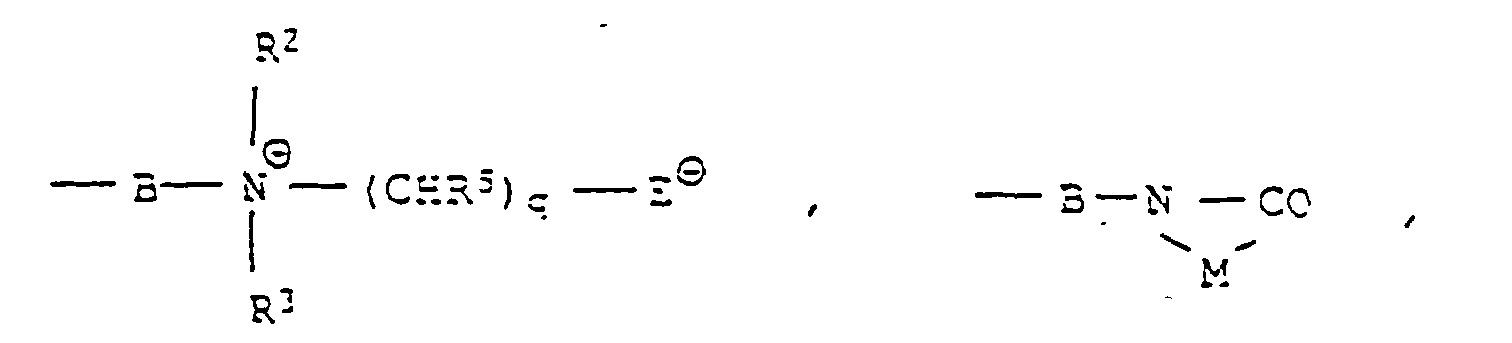

-CH2CH2N+R2R3-CH2-CO2-,
- D-
- Acetat, Formiat, Propionat oder Hydroxyd, vorzugsweise Acetat,
- E-
- Carboxylat oder Sulfonat, vorzugsweise Carboxylat,
- M
- eine Brückengruppierung zur Vervollständigung eines Pyrrolidon-, - oder Succinimid- oder Maleinimidrings als Gruppierung

- n
- 1 bis 50, vorzugsweise 2 bis 25,
- q
- 1 bis 4, vorzugsweise 1,
- x, y
- 1 oder 2 mit der Maßgabe, daß x+y ≤ 3 ist,
- R1
- (C8-C30)- Alkylgruppe oder wenn A = 0 (C4-C12)-alkylsubstituierter Phenylrest, vorzugsweise (C12-C18)-Alkylgruppe, darunter besonders Gemische aus (C13/C15)-Oxoalkoholresten sowie (C12/C14)- und (C16/C18)-Fettalkoholresten; im Fall, daß A für Sauerstoff steht, vorzugsweise tert.-Butyl-, iso-Octyl- und iso-Nonylphenyl,
- R2, R3, R4
- Wasserstoff, Methyl oder Ethyl, vorzugsweise Wasserstoff oder Methyl,
- R5
- Wasserstoff, Methyl.
- Bei den Verbindungen (I) handelt es sich um Alkylenoxid- oder Polyalkylenoxidderivate mit Resten (R1)x-A- und-Z als terminierende Gruppen.
- Die Dispergatoren der allgemeinen Formel (I) finden erfindungsgemäß Verwendung zur Dispergierung feinteiliger Feststoffe in einem fließfähigen Medium (Dispergiermittel).
- Derartige Feststoffe sind bevorzugt oxidische oder nichtoxidische anorganische Pulver und Metallpulver.
- Feinteilig bedeutet, daß die mittleren Korngrößen im allgemeinen 0,1 bis 10 µm betragen.
- Fließfähige Medien, (Dispergiermittel) umfassen Flüssigkeiten, die bei Raumtemperatur flüssig sind, wie Wasser oder organische Lösungsmittel wie Alkohole, Ether, Etheralkohole, Ester, aliphatische und aromatische Kohlenwasserstoffe, halogenierte Kohlenwasserstoffe, Amine, Amide und Nitroverbindungen. Es können auch Mischungen dieser Stoffe verwendet werden.
- Aus den oben genannten feinteiligen Feststoffen, den fließfähigen Medien sowie Verbindungen der Formel (I) sind erfindungsgemäß zu applizierende Zubereitungen erhältlich.
- Die Herstellung der erfindungsgemäß eingesetzten Zubereitungen erfolgt in an sich bekannter Weise. So hat es sich besonders bewährt, im kleinen Maßstab die Dispergierung mit Ultraschallwellen vorzunehmen, indem Dispergiermedium und Dispergator in einem Ultraschallbad mit dem Feststoff versetzt werden.
- Für größere Ansätze wird man zweckmäßigerweise auf die Vermahlung, z.B. in einer Schwingmühle oder Kugelmühle, zurückgreifen.
- Im Sinne der Erfindung als hoch effektive Dispergatoren zur Herstellung von Zubereitungen stabiler, hochkonzentrierter und niedrigviskoser Sprühmedien sind auch Dispergatoren der folgenden Formeln gut geeignet:


-C(O)-O-,
R2 an unterschiedlichen Positionen unabhängig voneinander -H, -CH3 oder -CH2-CH3, B die Gruppierung -HSO3, -H2PO4,
-(CH2)x-C(O)-OZ,
-(CH2)-NH2, -NH-(CH2)x-NH2 oder
-(CH2)x-C(O)-NY2,
in der Z für Wasserstoff, Alkalimetall oder Ammonium,
x für eine ganze Zahl von 1 bis 3 und y für H oder -CH3 steht,
D die Gruppierung >N- oder
>N-C(O)-(CH2)x-,
in der x ebenfalls die obige Bedeutung hat und n eine ganze Zahl von 1 bis 40 ist, bedeutet. - Vorzugsweise werden von den Dispergiermitteln 0,1 bis 10 Gew.-%, besonders bevorzugt 0,5 bis 5 Gew.-%, bezogen auf den Feststoff eingesetzt.
- Die durch das Sprühen aus zwei oder mehreren Düsen erhaltenen Schichten mit unterschiedlichen Zusammensetzungen werden einer thermischen Behandlung ausgesetzt. Diese kann sowohl während des Sprühprozesses als auch danach erfolgen. Erfolgt die thermische Behandlung während des Sprühprozesses, so erfolgt die Ablagerung der zerstäubten Materialien auf ungeheizte oder aufgeheizte Substrate (T=0-1500°C, ungeheizt bevorzugt 0 bis 40 °C, geheizt bevorzugt 150-800 °C).
- Erfolgt die thermische Behandlung nach der Zerstäubung der einzelnen Medien, so kann über die Zeit, in der sich die versprühten Rohmassen bis zu einer nachfolgenden thermischen Behandlung absetzen können, die Porosität der entstehenden Festkörper gesteuert werden. Tendenziell wird ein längeres Absetzen eher dichte Massen ohne Poren erzeugen, während poröse Körper durch direkt nachfolgende thermische Behandlung erzielt werden können.
- Der stoffliche Gradient der Materialkomponenten parallel zur Substratoberfläche ist nützlich, um Legierungen oder Verbindungen von Metallen und/oder Nichtmetallen, gemischte Oxide von Metallen und/oder Nichtmetallen oder andere Verbindungsklassen unterschiedlicher Zusammensetzungen herzustellen, die mittels spraypyrolytischen Verfahren zugänglich sind. Durch geeignete räumliche Anordnung der definierten Plätze auf dem Substrat kann die besprühte Matrix in Sektoren aufgeteilt werden, in denen, nach Art der "Stochastik", es zu einer Anreicherung jeweils einer der Komponenten kommt, so daß ein möglichst großer Bereich der potentiell herstellbaren Komponentenmischungen erzeugt werden kann. Vorzugsweise werden die Sprühdüsen in einer Ebene parallel zur Substratoberfläche angeordnet, so daß sie jeweils den gleichen Abstand zum Substrat haben. Dabei sind die Sprühdüsen so angeordnet, daß sich die Sprühkegel auf der Substratoberfläche überlappen, so daß sich Bereiche unterschiedlicher Zusammensetzung ergeben. Beispielsweise können drei Sprühdüsen in den Ecken eines gleichseitigen Dreiecks angeordnet sein, und die Sprühkegel so eingestellt werden, daß jeweils Bereiche auf dem Substrat erhalten werden, in denen nur eine Materialkomponente, zwei der Materialkomponenten bzw. drei Materialkomponenten vorliegen. Dies bedeutet, daß die Sprühkegel bzw. die auf dem Substrat erhaltenen kreisförmigen Sprühflächen sowohl in der Zweierkombination als auch in der Dreierkombination überlappen. Für die jeweilige Zusammensetzung spielen dabei sowohl die räumliche Düsenanordnung, als auch die Anordnung der definierten Substratplätze eine Rolle. Wie bereits oben beschrieben, kann auch über die zeitliche Abfolge des Besprühens mit unterschiedlichen Komponenten eine weitere Variable bei der Zusammensetzung eingeführt werden.
- Als Matrices oder Substrate eignen sich im Hinblick auf Materialien, die potentiell als Aktivkomponenten in der heterogenen Katalyse Anwendungspotential haben sollen, solche Materialien, die in DE-A-198 05 719 aufgeführt sind. Solche Materialien sind im wesentlichen Trägermaterialien (insbesondere Formkörper, zum Beispiel Röhrchen), die eine Porosität aufweisen wie im wesentlichen Keramiken (Oxide, Nitride, Carbide) wie Glaskeramik oder Sinterquarz, Metalle und Aktivkohlen. Auch glatte oder dichtgesinterte Materialien wie Glas können Einsatz finden. Solche Formkörper können ebenfalls durch geeignete Anordnung von innen oder außen mit den potentiellen Aktivmassen beschichtet werden, zum Beispiel durch Auftrennen von Röhrchen in zwei Hälften, die für einen nachfolgenden katalytischen Test wieder zusammengefügt und dann z.B. wie in DE-A-198 05 719 beschrieben als potentielle Aktivmasse in einem Rohrreaktor eingesetzt werden können.
- Potentielle Komponenten, die als Aktivmassc interessant sein können, sind zum Beispiel Metalle der Gruppen IB, IIB, IIIB, IVB, VB, VIB, VIIB und VIII, sowie Lanthanoiden und Actinoiden, sowie Metalle und Nichtmetalle der Gruppen IA, IIA, IIIA, IVA, VA und VIA.
- Als weitere nützliche Eigenschaften so hergestellter Materialien kommen Eigenschaften wie Supraleitfähigkeit, Sauerstoffionenleitfähigkeit bei erniedrigten Temperaturen kleiner als 900 °C oder hoher Seebeckkoeffizient in Frage.
- Hier sind insbesondere solche Materialien interessant, die Halbleitereigenschaften aufweisen und neben hohen Seebeckkoeffizienten hohe elektrische Leitfähigkeiten und gleichzeitig niedrige Wärmeleitfähigkeiten aufweisen.
- Gemäß der vorstehend beschriebenen Ausführungsform wird das flächige Substrat während des Sprühens nicht bewegt. Dabei ist das flächige Substrat vorzugsweise in einzelne definierte Plätze unterteilt, die voneinander abgegrenzt sind.
- Es ist auch möglich, das flächige Substrat während des Sprühens in mindestens eine Richtung innerhalb der Flächenebene zu verschieben. Dabei liegt das flächige Substrat vorzugsweise in Form eines flächigen flexiblen Bandes vor, das in Längsrichtung durch eine von den Sprühdüsen gebildete Sprühzone bewegt wird. Beispielsweise kann das Band von einer Rolle oder Walze abgewickelt, durch die Sprühzone geführt und auf eine weitere Walze oder Rolle aufgewickelt werden. Die in der Sprühzone, beispielsweise in Bandrichtung hintereinander angeordneten Sprühdüsen können dabei phasenmoduliert betrieben werden. Dabei können beispielsweise auch alle Düsen auf den gleichen Abschnitt des Bandes gerichtet sein. Sowohl durch Steuerung der Vorschubgeschwindigkeit des Bandes als auch zeitlich modulierende Ansteuerung der einzelnen Sprühdüsen ergeben sich variierende Zusammensetzungen auf dem Band.
- Beschichtungsverfahren, bei denen kontinuierliche Verfahren genutzt werden, wie etwa die Beschichtung von Bändern mittels Verfahren des Bandes in eine Richtung unter gleichzeitiger Beschichtung mittels Spraypyrolyse, eignen sich somit ebenfalls für die Herstellung von Materialbibliotheken. Dadurch, daß die versprühte Menge der zu zerstäubenden Komponenten, die sich auf dem mit konstanter Geschwindigkeit laufenden Band ablagert, als Funktion der Zeit für die einzelnen Komponenten phasenverschoben variiert wird (phasenmodulierte Düsensteuerung), besitzt das resultierende Band auf seiner ganzen Länge unterschiedliche Zusammensetzungen, und es kann in den einzelnen Abschnitten auf nützliche Eigenschaften getestet werden. Geeignete Bandmaterialien sind Metallbänder, -netze, -gewebe, -gestricke oder -filze, die für die Testung auf nützliche, wie z.B. katalytische Eigenschaften in Stücke geschnitten und anschließend zu Röhren verarbeitet werden können, um dann z.B. entsprechend DE-A-198 05 719 untersucht zu werden. Prinzipiell ist man nicht auf Metalle als Träger beschränkt, auch Formkörper aus Keramik oder Aktivkohle können so mit potentiellen Aktivmassen beschichtet werden.
Claims (7)
- Verfahren zur kombinatorischen Herstellung einer Bibliothek von Materialien in Form einer zweidimensionalen Matrix im Oberflächenbereich eines flächigen Substrats, bei dem mindestens zwei unterschiedliche sprühfähige Materialkomponenten aus mindestens zwei Sprühdüsen, die vom Substrat und voneinander beabstandet sind, auf dieselbe Seite des Substrats gesprüht werden, so dass in unterschiedlichen Oberflächenbereichen des Substrats Materialien mit unterschiedlicher Zusammensetzung erhalten werden, wobei das Substrat während oder nach dem Sprühen thermisch behandelt und somit eine Spraypyrolyse durchgeführt wird wobei die Sprühdüsen so angeordnet werden, dass sich die Sprühkegel auf der Substratoberfläche überlappen, so dass sich Bereiche unterschiedlicher Zusammensetzung ergeben.
- Verfahren nach Anspruch 1, dadurch gekennzeichnet, dass das flächige Substrat horizontal angeordnet ist und vertikal von oben besprüht wird, wobei sich die Sprühdüsen in einer zum flächigen Substrat parallelen Ebene befinden und im Wesentlichen senkrecht zum flächigen Substrat ausgerichtet sind.
- Verfahren nach Anspruch 1, dadurch gekennzeichnet, dass die sprühfähigen Materialkomponenten ausgewählt sind aus Lösungen, Emulsionen, Suspensionen oder Pulvern von Elementen der Gruppen IB, IIB, IIIB, IVB, VB, VIB, VIIB oder VIII, Lanthanoiden, Actinoiden, IA, IIA, IIIA, IVA, VA, VIA des Periodensystems der Elemente oder deren Verbindungen oder Gemischen davon.
- Verfahren nach einem der Ansprüche 1 bis 3, dadurch gekennzeichnet, dass das Sprühen durch Ultraschallanregung erfolgt.
- Verfahren nach einem der Ansprüche 1 bis 4, dadurch gekennzeichnet, dass das flächige Substrat während des Sprühens nicht bewegt wird.
- Verfahren nach einem der Ansprüche 1 bis 4, dadurch gekennzeichnet, dass das flächige Substrat während des Sprühens in mindestens eine Richtung innerhalb der Flächenebene verschoben wird.
- Verfahren nach Anspruch 6, dadurch gekennzeichnet, dass das flächige Substrat in Form eines flächigen flexiblen Bandes vorliegt, das in Längsrichtung durch eine von den Sprühdüsen gebildete Sprühzone bewegt wird.
Applications Claiming Priority (2)
| Application Number | Priority Date | Filing Date | Title |
|---|---|---|---|
| DE19955789 | 1999-11-19 | ||
| DE19955789A DE19955789A1 (de) | 1999-11-19 | 1999-11-19 | Verfahren zur kombinatorischen Herstellung einer Bibliothek von Materialien |
Publications (2)
| Publication Number | Publication Date |
|---|---|
| EP1101832A1 EP1101832A1 (de) | 2001-05-23 |
| EP1101832B1 true EP1101832B1 (de) | 2007-04-18 |
Family
ID=7929682
Family Applications (1)
| Application Number | Title | Priority Date | Filing Date |
|---|---|---|---|
| EP00124345A Expired - Lifetime EP1101832B1 (de) | 1999-11-19 | 2000-11-17 | Verfahren zur kombinatorischen Herstellung einer Biblithek von Materialien |
Country Status (2)
| Country | Link |
|---|---|
| EP (1) | EP1101832B1 (de) |
| DE (2) | DE19955789A1 (de) |
Cited By (3)
| Publication number | Priority date | Publication date | Assignee | Title |
|---|---|---|---|---|
| WO2011000357A2 (de) | 2009-06-30 | 2011-01-06 | Vascotec Gmbh | Verfahren und vorrichtung zur deposition dünner schichten, insbesondere zur herstellung von multilayerschichten, nanoschichten, nanostrukturen und nanokompositen |
| DE102009031768A1 (de) | 2009-06-30 | 2011-01-13 | Vascotec Gmbh | Verfahren und Vorrichtung zur Deposition dünner Schichten, insbesondere zur Herstellung von Multilayerschichten, Nanoschichten, Nanostrukturen und Nanokompositen |
| DE102015120252A1 (de) | 2015-11-23 | 2017-05-24 | Franz Herbst | Verfahren zur Deposition dünner Schichten |
Families Citing this family (3)
| Publication number | Priority date | Publication date | Assignee | Title |
|---|---|---|---|---|
| DE10139553B4 (de) | 2001-08-10 | 2008-04-10 | Robert Bosch Gmbh | Verfahren zur Herstellung einer Materialbibliothek |
| DE10335968A1 (de) | 2003-08-06 | 2005-02-24 | Basf Ag | Verfahren zur sequentiellen Herstellung einer Heterogenkatalysator-Bibliothek |
| CN101421433B (zh) * | 2006-02-10 | 2013-11-06 | 分子间公司 | 用于联合改变材料、单元工艺和工艺顺序的方法和装置 |
Family Cites Families (9)
| Publication number | Priority date | Publication date | Assignee | Title |
|---|---|---|---|---|
| SE303076B (de) * | 1963-05-15 | 1968-08-12 | Tetra Pak Ab | |
| GB1410169A (en) * | 1971-06-17 | 1975-10-15 | Johnson Matthey Co Ltd | Method of making composite layered structures by spraying |
| CA1217433A (en) * | 1983-08-29 | 1987-02-03 | Westinghouse Electric Corporation | Combustion turbine blade with varying coating |
| JPS6210264A (ja) * | 1985-07-05 | 1987-01-19 | Fujimura Noboru | ハイブリツド被膜の形成方法 |
| GB8627308D0 (en) * | 1986-11-14 | 1986-12-17 | Alcan Int Ltd | Composite metal deposit |
| GB9322565D0 (en) * | 1993-11-02 | 1993-12-22 | Sprayforming Dev Ltd | Improvements in graded composites |
| US6045671A (en) * | 1994-10-18 | 2000-04-04 | Symyx Technologies, Inc. | Systems and methods for the combinatorial synthesis of novel materials |
| US5985356A (en) * | 1994-10-18 | 1999-11-16 | The Regents Of The University Of California | Combinatorial synthesis of novel materials |
| JPH09176819A (ja) * | 1995-10-24 | 1997-07-08 | Mishima Kosan Co Ltd | 複数の溶射機を用いた溶射方法 |
-
1999
- 1999-11-19 DE DE19955789A patent/DE19955789A1/de not_active Withdrawn
-
2000
- 2000-11-17 DE DE50014259T patent/DE50014259D1/de not_active Expired - Fee Related
- 2000-11-17 EP EP00124345A patent/EP1101832B1/de not_active Expired - Lifetime
Cited By (3)
| Publication number | Priority date | Publication date | Assignee | Title |
|---|---|---|---|---|
| WO2011000357A2 (de) | 2009-06-30 | 2011-01-06 | Vascotec Gmbh | Verfahren und vorrichtung zur deposition dünner schichten, insbesondere zur herstellung von multilayerschichten, nanoschichten, nanostrukturen und nanokompositen |
| DE102009031768A1 (de) | 2009-06-30 | 2011-01-13 | Vascotec Gmbh | Verfahren und Vorrichtung zur Deposition dünner Schichten, insbesondere zur Herstellung von Multilayerschichten, Nanoschichten, Nanostrukturen und Nanokompositen |
| DE102015120252A1 (de) | 2015-11-23 | 2017-05-24 | Franz Herbst | Verfahren zur Deposition dünner Schichten |
Also Published As
| Publication number | Publication date |
|---|---|
| DE50014259D1 (de) | 2007-05-31 |
| EP1101832A1 (de) | 2001-05-23 |
| DE19955789A1 (de) | 2001-05-23 |
Similar Documents
| Publication | Publication Date | Title |
|---|---|---|
| DE69604915T2 (de) | Funktionalisierter nanostrukturierter film | |
| DE69534795T2 (de) | Screening von Organometallverbindungen für Katalyse | |
| DE69806757T2 (de) | Film oder beschichtung auf einer unterlage | |
| EP2486163B1 (de) | Atmosphärendruckplasmaverfahren zur herstellung oberflächenmodifizierter partikel und von beschichtungen | |
| DE69621826T2 (de) | Film- oder schicht-abscheidung und pulver herstellung | |
| DE69105605T2 (de) | Beschichtungsverfahren. | |
| DE69717997T2 (de) | Verfahren zur herstellung von trockenen pulverteilchen, pulver hergestellt durch dieses verfahren und eine elektrode und eine vorrichtung zur anwendung in diesem verfahren | |
| DE69900479T2 (de) | Produkt aus SiC und Verfahren zu seiner Herstellung | |
| DE60015725T2 (de) | Erzeugung von Werkstoffen | |
| DE102009031305A1 (de) | Katalysatorbeschichteter Träger, Verfahren zu dessen Herstellung, ein damit ausgestatteter Reaktor und dessen Verwendung | |
| EP4251589B1 (de) | Verfahren zur herstellung von beschichteten substraten sowie beschichtetes substrat und dessen verwendung | |
| WO2008011920A1 (de) | Metallische nanodrähte mit einer hülle aus oxid und herstellungsverfahren derselben | |
| DE602004005137T2 (de) | Verfahren zur Herstellung von Nanopartikeln | |
| DE69512298T2 (de) | Verfahren zur Herstellung eines mit Diamanten beschichteten Gegenstandes | |
| EP3749625B1 (de) | Verfahren zur beschichtung eines substrats mit einer wässrigen suspension enthaltend metallcarbid-partikel | |
| DE19955789A1 (de) | Verfahren zur kombinatorischen Herstellung einer Bibliothek von Materialien | |
| EP0625588A1 (de) | Plasmapolymer-Schichtenfolge als Hartstoffschicht mit definiert einstellbarem Adhäsionsverhalten | |
| DE2124400A1 (de) | Verfahren zur Abscheidung von anorganischen Überzügen aus der Dampfphase | |
| EP1928597B1 (de) | Verfahren zur anlagerung von nanopartikeln an substratpartikel | |
| WO2023012106A1 (de) | Verfahren zur herstellung von beschichteten substraten sowie beschichtetes substrat und dessen verwendung | |
| DE102004026746A1 (de) | Verfahren zur Herstellung einer Dünnfilm- oder Pulveranordnung unter Verwendung eines chemischen Abscheideverfahrens mit einer Flüssigkeitsnebelquelle | |
| EP1044178A1 (de) | Oberflächenbelegte, nichtoxidische keramiken | |
| EP2186922B1 (de) | Verfahren zum Abscheiden einer Nanokomposit-Schicht auf einem Substrat mittels chemischer Dampfabscheidung | |
| EP1244515B1 (de) | Herstellung von materialbibliotheken durch sputterverfahren | |
| EP1172459A2 (de) | Dosierung von Suspensionen im Mikromassstab zur Herstellung von Materialproben in der kombinatorischen Materialforschung |
Legal Events
| Date | Code | Title | Description |
|---|---|---|---|
| PUAI | Public reference made under article 153(3) epc to a published international application that has entered the european phase |
Free format text: ORIGINAL CODE: 0009012 |
|
| AK | Designated contracting states |
Kind code of ref document: A1 Designated state(s): BE DE FR GB NL |
|
| AX | Request for extension of the european patent |
Free format text: AL;LT;LV;MK;RO;SI |
|
| 17P | Request for examination filed |
Effective date: 20010607 |
|
| AKX | Designation fees paid |
Free format text: BE DE FR GB NL |
|
| 17Q | First examination report despatched |
Effective date: 20030415 |
|
| RAP1 | Party data changed (applicant data changed or rights of an application transferred) |
Owner name: HTE AKTIENGESELLSCHAFT THE HIGH THROUGHPUTEXPERIME |
|
| GRAP | Despatch of communication of intention to grant a patent |
Free format text: ORIGINAL CODE: EPIDOSNIGR1 |
|
| GRAS | Grant fee paid |
Free format text: ORIGINAL CODE: EPIDOSNIGR3 |
|
| GRAA | (expected) grant |
Free format text: ORIGINAL CODE: 0009210 |
|
| AK | Designated contracting states |
Kind code of ref document: B1 Designated state(s): BE DE FR GB NL |
|
| REF | Corresponds to: |
Ref document number: 50014259 Country of ref document: DE Date of ref document: 20070531 Kind code of ref document: P |
|
| GBT | Gb: translation of ep patent filed (gb section 77(6)(a)/1977) |
Effective date: 20070823 |
|
| ET | Fr: translation filed | ||
| RIN2 | Information on inventor provided after grant (corrected) |
Inventor name: SCHUNK, STEPHAN Inventor name: HIBST, HARTMUT, PROF. DR. Inventor name: STERZEL, HANS-JOSEF, DR. |
|
| PLBE | No opposition filed within time limit |
Free format text: ORIGINAL CODE: 0009261 |
|
| STAA | Information on the status of an ep patent application or granted ep patent |
Free format text: STATUS: NO OPPOSITION FILED WITHIN TIME LIMIT |
|
| 26N | No opposition filed |
Effective date: 20080121 |
|
| PGFP | Annual fee paid to national office [announced via postgrant information from national office to epo] |
Ref country code: DE Payment date: 20080821 Year of fee payment: 9 Ref country code: NL Payment date: 20081120 Year of fee payment: 9 |
|
| PGFP | Annual fee paid to national office [announced via postgrant information from national office to epo] |
Ref country code: BE Payment date: 20081203 Year of fee payment: 9 |
|
| PGFP | Annual fee paid to national office [announced via postgrant information from national office to epo] |
Ref country code: FR Payment date: 20081118 Year of fee payment: 9 |
|
| PGFP | Annual fee paid to national office [announced via postgrant information from national office to epo] |
Ref country code: GB Payment date: 20081121 Year of fee payment: 9 |
|
| BERE | Be: lapsed |
Owner name: HTE A.G. THE HIGH THROUGHPUT EXPERIMENTATION COMP Effective date: 20091130 |
|
| REG | Reference to a national code |
Ref country code: NL Ref legal event code: V1 Effective date: 20100601 |
|
| GBPC | Gb: european patent ceased through non-payment of renewal fee |
Effective date: 20091117 |
|
| REG | Reference to a national code |
Ref country code: FR Ref legal event code: ST Effective date: 20100730 |
|
| PG25 | Lapsed in a contracting state [announced via postgrant information from national office to epo] |
Ref country code: BE Free format text: LAPSE BECAUSE OF NON-PAYMENT OF DUE FEES Effective date: 20091130 Ref country code: NL Free format text: LAPSE BECAUSE OF NON-PAYMENT OF DUE FEES Effective date: 20100601 Ref country code: FR Free format text: LAPSE BECAUSE OF NON-PAYMENT OF DUE FEES Effective date: 20091130 |
|
| PG25 | Lapsed in a contracting state [announced via postgrant information from national office to epo] |
Ref country code: DE Free format text: LAPSE BECAUSE OF NON-PAYMENT OF DUE FEES Effective date: 20100601 |
|
| PG25 | Lapsed in a contracting state [announced via postgrant information from national office to epo] |
Ref country code: GB Free format text: LAPSE BECAUSE OF NON-PAYMENT OF DUE FEES Effective date: 20091117 |