EP1100628B1 - Off-aperture electrical connection for ultrasonic transducer - Google Patents
Off-aperture electrical connection for ultrasonic transducer Download PDFInfo
- Publication number
- EP1100628B1 EP1100628B1 EP99933066A EP99933066A EP1100628B1 EP 1100628 B1 EP1100628 B1 EP 1100628B1 EP 99933066 A EP99933066 A EP 99933066A EP 99933066 A EP99933066 A EP 99933066A EP 1100628 B1 EP1100628 B1 EP 1100628B1
- Authority
- EP
- European Patent Office
- Prior art keywords
- washer
- transducer
- transducer element
- matching layer
- imaging assembly
- Prior art date
- Legal status (The legal status is an assumption and is not a legal conclusion. Google has not performed a legal analysis and makes no representation as to the accuracy of the status listed.)
- Expired - Lifetime
Links
- 238000003384 imaging method Methods 0.000 claims description 54
- 239000000463 material Substances 0.000 claims description 39
- 239000004020 conductor Substances 0.000 claims description 22
- 239000000853 adhesive Substances 0.000 claims description 15
- 230000001070 adhesive effect Effects 0.000 claims description 15
- 238000004891 communication Methods 0.000 claims description 13
- 239000012811 non-conductive material Substances 0.000 claims description 10
- 239000004642 Polyimide Substances 0.000 claims description 5
- 229920001721 polyimide Polymers 0.000 claims description 5
- 239000010410 layer Substances 0.000 description 93
- 239000004593 Epoxy Substances 0.000 description 14
- 238000002604 ultrasonography Methods 0.000 description 9
- 230000000712 assembly Effects 0.000 description 6
- 238000000429 assembly Methods 0.000 description 6
- BQCADISMDOOEFD-UHFFFAOYSA-N Silver Chemical compound [Ag] BQCADISMDOOEFD-UHFFFAOYSA-N 0.000 description 5
- 229910052709 silver Inorganic materials 0.000 description 5
- 239000004332 silver Substances 0.000 description 5
- RYGMFSIKBFXOCR-UHFFFAOYSA-N Copper Chemical compound [Cu] RYGMFSIKBFXOCR-UHFFFAOYSA-N 0.000 description 4
- 229910000831 Steel Inorganic materials 0.000 description 4
- 239000012790 adhesive layer Substances 0.000 description 4
- 229910052802 copper Inorganic materials 0.000 description 4
- 239000010949 copper Substances 0.000 description 4
- 238000000034 method Methods 0.000 description 4
- 229910001220 stainless steel Inorganic materials 0.000 description 4
- 239000010935 stainless steel Substances 0.000 description 4
- 239000010959 steel Substances 0.000 description 4
- 238000012285 ultrasound imaging Methods 0.000 description 4
- 230000000644 propagated effect Effects 0.000 description 3
- 229920002799 BoPET Polymers 0.000 description 2
- VYZAMTAEIAYCRO-UHFFFAOYSA-N Chromium Chemical compound [Cr] VYZAMTAEIAYCRO-UHFFFAOYSA-N 0.000 description 2
- 239000005041 Mylar™ Substances 0.000 description 2
- PXHVJJICTQNCMI-UHFFFAOYSA-N Nickel Chemical compound [Ni] PXHVJJICTQNCMI-UHFFFAOYSA-N 0.000 description 2
- 230000008901 benefit Effects 0.000 description 2
- 230000005540 biological transmission Effects 0.000 description 2
- 238000013461 design Methods 0.000 description 2
- 229920001971 elastomer Polymers 0.000 description 2
- PCHJSUWPFVWCPO-UHFFFAOYSA-N gold Chemical compound [Au] PCHJSUWPFVWCPO-UHFFFAOYSA-N 0.000 description 2
- 229910052737 gold Inorganic materials 0.000 description 2
- 239000010931 gold Substances 0.000 description 2
- 229910052751 metal Inorganic materials 0.000 description 2
- 239000002184 metal Substances 0.000 description 2
- 238000012986 modification Methods 0.000 description 2
- 230000004048 modification Effects 0.000 description 2
- 239000004033 plastic Substances 0.000 description 2
- 229920003023 plastic Polymers 0.000 description 2
- 229920002635 polyurethane Polymers 0.000 description 2
- 239000004814 polyurethane Substances 0.000 description 2
- 239000005060 rubber Substances 0.000 description 2
- 239000007787 solid Substances 0.000 description 2
- 239000000758 substrate Substances 0.000 description 2
- WFKWXMTUELFFGS-UHFFFAOYSA-N tungsten Chemical compound [W] WFKWXMTUELFFGS-UHFFFAOYSA-N 0.000 description 2
- 229910052721 tungsten Inorganic materials 0.000 description 2
- 239000010937 tungsten Substances 0.000 description 2
- 229910001369 Brass Inorganic materials 0.000 description 1
- 239000004677 Nylon Substances 0.000 description 1
- 239000004698 Polyethylene Substances 0.000 description 1
- 239000002313 adhesive film Substances 0.000 description 1
- 230000002411 adverse Effects 0.000 description 1
- 210000003484 anatomy Anatomy 0.000 description 1
- 210000004204 blood vessel Anatomy 0.000 description 1
- 239000010951 brass Substances 0.000 description 1
- 230000008878 coupling Effects 0.000 description 1
- 238000010168 coupling process Methods 0.000 description 1
- 238000005859 coupling reaction Methods 0.000 description 1
- 230000000593 degrading effect Effects 0.000 description 1
- 239000012530 fluid Substances 0.000 description 1
- 229910052759 nickel Inorganic materials 0.000 description 1
- 229920001778 nylon Polymers 0.000 description 1
- -1 polyethylene Polymers 0.000 description 1
- 229920000573 polyethylene Polymers 0.000 description 1
- 238000012545 processing Methods 0.000 description 1
- 229910000679 solder Inorganic materials 0.000 description 1
- 125000000391 vinyl group Chemical group [H]C([*])=C([H])[H] 0.000 description 1
- 229920002554 vinyl polymer Polymers 0.000 description 1
- 238000003466 welding Methods 0.000 description 1
Images

Classifications
-
- B—PERFORMING OPERATIONS; TRANSPORTING
- B06—GENERATING OR TRANSMITTING MECHANICAL VIBRATIONS IN GENERAL
- B06B—METHODS OR APPARATUS FOR GENERATING OR TRANSMITTING MECHANICAL VIBRATIONS OF INFRASONIC, SONIC, OR ULTRASONIC FREQUENCY, e.g. FOR PERFORMING MECHANICAL WORK IN GENERAL
- B06B1/00—Methods or apparatus for generating mechanical vibrations of infrasonic, sonic, or ultrasonic frequency
- B06B1/02—Methods or apparatus for generating mechanical vibrations of infrasonic, sonic, or ultrasonic frequency making use of electrical energy
- B06B1/06—Methods or apparatus for generating mechanical vibrations of infrasonic, sonic, or ultrasonic frequency making use of electrical energy operating with piezoelectric effect or with electrostriction
- B06B1/0644—Methods or apparatus for generating mechanical vibrations of infrasonic, sonic, or ultrasonic frequency making use of electrical energy operating with piezoelectric effect or with electrostriction using a single piezoelectric element
- B06B1/0662—Methods or apparatus for generating mechanical vibrations of infrasonic, sonic, or ultrasonic frequency making use of electrical energy operating with piezoelectric effect or with electrostriction using a single piezoelectric element with an electrode on the sensitive surface
- B06B1/067—Methods or apparatus for generating mechanical vibrations of infrasonic, sonic, or ultrasonic frequency making use of electrical energy operating with piezoelectric effect or with electrostriction using a single piezoelectric element with an electrode on the sensitive surface which is used as, or combined with, an impedance matching layer
-
- A—HUMAN NECESSITIES
- A61—MEDICAL OR VETERINARY SCIENCE; HYGIENE
- A61B—DIAGNOSIS; SURGERY; IDENTIFICATION
- A61B8/00—Diagnosis using ultrasonic, sonic or infrasonic waves
- A61B8/44—Constructional features of the ultrasonic, sonic or infrasonic diagnostic device
- A61B8/4483—Constructional features of the ultrasonic, sonic or infrasonic diagnostic device characterised by features of the ultrasound transducer
- A61B8/4494—Constructional features of the ultrasonic, sonic or infrasonic diagnostic device characterised by features of the ultrasound transducer characterised by the arrangement of the transducer elements
Definitions
- the present invention relates generally to ultrasonic imaging catheters, and more particularly, to catheters having improved electrical connections for ultrasonic transducers.
- Intravascular imaging of blood vessels and surrounding tissues continues to be of great benefit in a wide range of medical fields.
- a particularly successful design for an intravascular imaging catheter employs a rotatable imaging assembly containing an ultrasonic transducer, where the assembly is attached to the distal end of a flexible drive cable.
- the transducer may be rotated within a catheter body or sheath in order to transmit an ultrasonic signal and produce a video image by well-known techniques.
- the transducer element or elements are connected to electronics, typically maintained outside the patient's body, to produce the video image.
- an electrode or lead typically is physically attached to either the transducer face, or to the face of a matching layer which is, in turn, attached to the transducer face.
- an attachment e.g., a soldered silver attachment point
- the attachment interferes with or blocks at least part of the transmitted and/or reflected signals. This problem is further exacerbated by the fact that such attachments often are made by hand. Attachments made by hand typically vary in both size and location from catheter to catheter. As a result, it can be difficult to predict the amount of interference the attachment will produce for a particular imaging catheter.
- the placement and attachment of the transducer onto the imaging assembly likewise presents difficulties. For example, it often is desirable to attach the transducer element to the imaging assembly so that the element is positioned at a certain angle, or a desired offset, with respect to the assembly centerline. For transducers that are placed and affixed by hand, the angle and offset can vary between otherwise identical catheters.
- JP 07322393 discloses a transducer arrangement comprising a variable thickness metal matching layer, one surface of which is connected to a transducer and the sides ofwhich are connected to a metal vessel.
- connections of the present invention are intended to overcome of at least alleviate at least some of the problems of the prior art.
- connections of the present invention move the electrode or front lead attachment off-aperture, or off the transducer face. This reduces or eliminates the interference such attachment points may cause to the ultrasound signals transmitted from and/or received by the transducer element.
- imaging assemblies of the present invention are designed to reduce or eliminate the catheter-to-catheter variations in the transducer's offset and angular position with respect to the assembly housing centerline. Such assemblies are hence more uniform and predictable.
- the electrical connection is made with a reduced concern as to the size or precise location of the attachment point because the lead is attached to the washer and not to the transducer or matching layer face.
- the matching layer includes a material having an acoustic impedance that is lower than an impedance of the transducer element.
- a matching layer is particularly useful since transducer elements typically have a significantly higher impedance than an impedance of the surrounding tissue being imaged.
- the matching layer includes an electrically conductive material. In this manner, the matching layer helps facilitate an electrical connection between the transducer element and the washer.
- the second matching layer surface incudes an electrically conductive material.
- the second matching layer-surface is operably attached to the washer using an electrically conductive adhesive material.
- the second matching layer surface is operably attached to the washer using an electrically non-conductive adhesive material, an ultrasonic or thermal bond, or the like.
- the washer includes a flexible circuit, such as a polyimide having at least one electrode.
- the electrode may be a gold-plated electrode pattern, a copper electrode pattern, or the like.
- at least a portion of the washer comprises an electrically conductive material.
- the washer has first and second washer surfaces, an outer diameter and an inner diameter.
- the washer outer diameter preferably is greater than a matching layer diameter.
- the matching layer and washer can be operably attached to one another, while leaving a portion of the washer exposed to permit a lead or electrode to be attached thereto.
- the washer and matching layer also may have an elliptical or oval shape. In such a case, the washer has an outer major axis and an inner major axis, with the washer outer major axis being greater than a matching layer major axis.
- the first washer surface comprises an electrically conductive material and is operably attached to the matching layer.
- a lead is operably attached to the first washer surface.
- the transducer element has an outer diameter or major axis that is about equal to the washer's inner diameter or inner major axis, respectively. In this manner, the transducer element is disposed within the washer hole so that the transducer element is in communication with an inner edge of the washer.
- the transducer element may be operably attached to the washer inner edge using an electrically conductive epoxy or the like.
- the transducer element may have an outer diameter or major axis that is less than the washer inner diameter or inner major axis. This configuration creates a gap between the transducer element and the washer's inner edge when the transducer element is disposed within the washer hole.
- the transducer element, washer and matching layer are all generally disk-shaped, although other shapes are possible within the scope of the present invention.
- the matching layer preferably has a diameter or major axis that is greater than the transducer element's diameter or major axis. Such a relationship facilitates electrical connections between the transducer element and matching layer, and between the matching layer and washer.
- the washer has a thickness that is greater than the transducer element's thickness. In this manner, the transducer element may be completely disposed within the washer hole.
- a transducer connection apparatus further includes a bond layer operably attached to the transducer element.
- the bond layer is at least partially disposed within the washer hole.
- the matching layer is operably attached to the washer and bond layer such that an electrical connection is established between the washer and the transducer element. In this manner, the bond layer acts as a second matching layer for the transducer element.
- the bond layer includes an electrically conductive adhesive material for bonding the transducer element and washer to the matching layer.
- the bond layer comprises an electrically non-conductive adhesive material for bonding the transducer element and washer to the matching layer.
- the non-conductive bond layer further includes an electrode operably attached to the transducer element and washer.
- the invention further provides an imaging assembly according to claim 26.
- the housing and lead are adapted to be attached to a cable.
- the housing and lead are adapted to be attached to an integrated coaxial/drive cable.
- a portion of the housing forms a generally flat surface to which the connection apparatus is operably attached.
- the surface is positioned generally parallel to the housing longitudinal axis.
- the surface is positioned to form a desired angle with the housing longitudinal axis, preferably, an angle that is between about -60 degrees and about +60 degrees, and more preferably, between about -15 degrees and about +15 degrees.
- the housing preferably is formed with a throughhole.
- the washer is operably attached to the surface to at least partially cover a first opening of the throughhole.
- a backing material is provided within the throughhole, preferably, a backing comprising sound-attenuating material.
- the backing material includes an electrically conductive material, and the transducer element is in electrical communication with the backing. In this manner, a back side electrical connection or negative connection or ground can be formed between the housing and the transducer element.
- the transducer element is in electrical communication with the housing.
- the backing material comprises an electrically non-conductive material.
- An electrode is provided that is operably attached to the transducer element and the housing. In this manner, the electrode provides a back side electrical connection or negative connection or ground from the transducer element to the housing.
- the transducer element is fully disposed within the washer hole.
- the housing includes a cap to enclose a second opening of the throughhole to form an air-filled cavity. In this matter, air operates as the backing material.
- the assembly further comprises an electrode that is operably attached to the transducer element and to the washer to provide a second electrical connection therebetween.
- the housing is formed with an air-filled cavity.
- the transducer apparatus is operably attached to the housing to at least partially cover an opening of the cavity.
- the transducer element is in electrical communication with the housing.
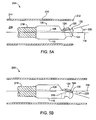
- Transducer connection apparatus 10 includes a washer 12.
- Washer 12 has an outer diameter 16 and an inner diameter 14 defining a washer hole 15.
- Washer 12 further includes a first washer surface 18, a second washer surface 20 and a washer thickness 22.
- Connection apparatus 10 includes a transducer element 24 having a diameter 34, a first face 35 and a second face 37.
- Transducer element diameter 34 and washer inner diameter 14 are adapted to allow transducer element 24 to be at least partially disposed within washer hole 15.
- Transducer element 24 may comprise piezocomposite materials, piezoceramics (such as PZT), piezoplastics, and the like.
- Connection apparatus 10 further includes a matching layer 26, having a first matching layer surface 28, a second matching layer surface 30, a matching layer thickness 32 and a matching layer diameter 36.
- Matching layer 26 is operably attached to washer 12, and preferably, is operably attached to first washer surface 18.
- washer outer diameter 16 is greater than matching layer diameter 36, and matching layer diameter 36 is greater than transducer element diameter 34.
- Transducer element 24 is disposed within washer hole 15 so that matching layer 26 is operably attached to washer 12 and to transducer element 24, and more preferably to transducer first face 35.
- matching layer 26 and transducer element 24 are proximate each other to provide for an electrical connection therebetween.
- transducer element 24 may be partially disposed within washer hole 15, such as when transducer element 24 has a thickness that is greater than washer thickness 22.
- Figs. 1A-1C depict washer 12, transducer element 24 and matching layer 26 as generally disk-shaped, these components may have a variety of shapes within the present invention.
- washer 12, transducer element 24 and matching layer 26 may be generally elliptical or oval in shape.
- diameters 34 and 36 would be major axis 34 and 36
- outer diameter 16 would be an outer major axis 16
- inner diameter 14 would be an inner major axis 14.
- washer 12 and matching layer 26 permit an electrical connection to be established between transducer element 24 and washer 12. Such a connection may be accomplished using a variety of methods.
- washer 12 and matching layer 26 may at least partially comprise electrically conductive materials. In this manner, electrical signals may be transferred between washer 12 and matching layer 26, and between matching layer 26 and transducer element 24.
- second matching layer surface 30 is operably attached to both transducer element 24 and washer first surface 18 using a thin layer of electrically conductive or non-conductive adhesive (not shown).
- the adhesive layer is thin enough to be generally acoustically transparent.
- an electrically conductive adhesive layer establishes an electrical connection between transducer element 24 and first washer surface 18.
- the adhesive layer provides the electrical conductive path between transducer element 24 and washer first surface 18.
- electrically conductive adhesive permits the use of matching layer 26 comprising either electrically conductive materials, such as silver-filled epoxy, tungsten-filled epoxy, or the like, or electrically non-conductive materials, such as mylar, polyimide, polyurethane or the like.
- matching layer 26 can be operably attached to transducer element 24 and first washer surface 18 using a thin layer of electrically non-conductive adhesive.
- matching layer 26 comprises an electrically conductive material, or second matching layer face 30 is coated with an electrically conductive material.
- the non-conductive adhesive layer is thin enough to permit a molecular contact between transducer first face 35 and second matching layer surface 30. The result is an ohmic, electrically-conductive contact.
- some roughness to the second matching layer surface 30, or to transducer first face 35 facilitates an electrically conductive bond.
- second matching layer surface 30 is electrically coupled to first washer face 18.
- Washer 12 may comprise electrically conductive materials, such as brass, copper, stainless steel or the like. Washer 12 also may comprise electrically non-conductive materials, such as polyimide, vinyl, mylar or the like. For washer 12 comprising electrically conductive material, a lead 38 may be attached using an attachment point 40 made directly to washer 12. Lead 38 then may be connected to other electronics, such as to ultrasound imaging equipment and the like. For washer 12 comprising electrically non-conductive material, washer 12 may require an electrode, electrically conductive film, or the like to be attached to washer 12 in order to complete an electrical connection to transducer element 24.
- Washer 12 also may comprise a flexible circuit board.
- a flex circuit typically consists of a substrate, for example a polyimide substrate, and an electrode pattern, preferably comprising a gold-plated or a copper electrode pattern.
- the flex circuit electrodes are electrically connected to lead 38 and to either an electrically conductive adhesive or to matching layer 26 to permit washer 12 to be in electrical communication with transducer element 24.
- electrical signals may be sent to and received from transducer element 24 by connecting electronics, such as ultrasound imaging equipment, to washer 12.
- transducer element diameter 34 is about equal to washer inner diameter 14, so that transducer element 24 is in contact with an inner edge 42 of washer 12.
- Transducer element 24 may be operably attached to washer 12 using electrically conductive epoxy, electrically non-conductive epoxy, or the like. Such material also may serve as a transducer backing material, depending upon the method used to establish a back side electrical connection, negative contact or ground for the transducer, as further described below. Physical contact between transducer element 24 and washer inner edge 42 results in transducer element 24 and washer 12 being acoustically coupled. Such a relationship does not significantly degrade transducer element 24 operation, provided that washer 12 comprises material that is acoustically lossive, such as epoxy, rubber or the like.
- Apparatus 10 In order to send electrical signals to, or receive signals from, transducer element 24, an electrical connection only need be made to washer 12. Apparatus 10 thereby eliminates the need to solder or otherwise affix an electrical connection, such as lead 38, directly to transducer element 24 or to matching layer 26.
- Lead attachment point 40 which may include silver, gold/chrome, gold/chrome/nickel, copper or the like, is made to washer 12. By making attachment point 40 to washer 12, instead of to transducer element first face 35 or to first matching layer surface 28, attachment point 40 does not interfere with ultrasound signals sent and/or received by transducer element 24. As a result, the variability of attachment point 40 size and location is a reduced concern due to its minimal impact on transducer element 24 performance.
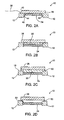
- FIG. 2A depicts connection apparatus 10 as previously described in conjunction with Figs. 1A-1C, with the exception that transducer element diameter 34 is smaller than washer inner diameter 14. This results in a gap 44, preferably an air-filled gap, between transducer element 24 and washer inner edge 42.
- transducer element 24 is operably attached to matching layer 26, or to other components of an imaging assembly (not shown in Fig. 2).
- the back side electrical connection to transducer element 24 is made using electrically conductive transducer backing (see Fig. 3A).
- Transducer connection apparatus 10 depicted in Figs. 2B and 2C are similar to apparatus 10 described in conjunction with Fig. 1, with the exception that the adhesive film is enlarged to comprise a bond layer 50.
- Bond layer 50 preferably comprises an electrically conductive, adhesive material to operably attach matching layer 26 to washer 12 and transducer element 24.
- bond layer 50 may comprise silver epoxy or the like.
- Bond layer 50 further preferably has an ultrasound impedance that is between the impedance of transducer element 24 and the impedance of matching layer 26.
- Such relative impedances facilities an in-phase alignment of the ultrasonic signal propagated by transducer element 24 with the portion of the propagated signal reflected by bond layer 50.
- Multiple matching layers result in improved efficiency and band width compared to single matching layer designs due, in part, to providing smaller, but more frequent impedance changes between the transducer and the surrounding tissue or fluid being imaged.
- Fig. 2B depicts bond layer 50 fully disposed within washer hole 15.
- matching layer 26 preferably is electrically conductive to provide an electrical connection between matching layer 26 and washer 12.
- second matching layer surface 30 can comprise electrically conductive material, or be coated with electrically conductive material to facilitate an electrical connection between bond layer 50 and washer 12.
- Fig. 2C depicts bond layer 50 being partially disposed within washer hole 15. Such an arrangement is particularly useful when matching layer 26 comprises an electrically non-conductive material. Electrically conductive bond layer 50 provides the electrical connection between transducer element 24 and first washer surface 18.
- Fig. 2D depicts transducer connection apparatus 10 having bond layer 50 comprising an electrically non-conductive material.
- Bond layer 50 (not cross-hatched for convenience of illustration) contains an electrode or lead 52, which operably connects transducer element 24 to washer 12. In this manner, lead 52 transmits electrical signals from transducer element 24 to washer 12.
- bond layer 50 may comprise electrically non-conductive material and be fully disposed within washer hole 15 (as depicted in Fig. 2B).
- matching layer 26 preferably comprises electrically conductive material and lead 52 provides an electrical connection between transducer element 24 and second matching layer surface 30. Second matching layer surface 30 is in electrical communication with washer 12.
- modifications may be made to the above described embodiments within the scope of the present invention. For example, additional matching layers may be added, provided the desired electrical connection between transducer element 24 and washer 12 is maintained.
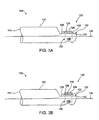
- An imaging assembly 100 comprises a housing 110, having a distal end 112, a proximal end 114 and a longitudinal axis 116. While housing 110 is shown to have a generally cylindrical shape, other housing 110 shapes are possible within the scope of the present invention. Housing 110 preferably comprises a hollow housing for embodiments having a throughhole with solid transducer backing, although a solid housing can be used within the scope of the present invention. Housing 110 preferably comprises stainless steel, nickel-plated steel, tin-plated steel, gold-plated steel or the like.
- housing 110 provides sufficient mechanical strength to enable housing 110 to be operably attached to a cable, such as a stainless steel drive cable (not shown in Fig. 3).
- Housing 110 also can comprise an epoxy-like material, plastics or the like. Such materials provide desirable sound attenuating and/or electrical conductivity properties.
- Imaging assembly 100 further includes a transducer connection apparatus 120.
- connection apparatus 120 includes a washer 122, a transducer element 124, a matching layer 126 and a lead 128 operably attached to washer 122.
- Fig. 3A depicts an embodiment without a bond layer.
- Fig. 3B depicts an embodiment having a bond layer 118 as previously described. Bond layer 118 is between matching layer 126 and transducer element 124, and is operably attached to washer 122 surface.
- Housing 110 further includes a throughhole 130 formed through at least a portion of housing 110, and a generally flat surface 132 located near distal end 112.
- Connection apparatus 120 is operably attached to surface 132 in a manner which positions transducer element 124 over an opening to throughhole 130.
- Washer 122 further operably attaches to surface 132 in a manner which positions transducer element 124 at a known offset from longitudinal axis 116. Offset is defined as the distance the transducer element 124 upper surface is located away from axis 116.
- transducer element 124 is positioned at a known angular relationship to axis 116 by operably attaching washer 122 to surface 132.
- Fig. 3 depicts surface 132, transducer 124 and axis 116 as being generally parallel.
- transducer element 124 For housing 110 comprising stainless steel, or the like, it is preferable to have transducer element 124 fully disposed within the washer hole (as shown in Fig. 3), because lateral coupling to hard materials such as steel is acoustically undesirable.
- transducer element 124 can extend into throughhole 130 without degrading transducer element 124 performance.
- Throughhole 130 preferably is filled with a backing material 136.
- Backing material 136 is selected to have sound attenuating qualities so that ultrasound signals propagated into the backing are not reflected by backing material 136, which would result in artifacts.
- Backing material 136 may comprise electrically conductive material, such as epoxy, silver/tungsten epoxy or the like.
- transducer element 124 preferably rests on, and/or is operably attached to, backing material 136. In this manner, electrically conductive backing material 136 provides a back side electrical connection or negative conductive path, or ground, between transducer element 124 and housing 110.
- backing material 136 may comprise electrically non-conductive material, such as epoxy, polyurethane, rubber or the like.
- transducer element 124 preferably has a second lead (not shown) to connect the throughhole-facing surface of transducer element 124 to housing 110.
- electrically conductive epoxy, or the like can be used to directly connect the throughhole-facing surface of transducer element 124 to housing 110.
- Transducer element 124 also may be grounded by connecting transducer element 124 directly to an electrically conductive washer 122 that is, in turn, connected to housing 110. Such a connection may be made using electrically conductive epoxy or the like. Washer 122 can provide both the positive and negative connection provided that the two are kept separate. For instance, a center conductor and shield of a miniature coaxial cable can be terminated to the washer, which provides both the positive and negative connection to transducer element 124.
- Imaging assembly 100 therefore provides a way to move the electrical attachment point for lead 128 to washer 122.
- Imaging assembly 100 further positions transducer element 124 at a known offset and angular relationship to axis 116 by mounting connection apparatus 120 to surface 132.
- manually positioned and attached transducer elements are typically attached within throughhole 130.
- Such transducer elements have an offset and angular relationship that can vary between otherwise identical imaging assemblies.
- Lead 128 preferably is adapted to be in communication with a cable, and more preferably, with an integrated coaxial/drive cable. In this manner, electrical signals can be sent to, and received from, transducer element 124.
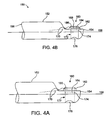
- An imaging assembly 150 includes a housing 152, having a distal end 154, a proximal end 156 and a longitudinal axis 158.
- a transducer connection apparatus 160 is provided, having a washer 162, a transducer element 164 and a matching layer 166.
- Fig. 4B depicts apparatus 150 also having a bond layer 168 disposed within washer 162 hole.
- Connection apparatus 160 is similar to connection apparatus 10 described in conjunction with Figs. 1 and 2.
- Imaging assembly 150 includes a lead 170, and an air-filled cavity 172 in housing 152.
- Cavity 172 may comprise a throughhole as shown in Fig. 2 with a cap 176 enclosing a second end of the throughhole.
- cavity 172 may comprise a cavity that does not extend completely through housing 152. Since air has an acoustic impedance of about 0.0004 megarayls, air-filled cavity 172 provides a nearly perfect reflection. Therefore, ultrasound waves typically will not emanate from the cavity-facing side of transducer element 164.
- Imaging assembly 150 may have one or more matching layers 166. As shown in Fig. 4B, imaging assembly 150 has bond layer 168 acting as the second matching layer for transducer element 164.
- transducer element 164 preferably is operably attached to the interior walls of cavity 172 using at least one attachment point 174.
- Attachment points 174 may comprise electrically conductive epoxy, or the like.
- a back side electrical connection or ground connection may be established by operably attaching transducer element 164 to washer 162, provided washer 162 is electrically conductive and is operably attached to housing 152.
- Catheter system 200 comprises a catheter body or sheath 210 having a distal end 212, a proximal end 214, and a working lumen 216.
- Sheath 210 preferably is fully sonolucent, or includes a portion of sonolucent material, to provide desirable acoustic transmissiveness.
- Sheath 210 may comprise nylon, polyethylene or the like.
- Imaging assembly 100 is disposed within lumen 216 and operably attached to a cable 218. Cable 218 preferably comprises an integrated coaxial/drive cable. Exemplary cables 218 are described in U.S. Patent Application Serial No.
- Imaging assembly 100 preferably is operably attached to a distal end of cable 218 by welding, electrically conductive adhesive or the like. This results in a mechanical connection between imaging assembly 100 and cable 218. Rotation of cable 218, in turn, rotates imaging assembly 100.
- Imaging assembly 100 and in particular, connection apparatus 120, are essentially as described in conjunction with Fig. 3.
- housing 110 is formed with surface 132 having a desired angle 222 with respect to axis 116.
- Angle 222 preferably is between about +60 degrees and about -60 degrees, and more preferably, between about + 15 degrees (as approximately shown in Fig. 5A) and about - 15 degrees (as approximately shown in Fig. 5B).
- ultrasound signals transmitted by transducer element 124 are less likely to be reflected by sheath or catheter body 210 during operation of catheter system 200.
- transducer element 124 By forming housing 100 so that surface 132 is at known angle 222 with respect to axis 116, transducer element 124 likewise is positioned at a known angle with respect to axis 116. In contrast, attaching transducer element 124 by hand to the inside of cavity 130, as may be done in the prior art, results in variations in the angle between axis 116 and transducer element 124. Therefore, catheter system 200 reduces or eliminates the catheter-to-catheter variation in angle 222 that typically occurs when transducer element 124 is attached by hand.
- lead 128 preferably is operably attached to washer 122 and to cable 218.
- an electrical connection is established between transducer element 124 and cable 218.
- desired electronics can transmit a signal through cable 218, through lead 128, and to washer 122.
- a positive electrical connection is made between washer 122 and transducer element 124 to allow the signal to reach transducer element 124.
- Lead 128 may comprise a center wire or lead from integrated coaxial/drive cable 218.
- the coaxial cable shield (not shown in Fig. 5) is terminated at a distal end of drive cable 218.
- the coaxial center wire or lead comprises, or operably attaches to, lead 128.
- Lead 128 is operably attached to washer 122, as previously discussed.
- a back side electrical connection or negative connection or ground is established between transducer element 124 and housing 110 as previously discussed.
- a second electrode 220 may be used to connect a cavity-facing side of transducer element 124 to housing 110 or to the coaxial cable shield (not shown).
- catheter system 200 comprises inserting catheter system 200 into a patient and positioning imaging assembly 100 at a desired location within the patient's anatomy.
- Drive cable 218 is rotated which, in turn, rotates imaging assembly 100 containing transducer element 124.
- Transducer element 124 is excited using an electrical or other signal transmitted through cable 218 and into transducer element 124.
- Transducer element 124 propagates ultrasound signals into the patient's tissue surrounding the imaging assembly 100. Ultrasound signals reflect off the patient's tissue and are received by transducer element 124.
- the present invention using improved transducer connection apparatus, reduces or eliminates the signal interference typically caused by attaching a lead or electrode to the transducer element 124 surface.
- the reflected signals are transmitted through cable 218 to ultrasound signal processing electronics which produces an image of the patient's tissue.
Landscapes
- Health & Medical Sciences (AREA)
- Life Sciences & Earth Sciences (AREA)
- Engineering & Computer Science (AREA)
- Heart & Thoracic Surgery (AREA)
- Molecular Biology (AREA)
- Nuclear Medicine, Radiotherapy & Molecular Imaging (AREA)
- Pathology (AREA)
- Radiology & Medical Imaging (AREA)
- Physics & Mathematics (AREA)
- Biomedical Technology (AREA)
- Gynecology & Obstetrics (AREA)
- Medical Informatics (AREA)
- Biophysics (AREA)
- Surgery (AREA)
- Animal Behavior & Ethology (AREA)
- General Health & Medical Sciences (AREA)
- Public Health (AREA)
- Veterinary Medicine (AREA)
- Mechanical Engineering (AREA)
- Ultra Sonic Daignosis Equipment (AREA)
- Transducers For Ultrasonic Waves (AREA)
Applications Claiming Priority (3)
| Application Number | Priority Date | Filing Date | Title |
|---|---|---|---|
| US09/127,089 US6113546A (en) | 1998-07-31 | 1998-07-31 | Off-aperture electrical connection for ultrasonic transducer |
| US127089 | 1998-07-31 | ||
| PCT/IB1999/001348 WO2000006309A2 (en) | 1998-07-31 | 1999-07-29 | Off-aperture electrical connection for ultrasonic transducer |
Publications (2)
| Publication Number | Publication Date |
|---|---|
| EP1100628A2 EP1100628A2 (en) | 2001-05-23 |
| EP1100628B1 true EP1100628B1 (en) | 2006-06-07 |
Family
ID=22428248
Family Applications (1)
| Application Number | Title | Priority Date | Filing Date |
|---|---|---|---|
| EP99933066A Expired - Lifetime EP1100628B1 (en) | 1998-07-31 | 1999-07-29 | Off-aperture electrical connection for ultrasonic transducer |
Country Status (7)
| Country | Link |
|---|---|
| US (2) | US6113546A (enExample) |
| EP (1) | EP1100628B1 (enExample) |
| JP (1) | JP2002521163A (enExample) |
| CA (1) | CA2339130A1 (enExample) |
| DE (1) | DE69931788T2 (enExample) |
| ES (1) | ES2265185T3 (enExample) |
| WO (1) | WO2000006309A2 (enExample) |
Families Citing this family (25)
| Publication number | Priority date | Publication date | Assignee | Title |
|---|---|---|---|---|
| US6723063B1 (en) | 1998-06-29 | 2004-04-20 | Ekos Corporation | Sheath for use with an ultrasound element |
| DE60209799T2 (de) | 2001-12-03 | 2007-01-25 | Ekos Corp., Bothell | Katheter mit mehreren ultraschall-abstrahlenden teilen |
| CA2468975A1 (en) * | 2001-12-14 | 2003-06-26 | Ekos Corporation | Blood flow reestablishment determination |
| AU2002367296A1 (en) | 2001-12-28 | 2003-07-24 | Ekos Corporation | Multi-resonant ultrasonic catheter |
| US8226629B1 (en) | 2002-04-01 | 2012-07-24 | Ekos Corporation | Ultrasonic catheter power control |
| US20060116584A1 (en) * | 2002-12-11 | 2006-06-01 | Koninklijke Philips Electronic N.V. | Miniaturized ultrasonic transducer |
| AU2003900260A0 (en) * | 2003-01-22 | 2003-02-06 | Uscom Pty Ltd | Ultrasonic transducer device |
| US20050154308A1 (en) * | 2003-12-30 | 2005-07-14 | Liposonix, Inc. | Disposable transducer seal |
| JP2007525263A (ja) | 2004-01-29 | 2007-09-06 | イコス コーポレイション | カテーテルによる血管の状態の検出方法及び装置 |
| US7698949B2 (en) * | 2005-09-09 | 2010-04-20 | The Boeing Company | Active washers for monitoring bolted joints |
| US8192363B2 (en) | 2006-10-27 | 2012-06-05 | Ekos Corporation | Catheter with multiple ultrasound radiating members |
| US10182833B2 (en) | 2007-01-08 | 2019-01-22 | Ekos Corporation | Power parameters for ultrasonic catheter |
| ES2471118T3 (es) | 2007-06-22 | 2014-06-25 | Ekos Corporation | Método y aparato para el tratamiento de hemorragias intracraneales |
| US7559302B2 (en) * | 2007-11-15 | 2009-07-14 | Harley-Davidson Motor Company Group, LLC | Thermally insulating element for an engine valve assembly |
| US8386118B2 (en) | 2009-08-04 | 2013-02-26 | The Boeing Company | System and method for detecting an anomaly in a hidden layer of a multi-layer structure |
| US9707413B2 (en) * | 2010-03-09 | 2017-07-18 | Profound Medical Inc. | Controllable rotating ultrasound therapy applicator |
| US11027154B2 (en) | 2010-03-09 | 2021-06-08 | Profound Medical Inc. | Ultrasonic therapy applicator and method of determining position of ultrasonic transducers |
| US11458290B2 (en) | 2011-05-11 | 2022-10-04 | Ekos Corporation | Ultrasound system |
| US9530955B2 (en) * | 2011-11-18 | 2016-12-27 | Acist Medical Systems, Inc. | Ultrasound transducer and processing methods thereof |
| WO2013170143A1 (en) * | 2012-05-11 | 2013-11-14 | Volcano Corporation | Device and system for imaging and blood flow velocity measurement |
| US10092742B2 (en) | 2014-09-22 | 2018-10-09 | Ekos Corporation | Catheter system |
| US10656025B2 (en) | 2015-06-10 | 2020-05-19 | Ekos Corporation | Ultrasound catheter |
| CN109596183B (zh) * | 2018-12-26 | 2024-04-05 | 无锡市宇超电子有限公司 | 一种流量换能器 |
| CN117917957A (zh) * | 2021-09-09 | 2024-04-23 | 皇家飞利浦有限公司 | 具有用于多排换能器阵列的电连接的腔内超声成像组件 |
| JP2024144888A (ja) * | 2023-03-31 | 2024-10-15 | テルモ株式会社 | 超音波カテーテル |
Citations (1)
| Publication number | Priority date | Publication date | Assignee | Title |
|---|---|---|---|---|
| DE4235089C1 (de) * | 1992-10-17 | 1994-03-31 | Pil Sensoren Gmbh | Ultraschallwandler mit einem piezoelektrischen Wandlerelement |
Family Cites Families (27)
| Publication number | Priority date | Publication date | Assignee | Title |
|---|---|---|---|---|
| DE2541492C3 (de) * | 1975-09-17 | 1980-10-09 | Siemens Ag, 1000 Berlin Und 8000 Muenchen | Ultraschallwandler |
| JPS5353393A (en) * | 1976-10-25 | 1978-05-15 | Matsushita Electric Ind Co Ltd | Ultrasonic probe |
| US4217684A (en) * | 1979-04-16 | 1980-08-19 | General Electric Company | Fabrication of front surface matched ultrasonic transducer array |
| US4348283A (en) * | 1980-11-05 | 1982-09-07 | Purdue Research Foundation | Reciprocating dialyzer having spacers |
| AU544464B2 (en) * | 1982-12-27 | 1985-05-30 | Tokyo Shibaura Denki Kabushiki Kaisha | Ultrasonic transducer |
| JPS59119999A (ja) * | 1982-12-27 | 1984-07-11 | Toshiba Corp | 超音波トランスジユ−サ |
| JPS59141060A (ja) * | 1983-01-31 | 1984-08-13 | Fujitsu Ltd | 超音波探触子 |
| JPS61161446A (ja) | 1985-01-10 | 1986-07-22 | Terumo Corp | 超音波探触子およびその製造方法 |
| DE3501808A1 (de) | 1985-01-21 | 1986-07-24 | Siemens AG, 1000 Berlin und 8000 München | Ultraschallwandler |
| US4889128A (en) * | 1985-09-13 | 1989-12-26 | Pfizer Hospital Products | Doppler catheter |
| US4794931A (en) * | 1986-02-28 | 1989-01-03 | Cardiovascular Imaging Systems, Inc. | Catheter apparatus, system and method for intravascular two-dimensional ultrasonography |
| US4861332A (en) * | 1986-04-14 | 1989-08-29 | Ultramed Corporation | Ultrasonic probe |
| US5108369A (en) * | 1990-03-15 | 1992-04-28 | Diagnostic Devices Group, Limited | Dual-diameter multifunction catheter |
| JPH04127800A (ja) * | 1990-09-19 | 1992-04-28 | Toshiba Ceramics Co Ltd | 圧電トランスデューサ |
| DE4233256C1 (de) * | 1992-10-02 | 1993-12-02 | Endress Hauser Gmbh Co | Schall- oder Ultraschallwandler |
| US5423220A (en) | 1993-01-29 | 1995-06-13 | Parallel Design | Ultrasonic transducer array and manufacturing method thereof |
| US5359760A (en) | 1993-04-16 | 1994-11-01 | The Curators Of The University Of Missouri On Behalf Of The University Of Missouri-Rolla | Method of manufacture of multiple-element piezoelectric transducer |
| US5402791A (en) | 1993-08-06 | 1995-04-04 | Kabushiki Kaisha Toshiba | Piezoelectric single crystal, ultrasonic probe, and array-type ultrasonic probe |
| JP3327497B2 (ja) * | 1994-05-26 | 2002-09-24 | 日本電波工業株式会社 | 超音波探触子 |
| JPH0833097A (ja) * | 1994-07-13 | 1996-02-02 | Olympus Optical Co Ltd | 圧電素子 |
| US5511550A (en) | 1994-10-14 | 1996-04-30 | Parallel Design, Inc. | Ultrasonic transducer array with apodized elevation focus |
| JPH08307995A (ja) * | 1995-05-08 | 1996-11-22 | Ge Yokogawa Medical Syst Ltd | 超音波探触子 |
| JPH0965489A (ja) * | 1995-08-24 | 1997-03-07 | Olympus Optical Co Ltd | 超音波探触子 |
| EP0766070B1 (de) | 1995-09-28 | 2001-07-04 | Endress + Hauser Gmbh + Co. | Ultraschallwandler |
| US5732706A (en) * | 1996-03-22 | 1998-03-31 | Lockheed Martin Ir Imaging Systems, Inc. | Ultrasonic array with attenuating electrical interconnects |
| US5857974A (en) * | 1997-01-08 | 1999-01-12 | Endosonics Corporation | High resolution intravascular ultrasound transducer assembly having a flexible substrate |
| US5920972A (en) | 1997-06-27 | 1999-07-13 | Siemens Medical Systems, Inc. | Interconnection method for a multilayer transducer array |
-
1998
- 1998-07-31 US US09/127,089 patent/US6113546A/en not_active Expired - Fee Related
-
1999
- 1999-07-29 JP JP2000562150A patent/JP2002521163A/ja active Pending
- 1999-07-29 WO PCT/IB1999/001348 patent/WO2000006309A2/en not_active Ceased
- 1999-07-29 DE DE69931788T patent/DE69931788T2/de not_active Expired - Fee Related
- 1999-07-29 EP EP99933066A patent/EP1100628B1/en not_active Expired - Lifetime
- 1999-07-29 CA CA002339130A patent/CA2339130A1/en not_active Abandoned
- 1999-07-29 ES ES99933066T patent/ES2265185T3/es not_active Expired - Lifetime
-
2000
- 2000-07-10 US US09/613,819 patent/US6733456B1/en not_active Expired - Fee Related
Patent Citations (1)
| Publication number | Priority date | Publication date | Assignee | Title |
|---|---|---|---|---|
| DE4235089C1 (de) * | 1992-10-17 | 1994-03-31 | Pil Sensoren Gmbh | Ultraschallwandler mit einem piezoelektrischen Wandlerelement |
Also Published As
| Publication number | Publication date |
|---|---|
| DE69931788T2 (de) | 2007-06-14 |
| WO2000006309A2 (en) | 2000-02-10 |
| WO2000006309A3 (en) | 2000-05-04 |
| US6733456B1 (en) | 2004-05-11 |
| US6113546A (en) | 2000-09-05 |
| CA2339130A1 (en) | 2000-02-10 |
| EP1100628A2 (en) | 2001-05-23 |
| JP2002521163A (ja) | 2002-07-16 |
| ES2265185T3 (es) | 2007-02-01 |
| DE69931788D1 (de) | 2006-07-20 |
Similar Documents
| Publication | Publication Date | Title |
|---|---|---|
| EP1100628B1 (en) | Off-aperture electrical connection for ultrasonic transducer | |
| EP0637937B1 (en) | Ultrasound catheter probe | |
| EP0356473B1 (en) | Ultrasound imaging probe | |
| US5002058A (en) | Ultrasonic transducer | |
| EP2316343B1 (en) | Probe for ultrasonic diagnostic apparatus and method of manufacturing the same | |
| KR101031010B1 (ko) | 피씨비 및 이를 구비하는 프로브 | |
| EP1825815A1 (en) | Ultrasonic vibrator, and manufacturing method thereof | |
| JP3825800B2 (ja) | 内部照明超音波像形成カテーテル | |
| US6287261B1 (en) | Focused ultrasound transducers and systems | |
| US6406433B1 (en) | Off-aperture electrical connect transducer and methods of making | |
| KR101863420B1 (ko) | 혈관 내 초음파 변환자를 위한 하우징 | |
| JPH11347032A (ja) | 超音波探触子 | |
| JP4109013B2 (ja) | 超音波トランスデューサ及び超音波トランスデューサの製造方法 | |
| JPH0734803B2 (ja) | 超音波探触子 | |
| JPH05184572A (ja) | 超音波探触子 | |
| JP2003033353A (ja) | 体腔内超音波プローブ | |
| JP3905494B2 (ja) | 超音波振動子 | |
| KR101565106B1 (ko) | 신호경로가 일체로 된 하우징을 사용하는 초음파 트랜스듀서 | |
| JP2003169396A (ja) | 圧電振動子の製造工程及び圧電振動子 |
Legal Events
| Date | Code | Title | Description |
|---|---|---|---|
| PUAI | Public reference made under article 153(3) epc to a published international application that has entered the european phase |
Free format text: ORIGINAL CODE: 0009012 |
|
| 17P | Request for examination filed |
Effective date: 20010129 |
|
| AK | Designated contracting states |
Kind code of ref document: A2 Designated state(s): AT BE CH CY DE DK ES FI FR GB GR IE IT LI LU MC NL PT SE |
|
| 17Q | First examination report despatched |
Effective date: 20030610 |
|
| GRAP | Despatch of communication of intention to grant a patent |
Free format text: ORIGINAL CODE: EPIDOSNIGR1 |
|
| RBV | Designated contracting states (corrected) |
Designated state(s): DE ES FR GB IT |
|
| GRAS | Grant fee paid |
Free format text: ORIGINAL CODE: EPIDOSNIGR3 |
|
| GRAA | (expected) grant |
Free format text: ORIGINAL CODE: 0009210 |
|
| AK | Designated contracting states |
Kind code of ref document: B1 Designated state(s): DE ES FR GB IT |
|
| REG | Reference to a national code |
Ref country code: GB Ref legal event code: FG4D |
|
| REF | Corresponds to: |
Ref document number: 69931788 Country of ref document: DE Date of ref document: 20060720 Kind code of ref document: P |
|
| ET | Fr: translation filed | ||
| REG | Reference to a national code |
Ref country code: ES Ref legal event code: FG2A Ref document number: 2265185 Country of ref document: ES Kind code of ref document: T3 |
|
| PLBE | No opposition filed within time limit |
Free format text: ORIGINAL CODE: 0009261 |
|
| STAA | Information on the status of an ep patent application or granted ep patent |
Free format text: STATUS: NO OPPOSITION FILED WITHIN TIME LIMIT |
|
| 26N | No opposition filed |
Effective date: 20070308 |
|
| PGFP | Annual fee paid to national office [announced via postgrant information from national office to epo] |
Ref country code: ES Payment date: 20080704 Year of fee payment: 10 Ref country code: DE Payment date: 20080731 Year of fee payment: 10 |
|
| PGFP | Annual fee paid to national office [announced via postgrant information from national office to epo] |
Ref country code: IT Payment date: 20080723 Year of fee payment: 10 Ref country code: FR Payment date: 20080707 Year of fee payment: 10 |
|
| PGFP | Annual fee paid to national office [announced via postgrant information from national office to epo] |
Ref country code: GB Payment date: 20080616 Year of fee payment: 10 |
|
| GBPC | Gb: european patent ceased through non-payment of renewal fee |
Effective date: 20090729 |
|
| REG | Reference to a national code |
Ref country code: FR Ref legal event code: ST Effective date: 20100331 |
|
| PG25 | Lapsed in a contracting state [announced via postgrant information from national office to epo] |
Ref country code: FR Free format text: LAPSE BECAUSE OF NON-PAYMENT OF DUE FEES Effective date: 20090731 |
|
| PG25 | Lapsed in a contracting state [announced via postgrant information from national office to epo] |
Ref country code: GB Free format text: LAPSE BECAUSE OF NON-PAYMENT OF DUE FEES Effective date: 20090729 |
|
| PG25 | Lapsed in a contracting state [announced via postgrant information from national office to epo] |
Ref country code: DE Free format text: LAPSE BECAUSE OF NON-PAYMENT OF DUE FEES Effective date: 20100202 |
|
| REG | Reference to a national code |
Ref country code: ES Ref legal event code: FD2A Effective date: 20090730 |
|
| PG25 | Lapsed in a contracting state [announced via postgrant information from national office to epo] |
Ref country code: ES Free format text: LAPSE BECAUSE OF NON-PAYMENT OF DUE FEES Effective date: 20090730 |
|
| PG25 | Lapsed in a contracting state [announced via postgrant information from national office to epo] |
Ref country code: IT Free format text: LAPSE BECAUSE OF NON-PAYMENT OF DUE FEES Effective date: 20090729 |