EP1097953A2 - Verfahren zur Herstellung von Polyurethanschaumstoffen - Google Patents
Verfahren zur Herstellung von Polyurethanschaumstoffen Download PDFInfo
- Publication number
- EP1097953A2 EP1097953A2 EP00120527A EP00120527A EP1097953A2 EP 1097953 A2 EP1097953 A2 EP 1097953A2 EP 00120527 A EP00120527 A EP 00120527A EP 00120527 A EP00120527 A EP 00120527A EP 1097953 A2 EP1097953 A2 EP 1097953A2
- Authority
- EP
- European Patent Office
- Prior art keywords
- foams
- catalysts
- blowing agent
- mixture
- carbamates
- Prior art date
- Legal status (The legal status is an assumption and is not a legal conclusion. Google has not performed a legal analysis and makes no representation as to the accuracy of the status listed.)
- Withdrawn
Links
Classifications
-
- C—CHEMISTRY; METALLURGY
- C08—ORGANIC MACROMOLECULAR COMPOUNDS; THEIR PREPARATION OR CHEMICAL WORKING-UP; COMPOSITIONS BASED THEREON
- C08G—MACROMOLECULAR COMPOUNDS OBTAINED OTHERWISE THAN BY REACTIONS ONLY INVOLVING UNSATURATED CARBON-TO-CARBON BONDS
- C08G18/00—Polymeric products of isocyanates or isothiocyanates
- C08G18/06—Polymeric products of isocyanates or isothiocyanates with compounds having active hydrogen
- C08G18/28—Polymeric products of isocyanates or isothiocyanates with compounds having active hydrogen characterised by the compounds used containing active hydrogen
- C08G18/40—High-molecular-weight compounds
- C08G18/48—Polyethers
- C08G18/4833—Polyethers containing oxyethylene units
- C08G18/4837—Polyethers containing oxyethylene units and other oxyalkylene units
- C08G18/485—Polyethers containing oxyethylene units and other oxyalkylene units containing mixed oxyethylene-oxypropylene or oxyethylene-higher oxyalkylene end groups
-
- C—CHEMISTRY; METALLURGY
- C08—ORGANIC MACROMOLECULAR COMPOUNDS; THEIR PREPARATION OR CHEMICAL WORKING-UP; COMPOSITIONS BASED THEREON
- C08G—MACROMOLECULAR COMPOUNDS OBTAINED OTHERWISE THAN BY REACTIONS ONLY INVOLVING UNSATURATED CARBON-TO-CARBON BONDS
- C08G18/00—Polymeric products of isocyanates or isothiocyanates
- C08G18/06—Polymeric products of isocyanates or isothiocyanates with compounds having active hydrogen
- C08G18/08—Processes
-
- C—CHEMISTRY; METALLURGY
- C08—ORGANIC MACROMOLECULAR COMPOUNDS; THEIR PREPARATION OR CHEMICAL WORKING-UP; COMPOSITIONS BASED THEREON
- C08G—MACROMOLECULAR COMPOUNDS OBTAINED OTHERWISE THAN BY REACTIONS ONLY INVOLVING UNSATURATED CARBON-TO-CARBON BONDS
- C08G18/00—Polymeric products of isocyanates or isothiocyanates
- C08G18/06—Polymeric products of isocyanates or isothiocyanates with compounds having active hydrogen
- C08G18/08—Processes
- C08G18/16—Catalysts
- C08G18/18—Catalysts containing secondary or tertiary amines or salts thereof
- C08G18/1841—Catalysts containing secondary or tertiary amines or salts thereof having carbonyl groups which may be linked to one or more nitrogen or oxygen atoms
-
- C—CHEMISTRY; METALLURGY
- C08—ORGANIC MACROMOLECULAR COMPOUNDS; THEIR PREPARATION OR CHEMICAL WORKING-UP; COMPOSITIONS BASED THEREON
- C08G—MACROMOLECULAR COMPOUNDS OBTAINED OTHERWISE THAN BY REACTIONS ONLY INVOLVING UNSATURATED CARBON-TO-CARBON BONDS
- C08G18/00—Polymeric products of isocyanates or isothiocyanates
- C08G18/06—Polymeric products of isocyanates or isothiocyanates with compounds having active hydrogen
- C08G18/28—Polymeric products of isocyanates or isothiocyanates with compounds having active hydrogen characterised by the compounds used containing active hydrogen
- C08G18/40—High-molecular-weight compounds
- C08G18/42—Polycondensates having carboxylic or carbonic ester groups in the main chain
- C08G18/4202—Two or more polyesters of different physical or chemical nature
-
- C—CHEMISTRY; METALLURGY
- C08—ORGANIC MACROMOLECULAR COMPOUNDS; THEIR PREPARATION OR CHEMICAL WORKING-UP; COMPOSITIONS BASED THEREON
- C08G—MACROMOLECULAR COMPOUNDS OBTAINED OTHERWISE THAN BY REACTIONS ONLY INVOLVING UNSATURATED CARBON-TO-CARBON BONDS
- C08G2110/00—Foam properties
- C08G2110/0008—Foam properties flexible
-
- C—CHEMISTRY; METALLURGY
- C08—ORGANIC MACROMOLECULAR COMPOUNDS; THEIR PREPARATION OR CHEMICAL WORKING-UP; COMPOSITIONS BASED THEREON
- C08G—MACROMOLECULAR COMPOUNDS OBTAINED OTHERWISE THAN BY REACTIONS ONLY INVOLVING UNSATURATED CARBON-TO-CARBON BONDS
- C08G2110/00—Foam properties
- C08G2110/0041—Foam properties having specified density
- C08G2110/005—< 50kg/m3
-
- C—CHEMISTRY; METALLURGY
- C08—ORGANIC MACROMOLECULAR COMPOUNDS; THEIR PREPARATION OR CHEMICAL WORKING-UP; COMPOSITIONS BASED THEREON
- C08G—MACROMOLECULAR COMPOUNDS OBTAINED OTHERWISE THAN BY REACTIONS ONLY INVOLVING UNSATURATED CARBON-TO-CARBON BONDS
- C08G2110/00—Foam properties
- C08G2110/0083—Foam properties prepared using water as the sole blowing agent
Definitions
- the invention relates to a method for producing polyurethane foams, especially from flexible to semi-hard Block foams or soft molded foams with polyesters or polyethers as polyols.
- Polyurethane foams are usually made by mixing a polyisocyanate component from at least one di- or polyisocyanate with a polyol component from at least one polyether or polyester polyol in the presence of at least one catalyst and at least one blowing agent and possibly in the presence various well known in polyurethane chemistry Auxiliaries and additives manufactured.
- PU foams are mainly used as blowing agents Carbon dioxide or haloalkanes are used.
- the selection The blowing agent depends, among other things, on the foam to be foamed Reaction mixture and the desired strength as well further properties of the foamed foam.
- chlorofluorocarbons in particular have so far been (CFC), hydrogen fluorochlorohydrocarbons (HCFC), Hydrogen fluorocarbons (HFCs) or special carbamates used as a blowing agent.
- hydrocarbons e.g. the isomer Pentanes or cyclopentanes as blowing agents usually do not because of the flammability of the substances.
- blowing agent in the manufacture of flexible Block foam or molded foam is water, which themselves in the reaction with isocyanates to carbon dioxide and Converts urea.
- the sole use of water as a blowing agent can have the disadvantage that the resulting urea the elasticity of the resulting foams is reduced.
- catalysts for the production of polyurethane foams Generally tertiary amines and organotin serve mainly Links. Cocatalysis, e.g. through metal catalysts, is possible. Especially in the manufacture of flexible up to semi-hard block or molded foams are built-in catalysts used over a primary or secondary amine function or via hydroxyl groups in the polymer Matrix of a polyurethane foam can be integrated. So far, however, these catalysts have had serious disadvantages on.
- Another difficulty that arises when activating with built-in catalysts, especially for block foams based on polyester is a deterioration in hydrolysis aging.
- Odor nuisance is a particular problem for block foams based on polyester.
- the invention is therefore based on the object of a method available for the production of polyurethane foam ask, where on the shared use more environmentally harmful Blowing agent and largely on conventional amine catalysts can be dispensed with.
- the aim is that with block foams with corresponding physical Properties a significantly reduced core discoloration and a significantly lower odor evaporation than with conventional foams is achieved.
- EP-B 0 121 850 already describes the use of certain Carbamates that carry hydroxyl groups as blowing agents for polyurethane foams, these as the exemplary embodiments can be seen, preferably in combination with others Blowing agents are used.
- EP-B 0 121 850 mediates but no indication of the surprising finding, that the carbamates also serve as catalysts for the manufacture of polyurethane foams can be used. Because of the special constitution of the carbamates specified there these also do not replace the tertiary amine catalysts.
- EP-B-10652250 describes the use of hydroxyl groups Carbamates as the sole blowing agent for integral foams. Again, it’s not about replacing catalysts, rather, catalysts are used that to the above undesirable side effects, such as odor nuisance and PVC discoloration.
- the process leads to PU foams, especially block and Soft foams, which significantly reduced with the same hardness Core discoloration and a significantly lower smell have as foams produced with conventional catalysts.
- the foams produced according to the invention stand out due to a lower bulk density compared to foams, that were made with the same water content, no problem Processing, reduced amine emissions and good hydrolysis stability out. With block foams there is no oxidative core discoloration on.
- the chemist uses this term understood well-known groups, e.g. on Methanol residue, ethanol residue, propanol residue, isopropanol residue, butanol residue, Isobutanol residue, t-butanol residue, pentanol residue, hexanol residue, Heptanol residue etc.
- alkyl radical all are under the general chemical Understanding the definition of an alkyl group, especially Methyl residues, ethyl residues, propyl residues, butyl residues, Isopropyl residues, isobutyl residues, tertiary butyl residues, cyclopropyl residues, Cyclopenthyl, cyclohexyl, cycloheptyl and longer chain branched or unbranched or cyclic Alkyl residues.
- reaction mixture can additionally further Polyester or polyether polyols or mixtures thereof with OH numbers from 70 - 400 included.
- Suitable isocyanate components are generally aliphatic, cycloaliphatic, araliphatic, aromatic and heterocyclic polyisocyanates, as described, for example, by W. Siefken in Justus Liebigs Annalen der Chemie, 562, pages 75 to 136.
- Q is an aliphatic hydrocarbon radical having 2 to 18, preferably 6 to 10, carbon atoms
- Polyisocyanates e.g. the 2,4- and 2,6-tolylene diisocyanate and any mixtures of these isomers (“TDI”), polyphenylpolymethylene polyisocyanates, as by aniline-formaldehyde condensation and subsequent phosgenation ("crude MDI”) and carbodiimide groups, urethane groups, allophanate groups, Isocyanurate groups, urea groups or biuret groups containing polyisocyanates (“modified polyisocyanates”), especially those modified polyisocyanates that from 2,4- and / or 2,6-tolylene diisocyanate or from 4,4'- and / or Derive 2,4'-diphenylmethane diisocyanate.
- TDI 2,4- and 2,6-tolylene diisocyanate and any mixtures of these isomers
- CAMDI aniline-formaldehyde condensation and subsequent phosgenation
- carbodiimide groups carbodiimide
- the polyisocyanate component A) is preferably liquid at 20 ° C. and has an NCO content of 25 to 48.3% by weight, preferably from 48.3% by weight. It is preferably a pure one or modified tolylene diisocyanate or at least one, optionally chemically modified, polyisocyanate or polyisocyanate mixture the diphenylmethane series.
- the polyether polyols used contain at least two hydrogen atoms reactive towards isocyanates and have Hydroxyl numbers from 20 to 400. You will get through Polyaddition of alkylene oxides such as ethylene oxide, Propylene oxide, butylene oxide, dodecyl oxide, or styrene oxide, preferably Propylene oxide or ethylene oxide on starter compounds such as water, propylene glycol, ethylene glycol, glycerin, trimethylolpropane, Pentaerythritol, sorbitol or others.
- alkylene oxides such as ethylene oxide, Propylene oxide, butylene oxide, dodecyl oxide, or styrene oxide, preferably Propylene oxide or ethylene oxide on starter compounds such as water, propylene glycol, ethylene glycol, glycerin, trimethylolpropane, Pentaerythritol, sorbitol or others.
- Suitable polyester polyols are the known, Hydroxyl group-containing esterification products of preferably dihydric alcohols such as ethylene glycol, Diethylene glycol, propylene glycol, neopentyl glycol, 1,4-butanediol, 1,6-hexanediol with insufficient amounts of preferably difunctional carboxylic acids such as succinic acid, Adipic acid, phthalic acid, tetrahydrophthalic acid, Hexahydrophthalic acid or mixtures of such acids.
- dihydric alcohols such as ethylene glycol, Diethylene glycol, propylene glycol, neopentyl glycol, 1,4-butanediol, 1,6-hexanediol with insufficient amounts of preferably difunctional carboxylic acids such as succinic acid, Adipic acid, phthalic acid, tetrahydrophthalic acid, Hexahydrophthalic acid or mixtures of such acids.
- the essentials of the invention are auxiliary and additional agents Carbamate and on the other hand additives of the itself known type used.
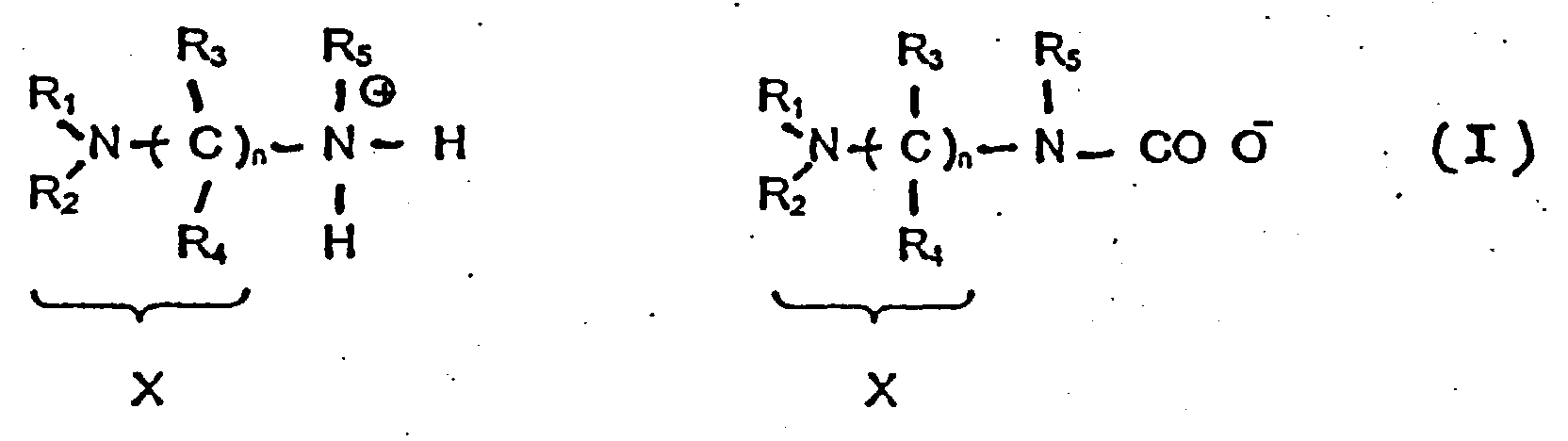
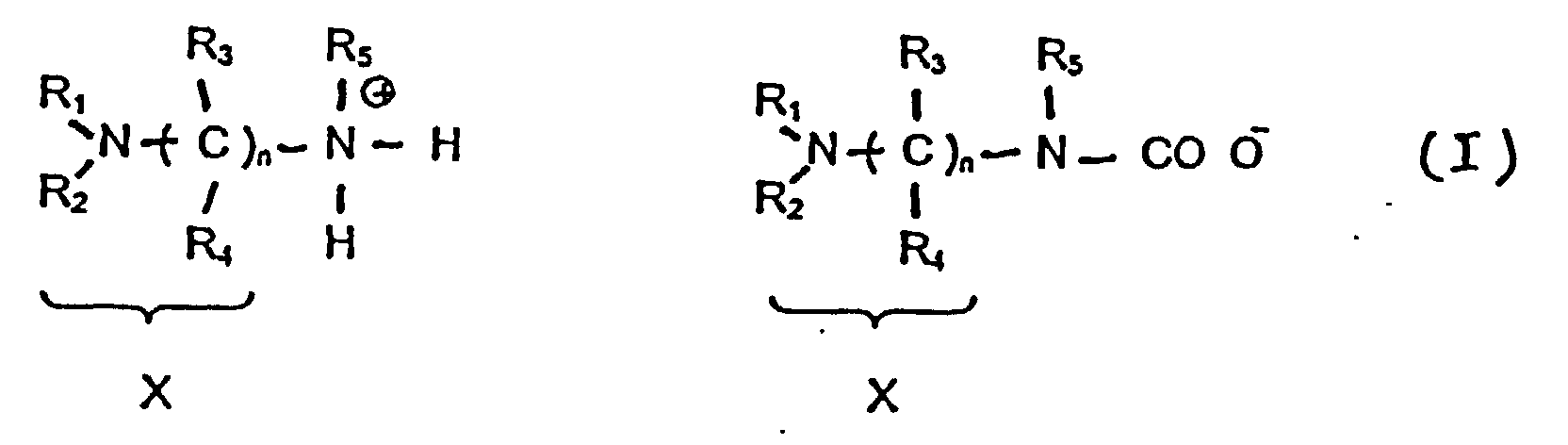
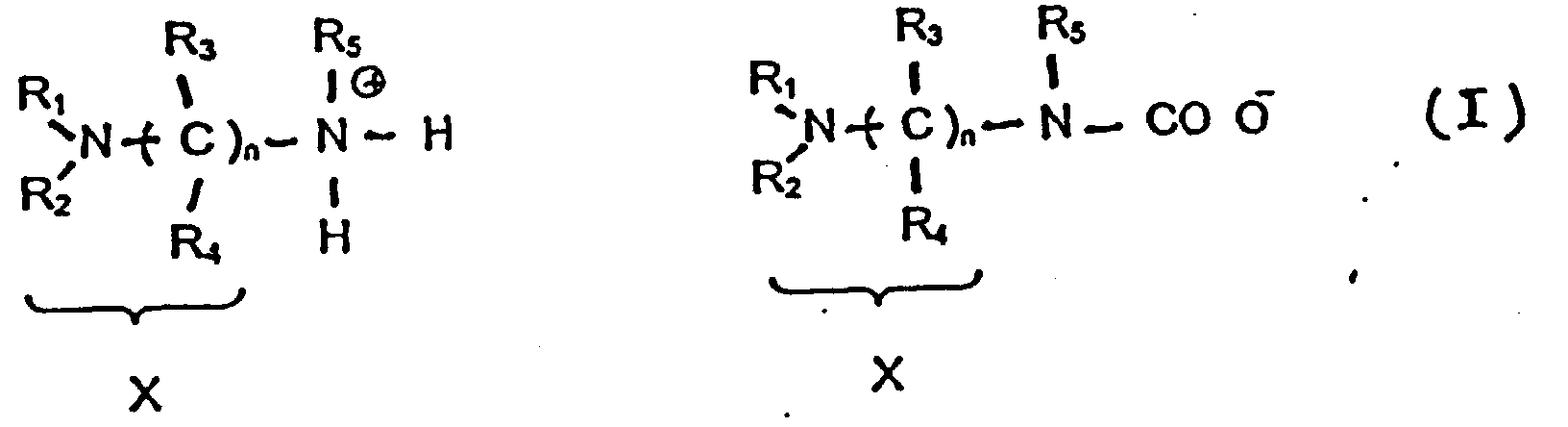
- the carbamates essential to the invention are compounds of the general formula already mentioned, where the variables R 1 to R 5 and n have the meaning already mentioned.
- R 5 is an alkanol radical
- R 1 and R 2 are methyl radicals
- R 3 and R 4 are identical or different radicals and are hydrogen or alkyl radicals are also preferred.
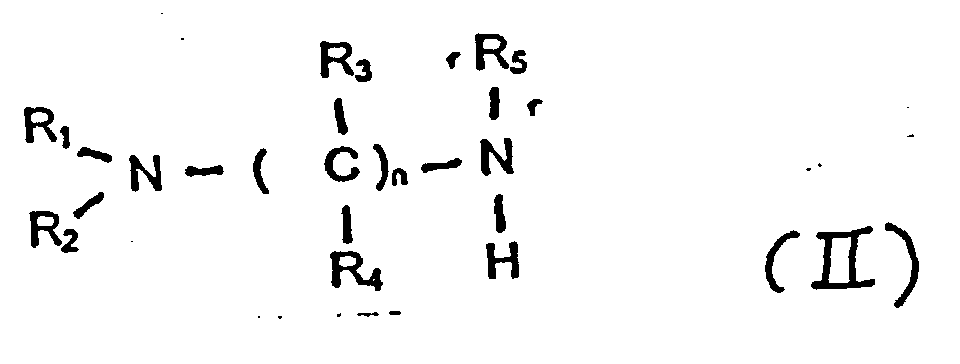
- the carbamates can be prepared by simply saturating the underlying diamines of the formula II with gaseous or solid carbon dioxide at temperatures between 40 and 130 ° C with or without the use of a suitable solvent.
- gaseous or solid carbon dioxide at temperatures between 40 and 130 ° C with or without the use of a suitable solvent.
- water has proven to be particularly suitable as a solvent.
- 3-Dimethylaminopropylamine and bis (3-dimethylaminpropyl) amine are particularly preferred for the production of the carbamates or mixtures these amines.
- Another foaming agent in the foams according to the invention preferably water used. Water generated by the Reaction with isocyanate carbon dioxide. For certain foam qualities is the use of liquid or gaseous Carbon dioxide possible. Other physical blowing agents can are used, but are not preferred.
- the carbamate used as a catalyst in an amount of less than 8% by weight, preferably 0.1 to 6, more preferably 0.3 up to 4% by weight, based on the weight of component B), is used.
- auxiliaries and additives that may be used are used in the production of polyurethane foams usual such as Activators or stabilizers.
- Further Auxiliaries and additives are surface-active, for example Additives and foam stabilizers as well as cell regulators, reaction retarders, Stabilizers, flame retardants, plasticizers, Dyes and fillers as well as fungistatic and bacteriostatic effective substances. Details of the use and mode of action of these additives are e.g. specified in: Kunststoff-Handbuch, Volume VII, ed. Vieweg and Höchtlen, Carl Hanser Verlag, Kunststoff 1966, pp. 103-113.
- the starting components are otherwise in such quantities used, which is an isocyanate index of 80 to 120, preferably 95 to 105.
- At least one cocatalyst can additionally be used e.g. a metal catalyst such as e.g. Dibutyltin dilaurate or tin dioctoate.
- a metal catalyst such as e.g. Dibutyltin dilaurate or tin dioctoate.
- reaction components are according to the invention known one-step process, the prepolymer process or brought the semiprepolymer process to implementation, where one often uses machinery, e.g. those who be described in US Pat. No. 2,764,565. Details about Processing facilities that are also in question according to the invention are described in the plastics manual, op. cit., pp. 121 - 205.
- foaming can be carried out during foam production can also be carried out in closed molds. there the reaction mixture is introduced into a mold.
- Molding material comes in metal, e.g. Aluminum, or plastic, e.g. Epoxy resin, in question.
- the foamable reaction mixture foams in the mold and forms the shaped body.
- the foaming of the mold can do so performed that the molded part on its surface Has cell structure. According to the invention, one can in this connection proceed in such a way that there is so much foamable in the mold Reaction mixture enters that the foam formed the shape just fills up.
- External release agents such as silicone oils
- silicone oils are also used. Of course but can also foam through block foaming getting produced.
- the foams produced according to the invention are preferred flexible block foams, which among other things for use in the automotive industry and the furniture industry.
- Advantageous the block foams according to the invention can also be used for Lamination can be used.
- the temperature of the reaction components is generally within the Temperature range from 20 to 45 ° C.
- the smell was determined according to VDA recommendation 270 variant B-3.
- the grade 1 stands for imperceptible and the Grade 6 for unbearable.
- the block foams are made on a commercially available system UBT manufactured by Henneke.
- the polyol comes with the specified substances in addition to the isocyanate premixed.
- Be on a commercial high pressure machine each mixed with the isocyanate formulation and the reaction mixture is put in a 40 liter box mold entered, which is heated to 50 ° C. The form is closed and after about five minutes the molded part is removed from the mold.
- the filling quantity is chosen so that the molding weight Is 2.1 kg.
- the result is a customary elastic soft molded foam.
- the amine determination is stored in after one day carried out in the manner described above.
Landscapes
- Chemical & Material Sciences (AREA)
- Health & Medical Sciences (AREA)
- Chemical Kinetics & Catalysis (AREA)
- Medicinal Chemistry (AREA)
- Polymers & Plastics (AREA)
- Organic Chemistry (AREA)
- Polyurethanes Or Polyureas (AREA)
Abstract
Description
als Katalysator und zugleich als Treibmittel verwendet wird, im wesentlichen unter Ausschluß von Aminkatalysatoren.
ggf. unter Zusatz üblicher Hilfs- und Zusatzstoffe, wie sie aus der Polyurethanchemie bekannt sind.
Toluylendiisocyanat mit einem Gehalt an 2,4-Isomeren von 80% und einem Gehalt an 2,6-Isomeren von 20%.
Toluylendiisocanat mit einem Gehalt an 2,4-Isomeren von 65% und einem Gehalt an 2,6-Isomeren von 35%.
Polyisocyanat mit einem NCO-Gehalt von 32,5% und einer Viskosität von 25 mPa s, bestehend aus 15% polymerem MDI, einer Konzentration von 2,4'-Diphenylmethandiisocyanat von 24% und einer Konzentration von 4,4'-Diphenylmethandiisocyanat von etwa 64%.
Polyesterpolyol durch Umsetzung von Adipinsäure, Diethylenglykol und Trimethylolpropan (OH-Zahl: 61, Säurezahl 1,4, mittlere Funktionalität ∼ 2,5).
Desmophen 2450 der Bayer AG. Polyester mit einer OH-Zahl von etwa 210.
Polyethertriol der OH-Zahl 36 hergestellt durch Propoxylierung von Trimethylolpropan mit anschließender Ethoxylierung des Propoxylierungsproduktes (PO:EO-Gewichtsverhältnis ∼ 85:15).
In 400g 3-Dimethylaminopropylamin in 400g Wasser wird bis zur Sättigung CO2 eingeleitet. Die aufgenommene CO2-Masse beträgt 195g und die Viskosität bei 25°C 95 mPa.s.
| Beispiel 1 | Beispiel 2 | Vergleichsbeispiel 1 | Vergleichsbeispiel 2 | |
| Polyol 1 | 87 | 87 | 100 | 100 |
| Polyol 2 | 13 | 13 | ||
| Carbamat 1 | 1,2 | 1,4 | ||
| N-Methylmorpholin | 1,2 | |||
| Dimethylethanolamin | 0,2 | |||
| SE 232 (3) | 1,0 | 1,0 | ||
| Emulgator EM | 2,0 | |||
| Emulgator TX | 1,5 | |||
| Dimethylpiperazin | 0,5 | |||
| B 8301 | 1,0 | |||
| Zinndioktoat | 0,1 | |||
| Wasser | 2,5 | 2,4 | 3,0 | 3,0 |
| Isocyanat 1 | 12,6 | 18,9 | 42 | 42 |
| Isocyanat 2 | 29,4 | 23,2 | ||
| Rohdichte (g/l) DIN 53420 | 32 | 29 | 31 | 32 |
| Stauchhärte (40%) (kPa) DIN 53577 | 3,6 | 3,6 | 3,6 | 3,8 |
| Druckverformungsrest (50%) (%) DIN 53572 | 8 | 10 | 7 | 9 |
| Bruchdehnung (%) DIN 53571 | 327 | 314 | 270 | 283 |
| Zugfestigkeit (kPa) DIN 53571 | 238 | 192 | 193 | 205 |
| Zugfestigkeit nach Hydrolysealterung (7 Tage, 70°C, 95% Feuchte) | 207 | 185 | 172 | 140 |
| Geruch | 2 | 1,5 | 5 | 4 |
| Aminbestimmung | <5ppm | <5ppm | >60ppm | >60ppm |
| Beispiel | Vergleichsbeispiel | |
| Polyol 3 | 100 | 100 |
| Carbamat 1 | 1,5 | - |
| Toyocat ET | - | 0,2 |
| Dabco 33LV | - | 0,4 |
| Arcol 2580 | 2,0 | 2,0 |
| Wasser | 2,4 | 3,0 |
| Stabilisator B4113 | 0,8 | 0,8 |
| Isocyanat | 49,3 | 49,3 |
| Aminbestimmung | <5ppm | >60ppm |
Claims (11)
- Verfahren zur Herstellung von Polyurethanschaumstoff in Gegenwart wenigstens eines Katalysators und wenigstens eines Treibmittels, dadurch gekennzeichnet, daß ein Carbamat oder ein Gemisch von Carbamaten der allgemeinen Formel I,wobei:
 R1 und R2 für gleiche oder verschiedene Alkylreste stehen,R3 und R4 für gleiche oder verschiedene Reste stehen und Wasserstoff oder Alkylreste bedeuten,R5 Wasserstoff, eine Alkanolrest, einen Polyethermonoolrest oder den mit X gekennzeichneten Rest bedeutet,n für 2 oder 3 steht,
als Katalysator und Treibmittel verwendet wird, im wesentlichen unter Ausschluß von Aminkatalysatoren. - Verfahren nach Anspruch 1, dadurch gekennzeichnet, daß der Polyurethanschaumstoff aus einem Reaktionsgemisch hergestellt, welches enthältA) eine Polyisocyanatkomponente mit einem NCO-Gehalt von 25 bis 48,3 Gew.-%, bestehend aus reinem oder modifiziertem Toluylendiisocyanat oder einem gegebenenfalls modifizierten Polyisocyanat oder Polyisocyanatgemisch der Diphenylmethanreihe;B) eine Polyolkomponente einer mittleren Hydroxylfunktionalität von 2-6 bestehend aus einem oder mehreren Polyether oder Polyesterpolyolen.
- Verfahren nach Anspruch 2, dadurch gekennzeichnet, daß mindestens 70% der Polyolkomponente B) eine OH-Zahl kleiner als 70 hat.
- Verfahren nach Anspruch 2 oder 3, dadurch gekennzeichnet, daß die Polyolkomponente B) weiter wenigstens ein Polyester- oder Polyetherpolyol oder eine Abmischung hiervon mit einer OH-Zahl von 70-400 enthält.
- Verfahren nach Anspruch 4, dadurch gekennzeichnet, daß die Polyolkomponente B) weiter wenigstens ein Polyester- oder Polyetherpolyol oder eine Abmischung hiervon mit einer OH-Zahl von 70-400 in einer Konzentration von 0% - 20% bezogen auf die Polyolkomponente B) enthält.
- Verfahren nach einem der Ansprüche 1 bis 5, dadurch gekennzeichnet, daß man zusätzlich wenigstens ein weiteres Treibmittel einsetzt.
- Verfahren nach einem der Ansprüche 1 bis 6, dadurch gekennzeichnet, daß das Treibmittel Wasser ist.
- Verfahren nach einem der Ansprüche 1 bis 7, dadurch gekennzeichnet, daß man zusätzliche Katalysatoren, Hilfs- und Zusatzstoffe einsetzt
- Verfahren nach einem der Ansprüche 1 bis 8, dadurch gekennzeichnet, daß die Carbamate in einer Menge von weniger als 8 Gew.-% bezogen auf das Gewicht der Polyolkomponente (B) eingesetzt werden, vorzugsweise in einer Menge zwischen 0,1 und 6 Gew.%, weiter vorzugsweise 0,3 bis 4 Gew.%.
- Verfahren nach einem der Ansprüche 1 bis 9, dadurch gekennzeichnet, daß die erfindungsgemäßen Katalysatoren zur Herstellung von flexiblen oder viskoelastischen Blockschaumstoffen eingesetzt werden.
- Verfahren nach einem der Ansprüche 1 bis 9, dadurch gekennzeichnet, daß die erfindungsgemäßen Katalysatoren zur Herstellung von flexiblen oder viskoelastischen Formschaumstoffen eingesetzt werden.
Applications Claiming Priority (4)
| Application Number | Priority Date | Filing Date | Title |
|---|---|---|---|
| DE19953060 | 1999-11-03 | ||
| DE19953060 | 1999-11-03 | ||
| DE10000494 | 2000-01-08 | ||
| DE10000494A DE10000494B4 (de) | 1999-11-03 | 2000-01-08 | Verfahren zur Herstellung von weichen Polyurethan-Block- oder Formschaumstoffen |
Publications (2)
| Publication Number | Publication Date |
|---|---|
| EP1097953A2 true EP1097953A2 (de) | 2001-05-09 |
| EP1097953A3 EP1097953A3 (de) | 2001-11-14 |
Family
ID=26003767
Family Applications (1)
| Application Number | Title | Priority Date | Filing Date |
|---|---|---|---|
| EP00120527A Withdrawn EP1097953A3 (de) | 1999-11-03 | 2000-09-20 | Verfahren zur Herstellung von Polyurethanschaumstoffen |
Country Status (4)
| Country | Link |
|---|---|
| US (1) | US6346559B1 (de) |
| EP (1) | EP1097953A3 (de) |
| JP (1) | JP2001139655A (de) |
| KR (1) | KR20010051399A (de) |
Cited By (4)
| Publication number | Priority date | Publication date | Assignee | Title |
|---|---|---|---|---|
| US6598251B2 (en) | 2001-06-15 | 2003-07-29 | Hon Technology Inc. | Body support system |
| WO2006125740A3 (de) * | 2005-05-23 | 2007-02-15 | Basf Ag | Verfahren zur herstellung von viskoelastischen polyurethan-weichschaumstoffen |
| CN102503909A (zh) * | 2011-11-21 | 2012-06-20 | 武汉大学 | 含叔胺脲衍生物类化合物及其制备方法和应用 |
| CN110591052A (zh) * | 2019-09-09 | 2019-12-20 | 优麦化学(山东)有限公司 | 一种低气味异氰酸酯混合物、制备方法及应用 |
Families Citing this family (13)
| Publication number | Priority date | Publication date | Assignee | Title |
|---|---|---|---|---|
| US6818675B2 (en) * | 2002-08-06 | 2004-11-16 | General Electric Company | Process for preparing polyurethane foam |
| US6734220B2 (en) | 2002-08-27 | 2004-05-11 | Foamex L.P. | Fine cell, high density viscoelastic polyurethane foams |
| US6653363B1 (en) | 2002-12-04 | 2003-11-25 | Foamex, L.P. | Low energy-loss, high firmness, temperature sensitive polyurethane foams |
| US6759447B1 (en) * | 2003-01-06 | 2004-07-06 | Air Products And Chemicals, Inc. | Physical properties of polyurethane foams using tertiary amino alkyl amide catalysts |
| US6762211B1 (en) * | 2003-01-03 | 2004-07-13 | Air Products And Chemicals, Inc. | Tertiary amino alkyl amide polyurethane catalysts derived from long chain alkyl and fatty carboxylic acids |
| US6737446B1 (en) * | 2003-01-03 | 2004-05-18 | Air Products And Chemicals, Inc. | Tertiary amino alkyl amide catalysts for improving the physical properties of polyurethane foams |
| US7169823B2 (en) * | 2003-03-10 | 2007-01-30 | Air Products And Chemicals, Inc. | Tertiary alkanolamine polyurethane catalysts derived from long chain alkyl and fatty carboxylic acids |
| US6747069B1 (en) * | 2003-03-10 | 2004-06-08 | Air Products And Chemicals, Inc. | Tertiary alkanolamine polyurethane catalysts derived from long chain alkyl and fatty carboxylic acids |
| US10842653B2 (en) | 2007-09-19 | 2020-11-24 | Ability Dynamics, Llc | Vacuum system for a prosthetic foot |
| JP2010270324A (ja) * | 2009-04-24 | 2010-12-02 | Tosoh Corp | ポリウレタンフォーム用の発泡性添加剤、及びそれを用いた硬質ポリウレタンフォームの製造方法 |
| JP2011037951A (ja) * | 2009-08-07 | 2011-02-24 | Tosoh Corp | ポリウレタンフォーム製造用の発泡性添加剤、及びそれを用いた硬質ポリウレタンフォームの製造方法 |
| JP2011026391A (ja) * | 2009-07-22 | 2011-02-10 | Tosoh Corp | スプレー式硬質ポリウレタンフォームの製造方法 |
| WO2010123118A1 (ja) * | 2009-04-24 | 2010-10-28 | 東ソー株式会社 | ポリウレタンフォーム製造用の発泡性添加剤、及びそれを用いた硬質ポリウレタンフォームの製造方法 |
Family Cites Families (14)
| Publication number | Priority date | Publication date | Assignee | Title |
|---|---|---|---|---|
| US2764565A (en) | 1951-12-24 | 1956-09-25 | Bayer Ag | Process and apparatus for the manufacture of polyurethane plastics |
| US3178490A (en) | 1961-10-06 | 1965-04-13 | Thiokol Chemical Corp | Process for producing a foamed plastic article having a dense skin |
| US3182104A (en) | 1962-02-14 | 1965-05-04 | Glidden Co | Process for making thick-skinned articles comprising polyurethane foam |
| DE1154269B (de) * | 1962-06-19 | 1963-09-12 | Bayer Ag | Verfahren zur Herstellung von Urethangruppen enthaltenden Schaumstoffen |
| DE2132102A1 (de) | 1970-06-30 | 1972-01-05 | Grace W R & Co | Mischung zur Herstellung von Polyurethanschaeumen |
| AU3752771A (en) | 1971-01-05 | 1973-07-05 | Dunlop Australia Limited | Cellular polymers |
| DE2832253A1 (de) | 1978-07-22 | 1980-01-31 | Bayer Ag | Verfahren zur herstellung von formschaumstoffen |
| US4467089A (en) * | 1982-03-04 | 1984-08-21 | Air Products And Chemicals, Inc. | Carbamate and carbonate salts of tertiary amines |
| DE3312215A1 (de) | 1983-04-05 | 1984-10-11 | Bayer Ag, 5090 Leverkusen | Verfahren zur herstellung eines zelligen polyurethans |
| US4517313A (en) * | 1984-04-11 | 1985-05-14 | Abbott Laboratories | Method of making polyurethane foam |
| CZ287435B6 (en) | 1993-11-04 | 2000-11-15 | Bayer Ag | Process for preparing foam polyurethane shaped parts without use of fluorochlorinated hydrocarbons |
| US5834579A (en) * | 1995-08-03 | 1998-11-10 | Bayer Aktiengesellschaft | Tertiary amines having carbonate and urethane groups |
| DE19529412A1 (de) * | 1995-08-10 | 1997-02-13 | Bayer Ag | Verfahren zur Herstellung emissionsarmer Polyurethan-Form und Verbundkörper sowie deren Verwendung |
| US6077877A (en) * | 1996-04-04 | 2000-06-20 | Ck Witco Corporation | Reactive amine catalysts for use in polyurethane polymers |
-
2000
- 2000-09-20 EP EP00120527A patent/EP1097953A3/de not_active Withdrawn
- 2000-10-04 JP JP2000305028A patent/JP2001139655A/ja active Pending
- 2000-11-02 KR KR1020000064856A patent/KR20010051399A/ko not_active Withdrawn
- 2000-11-03 US US09/706,479 patent/US6346559B1/en not_active Expired - Fee Related
Cited By (5)
| Publication number | Priority date | Publication date | Assignee | Title |
|---|---|---|---|---|
| US6598251B2 (en) | 2001-06-15 | 2003-07-29 | Hon Technology Inc. | Body support system |
| US6687933B2 (en) | 2001-06-15 | 2004-02-10 | Hon Technology, Inc. | Body support system with energy dissipation means |
| WO2006125740A3 (de) * | 2005-05-23 | 2007-02-15 | Basf Ag | Verfahren zur herstellung von viskoelastischen polyurethan-weichschaumstoffen |
| CN102503909A (zh) * | 2011-11-21 | 2012-06-20 | 武汉大学 | 含叔胺脲衍生物类化合物及其制备方法和应用 |
| CN110591052A (zh) * | 2019-09-09 | 2019-12-20 | 优麦化学(山东)有限公司 | 一种低气味异氰酸酯混合物、制备方法及应用 |
Also Published As
| Publication number | Publication date |
|---|---|
| JP2001139655A (ja) | 2001-05-22 |
| US6346559B1 (en) | 2002-02-12 |
| EP1097953A3 (de) | 2001-11-14 |
| KR20010051399A (ko) | 2001-06-25 |
Similar Documents
| Publication | Publication Date | Title |
|---|---|---|
| EP0296449B1 (de) | Verfahren zur Herstellung von kalthärtenden Polyurethan-Weichformschaumstoffen | |
| EP0344551B1 (de) | Flüssige Polyisocyanatmischungen, ein Verfahren zu ihrer Herstellung und ihre Verwendung zur Herstellung von Polyurethan-Weichschaumstoffen | |
| EP0805831B1 (de) | Verwendung von Toluylendiamin gestarteten Propylenoxid Polyolen in Polyurethan Hartschaumstoffen | |
| EP0346670B1 (de) | Verfahren zur Herstellung von Polyurethan-Weichblockschaumstoffen | |
| DE4204395A1 (de) | Verfahren zur herstellung von kalthaertenden polyurethan-weichformschaumstoffen | |
| EP1097953A2 (de) | Verfahren zur Herstellung von Polyurethanschaumstoffen | |
| EP1650240B1 (de) | Weichelastische Polyurethan Schaumstoffe geringer Rohdichten und Stauchhärte | |
| EP0759042B1 (de) | Zu harten polyurethanschaumstoffen führende mischungen | |
| EP0472080B1 (de) | Verfahren zur Herstellung von harten Polyurethanschaumstoffen | |
| EP0308733B1 (de) | Verfahren zur Herstellung von Polyurethan-Hartschaumstoffen | |
| DE4020255A1 (de) | Verfahren zur herstellung von urethan- und ueberwiegend isocyanuratgruppen aufweisenden hartschaumstoffen und deren verwendung als daemmaterialien | |
| EP1097954B1 (de) | Verfahren zur Herstellung von Polyurethanschaumstoffen | |
| EP0731120B1 (de) | Verfahren zur Herstellung von hochelastischen Polyurethanschaumstoffen | |
| EP0649440B1 (de) | Verfahren zur herstellung von harten urethangruppen und überwiegend isocyanuratgruppen aufweisenden schaumstoffen | |
| DE19962911C2 (de) | Flammwidriger HR-Kaltformschaum mit reduzierter Rauchgasintensität und -toxizität | |
| DE3934098C1 (de) | ||
| DE10000494B4 (de) | Verfahren zur Herstellung von weichen Polyurethan-Block- oder Formschaumstoffen | |
| EP0535358B1 (de) | Verfahren zur Herstellung von flammgeschützten Urethangruppen aufweisenden Hartschaumstoffen | |
| DE3825147A1 (de) | Verfahren zur herstellung von polyurethanschaumstoffen | |
| DE4006247A1 (de) | Verfahren zur herstellung von offenzelligen polyurethan-weichschaumstoffen | |
| DE19954739A1 (de) | Flammwidriger HR-Kaltformschaum mit reduzierter Rauchgasdichte und -toxizität | |
| DE3842220A1 (de) | Verfahren zur herstellung von offenzelligen, hydrophilen polyurethanschaumstoffen | |
| EP0389882A2 (de) | Verfahren zur Herstellung von heisshärtenden Polyurethan-Weichformschaumstoffen | |
| DE4024669A1 (de) | Verfahren zur herstellung von hochelastischen polyurethan-weichschaumstoffen und deren verwendung als polstermaterial | |
| DD292467A5 (de) | Verfahren zur herstellung von elastischen und offenzelligen polyurethan-weichformschaumstoffen |
Legal Events
| Date | Code | Title | Description |
|---|---|---|---|
| PUAI | Public reference made under article 153(3) epc to a published international application that has entered the european phase |
Free format text: ORIGINAL CODE: 0009012 |
|
| AK | Designated contracting states |
Kind code of ref document: A2 Designated state(s): AT BE CH CY DE DK ES FI FR GB GR IE IT LI LU MC NL PT SE |
|
| AX | Request for extension of the european patent |
Free format text: AL;LT;LV;MK;RO;SI |
|
| PUAL | Search report despatched |
Free format text: ORIGINAL CODE: 0009013 |
|
| AK | Designated contracting states |
Kind code of ref document: A3 Designated state(s): AT BE CH CY DE DK ES FI FR GB GR IE IT LI LU MC NL PT SE |
|
| AX | Request for extension of the european patent |
Free format text: AL;LT;LV;MK;RO;SI |
|
| RIC1 | Information provided on ipc code assigned before grant |
Free format text: 7C 08G 18/18 A, 7C 08G 18/66 B, 7C 08J 9/08 B |
|
| 17P | Request for examination filed |
Effective date: 20020507 |
|
| AKX | Designation fees paid |
Free format text: AT BE CH CY DE DK ES FI FR GB GR IE IT LI LU MC NL PT SE |
|
| 17Q | First examination report despatched |
Effective date: 20060321 |
|
| STAA | Information on the status of an ep patent application or granted ep patent |
Free format text: STATUS: THE APPLICATION IS DEEMED TO BE WITHDRAWN |
|
| 18D | Application deemed to be withdrawn |
Effective date: 20090401 |