EP1096733A2 - Kommunikationsverfahren und System - Google Patents
Kommunikationsverfahren und System Download PDFInfo
- Publication number
- EP1096733A2 EP1096733A2 EP00309222A EP00309222A EP1096733A2 EP 1096733 A2 EP1096733 A2 EP 1096733A2 EP 00309222 A EP00309222 A EP 00309222A EP 00309222 A EP00309222 A EP 00309222A EP 1096733 A2 EP1096733 A2 EP 1096733A2
- Authority
- EP
- European Patent Office
- Prior art keywords
- devices
- polling
- inquiry
- bus
- representative
- Prior art date
- Legal status (The legal status is an assumption and is not a legal conclusion. Google has not performed a legal analysis and makes no representation as to the accuracy of the status listed.)
- Granted
Links
Images



Classifications
-
- H—ELECTRICITY
- H04—ELECTRIC COMMUNICATION TECHNIQUE
- H04L—TRANSMISSION OF DIGITAL INFORMATION, e.g. TELEGRAPHIC COMMUNICATION
- H04L12/00—Data switching networks
- H04L12/28—Data switching networks characterised by path configuration, e.g. LAN [Local Area Networks] or WAN [Wide Area Networks]
- H04L12/40—Bus networks
- H04L12/403—Bus networks with centralised control, e.g. polling
-
- H—ELECTRICITY
- H04—ELECTRIC COMMUNICATION TECHNIQUE
- H04L—TRANSMISSION OF DIGITAL INFORMATION, e.g. TELEGRAPHIC COMMUNICATION
- H04L43/00—Arrangements for monitoring or testing data switching networks
- H04L43/10—Active monitoring, e.g. heartbeat, ping or trace-route
Definitions
- the present invention relates to a communication method and a communication system which perform mutual recognition among plural devices connected to a bus.
- each device it is common practice for each device to perform inquiries and to poll one another in order to recognize other devices. Polling refers to each device confirming (inquiring) with another device whether there is a data transmission request, and if there is a transmission request, the data is received.
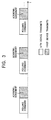
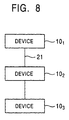
- a first device 10 1 polls a second device 10 2 and a third device 10 3 ; the second device 10 2 polls the first device 10 1 and the third device 10 3 ; and the third device 10 3 polls the first device 10 1 and the second device 10 2 .
- the first device 10 1 on behalf of the others, performs polling of other devices, and the result is transmitted as a message to the other devices. According to this scheme, since the devices other than the representative first device 10 1 do not perform polling, it is possible to reduce the bandwidth occupied.
- the second device 10 2 and the third device 10 3 are newly added to the system, the second device 10 2 and the third device 10 3 are not recognized until they are polled from the representative first device 10 1 . Therefore, since the second device 10 2 and the third device 10 3 are isolated until they are polled from the representative first device 10 1 , it is not possible to make full use of the mutual functions among devices, such as data exchange among devices.
- the second device 10 2 and the third device 10 3 cannot be aware of the presence of each other. For this reason, it is not possible to realize functions which are possible only between the second device 10 2 and the third device 10 3 .
- An object of at least preferred embodiments of the present invention is to provide a communication method and a communication system which are capable of reducing the amount of polling and reducing the bus transmission bandwidth without impairing the mutual functions among devices.
- a communication method which uses a system in which plural devices are connected with one another by a communication line, one device performs inquiries to other devices, the result of the inquiries is transmitted to the other devices, allowing the devices to recognize one another, characterized in that the other devices perform inquiry more infrequently than the frequency of inquiry of the one device.
- a communication system in which plural devices are connected with one another by a communication line, one device performs an inquiry to other devices, the result of the inquiries is transmitted to the other devices, allowing the devices to recognize one another, characterized in that the other devices perform an inquiry more infrequently that the frequency of inquiry of the one device.
- This system consists of n devices: a first device 10 1 up to an n-th device 10 n .
- n is an integer of 2 or more.
- the first device 10 1 comprises a first control section 11 1 for controlling the entirety of this first device 10 1 , and a first interface section 12 1 for connecting the control section 11 1 to a bus 21.
- the first control section 11 1 performs control on each section of the first device 10 1 . Also, the first control section 11 1 controls communication for other devices connected to the bus 21 via the first interface section 12 1 .
- This first control section 11 1 can be formed as a microcontroller having, for example, a CPU, a ROM, a RAM, etc.
- the first interface section 12 1 connects the first control section 11 1 to the bus 21.
- the first interface section 12 1 performs conversion between an internal data format in the first device 10 1 and a predetermined protocol in the bus 21.
- the bus 21 connects the devices from the first device 10 1 to the n-th device 10 n so that data is transmitted among the devices.
- communication is performed by a predetermined method in accordance with a predetermined protocol.
- This embodiment has a feature in the method of communicating data transmitted among the devices via the bus 21. That is, in this embodiment, a device which is newly added to the bus due to a new connection or at the activation of power performs an inquiry, that is, polling, only once at that time, and confirms the presence of the device of the other party. After polling is performed once, a polling command from the above-mentioned representative device is received, and the newly connected device does not itself thereafter performs polling.
- a device which cannot act as a device representing the system performs polling of the representative device more infrequently than the polling frequency of the representative device, and when the device is polled by the representative device, the device does not perform polling of other devices.
- a client device When polling is performed among devices, a client device does not usually perform polling, but performs polling only once at the set-up time of the device.
- n-th device 10 n is assumed to be a source device and a first device 10 1 is assumed to be a destination device, is taken as an example.
- a combination of a source device and a destination device is not limited to this example.
- the n-th device 10 n transmits a header composed of a set of a source device address which is the address of the n-th apparatus 10 n and a destination address which is an address of the first device 10 1 which is the destination. This header is received by the first device 10 1 via the bus 21.
- an acknowledgement is sent back from the first device 10 1 which is at a destination address. This makes it possible to confirm the fact that the header is received by the first device 10 1 .
- the n-th device 10 n transmits data following the header. This data is also received by the first device 10 1 via the bus 21, and an acknowledgement is sent back from the first device 10 1 .
- a case in which the n-th device 10 n performs polling to the first device 10 1 can also be performed in a manner similar to a case in which data is transmitted.
- the n-th device 10 n transmits a polling command.
- the polling command is composed of a set of the source device address which is the address of the n-th apparatus 10 n and the destination address which is the address of the first device 10 1 which is the destination.
- the first device 10 1 When the first device 10 1 receives the polling command sent from the n-th device 10 n , the first device 10 1 sends back an acknowledgement. This makes it possible to confirm the fact that the polling command is received by the first device 10 1 .
- the basic state is one in which one device among plural devices making up the system performs polling as a representative and the other devices do not perform polling.
- the first device 10 1 represents plural devices of the system. Needless to say, the representative device is not limited to the first device 10 1 .
- the representative first device 10 1 obtains information on devices which are present and are connected to the bus 21. This presence information is transmitted from the first device 10 1 to the other devices. Specifically, the presence information is carried on the data part described with reference to Fig. 2, and is transmitted as a message for the other devices from the representative first device 10 1 .
- This series of steps is started when, for example, an n-th device 10 n is newly connected to the bus 21, or when power to an n-th device 10 n which is connected to the bus 21, but is not switched on, is newly switched on.
- step S11 as shown in Fig. 3, an n-th control section 11 n of the n-th device 10 n outputs a polling command to the bus 21 via an n-th interface section 12 n.
- step S12 the process branches depending on whether or not the n-th device 10 n has received an acknowledgement from the first apparatus 10 1 , for example, within a predetermined time.
- the first device 10 1 since the first device 10 1 sends back an acknowledgement, it is possible to know the presence of the representative first device 10 1 according to the presence or absence of the acknowledgement.
- step S13 when it is found that the representative first device 10 1 is present as a result of receiving the acknowledgement, assuming that the determination is "YES" the process proceeds to step S13.
- the n-th device 10 n does not output a polling command, and only sends back an acknowledgement to the polling command from the representative device.
- the devices other than the first device 10 1 know that an acknowledgement is returned from the first device 10 1 to the n-th device 10 n and the first device 10 1 is a representative device.
- step S11 a polling command is transmitted again to the representative first device 10 1 .
- step S13 the process branches depending on whether or not the n-th device 10 n has received a polling command from the representative first device 10 1 . Then, when the polling command is received, for example, within a predetermined time, assuming that the determination is "YES”, the process proceeds to step S14, and when the polling command is not received, assuming that the determination is "NO", the process returns to step S13.
- the n-th device 10 n waits until a polling command from the representative first device 10 1 occurs in this step S13.
- step S14 since the n-th device 10 n has received the polling command in step S13, an acknowledgement is sent back.
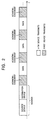
- the representative first device 10 1 performs polling at an interval of a first period T 1
- the n-th device 10 n performs polling at an interval of a second period T 2 .
- the second period T 2 is longer than the first period T 1 : T 2 > T 1 .
- the devices themselves other than the representative first device 10 1 stop polling.
- the process of the n-th device 10 n branches depending on whether or not the second period T 2 has elapsed from when the polling command was received previously at the time the polling command is newly received.
- the n-th device 10 n has contained therein an interval timer for measuring the elapse of time. Whether or not the second period T 2 has elapsed is determined according to whether or not this interval timer is 0.
- step S22 When the second period T 2 has not elapsed, assuming that the determination is "NO”, the process proceeds to step S25.
- the polling command is transmitted only from the representative first device 10 1 .
- Step S22 corresponds to a case in which it is determined that the representative first device 10 1 is not present in step S21. This is a state in which polling cannot be performed, for example, as a result of the first device 10 1 being disconnected from the bus 21 or the power being switched off.
- the n-th device 10 n starts polling at the timing when the interval timer reaches the second period T 2 .
- step S23 the process branches depending on whether or not the n-th device 10 n has received an acknowledgement, for example, within a predetermined time.
- an acknowledgement for example, within a predetermined time.
- a device of the other party which sent back the acknowledgement is present.
- a device of the other party which sends back the acknowledgement is not present.
- step S24 the second period T 2 is set to the interval timer. Then, the process returns to step S21.
- step S22 the polling command is transmitted again.
- step S25 corresponds to a case in which it is determined in step S21 that the first device 10 1 is present.
- the n-th device 10 n since the n-th device 10 n has received the polling command from the first device 10 1 , the n-th device 10 n recognizes the presence of the first device 10 1 and starts the counting in the interval timer from that time.
- step S26 the process branches whether or not the n-th device 10 n has received a polling command, for example, within a predetermined time.
- a polling command for example, within a predetermined time.
- a device of the other party which transmitted the polling command is present.
- a device of the other party which transmits the polling command is not present.
- step S27 the second period T 2 is set to the interval timer.
- step S28 the n-th device 10 n transmits an acknowledgement. Then, the process returns to step S21.
- a device which is newly connected to the system performs an inquiry once at the time of connection. Also, a device other than a device representing the system performs an inquiry more infrequently than does the representative device.
Landscapes
- Engineering & Computer Science (AREA)
- Computer Networks & Wireless Communication (AREA)
- Signal Processing (AREA)
- Health & Medical Sciences (AREA)
- Cardiology (AREA)
- General Health & Medical Sciences (AREA)
- Small-Scale Networks (AREA)
Applications Claiming Priority (2)
| Application Number | Priority Date | Filing Date | Title |
|---|---|---|---|
| JP30769399 | 1999-10-28 | ||
| JP30769399A JP4218152B2 (ja) | 1999-10-28 | 1999-10-28 | 通信方法及び通信システム |
Publications (3)
| Publication Number | Publication Date |
|---|---|
| EP1096733A2 true EP1096733A2 (de) | 2001-05-02 |
| EP1096733A3 EP1096733A3 (de) | 2002-09-04 |
| EP1096733B1 EP1096733B1 (de) | 2005-09-21 |
Family
ID=17972097
Family Applications (1)
| Application Number | Title | Priority Date | Filing Date |
|---|---|---|---|
| EP00309222A Expired - Lifetime EP1096733B1 (de) | 1999-10-28 | 2000-10-19 | Kommunikationsverfahren und System |
Country Status (3)
| Country | Link |
|---|---|
| EP (1) | EP1096733B1 (de) |
| JP (1) | JP4218152B2 (de) |
| DE (1) | DE60022720T2 (de) |
Family Cites Families (5)
| Publication number | Priority date | Publication date | Assignee | Title |
|---|---|---|---|---|
| JPH05219077A (ja) * | 1991-09-10 | 1993-08-27 | Philips Gloeilampenfab:Nv | 多重局バス系とそのような系に使用する局 |
| GB2272551B (en) * | 1992-11-14 | 1996-01-17 | Siemens Measurements Ltd | A polled communications network |
| US5734642A (en) * | 1995-12-22 | 1998-03-31 | Cabletron Systems, Inc. | Method and apparatus for network synchronization |
| US6195712B1 (en) * | 1997-06-13 | 2001-02-27 | Intel Corporation | Dynamic discovery of wireless peripherals |
| WO1999031521A1 (en) * | 1997-12-15 | 1999-06-24 | Intelogis | Method and apparatus for power line exchange protocol |
-
1999
- 1999-10-28 JP JP30769399A patent/JP4218152B2/ja not_active Expired - Lifetime
-
2000
- 2000-10-19 EP EP00309222A patent/EP1096733B1/de not_active Expired - Lifetime
- 2000-10-19 DE DE60022720T patent/DE60022720T2/de not_active Expired - Lifetime
Also Published As
| Publication number | Publication date |
|---|---|
| EP1096733B1 (de) | 2005-09-21 |
| EP1096733A3 (de) | 2002-09-04 |
| JP2001127775A (ja) | 2001-05-11 |
| DE60022720T2 (de) | 2006-06-29 |
| DE60022720D1 (de) | 2005-10-27 |
| JP4218152B2 (ja) | 2009-02-04 |
Similar Documents
| Publication | Publication Date | Title |
|---|---|---|
| JPH11194981A5 (de) | ||
| JPWO2009016785A1 (ja) | 通信制御システム | |
| US7421527B2 (en) | Transmission apparatus and transmission method | |
| WO2007034954A1 (ja) | 移動式無線通信装置及びその接続状態の管理方法 | |
| EP1244252B1 (de) | Gateway und ein das gateway benutzendes verteiltes system | |
| EP1096733A2 (de) | Kommunikationsverfahren und System | |
| AU1551101A (en) | Radio communication apparatus and radio communication method | |
| KR100226781B1 (ko) | 노드(node)인식(recognition)방법 | |
| US6912210B1 (en) | Data communication system and communication device used | |
| JP3037261B2 (ja) | 携帯電話通信切替方式 | |
| US8446598B2 (en) | Image forming device with a UWB communication function for transmitting search signal corresponding to type of data received, and method for providing data thereof, and system for providing data using the UWB communication function | |
| KR100798190B1 (ko) | 다중 프로토콜 연동을 위한 선택 게이트웨이 | |
| KR20010035641A (ko) | 외부에서 사설망 내부와 통신하는 인터넷 통신 장치 및 방법 | |
| JPH08130586A (ja) | 通信システム | |
| KR100358439B1 (ko) | 컴팩트 제어국간의 이더넷을 이용한 데이터 전송방법 | |
| JP4207725B2 (ja) | 無線データ収集装置 | |
| JP2001237985A (ja) | 通信システム | |
| US20050169308A1 (en) | Communication device and communication method | |
| JP4828322B2 (ja) | 基地局 | |
| CA2376718A1 (en) | Interface apparatus provided between two remote control systems having different transmission modes | |
| JP2002354004A (ja) | Tcp/ipプロトコルを用いる装置間の接続確立方法 | |
| JP2005184256A (ja) | 通信システム | |
| JP2007251444A (ja) | シリアル通信方法 | |
| KR20030049755A (ko) | 이동통신 단말기의 직렬 데이터 송수신 장치 및 방법 | |
| JPH11252149A (ja) | 通信システムおよび通信装置 |
Legal Events
| Date | Code | Title | Description |
|---|---|---|---|
| PUAI | Public reference made under article 153(3) epc to a published international application that has entered the european phase |
Free format text: ORIGINAL CODE: 0009012 |
|
| AK | Designated contracting states |
Kind code of ref document: A2 Designated state(s): AT BE CH CY DE DK ES FI FR GB GR IE IT LI LU MC NL PT SE |
|
| AX | Request for extension of the european patent |
Free format text: AL;LT;LV;MK;RO;SI |
|
| PUAL | Search report despatched |
Free format text: ORIGINAL CODE: 0009013 |
|
| AK | Designated contracting states |
Kind code of ref document: A3 Designated state(s): AT BE CH CY DE DK ES FI FR GB GR IE IT LI LU MC NL PT SE |
|
| AX | Request for extension of the european patent |
Free format text: AL;LT;LV;MK;RO;SI |
|
| 17P | Request for examination filed |
Effective date: 20030220 |
|
| 17Q | First examination report despatched |
Effective date: 20030319 |
|
| AKX | Designation fees paid |
Designated state(s): DE FR GB |
|
| GRAP | Despatch of communication of intention to grant a patent |
Free format text: ORIGINAL CODE: EPIDOSNIGR1 |
|
| GRAS | Grant fee paid |
Free format text: ORIGINAL CODE: EPIDOSNIGR3 |
|
| GRAA | (expected) grant |
Free format text: ORIGINAL CODE: 0009210 |
|
| AK | Designated contracting states |
Kind code of ref document: B1 Designated state(s): DE FR GB |
|
| REG | Reference to a national code |
Ref country code: GB Ref legal event code: FG4D |
|
| REF | Corresponds to: |
Ref document number: 60022720 Country of ref document: DE Date of ref document: 20051027 Kind code of ref document: P |
|
| ET | Fr: translation filed | ||
| PLBE | No opposition filed within time limit |
Free format text: ORIGINAL CODE: 0009261 |
|
| STAA | Information on the status of an ep patent application or granted ep patent |
Free format text: STATUS: NO OPPOSITION FILED WITHIN TIME LIMIT |
|
| 26N | No opposition filed |
Effective date: 20060622 |
|
| REG | Reference to a national code |
Ref country code: GB Ref legal event code: 746 Effective date: 20091130 |
|
| REG | Reference to a national code |
Ref country code: FR Ref legal event code: PLFP Year of fee payment: 16 |
|
| REG | Reference to a national code |
Ref country code: FR Ref legal event code: PLFP Year of fee payment: 17 |
|
| REG | Reference to a national code |
Ref country code: FR Ref legal event code: PLFP Year of fee payment: 18 |
|
| REG | Reference to a national code |
Ref country code: FR Ref legal event code: PLFP Year of fee payment: 19 |
|
| PGFP | Annual fee paid to national office [announced via postgrant information from national office to epo] |
Ref country code: DE Payment date: 20191021 Year of fee payment: 20 |
|
| PGFP | Annual fee paid to national office [announced via postgrant information from national office to epo] |
Ref country code: FR Payment date: 20191028 Year of fee payment: 20 |
|
| PGFP | Annual fee paid to national office [announced via postgrant information from national office to epo] |
Ref country code: GB Payment date: 20191021 Year of fee payment: 20 |
|
| REG | Reference to a national code |
Ref country code: DE Ref legal event code: R071 Ref document number: 60022720 Country of ref document: DE |
|
| REG | Reference to a national code |
Ref country code: GB Ref legal event code: PE20 Expiry date: 20201018 |
|
| PG25 | Lapsed in a contracting state [announced via postgrant information from national office to epo] |
Ref country code: GB Free format text: LAPSE BECAUSE OF EXPIRATION OF PROTECTION Effective date: 20201018 |