EP1076467A1 - Verfahren zur Basisstationswechsel (Handover) für mobile Endgeräte - Google Patents
Verfahren zur Basisstationswechsel (Handover) für mobile Endgeräte Download PDFInfo
- Publication number
- EP1076467A1 EP1076467A1 EP00117009A EP00117009A EP1076467A1 EP 1076467 A1 EP1076467 A1 EP 1076467A1 EP 00117009 A EP00117009 A EP 00117009A EP 00117009 A EP00117009 A EP 00117009A EP 1076467 A1 EP1076467 A1 EP 1076467A1
- Authority
- EP
- European Patent Office
- Prior art keywords
- base station
- connection
- addressing information
- mobile terminal
- switching system
- Prior art date
- Legal status (The legal status is an assumption and is not a legal conclusion. Google has not performed a legal analysis and makes no representation as to the accuracy of the status listed.)
- Granted
Links
- 238000000034 method Methods 0.000 title claims abstract description 29
- 230000001413 cellular effect Effects 0.000 title 1
- 230000015654 memory Effects 0.000 claims description 10
- 230000005540 biological transmission Effects 0.000 claims description 3
- 230000004913 activation Effects 0.000 claims 1
- 239000004020 conductor Substances 0.000 abstract 1
- 238000004891 communication Methods 0.000 description 13
- 230000008859 change Effects 0.000 description 5
- 238000011161 development Methods 0.000 description 3
- 230000018109 developmental process Effects 0.000 description 3
- 238000012546 transfer Methods 0.000 description 3
- 230000008569 process Effects 0.000 description 2
- 230000011664 signaling Effects 0.000 description 2
- 102100023817 26S proteasome complex subunit SEM1 Human genes 0.000 description 1
- 101000684297 Homo sapiens 26S proteasome complex subunit SEM1 Proteins 0.000 description 1
- 101000873438 Homo sapiens Putative protein SEM1, isoform 2 Proteins 0.000 description 1
- 230000008878 coupling Effects 0.000 description 1
- 238000010168 coupling process Methods 0.000 description 1
- 238000005859 coupling reaction Methods 0.000 description 1
- 230000006870 function Effects 0.000 description 1
- 238000005259 measurement Methods 0.000 description 1
- 230000004044 response Effects 0.000 description 1
- 238000000926 separation method Methods 0.000 description 1
- 239000013589 supplement Substances 0.000 description 1
Images
Classifications
-
- H—ELECTRICITY
- H04—ELECTRIC COMMUNICATION TECHNIQUE
- H04W—WIRELESS COMMUNICATION NETWORKS
- H04W36/00—Hand-off or reselection arrangements
- H04W36/14—Reselecting a network or an air interface
- H04W36/144—Reselecting a network or an air interface over a different radio air interface technology
Definitions
- end devices that are too different purposes, such as a transfer of Voice, video, fax, multimedia, information, text, Program and / or measurement data can be used to an increasing extent wirelessly coupled.
- a connection to such mobile Terminals are usually via so-called base stations created on the one hand via an air interface with the mobile devices can connect and on the other hand via a switching system to a communication network are coupled.
- base stations created on the one hand via an air interface with the mobile devices can connect and on the other hand via a switching system to a communication network are coupled.
- mobile devices are the following also understood so-called cordless devices.
- base stations are connected via an generally provided as a supplement to the switching system Radio switching module with the actual switching system coupled.
- This type of coupling is special when connecting several base stations that share a common Form multicellular radio network, in use.
- An in a mobile terminal registered in such a radio network thereby between the base stations located within radio range change this radio network at will.
- the area to a base station in which a wireless connection between a mobile device and this base station is also referred to as the radio cell of this base station.
- a current assignment of mobile devices to base stations of a radio network and all with one Operations related to base station changes are performed by the Radio switching module controlled.
- a radio switch assembly is such a switching system in the Usually controlled like a group of wired devices.
- a control of base stations via a radio switching module is for example from "Cordless Telecommunications in Europe "by Wally H.W. Tuttlebee (Ed.), Springer Verlag, London, 1990, pages 43 to 48 and 256 to 258 known.
- a base station can be used direct, i.e. without the intermediary of a radio switching module, via a terminal interface to a switching system be connected.
- a connection is often used for a monocellular radio network, e.g. for cordless phones or wirelessly connected desk phones used.
- the base station is used by the switching system, controlled like a terminal to which a terminal number assigned. Connection requirements to a mobile devices are used by the switching system based on the Number of the base station transferred to the base station. For further connection establishment up to a mobile device the base station is responsible.
- the base station interface is used, for example, in the telecommunications system "HICOM Cordless S" from Siemens AG used.
- the invention allows a handover of a mobile terminal between those controlled differently by a switching system Base stations that also have different radio networks can belong. This means that even individuals can directly access the Switching system switched base stations in a cross-radio network Handover concept to be involved.
- On Direct connection of a base station does not require any intermediate connection a radio switching module. Such an intermediary would especially if only one or a radio network having a few base stations is disproportionate require a lot of circuitry.
- With one directly connected and like a wired terminal controlled base station can also easily Features intended for wired communication of the switching system also from the mobile device be exploited.
- Radio switching module For base stations that have a radio switching module are connected to a switching system, controls and manages the radio switching module with a handover related processes and thus relieves the Switching systems.
- the management of these processes is common also referred to as mobility management.
- the method according to the invention regardless of a cause, which leads to a change of base station become; so e.g. for a base station change due to a Radio cell change of the mobile device, due to a Handover of a connection to another radio network mobile device, due to a connection failure via a first base station or only using a feature, that can only be accessed via another radio network is.
- a base station change due to a Radio cell change of the mobile device due to a Handover of a connection to another radio network mobile device, due to a connection failure via a first base station or only using a feature, that can only be accessed via another radio network is.
- To carry out the method according to the invention only such features of a switching system are required, those related to wired communication are known per se and thus in existing, for line-bound Communication systems designed for communication usually already exist.
- the method can be advantageously used with different switching systems combine, such as with private branch exchanges, Switching stations, so-called LAN servers or logically established switching systems.
- the service feature defined in the Euro ISDN standard for example, can be used in the switching system Direct response "can be activated.
- the held connection is switched through to the mobile terminal via the radio switching module and the second base station, without an explicit connection acceptance on the mobile terminal being necessary.
- the switching system assigns the second device addressing information to a first device addressing information based on a subscriber memory of the switching system, in the device addressing information participants assigned.
- Device addressing information are considered to be assigned to each other in this sense if they Participant memories are assigned to the same participant.
- There an administration of a subscriber memory with contemporary Switching systems is common requires implementation This type of assignment check requires little effort. Before the procedure is carried out, only the first device addressing information associated with the first base station and that assigned to the mobile terminal second device addressing information of the same participant in the Allocate subscriber memory.
- first and second device addressing information each other by belonging to the same Call pickup group must be assigned.
- Identification of the mobile device compared to the second Base station a device identifier of the mobile device from this be transmitted to the second base station. Based on Device identifier can then be the second device addressing information are determined under which the mobile device in Switching system is registered. Alternatively, the Identification of the mobile terminal device addressing information from the mobile device itself to the second base station are transmitted, thereby determining the second device addressing information from a device identifier becomes unnecessary.
- the method according to the invention is particularly simple realize with existing communication system components, if a phone number is used as device addressing information is used.
- the first base station has one for the mobile terminal reserved wireless transmission channel. With that a This mobile device does not establish a connection other connection-seeking, mobile devices are blocked. This way, by setting up base stations with radio channels reserved for certain mobile devices at least connect these mobile devices between the mobile devices and the switching system be guaranteed.
- the method according to the invention can also base stations set up for special purposes included in a crossover network handover concept become.
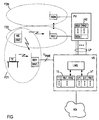
- a communication system with a switching system VS connected to a communication network KN, to which base stations BS1,..., BSN are coupled is shown schematically.
- the switching system VS has a feature control LMS with access to a subscriber memory TS and a connection table VT.
- the base stations BS1, ..., BSN each have an air interface, for example according to the DECT standard. While the base station BS1 is connected directly to the switching system VS via a U P0 / E interface, the base stations BS2 to BSN are coupled to the switching system VS via a radio switching module FV.
- the radio switching module FV is connected to the switching system VS via several logical ports LP. Alternatively, the radio switching module FV can also be integrated as a module in the switching system VS. In the sense of a clearer representation and a clearer separation of functions, an external radio switching module FV is considered in the present exemplary embodiment.
- the radio cells FZ1, ..., FZN of the base stations BS1, ..., BSN are each indicated by a dotted ellipse.
- the base station BS1 which is directly connected to the switching system VS, realizes a monocellular, first radio network, for example in accordance with the DECT standard, in the only radio cell FZ1 of which there is a table terminal TE connected wirelessly to the base station BS1 and a mobile terminal ME.
- the terminals TE and ME are registered in the base station BS1 as belonging to their radio network and each have a permanently reserved radio channel to the base station BS1.
- the base station BS1 emulates the switching system VS towards a terminal to which a call number RN1 is assigned.
- connection of the base station BS1 to the switching system VS via the U P0 / E interface allows not only features according to the Euro-ISDN standard but also features according to the so-called Cornet TS protocol to be activated in the switching system VS. These performance features can thus also be used from the wirelessly connected terminals TE and ME.
- Calls with destination number RN1 are from the switching system VS switched to the base station BS1 for further switching of these connections to the table terminal TE or to the mobile Terminal ME is responsible. Arriving for the destination number RN1 For example, connection requests can be from the base station BS1 signals on both terminals TE and ME and then the connection to that Terminal ME or TE are switched through, from which the Connection request is accepted first.
- the mobile end device ME is still in the Radio cell FZ2 of the base station BS2, which is a multicellular, second radio network, e.g. according to the DECT standard, with the base stations BS2, ..., BSN heard.
- the mobile terminal ME is also set up to establish a connection via this second radio network and in the base station BS2 as for establishing a connection authorized via this second radio network.
- the a second call number RN2 is assigned to mobile terminal ME, by means of which the mobile device can be reached via the second radio network is.
- a connection request directed to the mobile terminal ME with the destination number RN2 is from the switching system VS passed on to the radio switching module FV.
- a respective phone number of everyone in the second Radio network of the registered mobile terminal of that base station assigned is stored in the radio cell itself the relevant mobile device is currently located.
- a respective phone number of everyone in the second Radio network of the registered mobile terminal of that base station assigned is stored in the radio cell itself the relevant mobile device is currently located.
- / number assignment table LRZ assigned the number RN2 to the base station BS2.
- To transfer one to the destination number RN2 Directed connection request is the location / number assignment table LRZ searched for the destination number RN2 and the assigned base station, here BS2, determined.
- the Connection request is made by the radio switch board FV then forwarded to this base station, here BS2, which then establishes a connection to the mobile terminal device ME.
- the following is a situation that occurs frequently in practice considered, in which one between the table terminal TE and a participant in the communication network KN, via the base station BS1 and the switching system VS Connection is transferred to the mobile terminal ME, then from the first radio network to the second radio network changes.
- the transfer of the connection from the table terminal TE to the mobile terminal ME is within the first radio network solely from the base station BS1, e.g. as part of the DECT protocol, managed.
- the base station BS1 separates from this Purpose the connection to the table terminal TE and switches the Connection to the mobile terminal ME through.
- the control signal can, for example are sent automatically when leaving the radio cell FZ1.
- the feature is preferably activated according to a standardized signaling protocol, such as. according to the QSIG protocol or the DSS1 protocol ETSI standard, or also according to a proprietary signaling protocol, such as. the Cornet-TS protocol.
- the activated feature is that of the switching system VS and the base station BS1 running connection the switching system VS separately and in this the number RN1 kept assigned to base station BS1.
- connection table VT In the switching system VS are held connections based on the connection table VT manages in for every current connection V1, ... each assigned status information SI1, ... and at least one destination number assigned to the connection RN1, ... are saved.
- the connection table VT In the present embodiment is in the connection table VT by the Performance control LMS for the held connection V1 status information indicating the hold status of the connection SI1 and the number RN1 of the base station BS1 as Destination number of connection V1 entered.
- the mobile terminal device ME After separating those running through the base station BS1 Connection, the mobile terminal device ME sends a control signal to Resuming the connection via the base station BS2 the radio switching module FV. As a result, this transmits control information containing the number RN2 to the feature control LMS of the switching system VS to have a feature for direct addressing from held Activate connection.
- the feature control LMS searches as part of the activated feature the connection table VT after the transmitted number RN2. Since the number RN2 in the present embodiment is not contained in the connection table VT, the LMS feature control then searches the Subscriber memory TS after this number RN2. In the subscriber memory TS are registered for everyone in the VS switching system Subscriber T1, ... one or more numbers each RN1, RN2, ... saved that particular participant assigned.
- the call number is RN1 the base station BS1 and the call number RN2 of the mobile terminal ME assigned as a subscriber T1 in the subscriber memory TS saved.
- the number assigned to the same subscriber T1 RN1 determined and then a new search in the connection table VT performed - this time after the determined Call number RN1.
- the held on this call number assigned in the connection table VT Connection V1 as part of the activated performance feature to speak directly from the connection on hold Switching system VS for radio switching module FV and from this via the base station BS2 to the mobile terminal ME switched through.
- After resumption of the held Connection is the number RN1 from the switching system VS for subsequent connection requests in the first radio network released again.
Landscapes
- Engineering & Computer Science (AREA)
- Computer Networks & Wireless Communication (AREA)
- Signal Processing (AREA)
- Mobile Radio Communication Systems (AREA)
Abstract
Description

Claims (12)
- Verfahren zum Basisstationswechsel bei einer von einem Vermittlungssystem (VS) über eine erste Basisstation (BS1) zu einem mobilen Endgerät (ME) verlaufenden Verbindung, bei dema) durch die erste Basisstation (BS1), die vom Vermittlungssystem (VS) wie ein leitungsgebundenes, einer ersten Geräteadressierungsinformation (RN1) zugeordnetes Endgerät angesteuert wird, ein Leistungsmerkmal des Vermittlungssystems (VS) aktiviert wird, wodurch die Verbindung getrennt und der ersten Geräteadressierungsinformation (RN1) zugeordnet in einen Haltezustand versetzt wird,b) durch eine vom Vermittlungssystem (VS) über eine Funkvermittlungsbaugruppe (FV) angesteuerte, zweite Basisstation (BS2) eine erfolgte Identifizierung des mobilen Endgerätes (ME) an die Funkvermittlungsbaugruppe (FV) gemeldet wird,c) durch die Funkvermittlungsbaugruppe (FV) eine Steuerinformation, die eine das mobile Endgerät (ME) identifizierende, zweite Geräteadressierungsinformation (RN2) enthält, zum Wiederaufnehmen einer gehaltenen Verbindung an das Vermittlungssystem (VS) übermittelt wird,d) vom Vermittlungssystem (VS) geprüft wird, ob die in der Steuerinformation übermittelte, zweite Geräteadressierungsinformation (RN2) einer Geräteadressierungsinformation zugeordnet ist, die einer gehaltenen Verbindung zugeordnet ist, unde) falls die zweite Geräteadressierungsinformation (RN2) der ersten Geräteadressierungsinformation (RN1) zugeordnet ist, die der ersten Geräteadressierungsinformation (RN1) zugeordnete gehaltene Verbindung vom Vermittlungssystem (VS) zur Funkvermittlungsbaugruppe (FV) und von dieser über die zweite Basisstation (BS2) zum mobilen Endgerät (ME) durchgeschaltet wird.
- Verfahren nach Anspruch 1,
dadurch gekennzeichnet,daß zum Wiederaufnehmen einer gehaltenen Verbindung durch die Steuerinformation ein Leistungsmerkmal des Vermittlungssystems (VS) zum Direktansprechen aktiviert wird. - Verfahren nach Anspruch 1 oder 2,
dadurch gekennzeichnet,daß nach Wiederaufnahme einer gehaltenen Verbindung die erste Geräteadressierungsinformation (RN1) für nachfolgende Verbindungsanforderungen freigegeben wird. - Verfahren nach einem der vorhergehenden Ansprüche,
dadurch gekennzeichnet,daß die erste Geräteadressierungsinformation (RN1) und die zweite Geräteadressierungsinformation (RN2) in einem Teilnehmerspeicher (TS) des Vermittlungssystems (VS) einander als zum selben Teilnehmer (T1) gehörige Geräteadressierungsinformation zugeordnet sind. - Verfahren nach einem der vorhergehenden Ansprüche,
dadurch gekennzeichnet,daß die erste Geräteadressierungsinformation (RN1) und die zweite Geräteadressierungsinformation (RN2) im Vermittlungssystem (VS) einander als zur selben Anrufübernahmegruppe gehörige Geräteadressierungsinformationen zugeordnet sind. - Verfahren zum Basisstationswechsel bei einer von einem Vermittlungssystem (VS) über eine erste Basisstation (BS1) zu einem mobilen Endgerät (ME) verlaufenden Verbindung, wobei die erste Basisstation (BS1) vom Vermittlungssystem (VS) wie ein leitungsgebundenes, einer ersten Geräteadressierungsinformation (RN1) zugeordnetes Endgerät angesteuert wird, und wobeia) durch eine vom Vermittlungssystem (VS) über eine Funkvermittlungsbaugruppe (FV) angesteuerte, zweite Basisstation (BS2) eine erfolgte Identifizierung des mobilen Endgerätes (ME) an die Funkvermittlungsbaugruppe (FV) gemeldet wird, über die eine Verbindung vom Vermittlungssystem (VS) zur zweiten Basisstation (BS2) und von dort zum mobilen Endgerät (ME) mittels einer dem mobilen Endgerät (ME) zugeordneten, zweiten Geräteadressierungsinformation (RN2) aufbaubar ist,b) durch das mobile Endgerät (ME) eine Aktivierung eines Leistungsmerkmals des Vermittlungssystems (VS) zum Aufbau einer Konferenzschaltung veranlaßt wird, wobei dem Vermittlungssystem (VS) zur Identifizierung eines in die bestehende Verbindung einzubeziehenden Endgerätes die zweite Geräteadressierungsinformation (RN2) übermittelt wird,c) vom Vermittlungssystem (VS) anhand der übermittelten, zweiten Geräteadressierungsinformation (RN2) eine Teilverbindung über die Funkvermittlungsbaugruppe (FV) und die zweite Basisstation (BS2) zum mobilen Endgerät (ME) aufgebaut und der bestehenden Verbindung hinzugefügt wird, undd) die erste Basisstation (BS1) aus der Konferenzschaltung herausgeschaltet wird.
- Verfahren nach einem der vorhergehenden Ansprüche,
dadurch gekennzeichnet,daß zur Identifizierung des mobilen Endgerätes (ME) eine Gerätekennung des mobilen Endgerätes (ME) von diesem zur zweiten Basisstation (BS2) übertragen wird, und anhand der übertragenen Gerätekennung die zweite Geräteadressierungsinformation (RN2) ermittelt wird. - Verfahren nach einem der Ansprüche 1 bis 6,
dadurch gekennzeichnet,daß zur Identifizierung des mobilen Endgerätes (ME) die zweite Geräteadressierungsinformation (RN2) vom mobilen Endgerät (ME) zur zweiten Basisstation (BS2) übertragen wird. - Verfahren nach einem der vorhergehenden Ansprüche,
dadurch gekennzeichnet,daß als Geräteadressierungsinformation jeweils eine Rufnummer (RN1, RN2) verwendet wird. - Verfahren nach einem der vorhergehenden Ansprüche,
dadurch gekennzeichnet,daß die erste Basisstation (BS1) einen für das mobile Endgerät (ME) reservierten drahtlosen Übertragungskanal aufweist. - Verfahren nach einem der vorhergehenden Ansprüche,
dadurch gekennzeichnet,daß die erste Basisstation (BS1) einem anderen Funknetz als die zweite Basisstation (BS2) angehört und daß das mobile Endgerät (ME) für eine Verbindungsaufnahme in beiden Funknetzen eingerichtet ist. - Verfahren nach Anspruch 11,
dadurch gekennzeichnet,daß die erste Basisstation (BS1) einem monozellularen Funknetz und die zweite Basisstation (BS2) einem multizellularen Funknetz angehört.
Applications Claiming Priority (2)
| Application Number | Priority Date | Filing Date | Title |
|---|---|---|---|
| DE19937508 | 1999-08-09 | ||
| DE19937508A DE19937508A1 (de) | 1999-08-09 | 1999-08-09 | Verfahren zum Basisstationswechsel (Handover) für mobile Endgeräte |
Publications (2)
| Publication Number | Publication Date |
|---|---|
| EP1076467A1 true EP1076467A1 (de) | 2001-02-14 |
| EP1076467B1 EP1076467B1 (de) | 2006-07-12 |
Family
ID=7917708
Family Applications (1)
| Application Number | Title | Priority Date | Filing Date |
|---|---|---|---|
| EP00117009A Expired - Lifetime EP1076467B1 (de) | 1999-08-09 | 2000-08-08 | Verfahren zur Basisstationswechsel (Handover) für mobile Endgeräte |
Country Status (3)
| Country | Link |
|---|---|
| EP (1) | EP1076467B1 (de) |
| AT (1) | ATE333197T1 (de) |
| DE (2) | DE19937508A1 (de) |
Cited By (2)
| Publication number | Priority date | Publication date | Assignee | Title |
|---|---|---|---|---|
| WO2002085048A1 (en) * | 2001-04-12 | 2002-10-24 | Telefonaktiebolaget L M Ericsson (Publ) | A handover method in a gprs communication system |
| WO2006058498A1 (fr) * | 2004-12-02 | 2006-06-08 | Huawei Technologies Co., Ltd. | Procede de transfert intercellulaire dans un systeme de communication mobile pour garantir la continuation de la communication |
Families Citing this family (2)
| Publication number | Priority date | Publication date | Assignee | Title |
|---|---|---|---|---|
| DE10120763C2 (de) * | 2001-04-27 | 2003-07-03 | Tenovis Gmbh & Co Kg | Vermittlungsanlage, Basisstation und Verfahren zum Übertragen von Leistungsmerkmalen einer Vermittlungsanlage |
| US20250203014A1 (en) * | 2023-12-13 | 2025-06-19 | Vtech Telecommunications Limited | Systems and methods for emulating a shared line system in a multicell network |
Citations (4)
| Publication number | Priority date | Publication date | Assignee | Title |
|---|---|---|---|---|
| EP0700167A1 (de) * | 1993-08-04 | 1996-03-06 | AT&T Corp. | Universelles schnurloses Funktelefonsystem |
| WO1998009468A1 (en) * | 1996-08-30 | 1998-03-05 | Telefonaktiebolaget Lm Ericsson (Publ) | Radio communications systems and methods for mobile assisted handover between a private network and a public mobile network |
| WO1999025146A1 (en) * | 1997-11-07 | 1999-05-20 | Ericsson Inc. | Handover between fixed and mobile networks for dual mode phones |
| US5913166A (en) * | 1995-12-29 | 1999-06-15 | Lucent Technologies Inc. | Arrangement for providing a call hand-off for a mobile station from a land-line supported private base station to a cellular base station operating in a cellular system |
-
1999
- 1999-08-09 DE DE19937508A patent/DE19937508A1/de not_active Withdrawn
-
2000
- 2000-08-08 EP EP00117009A patent/EP1076467B1/de not_active Expired - Lifetime
- 2000-08-08 DE DE50013147T patent/DE50013147D1/de not_active Expired - Lifetime
- 2000-08-08 AT AT00117009T patent/ATE333197T1/de not_active IP Right Cessation
Patent Citations (4)
| Publication number | Priority date | Publication date | Assignee | Title |
|---|---|---|---|---|
| EP0700167A1 (de) * | 1993-08-04 | 1996-03-06 | AT&T Corp. | Universelles schnurloses Funktelefonsystem |
| US5913166A (en) * | 1995-12-29 | 1999-06-15 | Lucent Technologies Inc. | Arrangement for providing a call hand-off for a mobile station from a land-line supported private base station to a cellular base station operating in a cellular system |
| WO1998009468A1 (en) * | 1996-08-30 | 1998-03-05 | Telefonaktiebolaget Lm Ericsson (Publ) | Radio communications systems and methods for mobile assisted handover between a private network and a public mobile network |
| WO1999025146A1 (en) * | 1997-11-07 | 1999-05-20 | Ericsson Inc. | Handover between fixed and mobile networks for dual mode phones |
Cited By (4)
| Publication number | Priority date | Publication date | Assignee | Title |
|---|---|---|---|---|
| WO2002085048A1 (en) * | 2001-04-12 | 2002-10-24 | Telefonaktiebolaget L M Ericsson (Publ) | A handover method in a gprs communication system |
| WO2006058498A1 (fr) * | 2004-12-02 | 2006-06-08 | Huawei Technologies Co., Ltd. | Procede de transfert intercellulaire dans un systeme de communication mobile pour garantir la continuation de la communication |
| EP1734777A4 (de) * | 2004-12-02 | 2007-05-23 | Huawei Tech Co Ltd | Weiterreichverfahren in einem mobilkommunikationssystem zur sicherstellung der kommunikationsfortsetzung |
| US7885655B2 (en) | 2004-12-02 | 2011-02-08 | Huawei Technologies Co., Ltd. | Switch method for ensuring communication continuity in mobile communication system |
Also Published As
| Publication number | Publication date |
|---|---|
| DE19937508A1 (de) | 2001-03-01 |
| DE50013147D1 (de) | 2006-08-24 |
| EP1076467B1 (de) | 2006-07-12 |
| ATE333197T1 (de) | 2006-08-15 |
Similar Documents
| Publication | Publication Date | Title |
|---|---|---|
| EP0466736B1 (de) | Schnurlos-telefonsystem mit einer nebenstellen-kommunikationsanlage | |
| DE69429149T2 (de) | Verfahren zur Steuerung eines sprach- und datenintegrierten Mobilsystems mit einer Vielzahl von persönlichen Stationen | |
| DE69230782T2 (de) | Verfahren und Gerät zum Rufen mehrerer Fernsprechendgeräte bei einem ankommenden Gespräch | |
| DE69927867T2 (de) | System zum Integrieren von privaten Kommunikationsendgeräten | |
| DE69333401T2 (de) | Verfahren zur steuerung einer mobilen kommunikation unter verwendung von aufenthaltsregistern für teilnehmer und mobilstationen | |
| DE4406354C2 (de) | Anordnung zur Integration von EDV-Systemen und Telefonanlagen, die an das öffentliche Telefonnetz angeschlossen sind | |
| EP1121816B1 (de) | Übergabeverfahren (roaming) für mobile endeinrichtungen | |
| DE69434825T2 (de) | Kommunikationsnetzwerk mit automatischer Konfiguration | |
| DE69319035T2 (de) | Architektur für drahtloses zellular Telekommunikationssystem | |
| DE69331461T2 (de) | Verfahren und vorrichtung zur ausführung von kanalumlegung und eingehenden rufen in einem drahtlosen kommunikationssystem | |
| DE19651275C2 (de) | Kommunikationssystem und Verfahren zum Testen einer Kommunikationsvorrichtung | |
| EP0741951A1 (de) | Funksystem für eine geschlossene benutzergruppe | |
| EP0674453B1 (de) | Verfahren und Schaltungsanordnung für den Zugriff schnurloser Endgeräte auf ein Telekommunikationssystem | |
| EP1076467B1 (de) | Verfahren zur Basisstationswechsel (Handover) für mobile Endgeräte | |
| DE1762884C3 (de) | Schaltungsanordnung zur Bereitstellung von Sonderdiensten in Fernmelde-, insbesondere Fernsprechvermittlungsanlagen | |
| DE19726175A1 (de) | Verfahren zum Aufbau einer gebührenfreien Kommunikationsverbindung sowie Diensteinheit, Vermittlungsstelle und Kommunikationsnetz | |
| DE19537101A1 (de) | Verfahren zum Aufbau von Nachrichtenverbindungen für Gruppen- und/oder Sammelruf | |
| DE2653742C2 (de) | Verfahren zur Durchführung eines halbautomatischen Fernsprechauftragsdienstes | |
| DE69507952T2 (de) | Verbindungsaufbau und dienstanruf in fernsprechnetzen | |
| EP0760588B1 (de) | Verfahren und Anordnung zur Herstellung von Fernmeldeverbindungen | |
| DE69631454T2 (de) | Verfahren zum Telekommunikationsnetzbetrieb und Netzwerk dafür | |
| DE69131051T2 (de) | Programmgesteuerte digitale fernsprechvermittlungsstelle | |
| DE10016239C2 (de) | Verfahren und Anordnung zur Mobilkommunikation | |
| DE4232861C1 (de) | Verfahren zur Steuerung von Verbindungsprozeduren in einer programmgesteuerten Nebenstellenanlage mit daran angeschlossenen Mobilendgeräten | |
| EP2392127B1 (de) | Verfahren zur einrichtung und verwaltung einer anbindung eines mobilen kommunikationsendgerätes an eine nebenstellenanlage |
Legal Events
| Date | Code | Title | Description |
|---|---|---|---|
| PUAI | Public reference made under article 153(3) epc to a published international application that has entered the european phase |
Free format text: ORIGINAL CODE: 0009012 |
|
| AK | Designated contracting states |
Kind code of ref document: A1 Designated state(s): AT BE CH CY DE DK ES FI FR GB GR IE IT LI LU MC NL PT SE |
|
| AX | Request for extension of the european patent |
Free format text: AL;LT;LV;MK;RO;SI |
|
| 17P | Request for examination filed |
Effective date: 20010419 |
|
| AKX | Designation fees paid |
Free format text: AT BE CH CY DE DK ES FI FR GB GR IE IT LI LU MC NL PT SE |
|
| 17Q | First examination report despatched |
Effective date: 20031124 |
|
| GRAP | Despatch of communication of intention to grant a patent |
Free format text: ORIGINAL CODE: EPIDOSNIGR1 |
|
| GRAS | Grant fee paid |
Free format text: ORIGINAL CODE: EPIDOSNIGR3 |
|
| GRAA | (expected) grant |
Free format text: ORIGINAL CODE: 0009210 |
|
| AK | Designated contracting states |
Kind code of ref document: B1 Designated state(s): AT BE CH CY DE DK ES FI FR GB GR IE IT LI LU MC NL PT SE |
|
| PG25 | Lapsed in a contracting state [announced via postgrant information from national office to epo] |
Ref country code: IE Free format text: LAPSE BECAUSE OF FAILURE TO SUBMIT A TRANSLATION OF THE DESCRIPTION OR TO PAY THE FEE WITHIN THE PRESCRIBED TIME-LIMIT Effective date: 20060712 Ref country code: FI Free format text: LAPSE BECAUSE OF FAILURE TO SUBMIT A TRANSLATION OF THE DESCRIPTION OR TO PAY THE FEE WITHIN THE PRESCRIBED TIME-LIMIT Effective date: 20060712 Ref country code: NL Free format text: LAPSE BECAUSE OF FAILURE TO SUBMIT A TRANSLATION OF THE DESCRIPTION OR TO PAY THE FEE WITHIN THE PRESCRIBED TIME-LIMIT Effective date: 20060712 |
|
| REG | Reference to a national code |
Ref country code: GB Ref legal event code: FG4D Free format text: NOT ENGLISH |
|
| REG | Reference to a national code |
Ref country code: CH Ref legal event code: EP |
|
| GBT | Gb: translation of ep patent filed (gb section 77(6)(a)/1977) |
Effective date: 20060731 |
|
| REG | Reference to a national code |
Ref country code: IE Ref legal event code: FG4D Free format text: LANGUAGE OF EP DOCUMENT: GERMAN |
|
| REF | Corresponds to: |
Ref document number: 50013147 Country of ref document: DE Date of ref document: 20060824 Kind code of ref document: P |
|
| PG25 | Lapsed in a contracting state [announced via postgrant information from national office to epo] |
Ref country code: LI Free format text: LAPSE BECAUSE OF NON-PAYMENT OF DUE FEES Effective date: 20060831 Ref country code: BE Free format text: LAPSE BECAUSE OF NON-PAYMENT OF DUE FEES Effective date: 20060831 Ref country code: CH Free format text: LAPSE BECAUSE OF NON-PAYMENT OF DUE FEES Effective date: 20060831 Ref country code: MC Free format text: LAPSE BECAUSE OF NON-PAYMENT OF DUE FEES Effective date: 20060831 |
|
| PG25 | Lapsed in a contracting state [announced via postgrant information from national office to epo] |
Ref country code: DK Free format text: LAPSE BECAUSE OF FAILURE TO SUBMIT A TRANSLATION OF THE DESCRIPTION OR TO PAY THE FEE WITHIN THE PRESCRIBED TIME-LIMIT Effective date: 20061012 Ref country code: SE Free format text: LAPSE BECAUSE OF FAILURE TO SUBMIT A TRANSLATION OF THE DESCRIPTION OR TO PAY THE FEE WITHIN THE PRESCRIBED TIME-LIMIT Effective date: 20061012 |
|
| PG25 | Lapsed in a contracting state [announced via postgrant information from national office to epo] |
Ref country code: ES Free format text: LAPSE BECAUSE OF FAILURE TO SUBMIT A TRANSLATION OF THE DESCRIPTION OR TO PAY THE FEE WITHIN THE PRESCRIBED TIME-LIMIT Effective date: 20061023 |
|
| ET | Fr: translation filed | ||
| PG25 | Lapsed in a contracting state [announced via postgrant information from national office to epo] |
Ref country code: PT Free format text: LAPSE BECAUSE OF FAILURE TO SUBMIT A TRANSLATION OF THE DESCRIPTION OR TO PAY THE FEE WITHIN THE PRESCRIBED TIME-LIMIT Effective date: 20061212 |
|
| NLV1 | Nl: lapsed or annulled due to failure to fulfill the requirements of art. 29p and 29m of the patents act | ||
| REG | Reference to a national code |
Ref country code: CH Ref legal event code: PL |
|
| PLBE | No opposition filed within time limit |
Free format text: ORIGINAL CODE: 0009261 |
|
| STAA | Information on the status of an ep patent application or granted ep patent |
Free format text: STATUS: NO OPPOSITION FILED WITHIN TIME LIMIT |
|
| 26N | No opposition filed |
Effective date: 20070413 |
|
| PG25 | Lapsed in a contracting state [announced via postgrant information from national office to epo] |
Ref country code: AT Free format text: LAPSE BECAUSE OF NON-PAYMENT OF DUE FEES Effective date: 20060808 |
|
| BERE | Be: lapsed |
Owner name: SIEMENS A.G. Effective date: 20060831 |
|
| PG25 | Lapsed in a contracting state [announced via postgrant information from national office to epo] |
Ref country code: GR Free format text: LAPSE BECAUSE OF FAILURE TO SUBMIT A TRANSLATION OF THE DESCRIPTION OR TO PAY THE FEE WITHIN THE PRESCRIBED TIME-LIMIT Effective date: 20061013 |
|
| PG25 | Lapsed in a contracting state [announced via postgrant information from national office to epo] |
Ref country code: LU Free format text: LAPSE BECAUSE OF NON-PAYMENT OF DUE FEES Effective date: 20060808 |
|
| PG25 | Lapsed in a contracting state [announced via postgrant information from national office to epo] |
Ref country code: CY Free format text: LAPSE BECAUSE OF FAILURE TO SUBMIT A TRANSLATION OF THE DESCRIPTION OR TO PAY THE FEE WITHIN THE PRESCRIBED TIME-LIMIT Effective date: 20060712 |
|
| REG | Reference to a national code |
Ref country code: GB Ref legal event code: 732E Free format text: REGISTERED BETWEEN 20121025 AND 20121031 |
|
| REG | Reference to a national code |
Ref country code: FR Ref legal event code: TP Owner name: SIEMENS ENTERPRISE COMMUNICATIONS GMBH & CO. K, DE Effective date: 20130108 |
|
| REG | Reference to a national code |
Ref country code: DE Ref legal event code: R084 Ref document number: 50013147 Country of ref document: DE |
|
| REG | Reference to a national code |
Ref country code: DE Ref legal event code: R082 Ref document number: 50013147 Country of ref document: DE Representative=s name: FRITZSCHE PATENT, DE |
|
| REG | Reference to a national code |
Ref country code: DE Ref legal event code: R084 Ref document number: 50013147 Country of ref document: DE Effective date: 20130226 |
|
| REG | Reference to a national code |
Ref country code: DE Ref legal event code: R081 Ref document number: 50013147 Country of ref document: DE Owner name: UNIFY GMBH CO. KG, DE Free format text: FORMER OWNER: SIEMENS AKTIENGESELLSCHAFT, 80333 MUENCHEN, DE Effective date: 20130313 Ref country code: DE Ref legal event code: R082 Ref document number: 50013147 Country of ref document: DE Representative=s name: FRITZSCHE PATENT, DE Effective date: 20130313 Ref country code: DE Ref legal event code: R081 Ref document number: 50013147 Country of ref document: DE Owner name: SIEMENS ENTERPRISE COMMUNICATIONS GMBH & CO. K, DE Free format text: FORMER OWNER: SIEMENS AKTIENGESELLSCHAFT, 80333 MUENCHEN, DE Effective date: 20130313 Ref country code: DE Ref legal event code: R081 Ref document number: 50013147 Country of ref document: DE Owner name: UNIFY GMBH & CO. KG, DE Free format text: FORMER OWNER: SIEMENS AKTIENGESELLSCHAFT, 80333 MUENCHEN, DE Effective date: 20130313 Ref country code: DE Ref legal event code: R082 Ref document number: 50013147 Country of ref document: DE Representative=s name: FRITZSCHE PATENTANWAELTE, DE Effective date: 20130313 |
|
| REG | Reference to a national code |
Ref country code: GB Ref legal event code: 746 Effective date: 20130418 |
|
| REG | Reference to a national code |
Ref country code: DE Ref legal event code: R082 Ref document number: 50013147 Country of ref document: DE Representative=s name: FRITZSCHE PATENT, DE |
|
| REG | Reference to a national code |
Ref country code: DE Ref legal event code: R082 Ref document number: 50013147 Country of ref document: DE Representative=s name: FRITZSCHE PATENT, DE Effective date: 20131112 Ref country code: DE Ref legal event code: R081 Ref document number: 50013147 Country of ref document: DE Owner name: UNIFY GMBH & CO. KG, DE Free format text: FORMER OWNER: SIEMENS ENTERPRISE COMMUNICATIONS GMBH & CO. KG, 81379 MUENCHEN, DE Effective date: 20131112 Ref country code: DE Ref legal event code: R082 Ref document number: 50013147 Country of ref document: DE Representative=s name: FRITZSCHE PATENTANWAELTE, DE Effective date: 20131112 |
|
| REG | Reference to a national code |
Ref country code: FR Ref legal event code: CD Owner name: UNIFY GMBH & CO.KG, DE Effective date: 20140429 |
|
| REG | Reference to a national code |
Ref country code: FR Ref legal event code: PLFP Year of fee payment: 17 |
|
| REG | Reference to a national code |
Ref country code: DE Ref legal event code: R082 Ref document number: 50013147 Country of ref document: DE Representative=s name: FRITZSCHE PATENTANWAELTE, DE Ref country code: DE Ref legal event code: R081 Ref document number: 50013147 Country of ref document: DE Owner name: UNIFY GMBH & CO. KG, DE Free format text: FORMER OWNER: UNIFY GMBH & CO. KG, 81379 MUENCHEN, DE |
|
| REG | Reference to a national code |
Ref country code: FR Ref legal event code: PLFP Year of fee payment: 18 |
|
| REG | Reference to a national code |
Ref country code: FR Ref legal event code: PLFP Year of fee payment: 19 |
|
| PGFP | Annual fee paid to national office [announced via postgrant information from national office to epo] |
Ref country code: DE Payment date: 20180827 Year of fee payment: 19 Ref country code: FR Payment date: 20180824 Year of fee payment: 19 Ref country code: IT Payment date: 20180823 Year of fee payment: 19 |
|
| PGFP | Annual fee paid to national office [announced via postgrant information from national office to epo] |
Ref country code: GB Payment date: 20180828 Year of fee payment: 19 |
|
| REG | Reference to a national code |
Ref country code: DE Ref legal event code: R119 Ref document number: 50013147 Country of ref document: DE |
|
| GBPC | Gb: european patent ceased through non-payment of renewal fee |
Effective date: 20190808 |
|
| PG25 | Lapsed in a contracting state [announced via postgrant information from national office to epo] |
Ref country code: FR Free format text: LAPSE BECAUSE OF NON-PAYMENT OF DUE FEES Effective date: 20190831 Ref country code: DE Free format text: LAPSE BECAUSE OF NON-PAYMENT OF DUE FEES Effective date: 20200303 |
|
| PG25 | Lapsed in a contracting state [announced via postgrant information from national office to epo] |
Ref country code: IT Free format text: LAPSE BECAUSE OF NON-PAYMENT OF DUE FEES Effective date: 20190808 Ref country code: GB Free format text: LAPSE BECAUSE OF NON-PAYMENT OF DUE FEES Effective date: 20190808 |