EP1075827A2 - Selbstklebender Formkörper - Google Patents
Selbstklebender Formkörper Download PDFInfo
- Publication number
- EP1075827A2 EP1075827A2 EP00115955A EP00115955A EP1075827A2 EP 1075827 A2 EP1075827 A2 EP 1075827A2 EP 00115955 A EP00115955 A EP 00115955A EP 00115955 A EP00115955 A EP 00115955A EP 1075827 A2 EP1075827 A2 EP 1075827A2
- Authority
- EP
- European Patent Office
- Prior art keywords
- shaped body
- adhesive
- body according
- molded body
- self
- Prior art date
- Legal status (The legal status is an assumption and is not a legal conclusion. Google has not performed a legal analysis and makes no representation as to the accuracy of the status listed.)
- Granted
Links
Images

Classifications
-
- A—HUMAN NECESSITIES
- A61—MEDICAL OR VETERINARY SCIENCE; HYGIENE
- A61F—FILTERS IMPLANTABLE INTO BLOOD VESSELS; PROSTHESES; DEVICES PROVIDING PATENCY TO, OR PREVENTING COLLAPSING OF, TUBULAR STRUCTURES OF THE BODY, e.g. STENTS; ORTHOPAEDIC, NURSING OR CONTRACEPTIVE DEVICES; FOMENTATION; TREATMENT OR PROTECTION OF EYES OR EARS; BANDAGES, DRESSINGS OR ABSORBENT PADS; FIRST-AID KITS
- A61F13/00—Bandages or dressings; Absorbent pads
- A61F13/02—Adhesive bandages or dressings
- A61F13/0246—Adhesive bandages or dressings characterised by the skin-adhering layer
- A61F13/0256—Adhesive bandages or dressings characterised by the skin-adhering layer characterized by the parametric properties of the adhesive
-
- A—HUMAN NECESSITIES
- A61—MEDICAL OR VETERINARY SCIENCE; HYGIENE
- A61F—FILTERS IMPLANTABLE INTO BLOOD VESSELS; PROSTHESES; DEVICES PROVIDING PATENCY TO, OR PREVENTING COLLAPSING OF, TUBULAR STRUCTURES OF THE BODY, e.g. STENTS; ORTHOPAEDIC, NURSING OR CONTRACEPTIVE DEVICES; FOMENTATION; TREATMENT OR PROTECTION OF EYES OR EARS; BANDAGES, DRESSINGS OR ABSORBENT PADS; FIRST-AID KITS
- A61F13/00—Bandages or dressings; Absorbent pads
- A61F13/02—Adhesive bandages or dressings
- A61F13/023—Adhesive bandages or dressings wound covering film layers without a fluid retention layer
- A61F13/0243—Adhesive bandages or dressings wound covering film layers without a fluid retention layer characterised by the properties of the skin contacting layer, e.g. air-vapor permeability
-
- A—HUMAN NECESSITIES
- A61—MEDICAL OR VETERINARY SCIENCE; HYGIENE
- A61F—FILTERS IMPLANTABLE INTO BLOOD VESSELS; PROSTHESES; DEVICES PROVIDING PATENCY TO, OR PREVENTING COLLAPSING OF, TUBULAR STRUCTURES OF THE BODY, e.g. STENTS; ORTHOPAEDIC, NURSING OR CONTRACEPTIVE DEVICES; FOMENTATION; TREATMENT OR PROTECTION OF EYES OR EARS; BANDAGES, DRESSINGS OR ABSORBENT PADS; FIRST-AID KITS
- A61F13/00—Bandages or dressings; Absorbent pads
- A61F2013/00361—Plasters
- A61F2013/00902—Plasters containing means
- A61F2013/00906—Plasters containing means for transcutaneous or transdermal drugs application
Definitions
- the invention relates to a self-adhesive molded body, also referred to as a pad, with high restoring force for orthopedic purposes, especially for prophylaxis, postoperative Treatment and therapy, especially for faster restoration of function from injured joints, such as knee, ankle, shoulder, elbow and / or wrists.
- the functional bandaging technique is a treatment method for the prophylaxis and therapy of injuries, diseases and changes on the musculoskeletal system.
- the aim of taping is to target the capsule-band structures replicate and thereby achieve selective support and stabilization.
- the actual tape bandage is preferably made of non-elastic strips self-adhesive tapes, so-called reins, or in connection with short-elastic self-adhesive tapes. It protects, supports and relieves vulnerable, damaged or disturbed parts of a functional unit. It allows selective loading in the pain-free room of movement, but prevents extreme or painful Movements.
- EP 0 027 172 A1 describes a bandage in the form of a tube for support or Compression of knee, ankle, elbow and / or wrists. An adhesive Coating of the bandage is not described.
- An epicondylitis bandage is known from EP 0 250 409 A1.
- Such an epicondylitis bandage consists essentially of a hose section made of elastic Material, the tensile stress in the circumferential direction over a substantially circumferential tensioning straps can be changed with a closure.
- the bandage is not self-adhesive.
- DE 41 01 965 A1 discloses an articulated bandage made of elastic bandage material with a soft and a hard portion and at least one friction core. Self-adhesive properties are not described.
- the joint bandage enables a targeted transverse friction massage to restore the joint functions of injured joints such as knee, ankle, elbow, shoulder and wrist more quickly and has an insert that acts on the joint when it is in place and is designed as a pressure pad, the one through the bone projections and tendon attachments of the joint has a defining shape and is formed as a molded body made of a soft or soft-elastic material, in which at least one friction core made of a hard or incompressible material is arranged and fixed in position in the material of the molded body.
- the bandage for symptoms of overload, femoropatellar pain syndromes and the patellar tip syndrome made of an elastic bandage fabric in the form of a tube with an all-round insert made of a knitted wave has a pad in the front bandage part which is located above the kneecap when the bandage is applied and is open at the top and leaves the quadriceps tendon free and in the rear bandage part one or two pads arranged at a distance from one another and which act on the attachment of the ischiocrural muscles.
- the object of the invention is an anatomically shaped body for orthopedic To provide purposes, which due to the self-adhesive properties adheres to the skin or to a base material, which is due to the high Resilience of the molded body, when used correctly, has a massage effect sets which to restore the function of injured faster Joints, such as knee, ankle, shoulder, elbow and / or wrist leads. Further the proprioreceptive effect should be improved by the molded body.
- the molded body according to the invention is based on a composition which is characterized by appropriate process steps or self-adhesive by formulation with tackifiers is trained.
- an elastic polymer selected from the Group polyurethane, polyester, polyether, polyepoxide, polyolefin and / or from one elastic polymer based on natural or synthetic rubber.
- the technical properties of the molded body can be adjusted.
- strongly adhesive systems or less pressure-sensitive adhesives become Systems required for the molded body.
- the respective system corresponding additives such as adhesive resins, plasticizers, stabilizers and others Auxiliaries are added.
- Advantageous designs have an adhesive strength of 1.5 to 22 N / cm, particularly preferably of 1.5 to 18 N / cm.
- the adhesive force is 14.5 N / cm.
- the adhesive force is 16.0 N / cm.
- the mass used to produce the shaped body is a thermoplastic melt mass.
- the softening point of the thermoplastic melt should be higher than 50 ° C, since the application temperature during production is usually at least 70 ° C, preferably between 90 ° C and 190 ° C.
- Post-crosslinking by UV or electron beam radiation may be appropriate. This depends on the chosen structure of the parent polymer or its additives.
- the blending of block copolymers based on SEPS and SEBS for the production of a shaped body according to the invention is distinguished by its wide range of possible variations.
- the cohesive adhesive is preferably based on di-block (AB), tri-block copolymers (ABA block copolymers) and / or mixtures thereof, a proportion of di-block copolymers of less than 80% by weight being preferred.
- the hard phase A is primarily polystyrene or its derivatives
- the soft phase B contains ethylene and propylene or butylene or mixtures thereof.
- the phase B chain can also contain foreign species, such as isoprene, Butadiene or similar substances.
- Polystyrene blocks can also be used in the soft phase B, up to 20% by weight.
- the entire styrene content should always be less than 65% by weight, preferably less than 40% by weight, particularly preferably 3 to 35% by weight. Styrene contents between 3% by weight and 35% by weight are preferred, because a lower proportion of styrene makes the adhesive more supple.
- the aliphatic or aromatic oils, waxes and Resins are preferably hydrocarbon oils, waxes and resins, the oils such as Paraffinic hydrocarbon oils, or the waxes, such as paraffinic hydrocarbon waxes, have a favorable effect on the adhesive effect due to their consistency.
- the oils such as Paraffinic hydrocarbon oils, or the waxes, such as paraffinic hydrocarbon waxes, have a favorable effect on the adhesive effect due to their consistency.
- this core material is not designed to be adhesive.
- Natural rubber or other types of synthetic rubber such as butyl rubber, chloroprene, silicone rubber can be used.
- the molded body should have a high grip. Furthermore, in order to prevent slipping, a high shear strength of the PSA selected for the production of the molded article is necessary.
- the necessary functional bonding on the skin is guaranteed even at critical points of the human musculoskeletal system and is achieved on a base material.
- the product properties such as tack and shear stability can be easily quantified with the help of dynamic mechanical frequency measurement. Here a shear stress controlled rheometer is used.
- the results of this measurement method provide information about the physical properties of a substance by taking the viscoelastic component into account.
- the cohesive adhesive mass is vibrated between two plane-parallel plates with variable frequencies and low deformation (linear viscoelastic range).
- the quotient ( Q tan ⁇ ) between the loss module (G '' viscous part) and the storage module (G 'elastic part).
- a high frequency is chosen for the subjective feeling of tackiness (tack) and a low frequency for the shear strength.
- a low numerical value means low tack and good shear stability. description
- Low frequency / RT shear strength Touch sticky high frequency / RT PSA
- PSAs are preferred for forming the shaped body which is the ratio of the viscous component to the elastic component at a frequency of 100 rad / s at 25 ° C is greater than 0.4, or adhesive compositions in which the ratio of the viscous Part of the elastic part at a frequency of 0.1 rad / s at 25 ° C less than 0.5 is, preferably between 0.35 and 0.02, very particularly preferably between 0.3 and 0.05.
- the adhesives are further preferably set so that they are at a frequency of 0.1 rad / s a dynamic-complex glass transition temperature of less than 25 ° C, preferably from less than 10 ° C, very particularly preferably from 5 ° C to -150 ° C, exhibit.
- the pads have a favorable resetting behavior.
- the high shear strength of the adhesive is achieved by the cohesive nature of the polymer, especially block copolymers.
- a far-reaching improvement over the known prior art can be achieved by providing stretchable versions of the pads. This shows an improvement in the propioreceptive effect for long-term use, because pads that are too small do not stick permanently and therefore have no or significantly less propioreceptive effect.
- the elasticity depends on the corresponding use of the product. Strains of more than 10% are generally necessary. For a special version on the knee, the minimum elasticity should be 70%, for another special version for use on the elbow 50%.
- the molded body can be detached by stretching, too this requires a good elasticity of the pad material.
- the shaped bodies is doped with releasable locally or systemically active substances.
- the molded body which can be detached by stretching, has been treated with an active ingredient which can be released onto the skin.
- the molded articles can be produced from the melt of the abovementioned. Mass.
- Different manufacturing processes can be considered, depending on the Purpose may result in benefits.
- Common manufacturing methods are casting, Printing, spraying, atomizing, extruding, calendering and punching, embossing, Stretching, cutting or a combination thereof.
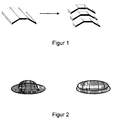
- profiles can be extruded, such as the figure 1 shows.
- the extruded profiles can then be cut into slices. In some cases cooling before cutting is advantageous.
- the molded part can also be made from a spatial limited plate or an endless ribbon can be punched or cut.
- Screen printing is a continuous process. This is about a Squeegee the melt filled in wells and at another point from the well taken out. Auxiliary carriers are usually used in this process, on which the moldings are temporarily applied. This creates nubbed surfaces, which have a better massage effect.
- the prior foaming of the adhesive compositions can be advantageous.
- the adhesives are preferably foamed with inert gases such as nitrogen, carbon dioxide, noble gases, hydrocarbons or air or mixtures thereof.
- foaming by thermal decomposition of gas-evolving substances such as azo, carbonate and hydrazide compounds has also proven to be suitable.
- the degree of foaming i.e. the gas content should be at least about 5% by volume and can range up to about 85% by volume.
- values of 10 vol% to 75 have been found Vol .-%, preferably 50 vol .-%, well proven. Is used at relatively high temperatures of worked around 100 ° C and comparatively high internal pressure, very arise Open-pore adhesive foam layers that are particularly well permeable to air and water vapor are. Furthermore, the at least partially open-pored molded articles can be damp take up.
- the advantageous property is the good conformability even on uneven surfaces due to the elasticity and plasticity of the foamed molded body. This advantage is particularly important for protruding bones (for example on the ankle).
- thermoplastic Adhesive under high pressure at a temperature above the softening point (about 120 ° C) with the intended gases such as nitrogen, air or Carbon dioxide in different volume fractions (about 10 vol.% To 80 vol.%)
- gases such as nitrogen, air or Carbon dioxide in different volume fractions (about 10 vol.% To 80 vol.%)
- stator / rotor system In implemented a stator / rotor system.
- the mixed pressures gas / thermoplastic in the system are 40 to 100 bar, preferably 40 to 70 bar.
- the PSA foam produced in this way can then reach the application plant via a line.
- Commercial nozzles, extruder or chamber systems are used in the application. Due to the foaming of the molded body and the resulting open pores in the mass, the products coated with the device are well permeable to water vapor and air when using a porous carrier. The amount of pressure sensitive adhesive required is significantly reduced without impairing the properties.
- Figure 3 shows that the molded body in a preferred embodiment stretching, especially in the direction of the bond plane, from the surface - in particular the skin - is detachable.
Landscapes
- Health & Medical Sciences (AREA)
- Life Sciences & Earth Sciences (AREA)
- General Health & Medical Sciences (AREA)
- Biomedical Technology (AREA)
- Heart & Thoracic Surgery (AREA)
- Vascular Medicine (AREA)
- Dermatology (AREA)
- Animal Behavior & Ethology (AREA)
- Engineering & Computer Science (AREA)
- Public Health (AREA)
- Veterinary Medicine (AREA)
- Materials For Medical Uses (AREA)
- Adhesives Or Adhesive Processes (AREA)
- Orthopedics, Nursing, And Contraception (AREA)
- Adhesive Tapes (AREA)
Abstract
Description
Die Gelenkbandage ermöglicht eine gezielte Querfriktionsmassage zur schnelleren Wiederherstellung der Gelenkfunktionen von verletzten Gelenken wie Knie-, Sprung-, Ellen-bogen-, Schulter- und Handgelenken und weist eine im angelegten Zustand das Gelenk beaufschlagende Einlage auf, die als Druckpelotte ausgebildet ist, die eine durch die Knochenvorsprünge und Sehnenansätze des Gelenkes bestimmende Form aufweist und als Formkörper aus einem weichen oder weich-elastischen Material ausgebildet ist, in dem mindestens ein Friktionskern aus einem harten oder inkompressiblen Material angeordnet und in dem Material des Formkörpers in seiner Lage fixiert ist.
Die Bandage für Überlastungserscheinungen, femoropatellare Schmerzsyndrome und das Patellaspitzensyndrom aus einem elastischen Bandagenstoff in Schlauchform mit einem rundherum laufenden Einsatz aus einem Wellengestrick weist in dem vorderen Bandagenteil eine im Bereich über der Kniescheibe bei angelegter Bandage liegende, nach oben offene und die Quadrizeps-Sehne freilassende Pelotte und in dem rückwärtigen Bandagenteil eine oder zwei im Abstand voneinander angeordnete, den Ansatz der ischiokruralen Muskulatur beaufschlagende Pelotten auf.
- mit einer Klebkraft von 1 N/cm bis 25 N/cm,
- einer Dehnfähigkeit von mehr als 10 %,
- einer Dicke von mehr als 0,5 mm und
- einem Rückstellvermögen von mehr als 50 % bei einer Zugbeanspruchung von 5 N/cm2.
In einer speziellen Ausführung für das Knie beträgt die Klebkraft 14,5 N/cm.
In einer weiteren speziellen Ausführung für den Ellenbogen beträgt die Klebkraft 16,0 N/cm.
Der Erweichungspunkt der thermoplastischen Schmelzmasse sollte höher als 50 °C liegen, da die Applikationstemperatur bei der Herstellung in der Regel mindestens 70 °C beträgt, bevorzugt zwischen 90 °C und 190 °C. Gegebenenfalls kann eine Nachvemetzung durch UV- oder Elektronenstrahlen-Bestrahlung angebracht sein. Dieses hängt vom gewählten Aufbau des Stammpolymers oder dessen Zusatzstoffen ab.
Für besonders starkhaftende Systeme basiert die kohäsive Haftmasse bevorzugt auf Di-Block- (A-B-), Tri-Blockcopolymeren (A-B-A-Blockcopolymere) und/oder deren Mischungen, wobei ein Anteil an Di-Blockcopolymeren von kleiner 80 Gew.-% bevorzugt wird. Die harte Phase A ist vornehmlich Polystyrol oder dessen Derivate, und die weiche Phase B enthält Ethylen und Propylen beziehungsweise Butylen oder deren Mischungen.
- 5 Gew.-% bis 90 Gew.-%
- Blockcopolymere,
- 5 Gew.-% bis 80 Gew.-%
- Klebrigmacher wie Öle, Wachse, Harze und/oder deren Mischungen, bevorzugt Mischungen aus Harzen und Ölen,
- weniger als 60 Gew.-%
- Weichmacher,
- weniger als 15 Gew.-%
- Additive,
- weniger als 5 Gew.-%
- Stabilisatoren,
Nach DIN 53505 (1987-06) entspricht die Shore-Härte bei der Prüfung von Elastomeren, Gummi und Kautschuk dem Widerstand gegen das Eindringen eines Kegelstumpfes (A oder C) beziehungsweise eines abgerundeten Kegels (D), der durch das Zusammendrücken einer Feder mit einer festgelegten Federcharakteristik gemessen und in dimensionslosen Shore-A(C, D)-Härteeinheiten ausgedrückt wird. Bei der Prüfung von Stahl wird die Shore-Rückprallhärte in dem sogenannten Skleroskop gemessen, bei dem die Rückprallhöhe eines Fallhammers, der in einem senkrechten Rohr auf die Prüffläche fällt, bestimmt wird.
Durch die gezielte Absenkung der Glasübergangstemperatur der Haftklebemasse infolge der Auswahl der Klebrigmacher, der Weichmacher sowie der Polymermolekülgröße und der Molekularverteilung der Einsatzkomponenten wird die notwendige funktionsgerechte Verklebung auf der Haut auch an kritischen Stellen des menschlichen Bewegungsapparates gewährleistet und oder auf einem Unterzugmaterial erreicht.
Die Produkteigenschaften wie Anfaßklebrigkeit und Scherstabilität lassen sich mit Hilfe einer dynamisch-mechanischen Frequenzmessung gut quantifizieren. Hierbei wird ein schubspannungsgesteuertes Rheometer verwendet.
Die Ergebnisse dieser Meßmethode geben Auskunft über die physikalischen Eigenschaften eines Stoffes durch die Berücksichtigung des viskoelastischen Anteils. Hierbei wird bei einer vorgegebenen Temperatur die kohäsive Haftmasse zwischen zwei planparallelen Platten mit variablen Frequenzen und geringer Verformung (linear viskoelastischer Bereich) in Schwingungen versetzt. Über eine Aufnahmesteuerung wird computerunterstützt der Quotient (
Ein niedriger Zahlenwert bedeutet eine geringe Anfaßklebrigkeit und eine gute Scherstabilität.
| Bezeichnung | Scherfestigkeit niedrige Frequenz/RT | Anfaßklebrigkeit hohe Frequenz/RT |
| Haftklebemasse A | | |
| Haftklebemasse B | | |
Die hohe Scherfestigkeit der Haftmasse wird durch den kohäsiven Charakter des Polymeren, insbesondere Blockcopolymeren, erreicht.
Die Dehnfähigkeit hängt von der entsprechenden Verwendung des Produktes ab. Generell sind Dehnungen von mehr als 10 % notwendig. Für eine spezielle Ausführung am Knie sollte die Mindestdehnbarkeit 70 %, für eine andere spezielle Ausführung für die Verwendung am Ellenbogen 50 % betragen.
In einem speziellen Fall ist der durch Dehnung entklebbare Formkörper mit einem an die Haut freisetzbaren Wirkstoff versetzt worden.
Die Klebemassen werden dabei bevorzugt mit inerten Gasen wie Stickstoff, Kohlendioxid, Edelgasen, Kohlenwasserstoffen oder Luft oder deren Gemischen geschäumt. In manchen Fällen hat sich ein Aufschäumen zusätzlich durch thermische Zersetzung gasentwickelnder Substanzen wie Azo-, Carbonat- und Hydrazid-Verbindungen als geeignet erwiesen.
Dieser Vorteil kommt besonders bei Knochenvorsprüngen (zum Beispiel am Sprung-gelenk) zum Tragen.
Durch die Schäumung des Formkörpers und die dadurch entstandenen offenen Poren in der Masse sind bei Verwendung eines an sich porösen Trägers die mit der Vorrichtung beschichteten Produkte gut wasserdampf- und luftdurchlässig. Die benötigte Haftklebermenge wird erheblich reduziert ohne Beeinträchtigung und Wirkungsweise der Eigenschaften.
Claims (9)
- Selbstklebender, der Anatomie angepaßter Formkörper mit propiorezeptiver Wirkung für medizinische Zwecke mit einer Klebkraft von 1 N/cm bis 25 N/cm, einer Dehnfähigkeit von mehr als 10 %, einer Dicke von mehr als 0,5 mm und einem Rückstellvermögen von mehr als 50 % bei einer Zugbeanspruchung von 5 N/cm2.
- Formkörper nach Anspruch 1, dadurch gekennzeichnet, daß der Formkörper zu wesentlichen Anteilen aus einem elastischen Polymer gewählt aus der Gruppe Polyurethan, Polyester, Polyether, Polyepoxid, Polyolefin besteht.
- Formkörper nach den Ansprüchen 1 und 2, dadurch gekennzeichnet, daß der Formkörper zu wesentlichen Anteilen aus einem elastischen Polymer auf Basis eines natürlichen oder synthetischen Kautschuks besteht
- Formkörper nach den Ansprüchen 1 bis 3, dadurch gekennzeichnet, daß der Formkörper aus einem styrolhaltigen A/B oder A/B/A Blockcopolymer besteht.
- Formkörper nach mindestens einem der vorangegangenen Ansprüche, dadurch gekennzeichnet, daß der Formkörper durch Dehnung entklebbar ist.
- Formkörper nach mindestens einem der vorangegangenen Ansprüche, dadurch gekennzeichnet, daß der Formkörper eine Klebkraft von 1,5 bis 22 N/cm, bevorzugt 1,5 bis 18 N/cm aufweist.
- Formkörper nach mindestens einem der vorangegangenen Ansprüche, dadurch gekennzeichnet, daß der Formkörper geschäumt ist und insbesondere einen Gasanteil von mindestens 5 Vol.-% aufweist, bevorzugt 10 Vol.-% bis 85 Vol.-%.
- Formkörper nach mindestens einem der vorangegangenen Ansprüche, dadurch gekennzeichnet, daß der Formkörper wenigstens eine genoppte Fläche hat.
- Formkörper nach mindestens einem der vorangegangenen Ansprüche, dadurch gekennzeichnet, daß der Formkörper eine freisetzbare lokal oder systemisch wirkende Substanz beinhaltet.
Applications Claiming Priority (2)
| Application Number | Priority Date | Filing Date | Title |
|---|---|---|---|
| DE19938322 | 1999-08-12 | ||
| DE19938322A DE19938322A1 (de) | 1999-08-12 | 1999-08-12 | Selbstklebender Formkörper |
Publications (3)
| Publication Number | Publication Date |
|---|---|
| EP1075827A2 true EP1075827A2 (de) | 2001-02-14 |
| EP1075827A3 EP1075827A3 (de) | 2002-06-19 |
| EP1075827B1 EP1075827B1 (de) | 2006-11-15 |
Family
ID=7918235
Family Applications (1)
| Application Number | Title | Priority Date | Filing Date |
|---|---|---|---|
| EP00115955A Expired - Lifetime EP1075827B1 (de) | 1999-08-12 | 2000-07-26 | Selbstklebender Formkörper |
Country Status (6)
| Country | Link |
|---|---|
| US (1) | US6506957B1 (de) |
| EP (1) | EP1075827B1 (de) |
| AT (1) | ATE345106T1 (de) |
| AU (1) | AU4898200A (de) |
| DE (2) | DE19938322A1 (de) |
| ES (1) | ES2274753T3 (de) |
Families Citing this family (12)
| Publication number | Priority date | Publication date | Assignee | Title |
|---|---|---|---|---|
| US8455710B2 (en) | 1997-09-22 | 2013-06-04 | Argentum Medical, Llc | Conductive wound dressings and methods of use |
| US8801681B2 (en) | 1995-09-05 | 2014-08-12 | Argentum Medical, Llc | Medical device |
| US6087549A (en) * | 1997-09-22 | 2000-07-11 | Argentum International | Multilayer laminate wound dressing |
| US5814094A (en) | 1996-03-28 | 1998-09-29 | Becker; Robert O. | Iontopheretic system for stimulation of tissue healing and regeneration |
| US7214847B1 (en) * | 1997-09-22 | 2007-05-08 | Argentum Medical, L.L.C. | Multilayer conductive appliance having wound healing and analgesic properties |
| US6861570B1 (en) | 1997-09-22 | 2005-03-01 | A. Bart Flick | Multilayer conductive appliance having wound healing and analgesic properties |
| EP1260565B1 (de) * | 2001-05-11 | 2006-03-29 | Nitto Denko Corporation | Druckempfindliches Klebeband zum Fixieren einer Gelenkpartie und Anwendungsverfahren |
| US6740057B2 (en) * | 2001-07-13 | 2004-05-25 | Ronald P. Grelsamer | External device diminishing odds of patient disengaging hip replacement |
| DE10243967A1 (de) * | 2002-09-20 | 2004-04-15 | Adiam Life Science Ag | Gefäßprothese oder Gewebeflicken aus biokompatiblem Polyurethan und Verfahren zur Verbesserung des E-Moduls dieser Werkstücke |
| DE10311433B4 (de) * | 2003-03-15 | 2016-08-04 | Lohmann Gmbh & Co. Kg | Verfahren zur Herstellung von haftklebender Materialien und Dichtungsmaterialien mit dreidimensionaler Struktur |
| WO2009135222A1 (en) | 2008-05-02 | 2009-11-05 | Protasiewicz Richard E Jr | Cutaneous proprioreceptive activation garment system |
| SMT201800390T1 (it) * | 2010-12-08 | 2018-09-13 | Convatec Technologies Inc | Medicazione autosigillante |
Family Cites Families (15)
| Publication number | Priority date | Publication date | Assignee | Title |
|---|---|---|---|---|
| US3934583A (en) | 1974-09-27 | 1976-01-27 | Danny W. Hollingshead | Therapeutic musculoskeletal support sleeve and method of manufacturing same |
| DE2936174A1 (de) | 1979-09-07 | 1981-03-19 | Bauerfeind Gmbh, 4152 Kempen | Bandage |
| DE8504357U1 (de) | 1985-02-14 | 1985-05-15 | Weihermüller & Voigtmann GmbH & Co KG, 8580 Bayreuth | Epicondylitis-bandage |
| DE8625798U1 (de) * | 1986-09-26 | 1988-01-28 | Heinz Schiebler Gummistrumpf-Fabrik, 2390 Flensburg | Kompressionseinlage für eine Bandage |
| DE4101965A1 (de) | 1991-01-24 | 1992-07-30 | Beiersdorf Ag | Gelenkbandage |
| JP3196851B2 (ja) * | 1991-04-01 | 2001-08-06 | 積水化学工業株式会社 | 医療用貼付剤 |
| JP3581863B2 (ja) * | 1992-05-07 | 2004-10-27 | 積水化学工業株式会社 | 貼付剤 |
| DE4237389A1 (de) | 1992-11-05 | 1994-05-11 | Beiersdorf Ag | Bandage für das Kniegelenk |
| DE4238610A1 (de) * | 1992-11-16 | 1994-05-19 | Hauber Ferd Gmbh | Gelenkbandage |
| WO1996011236A1 (en) * | 1994-10-07 | 1996-04-18 | The Procter & Gamble Company | Adhesive composition, method and apparatus for manufacture thereof and abosrbent articles comprising said adhesive compostion |
| DE19620107A1 (de) * | 1996-05-18 | 1997-11-20 | Beiersdorf Ag | Partiell selbstklebend beschichtetes Trägermaterial, Verfahren zu dessen Herstellung und Verwendung |
| DE19620109A1 (de) * | 1996-05-18 | 1997-11-20 | Beiersdorf Ag | Selbstklebend beschichtetes, luftdurchlässiges Trägermaterial, Verfahren zu dessen Herstellung und Verwendung |
| DE29618426U1 (de) * | 1996-10-14 | 1997-02-27 | Weihermüller & Voigtmann GmbH & Co KG, 95448 Bayreuth | Strukturierte Auflagefläche für medizinische Zwecke |
| DE19751873A1 (de) * | 1997-11-22 | 1999-08-05 | Beiersdorf Ag | Partiell selbstklebend ausgerüstetes Trägermaterial |
| DE19755222A1 (de) * | 1997-12-12 | 1999-06-24 | Beiersdorf Ag | Selbstklebend ausgerüstetes Trägermaterial |
-
1999
- 1999-08-12 DE DE19938322A patent/DE19938322A1/de not_active Withdrawn
-
2000
- 2000-07-20 US US09/620,383 patent/US6506957B1/en not_active Expired - Fee Related
- 2000-07-26 ES ES00115955T patent/ES2274753T3/es not_active Expired - Lifetime
- 2000-07-26 DE DE50013738T patent/DE50013738D1/de not_active Expired - Lifetime
- 2000-07-26 EP EP00115955A patent/EP1075827B1/de not_active Expired - Lifetime
- 2000-07-26 AT AT00115955T patent/ATE345106T1/de not_active IP Right Cessation
- 2000-08-02 AU AU48982/00A patent/AU4898200A/en not_active Abandoned
Also Published As
| Publication number | Publication date |
|---|---|
| ATE345106T1 (de) | 2006-12-15 |
| AU4898200A (en) | 2001-02-15 |
| EP1075827B1 (de) | 2006-11-15 |
| DE50013738D1 (de) | 2006-12-28 |
| DE19938322A1 (de) | 2001-02-15 |
| EP1075827A3 (de) | 2002-06-19 |
| US6506957B1 (en) | 2003-01-14 |
| ES2274753T3 (es) | 2007-06-01 |
Similar Documents
| Publication | Publication Date | Title |
|---|---|---|
| EP0901357B1 (de) | Partiell selbstklebend beschichtetes trägermaterial, verfahren zu dessen herstellung und verwendung | |
| EP0901356B1 (de) | Selbstklebend beschichtetes, luftdurchlässiges trägermaterial, verfahren zu dessen herstellung und verwendung | |
| EP0826380B1 (de) | Selbstklebend ausgerüstete Trägermaterialien | |
| DE69530607T2 (de) | Klebstoffzusammensetzung, verfahren und gerät zu dessen herstellung und absorbierende gegenstände die diese klebstoffzusammensetzung enthalten | |
| EP0918080B1 (de) | Partiell selbstklebend ausgerüstetes Trägermaterial | |
| EP1075827B1 (de) | Selbstklebender Formkörper | |
| DE69018650T2 (de) | Verbundstoff aus einem dispergierten gel in einer adhesiven matrix und verfahren zu seiner herstellung. | |
| DE69928941T2 (de) | Gelförmiger körperschutzartikel mit therapeutischen zutaten | |
| EP0027172B1 (de) | Bandage | |
| DE4101965A1 (de) | Gelenkbandage | |
| DE19749467C2 (de) | Wirkstoffhaltige Pflaster | |
| EP0922739B1 (de) | Selbstklebend ausgerüstetes Trägermaterial | |
| EP0846463B1 (de) | Wirkstoffhaltige Pflaster | |
| DE19729905A1 (de) | Trägermaterial für medizinische Zwecke | |
| DE60001980T2 (de) | Flüssigkeit absorbierende, adhesive hydrokolloide zusammensetzungen | |
| DE19825499C2 (de) | Wirkstoffhaltige Pflaster | |
| DE19804604A1 (de) | Vorrichtung zur Freigabe von Stoffen | |
| WO2000068334A1 (de) | Trägermaterial mit kohäsiver haftmasse | |
| WO1999066001A1 (de) | Partiell selbstklebend ausgerüsteter gegenstand mit dauerhaft verformter selbstklebemasse | |
| EP4121489A1 (de) | Bandage, hotmelt-klebstoff zur herstellung einer bandage, verwendung und verfahren zur herstellung eines hotmelt-klebstoffs | |
| DE2216366A1 (de) | Klebfaehiges verbundmaterial | |
| WO2000000234A1 (de) | Orthopädische bandage | |
| DE19962747A1 (de) | Orthopädische Bandage | |
| WO2025099053A1 (de) | Pelotte mit kühlfunktion und/oder wärmefunktion | |
| DE19964422B4 (de) | Orthopädische Bandage |
Legal Events
| Date | Code | Title | Description |
|---|---|---|---|
| PUAI | Public reference made under article 153(3) epc to a published international application that has entered the european phase |
Free format text: ORIGINAL CODE: 0009012 |
|
| AK | Designated contracting states |
Kind code of ref document: A2 Designated state(s): AT BE CH CY DE DK ES FI FR GB GR IE IT LI LU MC NL PT SE |
|
| AX | Request for extension of the european patent |
Free format text: AL;LT;LV;MK;RO;SI |
|
| PUAL | Search report despatched |
Free format text: ORIGINAL CODE: 0009013 |
|
| AK | Designated contracting states |
Kind code of ref document: A3 Designated state(s): AT BE CH CY DE DK ES FI FR GB GR IE IT LI LU MC NL PT SE |
|
| AX | Request for extension of the european patent |
Free format text: AL;LT;LV;MK;RO;SI |
|
| 17P | Request for examination filed |
Effective date: 20020724 |
|
| AKX | Designation fees paid |
Designated state(s): AT BE CH CY DE DK ES FI FR GB GR IE IT LI LU MC NL PT SE |
|
| 17Q | First examination report despatched |
Effective date: 20030630 |
|
| GRAP | Despatch of communication of intention to grant a patent |
Free format text: ORIGINAL CODE: EPIDOSNIGR1 |
|
| GRAS | Grant fee paid |
Free format text: ORIGINAL CODE: EPIDOSNIGR3 |
|
| GRAA | (expected) grant |
Free format text: ORIGINAL CODE: 0009210 |
|
| AK | Designated contracting states |
Kind code of ref document: B1 Designated state(s): AT BE CH CY DE DK ES FI FR GB GR IE IT LI LU MC NL PT SE |
|
| PG25 | Lapsed in a contracting state [announced via postgrant information from national office to epo] |
Ref country code: NL Free format text: LAPSE BECAUSE OF FAILURE TO SUBMIT A TRANSLATION OF THE DESCRIPTION OR TO PAY THE FEE WITHIN THE PRESCRIBED TIME-LIMIT Effective date: 20061115 Ref country code: IE Free format text: LAPSE BECAUSE OF FAILURE TO SUBMIT A TRANSLATION OF THE DESCRIPTION OR TO PAY THE FEE WITHIN THE PRESCRIBED TIME-LIMIT Effective date: 20061115 Ref country code: FI Free format text: LAPSE BECAUSE OF FAILURE TO SUBMIT A TRANSLATION OF THE DESCRIPTION OR TO PAY THE FEE WITHIN THE PRESCRIBED TIME-LIMIT Effective date: 20061115 Ref country code: IT Free format text: LAPSE BECAUSE OF FAILURE TO SUBMIT A TRANSLATION OF THE DESCRIPTION OR TO PAY THE FEE WITHIN THE PRESCRIBED TIME-LIMIT;WARNING: LAPSES OF ITALIAN PATENTS WITH EFFECTIVE DATE BEFORE 2007 MAY HAVE OCCURRED AT ANY TIME BEFORE 2007. THE CORRECT EFFECTIVE DATE MAY BE DIFFERENT FROM THE ONE RECORDED. Effective date: 20061115 |
|
| REG | Reference to a national code |
Ref country code: GB Ref legal event code: FG4D Free format text: NOT ENGLISH |
|
| REG | Reference to a national code |
Ref country code: CH Ref legal event code: EP |
|
| REF | Corresponds to: |
Ref document number: 50013738 Country of ref document: DE Date of ref document: 20061228 Kind code of ref document: P |
|
| REG | Reference to a national code |
Ref country code: IE Ref legal event code: FG4D Free format text: LANGUAGE OF EP DOCUMENT: GERMAN |
|
| PG25 | Lapsed in a contracting state [announced via postgrant information from national office to epo] |
Ref country code: SE Free format text: LAPSE BECAUSE OF FAILURE TO SUBMIT A TRANSLATION OF THE DESCRIPTION OR TO PAY THE FEE WITHIN THE PRESCRIBED TIME-LIMIT Effective date: 20070215 Ref country code: DK Free format text: LAPSE BECAUSE OF FAILURE TO SUBMIT A TRANSLATION OF THE DESCRIPTION OR TO PAY THE FEE WITHIN THE PRESCRIBED TIME-LIMIT Effective date: 20070215 |
|
| GBT | Gb: translation of ep patent filed (gb section 77(6)(a)/1977) |
Effective date: 20070125 |
|
| PG25 | Lapsed in a contracting state [announced via postgrant information from national office to epo] |
Ref country code: PT Free format text: LAPSE BECAUSE OF FAILURE TO SUBMIT A TRANSLATION OF THE DESCRIPTION OR TO PAY THE FEE WITHIN THE PRESCRIBED TIME-LIMIT Effective date: 20070416 |
|
| NLV1 | Nl: lapsed or annulled due to failure to fulfill the requirements of art. 29p and 29m of the patents act | ||
| ET | Fr: translation filed | ||
| REG | Reference to a national code |
Ref country code: ES Ref legal event code: FG2A Ref document number: 2274753 Country of ref document: ES Kind code of ref document: T3 |
|
| REG | Reference to a national code |
Ref country code: IE Ref legal event code: FD4D |
|
| PLBE | No opposition filed within time limit |
Free format text: ORIGINAL CODE: 0009261 |
|
| STAA | Information on the status of an ep patent application or granted ep patent |
Free format text: STATUS: NO OPPOSITION FILED WITHIN TIME LIMIT |
|
| 26N | No opposition filed |
Effective date: 20070817 |
|
| BERE | Be: lapsed |
Owner name: BEIERSDORF A.G. Effective date: 20070731 |
|
| REG | Reference to a national code |
Ref country code: CH Ref legal event code: PL |
|
| PG25 | Lapsed in a contracting state [announced via postgrant information from national office to epo] |
Ref country code: LI Free format text: LAPSE BECAUSE OF NON-PAYMENT OF DUE FEES Effective date: 20070731 Ref country code: MC Free format text: LAPSE BECAUSE OF NON-PAYMENT OF DUE FEES Effective date: 20070731 Ref country code: GR Free format text: LAPSE BECAUSE OF FAILURE TO SUBMIT A TRANSLATION OF THE DESCRIPTION OR TO PAY THE FEE WITHIN THE PRESCRIBED TIME-LIMIT Effective date: 20070216 Ref country code: CH Free format text: LAPSE BECAUSE OF NON-PAYMENT OF DUE FEES Effective date: 20070731 |
|
| PG25 | Lapsed in a contracting state [announced via postgrant information from national office to epo] |
Ref country code: BE Free format text: LAPSE BECAUSE OF NON-PAYMENT OF DUE FEES Effective date: 20070731 |
|
| PG25 | Lapsed in a contracting state [announced via postgrant information from national office to epo] |
Ref country code: AT Free format text: LAPSE BECAUSE OF NON-PAYMENT OF DUE FEES Effective date: 20070726 |
|
| PG25 | Lapsed in a contracting state [announced via postgrant information from national office to epo] |
Ref country code: CY Free format text: LAPSE BECAUSE OF FAILURE TO SUBMIT A TRANSLATION OF THE DESCRIPTION OR TO PAY THE FEE WITHIN THE PRESCRIBED TIME-LIMIT Effective date: 20061115 Ref country code: LU Free format text: LAPSE BECAUSE OF NON-PAYMENT OF DUE FEES Effective date: 20070726 |
|
| PGFP | Annual fee paid to national office [announced via postgrant information from national office to epo] |
Ref country code: DE Payment date: 20130731 Year of fee payment: 14 Ref country code: ES Payment date: 20130729 Year of fee payment: 14 |
|
| PGFP | Annual fee paid to national office [announced via postgrant information from national office to epo] |
Ref country code: FR Payment date: 20130722 Year of fee payment: 14 Ref country code: GB Payment date: 20130719 Year of fee payment: 14 |
|
| REG | Reference to a national code |
Ref country code: DE Ref legal event code: R119 Ref document number: 50013738 Country of ref document: DE |
|
| GBPC | Gb: european patent ceased through non-payment of renewal fee |
Effective date: 20140726 |
|
| REG | Reference to a national code |
Ref country code: FR Ref legal event code: ST Effective date: 20150331 |
|
| PG25 | Lapsed in a contracting state [announced via postgrant information from national office to epo] |
Ref country code: DE Free format text: LAPSE BECAUSE OF NON-PAYMENT OF DUE FEES Effective date: 20150203 |
|
| REG | Reference to a national code |
Ref country code: DE Ref legal event code: R119 Ref document number: 50013738 Country of ref document: DE Effective date: 20150203 |
|
| PG25 | Lapsed in a contracting state [announced via postgrant information from national office to epo] |
Ref country code: FR Free format text: LAPSE BECAUSE OF NON-PAYMENT OF DUE FEES Effective date: 20140731 Ref country code: GB Free format text: LAPSE BECAUSE OF NON-PAYMENT OF DUE FEES Effective date: 20140726 |
|
| REG | Reference to a national code |
Ref country code: ES Ref legal event code: FD2A Effective date: 20150827 |
|
| PG25 | Lapsed in a contracting state [announced via postgrant information from national office to epo] |
Ref country code: ES Free format text: LAPSE BECAUSE OF NON-PAYMENT OF DUE FEES Effective date: 20140727 |