EP1069806A2 - Defrosting using a microwave oven - Google Patents
Defrosting using a microwave oven Download PDFInfo
- Publication number
- EP1069806A2 EP1069806A2 EP99308600A EP99308600A EP1069806A2 EP 1069806 A2 EP1069806 A2 EP 1069806A2 EP 99308600 A EP99308600 A EP 99308600A EP 99308600 A EP99308600 A EP 99308600A EP 1069806 A2 EP1069806 A2 EP 1069806A2
- Authority
- EP
- European Patent Office
- Prior art keywords
- surface temperature
- value
- food
- temperature
- infrared sensor
- Prior art date
- Legal status (The legal status is an assumption and is not a legal conclusion. Google has not performed a legal analysis and makes no representation as to the accuracy of the status listed.)
- Granted
Links
Images


Classifications
-
- F—MECHANICAL ENGINEERING; LIGHTING; HEATING; WEAPONS; BLASTING
- F24—HEATING; RANGES; VENTILATING
- F24C—DOMESTIC STOVES OR RANGES ; DETAILS OF DOMESTIC STOVES OR RANGES, OF GENERAL APPLICATION
- F24C7/00—Stoves or ranges heated by electric energy
- F24C7/02—Stoves or ranges heated by electric energy using microwaves
-
- H—ELECTRICITY
- H05—ELECTRIC TECHNIQUES NOT OTHERWISE PROVIDED FOR
- H05B—ELECTRIC HEATING; ELECTRIC LIGHT SOURCES NOT OTHERWISE PROVIDED FOR; CIRCUIT ARRANGEMENTS FOR ELECTRIC LIGHT SOURCES, IN GENERAL
- H05B6/00—Heating by electric, magnetic or electromagnetic fields
- H05B6/64—Heating using microwaves
- H05B6/6447—Method of operation or details of the microwave heating apparatus related to the use of detectors or sensors
- H05B6/645—Method of operation or details of the microwave heating apparatus related to the use of detectors or sensors using temperature sensors
- H05B6/6455—Method of operation or details of the microwave heating apparatus related to the use of detectors or sensors using temperature sensors the sensors being infrared detectors
Definitions
- the present invention relates to a method of defrosting using a microwave oven and a microwave oven comprising a food receiving area, means for applying microwave energy to items in said area and control means for controlling defrosting of food items in said area.
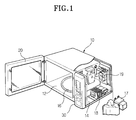
- the microwave oven includes a body 10 and cooking and electrical component chambers 12, 14 within the body 10. Food to be cooked is placed in the cooking chamber 12. A door 20 is provided for opening and closing the cooking chamber 12. A turntable 16 is located at the bottom of the cooking chamber 12.
- the electrical component chamber 14 includes various devices for generating and emitting microwaves to the cooking chamber 12, including a magnetron 17, a high-voltage transformer 18, a waveguide (not shown) and a cooking fan 19.
- a control panel 30 is mounted at the front of the electrical component chamber 14.
- the control panel 30 enables a user to input instructions into the oven. Food is cooked in accordance with the instruction input using the control panel 30 by a control part (not shown) which is formed at the back of the operation panel 30.
- the microwaves generated by the magnetron 17 are guided through the waveguide into the cooking chamber 12.
- the microwaves either irradiate the food directly or after being reflected from the walls of the cooking chamber 12.
- microwave ovens can be used for defrosting frozen food and for warming drinks.
- the frozen food is initially weighed (Step S1) using a weight sensor in the oven.
- Alternative prior art methods require the user to input the weight using the control panel 30.
- a defrosting time is set in dependence on the measured weight of the food (Step S2).
- the magnetron 17, or other microwave generator is operated for the defrosting time (Step S3).
- the magnetron 17 is stopped and the defrosting process is complete (Step S5).
- a method according to the present invention is characterised by the steps of: -
- said surface temperatures are determined by scanning a food receiving area with an infrared sensor and selecting the lowest temperature detected. More preferably, the food receiving area is the upper surface of a turntable and the infrared sensor has a fixed field of view.
- the microwave energy is applied at reducing levels until the target temperature is reached. More preferably, the difference between the initial surface temperature and the target temperature is divided into a plurality of temperature bands and the microwave energy is applied at different respective levels in dependence on the band into which the detected surface temperature of the food item falls during the application of microwave energy thereto.
- a microwave oven according to the present invention is characterised by infrared sensor means for detecting the surface temperature of food item in said area and in that the control means is responsive to the output of said sensor means to set a target surface temperature in dependence on an initial surface temperature and independently of the weight of the food item, and control the means for applying microwave energy, while monitoring the food item's surface temperature, until said target surface temperature is reached.
- scanning means is included for scanning said area with the infrared sensor means and the control means selects the lowest temperature detected during scanning by the scanning means as the surface temperature of the food item.
- the scanning means comprises a turntable having said area on its upper surface and the infrared sensor has a fixed field of view.
- control means controls the means for applying microwave energy such that the microwave energy is applied at reducing levels until the target temperature is reached. More preferably, the control means is configured to divide the difference between the initial surface temperature and the target temperature into a plurality of temperature bands and control the means for applying microwave energy to apply microwave energy at different respective levels in dependence on the band into which the detected surface temperature of the food item falls during the application of microwave energy thereto.
- an infrared sensor 106 is located at an upper front position relative to a cooking chamber 102 of a microwave oven, in order to detect the surface temperature of the food F placed within a detection spot Sp (See Figure 5) occupying a predetermined area of a turntable 104.
- a driving motor 108 for rotating the turntable 104 is located under the cooking chamber 102 and a door 110 is provided for opening and closing the cooking chamber 102.
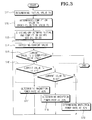
- an initial value Ts detected by the infrared sensor 106 is established (Step S11).
- the initial value Ts obtained in S11 corresponds to the initial surface temperature of the frozen food F.
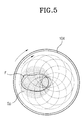
- the infrared sensor 106 outputs a voltage signal corresponding to the average temperature of the area occupied by the detection spot Sp. Accordingly, the voltage signal varies in dependence on the size of the frozen food F and the position of the frozen food F with respect to the turntable 104. More specifically, when the frozen food F is small and off-centre with respect to the turntable 104, as shown in Figure 5, the food F and part of the upper surface of the turntable 104 are simultaneously occupied by the detection spots Sp. In such a situation, the output value of the infrared sensor 106 corresponds to the average temperature of the surface temperature of the food F and the temperature of the upper side of the turntable 104.
- the problem is that the surface temperature of the food F (-20°C to -5°C in general) and the temperature of the upper side of the turntable 104 (at least room temperature) have a wide gap between them. Accordingly, the output of the infrared sensor 106 does not accurately reflect the actual surface temperature of the food F. However, the larger the area of the detection spot Sp occupied by the food F, the more accurate is the output value of the infrared sensor 106.
- the detection spots Sp of the infrared sensor 106 is made to occupy a certain area of the upper surface of the turntable 104, and the output value of the infrared sensor 106 is detected for a predetermined time period while the turntable 104, e.g. twice, and detected on a regular basis such as every second or every two seconds. Then the lowest output value of the infrared sensor 106 is determined to be the correct initial value for the infrared sensor 106.
- the detection spot Sp When the detection spot Sp is made to occupy a certain predetermined area of the upper surface of the turntable 104, the detection spot Sp is scanned circularly across the upper surface of the turntable 104 as it is rotated. Accordingly, as the detection spot Sp scans the turntable 104, the food F and the surface of the turntable 104 are sensed by the detection spots Sp in different proportions.
- the output value of the infrared sensor 106 which is obtained when the largest area of food F is covered by the detection spot Sp, is closest to the actual initial surface temperature of the food.
- the average temperature becomes lower when a greater as the area of food increases. As the average temperature becomes lower, the output value of the infrared sensor 106 becomes lower.
- the lowest value of the output values of the infrared sensor 106 is the closest value with respect to the actual initial surface temperature of the food F.
- the completion value Te is determined to determine the time when the defrosting process is completed (Step S12).
- the completion values Te are pre-stored in the memory, which is employed in the control part for controlling the operation of the microwave oven.
- Table 1 shows the respective completion values Te varying in in dependence on the initial values Ts established using the infrared sensor 106.
- Initial output value Ts of infrared sensor (arbirary units) 59-60 61 62 63-64 65-66 67-68
- Completion value Te of infrared sensor (arbitrary units) 69 70 71 72 73
- Power rate for divisions D1 (40%) 59, 60-62 61-63 62-64 63, 64-65 65, 66-67 67, 68-69 D2 (20%) 63-66 64-66 65-67 66-68 68-69 70-71 D3 (10%) 66-68 67-69 68-70 69-71 70-72 72-73
- the initial value Ts of the infrared sensor 106 ranges from 59 to 68, corresponding to a surface temperature of the food F approximately in the range -20°C to-2°C.
- the corresponding completion value Te ranges from 69 to 74, corresponding to the defrost completion temperature, approximately in the range 0°C to 10°C.
- the completion value Te varies depending on the initial values Ts. This is to prevent the incomplete defrosting of food F due to too short a defrosting time. If the completion value Te is uniformly set, the defrosting time may be shortened when the initial value Ts has a narrow gap with the completion value Te.
- the output value of the infrared sensor 106 corresponding to the temperature of the food F may be varied depending on the types of the infrared sensor 106.
- the magnetron is driven while the current value (Tc) of the infrared sensor 106 output, which corresponds to the surface temperature of the food F, is detected on a regular basis, until the Tc reaches the completion value Te.
- the gap between the initial value Ts and the completion value Te is divided into three divisions, D1, D2, and D3.
- the ranges of the three divisions D1, D2, and D3 are pre-stored in the memory of the controlling part.
- the ranges of the three divisions D1, D2, and D3 are determined by reading those that correspond to the initial value Ts from the memory of the control part.
- the current value Tc is detected (Step S14).
- the current value Tc is detected by the same method that is employed for detecting the initial value Ts in S11.
- a difference lies in that the current value Tc is preferably obtained by detecting the output value of the infrared sensor 106 on a predetermined time basis during the time in which the turntable 104 is rotated once, while the initial value Ts is preferably obtained by detecting the output value of the infrared sensor 106 for a predetermined time period.
- the current value Tc is compared with the completion value Te.
- the power level of the magnetron is set to 40% of maximum (Step S17).
- the power level of the magnetron is set to 20%, or 10%, respectively (Steps S18 and S19).
- the power levels of the magnetron are averages and expressed as percentages to indicate the time when the magnetron is actually driven in a predetermined time period. More specifically, the power level 40%, for example, means that the magnetron is driven periodically for 40% of the unit time period and not driven for 60% of the unit time period.
- the power rate of the magnetron is adjusted from 40% in the division D1, to 20% in the division D2, and to 10% in the division D3, sequentially.
- the current value Tc which is compared with the completion value Te in S15, is equal to or greater than the completion value Te, it is determined that the defrosting process is completed, so that the process exits the loop and the operation for defrosting process such as driving the magnetron, etc is stopped.
- the power of the magnetron is set at 40%, 20%, and 10% for the three divisions D1, D2, and D3, respectively, it is not limited to this case only, but can be varied only if the power rate of the magnetron is decreased as the current value Tc gets closer to the completion value Te from the initial value Ts.
- the defrosting method controls the defrosting process through the output value of the infrared sensor 106, which corresponds to the surface temperature of the food F, the accurate defrost can be performed regardless of the frozen degree of the food F and presence/absence of the receptacle for food F.
Landscapes
- Physics & Mathematics (AREA)
- Electromagnetism (AREA)
- Engineering & Computer Science (AREA)
- Chemical & Material Sciences (AREA)
- Combustion & Propulsion (AREA)
- Mechanical Engineering (AREA)
- General Engineering & Computer Science (AREA)
- Electric Ovens (AREA)
- Control Of High-Frequency Heating Circuits (AREA)
Abstract
Description
| Initial output value Ts of infrared sensor (arbirary units) | 59-60 | 61 | 62 | 63-64 | 65-66 | 67-68 | |
| Completion value Te of infrared sensor (arbitrary units) | 69 | 70 | 71 | 72 | 73 | 74 | |
| Power rate for divisions | D1 (40%) | 59, 60-62 | 61-63 | 62-64 | 63, 64-65 | 65, 66-67 | 67, 68-69 |
| D2 (20%) | 63-66 | 64-66 | 65-67 | 66-68 | 68-69 | 70-71 | |
| D3 (10%) | 66-68 | 67-69 | 68-70 | 69-71 | 70-72 | 72-73 |
Claims (15)
- A method of defrosting using a microwave oven characterised by the steps of: -determining an initial surface temperature of a frozen food item (F);setting a target surface temperature in dependence on the initial surface temperature and independently of the weight of the food item (F); andapplying microwave energy to the food item (F) while monitoring its surface temperature until said target surface temperature is reached.
- A method according to claim 1, wherein said surface temperatures are determined by scanning a food receiving area containing the food item (F) with an infrared sensor (106) and selecting the lowest temperature detected.
- A method according to claim 2, wherein the food receiving area is the upper surface of a turntable (104) and the infrared sensor (106) has a fixed field of view (Sp).
- A method according to claim 1, 2 or 3, wherein the microwave energy is applied at reducing levels until the target temperature is reached.
- A method according to claim 5, wherein the difference between the initial surface temperature and the target temperature is divided into a plurality of temperature bands and the microwave energy is applied at different respective levels in dependence on the band into which the detected surface temperature of the food item (F) falls during the application of microwave energy thereto.
- A microwave oven comprising a food receiving area, means (17) for applying microwave energy to items in said area and control means (30) for controlling defrosting of food items (F) in said area, characterised by infrared sensor means (106) for detecting the surface temperature of a food item (F) in said area and in that the control means (30) is responsive to the output of said sensor means (106) to set a target surface temperature in dependence on an initial surface temperature and independently of the weight of the food item (F), and control the means (17) for applying microwave energy, while monitoring the food item's surface temperature, until said target surface temperature is reached.
- A microwave oven according to claim 6, including scanning means for scanning said area with the infrared sensor means (106), wherein the control means (30) selects the lowest temperature detected during scanning by the scanning means as the surface temperature of the food item (F).
- A microwave oven according to claim 7, wherein the scanning means comprises a turntable (104) having said area on its upper surface and the infrared sensor (106) has a fixed field of view (Sp).
- A microwave oven according to claim 6, 7 or 8, wherein the control means (30) controls the means (17) for applying microwave energy such that the microwave energy is applied at reducing levels until the target temperature is reached.
- A microwave oven according to claim 9, wherein the control means (30) is configured to divide the difference between the initial surface temperature and the target temperature into a plurality of temperature bands and control the means (17) for applying microwave energy to apply microwave energy at different respective levels in dependence on the band into which the detected surface temperature of the food item (F) falls during the application of microwave energy thereto.
- A defrosting method for a microwave oven comprising the steps of:determining an initial value by detecting a surface temperature of food to defrost;determining a defrost completion value in accordance with the initial value which is determined in the step of determining the initial value;detecting a current value of an infrared sensor at a regular time basis while driving a magnetron; andcompleting the defrosting process if the current value reaches the completion value.
- The method as claimed in claim 11, wherein the step of determining the initial value is characterized in that an output value of the infrared sensor is detected at a predetermined regular time basis while a rotatable tray for placing the food is rotated, and the initial value is obtained from the lowest output value among a plurality of output values which are detected.
- The method as claimed in claim 11, wherein the step of driving the magnetron is characterized in that a gap between the initial value and the completion value is divided into at least two divisions, and a power rate of the magnetron is varied in accordance with the respective divisions.
- The method as claimed in claim 11, wherein the step for detecting the current value is characterized in that the output value of the infrared sensor is detected at a predetermined regular time basis while the rotatable tray for placing the food is rotated, and the current value is obtained from the lowest output value among the output values which are detected.
- The method as claimed in claim 13, wherein the power rate of the magnetron of the respective divisions, is decreased from the value which is closer to the initial value to the value which is closer to the completion value.
Applications Claiming Priority (2)
| Application Number | Priority Date | Filing Date | Title |
|---|---|---|---|
| KR9927971 | 1999-07-12 | ||
| KR1019990027971A KR100366020B1 (en) | 1999-07-12 | 1999-07-12 | Defrosting method for a microwave oven |
Publications (3)
| Publication Number | Publication Date |
|---|---|
| EP1069806A2 true EP1069806A2 (en) | 2001-01-17 |
| EP1069806A3 EP1069806A3 (en) | 2001-08-08 |
| EP1069806B1 EP1069806B1 (en) | 2004-10-27 |
Family
ID=19600990
Family Applications (1)
| Application Number | Title | Priority Date | Filing Date |
|---|---|---|---|
| EP99308600A Expired - Lifetime EP1069806B1 (en) | 1999-07-12 | 1999-10-29 | Defrosting using a microwave oven |
Country Status (8)
| Country | Link |
|---|---|
| US (1) | US6198084B1 (en) |
| EP (1) | EP1069806B1 (en) |
| JP (1) | JP3540226B2 (en) |
| KR (1) | KR100366020B1 (en) |
| CN (1) | CN1140724C (en) |
| AU (1) | AU724395B1 (en) |
| CA (1) | CA2288380C (en) |
| DE (1) | DE69921462T2 (en) |
Cited By (2)
| Publication number | Priority date | Publication date | Assignee | Title |
|---|---|---|---|---|
| ITMI20122013A1 (en) * | 2012-11-27 | 2014-05-28 | Tlc Gmbh | SIMULATION OF ONE OR MORE TEMPERATURES IN A FOOD |
| CN112393508A (en) * | 2020-11-13 | 2021-02-23 | 珠海格力电器股份有限公司 | Frosting time calculation method and refrigeration equipment |
Families Citing this family (45)
| Publication number | Priority date | Publication date | Assignee | Title |
|---|---|---|---|---|
| SE520882C2 (en) * | 1999-01-15 | 2003-09-09 | Whirlpool Co | Procedure for thawing frozen food in a microwave oven |
| SE523597C2 (en) * | 2000-11-23 | 2004-05-04 | Skarhamn Internat Ab | Method and apparatus for thawing frozen goods consisting of an organic cell mass such as food |
| KR100396662B1 (en) * | 2000-11-30 | 2003-09-02 | 엘지전자 주식회사 | Method for controlling defrost of micro wave oven |
| US20040081730A1 (en) * | 2001-07-25 | 2004-04-29 | J Michael Drozd | Rapid continuous, and selective moisture content equalization of nuts, grains, and similar commodities |
| JP3927387B2 (en) * | 2001-08-29 | 2007-06-06 | 株式会社オーク製作所 | Electrodeless lamp system |
| JP3769498B2 (en) * | 2001-12-06 | 2006-04-26 | 東芝コンシューママーケティング株式会社 | Vacuum microwave thawing machine and vacuum microwave thawing method |
| US6862494B2 (en) * | 2001-12-13 | 2005-03-01 | General Electric Company | Automated cooking system for food accompanied by machine readable indicia |
| CN1299052C (en) * | 2001-12-25 | 2007-02-07 | 乐金电子(天津)电器有限公司 | Thawing control device for microwave oven |
| KR100428511B1 (en) * | 2002-05-27 | 2004-04-29 | 삼성전자주식회사 | Microwave oven and control method thereof |
| US20050262774A1 (en) * | 2004-04-23 | 2005-12-01 | Eyre Ronald K | Low cobalt carbide polycrystalline diamond compacts, methods for forming the same, and bit bodies incorporating the same |
| CN101750169B (en) * | 2008-12-04 | 2013-09-11 | 乐金电子(天津)电器有限公司 | Measuring method for unfrozen object in microwave oven |
| CN102003996A (en) * | 2009-08-29 | 2011-04-06 | 乐金电子(天津)电器有限公司 | Method for identifying shape, size, placing position and temperature of food in micro-wave oven |
| CN102235693B (en) * | 2010-04-27 | 2015-06-10 | 乐金电子(天津)电器有限公司 | Defrosting method of microwave oven |
| US20120111204A1 (en) * | 2010-11-05 | 2012-05-10 | Samsung Electronics Co., Ltd. | Heating cooker |
| JP5899393B2 (en) * | 2011-02-25 | 2016-04-06 | パナソニックIpマネジメント株式会社 | Range food |
| EP2567627B1 (en) * | 2011-09-09 | 2015-07-08 | GEA Food Solutions Bakel B.V. | Defrosting apparatus and defrosting method |
| WO2015015010A1 (en) * | 2013-08-02 | 2015-02-05 | Koninklijke Philips N.V. | Apparatus and method for controlling food temperature |
| CN104676680B (en) * | 2014-02-14 | 2018-09-14 | 广东美的厨房电器制造有限公司 | Micro-wave oven and microwave thawing method for micro-wave oven |
| WO2015162131A1 (en) | 2014-04-23 | 2015-10-29 | Koninklijke Philips N.V. | Method and cooking apparatus for controlling a food cooking process |
| US9901213B2 (en) | 2015-09-10 | 2018-02-27 | Prince Castle LLC | Modular food holding system |
| US10455983B2 (en) * | 2015-09-10 | 2019-10-29 | Prince Castle LLC | Modular food holding system |
| US9962038B2 (en) | 2015-09-10 | 2018-05-08 | Prince Castle LLC | Modular food holding system |
| US10154757B2 (en) * | 2015-09-10 | 2018-12-18 | Prince Castle LLC | Modular food holding system |
| KR101732489B1 (en) * | 2015-11-25 | 2017-05-08 | 린나이코리아 주식회사 | Thawing temperature controlling device for gas range |
| CN105628213B (en) * | 2015-12-29 | 2019-03-29 | 广东美的厨房电器制造有限公司 | Food temperature detection method of heating cooker, food heating method and system thereof |
| US11185191B2 (en) | 2016-05-20 | 2021-11-30 | Marmon Foodservice Technologies, Inc. | Modular food holding system |
| EP3280224A1 (en) | 2016-08-05 | 2018-02-07 | NXP USA, Inc. | Apparatus and methods for detecting defrosting operation completion |
| EP3280225B1 (en) | 2016-08-05 | 2020-10-07 | NXP USA, Inc. | Defrosting apparatus with lumped inductive matching network and methods of operation thereof |
| US10917948B2 (en) * | 2017-11-07 | 2021-02-09 | Nxp Usa, Inc. | Apparatus and methods for defrosting operations in an RF heating system |
| US10771036B2 (en) | 2017-11-17 | 2020-09-08 | Nxp Usa, Inc. | RF heating system with phase detection for impedance network tuning |
| US10785834B2 (en) | 2017-12-15 | 2020-09-22 | Nxp Usa, Inc. | Radio frequency heating and defrosting apparatus with in-cavity shunt capacitor |
| EP3503679B1 (en) | 2017-12-20 | 2022-07-20 | NXP USA, Inc. | Defrosting apparatus and methods of operation thereof |
| EP3547801B1 (en) | 2018-03-29 | 2022-06-08 | NXP USA, Inc. | Defrosting apparatus and methods of operation thereof |
| CN108679663A (en) * | 2018-05-21 | 2018-10-19 | 广东美的厨房电器制造有限公司 | Microwave oven defrosting control method, micro-wave oven, terminal and computer storage media |
| CN108684098A (en) * | 2018-05-21 | 2018-10-19 | 广东美的厨房电器制造有限公司 | Microwave oven thawing control method, microwave oven, terminal and computer storage medium |
| CN108644827A (en) * | 2018-05-21 | 2018-10-12 | 广东美的厨房电器制造有限公司 | Microwave oven defrosting control method, micro-wave oven, terminal and computer storage media |
| US10952289B2 (en) | 2018-09-10 | 2021-03-16 | Nxp Usa, Inc. | Defrosting apparatus with mass estimation and methods of operation thereof |
| US11800608B2 (en) | 2018-09-14 | 2023-10-24 | Nxp Usa, Inc. | Defrosting apparatus with arc detection and methods of operation thereof |
| US11166352B2 (en) | 2018-12-19 | 2021-11-02 | Nxp Usa, Inc. | Method for performing a defrosting operation using a defrosting apparatus |
| US11039511B2 (en) | 2018-12-21 | 2021-06-15 | Nxp Usa, Inc. | Defrosting apparatus with two-factor mass estimation and methods of operation thereof |
| EP3929490B1 (en) * | 2019-02-22 | 2022-11-09 | Panasonic Intellectual Property Management Co., Ltd. | High frequency heating apparatus |
| CN110195882B (en) * | 2019-04-17 | 2021-10-08 | 广东美的厨房电器制造有限公司 | Thawing control method, thawing control device and computer storage medium |
| CN112197310A (en) * | 2020-09-30 | 2021-01-08 | 广东美的厨房电器制造有限公司 | Temperature control method, device, electronic device, turntable microwave oven and medium |
| US12465175B2 (en) * | 2021-01-26 | 2025-11-11 | Duke Manufacturing Co. | Pan storage apparatus |
| CN113251447B (en) * | 2021-06-02 | 2024-03-15 | 福州湘福机电科技有限公司 | Gas electric stove monitoring device based on infrared light sense and distance detection |
Family Cites Families (11)
| Publication number | Priority date | Publication date | Assignee | Title |
|---|---|---|---|---|
| CA1147036A (en) * | 1978-09-26 | 1983-05-24 | Shigeru Kusunoki | Method of controlling heating in food heating apparatus including infrared detecting system |
| JPS5597612A (en) * | 1979-01-20 | 1980-07-25 | Sanyo Electric Co Ltd | Electronic control type cooking unit |
| JPS58110929A (en) * | 1981-12-25 | 1983-07-01 | Matsushita Electric Ind Co Ltd | Microwave heating apparatus |
| JPS62169937A (en) * | 1986-01-20 | 1987-07-27 | Sanyo Electric Co Ltd | High frequency heating device |
| JPH0539929A (en) * | 1991-08-02 | 1993-02-19 | Hitachi Home Tec Ltd | High frequency heating device |
| EP0673182B1 (en) * | 1994-03-18 | 2000-03-29 | Lg Electronics Inc. | Method for automatic control of a microwave oven |
| KR960041890A (en) * | 1995-05-16 | 1996-12-19 | 구자홍 | Automatic cooker |
| FR2734893B1 (en) * | 1995-05-31 | 1997-09-19 | Moulinex Sa | METHOD FOR AUTOMATIC DEFROSTING OF A FOOD PLACED IN A MICROWAVE OVEN |
| US6013907A (en) * | 1997-06-09 | 2000-01-11 | Lg Electronics Inc. | Microwave oven equipped with thermopile sensor and thawing method using the same |
| KR100215036B1 (en) * | 1996-06-26 | 1999-08-16 | 윤종용 | Microwave defrosting device and its defrosting method |
| JPH10308275A (en) * | 1997-05-08 | 1998-11-17 | Matsushita Electric Ind Co Ltd | Cooker |
-
1999
- 1999-07-12 KR KR1019990027971A patent/KR100366020B1/en not_active Expired - Fee Related
- 1999-10-29 US US09/429,918 patent/US6198084B1/en not_active Expired - Lifetime
- 1999-10-29 EP EP99308600A patent/EP1069806B1/en not_active Expired - Lifetime
- 1999-10-29 DE DE69921462T patent/DE69921462T2/en not_active Expired - Lifetime
- 1999-11-02 CA CA002288380A patent/CA2288380C/en not_active Expired - Fee Related
- 1999-11-04 AU AU58279/99A patent/AU724395B1/en not_active Ceased
- 1999-12-08 JP JP34939499A patent/JP3540226B2/en not_active Expired - Fee Related
-
2000
- 2000-01-07 CN CNB001000489A patent/CN1140724C/en not_active Expired - Fee Related
Cited By (3)
| Publication number | Priority date | Publication date | Assignee | Title |
|---|---|---|---|---|
| ITMI20122013A1 (en) * | 2012-11-27 | 2014-05-28 | Tlc Gmbh | SIMULATION OF ONE OR MORE TEMPERATURES IN A FOOD |
| CN112393508A (en) * | 2020-11-13 | 2021-02-23 | 珠海格力电器股份有限公司 | Frosting time calculation method and refrigeration equipment |
| CN112393508B (en) * | 2020-11-13 | 2021-10-01 | 珠海格力电器股份有限公司 | Frosting time calculation method and refrigeration equipment |
Also Published As
| Publication number | Publication date |
|---|---|
| DE69921462T2 (en) | 2005-04-14 |
| EP1069806A3 (en) | 2001-08-08 |
| JP3540226B2 (en) | 2004-07-07 |
| CN1140724C (en) | 2004-03-03 |
| KR20010009558A (en) | 2001-02-05 |
| JP2001033041A (en) | 2001-02-09 |
| DE69921462D1 (en) | 2004-12-02 |
| AU724395B1 (en) | 2000-09-21 |
| KR100366020B1 (en) | 2002-12-26 |
| CA2288380C (en) | 2002-11-12 |
| EP1069806B1 (en) | 2004-10-27 |
| US6198084B1 (en) | 2001-03-06 |
| CA2288380A1 (en) | 2001-01-12 |
| CN1280275A (en) | 2001-01-17 |
Similar Documents
| Publication | Publication Date | Title |
|---|---|---|
| EP1069806B1 (en) | Defrosting using a microwave oven | |
| US4396817A (en) | Method of browning food in a microwave oven | |
| US6828533B2 (en) | Microwave heating device | |
| KR100408095B1 (en) | Apparatus and method for controlling cooking time in a light wave oven | |
| EP0562741B1 (en) | Microwave oven | |
| EP0455169A2 (en) | Heating cooker | |
| EP2345304A2 (en) | Device and method for heating using rf energy | |
| RU2124280C1 (en) | Technique for regulation of processes of unfreezing and preparation of foods in microwave oven | |
| EP1021066B1 (en) | Operating method for a microwave oven | |
| EP0064082A1 (en) | Method of thawing food in a microwave heater | |
| JP3184694B2 (en) | microwave | |
| RU2125683C1 (en) | Microwave oven control process | |
| EP0780641A1 (en) | Cooker | |
| JPH0975235A (en) | Oven toaster | |
| RU97102736A (en) | METHODS FOR REGULATING THE PROCESSES OF DEFROSTING AND PREPARING FOOD PRODUCTS IN A MICROWAVE FURNACE | |
| US4798927A (en) | Combined microwave and electric oven with intermittent power supply to both microwave and electric heating elements | |
| EP0066637A1 (en) | A method of browning food in a microwave oven | |
| KR101917798B1 (en) | Electric rice cooker having function for determining amount of cooked rice and method for determining amount of cooked rice | |
| US5859413A (en) | Method for controlling a microwave oven to prevent overcooking of small food portions | |
| US5302793A (en) | Microwave ovens with air inlet and air outlet temperature sensors | |
| KR100403032B1 (en) | Heat cooking utensil | |
| JP2003014241A (en) | Cooking device | |
| KR0131974B1 (en) | Automatic cooking control method of microwave oven | |
| KR19990058209A (en) | Control method of thawing by weight of microwave oven | |
| JP3102648B2 (en) | microwave |
Legal Events
| Date | Code | Title | Description |
|---|---|---|---|
| PUAI | Public reference made under article 153(3) epc to a published international application that has entered the european phase |
Free format text: ORIGINAL CODE: 0009012 |
|
| AK | Designated contracting states |
Kind code of ref document: A2 Designated state(s): AT BE CH CY LI Kind code of ref document: A2 Designated state(s): DE FR GB NL |
|
| AX | Request for extension of the european patent |
Free format text: AL;LT;LV;MK;RO;SI |
|
| PUAL | Search report despatched |
Free format text: ORIGINAL CODE: 0009013 |
|
| AK | Designated contracting states |
Kind code of ref document: A3 Designated state(s): AT BE CH CY DE DK ES FI FR GB GR IE IT LI LU MC NL PT SE |
|
| AX | Request for extension of the european patent |
Free format text: AL;LT;LV;MK;RO;SI |
|
| 17P | Request for examination filed |
Effective date: 20020102 |
|
| AKX | Designation fees paid |
Free format text: AT BE CH CY LI |
|
| REG | Reference to a national code |
Ref country code: DE Ref legal event code: 8566 |
|
| RBV | Designated contracting states (corrected) |
Designated state(s): DE FR GB NL |
|
| 17Q | First examination report despatched |
Effective date: 20020304 |
|
| GRAP | Despatch of communication of intention to grant a patent |
Free format text: ORIGINAL CODE: EPIDOSNIGR1 |
|
| GRAS | Grant fee paid |
Free format text: ORIGINAL CODE: EPIDOSNIGR3 |
|
| GRAA | (expected) grant |
Free format text: ORIGINAL CODE: 0009210 |
|
| RAP1 | Party data changed (applicant data changed or rights of an application transferred) |
Owner name: SAMSUNG ELECTRONICS CO., LTD. |
|
| AK | Designated contracting states |
Kind code of ref document: B1 Designated state(s): DE FR GB NL |
|
| REG | Reference to a national code |
Ref country code: GB Ref legal event code: FG4D |
|
| REF | Corresponds to: |
Ref document number: 69921462 Country of ref document: DE Date of ref document: 20041202 Kind code of ref document: P |
|
| ET | Fr: translation filed | ||
| PLBE | No opposition filed within time limit |
Free format text: ORIGINAL CODE: 0009261 |
|
| STAA | Information on the status of an ep patent application or granted ep patent |
Free format text: STATUS: NO OPPOSITION FILED WITHIN TIME LIMIT |
|
| 26N | No opposition filed |
Effective date: 20050728 |
|
| PGFP | Annual fee paid to national office [announced via postgrant information from national office to epo] |
Ref country code: DE Payment date: 20131015 Year of fee payment: 15 Ref country code: GB Payment date: 20131011 Year of fee payment: 15 Ref country code: FR Payment date: 20131015 Year of fee payment: 15 |
|
| PGFP | Annual fee paid to national office [announced via postgrant information from national office to epo] |
Ref country code: NL Payment date: 20131014 Year of fee payment: 15 |
|
| REG | Reference to a national code |
Ref country code: DE Ref legal event code: R119 Ref document number: 69921462 Country of ref document: DE |
|
| REG | Reference to a national code |
Ref country code: NL Ref legal event code: V1 Effective date: 20150501 |
|
| GBPC | Gb: european patent ceased through non-payment of renewal fee |
Effective date: 20141029 |
|
| PG25 | Lapsed in a contracting state [announced via postgrant information from national office to epo] |
Ref country code: GB Free format text: LAPSE BECAUSE OF NON-PAYMENT OF DUE FEES Effective date: 20141029 Ref country code: DE Free format text: LAPSE BECAUSE OF NON-PAYMENT OF DUE FEES Effective date: 20150501 |
|
| REG | Reference to a national code |
Ref country code: FR Ref legal event code: ST Effective date: 20150630 |
|
| PG25 | Lapsed in a contracting state [announced via postgrant information from national office to epo] |
Ref country code: NL Free format text: LAPSE BECAUSE OF NON-PAYMENT OF DUE FEES Effective date: 20150501 Ref country code: FR Free format text: LAPSE BECAUSE OF NON-PAYMENT OF DUE FEES Effective date: 20141031 |