EP1069790B1 - Procédé et appareil pour l'allocation dynamique de canaux dans un système de communication mobile asynchrone - Google Patents
Procédé et appareil pour l'allocation dynamique de canaux dans un système de communication mobile asynchrone Download PDFInfo
- Publication number
- EP1069790B1 EP1069790B1 EP20000305798 EP00305798A EP1069790B1 EP 1069790 B1 EP1069790 B1 EP 1069790B1 EP 20000305798 EP20000305798 EP 20000305798 EP 00305798 A EP00305798 A EP 00305798A EP 1069790 B1 EP1069790 B1 EP 1069790B1
- Authority
- EP
- European Patent Office
- Prior art keywords
- data packets
- mobile station
- transport channel
- traffic volume
- predetermined value
- Prior art date
- Legal status (The legal status is an assumption and is not a legal conclusion. Google has not performed a legal analysis and makes no representation as to the accuracy of the status listed.)
- Expired - Lifetime
Links
- 238000000034 method Methods 0.000 title claims description 22
- 238000010295 mobile communication Methods 0.000 title claims description 18
- 230000005540 biological transmission Effects 0.000 claims description 9
- 230000032258 transport Effects 0.000 description 53
- 238000010586 diagram Methods 0.000 description 18
- 230000008569 process Effects 0.000 description 5
- 230000011664 signaling Effects 0.000 description 4
- 108010003272 Hyaluronate lyase Proteins 0.000 description 3
- 238000004891 communication Methods 0.000 description 3
- 238000012546 transfer Methods 0.000 description 3
- 230000003247 decreasing effect Effects 0.000 description 2
- 230000009467 reduction Effects 0.000 description 2
- 238000007792 addition Methods 0.000 description 1
- 238000012937 correction Methods 0.000 description 1
- 230000003111 delayed effect Effects 0.000 description 1
- 238000001514 detection method Methods 0.000 description 1
- 238000013507 mapping Methods 0.000 description 1
- 238000012986 modification Methods 0.000 description 1
- 230000004048 modification Effects 0.000 description 1
- 238000012544 monitoring process Methods 0.000 description 1
- 238000006467 substitution reaction Methods 0.000 description 1
Images




Classifications
-
- H—ELECTRICITY
- H04—ELECTRIC COMMUNICATION TECHNIQUE
- H04W—WIRELESS COMMUNICATION NETWORKS
- H04W72/00—Local resource management
- H04W72/20—Control channels or signalling for resource management
- H04W72/23—Control channels or signalling for resource management in the downlink direction of a wireless link, i.e. towards a terminal
-
- H—ELECTRICITY
- H04—ELECTRIC COMMUNICATION TECHNIQUE
- H04W—WIRELESS COMMUNICATION NETWORKS
- H04W72/00—Local resource management
- H04W72/50—Allocation or scheduling criteria for wireless resources
- H04W72/52—Allocation or scheduling criteria for wireless resources based on load
-
- H—ELECTRICITY
- H04—ELECTRIC COMMUNICATION TECHNIQUE
- H04W—WIRELESS COMMUNICATION NETWORKS
- H04W72/00—Local resource management
- H04W72/50—Allocation or scheduling criteria for wireless resources
- H04W72/54—Allocation or scheduling criteria for wireless resources based on quality criteria
- H04W72/542—Allocation or scheduling criteria for wireless resources based on quality criteria using measured or perceived quality
-
- H—ELECTRICITY
- H04—ELECTRIC COMMUNICATION TECHNIQUE
- H04W—WIRELESS COMMUNICATION NETWORKS
- H04W24/00—Supervisory, monitoring or testing arrangements
- H04W24/10—Scheduling measurement reports ; Arrangements for measurement reports
-
- H—ELECTRICITY
- H04—ELECTRIC COMMUNICATION TECHNIQUE
- H04W—WIRELESS COMMUNICATION NETWORKS
- H04W72/00—Local resource management
- H04W72/12—Wireless traffic scheduling
-
- H—ELECTRICITY
- H04—ELECTRIC COMMUNICATION TECHNIQUE
- H04W—WIRELESS COMMUNICATION NETWORKS
- H04W72/00—Local resource management
- H04W72/50—Allocation or scheduling criteria for wireless resources
- H04W72/51—Allocation or scheduling criteria for wireless resources based on terminal or device properties
-
- H—ELECTRICITY
- H04—ELECTRIC COMMUNICATION TECHNIQUE
- H04W—WIRELESS COMMUNICATION NETWORKS
- H04W72/00—Local resource management
- H04W72/50—Allocation or scheduling criteria for wireless resources
- H04W72/56—Allocation or scheduling criteria for wireless resources based on priority criteria
- H04W72/563—Allocation or scheduling criteria for wireless resources based on priority criteria of the wireless resources
Definitions
- the present invention relates to a method and apparatus for assigning a channel in a mobile communication system; more particularly, relates to a method and apparatus for dynamically assigning a channel in an asynchronous mobile communication system when transmitting radio data packets from a base station to a mobile station (as is referred to "downlink").
- Fig. 1 is a block diagram of a channel assigning device in a conventional mobile communication system.
- the mobile communication system includes a mobile station 10, a radio access network controller 20, a base transceiver station 30 and a mobile switching center 40.
- the mobile station 10 includes a layer 1, a layer 2 and a layer 3.
- the layer 3 includes a call control/mobility management (CC/MM) entity 12 and a radio resource control (RRC) layer 14.
- the layer 2 includes a radio link control (RLC) layer and a medium access control (MAC) layer.
- the layer 1 includes physical layer 16 having a channel element 18. In substantial, the call control entity 12, the radio resource control layer 14 and the channel element 18 assigns a channel for transmitting signal.
- the radio access network controller 20 includes a physical layer, a MAC layer, a RLC layer, a RRC layer 24 and a CC/MM entity 22.
- the base transceiver station 30 includes a physical layer having a channel element 32.
- the mobile switching center 40 includes a physical layer, a MAC layer, a RLC layer, a RRC layer and a CC/MM entity 42.
- a downlink shared channel (DSCH) is used when transmitting radio data packets from a base station to a mobile station in an asynchronous mobile communication system.
- a common packet channel (CPCH) is used when transmitting radio data packets from a mobile station to a base station in an asynchronous mobile communication system.
- the DSCH transport channel and the CPCH transport channel are assigned in the RRC layer of the UTRAN.
- Each channel configuration is performed in the RRC layer.
- the channel configuration means that channel information elements, for example, a scrambling code, a spreading factor and a data rate of the assigned channel, are selected.
- Fig. 2 is a diagram showing a conventional DSCH transport channel.
- the DSCH transport channel is shared by a plurality of the mobile stations when transmitting data packets from the UTRAN to the MS 10.
- Each of the mobile stations has different quality of service, data rate and traffic volume.
- the data rate means an amount of transmitted data per a second.
- a mean data rate and a maximum data rate are specified before call setup.
- the traffic volume means an amount of data transmitted through a channel or a buffer for a predetermined period.
- the traffic volume is described with respect to data transmission capacity of the channel or the buffer.
- a conventional mobile communication system uses a spreading factor reduction method.
- reduction of the spreading factor increases transmission power (about twice). Increased transmission power acts as interference to signals for the neighbor mobile stations, to thereby fall quality of communication service.
- Fig. 3A is a diagram of protocol layers of a mobile communication system having a volume detector in accordance with the present invention.
- the mobile communication system has similar functions as those of mobile communication system in Fig. 1 except that the system has a volume detector. Accordingly, it is assumed that the same reference numeral denotes the same function block.
- the physical layer 16 offers data transport services to higher layers and transfers transport blocks over a radio interface to a mobile station.
- the channel element 18 performs functions for data transmission, e.g., encoding, modulation and interleaving of data to be transmitted.
- the MAC layer offers data transfer services on logical channels to a higher layer (RLC layer) and on transport channels to a lower layer (the physical layer).
- the MAC layer is responsible for mapping of the logical channel onto the appropriate transports channel.
- the RLC layer offers data transfer services on primitive to a higher layer and on logical channels to a lower layer (MAC layer). Also, the RLC layer performs an error correction process, a duplicate detection process, a ciphering process and a flow control process of the data.
- the RRC layer 14 offers data transmission services on primitive to a lower layer (RLC layer) and handles a control plane signaling of the layer 3 between a user equipment (UE) and an asynchronous radio network.
- the RRC layer 14 manages a radio resource. Also, the RRC layer assigns/reconfigures/releases the radio resource to user equipment /Universal mobile telecommunication system Terrestrial Radio Access Network (UE/UTRAN).
- UE Universal mobile telecommunication system Terrestrial Radio Access Network
- the CC entity handles a call control signaling of layer 3 between the UEs and the asynchronous radio network.
- the MM entity handles a mobility management signaling of layer 3 between the UEs and the asynchronous radio network.
- the layers of the mobile station communicate with corresponding layers of UTRAN.
- the reference numeral 20 denotes a radio access network controller including a CC/MM entity 22, a RRC layer 24, a RLC layer, a MAC layer and a physical layer.
- Functions of the protocol layers are similar to those described above referring to those of the mobile station 10. Accordingly, for the sake of convenience, a detailed description on functions of the protocol layers will be skipped.
- the reference numeral 30 denotes a base transceiver station (BTS).
- the BTS 30 communicates data with the mobile station 10 through radio channels and includes a channel element.
- Functions of the protocol layers for a base station are similar to those described above referring to those of the mobile station 10. Accordingly, for the sake of convenience, a detailed description on functions of the protocol layers will be skipped.
- the reference numeral 40 denotes a mobile switching center. Functions of the protocol layers are similar to those described above referring to those of the mobile station 10. Accordingly, for the sake of convenience, a detailed description on functions of the protocol layers will be skipped.
- the mobile station 10 is not directly connected to the RNC 20, the mobile station 10 is connected to the RNC 20 in Fig. 1 in order to show that role of the RNC 20 is more important for channel assignment than that of the BS 30. In substantial, the channel assignment is performed in UTRAN including the RNC 20 and the BS 30.
- the volume detector monitors data (e.g., control signaling data) from the RRC layer to the physical layer and data (e.g., packet data) from the RLC layer to the physical layer.
- data e.g., control signaling data
- data e.g., packet data
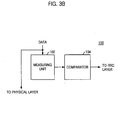
- Fig. 3B is a block diagram of the volume detector 100 of Fig. 3A.
- the volume detector 100 includes a measuring unit 102 and a comparator 104.
- the volume detector 100 monitors data packets to be transmitted to the mobile station and measures traffic volume of the data packets in a measuring unit 102.
- the measuring unit 102 sends the measured traffic volume of the data packets to a comparator 104.
- the comparator 104 compares the measured traffic volume of the data packets with predetermined values and transmits the comparing result to the RRC layer.
- Fig. 4A is a diagram of volume detectors where each volume detector measures traffic volume of data for each user and to be inputted to DSCH transport channel.
- volume detectors 51 to 50+N there are the same number of volume detectors 51 to 50+N as that of mobile stations connected to the UTRAN.
- Each volume detector measures traffic volume of data for each mobile station and to be inputted to DSCH transport channel.
- Fig. 4B is a diagram of a volume detector which measures traffic volume of data for a certain user and to be inputted to DCH transport channel.
- Input parameters for the volume detector monitoring the traffic volume of the data to inputted to the DSCH and DCH transport channels are as follows:
- the volume detector obtains these parameters from a call admission controller (CAC)(not shown in the drawing) in a radio resource management (RRM) unit of the RRC layer. Dynamic channel assignment and channel switching are performed in accordance with measuring results of the volume detector.
- CAC call admission controller
- RRM radio resource management
- Fig. 5 is a flow chart illustrating a method for assigning a channel in accordance with one embodiment of the present invention.
- parameters for the traffic volume detector which are described above, are set and stored on a memory device in the traffic volume detector at step S11.
- the volume detector measures traffic volume of data to be inputted into the DSCH transport channel for a predetermined time at step S12. Also, the volume detector monitors whether the data to be inputted to the transport channel has characteristics of the traffic descriptor set at step S11.
- step S13 it is determined whether the measured traffic volume is larger than a maximum buffer threshold U_limit. If the measured traffic volume is smaller than the maximum buffer threshold U_limit, the data is transmitted through only the assigned DSCH transport channel.
- a DCH transport channel is assigned to the mobile station.
- the data is transmitted through two transport channels multi-coded.
- the DCH transport channel is assigned to only a mobile station to receive data of which traffic volume is increased. In other words, only when the traffic volume of data for the mobile station is larger than the maximum buffer threshold U_limit, the DCH transport channel is assigned. At least one DCH transport channel can be simultaneously assigned to each user.
- Fig. 6 is an exemplary diagram of transport channels showing an assignment of a DCH transport channel because of increment of the traffic volume on DSCH transport channel.
- the data for a mobile station is transmitted through a DSCH transport channel as illustrated on the left side of Fig. 6.
- a DCH transport channel is additionally assigned to the mobile station as described on the right side of Fig. 6.
- Fig. 7 is a flow chart illustrating a method for assigning a channel in accordance with another embodiment of the present invention.
- parameters for the traffic volume detector e.g., the maximum buffer threshold U_limit, the minimum buffer threshold and the traffic descriptor.
- the volume detector measures traffic volume of data to be inputted into the DSCH transport channel for a predetermined time at step S22. Also, the volume detector monitors whether the data to be inputted to the DSCH transport channel has characteristics of the traffic descriptor set at step S21.
- step S23 it is determined whether the measured traffic volume of the data for a mobile station is larger than a maximum buffer threshold U_limit. If the measured traffic volume of the data for the mobile station is larger than the maximum buffer threshold U_limit, at step S24, an additional DSCH transport channel is assigned to the mobile station and the data is transmitted through the three transport channels, two DSCH and one DCH transport channels which are multi-coded.
- step S25 determines whether the traffic volume of the data is smaller than the minimum buffer threshold L_limit. If the traffic volume is smaller than the minimum buffer threshold L_limit, the assigned DCH transport channel is released and the data is transmitted through only the DSCH transport channel to the mobile station at step S26.
- the data is transmitted through one DSCH and one DCH transport channels which are already assigned.
- Fig. 8 is an exemplary diagram showing an assignment of another DSCH transport channel because of increment of the traffic volume on DCH transport channel.
- the data for a mobile station is transmitted through a DSCH and a DCH transport channels as illustrated on the left side of Fig. 8.
- a DSCH transport channel is additionally assigned to the mobile station as described on the right side of Fig. 8.
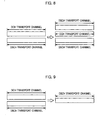
- Fig. 9 is an exemplary diagram demonstrating a release of the DCH transport channel because of decrement of the traffic volume on DCH transport channel.
- the data for a mobile station is transmitted through a DSCH and a DCH transport channels as illustrated on the left side of Fig. 9.
- the traffic volume is decreased, in other words, is smaller than the minimum buffer threshold L_limit, the DCH transport channel is released and the data is transmitted through only the DSCH transport channel as described on the right side of Fig. 9.
- an additional DCH channel is assigned to a mobile station when traffic volume of data for the mobile station is increased and therefore channel switching happens.
- the dynamic channel assigning method prevents quality of service from falling without causing interference to the other mobile stations where the fall of quality of service results from increment of the traffic volume.
- the DCH transport channel is released when the traffic volume is decreased. This dynamic channel assignment makes the communication systems stable and efficient.
Landscapes
- Engineering & Computer Science (AREA)
- Computer Networks & Wireless Communication (AREA)
- Signal Processing (AREA)
- Quality & Reliability (AREA)
- Mobile Radio Communication Systems (AREA)
- Time-Division Multiplex Systems (AREA)
Claims (8)
- Procédé pour faire fonctionner un système de communication mobile asynchrone transmettant des paquets de données à partir d'une station de base à une pluralité de stations mobiles à travers un premier canal de transport de canal partagé de liaison descendante (DSCH), le procédé comprenant les étapes de:a) mesure répétitivement (S22) d'un volume de trafic de paquets de données pour chacune des stations mobiles, dans lequel au moins une première partie des paquets de données pour chaque station mobile sont transmis via le premier canal de transport DSCH;b) détermination (S25) pour chacune des stations mobiles si le volume de trafic mesuré de paquets de données pour une station mobile est plus grand qu'une première valeur prédéterminée;c) une fois que le volume de trafic mesuré des paquets de données pour une station mobile est plus grand qu'une première valeur prédéterminée, assignation (S26) d'un canal de transport DCH (canal dédié) à la station mobile et transmission d'au moins une seconde partie des paquets de données à la station mobile via la combinaison du premier canal de transport DSCH et du canal de transport DCH;d) détermination (S23) pour chacune des stations mobiles si le volume de trafic mesuré des paquets de données pour une station mobile est plus grand qu'une seconde valeur prédéterminée, dans lequel la seconde valeur prédéterminée est plus grande que la première valeur prédéterminée; ete) une fois que le volume de trafic mesuré des paquets de données à la station mobile est plus grand que la seconde valeur prédéterminée, assignation (S24) d'un second canal de transport DSCH à la station mobile et transmission d'au moins une troisième partie des paquets de données à la station mobile à travers la combinaison du premier canal de transport DSCH, le canal de transport DCH et le second canal de transport DSCH.
- Procédé selon la revendication 1, dans lequel la première valeur prédéterminée est une valeur représentant un seuil de tampon maximum.
- Procédé selon la revendication 2, dans lequel le volume de trafic des paquets de données transmis via le canal de transport DCH correspond au résultat de soustraction de la première valeur prédéterminée à partir du volume de trafic total des paquets de données à la station mobile.
- Appareil pour faire fonctionner un système de communication mobile asynchrone transmettant des paquets de données à partir d'une station de base à une pluralité de stations mobiles par l'intermédiaire d'un premier canal partagé de liaison descendante (DSCH), l'appareil comprenant:un moyen pour mesurer répétitivement un volume de trafic de paquets de données pour chacune des stations mobiles, dans lequel au moins une première partie des paquets de données pour chaque station mobile sont transmis via le premier canal de transport DSCH;un moyen pour déterminer pour chacune des stations mobiles si le volume de trafic mesuré des paquets de données pour une station mobile est plus grand qu'une première valeur prédéterminée;un moyen pour assigner, une fois que le volume de trafic mesuré des paquets de données pour une station mobile est plus grand que la première valeur prédéterminée, un canal de transport de canal dédié (DCH) à la station mobile et pour transmettre au moins une seconde partie des paquets de données à la station mobile via la combinaison du premier canal de transport DSCH et du canal de transport DCH,un moyen pour déterminer pour chacune des stations mobiles si le volume de trafic mesuré des paquets de données pour une station mobile est plus grand qu'une seconde valeur prédéterminée, dans lequel la seconde valeur prédéterminée est plus grande que la première valeur prédéterminée; etun moyen pour assigner, une fois que le volume de trafic mesuré des paquets de données à la station mobile est plus grand que la seconde valeur prédéterminée, un second canal de transport DSCH à la station mobile et pour transmettre au moins une troisième partie des paquets de données à la station mobile par l'intermédiaire de la combinaison du premier canal de transport DSCH, du canal de transport DCH, et du second canal de transport DSCH.
- Appareil selon la revendication 4, dans lequel la première valeur prédéterminée est une valeur représentant un seuil de tampon maximum.
- Appareil selon la revendication 5, dans lequel le volume de trafic des paquets de données transmis via le canal de transport DCH correspond au résultat de soustraction de la première valeur prédéterminée à partir du volume total de trafic des paquets de données à la station mobile.
- Procédé selon la revendication 1 ou 2, dans lequel la transmission d'au moins la seconde partie des paquets de données de l'étape c) comprend l'étape de:c1) codage des paquets de données pour générer des paquets de données codés;c2) modulation des paquets de données codés pour fournir des paquets de données modulés;c3) conversion des paquets de données modulés en signaux de transmission haute fréquence; etc4) rayonnement des signaux de transmission haute fréquence à travers les premiers canaux de transport DSCH et DCH.
- Appareil selon la revendication 4 ou 5, dans lequel le moyen pour transmettre au moins une seconde partie des paquets de données comprend:un moyen pour encoder les paquets de données pour générer les paquets de données codés;un moyen pour moduler les paquets de données codés pour fournir des paquets de données modulés;un moyen pour convertir les paquets de données modulés en signaux haute fréquence; etun moyen pour rayonner les paquets de données convertis à travers les premiers canaux de transport DSCH et DCH.
Applications Claiming Priority (2)
| Application Number | Priority Date | Filing Date | Title |
|---|---|---|---|
| KR19990027896A KR100567283B1 (ko) | 1999-07-10 | 1999-07-10 | 이동통신 시스템에서 동적 채널 할당방법 |
| KR9927896 | 1999-07-10 |
Publications (3)
| Publication Number | Publication Date |
|---|---|
| EP1069790A2 EP1069790A2 (fr) | 2001-01-17 |
| EP1069790A3 EP1069790A3 (fr) | 2003-07-02 |
| EP1069790B1 true EP1069790B1 (fr) | 2007-05-16 |
Family
ID=19600893
Family Applications (1)
| Application Number | Title | Priority Date | Filing Date |
|---|---|---|---|
| EP20000305798 Expired - Lifetime EP1069790B1 (fr) | 1999-07-10 | 2000-07-10 | Procédé et appareil pour l'allocation dynamique de canaux dans un système de communication mobile asynchrone |
Country Status (3)
| Country | Link |
|---|---|
| EP (1) | EP1069790B1 (fr) |
| JP (1) | JP2001060932A (fr) |
| KR (1) | KR100567283B1 (fr) |
Families Citing this family (20)
| Publication number | Priority date | Publication date | Assignee | Title |
|---|---|---|---|---|
| KR20010026923A (ko) * | 1999-09-09 | 2001-04-06 | 서평원 | 패킷 데이터의 송/수신 방법 |
| DE19951797C2 (de) * | 1999-10-27 | 2002-04-18 | Siemens Ag | Verfahren zur dynamischen Zuweisung von Ressourcen in einem digitalen Funk-Kommunikationssystem |
| KR100830494B1 (ko) * | 2001-02-20 | 2008-05-20 | 엘지전자 주식회사 | 이동통신 시스템에서의 트래픽 볼륨 측정방법 |
| EP1255363B1 (fr) * | 2001-05-04 | 2007-06-27 | Lucent Technologies Inc. | Système de télécommunication sans fil et procédé pour transmission asymétrique des données |
| KR100458915B1 (ko) * | 2001-11-01 | 2004-12-03 | 엘지전자 주식회사 | 무선 통신망에서 인터넷 서비스 품질 지원을 위한 패킷스케쥴링 방법 |
| JP3848145B2 (ja) * | 2001-12-10 | 2006-11-22 | 株式会社エヌ・ティ・ティ・ドコモ | 通信制御システム、通信制御方法及び基地局 |
| KR100447059B1 (ko) * | 2001-12-21 | 2004-09-04 | 유티스타콤코리아 유한회사 | 무선통신시스템에서 제어국의 트래픽 핸들링 처리 블럭할당 방법 |
| KR100413968B1 (ko) * | 2001-12-22 | 2004-01-07 | 한국전자통신연구원 | 무선통신시스템에서 트랜스포트 채널 동기를 위한 버퍼관리 방법 |
| KR100436139B1 (ko) * | 2001-12-22 | 2004-06-14 | 엘지전자 주식회사 | 아이엠티-2000 에스지에스엔에서 패킷 서비스 시스템 및방법 |
| KR100547852B1 (ko) * | 2002-01-09 | 2006-02-01 | 삼성전자주식회사 | 이동통신 시스템에서 호 수락 방법 |
| JP4073434B2 (ja) | 2002-05-31 | 2008-04-09 | 富士通株式会社 | 下り共有チャネルを使用した移動通信システム |
| US7082304B2 (en) | 2002-06-05 | 2006-07-25 | Mitsubishi Denki Kabushiki Kaisha | Radio communication system, base station device, mobile terminal device, and radio link switching method |
| US6768715B2 (en) | 2002-06-07 | 2004-07-27 | Nokia Corporation | Apparatus, and associated method, for performing reverse-link traffic measurements in a radio communication system |
| DE10315767B4 (de) * | 2003-04-07 | 2005-07-07 | Siemens Ag | Verfahren zur Datenübertragung in einem Funkkommunikationssystem |
| WO2005006150A2 (fr) * | 2003-07-09 | 2005-01-20 | Interdigital Technology Corporation | Procede et systeme de gestion de ressources radio dans un systeme de communication a creneaux temporels |
| KR100625245B1 (ko) * | 2003-12-22 | 2006-09-19 | 삼성전자주식회사 | 초고속 휴대 인터넷 시스템의 하향 버스트 프로파일 변경 방법 |
| US20050159162A1 (en) * | 2004-01-20 | 2005-07-21 | Samsung Electronics Co., Ltd. | Method for transmitting data in mobile communication network |
| CN100344201C (zh) * | 2004-08-13 | 2007-10-17 | 华为技术有限公司 | 一种无线接入系统中能力均衡的方法 |
| JP5304801B2 (ja) * | 2009-01-07 | 2013-10-02 | 富士通株式会社 | 無線基地局、無線通信システムおよび無線通信方法 |
| EP2923523B1 (fr) * | 2012-11-23 | 2018-09-12 | Telefonaktiebolaget LM Ericsson (publ) | Procédé et appareil permettant une utilisation de ressources de liaison montante dans un système de télécommunications |
Citations (1)
| Publication number | Priority date | Publication date | Assignee | Title |
|---|---|---|---|---|
| US5859840A (en) * | 1996-05-31 | 1999-01-12 | Qualcomm Incorporated | Spread spectrum communication system which defines channel groups comprising selected channels that are additional to a primary channel and transmits group messages during call set up |
Family Cites Families (4)
| Publication number | Priority date | Publication date | Assignee | Title |
|---|---|---|---|---|
| US5673259A (en) * | 1995-05-17 | 1997-09-30 | Qualcomm Incorporated | Random access communications channel for data services |
| US6608832B2 (en) * | 1997-09-25 | 2003-08-19 | Telefonaktiebolaget Lm Ericsson | Common access between a mobile communications network and an external network with selectable packet-switched and circuit-switched and circuit-switched services |
| CN1126391C (zh) * | 1998-06-19 | 2003-10-29 | 艾利森电话股份有限公司 | 提供多通信业务的通信系统的方法和用于该方法的控制器和移动通信系统 |
| JP3546765B2 (ja) * | 1999-07-09 | 2004-07-28 | 日本電気株式会社 | パケット転送方法及びシステム |
-
1999
- 1999-07-10 KR KR19990027896A patent/KR100567283B1/ko not_active Expired - Fee Related
-
2000
- 2000-07-10 EP EP20000305798 patent/EP1069790B1/fr not_active Expired - Lifetime
- 2000-07-10 JP JP2000208753A patent/JP2001060932A/ja active Pending
Patent Citations (1)
| Publication number | Priority date | Publication date | Assignee | Title |
|---|---|---|---|---|
| US5859840A (en) * | 1996-05-31 | 1999-01-12 | Qualcomm Incorporated | Spread spectrum communication system which defines channel groups comprising selected channels that are additional to a primary channel and transmits group messages during call set up |
Also Published As
| Publication number | Publication date |
|---|---|
| KR20010009510A (ko) | 2001-02-05 |
| KR100567283B1 (ko) | 2006-04-05 |
| EP1069790A3 (fr) | 2003-07-02 |
| EP1069790A2 (fr) | 2001-01-17 |
| JP2001060932A (ja) | 2001-03-06 |
Similar Documents
| Publication | Publication Date | Title |
|---|---|---|
| US6519461B1 (en) | Channel-type switching from a common channel to a dedicated channel based on common channel load | |
| EP1069790A2 (fr) | Procédé et appareil pour l'allocation dynamique de canaux dans un système de communication mobile asynchrone | |
| EP1173986B1 (fr) | Procede et arrangement destines a la gestion de transfert de donnees par paquet dans un systeme cellulaire | |
| US5790534A (en) | Load control method and apparatus for CDMA cellular system having circuit and packet switched terminals | |
| JP4616996B2 (ja) | 拡散スペクトル通信システム内のデータ送信方法 | |
| JP3066327B2 (ja) | 符号分割多元接続システム | |
| US6754189B1 (en) | Method of queue length based burst management in wireless communication systems | |
| JP5038479B2 (ja) | 高速ワイヤレス通信ネットワークにおける閉ループ資源割当て | |
| US6792273B1 (en) | Method and apparatus for resource reservation in a mobile radio communication system | |
| EP0868826B1 (fr) | Transfert entre centres de commutation mobile en transmission de donnees a haute vitesse | |
| RU2433574C2 (ru) | Методика выполнения процедуры произвольного доступа по радиоинтерфейсу | |
| US7167457B2 (en) | Method for connection establishment in a radio system relaying packet-switched traffic | |
| CA2326750A1 (fr) | Acces et allocation de ressources radio flexibles dans un systeme universel de telecommunications mobiles (sutm) | |
| AU3093800A (en) | Method and apparatus for resource reservation in a mobile radio communications system | |
| JP3388224B2 (ja) | 通信端末装置 | |
| RU2392755C2 (ru) | Способ выделения ресурсов, система связи, сетевой элемент, модуль и дистрибутивный носитель компьютерной программы | |
| US7797012B1 (en) | Method of controlling power | |
| US20030096619A1 (en) | Data transmission in a telecommunications network | |
| US20040117504A1 (en) | Communication channel | |
| US20070091786A1 (en) | Transmitting data from a mobile station on an uplink in a spread spectrum cellular system | |
| WO2004060001A1 (fr) | Systeme de communication et procede associe de reduction du brouillage | |
| US20070081510A1 (en) | Method and arrangement for polling management | |
| US20060189341A1 (en) | Method of improving power control in a mobile radiocommunication system | |
| EP1435747A1 (fr) | Réduction d'interférence pour une connection prioritaire par modification d'une caractéristique de communication d'une autre connection |
Legal Events
| Date | Code | Title | Description |
|---|---|---|---|
| PUAI | Public reference made under article 153(3) epc to a published international application that has entered the european phase |
Free format text: ORIGINAL CODE: 0009012 |
|
| AK | Designated contracting states |
Kind code of ref document: A2 Designated state(s): AT BE CH CY DE DK ES FI FR GB GR IE IT LI LU MC NL PT SE |
|
| AX | Request for extension of the european patent |
Free format text: AL;LT;LV;MK;RO;SI |
|
| PUAL | Search report despatched |
Free format text: ORIGINAL CODE: 0009013 |
|
| AK | Designated contracting states |
Designated state(s): AT BE CH CY DE DK ES FI FR GB GR IE IT LI LU MC NL PT SE |
|
| AX | Request for extension of the european patent |
Extension state: AL LT LV MK RO SI |
|
| RIC1 | Information provided on ipc code assigned before grant |
Ipc: 7H 04Q 7/22 A Ipc: 7H 04L 12/56 B |
|
| 17P | Request for examination filed |
Effective date: 20031119 |
|
| RAP1 | Party data changed (applicant data changed or rights of an application transferred) |
Owner name: HYUNDAI SYSCOM INC. |
|
| AKX | Designation fees paid |
Designated state(s): GB |
|
| REG | Reference to a national code |
Ref country code: DE Ref legal event code: 8566 |
|
| 17Q | First examination report despatched |
Effective date: 20040416 |
|
| RAP1 | Party data changed (applicant data changed or rights of an application transferred) |
Owner name: UTSTARCOM KOREA LIMITED |
|
| GRAP | Despatch of communication of intention to grant a patent |
Free format text: ORIGINAL CODE: EPIDOSNIGR1 |
|
| 17Q | First examination report despatched |
Effective date: 20040416 |
|
| GRAS | Grant fee paid |
Free format text: ORIGINAL CODE: EPIDOSNIGR3 |
|
| GRAA | (expected) grant |
Free format text: ORIGINAL CODE: 0009210 |
|
| AK | Designated contracting states |
Kind code of ref document: B1 Designated state(s): GB |
|
| REG | Reference to a national code |
Ref country code: GB Ref legal event code: FG4D |
|
| PLBE | No opposition filed within time limit |
Free format text: ORIGINAL CODE: 0009261 |
|
| STAA | Information on the status of an ep patent application or granted ep patent |
Free format text: STATUS: NO OPPOSITION FILED WITHIN TIME LIMIT |
|
| 26N | No opposition filed |
Effective date: 20080219 |
|
| PGFP | Annual fee paid to national office [announced via postgrant information from national office to epo] |
Ref country code: GB Payment date: 20080729 Year of fee payment: 9 |
|
| GBPC | Gb: european patent ceased through non-payment of renewal fee |
Effective date: 20090710 |
|
| PG25 | Lapsed in a contracting state [announced via postgrant information from national office to epo] |
Ref country code: GB Free format text: LAPSE BECAUSE OF NON-PAYMENT OF DUE FEES Effective date: 20090710 |