EP1069765A2 - Verfahren und Vorrichtung zur Merkmalszene-Detektion, und Speichermedium mit einem Verarbeitungsprogramm dafür - Google Patents
Verfahren und Vorrichtung zur Merkmalszene-Detektion, und Speichermedium mit einem Verarbeitungsprogramm dafür Download PDFInfo
- Publication number
- EP1069765A2 EP1069765A2 EP00305951A EP00305951A EP1069765A2 EP 1069765 A2 EP1069765 A2 EP 1069765A2 EP 00305951 A EP00305951 A EP 00305951A EP 00305951 A EP00305951 A EP 00305951A EP 1069765 A2 EP1069765 A2 EP 1069765A2
- Authority
- EP
- European Patent Office
- Prior art keywords
- feature
- scenes
- video image
- scene
- detecting
- Prior art date
- Legal status (The legal status is an assumption and is not a legal conclusion. Google has not performed a legal analysis and makes no representation as to the accuracy of the status listed.)
- Granted
Links
Images


Classifications
-
- G—PHYSICS
- G11—INFORMATION STORAGE
- G11B—INFORMATION STORAGE BASED ON RELATIVE MOVEMENT BETWEEN RECORD CARRIER AND TRANSDUCER
- G11B27/00—Editing; Indexing; Addressing; Timing or synchronising; Monitoring; Measuring tape travel
- G11B27/10—Indexing; Addressing; Timing or synchronising; Measuring tape travel
- G11B27/19—Indexing; Addressing; Timing or synchronising; Measuring tape travel by using information detectable on the record carrier
- G11B27/28—Indexing; Addressing; Timing or synchronising; Measuring tape travel by using information detectable on the record carrier by using information signals recorded by the same method as the main recording
-
- G—PHYSICS
- G06—COMPUTING OR CALCULATING; COUNTING
- G06F—ELECTRIC DIGITAL DATA PROCESSING
- G06F16/00—Information retrieval; Database structures therefor; File system structures therefor
- G06F16/70—Information retrieval; Database structures therefor; File system structures therefor of video data
- G06F16/78—Retrieval characterised by using metadata, e.g. metadata not derived from the content or metadata generated manually
- G06F16/783—Retrieval characterised by using metadata, e.g. metadata not derived from the content or metadata generated manually using metadata automatically derived from the content
- G06F16/7847—Retrieval characterised by using metadata, e.g. metadata not derived from the content or metadata generated manually using metadata automatically derived from the content using low-level visual features of the video content
- G06F16/785—Retrieval characterised by using metadata, e.g. metadata not derived from the content or metadata generated manually using metadata automatically derived from the content using low-level visual features of the video content using colour or luminescence
-
- G—PHYSICS
- G11—INFORMATION STORAGE
- G11B—INFORMATION STORAGE BASED ON RELATIVE MOVEMENT BETWEEN RECORD CARRIER AND TRANSDUCER
- G11B27/00—Editing; Indexing; Addressing; Timing or synchronising; Monitoring; Measuring tape travel
- G11B27/10—Indexing; Addressing; Timing or synchronising; Measuring tape travel
- G11B27/11—Indexing; Addressing; Timing or synchronising; Measuring tape travel by using information not detectable on the record carrier
-
- G—PHYSICS
- G11—INFORMATION STORAGE
- G11B—INFORMATION STORAGE BASED ON RELATIVE MOVEMENT BETWEEN RECORD CARRIER AND TRANSDUCER
- G11B2220/00—Record carriers by type
- G11B2220/90—Tape-like record carriers
-
- G—PHYSICS
- G11—INFORMATION STORAGE
- G11B—INFORMATION STORAGE BASED ON RELATIVE MOVEMENT BETWEEN RECORD CARRIER AND TRANSDUCER
- G11B27/00—Editing; Indexing; Addressing; Timing or synchronising; Monitoring; Measuring tape travel
- G11B27/10—Indexing; Addressing; Timing or synchronising; Measuring tape travel
- G11B27/102—Programmed access in sequence to addressed parts of tracks of operating record carriers
- G11B27/107—Programmed access in sequence to addressed parts of tracks of operating record carriers of operating tapes
-
- G—PHYSICS
- G11—INFORMATION STORAGE
- G11B—INFORMATION STORAGE BASED ON RELATIVE MOVEMENT BETWEEN RECORD CARRIER AND TRANSDUCER
- G11B27/00—Editing; Indexing; Addressing; Timing or synchronising; Monitoring; Measuring tape travel
- G11B27/10—Indexing; Addressing; Timing or synchronising; Measuring tape travel
- G11B27/34—Indicating arrangements
Definitions
- the present invention relates generally to techniques for detecting feature scenes included in a video image, and more particularly to methods, apparatus and computer programs for detecting specific feature scenes within a video image, that has been divided and recorded in a plurality of sequential streams.
- the Independent Television Commission (hereinafter "ITC"), working in conjunction with medical experts and television licensees, has proposed a set of guidelines for reducing the risk of exposure to potentially harmful stimuli from television viewing. Television images are refreshed a number of times each second and interlaced scanning can generate harmful image flicker. According to the ITC guidelines, flashing and flickering images in black and white which result in visible screen brightness changes of more than 10% of the viewing screen area at rates exceeding 3 flashes per second should be avoided. Moderate brightness level changes in up to 10% of the viewing screen are acceptable to the ITC, as are repetitive changes in screen brightness not exceeding 10% between any two consecutive image frames. The ITC finds flashes of highly saturated red color particularly hazardous, and recommends that such flashes be avoided.
- the present invention has an object to provide a technique to reduce the above problems and enable detection of feature scene over a plurality of sequential streams.
- another object of the present invention is to provide a technique to enable an operator to replay a feature scene without being adversely effected by the feature scene when the feature scene is checked.
- Embodiments can include a detecting apparatus that detects specific feature scenes included in a video image.
- the video image can be divided and recorded in a plurality of sequential streams, and the like. Further, the video image may be divided such that one or more one feature scenes is divided between any two of the plurality of sequential streams.
- Techniques according to the invention are sufficiently robust to treat a'plurality of sequential streams as a continuous video image for the purposes of feature scene detection.
- a method for detecting a specific feature scene in a video image is provided.
- the video image may be divided and recorded into a plurality of sequential streams, for example.
- the video image can comprise time information indicative of a replay time of the feature scenes, and the like.
- the method can include, for example, searching one or more frames comprising the video image for feature scenes. If a feature scene is located, information about the feature scene can be stored into a list, for example. Computing a detection frequency of the feature scenes per unit time period can also be part of the method. Further, the method can include classifying a specific group of feature scenes having a detection frequency equal to or greater than a threshold value. When a particular feature scene is divided across multiple sequential input streams, the method can determine that divided portions of the particular feature scene comprise one feature scene based upon the time information corresponding to frames within the video image.
- a method for detecting a specific feature scene in a video image can search the video image for feature scenes by capturing a frame image and a corresponding time code.
- a feature amount can be computed for the captured frame image.
- the method can also include determining based upon the feature amount whether the frame image is a feature scene, and if so, storing information about the feature scene into a first list, for example.
- the method can also repeat the capturing, computing and determining for subsequent frame images.
- a method for detecting a specific feature scene in a video image can compute a detection frequency of the feature scenes per unit time period by determining a number of feature scenes detected, based upon the information about the feature scene stored into the first list, for example.
- the method can determine a time period from the time information corresponding to the detected feature scenes in the plurality of sequential streams; and compute the detection frequency of the feature scenes per unit time period from the number of feature scenes detected and the time period.
- a method for detecting a specific feature scene in a video image can classify feature scenes by selecting from the feature scenes groups of feature scenes having a number of feature scenes detected per unit time period equal to or greater than a threshold value; and thereupon store the selected groups of features scenes into a second list, for example.
- the method can also include obtaining a specific group of feature scenes having a detection frequency per unit period equal to or greater than a threshold value from among feature scenes included in a video image. Then the obtained specific group of feature scenes can be replayed using a replay technique to reduce a health risk to a viewer.
- the replay technique to reduce a health risk to a viewer further can be a technique of replaying the feature scenes at a slower than normal rate, for example. Another technique is to replay the feature scenes using a color substituted for red. Other such techniques can also be used without departing from the spirit and scope of the present invention.
- a computer program product for detecting a specific feature scene in a video image.
- the video image can be divided into portions, with each portion recorded into two or more sequential streams.
- the video image can have time information indicative of replay time of the feature scenes, for example.
- the computer program product comprises code that searches one or more frames comprising the video image for feature scenes, and if a feature scene is located, stores information about the feature scene into a first list, for example.
- the program product can also include code that computes a detection frequency of the feature scenes per unit time period; and code that classifies a specific group of feature scenes having a detection frequency equal to or greater than a threshold value.
- the program product further includes a computer readable storage medium for holding the code.
- a specific group of feature scenes is replayed using a replay technique that is different from a normal replay techniques, so that when the feature scene is checked, the replaying does not cause harmful effects to an operator performing the checking.
- feature scene detection is performed while a video image divided and recorded in a plurality of sequential streams is handled as a continuous video image, feature scene detection over a plurality of sequential streams can be performed.
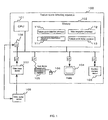
- Fig. 1 illustrates a diagram showing a representative system configuration of the feature scene detecting apparatus in a specific embodiment according to the present invention.
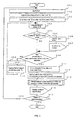
- Fig. 2 illustrates a flowchart showing a representative feature scene detection processing in a specific embodiment according to the present invention.
- Fig. 3 illustrates a diagram showing a representative data structure of data upon detection in a specific embodiment according to the present invention.
- Fig. 4 illustrates a diagram showing a representative data structure after the completion of the detection processing in a specific embodiment according to the present invention.
- Fig. 5 illustrates a diagram showing a representative user interface of the feature scene detecting apparatus in a specific embodiment according to the present invention.
- Fig. 6 illustrates a diagram showing a representative correspondence between video images and results of the feature scene detection processing in a specific embodiment according to the present invention.
- Fig. 7 illustrates a diagram showing a representative display of a total period of all the video images in the feature scene detecting apparatus in a specific embodiment according to the present invention.
- Fig. 8 illustrates a diagram showing a representative display of roll number and time code in the roll in the feature scene detecting apparatus in a specific embodiment according to the present invention.
- Fig. 9 illustrates a flowchart showing a representative video replay processing in a specific embodiment according to the present invention.
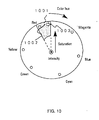
- Fig. 10 illustrates a diagram showing an overview of color information change in a specific embodiment according to the present invention.
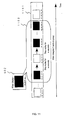
- Fig. 11 illustrates a diagram showing an overview of slow feature scene replay in a specific embodiment according to the present invention.
- the present invention provides techniques for feature scene detecting, including a feature scene detection apparatus, and a method for detecting a specific feature scenes included in a video image.
- the techniques according to the present invention can detect feature scenes in which a video image has been divided and recorded into a plurality of sequential streams analogous to a continuous video image.
- a device detects a video image part (feature scene), corresponding to a condition previously designated in the detection device, from a detection object video image, and outputs the result of detection , i.e., respective detected video image frames, detected time and the like, to a monitor, a printer or the like connected to the device.
- a video image part feature scene
- the result of detection i.e., respective detected video image frames, detected time and the like
- monitor i.e., respective detected video image frames, detected time and the like
- video image is held in a single source stream, for example, making detection processing of a plurality of video image parts included in a plurality of sequential streams as one video image unavailable. Accordingly, at the initial stage of video image formation, if a special effect, such as flashing light, for example, is present, but is split into components existing in a plurality of sequential streams, conventional techniques cannot determine whether the special effect corresponds to a previously-designated condition. Further, when many conventional techniques check a special effect, the checking process might pose a risk for a user performing the checking.
- a special effect such as flashing light
- feature scenes can be detected in a video image that has been divided and recorded into a plurality of sequential streams so that feature scene information is included in each video image in each stream.
- Specific embodiments according to the invention can detect such features scenes using time information, such as time code indicative of replay time of the feature scene, for example.
- the time information of the detected feature scenes is consecutive in a plurality of sequential streams.
- a detection frequency of the feature scenes per unit period is obtained. For example, in a case where a plurality of feature scenes are detected from the end of the first sequential stream to the beginning (hereinafter "head") of the second sequential stream, based upon the time codes of these scenes being consecutive, the number of feature scenes per unit period is calculated from the end of the first sequential stream to the head of the second sequential stream, thus the detection frequency is obtained. Then, the scenes with the obtained detection frequency equal to or greater than a threshold value are classified and recorded as a specific group of feature scenes (hereinafter "group").
- video images of the classified group of specific feature scenes are obtained from the plurality of sequential streams. Then, the obtained group of specific feature scenes are replayed by a replay technique different from a normal replay technique.
- the replay technique can be selected to reduce health risks to an operator, for example. For example, a replay technique using a color different from that of the color used in the scene or using a speed lower than a normal speed.
- the feature scene detecting apparatus of the present invention performs feature scene detection while regarding a video image divided and recorded in a plurality of sequential streams as a continuous video image, it can detect a feature scene split over sequential stream boundary in a plurality of sequential streams.
- a feature scene detecting apparatus according to a representative embodiment of the present invention will be described.
- the described embodiment can perform feature scene detection and is capable of processing a video image divided and recorded in a plurality of sequential streams as a continuous video image.
- Fig. 1 shows a system configuration of a feature scene detecting apparatus 100 in a representative embodiment according to the present invention.
- the feature scene detecting apparatus 100 has a CPU 101, a memory 102, an auxiliary memory device 103, a display device 104, a keyboard 105, a mouse 106, a video input device 107, an interface 108 and a video replay device 109.
- the CPU 101 controls the operation of the overall feature scene detecting apparatus 100.
- the memory 102 is a memory device for loading various programs to control the operation of the overall feature scene detecting apparatus 100.
- the auxiliary memory device 103 is a memory device for storing the various programs and data.
- the display device 104 can be a Cathode Ray Tube (CRT), for example, which displays the result of output from the feature scene detecting apparatus 100.
- CTR Cathode Ray Tube
- the keyboard 105 and the mouse 106 are input devices which input requests to the feature scene detecting apparatus 100.
- the video input device 107 can be a capture board, for example, which converts a video signal outputted from the video replay device 109 into a digital still image for input. Further, the video input device 107 obtains a time code corresponding to the digital still image.
- the interface 108 controls the operation of the video replay device 109 from the feature scene detecting apparatus 100 and sends a command from the video replay device 109 to the feature scene detecting apparatus 100.
- the video replay device 109 replays a video image stored in a video tape or the like.
- the feature scene detecting apparatus 100 comprises a feature scene detection processor 110, a feature scene classification processor 111, a video acquisition processor 112 and a feature scene replay processor 113.
- the feature scene detection processor 110 detects feature scenes included in a video image.
- the video image can be divided and recorded in a plurality of sequential streams. Further, the video image can comprise time information, such as time codes, indicative of replay time of the feature scenes.
- the feature scene classification processor 111 obtains a detection frequency of the feature scenes per unit period based upon the time information of the detected feature scene. In a specific embodiment, the feature scenes are stored consecutively in the plurality of sequential streams.
- the feature scene classification processor classifies and records a specific group of feature scenes having a detection frequency equal to or greater than a threshold value.
- the video acquisition processor 112 obtains a specific group of feature scenes having a detection frequency per unit period equal to or greater than a threshold value from among feature scenes included in a video image, from recording media.
- the feature scene replay processor 113 replays the obtained specific group of feature scenes by a replay method different from a normal replay method.
- the replay method may be slower, or less bright, for example, in order to minimize health effects on the viewer.
- a program for causing the feature scene detecting apparatus 100 to function as the feature scene detection processor 110, the feature scene classification processor 111, the video acquisition processor 112 and the feature scene replay processor 113 is recorded on a recording medium, such as a CD-ROM, and stored into a magnetic disk or the like, then loaded into a memory of a computer to be executed by the processor.
- a recording medium such as a CD-ROM
- the recording medium in which the program is recorded may be a recording medium other than the CD-ROM.
- a video image replayed by the video replay device 109 includes a plurality of still images, and a time code stored in each still image. Further, a request to the feature scene detecting apparatus 100 may be sent from the video replay device 109 via the interface 108.
- the video input device 107 such as a capture board, inputs a video signal outputted from the video replay device 109, then sequentially converts respective frames of the video image into digital still images and sends the images to the respective processors of the feature scene detecting apparatus 100. Further, the video input device 107 obtains time codes corresponding to the digital still images from the video signal.
- the digital still images and time codes enter the memory 102 via the video input device 107, and are processed by the CPU 101 in accordance with the program loaded in the memory 102.
- the digital still images, the time codes, and the various information resulting from processing by the CPU 101 can be stored in the auxiliary memory device 103, in accordance with the processing by the CPU 101.
- the processing by the CPU 101 of the image information will be described.
- Fig. 2 is a flowchart showing a processing procedure of feature scene detection processing in a representative embodiment according to the present invention. This processing is executed when the user requests start of detection processing using the mouse 106 or the keyboard 105, or when the start of the detection processing is requested from the video replay device 109.
- the feature scene detection processor 110 sets a number RollCnt uniquely indicating a detection object to be detected from a plurality of video images (step 201).
- the number RollCnt may be set by numbering in video-image input order, for example.
- a digital still image, fi and a time code, TCi, are captured via the video input device 107 (step 202).
- the time code TCi is stored as a head time code of the video image (TCrs) (step 203).
- a feature amount of the digital still image fi is calculated (step 204). Then, it is determined based on the feature amount whether the image fi is a feature scene (step 205). If it is determined that the image fi is a feature scene, then the digital still image fi, the feature amount computed in step 204 and the time code TCi are added to a list (step 206). The list can manage feature scenes in detected order, for example. Further, the digital still image fi is displayed in a table on the display device 104 in Fig. 1 (step 207).
- step 208 it is determined whether the next digital still image fi+1 is to be processed.
- the detection processing ends, and then processing at step 211 is performed. Otherwise, if detection processing termination is not requested, the next digital still image is read (steps 209 and 210), and processing from step 204 is continued.
- Fig. 3 shows a structure for data about detected feature scenes in a representative embodiment according to the present invention.
- Fig. 3 illustrates an element 301, comprising a video image number 302, a start time code 303 and an end code 304 of a video image, and the feature scene list 305 generated at step 206, in correspondence with each other, are elements of a ROLL list (step 212).
- a representative ROLL list that manages the data representing detected feature scenes is shown in Fig. 3.
- Elements 301 indicating respective video images are managed in a linear list with head data 307 indicating the head of the list.
- the head data 307 has a pointer to a head element 301 and the number of elements.
- the element 301 has the video number 302, the start time code 303 and the end time code 304 of the video image, the feature scene list 305, and a pointer 306 to the next element in the list.
- the feature scene classification processor 111 arranges feature scenes 308 from the head scene, in each element of the ROLL list. Based upon the time codes of the feature scenes 308 being consecutive in a plurality of sequential streams, feature scene classification processor 111 calculates the number of feature scenes 308 detected per second, for example. The processor selects a portion of feature scenes having the number feature scenes detected equal to or greater than a preset threshold value, and classifies it as a group (step 213). The results of classification step 213 will be discussed with reference to Fig. 4.
- Fig. 4 shows a data structure after the completion of the detection processing in a representative embodiment according to the present invention.
- the results of classification of the feature scenes into groups managed in a list is shown in Fig. 4.
- Fig. 4 illustrates a group list 401 managing elements 402, each indicating a group.
- Elements 402 indicate a group list 403, comprised of elements 404, each indicating a feature scene belonging to the group.
- the number of the element 404 indicating the feature scene in this figure corresponds to the number of the feature scene 308 in Fig. 3.
- the term "detection result" will be used to indicate the data generated at step 213.
- the feature scene detection processor 110 displays the detection result generated at step 213. If the user requests feature scene detection processing in another sequential stream at step 215, the process returns to step 201, and further feature scene detection processing is performed. Further, when the user requests termination of the feature scene detection, the feature scene detection processing ends.
- steps 213 and 214 may be executed after step 215, enabling a plurality of feature scenes to be processed prior to creating the data structures of Fig. 3 and Fig. 4.
- Fig. 5 shows an example user interface for the feature scene detecting apparatus 100 in a representative embodiment according to the present invention.
- the user uses the mouse 106 or the keyboard 105 in Fig. 1, to operate a mouse pointer 501 to point to a desired position on the user interface.
- a video display area 502 displays an object video image and a time code added to the image.
- a video image that is the object of detection and a video image that is the object of detection-result checking are displayed in this area.
- a detection operation start button 503 is used to request start of a detection operation.
- the feature scene detection processing in Fig. 2 is started by clicking this button using the mouse pointer 501.
- a detection operation end button 504 is used to request termination of the detection operation.
- the feature scene detection processing in Fig. 2 is terminated by clicking this button using the mouse pointer 501.
- a feature scene table area 505 is used to display a table of detected feature scenes.
- the results of the feature scene detection processing in Fig. 2 are displayed in this area.
- the correspondence between the video images and the results of detection is as shown in Fig 6.
- Fig. 6 shows the correspondence between the video images and the results of feature scene detection processing in a representative embodiment according to the present invention.
- still images 601 and 602 are detected based on luminance change.
- a scroll bar 506 is used when all of the results of detection cannot be displayed in the feature scene table area 505.
- buttons and scroll bar used in the user interface are often used in general personal computer processing, the detailed description on these tools is well known to those of ordinary skill in the art.
- a group icon 507 of Fig. 5 indicates a group detected by the feature scene detection processing in Fig. 2.
- the group is selected by selection of this icon using the mouse pointer 501, for example.
- the still images, the time codes and the feature amounts of the images, detected by the feature scene detection processing in Fig. 2, are displayed in icons 508 belonging to the group.
- Fig. 7 shows a display of a total period of all the video images in the feature scene detecting apparatus 100 of a specific embodiment according to the present invention.
- Fig. 8 shows a display of roll number and time code within the roll, in the feature scene detecting apparatus 100 of a specific embodiment according to the present invention.
- the time code is displayed below the group icon 507 and the icon 508, which belong to the group, as well.
- the display is of the total time period for the entire video image, and is continuous in a plurality of sequential streams as shown in Fig. 7.
- the display includes a combination of a title of the video image and its time code as shown in Fig. 8.
- a detection order display area 515 of Fig. 5 is used to display the detection order of a plurality of video images.
- a video length 510 indicates the length of each video image, and a video title 516 indicates the title of the video image.
- deletion processing is performed by clicking an initialize button 509. Further, if a junction between respective video images is designated by a pointer 511, the result of detection from a new video image is inserted at an arbitrary position among the results of detection for a plurality of existing video images. The position to insert the result of detection may be automatically designated if unique time codes are written in all the video images as detection objects.
- a video replay button 514 is used for performing a checking operation on the detection result video images. When a group is selected and this button is depressed, video image replay is performed beginning at an image corresponding to a time code indicating the group start time to a time code indicating the group end time.
- Video replay method buttons 512 and 513 indicate video replay methods for display in the video display area 502.
- the video replay method button 513 is used to change red coloration. If this button is depressed, processing to display a video image with changed red coloration in the video display area 502 is performed.
- the video replay method button 512 is used to perform slow replay. If this button is depressed, processing to slowly display a video image in the video display area 502 is performed.
- Fig. 9 is a flowchart showing a processing procedure of video replay processing in a representative embodiment according to the present invention.
- the flowchart of the video replay processing in Fig. 9 will be described for a case in which the results of feature scene detection processing of Fig. 2 are generated prior to the start of video replay processing. This processing is performed when the group icon 507 is selected and the video replay button 514 is depressed.
- the video acquisition processor 112 obtains a group head video image number RollCnts and a time code TCs (step 901). Video acquisition processor 112 also obtains a group end video image number RollCnte and a time code TCe (step 902). Then, the processor stores the number RollCnts as the current video image number RollCnti (step 903).
- the process waits until the RollCnts-th video image is set in the video replay device 109 (step 904). Then, video fast forward or rewind is performed to a position corresponding to the time code TCs in the video replay device 109 (step 905).
- a step 906 a still image fi and its time code TCi are sequentially obtained. Then at step 911, the still image fi is displayed.
- step 912 it is determined whether the current video image number RollCnti is less than the group end video image number RollCnte. If the current video image number is less than the group end video image number, it is determined at step 913 whether the entire video image of the video image number has been replayed. If the entire video image of the current video image number has not been replayed, then the processing from step 906 is continued.
- a video image of the next video image number is set in steps 914 to 916 before the processing at step 906 is continued, and a time code TCrs in the start position of the video image of the next video image number is set in the video replay device 109 (steps 914 to 916).
- step 912 If it is determined at step 912 that the current video image number is equal to the group end video image number, it is determined whether the time code TCi of the current video image is greater than the group end time code TCe. If the current video time code TCi is equal to or less than the group end time code TCe, the processing from step 906 is continued. Further, if the current video time code TCi is greater than the group end time code TCe, the video replay is stopped, and the process ends. The video replay is performed by the above processing.
- This processing is realized by adding processing for steps 907 to 910 between steps 906 and 911.
- step 907 the feature scene replay processor 113 determines whether the video replay method button 513 is selected, and if it has been selected, the red coloration change processing is performed (step 908).
- Fig. 10 shows an overview of color information change in a representative embodiment according to the present invention.
- a technique for changing red coloration in a HIS (Hue, Intensity and Saturation) color model is shown in Fig. 10.
- a part 1001 indicates the range of red to be changed
- a color 1002 belonging to the part 1001 is replaced with a color 1003 out of the range of red, nearest to the value of the color 1002, based on the boundary between the part 1001 and the space other that the part 1001 as a threshold value.
- processing for replaying a video image at a low speed in a specific embodiment according to the invention is performed when the video replay method button 512 in Fig. 5 is selected.
- the feature scene replay processor 113 determines whether the video replay method button 512 is selected, and if it has been selected, the processing for low-speed video image replay is performed (step 910).
- Fig. 11 shows an overview of a feature scene slow replay technique in a representative embodiment according to the present invention.
- a technique for performing low-speed video replay will be discussed with respect to an example case of replaying a video image part 1102 of video image 1101 in Fig. 11.
- replay is performed with replay stoppage for n seconds between respective still images of the video image part 1102.
- n is an example of one technique for obtaining n.
- replay independent of content can be made by performing the replay with the value n as a fixed value equal to or greater than 1.
- the feature scene detecting apparatus of a specific embodiment according to the present invention performs feature scene detection for video images, including video images that have been divided and recorded in a plurality of sequential streams as a continuous video image.
- embodiments according to the present invention can perform feature scene detection over a boundary between two sequential streams.
- a specific group of feature scenes can be replayed using a replay method different from a normal replay method, so that when the feature scene is checked, an operator will not suffer adverse effects from replaying the feature scene.
- Specific embodiments include any of replaying the feature scene at slower than normal speed, replacing red color with other colors, and the like.
- feature scene detection is performed while a video image that has been divided and recorded in a plurality of sequential streams is handled as a continuous video image, feature scene detection over a plurality of sequential streams can be performed.
Landscapes
- Engineering & Computer Science (AREA)
- Multimedia (AREA)
- Library & Information Science (AREA)
- Theoretical Computer Science (AREA)
- Data Mining & Analysis (AREA)
- Databases & Information Systems (AREA)
- Physics & Mathematics (AREA)
- General Engineering & Computer Science (AREA)
- General Physics & Mathematics (AREA)
- Television Signal Processing For Recording (AREA)
- Information Retrieval, Db Structures And Fs Structures Therefor (AREA)
- Management Or Editing Of Information On Record Carriers (AREA)
Applications Claiming Priority (2)
| Application Number | Priority Date | Filing Date | Title |
|---|---|---|---|
| JP20029199 | 1999-07-14 | ||
| JP20029199 | 1999-07-14 |
Publications (3)
| Publication Number | Publication Date |
|---|---|
| EP1069765A2 true EP1069765A2 (de) | 2001-01-17 |
| EP1069765A3 EP1069765A3 (de) | 2003-06-18 |
| EP1069765B1 EP1069765B1 (de) | 2005-05-25 |
Family
ID=16421883
Family Applications (1)
| Application Number | Title | Priority Date | Filing Date |
|---|---|---|---|
| EP00305951A Expired - Lifetime EP1069765B1 (de) | 1999-07-14 | 2000-07-13 | Verfahren und Vorrichtung zur Merkmalszene-Detektion, und Speichermedium mit einem Verarbeitungsprogramm dafür |
Country Status (2)
| Country | Link |
|---|---|
| EP (1) | EP1069765B1 (de) |
| DE (1) | DE60020303D1 (de) |
Cited By (3)
| Publication number | Priority date | Publication date | Assignee | Title |
|---|---|---|---|---|
| WO2003090168A1 (en) * | 2002-04-19 | 2003-10-30 | Henry James William Dienn | Prevention of photoepileptic seizures |
| GB2398380A (en) * | 2003-02-12 | 2004-08-18 | Nec Corp | Method of indexing seizure risk due to flashing lights on video display, and system therefor |
| US7136055B2 (en) | 2003-02-12 | 2006-11-14 | Nec Corporation | Method of indexing seizure risk due to flashing lights on video display and system therefor |
Family Cites Families (2)
| Publication number | Priority date | Publication date | Assignee | Title |
|---|---|---|---|---|
| JP2765674B2 (ja) * | 1993-12-16 | 1998-06-18 | インターナショナル・ビジネス・マシーンズ・コーポレイション | データ供給装置 |
| JP2000165806A (ja) * | 1998-11-30 | 2000-06-16 | Sony Corp | 情報処理装置および方法、並びに提供媒体 |
-
2000
- 2000-07-13 DE DE60020303T patent/DE60020303D1/de not_active Expired - Lifetime
- 2000-07-13 EP EP00305951A patent/EP1069765B1/de not_active Expired - Lifetime
Cited By (4)
| Publication number | Priority date | Publication date | Assignee | Title |
|---|---|---|---|---|
| WO2003090168A1 (en) * | 2002-04-19 | 2003-10-30 | Henry James William Dienn | Prevention of photoepileptic seizures |
| GB2398380A (en) * | 2003-02-12 | 2004-08-18 | Nec Corp | Method of indexing seizure risk due to flashing lights on video display, and system therefor |
| GB2398380B (en) * | 2003-02-12 | 2006-04-05 | Nec Corp | Method of indexing seizure risk due to flashing lights on video display, and system therefor |
| US7136055B2 (en) | 2003-02-12 | 2006-11-14 | Nec Corporation | Method of indexing seizure risk due to flashing lights on video display and system therefor |
Also Published As
| Publication number | Publication date |
|---|---|
| EP1069765A3 (de) | 2003-06-18 |
| DE60020303D1 (de) | 2005-06-30 |
| EP1069765B1 (de) | 2005-05-25 |
Similar Documents
| Publication | Publication Date | Title |
|---|---|---|
| US6256419B1 (en) | Method and apparatus for detecting a point of change in a moving image | |
| US7248294B2 (en) | Intelligent feature selection and pan zoom control | |
| US6487360B1 (en) | Method, apparatus, and computer program product for editing moving image and displaying selected groups of representative images of cuts of the moving image such that representative images having a predetermined feature can be distinguished from representative images not having the predetermined feature | |
| US5818439A (en) | Video viewing assisting method and a video playback system therefor | |
| US8379154B2 (en) | Key-frame extraction from video | |
| JP3361587B2 (ja) | 動画像検索装置及び方法 | |
| US20100272323A1 (en) | Display apparatus, image processing apparatus, and image processing system | |
| JPH09130732A (ja) | シーンチェンジ検出方法および動画像編集装置 | |
| WO2000054223A1 (en) | Extracting a time-sequence of slides from video | |
| CN101548546A (zh) | 输出设备、输出方法和程序 | |
| JP2000350156A (ja) | 動画像情報の記憶方法及びこれを記録した記録媒体 | |
| JP3728775B2 (ja) | 動画像の特徴場面検出方法及び装置 | |
| JP3258924B2 (ja) | シーン管理装置、シーン管理方法及び記録媒体 | |
| JP3622527B2 (ja) | 映像の特徴場面検出方法及び装置 | |
| US20020114615A1 (en) | Image processing apparatus and method for moving picture data playback, and computer-readable storage medium that stores program codes for image processing | |
| US20020161798A1 (en) | Information retrieving device | |
| EP1069765B1 (de) | Verfahren und Vorrichtung zur Merkmalszene-Detektion, und Speichermedium mit einem Verarbeitungsprogramm dafür | |
| JPH11134352A (ja) | 動画像表示方法 | |
| JP3534592B2 (ja) | 代表画像生成装置 | |
| JP3157928B2 (ja) | 動画像の拾い見装置 | |
| JP3625935B2 (ja) | 動画像の重要画像抽出装置および重要画像抽出方法 | |
| JP3067043B2 (ja) | 動画のカット自動分割方法 | |
| JP3893858B2 (ja) | 特徴場面検出方法及びその実施装置並びにその処理プログラムを記録した記録媒体 | |
| JP3024574B2 (ja) | 動画像検索装置 | |
| JPH0895986A (ja) | 動画像のデータベース装置及びその登録方法 |
Legal Events
| Date | Code | Title | Description |
|---|---|---|---|
| PUAI | Public reference made under article 153(3) epc to a published international application that has entered the european phase |
Free format text: ORIGINAL CODE: 0009012 |
|
| 17P | Request for examination filed |
Effective date: 20000802 |
|
| AK | Designated contracting states |
Kind code of ref document: A2 Designated state(s): AT BE CH CY DE DK ES FI FR GB GR IE IT LI LU MC NL PT SE |
|
| AX | Request for extension of the european patent |
Free format text: AL;LT;LV;MK;RO;SI |
|
| PUAL | Search report despatched |
Free format text: ORIGINAL CODE: 0009013 |
|
| AK | Designated contracting states |
Designated state(s): AT BE CH CY DE DK ES FI FR GB GR IE IT LI LU MC NL PT SE |
|
| AX | Request for extension of the european patent |
Extension state: AL LT LV MK RO SI |
|
| RIC1 | Information provided on ipc code assigned before grant |
Ipc: 7G 11B 27/28 B Ipc: 7H 04N 5/14 A |
|
| 17Q | First examination report despatched |
Effective date: 20040121 |
|
| AKX | Designation fees paid |
Designated state(s): DE FR GB |
|
| GRAP | Despatch of communication of intention to grant a patent |
Free format text: ORIGINAL CODE: EPIDOSNIGR1 |
|
| RIN1 | Information on inventor provided before grant (corrected) |
Inventor name: AMEMIYA, HIROKAZUC/O HITACHI LTD., INTEL.PROP.GR. Inventor name: YAMAMITSU, TADASHIC/O HITACHI LTD.,INTEL.PROP.GR. Inventor name: HAGIHARA, YOSHINOBUC/O HITACHI LTD.,INT.PROP.GR. Inventor name: SAGA, TOSHIHIDEC/O AKITA ELECTRONICS CO. LTD. Inventor name: SAKAMOTO, KATSUTOC/O HITACHI LTD.,INT.PROP.GROUP Inventor name: OMATA, MITSUTERUC/O HITACHI, LTD., INTEL.PROP.GR. |
|
| GRAS | Grant fee paid |
Free format text: ORIGINAL CODE: EPIDOSNIGR3 |
|
| GRAA | (expected) grant |
Free format text: ORIGINAL CODE: 0009210 |
|
| AK | Designated contracting states |
Kind code of ref document: B1 Designated state(s): DE FR GB |
|
| REG | Reference to a national code |
Ref country code: GB Ref legal event code: FG4D |
|
| REG | Reference to a national code |
Ref country code: IE Ref legal event code: FG4D |
|
| REF | Corresponds to: |
Ref document number: 60020303 Country of ref document: DE Date of ref document: 20050630 Kind code of ref document: P |
|
| PG25 | Lapsed in a contracting state [announced via postgrant information from national office to epo] |
Ref country code: GB Free format text: LAPSE BECAUSE OF NON-PAYMENT OF DUE FEES Effective date: 20050825 |
|
| PG25 | Lapsed in a contracting state [announced via postgrant information from national office to epo] |
Ref country code: DE Free format text: LAPSE BECAUSE OF FAILURE TO SUBMIT A TRANSLATION OF THE DESCRIPTION OR TO PAY THE FEE WITHIN THE PRESCRIBED TIME-LIMIT Effective date: 20050826 |
|
| PLBE | No opposition filed within time limit |
Free format text: ORIGINAL CODE: 0009261 |
|
| STAA | Information on the status of an ep patent application or granted ep patent |
Free format text: STATUS: NO OPPOSITION FILED WITHIN TIME LIMIT |
|
| GBPC | Gb: european patent ceased through non-payment of renewal fee |
Effective date: 20050825 |
|
| 26N | No opposition filed |
Effective date: 20060228 |
|
| EN | Fr: translation not filed | ||
| PG25 | Lapsed in a contracting state [announced via postgrant information from national office to epo] |
Ref country code: FR Free format text: LAPSE BECAUSE OF NON-PAYMENT OF DUE FEES Effective date: 20050731 |
|
| PG25 | Lapsed in a contracting state [announced via postgrant information from national office to epo] |
Ref country code: FR Free format text: LAPSE BECAUSE OF NON-PAYMENT OF DUE FEES Effective date: 20050525 |