EP1069277B1 - Arrangement pare-soleil avec commande de store automatique et possibilité d'intervention manuelle - Google Patents
Arrangement pare-soleil avec commande de store automatique et possibilité d'intervention manuelle Download PDFInfo
- Publication number
- EP1069277B1 EP1069277B1 EP00114879A EP00114879A EP1069277B1 EP 1069277 B1 EP1069277 B1 EP 1069277B1 EP 00114879 A EP00114879 A EP 00114879A EP 00114879 A EP00114879 A EP 00114879A EP 1069277 B1 EP1069277 B1 EP 1069277B1
- Authority
- EP
- European Patent Office
- Prior art keywords
- blind
- setting
- manual
- protecting arrangement
- input
- Prior art date
- Legal status (The legal status is an assumption and is not a legal conclusion. Google has not performed a legal analysis and makes no representation as to the accuracy of the status listed.)
- Expired - Lifetime
Links
- 230000007704 transition Effects 0.000 claims description 4
- 230000004075 alteration Effects 0.000 claims 1
- 230000006870 function Effects 0.000 abstract description 3
- 230000037072 sun protection Effects 0.000 description 18
- 230000006978 adaptation Effects 0.000 description 10
- 239000013598 vector Substances 0.000 description 10
- 230000008859 change Effects 0.000 description 6
- 238000001514 detection method Methods 0.000 description 6
- 239000000523 sample Substances 0.000 description 5
- 230000001133 acceleration Effects 0.000 description 4
- 230000003044 adaptive effect Effects 0.000 description 3
- 238000004364 calculation method Methods 0.000 description 3
- 238000010586 diagram Methods 0.000 description 3
- 230000005291 magnetic effect Effects 0.000 description 3
- 238000005259 measurement Methods 0.000 description 3
- 238000000034 method Methods 0.000 description 3
- 230000008569 process Effects 0.000 description 3
- 230000006399 behavior Effects 0.000 description 2
- 230000005540 biological transmission Effects 0.000 description 2
- 230000001419 dependent effect Effects 0.000 description 2
- 238000010438 heat treatment Methods 0.000 description 2
- 238000009434 installation Methods 0.000 description 2
- 230000005855 radiation Effects 0.000 description 2
- 241000446313 Lamella Species 0.000 description 1
- 238000012937 correction Methods 0.000 description 1
- 230000000694 effects Effects 0.000 description 1
- 238000011156 evaluation Methods 0.000 description 1
- 230000005294 ferromagnetic effect Effects 0.000 description 1
- 238000011835 investigation Methods 0.000 description 1
- QSHDDOUJBYECFT-UHFFFAOYSA-N mercury Chemical compound [Hg] QSHDDOUJBYECFT-UHFFFAOYSA-N 0.000 description 1
- 229910052753 mercury Inorganic materials 0.000 description 1
- 230000008447 perception Effects 0.000 description 1
- 238000001556 precipitation Methods 0.000 description 1
- 230000008672 reprogramming Effects 0.000 description 1
- 230000004044 response Effects 0.000 description 1
- 238000011524 similarity measure Methods 0.000 description 1
- 230000000475 sunscreen effect Effects 0.000 description 1
- 239000000516 sunscreening agent Substances 0.000 description 1
Images


Classifications
-
- E—FIXED CONSTRUCTIONS
- E06—DOORS, WINDOWS, SHUTTERS, OR ROLLER BLINDS IN GENERAL; LADDERS
- E06B—FIXED OR MOVABLE CLOSURES FOR OPENINGS IN BUILDINGS, VEHICLES, FENCES OR LIKE ENCLOSURES IN GENERAL, e.g. DOORS, WINDOWS, BLINDS, GATES
- E06B9/00—Screening or protective devices for wall or similar openings, with or without operating or securing mechanisms; Closures of similar construction
- E06B9/56—Operating, guiding or securing devices or arrangements for roll-type closures; Spring drums; Tape drums; Counterweighting arrangements therefor
- E06B9/68—Operating devices or mechanisms, e.g. with electric drive
Definitions
- the invention relates to a sunshade system with a motor-adjustable curtain and a control that makes the adjustment of the curtain in response to at least one specific input to a predetermined basic programming to generate at least one output, with a manual intervention option for the realization of the automatic setting different Settings of the blind is provided.
- sun protection systems with an automatic control, which generate output variables based on specific input parameters, for example for controlling electric motors, by means of which the curtain is automatically adjustable according to the input parameters. While the basic programming of such systems may be done in a manner believed to be optimal, it is very difficult to discern in advance the actual lighting characteristics of a room, and the subjective perception of the people working or living in shaded areas with such systems also varies considerably can be. Although one can manage by manual intervention in the control and adjust the desired shading state, but the user must then completely dispense with the automatic adjustment of the sunshade or constantly make manual changes, which can hardly be considered an acceptable solution.
- the object of the invention is to provide a sunshade system that will better meet the user requirements without costly reprogramming.
- the object is achieved by a sunshade system of the type described above, in which the control detects manually selected settings of the blind together with at least one input present at the time of manual intervention, stores and from a certain number substantially the same, at least twice repeated manual intervention with essentially the same input variable, the basic programming for future settings has been changed if this input variable is present and the manual intervention is evaluated.
- any more or less complicated programming by the user is eliminated.
- the programming of the controller, d. H. the deviation from the given basic programming according to the user's wishes, is done solely by the manual settings made in automatic mode, which the system detects and learns from.
- control and learning algorithms used in the control have the consequence that the user manual only in the initial phase after commissioning of the sunshade Changes must be made according to his wishes and after some time, the system no longer perceives, as always prevail the desired settings.
- the controller gradually adjusts the programming with increasing number of repetitions of substantially the same manual settings at substantially the same input size of the manual setting and makes the adjusted setting of the curtain in the present input.
- the programming takes over the manual setting and repeats them when the input variable is present.
- stepwise adaptation for example, can proceed so that one or two-time manual intervention only minimal changes
- it is recommended in the second variant described assume at least three to four times repetition of the manual setting for a change of programming to sufficient statistical certainty to assume that the user's manual interventions are based on a desire to fundamentally change programming.
- the learning algorithm is designed so that the call of the adapted or adopted setting is made in a certain parameter range of the detected input variable. This prevents that it is almost impossible due to exaggerated accuracy in the detection of the input variable and the manually set output that repeats this state, since the user will always make manual adjustments with a certain spread and also the detected inputs, especially in the detection of several input quantities are unlikely to be identical again and again.
- width of the parameter range is also another way to avoid a repetition of once made manual settings by the parameter range of the input variable with increasing number of repeated manual settings is wider and, for example, a single input a repetition is made only with exactly repeated input variables ,
- the controller detects at least the input variables time of day, day of the week, date, wind speed, solar intensity and / or temperature and takes this into account when changing the setting of the blind and / or the programming change.
- not all input variables that are used by the control for setting the blind must be included in the learning processes. Basically, however, it can be assumed that with additional input variable, which is used for programming change, an improved adaptation to the user requirements by changing the programming is possible.
- a call of a matched or accepted setting takes place when all input variables are within specific parameter ranges.
- the provision is made via an interpolated adjustment curve, which can be determined by the controller based on the output and approaching end setting of the curtain.
- the interpolated adjustment curves can be used to avoid sudden adjustment processes that are perceived as very disturbing by the persons present in the room shaded by the sun shading system. Particularly pleasant Verstell characterizingen arise when the provision is made sigmoidal, the sigmoidal transitions are realized by Bézier curves. Such return curves have only one turning point and thus give a perceived as particularly soft and pleasant change in lighting during the adjustment.
- the sunshade system can be switched to a purely manual control, for example, to be able to permanently set a desired Behang too in case of system errors.
- the controller is switchable to a state in which further manual settings cause no change in the basic programming. For example, if a room used by other people in the meantime, they could manipulate the programming of the actual user by repeated manual intervention, so that the actual user would then "reprogram" his sunscreen system again.
- the control described is basically used in all types of sun protection systems, wherein the setting of the curtain by varying at least one output variable, for example, the Behangbone, the Behangneist or the slat inclination occurs in external venetian blinds.
- the output variables may be, for example, the control signals of electric motors.
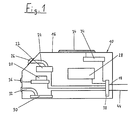
- FIG. 1 shows a sensor system 10 for determining active input variables for controlling a sunshade system 12 (see FIG. 2), which are transmitted to a controller 14 (see FIGS. 2 and 3) which, when defined switching values are reached, send drive commands to the drives 17 (see Fig. 3) of the sun protection system 12 transmitted and thus allows automatic adjustment of the sun protection system 12.
- the sensor system 10 shown in Fig. 1 is housed in a separate housing 16 which is coupled by means of connecting lines 18 to the controller 14.
- the sensor 10 must determine at least the input variables time / date, sun intensity and direction of the sunshade system to allow automatic control of the sunshade system 12 depending on the position of the sun. Especially with external sun protection systems, the detection of the additional input variables wind speed and outside temperature by the sensor 10 and a rain detector are useful.
- the sensor 10 has a radio receiver 20 which receives electromagnetic radio clock signals and forwards the calculation of the current position of the sun to the controller 14.
- the radio receiver 20 is of course formed with a suitable antenna (not shown), which ensures safe data reception location-independent within the transmission range. The determination of the day of the week and the summer time correction can be realized programmatically in the controller 14.
- the senor 10 may also have a clock that provides the required input variables.
- a clock that provides the required input variables.
- the determination of the input time time / date based on the radio clock principle provides a nearly perfect accuracy and the possibility of automatic initial and Nacheinstellens.
- the determination of the input sun intensity takes place with the aid of a sun sensor 22, which is designed as a photoresistor, photodiode or solar cell. It is also conceivable to provide a plurality of such sensors - also of different types - for determining the solar intensity.
- the sun sensor 22 is arranged in the illustrated embodiment directly on the board of the evaluation system within the sensor housing 16 and connected via a light guide 24 with a seated on the housing outer wall lens 26.
- the photosensitive element itself mount the outside of the housing and connect to the board using electrical cables.
- the sun sensor provides the controller 14 with information as to whether the sunshade system 14 or the window surface to be shaded by it is exposed to solar radiation at all, or whether, for example due to clouding, an extension of the sunshade system is necessary at all.
- the sun sensor 22 can also detect, for example, reflected sunlight from an opposite facade and cause an extension of the sunshade at a time of day, to which the controller actually assumes that the affected facade is in the shade.
- a direction sensor 28 is provided, which automatically detects the orientation of the sunshade 12 after installation, which of course assumes in the separately executed in Fig. 1 housing 16 of the sensor 10 that This is located in a well-defined location for sun protection.
- the direction sensor 28 in its embodiment as an electronic compass, can measure two or three axes of the final magnetic field and calculate the absolute direction from the individual components of the magnetic field. For most applications, the measurement of the two horizontal components is sufficient, since the sun protection system and thus the direction sensor 28 are aligned exactly during assembly using a spirit level. It is important to ensure that ferromagnetic components of the sun protection system, such. B.
- the electronic compass 28 may be embodied, for example, as a fluxgate sensor or as a magnetoresistive sensor.
- the senor 10 offers the possibility with the aid of a wind sensor 30 to detect the input variable wind speed and thus avoid a risk of the system by mechanical overload by causing the retraction of the system in strong wind.
- cup anemometer can be used as the wind sensor, but this can only detect the hoizontal components of the upcoming wind up to a deviation of approximately 15 ° from the horizontal.
- the input variable wind speed is given too low, in pure upwind or fall winds such tray crossanimometers can detect no wind movement.
- cup crossanimometers require a relatively large amount of space.
- a pressure sensor is therefore used as the wind sensor 30, which is arranged in the interior of the housing 16 and communicates with the environment via a hose connection 32.
- Other sensors by means of which an air flow can be detected, which can be considered as a measure of the wind speed, are thermos probes in which the air flow cools an electrically heated probe, so that at constant heating power, the temperature or at constant temperature, the heating power is a measure of the Flow rate is, or a strain gauge circuit, which uses the bend of a particular body exposed to the air flow as a measure of the flow velocity detected two DMS elements and evaluated with a bridge circuit.
- the wind sensor 30 may in turn be mounted on the surface of the housing 16.
- the wind sensor 22 has a sensor head (not shown) which either has a large detection range or is self-aligning. Depending on the geometry of the sensor head different large detection ranges can be covered, in which the deviations from measured to actual wind speed z. B. below 5%. In this case, recourse can be made to known investigations in connection with total pressure probes, with particularly shielded probe heads, such. B. Kielsche probes come as a geometry template in question.
- the sensor head may be attached to a movable wing, whereby it may be modeled on a simple Prandtlrohr.
- the wing must ensure free rotation in accordance with the attacking wind and the connection from the receiving tube to the sensor must be flexible so as not to restrict the mobility of the wing.
- a completely different principle for determining the input variable wind speed can be to determine immediate deformations, vibrations or accelerations on parts of the sunshade, which can be considered as a measure of the wind speed.
- deformations caused by wind can be determined with the aid of DMS circuits. These are preferably attached to a heavily loaded component of the sunshade system, in awnings, for example, on a awning support tube in the arm support or on the arm profiles.
- the strain gauge circuit is formed according to the deformation to be determined as a quarter, half or full bridge, wherein the resistance changes occurring in the measuring strips are a measure of the deformation and thus the attacking wind load.
- a mercury switch for detecting the vibrations and vibrations or a z.
- the sensor system 10 shown in FIG. 1 further has a rain sensor 34, which can detect precipitation or moisture and especially in wet-sensitive sun protection systems, such. As awnings, can cause the retraction of the system.
- the sensor 10 also has a temperature sensor 36, the signal of which can be used as a further input variable for the controller 14.
- the microcontroller 38 is connected to the controller 14 via a two-wire or three-wire bus line 44.
- FIG. 2 shows a schematic cross-section of a lamella trap door 12, in the upper rail 46 of which a sensor 10 according to the sensor system shown in FIG. 1 without a housing and a control 14 are integrated.
- the lens 26, the temperature sensor 36 and the opening of the hose 32 connected to the wind sensor 30 are provided on the outside of a shutter 48 which covers the upper part of a shaft 50 in which the external blind 12 is mounted.
- the external venetian blind 12 has a Lamellenbehang 52, the individual louvers 54 are shown in Fig. 2 in the retracted position as a package gathered.
- the external venetian blind 12 has two motors 17 (see Fig. 3), by means of which the slat curtain 52 extendable and the inclination of the slats 54 is adjustable. The control of the motors is taken over by the controller 14, wherein in addition to a purely automatic control and a manual intervention for the extension length and the angle adjustment of the curtain 52 is provided.
- the functional diagram shown in FIG. 3 shows the controller 14 for the motors 17 of the Venetian blind 12 in FIG. 2 with the sensors provided for determining relevant input variables.
- the sensors provided for determining relevant input variables.
- the already mentioned manual hand switches 56, 58 for the extension length or the angle setting of the curtain 52 are shown to determine further input variables.
- the handset can also be designed in the form of a remote control.
- Further input variables represent the actual extension length detected with the aid of an encoder 60 and the actual angular position of the curtain 52 detected with the aid of a further encoder 62.
- the two encoders 60, 62 can be provided on the motors 17, for example in the form of rotary encoders.
- the mentioned measured or adjusted input variables are forwarded to the multiplexer 40 and an analog-to-digital converter 42 following this, which converts the incoming sensor signals serially.
- the transducer 42 is followed by a sensor signal adaptation 64, which, for example, linearizes characteristic curves or converts signal pulses into a continuous variable.
- Sequence programs are stored on an EPROM memory module 66 which generate the output variables for controlling the motors 17 as a function of the output signal of the sensor signal adaptation 64.
- the control programs continue to be influenced by the contents of a memory 68, in which information about the geographic length and width of the exhibition site of the sun protection system 12 are deposited, since only on the exact geographical indication of an exact determination of the position of the sun relative to the sun protection system 12 is possible. However, even without this information, a good approximation for many locations is possible with the aid of a default setting.
- the controller 14 is constructed so that the values for the extension length or the angle setting manually inputted with the manual switches 56, 58 are given priority over the setting determined according to the measured input values based on the basic programming. If a manual setting is not corrected for a certain time, the controller 14 automatically adjusts the setting to the theoretical ideal course over a predefined period of several hours.
- the transitions are sigmoidal in order to allow as inconspicuous as possible a return.
- the sigmoidal transitions are realized via Bézier curves, which guarantee that the return curve always has only one turning point.
- the input variables time of day and date ascertained by the radio-controlled clock 20 serve to track the setting angle of the slats 54 to the sun's altitude, whereby the date information can compensate for season-dependent changes in the sun's path.
- special calculation formulas are stored in the controller 14, which calculate the azimuth and elevation angles of the solar radiation.
- input magnitude direction can be calculated whether the sun can shine directly on the system at all and which relative position it occupies the plant.
- These calculations can be further specified by the information stored in the memory 68 about the geographical location of the system 12, the data also being from a GPS receiver integrated in the system can be provided.
- the geographic data is stored in the memory 68 during installation of the system, for example by transmission from a mobile GPS receiver, immediate input of the geographical data or the auxiliary input of the geographic location approximately indicative information such. As postcodes or license plates.
- the other input variables sun intensity, wind speed, rain and temperature are treated so that when exceeding or falling below certain thresholds retraction of the system is caused by the controller 14. If appropriate, these threshold values can be varied as a function of the actual extension state of the system 12 determined by the encoders 60, 62.
- a further memory module 70 designed as an EEPROM is provided, which enables an adaptive learning capability of the controller 14.
- the memory module 70 it is possible in a manual intervention to store the system state, ie all input variables and output variables used for the adaptive learning capability, namely the setting parameters of the blind, in the form of a state vector.
- the input variables used for the learning process include the Time of day, month and day of the week, the wind speed, the temperature and the sun's intensity, but also the signal of the humidity sensor 34 in question.
- the controller 14 now permanently compares the input variables of all stored vectors with the actual variables of the system. If the system is again in a similar or even identical state in which previously manually determined output variables have been selected in deviation from the basic programming, then this vector is called again (recall). As a result, the stored output values corresponding to a previously made manual setting are automatically adjusted. Using the input variables, the system tries to determine the reason that led to a manual operation. Although an absolutely sure recognition of a cause is hard to achieve, with every additional input used in the adaptive learning ability, the certainty to recognize the user's will increases.
- the threshold values are not defined as fixed variables, but defined for each input variable as so-called recall range. These recall areas should be adapted only after repeated operation to provide greater safety and insensitivity to accidental manual intervention. It is therefore intended to select the recall areas very small with only a single input, so that a recall occurs only if the actual state values are identical with the stored input variables of a vector.
- the adaptation of the recall areas is carried out according to specific, defined rules that are components of the learning and control algorithms of the controller 14. If a hand setting z. B. at a certain time of day always on the same day of the week, the controller assumes that this setting should be made only on this day of the week.
- the generated Recall area is therefore limited to a weekday, but extended to all calendar weeks. If the entries are made on different days of the week, a relatively large extension of the recall area also takes place with reference to this input variable. This adaptation takes place continuously, whereby an optimal adaptation of the adaptation behavior to the desired learning behavior is possible.
- the learning algorithm is also able to weight input points of the user depending on their time distances from each other and their age. Older inputs are only used to a limited extent for the definition of the recall areas, whereby very old vectors of input quantities can also be deleted.
- the controller 14 further provides the possibility of a reset which clears all vectors and returns the algorithm to its start state in which the outputs are determined from the detected inputs only through the basic programming.
- the automatic control can also be switched off by the manual switches 56, 58.
- the sensors 10, control 14 and motors 17 of the sun protection system 12 need to supply only a conventional household power grid without additional components or even control lines, as they are found in previously implemented systems. With the connection to the power grid, the system is ready, with possibly only the data for the geographical location and / or the orientation of the system must be stored.
- the described combination of a sensor 10 with a controller 14 is also suitable for automatically controlling other sun protection systems, such. B. from awnings.
- the controller 14 can produce output signals for only one motor, for two motors (see embodiment) or even more motors.
- the basic programming must be adjusted, with adapted programming, the use of one and the same Unit of sensor 10 and controller 14 can be used for a variety of types of sun protection.
Landscapes
- Engineering & Computer Science (AREA)
- Structural Engineering (AREA)
- Architecture (AREA)
- Civil Engineering (AREA)
- Blinds (AREA)
- Operating, Guiding And Securing Of Roll- Type Closing Members (AREA)
Claims (12)
- Arrangement pare-soleil avec un store (52) réglable de manière motorisée et une commande (14) qui procède au réglage du store (52) en fonction d'au moins une grandeur d'entrée, selon une programmation de base prescrite, par la génération d'au moins une grandeur de sortie ; une possibilité d'intervention manuelle étant prévue pour réaliser des réglages divergeant du réglage automatique du store (52) ; caractérisé en ce que la commande (14) saisit et mémorise des réglages du store (52) sélectionnés manuellement avec au moins une grandeur d'entrée présente au moment de l'intervention manuelle, et modifie, à partir d'un certain nombre d'interventions manuelles, essentiellement identiques, répétées au moins deux fois, avec une grandeur d'entrée essentiellement identique, la programmation de base pour des réglages futurs lorsque cette grandeur d'entrée est présente, et ce en évaluant les interventions manuelles.
- Arrangement pare-soleil selon la revendication 1, caractérisé en ce que la commande (14) adapte progressivement la programmation en fonction du réglage manuel quand le nombre de répétitions de réglages manuels essentiellement identiques, avec au moins une grandeur d'entrée essentiellement identique, augmente, et procède au réglage adapté du store (52) lorsque au moins l'une des grandeurs d'entrée est présente.
- Arrangement pare-soleil selon la revendication 1 ou 2, caractérisé en ce que, après un certain nombre de répétitions de réglages manuels essentiellement identiques avec des grandeurs d'entrée essentiellement identiques, la programmation reprend le réglage manuel et répète le réglage du store (52) prescrit manuellement lorsque au moins l'une des grandeurs d'entrée est présente.
- Arrangement pare-soleil selon l'une des revendications 1 à 3, caractérisé en ce que l'appel du réglage adapté ou repris du store (52) s'effectue dans une plage de paramètres définie d'au moins l'une des grandeurs d'entrée saisies.
- Arrangement pare-soleil selon la revendication 4, caractérisé en ce que la plage d'au moins l'une des grandeurs d'entrée, dans laquelle des réglages adaptés ou repris peuvent être appelés, est plus large avec l'augmentation du nombre de réglages manuels répétés.
- Arrangement pare-soleil selon l'une des revendications précédentes, caractérisé en ce que la commande (14) saisit au moins les grandeurs d'entrée Heure, Jour, Date, Vitesse du vent, Intensité du soleil et/ou Température et en tient compte lors du réglage du store (52) et/ou de la modification de la programmation ; l'appel d'un réglage adapté ou repris du store (52) ayant alors lieu de préférence, avec plusieurs grandeurs d'entrée évaluées, lorsque toutes les grandeurs d'entrée se situent dans des plages de paramètres définies.
- Arrangement pare-soleil selon la revendication 6, caractérisé en ce que les plages de paramètres se réduisent avec l'augmentation du nombre de grandeurs d'entrée saisies.
- Arrangement pare-soleil selon l'une des revendications précédentes, caractérisé en ce que, au bout d'une certaine durée après une intervention manuelle ou l'appel d'un réglage adapté ou repris du store (52), le repositionnement à un réglage de la programmation de base ou à un réglage modifié s'effectue ; ce repositionnement ayant lieu, par exemple, en forme de sigmoïde et de préférence via une courbe de variation interpolée qui peut être déterminée par la commande (14) à l'aide de la position de sortie et de la position finale à atteindre du store (52) ; les transitions en forme de sigmoïde étant réalisables par des courbes de Bézier.
- Arrangement pare-soleil selon l'une des revendications précédentes, caractérisé en ce que la programmation de la commande (14) peut être réinitialisée de préférence pour reprendre la programmation de base et/ou commutée sur une commande purement manuelle ; les grandeurs d'entrée pouvant être déterminées par des capteurs (20, 22, 28, 30, 34, 36, 56, 58, 60, 62) affectés individuellement à l'arrangement pare-soleil (12) et l'alimentation en courant étant assurée par un réseau de courant à usage domestique.
- Arrangement pare-soleil selon l'une des revendications précédentes, caractérisé en ce que la commande (14) peut être commutée dans un état où d'autres réglages manuels du store (52) n'entraînent aucune modification de la programmation.
- Arrangement pare-soleil selon l'une des revendications précédentes, caractérisé en ce que le réglage du store (52) s'effectue par la variation d'au moins deux grandeurs de sortie.
- Arrangement pare-soleil selon l'une des revendications précédentes, caractérisé en ce qu'il s'agit d'un store à lamelles pour protection solaire (12) et que le réglage du store (52) s'effectue en modifiant les grandeurs de sortie Longueur du store et Réglage angulaire des lamelles (54).
Applications Claiming Priority (2)
| Application Number | Priority Date | Filing Date | Title |
|---|---|---|---|
| DE19932730A DE19932730A1 (de) | 1999-07-14 | 1999-07-14 | Sonnenschutzanlage mit automatischer Behangsteuerung und manueller Eingriffsmöglichkeit |
| DE19932730 | 1999-07-14 |
Publications (3)
| Publication Number | Publication Date |
|---|---|
| EP1069277A2 EP1069277A2 (fr) | 2001-01-17 |
| EP1069277A3 EP1069277A3 (fr) | 2003-06-18 |
| EP1069277B1 true EP1069277B1 (fr) | 2006-05-10 |
Family
ID=7914628
Family Applications (1)
| Application Number | Title | Priority Date | Filing Date |
|---|---|---|---|
| EP00114879A Expired - Lifetime EP1069277B1 (fr) | 1999-07-14 | 2000-07-12 | Arrangement pare-soleil avec commande de store automatique et possibilité d'intervention manuelle |
Country Status (3)
| Country | Link |
|---|---|
| EP (1) | EP1069277B1 (fr) |
| AT (1) | ATE325934T1 (fr) |
| DE (2) | DE19932730A1 (fr) |
Families Citing this family (13)
| Publication number | Priority date | Publication date | Assignee | Title |
|---|---|---|---|---|
| DE10248003A1 (de) * | 2002-10-15 | 2004-04-29 | Bayerische Motoren Werke Ag | Automatischer Sonnenschutz für Fahrzeuge |
| US8836263B2 (en) | 2004-05-06 | 2014-09-16 | Mechoshade Systems, Inc. | Automated shade control in connection with electrochromic glass |
| US8723467B2 (en) | 2004-05-06 | 2014-05-13 | Mechoshade Systems, Inc. | Automated shade control in connection with electrochromic glass |
| US10253564B2 (en) | 2004-05-06 | 2019-04-09 | Mechoshade Systems, Llc | Sky camera system for intelligent building control |
| US11187035B2 (en) | 2004-05-06 | 2021-11-30 | Mechoshade Systems, Llc | Sky camera virtual horizon mask and tracking solar disc |
| US8120292B2 (en) | 2004-05-06 | 2012-02-21 | Mechoshade Systems, Inc. | Automated shade control reflectance module |
| US8890456B2 (en) | 2004-05-06 | 2014-11-18 | Mechoshade Systems, Inc. | Automated shade control system utilizing brightness modeling |
| US10619415B2 (en) | 2004-05-06 | 2020-04-14 | Mechoshade Systems, Llc | Sky camera system utilizing circadian information for intelligent building control |
| US8525462B2 (en) | 2005-03-08 | 2013-09-03 | Mechoshade Systems, Inc. | Automated shade control method and system |
| DE102005032550A1 (de) * | 2005-07-11 | 2007-01-18 | Elsner Elektronik Gmbh | Steuervorrichtung für Jalousien an Hochbauten |
| DE102006006138B4 (de) * | 2006-02-10 | 2009-03-26 | Abb Ag | Jalousieantrieb oder Rollladenantrieb oder Markisenantrieb oder Lichtbildwandantrieb |
| WO2012073161A1 (fr) * | 2010-11-29 | 2012-06-07 | Koninklijke Philips Electronics N.V. | Commandes de systèmes d'éclairage |
| US8892262B2 (en) * | 2011-09-13 | 2014-11-18 | Qmotion Incorporated | Programmable wall station for automated window and door coverings |
Family Cites Families (3)
| Publication number | Priority date | Publication date | Assignee | Title |
|---|---|---|---|---|
| DE4221640A1 (de) * | 1992-07-02 | 1994-01-05 | Microsonic Ges Fuer Mikroelekt | Elektrisches Steuergerät zur manuellen und zeitabhängigen Steuerung von elektrisch betriebenen Rolladen, Jalousien und Markisen |
| DE4407919A1 (de) * | 1994-03-09 | 1995-09-14 | Tornado Antriebstech Gmbh | Kompaktsystem zur Steuerung von Getriebeantrieben, insbesondere für Rolltore, Schwenktore, Fördersysteme und dergleichen |
| FR2754117B1 (fr) * | 1996-09-30 | 1998-11-27 | Somfy | Dispositif de commande pour moteur asynchrone de store ou volet roulant |
-
1999
- 1999-07-14 DE DE19932730A patent/DE19932730A1/de not_active Withdrawn
-
2000
- 2000-07-12 EP EP00114879A patent/EP1069277B1/fr not_active Expired - Lifetime
- 2000-07-12 AT AT00114879T patent/ATE325934T1/de not_active IP Right Cessation
- 2000-07-12 DE DE50012715T patent/DE50012715D1/de not_active Expired - Fee Related
Also Published As
| Publication number | Publication date |
|---|---|
| EP1069277A3 (fr) | 2003-06-18 |
| ATE325934T1 (de) | 2006-06-15 |
| EP1069277A2 (fr) | 2001-01-17 |
| DE19932730A1 (de) | 2001-02-08 |
| DE50012715D1 (de) | 2006-06-14 |
Similar Documents
| Publication | Publication Date | Title |
|---|---|---|
| EP1077378B1 (fr) | Anémomètre pour une installation de protection du soleil | |
| EP0552459B1 (fr) | Dispositif de sécurité pour volets roulants et similaires | |
| EP1069277A2 (fr) | Arrangement pare-soleil avec commande de store automatique et possibilité d'intervention manuelle | |
| DE60312413T2 (de) | Motorisierte Fensterabdeckung und Verfahren zur Überwachung der Position einer motorisierten Fensterabdeckung | |
| DE9105497U1 (de) | Elektronische Rolladensteuerung | |
| EP1904712B1 (fr) | Dispositif de commande pour stores sur des batiments | |
| EP1069275A2 (fr) | Dispositif de protection solaire à position adaptable selon l'incidence de la lumière | |
| DE4407342C2 (de) | Verdunkelungsvorrichtung mit einer Markise, einer Außenjalousie o. dgl. | |
| EP0667440A1 (fr) | Dispositif pour la commande électronique d'un dispositif d'assombrissement | |
| DE29923046U1 (de) | Sensor für eine Verdunkelungsvorrichtung und Verdunkelungsanlage | |
| DE4315406C1 (de) | Vorrichtung zur automatischen Steuerung von Antrieben für insbesondere Rolläden, Jalousien o. dgl. | |
| DE4312613A1 (de) | Elektronischer Steuerbaustein zum Antrieb von Stellgliedern | |
| DE19605273C2 (de) | Rollo mit einem auf eine Wickelwelle auf- und von dieser abwickelbaren Wickelmedium | |
| DE69719295T2 (de) | Sonnenschutzvorrichtung | |
| DE29924615U1 (de) | Sonnenschutzanlage mit sich dem Lichteinfall anpassender Behangeinstellung | |
| EP0621390A2 (fr) | Dispositif électronique de contrôle pour contrôler des jalousies, volets roulants, marquises, rideaux, portes de garages et similaires | |
| DE2405350B1 (de) | Steuerung einer elektromotorisch betaetigbaren Sonnenschutzanlage | |
| EP1083291B1 (fr) | Dispositif d'entraínement éléctrique pour volet roulant | |
| EP3314223B1 (fr) | Dispositif et procédé pour la régulation de l'incidence de la lumière | |
| DE102016123867B4 (de) | Vorrichtung zur Steuerung einer Verschattungseinrichtung eines Fensters | |
| DE4443733A1 (de) | Verfahren und Vorrichtung zur Steuerung einer Sonnenschutzeinrichtung | |
| DE10202830A1 (de) | Vorrichtung zum Verstellen von Lichttechnikelementen | |
| EP1725081A2 (fr) | Méthode pour régler les seuils d' intensité lumineuse dans des détecteurs de présence | |
| CH689056A5 (de) | Steuervorrichtung mit einem Windsensor und einer Funkuhr. | |
| EP2186989A2 (fr) | Commande de moteur |
Legal Events
| Date | Code | Title | Description |
|---|---|---|---|
| PUAI | Public reference made under article 153(3) epc to a published international application that has entered the european phase |
Free format text: ORIGINAL CODE: 0009012 |
|
| AK | Designated contracting states |
Kind code of ref document: A2 Designated state(s): AT BE CH CY DE DK ES FI FR GB GR IE IT LI LU MC NL PT SE |
|
| AX | Request for extension of the european patent |
Free format text: AL;LT;LV;MK;RO;SI |
|
| PUAL | Search report despatched |
Free format text: ORIGINAL CODE: 0009013 |
|
| AK | Designated contracting states |
Designated state(s): AT BE CH CY DE DK ES FI FR GB GR IE IT LI LU MC NL PT SE |
|
| AX | Request for extension of the european patent |
Extension state: AL LT LV MK RO SI |
|
| 17P | Request for examination filed |
Effective date: 20031011 |
|
| AKX | Designation fees paid |
Designated state(s): AT CH DE LI |
|
| GRAP | Despatch of communication of intention to grant a patent |
Free format text: ORIGINAL CODE: EPIDOSNIGR1 |
|
| GRAS | Grant fee paid |
Free format text: ORIGINAL CODE: EPIDOSNIGR3 |
|
| GRAA | (expected) grant |
Free format text: ORIGINAL CODE: 0009210 |
|
| AK | Designated contracting states |
Kind code of ref document: B1 Designated state(s): AT CH DE LI |
|
| REG | Reference to a national code |
Ref country code: CH Ref legal event code: EP |
|
| REF | Corresponds to: |
Ref document number: 50012715 Country of ref document: DE Date of ref document: 20060614 Kind code of ref document: P |
|
| REG | Reference to a national code |
Ref country code: CH Ref legal event code: NV Representative=s name: ISLER & PEDRAZZINI AG |
|
| PLBE | No opposition filed within time limit |
Free format text: ORIGINAL CODE: 0009261 |
|
| STAA | Information on the status of an ep patent application or granted ep patent |
Free format text: STATUS: NO OPPOSITION FILED WITHIN TIME LIMIT |
|
| 26N | No opposition filed |
Effective date: 20070213 |
|
| REG | Reference to a national code |
Ref country code: CH Ref legal event code: PCAR Free format text: ISLER & PEDRAZZINI AG;POSTFACH 1772;8027 ZUERICH (CH) |
|
| PGFP | Annual fee paid to national office [announced via postgrant information from national office to epo] |
Ref country code: AT Payment date: 20090723 Year of fee payment: 10 Ref country code: CH Payment date: 20090727 Year of fee payment: 10 |
|
| PGFP | Annual fee paid to national office [announced via postgrant information from national office to epo] |
Ref country code: DE Payment date: 20090923 Year of fee payment: 10 |
|
| REG | Reference to a national code |
Ref country code: CH Ref legal event code: PL |
|
| PG25 | Lapsed in a contracting state [announced via postgrant information from national office to epo] |
Ref country code: CH Free format text: LAPSE BECAUSE OF NON-PAYMENT OF DUE FEES Effective date: 20100731 Ref country code: LI Free format text: LAPSE BECAUSE OF NON-PAYMENT OF DUE FEES Effective date: 20100731 Ref country code: DE Free format text: LAPSE BECAUSE OF NON-PAYMENT OF DUE FEES Effective date: 20110201 |
|
| REG | Reference to a national code |
Ref country code: DE Ref legal event code: R119 Ref document number: 50012715 Country of ref document: DE Effective date: 20110201 |
|
| PG25 | Lapsed in a contracting state [announced via postgrant information from national office to epo] |
Ref country code: AT Free format text: LAPSE BECAUSE OF NON-PAYMENT OF DUE FEES Effective date: 20100712 |