EP1064234B1 - Erbium doped optical glass - Google Patents
Erbium doped optical glass Download PDFInfo
- Publication number
- EP1064234B1 EP1064234B1 EP99910477A EP99910477A EP1064234B1 EP 1064234 B1 EP1064234 B1 EP 1064234B1 EP 99910477 A EP99910477 A EP 99910477A EP 99910477 A EP99910477 A EP 99910477A EP 1064234 B1 EP1064234 B1 EP 1064234B1
- Authority
- EP
- European Patent Office
- Prior art keywords
- optical glass
- glass
- erbium doped
- erbium
- germanate
- Prior art date
- Legal status (The legal status is an assumption and is not a legal conclusion. Google has not performed a legal analysis and makes no representation as to the accuracy of the status listed.)
- Expired - Lifetime
Links
Images
Classifications
-
- C—CHEMISTRY; METALLURGY
- C03—GLASS; MINERAL OR SLAG WOOL
- C03C—CHEMICAL COMPOSITION OF GLASSES, GLAZES OR VITREOUS ENAMELS; SURFACE TREATMENT OF GLASS; SURFACE TREATMENT OF FIBRES OR FILAMENTS MADE FROM GLASS, MINERALS OR SLAGS; JOINING GLASS TO GLASS OR OTHER MATERIALS
- C03C13/00—Fibre or filament compositions
- C03C13/04—Fibre optics, e.g. core and clad fibre compositions
-
- C—CHEMISTRY; METALLURGY
- C03—GLASS; MINERAL OR SLAG WOOL
- C03C—CHEMICAL COMPOSITION OF GLASSES, GLAZES OR VITREOUS ENAMELS; SURFACE TREATMENT OF GLASS; SURFACE TREATMENT OF FIBRES OR FILAMENTS MADE FROM GLASS, MINERALS OR SLAGS; JOINING GLASS TO GLASS OR OTHER MATERIALS
- C03C3/00—Glass compositions
- C03C3/04—Glass compositions containing silica
- C03C3/076—Glass compositions containing silica with 40% to 90% silica, by weight
- C03C3/11—Glass compositions containing silica with 40% to 90% silica, by weight containing halogen or nitrogen
- C03C3/112—Glass compositions containing silica with 40% to 90% silica, by weight containing halogen or nitrogen containing fluorine
-
- C—CHEMISTRY; METALLURGY
- C03—GLASS; MINERAL OR SLAG WOOL
- C03C—CHEMICAL COMPOSITION OF GLASSES, GLAZES OR VITREOUS ENAMELS; SURFACE TREATMENT OF GLASS; SURFACE TREATMENT OF FIBRES OR FILAMENTS MADE FROM GLASS, MINERALS OR SLAGS; JOINING GLASS TO GLASS OR OTHER MATERIALS
- C03C3/00—Glass compositions
- C03C3/12—Silica-free oxide glass compositions
-
- C—CHEMISTRY; METALLURGY
- C03—GLASS; MINERAL OR SLAG WOOL
- C03C—CHEMICAL COMPOSITION OF GLASSES, GLAZES OR VITREOUS ENAMELS; SURFACE TREATMENT OF GLASS; SURFACE TREATMENT OF FIBRES OR FILAMENTS MADE FROM GLASS, MINERALS OR SLAGS; JOINING GLASS TO GLASS OR OTHER MATERIALS
- C03C3/00—Glass compositions
- C03C3/12—Silica-free oxide glass compositions
- C03C3/122—Silica-free oxide glass compositions containing oxides of As, Sb, Bi, Mo, W, V, Te as glass formers
-
- C—CHEMISTRY; METALLURGY
- C03—GLASS; MINERAL OR SLAG WOOL
- C03C—CHEMICAL COMPOSITION OF GLASSES, GLAZES OR VITREOUS ENAMELS; SURFACE TREATMENT OF GLASS; SURFACE TREATMENT OF FIBRES OR FILAMENTS MADE FROM GLASS, MINERALS OR SLAGS; JOINING GLASS TO GLASS OR OTHER MATERIALS
- C03C3/00—Glass compositions
- C03C3/32—Non-oxide glass compositions, e.g. binary or ternary halides, sulfides or nitrides of germanium, selenium or tellurium
- C03C3/325—Fluoride glasses
-
- C—CHEMISTRY; METALLURGY
- C03—GLASS; MINERAL OR SLAG WOOL
- C03C—CHEMICAL COMPOSITION OF GLASSES, GLAZES OR VITREOUS ENAMELS; SURFACE TREATMENT OF GLASS; SURFACE TREATMENT OF FIBRES OR FILAMENTS MADE FROM GLASS, MINERALS OR SLAGS; JOINING GLASS TO GLASS OR OTHER MATERIALS
- C03C4/00—Compositions for glass with special properties
- C03C4/0071—Compositions for glass with special properties for laserable glass
-
- H—ELECTRICITY
- H01—ELECTRIC ELEMENTS
- H01S—DEVICES USING THE PROCESS OF LIGHT AMPLIFICATION BY STIMULATED EMISSION OF RADIATION [LASER] TO AMPLIFY OR GENERATE LIGHT; DEVICES USING STIMULATED EMISSION OF ELECTROMAGNETIC RADIATION IN WAVE RANGES OTHER THAN OPTICAL
- H01S3/00—Lasers, i.e. devices using stimulated emission of electromagnetic radiation in the infrared, visible or ultraviolet wave range
- H01S3/05—Construction or shape of optical resonators; Accommodation of active medium therein; Shape of active medium
- H01S3/06—Construction or shape of active medium
- H01S3/063—Waveguide lasers, i.e. whereby the dimensions of the waveguide are of the order of the light wavelength
- H01S3/067—Fibre lasers
- H01S3/06708—Constructional details of the fibre, e.g. compositions, cross-section, shape or tapering
- H01S3/06716—Fibre compositions or doping with active elements
-
- H—ELECTRICITY
- H01—ELECTRIC ELEMENTS
- H01S—DEVICES USING THE PROCESS OF LIGHT AMPLIFICATION BY STIMULATED EMISSION OF RADIATION [LASER] TO AMPLIFY OR GENERATE LIGHT; DEVICES USING STIMULATED EMISSION OF ELECTROMAGNETIC RADIATION IN WAVE RANGES OTHER THAN OPTICAL
- H01S3/00—Lasers, i.e. devices using stimulated emission of electromagnetic radiation in the infrared, visible or ultraviolet wave range
- H01S3/14—Lasers, i.e. devices using stimulated emission of electromagnetic radiation in the infrared, visible or ultraviolet wave range characterised by the material used as the active medium
- H01S3/16—Solid materials
- H01S3/17—Solid materials amorphous, e.g. glass
-
- H—ELECTRICITY
- H01—ELECTRIC ELEMENTS
- H01S—DEVICES USING THE PROCESS OF LIGHT AMPLIFICATION BY STIMULATED EMISSION OF RADIATION [LASER] TO AMPLIFY OR GENERATE LIGHT; DEVICES USING STIMULATED EMISSION OF ELECTROMAGNETIC RADIATION IN WAVE RANGES OTHER THAN OPTICAL
- H01S3/00—Lasers, i.e. devices using stimulated emission of electromagnetic radiation in the infrared, visible or ultraviolet wave range
- H01S3/14—Lasers, i.e. devices using stimulated emission of electromagnetic radiation in the infrared, visible or ultraviolet wave range characterised by the material used as the active medium
- H01S3/16—Solid materials
- H01S3/1601—Solid materials characterised by an active (lasing) ion
- H01S3/1603—Solid materials characterised by an active (lasing) ion rare earth
- H01S3/1608—Solid materials characterised by an active (lasing) ion rare earth erbium
Definitions
- This invention relates to an erbium doped tellurite or germanate optical glass.
- This erbium doped optical glass can be used in an optical amplifier or laser in the third telecommunication window.
- Erbium doped fibre amplifiers used for optical amplification at 1550nm are known. Such amplifiers are usually based on two types of glass host, silica or fluorozirconate with silica being by far the most common. The use of such glass hosts is disclosed in P.Wlksocki et al, OFC 1997, paper WF2; D Bayart et al, IEEE Photon Technol letter 6 (1994), 615 and B Clesca et al, IEEE Photon Technol letters 6 (1994) 509.
- Fibre amplifiers based on a silica glass host have a gain profile which varies rapidly with wavelength. This makes such fibre amplifiers unsuitable for use in wavelength division multiplexers (WDM) as such devices must be capable of simultaneously transmitting signals at many different wavelengths at uniform power and without distortion.
- WDM wavelength division multiplexers
- Such fibre amplifiers can only be used as wave division multiplexers in combination with complex filters; as described in P Wysocki et al, OFC 1997, paper PD2-1.
- Fibre amplifiers based on fluorozirconate host glass have a smoother gain profile than amplifiers based on silica glass and are suitable for use in wavelength division multiplexing.
- fluorozirconate glass is difficult and expensive to fabricate and is vulnerable to environmental attack, especially by moisture.
- erbium doped ZBLAN fibre amplifiers cannot be pumped at 980 nm.
- EP 0 673 892 A2 discloses a silica glass including oxides of metals. Such oxides broaden the width of the gain profile and also increase the concentration of erbium dopant than can be accepted by the glass. However, further broadening and smoothing of the emission cross section is desirable.
- an erbium doped tellurite or germanate glass comprising
- Such a tellurite or germanate glass has a large emission cross section and a broad emission peak at around 1.55 micron. This enables broadband amplification and lasing. It also has excellent fibre drawing properties.
- the concentration of the GeO 2 or TeO 2 is in the range 50 to 80 mol%. This results in a stable glass.
- the oxide of a metal comprises an oxide of at least one of barium, bismuth, lead, zinc, gallium, lanthanum, niobium, tungsten, tantalum, vanadium and mixtures thereof.
- These oxides act to break up the uniform network of the glass to create different sites for the erbium dopant, increase refractive index and erbium dopant solubility.
- Including such oxides into the glass of the invention results in the glass having a large refractive index of the order 1.7 or higher at a wavelength of 589 nm sodium line. This in turn gives rise to a relatively large emission cross section which is important in the production of short fibre amplifiers and planar optical devices and enables the production of broadband, flat - gain amplifiers.
- the oxide of a metal includes at least one selected from the group BaO, Bi 2 O 3 , PbO, ZnO, Ga 2 O 3 , La 2 O 3 , Li 2 O, BiO, Nb 2 O 5 , WO 3 , Ta 2 O 5 , V 2 O 5 and mixtures thereof. Such oxides are particularly effective at broadening the emission cross section. ,
- the tellurite or germanate, optical glass according to the invention further comprises at least one of Na 2 or K 2 O and mixtures thereof, the concentration of which preferably being in the range trace to 20 mol%.
- the tellurite or germanate optical glass according to the invention further comprises a metal halide selected from the group comprising HaCl 2 , PbCl 2 , PbF 3 , LaF 3 , ZnF 2 , HaF 2 , NaF, NaCl, LiF and mixtures thereof.
- a metal halide selected from the group comprising HaCl 2 , PbCl 2 , PbF 3 , LaF 3 , ZnF 2 , HaF 2 , NaF, NaCl, LiF and mixtures thereof.
- the concentration of the metal halide can be in the range trace to 20 mol%.
- the concentration of erbium dopant in the tellurite or germinate optical glass can be in the range 0.01 to 5 mol%.
- the tellurite or germanate optical glass has an emission cross section greater than 7 x 10 -21 cm 2 at a wavelength of 1530nm, preferably greater than 8 x 10 -21 cm 2 at a wavelength of 1530nm.
- the tellurite or germanate optical glass has a peak in the emission cross section in the 1450 to 1650 nanometres range, the emission peak having a full width at half maximum of at least 60nm, preferably at least 70nm, more, preferably at least 80nm, more preferably at least 90 nm.
- the tellurite or germanate optical glass has a refractive index of at least 1.7 more preferably at least 1.8 at the 589 nm sodium line.
- Table 1 lists examples of erbium doped tellurite and germanate glass compositions according to the invention (the tellurite and germinate glass compositions are collectively referred to as heavy metal oxide (HMO) glasses; and
- HMO heavy metal oxide
- Table 2 lists lifetimes and emission cross sections for the glass compositions listed in table 3.
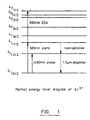
- Shown in figure 1 is a partial energy level diagram of Er 3+ .
- Erbium doped fibre amplifiers utilize the 4 I 13/2 - 4 I 15/2 transition of Er 3+ to obtain amplification at 1.5 ⁇ m.
- Two pumping schemes are available.
- the 980 nm pump promotes the ions to the 4 I 11/2 level, from which they relax nonradiatively to the lasing 4 I 13/2 level.
- direct in-band pumping of the 4 I 13/2 level is possible using a 1480 nm pump. Pumping at 980 nm has several advantages. In-band pumping, as at 1480 nm, gives rise to amplifier noise, and therefore degrades amplifier performance. Moreover, in-band pumping makes the short-wavelength part of the emission spectrum unavailable for amplification.
- the nonradiative 4 I 11/2 - 4 I 13/2 transition must be very fast, i.e. the lifetime of the 4 I 11/2 level must be short compared with the pumping rate. This is important for two reasons. First, in order to maintain population inversion between the lasing levels it is necessary for the upper lasing level ( 4 I 13/2 ) to be rapidly repopulated. In conditions of high-pump high-gain, the 4 I 11/2 state can accumulate population, creating a bottleneck and causing gain saturation. When the lifetime of the 4 I 11/2 level is short this problem is greatly reduced. Second, the presence of pump ESA (excited state absorption) from the 4 I 11/2 level reduces pump efficiency.
- ESA excited state absorption
- ESA depends on the lifetime of the upper level; when the residence time is very short ESA becomes negligible.
- the lifetime of the 4 I 11/2 level is determined by the phonon energy of the host glass: the higher the phonon energy, the shorter the lifetime, in a roughly exponential relationship.
- high-phonon energy glasses such as silica
- low-phonon energy glasses such as ZBLAN
- the 980 nm pump cannot be used due to the long lifetime of the feeding 4 I 11/2 level, and the 1480 nm pumping scheme must be employed instead.
- the modified silica glasses retain the high phonon energy of the silica family.
- the heavy-metal-oxide and fluoroaluminate glasses have lower phonon energies than silica, but higher than ZBLAN; and the lifetime of the 4 I 11/2 level is short enough to allow pumping at 980 nm.
- the emission cross-section and profile of the 4 I 13/2 - 4 I 15/5 transition are strongly influenced by the host glass as disclosed in 'Rare Earth doped Fibre Lasers and Amplifiers' ed MJF Digonnet, Marcel Dekker 1993. There are two major independent effects.
- the value of the emission cross-section increases with the refractive index of the host. This increase reflects the relationship between the oscillator strength and the host field as represented by the refractive index of the bulk glass.
- the second effect modifies the emission profile and arises from the local ligand field environment of the dopant ions.
- the amplifying transition takes place between two energy level manifolds consisting of several Stark sub-levels (4 sub-levels in 4 I 13/4 and 5 sub-levels in 4 I 15/2 ).
- the emission and gain profiles combine the contributions of all the transitions between the sub-levels.
- the profiles are determined by the Stark splitting of the two levels and the oscillator strengths of the individual transitions. Both the Stark splittings and the oscillator strengths are strongly affected by the ligand field of the ion environment.
- the ligand field is the local electromagnetic field as experienced by the dopant ion, and determined by the symmetry and the chemical nature of the host material.
- the emission and gain profiles of an Er 3+ ion will therefore depend on the ligand field at the ion site.
- Asymmetric ionic ligand fields produce especially strong broadening effects. If the host glass offers a multiplicity of different dopant sites with different ligand fields, the ions at these sites will emit slightly different spectra. The total Er 3+ emission in the glasses according to the invention combine the contributions of all ions from different sites, and will therefore produce a broader, smoother emission profile.
- the role of network modifiers in:the erbium doped glasses according to the invention is to break up the uniform host glass network and to create numerous different sites for the Er 3+ dopant.
- the network modifiers are chosen so as to achieve two aims. Heavy-metal-oxides/fluorides are employed to increase the refractive index, thereby increasing the emission cross-section.
- All network modifiers are designed to provide new strongly-bonded ionic sites for the erbium dopant. Ionic bonding is associated with ionicity of ligand fields, and therefore broader emission spectrum. Furthermore, strong ionic bonding leads to increased solubility, thereby allowing higher erbium doping levels.
- the erbium doped optical glasses of the invention provide a multiplicity of different erbium dopant sites. The erbium ions of these sites experience different ligand fields and so will emit slightly different spectra. The total Er 3+ emission spectrum in these glasses will be a combination of contributions from all Er 3+ ions from different sites, and will therefore produce a broad, smooth emission profile.
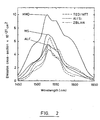
- Figure 2 shows emission cross section spectra of erbium in several glasses. Modified silica(MS), heavy metal oxide (HMO) and Fluoroaluminate (ALF) glasses as shown by solid lines. Dashed lines represent the industry bench mark glasses. Although the emission spectrum differs significantly from the gain profile, broad band emission spectra give rise to a large gain band width. A higher emission cross section reduces the gain threshold and makes broadband gain easier to achieve.
- Modified silica(MS), heavy metal oxide (HMO) and Fluoroaluminate (ALF) glasses as shown by solid lines. Dashed lines represent the industry bench mark glasses.
- Table 1 shows some erbium doped HMO glass compositions of the invention
- Table 2 gives erbium lifetimes, emission cross-sections and the figure-of-merit product in these glasses.
- Fluorozirconate ZBLAN glass is included for comparison.
- Also included is a tellurite glass developed by NTT as disclosed in A Mori et al, OFC 1997, paper PD1-1.
- All glasses were prepared from commercial high purity powders and were melted under clean conditions in platinum crucibles. Modified silica glasses were melted at 1150°C-1350°C and were annealed in the crucible at 400°C. HMO glasses were melted at 650-750°C and were annealed in the crucible at 200-250°C.
- Fluoroaluminate glasses were melted at 950°-1000°C under dry nitrogen atmosphere, and were cast into preheated moulds at 280°-330°C.
- the melting temperature and duration are such as to allow a thorough homogenization of the glass, while avoiding losses due to volatilization.
- the annealing stage is designed to remove quenching stresses and to prevent glass cracking.
- High purity raw materials are required to avoid OH - and transition metal impurities in the produced glass.
- Some example compositions of Er 3+ -doped HMO glasses Glass Composition ONO1 50GeO 2 :20PbO:14Ga 2 O 3 :15Bi 2 O 3 : 1Er 2 O 3 TNO1 42GeO 2 :10TeO 2 :20PbO:12Ga 2 O 3 : 15Bi 2 O 3 :1Er 2 O 3 TNO4 80TeO 2 :19Na 2 O:1Er 2 O 3 TNO541 79TeO 2 :10Na 2 O:9ZnO:2Er 2 O 3 Fl 80.
Landscapes
- Chemical & Material Sciences (AREA)
- Engineering & Computer Science (AREA)
- Materials Engineering (AREA)
- Chemical Kinetics & Catalysis (AREA)
- General Chemical & Material Sciences (AREA)
- Geochemistry & Mineralogy (AREA)
- Life Sciences & Earth Sciences (AREA)
- Organic Chemistry (AREA)
- Physics & Mathematics (AREA)
- Electromagnetism (AREA)
- Optics & Photonics (AREA)
- Plasma & Fusion (AREA)
- Glass Compositions (AREA)
- Lasers (AREA)
- Optical Elements Other Than Lenses (AREA)
Applications Claiming Priority (3)
| Application Number | Priority Date | Filing Date | Title |
|---|---|---|---|
| GB9805800 | 1998-03-19 | ||
| GBGB9805800.1A GB9805800D0 (en) | 1998-03-19 | 1998-03-19 | Erbium doped optical glass |
| PCT/GB1999/000726 WO1999047464A2 (en) | 1998-03-19 | 1999-03-19 | Erbium doped optical glass |
Publications (2)
| Publication Number | Publication Date |
|---|---|
| EP1064234A2 EP1064234A2 (en) | 2001-01-03 |
| EP1064234B1 true EP1064234B1 (en) | 2005-05-25 |
Family
ID=10828816
Family Applications (1)
| Application Number | Title | Priority Date | Filing Date |
|---|---|---|---|
| EP99910477A Expired - Lifetime EP1064234B1 (en) | 1998-03-19 | 1999-03-19 | Erbium doped optical glass |
Country Status (8)
| Country | Link |
|---|---|
| EP (1) | EP1064234B1 (enExample) |
| JP (2) | JP2002506791A (enExample) |
| AT (1) | ATE296270T1 (enExample) |
| AU (1) | AU2941999A (enExample) |
| CA (1) | CA2324321C (enExample) |
| DE (1) | DE69925470T2 (enExample) |
| GB (1) | GB9805800D0 (enExample) |
| WO (1) | WO1999047464A2 (enExample) |
Families Citing this family (5)
| Publication number | Priority date | Publication date | Assignee | Title |
|---|---|---|---|---|
| DE10139904A1 (de) * | 2001-08-15 | 2003-02-27 | Univ Schiller Jena | Optische Telluritgläser für Lichtwellenleiterverstärker und Oszillatoren sowie Verfahren zu ihrer Herstellung |
| JP4671263B2 (ja) * | 2001-09-10 | 2011-04-13 | ショット アクチエンゲゼルシャフト | 酸化ゲルマニウムを含有する酸化ビスマスガラス |
| JP4621456B2 (ja) * | 2004-08-27 | 2011-01-26 | 学校法人トヨタ学園 | 光機能導波路材料および光増幅媒体、光増幅器、レーザ装置、光源 |
| DE102013226636A1 (de) | 2013-12-19 | 2015-06-25 | Friedrich-Schiller-Universität Jena | Glaszusammensetzung, Bauelement und Verfahren zur Herstellung eines Bauelements |
| CN111370983B (zh) * | 2020-03-19 | 2022-03-08 | 吉林大学 | 一种掺铒氟化铟基玻璃光纤在实现3.3μm波段激光输出方面的应用 |
Family Cites Families (8)
| Publication number | Priority date | Publication date | Assignee | Title |
|---|---|---|---|---|
| DE2500317A1 (de) * | 1974-01-17 | 1975-07-24 | South African Inventions | Photochromes glas |
| WO1991011401A1 (en) * | 1990-02-05 | 1991-08-08 | The Furukawa Electric Co., Ltd. | Quartz glass doped with rare earth element and production thereof |
| JP3145136B2 (ja) * | 1991-01-18 | 2001-03-12 | 株式会社住田光学ガラス | 赤外線透過フッ化物ガラス |
| JP3411067B2 (ja) * | 1993-08-27 | 2003-05-26 | 株式会社住田光学ガラス | 波長上方変換透明化ガラスセラミックスおよびその製造方法 |
| US5475528A (en) * | 1994-03-25 | 1995-12-12 | Corning Incorporated | Optical signal amplifier glasses |
| CA2201576A1 (en) * | 1996-04-17 | 1997-10-17 | James Edward Dickinson, Jr. | Rare earth doped oxyhalide laser glass |
| US5955388A (en) * | 1997-01-02 | 1999-09-21 | Corning Incorporated | Transparent oxyflouride glass-ceramic composition and process of making |
| DE69825640T2 (de) * | 1997-02-14 | 2005-08-04 | Nippon Telegraph And Telephone Corp. | Tellurit-Glas, optischer Verstärker und Lichtquelle |
-
1998
- 1998-03-19 GB GBGB9805800.1A patent/GB9805800D0/en not_active Ceased
-
1999
- 1999-03-19 JP JP2000536663A patent/JP2002506791A/ja active Pending
- 1999-03-19 DE DE69925470T patent/DE69925470T2/de not_active Expired - Lifetime
- 1999-03-19 CA CA2324321A patent/CA2324321C/en not_active Expired - Fee Related
- 1999-03-19 AT AT99910477T patent/ATE296270T1/de not_active IP Right Cessation
- 1999-03-19 AU AU29419/99A patent/AU2941999A/en not_active Abandoned
- 1999-03-19 EP EP99910477A patent/EP1064234B1/en not_active Expired - Lifetime
- 1999-03-19 WO PCT/GB1999/000726 patent/WO1999047464A2/en not_active Ceased
-
2010
- 2010-07-28 JP JP2010169388A patent/JP5309096B2/ja not_active Expired - Fee Related
Also Published As
| Publication number | Publication date |
|---|---|
| GB9805800D0 (en) | 1998-05-13 |
| EP1064234A2 (en) | 2001-01-03 |
| WO1999047464A2 (en) | 1999-09-23 |
| CA2324321C (en) | 2010-06-15 |
| CA2324321A1 (en) | 1999-09-23 |
| ATE296270T1 (de) | 2005-06-15 |
| JP5309096B2 (ja) | 2013-10-09 |
| DE69925470T2 (de) | 2006-02-02 |
| AU2941999A (en) | 1999-10-11 |
| JP2010260790A (ja) | 2010-11-18 |
| JP2002506791A (ja) | 2002-03-05 |
| WO1999047464A3 (en) | 1999-11-04 |
| DE69925470D1 (de) | 2005-06-30 |
Similar Documents
| Publication | Publication Date | Title |
|---|---|---|
| Tanabe et al. | Broad-band 1.5 μm emission of Er3+ ions in bismuth-based oxide glasses for potential WDM amplifier | |
| Shen et al. | Tellurite glasses for broadband amplifiers and integrated optics | |
| Viswanath et al. | Near-infrared and upconversion luminescence of Tm3+ and Tm3+/Yb3+-doped oxyfluorosilicate glasses | |
| Feng et al. | Hydroxyl groups in erbium-doped germanotellurite glasses | |
| US6599852B2 (en) | Optical amplifying glass | |
| US6503860B1 (en) | Antimony oxide glass with optical activity | |
| US6589895B2 (en) | Thulium-doped germanate glass composition and device for optical amplification | |
| US6413891B1 (en) | Glass material suitable for a waveguide of an optical amplifier | |
| Shen et al. | Compositional effects and spectroscopy of rare earths (Er 3+, Tm 3+, and Nd 3+) in tellurite glasses | |
| US6410467B1 (en) | Antimony oxide glass with optical activity | |
| US6515795B1 (en) | Borosilicate cladding glasses for germanate core thulium-doped amplifiers | |
| JP4773948B2 (ja) | 酸化ビスマスガラスおよびそれを製造するプロセス | |
| Chen et al. | Novel Er-doped PbO and B2O3 based glasses: investigation of quantum efficiency and non-radiative transition probability for 1.5 μm broadband emission fluorescence | |
| Pisarski et al. | Enhanced mid-IR luminescence of Er3+ ions at 2.7 μm in TiO2-GeO2-BaO-Ga2O3 glasses | |
| Zhou et al. | Improvement of 1.53 μm emission and energy transfer of Yb3+/Er3+ co-doped tellurite glass and fiber | |
| JP5309096B2 (ja) | エルビウム添加光学ガラス | |
| US6821917B2 (en) | Tellurite glass and applications thereof | |
| Cho et al. | Improvement of 4I11/2→ 4I13/2 Transition Rate and Thermal Stabilities in Er3+‐Doped TeO2‐B2O3 (GeO2)‐ZnO‐K2O Glasses | |
| US20020041750A1 (en) | Rare earth element-doped, Bi-Sb-Al-Si glass and its use in optical amplifiers | |
| US6344425B1 (en) | Fluorotellurite, amplifier glasses | |
| JP4862233B2 (ja) | 光増幅ガラス | |
| US6797657B2 (en) | Tm-doped fluorophosphate glasses for 14xx amplifiers and lasers | |
| WO2001001529A1 (en) | A wide band optical amplifier | |
| US6916753B2 (en) | Tm3+-doped silicate glass and the use thereof | |
| Naftaly et al. | Spectroscopic properties of Nd3+ in fluoroaluminate glasses for an efficient 1.3 μm optical amplifier |
Legal Events
| Date | Code | Title | Description |
|---|---|---|---|
| PUAI | Public reference made under article 153(3) epc to a published international application that has entered the european phase |
Free format text: ORIGINAL CODE: 0009012 |
|
| 17P | Request for examination filed |
Effective date: 20000907 |
|
| AK | Designated contracting states |
Kind code of ref document: A2 Designated state(s): AT BE CH CY DE DK ES FI FR GB GR IE IT LI LU MC NL PT SE |
|
| 17Q | First examination report despatched |
Effective date: 20010131 |
|
| GRAP | Despatch of communication of intention to grant a patent |
Free format text: ORIGINAL CODE: EPIDOSNIGR1 |
|
| GRAS | Grant fee paid |
Free format text: ORIGINAL CODE: EPIDOSNIGR3 |
|
| GRAA | (expected) grant |
Free format text: ORIGINAL CODE: 0009210 |
|
| AK | Designated contracting states |
Kind code of ref document: B1 Designated state(s): AT BE CH CY DE DK ES FI FR GB GR IE IT LI LU MC NL PT SE |
|
| PG25 | Lapsed in a contracting state [announced via postgrant information from national office to epo] |
Ref country code: NL Free format text: LAPSE BECAUSE OF FAILURE TO SUBMIT A TRANSLATION OF THE DESCRIPTION OR TO PAY THE FEE WITHIN THE PRESCRIBED TIME-LIMIT Effective date: 20050525 Ref country code: LI Free format text: LAPSE BECAUSE OF FAILURE TO SUBMIT A TRANSLATION OF THE DESCRIPTION OR TO PAY THE FEE WITHIN THE PRESCRIBED TIME-LIMIT Effective date: 20050525 Ref country code: IT Free format text: LAPSE BECAUSE OF FAILURE TO SUBMIT A TRANSLATION OF THE DESCRIPTION OR TO PAY THE FEE WITHIN THE PRE;WARNING: LAPSES OF ITALIAN PATENTS WITH EFFECTIVE DATE BEFORE 2007 MAY HAVE OCCURRED AT ANY TIME BEFORE 2007. THE CORRECT EFFECTIVE DATE MAY BE DIFFERENT FROM THE ONE RECORDED.SCRIBED TIME-LIMIT Effective date: 20050525 Ref country code: FI Free format text: LAPSE BECAUSE OF FAILURE TO SUBMIT A TRANSLATION OF THE DESCRIPTION OR TO PAY THE FEE WITHIN THE PRESCRIBED TIME-LIMIT Effective date: 20050525 Ref country code: CH Free format text: LAPSE BECAUSE OF FAILURE TO SUBMIT A TRANSLATION OF THE DESCRIPTION OR TO PAY THE FEE WITHIN THE PRESCRIBED TIME-LIMIT Effective date: 20050525 Ref country code: BE Free format text: LAPSE BECAUSE OF FAILURE TO SUBMIT A TRANSLATION OF THE DESCRIPTION OR TO PAY THE FEE WITHIN THE PRESCRIBED TIME-LIMIT Effective date: 20050525 Ref country code: AT Free format text: LAPSE BECAUSE OF FAILURE TO SUBMIT A TRANSLATION OF THE DESCRIPTION OR TO PAY THE FEE WITHIN THE PRESCRIBED TIME-LIMIT Effective date: 20050525 |
|
| REG | Reference to a national code |
Ref country code: GB Ref legal event code: FG4D |
|
| REG | Reference to a national code |
Ref country code: CH Ref legal event code: EP |
|
| REG | Reference to a national code |
Ref country code: IE Ref legal event code: FG4D |
|
| REF | Corresponds to: |
Ref document number: 69925470 Country of ref document: DE Date of ref document: 20050630 Kind code of ref document: P |
|
| PG25 | Lapsed in a contracting state [announced via postgrant information from national office to epo] |
Ref country code: SE Free format text: LAPSE BECAUSE OF FAILURE TO SUBMIT A TRANSLATION OF THE DESCRIPTION OR TO PAY THE FEE WITHIN THE PRESCRIBED TIME-LIMIT Effective date: 20050825 Ref country code: GR Free format text: LAPSE BECAUSE OF FAILURE TO SUBMIT A TRANSLATION OF THE DESCRIPTION OR TO PAY THE FEE WITHIN THE PRESCRIBED TIME-LIMIT Effective date: 20050825 Ref country code: DK Free format text: LAPSE BECAUSE OF FAILURE TO SUBMIT A TRANSLATION OF THE DESCRIPTION OR TO PAY THE FEE WITHIN THE PRESCRIBED TIME-LIMIT Effective date: 20050825 |
|
| PG25 | Lapsed in a contracting state [announced via postgrant information from national office to epo] |
Ref country code: ES Free format text: LAPSE BECAUSE OF FAILURE TO SUBMIT A TRANSLATION OF THE DESCRIPTION OR TO PAY THE FEE WITHIN THE PRESCRIBED TIME-LIMIT Effective date: 20050905 |
|
| PG25 | Lapsed in a contracting state [announced via postgrant information from national office to epo] |
Ref country code: PT Free format text: LAPSE BECAUSE OF FAILURE TO SUBMIT A TRANSLATION OF THE DESCRIPTION OR TO PAY THE FEE WITHIN THE PRESCRIBED TIME-LIMIT Effective date: 20051027 |
|
| REG | Reference to a national code |
Ref country code: CH Ref legal event code: PL |
|
| NLV1 | Nl: lapsed or annulled due to failure to fulfill the requirements of art. 29p and 29m of the patents act | ||
| PG25 | Lapsed in a contracting state [announced via postgrant information from national office to epo] |
Ref country code: IE Free format text: LAPSE BECAUSE OF NON-PAYMENT OF DUE FEES Effective date: 20060320 |
|
| PG25 | Lapsed in a contracting state [announced via postgrant information from national office to epo] |
Ref country code: MC Free format text: LAPSE BECAUSE OF NON-PAYMENT OF DUE FEES Effective date: 20060331 Ref country code: LU Free format text: LAPSE BECAUSE OF NON-PAYMENT OF DUE FEES Effective date: 20060331 |
|
| PLBE | No opposition filed within time limit |
Free format text: ORIGINAL CODE: 0009261 |
|
| STAA | Information on the status of an ep patent application or granted ep patent |
Free format text: STATUS: NO OPPOSITION FILED WITHIN TIME LIMIT |
|
| ET | Fr: translation filed | ||
| 26N | No opposition filed |
Effective date: 20060228 |
|
| REG | Reference to a national code |
Ref country code: IE Ref legal event code: MM4A |
|
| PG25 | Lapsed in a contracting state [announced via postgrant information from national office to epo] |
Ref country code: CY Free format text: LAPSE BECAUSE OF FAILURE TO SUBMIT A TRANSLATION OF THE DESCRIPTION OR TO PAY THE FEE WITHIN THE PRESCRIBED TIME-LIMIT Effective date: 20050525 |
|
| REG | Reference to a national code |
Ref country code: FR Ref legal event code: PLFP Year of fee payment: 18 |
|
| PGFP | Annual fee paid to national office [announced via postgrant information from national office to epo] |
Ref country code: GB Payment date: 20160317 Year of fee payment: 18 Ref country code: FR Payment date: 20160321 Year of fee payment: 18 |
|
| PGFP | Annual fee paid to national office [announced via postgrant information from national office to epo] |
Ref country code: DE Payment date: 20160330 Year of fee payment: 18 |
|
| REG | Reference to a national code |
Ref country code: DE Ref legal event code: R119 Ref document number: 69925470 Country of ref document: DE |
|
| GBPC | Gb: european patent ceased through non-payment of renewal fee |
Effective date: 20170319 |
|
| REG | Reference to a national code |
Ref country code: FR Ref legal event code: ST Effective date: 20171130 |
|
| PG25 | Lapsed in a contracting state [announced via postgrant information from national office to epo] |
Ref country code: FR Free format text: LAPSE BECAUSE OF NON-PAYMENT OF DUE FEES Effective date: 20170331 Ref country code: DE Free format text: LAPSE BECAUSE OF NON-PAYMENT OF DUE FEES Effective date: 20171003 |
|
| PG25 | Lapsed in a contracting state [announced via postgrant information from national office to epo] |
Ref country code: GB Free format text: LAPSE BECAUSE OF NON-PAYMENT OF DUE FEES Effective date: 20170319 |