EP1062669B1 - Method of producing carbon with electrically active sites - Google Patents
Method of producing carbon with electrically active sites Download PDFInfo
- Publication number
- EP1062669B1 EP1062669B1 EP99939856A EP99939856A EP1062669B1 EP 1062669 B1 EP1062669 B1 EP 1062669B1 EP 99939856 A EP99939856 A EP 99939856A EP 99939856 A EP99939856 A EP 99939856A EP 1062669 B1 EP1062669 B1 EP 1062669B1
- Authority
- EP
- European Patent Office
- Prior art keywords
- irradiation
- energy
- mev
- carbon
- diamond
- Prior art date
- Legal status (The legal status is an assumption and is not a legal conclusion. Google has not performed a legal analysis and makes no representation as to the accuracy of the status listed.)
- Expired - Lifetime
Links
Images
Classifications
-
- G—PHYSICS
- G21—NUCLEAR PHYSICS; NUCLEAR ENGINEERING
- G21G—CONVERSION OF CHEMICAL ELEMENTS; RADIOACTIVE SOURCES
- G21G1/00—Arrangements for converting chemical elements by electromagnetic radiation, corpuscular radiation or particle bombardment, e.g. producing radioactive isotopes
- G21G1/04—Arrangements for converting chemical elements by electromagnetic radiation, corpuscular radiation or particle bombardment, e.g. producing radioactive isotopes outside nuclear reactors or particle accelerators
- G21G1/12—Arrangements for converting chemical elements by electromagnetic radiation, corpuscular radiation or particle bombardment, e.g. producing radioactive isotopes outside nuclear reactors or particle accelerators by electromagnetic irradiation, e.g. with gamma or X-rays
-
- Y—GENERAL TAGGING OF NEW TECHNOLOGICAL DEVELOPMENTS; GENERAL TAGGING OF CROSS-SECTIONAL TECHNOLOGIES SPANNING OVER SEVERAL SECTIONS OF THE IPC; TECHNICAL SUBJECTS COVERED BY FORMER USPC CROSS-REFERENCE ART COLLECTIONS [XRACs] AND DIGESTS
- Y10—TECHNICAL SUBJECTS COVERED BY FORMER USPC
- Y10S—TECHNICAL SUBJECTS COVERED BY FORMER USPC CROSS-REFERENCE ART COLLECTIONS [XRACs] AND DIGESTS
- Y10S977/00—Nanotechnology
- Y10S977/84—Manufacture, treatment, or detection of nanostructure
- Y10S977/901—Manufacture, treatment, or detection of nanostructure having step or means utilizing electromagnetic property, e.g. optical, x-ray, electron beamm
Definitions
- This invention relates to a method of producing carbon with electrically active sites.
- Diamond is well-appreciated as an excellent electrical insulator. However, a rare class of diamond is found in nature, codified as Type IIb, which has p-type semiconducting properties. Research by one of the inventors (Ref. Sellschop JPF et al, Int J of App Rad and Isot. 28(1977)277) demonstrated that this was due to the presence of boron in the diamond.
- Type IIb diamonds are extremely rare in nature, but have been produced synthetically both in high pressure, high temperature growth (HPHT), and in chemical vapour deposition (CVD) growth, by the addition of boron to the synthesis mix.
- ion implantation is normally automatically considered as having a geometry where the accelerated ion beam addresses the sample through a flat surface. It cannot handle samples of random and various shapes in a sensible way.
- a method of producing carbon with electrically active boron sites includes the steps of providing a source of carbon and exposing that source to irradiation of an energy suitable to cause the photonuclear transmutation of some of the carbon atoms into boron, the source of carbon being diamond or diamond-like material.
- the carbon source is diamond or diamond-like materials.
- the invention provides a method of producing a population of electrically active sites, some of which will be substitutional when the carbon has a crystalline structure, by the homogeneous photonuclear transmutation of some of the carbon atoms into boron.
- the transmutation may be assisted and enhanced if appropriate by one or more of a selection of annealing regimes: thermal heating and/or electron beam heating or any other form of specimen-specific heating, either post-irradiation or during irradiation; laser irradiation again either post irradiation or during irradiation, assisted if necessary simultaneously by thermal or electron beam heating; laser illumination at specifically selected wavelengths and/or of wavelength bands, again either post-irradiation or during irradiation or both, assisted if necessary by sample heating of thermal or electron beam origin or other means: including the concept of resonant effects in the annealing process including specifically resonant laser annealing at room or elevated temperatures, including also specifically combinations of temperature protocols such as low temperature irradiation followed by rapid thermal annealing.
- the invention has particular application to the controlled and homogeneous doping of diamonds of all types, shapes and sizes, single crystal and polycrystalline, natural and synthetic.
- the synthetic diamond may be produced by high pressure/high temperature growth or chemical vapour deposition.
- the irradiation will preferably be achieved using photons, and particularly gamma rays, but may also be achieved by using other irradiation sources such as electrons.
- radiation damage is caused, for example by an energetic proton or neutron and a recoiling boron being produced, such damage may be reduced by use of one or other of the annealing methods described above.
- Photons have a high penetrating power as compared with all other typical radiations, hence lending themselves to an extremely high degree of homogeneity in any effects which they produce.
- the energy of the radiation is chosen so that the desired photonuclear reaction leading to the formation of boron is achieved.
- the minimum energy of the radiation necessary to achieve a particular photonuclear reaction will vary according to the specific energetics of the reaction. Examples are provided hereinafter.
- the energy of the radiation will be in the range 16 MeV to 32 MeV.
- the energy of the radiation is chosen to excite the giant dipole resonance (GDR) which leads to an enhancement of the boron production rate.
- GDR giant dipole resonance
- the GDR is a broad resonance and bremsstrahlung can be produced by means of an electron accelerator such that the endpoint energy of the bremsstrahlung spectrum is above the region of the GDR providing thereby photons in the relevant energy range to excite the GDR.
- Certain advantages may be achieved by the use of monoenergetic (monochromatic) photons of selected energy, or by a defined window of photon energies of chosen energy width and median energy.
- the photonuclear reaction can be employed to effect the transmutation of carbon atoms to boron atoms with complete control of the number of boron atoms produced. Doping concentrations of a few parts of boron per million carbon atoms, can be achieved with the ability of producing smaller or larger dopant concentrations.
- both the ( ⁇ ,p) and ( ⁇ ,n) channels for carbon-12 are closed.
- a photon energy of 16 MeV it is above threshold for the 12 C ( ⁇ ,p) 11 B reaction so that the channel is open, while it is still below threshold for the 12 C ( ⁇ ,n) 11 C reaction so that this channel is still closed to production.
- GDR giant dipole resonance
- the threshold energies for the photonuclear reactions described above are: Reaction (1) 15,957 MeV Reaction (2) 18,722 MeV Reaction (3) 17,533 MeV Reaction (4) 4,947 MeV Reaction (5) 25,187 MeV Reaction (6) 27,412 MeV Reaction (7) 31,806 MeV Reaction (8) 27,370 MeV Reaction (9) 26,281 MeV Reaction (10) 7,370 MeV Reaction (11) 27,222 MeV Reaction (12) 24,6 MeV
- Monochromatic photons or photons in an energy window of finite width and selected median energy, and this may be used to advantage.
- One such situation would be to reduce the radiation damage to the carbon crystal by using only photons with energy in the GDR region, in other words eliminating photons that contribute only in a small way to the chosen photonuclear yield, but which nevertheless contribute to the radiation damage.
- Diamond can contain elemental defects, the most common of which are hydrogen, nitrogen and oxygen. While hydrogen plays a role of singular importance in the growth of diamond and in the properties of diamond, it plays no ostensible role in the sense of photonuclear transmutation reactions, other than in the case of the minor isotope of hydrogen (deuterium).
- the major elemental defects that are characteristic of diamond, namely the light volatiles hydrogen, nitrogen and oxygen do not present any problems in the transmutation doping of carbon by photonuclear reactions.
- the other characteristic defects in diamond viz, structural defects, have no specific interactions with incident photons.
- the boron production in diamond through photonuclear reactions specifically in the GDR region may be quantified. This aspect can be divided into well-defined stages:
- the selection of incident electron energy is influenced by the need for enhanced yield in the GDR region which suggests going to higher electron energies but this has as a consequence a greater flux of photons that do not contribute to the GDR and which contribute to the photonuclear cross section in only a minor way consistent with the small non-GDR cross section, but which add unnecessarily to the radiation damage.
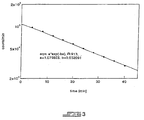
- Measurements have been made on two electron microtron accelerators at electron energies of 30, 40, 50 and 100 MeV. At each of these energies unambiguous 20 minute halflife activity (e.g. see Figure 3) was detected in two-photon positron annihilation signals, corresponding uniquely to the decay of carbon-11 which had been produced in the reaction 12 C( ⁇ ,n) 11 C. This is clear proof of boron production.
- the photon flux as assessed from such measurements is consistent with the calculated flux.
- a typical flux as determined for the case of 100 MeV incident electrons was 0,3 x 10 10 photons/cm 2 /sec.
- the actual number of atoms of the nuclide B formed can be independently determined.
- the invention provides a number of advantages over known methods of producing diamond, with dopants in electrically active sites. Some of these advantages and preferred ways of carrying out the invention are set out hereinafter:
- Semi-conducting diamond produced by the method of the invention has particular application in the field of detectors.
- the invention brings to this situation the ample provision of p-type doping of diamond, in single crystal and polycrystalline form, of diamond-like carbon and of both natural and synthetic man-made diamond (produced both by high pressure high temperature and by CVD techniques), all readily available through the photonuclear transmutation of carbon to boron, exploiting the high yield of the giant dipole resonance.
- thick or thin target bremsstrahlung can simply be used, in other cases monochromatic photons are better deployed, and in yet other circumstances a band of photon energies is best used.
- Patterns of boronation can be produced for special applications of detectors or devices in general, either through collimation or through the use of micron-diameter electron/positron beams, with writing capability.
- Very thin diamond films, boron doped and surface treated by the method of the invention, would make much superior positron thermalising moderators, and also low energy electron / positron "start" detectors.
Landscapes
- Chemical & Material Sciences (AREA)
- Chemical Kinetics & Catalysis (AREA)
- General Chemical & Material Sciences (AREA)
- Physics & Mathematics (AREA)
- Engineering & Computer Science (AREA)
- General Engineering & Computer Science (AREA)
- High Energy & Nuclear Physics (AREA)
- Crystals, And After-Treatments Of Crystals (AREA)
- Battery Electrode And Active Subsutance (AREA)
- Luminescent Compositions (AREA)
- Carbon And Carbon Compounds (AREA)
Applications Claiming Priority (3)
| Application Number | Priority Date | Filing Date | Title |
|---|---|---|---|
| ZA9802242 | 1998-03-17 | ||
| ZA982242 | 1998-03-17 | ||
| PCT/IB1999/000425 WO1999048107A1 (en) | 1998-03-17 | 1999-03-16 | Method of producing carbon with electrically active sites |
Publications (2)
| Publication Number | Publication Date |
|---|---|
| EP1062669A1 EP1062669A1 (en) | 2000-12-27 |
| EP1062669B1 true EP1062669B1 (en) | 2003-12-17 |
Family
ID=25586903
Family Applications (1)
| Application Number | Title | Priority Date | Filing Date |
|---|---|---|---|
| EP99939856A Expired - Lifetime EP1062669B1 (en) | 1998-03-17 | 1999-03-16 | Method of producing carbon with electrically active sites |
Country Status (7)
| Country | Link |
|---|---|
| US (1) | US6563123B1 (enExample) |
| EP (1) | EP1062669B1 (enExample) |
| JP (1) | JP4436968B2 (enExample) |
| AT (1) | ATE256911T1 (enExample) |
| AU (1) | AU3268199A (enExample) |
| DE (1) | DE69913668T2 (enExample) |
| WO (1) | WO1999048107A1 (enExample) |
Families Citing this family (8)
| Publication number | Priority date | Publication date | Assignee | Title |
|---|---|---|---|---|
| JP3854072B2 (ja) * | 2001-01-11 | 2006-12-06 | 独立行政法人科学技術振興機構 | 半導体基板への不純物ドーピング方法及びそれによって製造される半導体基板 |
| US8466044B2 (en) * | 2008-08-07 | 2013-06-18 | Sandisk 3D Llc | Memory cell that includes a carbon-based memory element and methods forming the same |
| CN102939261B (zh) | 2010-06-03 | 2015-09-23 | 六号元素有限公司 | 金刚石工具 |
| JP6429451B2 (ja) * | 2013-11-20 | 2018-11-28 | 株式会社日立製作所 | 放射性核種製造システムおよび放射性核種製造方法 |
| JP6602530B2 (ja) * | 2014-07-25 | 2019-11-06 | 株式会社日立製作所 | 放射性核種製造方法及び放射性核種製造装置 |
| WO2017115430A1 (ja) * | 2015-12-28 | 2017-07-06 | 公立大学法人兵庫県立大学 | 放射性廃棄物の処理方法 |
| NL2021956B1 (en) * | 2018-11-08 | 2020-05-15 | Univ Johannesburg | Method and system for high speed detection of diamonds |
| WO2023228702A1 (ja) * | 2022-05-26 | 2023-11-30 | 克弥 西沢 | 導線、伝送装置、宇宙太陽光エネルギー輸送方法 |
Family Cites Families (6)
| Publication number | Priority date | Publication date | Assignee | Title |
|---|---|---|---|---|
| BE537440A (enExample) * | 1954-04-19 | |||
| GB8604583D0 (en) * | 1986-02-25 | 1986-04-03 | Atomic Energy Authority Uk | Photonuclear doping of semiconductors |
| US4749869A (en) * | 1986-05-14 | 1988-06-07 | Anil Dholakia | Process for irradiating topaz and the product resulting therefrom |
| US5084909A (en) * | 1990-03-23 | 1992-01-28 | Pollak Richard D | Method of processing gemstones to enhance their color |
| GB9021689D0 (en) | 1990-10-05 | 1990-11-21 | De Beers Ind Diamond | Diamond neutron detector |
| EP1097107B1 (en) * | 1998-06-24 | 2006-03-01 | Jacques Pierre Friedrich Sellschop | A method of altering the colour of a material |
-
1999
- 1999-03-16 EP EP99939856A patent/EP1062669B1/en not_active Expired - Lifetime
- 1999-03-16 AT AT99939856T patent/ATE256911T1/de not_active IP Right Cessation
- 1999-03-16 US US09/646,359 patent/US6563123B1/en not_active Expired - Fee Related
- 1999-03-16 AU AU32681/99A patent/AU3268199A/en not_active Abandoned
- 1999-03-16 JP JP2000537223A patent/JP4436968B2/ja not_active Expired - Fee Related
- 1999-03-16 DE DE1999613668 patent/DE69913668T2/de not_active Expired - Lifetime
- 1999-03-16 WO PCT/IB1999/000425 patent/WO1999048107A1/en not_active Ceased
Also Published As
| Publication number | Publication date |
|---|---|
| JP2002507732A (ja) | 2002-03-12 |
| WO1999048107A1 (en) | 1999-09-23 |
| DE69913668D1 (de) | 2004-01-29 |
| EP1062669A1 (en) | 2000-12-27 |
| DE69913668T2 (de) | 2005-01-13 |
| US6563123B1 (en) | 2003-05-13 |
| AU3268199A (en) | 1999-10-11 |
| JP4436968B2 (ja) | 2010-03-24 |
| ATE256911T1 (de) | 2004-01-15 |
Similar Documents
| Publication | Publication Date | Title |
|---|---|---|
| Nair et al. | Photoactivation experiment on Au 197 and its implications for the dipole strength in heavy nuclei | |
| US6563123B1 (en) | Method of producing carbon with electrically active sites | |
| Carroll et al. | Accelerated decay of Ta-180 (m) and Lu-176 in stellar interiors through gamma, gamma-prime reactions | |
| Mazur et al. | Excitation of the 119 Te m, 121 Te m, 123 Te m, 127 Te m, and 129 Te m isomers in (γ, n) reactions from 10 to 22 MeV | |
| Abov et al. | Parity violation in nuclear interactions | |
| Limata et al. | New measurement of 7Be half-life in different metallic environments | |
| EP3921674B1 (en) | Inhomogeneous transmutation detector and the method of its evaluation | |
| Chillery | Underground study at LUNA of proton-induced reactions on 6Li at astrophysical energies | |
| Kumar et al. | Development of time differential perturbed angular correlation spectroscopy for application in material sciences | |
| Karamian et al. | Production of isotopes and isomers with irradiation of Z= 47–50 targets by 23-MeV bremsstrahlung | |
| Karamian | Comparative analysis of the 178 m 2Hf yield at reactions with different projectiles | |
| Cvetinović et al. | Precise measurement of the half-life of 61Cu | |
| Weber et al. | Towards a determination of absolute cross sections for projectile excitation of hydrogen‐like uranium in collisions with neutral atoms | |
| Rubio et al. | Total absorption spectroscopy | |
| Kamal | Radioactivity | |
| Karamyan et al. | Formation of the high-spin 179m2Hf isomer in reactor irradiations | |
| Lee et al. | A Physics Study on Photoproduction of Tc-99m Using the NRF Phenomenon | |
| Karamyan | 178m2Hf and other isomers candidates for the decay stimulated by x-ray photons | |
| Lipson et al. | Possibility of mechanically stimulated transmutation of carbon nuclei in ultradisperse deuterium-containing media | |
| Abazov et al. | The probability of the reaction (π-, p) and the existence of Δ-isobars in the atomic nucleus | |
| Gurevich et al. | Angular distributions of α particles emitted by oriented nuclei and their relation to nuclear deformation | |
| Bartholomew et al. | Some advanced research uses of Canadian reactors and accelerators | |
| Skopec | Mixed-radiation discrimination using thermoluminescent dosimeters | |
| Bauer et al. | Spectrometry for spin and shape isomer identification | |
| Misaelides | Quantitative Determination of Light Elements in Semiconductor Matrices by Charged Particle Activation Analysis |
Legal Events
| Date | Code | Title | Description |
|---|---|---|---|
| PUAI | Public reference made under article 153(3) epc to a published international application that has entered the european phase |
Free format text: ORIGINAL CODE: 0009012 |
|
| 17P | Request for examination filed |
Effective date: 20001017 |
|
| AK | Designated contracting states |
Kind code of ref document: A1 Designated state(s): CH DE FR GB IT LI NL SE |
|
| 17Q | First examination report despatched |
Effective date: 20010521 |
|
| GRAH | Despatch of communication of intention to grant a patent |
Free format text: ORIGINAL CODE: EPIDOS IGRA |
|
| RBV | Designated contracting states (corrected) |
Designated state(s): AT CH DE FR GB IT LI NL SE |
|
| GRAS | Grant fee paid |
Free format text: ORIGINAL CODE: EPIDOSNIGR3 |
|
| GRAA | (expected) grant |
Free format text: ORIGINAL CODE: 0009210 |
|
| AK | Designated contracting states |
Kind code of ref document: B1 Designated state(s): AT CH DE FR GB IT LI NL SE |
|
| PG25 | Lapsed in a contracting state [announced via postgrant information from national office to epo] |
Ref country code: NL Free format text: LAPSE BECAUSE OF FAILURE TO SUBMIT A TRANSLATION OF THE DESCRIPTION OR TO PAY THE FEE WITHIN THE PRESCRIBED TIME-LIMIT Effective date: 20031217 Ref country code: LI Free format text: LAPSE BECAUSE OF FAILURE TO SUBMIT A TRANSLATION OF THE DESCRIPTION OR TO PAY THE FEE WITHIN THE PRESCRIBED TIME-LIMIT Effective date: 20031217 Ref country code: IT Free format text: LAPSE BECAUSE OF FAILURE TO SUBMIT A TRANSLATION OF THE DESCRIPTION OR TO PAY THE FEE WITHIN THE PRESCRIBED TIME-LIMIT;WARNING: LAPSES OF ITALIAN PATENTS WITH EFFECTIVE DATE BEFORE 2007 MAY HAVE OCCURRED AT ANY TIME BEFORE 2007. THE CORRECT EFFECTIVE DATE MAY BE DIFFERENT FROM THE ONE RECORDED. Effective date: 20031217 Ref country code: CH Free format text: LAPSE BECAUSE OF FAILURE TO SUBMIT A TRANSLATION OF THE DESCRIPTION OR TO PAY THE FEE WITHIN THE PRESCRIBED TIME-LIMIT Effective date: 20031217 Ref country code: AT Free format text: LAPSE BECAUSE OF FAILURE TO SUBMIT A TRANSLATION OF THE DESCRIPTION OR TO PAY THE FEE WITHIN THE PRESCRIBED TIME-LIMIT Effective date: 20031217 |
|
| REG | Reference to a national code |
Ref country code: GB Ref legal event code: FG4D |
|
| REG | Reference to a national code |
Ref country code: CH Ref legal event code: EP |
|
| REF | Corresponds to: |
Ref document number: 69913668 Country of ref document: DE Date of ref document: 20040129 Kind code of ref document: P |
|
| PG25 | Lapsed in a contracting state [announced via postgrant information from national office to epo] |
Ref country code: SE Free format text: LAPSE BECAUSE OF FAILURE TO SUBMIT A TRANSLATION OF THE DESCRIPTION OR TO PAY THE FEE WITHIN THE PRESCRIBED TIME-LIMIT Effective date: 20040317 |
|
| REG | Reference to a national code |
Ref country code: GB Ref legal event code: 732E |
|
| NLV1 | Nl: lapsed or annulled due to failure to fulfill the requirements of art. 29p and 29m of the patents act | ||
| REG | Reference to a national code |
Ref country code: CH Ref legal event code: PL |
|
| ET | Fr: translation filed | ||
| PLBE | No opposition filed within time limit |
Free format text: ORIGINAL CODE: 0009261 |
|
| STAA | Information on the status of an ep patent application or granted ep patent |
Free format text: STATUS: NO OPPOSITION FILED WITHIN TIME LIMIT |
|
| 26N | No opposition filed |
Effective date: 20040920 |
|
| REG | Reference to a national code |
Ref country code: FR Ref legal event code: TP |
|
| PGFP | Annual fee paid to national office [announced via postgrant information from national office to epo] |
Ref country code: FR Payment date: 20100324 Year of fee payment: 12 |
|
| PGFP | Annual fee paid to national office [announced via postgrant information from national office to epo] |
Ref country code: DE Payment date: 20100422 Year of fee payment: 12 |
|
| PGFP | Annual fee paid to national office [announced via postgrant information from national office to epo] |
Ref country code: GB Payment date: 20110316 Year of fee payment: 13 |
|
| REG | Reference to a national code |
Ref country code: FR Ref legal event code: ST Effective date: 20111130 |
|
| PG25 | Lapsed in a contracting state [announced via postgrant information from national office to epo] |
Ref country code: DE Free format text: LAPSE BECAUSE OF NON-PAYMENT OF DUE FEES Effective date: 20111001 Ref country code: FR Free format text: LAPSE BECAUSE OF NON-PAYMENT OF DUE FEES Effective date: 20110331 |
|
| REG | Reference to a national code |
Ref country code: DE Ref legal event code: R119 Ref document number: 69913668 Country of ref document: DE Effective date: 20111001 |
|
| GBPC | Gb: european patent ceased through non-payment of renewal fee |
Effective date: 20120316 |
|
| PG25 | Lapsed in a contracting state [announced via postgrant information from national office to epo] |
Ref country code: GB Free format text: LAPSE BECAUSE OF NON-PAYMENT OF DUE FEES Effective date: 20120316 |