EP1058133A2 - Polymerizable composition and process for producing optical resin comprising the same - Google Patents

Polymerizable composition and process for producing optical resin comprising the same Download PDF

Info

Publication number
EP1058133A2
EP1058133A2 EP00304727A EP00304727A EP1058133A2 EP 1058133 A2 EP1058133 A2 EP 1058133A2 EP 00304727 A EP00304727 A EP 00304727A EP 00304727 A EP00304727 A EP 00304727A EP 1058133 A2 EP1058133 A2 EP 1058133A2
Authority
EP
European Patent Office
Prior art keywords
compound
resin
polymerizable composition
bis
group
Prior art date
Legal status (The legal status is an assumption and is not a legal conclusion. Google has not performed a legal analysis and makes no representation as to the accuracy of the status listed.)
Granted
Application number
EP00304727A
Other languages
German (de)
French (fr)
Other versions
EP1058133B1 (en
EP1058133A3 (en
Inventor
Akinori Ryu
Seiichi Kobayashi
Hiroyuki Morijiri
Chitoshi Shimakawa
Koju Okazaki
Yoshinobu Kanemura
Nobuo Kawato
Current Assignee (The listed assignees may be inaccurate. Google has not performed a legal analysis and makes no representation or warranty as to the accuracy of the list.)
Mitsui Chemicals Inc
Original Assignee
Mitsui Chemicals Inc
Priority date (The priority date is an assumption and is not a legal conclusion. Google has not performed a legal analysis and makes no representation as to the accuracy of the date listed.)
Filing date
Publication date
Application filed by Mitsui Chemicals Inc filed Critical Mitsui Chemicals Inc
Publication of EP1058133A2 publication Critical patent/EP1058133A2/en
Publication of EP1058133A3 publication Critical patent/EP1058133A3/en
Application granted granted Critical
Publication of EP1058133B1 publication Critical patent/EP1058133B1/en
Anticipated expiration legal-status Critical
Expired - Lifetime legal-status Critical Current

Links

Classifications

    • CCHEMISTRY; METALLURGY
    • C08ORGANIC MACROMOLECULAR COMPOUNDS; THEIR PREPARATION OR CHEMICAL WORKING-UP; COMPOSITIONS BASED THEREON
    • C08GMACROMOLECULAR COMPOUNDS OBTAINED OTHERWISE THAN BY REACTIONS ONLY INVOLVING UNSATURATED CARBON-TO-CARBON BONDS
    • C08G75/00Macromolecular compounds obtained by reactions forming a linkage containing sulfur with or without nitrogen, oxygen, or carbon in the main chain of the macromolecule
    • CCHEMISTRY; METALLURGY
    • C08ORGANIC MACROMOLECULAR COMPOUNDS; THEIR PREPARATION OR CHEMICAL WORKING-UP; COMPOSITIONS BASED THEREON
    • C08GMACROMOLECULAR COMPOUNDS OBTAINED OTHERWISE THAN BY REACTIONS ONLY INVOLVING UNSATURATED CARBON-TO-CARBON BONDS
    • C08G75/00Macromolecular compounds obtained by reactions forming a linkage containing sulfur with or without nitrogen, oxygen, or carbon in the main chain of the macromolecule
    • C08G75/02Polythioethers
    • C08G75/06Polythioethers from cyclic thioethers
    • C08G75/08Polythioethers from cyclic thioethers from thiiranes
    • CCHEMISTRY; METALLURGY
    • C08ORGANIC MACROMOLECULAR COMPOUNDS; THEIR PREPARATION OR CHEMICAL WORKING-UP; COMPOSITIONS BASED THEREON
    • C08GMACROMOLECULAR COMPOUNDS OBTAINED OTHERWISE THAN BY REACTIONS ONLY INVOLVING UNSATURATED CARBON-TO-CARBON BONDS
    • C08G59/00Polycondensates containing more than one epoxy group per molecule; Macromolecules obtained by polymerising compounds containing more than one epoxy group per molecule using curing agents or catalysts which react with the epoxy groups
    • C08G59/18Macromolecules obtained by polymerising compounds containing more than one epoxy group per molecule using curing agents or catalysts which react with the epoxy groups ; e.g. general methods of curing
    • C08G59/20Macromolecules obtained by polymerising compounds containing more than one epoxy group per molecule using curing agents or catalysts which react with the epoxy groups ; e.g. general methods of curing characterised by the epoxy compounds used
    • C08G59/22Di-epoxy compounds
    • C08G59/30Di-epoxy compounds containing atoms other than carbon, hydrogen, oxygen and nitrogen
    • C08G59/302Di-epoxy compounds containing atoms other than carbon, hydrogen, oxygen and nitrogen containing sulfur
    • CCHEMISTRY; METALLURGY
    • C08ORGANIC MACROMOLECULAR COMPOUNDS; THEIR PREPARATION OR CHEMICAL WORKING-UP; COMPOSITIONS BASED THEREON
    • C08GMACROMOLECULAR COMPOUNDS OBTAINED OTHERWISE THAN BY REACTIONS ONLY INVOLVING UNSATURATED CARBON-TO-CARBON BONDS
    • C08G65/00Macromolecular compounds obtained by reactions forming an ether link in the main chain of the macromolecule
    • C08G65/02Macromolecular compounds obtained by reactions forming an ether link in the main chain of the macromolecule from cyclic ethers by opening of the heterocyclic ring
    • C08G65/04Macromolecular compounds obtained by reactions forming an ether link in the main chain of the macromolecule from cyclic ethers by opening of the heterocyclic ring from cyclic ethers only
    • C08G65/22Cyclic ethers having at least one atom other than carbon and hydrogen outside the ring
    • GPHYSICS
    • G02OPTICS
    • G02BOPTICAL ELEMENTS, SYSTEMS OR APPARATUS
    • G02B1/00Optical elements characterised by the material of which they are made; Optical coatings for optical elements
    • G02B1/04Optical elements characterised by the material of which they are made; Optical coatings for optical elements made of organic materials, e.g. plastics

Definitions

  • This invention relates to a resin which is preferably usable for optical materials such as plastic lenses, prisms, optical fibers, information recording substrates, filters and light emitting diodes and also to a polymerizable composition which serves as a raw material of the resin. Most preferably, the invention relates to a polymerizable composition suited as a raw material for eyeglass plastic lenses.
  • Plastic lenses are lightweight and non-brittle compared with inorganic glass lenses, and dyeable, and have been therefore rapidly prevailing in the areas of optical devices such as eyeglass lenses and camera lenses in recent years.
  • the plastic lenses have been required to have a high refractive index and a high Abbe number as optical performances and to have high heat resistance, a low specific gravity and processability as physical properties.
  • a resin imparted with a higher refractive index than the D.A.C. resin known is a polythiourethane resin (Japanese Patent Publication No. 58489/1992) having a sulfur atom introduced into the resin, a sulfur-containing O-(meth)acrylate resin (Japanese Patent Laid-Open No. 16140/1992) or a thio(meth)acrylate resin (Japanese Patent Publication No. 59060/1991).
  • the polythiourethane resin is well balanced with a high refractive index and good impact resistance.
  • Preferred embodiments of the present invention may provide a polymerizable composition imparted with a sufficiently long pot life and capable of controlling the heat release upon polymerization; and a resin available therefrom, which is reduced in yellowing upon heating and improved in the hue while having a high refractive index and a high Abbe number, and has effects, when used for the production of lenses, for suppressing the formation of striae inside of the lenses, thereby preventing a yield lowering which otherwise occurs due to striae.
  • the present inventors have carried out an extensive investigation in order to attain the above-described object.
  • the polymerizable composition according to preferred embodiments of the present invention can have sufficiently long pot life; and the resin available therefrom is, while having a high refractive index and well-balanced Abbe number, reduced in yellowing upon heating and improved in the hue owing to suppression of heat release upon polymerization, and has effects, in the mass-production of lenses, for suppressing the formation of striae inside of the lenses, thereby preventing a yield lowering, which otherwise occurs due to striae, leading to completion of the present invention.
  • the present invention therefore provides: (A) a polymerizable composition comprising at least one compound (a) having at least one structure represented by the following formula (1): wherein R 1 is a divalent hydrocarbon group having 1 to 10 carbon atoms, R 2 , R 3 and R 4 each independently represents a hydrocarbon group having 1 to 10 carbon atoms or a hydrogen atom; X stands for an S or O atom and the average number of S atom is at least 50% based on the total number of S and O atoms which consist of the three membered ring; and X' is -S- or -O-, at least two compounds (b) having a tertiary amino group substituted with aliphatic and/or aromatic group(s) which are each different in catalytic activity as a polymerization catalyst, with the proviso that the ratio of the total of the tertiary amino groups in the at least two compounds (b) to the episulfide groups in the compound (a) is in the range of 0.0001 to 0.02
  • the total content of X atoms is at least 50% S (by number).
  • the total content of X atoms is at least 50% S.
  • the present invention makes it possible to provide a polymerizable composition having a sufficiently long pot life, which was not actualized by the conventional technique, and capable of suppressing heat release upon polymerization; and also a resin, which is obtained by curing and polymerizing the composition, improved in hue and reduced in yellowing upon post-heating while having a high refractive index and well-balanced Abbe number.
  • formation of striae inside of lenses can be suppressed upon mass production of the lenses, whereby a lowering in a yield due to striae can be prevented.
  • the effects for preventing a lowering in a yield, which otherwise occurs by the striae are particularly eminent when at least two compounds (b) having a tertiary amino group different in catalytic activity are employed as a polymerization catalyst.
  • the pot life of the polymerizable composition can be maintained long, yellowing due to heating can be reduced without impairing a high refractive index, a transparent resin with good hue becomes available by suppressing heat release upon polymerization, and a lowering in an yield due to striae can be prevented.
  • the elongation of the pot life leads to an improvement in the working efficiency upon resin production and the resin thus available contributes to the production of thin and fashionable lenses, particularly in the field of eyeglass lenses.
  • a polymerizable composition comprising the compound (a) and at least two compounds (b) having tertiary amino group substituted with aliphatic and/or aromatic group(s) and being different in catalytic activity, a ratio of the tertiary amino group in the compounds (b) to the episulfide group in the compound (a) being in the range of from 0.0001 to 0.02, preferably from 0.0002 to 0.01 has a sufficiently long pot life and can suppress heat release upon polymerization.
  • a resin obtained therefrom is improved in hue and reduced in yellowing upon post-heating, without impairing a high refractive index and a high Abbe number.
  • formation of striae inside of the lenses can be suppressed, whereby a lowering in a yield due to striae can be prevented.
  • a polymerizable composition comprising the above-described compound (c) and one or more than one compound (d) having a tertiary amino group substituted with aliphatic and/or aromatic group(s), a ratio of the tertiary amino group in the compound (d) to an episulfide group in the compound (c) being in the range of 0.0001 to 0.02 has a sufficiently long pot life and can suppress heat release upon polymerization.
  • the resin obtained therefrom is improved in hue and is reduced in yellowing upon post-heating, while maintaining a high refractive index and a high Abbe number.
  • the compound having a tertiary amino group as (b) or (d) in the present invention include, but not limited to, aliphatic and aromatic tertiary amines such as triethylamine, tri-n-butylamine, tri-n-hexylamine, N,N-diisopropylethylamine, triethylenediamine, triphenylamine, N,N-dimethylethanolamine, N,N-diethylethanolamine, N,N-dibutylethanolamine, triethanolamine, N-ethyldiethanolamine, N,N-dimethylbenzylamine, N,N-diethylbenzylamine, tribenzylamine, N-methyldibenzylamine, N,N-dimethylcyclohexylamine, N,N-diethylcyclohexylamine, N,N-dimethylbutylamine, N-methyldicyclohexylamine, N-methylmorpholine,
  • N,N-diisopropylethylamine preferred are N,N-diisopropylethylamine, N-methyldicyclohexylamine, N,N-dimethylcyclohexylamine and N,N-diethylethanolamine.
  • preferred examples include the combination of N,N-dimethylcyclohexylamine and N-methyldicyclohexylamine, that of N,N-dimethylcyclohexylamine and N,N-diisopropylethylamine and that of N,N-diethylethanolamine and N-methyldicyclohexylamine, each combination comprising the compounds selected respectively from two groups, that is, a high-catalyticactivity group such as N,N-dimethylcyclohexylamine and N,N-diethylethanolamine and a low-catalytic-activity group such as N,N-diisopropylethylamine and N-methyldicyclohexylamine.
  • the compound (a) usable in the present invention as a raw material include, but not limited to, linear aliphatic ⁇ -epithiopropylthio compounds such as bis( ⁇ -epithiopropyl)sulfide, bis( ⁇ -epithiopropyl)disulfide, bis( ⁇ -epithiopropylthio)methane, 1,2-bis( ⁇ -epithiopropylthio)ethane, 1,2-bis( ⁇ -epithiopropylthio)propane, 1,3-bis( ⁇ -epithiopropylthio)propane, 1,3-bis( ⁇ -epithiopropylthio)-2-methylpropane, 1,4-bis( ⁇ -epithiopropylthio)butane, 1,4-bis( ⁇ -epithiopropylthio)-2-methylbutane, 1,3-bis( ⁇ -epithiopropylthio)
  • the polymerizable composition of the present invention may contain a polysulfide oligomer such as dimer, trimer or tetramer of the compound; a mercapto-containing episulfide resin which is formed when an epihalohydrin is insufficient upon synthesis of an episulfide resin; and/or an inorganic acid, organic acid, solvent or unreacted raw material which is employed upon synthesis of the episulfide compound; and organic compounds or inorganic compounds as byproducts or impurities within an extent not causing a problem.
  • a polysulfide oligomer such as dimer, trimer or tetramer of the compound
  • a mercapto-containing episulfide resin which is formed when an epihalohydrin is insufficient upon synthesis of an episulfide resin
  • an inorganic acid, organic acid, solvent or unreacted raw material which is employed upon synthesis of the episulfide compound
  • organic compounds or inorganic compounds as byproducts or
  • a resin modifier can be added with a view to improving the resin, mainly for adjusting optical properties such as refractive index of the resulting lens, various physical properties such as specific gravity, and viscosity of the composition, and for improving the handling ease.
  • the resin modifier examples include episulfide compounds other than those contained in the polymerizable composition of the present invention, epoxy compounds, olefins including (meth)acrylates, primary or secondary amine compounds, thiol compounds, polyphenolic compounds, amino acids and mercaptoamines, organic acids and anhydrides thereof, and mercapto-organic acids.
  • Preferred specific examples of the epoxy compound as a resin modifier include, but not limited to, phenolic epoxy compounds available by condensation of a polyvalent phenolic compound such as bisphenol A glycidyl ether with an epihalohydrin compound, alcoholic epoxy compounds available by condensation of a polyhydric alcohol compound such as hydrogenated bisphenol A glycidyl ether with an epihalohydrin compound, glycidyl ester epoxy compounds available by condensation of a polyvalent organic acid compound such as 3,4-epoxycyclohexylmethyl-3',4'-epoxycyclohexanecarboxylate or diglycidyl 1,2-hexahydrophthalate with an epihalohydrin compound, amine epoxy compounds available by condensation of a primary or secondary diamine compound with an epihalohydrin compound and aliphatic polyvalent epoxy compounds such as vinylcyclohexene diepoxide. These epoxy compounds may be used either singly or in combination.
  • Preferred specific examples of the olefin as a resin modifier include, but not limited to, (meth)acrylate compounds such as benzyl acrylate, benzyl methacrylate, butoxyethyl acrylate, butoxymethyl methacrylate, cyclohexyl acrylate, cyclohexyl methacrylate, 2-hydroxyethyl acrylate, hydroxymethyl methacrylate, glycidyl acrylate, glycidyl methacrylate, phenoxyethyl acrylate, phenoxyethyl methacrylate, phenyl methacrylate, ethylene glycol diacrylate, ethylene glycol dimethacrylate, diethylene glycol diacrylate, diethylene glycol dimethacrylate, triethylene glycol diacrylate, triethylene glycol dimethacrylate, tetraethylene glycol diacrylate, tetraethylene glycol dimethacrylate, polyethylene glycol diacrylate, polyethylene glycol dimeth
  • Preferred specific examples of the primary or secondary amine compound as a resin modifier include, but not limited to, monofunctional primary amine compounds such as ethylamine, n-propylamine, isopropylamine, n-butylamine, sec-butylamine, tert-butylamine, pentylamine, hexylamine, heptylamine, octylamine, decylamine, laurylamine, myristylamine, 3-pentylamine, 2-ethylhexylamine, 1,2-dimethylhexylamine, allylamine, aminomethylbicycloheptane, cyclopentylamine, cyclohexylamine, 2,3-dimethylcyclohexylamine, aminomethylcyclohexane, aniline, benzylamine, phenetylamine, 2-, 3-, or 4-methylbenzylamine, o-, m-, or p-methylaniline,
  • thiol compound examples include, but not limited to, aliphatic thiols such as methylmercaptane, ethylmercaptane, 1,2-ethanedithiol, 1,2-propanedithiol, 1,3-propanedithiol, 2,2-propanedithiol, 1,4-butanedithiol, 1,2,3-trimercaptopropane, tetrakis(mercaptomethyl)methane, 1,2-dimercaptocyclohexane, bis(2-mercaptoethyl)sulfide, 2,3-dimercapto-1-propanol, ethylene glycol bis(3-mercaptopropionate), diethylene glycol bis(3-mercaptopropionate), diethylene glycol bis(2-mercaptoglycolate), pentaerythritol tetrakis(2-mercaptothioglycolate), pentaerythritol tetraki
  • the polyphenolic compound is a compound having at least one phenolic hydroxyl group on their aromatic ring.
  • Specific examples of the polyphenolic compound include, but not limited to, monophenols such as phenol, o-cresol, m-cresol, p-cresol, 3-methoxyphenol, 4-ethoxyphenol, 4-n-propoxyphenol, 3-butoxyphenol, nonylphenol, 2-n-propylphenol, 2,3,4,6-tetrachlorophenol, 2,3,5,6-tetrafluorophenol, 2,4,6-tribromophenol, 2,6-dichloro-4-fluorophenol, 2,6-dichloro-4-nitrophenol, 2,3,4-trichlorophenol, 4-bromo-2-chlorophenol, 2,4-dibromophenol, 2-chloro-4-nitrophenol, 2,3-dichlorophenol, 2-fluoro-4-nitrophenol, 3,5-xylenol, 2,3-difluorophenol, 2,4-dinitrophenol, 2-
  • Preferred specific examples of the mercapto-organic acid include, but not limited to, thioglycolic acid, 3-mercaptopropionic acid, thioacetic acid, thiolactic acid, thiomalic acid and thiosalicylic acid. They may be used either singly or in combination.
  • organic acid or anhydride thereof include, but not limited to, thiodiglycollic acid, thiodipropionic acid, dithiodipropionic acid, phthalic anhydride, hexahydrophthalic anhydride, methylhexahydrophthalic anhydride, methyltetrahydrophthalic anhydride, methylnorbornenic anhydride, methylnarbornanic anhydride, maleic anhydride, trimellitic anhydride and pyromellitic anhydride. They may be used ether singly or in combination.
  • additives such as internal mold releasing agent, photo stabilizer, ultraviolet absorber, antioxidant, dyestuff and/or filler may be added according to the using purpose within an extent not causing a problem.
  • a typical polymerization method for obtaining the resin (ex. plastic lens) of the present invention is casting polymerization.
  • the polymerizable composition of the present invention is mixed with a resin modifier as needed and then, the resulting mixture is cast between molds supported by a gasket or tape. Degassing treatment as needed before or after casting does not cause any trouble.
  • a polymerization product may be took out from the mold.
  • the polymerization method or conditions for obtaining the resin of the present invention cannot be generalized, since they depend on the amounts and types of ingredients such as curing catalysts as well as types and proportions of monomers.
  • Heat curing conditions for a polymerizable composition of the present invention poured into the mold significantly vary depending of various factors such as types of compounds (a) and (b), a type of the resin modifier and the shape of the mold and therefore cannot be specifically limited, but the composition may be typically cured at -50 to 200°C for 0.1 to 100 hours. It may be cured keeping or gradually raising a temperature within a range of from 10 to 150°C for 1 to 80 hours, providing good results.
  • the polymerizable composition of the present invention may be cured in a reduced time by irradiating ultraviolet rays or the like. At this time, a curing catalyst such as radical polymerization catalyst may be added.
  • various substances such as chain extenders, crosslinking agents, photo-stabilizers, ultraviolet absorbers, antioxidants, coloring preventives other than that added upon preparation of the resin of the present invention, dyestuffs, fillers, internal or external mold releasing agents, internal or external adhesion improving agents, and hydroxyl-containing compound as dye-affinity improving agents may be added, depending on a purpose.
  • the resin after removed from the mold may be annealed if necessary.
  • the resin according to the present invention can be formed or molded into products of various shapes by changing the mold to be used upon casting polymerization. It can be used, for example, as optical materials such as eyeglass lenses, camera lenses and light emitting diodes (LED) and also as transparent resins. It is particularly suited as optical materials such as eyeglass lenses and camera lenses.
  • the lens made of the optical material of the present invention can be, if necessary, subjected to physical or chemical treatments such as surface abrasion, antistatic treatment, hard coating, anti-reflection coating treatment or dyeing treatment in order to prevent reflection, impart high hardness, improve abrasion resistance, improve chemical resistance, impart antifoggy property or make it fashionable.
  • physical or chemical treatments such as surface abrasion, antistatic treatment, hard coating, anti-reflection coating treatment or dyeing treatment in order to prevent reflection, impart high hardness, improve abrasion resistance, improve chemical resistance, impart antifoggy property or make it fashionable.
  • Compound (A) bis(2,3-epithiopropyl)disulfide
  • Compound (B) bis(2,3-epithiopropyl)disulfide
  • Mode (A) bis(2,3-epithiopropyl)disulfide
  • Mode (B) 4,8-dimercaptomethyl-1,11-mercapto-3,6,9-trithiaundecane
  • the molds were lagged at 30°C for 10 hours and then gradually heated from 30 to 80°C, at which polymerization was conducted for 20 hours. After completion of the polymerization, the resulting resin was released from each of the molds by gradual cooling. The resin was annealed at 120°C for 3 hours, whereby 100 resin pieces were obtained.
  • the physical properties and hue of the resin, the pot life of the polymerizable composition and the yield influenced by striae are shown in Table 1.
  • Example 1 2 3 Compound (a) or (c) (A) (A) (A) Compound (b) or (d) DCA/DCH DCA DCA Resin modifier (B) (B) (B) Amino/episulfide, a molar ratio of functional group 0.0007 0.0017 0.0017 Refractive index Nd 1.734 1.734 1.736 Abbe Number ⁇ d 34 34 33 Heat resistance (Tg: °C) 81 81 89 ⁇ YI 1.9 1.9 5.0 Pot life 30°C ⁇ 7 hrs. A A A Heat release Degree °C 20-25 35 40 Yield (%) 95 50 50 50
  • Example 4 In a similar manner to Example 4 except for the use of 0.02 g of DCA and 0.5 g of N,N-diisopropylethylamine (hereinafter abbreviated as "DIPEA") as the compounds (b), an operation was carried out.
  • DIPEA N,N-diisopropylethylamine
  • Table 2 The physical properties and hue of the resin and the pot life of the polymerizable composition are shown in Table 2.
  • Example 2 In a similar manner to Example 4 except for the use of 0.02 g of DCA and 0.5 g of DCH as the compounds (b), an operation was carried out.
  • the physical properties and hue of the resin and the pot life of the polymerizable composition are shown in Table 2.
  • Example 12 In a similar manner to Example 12 except for the use of 0.5 g of DCH instead of DIPEA as the compound (d), an operation was carried out.
  • the physical properties and hue of the resin and the pot life of the polymerizable composition are shown in Table 3.
  • Example 12 In a similar manner to Example 12 except for the use of 0.5 g of DEEA instead of DIPEA as the compound (d), an operation was carried out.
  • the physical properties and hue of the resin and the pot life of the polymerizable composition are shown in Table 3.
  • Example 12 In a similar manner to Example 12 except for the use of 0.2 g of DCA instead of DIPEA as the compound (d), an operation was carried out.
  • the physical properties and hue of the resin and the pot life of the polymerizable composition are shown in Table 3.
  • Example 12 In a similar manner to Example 12 except for the use of 10 g of Modifier (B) as a resin modifier, an operation was carried out.
  • the physical properties and hue of the resin and the pot life of the polymerizable composition are shown in Table 3.
  • Example 13 In a similar manner to Example 13 except for the use of 10 g of Modifier (B) as a resin modifier, an operation was carried out.
  • the physical properties and hue of the resin and the pot life of the polymerizable composition are shown in Table 3.
  • Example 14 In a similar manner to Example 14 except for the use of 10 g of Modifier (B) as a resin modifier, an operation was carried out.
  • the physical properties and hue of the resin and pot life of the polymerizable composition are shown in Table 3.
  • the physical properties and hue of the resin and the pot life of the polymerizable composition are shown in Table 4.
  • the resulting resin had a deteriorated refractive index and deteriorated heat resistance.
  • the pot life was short and after 5 hours, the polymerizable composition was gelled while releasing heat. Thus, satisfactory results were not attained.

Landscapes

  • Chemical & Material Sciences (AREA)
  • Health & Medical Sciences (AREA)
  • Chemical Kinetics & Catalysis (AREA)
  • Medicinal Chemistry (AREA)
  • Polymers & Plastics (AREA)
  • Organic Chemistry (AREA)
  • Physics & Mathematics (AREA)
  • General Physics & Mathematics (AREA)
  • Optics & Photonics (AREA)
  • Polymers With Sulfur, Phosphorus Or Metals In The Main Chain (AREA)

Abstract

A polymerizable composition according to the present invention is characterized by that it comprises a compound (a) having at least one structure represented by the following formula (1):
Figure 80000001
wherein R1 is a divalent hydrocarbon group having 1 to 10 carbon atoms, R2, R3 and R4 each independently represents a hydrocarbon group having 1 to 10 carbon atoms or a hydrogen atom; X stands for an S or O atom and the average number of S atom is at least 50% based on the total number of S and O atoms which consist of the three membered ring; and X' is -S- or -O-,
at least two compounds (b) having a tertiary amino group substituted with aliphatic and/or aromatic group(s), which are each different in catalytic activity as a polymerization catalyst,
with the proviso that the ratio of the total of the tertiary amino groups in the at least two compounds (b) to the episulfide groups in compound (a) is in the range of 0.0001 to 0.02 in terms of a molar ratio of amino/episulfide functional group.

Description

This invention relates to a resin which is preferably usable for optical materials such as plastic lenses, prisms, optical fibers, information recording substrates, filters and light emitting diodes and also to a polymerizable composition which serves as a raw material of the resin. Most preferably, the invention relates to a polymerizable composition suited as a raw material for eyeglass plastic lenses.
Plastic lenses are lightweight and non-brittle compared with inorganic glass lenses, and dyeable, and have been therefore rapidly prevailing in the areas of optical devices such as eyeglass lenses and camera lenses in recent years. The plastic lenses have been required to have a high refractive index and a high Abbe number as optical performances and to have high heat resistance, a low specific gravity and processability as physical properties.
Among these performances, the requirement for a high heat resistance and low specific gravity have been satisfied on a high level in high-refractive-index plastic lenses produced at present. Resins widely employed these days for such purposes include a radical polymerization product of diethylene glycol bis(allylcarbonate) (which will hereinafter be abbreviated as "D.A.C."). This resin has various advantages such as excellent impact resistance, lightweight, superb tintability, and good processability such as good cutting and grinding machinability. Its refractive index, however, is about 1.50 nd so that the peripheral thickness inevitably becomes large. There is accordingly a desire for the development of a lens resin having a still higher refractive index.
As a resin imparted with a higher refractive index than the D.A.C. resin, known is a polythiourethane resin (Japanese Patent Publication No. 58489/1992) having a sulfur atom introduced into the resin, a sulfur-containing O-(meth)acrylate resin (Japanese Patent Laid-Open No. 16140/1992) or a thio(meth)acrylate resin (Japanese Patent Publication No. 59060/1991). The polythiourethane resin is well balanced with a high refractive index and good impact resistance.
It is however very difficult to improve both refractive index and Abbe number simultaneously, because these physical properties are contrary each other and the Abbe number decreases with a rise in the refractive index. Heightening of the refractive index while suppressing a reduction in the Abbe number is therefore studied briskly.
Among various studies, one of the most typical proposals is for a high-refractive-index lens resin using an episulfide compound, for example, in Japanese Patent Laid-Open Nos. 110979/1997, 71580/1997, 255781/1997, 2982878/1998, 166037/1999, WO89/10575, 140070/1999, 183702/1999, and 189592/1999 or Japanese Patent Application No. 68448/1999.
The process as described in such a literature makes it possible to provide a resin having a high refractive index while maintaining a relatively high Abbe number. When a resin is prepared by any one of the above-described processes, however, the pot life of the monomer is not sufficient upon polymerization, which prevents smooth polymerization work; or considerable heat released upon polymerization happens to cause yellowing or burning of the resin or polymerization runaway. A post-heating step such as annealing also happens to cause yellowing of the resin. In the industrial production of lenses, a yield of 90% or greater is generally required. In the small-quantity production of lenses using an episulfide compound, it is relatively easy to suppress heat release upon polymerization. Upon mass production of lenses, on the other hand, it is difficult to completely control the polymerization for all the lenses and thermal unevenness appears in some of the lenses during polymerization, leading to formation of optical inhomogeneity (which will hereinafter be called "striae") in these lens thus obtained. Owing to striae, a yield of the lenses sometimes lowers.
Preferred embodiments of the present invention may provide a polymerizable composition imparted with a sufficiently long pot life and capable of controlling the heat release upon polymerization; and a resin available therefrom, which is reduced in yellowing upon heating and improved in the hue while having a high refractive index and a high Abbe number, and has effects, when used for the production of lenses, for suppressing the formation of striae inside of the lenses, thereby preventing a yield lowering which otherwise occurs due to striae.
With the foregoing in view, the present inventors have carried out an extensive investigation in order to attain the above-described object. As a result, it has been found that the polymerizable composition according to preferred embodiments of the present invention can have sufficiently long pot life; and the resin available therefrom is, while having a high refractive index and well-balanced Abbe number, reduced in yellowing upon heating and improved in the hue owing to suppression of heat release upon polymerization, and has effects, in the mass-production of lenses, for suppressing the formation of striae inside of the lenses, thereby preventing a yield lowering, which otherwise occurs due to striae, leading to completion of the present invention.
The present invention therefore provides:
   (A) a polymerizable composition comprising at least one compound (a) having at least one structure represented by the following formula (1):
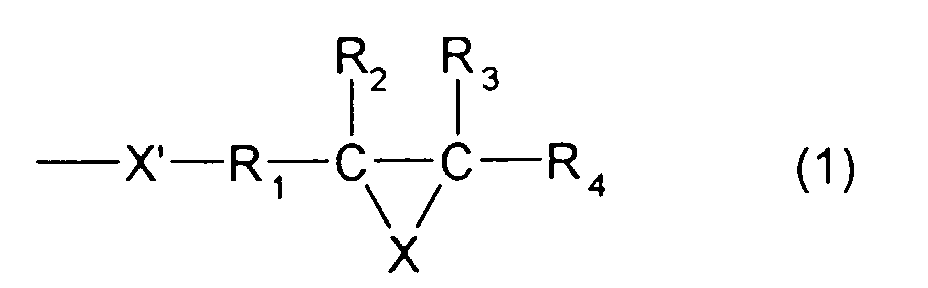
Figure 00050001
wherein R1 is a divalent hydrocarbon group having 1 to 10 carbon atoms, R2, R3 and R4 each independently represents a hydrocarbon group having 1 to 10 carbon atoms or a hydrogen atom; X stands for an S or O atom and the average number of S atom is at least 50% based on the total number of S and O atoms which consist of the three membered ring; and X' is -S- or -O-,
at least two compounds (b) having a tertiary amino group substituted with aliphatic and/or aromatic group(s) which are each different in catalytic activity as a polymerization catalyst,
with the proviso that the ratio of the total of the tertiary amino groups in the at least two compounds (b) to the episulfide groups in the compound (a) is in the range of 0.0001 to 0.02 in terms of a molar ratio of amino/episulfide functional group,
If there are plural compounds (a), preferably the total content of X atoms is at least 50% S (by number).
In the or each compound (a), preferably the total content of X atoms is at least 50% S.
  • (B) the polymerizable composition of (A), wherein the compound (a) has at least one structure represented by the following formula (2) :
    Figure 00060001
    wherein, R5 represents a divalent hydrocarbon group having 1 to 10 carbon atoms, R6, R7 and R8 each independently represents a hydrocarbon group having 1 to 10 carbon atoms or a hydrogen atom, and X stands for an S or O atom, the average number of the S atom being at least 50% based on the total number of S and O atoms which constitute the three-membered ring,
  • (C) the polymerizable composition of (A), wherein the compound (a) is represented by the following formula (3) :
    Figure 00060002
    wherein, R9 to R14 each independently represents a hydrocarbon group having 1 to 10 carbon atoms or a hydrogen atom, Y represents a substituted or unsubstituted, linear or branched divalent hydrocarbon group having 1 to 10 carbon atoms, a substituted or unsubstituted 1,4-dithian group or an arylene group, m stands for an integer of 0 to 2, n stands for an integer of 0 to 4, and Xs each stands for an S or O atom,
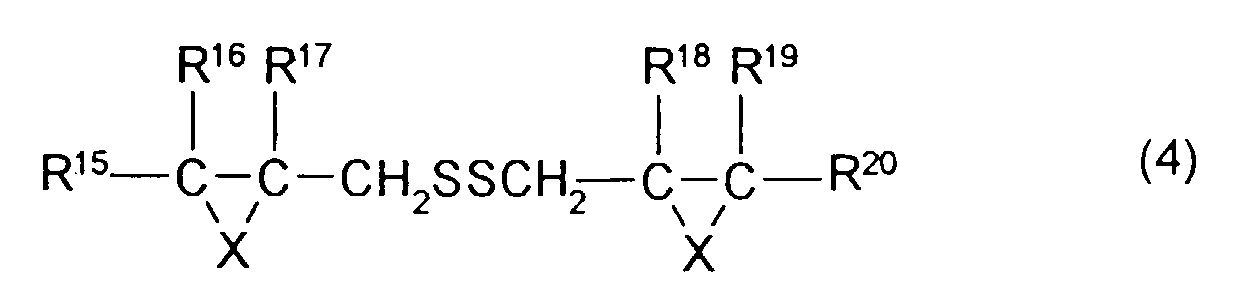
  • (D) the polymerizable composition of (A), wherein the compound (a) is represented by the following formula (4):
    Figure 00070001
    wherein, R15 to R20 each independently represents a hydrocarbon group having 1 to 10 carbon atom or a hydrogen atom, and Xs each stands for an S or O atom,
  • (E) the polymerizable composition of (A), wherein the at least two compounds (b) used as a polymerization catalyst and different each other in catalytic activity are at least two compounds selected, respectively, from compounds having high catalytic activity consisting of N,N-dimethylcyclohexylamine and N,N-diethylethanolamine and those having low catalytic activity consisting of N,N-diisopropylethylamine and N-methyldicyclohexylamine,
  • (F) a resin obtained by heat curing the polymerizable composition of (A),
  • (G) a process for producing a resin, which comprises heat curing the polymerizable composition of (A),
  • (H) an optical material comprising the resin of (F),
  • (I) a process for producing an optical material, which comprises casting polymerization of the polymerizable composition of (A),
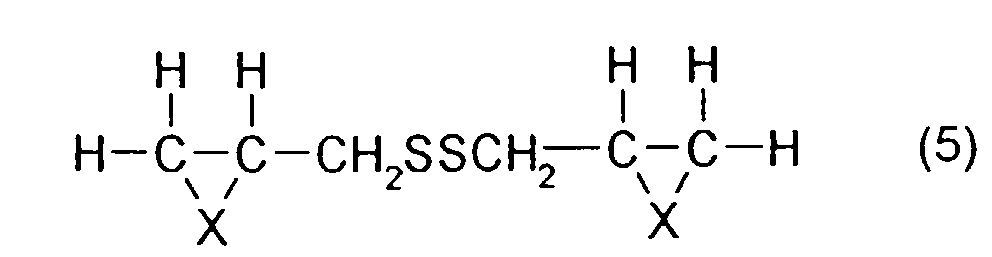
  • (J) a polymerizable composition comprising a compound (c) represented by the following formula (5):
    Figure 00080001
    wherein, Xs each represents an S or O atom and they may be the same or different, and at least one compound (d) having a tertiary amino group substituted with aliphatic and/or aromatic group(s), with the proviso that the ratio of the tertiary amino group in the compound (d) to the episulfide group in the compound (c) is in the range of 0.0001 to 0.02 in terms of a molar ratio of an amino/episulfide functional group,
  • (K) the polymerizable composition of (J), wherein the compound (d) is one or more than one compound selected from the group consisting of N,N-diisopropylethylamine, N,N-dimethylcyclohexylamine and N-methyldicyclohexylamine,
  • (L) a resin obtained by heat curing the polymerizable composition of (J),
  • (M) a process for producing a resin, which comprises heat curing the polymerizable resin composition of (J),
  • (N) an optical material comprising the resin of (L), and
  • (O) a process for producing an optical material, which comprises cast polymerizing the polymerizable composition of (J).
  • It is possible to judge whether at least two compounds (b) having a tertiary amino group differ in catalytic activity or not, for example, by the following method.
  • (1) As the compound (a) which serves as a standard compound, bis(β-epithiopropyl) disulfide is selected and it is mixed with one compound (b) having a tertiary amino group so that an amino group/episulfide group ratio (molar ratio of a functional group) becomes 0.0025. From the viscosity of the mixture rightly after completion of mixing at 20°C and that of the mixture 3 hours after mixing, a change in the viscosity was studied. At the same time, the resulting mixture was heated from 30 to 80°C over 10 hours and heat release starting time and ultimate temperature by heat release were studied.
  • (2) With regards to various compounds (b) having a tertiary amino group, a change in the viscosity was studied in a similar manner to (1).
  • (3) Any two compounds (b) are selected and they are compared in a change in viscosity, heat release starting temperature and ultimate temperature by heat release. When these two compounds agree in at least one condition, among three conditions, that is, a difference in the change in viscosity not less than 50 mPa.s, a difference in the heat release starting time not less than 2 hours, and a difference in the ultimate temperature by heat release not less than 30°C, these two compounds (b) are regarded to differ in catalytic activity.
  • The present invention makes it possible to provide a polymerizable composition having a sufficiently long pot life, which was not actualized by the conventional technique, and capable of suppressing heat release upon polymerization; and also a resin, which is obtained by curing and polymerizing the composition, improved in hue and reduced in yellowing upon post-heating while having a high refractive index and well-balanced Abbe number. In addition, according to the present invention, formation of striae inside of lenses can be suppressed upon mass production of the lenses, whereby a lowering in a yield due to striae can be prevented. The effects for preventing a lowering in a yield, which otherwise occurs by the striae, are particularly eminent when at least two compounds (b) having a tertiary amino group different in catalytic activity are employed as a polymerization catalyst.
    As a result, the pot life of the polymerizable composition can be maintained long, yellowing due to heating can be reduced without impairing a high refractive index, a transparent resin with good hue becomes available by suppressing heat release upon polymerization, and a lowering in an yield due to striae can be prevented. The elongation of the pot life leads to an improvement in the working efficiency upon resin production and the resin thus available contributes to the production of thin and fashionable lenses, particularly in the field of eyeglass lenses.
    DETAILED DESCRIPTION OF THE PREFERRED EMBODIMENTS
    The present invention will next be described specifically.
    In the present invention, a polymerizable composition comprising the compound (a) and at least two compounds (b) having tertiary amino group substituted with aliphatic and/or aromatic group(s) and being different in catalytic activity, a ratio of the tertiary amino group in the compounds (b) to the episulfide group in the compound (a) being in the range of from 0.0001 to 0.02, preferably from 0.0002 to 0.01 has a sufficiently long pot life and can suppress heat release upon polymerization. A resin obtained therefrom is improved in hue and reduced in yellowing upon post-heating, without impairing a high refractive index and a high Abbe number. In addition, when lenses are mass-produced, formation of striae inside of the lenses can be suppressed, whereby a lowering in a yield due to striae can be prevented.
    Moreover, in the present invention, a polymerizable composition comprising the above-described compound (c) and one or more than one compound (d) having a tertiary amino group substituted with aliphatic and/or aromatic group(s), a ratio of the tertiary amino group in the compound (d) to an episulfide group in the compound (c) being in the range of 0.0001 to 0.02 has a sufficiently long pot life and can suppress heat release upon polymerization. The resin obtained therefrom is improved in hue and is reduced in yellowing upon post-heating, while maintaining a high refractive index and a high Abbe number.
    Specific examples of the compound having a tertiary amino group as (b) or (d) in the present invention include, but not limited to, aliphatic and aromatic tertiary amines such as triethylamine, tri-n-butylamine, tri-n-hexylamine, N,N-diisopropylethylamine, triethylenediamine, triphenylamine, N,N-dimethylethanolamine, N,N-diethylethanolamine, N,N-dibutylethanolamine, triethanolamine, N-ethyldiethanolamine, N,N-dimethylbenzylamine, N,N-diethylbenzylamine, tribenzylamine, N-methyldibenzylamine, N,N-dimethylcyclohexylamine, N,N-diethylcyclohexylamine, N,N-dimethylbutylamine, N-methyldicyclohexylamine, N-methylmorpholine, N-isopropylmorpholine, pyridine, quinoline, N,N-dimethylaniline, N,N-diethylaniline, α-, β- or γ-picoline, 2,2'-bipyridyl, 1,4-dimethylpiperazine, dicyandiamide, tetramethylethylenediamine, hexamethylenetetramine, 1,8-diazabicyclo[5.4.0]-7-undecene, and 2,4,6-tris(N,N-dimethylaminomethyl)phenol. Among these exemplified compounds, preferred are N,N-diisopropylethylamine, N-methyldicyclohexylamine, N,N-dimethylcyclohexylamine and N,N-diethylethanolamine. Use of a mixture of at least two tertiary amines different in catalytic activity as the compounds (b) brings about good results.
    Although it is impossible to limit combination of tertiary amines, as the compounds (b), different in catalytic activity in a wholesale manner, because it may depend on the kind of the compound (a) or the kind of a resin modifier to be described later, preferred examples include the combination of N,N-dimethylcyclohexylamine and N-methyldicyclohexylamine, that of N,N-dimethylcyclohexylamine and N,N-diisopropylethylamine and that of N,N-diethylethanolamine and N-methyldicyclohexylamine, each combination comprising the compounds selected respectively from two groups, that is, a high-catalyticactivity group such as N,N-dimethylcyclohexylamine and N,N-diethylethanolamine and a low-catalytic-activity group such as N,N-diisopropylethylamine and N-methyldicyclohexylamine.
    Specific examples of the compound (a) usable in the present invention as a raw material include, but not limited to, linear aliphatic β-epithiopropylthio compounds such as bis(β-epithiopropyl)sulfide, bis(β-epithiopropyl)disulfide, bis(β-epithiopropylthio)methane, 1,2-bis(β-epithiopropylthio)ethane, 1,2-bis(β-epithiopropylthio)propane, 1,3-bis(β-epithiopropylthio)propane, 1,3-bis(β-epithiopropylthio)-2-methylpropane, 1,4-bis(β-epithiopropylthio)butane, 1,4-bis(β-epithiopropylthio)-2-methylbutane, 1,3-bis(β-epithiopropylthio)butane, 1,5-bis(β-epithiopropylthio)pentane, 1,5-bis(β-epithiopropylthio)-2-methylpentane, 1,5-bis(β-epithiopropylthio)-3-thiapentane, 1,6-bis(β-epithiopropylthio)hexane, 1,6-bis(β-epithiopropylthio)-2-methylhexane, 3,8-bis(β-epithiopropylthio)-3,6-dithiaoctane, 1,2,3-tris(β-epithiopropylthio)propane, 2,2-bis(β-epithiopropylthiomethyl)-1,3-bis(β-epithiopropylthio)propane, 2,2-bis(β-epithiopropylthiomethyl)-1-(β-epithiopropylthio)butane, 1,5-bis(β-epithiopropylthio)-2-(β-epithiopropylthiomethyl)-3-thiapentane, 1,5-bis(β-epithiopropylthio)-2,4-bis(β-epithiopropylthiomethyl)-3-thiapentane, 1-(β-epithiopropylthio)-2,2-bis(β-epithiopropylthiomethyl)-4-thiahexane, 1,8-bis(β-epithiopropylthio)-4-(β-epithiopropylthiomethyl)-3,6-dithiaoctane, 1,8-bis(β-epithiopropylthio)-4,5-bis(β-epithiopropylthiomethyl)-3,6-dithiaoctane, 1,8-bis(β-epithiopropylthio)-4,4-bis(β-epithiopropylthiomethyl)-3,6-dithiaoctane, 1,8-bis(β-epithiopropylthio)-2,5-bis(β-epithiopropylthiomethyl)-3,6-dithiaoctane, 1,8-bis(β-epithiopropylthio)-2,4,5-tris(β-epithiopropylthiomethyl)-3,6-dithiaoctane, 1,1,1-tris{[2-(β-epithiopropylthio)ethyl]thiomethyl}-2-(β-epithiopropylthio)ethane, 1,1,2,2-tetrakis{[2-(β-epithiopropylthio)ethyl]thiomethyl}ethane, 1,11-bis(β-epithiopropylthio)-4,8-bis(β-epithiopropylthiomethyl)-3,6,9-trithiaundecane, 1,11-bis(β-epithiopropylthio)-4,7-bis(β-epithiopropylthiomethyl)-3,6,9-trithiaundecane and 1,11-bis(β-epithiopropylthio)-5,7-bis(β-epithiopropylthiomethyl)-3,6,9-trithiaundecane; cyclic aliphatic β-epithiopropylthio compounds such as 1,3-bis(β-epithiopropylthio)cyclohexane, 1,4-bis(β-epithiopropylthio)cyclohexane, 1,3-bis(β-epithiopropylthiomethyl)cyclohexane, 1,4-bis(β-epithiopropylthiomethyl)cyclohexane, 2,5-bis(β-epithiopropylthiomethyl)-1,4-dithiane and 2,5-bis{[2-(β-epithiopropylthio)ethyl]thiomethyl}-1,4-dithiane; aromatic β-epithiopropylthio compounds such as 1,3-bis(β-epithiopropylthio)benzene, 1,4-bis(β-epithiopropylthio)benzene, 1,3-bis(β-epithiopropylthiomethyl)benzene, 1,4-bis(β-epithiopropylthiomethyl)benzene, bis[4-(β-epithiopropylthio)phenyl]methane, 2,2-bis[4-(β-epithiopropylthio)phenyl]propane, bis[4-(β-epithiopropylthio)phenyl]sulfide, bis[4-(β-epithiopropylthio)phenyl]sulfone and 4,4'-bis(β-epithiopropylthio)biphenyl; mercapto-containing epithio compounds such as 3-mercaptopropylene sulfide and 4-mercaptobutene sulfide; and bis(β-epithiopropyl)ether, bis(β-epithiopropyloxy)methane, 1,2-bis(β-epithiopropyloxy)ethane, 1,3-bis(β-epithiopropyloxy)propane, 1,2-bis(β-epithiopropyloxymethyl)propane, 1-(β-epithiopropyloxy)-2-(β-epithiopropyloxymethyl)propane, 1,4-bis(β-epithiopropyloxy)butane, 1,3-bis(β-epithiopropyloxy)butane, 1-(β-epithiopropyloxy)-3-(β-epithiopropyloxymethyl)butane, 1,5-bis(β-epithiopropyloxy)pentane, 1-(β-epithiopropyloxy)-4-(β-epithiopropyloxymethyl)pentane, 1,6-bis(β-epithiopropyloxy)hexane, 1-(β-epithiopropyloxy)-5-(β-epithiopropyloxymethyl)hexane, 1-(β-epithiopropyloxy)-2-[(2-β-epithiopropyloxyethyl)oxy]ethane, 1-(β-epithiopropyloxy)-2-{[2-(2-β-epithiopropyloxyethyl)oxyethyl]oxy}ethane, tetrakis(β-epithiopropyloxymethyl)methane, 1,1,1-tris(β-epithiopropyloxymethyl)propane, 1,5-bis(β-epithiopropyloxy)-2-(β-epithiopropyloxymethyl)-3-thiapentane, 1,5-bis(β-epithiopropyloxy)-2,4-bis(β-epithiopropyloxymethyl)-3-thiapentane, 1-(β-epithiopropyloxy)-2,2-bis(β-epithiopropyloxymethyl)-4-thiahexane, 1,5,6-tris(β-epithiopropyloxy)-4-(β-epithiopropyloxymethyl)-3-thiahexane, 1,8-bis(β-epithiopropyloxy)-4-(β-epithiopropyloxymethyl)-3,6-dithiaoctane, 1,8-bis(β-epithiopropyloxy)-4,5-bis(β-epithiopropyloxymethyl)-3,6-dithiaoctane, 1,8-bis(β-epithiopropyloxy)-4,4-bis(β-epithiopropyloxymethyl)-3,6-dithiaoctane, 1,8-bis(β-epithiopropyloxy)-2,4,5-tris(β-epithiopropyloxymethyl)-3,6-dithiaoctane, 1,8-bis(β-epithiopropyloxy)-2,5-bis(β-epithiopropyloxymethyl)-3,6-dithiaoctane, 1,9-bis(β-epithiopropyloxy)-5-(β-epithiopropyloxymethyl)-5-[(2-β-epithiopropyloxyethyl)oxymethyl]-3,7-dithianonane, 1,10-bis(β-epithiopropyloxy)-5,6-bis[(2-β-epithiopropyloxyethyl)oxy]-3,6,9-trithiadecane, 1,11-bis(β-epithiopropyloxy)-4,8-bis(β-epithiopropyloxymethyl)-3,6,9-trithiaundecane, 1,11-bis(β-epithiopropyloxy)-5,7-bis(β-epithiopropyloxymethyl)-3,6,9-trithiaundecane, 1,11-bis(β-epithiopropyloxy)-5,7-bis[(2-β-epithiopropyloxyethyl)oxymethyl]-3,6,9-trithiaundecane, 1,11-bis(β-epithiopropyloxy)-4,7-bis(β-epithiopropyloxymethyl)-3,6,9-trithiaundecane, 1,3- and 1,4-bis(β-epithiopropyloxy)cyclohexane, 1,3- and 1,4-bis(β-epithiopropyloxymethyl)cyclohexane, bis[4-(β-epithiopropyloxy)cyclohexyl]methane, 2,2-bis[4-(β-epithiopropyloxy)cyclohexyl]propane, bis[4-(β-epithiopropyloxy)cyclohexyl]sulfide, 2,5-bis(β-epithiopropyloxymethyl)-1,4-dithiane, 2,5-bis(β-epithiopropyloxyethyloxymethyl)-1,4-dithiane, 1,3- and 1,4-bis(β-epithiopropyloxy)benzene and 1,3- and 1,4-bis(β-epithiopropyloxymethyl)benzene. These compounds may be used either singly or in combination. It is preferred that each of these compounds (a) contains the episulfide group in an amount not less than 50 mole% based on total moles of the episulfide group and epoxy group.
    As well as the above-exemplified episulfide compound, the polymerizable composition of the present invention may contain a polysulfide oligomer such as dimer, trimer or tetramer of the compound; a mercapto-containing episulfide resin which is formed when an epihalohydrin is insufficient upon synthesis of an episulfide resin; and/or an inorganic acid, organic acid, solvent or unreacted raw material which is employed upon synthesis of the episulfide compound; and organic compounds or inorganic compounds as byproducts or impurities within an extent not causing a problem.
    To the polymerizable composition for lenses in the present invention, a resin modifier can be added with a view to improving the resin, mainly for adjusting optical properties such as refractive index of the resulting lens, various physical properties such as specific gravity, and viscosity of the composition, and for improving the handling ease.
    Examples of the resin modifier include episulfide compounds other than those contained in the polymerizable composition of the present invention, epoxy compounds, olefins including (meth)acrylates, primary or secondary amine compounds, thiol compounds, polyphenolic compounds, amino acids and mercaptoamines, organic acids and anhydrides thereof, and mercapto-organic acids.
    Preferred specific examples of the epoxy compound as a resin modifier include, but not limited to, phenolic epoxy compounds available by condensation of a polyvalent phenolic compound such as bisphenol A glycidyl ether with an epihalohydrin compound, alcoholic epoxy compounds available by condensation of a polyhydric alcohol compound such as hydrogenated bisphenol A glycidyl ether with an epihalohydrin compound, glycidyl ester epoxy compounds available by condensation of a polyvalent organic acid compound such as 3,4-epoxycyclohexylmethyl-3',4'-epoxycyclohexanecarboxylate or diglycidyl 1,2-hexahydrophthalate with an epihalohydrin compound, amine epoxy compounds available by condensation of a primary or secondary diamine compound with an epihalohydrin compound and aliphatic polyvalent epoxy compounds such as vinylcyclohexene diepoxide. These epoxy compounds may be used either singly or in combination.
    Preferred specific examples of the olefin as a resin modifier include, but not limited to, (meth)acrylate compounds such as benzyl acrylate, benzyl methacrylate, butoxyethyl acrylate, butoxymethyl methacrylate, cyclohexyl acrylate, cyclohexyl methacrylate, 2-hydroxyethyl acrylate, hydroxymethyl methacrylate, glycidyl acrylate, glycidyl methacrylate, phenoxyethyl acrylate, phenoxyethyl methacrylate, phenyl methacrylate, ethylene glycol diacrylate, ethylene glycol dimethacrylate, diethylene glycol diacrylate, diethylene glycol dimethacrylate, triethylene glycol diacrylate, triethylene glycol dimethacrylate, tetraethylene glycol diacrylate, tetraethylene glycol dimethacrylate, polyethylene glycol diacrylate, polyethylene glycol dimethacrylate, neopentyl glycol diacrylate, neopentyl glycol dimethacrylate, ethylene glycol bisglycidyl acrylate, ethylene glycol bisglycidyl methacrylate, bisphenol A diacrylate, bisphenol A dimethacrylate, 2,2-bis(4-acryloxyethoxyphenyl)propane, 2,2-bis(4-methacryloxyethoxyphenyl)propane, 2,2-bis(4-acryloxydiethoxyphenyl)propane, 2,2-bis(4-methacryloxydiethoxyphenyl)propane, bisphenol F diacrylate, bisphenol F dimethacrylate, 1,1-bis(4-acryloxyethoxyphenyl)methane, 1,1-bis(4-methacryloxyethoxyphenyl)methane, 1,1-bis(4-acryloxydiethoxyphenyl)methane, 1,1-bis(4-methacryloxydiethoxyphenyl)methane, dimethylol tricyclodecane diacrylate, trimethylolpropane triacrylate, trimethylolpropane trimethacrylate, glycerol diacrylate, glycerol dimethacrylate, pentaerythritol triacrylate, pentaerythritol tetraacrylate, pentaerythritol tetramethacrylate, methylthioacrylate, methylthiomethacrylate, phenylthioacrylate, benzylthiomethacrylate, xylylenedithiol diacrylate, xylylenedithiol dimethacrylate, mercaptoethylsulfide diacrylate and mercaptoethylsulfide dimethacrylate; allyl compounds such as allyl glycidyl ether, diallyl phthalate, diallyl terephthalate, diallyl isophthalate, diallyl carbonate and diethylene glycol bisallyl carbonate; vinyl compounds such as styrene, chlorostyrene, methylstyrene, bromostyrene, dibromostyrene, divinylbenzene and 3,9-divinylspirobi(m-dioxane); and diisopropenyl benzene. These olefins may be used either singly or in combination. Moreover, the above-exemplified resin modifiers may be used either singly or in combination.
    Preferred specific examples of the primary or secondary amine compound as a resin modifier include, but not limited to, monofunctional primary amine compounds such as ethylamine, n-propylamine, isopropylamine, n-butylamine, sec-butylamine, tert-butylamine, pentylamine, hexylamine, heptylamine, octylamine, decylamine, laurylamine, myristylamine, 3-pentylamine, 2-ethylhexylamine, 1,2-dimethylhexylamine, allylamine, aminomethylbicycloheptane, cyclopentylamine, cyclohexylamine, 2,3-dimethylcyclohexylamine, aminomethylcyclohexane, aniline, benzylamine, phenetylamine, 2-, 3-, or 4-methylbenzylamine, o-, m-, or p-methylaniline, o-, m-, or p-ethylaniline, aminomorpholine, naphthylamine, furfurylamine, α-aminodiphenylmethane, toluidine, aminopyridine, aminophenol, aminoethanol, 1-aminopropanol, 2-aminopropanol, aminobutanol, aminopentanol, aminohexanol, methoxyethylamine, 2-(2-aminoethoxy)ethanol, 3-ethoxypropylamine, 3-propoxypropylamine, 3-butoxypropylamine, 3-isopropoxypropylamine, 3-isobutoxypropylamine and 2,2-diethoxyethylamine; primary polyamine compounds such as ethylenediamine, 1,2- or 1,3-diaminopropane, 1,2-, 1,3-or 1,4-diaminobutane, 1,5-diaminopentane, 1,6-diaminohexane, 1,7-diaminoheptane, 1,8-diaminooctane, 1,10-diaminodecane, 1,2-, 1,3- or 1,4-diaminocyclohexane, o-, m- or p-diaminobenzene, 3,4- or 4,4'-diaminobenzophenone, 3,4- or 4,4'-diaminodiphenylether, 4,4'-diaminodiphenylmethane, 4,4'-diaminodiphenylsulfide, 3,3'- or 4,4'-diaminodiphenylsulfone, 2,7-diaminofluorene, 1,5-, 1,8-or 2,3-diaminonaphthalene, 2,3-, 2,6- or 3,4-diaminopyridine, 2,4- or 2,6-diaminotoluene, m- or p-xylylenediamine, isophoronediamine, diaminomethylbicycloheptane, 1,3- or 1,4-diaminomethylcyclohexane, 2- or 4-aminopiperidine, 2- or 4-aminomethylpiperidine, 2- or 4-aminoethylpiperidine, N-aminoethylmorpholine and N-aminopropylmorpholine; monofunctional secondary amine compounds such as diethylamine, dipropylamine, di-n-butylamine, di-sec-butylamine, diisobutylamine, di-n-pentylamine, di-3-pentylamine, dihexylamine, dioctylamine, di(2-ethylhexyl)amine, methylhexylamine, diallylamine, N-methylallylamine, piperidine, pyrrolidine, diphenylamine, N-methylamine, N-ethylamine, dibenzylamine, N-methylbenzylamine, N-ethylbenzylamine, dicyclohexylamine, N-methylaniline, N-ethylaniline, dinaphthylamine, 1-methylpiperazine and morpholine; and secondary polyamine compounds such as N,N'-dimethylethylenediamine, N,N'-dimethyl-1,2-diaminopropane, N,N'-dimethyl-1,3-diaminopropane, N,N'-dimethyl-1,2-diaminobutane, N,N'-dimethyl-1,3-diaminobutane, N,N'-dimethyl-1,4-diaminobutane, N,N'-dimethyl-1,5-diaminopentane, N,N'-dimethyl-1,6-diaminohexane, N,N'-dimethyl-1,7-diaminoheptane, N,N'-diethylethylenediamine, N,N'-diethyl-1,2-diaminopropane, N,N'-diethyl-1,3-diaminopropane, N,N'-diethyl-1,2-diaminobutane, N,N'-diethyl-1,3-diaminobutane, N,N'-diethyl-1,4-diaminobutane, N,N'-diethyl-1,5-diaminopentane, N,N'-diethyl-1,6-diaminohexane, N,N'-diethyl-1,7-diaminoheptane, piperazine, 2-methylpiperazine, 2,5-dimethylpiperazine, 2,6-dimethylpiperazine, homopiperazine, 1,1-di(4-piperidyl)methane, 1,2-di(4-piperidyl)ethane, 1,3-di(4-piperidyl)propane, 1,4-di(4-piperidyl)butane and tetramethylguanidine. They may be used either singly or in combination. Among these exemplified compounds, benzylamine and piperazines are more preferred.
    Preferred specific examples of the thiol compound include, but not limited to, aliphatic thiols such as methylmercaptane, ethylmercaptane, 1,2-ethanedithiol, 1,2-propanedithiol, 1,3-propanedithiol, 2,2-propanedithiol, 1,4-butanedithiol, 1,2,3-trimercaptopropane, tetrakis(mercaptomethyl)methane, 1,2-dimercaptocyclohexane, bis(2-mercaptoethyl)sulfide, 2,3-dimercapto-1-propanol, ethylene glycol bis(3-mercaptopropionate), diethylene glycol bis(3-mercaptopropionate), diethylene glycol bis(2-mercaptoglycolate), pentaerythritol tetrakis(2-mercaptothioglycolate), pentaerythritol tetrakis(3-mercaptopropionate), trimethylolpropane tris(2-mercaptothioglycolate), trimethylolpropane tris(3-mercaptopropionate), 1,1,1-trimethylmercaptoethane, 1,1,1-trimethylmercaptopropane, 2,5-dimercaptomethylthiophene, 4-mercaptomethyl-1,8-dimercapto-3,6-dithiaoctane, 2,5-dimercaptomethyl-1,4-dithiane, 2,5-bis[(2-mercaptoethyl)thiomethyl]-1,4-dithiane, 1,3-cyclohexanedithiol, 1,4-cyclohexanedithiol, 4,8-dimercaptomethyl-1,11-dimercapto-3,6,9-trithiaundecane, 4,7-dimercaptomethyl-1,11-dimercapto-3,6,9-trithiaundecane and 5,7-dimercaptomethyl-1,11-dimercapto-3,6,9-trithiaundecane; and aromatic thiols such as benzylmercaptane, thiophenol, 1,2-dimercaptobenzene, 1,3-dimercaptobenzene, 1,4-dimercaptobenzene, 1,2-bis(mercaptomethyl)benzene, 1,3-bis(mercaptomethyl)benzene, 1,4-bis(mercaptomethyl)benzene, 2,2'-dimercaptobiphenyl, 4,4'-dimercaptobiphenyl, bis(4-mercaptophenyl)methane, bis(4-mercaptophenyl)sulfide, bis(4-mercaptophenyl)sulfone, 2,2-bis(4-mercaptophenyl)propane, 1,2,3-trimercaptobenzene, 1,2,4-trimercaptobenzene and 1,2,5-trimercaptobenzene. They may be used either singly or in combination.
    The polyphenolic compound is a compound having at least one phenolic hydroxyl group on their aromatic ring. Specific examples of the polyphenolic compound include, but not limited to, monophenols such as phenol, o-cresol, m-cresol, p-cresol, 3-methoxyphenol, 4-ethoxyphenol, 4-n-propoxyphenol, 3-butoxyphenol, nonylphenol, 2-n-propylphenol, 2,3,4,6-tetrachlorophenol, 2,3,5,6-tetrafluorophenol, 2,4,6-tribromophenol, 2,6-dichloro-4-fluorophenol, 2,6-dichloro-4-nitrophenol, 2,3,4-trichlorophenol, 4-bromo-2-chlorophenol, 2,4-dibromophenol, 2-chloro-4-nitrophenol, 2,3-dichlorophenol, 2-fluoro-4-nitrophenol, 3,5-xylenol, 2,3-difluorophenol, 2,4-dinitrophenol, 2-bromophenol, 2-amino-4-chloro-5-nitrophenol, 2-chlorophenol, 4-amino-2,6-dichlorphenol, 2-nitrophenol, 2-amino-4-nitrophenol, thymol, carbachol, α-naphthol and 2-aminophenol; and polyphenols such as catechol, 3-chlorocatechol, resorcin, hydroquinone, chlorohydroquinone, pyrogallol and phloroglucinol. They may be used either singly or in combination.
    Preferred specific examples of the mercapto-organic acid include, but not limited to, thioglycolic acid, 3-mercaptopropionic acid, thioacetic acid, thiolactic acid, thiomalic acid and thiosalicylic acid. They may be used either singly or in combination.
    Preferred specific examples of the organic acid or anhydride thereof include, but not limited to, thiodiglycollic acid, thiodipropionic acid, dithiodipropionic acid, phthalic anhydride, hexahydrophthalic anhydride, methylhexahydrophthalic anhydride, methyltetrahydrophthalic anhydride, methylnorbornenic anhydride, methylnarbornanic anhydride, maleic anhydride, trimellitic anhydride and pyromellitic anhydride. They may be used ether singly or in combination.
    As well as the above-exemplified resin modifier, various known additives such as internal mold releasing agent, photo stabilizer, ultraviolet absorber, antioxidant, dyestuff and/or filler may be added according to the using purpose within an extent not causing a problem.
    A typical polymerization method for obtaining the resin (ex. plastic lens) of the present invention is casting polymerization. In this method, the polymerizable composition of the present invention is mixed with a resin modifier as needed and then, the resulting mixture is cast between molds supported by a gasket or tape. Degassing treatment as needed before or after casting does not cause any trouble.
    Then, it may be subject to curing by heating in a heating apparatus such as an oven or in water, and then a polymerization product may be took out from the mold.
    The polymerization method or conditions for obtaining the resin of the present invention cannot be generalized, since they depend on the amounts and types of ingredients such as curing catalysts as well as types and proportions of monomers.
    Heat curing conditions for a polymerizable composition of the present invention poured into the mold significantly vary depending of various factors such as types of compounds (a) and (b), a type of the resin modifier and the shape of the mold and therefore cannot be specifically limited, but the composition may be typically cured at -50 to 200°C for 0.1 to 100 hours. It may be cured keeping or gradually raising a temperature within a range of from 10 to 150°C for 1 to 80 hours, providing good results.
    In addition, the polymerizable composition of the present invention may be cured in a reduced time by irradiating ultraviolet rays or the like. At this time, a curing catalyst such as radical polymerization catalyst may be added.
    Upon molding or forming of the resin of the present invention, similar to the known molding or forming method, various substances such as chain extenders, crosslinking agents, photo-stabilizers, ultraviolet absorbers, antioxidants, coloring preventives other than that added upon preparation of the resin of the present invention, dyestuffs, fillers, internal or external mold releasing agents, internal or external adhesion improving agents, and hydroxyl-containing compound as dye-affinity improving agents may be added, depending on a purpose.
    The resin after removed from the mold may be annealed if necessary.
    The resin according to the present invention can be formed or molded into products of various shapes by changing the mold to be used upon casting polymerization. It can be used, for example, as optical materials such as eyeglass lenses, camera lenses and light emitting diodes (LED) and also as transparent resins. It is particularly suited as optical materials such as eyeglass lenses and camera lenses.
    The lens made of the optical material of the present invention can be, if necessary, subjected to physical or chemical treatments such as surface abrasion, antistatic treatment, hard coating, anti-reflection coating treatment or dyeing treatment in order to prevent reflection, impart high hardness, improve abrasion resistance, improve chemical resistance, impart antifoggy property or make it fashionable.
    The present invention will hereinafter be described more specifically by Examples. It should be noted that among the performances of the resulting resin tested, the refractive index, Abbe number, heat resistance, resin hue, pot life and heat release degree during polymerization were evaluated by the testing methods which will be described below.
    • Refractive index (nd), Abbe number (νd): this was determined at 20°C by a Pulfrich refractometer.
    • Heat resistance: Tg was determined by the TMA penetrating method (load: 50 g, pin point: 0.5 mm, heating at 10°C/min, 150°C/max).
    • Hue: a yellowness index (which will hereinafter be abbreviated as "YI") of a flat plate which had been made of a resin to have a thickness of 9 mm was determined by a color differential colorimeter (product of Minolta Co., Ltd.). In the tables of Examples, ΔYI means a value obtained by subtracting the hue of the resin after completion of the polymerization from the hue of a resin after heat treatment at 120°C for 3 hours. The value thus obtained stands for a changing amount of the hue.
    • Pot life: a polymerizable composition was lagged in a water bath of 30°C and after 7 hours, its viscosity was measured by a Brookfield viscometer. When the viscosity after 7 hours was 100 mPa·S or less, the polymerizable composition was evaluated as "A". When the viscosity was 150 mPa·S or less, the composition was evaluated as "B". The polymerizable composition which had been gelled or resinified was evaluated as "C".
    • Measurement of heat release degree during polymerization: the temperature of a resin was measured during polymerization by using a thermocouple thermometer equipped with a recorder and the value obtained by subtracting the temperature of the polymerizing oven from the temperature of the resin was designated as heat release degree.
    • Judgment of striae: 100 resin pieces were prepared and exposed to a high-pressure mercury lamp. The existence or absence of striae was visually observed and a yield was calculated.
    In Examples and Comparative Examples, bis(2,3-epithiopropyl)disulfide (which will hereinafter be called "Compound (A)") was employed as the compound (a) or (c), and benzylamine (which will hereinafter be called "Modifier (A)") or 4,8-dimercaptomethyl-1,11-mercapto-3,6,9-trithiaundecane (which will hereinafter be called "Modifier (B)") was added as a modifier.
    Example 1
    Compound (A) (7000 g) as the compound (a), 1.4 g of N,N-dimethylcyclohexylamine (hereinafter be abbreviated as "DCA") and 7 g of N,N-dicyclohexylmethylamine (hereinafter be abbreviated as "DCH") as the compounds (b), and 700 g of Modifier (B) as a resin modifier were mixed under stirring, followed by degassing for 1 hour under reduced pressure. After filtration through a 3 µm Teflon filter, the residue was cast, in equal portions, into 100 molds each made of a glass mold and a gasket over 4 hours. The molds were lagged at 30°C for 10 hours and then gradually heated from 30 to 80°C, at which polymerization was conducted for 20 hours. After completion of the polymerization, the resulting resin was released from each of the molds by gradual cooling. The resin was annealed at 120°C for 3 hours, whereby 100 resin pieces were obtained. The physical properties and hue of the resin, the pot life of the polymerizable composition and the yield influenced by striae are shown in Table 1.
    Example 2
    Compound (A) (7000 g) as the compound (c), 14 g of DCA as the compound (d) and 700 g of Modifier (B) as a resin modifier were mixed under stirring, followed by degassing for 1 hour under reduced pressure. After filtration through a 3 µm Teflon filter, the residue was cast, in equal portions, into 100 molds each made of a glass mold and a gasket over 4 hours. The molds were lagged at 30°C for 10 hours and then gradually heated from 30 to 80°C, at which polymerization was conducted for 20 hours. After completion of the polymerization, the resulting resin was released from each of the molds by gradual cooling. The resin was annealed at 120°C for 3 hours, whereby 100 resin pieces were obtained. The physical properties and hue of the resin, the pot life of the polymerizable composition and the yield influenced by striae are shown in Table 1.
    Example 3
    Compound (A) (7000 g) as the compound (c), 14 g of DCA as the compound (d) and 350 g of Modifier (B) as a resin modifier were mixed under stirring, followed by degassing for 1 hour under reduced pressure. After filtration through a 3 µm Teflon filter, the residue was cast, in equal portions, into 100 molds each made of a glass mold and a gasket over 4 hours. The molds were lagged at 30°C for 10 hours and then gradually heated from 30 to 80°C, at which polymerization was conducted for 20 hours. After completion of the polymerization, the resulting resin was released from each of the molds by gradual cooling. The resin was annealed at 120°C for 3 hours, whereby 100 resin pieces were obtained. The physical properties and hue of the resin, the pot life of the polymerizable composition and the yield influenced by striae are shown in Table 1.
    Example 1 2 3
    Compound (a) or (c) (A) (A) (A)
    Compound (b) or (d) DCA/DCH DCA DCA
    Resin modifier (B) (B) (B)
    Amino/episulfide, a molar ratio of functional group 0.0007 0.0017 0.0017
    Refractive index Nd 1.734 1.734 1.736
    Abbe Number νd 34 34 33
    Heat resistance (Tg: °C) 81 81 89
    ΔYI 1.9 1.9 5.0
    Pot life 30°C × 7 hrs. A A A
    Heat release Degree °C 20-25 35 40
    Yield (%) 95 50 50
    Example 4
    Compound (A) (100 g) as the compound (a), 0.02 g of DCA and 0.1 g of DCH as the compounds (b), and 5 g of Modifier (A) as a resin modifier were mixed under stirring, followed by degassing for 0.4 hour under reduced pressure. After filtration through a 3 µm Teflon filter, the residue was cast into a mold made of a glass mold and a gasket. The mold was lagged at 30°C for 10 hours and then gradually heated from 30 to 80°C, at which polymerization was conducted for 20 hours. After completion of the polymerization, the resulting resin was released from the mold by gradual cooling. The resin was annealed at 120°C for 3 hours and its physical properties were measured. The physical properties and hue of the resin and the pot life of the polymerizable composition are shown in Table 2.
    Example 5
    In a similar manner to Example 4 except for the use of 0.02 g of DCA and 0.5 g of N,N-diisopropylethylamine (hereinafter abbreviated as "DIPEA") as the compounds (b), an operation was carried out. The physical properties and hue of the resin and the pot life of the polymerizable composition are shown in Table 2.
    Example 6
    In a similar manner to Example 4 except for the use of 0.02 g of DCA and 0.5 g of DCH as the compounds (b), an operation was carried out. The physical properties and hue of the resin and the pot life of the polymerizable composition are shown in Table 2.
    Example 7
    In a similar manner to Example 4 except for the use of 0.05 g of N,N-diethylethanolamine (which will hereinafter be abbreviated as "DEEA") and 0.5 g of DCH as the compounds (b), an operation was carried out. The physical properties and hue of the resin and the pot life of the polymerizable composition are shown in Table 2.
    Example 8
    In a similar manner to Example 4 except for the use of 10 g of Modifier (B) as a resin modifier, an operation was carried out. The physical properties and hue of the resin and the pot life of the polymerizable composition are shown in Table 2.
    Example 9
    In a similar manner to Example 5 except for the use of 10 g of Modifier (B) as a resin modifier, an operation was carried out. The physical properties and hue of the resin and the pot life of the polymerizable composition are shown in Table 2.
    Example 10
    In a similar manner to Example 6 except for the use of 10 g of Modifier (B) as a resin modifier, an operation was carried out. The physical properties and hue of the resin and the pot life of the polymerizable composition are shown in Table 2.
    Example 11
    In a similar manner to Example 7 except for the use of 10 g of Modifier (B) as a resin modifier, an operation was carried out. The physical properties and hue of the resin and the pot life of the polymerizable composition are shown in Table 2.
    Example 4 5 6 7 8 9 10 11
    Compound (a) (A) (A) (A) (A) (A) (A) (A) (A)
    Compound (b) DCA/ DCH DCA/ DIPEA DCA/ DCH DEEA/ DCH DCA/ DCH DCA/ DIPEA DCA/ DCH DEEA/ DCH
    Resin modifier (A) (A) (A) (A) (A) (A) (A) (A) (B) (B) (B) (B) (B) (B) (B) (B)
    Amino/episulfide, a molar ratio of functional group 0.0007 0.0042 0.0029 0.0031 0.0007 0.0042 0.0029 0.0031
    Refractive index Nd 1.728 1.725 1.726 1.727 1.734 1.733 1.733 1.733
    Abbe Number υd 33 33 34 33 34 34 34 34
    Heat resistance (Tg: °C) 79 81 81 81 79 81 79 79
    ΔYI 7.2 4.3 5.7 6.8 2.5 2.5 2.1 2.5
    Pot life 30°C × 7 hrs. A A A A A A A A
    Heat release Degree °C 25-30 10 25-30 25 20-25 10 25-30 30
    Example 12
    Compound (A) (100 g) as the compound (c), 0.5 g of DIPEA as the compound (d) and 5 g of Modifier (A) as a resin modifier were mixed under stirring, followed by degassing for 0.4 hour under reduced pressure. After filtration through a 3 µm Teflon filter, the residue was cast into a mold made of a glass mold and a gasket. The mold was lagged at 30°C for 10 hours and then gradually heated from 30 to 80°C, at which polymerization was conducted for 20 hours. After completion of the polymerization, the resulting resin was released from the mold by gradual cooling. The resin was annealed at 120°C for 3 hours and its physical properties were measured. The physical properties and hue of the resin and pot life of the polymerizable composition are shown in Table 3.
    Example 13
    In a similar manner to Example 12 except for the use of 0.5 g of DCH instead of DIPEA as the compound (d), an operation was carried out. The physical properties and hue of the resin and the pot life of the polymerizable composition are shown in Table 3.
    Example 14
    In a similar manner to Example 12 except for the use of 0.5 g of DEEA instead of DIPEA as the compound (d), an operation was carried out. The physical properties and hue of the resin and the pot life of the polymerizable composition are shown in Table 3.
    Example 15
    In a similar manner to Example 12 except for the use of 0.2 g of DCA instead of DIPEA as the compound (d), an operation was carried out. The physical properties and hue of the resin and the pot life of the polymerizable composition are shown in Table 3.
    Example 16
    In a similar manner to Example 12 except for the use of 10 g of Modifier (B) as a resin modifier, an operation was carried out. The physical properties and hue of the resin and the pot life of the polymerizable composition are shown in Table 3.
    Example 17
    In a similar manner to Example 13 except for the use of 10 g of Modifier (B) as a resin modifier, an operation was carried out. The physical properties and hue of the resin and the pot life of the polymerizable composition are shown in Table 3.
    Example 18
    In a similar manner to Example 14 except for the use of 10 g of Modifier (B) as a resin modifier, an operation was carried out. The physical properties and hue of the resin and pot life of the polymerizable composition are shown in Table 3.
    Example 19
    In a similar manner to Example 15 except for the use of 10 g of Modifier (B) as a resin modifier, an operation was carried out. The physical properties and hue of the resin and the pot life of the polymerizable composition are shown in Table 3.
    Example 12 13 14 15 16 17 18 19
    Compound (c) (A) (A) (A) (A) (A) (A) (A) (A)
    Compound (d) DIPEA DCH DEEA DCA DIPEA DCH DEEA DCA
    Resin modifier (A) (A) (A) (A) (B) (B) (B) (B)
    Amino/episulfide, a molar ratio of functional group 0.0041 0.0026 0.0045 0.0017 0.0041 0.0026 0.0045 0.0017
    Refractive index Nd 1.725 1.726 1.727 1.728 1.733 1.733 1.734 1.734
    Abbe Number νd 33 34 33 34 34 34 34 34
    Heat resistance (Tg: °C) 81 81 81 81 79 81 79 81
    ΔYI 4.3 5.7 6.8 6.5 2.5 2.1 2.5 1.9
    Pot life 30°C × 7 hrs. A A A A A A A A
    Heat release Degree °C 10 25-30 30 35 10 20-25 30 35
    Comparative Example 1
    Compound (A) (100 g), a catalyst composed of 1.5 g of DCA and 3.0 g of DCH, and 10 g of Modifier (B) as a resin modifier were mixed under stirring, followed by degassing for 0.4 hour under reduced pressure. After filtration through a 3 µm Teflon filter, the residue was cast into a mold made of a glass mold and a gasket. The mold was lagged at 30°C for 10 hours and then gradually heated from 30 to 80°C, at which polymerization was conducted for 20 hours. After completion of the polymerization, the resulting resin was removed from the mold by gradual cooling. The resin was annealed at 120°C for 3 hours and its physical properties were measured. The physical properties and hue of the resin and the pot life of the polymerizable composition are shown in Table 4. However, the yellowing of the resin was marked and concerning the pot life, severe heat release occurred and the polymerizable composition was resinified after about 3 hours.
    Comparative Example 2
    Compound (A) (100 g), 2.5 g of a catalyst composed solely of DCA and 5 g of Modifier (A) as a resin modifier were mixed under stirring, followed by degassing for 0.4 hour under reduced pressure. After filtration through a 3 µm Teflon filter, the residue was cast into a mold made of a glass mold and a gasket. The mold was lagged at 30°C for 10 hours and then gradually heated from 30 to 80°C, at which polymerization was conducted for 20 hours. After completion of the polymerization, the resulting resin was removed from the mold by gradual cooling. The resin was annealed at 120°C for 3 hours and its physical properties were measured. The physical properties and hue of the resin and the pot life of the polymerizable composition are shown in Table 4. The resulting resin, however, had a deteriorated refractive index and deteriorated heat resistance. Moreover, the pot life was short and after 5 hours, the polymerizable composition was gelled while releasing heat. Thus, satisfactory results were not attained.
    Comparative Example 3
    In a similar manner to Comparative Example 1 except for the use of 0.001 g of a catalyst composed solely of DCA, an operation was carried out. The physical properties and hue of the resin and the pot life are shown in Table 4. Polymerization however did not proceed sufficiently, leading to a deterioration in optical properties.
    Comparative Example 4
    In a similar manner to Comparative Example 2 except for the use of 2.0 g of a catalyst composed solely of triethylamine (which will hereinafter be abbreviated as "TEA") instead of DCA, an operation was carried out. The physical properties and hue of the resulting resin and the pot life are shown in Table 4. However, the yellowing of the resin was marked and concerning the pot life, severe heat release occurred and the polymerizable composition was resinified after about 4 hours.
    Comparative Example 5
    In a similar manner to Comparative Example 2 except for the use of 0.009 g of a catalyst composed solely of TEA instead of DCA, an operation was carried out. The physical properties and hue of the resulting resin and the pot life are shown in Table 4. Polymerization however did not proceed sufficiently, leading to a deterioration in optical properties.
    Comparative Example 6
    In a similar manner to Comparative Example 2 except for the use of 10 g of Modifier (B) instead of Modifier (A) as a resin modifier, an operation was carried out. The physical properties and hue of the resulting resin and the pot life are shown in Table 4. However, yellowing of the resulting resin was severe and concerning the pot life, the polymerizable composition was gelled while releasing heat after 5 hours and satisfactory results were not available.
    Comparative Example 7
    In a similar manner to Comparative Example 2 except for the use of 10 g of Modifier (B) instead of Modifier (A) as a resin modifier, and 0.01 g of a catalyst composed solely of DCA, an operation was carried out. The physical properties and hue of the resulting resin and the pot life are shown in Table 4. Polymerization however did not proceed sufficiently, leading to a deterioration in optical properties.
    Comparative Example 8
    In a similar manner to Comparative Example 2 except for the use of 10 g of Modifier (B) instead of Modifier (A) as a resin modifier, and 2.0 g of a catalyst composed solely of TEA instead of DCA, an operation was carried out. The physical properties and hue of the resulting resin and the pot life are shown in Table 4. However, yellowing of the resin was marked and concerning the pot life, the polymerizable composition was resinified after about 5 hours while releasing heat.
    Comparative Example 9
    In a similar manner to Comparative Example 2 except for the use of 10 g of Modifier (B) instead of Modifier (A) as a resin modifier, and 0.009 g of a catalyst composed solely of TEA instead of DCA, an operation was carried out. The physical properties and hue of the resulting resin and the pot life are shown in Table 4. Polymerization however did not proceed sufficiently, leading to a deterioration in optical properties.
    Comparative Example 1 2 3 4 5 6 7 8 9
    Compound (a) or (c) (A) (A) (A) (A) (A) (A) (A) (A) (A)
    Compound (b) or (d) DCA/DCH DCA DCA TEA TEA DCA DCA TEA TEA
    Resin modifier (B) (A) (A) (A) (A) (B) (B) (B) (B)
    Amino/ episulfide, a molar ratio of functional group 0.0271 0.0210 0.00008 0.0210 0.00009 0.0210 0.00008 0.0210 0.00009
    Refractive index Nd 1.732 1.725 1.721 1.724 1.721 1.733 1.730 1.732 1.732
    Abbe Number νd 33 33 33 33 33 33 33 33 33
    Heat resistance (Tg: °C) 75.3 76.9 60.3 75.3 59.4 76.3 59.8 74.6 58.5
    ΔYI 15.6 15.0 17.3 20.5 21.3 8.5 13.4 9.5 15.1
    Pot life 30°C × 7 hrs. C C A C A C A C A
    Heat release Degree °C 100 100 10 100 25 80 10 100 20

    Claims (15)

    1. A polymerizable composition comprising at least one compound (a) including at least one moiety represented by the following formula (1):
      Figure 00440001
      wherein R1 is a divalent hydrocarbon group having 1 to 10 carbon atoms, R2, R3 and R4 each independently represents a hydrocarbon group having 1 to 10 carbon atoms or a hydrogen atom; X stands for an S or O atom and the average number of S atom is at least 50% based on the total number of S and O atoms in the three membered ring(s); and X' is -S- or -O-,
      at least two compounds (b) having a tertiary amino group substituted with aliphatic and/or aromatic group(s), which are each different in catalytic activity as a polymerization catalyst,
      with the proviso that the ratio of the total of the tertiary amino groups in the at least two compounds (b) to the episulfide groups in compound (a) is in the range of 0.0001 to 0.02 in terms of a molar ratio of amino/episulfide functional group.
    2. The polymerizable composition according to claim 1, wherein at least one compound (a) has at least one structure represented by the following formula (2):
      Figure 00450001
      wherein, R5 represents a divalent hydrocarbon group having 1 to 10 carbon atoms, R6, R7 and R8 each independently represents a hydrocarbon group having 1 to 10 carbon atoms or a hydrogen atom, and X stands for an S or O atom, the average number of the S atom being at least 50% based on the total number of S and O atoms which constitute the three-membered ring.
    3. The polymerizable composition according to claim 1 or 2, wherein at least one compound (a) is represented by the following formula (3):
      Figure 00450002
      wherein, R9 to R14 each independently represents a hydrocarbon group having 1 to 10 carbon atoms or a hydrogen atom, Y represents a substituted or unsubstituted, linear or branched divalent hydrocarbon group having 1 to 10 carbon atoms, a substituted or unsubstituted 1,4-dithian group or an arylene group, m stands for an integer of 0 to 2, n stands for an integer of 0 to 4, and each X stands for an S or O atom.

    4. The polymerizable composition according to claim 1, 2 or 3, wherein at least one compound (a) is represented by the following formula (4):
      Figure 00460001
      wherein, R15 to R20 each independently represents a hydrocarbon group having 1 to 10 carbon atom or a hydrogen atom, and each X stands for an S or O atom.
    5. The polymerizable composition according to any preceding claim, wherein the tertiary-amino-containing compounds (b) used as a polymerization catalyst and different each other in catalytic activity are at least two compounds selected, respectively, from compounds having high catalytic activity consisting of N,N-dimethylcyclohexylamine and N,N-diethylethanolamine and those having low catalytic activity consisting of N,N-diisopropylethylamine and N-methyldicyclohexylamine.
    6. A resin obtained by heat curing the polymerizable composition as claimed in any preceding claim.
    7. A process for producing a resin, which comprises heat curing the polymerizable composition as claimed in any of claims 1-5.
    8. An optical material comprising the resin as claimed in claim 6.
    9. A process for producing an optical material, which comprises casting polymerization of the polymerizable composition as claimed in any of claims 1-5.
    10. A polymerizable composition comprising a compound (c) represented by the following formula (5):
      Figure 00470001
      wherein, each X represents an S or O atom and they may be the same or different, and at least one compound (d) having a tertiary amino group substituted with aliphatic and/or aromatic group(s), with a proviso that the ratio of the tertiary amino group in the compound (d) to the episulfide group in the compound (c) is in a range of 0.0001 to 0.02 in terms of a molar ratio of an amino/episulfide functional group.
    11. The polymerizable composition according to claim 10, wherein the compound (d) is one or more than one compound selected from the group consisting of N,N-diisopropylethylamine, N,N-dimethylcyclohexylamine and N-methyldicyclohexylamine.
    12. A resin obtained by heat curing the polymerizable composition as claimed in claim 10.
    13. A process for producing a resin, which comprises heat curing the polymerizable resin composition as claimed in claim 10.
    14. An optical material comprising the resin as claimed in claim 12.
    15. A process for producing an optical material, which comprises cast polymerizing the polymerizable composition as claimed in claim 12.
    EP00304727A 1999-06-03 2000-06-05 Polymerizable composition and process for producing optical resin comprising the same Expired - Lifetime EP1058133B1 (en)

    Applications Claiming Priority (4)

    Application Number Priority Date Filing Date Title
    JP15665799 1999-06-03
    JP15665799 1999-06-03
    JP34004799 1999-11-30
    JP34004799 1999-11-30

    Publications (3)

    Publication Number Publication Date
    EP1058133A2 true EP1058133A2 (en) 2000-12-06
    EP1058133A3 EP1058133A3 (en) 2001-08-22
    EP1058133B1 EP1058133B1 (en) 2004-09-22

    Family

    ID=26484342

    Family Applications (1)

    Application Number Title Priority Date Filing Date
    EP00304727A Expired - Lifetime EP1058133B1 (en) 1999-06-03 2000-06-05 Polymerizable composition and process for producing optical resin comprising the same

    Country Status (4)

    Country Link
    US (1) US6365707B1 (en)
    EP (1) EP1058133B1 (en)
    KR (1) KR100339636B1 (en)
    DE (1) DE60013958T2 (en)

    Cited By (1)

    * Cited by examiner, † Cited by third party
    Publication number Priority date Publication date Assignee Title
    WO2002088220A1 (en) * 2001-04-30 2002-11-07 Essilor International Compagnie Generale D'optique Photopolymerization of episulfides using metal complexes and its use for making ophthalmic lenses

    Families Citing this family (3)

    * Cited by examiner, † Cited by third party
    Publication number Priority date Publication date Assignee Title
    TWI697516B (en) 2014-04-23 2020-07-01 日商三菱瓦斯化學股份有限公司 Method for manufacturing episulfide resin cured product
    US12379367B2 (en) 2018-07-24 2025-08-05 Mitsui Chemicals, Inc. Method for setting polymerization condition and method for manufacturing optical material
    US20230111506A1 (en) * 2020-03-10 2023-04-13 Mitsui Chemicals, Inc. Polymerizable composition for optical material, polymerizable prepolymer composition for optical material, cured product, and method for producing optical material

    Family Cites Families (5)

    * Cited by examiner, † Cited by third party
    Publication number Priority date Publication date Assignee Title
    US5807975A (en) * 1995-08-16 1998-09-15 Mitsubishi Gas Chemical Company,Inc. Alkyl sulfide type episulfide compound
    JPH09255781A (en) * 1996-01-17 1997-09-30 Mitsubishi Gas Chem Co Inc New episulfide compound
    US5945504A (en) * 1996-01-17 1999-08-31 Mitsubishi Gas Chemical Company, Inc. Episulfide compound
    US6204311B1 (en) * 1998-03-13 2001-03-20 Mitsui Chemicals, Inc. Polymerizable composition
    US6201061B1 (en) * 1998-03-26 2001-03-13 Mitsubishi Gas Chemical Company, Inc. Process for producing a novel resin for optical materials having excellent color tone and transparency

    Cited By (2)

    * Cited by examiner, † Cited by third party
    Publication number Priority date Publication date Assignee Title
    WO2002088220A1 (en) * 2001-04-30 2002-11-07 Essilor International Compagnie Generale D'optique Photopolymerization of episulfides using metal complexes and its use for making ophthalmic lenses
    US6592801B2 (en) 2001-04-30 2003-07-15 Essilor International Compagnie Generale D'optique Photopolymerization of episulfides using metal complexes and its use for making ophthalmic lenses

    Also Published As

    Publication number Publication date
    EP1058133B1 (en) 2004-09-22
    DE60013958D1 (en) 2004-10-28
    US6365707B1 (en) 2002-04-02
    KR20010007224A (en) 2001-01-26
    KR100339636B1 (en) 2002-06-03
    DE60013958T2 (en) 2005-10-06
    EP1058133A3 (en) 2001-08-22

    Similar Documents

    Publication Publication Date Title
    EP0942027B1 (en) A polymerizable composition
    EP0785194B1 (en) Episulfide compound
    KR20040053250A (en) Polymerizable composition containing novel cyclic sulfur compound and resin obtained by curing the polymerizable composition
    JP3563006B2 (en) (Thio) epoxy polymerizable composition
    JP3373800B2 (en) New optical resin
    EP1058133B1 (en) Polymerizable composition and process for producing optical resin comprising the same
    JP3668670B2 (en) Polymerizable composition and method for producing optical resin comprising the same
    JP3973617B2 (en) (Thio) epoxy polymerizable composition
    JP3373827B2 (en) Lens manufacturing method
    JP3405934B2 (en) New optical resin
    JP2003246859A (en) Resin used for lens and method for producing lens
    JP2001200057A (en) Resin used for lens and method for manufacturing lens
    JP3387873B2 (en) Purification method of (thio) epoxy compound
    JP3373825B2 (en) Polymerizable composition and method for producing optical resin comprising the same
    KR20020032363A (en) Optical product, asymmetric disulfide compound used therefor and method for producing the asymmetric disulfide compound
    JP4704974B2 (en) Method for improving releasability of lens resin
    JP3718189B2 (en) Polymerizable composition containing novel episulfide compound, resin and lens comprising the polymerizable composition
    JP4015338B2 (en) Episulfide polymerizable composition and resin production method
    JP3686806B2 (en) Purification method of (thio) epoxy compound
    JP3821766B2 (en) Method for producing cured resin
    JP2007051301A (en) Lens with improved mold-releasability
    JP2001166101A (en) Lens and manufacturing method thereof
    JP2001164110A (en) Polymerizable composition
    JP2001166102A (en) Optical material and method for producing same
    JP2005213271A (en) Method for purifying thioepoxy compound

    Legal Events

    Date Code Title Description
    PUAI Public reference made under article 153(3) epc to a published international application that has entered the european phase

    Free format text: ORIGINAL CODE: 0009012

    17P Request for examination filed

    Effective date: 20000626

    AK Designated contracting states

    Kind code of ref document: A2

    Designated state(s): DE FR GB

    Kind code of ref document: A2

    Designated state(s): AT BE CH CY DE DK ES FI FR GB GR IE IT LI LU MC NL PT SE

    AX Request for extension of the european patent

    Free format text: AL;LT;LV;MK;RO;SI

    PUAL Search report despatched

    Free format text: ORIGINAL CODE: 0009013

    AK Designated contracting states

    Kind code of ref document: A3

    Designated state(s): AT BE CH CY DE DK ES FI FR GB GR IE IT LI LU MC NL PT SE

    AX Request for extension of the european patent

    Free format text: AL;LT;LV;MK;RO;SI

    RIC1 Information provided on ipc code assigned before grant

    Free format text: 7G 02B 1/04 A, 7C 08L 81/00 B, 7C 08L 63/00 B, 7C 08G 59/30 B, 7C 08G 59/68 B, 7C 08G 75/08 B, 7C 08G 65/22 B

    AKX Designation fees paid

    Free format text: DE FR GB

    17Q First examination report despatched

    Effective date: 20030916

    GRAP Despatch of communication of intention to grant a patent

    Free format text: ORIGINAL CODE: EPIDOSNIGR1

    GRAS Grant fee paid

    Free format text: ORIGINAL CODE: EPIDOSNIGR3

    GRAA (expected) grant

    Free format text: ORIGINAL CODE: 0009210

    AK Designated contracting states

    Kind code of ref document: B1

    Designated state(s): DE FR GB

    REG Reference to a national code

    Ref country code: GB

    Ref legal event code: FG4D

    REF Corresponds to:

    Ref document number: 60013958

    Country of ref document: DE

    Date of ref document: 20041028

    Kind code of ref document: P

    RAP2 Party data changed (patent owner data changed or rights of a patent transferred)

    Owner name: MITSUI CHEMICALS, INC.

    PLBE No opposition filed within time limit

    Free format text: ORIGINAL CODE: 0009261

    STAA Information on the status of an ep patent application or granted ep patent

    Free format text: STATUS: NO OPPOSITION FILED WITHIN TIME LIMIT

    ET Fr: translation filed
    26N No opposition filed

    Effective date: 20050623

    REG Reference to a national code

    Ref country code: DE

    Ref legal event code: R082

    Ref document number: 60013958

    Country of ref document: DE

    Representative=s name: MAI DOERR BESIER EUROPEAN PATENT ATTORNEYS - E, DE

    Ref country code: DE

    Ref legal event code: R082

    Ref document number: 60013958

    Country of ref document: DE

    Representative=s name: MAI DOERR BESIER PATENTANWAELTE, DE

    REG Reference to a national code

    Ref country code: FR

    Ref legal event code: PLFP

    Year of fee payment: 16

    REG Reference to a national code

    Ref country code: FR

    Ref legal event code: PLFP

    Year of fee payment: 17

    REG Reference to a national code

    Ref country code: FR

    Ref legal event code: PLFP

    Year of fee payment: 18

    REG Reference to a national code

    Ref country code: FR

    Ref legal event code: PLFP

    Year of fee payment: 19

    PGFP Annual fee paid to national office [announced via postgrant information from national office to epo]

    Ref country code: DE

    Payment date: 20190619

    Year of fee payment: 20

    PGFP Annual fee paid to national office [announced via postgrant information from national office to epo]

    Ref country code: FR

    Payment date: 20190619

    Year of fee payment: 20

    PGFP Annual fee paid to national office [announced via postgrant information from national office to epo]

    Ref country code: GB

    Payment date: 20190619

    Year of fee payment: 20

    REG Reference to a national code

    Ref country code: DE

    Ref legal event code: R071

    Ref document number: 60013958

    Country of ref document: DE

    REG Reference to a national code

    Ref country code: GB

    Ref legal event code: PE20

    Expiry date: 20200604

    PG25 Lapsed in a contracting state [announced via postgrant information from national office to epo]

    Ref country code: GB

    Free format text: LAPSE BECAUSE OF EXPIRATION OF PROTECTION

    Effective date: 20200604