EP1056078A1 - Process for preparation of optical information recording disc, optical information recording disc and dye solution - Google Patents
Process for preparation of optical information recording disc, optical information recording disc and dye solution Download PDFInfo
- Publication number
- EP1056078A1 EP1056078A1 EP00304521A EP00304521A EP1056078A1 EP 1056078 A1 EP1056078 A1 EP 1056078A1 EP 00304521 A EP00304521 A EP 00304521A EP 00304521 A EP00304521 A EP 00304521A EP 1056078 A1 EP1056078 A1 EP 1056078A1
- Authority
- EP
- European Patent Office
- Prior art keywords
- group
- dye
- carbon atoms
- alkene
- independently
- Prior art date
- Legal status (The legal status is an assumption and is not a legal conclusion. Google has not performed a legal analysis and makes no representation as to the accuracy of the status listed.)
- Granted
Links
- 230000003287 optical effect Effects 0.000 title claims abstract description 48
- 238000000034 method Methods 0.000 title claims description 42
- 238000002360 preparation method Methods 0.000 title claims description 22
- 239000000758 substrate Substances 0.000 claims abstract description 58
- 150000001336 alkenes Chemical class 0.000 claims abstract description 55
- 150000001924 cycloalkanes Chemical class 0.000 claims abstract description 55
- 238000000576 coating method Methods 0.000 claims abstract description 14
- 239000011248 coating agent Substances 0.000 claims abstract description 13
- 239000003960 organic solvent Substances 0.000 claims abstract description 11
- 238000001035 drying Methods 0.000 claims abstract description 10
- 239000000975 dye Substances 0.000 claims description 206
- 125000004432 carbon atom Chemical group C* 0.000 claims description 194
- -1 alicyclic hydrocarbon Chemical class 0.000 claims description 174
- 125000001424 substituent group Chemical group 0.000 claims description 103
- 239000002904 solvent Substances 0.000 claims description 56
- 125000000217 alkyl group Chemical group 0.000 claims description 54
- 125000000623 heterocyclic group Chemical group 0.000 claims description 39
- 239000007788 liquid Substances 0.000 claims description 30
- 125000003118 aryl group Chemical group 0.000 claims description 28
- YMWUJEATGCHHMB-UHFFFAOYSA-N Dichloromethane Chemical compound ClCCl YMWUJEATGCHHMB-UHFFFAOYSA-N 0.000 claims description 23
- 150000001298 alcohols Chemical class 0.000 claims description 18
- 238000009835 boiling Methods 0.000 claims description 18
- 239000000203 mixture Substances 0.000 claims description 17
- 125000003710 aryl alkyl group Chemical group 0.000 claims description 16
- 125000005843 halogen group Chemical group 0.000 claims description 16
- 229910052751 metal Inorganic materials 0.000 claims description 16
- 239000002184 metal Substances 0.000 claims description 16
- PXHVJJICTQNCMI-UHFFFAOYSA-N Nickel Chemical compound [Ni] PXHVJJICTQNCMI-UHFFFAOYSA-N 0.000 claims description 15
- 125000003545 alkoxy group Chemical group 0.000 claims description 15
- 150000001450 anions Chemical class 0.000 claims description 14
- 125000001997 phenyl group Chemical group [H]C1=C([H])C([H])=C(*)C([H])=C1[H] 0.000 claims description 14
- 125000002252 acyl group Chemical group 0.000 claims description 13
- UHOVQNZJYSORNB-UHFFFAOYSA-N Benzene Chemical compound C1=CC=CC=C1 UHOVQNZJYSORNB-UHFFFAOYSA-N 0.000 claims description 12
- 150000001338 aliphatic hydrocarbons Chemical class 0.000 claims description 12
- 125000004390 alkyl sulfonyl group Chemical group 0.000 claims description 12
- 125000003917 carbamoyl group Chemical group [H]N([H])C(*)=O 0.000 claims description 12
- IDBYQQQHBYGLEQ-UHFFFAOYSA-N 1,1,2,2,3,3,4-heptafluorocyclopentane Chemical group FC1CC(F)(F)C(F)(F)C1(F)F IDBYQQQHBYGLEQ-UHFFFAOYSA-N 0.000 claims description 11
- 150000001768 cations Chemical class 0.000 claims description 11
- SWXVUIWOUIDPGS-UHFFFAOYSA-N diacetone alcohol Chemical compound CC(=O)CC(C)(C)O SWXVUIWOUIDPGS-UHFFFAOYSA-N 0.000 claims description 11
- 125000001624 naphthyl group Chemical group 0.000 claims description 11
- RTZKZFJDLAIYFH-UHFFFAOYSA-N Diethyl ether Chemical compound CCOCC RTZKZFJDLAIYFH-UHFFFAOYSA-N 0.000 claims description 10
- 125000004391 aryl sulfonyl group Chemical group 0.000 claims description 10
- 125000004093 cyano group Chemical group *C#N 0.000 claims description 10
- 125000001434 methanylylidene group Chemical group [H]C#[*] 0.000 claims description 10
- NBUKAOOFKZFCGD-UHFFFAOYSA-N 2,2,3,3-tetrafluoropropan-1-ol Chemical compound OCC(F)(F)C(F)F NBUKAOOFKZFCGD-UHFFFAOYSA-N 0.000 claims description 9
- CSCPPACGZOOCGX-UHFFFAOYSA-N Acetone Chemical compound CC(C)=O CSCPPACGZOOCGX-UHFFFAOYSA-N 0.000 claims description 9
- 229910052759 nickel Inorganic materials 0.000 claims description 9
- QPFMBZIOSGYJDE-UHFFFAOYSA-N 1,1,2,2-tetrachloroethane Chemical compound ClC(Cl)C(Cl)Cl QPFMBZIOSGYJDE-UHFFFAOYSA-N 0.000 claims description 8
- LFQSCWFLJHTTHZ-UHFFFAOYSA-N Ethanol Chemical compound CCO LFQSCWFLJHTTHZ-UHFFFAOYSA-N 0.000 claims description 8
- XEEYBQQBJWHFJM-UHFFFAOYSA-N Iron Chemical compound [Fe] XEEYBQQBJWHFJM-UHFFFAOYSA-N 0.000 claims description 8
- 125000003277 amino group Chemical group 0.000 claims description 8
- 239000000987 azo dye Substances 0.000 claims description 8
- 125000002887 hydroxy group Chemical group [H]O* 0.000 claims description 8
- 150000002500 ions Chemical class 0.000 claims description 8
- 125000004104 aryloxy group Chemical group 0.000 claims description 7
- 229910052802 copper Inorganic materials 0.000 claims description 7
- 239000010949 copper Substances 0.000 claims description 7
- BASFCYQUMIYNBI-UHFFFAOYSA-N platinum Chemical compound [Pt] BASFCYQUMIYNBI-UHFFFAOYSA-N 0.000 claims description 7
- 229910052717 sulfur Inorganic materials 0.000 claims description 7
- JSPLKZUTYZBBKA-UHFFFAOYSA-N trioxidane Chemical compound OOO JSPLKZUTYZBBKA-UHFFFAOYSA-N 0.000 claims description 7
- 239000004215 Carbon black (E152) Substances 0.000 claims description 6
- 150000004945 aromatic hydrocarbons Chemical class 0.000 claims description 6
- 239000010931 gold Substances 0.000 claims description 6
- 229930195733 hydrocarbon Natural products 0.000 claims description 6
- 125000004435 hydrogen atom Chemical group [H]* 0.000 claims description 6
- 150000002576 ketones Chemical class 0.000 claims description 6
- 125000004434 sulfur atom Chemical group 0.000 claims description 6
- SCYULBFZEHDVBN-UHFFFAOYSA-N 1,1-Dichloroethane Chemical compound CC(Cl)Cl SCYULBFZEHDVBN-UHFFFAOYSA-N 0.000 claims description 5
- KDLHZDBZIXYQEI-UHFFFAOYSA-N Palladium Chemical compound [Pd] KDLHZDBZIXYQEI-UHFFFAOYSA-N 0.000 claims description 5
- 150000001408 amides Chemical class 0.000 claims description 5
- 229910017052 cobalt Inorganic materials 0.000 claims description 5
- 239000010941 cobalt Substances 0.000 claims description 5
- GUTLYIVDDKVIGB-UHFFFAOYSA-N cobalt atom Chemical compound [Co] GUTLYIVDDKVIGB-UHFFFAOYSA-N 0.000 claims description 5
- 125000001153 fluoro group Chemical group F* 0.000 claims description 5
- 229910052737 gold Inorganic materials 0.000 claims description 5
- 229910052742 iron Inorganic materials 0.000 claims description 5
- 238000002156 mixing Methods 0.000 claims description 5
- 150000002825 nitriles Chemical class 0.000 claims description 5
- QJGQUHMNIGDVPM-UHFFFAOYSA-N nitrogen group Chemical group [N] QJGQUHMNIGDVPM-UHFFFAOYSA-N 0.000 claims description 5
- 125000004430 oxygen atom Chemical group O* 0.000 claims description 5
- 229910052697 platinum Inorganic materials 0.000 claims description 5
- RYGMFSIKBFXOCR-UHFFFAOYSA-N Copper Chemical compound [Cu] RYGMFSIKBFXOCR-UHFFFAOYSA-N 0.000 claims description 4
- RHQDFWAXVIIEBN-UHFFFAOYSA-N Trifluoroethanol Chemical compound OCC(F)(F)F RHQDFWAXVIIEBN-UHFFFAOYSA-N 0.000 claims description 4
- 125000001931 aliphatic group Chemical group 0.000 claims description 4
- RXKJFZQQPQGTFL-UHFFFAOYSA-N dihydroxyacetone Chemical compound OCC(=O)CO RXKJFZQQPQGTFL-UHFFFAOYSA-N 0.000 claims description 4
- 150000003462 sulfoxides Chemical class 0.000 claims description 4
- 125000004429 atom Chemical group 0.000 claims description 3
- 229910052763 palladium Inorganic materials 0.000 claims description 3
- 229910052725 zinc Inorganic materials 0.000 claims description 3
- 239000011701 zinc Substances 0.000 claims description 3
- HCHKCACWOHOZIP-UHFFFAOYSA-N Zinc Chemical compound [Zn] HCHKCACWOHOZIP-UHFFFAOYSA-N 0.000 claims description 2
- 125000003368 amide group Chemical group 0.000 claims description 2
- 125000006615 aromatic heterocyclic group Chemical group 0.000 claims description 2
- 125000002837 carbocyclic group Chemical group 0.000 claims description 2
- PCHJSUWPFVWCPO-UHFFFAOYSA-N gold Chemical compound [Au] PCHJSUWPFVWCPO-UHFFFAOYSA-N 0.000 claims description 2
- 230000003472 neutralizing effect Effects 0.000 claims description 2
- 125000000565 sulfonamide group Chemical group 0.000 claims description 2
- ANRHNWWPFJCPAZ-UHFFFAOYSA-M thionine Chemical compound [Cl-].C1=CC(N)=CC2=[S+]C3=CC(N)=CC=C3N=C21 ANRHNWWPFJCPAZ-UHFFFAOYSA-M 0.000 claims 3
- 125000003262 carboxylic acid ester group Chemical class [H]C([H])([*:2])OC(=O)C([H])([H])[*:1] 0.000 claims 2
- 150000004696 coordination complex Chemical class 0.000 claims 2
- 239000010410 layer Substances 0.000 description 76
- 239000000243 solution Substances 0.000 description 56
- QGKMIGUHVLGJBR-UHFFFAOYSA-M (4z)-1-(3-methylbutyl)-4-[[1-(3-methylbutyl)quinolin-1-ium-4-yl]methylidene]quinoline;iodide Chemical compound [I-].C12=CC=CC=C2N(CCC(C)C)C=CC1=CC1=CC=[N+](CCC(C)C)C2=CC=CC=C12 QGKMIGUHVLGJBR-UHFFFAOYSA-M 0.000 description 22
- 150000001875 compounds Chemical class 0.000 description 13
- 229910052739 hydrogen Inorganic materials 0.000 description 13
- 239000001257 hydrogen Substances 0.000 description 13
- 239000000463 material Substances 0.000 description 13
- 239000011241 protective layer Substances 0.000 description 13
- 235000019441 ethanol Nutrition 0.000 description 12
- 125000002496 methyl group Chemical group [H]C([H])([H])* 0.000 description 12
- 239000011347 resin Substances 0.000 description 12
- 229920005989 resin Polymers 0.000 description 12
- 229910052731 fluorine Inorganic materials 0.000 description 11
- ZXSQZYGFCBGKMY-UHFFFAOYSA-N [2-oxo-4-(trifluoromethyl)chromen-7-yl] dihydrogen phosphate Chemical compound FC(F)(F)C1=CC(=O)OC2=CC(OP(O)(=O)O)=CC=C21 ZXSQZYGFCBGKMY-UHFFFAOYSA-N 0.000 description 10
- 125000004397 aminosulfonyl group Chemical group NS(=O)(=O)* 0.000 description 10
- 125000001495 ethyl group Chemical group [H]C([H])([H])C([H])([H])* 0.000 description 10
- 239000011737 fluorine Substances 0.000 description 10
- OKTJSMMVPCPJKN-UHFFFAOYSA-N Carbon Chemical compound [C] OKTJSMMVPCPJKN-UHFFFAOYSA-N 0.000 description 9
- YCKRFDGAMUMZLT-UHFFFAOYSA-N Fluorine atom Chemical compound [F] YCKRFDGAMUMZLT-UHFFFAOYSA-N 0.000 description 9
- 150000002431 hydrogen Chemical group 0.000 description 9
- 125000003342 alkenyl group Chemical group 0.000 description 8
- 150000001733 carboxylic acid esters Chemical class 0.000 description 8
- 229910052757 nitrogen Inorganic materials 0.000 description 8
- 239000004417 polycarbonate Substances 0.000 description 8
- 229920000515 polycarbonate Polymers 0.000 description 8
- JUJWROOIHBZHMG-UHFFFAOYSA-N Pyridine Chemical compound C1=CC=NC=C1 JUJWROOIHBZHMG-UHFFFAOYSA-N 0.000 description 7
- 229910052801 chlorine Inorganic materials 0.000 description 7
- HIXDQWDOVZUNNA-UHFFFAOYSA-N 2-(3,4-dimethoxyphenyl)-5-hydroxy-7-methoxychromen-4-one Chemical compound C=1C(OC)=CC(O)=C(C(C=2)=O)C=1OC=2C1=CC=C(OC)C(OC)=C1 HIXDQWDOVZUNNA-UHFFFAOYSA-N 0.000 description 6
- QPRQEDXDYOZYLA-UHFFFAOYSA-N 2-methylbutan-1-ol Chemical compound CCC(C)CO QPRQEDXDYOZYLA-UHFFFAOYSA-N 0.000 description 6
- IJGRMHOSHXDMSA-UHFFFAOYSA-N Atomic nitrogen Chemical compound N#N IJGRMHOSHXDMSA-UHFFFAOYSA-N 0.000 description 6
- XEKOWRVHYACXOJ-UHFFFAOYSA-N Ethyl acetate Chemical compound CCOC(C)=O XEKOWRVHYACXOJ-UHFFFAOYSA-N 0.000 description 6
- YXFVVABEGXRONW-UHFFFAOYSA-N Toluene Chemical compound CC1=CC=CC=C1 YXFVVABEGXRONW-UHFFFAOYSA-N 0.000 description 6
- 125000001797 benzyl group Chemical group [H]C1=C([H])C([H])=C(C([H])=C1[H])C([H])([H])* 0.000 description 6
- 239000000460 chlorine Substances 0.000 description 6
- 229920001577 copolymer Polymers 0.000 description 6
- 125000003754 ethoxycarbonyl group Chemical group C(=O)(OCC)* 0.000 description 6
- RKJUIXBNRJVNHR-UHFFFAOYSA-N indolenine group Chemical group N1=CCC2=CC=CC=C12 RKJUIXBNRJVNHR-UHFFFAOYSA-N 0.000 description 6
- 125000004433 nitrogen atom Chemical group N* 0.000 description 6
- 229910052760 oxygen Inorganic materials 0.000 description 6
- 239000001301 oxygen Substances 0.000 description 6
- 150000003839 salts Chemical class 0.000 description 6
- WVDDGKGOMKODPV-UHFFFAOYSA-N Benzyl alcohol Chemical compound OCC1=CC=CC=C1 WVDDGKGOMKODPV-UHFFFAOYSA-N 0.000 description 5
- ZAMOUSCENKQFHK-UHFFFAOYSA-N Chlorine atom Chemical compound [Cl] ZAMOUSCENKQFHK-UHFFFAOYSA-N 0.000 description 5
- RWRDLPDLKQPQOW-UHFFFAOYSA-N Pyrrolidine Chemical compound C1CCNC1 RWRDLPDLKQPQOW-UHFFFAOYSA-N 0.000 description 5
- 125000004423 acyloxy group Chemical group 0.000 description 5
- 125000004453 alkoxycarbonyl group Chemical group 0.000 description 5
- 125000004414 alkyl thio group Chemical group 0.000 description 5
- 125000000304 alkynyl group Chemical group 0.000 description 5
- 239000000956 alloy Substances 0.000 description 5
- 229910045601 alloy Inorganic materials 0.000 description 5
- QVGXLLKOCUKJST-UHFFFAOYSA-N atomic oxygen Chemical compound [O] QVGXLLKOCUKJST-UHFFFAOYSA-N 0.000 description 5
- 229910052799 carbon Inorganic materials 0.000 description 5
- 125000003178 carboxy group Chemical group [H]OC(*)=O 0.000 description 5
- 125000000959 isobutyl group Chemical group [H]C([H])([H])C([H])(C([H])([H])[H])C([H])([H])* 0.000 description 5
- 229920000642 polymer Polymers 0.000 description 5
- 125000001436 propyl group Chemical group [H]C([*])([H])C([H])([H])C([H])([H])[H] 0.000 description 5
- 125000001453 quaternary ammonium group Chemical group 0.000 description 5
- 239000004065 semiconductor Substances 0.000 description 5
- 239000011877 solvent mixture Substances 0.000 description 5
- 125000005420 sulfonamido group Chemical group S(=O)(=O)(N*)* 0.000 description 5
- ZNQVEEAIQZEUHB-UHFFFAOYSA-N 2-ethoxyethanol Chemical compound CCOCCO ZNQVEEAIQZEUHB-UHFFFAOYSA-N 0.000 description 4
- 125000000094 2-phenylethyl group Chemical group [H]C1=C([H])C([H])=C(C([H])=C1[H])C([H])([H])C([H])([H])* 0.000 description 4
- MXLMTQWGSQIYOW-UHFFFAOYSA-N 3-methyl-2-butanol Chemical compound CC(C)C(C)O MXLMTQWGSQIYOW-UHFFFAOYSA-N 0.000 description 4
- WKBOTKDWSSQWDR-UHFFFAOYSA-N Bromine atom Chemical compound [Br] WKBOTKDWSSQWDR-UHFFFAOYSA-N 0.000 description 4
- XTHFKEDIFFGKHM-UHFFFAOYSA-N Dimethoxyethane Chemical compound COCCOC XTHFKEDIFFGKHM-UHFFFAOYSA-N 0.000 description 4
- YLQBMQCUIZJEEH-UHFFFAOYSA-N Furan Chemical compound C=1C=COC=1 YLQBMQCUIZJEEH-UHFFFAOYSA-N 0.000 description 4
- YNAVUWVOSKDBBP-UHFFFAOYSA-N Morpholine Chemical compound C1COCCN1 YNAVUWVOSKDBBP-UHFFFAOYSA-N 0.000 description 4
- LRHPLDYGYMQRHN-UHFFFAOYSA-N N-Butanol Chemical compound CCCCO LRHPLDYGYMQRHN-UHFFFAOYSA-N 0.000 description 4
- IMNFDUFMRHMDMM-UHFFFAOYSA-N N-Heptane Chemical compound CCCCCCC IMNFDUFMRHMDMM-UHFFFAOYSA-N 0.000 description 4
- AMQJEAYHLZJPGS-UHFFFAOYSA-N N-Pentanol Chemical compound CCCCCO AMQJEAYHLZJPGS-UHFFFAOYSA-N 0.000 description 4
- CTQNGGLPUBDAKN-UHFFFAOYSA-N O-Xylene Chemical group CC1=CC=CC=C1C CTQNGGLPUBDAKN-UHFFFAOYSA-N 0.000 description 4
- FZWLAAWBMGSTSO-UHFFFAOYSA-N Thiazole Chemical compound C1=CSC=N1 FZWLAAWBMGSTSO-UHFFFAOYSA-N 0.000 description 4
- YTPLMLYBLZKORZ-UHFFFAOYSA-N Thiophene Chemical compound C=1C=CSC=1 YTPLMLYBLZKORZ-UHFFFAOYSA-N 0.000 description 4
- 125000005110 aryl thio group Chemical group 0.000 description 4
- 239000011230 binding agent Substances 0.000 description 4
- BTANRVKWQNVYAZ-UHFFFAOYSA-N butan-2-ol Chemical compound CCC(C)O BTANRVKWQNVYAZ-UHFFFAOYSA-N 0.000 description 4
- 125000000484 butyl group Chemical group [H]C([*])([H])C([H])([H])C([H])([H])C([H])([H])[H] 0.000 description 4
- 125000001951 carbamoylamino group Chemical group C(N)(=O)N* 0.000 description 4
- 239000003795 chemical substances by application Substances 0.000 description 4
- 239000002131 composite material Substances 0.000 description 4
- 125000004122 cyclic group Chemical group 0.000 description 4
- JHIVVAPYMSGYDF-UHFFFAOYSA-N cyclohexanone Chemical compound O=C1CCCCC1 JHIVVAPYMSGYDF-UHFFFAOYSA-N 0.000 description 4
- 238000011156 evaluation Methods 0.000 description 4
- 238000001704 evaporation Methods 0.000 description 4
- 229910052736 halogen Inorganic materials 0.000 description 4
- 150000002367 halogens Chemical class 0.000 description 4
- ZXEKIIBDNHEJCQ-UHFFFAOYSA-N isobutanol Chemical compound CC(C)CO ZXEKIIBDNHEJCQ-UHFFFAOYSA-N 0.000 description 4
- 125000001449 isopropyl group Chemical group [H]C([H])([H])C([H])(*)C([H])([H])[H] 0.000 description 4
- IVSZLXZYQVIEFR-UHFFFAOYSA-N m-xylene Chemical group CC1=CC=CC(C)=C1 IVSZLXZYQVIEFR-UHFFFAOYSA-N 0.000 description 4
- 238000004519 manufacturing process Methods 0.000 description 4
- 125000004170 methylsulfonyl group Chemical group [H]C([H])([H])S(*)(=O)=O 0.000 description 4
- BDERNNFJNOPAEC-UHFFFAOYSA-N propan-1-ol Chemical compound CCCO BDERNNFJNOPAEC-UHFFFAOYSA-N 0.000 description 4
- 229920006395 saturated elastomer Polymers 0.000 description 4
- 239000000126 substance Substances 0.000 description 4
- 125000000020 sulfo group Chemical group O=S(=O)([*])O[H] 0.000 description 4
- 229920002554 vinyl polymer Polymers 0.000 description 4
- DNIAPMSPPWPWGF-GSVOUGTGSA-N (R)-(-)-Propylene glycol Chemical group C[C@@H](O)CO DNIAPMSPPWPWGF-GSVOUGTGSA-N 0.000 description 3
- BCMCBBGGLRIHSE-UHFFFAOYSA-N 1,3-benzoxazole Chemical class C1=CC=C2OC=NC2=C1 BCMCBBGGLRIHSE-UHFFFAOYSA-N 0.000 description 3
- RYHBNJHYFVUHQT-UHFFFAOYSA-N 1,4-Dioxane Chemical compound C1COCCO1 RYHBNJHYFVUHQT-UHFFFAOYSA-N 0.000 description 3
- HYZJCKYKOHLVJF-UHFFFAOYSA-N 1H-benzimidazole Chemical class C1=CC=C2NC=NC2=C1 HYZJCKYKOHLVJF-UHFFFAOYSA-N 0.000 description 3
- XNWFRZJHXBZDAG-UHFFFAOYSA-N 2-METHOXYETHANOL Chemical compound COCCO XNWFRZJHXBZDAG-UHFFFAOYSA-N 0.000 description 3
- POAOYUHQDCAZBD-UHFFFAOYSA-N 2-butoxyethanol Chemical compound CCCCOCCO POAOYUHQDCAZBD-UHFFFAOYSA-N 0.000 description 3
- HCGFUIQPSOCUHI-UHFFFAOYSA-N 2-propan-2-yloxyethanol Chemical compound CC(C)OCCO HCGFUIQPSOCUHI-UHFFFAOYSA-N 0.000 description 3
- HTSABYAWKQAHBT-UHFFFAOYSA-N 3-methylcyclohexanol Chemical compound CC1CCCC(O)C1 HTSABYAWKQAHBT-UHFFFAOYSA-N 0.000 description 3
- MQWCXKGKQLNYQG-UHFFFAOYSA-N 4-methylcyclohexan-1-ol Chemical compound CC1CCC(O)CC1 MQWCXKGKQLNYQG-UHFFFAOYSA-N 0.000 description 3
- UFHFLCQGNIYNRP-UHFFFAOYSA-N Hydrogen Chemical compound [H][H] UFHFLCQGNIYNRP-UHFFFAOYSA-N 0.000 description 3
- KFZMGEQAYNKOFK-UHFFFAOYSA-N Isopropanol Chemical compound CC(C)O KFZMGEQAYNKOFK-UHFFFAOYSA-N 0.000 description 3
- OKKJLVBELUTLKV-UHFFFAOYSA-N Methanol Chemical compound OC OKKJLVBELUTLKV-UHFFFAOYSA-N 0.000 description 3
- ZMXDDKWLCZADIW-UHFFFAOYSA-N N,N-Dimethylformamide Chemical compound CN(C)C=O ZMXDDKWLCZADIW-UHFFFAOYSA-N 0.000 description 3
- ZMANZCXQSJIPKH-UHFFFAOYSA-N Triethylamine Chemical compound CCN(CC)CC ZMANZCXQSJIPKH-UHFFFAOYSA-N 0.000 description 3
- 125000002777 acetyl group Chemical group [H]C([H])([H])C(*)=O 0.000 description 3
- 229910052782 aluminium Inorganic materials 0.000 description 3
- IOJUPLGTWVMSFF-UHFFFAOYSA-N benzothiazole Chemical class C1=CC=C2SC=NC2=C1 IOJUPLGTWVMSFF-UHFFFAOYSA-N 0.000 description 3
- GDTBXPJZTBHREO-UHFFFAOYSA-N bromine Substances BrBr GDTBXPJZTBHREO-UHFFFAOYSA-N 0.000 description 3
- 229910052794 bromium Inorganic materials 0.000 description 3
- DKPFZGUDAPQIHT-UHFFFAOYSA-N butyl acetate Chemical compound CCCCOC(C)=O DKPFZGUDAPQIHT-UHFFFAOYSA-N 0.000 description 3
- 229910052804 chromium Inorganic materials 0.000 description 3
- 125000000113 cyclohexyl group Chemical group [H]C1([H])C([H])([H])C([H])([H])C([H])(*)C([H])([H])C1([H])[H] 0.000 description 3
- 125000001559 cyclopropyl group Chemical group [H]C1([H])C([H])([H])C1([H])* 0.000 description 3
- 230000008020 evaporation Effects 0.000 description 3
- 238000005562 fading Methods 0.000 description 3
- XLSMFKSTNGKWQX-UHFFFAOYSA-N hydroxyacetone Chemical compound CC(=O)CO XLSMFKSTNGKWQX-UHFFFAOYSA-N 0.000 description 3
- RAXXELZNTBOGNW-UHFFFAOYSA-N imidazole Natural products C1=CNC=N1 RAXXELZNTBOGNW-UHFFFAOYSA-N 0.000 description 3
- WDAXFOBOLVPGLV-UHFFFAOYSA-N isobutyric acid ethyl ester Natural products CCOC(=O)C(C)C WDAXFOBOLVPGLV-UHFFFAOYSA-N 0.000 description 3
- 125000001160 methoxycarbonyl group Chemical group [H]C([H])([H])OC(*)=O 0.000 description 3
- VLKZOEOYAKHREP-UHFFFAOYSA-N n-Hexane Chemical compound CCCCCC VLKZOEOYAKHREP-UHFFFAOYSA-N 0.000 description 3
- 125000002971 oxazolyl group Chemical group 0.000 description 3
- VLTRZXGMWDSKGL-UHFFFAOYSA-M perchlorate Chemical compound [O-]Cl(=O)(=O)=O VLTRZXGMWDSKGL-UHFFFAOYSA-M 0.000 description 3
- 125000000951 phenoxy group Chemical group [H]C1=C([H])C([H])=C(O*)C([H])=C1[H] 0.000 description 3
- 229920003229 poly(methyl methacrylate) Polymers 0.000 description 3
- 239000004926 polymethyl methacrylate Substances 0.000 description 3
- 229920000915 polyvinyl chloride Polymers 0.000 description 3
- 239000004800 polyvinyl chloride Substances 0.000 description 3
- 230000001681 protective effect Effects 0.000 description 3
- JUJWROOIHBZHMG-UHFFFAOYSA-O pyridinium Chemical compound C1=CC=[NH+]C=C1 JUJWROOIHBZHMG-UHFFFAOYSA-O 0.000 description 3
- 125000004076 pyridyl group Chemical group 0.000 description 3
- 125000000714 pyrimidinyl group Chemical group 0.000 description 3
- 125000000168 pyrrolyl group Chemical group 0.000 description 3
- 229910052709 silver Inorganic materials 0.000 description 3
- 238000004544 sputter deposition Methods 0.000 description 3
- 125000000475 sulfinyl group Chemical group [*:2]S([*:1])=O 0.000 description 3
- 125000000472 sulfonyl group Chemical group *S(*)(=O)=O 0.000 description 3
- 125000000999 tert-butyl group Chemical group [H]C([H])([H])C(*)(C([H])([H])[H])C([H])([H])[H] 0.000 description 3
- 125000000391 vinyl group Chemical group [H]C([*])=C([H])[H] 0.000 description 3
- GGMAUXPWPYFQRB-UHFFFAOYSA-N 1,1,2,2,3,3,4,4-octafluorocyclopentane Chemical compound FC1(F)CC(F)(F)C(F)(F)C1(F)F GGMAUXPWPYFQRB-UHFFFAOYSA-N 0.000 description 2
- QVEJLBREDQLBKB-UHFFFAOYSA-N 1,1,2,2,3,3,4,5-octafluorocyclopentane Chemical compound FC1C(F)C(F)(F)C(F)(F)C1(F)F QVEJLBREDQLBKB-UHFFFAOYSA-N 0.000 description 2
- WDMXOFDLUKTYOM-UHFFFAOYSA-N 1,1,2,2,3,4,5-heptafluorocyclopentane Chemical compound FC1C(F)C(F)(F)C(F)(F)C1F WDMXOFDLUKTYOM-UHFFFAOYSA-N 0.000 description 2
- QEGNUYASOUJEHD-UHFFFAOYSA-N 1,1-dimethylcyclohexane Chemical compound CC1(C)CCCCC1 QEGNUYASOUJEHD-UHFFFAOYSA-N 0.000 description 2
- CFXQEHVMCRXUSD-UHFFFAOYSA-N 1,2,3-Trichloropropane Chemical compound ClCC(Cl)CCl CFXQEHVMCRXUSD-UHFFFAOYSA-N 0.000 description 2
- GWHJZXXIDMPWGX-UHFFFAOYSA-N 1,2,4-trimethylbenzene Chemical compound CC1=CC=C(C)C(C)=C1 GWHJZXXIDMPWGX-UHFFFAOYSA-N 0.000 description 2
- LZDKZFUFMNSQCJ-UHFFFAOYSA-N 1,2-diethoxyethane Chemical compound CCOCCOCC LZDKZFUFMNSQCJ-UHFFFAOYSA-N 0.000 description 2
- 125000000355 1,3-benzoxazolyl group Chemical group O1C(=NC2=C1C=CC=C2)* 0.000 description 2
- UWFRVQVNYNPBEF-UHFFFAOYSA-N 1-(2,4-dimethylphenyl)propan-1-one Chemical compound CCC(=O)C1=CC=C(C)C=C1C UWFRVQVNYNPBEF-UHFFFAOYSA-N 0.000 description 2
- BBMCTIGTTCKYKF-UHFFFAOYSA-N 1-heptanol Chemical compound CCCCCCCO BBMCTIGTTCKYKF-UHFFFAOYSA-N 0.000 description 2
- ARXJGSRGQADJSQ-UHFFFAOYSA-N 1-methoxypropan-2-ol Chemical compound COCC(C)O ARXJGSRGQADJSQ-UHFFFAOYSA-N 0.000 description 2
- PAMIQIKDUOTOBW-UHFFFAOYSA-N 1-methylpiperidine Chemical compound CN1CCCCC1 PAMIQIKDUOTOBW-UHFFFAOYSA-N 0.000 description 2
- 125000006017 1-propenyl group Chemical group 0.000 description 2
- JUGSKHLZINSXPQ-UHFFFAOYSA-N 2,2,3,3,4,4,5,5-octafluoropentan-1-ol Chemical compound OCC(F)(F)C(F)(F)C(F)(F)C(F)F JUGSKHLZINSXPQ-UHFFFAOYSA-N 0.000 description 2
- HXVNBWAKAOHACI-UHFFFAOYSA-N 2,4-dimethyl-3-pentanone Chemical compound CC(C)C(=O)C(C)C HXVNBWAKAOHACI-UHFFFAOYSA-N 0.000 description 2
- SBASXUCJHJRPEV-UHFFFAOYSA-N 2-(2-methoxyethoxy)ethanol Chemical compound COCCOCCO SBASXUCJHJRPEV-UHFFFAOYSA-N 0.000 description 2
- PTTPXKJBFFKCEK-UHFFFAOYSA-N 2-Methyl-4-heptanone Chemical compound CC(C)CC(=O)CC(C)C PTTPXKJBFFKCEK-UHFFFAOYSA-N 0.000 description 2
- FZXRXKLUIMKDEL-UHFFFAOYSA-N 2-Methylpropyl propanoate Chemical compound CCC(=O)OCC(C)C FZXRXKLUIMKDEL-UHFFFAOYSA-N 0.000 description 2
- TZYRSLHNPKPEFV-UHFFFAOYSA-N 2-ethyl-1-butanol Chemical compound CCC(CC)CO TZYRSLHNPKPEFV-UHFFFAOYSA-N 0.000 description 2
- YIWUKEYIRIRTPP-UHFFFAOYSA-N 2-ethylhexan-1-ol Chemical compound CCCCC(CC)CO YIWUKEYIRIRTPP-UHFFFAOYSA-N 0.000 description 2
- CETWDUZRCINIHU-UHFFFAOYSA-N 2-heptanol Chemical compound CCCCCC(C)O CETWDUZRCINIHU-UHFFFAOYSA-N 0.000 description 2
- 125000000954 2-hydroxyethyl group Chemical group [H]C([*])([H])C([H])([H])O[H] 0.000 description 2
- SZNYYWIUQFZLLT-UHFFFAOYSA-N 2-methyl-1-(2-methylpropoxy)propane Chemical compound CC(C)COCC(C)C SZNYYWIUQFZLLT-UHFFFAOYSA-N 0.000 description 2
- CEBKHWWANWSNTI-UHFFFAOYSA-N 2-methylbut-3-yn-2-ol Chemical compound CC(C)(O)C#C CEBKHWWANWSNTI-UHFFFAOYSA-N 0.000 description 2
- 125000003903 2-propenyl group Chemical group [H]C([*])([H])C([H])=C([H])[H] 0.000 description 2
- BNDRWEVUODOUDW-UHFFFAOYSA-N 3-Hydroxy-3-methylbutan-2-one Chemical compound CC(=O)C(C)(C)O BNDRWEVUODOUDW-UHFFFAOYSA-N 0.000 description 2
- UJBOOUHRTQVGRU-UHFFFAOYSA-N 3-methylcyclohexan-1-one Chemical compound CC1CCCC(=O)C1 UJBOOUHRTQVGRU-UHFFFAOYSA-N 0.000 description 2
- YELMWJNXDALKFE-UHFFFAOYSA-N 3h-imidazo[4,5-f]quinoxaline Chemical compound N1=CC=NC2=C(NC=N3)C3=CC=C21 YELMWJNXDALKFE-UHFFFAOYSA-N 0.000 description 2
- MWVTWFVJZLCBMC-UHFFFAOYSA-N 4,4'-bipyridine Chemical group C1=NC=CC(C=2C=CN=CC=2)=C1 MWVTWFVJZLCBMC-UHFFFAOYSA-N 0.000 description 2
- HCFAJYNVAYBARA-UHFFFAOYSA-N 4-heptanone Chemical compound CCCC(=O)CCC HCFAJYNVAYBARA-UHFFFAOYSA-N 0.000 description 2
- WVYWICLMDOOCFB-UHFFFAOYSA-N 4-methyl-2-pentanol Chemical compound CC(C)CC(C)O WVYWICLMDOOCFB-UHFFFAOYSA-N 0.000 description 2
- VGVHNLRUAMRIEW-UHFFFAOYSA-N 4-methylcyclohexan-1-one Chemical compound CC1CCC(=O)CC1 VGVHNLRUAMRIEW-UHFFFAOYSA-N 0.000 description 2
- ROFVEXUMMXZLPA-UHFFFAOYSA-N Bipyridyl Chemical group N1=CC=CC=C1C1=CC=CC=N1 ROFVEXUMMXZLPA-UHFFFAOYSA-N 0.000 description 2
- RZKSECIXORKHQS-UHFFFAOYSA-N Heptan-3-ol Chemical compound CCCCC(O)CC RZKSECIXORKHQS-UHFFFAOYSA-N 0.000 description 2
- GWESVXSMPKAFAS-UHFFFAOYSA-N Isopropylcyclohexane Chemical compound CC(C)C1CCCCC1 GWESVXSMPKAFAS-UHFFFAOYSA-N 0.000 description 2
- HBBGRARXTFLTSG-UHFFFAOYSA-N Lithium ion Chemical compound [Li+] HBBGRARXTFLTSG-UHFFFAOYSA-N 0.000 description 2
- ZCQWOFVYLHDMMC-UHFFFAOYSA-N Oxazole Chemical compound C1=COC=N1 ZCQWOFVYLHDMMC-UHFFFAOYSA-N 0.000 description 2
- 239000004698 Polyethylene Substances 0.000 description 2
- 239000004743 Polypropylene Substances 0.000 description 2
- 239000004372 Polyvinyl alcohol Substances 0.000 description 2
- NPYPAHLBTDXSSS-UHFFFAOYSA-N Potassium ion Chemical compound [K+] NPYPAHLBTDXSSS-UHFFFAOYSA-N 0.000 description 2
- XBDQKXXYIPTUBI-UHFFFAOYSA-M Propionate Chemical compound CCC([O-])=O XBDQKXXYIPTUBI-UHFFFAOYSA-M 0.000 description 2
- KYQCOXFCLRTKLS-UHFFFAOYSA-N Pyrazine Chemical compound C1=CN=CC=N1 KYQCOXFCLRTKLS-UHFFFAOYSA-N 0.000 description 2
- KAESVJOAVNADME-UHFFFAOYSA-N Pyrrole Chemical compound C=1C=CNC=1 KAESVJOAVNADME-UHFFFAOYSA-N 0.000 description 2
- SMWDFEZZVXVKRB-UHFFFAOYSA-N Quinoline Chemical compound N1=CC=CC2=CC=CC=C21 SMWDFEZZVXVKRB-UHFFFAOYSA-N 0.000 description 2
- VYPSYNLAJGMNEJ-UHFFFAOYSA-N Silicium dioxide Chemical compound O=[Si]=O VYPSYNLAJGMNEJ-UHFFFAOYSA-N 0.000 description 2
- FKNQFGJONOIPTF-UHFFFAOYSA-N Sodium cation Chemical compound [Na+] FKNQFGJONOIPTF-UHFFFAOYSA-N 0.000 description 2
- PPBRXRYQALVLMV-UHFFFAOYSA-N Styrene Chemical compound C=CC1=CC=CC=C1 PPBRXRYQALVLMV-UHFFFAOYSA-N 0.000 description 2
- NINIDFKCEFEMDL-UHFFFAOYSA-N Sulfur Chemical compound [S] NINIDFKCEFEMDL-UHFFFAOYSA-N 0.000 description 2
- DKGAVHZHDRPRBM-UHFFFAOYSA-N Tert-Butanol Chemical compound CC(C)(C)O DKGAVHZHDRPRBM-UHFFFAOYSA-N 0.000 description 2
- 239000006096 absorbing agent Substances 0.000 description 2
- KXKVLQRXCPHEJC-UHFFFAOYSA-N acetic acid trimethyl ester Natural products COC(C)=O KXKVLQRXCPHEJC-UHFFFAOYSA-N 0.000 description 2
- YRKCREAYFQTBPV-UHFFFAOYSA-N acetylacetone Chemical compound CC(=O)CC(C)=O YRKCREAYFQTBPV-UHFFFAOYSA-N 0.000 description 2
- 239000000654 additive Substances 0.000 description 2
- 239000000853 adhesive Substances 0.000 description 2
- 230000001070 adhesive effect Effects 0.000 description 2
- 125000002723 alicyclic group Chemical group 0.000 description 2
- 125000004466 alkoxycarbonylamino group Chemical group 0.000 description 2
- 125000003282 alkyl amino group Chemical group 0.000 description 2
- XXROGKLTLUQVRX-UHFFFAOYSA-N allyl alcohol Chemical compound OCC=C XXROGKLTLUQVRX-UHFFFAOYSA-N 0.000 description 2
- HSFWRNGVRCDJHI-UHFFFAOYSA-N alpha-acetylene Natural products C#C HSFWRNGVRCDJHI-UHFFFAOYSA-N 0.000 description 2
- RDOXTESZEPMUJZ-UHFFFAOYSA-N anisole Chemical compound COC1=CC=CC=C1 RDOXTESZEPMUJZ-UHFFFAOYSA-N 0.000 description 2
- 238000006254 arylation reaction Methods 0.000 description 2
- 125000000499 benzofuranyl group Chemical group O1C(=CC2=C1C=CC=C2)* 0.000 description 2
- 125000001164 benzothiazolyl group Chemical group S1C(=NC2=C1C=CC=C2)* 0.000 description 2
- 125000004541 benzoxazolyl group Chemical group O1C(=NC2=C1C=CC=C2)* 0.000 description 2
- QARVLSVVCXYDNA-UHFFFAOYSA-N bromobenzene Chemical compound BrC1=CC=CC=C1 QARVLSVVCXYDNA-UHFFFAOYSA-N 0.000 description 2
- KBPLFHHGFOOTCA-UHFFFAOYSA-N caprylic alcohol Natural products CCCCCCCCO KBPLFHHGFOOTCA-UHFFFAOYSA-N 0.000 description 2
- 125000002057 carboxymethyl group Chemical group [H]OC(=O)C([H])([H])[*] 0.000 description 2
- 238000006243 chemical reaction Methods 0.000 description 2
- ZYGHJZDHTFUPRJ-UHFFFAOYSA-N coumarin Chemical group C1=CC=C2OC(=O)C=CC2=C1 ZYGHJZDHTFUPRJ-UHFFFAOYSA-N 0.000 description 2
- 125000006165 cyclic alkyl group Chemical group 0.000 description 2
- HGCIXCUEYOPUTN-UHFFFAOYSA-N cyclohexene Chemical compound C1CCC=CC1 HGCIXCUEYOPUTN-UHFFFAOYSA-N 0.000 description 2
- LPIQUOYDBNQMRZ-UHFFFAOYSA-N cyclopentene Chemical compound C1CC=CC1 LPIQUOYDBNQMRZ-UHFFFAOYSA-N 0.000 description 2
- 230000006866 deterioration Effects 0.000 description 2
- 229920001971 elastomer Polymers 0.000 description 2
- 239000003822 epoxy resin Substances 0.000 description 2
- 150000002170 ethers Chemical class 0.000 description 2
- 125000001301 ethoxy group Chemical group [H]C([H])([H])C([H])([H])O* 0.000 description 2
- LZCLXQDLBQLTDK-UHFFFAOYSA-N ethyl 2-hydroxypropanoate Chemical compound CCOC(=O)C(C)O LZCLXQDLBQLTDK-UHFFFAOYSA-N 0.000 description 2
- IIEWJVIFRVWJOD-UHFFFAOYSA-N ethylcyclohexane Chemical compound CCC1CCCCC1 IIEWJVIFRVWJOD-UHFFFAOYSA-N 0.000 description 2
- 125000004705 ethylthio group Chemical group C(C)S* 0.000 description 2
- 125000002534 ethynyl group Chemical group [H]C#C* 0.000 description 2
- LNEPOXFFQSENCJ-UHFFFAOYSA-N haloperidol Chemical compound C1CC(O)(C=2C=CC(Cl)=CC=2)CCN1CCCC(=O)C1=CC=C(F)C=C1 LNEPOXFFQSENCJ-UHFFFAOYSA-N 0.000 description 2
- 238000010438 heat treatment Methods 0.000 description 2
- NGAZZOYFWWSOGK-UHFFFAOYSA-N heptan-3-one Chemical compound CCCCC(=O)CC NGAZZOYFWWSOGK-UHFFFAOYSA-N 0.000 description 2
- ZSIAUFGUXNUGDI-UHFFFAOYSA-N hexan-1-ol Chemical compound CCCCCCO ZSIAUFGUXNUGDI-UHFFFAOYSA-N 0.000 description 2
- 150000002430 hydrocarbons Chemical class 0.000 description 2
- 125000002883 imidazolyl group Chemical group 0.000 description 2
- 239000003112 inhibitor Substances 0.000 description 2
- 230000001678 irradiating effect Effects 0.000 description 2
- 229940035429 isobutyl alcohol Drugs 0.000 description 2
- HJOVHMDZYOCNQW-UHFFFAOYSA-N isophorone Chemical compound CC1=CC(=O)CC(C)(C)C1 HJOVHMDZYOCNQW-UHFFFAOYSA-N 0.000 description 2
- 238000010030 laminating Methods 0.000 description 2
- 229910001416 lithium ion Inorganic materials 0.000 description 2
- 125000000956 methoxy group Chemical group [H]C([H])([H])O* 0.000 description 2
- BHIWKHZACMWKOJ-UHFFFAOYSA-N methyl isobutyrate Chemical compound COC(=O)C(C)C BHIWKHZACMWKOJ-UHFFFAOYSA-N 0.000 description 2
- UAEPNZWRGJTJPN-UHFFFAOYSA-N methylcyclohexane Chemical compound CC1CCCCC1 UAEPNZWRGJTJPN-UHFFFAOYSA-N 0.000 description 2
- 125000002816 methylsulfanyl group Chemical group [H]C([H])([H])S[*] 0.000 description 2
- 239000012046 mixed solvent Substances 0.000 description 2
- 239000000178 monomer Substances 0.000 description 2
- 125000000449 nitro group Chemical group [O-][N+](*)=O 0.000 description 2
- 150000002832 nitroso derivatives Chemical class 0.000 description 2
- 229940078552 o-xylene Drugs 0.000 description 2
- SJWFXCIHNDVPSH-UHFFFAOYSA-N octan-2-ol Chemical compound CCCCCCC(C)O SJWFXCIHNDVPSH-UHFFFAOYSA-N 0.000 description 2
- OXUCOTSGWGNWGC-UHFFFAOYSA-N octane Chemical compound CCCCCCC[CH2-] OXUCOTSGWGNWGC-UHFFFAOYSA-N 0.000 description 2
- 125000002347 octyl group Chemical group [H]C([*])([H])C([H])([H])C([H])([H])C([H])([H])C([H])([H])C([H])([H])C([H])([H])C([H])([H])[H] 0.000 description 2
- 239000011368 organic material Substances 0.000 description 2
- 230000003647 oxidation Effects 0.000 description 2
- 238000007254 oxidation reaction Methods 0.000 description 2
- 125000003356 phenylsulfanyl group Chemical group [*]SC1=C([H])C([H])=C([H])C([H])=C1[H] 0.000 description 2
- 125000003170 phenylsulfonyl group Chemical group C1(=CC=CC=C1)S(=O)(=O)* 0.000 description 2
- 239000001007 phthalocyanine dye Substances 0.000 description 2
- PJGSXYOJTGTZAV-UHFFFAOYSA-N pinacolone Chemical compound CC(=O)C(C)(C)C PJGSXYOJTGTZAV-UHFFFAOYSA-N 0.000 description 2
- 125000003386 piperidinyl group Chemical group 0.000 description 2
- 125000005936 piperidyl group Chemical group 0.000 description 2
- 229920000647 polyepoxide Polymers 0.000 description 2
- 229920000728 polyester Polymers 0.000 description 2
- 229920000573 polyethylene Polymers 0.000 description 2
- 239000002861 polymer material Substances 0.000 description 2
- 239000003505 polymerization initiator Substances 0.000 description 2
- 229920000098 polyolefin Polymers 0.000 description 2
- 229920002451 polyvinyl alcohol Polymers 0.000 description 2
- 229910001414 potassium ion Inorganic materials 0.000 description 2
- 125000002924 primary amino group Chemical group [H]N([H])* 0.000 description 2
- TVDSBUOJIPERQY-UHFFFAOYSA-N prop-2-yn-1-ol Chemical compound OCC#C TVDSBUOJIPERQY-UHFFFAOYSA-N 0.000 description 2
- 125000001501 propionyl group Chemical group O=C([*])C([H])([H])C([H])([H])[H] 0.000 description 2
- 125000003226 pyrazolyl group Chemical group 0.000 description 2
- 125000005495 pyridazyl group Chemical group 0.000 description 2
- UMJSCPRVCHMLSP-UHFFFAOYSA-N pyridine Natural products COC1=CC=CN=C1 UMJSCPRVCHMLSP-UHFFFAOYSA-N 0.000 description 2
- 230000035945 sensitivity Effects 0.000 description 2
- LIVNPJMFVYWSIS-UHFFFAOYSA-N silicon monoxide Chemical compound [Si-]#[O+] LIVNPJMFVYWSIS-UHFFFAOYSA-N 0.000 description 2
- 239000010944 silver (metal) Substances 0.000 description 2
- 229910001415 sodium ion Inorganic materials 0.000 description 2
- 229910001220 stainless steel Inorganic materials 0.000 description 2
- 239000010935 stainless steel Substances 0.000 description 2
- 238000003756 stirring Methods 0.000 description 2
- 239000011593 sulfur Substances 0.000 description 2
- WMOVHXAZOJBABW-UHFFFAOYSA-N tert-butyl acetate Chemical compound CC(=O)OC(C)(C)C WMOVHXAZOJBABW-UHFFFAOYSA-N 0.000 description 2
- 150000003536 tetrazoles Chemical class 0.000 description 2
- XOLBLPGZBRYERU-UHFFFAOYSA-N tin dioxide Chemical compound O=[Sn]=O XOLBLPGZBRYERU-UHFFFAOYSA-N 0.000 description 2
- IMNIMPAHZVJRPE-UHFFFAOYSA-N triethylenediamine Chemical compound C1CN2CCN1CC2 IMNIMPAHZVJRPE-UHFFFAOYSA-N 0.000 description 2
- GETQZCLCWQTVFV-UHFFFAOYSA-N trimethylamine Chemical compound CN(C)C GETQZCLCWQTVFV-UHFFFAOYSA-N 0.000 description 2
- 238000001771 vacuum deposition Methods 0.000 description 2
- BYEAHWXPCBROCE-UHFFFAOYSA-N 1,1,1,3,3,3-hexafluoropropan-2-ol Chemical compound FC(F)(F)C(O)C(F)(F)F BYEAHWXPCBROCE-UHFFFAOYSA-N 0.000 description 1
- HSXGEEMQVFBDOK-UHFFFAOYSA-N 1,1,2,2,3,3,4,4,5-nonafluorocyclohexane Chemical compound FC1CC(F)(F)C(F)(F)C(F)(F)C1(F)F HSXGEEMQVFBDOK-UHFFFAOYSA-N 0.000 description 1
- MITPAYPSRYWXNR-UHFFFAOYSA-N 1,1,2,2,3,3-hexafluorocyclopentane Chemical compound FC1(F)CCC(F)(F)C1(F)F MITPAYPSRYWXNR-UHFFFAOYSA-N 0.000 description 1
- CCVRBOAAPJPHKL-UHFFFAOYSA-N 1,1,2,2,3-pentafluorocyclobutane Chemical compound FC1CC(F)(F)C1(F)F CCVRBOAAPJPHKL-UHFFFAOYSA-N 0.000 description 1
- ZFFLXJVVPHACEG-UHFFFAOYSA-N 1,2,3,3,4,4,5,5,6,6-decafluorocyclohexene Chemical compound FC1=C(F)C(F)(F)C(F)(F)C(F)(F)C1(F)F ZFFLXJVVPHACEG-UHFFFAOYSA-N 0.000 description 1
- YBMDPYAEZDJWNY-UHFFFAOYSA-N 1,2,3,3,4,4,5,5-octafluorocyclopentene Chemical compound FC1=C(F)C(F)(F)C(F)(F)C1(F)F YBMDPYAEZDJWNY-UHFFFAOYSA-N 0.000 description 1
- QVHWOZCZUNPZPW-UHFFFAOYSA-N 1,2,3,3,4,4-hexafluorocyclobutene Chemical compound FC1=C(F)C(F)(F)C1(F)F QVHWOZCZUNPZPW-UHFFFAOYSA-N 0.000 description 1
- XFNJYAKDBJUJAJ-UHFFFAOYSA-N 1,2-dibromopropane Chemical compound CC(Br)CBr XFNJYAKDBJUJAJ-UHFFFAOYSA-N 0.000 description 1
- AIGNCQCMONAWOL-UHFFFAOYSA-N 1,3-benzoselenazole Chemical class C1=CC=C2[se]C=NC2=C1 AIGNCQCMONAWOL-UHFFFAOYSA-N 0.000 description 1
- WKKIRKUKAAAUNL-UHFFFAOYSA-N 1,3-benzotellurazole Chemical class C1=CC=C2[Te]C=NC2=C1 WKKIRKUKAAAUNL-UHFFFAOYSA-N 0.000 description 1
- WJBOXEGAWJHKIM-UHFFFAOYSA-N 1,3-benzoxazole-5-carboxylic acid Chemical compound OC(=O)C1=CC=C2OC=NC2=C1 WJBOXEGAWJHKIM-UHFFFAOYSA-N 0.000 description 1
- PVDLUGWWIOGCNH-UHFFFAOYSA-N 1,3-difluoro-2-propanol Chemical compound FCC(O)CF PVDLUGWWIOGCNH-UHFFFAOYSA-N 0.000 description 1
- ODIRBFFBCSTPTO-UHFFFAOYSA-N 1,3-selenazole Chemical class C1=C[se]C=N1 ODIRBFFBCSTPTO-UHFFFAOYSA-N 0.000 description 1
- PYWQACMPJZLKOQ-UHFFFAOYSA-N 1,3-tellurazole Chemical class [Te]1C=CN=C1 PYWQACMPJZLKOQ-UHFFFAOYSA-N 0.000 description 1
- OCJBOOLMMGQPQU-UHFFFAOYSA-N 1,4-dichlorobenzene Chemical compound ClC1=CC=C(Cl)C=C1 OCJBOOLMMGQPQU-UHFFFAOYSA-N 0.000 description 1
- KJDRSWPQXHESDQ-UHFFFAOYSA-N 1,4-dichlorobutane Chemical compound ClCCCCCl KJDRSWPQXHESDQ-UHFFFAOYSA-N 0.000 description 1
- RXYPXQSKLGGKOL-UHFFFAOYSA-N 1,4-dimethylpiperazine Chemical compound CN1CCN(C)CC1 RXYPXQSKLGGKOL-UHFFFAOYSA-N 0.000 description 1
- SIYWDKQSSDBLOA-UHFFFAOYSA-N 1-(2,6-difluorophenyl)ethanol Chemical compound CC(O)C1=C(F)C=CC=C1F SIYWDKQSSDBLOA-UHFFFAOYSA-N 0.000 description 1
- GDXHBFHOEYVPED-UHFFFAOYSA-N 1-(2-butoxyethoxy)butane Chemical compound CCCCOCCOCCCC GDXHBFHOEYVPED-UHFFFAOYSA-N 0.000 description 1
- IANQTJSKSUMEQM-UHFFFAOYSA-N 1-benzofuran Chemical compound C1=CC=C2OC=CC2=C1 IANQTJSKSUMEQM-UHFFFAOYSA-N 0.000 description 1
- AITNMTXHTIIIBB-UHFFFAOYSA-N 1-bromo-4-fluorobenzene Chemical compound FC1=CC=C(Br)C=C1 AITNMTXHTIIIBB-UHFFFAOYSA-N 0.000 description 1
- DURPTKYDGMDSBL-UHFFFAOYSA-N 1-butoxybutane Chemical compound CCCCOCCCC DURPTKYDGMDSBL-UHFFFAOYSA-N 0.000 description 1
- FNPVYRJTBXHIPB-UHFFFAOYSA-N 1-chloro-3-fluoro-2-methylbenzene Chemical compound CC1=C(F)C=CC=C1Cl FNPVYRJTBXHIPB-UHFFFAOYSA-N 0.000 description 1
- BUAKPITZELZWNI-UHFFFAOYSA-N 1-chlorocyclohexene Chemical compound ClC1=CCCCC1 BUAKPITZELZWNI-UHFFFAOYSA-N 0.000 description 1
- JOLQKTGDSGKSKJ-UHFFFAOYSA-N 1-ethoxypropan-2-ol Chemical compound CCOCC(C)O JOLQKTGDSGKSKJ-UHFFFAOYSA-N 0.000 description 1
- CSZZMFWKAQEMPB-UHFFFAOYSA-N 1-methoxybutan-2-ol Chemical compound CCC(O)COC CSZZMFWKAQEMPB-UHFFFAOYSA-N 0.000 description 1
- MCTWTZJPVLRJOU-UHFFFAOYSA-N 1-methyl-1H-imidazole Chemical compound CN1C=CN=C1 MCTWTZJPVLRJOU-UHFFFAOYSA-N 0.000 description 1
- AVFZOVWCLRSYKC-UHFFFAOYSA-N 1-methylpyrrolidine Chemical compound CN1CCCC1 AVFZOVWCLRSYKC-UHFFFAOYSA-N 0.000 description 1
- LVFXLZRISXUAIL-UHFFFAOYSA-N 2,2,3,4,4,4-hexafluorobutan-1-ol Chemical compound OCC(F)(F)C(F)C(F)(F)F LVFXLZRISXUAIL-UHFFFAOYSA-N 0.000 description 1
- VOGSDFLJZPNWHY-UHFFFAOYSA-N 2,2-difluoroethanol Chemical compound OCC(F)F VOGSDFLJZPNWHY-UHFFFAOYSA-N 0.000 description 1
- VUAXHMVRKOTJKP-UHFFFAOYSA-M 2,2-dimethylbutanoate Chemical compound CCC(C)(C)C([O-])=O VUAXHMVRKOTJKP-UHFFFAOYSA-M 0.000 description 1
- YQTCQNIPQMJNTI-UHFFFAOYSA-N 2,2-dimethylpropan-1-one Chemical group CC(C)(C)[C]=O YQTCQNIPQMJNTI-UHFFFAOYSA-N 0.000 description 1
- WXFWXFIWDGJRSC-UHFFFAOYSA-N 2,5-dimethoxy-2,5-dihydrofuran Chemical compound COC1OC(OC)C=C1 WXFWXFIWDGJRSC-UHFFFAOYSA-N 0.000 description 1
- SMZOUWXMTYCWNB-UHFFFAOYSA-N 2-(2-methoxy-5-methylphenyl)ethanamine Chemical compound COC1=CC=C(C)C=C1CCN SMZOUWXMTYCWNB-UHFFFAOYSA-N 0.000 description 1
- MHNWCBOXPOLLIB-UHFFFAOYSA-N 2-(bromomethyl)oxane Chemical compound BrCC1CCCCO1 MHNWCBOXPOLLIB-UHFFFAOYSA-N 0.000 description 1
- NIXOWILDQLNWCW-UHFFFAOYSA-N 2-Propenoic acid Natural products OC(=O)C=C NIXOWILDQLNWCW-UHFFFAOYSA-N 0.000 description 1
- 125000000143 2-carboxyethyl group Chemical group [H]OC(=O)C([H])([H])C([H])([H])* 0.000 description 1
- 125000004200 2-methoxyethyl group Chemical group [H]C([H])([H])OC([H])([H])C([H])([H])* 0.000 description 1
- NBTNAJFSDABENG-UHFFFAOYSA-N 2-methyl-2-[1-[1-[(2-methylpropan-2-yl)oxy]ethoxyperoxy]ethoxy]propane Chemical compound C(C)(C)(C)OC(C)OOOC(C)OC(C)(C)C NBTNAJFSDABENG-UHFFFAOYSA-N 0.000 description 1
- MSXVEPNJUHWQHW-UHFFFAOYSA-N 2-methylbutan-2-ol Chemical compound CCC(C)(C)O MSXVEPNJUHWQHW-UHFFFAOYSA-N 0.000 description 1
- NDVWOBYBJYUSMF-UHFFFAOYSA-N 2-methylcyclohexan-1-ol Chemical compound CC1CCCCC1O NDVWOBYBJYUSMF-UHFFFAOYSA-N 0.000 description 1
- LFSAPCRASZRSKS-UHFFFAOYSA-N 2-methylcyclohexan-1-one Chemical compound CC1CCCCC1=O LFSAPCRASZRSKS-UHFFFAOYSA-N 0.000 description 1
- BSKHPKMHTQYZBB-UHFFFAOYSA-N 2-methylpyridine Chemical compound CC1=CC=CC=N1 BSKHPKMHTQYZBB-UHFFFAOYSA-N 0.000 description 1
- 125000006024 2-pentenyl group Chemical group 0.000 description 1
- 125000001494 2-propynyl group Chemical group [H]C#CC([H])([H])* 0.000 description 1
- NDZCPOSFHWMJGY-UHFFFAOYSA-N 3,3-difluoroheptane-1,2-diol Chemical compound CCCCC(F)(F)C(O)CO NDZCPOSFHWMJGY-UHFFFAOYSA-N 0.000 description 1
- CQZIEDXCLQOOEH-UHFFFAOYSA-N 3-bromopropanenitrile Chemical compound BrCCC#N CQZIEDXCLQOOEH-UHFFFAOYSA-N 0.000 description 1
- QOXOZONBQWIKDA-UHFFFAOYSA-N 3-hydroxypropyl Chemical group [CH2]CCO QOXOZONBQWIKDA-UHFFFAOYSA-N 0.000 description 1
- JSGVZVOGOQILFM-UHFFFAOYSA-N 3-methoxy-1-butanol Chemical compound COC(C)CCO JSGVZVOGOQILFM-UHFFFAOYSA-N 0.000 description 1
- HCCNHYWZYYIOFM-UHFFFAOYSA-N 3h-benzo[e]benzimidazole Chemical class C1=CC=C2C(N=CN3)=C3C=CC2=C1 HCCNHYWZYYIOFM-UHFFFAOYSA-N 0.000 description 1
- MVVFUAACPKXXKJ-UHFFFAOYSA-N 4,5-dihydro-1,3-selenazole Chemical class C1CN=C[Se]1 MVVFUAACPKXXKJ-UHFFFAOYSA-N 0.000 description 1
- VAPOFMGACKUWCI-UHFFFAOYSA-N 4-(cyclopenten-1-yl)morpholine Chemical compound C1CCC=C1N1CCOCC1 VAPOFMGACKUWCI-UHFFFAOYSA-N 0.000 description 1
- MOOUWXDQAUXZRG-UHFFFAOYSA-N 4-(trifluoromethyl)benzyl alcohol Chemical compound OCC1=CC=C(C(F)(F)F)C=C1 MOOUWXDQAUXZRG-UHFFFAOYSA-N 0.000 description 1
- KOVAQMSVARJMPH-UHFFFAOYSA-N 4-methoxybutan-1-ol Chemical compound COCCCCO KOVAQMSVARJMPH-UHFFFAOYSA-N 0.000 description 1
- XURABDHWIADCPO-UHFFFAOYSA-N 4-prop-2-enylhepta-1,6-diene Chemical compound C=CCC(CC=C)CC=C XURABDHWIADCPO-UHFFFAOYSA-N 0.000 description 1
- PSBKJPTZCVYXSD-UHFFFAOYSA-N 5-methylheptan-3-one Chemical compound CCC(C)CC(=O)CC PSBKJPTZCVYXSD-UHFFFAOYSA-N 0.000 description 1
- ZCYVEMRRCGMTRW-UHFFFAOYSA-N 7553-56-2 Chemical compound [I] ZCYVEMRRCGMTRW-UHFFFAOYSA-N 0.000 description 1
- LPEKGGXMPWTOCB-UHFFFAOYSA-N 8beta-(2,3-epoxy-2-methylbutyryloxy)-14-acetoxytithifolin Natural products COC(=O)C(C)O LPEKGGXMPWTOCB-UHFFFAOYSA-N 0.000 description 1
- RSWGJHLUYNHPMX-UHFFFAOYSA-N Abietic-Saeure Natural products C12CCC(C(C)C)=CC2=CCC2C1(C)CCCC2(C)C(O)=O RSWGJHLUYNHPMX-UHFFFAOYSA-N 0.000 description 1
- QTBSBXVTEAMEQO-UHFFFAOYSA-M Acetate Chemical compound CC([O-])=O QTBSBXVTEAMEQO-UHFFFAOYSA-M 0.000 description 1
- NIXOWILDQLNWCW-UHFFFAOYSA-M Acrylate Chemical compound [O-]C(=O)C=C NIXOWILDQLNWCW-UHFFFAOYSA-M 0.000 description 1
- 239000004925 Acrylic resin Substances 0.000 description 1
- 229920000178 Acrylic resin Polymers 0.000 description 1
- 0 CN*1=C(*)Cc2c1ccc1c2cccc1 Chemical compound CN*1=C(*)Cc2c1ccc1c2cccc1 0.000 description 1
- BHPQYMZQTOCNFJ-UHFFFAOYSA-N Calcium cation Chemical compound [Ca+2] BHPQYMZQTOCNFJ-UHFFFAOYSA-N 0.000 description 1
- 239000004709 Chlorinated polyethylene Substances 0.000 description 1
- JPVYNHNXODAKFH-UHFFFAOYSA-N Cu2+ Chemical compound [Cu+2] JPVYNHNXODAKFH-UHFFFAOYSA-N 0.000 description 1
- XDTMQSROBMDMFD-UHFFFAOYSA-N Cyclohexane Chemical compound C1CCCCC1 XDTMQSROBMDMFD-UHFFFAOYSA-N 0.000 description 1
- 229920002307 Dextran Polymers 0.000 description 1
- ZAFNJMIOTHYJRJ-UHFFFAOYSA-N Diisopropyl ether Chemical compound CC(C)OC(C)C ZAFNJMIOTHYJRJ-UHFFFAOYSA-N 0.000 description 1
- MYMOFIZGZYHOMD-UHFFFAOYSA-N Dioxygen Chemical compound O=O MYMOFIZGZYHOMD-UHFFFAOYSA-N 0.000 description 1
- VGGSQFUCUMXWEO-UHFFFAOYSA-N Ethene Chemical compound C=C VGGSQFUCUMXWEO-UHFFFAOYSA-N 0.000 description 1
- XXRCUYVCPSWGCC-UHFFFAOYSA-N Ethyl pyruvate Chemical compound CCOC(=O)C(C)=O XXRCUYVCPSWGCC-UHFFFAOYSA-N 0.000 description 1
- 239000005977 Ethylene Substances 0.000 description 1
- 108700042658 GAP-43 Proteins 0.000 description 1
- 108010010803 Gelatin Proteins 0.000 description 1
- MFESCIUQSIBMSM-UHFFFAOYSA-N I-BCP Chemical compound ClCCCBr MFESCIUQSIBMSM-UHFFFAOYSA-N 0.000 description 1
- KWYHDKDOAIKMQN-UHFFFAOYSA-N N,N,N',N'-tetramethylethylenediamine Chemical compound CN(C)CCN(C)C KWYHDKDOAIKMQN-UHFFFAOYSA-N 0.000 description 1
- FXHOOIRPVKKKFG-UHFFFAOYSA-N N,N-Dimethylacetamide Chemical compound CN(C)C(C)=O FXHOOIRPVKKKFG-UHFFFAOYSA-N 0.000 description 1
- SUAKHGWARZSWIH-UHFFFAOYSA-N N,N‐diethylformamide Chemical compound CCN(CC)C=O SUAKHGWARZSWIH-UHFFFAOYSA-N 0.000 description 1
- CNCOEDDPFOAUMB-UHFFFAOYSA-N N-Methylolacrylamide Chemical compound OCNC(=O)C=C CNCOEDDPFOAUMB-UHFFFAOYSA-N 0.000 description 1
- SECXISVLQFMRJM-UHFFFAOYSA-N N-Methylpyrrolidone Chemical compound CN1CCCC1=O SECXISVLQFMRJM-UHFFFAOYSA-N 0.000 description 1
- AHVYPIQETPWLSZ-UHFFFAOYSA-N N-methyl-pyrrolidine Natural products CN1CC=CC1 AHVYPIQETPWLSZ-UHFFFAOYSA-N 0.000 description 1
- 229930192627 Naphthoquinone Natural products 0.000 description 1
- 239000000020 Nitrocellulose Substances 0.000 description 1
- PCNDJXKNXGMECE-UHFFFAOYSA-N Phenazine Natural products C1=CC=CC2=NC3=CC=CC=C3N=C21 PCNDJXKNXGMECE-UHFFFAOYSA-N 0.000 description 1
- 229920002319 Poly(methyl acrylate) Polymers 0.000 description 1
- 239000004642 Polyimide Substances 0.000 description 1
- 239000004793 Polystyrene Substances 0.000 description 1
- 229920001328 Polyvinylidene chloride Polymers 0.000 description 1
- AZFUASHXSOTBNU-UHFFFAOYSA-N Propyl 2-methylpropanoate Chemical compound CCCOC(=O)C(C)C AZFUASHXSOTBNU-UHFFFAOYSA-N 0.000 description 1
- WTKZEGDFNFYCGP-UHFFFAOYSA-N Pyrazole Chemical compound C=1C=NNC=1 WTKZEGDFNFYCGP-UHFFFAOYSA-N 0.000 description 1
- KHPCPRHQVVSZAH-HUOMCSJISA-N Rosin Natural products O(C/C=C/c1ccccc1)[C@H]1[C@H](O)[C@@H](O)[C@@H](O)[C@@H](CO)O1 KHPCPRHQVVSZAH-HUOMCSJISA-N 0.000 description 1
- 229910052581 Si3N4 Inorganic materials 0.000 description 1
- 239000006087 Silane Coupling Agent Substances 0.000 description 1
- QAOWNCQODCNURD-UHFFFAOYSA-L Sulfate Chemical compound [O-]S([O-])(=O)=O QAOWNCQODCNURD-UHFFFAOYSA-L 0.000 description 1
- ZMZDMBWJUHKJPS-UHFFFAOYSA-M Thiocyanate anion Chemical compound [S-]C#N ZMZDMBWJUHKJPS-UHFFFAOYSA-M 0.000 description 1
- GSEJCLTVZPLZKY-UHFFFAOYSA-N Triethanolamine Chemical compound OCCN(CCO)CCO GSEJCLTVZPLZKY-UHFFFAOYSA-N 0.000 description 1
- XTXRWKRVRITETP-UHFFFAOYSA-N Vinyl acetate Chemical compound CC(=O)OC=C XTXRWKRVRITETP-UHFFFAOYSA-N 0.000 description 1
- BZHJMEDXRYGGRV-UHFFFAOYSA-N Vinyl chloride Chemical compound ClC=C BZHJMEDXRYGGRV-UHFFFAOYSA-N 0.000 description 1
- 229920002433 Vinyl chloride-vinyl acetate copolymer Polymers 0.000 description 1
- DGEZNRSVGBDHLK-UHFFFAOYSA-N [1,10]phenanthroline Chemical compound C1=CN=C2C3=NC=CC=C3C=CC2=C1 DGEZNRSVGBDHLK-UHFFFAOYSA-N 0.000 description 1
- 125000000738 acetamido group Chemical group [H]C([H])([H])C(=O)N([H])[*] 0.000 description 1
- 125000003668 acetyloxy group Chemical group [H]C([H])([H])C(=O)O[*] 0.000 description 1
- 125000005035 acylthio group Chemical group 0.000 description 1
- 125000005073 adamantyl group Chemical group C12(CC3CC(CC(C1)C3)C2)* 0.000 description 1
- 150000001335 aliphatic alkanes Chemical class 0.000 description 1
- 229910001413 alkali metal ion Inorganic materials 0.000 description 1
- 125000004644 alkyl sulfinyl group Chemical group 0.000 description 1
- 230000029936 alkylation Effects 0.000 description 1
- 238000005804 alkylation reaction Methods 0.000 description 1
- 238000005905 alkynylation reaction Methods 0.000 description 1
- 229940072049 amyl acetate Drugs 0.000 description 1
- PGMYKACGEOXYJE-UHFFFAOYSA-N anhydrous amyl acetate Natural products CCCCCOC(C)=O PGMYKACGEOXYJE-UHFFFAOYSA-N 0.000 description 1
- 150000001449 anionic compounds Chemical class 0.000 description 1
- 125000000129 anionic group Chemical group 0.000 description 1
- 239000001000 anthraquinone dye Substances 0.000 description 1
- 239000002216 antistatic agent Substances 0.000 description 1
- 125000005129 aryl carbonyl group Chemical group 0.000 description 1
- 125000005161 aryl oxy carbonyl group Chemical group 0.000 description 1
- 239000002585 base Substances 0.000 description 1
- 125000000043 benzamido group Chemical group [H]N([*])C(=O)C1=C([H])C([H])=C([H])C([H])=C1[H] 0.000 description 1
- 150000001555 benzenes Chemical class 0.000 description 1
- AMTXUWGBSGZXCJ-UHFFFAOYSA-N benzo[e][1,3]benzoselenazole Chemical class C1=CC=C2C(N=C[se]3)=C3C=CC2=C1 AMTXUWGBSGZXCJ-UHFFFAOYSA-N 0.000 description 1
- KXNQKOAQSGJCQU-UHFFFAOYSA-N benzo[e][1,3]benzothiazole Chemical class C1=CC=C2C(N=CS3)=C3C=CC2=C1 KXNQKOAQSGJCQU-UHFFFAOYSA-N 0.000 description 1
- WMUIZUWOEIQJEH-UHFFFAOYSA-N benzo[e][1,3]benzoxazole Chemical class C1=CC=C2C(N=CO3)=C3C=CC2=C1 WMUIZUWOEIQJEH-UHFFFAOYSA-N 0.000 description 1
- 125000003236 benzoyl group Chemical group [H]C1=C([H])C([H])=C(C([H])=C1[H])C(*)=O 0.000 description 1
- 235000019445 benzyl alcohol Nutrition 0.000 description 1
- 230000015572 biosynthetic process Effects 0.000 description 1
- 229910052797 bismuth Inorganic materials 0.000 description 1
- 125000004106 butoxy group Chemical group [*]OC([H])([H])C([H])([H])C(C([H])([H])[H])([H])[H] 0.000 description 1
- BTMVHUNTONAYDX-UHFFFAOYSA-N butyl propionate Chemical compound CCCCOC(=O)CC BTMVHUNTONAYDX-UHFFFAOYSA-N 0.000 description 1
- 229910052793 cadmium Inorganic materials 0.000 description 1
- 229910001424 calcium ion Inorganic materials 0.000 description 1
- 150000001721 carbon Chemical group 0.000 description 1
- 125000002091 cationic group Chemical group 0.000 description 1
- 239000001913 cellulose Substances 0.000 description 1
- 229920002678 cellulose Polymers 0.000 description 1
- 125000001309 chloro group Chemical group Cl* 0.000 description 1
- 239000011651 chromium Substances 0.000 description 1
- 229910052681 coesite Inorganic materials 0.000 description 1
- 229910001431 copper ion Inorganic materials 0.000 description 1
- 229910052906 cristobalite Inorganic materials 0.000 description 1
- 125000001995 cyclobutyl group Chemical group [H]C1([H])C([H])([H])C([H])(*)C1([H])[H] 0.000 description 1
- ZXIJMRYMVAMXQP-UHFFFAOYSA-N cycloheptene Chemical compound C1CCC=CCC1 ZXIJMRYMVAMXQP-UHFFFAOYSA-N 0.000 description 1
- 125000000582 cycloheptyl group Chemical group [H]C1([H])C([H])([H])C([H])([H])C([H])([H])C([H])(*)C([H])([H])C1([H])[H] 0.000 description 1
- HPXRVTGHNJAIIH-UHFFFAOYSA-N cyclohexanol Chemical compound OC1CCCCC1 HPXRVTGHNJAIIH-UHFFFAOYSA-N 0.000 description 1
- WJTCGQSWYFHTAC-UHFFFAOYSA-N cyclooctane Chemical compound C1CCCCCCC1 WJTCGQSWYFHTAC-UHFFFAOYSA-N 0.000 description 1
- 239000004914 cyclooctane Substances 0.000 description 1
- XCIXKGXIYUWCLL-UHFFFAOYSA-N cyclopentanol Chemical compound OC1CCCC1 XCIXKGXIYUWCLL-UHFFFAOYSA-N 0.000 description 1
- 125000001511 cyclopentyl group Chemical group [H]C1([H])C([H])([H])C([H])([H])C([H])(*)C1([H])[H] 0.000 description 1
- YBPJNJSKPUAMKZ-UHFFFAOYSA-N decane Chemical compound CCCCCCCCC[CH2-] YBPJNJSKPUAMKZ-UHFFFAOYSA-N 0.000 description 1
- 230000003247 decreasing effect Effects 0.000 description 1
- 239000003599 detergent Substances 0.000 description 1
- 229940117389 dichlorobenzene Drugs 0.000 description 1
- 150000005690 diesters Chemical class 0.000 description 1
- IAZDPXIOMUYVGZ-UHFFFAOYSA-N dimethyl sulfoxide Natural products CS(C)=O IAZDPXIOMUYVGZ-UHFFFAOYSA-N 0.000 description 1
- OAGOUCJGXNLJNL-UHFFFAOYSA-N dimethylcyanamide Chemical compound CN(C)C#N OAGOUCJGXNLJNL-UHFFFAOYSA-N 0.000 description 1
- 238000004090 dissolution Methods 0.000 description 1
- ODQWQRRAPPTVAG-GZTJUZNOSA-N doxepin Chemical compound C1OC2=CC=CC=C2C(=C/CCN(C)C)/C2=CC=CC=C21 ODQWQRRAPPTVAG-GZTJUZNOSA-N 0.000 description 1
- 125000006627 ethoxycarbonylamino group Chemical group 0.000 description 1
- SJMLNDPIJZBEKY-UHFFFAOYSA-N ethyl 2,2,2-trichloroacetate Chemical compound CCOC(=O)C(Cl)(Cl)Cl SJMLNDPIJZBEKY-UHFFFAOYSA-N 0.000 description 1
- HHEIMYAXCOIQCJ-UHFFFAOYSA-N ethyl 2,2-dimethylpropanoate Chemical compound CCOC(=O)C(C)(C)C HHEIMYAXCOIQCJ-UHFFFAOYSA-N 0.000 description 1
- ZANNOFHADGWOLI-UHFFFAOYSA-N ethyl 2-hydroxyacetate Chemical compound CCOC(=O)CO ZANNOFHADGWOLI-UHFFFAOYSA-N 0.000 description 1
- ZCLGVXACCAZJOX-UHFFFAOYSA-N ethyl 3-chloropropanoate Chemical compound CCOC(=O)CCCl ZCLGVXACCAZJOX-UHFFFAOYSA-N 0.000 description 1
- 229940116333 ethyl lactate Drugs 0.000 description 1
- 229940117360 ethyl pyruvate Drugs 0.000 description 1
- 238000001125 extrusion Methods 0.000 description 1
- 230000002349 favourable effect Effects 0.000 description 1
- SLGWESQGEUXWJQ-UHFFFAOYSA-N formaldehyde;phenol Chemical compound O=C.OC1=CC=CC=C1 SLGWESQGEUXWJQ-UHFFFAOYSA-N 0.000 description 1
- 125000002541 furyl group Chemical group 0.000 description 1
- 229910052733 gallium Inorganic materials 0.000 description 1
- 239000008273 gelatin Substances 0.000 description 1
- 229920000159 gelatin Polymers 0.000 description 1
- 235000019322 gelatine Nutrition 0.000 description 1
- 235000011852 gelatine desserts Nutrition 0.000 description 1
- 229910052732 germanium Inorganic materials 0.000 description 1
- 239000011521 glass Substances 0.000 description 1
- 229910052735 hafnium Inorganic materials 0.000 description 1
- 150000004820 halides Chemical class 0.000 description 1
- MNWFXJYAOYHMED-UHFFFAOYSA-M heptanoate Chemical compound CCCCCCC([O-])=O MNWFXJYAOYHMED-UHFFFAOYSA-M 0.000 description 1
- FUZZWVXGSFPDMH-UHFFFAOYSA-M hexanoate Chemical compound CCCCCC([O-])=O FUZZWVXGSFPDMH-UHFFFAOYSA-M 0.000 description 1
- 125000004051 hexyl group Chemical group [H]C([H])([H])C([H])([H])C([H])([H])C([H])([H])C([H])([H])C([H])([H])* 0.000 description 1
- GPRLSGONYQIRFK-UHFFFAOYSA-N hydron Chemical compound [H+] GPRLSGONYQIRFK-UHFFFAOYSA-N 0.000 description 1
- 229920002681 hypalon Polymers 0.000 description 1
- 150000002460 imidazoles Chemical class 0.000 description 1
- 229910052738 indium Inorganic materials 0.000 description 1
- 239000001013 indophenol dye Substances 0.000 description 1
- 238000002347 injection Methods 0.000 description 1
- 239000007924 injection Substances 0.000 description 1
- 238000001746 injection moulding Methods 0.000 description 1
- 229910001412 inorganic anion Inorganic materials 0.000 description 1
- 229910010272 inorganic material Inorganic materials 0.000 description 1
- 239000011147 inorganic material Substances 0.000 description 1
- 229910052740 iodine Inorganic materials 0.000 description 1
- 239000011630 iodine Substances 0.000 description 1
- MGFYSGNNHQQTJW-UHFFFAOYSA-N iodonium Chemical compound [IH2+] MGFYSGNNHQQTJW-UHFFFAOYSA-N 0.000 description 1
- 238000007733 ion plating Methods 0.000 description 1
- 229910052741 iridium Inorganic materials 0.000 description 1
- GJRQTCIYDGXPES-UHFFFAOYSA-N iso-butyl acetate Natural products CC(C)COC(C)=O GJRQTCIYDGXPES-UHFFFAOYSA-N 0.000 description 1
- FGKJLKRYENPLQH-UHFFFAOYSA-M isocaproate Chemical compound CC(C)CCC([O-])=O FGKJLKRYENPLQH-UHFFFAOYSA-M 0.000 description 1
- 125000001972 isopentyl group Chemical group [H]C([H])([H])C([H])(C([H])([H])[H])C([H])([H])C([H])([H])* 0.000 description 1
- JMMWKPVZQRWMSS-UHFFFAOYSA-N isopropanol acetate Natural products CC(C)OC(C)=O JMMWKPVZQRWMSS-UHFFFAOYSA-N 0.000 description 1
- 229940011051 isopropyl acetate Drugs 0.000 description 1
- 125000002183 isoquinolinyl group Chemical class C1(=NC=CC2=CC=CC=C12)* 0.000 description 1
- 125000001786 isothiazolyl group Chemical group 0.000 description 1
- GWYFCOCPABKNJV-UHFFFAOYSA-M isovalerate Chemical compound CC(C)CC([O-])=O GWYFCOCPABKNJV-UHFFFAOYSA-M 0.000 description 1
- OQAGVSWESNCJJT-UHFFFAOYSA-N isovaleric acid methyl ester Natural products COC(=O)CC(C)C OQAGVSWESNCJJT-UHFFFAOYSA-N 0.000 description 1
- 125000000842 isoxazolyl group Chemical group 0.000 description 1
- 239000000314 lubricant Substances 0.000 description 1
- 229910001635 magnesium fluoride Inorganic materials 0.000 description 1
- 238000001755 magnetron sputter deposition Methods 0.000 description 1
- 229910052748 manganese Inorganic materials 0.000 description 1
- DZVCFNFOPIZQKX-LTHRDKTGSA-M merocyanine Chemical compound [Na+].O=C1N(CCCC)C(=O)N(CCCC)C(=O)C1=C\C=C\C=C/1N(CCCS([O-])(=O)=O)C2=CC=CC=C2O\1 DZVCFNFOPIZQKX-LTHRDKTGSA-M 0.000 description 1
- 229910001507 metal halide Inorganic materials 0.000 description 1
- 150000005309 metal halides Chemical class 0.000 description 1
- 229910021645 metal ion Inorganic materials 0.000 description 1
- 150000002739 metals Chemical class 0.000 description 1
- UZKWTJUDCOPSNM-UHFFFAOYSA-N methoxybenzene Substances CCCCOC=C UZKWTJUDCOPSNM-UHFFFAOYSA-N 0.000 description 1
- 125000006626 methoxycarbonylamino group Chemical group 0.000 description 1
- 125000006178 methyl benzyl group Chemical group 0.000 description 1
- 229940057867 methyl lactate Drugs 0.000 description 1
- GYNNXHKOJHMOHS-UHFFFAOYSA-N methyl-cycloheptane Natural products CC1CCCCCC1 GYNNXHKOJHMOHS-UHFFFAOYSA-N 0.000 description 1
- 229910052750 molybdenum Inorganic materials 0.000 description 1
- GSHGEYWHRWQIPA-UHFFFAOYSA-N n,n-dimethylcyclopenten-1-amine Chemical compound CN(C)C1=CCCC1 GSHGEYWHRWQIPA-UHFFFAOYSA-N 0.000 description 1
- MBHINSULENHCMF-UHFFFAOYSA-N n,n-dimethylpropanamide Chemical compound CCC(=O)N(C)C MBHINSULENHCMF-UHFFFAOYSA-N 0.000 description 1
- TVMXDCGIABBOFY-UHFFFAOYSA-N n-Octanol Natural products CCCCCCCC TVMXDCGIABBOFY-UHFFFAOYSA-N 0.000 description 1
- 125000004108 n-butyl group Chemical group [H]C([H])([H])C([H])([H])C([H])([H])C([H])([H])* 0.000 description 1
- DIOQZVSQGTUSAI-UHFFFAOYSA-N n-butylhexane Natural products CCCCCCCCCC DIOQZVSQGTUSAI-UHFFFAOYSA-N 0.000 description 1
- 125000001280 n-hexyl group Chemical group C(CCCCC)* 0.000 description 1
- 125000004123 n-propyl group Chemical group [H]C([H])([H])C([H])([H])C([H])([H])* 0.000 description 1
- FRASJONUBLZVQX-UHFFFAOYSA-N naphthoquinone group Chemical group C1(C=CC(C2=CC=CC=C12)=O)=O FRASJONUBLZVQX-UHFFFAOYSA-N 0.000 description 1
- 150000002791 naphthoquinones Chemical class 0.000 description 1
- 125000001971 neopentyl group Chemical group [H]C([*])([H])C(C([H])([H])[H])(C([H])([H])[H])C([H])([H])[H] 0.000 description 1
- 229910052758 niobium Inorganic materials 0.000 description 1
- 229920001220 nitrocellulos Polymers 0.000 description 1
- SXQMONVCMHFPDA-UHFFFAOYSA-N nonane Chemical compound CCCCCCCC[CH2-] SXQMONVCMHFPDA-UHFFFAOYSA-N 0.000 description 1
- BKIMMITUMNQMOS-UHFFFAOYSA-N normal nonane Natural products CCCCCCCCC BKIMMITUMNQMOS-UHFFFAOYSA-N 0.000 description 1
- 150000002891 organic anions Chemical class 0.000 description 1
- 230000010355 oscillation Effects 0.000 description 1
- 150000004866 oxadiazoles Chemical class 0.000 description 1
- 150000002916 oxazoles Chemical class 0.000 description 1
- 150000002918 oxazolines Chemical class 0.000 description 1
- RGSFGYAAUTVSQA-UHFFFAOYSA-N pentamethylene Natural products C1CCCC1 RGSFGYAAUTVSQA-UHFFFAOYSA-N 0.000 description 1
- GTCCGKPBSJZVRZ-UHFFFAOYSA-N pentane-2,4-diol Chemical compound CC(O)CC(C)O GTCCGKPBSJZVRZ-UHFFFAOYSA-N 0.000 description 1
- 125000001147 pentyl group Chemical group C(CCCC)* 0.000 description 1
- 229920001568 phenolic resin Polymers 0.000 description 1
- NBIIXXVUZAFLBC-UHFFFAOYSA-K phosphate Chemical compound [O-]P([O-])([O-])=O NBIIXXVUZAFLBC-UHFFFAOYSA-K 0.000 description 1
- 229940085991 phosphate ion Drugs 0.000 description 1
- XYFCBTPGUUZFHI-UHFFFAOYSA-O phosphonium Chemical compound [PH4+] XYFCBTPGUUZFHI-UHFFFAOYSA-O 0.000 description 1
- OXNIZHLAWKMVMX-UHFFFAOYSA-M picrate anion Chemical compound [O-]C1=C([N+]([O-])=O)C=C([N+]([O-])=O)C=C1[N+]([O-])=O OXNIZHLAWKMVMX-UHFFFAOYSA-M 0.000 description 1
- 229920003023 plastic Polymers 0.000 description 1
- 239000004033 plastic Substances 0.000 description 1
- 239000004014 plasticizer Substances 0.000 description 1
- 229920002037 poly(vinyl butyral) polymer Polymers 0.000 description 1
- 229920000058 polyacrylate Polymers 0.000 description 1
- 229920001721 polyimide Polymers 0.000 description 1
- 239000002952 polymeric resin Substances 0.000 description 1
- 229920001155 polypropylene Polymers 0.000 description 1
- 229920000379 polypropylene carbonate Polymers 0.000 description 1
- 229920002223 polystyrene Polymers 0.000 description 1
- 239000005033 polyvinylidene chloride Substances 0.000 description 1
- 230000002035 prolonged effect Effects 0.000 description 1
- FKRCODPIKNYEAC-UHFFFAOYSA-N propionic acid ethyl ester Natural products CCOC(=O)CC FKRCODPIKNYEAC-UHFFFAOYSA-N 0.000 description 1
- HUAZGNHGCJGYNP-UHFFFAOYSA-N propyl butyrate Chemical compound CCCOC(=O)CCC HUAZGNHGCJGYNP-UHFFFAOYSA-N 0.000 description 1
- MCSINKKTEDDPNK-UHFFFAOYSA-N propyl propionate Chemical compound CCCOC(=O)CC MCSINKKTEDDPNK-UHFFFAOYSA-N 0.000 description 1
- LLHKCFNBLRBOGN-UHFFFAOYSA-N propylene glycol methyl ether acetate Chemical compound COCC(C)OC(C)=O LLHKCFNBLRBOGN-UHFFFAOYSA-N 0.000 description 1
- 150000003222 pyridines Chemical class 0.000 description 1
- 150000003230 pyrimidines Chemical class 0.000 description 1
- WVIICGIFSIBFOG-UHFFFAOYSA-N pyrylium Chemical compound C1=CC=[O+]C=C1 WVIICGIFSIBFOG-UHFFFAOYSA-N 0.000 description 1
- 150000003248 quinolines Chemical class 0.000 description 1
- 125000005493 quinolyl group Chemical group 0.000 description 1
- 239000012260 resinous material Substances 0.000 description 1
- 229910052702 rhenium Inorganic materials 0.000 description 1
- 229910052703 rhodium Inorganic materials 0.000 description 1
- 229910052707 ruthenium Inorganic materials 0.000 description 1
- DCKVNWZUADLDEH-UHFFFAOYSA-N sec-butyl acetate Chemical compound CCC(C)OC(C)=O DCKVNWZUADLDEH-UHFFFAOYSA-N 0.000 description 1
- SPVXKVOXSXTJOY-UHFFFAOYSA-O selenonium Chemical compound [SeH3+] SPVXKVOXSXTJOY-UHFFFAOYSA-O 0.000 description 1
- 229910052710 silicon Inorganic materials 0.000 description 1
- 239000000377 silicon dioxide Substances 0.000 description 1
- 239000002356 single layer Substances 0.000 description 1
- 239000007921 spray Substances 0.000 description 1
- 229910052682 stishovite Inorganic materials 0.000 description 1
- 229920003002 synthetic resin Polymers 0.000 description 1
- 229910052715 tantalum Inorganic materials 0.000 description 1
- JAELLLITIZHOGQ-UHFFFAOYSA-N tert-butyl propanoate Chemical compound CCC(=O)OC(C)(C)C JAELLLITIZHOGQ-UHFFFAOYSA-N 0.000 description 1
- XTVMZZBLCLWBPM-UHFFFAOYSA-N tert-butylcyclohexane Chemical compound CC(C)(C)C1CCCCC1 XTVMZZBLCLWBPM-UHFFFAOYSA-N 0.000 description 1
- 150000003512 tertiary amines Chemical class 0.000 description 1
- 229920001169 thermoplastic Polymers 0.000 description 1
- 229920001187 thermosetting polymer Polymers 0.000 description 1
- 239000004416 thermosoftening plastic Substances 0.000 description 1
- 150000004867 thiadiazoles Chemical class 0.000 description 1
- 150000003557 thiazoles Chemical class 0.000 description 1
- 150000003549 thiazolines Chemical class 0.000 description 1
- 125000000335 thiazolyl group Chemical group 0.000 description 1
- 125000001544 thienyl group Chemical group 0.000 description 1
- 125000003396 thiol group Chemical group [H]S* 0.000 description 1
- 229930192474 thiophene Natural products 0.000 description 1
- OKYDCMQQLGECPI-UHFFFAOYSA-N thiopyrylium Chemical compound C1=CC=[S+]C=C1 OKYDCMQQLGECPI-UHFFFAOYSA-N 0.000 description 1
- 229910052719 titanium Inorganic materials 0.000 description 1
- KHPCPRHQVVSZAH-UHFFFAOYSA-N trans-cinnamyl beta-D-glucopyranoside Natural products OC1C(O)C(O)C(CO)OC1OCC=CC1=CC=CC=C1 KHPCPRHQVVSZAH-UHFFFAOYSA-N 0.000 description 1
- 125000001425 triazolyl group Chemical group 0.000 description 1
- IMFACGCPASFAPR-UHFFFAOYSA-N tributylamine Chemical compound CCCCN(CCCC)CCCC IMFACGCPASFAPR-UHFFFAOYSA-N 0.000 description 1
- 229910052905 tridymite Inorganic materials 0.000 description 1
- 150000005691 triesters Chemical class 0.000 description 1
- 125000001889 triflyl group Chemical group FC(F)(F)S(*)(=O)=O 0.000 description 1
- AAAQKTZKLRYKHR-UHFFFAOYSA-N triphenylmethane Chemical compound C1=CC=CC=C1C(C=1C=CC=CC=1)C1=CC=CC=C1 AAAQKTZKLRYKHR-UHFFFAOYSA-N 0.000 description 1
- 229910052721 tungsten Inorganic materials 0.000 description 1
- 229910052720 vanadium Inorganic materials 0.000 description 1
- 229910052727 yttrium Inorganic materials 0.000 description 1
- 229910052726 zirconium Inorganic materials 0.000 description 1
Classifications
-
- G—PHYSICS
- G11—INFORMATION STORAGE
- G11B—INFORMATION STORAGE BASED ON RELATIVE MOVEMENT BETWEEN RECORD CARRIER AND TRANSDUCER
- G11B7/00—Recording or reproducing by optical means, e.g. recording using a thermal beam of optical radiation by modifying optical properties or the physical structure, reproducing using an optical beam at lower power by sensing optical properties; Record carriers therefor
- G11B7/24—Record carriers characterised by shape, structure or physical properties, or by the selection of the material
- G11B7/241—Record carriers characterised by shape, structure or physical properties, or by the selection of the material characterised by the selection of the material
- G11B7/242—Record carriers characterised by shape, structure or physical properties, or by the selection of the material characterised by the selection of the material of recording layers
- G11B7/244—Record carriers characterised by shape, structure or physical properties, or by the selection of the material characterised by the selection of the material of recording layers comprising organic materials only
- G11B7/246—Record carriers characterised by shape, structure or physical properties, or by the selection of the material characterised by the selection of the material of recording layers comprising organic materials only containing dyes
-
- C—CHEMISTRY; METALLURGY
- C09—DYES; PAINTS; POLISHES; NATURAL RESINS; ADHESIVES; COMPOSITIONS NOT OTHERWISE PROVIDED FOR; APPLICATIONS OF MATERIALS NOT OTHERWISE PROVIDED FOR
- C09B—ORGANIC DYES OR CLOSELY-RELATED COMPOUNDS FOR PRODUCING DYES, e.g. PIGMENTS; MORDANTS; LAKES
- C09B23/00—Methine or polymethine dyes, e.g. cyanine dyes
- C09B23/0008—Methine or polymethine dyes, e.g. cyanine dyes substituted on the polymethine chain
-
- C—CHEMISTRY; METALLURGY
- C09—DYES; PAINTS; POLISHES; NATURAL RESINS; ADHESIVES; COMPOSITIONS NOT OTHERWISE PROVIDED FOR; APPLICATIONS OF MATERIALS NOT OTHERWISE PROVIDED FOR
- C09B—ORGANIC DYES OR CLOSELY-RELATED COMPOUNDS FOR PRODUCING DYES, e.g. PIGMENTS; MORDANTS; LAKES
- C09B23/00—Methine or polymethine dyes, e.g. cyanine dyes
- C09B23/0008—Methine or polymethine dyes, e.g. cyanine dyes substituted on the polymethine chain
- C09B23/0016—Methine or polymethine dyes, e.g. cyanine dyes substituted on the polymethine chain the substituent being a halogen atom
-
- C—CHEMISTRY; METALLURGY
- C09—DYES; PAINTS; POLISHES; NATURAL RESINS; ADHESIVES; COMPOSITIONS NOT OTHERWISE PROVIDED FOR; APPLICATIONS OF MATERIALS NOT OTHERWISE PROVIDED FOR
- C09B—ORGANIC DYES OR CLOSELY-RELATED COMPOUNDS FOR PRODUCING DYES, e.g. PIGMENTS; MORDANTS; LAKES
- C09B23/00—Methine or polymethine dyes, e.g. cyanine dyes
- C09B23/02—Methine or polymethine dyes, e.g. cyanine dyes the polymethine chain containing an odd number of >CH- or >C[alkyl]- groups
- C09B23/06—Methine or polymethine dyes, e.g. cyanine dyes the polymethine chain containing an odd number of >CH- or >C[alkyl]- groups three >CH- groups, e.g. carbocyanines
-
- C—CHEMISTRY; METALLURGY
- C09—DYES; PAINTS; POLISHES; NATURAL RESINS; ADHESIVES; COMPOSITIONS NOT OTHERWISE PROVIDED FOR; APPLICATIONS OF MATERIALS NOT OTHERWISE PROVIDED FOR
- C09B—ORGANIC DYES OR CLOSELY-RELATED COMPOUNDS FOR PRODUCING DYES, e.g. PIGMENTS; MORDANTS; LAKES
- C09B23/00—Methine or polymethine dyes, e.g. cyanine dyes
- C09B23/02—Methine or polymethine dyes, e.g. cyanine dyes the polymethine chain containing an odd number of >CH- or >C[alkyl]- groups
- C09B23/08—Methine or polymethine dyes, e.g. cyanine dyes the polymethine chain containing an odd number of >CH- or >C[alkyl]- groups more than three >CH- groups, e.g. polycarbocyanines
- C09B23/083—Methine or polymethine dyes, e.g. cyanine dyes the polymethine chain containing an odd number of >CH- or >C[alkyl]- groups more than three >CH- groups, e.g. polycarbocyanines five >CH- groups
-
- C—CHEMISTRY; METALLURGY
- C09—DYES; PAINTS; POLISHES; NATURAL RESINS; ADHESIVES; COMPOSITIONS NOT OTHERWISE PROVIDED FOR; APPLICATIONS OF MATERIALS NOT OTHERWISE PROVIDED FOR
- C09B—ORGANIC DYES OR CLOSELY-RELATED COMPOUNDS FOR PRODUCING DYES, e.g. PIGMENTS; MORDANTS; LAKES
- C09B23/00—Methine or polymethine dyes, e.g. cyanine dyes
- C09B23/02—Methine or polymethine dyes, e.g. cyanine dyes the polymethine chain containing an odd number of >CH- or >C[alkyl]- groups
- C09B23/08—Methine or polymethine dyes, e.g. cyanine dyes the polymethine chain containing an odd number of >CH- or >C[alkyl]- groups more than three >CH- groups, e.g. polycarbocyanines
- C09B23/086—Methine or polymethine dyes, e.g. cyanine dyes the polymethine chain containing an odd number of >CH- or >C[alkyl]- groups more than three >CH- groups, e.g. polycarbocyanines more than five >CH- groups
-
- C—CHEMISTRY; METALLURGY
- C09—DYES; PAINTS; POLISHES; NATURAL RESINS; ADHESIVES; COMPOSITIONS NOT OTHERWISE PROVIDED FOR; APPLICATIONS OF MATERIALS NOT OTHERWISE PROVIDED FOR
- C09B—ORGANIC DYES OR CLOSELY-RELATED COMPOUNDS FOR PRODUCING DYES, e.g. PIGMENTS; MORDANTS; LAKES
- C09B45/00—Complex metal compounds of azo dyes
- C09B45/02—Preparation from dyes containing in o-position a hydroxy group and in o'-position hydroxy, alkoxy, carboxyl, amino or keto groups
- C09B45/14—Monoazo compounds
- C09B45/22—Monoazo compounds containing other metals
-
- G—PHYSICS
- G11—INFORMATION STORAGE
- G11B—INFORMATION STORAGE BASED ON RELATIVE MOVEMENT BETWEEN RECORD CARRIER AND TRANSDUCER
- G11B7/00—Recording or reproducing by optical means, e.g. recording using a thermal beam of optical radiation by modifying optical properties or the physical structure, reproducing using an optical beam at lower power by sensing optical properties; Record carriers therefor
- G11B7/24—Record carriers characterised by shape, structure or physical properties, or by the selection of the material
- G11B7/241—Record carriers characterised by shape, structure or physical properties, or by the selection of the material characterised by the selection of the material
- G11B7/242—Record carriers characterised by shape, structure or physical properties, or by the selection of the material characterised by the selection of the material of recording layers
- G11B7/244—Record carriers characterised by shape, structure or physical properties, or by the selection of the material characterised by the selection of the material of recording layers comprising organic materials only
- G11B7/246—Record carriers characterised by shape, structure or physical properties, or by the selection of the material characterised by the selection of the material of recording layers comprising organic materials only containing dyes
- G11B7/247—Record carriers characterised by shape, structure or physical properties, or by the selection of the material characterised by the selection of the material of recording layers comprising organic materials only containing dyes methine or polymethine dyes
- G11B7/2472—Record carriers characterised by shape, structure or physical properties, or by the selection of the material characterised by the selection of the material of recording layers comprising organic materials only containing dyes methine or polymethine dyes cyanine
-
- G—PHYSICS
- G11—INFORMATION STORAGE
- G11B—INFORMATION STORAGE BASED ON RELATIVE MOVEMENT BETWEEN RECORD CARRIER AND TRANSDUCER
- G11B7/00—Recording or reproducing by optical means, e.g. recording using a thermal beam of optical radiation by modifying optical properties or the physical structure, reproducing using an optical beam at lower power by sensing optical properties; Record carriers therefor
- G11B7/24—Record carriers characterised by shape, structure or physical properties, or by the selection of the material
- G11B7/241—Record carriers characterised by shape, structure or physical properties, or by the selection of the material characterised by the selection of the material
- G11B7/242—Record carriers characterised by shape, structure or physical properties, or by the selection of the material characterised by the selection of the material of recording layers
- G11B7/244—Record carriers characterised by shape, structure or physical properties, or by the selection of the material characterised by the selection of the material of recording layers comprising organic materials only
- G11B7/249—Record carriers characterised by shape, structure or physical properties, or by the selection of the material characterised by the selection of the material of recording layers comprising organic materials only containing organometallic compounds
-
- G—PHYSICS
- G11—INFORMATION STORAGE
- G11B—INFORMATION STORAGE BASED ON RELATIVE MOVEMENT BETWEEN RECORD CARRIER AND TRANSDUCER
- G11B7/00—Recording or reproducing by optical means, e.g. recording using a thermal beam of optical radiation by modifying optical properties or the physical structure, reproducing using an optical beam at lower power by sensing optical properties; Record carriers therefor
- G11B7/24—Record carriers characterised by shape, structure or physical properties, or by the selection of the material
- G11B7/241—Record carriers characterised by shape, structure or physical properties, or by the selection of the material characterised by the selection of the material
- G11B7/252—Record carriers characterised by shape, structure or physical properties, or by the selection of the material characterised by the selection of the material of layers other than recording layers
- G11B7/253—Record carriers characterised by shape, structure or physical properties, or by the selection of the material characterised by the selection of the material of layers other than recording layers of substrates
- G11B7/2533—Record carriers characterised by shape, structure or physical properties, or by the selection of the material characterised by the selection of the material of layers other than recording layers of substrates comprising resins
- G11B7/2534—Record carriers characterised by shape, structure or physical properties, or by the selection of the material characterised by the selection of the material of layers other than recording layers of substrates comprising resins polycarbonates [PC]
-
- G—PHYSICS
- G11—INFORMATION STORAGE
- G11B—INFORMATION STORAGE BASED ON RELATIVE MOVEMENT BETWEEN RECORD CARRIER AND TRANSDUCER
- G11B7/00—Recording or reproducing by optical means, e.g. recording using a thermal beam of optical radiation by modifying optical properties or the physical structure, reproducing using an optical beam at lower power by sensing optical properties; Record carriers therefor
- G11B7/24—Record carriers characterised by shape, structure or physical properties, or by the selection of the material
- G11B7/241—Record carriers characterised by shape, structure or physical properties, or by the selection of the material characterised by the selection of the material
- G11B7/252—Record carriers characterised by shape, structure or physical properties, or by the selection of the material characterised by the selection of the material of layers other than recording layers
- G11B7/254—Record carriers characterised by shape, structure or physical properties, or by the selection of the material characterised by the selection of the material of layers other than recording layers of protective topcoat layers
- G11B7/2542—Record carriers characterised by shape, structure or physical properties, or by the selection of the material characterised by the selection of the material of layers other than recording layers of protective topcoat layers consisting essentially of organic resins
-
- G—PHYSICS
- G11—INFORMATION STORAGE
- G11B—INFORMATION STORAGE BASED ON RELATIVE MOVEMENT BETWEEN RECORD CARRIER AND TRANSDUCER
- G11B7/00—Recording or reproducing by optical means, e.g. recording using a thermal beam of optical radiation by modifying optical properties or the physical structure, reproducing using an optical beam at lower power by sensing optical properties; Record carriers therefor
- G11B7/24—Record carriers characterised by shape, structure or physical properties, or by the selection of the material
- G11B7/241—Record carriers characterised by shape, structure or physical properties, or by the selection of the material characterised by the selection of the material
- G11B7/252—Record carriers characterised by shape, structure or physical properties, or by the selection of the material characterised by the selection of the material of layers other than recording layers
- G11B7/258—Record carriers characterised by shape, structure or physical properties, or by the selection of the material characterised by the selection of the material of layers other than recording layers of reflective layers
- G11B7/259—Record carriers characterised by shape, structure or physical properties, or by the selection of the material characterised by the selection of the material of layers other than recording layers of reflective layers based on silver
-
- Y—GENERAL TAGGING OF NEW TECHNOLOGICAL DEVELOPMENTS; GENERAL TAGGING OF CROSS-SECTIONAL TECHNOLOGIES SPANNING OVER SEVERAL SECTIONS OF THE IPC; TECHNICAL SUBJECTS COVERED BY FORMER USPC CROSS-REFERENCE ART COLLECTIONS [XRACs] AND DIGESTS
- Y10—TECHNICAL SUBJECTS COVERED BY FORMER USPC
- Y10S—TECHNICAL SUBJECTS COVERED BY FORMER USPC CROSS-REFERENCE ART COLLECTIONS [XRACs] AND DIGESTS
- Y10S430/00—Radiation imagery chemistry: process, composition, or product thereof
- Y10S430/146—Laser beam
Definitions
- This invention relates to an optical information recording medium such as a compact disc (namely, CD), a digital video disc (namely, DVD), a recordable compact disc (namely, CD-R) or a recordable digital video disc (namely, DVD-R).
- a compact disc namely, CD
- DVD digital video disc
- CD-R recordable compact disc
- DVD-R recordable digital video disc
- the optical disc of CD-R type generally has a multi-layered structure typically comprising a disc-shaped transparent substrate (support), a recording layer comprising an laser light-sensitive organic dye (often referred to as “recording dye layer”), a light-reflecting layer comprising a metal (hereinafter, often referred to as "metallic light-reflecting layer", or simply “reflecting layer”), and optionally a protective layer made of resin overlaid in order.
- an optical disc of CD-R type does not have satisfactorily large information-recording capacity. Therefore, an optical disc having satisfactorily large information-recording capacity has been studied and proposed.
- a recordable DVD i.e., recordable digital video disc, DVD-R
- the optical disc of DVD-R type is formed by laminating two composites having a layered structure.
- Each of the layered composites comprises a transparent disc substrate provided with a guide groove (i.e., pre-groove) for tracking of the laser beam, a recording layer comprising an organic dye, a light-reflecting layer, and a protective layer arranged in order.
- the layered composites are combined with an adhesive so that the recording layers would be placed inside.
- the optical disc of DVD-R type is formed by combining a protective disc plate and the layered composites comprising a substrate, a recording layer, a light-reflecting layer, and a protective layer arranged in order.
- a CD-R is irradiated with a laser beam having a wavelength in the range of 770 to 790 nm, typically approx. 780 nm, while a DVD-R is irradiated with a laser beam of visible wavelength region (generally having a wavelength of 600 to 700 nm, typically approx. 650 nm).
- a laser beam of visible wavelength region generally having a wavelength of 600 to 700 nm, typically approx. 650 nm.
- the digital information is recorded.
- the recorded information can be read by a reproducing procedure generally comprising the steps of irradiating the recording layer with a relatively weak laser beam having the same wavelength as that employed in the recording procedure, and detecting the light-reflection difference between the pits and their surrounding areas.
- the recording dye layer of DVD-R or CD-R is generally formed by dissolving a laser light-sensitive dye in a solvent to prepare a dye solution and coating the dye solution on a transparent substrate disc having a pre-groove on its surface by spin-coat procedure.
- the dye solution is continuously dropped on the surface of the substrate under rotation.
- the dropped dye solution is centrifugally spread out, and an excessive portion of the dye solution is splashed off from the edge of the substrate.
- the dye solution remaining on the substrate is dried by evaporation of the solvent to form a thin recording dye layer on the substrate.
- the solvent for the dye solution naturally should dissolve therein the laser light-sensitive dye at a relatively high solubility level, but essentially should not dissolve the material of the substrate. Most of the known solvents in which the dye is well soluble dissolve the surface of the substrate to damage the pre-groove. Most of the known solvents which are essentially inert to the substrate cannot dissolve the dye at a satisfactory level.
- United States Patent No. 4,832,992 discloses that a fluorine-containing compound is favorably employed as the solvent for the preparation of the dye solution.
- the fluorine-containing compound has excellent properties as a solvent for the preparation of a dye solution. For example, most laser light-sensitive dyes are well soluble in the fluorine-containing compounds while a substrate made of polycarbonate is not damaged by the fluorine-containing compounds.
- the U.S. Patent further discloses a representative fluorinated alcohol, namely, 2,2,3,3-tetrafluoro-1-propanol.
- the fluorinated alcohol is a favorable solvent for the preparation of a dye solution to be coated on a substrate disc made of polycarbonate.
- a substrate disc made of polycarbonate the fluorinated alcohol is a favorable solvent for the preparation of a dye solution to be coated on a substrate disc made of polycarbonate.
- our detailed study has revealed that it takes a relatively long time of period for evaporating the fluorinated alcohol from the dye solution coated on the substrate disc to produce a uniform thin recording dye layer.
- the requirement of such long time of period for drying the coated dye solution is disadvantageous for mass production of optical recording discs.
- the present inventors have made studies to find a group of new solvents which can dissolve the laser light-sensitive dye at a relatively high level, which is essentially inert to the substrate material, particularly, polycarbonate, and which evaporates rapidly at an ambient temperature.
- the fluorinated hydrocarbon such as fluorinated cyclic alkane or alkene is described for the use as a detergent in Japanese Patent Provisional Publication Nos. 10-316596, 10-316597 and 10-316598. These publications further describe that a 4- to 6-membered fluorinated cyclic alkane or alkene, particularly 1,1,2,2,3,3,4-heptafluorocyclopentane is preferred.
- a laser light-sensitive dye solution which can dissolve the dye at a relatively high level, which is essentially inert to the substrate material, particularly, polycarbonate, and which evaporates rapidly at an ambient temperature.
- the present invention resides in a process for the preparation of an optical information recording disc comprising the steps of coating a dye solution on a transparent substrate disc and drying the coated dye solution, in which the dye solution is a solution of a laser-light sensitive organic dye dissolved in an organic solvent comprising a fluorinated cyclic alkane or alkene.
- the invention further resides in an optical information recording disc comprising a transparent substrate disc and a recording dye layer provided on the substrate disc, in which the recording dye layer is produced by the above-mentioned process.
- the invention furthermore resides in a dye solution which comprises a laser-light sensitive organic dye dissolved in an organic solvent comprising a fluorinated cyclic alkane or alkene.
- the fluorinated cyclic alkane or alkene preferably has fluorine atoms of a number of 0.5 to 2.0 times based on the number of carbon atoms constituting its skeleton. Most preferred is 1,1,2,2,3,3,4-heptafluorocyclopentane, which is illustrated by the following formula (I).
- the dye solution of the present invention is preferably prepared by the steps of mixing the organic dye and the solvent and keeping the resulting mixture at a temperature of higher than 45°C but lower than a boiling temperature of the solvent by at least 10°C for a period of 5 minutes to 2 hours.
- the solvent for the preparation of the dye solution of the invention may comprise the fluorinated cyclic alkane or alkene and one or more organic solvents or liquids.
- the solvent may comprise the fluorinated cyclic alkane or alkene and an organic liquid which has a boiling point higher than that of the fluorinated cyclic alkane or alkene, which is essentially inert to the substrate, and in which the dye is soluble, in a volume ratio of 99:1 to 51:49.
- the organic liquid preferably has a boiling point of lower than 250°C but higher than that of the fluorinated cyclic alkane or alkene by at least 10°C.
- organic liquids examples include an aliphatic ketone, an aliphatic hydrocarbon, an alicyclic hydrocarbon, a carboxylic acid ester, an aliphatic ether, and an alcohol.
- Preferred organic liquids are a fluorinated alcohols having the formulas of CF 3 CH 2 OH, HCF 2 CF 2 CH 2 OH, H(CF 2 CF 2 ) 2 CH 2 OH, and H(CF 2 CF 2 ) 3 CH 2 OH.
- a ketoalcohol e.g., diacetone alcohol is also preferred.
- the organic solvent may comprise the fluorinated cyclic alkane or alkene and an organic liquid which has a solubility for the dye higher than that of the fluorinated cyclic alkane or alkene and which is active to the substrate, in a volume ratio of 99.9:0.1 to 80:20.
- the organic liquids include a halogenated aliphatic hydrocarbon, an aromatic hydrocarbon, a ketone, a sulfoxide, an amide, a carboxylic acid ester, an ether, and a nitrile.
- Preferred organic liquid is a halogenated aliphatic hydrocarbon such as dichloromethane, dichloroethane, or tetrachloroethane. Acetone is also preferred.
- the solvent may comprise the fluorinated cyclic alkane or alkene and a fluorinated alcohol in a volume ratio of 50:50 to 1:99.
- Preferred fluorinated alcohol is 2,2,3,3-tetrafluoro-1-propanol.
- the optical information recording disc prepared by the process of the invention has a recording dye layer formed employing the specifically selected laser light-sensitive dye solution.
- the recording disc may be of CD-R type and DVD-R type.
- the process of the invention is explained with respect to an optical recording disc of CD-R type as an example.
- a typical optical disc of CD-R type comprises a transparent disc substrate having provided thereon a recording dye layer, a light-reflecting metal layer, and a protective resin layer overlaid in order.
- the process for producing an optical information recording disc comprising a transparent substrate, a recording dye layer, a light-reflecting metal layer and a protective resin layer, as an example, is described below in order.
- the transparent substrate disc can be made of any of materials known as those for the producing the substrate of the known optical information recording disc.
- the materials include glass; polycarbonate; acrylic resins such as polymethyl methacrylate; vinyl chloride resins such as polyvinyl chloride and vinyl chloride copolymer; epoxy resins; amorphous polyolefins and polyesters. These materials can be employed in combination, if desired.
- the materials are molded to give a film or a rigid plate. Polycarbonate is most preferred from the viewpoints of anti-humidity, dimensional stability, and production cost.
- the substrate disc may have an undercoating layer on its surface of the recording layer side, so as to enhance surface smoothness and adhesion and to keep the recording dye layer from deterioration.
- the material for the undercoating layer include polymers such as polymethyl methacrylate, acrylate/methacrylate copolymer, styrene/maleic anhydride copolymer, polyvinyl alcohol, N-methylolacrylamide, styrene/vinyltoluene copolymer, chlorosulfonated polyethylene, nitrocellulose, polyvinyl chloride, chlorinated polyolefin, polyester, polyimide, vinyl acetate/vinyl chloride copolymer, ethylene/vinyl acetate copolymer, polyethylene, polypropylene and polycarbonate; and surface treating agents such as a silane-coupling agent.
- the undercoating layer can be formed by applying a coating solution (in which one or more of the above-mentioned materials are dissolved or dispersed) onto the surface of the substrate disc by the known coating methods such as spin-coat, dip-coat, and extrusion-coat.
- the undercoating layer generally has a thickness of 0.005 to 20 ⁇ m, preferably 0.01 to 10 ⁇ m.
- a pregroove for tracking or giving address signals is formed on the surface of the substrate or on the undercoating layer.
- the pregroove is preferably formed directly on the surface of the substrate disc when the substrate disc is molded from polymer material by injection or extrusion.
- the pregroove can be provided on the surface of the substrate disc by placing a pregroove layer.
- the pregroove layer can be produced from a mixture of a monomer (such as monoester, diester, triester and tetraester) of acrylic acid (or its oligomer) and a photo-polymerization initiator.
- the pregroove layer can be produced by the steps of coating a precisely produced stamper with the mixture of the polymerization initiator and the monomer such as the above-mentioned acrylic ester, placing a substrate disc on the formed layer, and irradiating the formed layer with ultra-violet rays through the stamper or the substrate disc so as to cure the layer as well as to combine the cured layer and the substrate disc.
- the substrate disc to which the cured layer is attached is separated from the stamper, to give the desired substrate disc equipped with the pregroove layer.
- the thickness of the pregroove layer generally is in the range of 0.05 to 100 ⁇ m, preferably in the range of 0.1 to 50 ⁇ m.
- the pregroove formed on the substrate disc preferably has a depth in the range of 0.01 to 0.3 ⁇ m and a half-width of 0.2 to 0.9 ⁇ m.
- a depth of 0.15 to 0.2 ⁇ m of the pregroove is preferably adopted because such pregroove can enhance the sensitivity without decreasing the light-reflection on the substrate.
- the optical disc having a recording dye layer formed on the deep pregroove arid a light-reflection layer shows a high sensitivity, and hence is employable even in a recording system using a laser beam of low power. This means that a semiconductor laser of low output power can be employed, and the life of semiconductor laser can be prolonged.
- the recording dye layer On the substrate provided with the pregroove, the recording dye layer is placed.
- the dye employed for the recording layer is not particularly restricted.
- the dye include cyanine dyes, phthalocyanine dyes, imidazoquinoxaline dyes, pyrylium/thiopyrylium dyes, azulenium dyes, squarilium dyes, metal (e.g., Ni, Cr) complex dyes, naphthoquinone dyes, anthraquinone dyes, indophenol dyes, merocyanine dyes, oxonol dyes, naphthoaniline dyes, triphenylmethane dyes, triallylmethane dyes, aminium/diimmonium dyes and nitroso compounds.
- cyanine dyes Preferred are cyanine dyes, phthalocyanine dyes, azo dyes, azulenium dyes, squarilium dyes, oxonol dyes and imidazoquinoxaline dyes. Cyanine dyes, azo dyes and oxonol dyes are particularly preferred.
- the cyanine dyes are compounds represented by the following formula (II).
- the cyanine dyes of the formula (II) are described in Japanese Patent Provisional Publication Nos. 4-175188, 10-151861, and 11-58973:
- each of Z 1 and Z 2 independently is an atomic group for forming a 5- or 6-membered nitrogen-containing heterocyclic ring; each of R 1 and R 2 independently is an alkyl group; each of L 1 , L 2 , L 3 , L 4 and L 5 independently is a methine group which may have one or more substituents; each of n1 and n2 independently is 0, 1 or 2; each of p and q independently is 0 or 1, M1 is a charge-neutralizing counter ion; and m1 is a number of 0 or more which corresponds to an electron charge for neutralizing the cyanine dye.
- Examples of the nitrogen atom-containing heterocyclic rings (nuclei) containing the atomic group employing Z 1 or Z 2 include 3,3-dialkylindolenine nucleus, 3,3-dialkylbenzoindolenine nucleus, thiazole nucleus, benzothiazole nucleus, naphthothiazole nucleus, thiazoline nucleus, oxazole nucleus, benzooxazole nucleus, naphthooxazole nucleus, oxazoline nucleus, selenazole nucleus, benzoselenazole nucleus, naphthoselenazole nucleus, selenazoline nucleus, tellurazole nucleus, benzotellurazole nucleus, naphthotellurazole nucleus, tellurazoline nucleus, imidazole nucleus, benzoimidazole nucleus, naphthoimidazole nucleus, pyridine nucle
- Each of the nitrogen atom-containing heterocyclic rings may have one or more substituents.
- the substituents may be composed of halogen, carbon, oxygen, nitrogen, sulfur, and hydrogen.
- Examples of the substituents (or substituent atoms) include a halogen atom, an alkyl group, an alkenyl group, an aryl group, an aralkyl group, a hetero-cyclic group, a cyano group, a nitro group, a mercapto group, a hydroxyl group, an alkoxy group, an aryloxy group, an alkylthio group, an arylthio group, an acylthio group, an acyloxy group, an amino group, an alkylamino group, a carbonamido group, a sulfonamido group, a sulfamoylamino group, an alkoxycarbonylamino group, an alkoxysulfonylanimo group, a urei
- the alkyl group represented by R 1 or R 2 preferably has 1-18 (more preferably 1-8, further preferably 1-6) carbon atoms and may be of a straight chain, a cyclic chain or a branched chain.
- the alkyl group of R 1 or R 2 may have a substituent group.
- the halogen atoms can be fluorine, chlorine, or bromine.
- the alkyl group preferably is a linear chain, branched chain, or cyclic alkyl having 1 to 18 carbon atoms (preferably 1 to 8 carbon atoms), such as methyl, ethyl, propyl, isopropyl, butyl, isobutyl, pentyl, 2-hydroxyethyl, 4-carboxybutyl, hexyl, or octyl.
- the alkenyl group preferably is linear chain, branched chain, or cyclic alkenyl having 2 to 18 carbon atoms (preferably 2 to 8 carbon atoms), such as vinyl, allyl, 1-propenyl, 2-pentenyl, 1,3-butadienyl, or 2-octenyl.
- the aryl group preferably has 6 to 10 carbon atoms, for instance, phenyl, naphthyl, 4-carboxyphenyl, 3-carboxyphenyl, 3,5-dicarboxyphenyl, 4-methanesulfonamidophenyl, and 4-butanesulfonamidophenyl.
- the aralkyl group preferably has 7 to 10 carbon atoms, for instance, benzyl and phenethyl.
- the heterocyclic group preferably is a 5- or 6-membered saturated or unsaturated heterocyclic group composed of carbon, nitrogen, oxygen, and/or sulfur, such as a ring of oxazole, benzoxazole, 5-carboxybenzoxazole, thiazole, imidazole, pyridine, sulforane, furan, thiophene, pyrazole, pyrrole, cumarone, or cumarince.
- the alkoxy group preferably has 1 to 18 carbon atoms, more preferably 1 to 8 carbon atoms, for instance, methoxy, ethoxy, propoxy, and butoxy.
- the aryloxy group preferably has 6 to 10 carbon atoms, for instance, phenoxy and p-methoxyphenoxy.
- the alkylthio group preferably has 1 to 18 carbon atoms, more preferably 1 to 8 carbon atoms, for instance, methylthio and ethylthio.
- the arylthio group preferably has 6 to 10 carbon atoms, for instance, phenylthio.
- the acyloxy group preferably has 1 to 18 carbon atoms, more preferably 1 to 8 carbon atoms, for instance, acetoxy, propanoyloxy, pentanoyloxy, and octanoyloxy.
- the alkylamino group preferably has 1 to 18 carbon atoms, more preferably 1 to 8 carbon atoms, for instance, methylamino, dimethylamino, diethylamino, dibutylamino, and octylamino.
- the carbonamido group preferably has 1 to 18 carbon atoms, more preferably 1 to 8 carbon atoms, for instance, acetamido, propanoylamido, propanoylamino, pentanoylamino, octanoylamino, octanoylmethylamino, and benzamido.
- the sulfonamido group preferably has 1 to 18 carbon atoms, more preferably 1 to 8 carbon atoms, for instance, methanesulfonamido, ethanesulfonamido, propanesulfonamido, butanesulfonamido, and benzenesulfonamido.
- the alkoxycarbonylamino preferably has 1 to 18 carbon atoms, more preferably 1 to 8 carbon atoms, for instance, methoxycarbonylamino and ethoxycarbonylamino.
- the alkoxysulfonylamino preferably has 1 to 18 carbon atoms, more preferably 1 to 8 carbon atoms, for instance, methoxysulfonylamino and ethoxysulfonylamino.
- the sulfamoylamino group preferably is sulfamoylamino or a sulfamoylamino having a substituent having 1 to 18 carbon atoms, more preferably 1 to 8 carbon atoms, for instance, methylsulfamoylamino, dimethylsulfamoylamino, ethylsulfamoylamino, propylsulfamoylamino, and octylsulfamoylamino.
- the ureido group may have a substituent of 1 to 18 carbon atoms, more preferably 1 to 8 carbon atoms, for instance, ureido, methylureido, N,N-dimethylureido, and octylureido.
- the thioureido group may have a substituent of 1 to 18 carbon atoms, more preferably 1 to 8 carbon atoms, for instance, thioureido, methylthioureido, N,N-dimethylthioureido, and octylthioureido.
- the acyl group preferably has 1 to 18 carbon atoms, more preferably 1 to 8 carbon atoms, for instance, acetyl, benzoyl, and propanoyl.
- the alkoxycarbonyl preferably has 2 to 18 carbon atoms, more preferably 2 to 8 carbon atoms, for instance, methoxycarbonyl, ethoxycarbonyl, and octyloxycarbonyl.
- the carbamoyl group may have a substituent of 1 to 18 carbon atoms, more preferably 1 to 8 carbon atoms, for instance, carbamoyl, N,N-dimethylcarbamoyl, and N-ethylcarbamoyl.
- the sulfonyl group preferably has 1 to 18 carbon atoms, more preferably 1 to 8 carbon atoms, for instance, methanesulfonyl, ethanesulfonyl, and benzenesulfonyl.
- the sulfinyl group preferably has 1 to 18 carbon atoms, more preferably 1 to 8 carbon atoms, for instance, methanesulfinyl, ethanesulfinyl, and octanesulfinyl.
- the sulfamoyl group may be sulfamoyl or a sulfamoyl having 1 to 18 carbon atoms, more preferably 1 to 8 carbon atoms, for instance, sulfamoyl, dimethylsulfamoyl, ethylsulfamoyl, butylsulfamoyl, octylsulfamoyl, and phenylsulfamoyl.
- Z 1 and Z 2 preferably is a 3,3-dialkylindolenine or 3,3-dialkylbenzoindolenine nucleus which may have one or more substituents. More preferably, each of Z 1 and Z 2 is a 3,3-dialkylindolenine or 3,3-dialkylbenzoindolenine nucleus which may have one or more substituents.
- each of R 1 and R 2 is an alkyl group.
- Preferred alkyl group is a linear chain, branched chain, or cyclic alkyl having 1 to 18 carbon atoms, particularly 1 to 8 carbon atoms, which may have one or more substituents. The substituents may be those mentioned for the nitrogen atom-containing heterocyclic group.
- Preferred alkyl groups are unsubstituted alkyl groups, and alkyl groups having one or more substituents such as aryl, halogen, hydroxyl, alkoxy, acyloxy, carbonamido, sulfonamido, oxycarbonyl, carboxyl, and sulfo.
- alkyl group examples include methyl, ethyl, propyl, butyl, isobutyl, 2-ethylhexyl, octyl, benzyl, 2-phenylethyl, 2-hydroxyethyl, 3-hydroxypropyl, 2-carboxyethyl, 3-carboxypropyl, 4-carboxybutyl, carboxymethyl, 2-methoxyethyl, 2-(2-methoxyethoxy)ethyl, 2-sulfoethyl, 3-sulfopropyl, 3-sulfobutyl, 3-sulfobutyl, 2-(3-sulfopropoxy)ethyl, 2-hydroxy-3-sulfopropyl, 3-sulfopropoxyethoxyethyl, 2-acetoxyethyl, carboxymethoxymethyl, and 2-methanesulfonylaminoethyl.
- the methine groups represented by L 1 through L 5 may have the same or are different from each other and each has a substituent.
- the substituents may be those mentioned for the nitrogen atom-containing heterocyclic group.
- the substituents may be combined to form a 5- to 7-membered ring, for instance, a ring of cyclopentene, 1-dimethylaminocyclopentene, 1-diphenylaminodcyclopentene, cyclohexene, 1-chlorocyclohexene, isophorone, 1-morpholinocyclopentene, or cycloheptene. Otherwise, the substituent may be combined with an auxochrome to form a ring.
- n1 and n2 independently 0, 1 or 2, provided that n1+n2 is 3 or less.
- M1 is an electron-balancing counter ion, and may be a cation or an anion.
- the cations include alkali metal ions such as sodium ion, potassium ion, and lithium ion, and organic ions such as tetraalkylammonium ion and pyridinium ion.
- the anions may be an inorganic anion or an organic anion.
- halide anions e.g., F - , Cl - , Br - , and I -
- sulfonate ions e.g., methanesulfonate ion, trifluoromethanesulfonate ion, p-toluenesulfonate ion, p-chlorobenzenesulfonate ion, benzene-1,3-disulfonate ion, naphthalene-1,5-disulfonate ion, and naphthalene-2,6-disulfonate ion), sulfate ion (e.g., methylsulfate ion), thiocyanate ion, perchlorate ion, tetrafluoroborate ion, picrate ion, acetate ion, metal complex ion having the following formula: (R is
- the anion preferably is monovalent or divalent. A divalent anion is most preferred.
- m1 is a number of 0 or more, preferably a number of 0 to 4, which is required for balancing the electric charge. If an intra-molecular salt is formed, m1 is 0.
- the compound of the formula (II) may be present in the bis-form by combining two compounds at an optionally chosen carbon site.
- divalent anions include divalent sulfonate ions such as benzene-1,3-disulfonate ion, 3,3'-biphenyldisulfonate ion, naphthalene-1,5-disulfonate ion, naphthalene-1,6-disulfonate ion, naphthalene-2,6-disulfonate ion, 1-methylnaphthalne-2,6-disulfonate ion, naphthalene-2,7-disulfonate ion, naphthalene-2,8-disulfonate ion, 2-naphthol-6,8-disulfonate ion, 1,8-dihydroxynaphthalene-3,6-disulfonate ion, and 1,5-dihydroxynaphthalene-2,6-disulfonate ions.
- naphthalene-1,5-disulfonate ion naphthalene-1,6-disulfonate ion
- naphthalene-2,6-disulfonate ion 1-methylnaphthalne-2,6-disulfonate ion
- naphthalene-2,7-disulfonate ion naphthalene-2,8-disulfonate ion.
- Particularly preferred is naphthalene-1,5-disulfonate ion.
- the cyanine dyes of the formula (II) preferably have the following formula (II-1) or (II-2):
- each of Z 3 and Z 4 independently is an atomic group for forming a benzene or naphthalene ring which may have one or more substituents; each of R 3 , R 4 , R 5 , R 6 , R 7 and R 8 is independently an alkyl group having 1 to 8 carbon atoms; R 9 is hydrogen, an alkyl group having 1 to 8 carbon atoms, an aralkyl group having 7 to 10 carbon atoms, an aryl group having 6 to 10 carbon atoms, an alkoxy group having 1 to 8 carbon atoms, a heterocyclic ring, a halogen atom, or a carbamoyl group having 1 to 8 carbon atoms; M2 m2- is an anion; and m2 is 1 or 2.
- Each of Z 3 and Z 4 independently is an atomic group for forming a benzene or naphthalene ring having no substituent or a benzene ring having one or two substituents.
- substituents include an alkoxy having 1 to 3 carbon atoms, a halogen atom, an alkoxy group having 1 to 3 carbon atoms, a sulfonamido group, and alkoxy group. If the benzene ring has two adjoining substituents, the adjoining substituents may be combined to form a ring (e.g., 1,3-dioxorane ring).
- Each of R 3 , R 4 is an alkyl group having 1 to 6 carbon atoms, which may have a fluorine or alkoxy substituent.
- Each of R 5 , R 6 , R 7 and R 8 independently is an alkyl group having 1 to 6 carbon atoms which has no substituent.
- R 9 is hydrogen, an alkyl group having 1 to 6 carbon atoms, phenyl, benzyl, pyridyl, pyrimidyl, benzoxazole, or halogen.
- M2 is a divalent sulfonate ion, a perchlorate ion, a hexafluorophosphate ion, or a metal complex ion having the following formula: (R is a halogen atom or an alkyl group; M5 is cobalt, nickel, or copper, and u is an integer of 0 to 4).
- Each of Z 3 and Z 4 independently is an atomic group for forming a benzene or naphthalene ring having no substituent or a benzene ring having one or two substituents.
- substituents are methyl, chlorine, fluorine, methoxy, ethoxy, sulfonamido, and ethoxycarbonyl. If the benzene ring has two adjoining substituents, the adjoining substituents may be combined to form a ring (e.g., 1,3-dioxorane ring).
- Each of R 3 , R 4 is an alkyl group having 1 to 6 carbon atoms, which have no substituent. Preferred is methyl, ethyl, propyl, isopropyl, or butyl.
- Each of R 5 , R 6 , R 7 and R 8 independently is methyl or ethyl.
- R 9 is hydrogen, methyl, ethyl, chlorine, or bromine.
- M2 is a divalent sulfonate ion, a perchlorate ion, a hexafluorophosphate ion, or a metal complex ion having the aforementioned formula.
- the cyanine dye of the aforementioned formula (II-1) preferably has one of the following formulas (II-1-A, II-1-B, II-1-C), and the formula (II-1-B) is preferred:
- the cyanine dye of the aforementioned formula (II-2) preferably has one of the following formulas (II-2-A, II-2-B, II-2-C), and the formula (II-2-B) is preferred:
- R 10 has the same meaning as that of R 3 or R 4 for the formula (II-1) or (II-2); each of R 11 and R 12 has the same meaning as that of R 5 , R 6 , R 7 , or R 8 for the formula (II-1) or (II-2).
- R 13 has the same meaning as that of R 9 for the formula (II-1) or (II-2).
- R 14 is hydrogen, methyl, chlorine, fluorine, methoxy, ethoxy, sulfonamido, or ethoxycarbonyl.
- M3 and m3 has the same meaning as that of M2 and m2, respectively, for the formula (II-1) or (II-2).
- the azo dyes are preferably represented by the following formula (III):
- M is a metal atom
- Z 11 is an atomic group for forming a 5- or 6-membered nitrogen-containing heterocyclic ring
- Z 12 is an atomic group for forming an aromatic ring or a heterocyclic aromatic ring.
- Each ring may has one or more substituents.
- the azo dyes of the formula (III) preferably have the following formula (III-1):
- M is iron, cobalt, nickel, copper, zinc, palladium, platinum or gold;
- each of R 12 , R 13 and R 14 independently is an alkyl group having 1 to 12 carbon atoms which may have one or more substituents;
- R 13 and R 14 may be combined to form a ring;
- R 15 is an alkyl group having 1 to 12 carbon atoms which may have one or more substituents, a phenyl group having 6 to 16 carbon atoms which may have one or more substituents, or naphthyl group;
- each of R 16 and R 17 independently is hydrogen, a halogen atom, an alkyl group, an aryl group, cyano, an acyl group, an alkylsulfonyl group, or an arylsulfonyl group;
- each of R 18 , R 19 and R 20 independently is hydrogen, an alkyl group, an aryl group,
- the azo dyes of the formula (III-1) preferably have the following formula (III-2):
- M preferably is iron, cobalt, or nickel. Nickel is most preferred.
- R 21 preferably is an alkylsulfonyl group having 1 to 4 carbon atoms or an arylsulfonyl group having 6 to 10 carbon atoms, which may have one or more substituents. Particularly preferred are an alkylsulfonyl group having 1 to 4 carbon atoms which has no substituent or has a fluorine atom substituent (e.g., methylsulfonyl or trifluoromethylsulfonyl) and an arylsulfonyl group having 6 to 10 carbon atoms, which has no substituent (e.g., phenylsulfonyl).
- Each of R 22 , R 23 and R 24 preferably is an alkyl group having 1 to 4 carbon atoms which may have one or more substituents.
- Preferred substituents are halogen, hydroxyl, cyano, alkoxy, alkylthio, arylthio, acyl, alkylsulfonyl, and arylsulfonyl.
- each of R 22 , R 23 and R 24 independently is an alkyl group having 1 to 4 carbon atoms which has no substituent. It is also preferred that R 23 and R 24 are combined to form a ring (e.g., pyrrolidine or morpholine).
- R 25 and R 26 preferably is cyano, acyl, alkylsulfonyl, or arylsulfonyl. Most preferred is cyano for each of R 25 and R 26 .
- R 27 , R 28 and R 29 preferably is hydrogen, alkyl, aryl, hydroxyl, alkoxy, aryloxy, amino, carbonamio, or sulfonamido. Most preferred is hydrogen for each of R 27 , R 28 and R 29 .
- the oxonol dyes are preferably compounds represented by the following formula (IV-1) or (IV-2).
- the oxonol dyes of the formulas (IV-1) and (IV-2) are described in Japanese Patent Provisional Publication Nos. 10-297103, 10-309871, and 10-309872.
- each of A 21 , A 22 , B 21 and B 22 independently is a substituent group; each of Y 21 and Z 21 independently is an atomic group for forming a carbocyclic or heterocyclic ring; each of E and G independently is an atomic group for forming a conjugated double bond chain;
- X 22 is -O, -NR 21 or -C(CN) 2 [in which R 21 is a substituent group];
- each of L 21 , L 22 , L 23 , L 24 and L 25 independently is a methine group which may be substituted;
- V k+ is a cation; each of n3 and n4 independently is 0, 1 or 2; each of x and y independently is 0 or 1; and k is an integer of 1 to 10.
- Examples of the substituents groups represented by A 21 , A 22 , B 21 and B 22 include a linear (or straight) chain, branched chain, or cyclic alkyl group having 1 to 18 carbon atoms, particularly 1 to 8 carbon atoms, which may have one or more substituents; an alkenyl group having 2 to 18 carbon atoms, particularly 2 to 8 carbon atom; an aryl group having 6 to 18 carbon atoms, particularly 6 to 10 carbon atoms, which may have one or more substituents; an aralkyl group having 7 to 18 carbon atoms, particularly 7 to 12 carbon atoms, which may have one or more substituents; an acyl group having 2 to 18 carbon atoms, particularly 2 to 8 carbon atoms, which may have one or more substituents; an alkyl- or arylsulfonyl group having 1 to 18 carbon atoms, particularly 1 to 8 carbon atoms, which may have one or more substituents; an alkylsulfinyl group having 1
- a carbon ring or a heterocyclic ring formed by Y 21 and W1 as well as Z 21 and W2 is in a resonance structure.
- the carbon ring or heterocyclic ring preferably is one of 4- to 7-membered rings, preferably 5- to 6-membered rings. These rings may be fused with other 4- to 7-membered rings to form a condensed ring. These rings may have one or more substituents such as those hereinbefore described for A 21 , A 22 , B 21 and B 22 .
- the oxonol dyes are preferably represented by the following formula (IV-2-A):
- each of R 51 , R 52 , R 53 and R 54 independently is hydrogen, an alkyl group, an aryl group, an aralkyl group, or heterocyclic group. These group may have one or more substituents.
- Each of L 31 , L 32 , and L 33 independently is a methine group which may have a substituent.
- n5 is 0, 1, 2, or 3. If n5 is 2 or 3, each of the plural L 32 and L 33 may be the same or different.
- V k+ is a cation. k is an integer of 1 to 10.
- the anionic component (namely, anion part) is described below.
- the alkyl group for R 51 , R 52 , R 53 and R 54 preferably is an alkyl group having 1 to 20 carbon atoms, which may have one or more substituents, such as methyl, ethyl, propyl, butyl, isobutyl, t-butyl, isoamyl, cyclopropyl, or cyclohexyl.
- substituents examples include an alkyl group having 1 to 20 carbon atoms (e.g., methyl, ethyl, propyl, carboxymethyl, or ethoxycarbonyl); an aralkyl group having 7 to 20 carbon atoms (e.g., benzyl or phenethyl); an alkoxy group having 1 to 8 carbon atoms (e.g., methoxy or ethoxy); an aryl group having 6 to 20 carbon atoms (e.g., phenyl or naphthyl); an aryloxy group having 6 to 20 carbon atoms (e.g., phenoxy or naphthoxy); a heterocyclic group (e.g., pyridyl, pyrimidyl, pyridazyl, benzoimidazolyl, benzothiazolyl, benzoxazolyl, 2-pyrrolidin-1-yl, 2-piperidon-1-yl, 2,4
- the aryl group for R 51 , R 52 , R 53 and R 54 can be an aryl group having 6 to 20 carbon atoms (e.g., phenyl or naphthyl).
- the aryl group may have one or more substituents such as those described above.
- the aralkyl group for R 51 , R 52 , R 53 and R 54 can be an aralkyl group having 7 to 20 carbon atoms (e.g., benzyl or phenethyl).
- the aralkyl group may have one or more substituents such as those described above.
- the heterocyclic group for R 51 , R 52 , R 53 and R 54 can be a 5- or 6-membered saturated or unsaturated heterocyclic group which comprises one or more of carbon atoms, nitrogen atoms, oxygen atoms, and/or sulfur atoms.
- Examples include pyridyl, pyrimidyl, pyridazyl, piperidyl, triazyl, pyrrolyl, imidzolyl, triazolyl, furanyl, thiophenyl, thiazolyl, oxazolyl, isothiazolyl, and isoxazolyl.
- heterocyclic group may be fused with a benzene ring to form a condensed ring, such as, quinolyl, benzoimidazolyl, benzothiazolyl, or benzoxazolyl.
- the heterocyclic group may have one or more substituents such as those described above.
- Each of R 51 , R 52 , R 53 and R 54 preferably is an alkyl group having 1 to 8 carbon atoms, an aryl group having 6 to 10 carbon atoms, an aralkyl group having 7 to 10 carbon atoms, or a heterocyclic group having 6 to 10 carbon atoms.
- R 51 , R 52 , R 53 and R 54 can be combined to form a carbon ring (e.g., cyclopropyl, cyclobutyl, cyclopentyl, cyclohexyl, 2-methylcyclohexyl, cycloheptyl, or cycloctyl) or a heterocyclic ring (e.g., piperidyl, curomanyl, or morpholyl).
- R 51 and R 52 or R 53 and R 54 are preferably combined to form a carbon ring having 3 to 10 carbon atoms or a heterocyclic group having 2 to 10 carbon atoms.
- Each of L 31 , L 32 and L 33 independently is a substituted or unsubstituted methine group. Examples of the substituents can be those described hereinbefore.
- Each of L 31 , L 32 and L 33 preferably is an unsubstituted methine group, or a methine group having a substituent such as an alkyl group having 1 to 5 carbon atoms, an aralkyl group having 7 to 10 carbon atoms, an aryl group having 6 to 10 carbon atoms, a saturated or unsaturated heterocyclic group, or a halogen atom.
- n5 preferably is 1, 2 or 3.
- the cationic component (namely, cation part) is described below.
- Examples of the cation parts represented by V k+ include hydrogen ion, metal ions such as sodium ion, potassium ion, lithium ion, calcium ion, iron ion, and copper ion, ammonium ions, pyridinium ion, oxonium ions, sulfonium ions, phosphonium ions selenonium ion, and iodonium ion.
- V k+ preferably is not a cyanine ion. Preferred is a quaternary ammonium ion.
- the quaternary ammonium ion can be prepared by alkylation (Menshutkin reaction), alkenylation, alkynylation or arylation of a tertiary amine (e.g., trimethylamine, triethylamine, tributylamine, triethanolamine, N-methylpyrrolidine, N-methylpiperidine, N,N-dimethylpiperazine, triethylenediamine, or N,N,N',N'-tetramethylethylenediamine) or a compound having a nitrogen atom-containing heterocyclic ring such as a pyridine, picoline, 2,2'-bipyridyl, 4,4'-bipyridyl, 1,10-phenanthroline, quinoline, oxazole, thiazole, N-methylimidazole, pyrazine, or tetrazole).
- a tertiary amine e.g., trimethylamine, triethylamine
- the quaternary ammonium ion preferably has a nitrogen-containing heterocyclic group. Most preferred is a quaternary pyridinium ion.
- k is an integer of 1 to 10, preferably 1 to 4. Most preferred is 2.
- the quaternary ammonium ion preferably has the below-mentioned formula (V-1).
- This compound can be easily prepared by the Menshutkin reaction (see, for instance, Japanese Patent Provisional Publication No. 61-148162) or arylation (see, for instance, Japanese Patent Provisional Publications No. 51-16675 and No. 1-96171) of 2,2'-bipyridyl or 4,4'-bipyridyl with a halide having the desired substituent.
- each of R 60 and R 61 independently is a substituent, and each of R 62 and R 63 is alkyl, alkenyl, alkynyl, aralkyl, aryl, or a heterocyclic group.
- Each combination of R 60 and R 61 , R 60 and R 62 , and R 61 and R 63 may be combined with each other to form a ring.
- Each of r and s independently is an integer of 0 to 4. If any of r and s is 2 or more, plural numbers of R 60 and R 61 may be the same or different.
- the alkyl group for R 62 and R 63 preferably is a straight chain, branched chain, or cyclic alkyl group having 1 to 18 carbon atoms, more preferably 1 to 8 carbon atoms, which may have one or more substituents. Examples are methyl, ethyl, n-propyl, isopropyl, n-butyl, isobutyl, t-butyl, neopentyl, n-hexyl, cyclopropyl, cyclohexyl, or adamantyl.
- substituents for the alkyl group are as follows (the following group may have one or more substituent groups including an alkenyl group having 2 to 18 carbon atoms, preferably 2 to 8 carbon atoms (e.g., vinyl); an alkynyl group having 2 to 18 carbon atoms, preferably 2 to 8 carbon atoms (e.g., ethynyl); an aryl group having 6 to 10 carbon atoms (e.g., phenyl and naphthyl); a halogen atom (e.g., F, Cl, or Br); an alkoxy group having 1 to 18 carbon atoms, preferably 1 to 8 carbon atoms (e.g., methoxy or ethoxy); an aryloxy group having 6 to 10 carbon atoms (e.g., phenoxy or p-methoxyphenoxy); an alkylthio group having 1 to 18 carbon atoms, preferably 1 to 8 carbon atoms (e.g., methylthio
- the alkenyl group for R 62 and R 63 preferably is an alkenyl group having 2 to 18 carbon atoms, preferably 2 to 8 carbon atoms, which may have one or more substituents, such as vinyl, allyl, 1-propenyl, or 1,3-butandienyl.
- the substituents for the alkenyl group can be the same as those described hereinbefore for the alkyl group.
- the alkynyl group for R 62 and R 63 preferably is an alkynyl group having 2 to 18 carbon atoms, preferably 2 to 8 carbon atoms, which may have one or more substituents, such as ethynyl or 2-propynyl.
- the substituents for the alkynyl group can be the same as those described hereinbefore for the alkyl group.
- the aralkyl group for R 62 and R 63 preferably is an aralkyl group having 7 to 18 carbon atoms, which may have one or more substituents, such as benzyl or methylbenzyl.
- the aryl group for R 62 and R 63 preferably is an aryl group having 6 to 18 carbon atoms, which may have one or more substituents, such as phenyl or naphthyl.
- the substituents for the aryl group can be the same as those described hereinbefore for the alkyl group. Otherwise, the substituent may be an alkyl group such as methyl or ethyl.
- the heterocyclic group for R 62 and R 63 preferably has a 5- or 6-membered saturated or unsaturated heterocyclic ring comprising carbon, nitrogen, oxygen and/or sulfur atom(s), such as oxazole ring, benzoxazole ring, thiazol ring, benzothiazol ring, imidazole ring, benzoimidazole ring, indolenine ring, pyridine ring, piperidine ring, pyrrolidine ring, morpholine ring, sulforane ring, furan ring, thiophene ring, pyrazole ring, pyrrole ring, cumarone ring, or cumarin ring.
- the heterocyclic ring may have one or more substituents.
- the substituents for the heterocyclic ring group can be the same as those described hereinbefore for the alkyl group.
- the substituents for R 60 and R 61 can be the same as those described hereinbefore for the alkyl group. Otherwise, the substituent can be an alkyl group such as methyl or ethyl.
- the substituent for R 60 and R 61 preferably is hydrogen or an alkyl group. Hydrogen is most preferred.
- the quaternary ammonium ion preferably has the following formula (V-1-A) or (V-1-B):
- R 64 and R 65 can be the same as the substituents described for R 60 and R 61 of the formula (V-1).
- R 66 and R 67 can be the same as the substituents described for R 62 and R 63 of the formula (V-1).
- Each of r and s is an integer of 0 to 4. If r or s is 2 or more, plural numbers of R 64 or R 65 can be the same or different;
- R 68 and R 69 can be the same as the substituents described for R 60 and R 61 of the formula (V-1).
- R 68 and R 69 preferably are combined with each other to form a carbon ring or a heterocyclic ring, particularly, a condensed ring in combination with the pyridine rings to which R 68 and R 69 are attached.
- Each of r and s is an integer of 0 to 4. If r or s is 2 or more, plural numbers of R 68 or R 69 can be the same or different.
- oxonol dyes having the formula (IV-1) or (IV-2), including the formula (IV-2-A) are illustrated in the following Tables 1(1) and 1(2), in which the dye compound (identified by the dye number) is expressed by the combination of an anion part (A- ) and a cation part (B- ).
- the dye compound of the dye number 1 which is formed of the anion part of A-4 and the cation part of B-21 has the following formula: Dye No. Anion Cation Dye No.
- the oxonol dyes of the formula (IV-1) or (IV-2) can be prepared by the preparation process described in Japanese Patent Provisional Publication 10-297103.
- the dye is dissolved in a solvent comprising a fluorinated cyclic alkane or alkene, so as to form a dye solution for the preparation of the recording dye layer.
- the fluorinated cyclic alkane or alkene preferably is a 4- to 6-membered fluorinated cyclic alkane or alkene, and more preferably a 5-membered fluorinated cyclic alkane or alkene.
- the fluorinated cyclic alkane or alkene is substituted with fluorine in an amount of 0.5 to 2.0 (more preferably 1.0 to 2.0, further preferably 1.0 to 1.8, most preferably 1.2 to 1.6) times the number of carbon atoms in the skeleton.
- fluorinated cyclic alkanes examples include 1,1,2,2,3-pentafluorocyclobutane, 1,1,2,2,3,3-hexafluorocyclopentane, 1,1,2,2,3,3,4-heptafluorocyclopentane, 1,1,2,2,3,4,5-heptafluorocyclopentane, 1,1,2,2,3,3,4,4-octafluorocyclopentane, 1,1,2,2,3,3,4,5-octafluorocyclopentane and 1,1,2,2,3,3,4,4,5-nonafluorocyclohexane.
- fluorinated cyclic alkenes examples include 1,1,2,2,3,4-hexafluorocyclobutene, 1,1,2,2,3,3,4,5-octafluorocyclopentene and 1,1,2,2,3,3,4,4,5,6-decafluorocyclohexene. These compounds are disclosed in Japanese Patent Provisional Publication Nos. 10-316596, 10-316597, 10-316598, 8-12603, 8-143487 and 9-95458.
- fluorinated cyclic alkane or alkenes include 1,1,2,2,3,3,4-heptafluorocyclopentane, 1,1,2,2,3,4,5-heptafluorocyclopentane, 1,1,2,2,3,3,4,4-octafluorocyclopentane and 1, 1,2,2,3,3,4,5-octafluorocyclopentane.
- Particularly preferred is 1,1,2,2,3,3,4-heptafluorocyclopentane
- the solvent may consist essentially of a fluorinated cyclic alkane or alkene.
- Most of the laser light-sensitive dyes described in detail hereinbefore can be soluble in the fluorinated cyclic alkane or alkene. However, the solubility is not high, and the dissolving rate is not high. Therefore, if the fluorinated cyclic alkane or alkene is employed alone as the solvent for a laser light-sensitive dye, the dye solution is preferably prepared by the steps of mixing the organic dye and the solvent and keeping the resulting mixture at a temperature of higher than 45°C but lower than a boiling temperature of the solvent by at least 10°C for a period of 5 minutes to 2 hours.
- a laser light-sensitive dye is added to a solvent containing a fluorinated cyclic alkane or alkene so as to prepare a dye-solvent mixture.
- the mixture of the dye and solvent is preferably prepared by adding the dye in the solvent at room temperature (25°C).
- the mixture is kept at a temperature of not lower than 45°C and below the boiling point of the solvent by 5°C or more for 5 minutes to 2 hours so as to prepare a dye solution.
- the mixture is preferably kept at a temperature of not lower than 50°C (more preferably not lower than 55°C, further preferably not lower than 60°C) and below the boiling point of the solvent by 10°C or more (more preferably by 15°C or more, further preferably by 20°C or more). If the temperature is too high, the dye may deteriorate and the solvent often evaporates too much.
- the temperature is preferably kept in the aforementioned range for 10 to 90 minutes, more preferably 15 to 75 minutes. During this period, the dye is dissolved in the solvent enough to prepare a dye solution appropriately employable for the coating.
- stirring or vibration should be applied to the mixture with a proper means while the mixture is kept at a temperature in the afore-mentioned range.
- the means for stirring or vibration include a means for ultrasonic wave and a magnetic stirrer. Preferred is a means for ultrasonic wave.
- the dye solution is preferably prepared in a container having a lid to efficiently keep the solvent from evaporation.
- a container equipped with a high pressure proof lid e.g., a pressure container
- a container having a lid provided with a hole for releasing vapor is preferably used.
- an upright container is preferably used so that the surface of the dye/solvent mixture in the container may be small.
- a preferred example of that container is a container whose upper part has a small cross section.
- the dye solution is preferably adjusted to have a concentration in a specific range because the concentration affects the coating properties.
- the amount of evaporated solvent is measured, and according to that the solvent is additionally supplemented.
- the solvent is preferably supplemented in several portions, and the portions are preferably added at a specific temperature. Preferably, they are supplemented approx. at room temperature (20 to 30°C, more preferably 22 to 28°C). If the amount of evaporated solvent is too much, the dye solution is so concentrated that insoluble nuclei of the dye may be produced.
- the amount of evaporated solvent therefore, is preferably controlled to be not more than 30%, more preferably not more than 20%, further preferably not more than 10% based on the initial volume.
- the fluorinated cyclic alkane or alkene is advantageously employed in a combination with an organic liquid which has a boiling point higher than that of the fluorinated cyclic alkane or alkene, which is essentially inert to the substrate, and in which the dye is soluble, in a volume ratio of 99:1 to 51:49 (alkane or alkene:organic liquid).
- the range of volume ratio preferably is 95:5 to 70:30, more preferably 90:10 to 80:20.
- the organic liquid preferably has a boiling point of lower than 250°C (preferably lower than 200°C, more preferably lower than 180°C) but higher than that of the fluorinated cyclic alkane or alkene by at least 10°C (preferably at least 15°C, more preferably at least 20°C).
- high-boiling point solvents examples include aliphatic ketone, an aliphatic hydrocarbon, an alicyclic hydrocarbon, a carboxylic acid ester, an aliphatic ether, and an alcohol.
- the alcohol preferably is aliphatic alcohol, alicyclic alcohol, aromatic alcohol, fluorinated alcohol, alkoxyalcohol, or ketoalcohol.
- the high-boiling solvents can be employed singly or in combination.
- an aliphatic ketone having 4 to 12 carbon atoms e.g., t-butylmethylketone and disobutylketone
- an aliphatic hydrocarbon having 5 to 10 carbon atoms e.g., hexane, heptane, octane, nanane, and decane
- an alicyclic hydrocarbon having 6 to 12 carbon atoms e.g., cyclohexane, methylcyclohexane, dimethylcyclohexane, ethylcyclohexane, isopropylcyclohexane, t-butylcyclohexane, and cyclooctane
- a carboxylic acid ester having 5 to 10 carbon atoms e.g., isopropyl acetate, t-butyl acetate, isobutyl propionate, t-but
- Preferred high-boiling point solvents are aliphatic ketones (e.g., t-butyl methyl ketone and di-isobutyl ketone), aliphatic hydrocarbons (e.g., heptane, octane, and nonane), saturated aliphatic alcohols (e.g., n-propyl alcohol, butyl alcohol, isobutyl alcohol, sec-butyl alcohol, 3-methyl-2-butanol, 2-ethylbutanol, 2-methyl-1-butanol, pentanol, 3-methyl-1-pentyl-3-ol, 4-methyl-2-pentanol), saturated aliphatic alcohols (e.g., propargyl alcohol and 3-methyl-1-butyn-3-ol), ketoalcohols (e.g., diacetone alcohol), fluorinated alcohols (e.g., 2,2,3,3-tetrafluoro-1-propanol, 2,2,
- fluorinated alcohols e.g., 2,2,3,3-tetrafluoro-1-propanol
- ketoalcohols e.g., acetone alcohol
- the fluorinated cyclic alkane or alkene is also employable for dissolving the laser-light sensitive dye in combination with an organic liquid which has a solubility for the dye higher than that of the fluorinated cyclic alkane or alkene and which is active to the substrate, in a volume ratio of 99.9:0.1 to 80:20 (preferably 99.7:0.3 to 88: 12, more preferably 99.5:0.5 to 92:8).
- the organic liquid preferably is a halogenated aliphatic hydrocarbon, an aromatic hydrocarbon, a ketone, a sulfoxide, an amide, a carboxylic acid ester, an ether, or a nitrile.
- the organic liquids can be employed singly or in combination.
- organic liquid which is employable in a small amount in combination with the fluorinated cyclic alkane or alkene is further described below in more detail.
- the halogenated aliphatic hydrocarbon preferably has 1 to 6 carbon atoms.
- the halogen atom may be chlorine atom and bromine atom.
- Examples of the halogenated aliphatic hydrocarbons include dichloromethane, dichloroethane, trichloroetbane, tetrachloroethane, 1,2,3-trichloropropane, 1,2-dibromopropane, 1-bromo-3-chloropropane, and 1,4-dichlorobutane.
- the aromatic hydrocarbon preferably has a benzene nucleus and has 6 to 10 carbon atoms.
- the aromatic hydrocarbons include bromobenzene, dichlorobenzene, 1-bromo-4-fluorobenzene, toluene, 2-chloro-6-fluorotoluene, o-xylene, m-xylene, and 1,2,4-trimethylbenzene.
- the ketone preferably has 2 to 10 carbon atoms and man be in the cyclic form.
- the ketones include acetone, 2,4-pentanedione, 3-heptanone, 4-heptanone, 2,6-dimethyl-4-heptanone, diisopropyl ketone, 2-methylbutyl ethyl ketone, cyclohexanone, 2-methylcyclohexanone, 3-methylcyclohexanone, and 4-methylcyclohexanone.
- the sulfoxide preferably has 2 to 10 carbon atoms, and preferably is dimethylsulfoxide.
- the amide preferably has 1 to 10 carbon atoms, and may be in the cyclic form.
- Examples of the amides include N,N-dimethylformamide, N,N-dimethylacetamide, N,N-diethylformamide, N,N-dimethylpropionamide, and 1-methyl-2-pyrrolidone.
- the carboxylic acid ester preferably has 3 to 10 carbon atoms.
- the carboxylic acid esters include methyl acetate, ethyl acetate, ethyl trichloroacetate, n-butyl acetate, isobutyl acetate, sec-butyl acetate, t-butyl acetate, amyl acetate, ethyl 3-chloropropionate, n-propyl propionate, n-butyl propionate, n-propyl butyrate, methyl isobutyrate, ethyl isobutyrate, n-propyl isobutyrate, methyl pivalate, ethyl glycolate, ethyl pyruvate, and t-butyl acetacetate.
- the ether preferably has 2 to 10 carbon atoms, and may be in the cyclic form.
- the ethers include t-butoxy-2-ethoxy ether, butyl ether, propylene glycol methyl ether acetate, dioxane, anisole, 2,5-dimethoxy-2,5-dihydrofuran, 2,5-dimethoxycetrahydrofuran, 2-(bromomethyl)-tetrahydro-2H-pyrane, and 2-chloromethyl-1,3-dioxorane. Dioxane is preferred.
- the nitrile preferably has 1 to 6 carbon atoms.
- examples of the nitriles include 3-bromopropionitrile, 3-ethoxypropylnitrile, and dimethylcarbamate nitrile (dimethylcyanamide).
- Examples of the preferred organic liquids include aliphatic halogenated hydrocarbons (particularly, dichloromethane, dichloroethane, and tetrachloroethane), aromatic hydrocarbons (particularly, toluene, o-xylene, and m-xylene), ketones (particularly, acetone and cyclohexanone), carboxylic acid esters (particularly, methyl acetate, ethyl acetate, and butyl acetate), and ethers (particularly dioxane).
- aliphatic halogenated hydrocarbons particularly, dichloromethane, dichloroethane, and tetrachloroethane
- aromatic hydrocarbons particularly, toluene, o-xylene, and m-xylene
- ketones particularly, acetone and cyclohexanone
- carboxylic acid esters particularly, methyl acetate, ethyl acetate, and butyl acetate
- the fluorinated cyclic alkane or alkene can be employed in combination with a fluorinated alcohol in a volume ratio of 50:50 to 1:99.
- the fluorinated cyclic alkane or alkene serves not only to dissolve the laser light-sensitive dye but also to accelerate evaporation of the fluorinated alcohol, so as to shorten the period for drying the coated dye solution.
- the fluorinated alcohols are those mentioned hereinbefore.
- the dye solution is prepared by beforehand adding the dye to the fluorinated cyclic alkane or alkene to prepare a mixture, heating the mixture to dissolve the dye, and then adding other solvents to the mixture.
- the dye solution can be prepared by beforehand mixing the fluorinated cyclic alkane or alkene and other solvents to prepare a mixed solvent, adding the dye to the mixed solvent, and heating the mixture to dissolve the dye.
- the dye solution may further contain auxiliary additives such as oxidation inhibitors, UV absorbers, plasticizers, and lubricants.
- an anti-fading agent and, if needed, a binder can be incorporated.
- the anti-fading agents include nitroso compounds, metal complexes, diimmmonium salts and aminium salts. These examples are described, for example, in Japanese Patent Provisional Publications No. 2-300288, No. 3-224793 and No. 4-146189.
- the anti-fading agent is used, its amount is in the range of usually 0.1 to 50 wt.%, preferably 0.5 to 45 wt.%, further preferably 3 to 40 wt.%, particularly preferably 5 to 25 wt.% base on the amount of the dye.
- the binders include natural-origin polymers such as gelatin, cellulose derivatives, dextran, rosin and rubber; hydrocarbon polymer resins such as polyethylene, polypropylene, polystyrene and polyisobutyrene; vinyl polymers such as polyvinyl chloride, polyvinylidene chloride and vinyl chloride-vinyl acetate copolymer; acrylate polymers such as polymethyl acrylate and polymethyl methacrylate; polyvinyl alcohol; chlorinated polyethylene; epoxy resins; butyral resins; rubber derivatives; and thermosetting resins such as prepolymers of phenol-formaldehyde.
- the binder is optionally employed so that the amount of the binder may be not more than 20 weight parts, preferably not more than 10 weight parts, further preferably not more than 5 weight parts based on 100 weight parts of the dye.
- the thus-prepared coating liquid contains the dye in a concentration of generally 0.01 to 10 wt.%, preferably 0.1 to 5 wt.%.
- the dye solution is then coated on the substrate disc.
- the dye solution is coated on the substrate disc, while the temperature of the liquid preferably is not higher than 40°C, more preferably not higher than 35°C, further preferably 25 to 30°C.
- the coating can be performed by the known methods such as spray coat, spin coat, dip coat, roll coat, blade coat, doctor roller coat and screen print. Spin coat is preferred.
- the recording dye layer can be a single layer or can comprise plural layers.
- the thickness of the recording dye layer (after drying) generally is in the range of 20 to 500 nm, preferably 50 to 300 nm.
- the light-reflecting layer On the recording dye layer, the light-reflecting layer is generally placed so as to enhance the light-reflection in the course of reproduction of the recorded information.
- the light-reflecting material to be used for the formation of the light-reflecting layer should show a high reflection to the laser light.
- the light-reflecting materials include metals and sub-metals such as Mg, Se, Y, Ti, Zr, Hf, V, Nb, Ta, Cr, Mo, W, Mn, Re, Fe, Co, Ni, Ru, Rh, Pd, Ir, Pt, Cu, Ag, Au, Zn, Cd, Al, Ga, In, Si, Ge, Te, Pb, Po, Sn and Bi.
- Stainless steel film is also employable. These materials can be employed singly, in combination or in the form of alloy.
- the light-reflecting layer can be formed on the recording dye layer, for example, by vacuum deposition, sputtering or ion-plating.
- the thickness of the light-reflecting layer generally is 10 to 800 nm, preferably 20 to 500 nm, further preferably 50 to 300 nm.
- a protective layer is generally provided so as to protect the recording dye layer and the light-reflecting layer from chemical deterioration or physical damage.
- the protective layer can be made of inorganic materials such as SiO, SiO 2 , MgF 2 , SnO 2 , Si 3 N 4 ; or organic materials such as thermo-plastic resins, thermo-setting resins and UV curable resins.
- the protective layer can be formed by laminating a film of plastic material using an adhesive. Otherwise, it can be also formed by vacuum deposition, sputtering or coating.
- the organic material protective layer can be formed by the steps of dissolving the polymer material to prepare a polymer solution, coating the polymer solution to form a layer, and then tying the formed layer to give the protective layer.
- a UV curable resin neat resinous material having no solvent or a solution of the resin may be applied and then cured by applying ultraviolet rays to the formed layer.
- the polymer solution for protective layer can optionally contain various additives such as anti-static agents, oxidation inhibitors and UV absorbers.
- another protective layer can be also placed on the face not having the recording dye layer so as to enhance the scratch resistance and the moisture resistance of the medium.
- the thickness of the protective layer is generally in the range of 0.1 to 100 ⁇ m.
- the recording/reproducing procedures with an optical disc of CD-R type are carried out, for example, in the following manner.
- the information recording/reproducing can be carried out not only at a normal line rate (1.2 to 1.4 m/sec.) but also at a twofold line rate, a fourfold line rate and a sixfold or more line rate.
- the optical disc is made to rotate at a predetermined line rate (1.2 to 1.4 m/sec., in the case of CD format), or a predetermined angular rate.
- a recording light source such as a semiconductor laser beam is applied through the transparent substrate.
- the light source preferably is a semiconductor laser having an oscillation frequency in the range of 500 to 850 nm.
- the preferred beam wavelength is in the range of 500 to 800 nm.
- the laser beam preferably has a wavelength of 770 to 790 nm.
- the reproduction of the recorded information can be accomplished by applying a semiconductor laser beam on the optical disc rotating at a predetermined line rate. The light-reflection is then detected from the transparent substrate side.
- optical information recording medium of the invention is described above with respect to an optical disc of CD-R type, as an example.
- the invention can be also used for an optical disc of DVD-R type.
- a container having a lid provided with a hole for releasing the vapor was prepared.
- the upper part of the container had a small cross section.
- a dye solution for recording layer was prepared in the following manner.
- the dye solution was cooled to 25°C, and applied by spin-coat on the surface (on which pregroove was formed) of a polycarbonate substrate disc (outer diameter: 120 mm, inner diameter: 15 mm, thickness: 1.2 mm) and then dried to give a recording dye layer (thickness at the pregroove: approx. 180 nm).
- the pregroove was beforehand formed spirally on the substrate (track pitch: 1.6 ⁇ m, pregroove width: 500 nm, depth at pregroove: 175 nm) by injection molding.
- a light-reflecting layer made of Ag (thickness: about 150 nm) was provided by sputtering with DC magnetron sputtering apparatus.
- a UV curable photopolymer (Daicureclear SD-318 [trade name], available from Dainippon Ink & Chemicals, Inc.) was further applied by spin-coat, and then irradiated with ultraviolet rays of a metal halide lamp to be cured to form a resin protective layer of about 8 ⁇ m thickness.
- CD-R an optical disc of CD-R type (hereinafter simply referred to as "CD-R") comprising a substrate, a recording dye layer, a light-reflecting metal layer and a resin protective layer overlaid in order was produced according to the present invention.
- Example No. Dye (Dye No.) Amount
- Example 7 Cyanine dye (I-104) 1.5 g
- EFM signals were recorded with a laser beam of 780 nm through a NA 0.5 pick-up (line rate: 4.8 m/sec.) by means of OTM-2000 ([trade name], available from Pulstech) at the optimum power while the power varies in the range of 3 to 10 mW.
- the recorded signals were then reproduced with a laser beam of 780 nm through a NA0.45 pick-up (line rate: 1.2 m/sec.) by means of CD-CATS (trade name, available from Audio Development) at the laser power of 0.5 mW, and thereby 11T land jitter (jitter between pits) at the position 40 mm from the center position was measured by means of TIA (available from Hewlett Packard). A small jitter value indicates that the recorded signals are uniform.
- optical discs of Examples 11 to 14 were evaluated in the aforementioned manner with respect to 11T land jitter (jitter between pits) at the positions 40 mm and 57 mm from the center position.
- Example Solvent mixture (vol. ratio) 11T land litter (ns) 40 mm 57 mm Ex. 11 HFCP/DCM (99/1) 31 33 Ex. 12 HFCP/DCM (98/2) 31 33 Ex. 13 HFCP/DCM (95/5) 33 34 Ex. 14 HFCP/DCE (95/5) 32 33
- optical discs of Examples 15 and 16 as well as Comparison Example 1 were evaluated in the aforementioned manner with respect to 11T land jitter (jitter between pits) at the positions 40 mm and 57 mm from the center position.
- Example Solvent mixture (vol. ratio) 11T land litter (ns) 40 mm 57 mm Ex. 15 HFCP/TFP (90/10) 30 31 Ex. 16 HFCP/DAA (95/5) 31 32 Com. 1 TFP (100) 36 41
- optical discs of Examples 17 and 21 as well as Comparison Example 2 were evaluated in the aforementioned manner with respect to 11T land jitter (jitter between pits) at the positions 40 mm from the center position.
- Example Solvent (TFP/HFCP) (vol. ratio) Time for Dryness(sec.) 11T land jitter (ns) 40 mm Ex. 17 95/5 13 32 Ex. 18 85/15 11 32 Ex. 19 75/25 10 31 Ex. 20 65/35 9 32 Ex. 21 55/45 8 34 Com. 2 TFP(100) 16 34
Landscapes
- Chemical & Material Sciences (AREA)
- Organic Chemistry (AREA)
- Optical Record Carriers And Manufacture Thereof (AREA)
- Thermal Transfer Or Thermal Recording In General (AREA)
Abstract
Description
- This invention relates to an optical information recording medium such as a compact disc (namely, CD), a digital video disc (namely, DVD), a recordable compact disc (namely, CD-R) or a recordable digital video disc (namely, DVD-R).
- An optical information recording medium on which information can be only once recorded by means of a laser beam (i.e., an optical disc of write-once type) is known as a recordable compact disc (CD-R), and at present is widely used in practice. The optical disc of CD-R type generally has a multi-layered structure typically comprising a disc-shaped transparent substrate (support), a recording layer comprising an laser light-sensitive organic dye (often referred to as "recording dye layer"), a light-reflecting layer comprising a metal (hereinafter, often referred to as "metallic light-reflecting layer", or simply "reflecting layer"), and optionally a protective layer made of resin overlaid in order.
- A demand for large recording capacity has recently increased, but an optical disc of CD-R type does not have satisfactorily large information-recording capacity. Therefore, an optical disc having satisfactorily large information-recording capacity has been studied and proposed. For example, a recordable DVD (i.e., recordable digital video disc, DVD-R), in which information can be recorded on and read out from by means of a laser beam having a shorter wavelength than that for CD-R, has been developed. The optical disc of DVD-R type is formed by laminating two composites having a layered structure. Each of the layered composites comprises a transparent disc substrate provided with a guide groove (i.e., pre-groove) for tracking of the laser beam, a recording layer comprising an organic dye, a light-reflecting layer, and a protective layer arranged in order. The layered composites are combined with an adhesive so that the recording layers would be placed inside. Otherwise, the optical disc of DVD-R type is formed by combining a protective disc plate and the layered composites comprising a substrate, a recording layer, a light-reflecting layer, and a protective layer arranged in order.
- For writing (i.e., recording) and reading (i.e., reproducing) the information, a CD-R is irradiated with a laser beam having a wavelength in the range of 770 to 790 nm, typically approx. 780 nm, while a DVD-R is irradiated with a laser beam of visible wavelength region (generally having a wavelength of 600 to 700 nm, typically approx. 650 nm). By the irradiation of the laser beam, the irradiated area of the recording dye layer is locally heated to change its physical or chemical characteristics. Thus, pits are formed in the irradiated area of the recording layer. Since the optical characteristics of the formed pits are different from those of the surrounding area having been not irradiated, the digital information is recorded. The recorded information can be read by a reproducing procedure generally comprising the steps of irradiating the recording layer with a relatively weak laser beam having the same wavelength as that employed in the recording procedure, and detecting the light-reflection difference between the pits and their surrounding areas.
- The recording dye layer of DVD-R or CD-R is generally formed by dissolving a laser light-sensitive dye in a solvent to prepare a dye solution and coating the dye solution on a transparent substrate disc having a pre-groove on its surface by spin-coat procedure. In the spin-coat procedure, the dye solution is continuously dropped on the surface of the substrate under rotation. The dropped dye solution is centrifugally spread out, and an excessive portion of the dye solution is splashed off from the edge of the substrate. The dye solution remaining on the substrate is dried by evaporation of the solvent to form a thin recording dye layer on the substrate.
- The solvent for the dye solution naturally should dissolve therein the laser light-sensitive dye at a relatively high solubility level, but essentially should not dissolve the material of the substrate. Most of the known solvents in which the dye is well soluble dissolve the surface of the substrate to damage the pre-groove. Most of the known solvents which are essentially inert to the substrate cannot dissolve the dye at a satisfactory level.
- United States Patent No. 4,832,992 discloses that a fluorine-containing compound is favorably employed as the solvent for the preparation of the dye solution. The fluorine-containing compound has excellent properties as a solvent for the preparation of a dye solution. For example, most laser light-sensitive dyes are well soluble in the fluorine-containing compounds while a substrate made of polycarbonate is not damaged by the fluorine-containing compounds. The U.S. Patent further discloses a representative fluorinated alcohol, namely, 2,2,3,3-tetrafluoro-1-propanol.
- Thus, the fluorinated alcohol is a favorable solvent for the preparation of a dye solution to be coated on a substrate disc made of polycarbonate. However, our detailed study has revealed that it takes a relatively long time of period for evaporating the fluorinated alcohol from the dye solution coated on the substrate disc to produce a uniform thin recording dye layer. The requirement of such long time of period for drying the coated dye solution is disadvantageous for mass production of optical recording discs.
- Accordingly, the present inventors have made studies to find a group of new solvents which can dissolve the laser light-sensitive dye at a relatively high level, which is essentially inert to the substrate material, particularly, polycarbonate, and which evaporates rapidly at an ambient temperature.
- In the course of the studies, the inventors have tried to employ an organic solvent comprising a fluorinated cyclic alkane or alkene as a solvent for preparing a dye solution for the manufacture of a recording dye layer of an optical information recording medium.
- The fluorinated hydrocarbon such as fluorinated cyclic alkane or alkene is described for the use as a detergent in Japanese Patent Provisional Publication Nos. 10-316596, 10-316597 and 10-316598. These publications further describe that a 4- to 6-membered fluorinated cyclic alkane or alkene, particularly 1,1,2,2,3,3,4-heptafluorocyclopentane is preferred.
- Accordingly, it is the object of the present invention to provide a laser light-sensitive dye solution which can dissolve the dye at a relatively high level, which is essentially inert to the substrate material, particularly, polycarbonate, and which evaporates rapidly at an ambient temperature.
- It is another object of the invention to provide a process for the production of an optical information recording medium which is enable to produce the recording medium for a shortened drying period.
- The present invention resides in a process for the preparation of an optical information recording disc comprising the steps of coating a dye solution on a transparent substrate disc and drying the coated dye solution, in which the dye solution is a solution of a laser-light sensitive organic dye dissolved in an organic solvent comprising a fluorinated cyclic alkane or alkene.
- The invention further resides in an optical information recording disc comprising a transparent substrate disc and a recording dye layer provided on the substrate disc, in which the recording dye layer is produced by the above-mentioned process.
- The invention furthermore resides in a dye solution which comprises a laser-light sensitive organic dye dissolved in an organic solvent comprising a fluorinated cyclic alkane or alkene.
- In the dye solution of the invention, the fluorinated cyclic alkane or alkene preferably has fluorine atoms of a number of 0.5 to 2.0 times based on the number of carbon atoms constituting its skeleton. Most preferred is 1,1,2,2,3,3,4-heptafluorocyclopentane, which is illustrated by the following formula (I).

- The dye solution of the present invention is preferably prepared by the steps of mixing the organic dye and the solvent and keeping the resulting mixture at a temperature of higher than 45°C but lower than a boiling temperature of the solvent by at least 10°C for a period of 5 minutes to 2 hours.
- The solvent for the preparation of the dye solution of the invention may comprise the fluorinated cyclic alkane or alkene and one or more organic solvents or liquids. For instance, the solvent may comprise the fluorinated cyclic alkane or alkene and an organic liquid which has a boiling point higher than that of the fluorinated cyclic alkane or alkene, which is essentially inert to the substrate, and in which the dye is soluble, in a volume ratio of 99:1 to 51:49. The organic liquid preferably has a boiling point of lower than 250°C but higher than that of the fluorinated cyclic alkane or alkene by at least 10°C. Examples of the organic liquids include an aliphatic ketone, an aliphatic hydrocarbon, an alicyclic hydrocarbon, a carboxylic acid ester, an aliphatic ether, and an alcohol. Preferred organic liquids are a fluorinated alcohols having the formulas of CF3CH2OH, HCF2CF2CH2OH, H(CF2CF2)2CH2OH, and H(CF2CF2)3CH2OH. A ketoalcohol (e.g., diacetone alcohol) is also preferred.
- The organic solvent may comprise the fluorinated cyclic alkane or alkene and an organic liquid which has a solubility for the dye higher than that of the fluorinated cyclic alkane or alkene and which is active to the substrate, in a volume ratio of 99.9:0.1 to 80:20. Examples of the organic liquids include a halogenated aliphatic hydrocarbon, an aromatic hydrocarbon, a ketone, a sulfoxide, an amide, a carboxylic acid ester, an ether, and a nitrile. Preferred organic liquid is a halogenated aliphatic hydrocarbon such as dichloromethane, dichloroethane, or tetrachloroethane. Acetone is also preferred.
- The solvent may comprise the fluorinated cyclic alkane or alkene and a fluorinated alcohol in a volume ratio of 50:50 to 1:99. Preferred fluorinated alcohol is 2,2,3,3-tetrafluoro-1-propanol.
- The optical information recording disc prepared by the process of the invention has a recording dye layer formed employing the specifically selected laser light-sensitive dye solution. The recording disc may be of CD-R type and DVD-R type. In the present specification, the process of the invention is explained with respect to an optical recording disc of CD-R type as an example.
- A typical optical disc of CD-R type comprises a transparent disc substrate having provided thereon a recording dye layer, a light-reflecting metal layer, and a protective resin layer overlaid in order. The process for producing an optical information recording disc comprising a transparent substrate, a recording dye layer, a light-reflecting metal layer and a protective resin layer, as an example, is described below in order.
- The transparent substrate disc can be made of any of materials known as those for the producing the substrate of the known optical information recording disc. Examples of the materials include glass; polycarbonate; acrylic resins such as polymethyl methacrylate; vinyl chloride resins such as polyvinyl chloride and vinyl chloride copolymer; epoxy resins; amorphous polyolefins and polyesters. These materials can be employed in combination, if desired. The materials are molded to give a film or a rigid plate. Polycarbonate is most preferred from the viewpoints of anti-humidity, dimensional stability, and production cost.
- The substrate disc may have an undercoating layer on its surface of the recording layer side, so as to enhance surface smoothness and adhesion and to keep the recording dye layer from deterioration. Examples of the material for the undercoating layer include polymers such as polymethyl methacrylate, acrylate/methacrylate copolymer, styrene/maleic anhydride copolymer, polyvinyl alcohol, N-methylolacrylamide, styrene/vinyltoluene copolymer, chlorosulfonated polyethylene, nitrocellulose, polyvinyl chloride, chlorinated polyolefin, polyester, polyimide, vinyl acetate/vinyl chloride copolymer, ethylene/vinyl acetate copolymer, polyethylene, polypropylene and polycarbonate; and surface treating agents such as a silane-coupling agent.
- The undercoating layer can be formed by applying a coating solution (in which one or more of the above-mentioned materials are dissolved or dispersed) onto the surface of the substrate disc by the known coating methods such as spin-coat, dip-coat, and extrusion-coat. The undercoating layer generally has a thickness of 0.005 to 20 µm, preferably 0.01 to 10 µm.
- On the surface of the substrate or on the undercoating layer, a pregroove for tracking or giving address signals is formed. The pregroove is preferably formed directly on the surface of the substrate disc when the substrate disc is molded from polymer material by injection or extrusion.
- Alternatively, the pregroove can be provided on the surface of the substrate disc by placing a pregroove layer. The pregroove layer can be produced from a mixture of a monomer (such as monoester, diester, triester and tetraester) of acrylic acid (or its oligomer) and a photo-polymerization initiator. The pregroove layer can be produced by the steps of coating a precisely produced stamper with the mixture of the polymerization initiator and the monomer such as the above-mentioned acrylic ester, placing a substrate disc on the formed layer, and irradiating the formed layer with ultra-violet rays through the stamper or the substrate disc so as to cure the layer as well as to combine the cured layer and the substrate disc. The substrate disc to which the cured layer is attached is separated from the stamper, to give the desired substrate disc equipped with the pregroove layer. The thickness of the pregroove layer generally is in the range of 0.05 to 100 µm, preferably in the range of 0.1 to 50 µm.
- The pregroove formed on the substrate disc preferably has a depth in the range of 0.01 to 0.3 µm and a half-width of 0.2 to 0.9 µm. A depth of 0.15 to 0.2 µm of the pregroove is preferably adopted because such pregroove can enhance the sensitivity without decreasing the light-reflection on the substrate. The optical disc having a recording dye layer formed on the deep pregroove arid a light-reflection layer shows a high sensitivity, and hence is employable even in a recording system using a laser beam of low power. This means that a semiconductor laser of low output power can be employed, and the life of semiconductor laser can be prolonged.
- On the substrate provided with the pregroove, the recording dye layer is placed. The dye employed for the recording layer is not particularly restricted. Examples of the dye include cyanine dyes, phthalocyanine dyes, imidazoquinoxaline dyes, pyrylium/thiopyrylium dyes, azulenium dyes, squarilium dyes, metal (e.g., Ni, Cr) complex dyes, naphthoquinone dyes, anthraquinone dyes, indophenol dyes, merocyanine dyes, oxonol dyes, naphthoaniline dyes, triphenylmethane dyes, triallylmethane dyes, aminium/diimmonium dyes and nitroso compounds. Preferred are cyanine dyes, phthalocyanine dyes, azo dyes, azulenium dyes, squarilium dyes, oxonol dyes and imidazoquinoxaline dyes. Cyanine dyes, azo dyes and oxonol dyes are particularly preferred.
- Preferably, the cyanine dyes are compounds represented by the following formula (II). The cyanine dyes of the formula (II) are described in Japanese Patent Provisional Publication Nos. 4-175188, 10-151861, and 11-58973:

- In the formula (II), each of Z1 and Z2 independently is an atomic group for forming a 5- or 6-membered nitrogen-containing heterocyclic ring; each of R1 and R2 independently is an alkyl group; each of L1, L2, L3, L4 and L5 independently is a methine group which may have one or more substituents; each of n1 and n2 independently is 0, 1 or 2; each of p and q independently is 0 or 1, M1 is a charge-neutralizing counter ion; and m1 is a number of 0 or more which corresponds to an electron charge for neutralizing the cyanine dye.
- Examples of the nitrogen atom-containing heterocyclic rings (nuclei) containing the atomic group employing Z1 or Z2 include 3,3-dialkylindolenine nucleus, 3,3-dialkylbenzoindolenine nucleus, thiazole nucleus, benzothiazole nucleus, naphthothiazole nucleus, thiazoline nucleus, oxazole nucleus, benzooxazole nucleus, naphthooxazole nucleus, oxazoline nucleus, selenazole nucleus, benzoselenazole nucleus, naphthoselenazole nucleus, selenazoline nucleus, tellurazole nucleus, benzotellurazole nucleus, naphthotellurazole nucleus, tellurazoline nucleus, imidazole nucleus, benzoimidazole nucleus, naphthoimidazole nucleus, pyridine nucleus, quinoline nucleus, isoquinoline nucleus, imidazo[4,5-b]quinozaline nucleus, oxadiazole nucleus, thiadiazole nucleus, tetrazole nucleus, and pyrimidine nucleus. The above heterocyclic rings may be condensed with a benzene ring or a naphthoquinone ring.
- Each of the nitrogen atom-containing heterocyclic rings may have one or more substituents. The substituents may be composed of halogen, carbon, oxygen, nitrogen, sulfur, and hydrogen. Examples of the substituents (or substituent atoms) include a halogen atom, an alkyl group, an alkenyl group, an aryl group, an aralkyl group, a hetero-cyclic group, a cyano group, a nitro group, a mercapto group, a hydroxyl group, an alkoxy group, an aryloxy group, an alkylthio group, an arylthio group, an acylthio group, an acyloxy group, an amino group, an alkylamino group, a carbonamido group, a sulfonamido group, a sulfamoylamino group, an alkoxycarbonylamino group, an alkoxysulfonylanimo group, a ureido group, a thioureido group, an acyl group, an alkoxycarbonyl group, carbamoyl group, a sulfonyl group, a sulfinyl group, a sulfamoyl group, a carboxyl group (and its salt), and a sulfo group (and its salt). These groups can further have one or more substituents.
- The alkyl group represented by R1 or R2 preferably has 1-18 (more preferably 1-8, further preferably 1-6) carbon atoms and may be of a straight chain, a cyclic chain or a branched chain. The alkyl group of R1 or R2 may have a substituent group.
- The above-mentioned substituents are further described below.
- The halogen atoms can be fluorine, chlorine, or bromine.
- The alkyl group preferably is a linear chain, branched chain, or cyclic alkyl having 1 to 18 carbon atoms (preferably 1 to 8 carbon atoms), such as methyl, ethyl, propyl, isopropyl, butyl, isobutyl, pentyl, 2-hydroxyethyl, 4-carboxybutyl, hexyl, or octyl.
- The alkenyl group preferably is linear chain, branched chain, or cyclic alkenyl having 2 to 18 carbon atoms (preferably 2 to 8 carbon atoms), such as vinyl, allyl, 1-propenyl, 2-pentenyl, 1,3-butadienyl, or 2-octenyl.
- The aryl group preferably has 6 to 10 carbon atoms, for instance, phenyl, naphthyl, 4-carboxyphenyl, 3-carboxyphenyl, 3,5-dicarboxyphenyl, 4-methanesulfonamidophenyl, and 4-butanesulfonamidophenyl.
- The aralkyl group preferably has 7 to 10 carbon atoms, for instance, benzyl and phenethyl.
- The heterocyclic group preferably is a 5- or 6-membered saturated or unsaturated heterocyclic group composed of carbon, nitrogen, oxygen, and/or sulfur, such as a ring of oxazole, benzoxazole, 5-carboxybenzoxazole, thiazole, imidazole, pyridine, sulforane, furan, thiophene, pyrazole, pyrrole, cumarone, or cumarince.
- The alkoxy group preferably has 1 to 18 carbon atoms, more preferably 1 to 8 carbon atoms, for instance, methoxy, ethoxy, propoxy, and butoxy.
- The aryloxy group preferably has 6 to 10 carbon atoms, for instance, phenoxy and p-methoxyphenoxy.
- The alkylthio group preferably has 1 to 18 carbon atoms, more preferably 1 to 8 carbon atoms, for instance, methylthio and ethylthio.
- The arylthio group preferably has 6 to 10 carbon atoms, for instance, phenylthio.
- The acyloxy group preferably has 1 to 18 carbon atoms, more preferably 1 to 8 carbon atoms, for instance, acetoxy, propanoyloxy, pentanoyloxy, and octanoyloxy.
- The alkylamino group preferably has 1 to 18 carbon atoms, more preferably 1 to 8 carbon atoms, for instance, methylamino, dimethylamino, diethylamino, dibutylamino, and octylamino.
- The carbonamido group preferably has 1 to 18 carbon atoms, more preferably 1 to 8 carbon atoms, for instance, acetamido, propanoylamido, propanoylamino, pentanoylamino, octanoylamino, octanoylmethylamino, and benzamido.
- The sulfonamido group preferably has 1 to 18 carbon atoms, more preferably 1 to 8 carbon atoms, for instance, methanesulfonamido, ethanesulfonamido, propanesulfonamido, butanesulfonamido, and benzenesulfonamido.
- The alkoxycarbonylamino preferably has 1 to 18 carbon atoms, more preferably 1 to 8 carbon atoms, for instance, methoxycarbonylamino and ethoxycarbonylamino.
- The alkoxysulfonylamino preferably has 1 to 18 carbon atoms, more preferably 1 to 8 carbon atoms, for instance, methoxysulfonylamino and ethoxysulfonylamino.
- The sulfamoylamino group preferably is sulfamoylamino or a sulfamoylamino having a substituent having 1 to 18 carbon atoms, more preferably 1 to 8 carbon atoms, for instance, methylsulfamoylamino, dimethylsulfamoylamino, ethylsulfamoylamino, propylsulfamoylamino, and octylsulfamoylamino.
- The ureido group may have a substituent of 1 to 18 carbon atoms, more preferably 1 to 8 carbon atoms, for instance, ureido, methylureido, N,N-dimethylureido, and octylureido.
- The thioureido group may have a substituent of 1 to 18 carbon atoms, more preferably 1 to 8 carbon atoms, for instance, thioureido, methylthioureido, N,N-dimethylthioureido, and octylthioureido.
- The acyl group preferably has 1 to 18 carbon atoms, more preferably 1 to 8 carbon atoms, for instance, acetyl, benzoyl, and propanoyl.
- The alkoxycarbonyl preferably has 2 to 18 carbon atoms, more preferably 2 to 8 carbon atoms, for instance, methoxycarbonyl, ethoxycarbonyl, and octyloxycarbonyl.
- The carbamoyl group may have a substituent of 1 to 18 carbon atoms, more preferably 1 to 8 carbon atoms, for instance, carbamoyl, N,N-dimethylcarbamoyl, and N-ethylcarbamoyl.
- The sulfonyl group preferably has 1 to 18 carbon atoms, more preferably 1 to 8 carbon atoms, for instance, methanesulfonyl, ethanesulfonyl, and benzenesulfonyl.
- The sulfinyl group preferably has 1 to 18 carbon atoms, more preferably 1 to 8 carbon atoms, for instance, methanesulfinyl, ethanesulfinyl, and octanesulfinyl.
- The sulfamoyl group may be sulfamoyl or a sulfamoyl having 1 to 18 carbon atoms, more preferably 1 to 8 carbon atoms, for instance, sulfamoyl, dimethylsulfamoyl, ethylsulfamoyl, butylsulfamoyl, octylsulfamoyl, and phenylsulfamoyl.
- Z1 and Z2 preferably is a 3,3-dialkylindolenine or 3,3-dialkylbenzoindolenine nucleus which may have one or more substituents. More preferably, each of Z1 and Z2 is a 3,3-dialkylindolenine or 3,3-dialkylbenzoindolenine nucleus which may have one or more substituents.
- Preferably, each of R1 and R2 is an alkyl group. Preferred alkyl group is a linear chain, branched chain, or cyclic alkyl having 1 to 18 carbon atoms, particularly 1 to 8 carbon atoms, which may have one or more substituents. The substituents may be those mentioned for the nitrogen atom-containing heterocyclic group. Preferred alkyl groups are unsubstituted alkyl groups, and alkyl groups having one or more substituents such as aryl, halogen, hydroxyl, alkoxy, acyloxy, carbonamido, sulfonamido, oxycarbonyl, carboxyl, and sulfo. Examples of the alkyl group include methyl, ethyl, propyl, butyl, isobutyl, 2-ethylhexyl, octyl, benzyl, 2-phenylethyl, 2-hydroxyethyl, 3-hydroxypropyl, 2-carboxyethyl, 3-carboxypropyl, 4-carboxybutyl, carboxymethyl, 2-methoxyethyl, 2-(2-methoxyethoxy)ethyl, 2-sulfoethyl, 3-sulfopropyl, 3-sulfobutyl, 3-sulfobutyl, 2-(3-sulfopropoxy)ethyl, 2-hydroxy-3-sulfopropyl, 3-sulfopropoxyethoxyethyl, 2-acetoxyethyl, carboxymethoxymethyl, and 2-methanesulfonylaminoethyl.
- The methine groups represented by L1 through L5 may have the same or are different from each other and each has a substituent. The substituents may be those mentioned for the nitrogen atom-containing heterocyclic group. The substituents may be combined to form a 5- to 7-membered ring, for instance, a ring of cyclopentene, 1-dimethylaminocyclopentene, 1-diphenylaminodcyclopentene, cyclohexene, 1-chlorocyclohexene, isophorone, 1-morpholinocyclopentene, or cycloheptene. Otherwise, the substituent may be combined with an auxochrome to form a ring.
- Each of n1 and n2 independently 0, 1 or 2, provided that n1+n2 is 3 or less.
- M1 is an electron-balancing counter ion, and may be a cation or an anion. Examples of the cations include alkali metal ions such as sodium ion, potassium ion, and lithium ion, and organic ions such as tetraalkylammonium ion and pyridinium ion. The anions may be an inorganic anion or an organic anion. Examples of the anions are as follows: halide anions (e.g., F-, Cl-, Br-, and I-), sulfonate ions (e.g., methanesulfonate ion, trifluoromethanesulfonate ion, p-toluenesulfonate ion, p-chlorobenzenesulfonate ion, benzene-1,3-disulfonate ion, naphthalene-1,5-disulfonate ion, and naphthalene-2,6-disulfonate ion), sulfate ion (e.g., methylsulfate ion), thiocyanate ion, perchlorate ion, tetrafluoroborate ion, picrate ion, acetate ion, metal complex ion having the following formula:(R is a halogen atom or an alkyl group; M5 is cobalt, nickel, or copper, and u is an integer of 0 to 4), and phosphate ion (e.g., hexafluorophosphate ion).

- The anion preferably is monovalent or divalent. A divalent anion is most preferred. m1 is a number of 0 or more, preferably a number of 0 to 4, which is required for balancing the electric charge. If an intra-molecular salt is formed, m1 is 0.
- The compound of the formula (II) may be present in the bis-form by combining two compounds at an optionally chosen carbon site.
- Representative examples of the preferred divalent anions include divalent sulfonate ions such as benzene-1,3-disulfonate ion, 3,3'-biphenyldisulfonate ion, naphthalene-1,5-disulfonate ion, naphthalene-1,6-disulfonate ion, naphthalene-2,6-disulfonate ion, 1-methylnaphthalne-2,6-disulfonate ion, naphthalene-2,7-disulfonate ion, naphthalene-2,8-disulfonate ion, 2-naphthol-6,8-disulfonate ion, 1,8-dihydroxynaphthalene-3,6-disulfonate ion, and 1,5-dihydroxynaphthalene-2,6-disulfonate ions. Most preferred are naphthalene-1,5-disulfonate ion, naphthalene-1,6-disulfonate ion, naphthalene-2,6-disulfonate ion, 1-methylnaphthalne-2,6-disulfonate ion, naphthalene-2,7-disulfonate ion, and naphthalene-2,8-disulfonate ion. Particularly preferred is naphthalene-1,5-disulfonate ion.
- The cyanine dyes of the formula (II) preferably have the following formula (II-1) or (II-2):
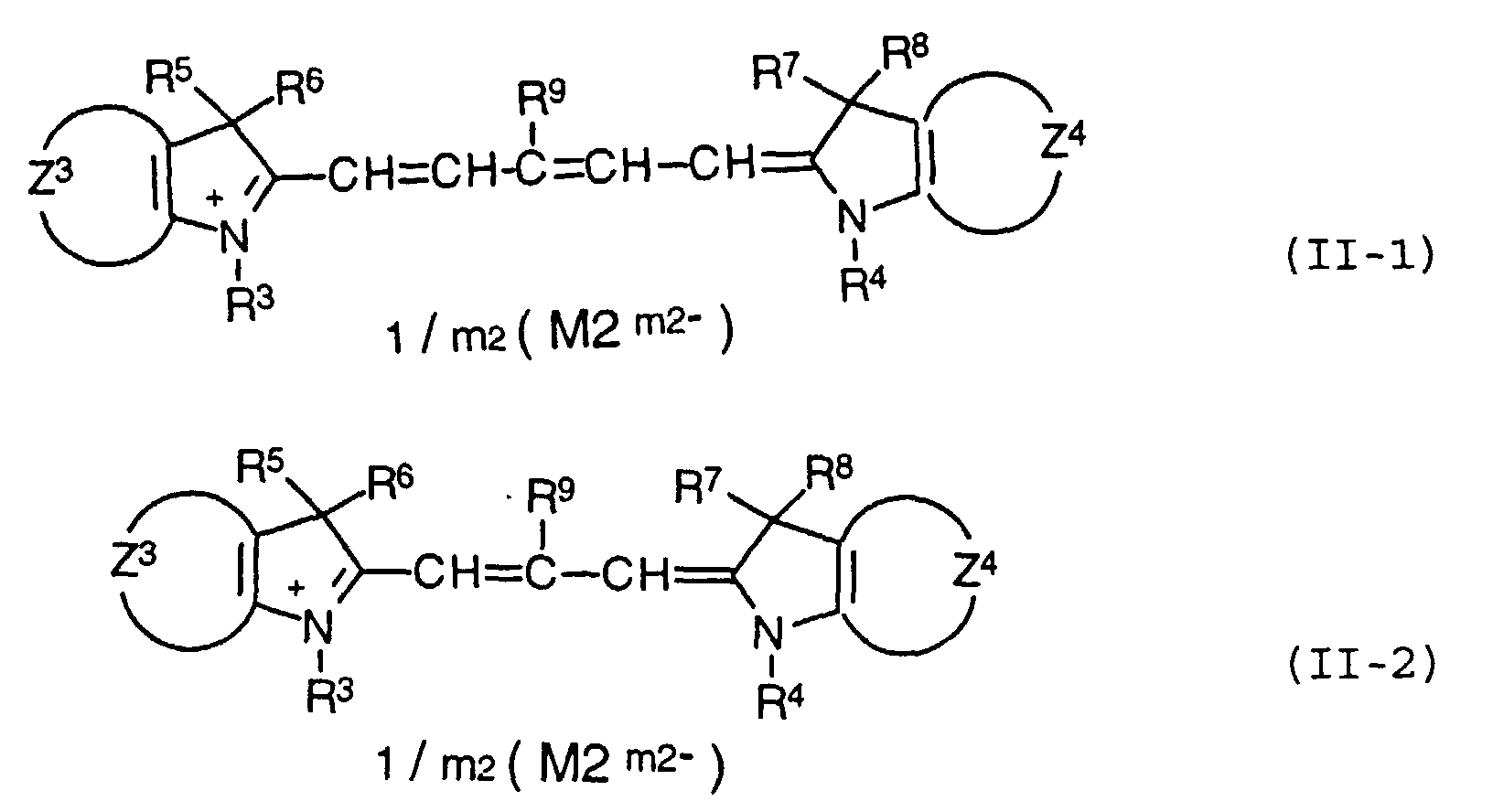
- In the formulas (II-1) and (II-2), each of Z3 and Z4 independently is an atomic group for forming a benzene or naphthalene ring which may have one or more substituents; each of R3, R4, R5, R6, R7 and R8 is independently an alkyl group having 1 to 8 carbon atoms; R9 is hydrogen, an alkyl group having 1 to 8 carbon atoms, an aralkyl group having 7 to 10 carbon atoms, an aryl group having 6 to 10 carbon atoms, an alkoxy group having 1 to 8 carbon atoms, a heterocyclic ring, a halogen atom, or a carbamoyl group having 1 to 8 carbon atoms; M2m2- is an anion; and m2 is 1 or 2.
- With respect to the formulas (II-1) and (II-2), preferred combinations are described below.
- Each of Z3 and Z4 independently is an atomic group for forming a benzene or naphthalene ring having no substituent or a benzene ring having one or two substituents. Examples of the substituents include an alkoxy having 1 to 3 carbon atoms, a halogen atom, an alkoxy group having 1 to 3 carbon atoms, a sulfonamido group, and alkoxy group. If the benzene ring has two adjoining substituents, the adjoining substituents may be combined to form a ring (e.g., 1,3-dioxorane ring).
- Each of R3, R4 is an alkyl group having 1 to 6 carbon atoms, which may have a fluorine or alkoxy substituent.
- Each of R5, R6, R7 and R8 independently is an alkyl group having 1 to 6 carbon atoms which has no substituent.
- R9 is hydrogen, an alkyl group having 1 to 6 carbon atoms, phenyl, benzyl, pyridyl, pyrimidyl, benzoxazole, or halogen.
- M2 is a divalent sulfonate ion, a perchlorate ion, a hexafluorophosphate ion, or a metal complex ion having the following formula:(R is a halogen atom or an alkyl group; M5 is cobalt, nickel, or copper, and u is an integer of 0 to 4).
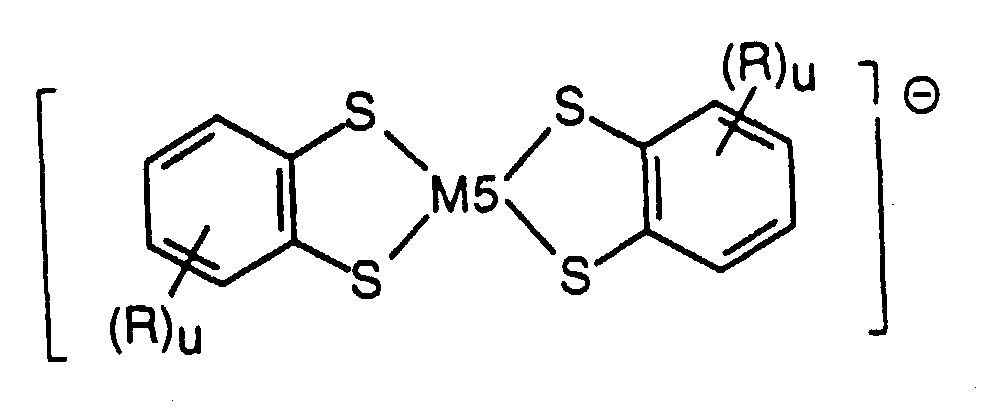
- With respect to the formulas (II-1) and (II-2), most preferred combinations are described below.
- Each of Z3 and Z4 independently is an atomic group for forming a benzene or naphthalene ring having no substituent or a benzene ring having one or two substituents. Examples of the substituents are methyl, chlorine, fluorine, methoxy, ethoxy, sulfonamido, and ethoxycarbonyl. If the benzene ring has two adjoining substituents, the adjoining substituents may be combined to form a ring (e.g., 1,3-dioxorane ring).
- Each of R3, R4 is an alkyl group having 1 to 6 carbon atoms, which have no substituent. Preferred is methyl, ethyl, propyl, isopropyl, or butyl. Each of R5, R6, R7 and R8 independently is methyl or ethyl. R9 is hydrogen, methyl, ethyl, chlorine, or bromine.
- M2 is a divalent sulfonate ion, a perchlorate ion, a hexafluorophosphate ion, or a metal complex ion having the aforementioned formula.
- The cyanine dye of the aforementioned formula (II-1) preferably has one of the following formulas (II-1-A, II-1-B, II-1-C), and the formula (II-1-B) is preferred:

- The cyanine dye of the aforementioned formula (II-2) preferably has one of the following formulas (II-2-A, II-2-B, II-2-C), and the formula (II-2-B) is preferred:
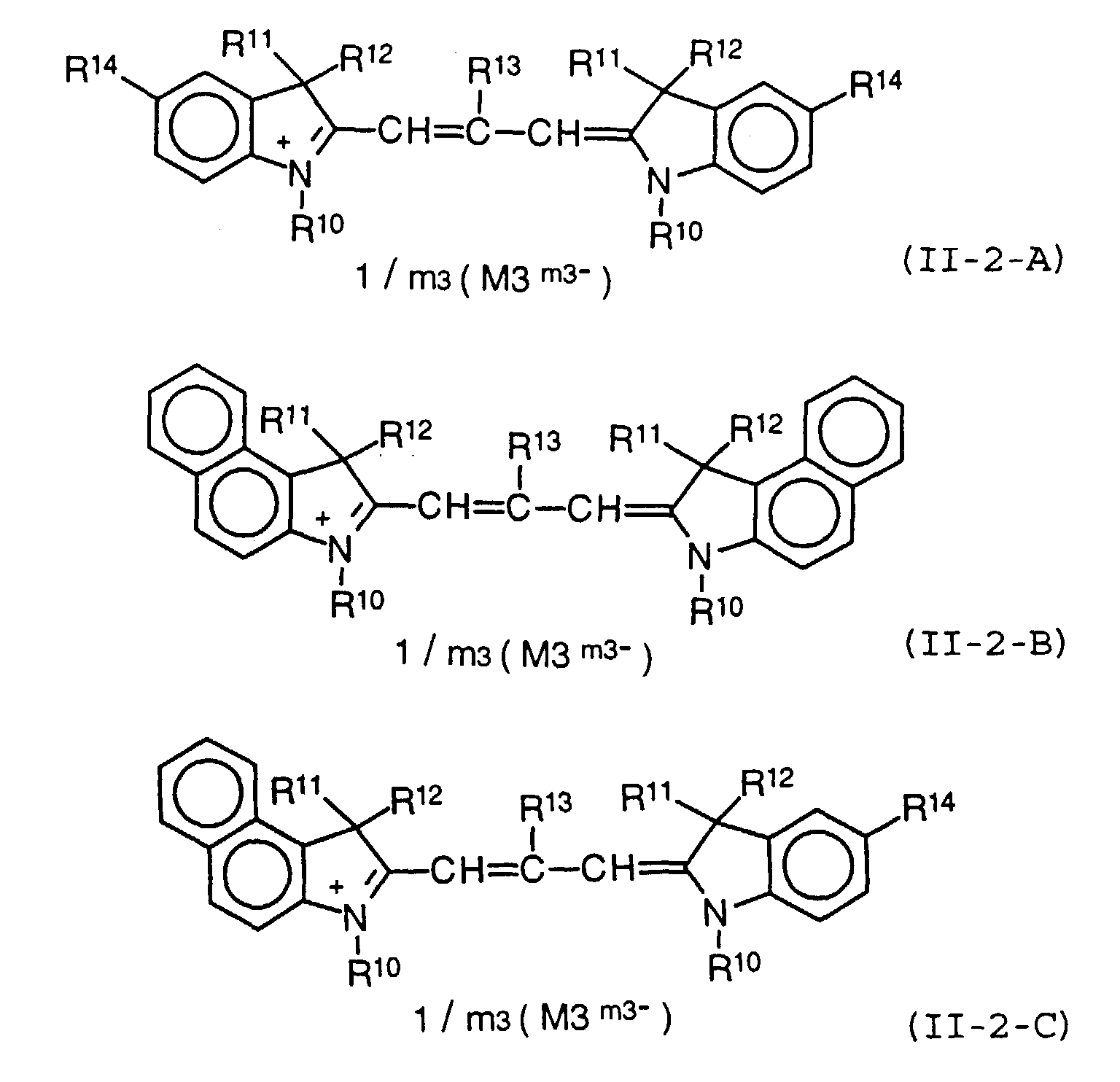
- In the formulas of (II-1-A), (II-1-B), (II-1-C), (II-2-A), (II-2-B), and (II-2-C), R10 has the same meaning as that of R3 or R4 for the formula (II-1) or (II-2); each of R11 and R12 has the same meaning as that of R5, R6, R7, or R8 for the formula (II-1) or (II-2). R13 has the same meaning as that of R9 for the formula (II-1) or (II-2). R14 is hydrogen, methyl, chlorine, fluorine, methoxy, ethoxy, sulfonamido, or ethoxycarbonyl. Each of M3 and m3 has the same meaning as that of M2 and m2, respectively, for the formula (II-1) or (II-2).
- Preferred cyanine dyes having the formula (II) are described below:


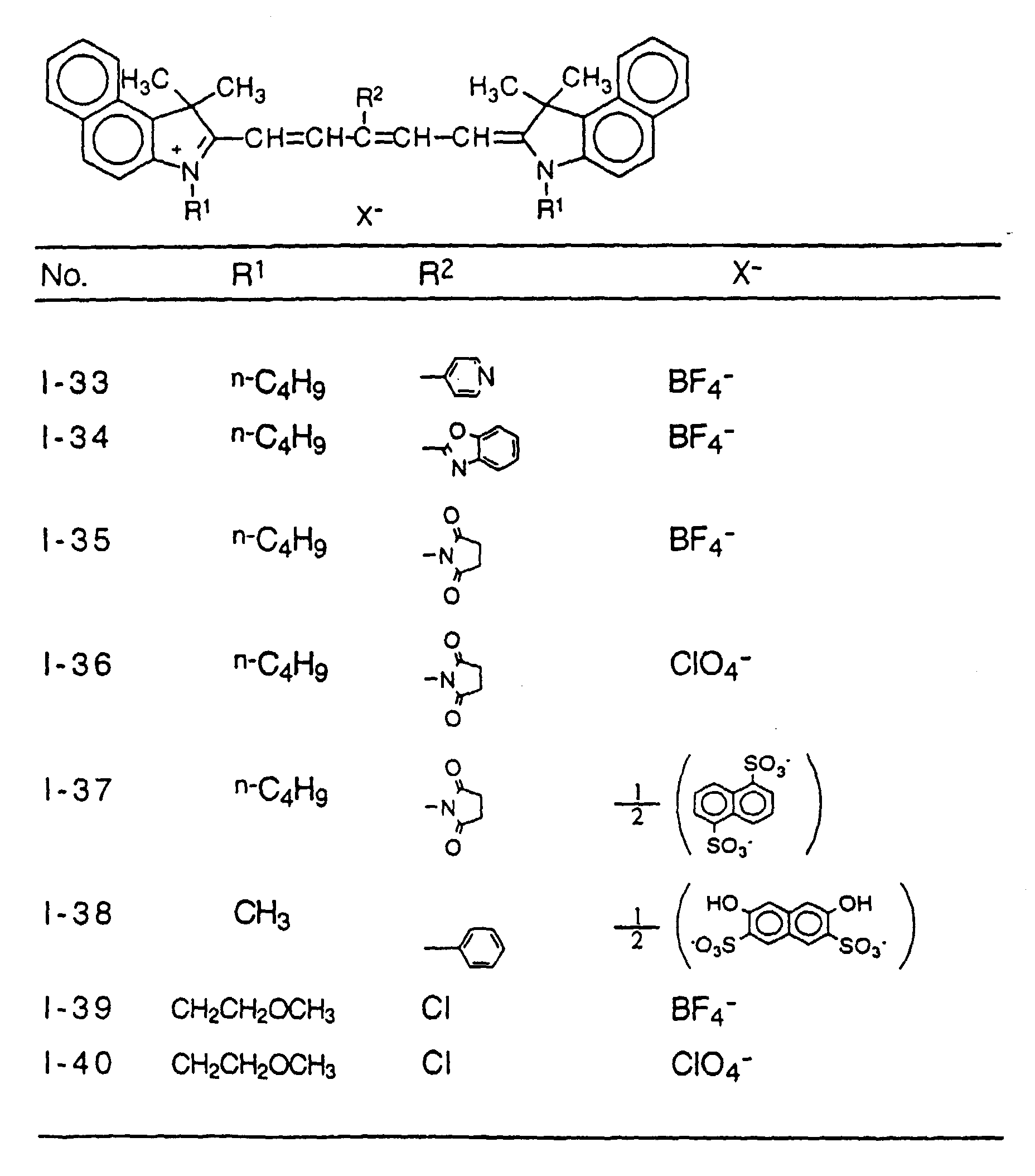
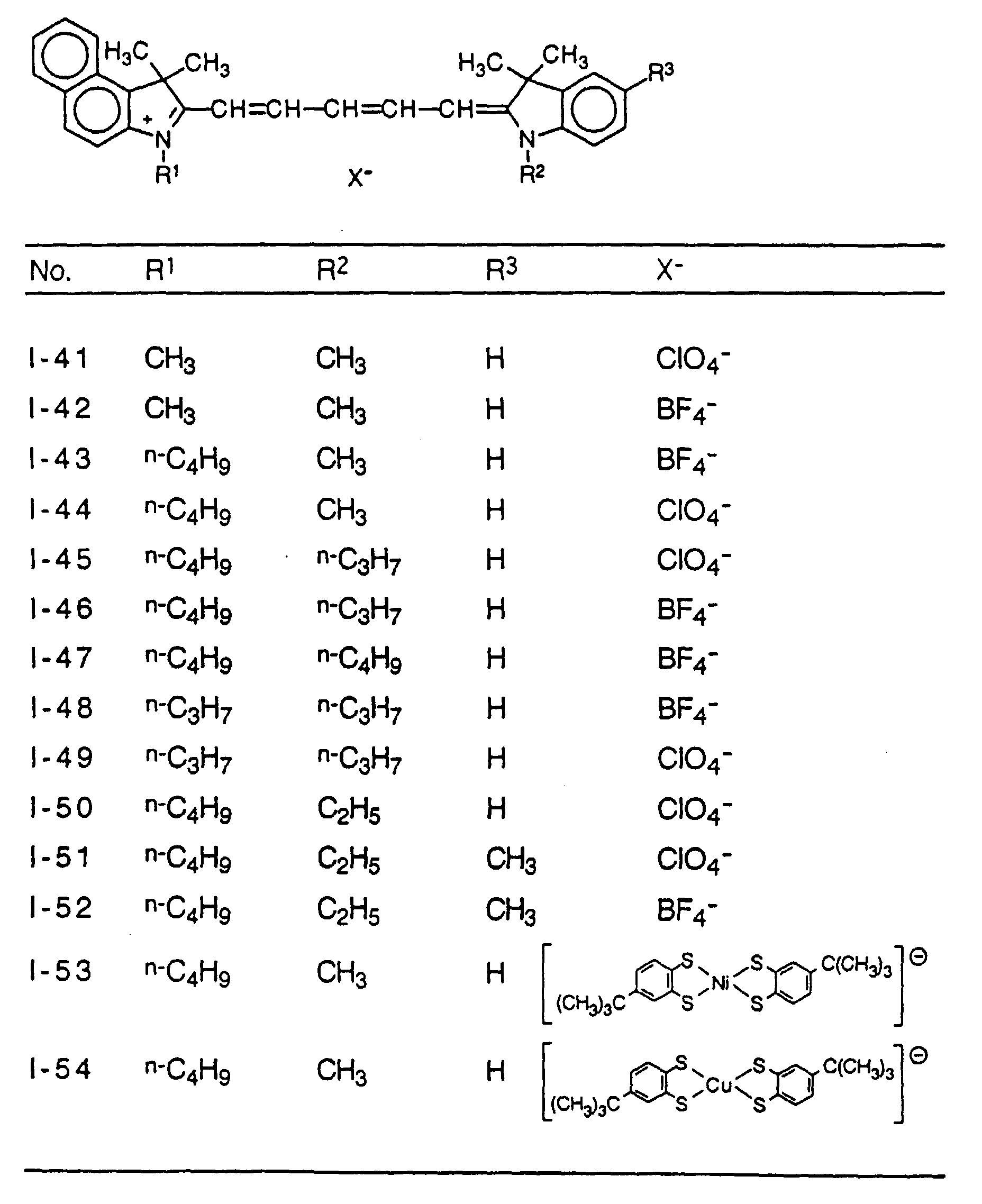
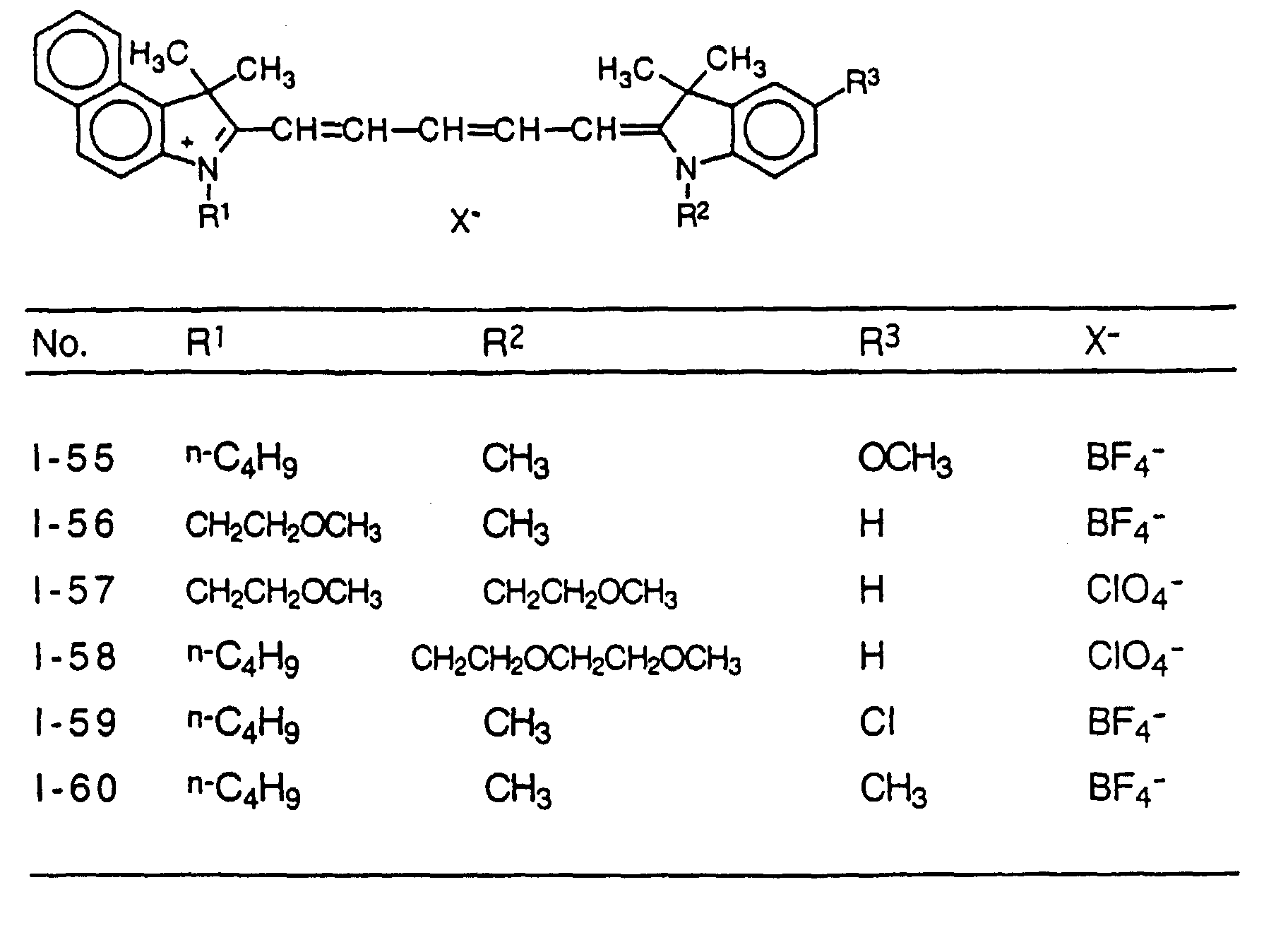
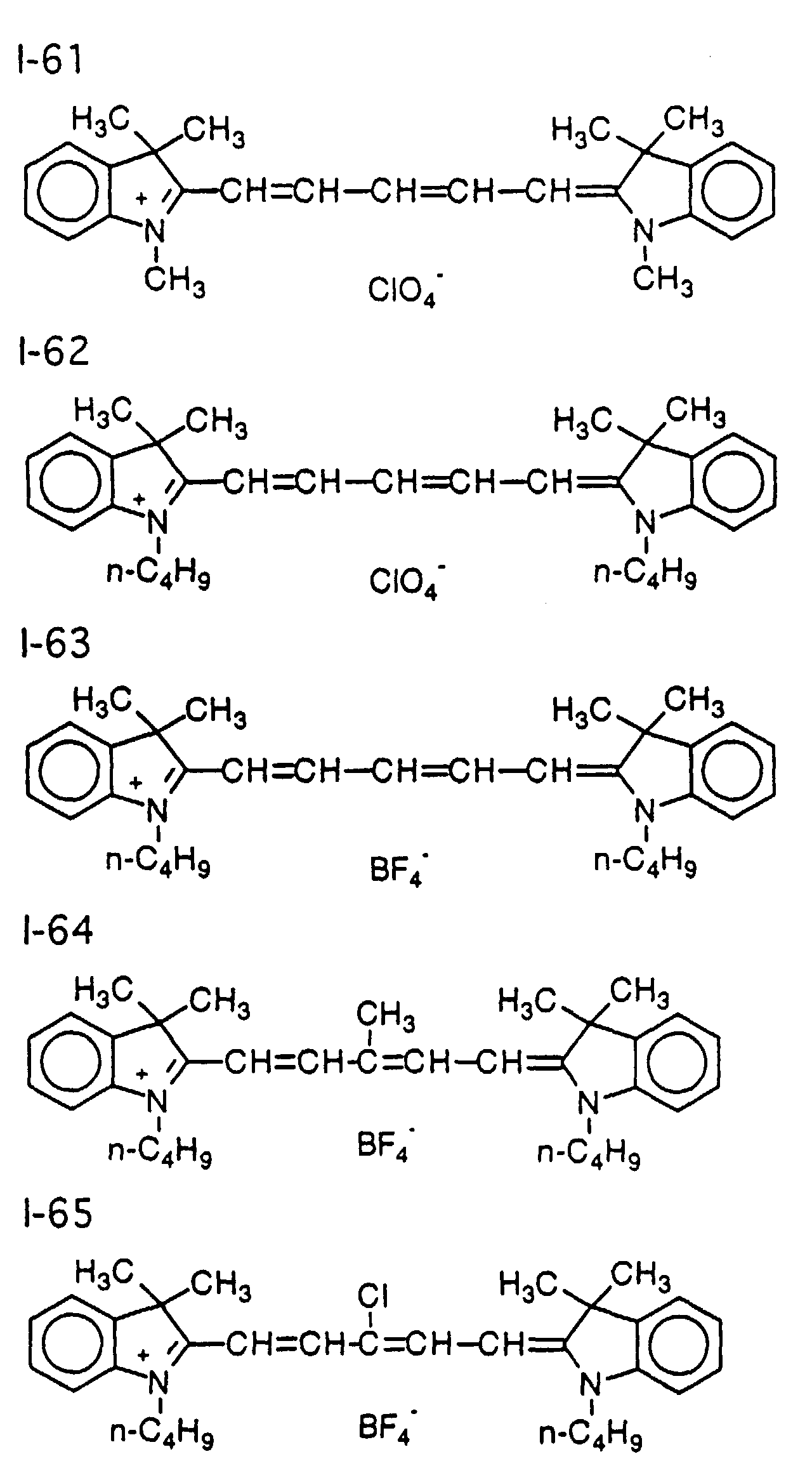


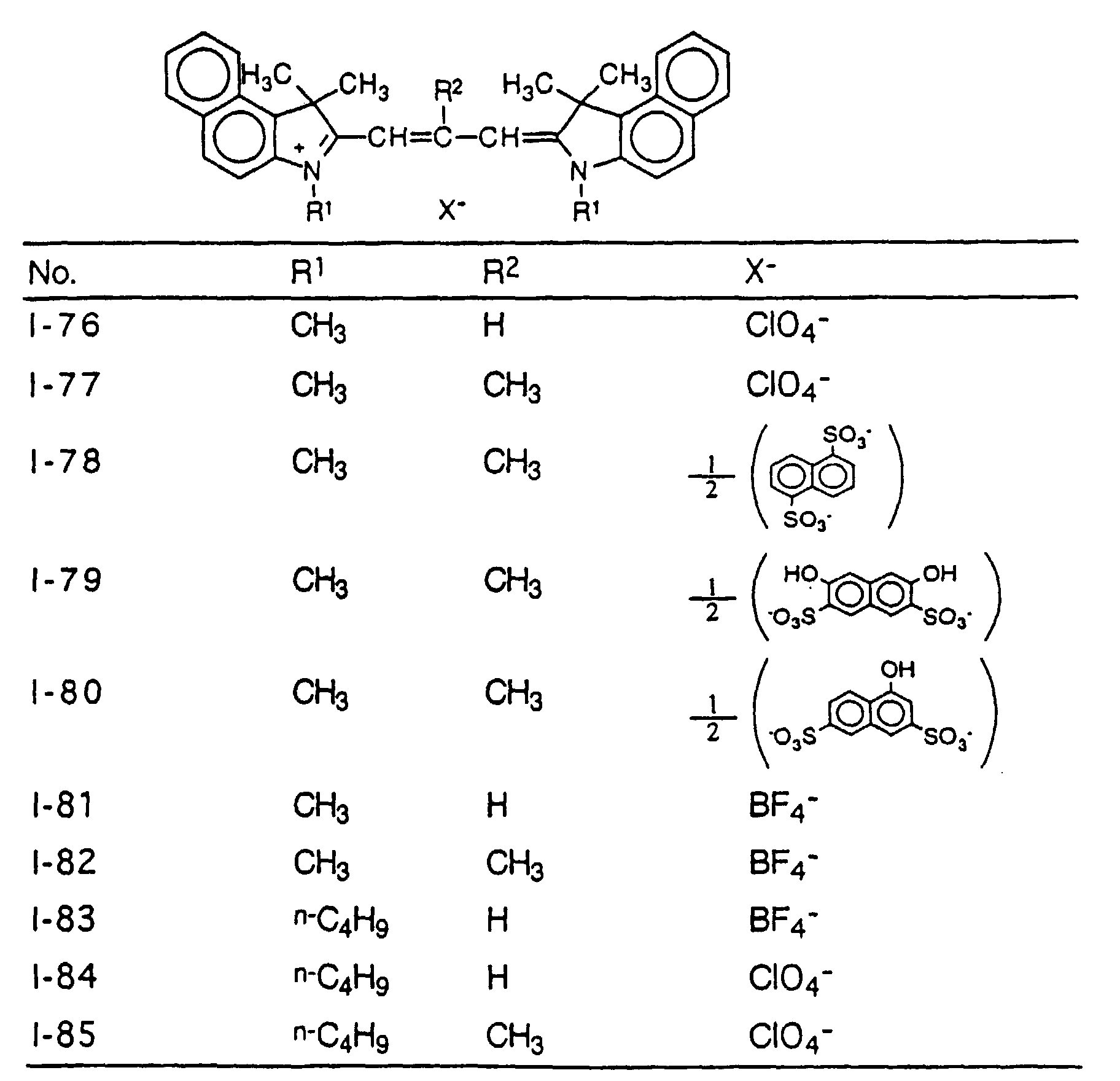

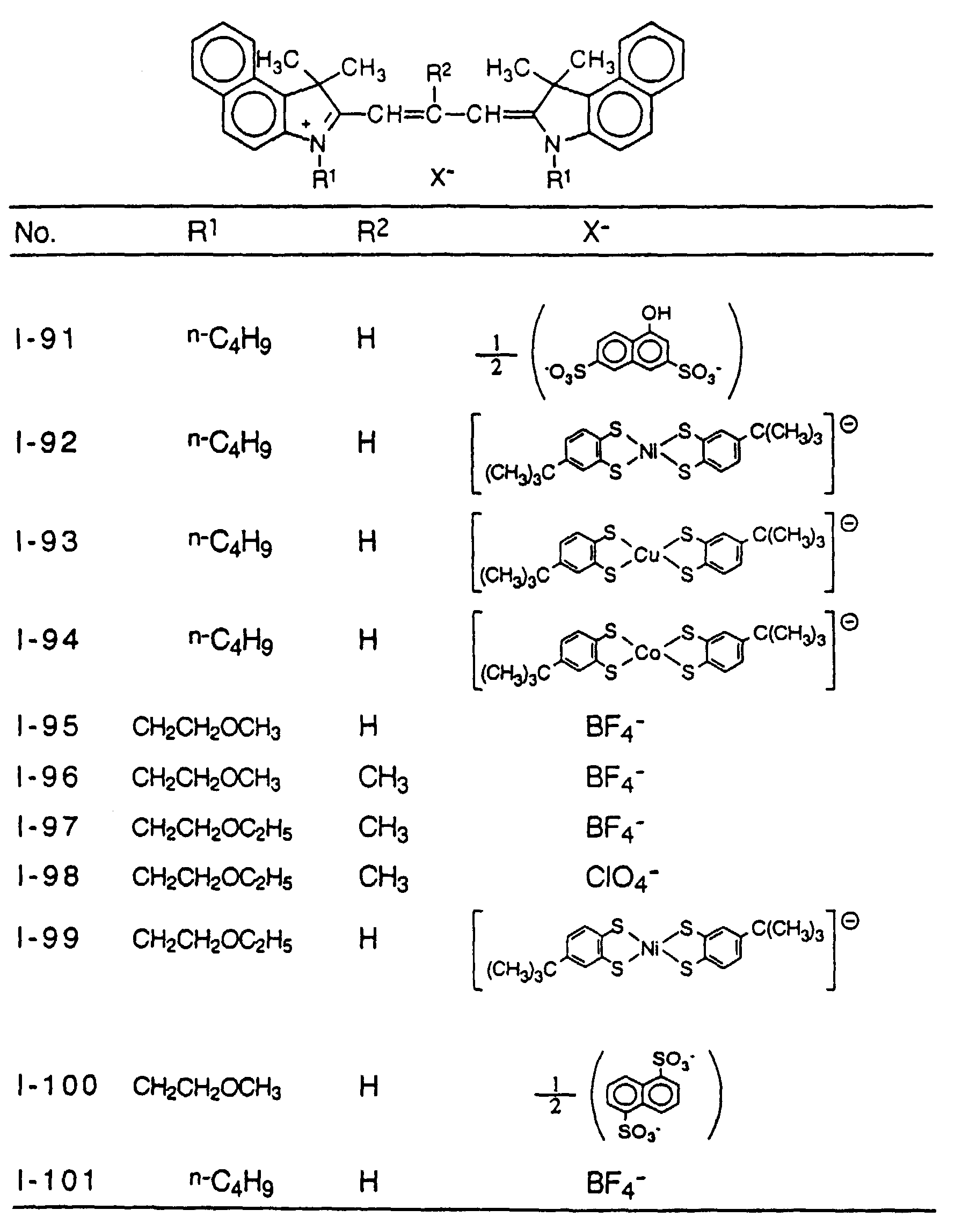
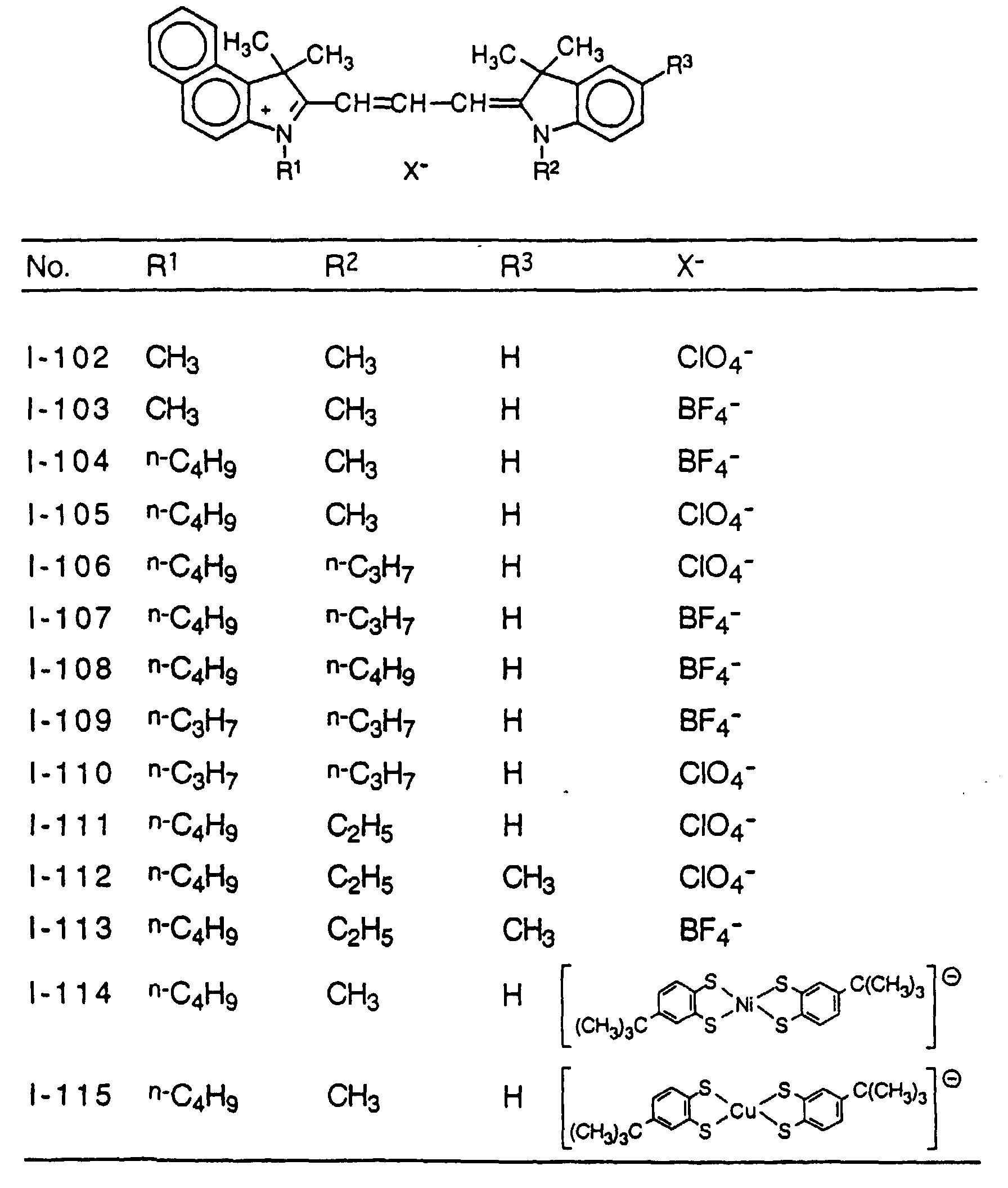
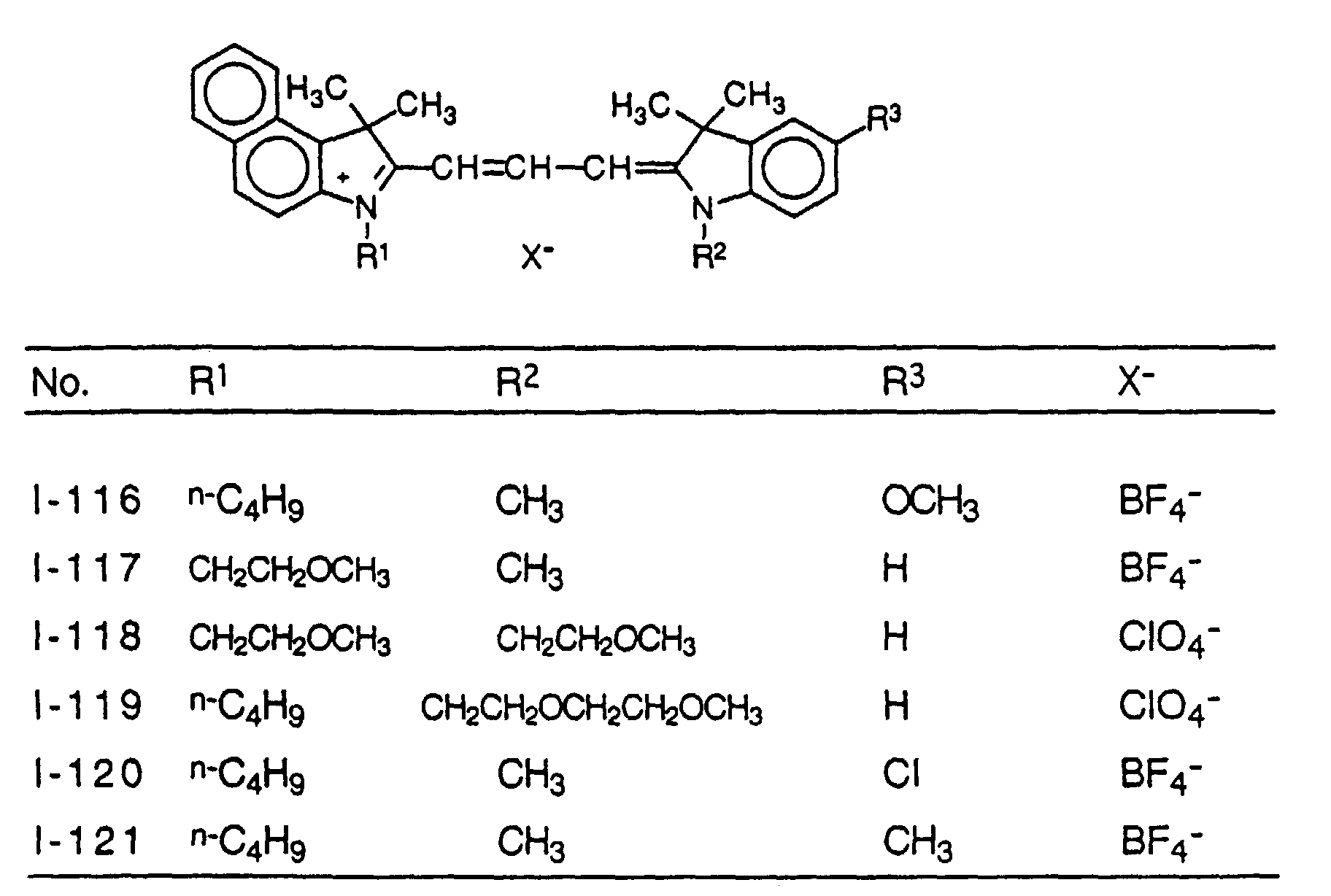


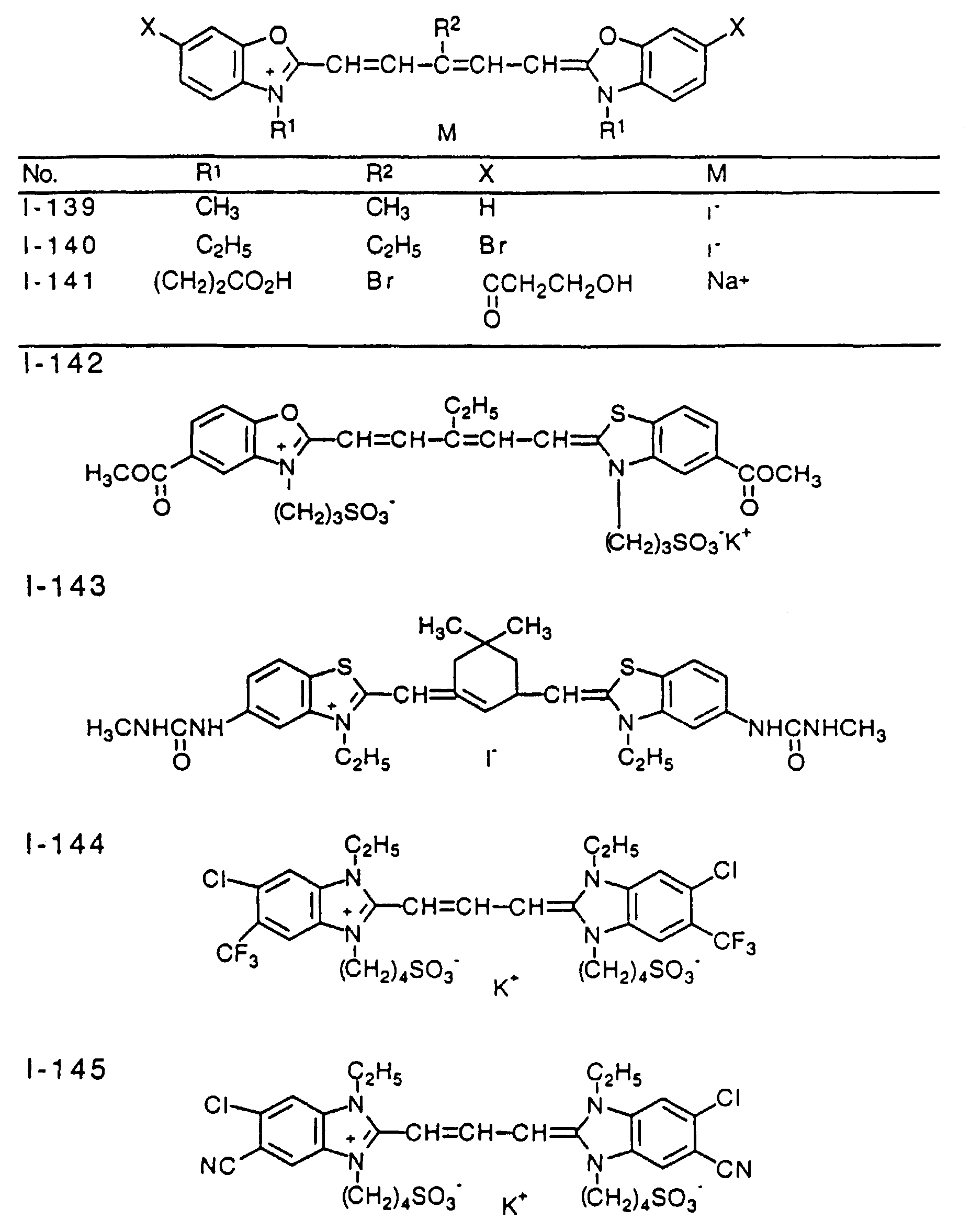


- The azo dyes are preferably represented by the following formula (III):

- In the formula (III), M is a metal atom; X is an oxygen atom, a sulfur atom, or =NR11 in which R11 represents hydrogen, an alkyl group, an aryl group, an acyl group, an alkylsulfonyl group or an axylsulfonyl group; Z11 is an atomic group for forming a 5- or 6-membered nitrogen-containing heterocyclic ring; and Z12 is an atomic group for forming an aromatic ring or a heterocyclic aromatic ring. Each ring may has one or more substituents.
- The azo dyes of the formula (III) preferably have the following formula (III-1):

- In the formula (III-1), M is iron, cobalt, nickel, copper, zinc, palladium, platinum or gold; Y is oxygen atom, sulfur atom or =NR12; each of R12, R13 and R14 independently is an alkyl group having 1 to 12 carbon atoms which may have one or more substituents; R13 and R14 may be combined to form a ring; R15 is an alkyl group having 1 to 12 carbon atoms which may have one or more substituents, a phenyl group having 6 to 16 carbon atoms which may have one or more substituents, or naphthyl group; each of R16 and R17 independently is hydrogen, a halogen atom, an alkyl group, an aryl group, cyano, an acyl group, an alkylsulfonyl group, or an arylsulfonyl group; and each of R18, R19 and R20 independently is hydrogen, an alkyl group, an aryl group, hydroxyl, an alkoxy group, an aryloxy group, amino, a carboxylic amide group, a sulfonamide group, cyano, a halogen atom, an acyl group, an alkylsulfonyl group, or an arylsulfonyl group.
- The azo dyes of the formula (III-1) preferably have the following formula (III-2):
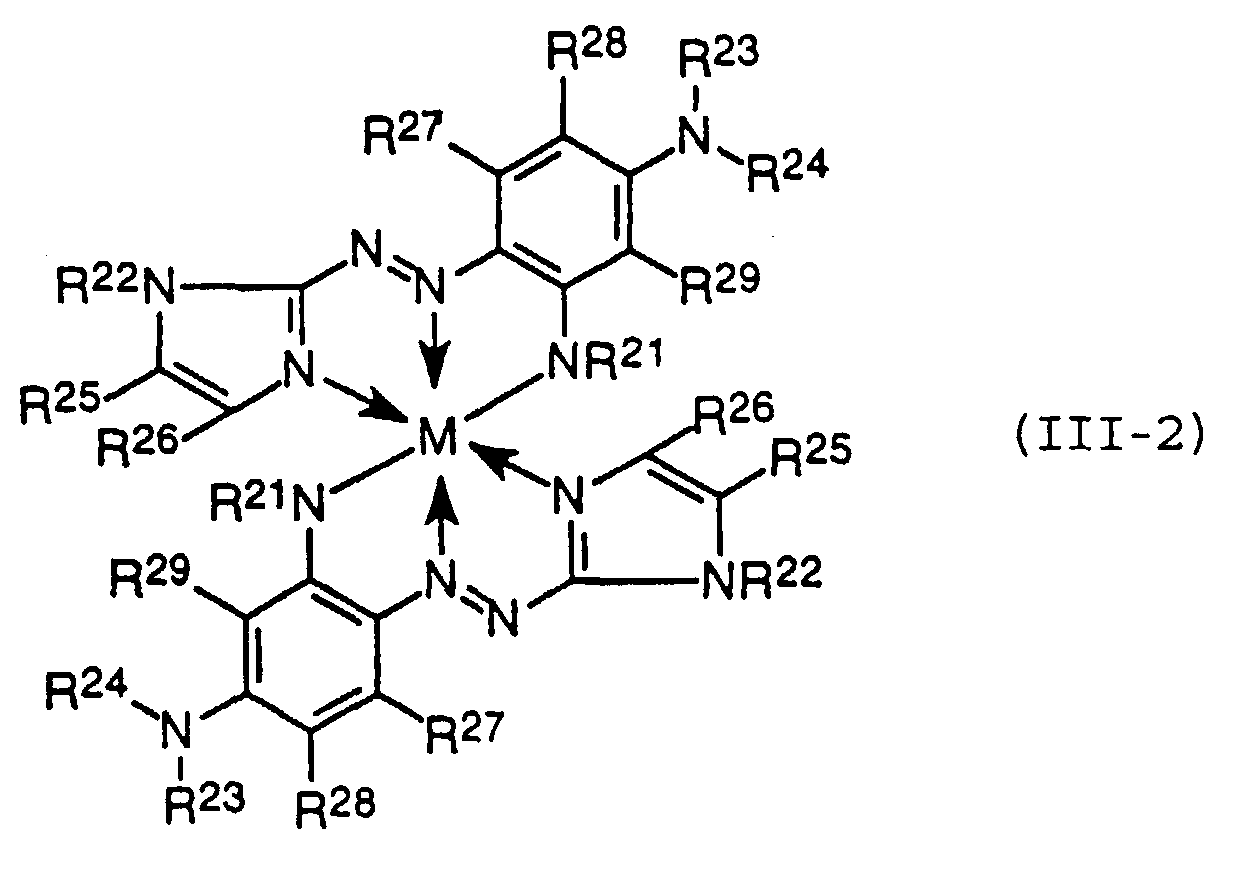
- In the formula (III-2), M preferably is iron, cobalt, or nickel. Nickel is most preferred.
- R21 preferably is an alkylsulfonyl group having 1 to 4 carbon atoms or an arylsulfonyl group having 6 to 10 carbon atoms, which may have one or more substituents. Particularly preferred are an alkylsulfonyl group having 1 to 4 carbon atoms which has no substituent or has a fluorine atom substituent (e.g., methylsulfonyl or trifluoromethylsulfonyl) and an arylsulfonyl group having 6 to 10 carbon atoms, which has no substituent (e.g., phenylsulfonyl).
- Each of R22, R23 and R24 preferably is an alkyl group having 1 to 4 carbon atoms which may have one or more substituents. Preferred substituents are halogen, hydroxyl, cyano, alkoxy, alkylthio, arylthio, acyl, alkylsulfonyl, and arylsulfonyl. More preferably, each of R22, R23 and R24 independently is an alkyl group having 1 to 4 carbon atoms which has no substituent. It is also preferred that R23 and R24 are combined to form a ring (e.g., pyrrolidine or morpholine).
- Each of R25 and R26 preferably is cyano, acyl, alkylsulfonyl, or arylsulfonyl. Most preferred is cyano for each of R25 and R26.
- Each of R27, R28 and R29 preferably is hydrogen, alkyl, aryl, hydroxyl, alkoxy, aryloxy, amino, carbonamio, or sulfonamido. Most preferred is hydrogen for each of R27, R28 and R29.
- Representative examples of the azo dyes of the formula (III) are described below.
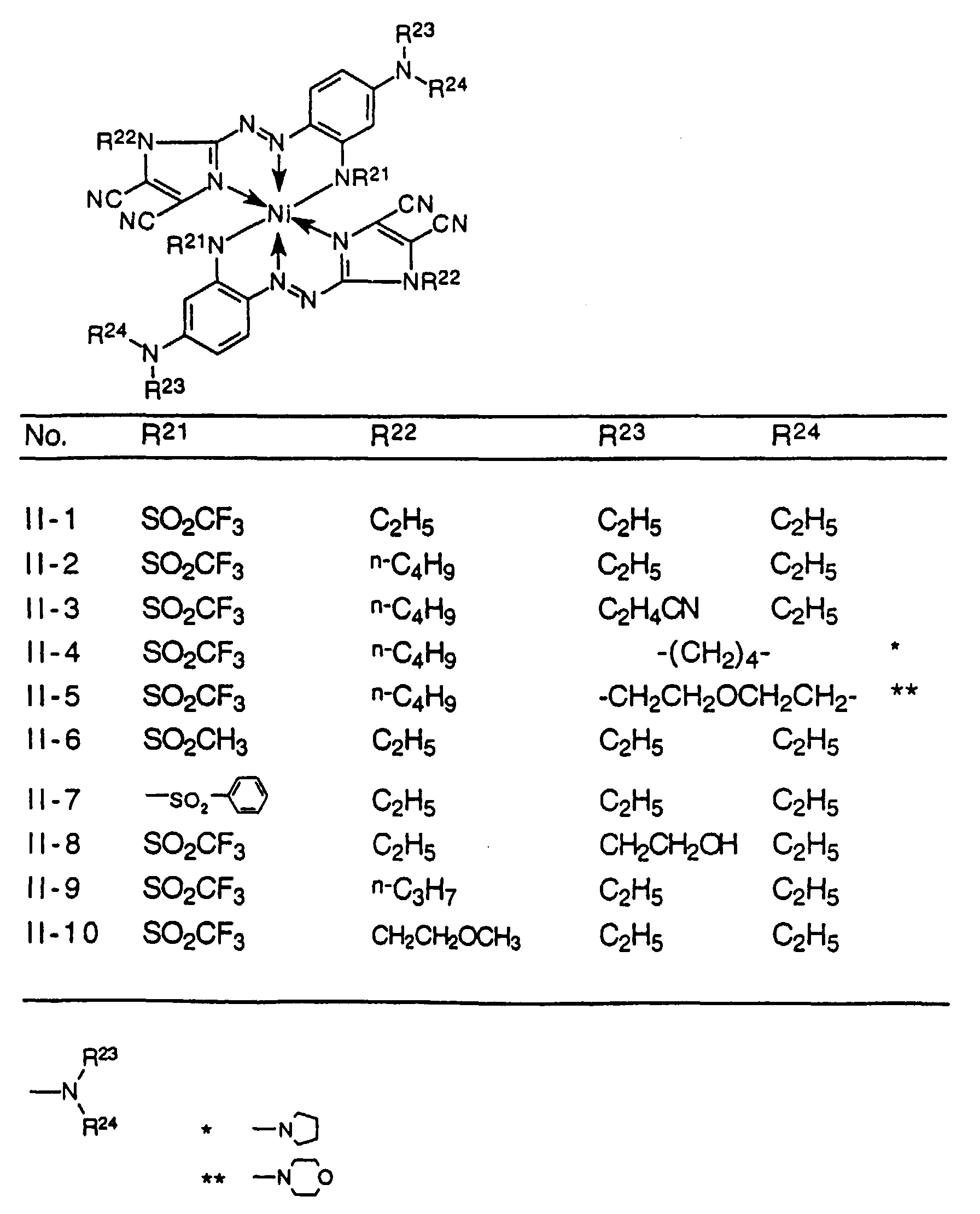
- The oxonol dyes are preferably compounds represented by the following formula (IV-1) or (IV-2). The oxonol dyes of the formulas (IV-1) and (IV-2) are described in Japanese Patent Provisional Publication Nos. 10-297103, 10-309871, and 10-309872.
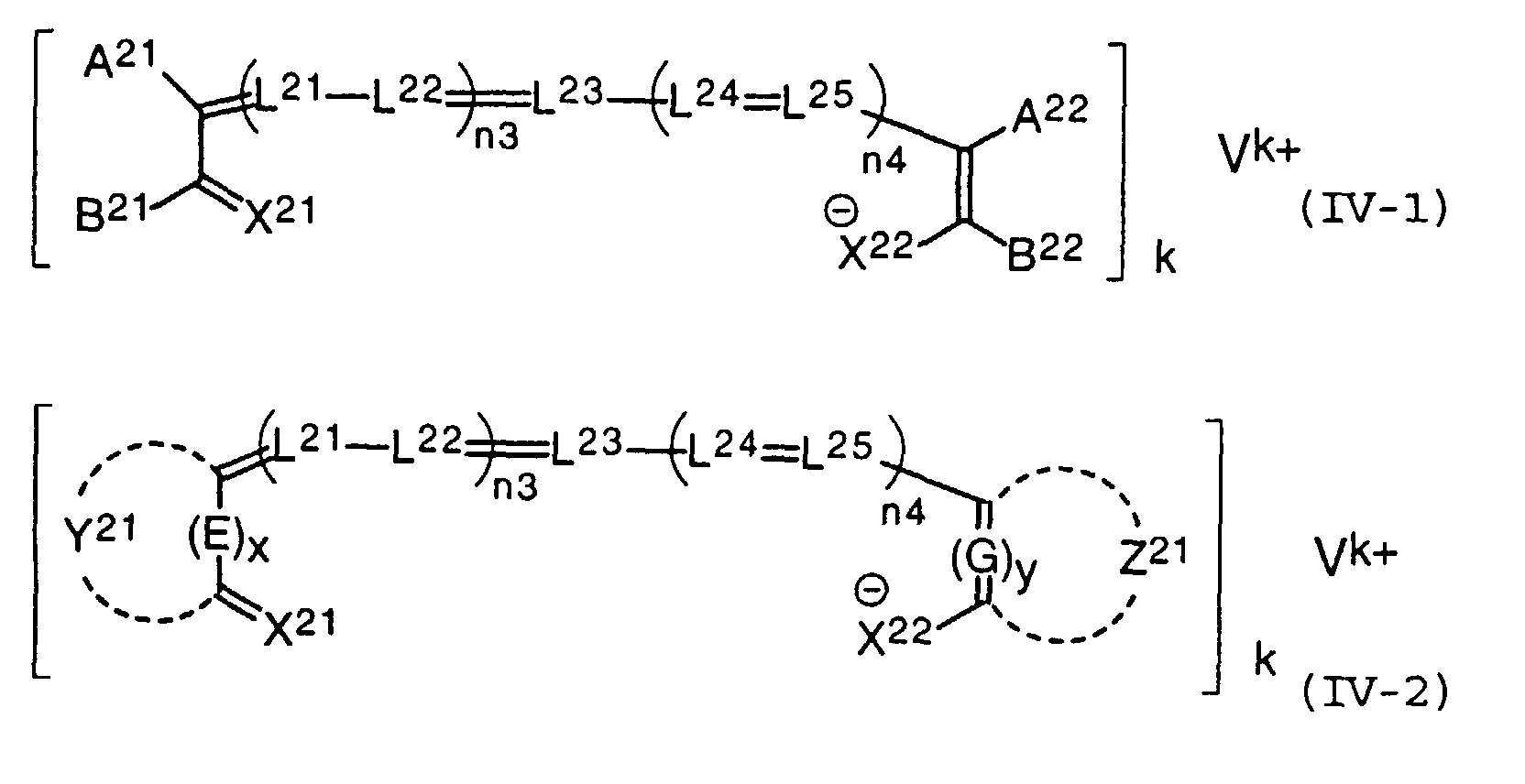
- In the formulas (IV-1) and (IV-2), each of A21, A22, B21 and B22 independently is a substituent group; each of Y21 and Z21 independently is an atomic group for forming a carbocyclic or heterocyclic ring; each of E and G independently is an atomic group for forming a conjugated double bond chain; X21 is =O, =NR21 or =C(CN)2; X22 is -O, -NR21 or -C(CN)2 [in which R21 is a substituent group]; each of L21, L22, L23, L24 and L25 independently is a methine group which may be substituted; Vk+ is a cation; each of n3 and n4 independently is 0, 1 or 2; each of x and y independently is 0 or 1; and k is an integer of 1 to 10.
- Examples of the substituents groups represented by A21, A22, B21 and B22 include a linear (or straight) chain, branched chain, or cyclic alkyl group having 1 to 18 carbon atoms, particularly 1 to 8 carbon atoms, which may have one or more substituents; an alkenyl group having 2 to 18 carbon atoms, particularly 2 to 8 carbon atom; an aryl group having 6 to 18 carbon atoms, particularly 6 to 10 carbon atoms, which may have one or more substituents; an aralkyl group having 7 to 18 carbon atoms, particularly 7 to 12 carbon atoms, which may have one or more substituents; an acyl group having 2 to 18 carbon atoms, particularly 2 to 8 carbon atoms, which may have one or more substituents; an alkyl- or arylsulfonyl group having 1 to 18 carbon atoms, particularly 1 to 8 carbon atoms, which may have one or more substituents; an alkylsulfinyl group having 1 to 18 carbon atoms, particularly 1 to 8 carbon atoms, an alkoxycarbonyl group having 2 to 18 carbon atoms, particularly 2 to 8 carbon atoms, an aryloxycarbonyl having 7 to 18 carbon atoms, particularly 7 to 12 carbon atoms, an alkoxy group having 1 to 18 carbon atoms, particularly 1 to 8 carbon atoms, which may have one or more substituents; an axyloxy group having 6 to 18 carbon atoms, particularly 6 to 10 carbon atoms, which may have one or more substituents; an alkylthio group having 1 to 18 carbon atoms, particularly 1 to 8 carbon atoms, an axylthio group having 6 to 18 carbon atoms, particularly 6 to 10 carbon atoms; an acyloxy group having 2 to 18 carbon atoms, particularly 2 to 8 carbon atoms, which may have one or more substituents; a sulfonyloxy group having 1 to 18 carbon atoms, particularly 1 to 8 carbon atoms, which may have one or more substituents; a carbamoyloxy group having 1 to 18 carbon atoms, particularly 1 to 8 carbon atoms, which may have one or more substituents; an unsubstituted amino group; an amino group having a substituent which has 1 to 18 carbon atoms, particularly 1 to 8 carbon atoms; an unsubstituted carbamoyl group; a carbamoyl group having a substituent which has 1 to 18 carbon atoms, particularly 1 to 8 carbon atoms; an unsubstituted sulfamoyl group; a sulfamoyl group having a substituent which has 1 to 18 carbon atoms, particularly 1 to 8 carbon atoms; a halogen atom, and a heterocyclic group. These substituents may have one or more substituents.
- Each of [-C(=L21)-(E)x-C(=X21)-] (referred to as W1) combined with Y21 and [-C(=L25)-(G)y-C(-X22)-] (referred to as W2) combined with Z21 is under conjugated condition. Therefore, a carbon ring or a heterocyclic ring formed by Y21 and W1 as well as Z21 and W2 is in a resonance structure. The carbon ring or heterocyclic ring preferably is one of 4- to 7-membered rings, preferably 5- to 6-membered rings. These rings may be fused with other 4- to 7-membered rings to form a condensed ring. These rings may have one or more substituents such as those hereinbefore described for A21, A22, B21 and B22.
- It is preferred that each of x and y is 0. It is also preferred that X21 is =O and X22 is -O.
- The oxonol dyes are preferably represented by the following formula (IV-2-A):
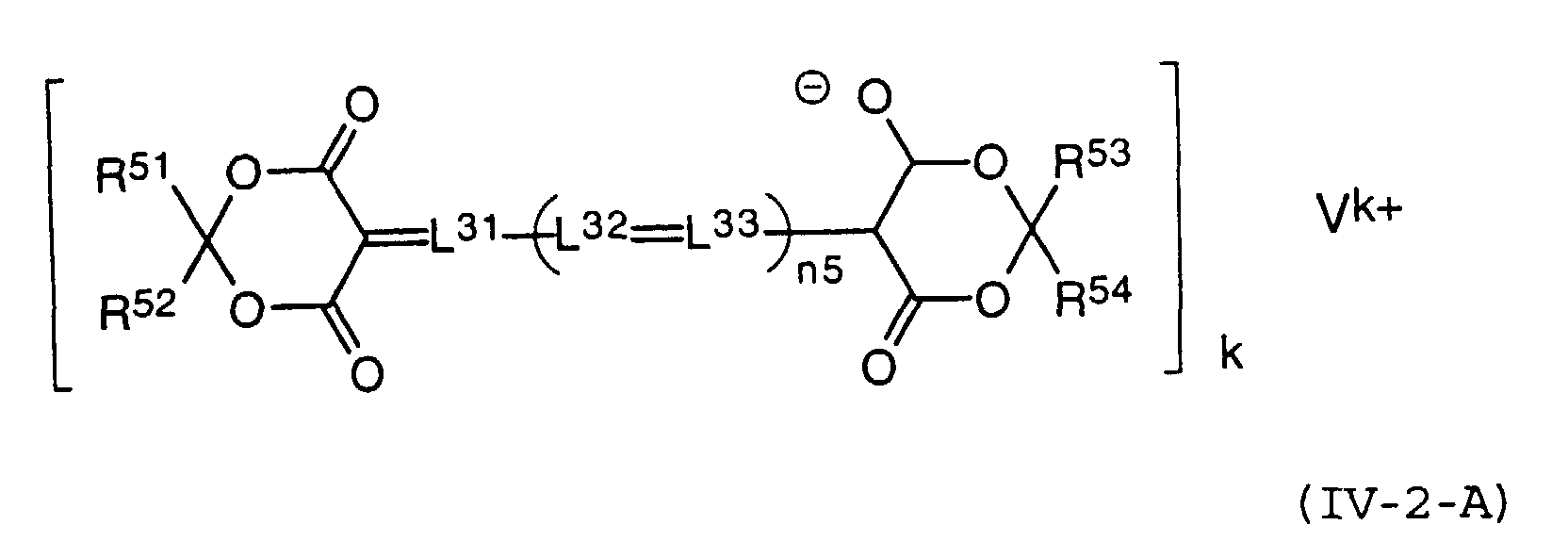
- In the formula, each of R51, R52, R53 and R54 independently is hydrogen, an alkyl group, an aryl group, an aralkyl group, or heterocyclic group. These group may have one or more substituents. Each of L31, L32, and L33 independently is a methine group which may have a substituent. n5 is 0, 1, 2, or 3. If n5 is 2 or 3, each of the plural L32 and L33 may be the same or different. Vk+ is a cation. k is an integer of 1 to 10.
- The anionic component (namely, anion part) is described below.
- The alkyl group for R51, R52, R53 and R54 preferably is an alkyl group having 1 to 20 carbon atoms, which may have one or more substituents, such as methyl, ethyl, propyl, butyl, isobutyl, t-butyl, isoamyl, cyclopropyl, or cyclohexyl.
- Examples of the above-mentioned substituents include an alkyl group having 1 to 20 carbon atoms (e.g., methyl, ethyl, propyl, carboxymethyl, or ethoxycarbonyl); an aralkyl group having 7 to 20 carbon atoms (e.g., benzyl or phenethyl); an alkoxy group having 1 to 8 carbon atoms (e.g., methoxy or ethoxy); an aryl group having 6 to 20 carbon atoms (e.g., phenyl or naphthyl); an aryloxy group having 6 to 20 carbon atoms (e.g., phenoxy or naphthoxy); a heterocyclic group (e.g., pyridyl, pyrimidyl, pyridazyl, benzoimidazolyl, benzothiazolyl, benzoxazolyl, 2-pyrrolidin-1-yl, 2-piperidon-1-yl, 2,4-dioxyimidazolidin-3-yl, 2,4-dioxyoxazolidin-3-yl, succinimido, phthalimido, or maleimido); a halogen atom (e.g., fluorine, chlorine, bromine, or iodine); a carboxyl group; an alkoxycarbonyl group having 2 to 10 carbon atoms (e.g., methoxycarbonyl or ethoxycarbonyl); a cyano group; an acyl group having 2 to 10 carbon atoms (e.g., acetyl or pivaloyl); a carbamoyl group having 1 to 10 carbon atoms (e.g., carbamoyl, methyl carbamoyl, or morpholinocarbamoyl); an amino group; an amino group having a substituent which has 1 to 20 carbon atoms (e.g., dimethylamino, diethylamino, bis(methylsulfonylethyl)amino, or N-ethyl-N'-sulfoethylamino); a sulfo group; a hydroxyl group; a nitro group; a sulfonamido group having 1 to 10 carbon atoms (e.g., methanesulfonamido); a ureido group having 1 to 10 carbon atoms (e.g., ureido or methylureido); a sulfonyl group having 1 to 10 carbon atoms (e.g., methanesulfonyl or ethanesulfonyl); a sulfinyl group having 1 to 10 carbon atoms (e.g., methanesulfinyl); and a sulfamoyl group having 0 to 10 carbon atoms (e.g., sulfamoyl or methanesulfamoyl). The carboxyl group and sulfo group may be in the form of a salt.
- The aryl group for R51, R52, R53 and R54 can be an aryl group having 6 to 20 carbon atoms (e.g., phenyl or naphthyl). The aryl group may have one or more substituents such as those described above.
- The aralkyl group for R51, R52, R53 and R54 can be an aralkyl group having 7 to 20 carbon atoms (e.g., benzyl or phenethyl). The aralkyl group may have one or more substituents such as those described above.
- The heterocyclic group for R51, R52, R53 and R54 can be a 5- or 6-membered saturated or unsaturated heterocyclic group which comprises one or more of carbon atoms, nitrogen atoms, oxygen atoms, and/or sulfur atoms. Examples include pyridyl, pyrimidyl, pyridazyl, piperidyl, triazyl, pyrrolyl, imidzolyl, triazolyl, furanyl, thiophenyl, thiazolyl, oxazolyl, isothiazolyl, and isoxazolyl. These heterocyclic group may be fused with a benzene ring to form a condensed ring, such as, quinolyl, benzoimidazolyl, benzothiazolyl, or benzoxazolyl. The heterocyclic group may have one or more substituents such as those described above.
- Each of R51, R52, R53 and R54 preferably is an alkyl group having 1 to 8 carbon atoms, an aryl group having 6 to 10 carbon atoms, an aralkyl group having 7 to 10 carbon atoms, or a heterocyclic group having 6 to 10 carbon atoms.
- If each of R51, R52, R53 and R54 is an alkyl group, R51 and R52 or R53 and R54 can be combined to form a carbon ring (e.g., cyclopropyl, cyclobutyl, cyclopentyl, cyclohexyl, 2-methylcyclohexyl, cycloheptyl, or cycloctyl) or a heterocyclic ring (e.g., piperidyl, curomanyl, or morpholyl). R51 and R52 or R53 and R54 are preferably combined to form a carbon ring having 3 to 10 carbon atoms or a heterocyclic group having 2 to 10 carbon atoms.
- Each of L31, L32 and L33 independently is a substituted or unsubstituted methine group. Examples of the substituents can be those described hereinbefore. Each of L31, L32 and L33 preferably is an unsubstituted methine group, or a methine group having a substituent such as an alkyl group having 1 to 5 carbon atoms, an aralkyl group having 7 to 10 carbon atoms, an aryl group having 6 to 10 carbon atoms, a saturated or unsaturated heterocyclic group, or a halogen atom. n5 preferably is 1, 2 or 3.
- Preferred anion parts of the oxonol dyes having the formula (IV-1) or (IV-2), particularly (IV-2-A), are illustrated below.

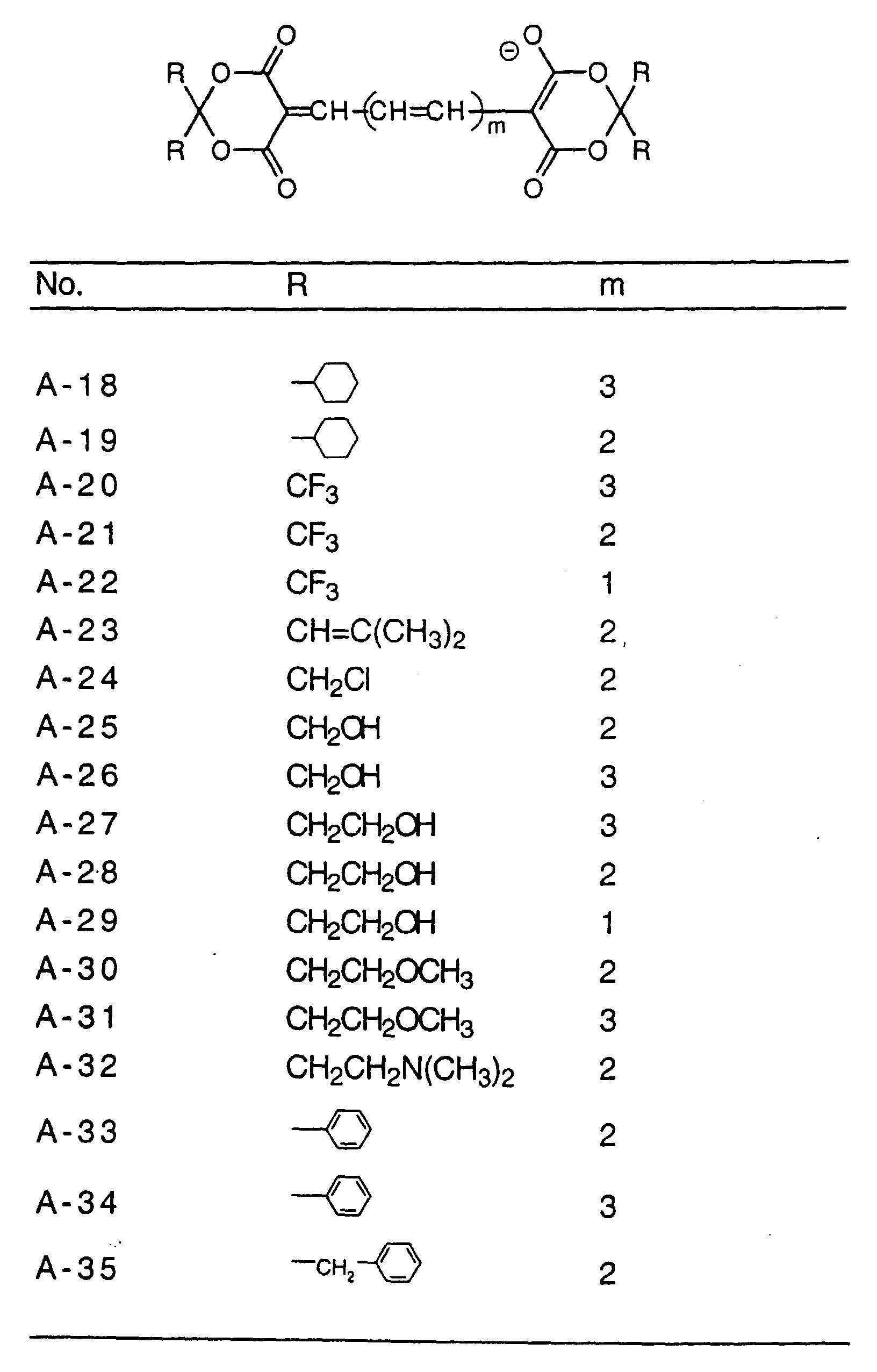


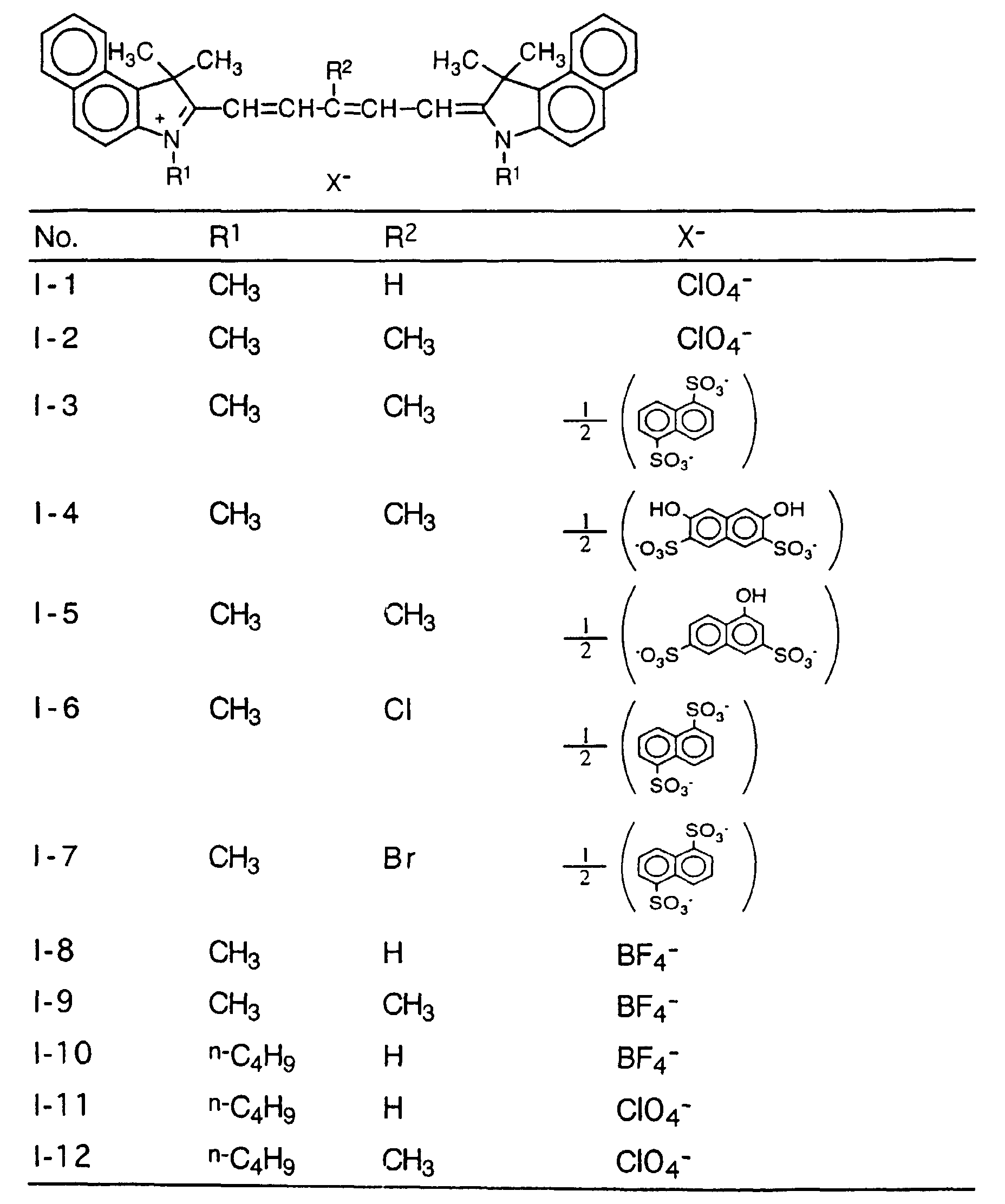

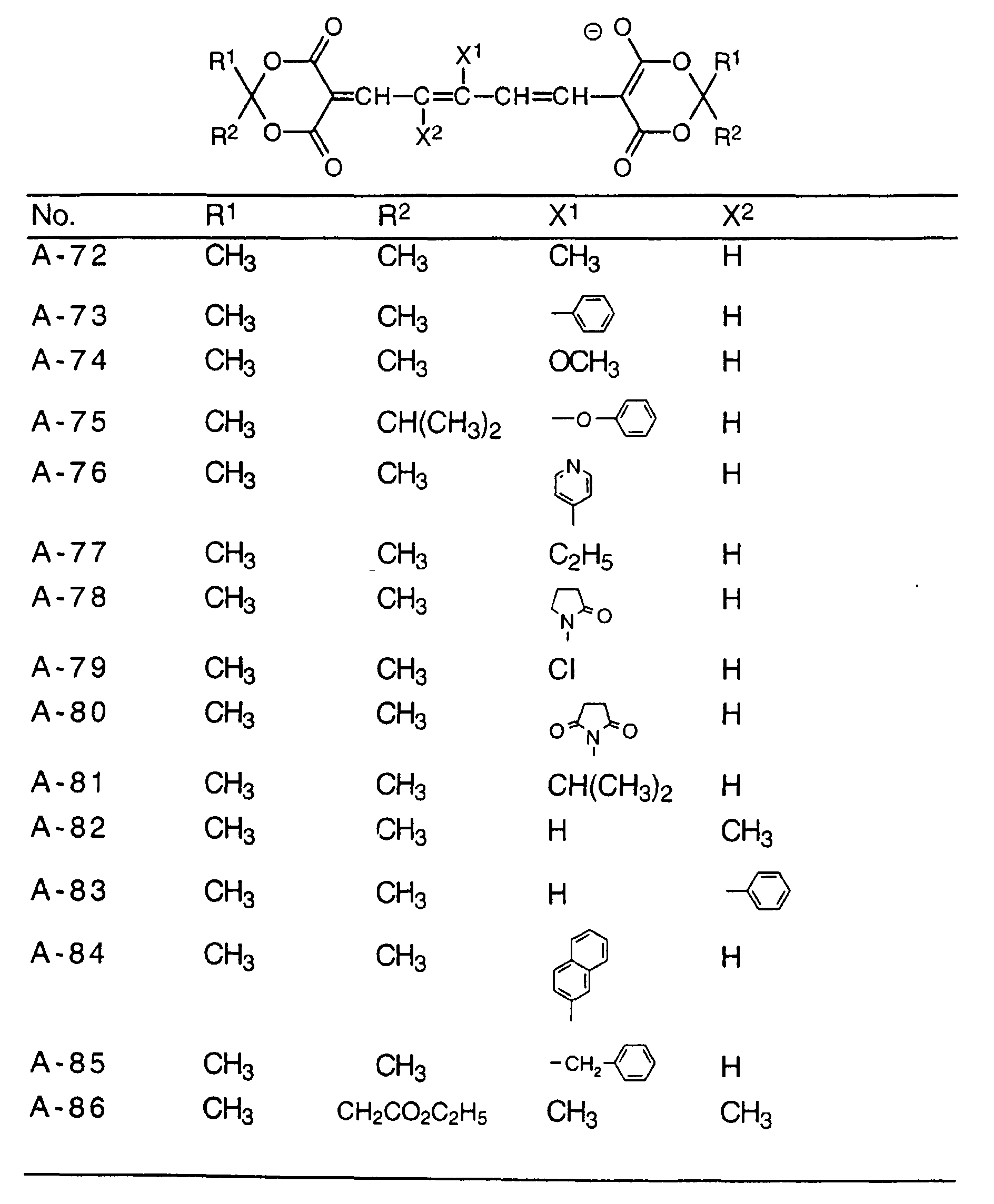

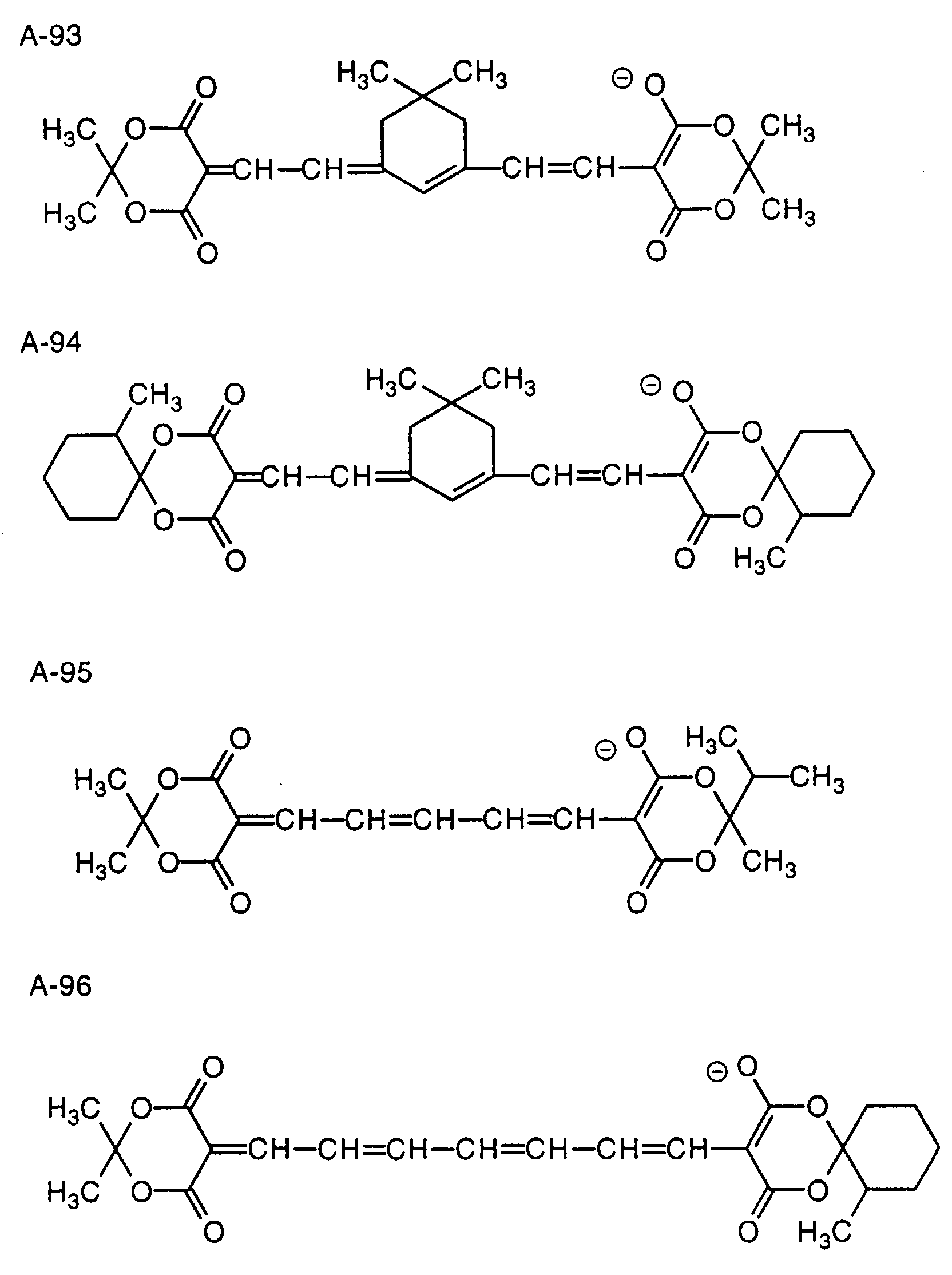
- The cationic component (namely, cation part) is described below.
- Examples of the cation parts represented by Vk+ include hydrogen ion, metal ions such as sodium ion, potassium ion, lithium ion, calcium ion, iron ion, and copper ion, ammonium ions, pyridinium ion, oxonium ions, sulfonium ions, phosphonium ions selenonium ion, and iodonium ion. Vk+ preferably is not a cyanine ion. Preferred is a quaternary ammonium ion.
- The quaternary ammonium ion can be prepared by alkylation (Menshutkin reaction), alkenylation, alkynylation or arylation of a tertiary amine (e.g., trimethylamine, triethylamine, tributylamine, triethanolamine, N-methylpyrrolidine, N-methylpiperidine, N,N-dimethylpiperazine, triethylenediamine, or N,N,N',N'-tetramethylethylenediamine) or a compound having a nitrogen atom-containing heterocyclic ring such as a pyridine, picoline, 2,2'-bipyridyl, 4,4'-bipyridyl, 1,10-phenanthroline, quinoline, oxazole, thiazole, N-methylimidazole, pyrazine, or tetrazole).
- The quaternary ammonium ion preferably has a nitrogen-containing heterocyclic group. Most preferred is a quaternary pyridinium ion.
- k is an integer of 1 to 10, preferably 1 to 4. Most preferred is 2.
- The quaternary ammonium ion preferably has the below-mentioned formula (V-1). This compound can be easily prepared by the Menshutkin reaction (see, for instance, Japanese Patent Provisional Publication No. 61-148162) or arylation (see, for instance, Japanese Patent Provisional Publications No. 51-16675 and No. 1-96171) of 2,2'-bipyridyl or 4,4'-bipyridyl with a halide having the desired substituent.
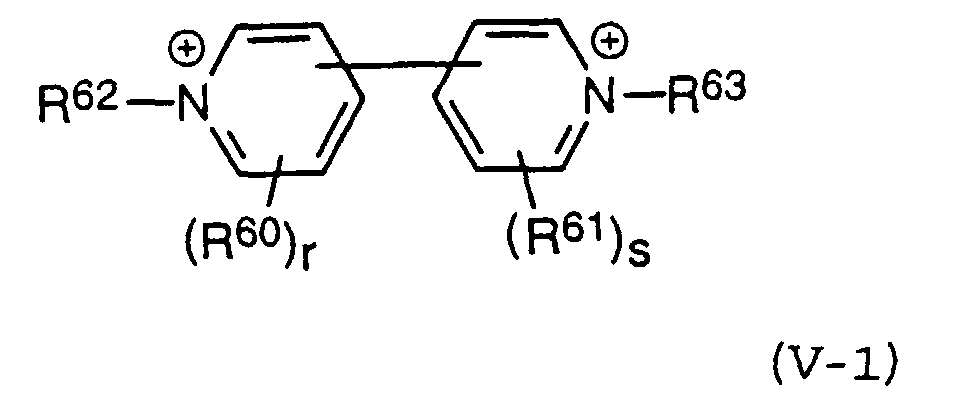
- In the formula (V-1), each of R60 and R61 independently is a substituent, and each of R62 and R63 is alkyl, alkenyl, alkynyl, aralkyl, aryl, or a heterocyclic group. Each combination of R60 and R61, R60 and R62, and R61 and R63 may be combined with each other to form a ring. Each of r and s independently is an integer of 0 to 4. If any of r and s is 2 or more, plural numbers of R60 and R61 may be the same or different.
- The alkyl group for R62 and R63 preferably is a straight chain, branched chain, or cyclic alkyl group having 1 to 18 carbon atoms, more preferably 1 to 8 carbon atoms, which may have one or more substituents. Examples are methyl, ethyl, n-propyl, isopropyl, n-butyl, isobutyl, t-butyl, neopentyl, n-hexyl, cyclopropyl, cyclohexyl, or adamantyl.
- Examples of the substituents for the alkyl group are as follows (the following group may have one or more substituent groups including an alkenyl group having 2 to 18 carbon atoms, preferably 2 to 8 carbon atoms (e.g., vinyl); an alkynyl group having 2 to 18 carbon atoms, preferably 2 to 8 carbon atoms (e.g., ethynyl); an aryl group having 6 to 10 carbon atoms (e.g., phenyl and naphthyl); a halogen atom (e.g., F, Cl, or Br); an alkoxy group having 1 to 18 carbon atoms, preferably 1 to 8 carbon atoms (e.g., methoxy or ethoxy); an aryloxy group having 6 to 10 carbon atoms (e.g., phenoxy or p-methoxyphenoxy); an alkylthio group having 1 to 18 carbon atoms, preferably 1 to 8 carbon atoms (e.g., methylthio or ethylthio); an arylthio group having 6 to 10 carbon atoms (e.g, phenylthio); an acyl group having 2 to 18 carbon atoms, preferably 2 to 8 carbon atoms (e.g., acetyl or propionyl); an alkylsulfonyl group having 1 to 18 carbon atoms, preferably 1 to 8 carbon atoms (e.g., methanesulfonyl or p-toluenesulfonyl); an acyloxy group having 2 to 18 carbon atoms, preferably 2 to 8 carbon atoms (e.g., acetoxy or propionyloxy); an alkoxycarbonyl having 2 to 18 carbon atoms, preferably 2 to 8 carbon atoms (e.g., methoxycarbonyl or ethoxycarbonyl); an arylcarbonyl group having 7 to 11 carbon atoms (e.g., naphthoxycarbonyl); an amino group; a substituted amino group (e.g., methylamino, dimethylamino, diethylamino, anilino, methoxyphenylamino, chlorophenylamino, pyridylamino, methoxycarbonylamino, n-butoxycarbonylamino, phenoxycarbonylamino, methylcarbamoylamino, ethylthiocarbamoylamino, phenylcarbamoylamino, acetylamino, ethylcarbonylamino, ethylthiocarbamoylamino, cyclohexylcarbonylamino, benzoylamino, chloroacetylamino, or methylsulfonylamino); a carbamoyl group having 1 to 18 carbon atoms, preferably 1 to 8 carbon atoms (e.g., unsubstituted carbamoyl, methylcarbamoyl, ethylcarbamoyl, n-butylcarbamoyl, t-butylcarbamoyl, dimethylcarbamoyl, morpholinocarbamoyl, or pyrrolidinocarbamoyl); unsubstituted sulfamoyl group; a substituted carbamoyl group having 1 to 18 carbon atoms, preferably 1 to 8 carbon atoms (e.g., methylsulfamoyl, or phenylsulfamoyl); a cyano group; a nitoro group; a carboxy group, a hydroxyl group; a heterocyclic group (e.g., oxazole ring, benzoxazole ring, thiazol ring, benzothiazol ring, imidazole ring, benzoimidazole ring, indolenine ring, pyridine ring, piperidine ring, pyrrolidine ring, morpholine ring, sulforane ring, furan ring, thiophene ring, pyrazole ring, pyrrole ring, cumarone ring, or cumarin ring.
- The alkenyl group for R62 and R63 preferably is an alkenyl group having 2 to 18 carbon atoms, preferably 2 to 8 carbon atoms, which may have one or more substituents, such as vinyl, allyl, 1-propenyl, or 1,3-butandienyl. The substituents for the alkenyl group can be the same as those described hereinbefore for the alkyl group.
- The alkynyl group for R62 and R63 preferably is an alkynyl group having 2 to 18 carbon atoms, preferably 2 to 8 carbon atoms, which may have one or more substituents, such as ethynyl or 2-propynyl. The substituents for the alkynyl group can be the same as those described hereinbefore for the alkyl group.
- The aralkyl group for R62 and R63 preferably is an aralkyl group having 7 to 18 carbon atoms, which may have one or more substituents, such as benzyl or methylbenzyl.
- The aryl group for R62 and R63 preferably is an aryl group having 6 to 18 carbon atoms, which may have one or more substituents, such as phenyl or naphthyl. The substituents for the aryl group can be the same as those described hereinbefore for the alkyl group. Otherwise, the substituent may be an alkyl group such as methyl or ethyl.
- The heterocyclic group for R62 and R63 preferably has a 5- or 6-membered saturated or unsaturated heterocyclic ring comprising carbon, nitrogen, oxygen and/or sulfur atom(s), such as oxazole ring, benzoxazole ring, thiazol ring, benzothiazol ring, imidazole ring, benzoimidazole ring, indolenine ring, pyridine ring, piperidine ring, pyrrolidine ring, morpholine ring, sulforane ring, furan ring, thiophene ring, pyrazole ring, pyrrole ring, cumarone ring, or cumarin ring. The heterocyclic ring may have one or more substituents. The substituents for the heterocyclic ring group can be the same as those described hereinbefore for the alkyl group.
- The substituents for R60 and R61 can be the same as those described hereinbefore for the alkyl group. Otherwise, the substituent can be an alkyl group such as methyl or ethyl. The substituent for R60 and R61 preferably is hydrogen or an alkyl group. Hydrogen is most preferred.
- The quaternary ammonium ion preferably has the following formula (V-1-A) or (V-1-B):
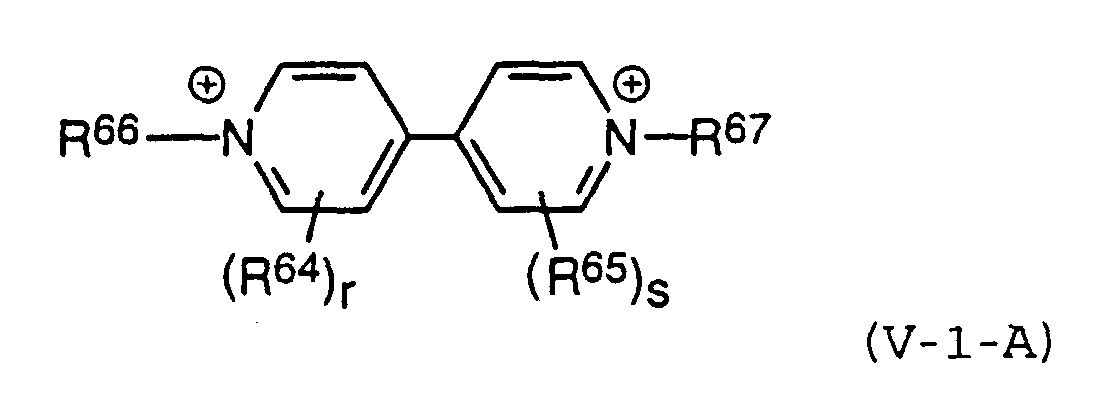
- In the formula, R64 and R65 can be the same as the substituents described for R60 and R61 of the formula (V-1). R66 and R67 can be the same as the substituents described for R62 and R63 of the formula (V-1). Each of r and s is an integer of 0 to 4. If r or s is 2 or more, plural numbers of R64 or R65 can be the same or different;
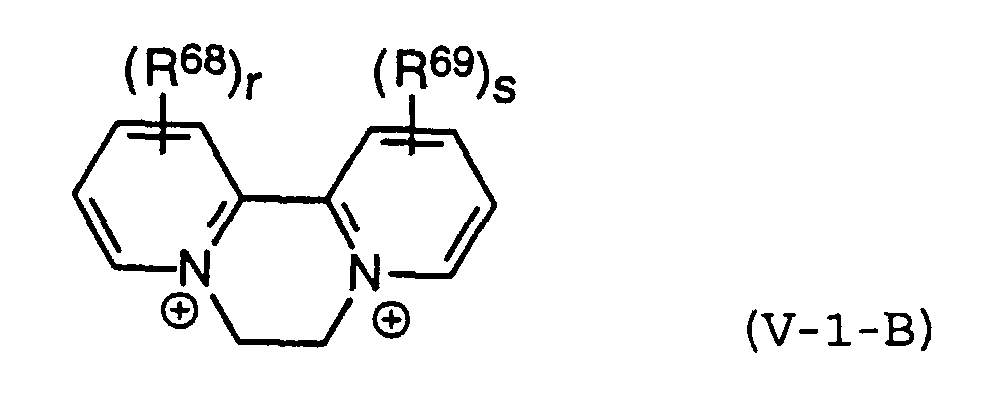
- In the formula, R68 and R69 can be the same as the substituents described for R60 and R61 of the formula (V-1). R68 and R69 preferably are combined with each other to form a carbon ring or a heterocyclic ring, particularly, a condensed ring in combination with the pyridine rings to which R68 and R69 are attached. Each of r and s is an integer of 0 to 4. If r or s is 2 or more, plural numbers of R68 or R69 can be the same or different.
- Representative examples of the cation parts of the oxonol dyes having the formula (IV-1) or (IV-2), including the formula (IV-2-A) are illustrated below:
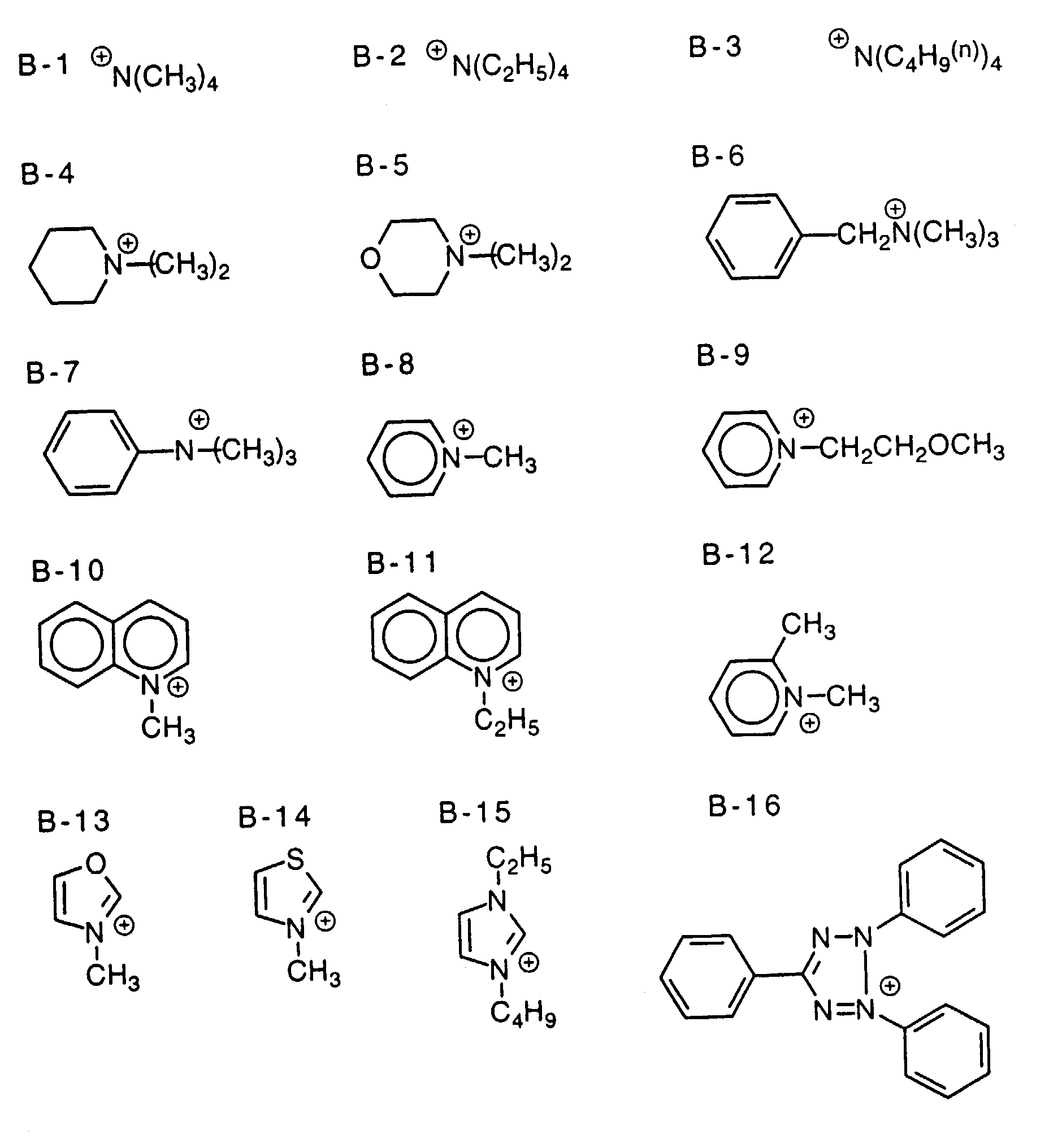


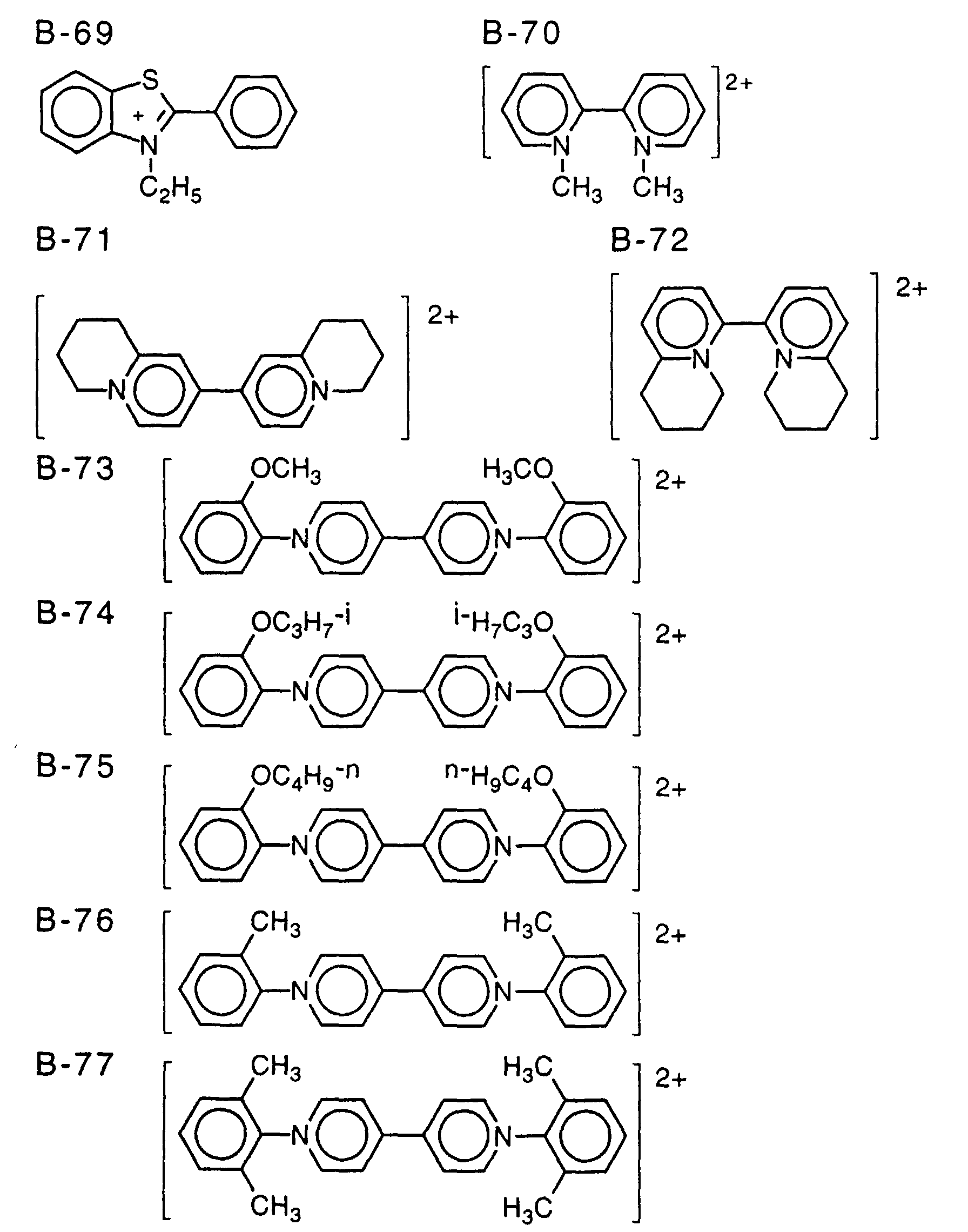


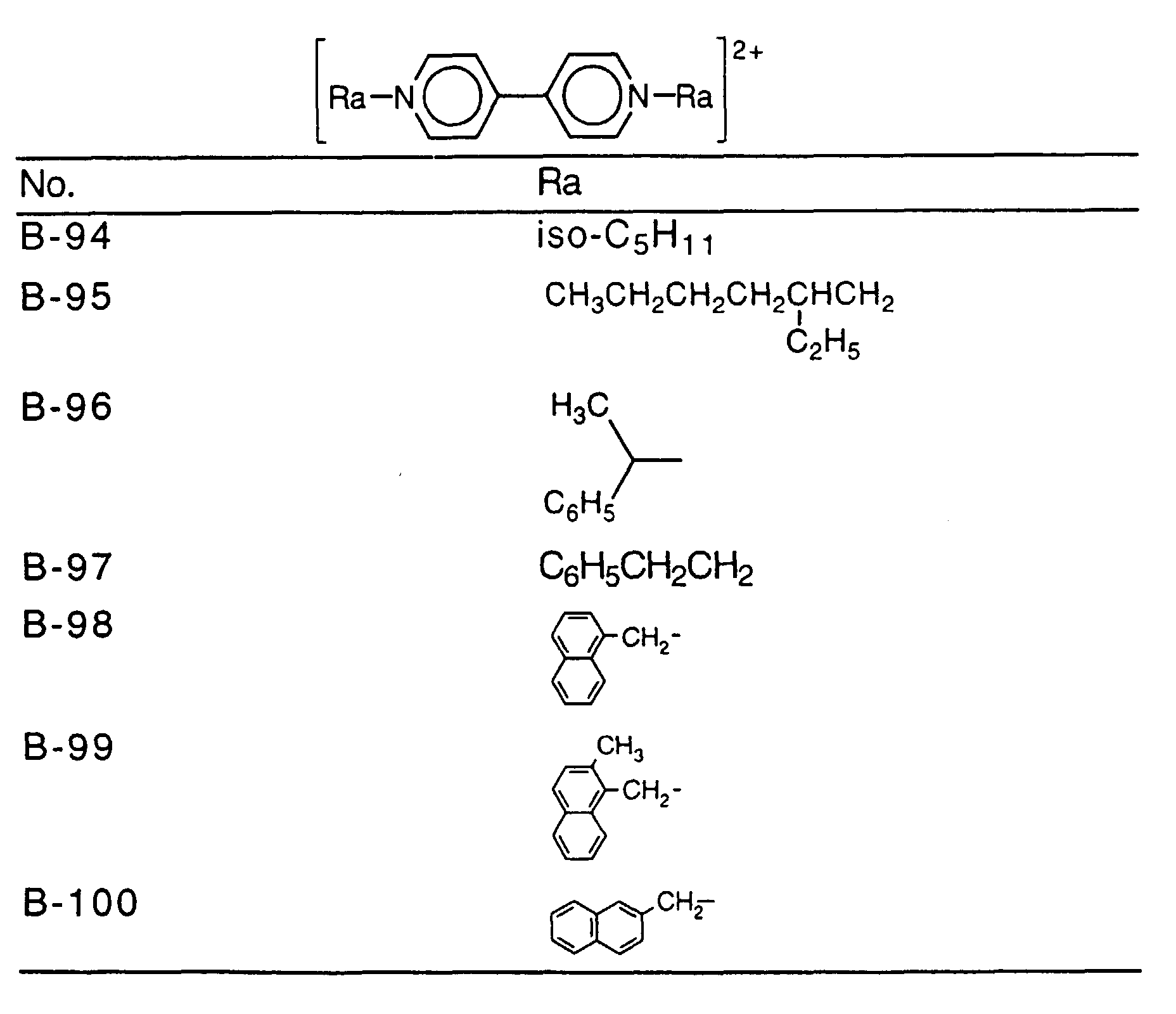
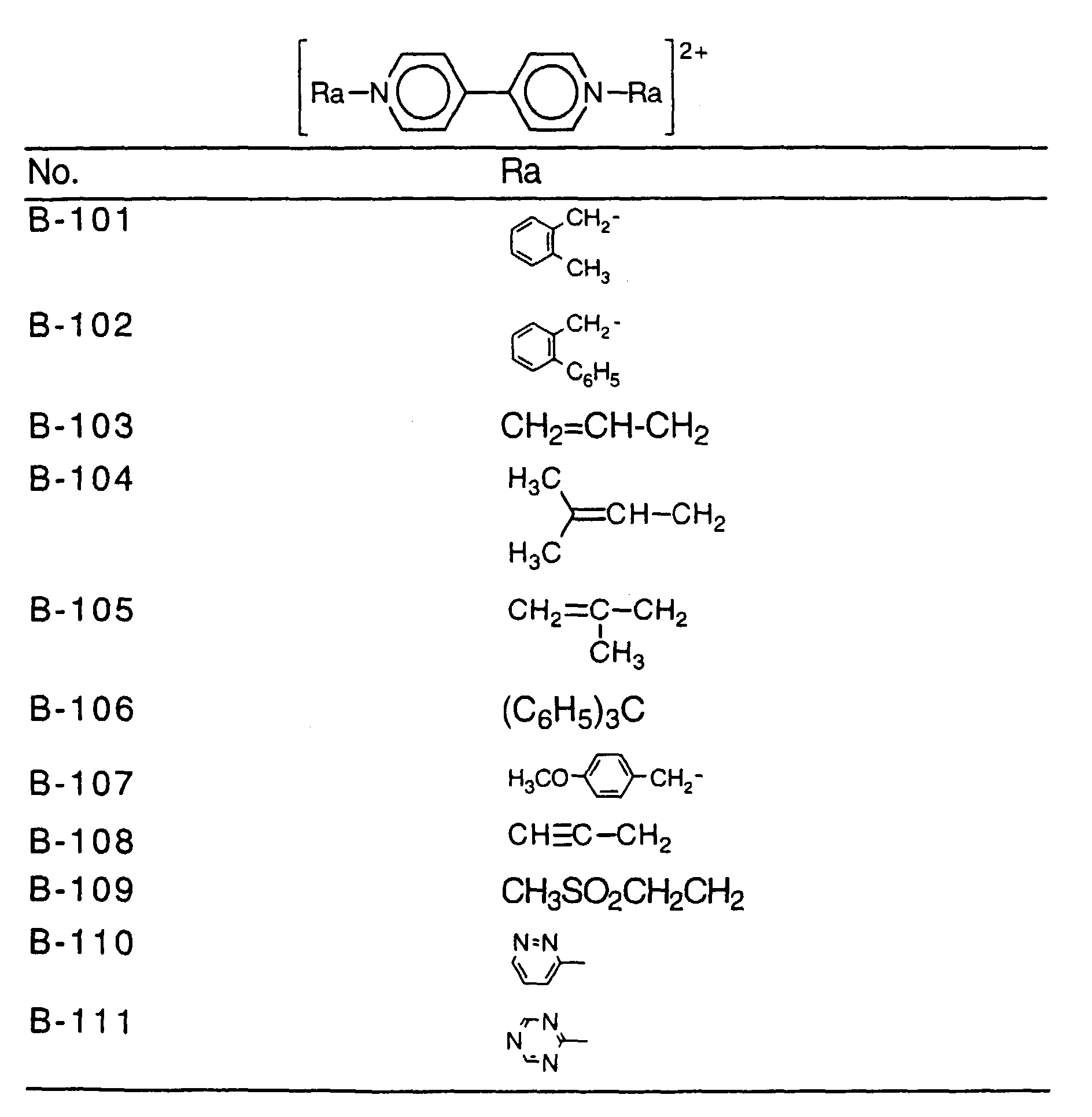


- Representative examples of the oxonol dyes having the formula (IV-1) or (IV-2), including the formula (IV-2-A) are illustrated in the following Tables 1(1) and 1(2), in which the dye compound (identified by the dye number) is expressed by the combination of an anion part (A- ) and a cation part (B- ). For instance, the dye compound of the dye number 1 which is formed of the anion part of A-4 and the cation part of B-21 has the following formula:
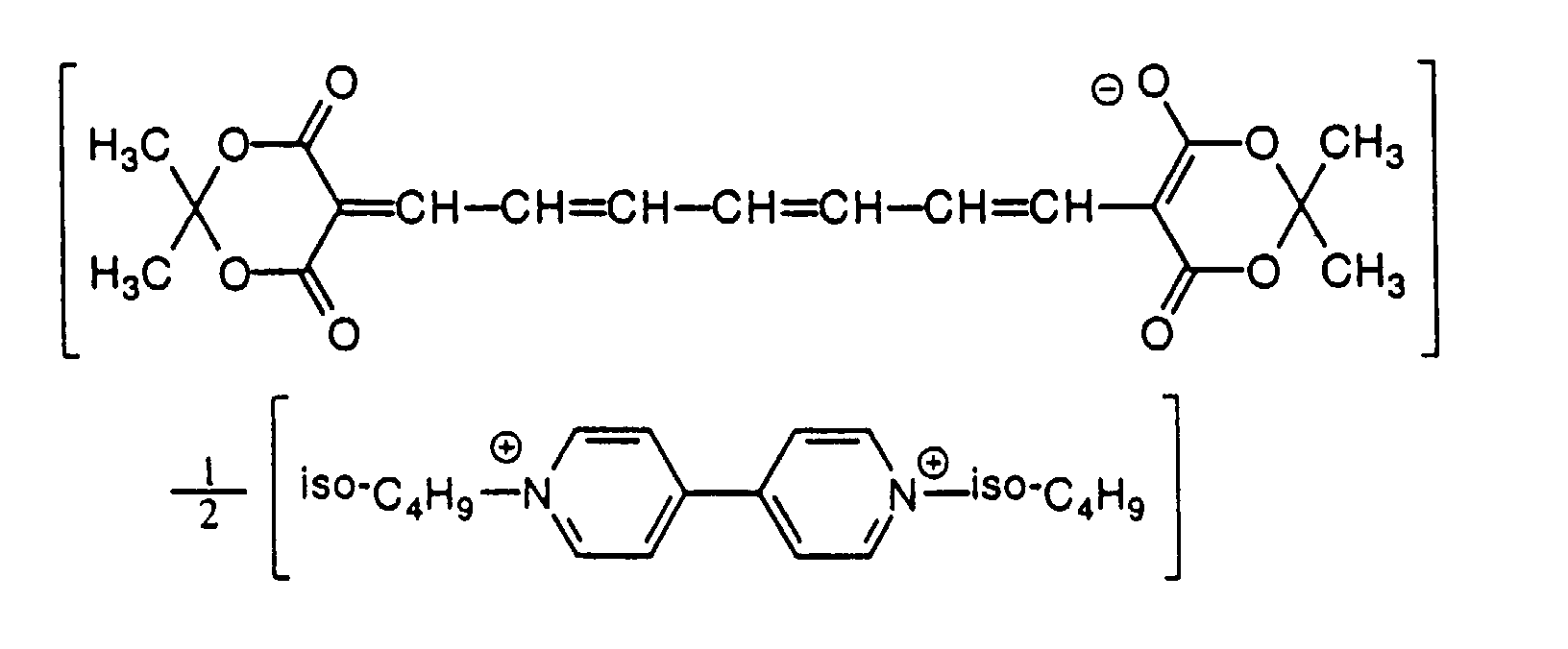
Dye No. Anion Cation Dye No. Anion Cation 1 A-4 B-21 2 A-4 B-77 3 A-4 B-123 4 A-5 B-21 5 A-5 B-78 6 A-6 B-22 7 A-7 B-22 8 A-10 B-78 9 A-10 B-117 10 A-5 B-123 11 A-11 B-85 12 A-14 B-21 13 A-14 B-77 14 A-14 B-113 15 A-15 B-1 16 A-15 B-148 17 A-15 B-168 18 A-21 B-15 19 A-21 B-103 20 A-23 B-74 21 A-24 B-78 22 A-25 B-78 23 A-28 B-78 24 A-33 B-30 25 A-33 B-51 26 A-34 B-78 27 A-36 B-21 28 A-36 B-78 29 A-36 B-87 30 A-37 B-21 31 A-37 B-41 32 A-37 B-78 33 A-37 B-113 34 A-37 B-117 35 A-38 B-117 36 A-38 B-133 37 A-38 B-85 38 A-39 B-23 39 A-39 B-33 40 A-39 B-55 41 A-39 B-78 42 A-39 B-85 43 A-39 B-117 44 A-39 B-123 45 A-39 B-168 46 A-40 B-21 47 A-40 B-55 48 A-40 B-78 49 A-40 B-85 50 A-40 B-89 51 A-40 B-113 52 A-40 B-117 53 A-40 B-168 54 A-41 B-21 55 A-44 B-33 56 A-44 B-50 Dye No. Anion Cation Dye No. Anion Cation 57 A-44 B-78 58 A-44 B-94 59 A-44 B-98 60 A-44 B-117 61 A-44 B-132 62 A-45 B-21 63 A-45 B-53 64 A-48 B-24 65 A-48 B-33 66 A-48 B-55 67 A-48 B-84 68 A-48 B-110 69 A-48 B-117 70 A-49 B-78 71 A-49 B-94 72 A-49 B-115 73 A-49 B-117 74 A-50 B-78 75 A-55 B-18 76 A-55 B-82 77 A-55 B-114 78 A-57 B-78 79 A-58 B-78 80 A-60 B-33 81 A-60 B-78 82 A-60 B-117 83 A-61 B-17 84 A-61 B-79 85 A-64 B-27 86 A-64 B-77 87 A-69 B-78 88 A-69 B-117 89 A-70 B-26 90 A-70 B-76 91 A-72 B-77 92 A-73 B-77 93 A-73 B-94 94 A-74 B-24 95 A-74 B-78 96 A-82 B-78 97 A-93 B-21 98 A-93 B-78 99 A-94 B-78 100 A-96 B-78 101 A-5 B-24 - The oxonol dyes of the formula (IV-1) or (IV-2) can be prepared by the preparation process described in Japanese Patent Provisional Publication 10-297103.
- According to the present invention, the dye is dissolved in a solvent comprising a fluorinated cyclic alkane or alkene, so as to form a dye solution for the preparation of the recording dye layer.
- The fluorinated cyclic alkane or alkene preferably is a 4- to 6-membered fluorinated cyclic alkane or alkene, and more preferably a 5-membered fluorinated cyclic alkane or alkene. Preferably, the fluorinated cyclic alkane or alkene is substituted with fluorine in an amount of 0.5 to 2.0 (more preferably 1.0 to 2.0, further preferably 1.0 to 1.8, most preferably 1.2 to 1.6) times the number of carbon atoms in the skeleton. Examples of the fluorinated cyclic alkanes include 1,1,2,2,3-pentafluorocyclobutane, 1,1,2,2,3,3-hexafluorocyclopentane, 1,1,2,2,3,3,4-heptafluorocyclopentane, 1,1,2,2,3,4,5-heptafluorocyclopentane, 1,1,2,2,3,3,4,4-octafluorocyclopentane, 1,1,2,2,3,3,4,5-octafluorocyclopentane and 1,1,2,2,3,3,4,4,5-nonafluorocyclohexane. Examples of the fluorinated cyclic alkenes include 1,1,2,2,3,4-hexafluorocyclobutene, 1,1,2,2,3,3,4,5-octafluorocyclopentene and 1,1,2,2,3,3,4,4,5,6-decafluorocyclohexene. These compounds are disclosed in Japanese Patent Provisional Publication Nos. 10-316596, 10-316597, 10-316598, 8-12603, 8-143487 and 9-95458.
- Preferred examples of the fluorinated cyclic alkane or alkenes include 1,1,2,2,3,3,4-heptafluorocyclopentane, 1,1,2,2,3,4,5-heptafluorocyclopentane, 1,1,2,2,3,3,4,4-octafluorocyclopentane and 1, 1,2,2,3,3,4,5-octafluorocyclopentane. Particularly preferred is 1,1,2,2,3,3,4-heptafluorocyclopentane
- The solvent may consist essentially of a fluorinated cyclic alkane or alkene. Most of the laser light-sensitive dyes described in detail hereinbefore can be soluble in the fluorinated cyclic alkane or alkene. However, the solubility is not high, and the dissolving rate is not high. Therefore, if the fluorinated cyclic alkane or alkene is employed alone as the solvent for a laser light-sensitive dye, the dye solution is preferably prepared by the steps of mixing the organic dye and the solvent and keeping the resulting mixture at a temperature of higher than 45°C but lower than a boiling temperature of the solvent by at least 10°C for a period of 5 minutes to 2 hours.
- The dye-dissolving steps of the above-mentioned procedure is further described.
- In the first step, a laser light-sensitive dye is added to a solvent containing a fluorinated cyclic alkane or alkene so as to prepare a dye-solvent mixture. The mixture of the dye and solvent is preferably prepared by adding the dye in the solvent at room temperature (25°C).
- In the second step, the mixture is kept at a temperature of not lower than 45°C and below the boiling point of the solvent by 5°C or more for 5 minutes to 2 hours so as to prepare a dye solution. The mixture is preferably kept at a temperature of not lower than 50°C (more preferably not lower than 55°C, further preferably not lower than 60°C) and below the boiling point of the solvent by 10°C or more (more preferably by 15°C or more, further preferably by 20°C or more). If the temperature is too high, the dye may deteriorate and the solvent often evaporates too much. The temperature is preferably kept in the aforementioned range for 10 to 90 minutes, more preferably 15 to 75 minutes. During this period, the dye is dissolved in the solvent enough to prepare a dye solution appropriately employable for the coating.
- In order to promote dissolution of the dye in the solvent, it is preferred that stirring or vibration should be applied to the mixture with a proper means while the mixture is kept at a temperature in the afore-mentioned range. Examples of the means for stirring or vibration include a means for ultrasonic wave and a magnetic stirrer. Preferred is a means for ultrasonic wave. The dye solution is preferably prepared in a container having a lid to efficiently keep the solvent from evaporation. A container equipped with a high pressure proof lid (e.g., a pressure container) is advantageously used. However, it is generally dangerous and difficult to use a pressure container. In consideration of this, a container having a lid provided with a hole for releasing vapor is preferably used. In this case, for reducing the amount of released vapor, an upright container is preferably used so that the surface of the dye/solvent mixture in the container may be small. A preferred example of that container is a container whose upper part has a small cross section. When the dye/solvent mixture is heated to a high temperature, the dye is liable to deteriorate. Since the dye is further liable to deteriorate in the presence of oxygen, the air in contact with the mixture may be made to contain oxygen in as small an amount as possible. The amount of oxygen preferably is less than 15%, more preferably less than 10%, further preferably less than 5%, most preferably less than 1%.
- The dye solution is preferably adjusted to have a concentration in a specific range because the concentration affects the coating properties. For example, during the preparation of the dye solution, the amount of evaporated solvent is measured, and according to that the solvent is additionally supplemented. The solvent is preferably supplemented in several portions, and the portions are preferably added at a specific temperature. Preferably, they are supplemented approx. at room temperature (20 to 30°C, more preferably 22 to 28°C). If the amount of evaporated solvent is too much, the dye solution is so concentrated that insoluble nuclei of the dye may be produced. The amount of evaporated solvent, therefore, is preferably controlled to be not more than 30%, more preferably not more than 20%, further preferably not more than 10% based on the initial volume.
- The fluorinated cyclic alkane or alkene is advantageously employed in a combination with an organic liquid which has a boiling point higher than that of the fluorinated cyclic alkane or alkene, which is essentially inert to the substrate, and in which the dye is soluble, in a volume ratio of 99:1 to 51:49 (alkane or alkene:organic liquid). The range of volume ratio preferably is 95:5 to 70:30, more preferably 90:10 to 80:20. The organic liquid preferably has a boiling point of lower than 250°C (preferably lower than 200°C, more preferably lower than 180°C) but higher than that of the fluorinated cyclic alkane or alkene by at least 10°C (preferably at least 15°C, more preferably at least 20°C).
- Examples of such high-boiling point solvents include aliphatic ketone, an aliphatic hydrocarbon, an alicyclic hydrocarbon, a carboxylic acid ester, an aliphatic ether, and an alcohol. The alcohol preferably is aliphatic alcohol, alicyclic alcohol, aromatic alcohol, fluorinated alcohol, alkoxyalcohol, or ketoalcohol. The high-boiling solvents can be employed singly or in combination.
- Examples of the high-boiling point solvents are described below: an aliphatic ketone having 4 to 12 carbon atoms (e.g., t-butylmethylketone and disobutylketone); an aliphatic hydrocarbon having 5 to 10 carbon atoms (e.g., hexane, heptane, octane, nanane, and decane); an alicyclic hydrocarbon having 6 to 12 carbon atoms (e.g., cyclohexane, methylcyclohexane, dimethylcyclohexane, ethylcyclohexane, isopropylcyclohexane, t-butylcyclohexane, and cyclooctane); a carboxylic acid ester having 5 to 10 carbon atoms (e.g., isopropyl acetate, t-butyl acetate, isobutyl propionate, t-butyl propionate, ethyl pivalate, methyl lactate, ethyl lactate, isopropyl isovalate, and isobutyl isovalate); an aliphatic ether having 6 to 10 carbon atoms (e.g., diisopropyl ether and diisobutyl ether); a saturated aliphatic alcohol having 1 to 12 carbon atoms (e.g., methyl alcohol, ethyl alcohol, n-propylalcohol, isopropyl alcohol, butyl alcohol, isobutyl alcohol, sec-butyl alcohol, t-butyl alcohol, 3-methyl-2-butanol, 2-ethylbutanol, 2-methyl-1-butanol, pentanol, t-pentyl alcohol, 3-methyl-1-pentyl-3-ol, 4-methyl-2-pentanol, 2,4-pentanediol, n-hexanol, 2-ethylhexanol, n-heptanol, 2-heptanol, 3-heptanol, n-octanol, and 2-octanol); an unsaturated aliphatic alcohol having 3 to 6 carbon atoms (e.g., allyl alcohol, propargyl alcohol, and 3-methyl-1-butyn-3-ol); an alicyclic alcohol having 5 to 8 carbon atoms (e.g., cyclopentanol, cyclohexanol, 2-methylcyclohexanol, 3-methylcyclohexanol, and 4-methylcyclohexanol); an aromatic alcohol having 7 to 10 carbon atoms (e.g., benzyl alcohol); a ketoalcohol having 3 to 8 carbon atoms (e.g., diacetone alcohol, 1-hydroxy-2-propanone, and 3-hydroxy-3-methyl-2-butanone); a monovalent or divalent fluorinated alcohol having 1 to 12 carbon atoms (e.g., 2,2-difluoro-1-ethanol, 2,2,2-trifluoro-1-ethanol, 1,3-difluoro-2-propanol, 2,2,3,3-tetrafluoro-1-propanol, 1,1,1,3,3,3-hexafluoro-2-propanol, 2,2,3,4,4,4-hexafluoro-1-butanol, 2,2,3,3,4,4,5,5-octafluoro-1-pentanol, 3,3-difluoro-1,2-heptanediol, 4-(trifluoromethyl)benzyl alcohol, and 2,6-difluoro-α-methylbenzyl alcohol); an alkoxyalcohol having 3 to 12 carbon atoms (e.g., ethylene glycol monomethyl ether (methylcellosolve and methoxyethanol), ethylene glycol monoethyl ether (ethylcellosolve and ethoxyethanol), ethylene glycol monoisopropyl ether, ethylene glycol monobutyl ether (butylcellosolve), ethylene glycol dimethyl ether, ethylene glycol diethyl ether, ethylene glycol dibutyl ether, ethylene glycol diglycidyl ether, ethylene glycol dimethyl ether, 1-ethoxy-2-propanol, 1-methoxy-2-propanol, 2-isopropoxy-1-ethanol, 1-methoxy-2-butanol, 3-methoxy-1-butanol, 4-methoxy-1-butanol, and 2-(2-methoxyethoxy)ethanol.
- Preferred high-boiling point solvents are aliphatic ketones (e.g., t-butyl methyl ketone and di-isobutyl ketone), aliphatic hydrocarbons (e.g., heptane, octane, and nonane), saturated aliphatic alcohols (e.g., n-propyl alcohol, butyl alcohol, isobutyl alcohol, sec-butyl alcohol, 3-methyl-2-butanol, 2-ethylbutanol, 2-methyl-1-butanol, pentanol, 3-methyl-1-pentyl-3-ol, 4-methyl-2-pentanol), saturated aliphatic alcohols (e.g., propargyl alcohol and 3-methyl-1-butyn-3-ol), ketoalcohols (e.g., diacetone alcohol), fluorinated alcohols (e.g., 2,2,3,3-tetrafluoro-1-propanol, 2,2,3,3,4,4,5,5-octafluoro-1-pentanol; and alkoxyalcohols (e.g., ethylene glycol monoethyl ether, ethylene glycol monoisopropyl ether, ethylene glycol monobutyl ether, ethylene glycol diglycidyl ether, and ethylene glycol diethyl ether).
- Most preferred are fluorinated alcohols (e.g., 2,2,3,3-tetrafluoro-1-propanol) and ketoalcohols (e.g., acetone alcohol).
- The fluorinated cyclic alkane or alkene is also employable for dissolving the laser-light sensitive dye in combination with an organic liquid which has a solubility for the dye higher than that of the fluorinated cyclic alkane or alkene and which is active to the substrate, in a volume ratio of 99.9:0.1 to 80:20 (preferably 99.7:0.3 to 88: 12, more preferably 99.5:0.5 to 92:8). The organic liquid preferably is a halogenated aliphatic hydrocarbon, an aromatic hydrocarbon, a ketone, a sulfoxide, an amide, a carboxylic acid ester, an ether, or a nitrile. The organic liquids can be employed singly or in combination.
- The organic liquid which is employable in a small amount in combination with the fluorinated cyclic alkane or alkene is further described below in more detail.
- The halogenated aliphatic hydrocarbon preferably has 1 to 6 carbon atoms. The halogen atom may be chlorine atom and bromine atom. Examples of the halogenated aliphatic hydrocarbons include dichloromethane, dichloroethane, trichloroetbane, tetrachloroethane, 1,2,3-trichloropropane, 1,2-dibromopropane, 1-bromo-3-chloropropane, and 1,4-dichlorobutane.
- The aromatic hydrocarbon preferably has a benzene nucleus and has 6 to 10 carbon atoms. Examples of the aromatic hydrocarbons include bromobenzene, dichlorobenzene, 1-bromo-4-fluorobenzene, toluene, 2-chloro-6-fluorotoluene, o-xylene, m-xylene, and 1,2,4-trimethylbenzene.
- The ketone preferably has 2 to 10 carbon atoms and man be in the cyclic form. Examples of the ketones include acetone, 2,4-pentanedione, 3-heptanone, 4-heptanone, 2,6-dimethyl-4-heptanone, diisopropyl ketone, 2-methylbutyl ethyl ketone, cyclohexanone, 2-methylcyclohexanone, 3-methylcyclohexanone, and 4-methylcyclohexanone.
- The sulfoxide preferably has 2 to 10 carbon atoms, and preferably is dimethylsulfoxide.
- The amide preferably has 1 to 10 carbon atoms, and may be in the cyclic form. Examples of the amides include N,N-dimethylformamide, N,N-dimethylacetamide, N,N-diethylformamide, N,N-dimethylpropionamide, and 1-methyl-2-pyrrolidone.
- The carboxylic acid ester preferably has 3 to 10 carbon atoms. Examples of the carboxylic acid esters include methyl acetate, ethyl acetate, ethyl trichloroacetate, n-butyl acetate, isobutyl acetate, sec-butyl acetate, t-butyl acetate, amyl acetate, ethyl 3-chloropropionate, n-propyl propionate, n-butyl propionate, n-propyl butyrate, methyl isobutyrate, ethyl isobutyrate, n-propyl isobutyrate, methyl pivalate, ethyl glycolate, ethyl pyruvate, and t-butyl acetacetate.
- The ether preferably has 2 to 10 carbon atoms, and may be in the cyclic form. Examples of the ethers include t-butoxy-2-ethoxy ether, butyl ether, propylene glycol methyl ether acetate, dioxane, anisole, 2,5-dimethoxy-2,5-dihydrofuran, 2,5-dimethoxycetrahydrofuran, 2-(bromomethyl)-tetrahydro-2H-pyrane, and 2-chloromethyl-1,3-dioxorane. Dioxane is preferred.
- The nitrile preferably has 1 to 6 carbon atoms. Examples of the nitriles include 3-bromopropionitrile, 3-ethoxypropylnitrile, and dimethylcarbamate nitrile (dimethylcyanamide).
- Examples of the preferred organic liquids include aliphatic halogenated hydrocarbons (particularly, dichloromethane, dichloroethane, and tetrachloroethane), aromatic hydrocarbons (particularly, toluene, o-xylene, and m-xylene), ketones (particularly, acetone and cyclohexanone), carboxylic acid esters (particularly, methyl acetate, ethyl acetate, and butyl acetate), and ethers (particularly dioxane).
- The fluorinated cyclic alkane or alkene can be employed in combination with a fluorinated alcohol in a volume ratio of 50:50 to 1:99. In this case, the fluorinated cyclic alkane or alkene serves not only to dissolve the laser light-sensitive dye but also to accelerate evaporation of the fluorinated alcohol, so as to shorten the period for drying the coated dye solution. Examples of the fluorinated alcohols are those mentioned hereinbefore.
- In the case that the fluorinated cyclic alkane or alkene is employed in combination with other solvents for the preparation of the dye solution, it is preferred that the dye solution is prepared by beforehand adding the dye to the fluorinated cyclic alkane or alkene to prepare a mixture, heating the mixture to dissolve the dye, and then adding other solvents to the mixture. Otherwise, the dye solution can be prepared by beforehand mixing the fluorinated cyclic alkane or alkene and other solvents to prepare a mixed solvent, adding the dye to the mixed solvent, and heating the mixture to dissolve the dye.
- The dye solution may further contain auxiliary additives such as oxidation inhibitors, UV absorbers, plasticizers, and lubricants.
- In the preparation of the dye solution, an anti-fading agent and, if needed, a binder can be incorporated. Examples of the anti-fading agents include nitroso compounds, metal complexes, diimmmonium salts and aminium salts. These examples are described, for example, in Japanese Patent Provisional Publications No. 2-300288, No. 3-224793 and No. 4-146189. If the anti-fading agent is used, its amount is in the range of usually 0.1 to 50 wt.%, preferably 0.5 to 45 wt.%, further preferably 3 to 40 wt.%, particularly preferably 5 to 25 wt.% base on the amount of the dye.
- Examples of the binders include natural-origin polymers such as gelatin, cellulose derivatives, dextran, rosin and rubber; hydrocarbon polymer resins such as polyethylene, polypropylene, polystyrene and polyisobutyrene; vinyl polymers such as polyvinyl chloride, polyvinylidene chloride and vinyl chloride-vinyl acetate copolymer; acrylate polymers such as polymethyl acrylate and polymethyl methacrylate; polyvinyl alcohol; chlorinated polyethylene; epoxy resins; butyral resins; rubber derivatives; and thermosetting resins such as prepolymers of phenol-formaldehyde. The binder is optionally employed so that the amount of the binder may be not more than 20 weight parts, preferably not more than 10 weight parts, further preferably not more than 5 weight parts based on 100 weight parts of the dye.
- The thus-prepared coating liquid contains the dye in a concentration of generally 0.01 to 10 wt.%, preferably 0.1 to 5 wt.%.
- The dye solution is then coated on the substrate disc.
- The dye solution is coated on the substrate disc, while the temperature of the liquid preferably is not higher than 40°C, more preferably not higher than 35°C, further preferably 25 to 30°C. The coating can be performed by the known methods such as spray coat, spin coat, dip coat, roll coat, blade coat, doctor roller coat and screen print. Spin coat is preferred. The recording dye layer can be a single layer or can comprise plural layers. The thickness of the recording dye layer (after drying) generally is in the range of 20 to 500 nm, preferably 50 to 300 nm.
- On the recording dye layer, the light-reflecting layer is generally placed so as to enhance the light-reflection in the course of reproduction of the recorded information. The light-reflecting material to be used for the formation of the light-reflecting layer should show a high reflection to the laser light. Examples of the light-reflecting materials include metals and sub-metals such as Mg, Se, Y, Ti, Zr, Hf, V, Nb, Ta, Cr, Mo, W, Mn, Re, Fe, Co, Ni, Ru, Rh, Pd, Ir, Pt, Cu, Ag, Au, Zn, Cd, Al, Ga, In, Si, Ge, Te, Pb, Po, Sn and Bi. Stainless steel film is also employable. These materials can be employed singly, in combination or in the form of alloy.
- Preferred are Cr, Ni, Pt, Cu, Ag, Au, Al and stainless steel. Au metal, Ag metal, and their alloys are particularly preferred. Preferred alloys of Au or Ag are alloys with at least one metal selected from the group consisting of Pt, Cu and Al. Most preferred is Ag metal or an alloy of Ag. The light-reflecting layer can be formed on the recording dye layer, for example, by vacuum deposition, sputtering or ion-plating. The thickness of the light-reflecting layer generally is 10 to 800 nm, preferably 20 to 500 nm, further preferably 50 to 300 nm.
- On the light-reflecting layer, a protective layer is generally provided so as to protect the recording dye layer and the light-reflecting layer from chemical deterioration or physical damage. The protective layer can be made of inorganic materials such as SiO, SiO2, MgF2, SnO2, Si3N4; or organic materials such as thermo-plastic resins, thermo-setting resins and UV curable resins. On the light-reflecting layer and/or the substrate, the protective layer can be formed by laminating a film of plastic material using an adhesive. Otherwise, it can be also formed by vacuum deposition, sputtering or coating. The organic material protective layer can be formed by the steps of dissolving the polymer material to prepare a polymer solution, coating the polymer solution to form a layer, and then tying the formed layer to give the protective layer. In the case of a UV curable resin, neat resinous material having no solvent or a solution of the resin may be applied and then cured by applying ultraviolet rays to the formed layer. The polymer solution for protective layer can optionally contain various additives such as anti-static agents, oxidation inhibitors and UV absorbers. Besides on the light-reflecting layer, another protective layer can be also placed on the face not having the recording dye layer so as to enhance the scratch resistance and the moisture resistance of the medium. The thickness of the protective layer is generally in the range of 0.1 to 100 µm.
- The recording/reproducing procedures with an optical disc of CD-R type are carried out, for example, in the following manner.
- Using an optical disc of CD-R type, the information recording/reproducing can be carried out not only at a normal line rate (1.2 to 1.4 m/sec.) but also at a twofold line rate, a fourfold line rate and a sixfold or more line rate.
- The optical disc is made to rotate at a predetermined line rate (1.2 to 1.4 m/sec., in the case of CD format), or a predetermined angular rate. On the rotating disc, a recording light source such as a semiconductor laser beam is applied through the transparent substrate. By the application of the laser beam, irradiated area of the recording layer is locally heated to change the physical or chemical characteristics, and thus pits are formed in the recording layer to record the information. The light source preferably is a semiconductor laser having an oscillation frequency in the range of 500 to 850 nm. The preferred beam wavelength is in the range of 500 to 800 nm. In the case of the optical disc of CD-R type, the laser beam preferably has a wavelength of 770 to 790 nm. The reproduction of the recorded information can be accomplished by applying a semiconductor laser beam on the optical disc rotating at a predetermined line rate. The light-reflection is then detected from the transparent substrate side.
- The preparation of optical information recording medium of the invention is described above with respect to an optical disc of CD-R type, as an example. However, the invention can be also used for an optical disc of DVD-R type.
- The present invention is further described by the following examples.
- A container having a lid provided with a hole for releasing the vapor was prepared. The upper part of the container had a small cross section. In this container, a dye solution for recording layer was prepared in the following manner.

- Into the container, 1.5 g of an indolenine type cyanine dye shown above and 100 mL of 1,1,2,2,3,3,4-heptafluorocyclopentane [Zeorola H (trade name), available from Nippon Zeon Co. Ltd., boiling point: 82.5°C] were introduced at room temperature (25°C). The mixture was then heated for 10 minutes to 60°C. While the temperature was kept at 60°C, ultrasonic waves were applied for 1 hour to dissolve the dye. Thus, the dye solution for recording layer was prepared.
- The dye solution was cooled to 25°C, and applied by spin-coat on the surface (on which pregroove was formed) of a polycarbonate substrate disc (outer diameter: 120 mm, inner diameter: 15 mm, thickness: 1.2 mm) and then dried to give a recording dye layer (thickness at the pregroove: approx. 180 nm). The pregroove was beforehand formed spirally on the substrate (track pitch: 1.6 µm, pregroove width: 500 nm, depth at pregroove: 175 nm) by injection molding.
- On thus-formed dye layer, a light-reflecting layer made of Ag (thickness: about 150 nm) was provided by sputtering with DC magnetron sputtering apparatus. On thus-formed light-reflecting metal layer, a UV curable photopolymer (Daicureclear SD-318 [trade name], available from Dainippon Ink & Chemicals, Inc.) was further applied by spin-coat, and then irradiated with ultraviolet rays of a metal halide lamp to be cured to form a resin protective layer of about 8 µm thickness.
- Thus, an optical disc of CD-R type (hereinafter simply referred to as "CD-R") comprising a substrate, a recording dye layer, a light-reflecting metal layer and a resin protective layer overlaid in order was produced according to the present invention.
- The procedure for the preparation of dye solution described in Example 1 was repeated except for replacing the dye with one of the cyanine or oxonol dyes set forth in Table 2, to prepare an optical disc.
Example No. Dye (Dye No.) Amount Example 2 Cyanine dye (I-43) 1.5 g Example 3 Cyanine dye (I-17) 1.5 g Example 4 Cyanine dye (I-62) 0.9 g Cyanine dye (I-17) 0.4 g Cyanine dye (I-11) 0.2 g Example 5 Cyanine dye (I-12) 1.5 g Example 6 Cyanine dye (I-101) 1.5 g Example 7 Cyanine dye (I-104) 1.5 g Example 8 Cyanine dye (I-123) 1.5 g Example 9 Cyanine dye (I-124) 1.5 g Example 10 Oxonol dye (1 in Table 1) 1.5 g - Onto the optical disc of Example 1, EFM signals were recorded with a laser beam of 780 nm through a NA 0.5 pick-up (line rate: 4.8 m/sec.) by means of OTM-2000 ([trade name], available from Pulstech) at the optimum power while the power varies in the range of 3 to 10 mW. The recorded signals were then reproduced with a laser beam of 780 nm through a NA0.45 pick-up (line rate: 1.2 m/sec.) by means of CD-CATS (trade name, available from Audio Development) at the laser power of 0.5 mW, and thereby 11T land jitter (jitter between pits) at the position 40 mm from the center position was measured by means of TIA (available from Hewlett Packard). A small jitter value indicates that the recorded signals are uniform.
- The results are shown in Table 3.
11T land jitter (ns) Example 1 31 - The procedure for the preparation of dye solution described in Example 1 was repeated except for replacing the solvent with a combination of 1,1,2,2,3,3,4-heptafluorocyclopentane (HFCP) and dichloromethane (DCM, for Examples 11 to 13) in the ratio set forth in Table 4, or dichloroethane (DCE, for Example 14) in the ratio set forth in Table 4, to prepare an optical disc.
- The optical discs of Examples 11 to 14 were evaluated in the aforementioned manner with respect to 11T land jitter (jitter between pits) at the positions 40 mm and 57 mm from the center position.
- The results are shown in Table 4.
Example Solvent mixture (vol. ratio) 11T land litter (ns) 40 mm 57 mm Ex. 11 HFCP/DCM (99/1) 31 33 Ex. 12 HFCP/DCM (98/2) 31 33 Ex. 13 HFCP/DCM (95/5) 33 34 Ex. 14 HFCP/DCE (95/5) 32 33 - The procedure for the preparation of dye solution described in Example 1 was repeated except for replacing the solvent with a combination of 1,1,2,2,3,3,4-heptafluorocyclopentane (HFCP) and 2,2,3,3-tetrafluoroalcohol (TFP, for Example 15) in the ratio set forth in Table 5, or diacetone alcohol (DAA, for Example 16) in the ratio set forth in Table 5, to prepare an optical disc.
- The procedure for the preparation of dye solution described in Example 1 was repeated except for replacing the solvent with 2,2,3,3-tetrafluoroalcohol, to prepare an optical disc.
- The optical discs of Examples 15 and 16 as well as Comparison Example 1 were evaluated in the aforementioned manner with respect to 11T land jitter (jitter between pits) at the positions 40 mm and 57 mm from the center position.
- The results are shown in Table 5.
Example Solvent mixture (vol. ratio) 11T land litter (ns) 40 mm 57 mm Ex. 15 HFCP/TFP (90/10) 30 31 Ex. 16 HFCP/DAA (95/5) 31 32 Com. 1 TFP (100) 36 41 - The procedure for the preparation of dye solution described in Example 1 was repeated except for replacing the solvent with a combination of 2,2,3,3-tetrafluoroalcohol (TFP) and 1,1,2,2,3,3,4-heptafluorocyclopentane (HFCP) in the ratio set forth in Table 6 in the ratio set forth in Table 5, to prepare an optical disc.
- In the preparation, the time required for drying the coated dye solution was measured.
- The procedure for the preparation of dye solution described in Example 1 was repeated except for replacing the solvent with 2,2,3,3-tetrafluoroalcohol, to prepare an optical disc.
- In the preparation, the time required for drying the coated dye solution was measured.
- The optical discs of Examples 17 and 21 as well as Comparison Example 2 were evaluated in the aforementioned manner with respect to 11T land jitter (jitter between pits) at the positions 40 mm from the center position.
- The results are shown in Table 6.
Example Solvent (TFP/HFCP) (vol. ratio) Time for Dryness(sec.) 11T land jitter (ns) 40 mm Ex. 17 95/5 13 32 Ex. 18 85/15 11 32 Ex. 19 75/25 10 31 Ex. 20 65/35 9 32 Ex. 21 55/45 8 34 Com. 2 TFP(100) 16 34
Claims (31)
- A process for the preparation of an optical information recording disc comprising the steps of coating a dye solution on a transparent substrate disc and drying the coated dye solution, in which the dye solution is a solution of a laser-light sensitive organic dye dissolved in an organic solvent comprising a fluorinated cyclic alkane or alkene.
- The process of claim 1, wherein the fluorinated cyclic alkane or alkene has fluorine atoms of a number of 0.5 to 2.0 times based on the number of carbon atoms constituting its skeleton.
- The process of claim 1, wherein the fluorinated cyclic alkane or alkene is 1,1,2,2,3,3,4-heptafluorocyclopentane.
- The process of claim 1, wherein the dye solution is prepared by the steps of mixing the organic dye and the solvent and keeping the resulting mixture at a temperature of higher than 45°C but lower than a boiling temperature of the solvent by at least 10°C for a period of 5 minutes to 2 hours.
- The process of claim 1, wherein the solvent comprises the fluorinated cyclic alkane or alkene and an organic liquid which has a boiling point higher than that of the fluorinated cyclic alkane or alkene, which is essentially inert to the substrate, and in which the dye is soluble, in a volume ratio of 99:1 to 51:49.
- The process of claim 5, wherein the organic liquid has a boiling point of lower than 250°C but higher than that of the fluorinated cyclic alkane or alkene by at least 10°C.
- The process of claim 5, wherein the organic liquid is selected from the group consisting of an aliphatic ketone, an aliphatic hydrocarbon, an alicyclic hydrocarbon, a carboxylic acid ester, an aliphatic ether, and an alcohol.
- The process of claim 5, wherein the organic liquid is a fluorinated alcohol having one of the formulas of CF3CH2OH, HCF2CF2CH2OH, H(CF2CF2)2CH2OH, and H(CF2CF2)3CH2OH.
- The process of claim 5, wherein the organic liquid is a ketoalcohol.
- The process of claim 9, wherein the ketoalcohol is diacetone alcohol.
- The process of claim 1, wherein the organic solvent comprises the fluorinated cyclic alkane or alkene and an organic liquid which has a solubility for the dye higher than that of the fluorinated cyclic alkane or alkene and which is active to the substrate, in a volume ratio of 99.9:0.1 to 80:20.
- The process of claim 11, wherein the organic liquid is selected from the group consisting of a halogenated aliphatic hydrocarbon, an aromatic hydrocarbon, a ketone, a sulfoxide, an amide, a carboxylic acid ester, an ether, and a nitrile.
- The process of claim 11, wherein the organic liquid is a halogenated aliphatic hydrocarbon selected from the group consisting of dichloromethane, dichloroethane, and tetrachloroethane.
- The process of claim 11, wherein the organic liquid is acetone.
- The process of claim 1, wherein the solvent comprises the fluorinated cyclic alkane or alkene and a fluorinated alcohol in a volume ratio of 50:50 to 1:99.
- The process of claim 15, wherein the fluorinated alcohol is 2,2,3,3-tetrafluoro-1-propanol.
- The process of claim 1, wherein the organic dye is a cyanine dye having the following formula:wherein each of Z1 and Z2 independently is an atomic group required for forming a 5- or 6-membered nitrogen-containing heterocyclic ring; each of R1 and R2 independently is an alkyl group; each of L1, L2, L3, L4 and L5 independently is a methine group which may have one or more substituents; each of n1 and n2 independently is 0, 1 or 2; each of p and q independently is 0 or 1; M1 is a charge-neutralizing counter ion; and m1 is a number of 0 or more which corresponds to an electron charge number required for neutralizing the cyanine dye.

- The process of claim 17, wherein the cyanine dye has one of the following formulas:
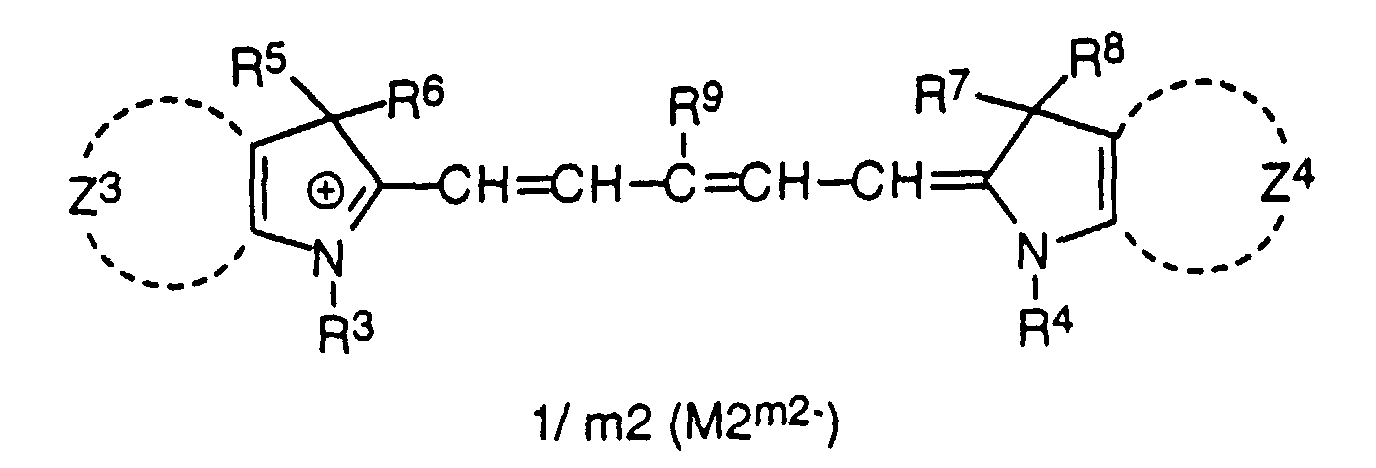 wherein each of Z3 and Z4 independently is an atomic group required for forming a benzene or naphthalene ring which may have one or more substituents; each of R3, R4, R5, R6, R7 and R8 independently is an alkyl group having 1 to 8 carbon atoms; R9 is a hydrogen atom, an alkyl group having 1 to 8 carbon atoms, an aralkyl group having 7 to 10 carbon atoms, an aryl group having 6 to 10 carbon atoms, an alkoxy group having 1 to 8 carbon atoms, a heterocyclic ring, a halogen atom, or a carbamoyl group having 1 to 8 carbon atoms; and M2m2- is an anion, in which m2 is 1 or 2.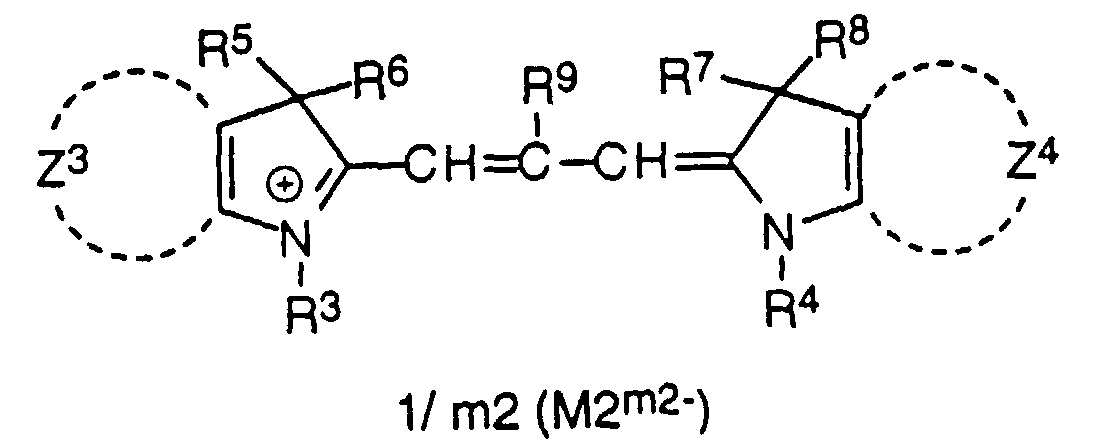
- The process of claim 1, wherein the organic dye is a metal complex of an azo dye having the following formula:wherein M is a metal atom; X is an oxygen atom, a sulfur atom, or =NR11 in which R11 represents a hydrogen atom, an alkyl group, an aryl group, an acyl group, an alkylsulfonyl group, or an arylsulfonyl group; Z11 is an atomic group required for forming a 5- or 6-membered nitrogen-containing heterocyclic ring; and Z12 is an atomic group required for forming an aromatic ring or a heterocyclic aromatic ring.
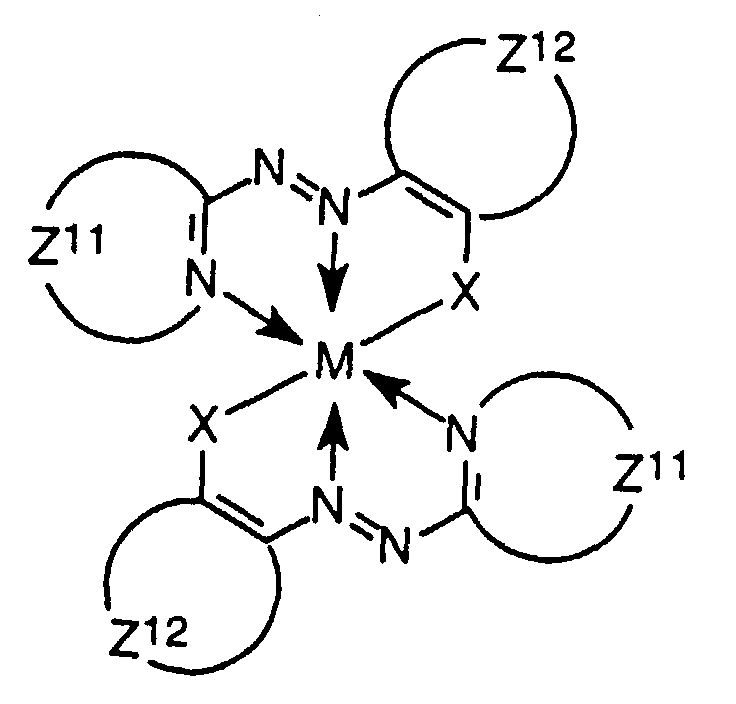
- The process of claim 19, wherein the metal complex of an azo dye has the following formula:wherein M is a metal atom selected from the group consisting of iron, cobalt, nickel, copper, zinc, palladium, platinum, and gold; Y is an oxygen atom, a sulfur atom or a group of =NR12; each of R12, R13 and R14 independently is an alkyl group having 1 to 12 carbon atoms which may have one or more substituents, in which R13 and R14 may be connected to form a ring; R15 is an alkyl group having 1 to 12 carbon atoms which may have one or more substituents, a phenyl or naphthyl group which may have one or more substituent groups; each of R16 and R17 independently is a hydrogen atom, a halogen atom, an alkyl group, an aryl group, a cyano group, an acyl group, an alkylsulfonyl group, or an arylsulfonyl group; and each of R18, R19 and R20 independently is a hydrogen atom, an alkyl group, an aryl group, a hydroxyl group, an alkoxy group, an aryloxy group, an amino group, a carboxylic amide group, a sulfonamide group, a cyano group, a halogen atom, an acyl group, an alkylsulfonyl group, or an arylsulfonyl group.

- The process of claim 1, wherein the organic dye is an oxonol dye having one of the following formulas:wherein each of A21, A22, B21 and B22 independently is a substituent group; each of Y21 and Z21 independently is an atomic group required for forming a carbocyclic or heterocyclic ring; each of E and G independently is an atomic group required for forming a conjugated double bond chain; X21 is =O, =NR21, or =C(CN)2; X22 is -O, -NR21, or -C(CN)2, in which R21 is a substituent group; each of L21, L22, L23, L24 and L25 independently is a methine group which may have one or more substituents; Vk+ is a cation; each of n3 and n4 independently is 0, 1 or 2; each of x and y independently is 0 or 1; and k is an integer of 1 to 10.
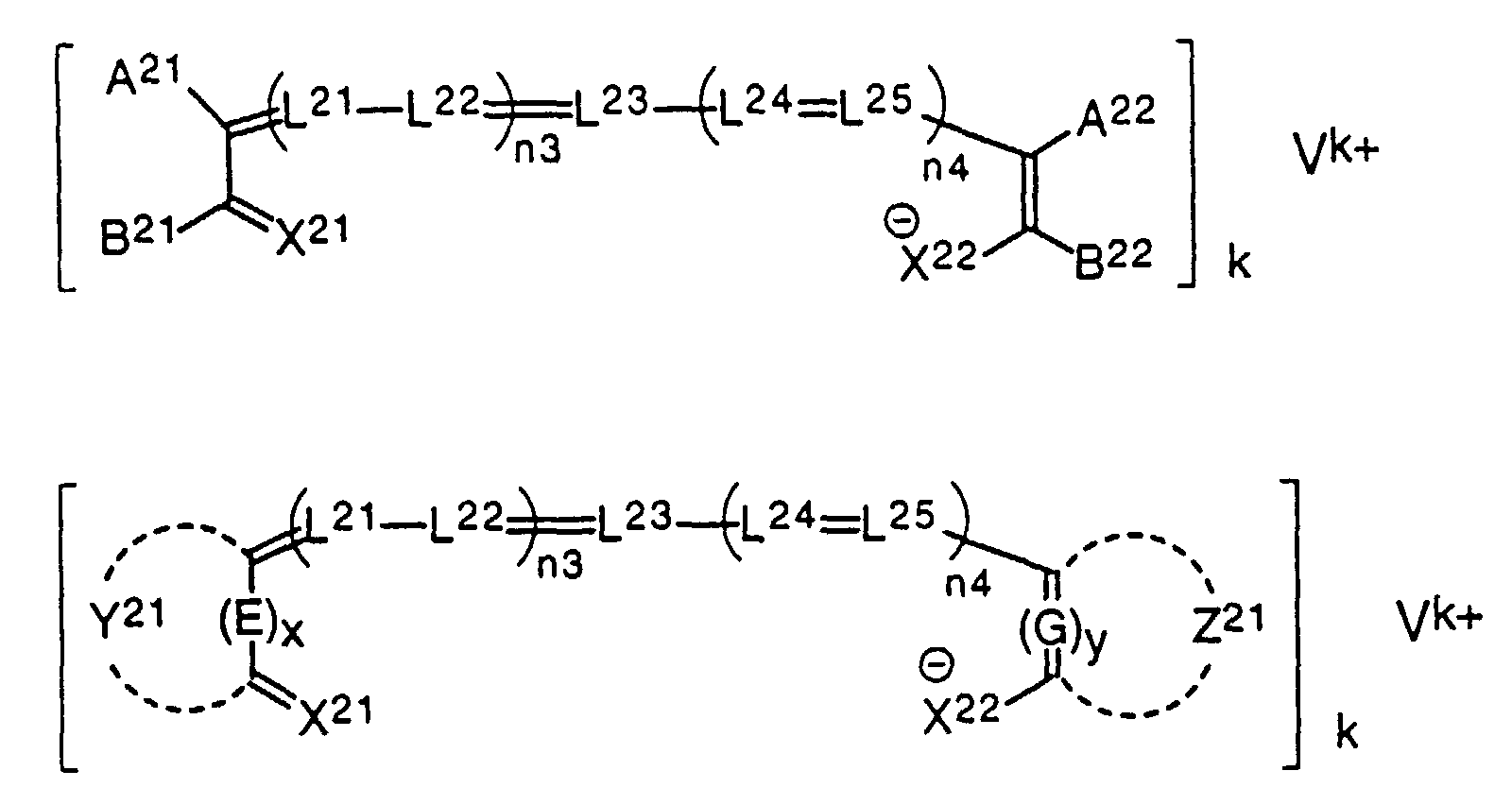
- The process of claim 21, wherein the oxonol dye has the following formula:wherein each of R51, R52, R53 and R54 independently is a hydrogen atom, an alkyl group, an aryl group, an aralkyl group, or a heterocyclic group, each group possibly hay-ing one or more substituents; each of L31, L32, and L33 is a methine group which may have one or more substituents; n5 is 0, 1, 2, or 3; and Vk+ is a cation in which k is an integer of 1 to 10.
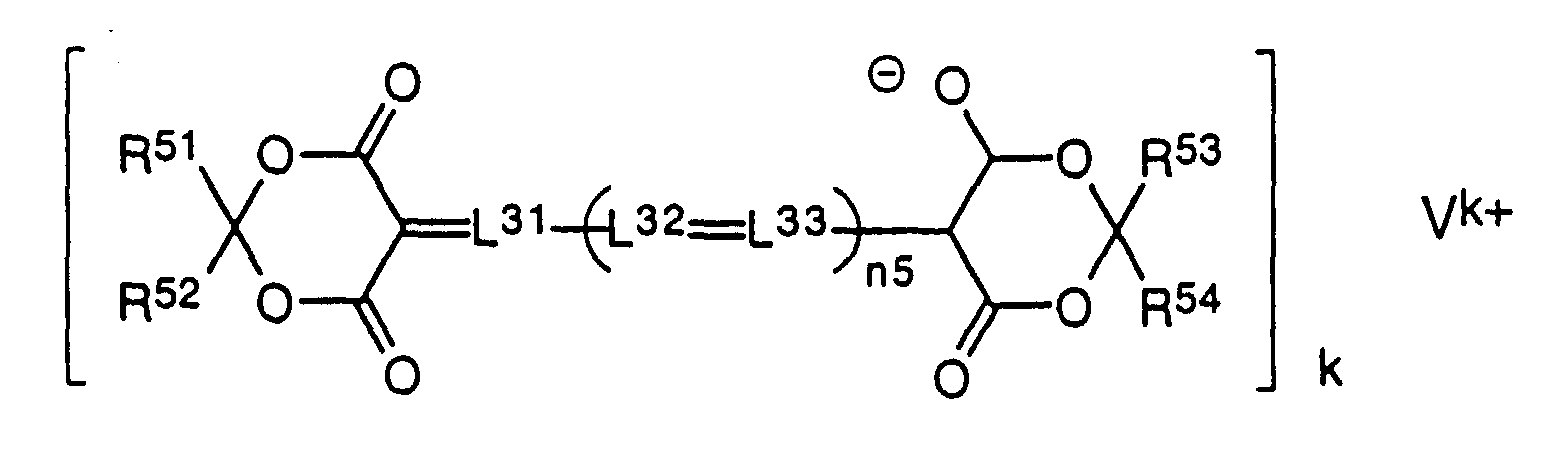
- An optical information recording disc comprising a transparent substrate disc and a recording dye layer provided on the substrate disc, in which the recording dye layer is produced by coating on the substrate disc a dye solution of a laser-light sensitive organic dye dissolved in an organic solvent comprising a fluorinated cyclic alkane or alkene and drying the coated dye solution.
- A dye solution which comprises a laser-light sensitive organic dye dissolved in an organic solvent comprising a fluorinated cyclic alkane or alkene.
- The dye solution of claim 24, wherein the fluorinated cyclic alkane or alkene has fluorine atoms of a number of 0.5 to 2.0 times based on the number of carbon atoms constituting its skeleton.
- The dye solution of claim 24, wherein the fluorinated cyclic alkane or alkene is 1,1,2,2,3,3,4-heptafluorocyclopentane.
- The dye solution of claim 24, which is prepared by the steps of mixing the organic dye and the solvent and keeping the resulting mixture at a temperature of higher than 45°C but lower than a boiling temperature of the solvent by at least 10°C for a period of 5 minutes to 2 hours.
- The dye solution of claim 24, wherein the solvent comprises the fluorinated cyclic alkane or alkene and an organic liquid which has a boiling point higher than that of the fluorinated cyclic alkane or alkene, which is essentially inert to the substrate, and in which the dye is soluble, in a volume ratio of 99:1 to 51:49.
- The dye solution of claim 24, wherein the organic liquid is a fluorinated alcohol having one of the formulas of CF3CH2OH, HCF2CF2CH2OH, H(CF2CF2)2CH2OH, and H(CF2CF2)3CH2OH.
- The dye solution of claim 24, wherein the organic solvent comprises the fluorinated cyclic alkane or alkene and an organic liquid which has a solubility for the dye higher than that of the fluorinated cyclic alkane or alkene and which is active to the substrate, in a volume ratio of 99.9:0.1 to 80:20.
- The dye solution of claim 24, wherein the solvent comprises the fluorinated cyclic alkane or alkene and a fluorinated alcohol in a volume ratio of 50:50 to 1:99.
Applications Claiming Priority (10)
| Application Number | Priority Date | Filing Date | Title |
|---|---|---|---|
| JP14640199A JP3896402B2 (en) | 1999-05-26 | 1999-05-26 | Optical information recording medium manufacturing method and optical information recording medium |
| JP11146400A JP2000339776A (en) | 1999-05-26 | 1999-05-26 | Method for manufacturing optical information recording medium and optical information recording medium |
| JP14640199 | 1999-05-26 | ||
| JP14640099 | 1999-05-26 | ||
| JP16084899 | 1999-06-08 | ||
| JP11160848A JP2000348390A (en) | 1999-06-08 | 1999-06-08 | Production of optical information recording medium and optical information recording medium |
| JP11167304A JP2000357350A (en) | 1999-06-14 | 1999-06-14 | Manufacture of optical information recording medium and optical information recording medium |
| JP16740599 | 1999-06-14 | ||
| JP16740599A JP4159068B2 (en) | 1999-06-14 | 1999-06-14 | Dye composition |
| JP16730499 | 1999-06-14 |
Publications (2)
| Publication Number | Publication Date |
|---|---|
| EP1056078A1 true EP1056078A1 (en) | 2000-11-29 |
| EP1056078B1 EP1056078B1 (en) | 2006-04-12 |
Family
ID=27527764
Family Applications (1)
| Application Number | Title | Priority Date | Filing Date |
|---|---|---|---|
| EP00304521A Expired - Lifetime EP1056078B1 (en) | 1999-05-26 | 2000-05-26 | Process for preparation of optical information recording disc, optical information recording disc and dye solution |
Country Status (5)
| Country | Link |
|---|---|
| US (1) | US6531261B1 (en) |
| EP (1) | EP1056078B1 (en) |
| CN (1) | CN1213419C (en) |
| DE (1) | DE60027220T2 (en) |
| TW (1) | TW486432B (en) |
Cited By (4)
| Publication number | Priority date | Publication date | Assignee | Title |
|---|---|---|---|---|
| WO2004010427A1 (en) * | 2002-07-19 | 2004-01-29 | Honeywell International Inc. | Coating solutions |
| WO2004072087A3 (en) * | 2003-02-13 | 2005-05-12 | Bayer Chemicals Ag | Metal complexes as light-absorbing compounds in the information layer of optical data carriers |
| EP1863026A3 (en) * | 2006-05-31 | 2008-01-02 | Kabushiki Kaisha Toshiba | Optical disc, information recording method, and information reproducing method |
| US7625621B2 (en) | 2004-07-29 | 2009-12-01 | Clariant Finance (Bvi) Limited | Amino antipyrine based azo ligands and their metal complexes for use as optical recording media |
Families Citing this family (12)
| Publication number | Priority date | Publication date | Assignee | Title |
|---|---|---|---|---|
| JP2001047746A (en) * | 1999-08-13 | 2001-02-20 | Sony Corp | Optical recording medium |
| TW200406466A (en) * | 2001-11-13 | 2004-05-01 | Ciba Sc Holding Ag | Compositions comprising at least one oxonol dye and at least one metal complex |
| US7125644B2 (en) * | 2003-08-11 | 2006-10-24 | Hewlett-Packard Development Company, L.P. | Systems and methods for storing data on an optical disk |
| US7198834B2 (en) * | 2005-03-22 | 2007-04-03 | Hewlett-Packard Development Company, L.P. | Imaging media including interference layer for generating human-readable marking on optical media |
| US20070065749A1 (en) * | 2005-09-21 | 2007-03-22 | Vladek Kasperchik | Radiation-markable coatings for printing and imaging |
| US20070065623A1 (en) * | 2005-09-21 | 2007-03-22 | Vladek Kasperchik | Laser-imageable coating based on exothermic decomposition |
| US20070086308A1 (en) * | 2005-10-13 | 2007-04-19 | Gore Makarand P | Systems and methods for imaging |
| JP2010218605A (en) * | 2009-03-13 | 2010-09-30 | Toshiba Corp | Ultraviolet-curable resin material for pattern transfer and method for manufacturing magnetic recording medium using the same |
| JP2010218597A (en) * | 2009-03-13 | 2010-09-30 | Toshiba Corp | Resin stamper for pattern transfer and magnetic recording medium manufacturing method using the same |
| JP4543117B1 (en) * | 2009-03-13 | 2010-09-15 | 株式会社東芝 | Ultraviolet curable resin material for pattern transfer and method for producing magnetic recording medium using the same |
| JP4729114B2 (en) * | 2009-03-18 | 2011-07-20 | 株式会社東芝 | Method for manufacturing magnetic recording medium |
| WO2025144673A1 (en) * | 2023-12-27 | 2025-07-03 | Dupont Safety & Construction, Inc. | Non-azeotropic compositions comprising dichloromethane and 1h,1h,2h-heptafluorocyclopentane and use of the compositions as flash spinning agents |
Citations (2)
| Publication number | Priority date | Publication date | Assignee | Title |
|---|---|---|---|---|
| EP0272933A2 (en) * | 1986-12-23 | 1988-06-29 | Fuji Photo Film Co., Ltd. | Process for the preparation of information recording medium |
| US5316814A (en) * | 1991-05-14 | 1994-05-31 | Ricoh Company, Ltd. | Optical information recording medium |
Family Cites Families (9)
| Publication number | Priority date | Publication date | Assignee | Title |
|---|---|---|---|---|
| NL7905914A (en) * | 1979-08-01 | 1981-02-03 | Philips Nv | DYE CONTAINING LAYER OF A FILM-FORMING POLYMER BINDER AND USE THEREOF IN AN INFORMATION REGISTRATION ELEMENT. |
| US4369120A (en) * | 1981-05-21 | 1983-01-18 | Racon Incorporated | Refrigeration liquid with leak indicator and process of using same |
| US4582776A (en) * | 1981-10-09 | 1986-04-15 | Pioneer Electronic Corporation | Information recording disc having light absorbing cellulose nitrate coating |
| EP0483387B1 (en) * | 1990-05-25 | 1995-08-23 | Mitsubishi Chemical Corporation | Dye composition and optical recording medium |
| JP3731244B2 (en) * | 1996-04-03 | 2006-01-05 | 三菱化学株式会社 | Optical recording medium and manufacturing method thereof |
| US5858613A (en) * | 1996-01-23 | 1999-01-12 | Tdk Corporation | Optical recording medium |
| ATE231645T1 (en) * | 1996-09-30 | 2003-02-15 | Fuji Photo Film Co Ltd | MEDIUM FOR INFORMATION RECORDING |
| JP3666702B2 (en) * | 1996-10-08 | 2005-06-29 | 富士写真フイルム株式会社 | Information recording medium |
| JP3636857B2 (en) * | 1997-02-21 | 2005-04-06 | 富士写真フイルム株式会社 | Optical information recording medium |
-
2000
- 2000-05-26 TW TW089110283A patent/TW486432B/en active
- 2000-05-26 DE DE60027220T patent/DE60027220T2/en not_active Expired - Lifetime
- 2000-05-26 EP EP00304521A patent/EP1056078B1/en not_active Expired - Lifetime
- 2000-05-26 CN CNB001216996A patent/CN1213419C/en not_active Expired - Fee Related
- 2000-05-26 US US09/579,704 patent/US6531261B1/en not_active Expired - Fee Related
Patent Citations (2)
| Publication number | Priority date | Publication date | Assignee | Title |
|---|---|---|---|---|
| EP0272933A2 (en) * | 1986-12-23 | 1988-06-29 | Fuji Photo Film Co., Ltd. | Process for the preparation of information recording medium |
| US5316814A (en) * | 1991-05-14 | 1994-05-31 | Ricoh Company, Ltd. | Optical information recording medium |
Cited By (5)
| Publication number | Priority date | Publication date | Assignee | Title |
|---|---|---|---|---|
| WO2004010427A1 (en) * | 2002-07-19 | 2004-01-29 | Honeywell International Inc. | Coating solutions |
| WO2004072087A3 (en) * | 2003-02-13 | 2005-05-12 | Bayer Chemicals Ag | Metal complexes as light-absorbing compounds in the information layer of optical data carriers |
| US7625621B2 (en) | 2004-07-29 | 2009-12-01 | Clariant Finance (Bvi) Limited | Amino antipyrine based azo ligands and their metal complexes for use as optical recording media |
| EP1863026A3 (en) * | 2006-05-31 | 2008-01-02 | Kabushiki Kaisha Toshiba | Optical disc, information recording method, and information reproducing method |
| US8179763B2 (en) | 2006-05-31 | 2012-05-15 | Kabushiki Kaisha Toshiba | Optical disc, information recording method, and information reproducing method |
Also Published As
| Publication number | Publication date |
|---|---|
| EP1056078B1 (en) | 2006-04-12 |
| US6531261B1 (en) | 2003-03-11 |
| DE60027220T2 (en) | 2006-10-12 |
| CN1282957A (en) | 2001-02-07 |
| CN1213419C (en) | 2005-08-03 |
| DE60027220D1 (en) | 2006-05-24 |
| TW486432B (en) | 2002-05-11 |
Similar Documents
| Publication | Publication Date | Title |
|---|---|---|
| EP1056078B1 (en) | Process for preparation of optical information recording disc, optical information recording disc and dye solution | |
| JP3666702B2 (en) | Information recording medium | |
| JP3636857B2 (en) | Optical information recording medium | |
| EP0833314A2 (en) | Information recording medium | |
| JP4082872B2 (en) | Optical information recording medium and optical information recording method | |
| JP2004188968A (en) | Optical information recording medium and novel oxonol compound | |
| TWI304211B (en) | Photorecording medium | |
| JP3707759B2 (en) | Information recording medium and oxonol compound | |
| JPH1158973A (en) | Optical information recording medium and method for recording information | |
| JP3768346B2 (en) | Information recording medium and information recording method | |
| US6258509B1 (en) | Optical information recording medium | |
| JP3620681B2 (en) | Information recording medium | |
| JP2001232943A (en) | Method for manufacturing optical data recording medium, coloring matter solution, and optical data recording medium | |
| JP2000355659A (en) | Colorant composition | |
| JP3707760B2 (en) | Information recording medium and information recording method | |
| JP3573600B2 (en) | Optical information recording medium | |
| JP2000348390A (en) | Production of optical information recording medium and optical information recording medium | |
| JP2001126309A (en) | Optical information recording medium | |
| JP3703609B2 (en) | Optical information recording medium | |
| JP4234822B2 (en) | Information recording medium containing cyanine dye compound | |
| JP2982925B2 (en) | Optical recording method and reproduction method | |
| JP3896402B2 (en) | Optical information recording medium manufacturing method and optical information recording medium | |
| JP2006181908A (en) | Medium and method for optical information recording | |
| JP2005190559A (en) | Optical information recording medium | |
| JP2000280622A (en) | Information recording medium |
Legal Events
| Date | Code | Title | Description |
|---|---|---|---|
| PUAI | Public reference made under article 153(3) epc to a published international application that has entered the european phase |
Free format text: ORIGINAL CODE: 0009012 |
|
| AK | Designated contracting states |
Kind code of ref document: A1 Designated state(s): DE FR GB |
|
| AX | Request for extension of the european patent |
Free format text: AL;LT;LV;MK;RO;SI |
|
| 17P | Request for examination filed |
Effective date: 20001207 |
|
| AKX | Designation fees paid |
Free format text: DE FR GB |
|
| 17Q | First examination report despatched |
Effective date: 20040302 |
|
| GRAP | Despatch of communication of intention to grant a patent |
Free format text: ORIGINAL CODE: EPIDOSNIGR1 |
|
| GRAS | Grant fee paid |
Free format text: ORIGINAL CODE: EPIDOSNIGR3 |
|
| GRAA | (expected) grant |
Free format text: ORIGINAL CODE: 0009210 |
|
| AK | Designated contracting states |
Kind code of ref document: B1 Designated state(s): DE FR GB |
|
| REG | Reference to a national code |
Ref country code: GB Ref legal event code: FG4D |
|
| REF | Corresponds to: |
Ref document number: 60027220 Country of ref document: DE Date of ref document: 20060524 Kind code of ref document: P |
|
| ET | Fr: translation filed | ||
| PLBE | No opposition filed within time limit |
Free format text: ORIGINAL CODE: 0009261 |
|
| STAA | Information on the status of an ep patent application or granted ep patent |
Free format text: STATUS: NO OPPOSITION FILED WITHIN TIME LIMIT |
|
| RAP2 | Party data changed (patent owner data changed or rights of a patent transferred) |
Owner name: FUJIFILM CORPORATION |
|
| 26N | No opposition filed |
Effective date: 20070115 |
|
| REG | Reference to a national code |
Ref country code: FR Ref legal event code: TP Ref country code: FR Ref legal event code: CD |
|
| PGFP | Annual fee paid to national office [announced via postgrant information from national office to epo] |
Ref country code: FR Payment date: 20110523 Year of fee payment: 12 |
|
| PGFP | Annual fee paid to national office [announced via postgrant information from national office to epo] |
Ref country code: GB Payment date: 20110525 Year of fee payment: 12 |
|
| PGFP | Annual fee paid to national office [announced via postgrant information from national office to epo] |
Ref country code: DE Payment date: 20110427 Year of fee payment: 12 |
|
| GBPC | Gb: european patent ceased through non-payment of renewal fee |
Effective date: 20120526 |
|
| REG | Reference to a national code |
Ref country code: FR Ref legal event code: ST Effective date: 20130131 |
|
| REG | Reference to a national code |
Ref country code: DE Ref legal event code: R119 Ref document number: 60027220 Country of ref document: DE Effective date: 20121201 |
|
| PG25 | Lapsed in a contracting state [announced via postgrant information from national office to epo] |
Ref country code: FR Free format text: LAPSE BECAUSE OF NON-PAYMENT OF DUE FEES Effective date: 20120531 Ref country code: GB Free format text: LAPSE BECAUSE OF NON-PAYMENT OF DUE FEES Effective date: 20120526 |
|
| PG25 | Lapsed in a contracting state [announced via postgrant information from national office to epo] |
Ref country code: DE Free format text: LAPSE BECAUSE OF NON-PAYMENT OF DUE FEES Effective date: 20121201 |