EP1048232A2 - Racing swimsuit - Google Patents
Racing swimsuit Download PDFInfo
- Publication number
- EP1048232A2 EP1048232A2 EP00300702A EP00300702A EP1048232A2 EP 1048232 A2 EP1048232 A2 EP 1048232A2 EP 00300702 A EP00300702 A EP 00300702A EP 00300702 A EP00300702 A EP 00300702A EP 1048232 A2 EP1048232 A2 EP 1048232A2
- Authority
- EP
- European Patent Office
- Prior art keywords
- water
- water repellent
- swimsuit
- repellent
- racing
- Prior art date
- Legal status (The legal status is an assumption and is not a legal conclusion. Google has not performed a legal analysis and makes no representation as to the accuracy of the status listed.)
- Granted
Links
Images


Classifications
-
- A—HUMAN NECESSITIES
- A41—WEARING APPAREL
- A41D—OUTERWEAR; PROTECTIVE GARMENTS; ACCESSORIES
- A41D7/00—Bathing gowns; Swim-suits, drawers, or trunks; Beach suits
-
- A—HUMAN NECESSITIES
- A41—WEARING APPAREL
- A41D—OUTERWEAR; PROTECTIVE GARMENTS; ACCESSORIES
- A41D2400/00—Functions or special features of garments
- A41D2400/24—Reducing drag or turbulence in air or water
-
- Y—GENERAL TAGGING OF NEW TECHNOLOGICAL DEVELOPMENTS; GENERAL TAGGING OF CROSS-SECTIONAL TECHNOLOGIES SPANNING OVER SEVERAL SECTIONS OF THE IPC; TECHNICAL SUBJECTS COVERED BY FORMER USPC CROSS-REFERENCE ART COLLECTIONS [XRACs] AND DIGESTS
- Y10—TECHNICAL SUBJECTS COVERED BY FORMER USPC
- Y10T—TECHNICAL SUBJECTS COVERED BY FORMER US CLASSIFICATION
- Y10T442/00—Fabric [woven, knitted, or nonwoven textile or cloth, etc.]
- Y10T442/20—Coated or impregnated woven, knit, or nonwoven fabric which is not [a] associated with another preformed layer or fiber layer or, [b] with respect to woven and knit, characterized, respectively, by a particular or differential weave or knit, wherein the coating or impregnation is neither a foamed material nor a free metal or alloy layer
Definitions
- the present invention relates to a racing swimsuit. More particularly, the present invention relates to a racing swimsuit capable of reducing surface frictional resistance in water by providing a water repellent region on the surface of the swimsuit as well as capable of reducing turbulence frictional resistance occurred on the surface of the swimsuit of a racer by forming a plurality of fine grooves parallel to a body lengthwise direction.
- Japanese Examined Utility Model Publication No. 63-39206 discloses a swimsuit characterized in that concave portions or convex potions each having a thin width are disposed in a body lengthwise direction when the swimsuit is worn for the purpose of promptly escaping the resistance of water applied to the swimsuit in a race.
- Japanese Examined Utility Model Publication No. 5-38006 discloses a swimsuit having a non-permeable sheet bonded to a portion adjacent to the opening of the swimsuit for the purpose of obtaining the flow straightening effect of the surface of the swimsuit in a race.
- Japanese Unexamined Patent Publication No. 8-311751 and Japanese Unexamined Patent Publication No. 9-49107 disclose a technology for providing water repellent sections and non-water repellent sections on the surface of fabric for the purpose of reducing the frictional resistance on the surface of the fabric and securing a water releasing property.
- racing swimsuits which address the above problems and reduce the surface frictional resistance as well as suppress the occurrence of turbulence on the surface of clothes, thereby reducing the resistance of a racer.
- a racing swimsuit according to an embodiment of the present invention comprising an elastic fabric is characterized in that a water repellent treatment is applied to at least a portion of the surface of the swimsuit to reduce surface friction resistance and a plurality of fine grooves parallel to a body lengthwise direction are formed to suppress the occurrence of turbulence on the surface of the swimsuit.
- the surface of the swimsuit means the surface which is in contact with water, that is the outside surface of the swimsuit.
- the water repellent treatment is applied to essentially the entire surface of the swimsuit.
- a racing swimsuit can be arranged such that a water repellent treatment is applied to the entire surface of the swimsuit and the swimsuit has groove sections, in which a plurality of fine grooves parallel to a body lengthwise direction are formed, on at least a portion thereof; a plurality of fine grooves parallel to a body lengthwise direction are formed on the entire surface of the swimsuit and the swimsuit has a water repellent region, to which a water repellent treatment is applied, on at least a portion thereof; and the swimsuit has a water repellent region, to which a water repellent treatment is applied, on at least a portion of the surface thereof as well as has groove sections, in which a plurality of fine grooves parallel to a body lengthwise direction are formed, formed on at least a portion thereof.
- the swimsuit when the swimsuit is provided with the groove sections in which a plurality of fine grooves parallel to the body lengthwise direction are formed on at least a portion thereof, it is possible to form the groove sections in the shape of stripes parallel to the body lengthwise direction.
- the racing swimsuit has the water repellent region in which the water repellent treatment is applied to at least a portion thereof, it is also possible to form the water repellent region in the shape of stripes parallel to the body lengthwise direction.
- the water repellent region is composed of intermittently-water-repellent segments in which water repellent sections, to which the water repellent treatment is applied, and non-water-repellent sections, to which no water repellent treatment is applied, are intermittently formed and which are formed in the shape of stripes parallel to the body lengthwise direction, or the water repellent region is composed of intermittently-water-repellent segments in which water repellent sections, to which the water repellent treatment is applied, and non-water-repellent sections, to which no water repellent treatment is applied, are intermittently formed and continuously-water-repellent segments to which the water repellent treatment is continuously applied, and the intermittently-water-repellent segments and the continuously-water-repellent segments are formed in the shape of stripes parallel to the body lengthwise direction.
- the racing swimsuit when the racing swimsuit has the intermittently-water-repellent segments in the water repellent region, it is possible that the water repellent sections of the intermittently-water-repellent segments are formed by being at least partially coupled with the continuously-water-repellent segments or without being coupled therewith.
- both the upper and lower edges of the water repellent sections of the intermittently-water-repellent segments are formed such that they have angles of -60° to 60° to the body lengthwise direction to reduce surface frictional resistance in water and to secure an effective water releasing property.
- the ratio of the area of water repellent sections occupied in the area of the water repellent region is 70 to 90%.
- the groove sections are formed by the structural change of the woven structure or the knitted structure of the fabric forming the racing swimsuit. Further, it is also possible to form the groove sections by an embossing treatment applied to the surface of the fabric.
- the grooves for forming the groove sections have a depth of 20 to 500 ⁇ m, a width of 200 to 1500 ⁇ m and a pitch of 300 to 3000 ⁇ m.
- the racing swimsuit according to the present invention it is possible to apply a smoothing treatment to the region of the surface of the fabric forming the racing swimsuit other than the groove section thereof.
- the racing swimsuit according to the present invention is a racing swimsuit comprising an elastic fabric and it can be fitted to a human body by the use of the elastic fabric.
- Examples of the material of the fabric used for the racing swimsuit according to the present invention are a knitted fabric and a woven fabric comprising knitted union cloth or woven union cloth of multi-filament threads of synthetic fibers of polyamide, polyester, polypropylene and the like or knitted union cloth or woven union cloth of the multi-filament threads of the above synthetic fibers and elastic polyurethane threads.
- the knitted fabric comprising the woven union cloth of the multi-filament threads of the synthetic fibers and the polyurethane elastic threads is more preferable as the form of the material.
- any of a single circular knitted fabric and a double circular knitted fabric as a circular knitted fabric and a tricot fabric and a raschel fabric as a warp knitted fabric can be used as the form of the knitted fabric.
- the tricot fabric is more preferable from the view point of a stretching property, the thinness of the fabric and the like.
- Water repellent sections to which a water repellent treatment is applied to reduce surface frictional resistance, and a plurality of fine grooves parallel to the body lengthwise direction for suppressing the occurrence of turbulence on the surface of the racing swimsuit according to the present invention are formed in combination on the surface thereof.
- the combinations of the water repellent sections and the grooves are such that the water repellent treatment is applied to the entire surface of the racing swimsuit and a plurality of fine grooves parallel to the body lengthwise direction are formed on the entire surface of the racing swimsuit; the water repellent treatment is applied to the entire surface of the racing swimsuit and groove sections, in each of which a plurality of fine grooves parallel to the body lengthwise direction are formed, are provided with at least a portion of the surface of the racing swimsuit; a plurality of fine grooves parallel to the body lengthwise direction are formed on the entire surface of the racing swimsuit and a water repellent region, to which the water repellent treatment is applied, are provided with at least a portion of the surface of the racing swimsuit; or a water repellent region, to which the water repellent treatment is applied, are provided with at least a portion of the surface of the racing swimsuit and groove sections, in each of which a plurality of fine grooves parallel to the body lengthwise direction are formed, are provided with at least a portion of the surface of the racing swim
- the water repellent treatment since a speed is required in short distance events, it is contemplated preferable to apply the water repellent treatment to the entire surface to reduce the surface frictional resistance as much as possible. In contrast, in long distance events, it is contemplated preferable to apply the water repellent treatment to a portion of the entire surface of the swimsuit to secure a water releasing property for releasing water penetrating into the swimsuit in a race.
- grooves are formed on at least a portion of the surface of the swimsuit, it is also possible to uniformly form the grooves on the entire surface of the region where they are formed.
- groove sections are arranged such that a plurality of fine grooves parallel to the body lengthwise direction are formed therein and the groove sections are formed in the shape of stripes parallel to the body lengthwise direction in the region where the grooves are formed.
- groove sections in the shape of stripes parallel to the body lengthwise direction on the entire surface of the racing swimsuit or to form them only on a bulge portion such as the breast and the buttocks.
- the swimsuit having a water repellent region in which the water repellent treatment is applied to at least a portion thereof, it is also possible to uniformly apply the water repellent treatment to the entire surface of the water repellent region. However, it is preferable to apply the water repellent treatment in the shape of stripes parallel to the body lengthwise direction in the water repellent region.
- the width of the stripes can be suitably adjusted.
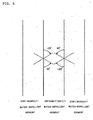
- each water repellent section has angles of -60° to 60° with respect to the body lengthwise direction.
- a method of measuring the above angles is such that 0° to 60° are measured counterclockwise and 0° to -60° are measured clockwise with respect to the body lengthwise direction as shown in Fig. 5.
- the water repellent treatment when applied to the water repellent region in the shape of stripes, it is possible to form the intermittently-water-repellent segments and the continuously-water-repellent segments, to which the water repellent treatment is continuously applied, to in the shape of stripes parallel to the body lengthwise direction.
- the width of the stripes can be suitably adjusted.
- the directions of the respective stripes must be prescribed based on the directions in which water flows along a human body. From the point of view, the stripes are disposed substantially parallel to the body lengthwise direction in the front body portion, back body portion, waist portion, armpit portion and the like.
- the portions corresponding to the side portion and the protruding portion of a human body it is more preferable to select the directions, in which the stripes are disposed, such that they have a predetermined angle with respect to the body lengthwise direction in consideration of the directions of water flows in a race.
- the racing swimsuit according to the present invention which has the intermittently-water-repellent segments in the water repellent region, it is possible that the water repellent sections of each intermittently-water-repellent segment are formed so as to be at least partially coupled with the continuously-water-repellent segments.
- the ratio of the area of the water repellent sections occupied in the area of a water repellent region is increased, which contributes to the reduction of the surface frictional resistance.
- the ratio of the area of the water repellent sections occupied in the area of the water repellent region is 70 to 90% to secure an optimum water releasing property while reducing the surface frictional resistance.
- the ratio of the area of the water repellent region occupied in the entire area of the racing swimsuit is not particularly limited, and it is determined based on the use, function and the like of the racing swimsuit such as from several tens of percentages only on the breast, only on the buttocks and the like to the entire surface of the swimsuit.
- a water repellent agent used in the racing swimsuit according to the present invention can be suitably selected from various types of conventionally used water repellent agents such as a silicone water repellent agent, a fluorine water repellent agent and the like.
- treatment agents used for the water repellent sections of the racing swimsuit according to the present invention are not stuck to the name "water repellent agent” and any treatment agent may be used so long as it substantially reduces the surface frictional resistance of a swimsuit in water by an water repellent effect.
- treatment agents named as a print agent, sealing agent and the like may be used.
- a printing treatment which has been ordinarily used industrially, is preferable as a method of adhering the water repellent agent on the surface of a fabric, and an apparatus to be used for the adhesion thereof may be suitably selected from a roller printing machine, an automatic screen printing machine, a hand screen printing machine, and the like.
- the heat treatment for the acceleration of the cross-linking reaction can be carried out by an ordinary pin tenter or the like.
- the racing swimsuit according to the present invention it is possible to from the groove sections by the structural change of the woven structure or the knitted structure of the fabric forming the racing swimsuit.
- the size of the rib-shaped knitted structure can be relatively simply adjusted, when it is knitted to a predetermined size, it can be directly used as the grooves according to the present invention.
- the racing swimsuit according to the present invention it is also possible to form the groove sections by applying an embossing treatment to the surface of the fabric by a high temperature high pressure roll.
- the embossing roll is a metal or resin roll having irregular portions formed therearound by engraving projections in a circumferential direction in correspondence with the depth, width and pitch of the grooves which are desired to be applied.
- the roll is heated to a predetermined temperature in accordance with the material and the like of a fabric, a predetermined pressure is applied to the roll and the knitted fabric or the woven fabric is pressed by the roll at a constant velocity so as to be pressed.
- a predetermined pressure is applied to the roll and the knitted fabric or the woven fabric is pressed by the roll at a constant velocity so as to be pressed.
- the surface of the fabric is compressed and shaped by the projecting portions of the roll, whereby fine grooves can be formed thereto in a desired depth, width and pitch.
- the temperature, pressure and velocity of the roll are changed depending upon the material, weight (g/m 2 ), thickness of the fabric to be processed, and the working environment where the embossing treatment is carried out.
- embossing treatment when applied to a knitted fabric composed of a 2-way tricot material having a weight of 120 to 330 g/m 2 and a thickness of 0.4 to 0.9 mm, it is suitable to set a roll temperature to about 180 to 220°C, a pressure to about 44130 to 53937 N (4500 to 5500 kgf) and a roll velocity to about 6 to 10 m/min.
- the shape of the grooves according to the present invention is not particularly limited and suitably selected from a V-shape, a U-shape, a trapezoid shape and the like.
- the fine grooves according to the present invention have a depth of 20 to 500 ⁇ m, a width of 200 to 1500 ⁇ m and a pitch of 300 to 3000 ⁇ m.
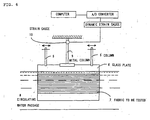
- the surface frictional resistance tester for fabric was arranged such that test fabrics 7 were bonded on both the surfaces of a glass plate 6 (3000 mm long ⁇ 600 mm wide) supported by columns 5 whose respective upper ends could be optionally moved in a horizontal direction and the glass plate 6 was sunk up to a predetermined depth in a water circulating water vessel 8.
- a metal column 9 had a lower end fixed to the glass plate 6 and an upper end fixed to a ceiling.
- a strain gauge 10 was disposed at an upper portion of the metal column 9.
- test fabrics 7 having the fine grooves formed thereon with the depth, width and pitch thereof changed were bonded on both the surfaces of the glass plate 6.
- the magnitude of the resistance received from the water flows flowing on the surfaces of the test fabrics 7 was measured by a dynamic strain gauge, as an electric signal from the strain gauge 10 and displayed on and recorded by a personal computer through an A/D converter.
- the glass plate, on which the test fabrics 7 were bonded was disposed in the water circulating water vessel 8, the water flows having a flow velocity of 1.8 m/sec were impinged against the glass plate, and the resistance value was calculated from the value of entire resistance measured at the time.
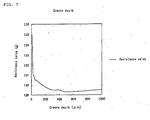
- Fig. 7 shows a result of the experiment carried out to optimize the depth of the grooves according to the present invention.
- the width of the grooves was set to a constant value of 200 ⁇ m and the pitch thereof was set to a constant value of 2000 ⁇ m.
- the depth of the grooves when the depth of the grooves is set to 500 ⁇ m or more, the manufacture of a fabric having such deep grooves is difficult in a manufacturing technology as well as a problem is caused in strength and there is a possibility that the fabric is liable to be broken.
- the depth of the grooves according to the present invention is 20 to 500 ⁇ m, a most meaningful effect can be obtained without being accompanied with difficulties in the manufacturing technology and strength.
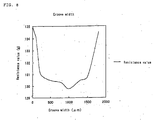
- Fig. 8 shows a result of the experiment carried out to optimize the width of the grooves according to the present invention.
- the depth of the grooves was set to a constant value of 50 ⁇ m and the pitch thereof was set to a constant value of 2000 ⁇ m.
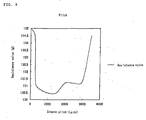
- Fig. 9 shows a result of the experiment.
- the depth of the grooves was set to a constant value of 50 ⁇ m and the pitch thereof was set to a constant value of 200 ⁇ m.
- the racing swimsuit according to the present invention it is also possible to apply a smoothing treatment to the region of the surface of the fabric forming the racing swimsuit other than the groove sections thereof.
- the smoothing treatment is also carried out by heating a roll having a smooth surface to a predetermined temperature in accordance with the material and the like of a fabric, applying a predetermined pressure to the roll and pressing the knitted fabric or the woven fabric by the roll at a constant velocity, similarly to the above embossing treatment.
- the grooves are formed by the change of the structure of the woven structure or the knitted structure of the fabric, it is also possible to apply the smoothing treatment only to the top of the fine ridge-shaped knitted structure of the surface of the fabric where the grooves are formed.
- the racing swimsuit according to the embodiment is formed by combining water repellent sections to which a water repellent treatment is applied to reduce surface frictional resistance, a plurality of fine grooves parallel to a body lengthwise direction to suppress the occurrence of turbulence on the surface of the swimsuit and a smoothing treatment.
- a tricot knitted fabric composed of knitted union cloth of multi-filament threads of polyester synthetic fibers and polyurethane elastic threads is used as the material of the fabric used in the embodiment.
- a pretreatment is applied to the surface of the fabric in the sequence of the water repellent treatment, the smoothing treatment, and the formation of the fine grooves by a final embossing treatment.
- the smoothing treatment is applied to the entire surface of the racing swimsuit and the plurality of fine grooves parallel to the body lengthwise direction are formed on the entire surface of the racing swimsuit.
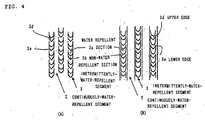
- the water repellent treatment is applied to the entire surface of the racing swimsuit so that the intermittently-water-repellent segments and the continuously-water-repellent segments are formed in the shape of stripes parallel to the body lengthwise direction.
- each intermittently-water-repellent segment 3 is composed of water repellent sections 3a and non-water-repellent sections 3b which are symmetrical with respect to a center line 3c.
- the upper edge 3d of each water repellent section 3a has an angle of 45° to each left edge 2a of the continuously-water repellent segment 2 and an angle of -45° to each right edge 2b thereof.
- the lower edge 3e of each water repellent section 3a has an angle of 55° to each left edge 2a of the continuously-water-repellent segment 2 and an angle of -55° to each right edge 2b thereof.
- each stripe of the racing swimsuit according to the embodiment is 8 mm in the continuously-water-repellent segments 2 and 10 mm in the intermittently-water-repellent segments 3.
- the intermittently-water-repellent segments are formed such that both the right and left edges of the water repellent sections are coupled with the continuously-water-repellent segments adjacent thereto, respectively.
- a fluorine water repellent agent is used as a water repellent agent used in the racing swimsuit according to the embodiment.
- a printing treatment which has been ordinarily used industrially, is used as a method of adhering the water repellent agent, and a roller printing machine is used as an apparatus to be used.
- a heat treatment is carried out to accelerate a cross-linking reaction for fixing the water repellent agent to the fabric using a pin tenter.
- the ratio of the area of the water repellent sections occupied in the water repellent region, that is, the entire area of the racing swimsuit is about 75%.
- the smoothing treatment is applied to the fabric, to which the water repellent treatment has been applied in the predetermined shape, for the purpose of more reducing the surface frictional resistance.
- the smoothing treatment is applied to the region of the fabric forming the racing swimsuit other than the grooves on the surface thereof.
- the smoothing treatment is carried out by a conventionally executed method of heating a roll having a smooth surface to a predetermined temperature in accordance with the material and the like of the fabric, applying a predetermined pressure to the roll and pressing the knitted fabric or the woven fabric by the roll at a constant velocity
- the plurality of fine grooves parallel to the body lengthwise direction are formed on the surface of the fabric, to which the water repellent treatment and the smoothing treatment have been applied, for the purpose of suppressing the occurrence of turbulence on the surface of the swimsuit.
- the grooves are uniformly formed on the entire surface of the racing swimsuit in a certain shape at constant intervals.
- the shape of the grooves according to the embodiment is a rectangular shape as shown in Fig. 3.
- Each groove has a depth set to about 70 ⁇ m, a width set to about 470 ⁇ m and a pitch set to about 1470 ⁇ m (Fig. 3 schematically shows the shape of the grooves and the ratios of the depth and the like of the grooves are not actual ratios).
- the grooves are formed by embossing the surface of the fabric with a high temperature high pressure roll.
- the embossing roll is a metal roll having irregular portions formed therearound by engraving projections corresponding to the above shape in the circumferential direction thereof.
- a roll temperature is set to about 200°
- a pressure is set to about 53937N (5500 kgf)
- a roll velocity is set to about 6 to 10 m/min.
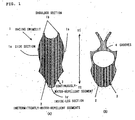
- the racing swimsuit according to the present invention is formed by cutting the elastic fabric, to which the pretreatment including the water repellent treatment, the smoothing treatment and the formation of the fine grooves by the embossing treatment has been applied, to predetermined shapes and sewing or boding side sections 1a, shoulder sections 1b and an inside-leg section 1c as shown in Fig. 1.
- the intermittently-water-repellent segments, the continuously-water-repellent segments and the grooves must be disposed in the shape of stripes in a direction substantially parallel to the body lengthwise direction, that is, in a direction parallel to the Y1 - Y2 direction in Fig. 1 in a sewed state.
- the portions corresponding to the side portion and the protruding portion of a human body it is also possible to select the directions in which the stripes are disposed so that they are at predetermined angles with respect to the body lengthwise direction.
- the racing swimsuit according to the present invention reduces the surface frictional resistance in water by the provision of the water repellent region on the surface of the racing swimsuit as well as makes it possible to reduce even the frictional resistance of turbulence occurred on the surface of the swimsuit of a racer by the formation of the plurality of fine grooves parallel to the body lengthwise direction, whereby the fluid resistance caused by water flows can be reduced in multiplication.
Landscapes
- Engineering & Computer Science (AREA)
- Textile Engineering (AREA)
- Professional, Industrial, Or Sporting Protective Garments (AREA)
- Treatments For Attaching Organic Compounds To Fibrous Goods (AREA)
- Synchronizing For Television (AREA)
- Fats And Perfumes (AREA)
- Meat, Egg Or Seafood Products (AREA)
Abstract
Description
- 1.
- racing swimsuit
- 1a.
- side section
- 1b.
- shoulder section
- 1c.
- inside-leg section
- 2.
- continuously-water-repellent segment
- 2a.
- side edge
- 2b.
- right edge
- 3.
- intermittently-water-repellent segment
- 3a.
- water repellent section
- 3b.
- non-water repellent section
- 3c.
- center line
- 3d.
- upper edge
- 3e.
- lower edge
- 4.
- groove
- 5.
- column
- 6.
- glass plate
- 7.
- fabric to be tested
- 8.
- circulating water passage
- 9.
- metal column
- 10.
- strain gauge
Claims (16)
- A racing swimsuit comprising an elastic fabric, wherein the swimsuit has a water repellent region, to which a water repellent treatment is applied, on at least a portion of the surface thereof, and which swimsuit has groove sections, in which a plurality of fine grooves parallel to a body lengthwise direction are formed, formed on at least a portion thereof.
- A racing swimsuit according to claim 1, in which a water repellent treatment is applied to the entire surface of the swimsuit and the swimsuit has groove sections, in which a plurality of fine grooves parallel to a body lengthwise direction are formed, on at least a portion thereof.
- A racing swimsuit according to claim 1, in which a plurality of fine grooves parallel to a body lengthwise direction are formed on the entire surface of the swimsuit and the swimsuit has a water repellent region, to which a water repellent treatment is applied, on at least a portion thereof.
- A racing swimsuit according to claim 1, in which a water repellent treatment is applied to the entire surface of the swimsuit and a plurality of fine grooves parallel to a body lengthwise direction are formed on the entire surface thereof.
- A racing swimsuit according to claim 1 or 2, wherein the groove sections are formed in the shape of stripes parallel to the body lengthwise direction.
- A racing swimsuit according to claim 1 or 3, wherein the water repellent region is formed in the shape of stripes parallel to the body lengthwise direction.
- A racing swimsuit according to claim 6, wherein the water repellent region is composed of intermittently-water-repellent segments in which water repellent sections, to which the water repellent treatment is applied, and non-water-repellent sections, to which no water repellent treatment is applied, are intermittently formed and which are formed in the shape of stripes parallel to the body lengthwise direction.
- A racing swimsuit according to claim 6, wherein the water repellent region is composed of intermittently-water-repellent segments in which water repellent sections, to which the water repellent treatment is applied, and non-water-repellent sections, to which no water repellent treatment is applied, are intermittently formed and continuously-water-repellent segments to which the water repellent treatment is continuously applied, and the intermittently-water-repellent segments and the continuously-water-repellent segments are formed in the shape of stripes parallel to the body lengthwise direction.
- A racing swimsuit according to claim 8, wherein the water repellent sections of the intermittently-water-repellent segments are at least partially coupled with the continuously-water-repellent segments.
- A racing swimsuit according to claim 8, wherein the water repellent sections of the intermittently-water-repellent segments are not coupled with the continuously-water repellent segments.
- A racing swimsuit according to any one of claims 7 to 10, wherein both the upper and lower edges of the water repellent sections of the intermittently-water-repellent segments have angles of -60° to 60° to the body lengthwise direction.
- A racing swimsuit according to any one of claims 3 to 11, wherein the ratio of the area of the water repellent sections occupied in the area of the water repellent region is 70 to 90%.
- A racing swimsuit according to any one of claims 1 to 12, wherein the groove sections are formed by the structural change of the woven structure or the knitted structure of the fabric forming the racing swimsuit.
- A racing swimsuit according to any one of claims 1 to 12, wherein the groove sections are formed by an embossing treatment applied to the surface of the fabric forming the racing swimsuit.
- A racing swimsuit according to any one of claims 1 to 14, wherein the grooves forming the groove sections have a depth of 20 to 500 µm, a width of 200 - 1500 µm and a pitch of 300 to 3000 µm.
- A racing swimsuit according to any one of claims 1 to 15, wherein smoothing treatment is applied to the region of the surface of the fabric forming the racing swimsuit other than the groove sections thereof.
Applications Claiming Priority (2)
| Application Number | Priority Date | Filing Date | Title |
|---|---|---|---|
| JP12070499 | 1999-04-27 | ||
| JP11120704A JP2000314015A (en) | 1999-04-27 | 1999-04-27 | Swimsuit |
Publications (3)
| Publication Number | Publication Date |
|---|---|
| EP1048232A2 true EP1048232A2 (en) | 2000-11-02 |
| EP1048232A3 EP1048232A3 (en) | 2001-04-25 |
| EP1048232B1 EP1048232B1 (en) | 2004-03-31 |
Family
ID=14792930
Family Applications (1)
| Application Number | Title | Priority Date | Filing Date |
|---|---|---|---|
| EP00300702A Expired - Lifetime EP1048232B1 (en) | 1999-04-27 | 2000-01-31 | Racing swimsuit |
Country Status (6)
| Country | Link |
|---|---|
| US (1) | US6647550B1 (en) |
| EP (1) | EP1048232B1 (en) |
| JP (1) | JP2000314015A (en) |
| AT (1) | ATE262803T1 (en) |
| AU (1) | AU762207B2 (en) |
| DE (1) | DE60009380T2 (en) |
Cited By (6)
| Publication number | Priority date | Publication date | Assignee | Title |
|---|---|---|---|---|
| DE10130392C2 (en) * | 2001-06-23 | 2003-06-26 | Bernd Spaeth | Sliding elements, for example snow sliding elements, with improved properties |
| WO2004098327A1 (en) * | 2003-05-05 | 2004-11-18 | Vives Vidal, Vivesa, Sa | Sports garment |
| EP2157226A3 (en) * | 2008-06-26 | 2010-08-11 | Dimension-Polyant GmbH | Sail membrane |
| CN106793840A (en) * | 2015-06-05 | 2017-05-31 | 美津浓株式会社 | Swimming suit |
| CN108158058A (en) * | 2018-01-09 | 2018-06-15 | 高鹤洋 | A kind of gym suit |
| US11154100B2 (en) | 2012-02-29 | 2021-10-26 | Nike, Inc. | Wetsuits with hydrodynamic interlocking and kinesiologic features |
Families Citing this family (21)
| Publication number | Priority date | Publication date | Assignee | Title |
|---|---|---|---|---|
| US20050003146A1 (en) * | 2001-06-21 | 2005-01-06 | Bernd Spath | Body with improved surface properties |
| AU2003242479A1 (en) * | 2002-06-21 | 2004-01-06 | Asahi Kasei Fibers Corporation | Cloth |
| US8082595B2 (en) * | 2004-03-10 | 2011-12-27 | Nike, Inc. | Article of swimwear with resilient seal |
| US20050223753A1 (en) * | 2004-04-09 | 2005-10-13 | Nordstrom Matthew D | Article of apparel with areas of increased tension |
| JP4585385B2 (en) * | 2005-06-13 | 2010-11-24 | 美津濃株式会社 | Swimsuit |
| US20070016999A1 (en) * | 2005-06-20 | 2007-01-25 | Nike, Inc. | Visual stimulus management |
| US8336117B2 (en) * | 2005-10-19 | 2012-12-25 | Nike, Inc. | Article of apparel with material elements having a reversible structure |
| BRPI0710336A2 (en) * | 2006-05-03 | 2011-08-09 | Dow Global Technologies Inc | elastic cloth, costume and method for making a dimensionally stable nelastic cloth |
| GB2456682B (en) | 2006-12-15 | 2009-09-30 | Speedo Int Ltd | Swim cap |
| GB2444804B (en) | 2006-12-15 | 2009-04-01 | Speedo Int Ltd | Elasticated sports garments |
| US7941869B2 (en) | 2007-02-09 | 2011-05-17 | Nike, Inc. | Apparel with reduced drag coefficient |
| US7849518B2 (en) | 2007-08-10 | 2010-12-14 | Hurley International, Llc | Water shorts incorporating a stretch textile |
| US8375465B2 (en) * | 2008-07-23 | 2013-02-19 | Patrick Gerald Whaley | Drag inducing swimwear |
| USD599083S1 (en) * | 2009-01-02 | 2009-09-01 | Warner Ragoobarsingh | Shredded swim suit |
| JP4578559B1 (en) * | 2009-06-04 | 2010-11-10 | 株式会社ゴールドウイン | Swimsuit with water ingress suppression part |
| JP5772824B2 (en) * | 2010-12-01 | 2015-09-02 | 東レ株式会社 | Swimwear textiles and swimwear |
| US20130007947A1 (en) | 2011-07-08 | 2013-01-10 | Hurley International, Llc | Water Shorts |
| KR101886769B1 (en) | 2014-03-31 | 2018-08-08 | 미즈노 가부시키가이샤 | Stretch woven fabric, and sportswear and swimwear employing same |
| US12129202B2 (en) | 2020-12-30 | 2024-10-29 | Whirlpool Corporation | Spill containment and management system for glass ceramic cooktop |
| CN117449020B (en) * | 2023-10-09 | 2026-02-03 | 东华大学 | Drag reduction fabric based on multi-mechanism synergistic effect, swimsuit and preparation method thereof |
| CN119843416B (en) * | 2025-03-21 | 2025-06-20 | 晋江友雅服饰有限公司 | Preparation method of bionic drag-reduction swimsuit fabric |
Family Cites Families (13)
| Publication number | Priority date | Publication date | Assignee | Title |
|---|---|---|---|---|
| JPS553010B2 (en) | 1971-09-14 | 1980-01-23 | ||
| JPS5526243A (en) | 1978-08-14 | 1980-02-25 | Tore Textile | Swimming suit |
| JPS6067312A (en) | 1983-09-16 | 1985-04-17 | Shinkawa Ltd | Lead frame transfer device |
| US5133516A (en) | 1985-05-31 | 1992-07-28 | Minnesota Mining And Manufacturing Co. | Drag reduction article |
| US4986496A (en) * | 1985-05-31 | 1991-01-22 | Minnesota Mining And Manufacturing | Drag reduction article |
| US5380578A (en) | 1988-06-30 | 1995-01-10 | Arlington Fabrics Corporation | Elastic fabric having a grooved outer surface and garments made therefrom |
| DE69008453T2 (en) * | 1989-07-24 | 1994-08-18 | Descente Ltd | Clothing to reduce fluid resistance. |
| JP2996536B2 (en) | 1991-06-14 | 2000-01-11 | 松下電器産業株式会社 | Swimsuit |
| JPH0612419A (en) | 1992-04-06 | 1994-01-21 | Nec Corp | Taxi operation management device, taxi operation status analysis device, and taxi operation management system |
| JP3182456B2 (en) | 1992-09-01 | 2001-07-03 | 日本金属株式会社 | Method for manufacturing metal resin laminate |
| JP2890340B2 (en) | 1992-09-29 | 1999-05-10 | 三井造船株式会社 | Method of forming air film on submerged surface of structure having submerged part and film structure on submerged surface |
| JP3283404B2 (en) * | 1995-07-06 | 2002-05-20 | 美津濃株式会社 | Swimsuit |
| AU6969396A (en) * | 1995-09-08 | 1997-03-27 | Eric L. Eagen | Reducing drag on bodies moving through fluid mediums |
-
1999
- 1999-04-27 JP JP11120704A patent/JP2000314015A/en active Pending
-
2000
- 2000-01-24 AU AU13528/00A patent/AU762207B2/en not_active Expired
- 2000-01-27 US US09/492,598 patent/US6647550B1/en not_active Expired - Lifetime
- 2000-01-31 DE DE60009380T patent/DE60009380T2/en not_active Expired - Lifetime
- 2000-01-31 AT AT00300702T patent/ATE262803T1/en not_active IP Right Cessation
- 2000-01-31 EP EP00300702A patent/EP1048232B1/en not_active Expired - Lifetime
Cited By (7)
| Publication number | Priority date | Publication date | Assignee | Title |
|---|---|---|---|---|
| DE10130392C2 (en) * | 2001-06-23 | 2003-06-26 | Bernd Spaeth | Sliding elements, for example snow sliding elements, with improved properties |
| WO2004098327A1 (en) * | 2003-05-05 | 2004-11-18 | Vives Vidal, Vivesa, Sa | Sports garment |
| EP2157226A3 (en) * | 2008-06-26 | 2010-08-11 | Dimension-Polyant GmbH | Sail membrane |
| US11154100B2 (en) | 2012-02-29 | 2021-10-26 | Nike, Inc. | Wetsuits with hydrodynamic interlocking and kinesiologic features |
| CN106793840A (en) * | 2015-06-05 | 2017-05-31 | 美津浓株式会社 | Swimming suit |
| CN108158058A (en) * | 2018-01-09 | 2018-06-15 | 高鹤洋 | A kind of gym suit |
| CN108158058B (en) * | 2018-01-09 | 2019-10-11 | 安徽伯希和户外装备用品有限公司 | a sportswear |
Also Published As
| Publication number | Publication date |
|---|---|
| AU762207B2 (en) | 2003-06-19 |
| EP1048232B1 (en) | 2004-03-31 |
| AU1352800A (en) | 2000-11-02 |
| US6647550B1 (en) | 2003-11-18 |
| DE60009380T2 (en) | 2005-02-17 |
| ATE262803T1 (en) | 2004-04-15 |
| EP1048232A3 (en) | 2001-04-25 |
| JP2000314015A (en) | 2000-11-14 |
| DE60009380D1 (en) | 2004-05-06 |
Similar Documents
| Publication | Publication Date | Title |
|---|---|---|
| EP1048232B1 (en) | Racing swimsuit | |
| US8029862B2 (en) | Composite fabric with engineered pattern | |
| JP6373548B2 (en) | Partially water-absorbing knitting and clothing | |
| EP2647748A1 (en) | Woven fabric for swimsuits, and swimsuit | |
| US7670666B2 (en) | Cloth | |
| EP3255186A1 (en) | Thin lightweight woven fabric | |
| JP3283404B2 (en) | Swimsuit | |
| JP2000178877A (en) | Woven knitted fabric with good drainage | |
| JP6012817B1 (en) | Swimsuit | |
| JP4377374B2 (en) | Low fluid resistance wear fabric and manufacturing method thereof | |
| JP4585385B2 (en) | Swimsuit | |
| JP3937653B2 (en) | Stretch fatigue test apparatus for fabric and stretch fatigue test method for fabric | |
| JP3537177B2 (en) | Fabric having a smooth surface and method for producing the same | |
| JP3604680B2 (en) | Swimsuit | |
| JP2000226709A (en) | Swimsuit | |
| JP2008138345A (en) | Fabric and sportswear | |
| JP3019982B2 (en) | Stretch adhesive interlining and manufacturing method thereof | |
| CN117702344B (en) | High-strength cut-resistant outdoor fabric and preparation method thereof | |
| JPH0235835Y2 (en) | ||
| HU215076B (en) | Strap for women`s underwear | |
| JP2008115508A (en) | Swimwear fabric, manufacturing method thereof, and swimsuit | |
| JP2026016028A (en) | Swimsuit | |
| JPS60162858A (en) | Softening processing apparatus | |
| JPH0478742B2 (en) | ||
| KR20210118913A (en) | letters and clothing |
Legal Events
| Date | Code | Title | Description |
|---|---|---|---|
| PUAI | Public reference made under article 153(3) epc to a published international application that has entered the european phase |
Free format text: ORIGINAL CODE: 0009012 |
|
| AK | Designated contracting states |
Kind code of ref document: A2 Designated state(s): AT BE CH CY DE DK ES FI FR GB GR IE IT LI LU MC NL PT SE |
|
| AX | Request for extension of the european patent |
Free format text: AL;LT;LV;MK;RO;SI |
|
| PUAL | Search report despatched |
Free format text: ORIGINAL CODE: 0009013 |
|
| AK | Designated contracting states |
Kind code of ref document: A3 Designated state(s): AT BE CH CY DE DK ES FI FR GB GR IE IT LI LU MC NL PT SE |
|
| AX | Request for extension of the european patent |
Free format text: AL;LT;LV;MK;RO;SI |
|
| 17P | Request for examination filed |
Effective date: 20010702 |
|
| AKX | Designation fees paid |
Free format text: AT BE CH CY DE DK ES FI FR GB GR IE IT LI LU MC NL PT SE |
|
| 17Q | First examination report despatched |
Effective date: 20021122 |
|
| GRAP | Despatch of communication of intention to grant a patent |
Free format text: ORIGINAL CODE: EPIDOSNIGR1 |
|
| RIN1 | Information on inventor provided before grant (corrected) |
Inventor name: MATSUZAKI, TAKESHI Inventor name: KINOSHITA, KATSUHIRO Inventor name: MORI, KENJIRO Inventor name: NIWA, UJITERU |
|
| GRAS | Grant fee paid |
Free format text: ORIGINAL CODE: EPIDOSNIGR3 |
|
| GRAA | (expected) grant |
Free format text: ORIGINAL CODE: 0009210 |
|
| AK | Designated contracting states |
Kind code of ref document: B1 Designated state(s): AT BE CH CY DE DK ES FI FR GB GR IE IT LI LU MC NL PT SE |
|
| PG25 | Lapsed in a contracting state [announced via postgrant information from national office to epo] |
Ref country code: NL Free format text: LAPSE BECAUSE OF FAILURE TO SUBMIT A TRANSLATION OF THE DESCRIPTION OR TO PAY THE FEE WITHIN THE PRESCRIBED TIME-LIMIT Effective date: 20040331 Ref country code: AT Free format text: LAPSE BECAUSE OF FAILURE TO SUBMIT A TRANSLATION OF THE DESCRIPTION OR TO PAY THE FEE WITHIN THE PRESCRIBED TIME-LIMIT Effective date: 20040331 Ref country code: FI Free format text: LAPSE BECAUSE OF FAILURE TO SUBMIT A TRANSLATION OF THE DESCRIPTION OR TO PAY THE FEE WITHIN THE PRESCRIBED TIME-LIMIT Effective date: 20040331 Ref country code: BE Free format text: LAPSE BECAUSE OF FAILURE TO SUBMIT A TRANSLATION OF THE DESCRIPTION OR TO PAY THE FEE WITHIN THE PRESCRIBED TIME-LIMIT Effective date: 20040331 |
|
| REG | Reference to a national code |
Ref country code: GB Ref legal event code: FG4D Ref country code: CH Ref legal event code: EP |
|
| REG | Reference to a national code |
Ref country code: IE Ref legal event code: FG4D |
|
| REF | Corresponds to: |
Ref document number: 60009380 Country of ref document: DE Date of ref document: 20040506 Kind code of ref document: P |
|
| REG | Reference to a national code |
Ref country code: CH Ref legal event code: NV Representative=s name: ISLER & PEDRAZZINI AG |
|
| PG25 | Lapsed in a contracting state [announced via postgrant information from national office to epo] |
Ref country code: DK Free format text: LAPSE BECAUSE OF FAILURE TO SUBMIT A TRANSLATION OF THE DESCRIPTION OR TO PAY THE FEE WITHIN THE PRESCRIBED TIME-LIMIT Effective date: 20040630 Ref country code: SE Free format text: LAPSE BECAUSE OF FAILURE TO SUBMIT A TRANSLATION OF THE DESCRIPTION OR TO PAY THE FEE WITHIN THE PRESCRIBED TIME-LIMIT Effective date: 20040630 Ref country code: GR Free format text: LAPSE BECAUSE OF FAILURE TO SUBMIT A TRANSLATION OF THE DESCRIPTION OR TO PAY THE FEE WITHIN THE PRESCRIBED TIME-LIMIT Effective date: 20040630 |
|
| PG25 | Lapsed in a contracting state [announced via postgrant information from national office to epo] |
Ref country code: ES Free format text: LAPSE BECAUSE OF FAILURE TO SUBMIT A TRANSLATION OF THE DESCRIPTION OR TO PAY THE FEE WITHIN THE PRESCRIBED TIME-LIMIT Effective date: 20040712 |
|
| NLV1 | Nl: lapsed or annulled due to failure to fulfill the requirements of art. 29p and 29m of the patents act | ||
| ET | Fr: translation filed | ||
| PGFP | Annual fee paid to national office [announced via postgrant information from national office to epo] |
Ref country code: CH Payment date: 20050127 Year of fee payment: 6 |
|
| PG25 | Lapsed in a contracting state [announced via postgrant information from national office to epo] |
Ref country code: LU Free format text: LAPSE BECAUSE OF NON-PAYMENT OF DUE FEES Effective date: 20050131 Ref country code: IE Free format text: LAPSE BECAUSE OF NON-PAYMENT OF DUE FEES Effective date: 20050131 Ref country code: MC Free format text: LAPSE BECAUSE OF NON-PAYMENT OF DUE FEES Effective date: 20050131 Ref country code: CY Free format text: LAPSE BECAUSE OF FAILURE TO SUBMIT A TRANSLATION OF THE DESCRIPTION OR TO PAY THE FEE WITHIN THE PRESCRIBED TIME-LIMIT Effective date: 20050131 |
|
| PLBE | No opposition filed within time limit |
Free format text: ORIGINAL CODE: 0009261 |
|
| STAA | Information on the status of an ep patent application or granted ep patent |
Free format text: STATUS: NO OPPOSITION FILED WITHIN TIME LIMIT |
|
| 26N | No opposition filed |
Effective date: 20050104 |
|
| REG | Reference to a national code |
Ref country code: IE Ref legal event code: MM4A |
|
| PG25 | Lapsed in a contracting state [announced via postgrant information from national office to epo] |
Ref country code: LI Free format text: LAPSE BECAUSE OF NON-PAYMENT OF DUE FEES Effective date: 20060131 Ref country code: CH Free format text: LAPSE BECAUSE OF NON-PAYMENT OF DUE FEES Effective date: 20060131 |
|
| REG | Reference to a national code |
Ref country code: CH Ref legal event code: PL |
|
| PG25 | Lapsed in a contracting state [announced via postgrant information from national office to epo] |
Ref country code: PT Free format text: LAPSE BECAUSE OF NON-PAYMENT OF DUE FEES Effective date: 20040831 |
|
| REG | Reference to a national code |
Ref country code: FR Ref legal event code: PLFP Year of fee payment: 17 |
|
| REG | Reference to a national code |
Ref country code: FR Ref legal event code: PLFP Year of fee payment: 18 |
|
| REG | Reference to a national code |
Ref country code: FR Ref legal event code: PLFP Year of fee payment: 19 |
|
| PGFP | Annual fee paid to national office [announced via postgrant information from national office to epo] |
Ref country code: FR Payment date: 20181213 Year of fee payment: 20 |
|
| PGFP | Annual fee paid to national office [announced via postgrant information from national office to epo] |
Ref country code: IT Payment date: 20190121 Year of fee payment: 20 Ref country code: GB Payment date: 20190130 Year of fee payment: 20 Ref country code: DE Payment date: 20190115 Year of fee payment: 20 |
|
| REG | Reference to a national code |
Ref country code: DE Ref legal event code: R071 Ref document number: 60009380 Country of ref document: DE |
|
| REG | Reference to a national code |
Ref country code: GB Ref legal event code: PE20 Expiry date: 20200130 |
|
| PG25 | Lapsed in a contracting state [announced via postgrant information from national office to epo] |
Ref country code: GB Free format text: LAPSE BECAUSE OF EXPIRATION OF PROTECTION Effective date: 20200130 |