EP1044591B1 - Function management system for vehicles - Google Patents
Function management system for vehicles Download PDFInfo
- Publication number
- EP1044591B1 EP1044591B1 EP00107566A EP00107566A EP1044591B1 EP 1044591 B1 EP1044591 B1 EP 1044591B1 EP 00107566 A EP00107566 A EP 00107566A EP 00107566 A EP00107566 A EP 00107566A EP 1044591 B1 EP1044591 B1 EP 1044591B1
- Authority
- EP
- European Patent Office
- Prior art keywords
- sequence
- control unit
- management system
- switch
- function
- Prior art date
- Legal status (The legal status is an assumption and is not a legal conclusion. Google has not performed a legal analysis and makes no representation as to the accuracy of the status listed.)
- Expired - Lifetime
Links
- 230000006870 function Effects 0.000 claims description 58
- 230000004913 activation Effects 0.000 claims 5
- 206010000210 abortion Diseases 0.000 claims 1
- 230000005540 biological transmission Effects 0.000 description 13
- 230000000994 depressogenic effect Effects 0.000 description 3
- 238000010586 diagram Methods 0.000 description 3
- 230000007935 neutral effect Effects 0.000 description 3
- 238000004891 communication Methods 0.000 description 2
- 230000000694 effects Effects 0.000 description 2
- 239000012530 fluid Substances 0.000 description 2
- 238000000034 method Methods 0.000 description 2
- 238000012986 modification Methods 0.000 description 2
- 230000004048 modification Effects 0.000 description 2
- 230000004044 response Effects 0.000 description 2
- 230000005355 Hall effect Effects 0.000 description 1
- 241001236644 Lavinia Species 0.000 description 1
- 241000947772 Strawberry crinkle virus Species 0.000 description 1
- 238000007792 addition Methods 0.000 description 1
- 238000003967 crop rotation Methods 0.000 description 1
- 230000001419 dependent effect Effects 0.000 description 1
- 230000000881 depressing effect Effects 0.000 description 1
- 238000011161 development Methods 0.000 description 1
- 230000018109 developmental process Effects 0.000 description 1
- 238000003306 harvesting Methods 0.000 description 1
- 230000010354 integration Effects 0.000 description 1
- 230000008569 process Effects 0.000 description 1
- 239000002689 soil Substances 0.000 description 1
- 230000001052 transient effect Effects 0.000 description 1
- 230000007704 transition Effects 0.000 description 1
Images


Classifications
-
- E—FIXED CONSTRUCTIONS
- E02—HYDRAULIC ENGINEERING; FOUNDATIONS; SOIL SHIFTING
- E02F—DREDGING; SOIL-SHIFTING
- E02F9/00—Component parts of dredgers or soil-shifting machines, not restricted to one of the kinds covered by groups E02F3/00 - E02F7/00
- E02F9/20—Drives; Control devices
-
- A—HUMAN NECESSITIES
- A01—AGRICULTURE; FORESTRY; ANIMAL HUSBANDRY; HUNTING; TRAPPING; FISHING
- A01B—SOIL WORKING IN AGRICULTURE OR FORESTRY; PARTS, DETAILS, OR ACCESSORIES OF AGRICULTURAL MACHINES OR IMPLEMENTS, IN GENERAL
- A01B63/00—Lifting or adjusting devices or arrangements for agricultural machines or implements
-
- A—HUMAN NECESSITIES
- A01—AGRICULTURE; FORESTRY; ANIMAL HUSBANDRY; HUNTING; TRAPPING; FISHING
- A01B—SOIL WORKING IN AGRICULTURE OR FORESTRY; PARTS, DETAILS, OR ACCESSORIES OF AGRICULTURAL MACHINES OR IMPLEMENTS, IN GENERAL
- A01B63/00—Lifting or adjusting devices or arrangements for agricultural machines or implements
- A01B63/02—Lifting or adjusting devices or arrangements for agricultural machines or implements for implements mounted on tractors
- A01B63/10—Lifting or adjusting devices or arrangements for agricultural machines or implements for implements mounted on tractors operated by hydraulic or pneumatic means
- A01B63/111—Lifting or adjusting devices or arrangements for agricultural machines or implements for implements mounted on tractors operated by hydraulic or pneumatic means regulating working depth of implements
- A01B63/1117—Lifting or adjusting devices or arrangements for agricultural machines or implements for implements mounted on tractors operated by hydraulic or pneumatic means regulating working depth of implements using a hitch position sensor
-
- E—FIXED CONSTRUCTIONS
- E02—HYDRAULIC ENGINEERING; FOUNDATIONS; SOIL SHIFTING
- E02F—DREDGING; SOIL-SHIFTING
- E02F9/00—Component parts of dredgers or soil-shifting machines, not restricted to one of the kinds covered by groups E02F3/00 - E02F7/00
- E02F9/26—Indicating devices
-
- G—PHYSICS
- G05—CONTROLLING; REGULATING
- G05B—CONTROL OR REGULATING SYSTEMS IN GENERAL; FUNCTIONAL ELEMENTS OF SUCH SYSTEMS; MONITORING OR TESTING ARRANGEMENTS FOR SUCH SYSTEMS OR ELEMENTS
- G05B2219/00—Program-control systems
- G05B2219/20—Pc systems
- G05B2219/23—Pc programming
- G05B2219/23423—Record playback
-
- G—PHYSICS
- G05—CONTROLLING; REGULATING
- G05B—CONTROL OR REGULATING SYSTEMS IN GENERAL; FUNCTIONAL ELEMENTS OF SUCH SYSTEMS; MONITORING OR TESTING ARRANGEMENTS FOR SUCH SYSTEMS OR ELEMENTS
- G05B2219/00—Program-control systems
- G05B2219/20—Pc systems
- G05B2219/26—Pc applications
- G05B2219/2663—Tractor
Definitions
- the invention relates to a function management system for vehicles, which has at least one function that can perform certain operations when driving the vehicle depending on settings on at least one, the function associated control element using a control unit.
- Such a function management system is for example from the US 5,050,771 known.
- the object underlying the invention is seen to provide a function management system of the type mentioned, by which the aforementioned problems are overcome.
- the function management should simplify the operation of a work vehicle such as an agricultural tractor.
- a tractor includes various functional systems, also called functions, such as a powershift transmission, a hitch with a hitch control, a PTO, several auxiliary control valves, etc. controlled by a control unit in response to detected parameters and depending on the adjustment of controls such as switches and levers operating an operator, to be controlled.
- the control unit includes a learning mode that is operable while the vehicle is moving. During the execution of the learning mode, the operator performs a sequence of manipulations on the controllers, and the controller stores information associated with the sequences along with information related to the distances the tractor between two Completed operations.
- the control unit also has a run or repeat mode in which it automatically executes the stored work sequence so that the work sequence is executed at the same distance intervals at which it was learned, regardless of the vehicle speed.
- the function management according to the invention makes it possible to considerably reduce the operating requirements for a work vehicle, such as an agricultural tractor, imposed on an operator.
- the functional management system according to the invention is able to learn and store various operational sequences of functional operations and to execute and repeat such learned operations on command. The operations are learned as a function of driving distances of the vehicle so that the working sequences are automatically repeated at the same intermediate distance ratios as learned.
- the vehicle underlying FIG. 1 is, for example, a commercially available John Deere Series 8000 Series Tractor and includes a prime mover 10 which drives an output shaft which in turn drives a powershift transmission (PST) 12 which in turn drives an output drive shaft connected to the Drive wheels 17 of the vehicle is in communication.
- the power shift transmission 12 includes a transmission 18 which is actuated by a set of pressure actuated elements or clutches 20 actuated by a set of associated solenoid operated control valves 22.
- the power shift transmission 12 may be one used in the aforementioned John Deere series tractor. However, it can also be any electronically controlled transmission with similar controls.
- the valves 22 may be electro-hydraulically actuated valves, as also used in the John Deere series tractor.
- the prime mover 10 additionally drives the PTO drive, not shown, for a conventional power take off (PTO) and a hydraulic pump which delivers pressurized hydraulic fluid to auxiliary control valves (not shown), also known from the John Deere series tractor.
- a tractor can, for example, a switchable differential lock and Include a switchable mechanical front wheel drive.
- electro-hydraulic depth control cylinder can be located on the not shown, pulled by the tractor attachment.
- An attachment device such as a conventional 3-point hitch, includes tension members (lower links) 32 which are connected via lift rods 36 to lift arms 34.
- the lifting arms 34 are connected to a lifting shaft 28, that a simultaneous and equal movement is ensured. They are raised or lowered by two lifting cylinders 38 connected in parallel.
- the illustrated tractor cutout and hitch 30 are shown by way of example only, it will be apparent to those skilled in the art that the invention can be applied to tractors or hitches of other configurations.
- various types of non-illustrated soil working implements such as a mouldboard plow or a chisel plow, may be attached to the hitch 30 in a conventional manner.
- the power shift transmission 12, the hitch 30, a PTO, not shown, additional control valves, a differential lock, not shown front wheel drive and not shown electro-hydraulic depth control cylinder are examples of different types of functions or actuators, during the tractor operation, for example on Beginning or end of a crop row in the desired sequence (sequence) to be pressed.
- the hydraulic fluid communication to and from the cylinders 38 is controlled by two electro-hydraulic flow control solenoid valves 40a and 40b, which in turn are controlled by drivers 42a and 42b which receive electrical control signals generated by the vehicle control unit (VCU) 44.
- the VCU 44 is preferably a microprocessor-based electronic control unit as it is used on John Deere Series 8000 series tractors. Also, the flow control valves 40a and 40b and the drivers 42a and 42b may be components already used in the John Deere series tractor.
- the VCU 44 preferably also controls a differential lock, not shown, a not shown mechanical front wheel drive, a PTO, not shown, not shown auxiliary control valves, as they are all known for example from the John Deere series tractor.
- the VCU 44 receives signals from a spring-centered rocker switch 46, which has three positions and which serves to raise and lower (H / S) the implement 30, a vehicle monitor / display unit 48, and a gearshift unit 50, all of them from the John Deere series tugs are known.
- the VCU 44 also receives signals from an engine speed sensor 52, preferably a magnetic pickup, and an axle speed sensor 54, preferably a Hall effect sensor, that provides an axle speed signal.
- Components 52 and 54 are preferably similar to the corresponding components of the John Deere series tractor. However, corresponding components which are otherwise commercially available are also suitable.
- the VCU 44 also receives signals from a self-centering sequence switch 56 that is switchable between a first and a second sequence and that is configured as a commercially available flip-flop switchable between three positions (1st sequence, 2nd sequence and neutral) and in conjunction with the present one Invention is used.
- the VCU 44 includes an input and output circuit, a programmable microprocessor, and a memory, not shown.
- the VCU 44 also receives signals from a clutch switch 57 which operatively communicates with the clutch pedal 58.
- the monitor / display unit 48 shown in Figure 2 is similar to the monitor / display unit used in John Deere Series 8000 series tractors, but with some additions and / or changes as will be described.
- the left third of the monitor / display unit 48 includes a plurality of warning and status lights 60 associated with various vehicle functions, but not directly related to the present invention.
- the upper, middle portion of the unit 48 includes a graphics and number display 62.
- the lower, middle portion of the unit 48 includes a plurality of touch pad switches 64 (which are also not within the scope of the present invention) that allow adjustment. which parameters should be indicated by the numeric part of the display.
- the upper part and lower part of the right third of the monitor / display unit 48 may include non-illustrated touch surface switches not belonging to the present invention.
- the unit 48 also includes a speaker, not shown, which emits acoustic signals in response to certain conditions and operations.
- the middle part of the right third of the monitor / display unit 48 includes an on / off switch 66 and a learn / store switch 68, both of which may be a touch pad switch and used in conjunction with the present invention functional management system according to the invention can be used.
- the lower right portion of the display 62 includes a HMI system IMS (Implement Management System) indicator 70 and a display element 72 for indicating the operative sequence (1 or 2).
- the display elements 70, 72 light up depending on the functional status according to the present invention, as will be described.
- the VCU 44 is programmed accordingly.
- the programmed VCU 44 derives the required distance information using known integration techniques from the speed sensor 54.
- the programmed VCU 44 cooperates with the elements shown in FIGS. 1 and 2 and thereby implements the function management system according to the invention.
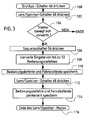
- the learn / store mode operates as follows: In step 100, the system is first turned on by pressing the on / off switch 66 and the IMS indicator 70 turns on. By depressing the learn / memory switch 68, step 102 activates the learn / memory mode, the IMS indicator 70 begins to flash, and an audible alarm sounds every two seconds.
- step 104 the learn / save mode continues as long as a forward gear is adjusted on the transmission 18 and the tractor is moving faster than a minimum speed, for example, 0.5 km / h.
- the function management system exits the learning / memory mode and cancels it. The previously determined sequences are deleted.
- step 106 the operator temporarily actuates the sequence switch 56 to set the sequence 1 or sequence 2.
- the associated sequence number of the sequence display element 72 starts to flash.
- step 108 the operator may manually execute a sequence (sequence) of functional operator commands that may be limited to a maximum number (e.g., 12).
- the operation commands are, for example, shifting the transmission 18 by operating the shift lever 50, or raising and / or lowering the attachment 30 by operating the raise / lower rocker switch 46.
- the VCU 44 records in step 110 (in FIG temporary memory) all manually executed operations together with the associated driving distances, the tractor between the various manually executed operations.
- step 112 the learn / memory switch 68 is pressed again, and through step 114, the VCU 44 stores in a permanent memory the operating sequence and the associated driving distances, as well as the sequence number 1 or 2, which depends on which position the switch 56 before (step 106) was pressed.
- the learn / save mode then ends with step 116, the sequence indicator 72 stops flashing and only the IMS indicator 70 remains illuminated.
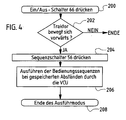
- Step 200 the on / off switch 66 is depressed to turn on the function management system.
- the IMS indicator lights up.
- Step 202 allows the execution mode to proceed when the tractor gearbox 18 is in a forward gear and the tractor is moving faster than a minimum speed.
- the operator temporarily depresses the sequence switch 56 to the "1" position or the "2" position to select which of the stored sequences will be played should.
- the "1" or "2" of the sequence display element 72 lights up and remains on for at least 3 seconds, even if the sequence to be executed takes less than 3 seconds. Then, the VCU 44 automatically executes the selected one in step 206 Sequence of stored operating commands. For example, the transmission 18 is automatically switched without the operator operating the gearshift lever 50, or the hitch 30 is automatically raised and / or lowered without the operator operating the lift / lower rocker switch 46. The stored operator commands are each executed at the same relative distances as learned, regardless of whether the tractor is traveling at the same, lower, or higher speed. When the sequence is completed, the "1" or "2" of the sequence display element 72 goes out. The execution mode then ends with step 208.
- the operator can temporarily toggle the sequence switch 56 to its "1" position for the first sequence for example, automatically execute at the end of each harvest series.
- the operator may temporarily flip the sequence switch 56 to its "2" position to automatically execute, for example, the second sequence at the beginning of each crop rotation.
- the feature management system described herein may be used to automatically execute a first sequence of operations at the beginning of each crop series and, by another temporary operation of the sequence switch 56, automatically execute another second sequence of operations at the end of each crop series with a single transient operation of the sequence switch 56.
- the function management system is not based on fixed time intervals but based on the tractor's traveled distances, the sequences can be "learned" slowly, ie at low tractor speeds, and then played and executed faster when the tractor is operating at normal operating speeds , This grants the operator sufficient time to execute the learning mode, in which the control unit 48 learns a complex operating sequence.
- the function management system of the present invention operates as follows.
- the on / off switch 66 When the on / off switch 66 is pressed, an audible signal sounds.
- the program When the program is turned on, the contents of the stored sequences appear on the monitor / display unit 48. For each sequence starting with sequence "1", each event is displayed every two seconds followed by an "end” indication on the display 62.
- Learned sequences are recorded indefinitely. A maximum number of operations, for example 12, can be recorded. The operator may erase a learned sequence from memory. If the learn / save mode is aborted during a learning process, e.g. For example, if the sequence did not complete properly, the sequence will be deleted from memory. A stored sequence can be removed from memory by starting the learn / save mode normally, selecting the sequence, and then operating the learn / memory switch 68 without manually executing vehicle operator commands. This causes the program to exit the learn / save mode and to stop flashing the sequence number while the IMS indicator 70 continues to light alone.
- the learn / save mode may also be cleared by operating the on / off switch 66 and either a) not selecting a sequence with the sequence switch 56 within 30 seconds, b) within 30 seconds after the sequence switch 56 is actuated become, no operator commands were "learned", c) within 30 seconds of learning the first operation command, the learn / memory switch 68 is not operated, d) the forward gear of the transmission 18 is left, or e) the operator is not present and the tractor has not moved for more than 5 seconds.
- the IMS status indicator 70 in the display 62 lights up when the program is in operation.
- the program turns off the function management system and turns off the IMS indicator 70. If the on / off switch 66 is depressed and the sequence switch 56 is not in its neutral position, then the function management system will not be turned on. If the program is in learn / save mode with the feature management system turned off, the learn / save mode is terminated and no sequence is saved. If the program executes or repeats a sequence with the feature management system turned off, execution of the sequence is aborted.
- an audible signal (beep) is emitted.
- the IMS status indicator 70 on the display 62 flashes during a learn mode. Every two seconds, the VCU 44 generates a 1/16 second beep.
- the function management system is not turned on, the operation of the learning / memory switch 68 has no effect.
- the program enters the learning / memory mode.
- the execution of a sequence always begins with the first operation of the sequence, even if the sequence was previously aborted.
- the program always executes the learned operation commands for a function. If the function is already in the state to be reached by the learned operation, the program has no influence on the function. For example, if it is a lifting command for the hitch and it is already fully raised, the program proceeds to the next operation of the sequence. If the sequence is already being executed while the sequence switch 56 is again pressed into the corresponding sequence position, the actuation of the sequence switch 56 is ignored and the sequence execution continues. If a sequence is already in progress and then the sequence switch 56 is pressed into the other sequence position, then the program aborts the execution of the sequence. If a function is ineffective at the time a sequence is called, the program will not execute a sequence.
- the operator may use the clutch pedal 58 to prevent the program from accumulating travel distances during a learn / save mode and to temporarily suspend automatic execution of a service command during execution of a stored sequence. Once 30 seconds have elapsed, the sequence is aborted regardless of whether the clutch is engaged or not engaged.
- the program also prevents the execution of a sequence when the gear of the transmission 18 is above a predeterminable maximum gear, for example the 14th forward gear, irrespective of whether the sequence was learned above this maximum gear.
- Alarm messages relating to functions not included in the executed sequence do not cause the function management system to abort the sequence execution.
- the functional management system described may also be used to learn and repeat operations involving differential lock, mechanical front wheel drive, PTO, auxiliary control valves (SCVs), and electro-hydraulic depth control cylinders, such as those found on towed attachments and which may be actuated by the operator from the tractor.
- PCVs auxiliary control valves
- electro-hydraulic depth control cylinders such as those found on towed attachments and which may be actuated by the operator from the tractor.
Landscapes
- Engineering & Computer Science (AREA)
- Life Sciences & Earth Sciences (AREA)
- Environmental Sciences (AREA)
- General Engineering & Computer Science (AREA)
- Structural Engineering (AREA)
- Civil Engineering (AREA)
- Mechanical Engineering (AREA)
- Soil Sciences (AREA)
- Mining & Mineral Resources (AREA)
- Agricultural Machines (AREA)
- Lifting Devices For Agricultural Implements (AREA)
- Control Of Position, Course, Altitude, Or Attitude Of Moving Bodies (AREA)
- Guiding Agricultural Machines (AREA)
- Time Recorders, Dirve Recorders, Access Control (AREA)
- Feedback Control In General (AREA)
- Navigation (AREA)
- Traffic Control Systems (AREA)
Description
Die Erfindung betrifft ein Funktionsmanagementsystem für Fahrzeuge, welches wenigstens eine Funktion aufweist, die bei fahrendem Fahrzeug in Abhängigkeit von Einstellungen an wenigsten einem, der Funktion zugeordneten Bedienungselement unter Verwendung einer Steuereinheit bestimmte Operationen ausführen kann.The invention relates to a function management system for vehicles, which has at least one function that can perform certain operations when driving the vehicle depending on settings on at least one, the function associated control element using a control unit.
Ein solches Funktionsmanagementsystem ist beispielsweise aus der
Wenn sich ein landwirtschaftlicher Traktor über ein Feld bewegt, muß die Bedienungsperson gewöhnlich zusätzlich zum Lenken des Traktors, am Beginn oder Ende einer Erntereihe viele Operationen an Funktionen ausführen, wie beispielsweise Anheben und Absenken einer Anbaueinrichtung für Anbaugeräte, Umschalten des Getriebes, Einschalten oder Ausschalten der Zapfwelle etc. Die Anzahl und Komplexität dieser Aufgaben kann zur Ermüdung der Bedienungsperson und zu Bedienungsfehlern führen. Es ist ein System wünschenswert, das die an die Bedienungsperson gestellten Anforderungen vermindert.When an agricultural tractor travels across a field, in addition to steering the tractor at the beginning or end of a crop row, the operator usually has to perform many operations on functions such as raising and lowering an attachment attachment, shifting the gearbox, turning it on or off PTO, etc. The number and complexity of these tasks can lead to fatigue of the operator and operator errors. It is desirable to have a system that reduces the demands placed on the operator.
Die der Erfindung zugrunde liegende Aufgabe wird darin gesehen, ein Funktionsmanagementsystem der eingangs genannten Art anzugeben, durch welches die vorgenannten Probleme überwunden werden. Insbesondere soll das Funktionsmanagement die Bedienung eines Arbeitsfahrzeugs, wie beispielsweise eines landwirtschaftlichen Traktors, vereinfachen.The object underlying the invention is seen to provide a function management system of the type mentioned, by which the aforementioned problems are overcome. In particular, the function management should simplify the operation of a work vehicle such as an agricultural tractor.
Die Aufgabe wird erfindungsgemäß durch die Lehre des Patentanspruchs 1 gelöst. Weitere vorteilhafte Ausgestaltungen und Weiterbildungen der Erfindung gehen aus den Unteransprüchen hervor.The object is achieved by the teaching of claim 1. Further advantageous embodiments and modifications of the invention will become apparent from the dependent claims.
Ein Traktor enthält verschiedene funktionelle Systeme, auch Funktionen genannt, wie ein Lastschaltgetriebe, eine Anhängevorrichtung mit einem Anhängevorrichtungssteuergerät, eine Zapfwelle, mehrere Zusatzsteuerventile usw., die durch eine Steuereinheit in Abhängigkeit ermittelter Parameter sowie in Abhängigkeit von der Einstellung von Bedienungselementen, wie Schalter und Hebel, die eine Bedienungsperson betätigt, gesteuert werden. Erfindungsgemäß enthält die Steuereinheit einen Lernmodus, der betriebsfähig ist, während sich das Fahrzeug bewegt. Während der Ausführung des Lernmodus führt die Bedienungsperson eine Sequenz von Handhabungen (Manipulationen) an den Steuereinrichtungen aus, und die Steuereinheit speichert Informationen, die mit den Sequenzen im Zusammenhang stehen zusammen mit Informationen, die mit den Distanzen in Zusammenhang stehen, die der Traktor zwischen zwei Operationen zurückgelegt hat. Die Steuereinheit weist auch einen Ausführ- oder Wiederholmodus auf, in dem sie automatisch die gespeicherte Arbeitssequenz ausführt, so daß die Arbeitssequenz bei den gleichen Abstandsintervallen ausgeführt werden, bei welchen sie gelernt wurden, und zwar unabhängig von der Fahrzeuggeschwindigkeit.A tractor includes various functional systems, also called functions, such as a powershift transmission, a hitch with a hitch control, a PTO, several auxiliary control valves, etc. controlled by a control unit in response to detected parameters and depending on the adjustment of controls such as switches and levers operating an operator, to be controlled. According to the invention, the control unit includes a learning mode that is operable while the vehicle is moving. During the execution of the learning mode, the operator performs a sequence of manipulations on the controllers, and the controller stores information associated with the sequences along with information related to the distances the tractor between two Completed operations. The control unit also has a run or repeat mode in which it automatically executes the stored work sequence so that the work sequence is executed at the same distance intervals at which it was learned, regardless of the vehicle speed.
Durch das erfindungsgemäße Funktionsmanagement lassen sich die an eine Bedienungsperson gestellten Bedienungsanforderungen für ein Arbeitsfahrzeug, wie beispielsweise einen landwirtschaftlichen Traktor, erheblich herabsetzen. Das erfindungsgemäße Funktionsmanagementsystem ist in der Lage, verschiedene Arbeitssequenzen von Funktionsoperationen zu erlernen und abzuspeichern und solche erlernten Operationen auf Befehl auszuführen und zu wiederholen. Die Operationen werden in Abhängigkeit von Fahrdistanzen des Fahrzeugs erlernt, so daß sich die Arbeitssequenzen bei denselben zwischenliegenden Abstandsverhältnissen automatisch, so wie sie erlernt wurden, wiederholen lassen.The function management according to the invention makes it possible to considerably reduce the operating requirements for a work vehicle, such as an agricultural tractor, imposed on an operator. The functional management system according to the invention is able to learn and store various operational sequences of functional operations and to execute and repeat such learned operations on command. The operations are learned as a function of driving distances of the vehicle so that the working sequences are automatically repeated at the same intermediate distance ratios as learned.
Anhand der Zeichnung, die ein Ausführungsbeispiel der Erfindung zeigt, werden nachfolgend die Erfindung sowie weitere Vorteile und vorteilhafte Weiterbildungen und Ausgestaltungen der Erfindung näher beschrieben und erläutert.Reference to the drawing, which shows an embodiment of the invention, the invention and further advantages and advantageous developments and refinements of the invention are described and explained in more detail below.
Es zeigt:
- Fig. 1
- das schematische Diagramm eines erfindungsgemäßen Funktionsmanagementsystems für Fahrzeuge,
- Fig. 2
- die Ansicht einer Vorderwand mit einer Fahrzeug-Monitor/Display-Einheit,
- Fig. 3
- ein vereinfachtes logisches Flußdiagramm, welches die Betriebsweise eines Lern/Speicher-Modus der vorliegenden Erfindung illustriert, und
- Fig. 4
- ein vereinfachtes logisches Flußdiagramm, welches die Betriebsweise eines Ausführungsmodus der vorliegenden Erfindung illustriert.
- Fig. 1
- the schematic diagram of a functional management system according to the invention for vehicles,
- Fig. 2
- the view of a front wall with a vehicle monitor / display unit,
- Fig. 3
- a simplified logic flow diagram illustrating the operation of a learning / memory mode of the present invention, and
- Fig. 4
- a simplified logic flow diagram illustrating the operation of an embodiment of the present invention.
Das der Fig. 1 zugrunde liegende Fahrzeug ist beispielsweise ein im Handel erhältlicher John Deere Serientraktor der Serie 8000 und enthält eine Antriebsmaschine 10, welche eine Ausgangswelle antreibt, die ihrerseits ein Lastschaltgetriebe (PST) 12 antreibt, welches seinerseits eine Ausgangsantriebswelle antreibt, die mit den Antriebsrädern 17 des Fahrzeugs in Verbindung steht. Das Lastschaltgetriebe 12 enthält ein Getriebe 18, welches durch einen Satz von druckbetätigten Elementen oder Kupplungen 20 betätigt wird, die durch einen Satz zugehöriger elektromagnetisch betätigter Steuerventile 22 betätigt werden. Bei dem Lastschaltgetriebe 12 kann es sich um ein solches handeln, wie es in dem genannten John Deere Serientraktor verwendet wird. Es kann jedoch auch ein beliebiges elektronisch gesteuertes Getriebe mit ähnlichen Bedienungselementen sein. Die Ventile 22 können elektrohydraulisch betätigte Ventile, wie sie ebenfalls in dem John Deere Serientraktor verwendet werden, sein. Die Antriebsmaschine 10 treibt zusätzlich über eine nicht gezeigte Zapfwellenkupplung den nicht gezeigten Antrieb für eine übliche Zapfwelle (PTO) sowie eine Hydraulikpumpe an, die unter Druck stehende Hydraulikflüssigkeit an nicht gezeigte Zusatzsteuerventile liefert, was ebenfalls von dem John Deere Serientraktor bekannt ist. Ein derartiger Traktor kann beispielsweise auch eine schaltbare Differentialsperre und einen zuschaltbaren mechanischen Vorderradantrieb enthalten. Des weiteren können sich nicht gezeigte elektro-hydraulische Tiefensteuerzylinder auf dem nicht gezeigten, durch den Traktor gezogenen Anbaugerät befinden.The vehicle underlying FIG. 1 is, for example, a commercially available John Deere Series 8000 Series Tractor and includes a
Eine Anbaugeräteeinrichtung, wie beispielsweise eine konventionelle 3-Punkt-Anbauvorrichtung, enthält Zugelemente (Unterlenker) 32 die über Hubstreben 36 mit Hubarmen 34 verbunden sind. Die Hubarme 34 sind derart mit einer Hubwelle 28 verbunden, daß eine simultane und gleiche Bewegung gewährleistet ist. Sie werden durch zwei parallel geschaltete Hubzylinder 38 angehoben bzw. abgesenkt. Der dargestellte Traktorausschnitt und die Anbauvorrichtung 30 sind lediglich exemplarisch dargestellt, es ist für Fachleute ersichtlich, daß die Erfindung auch bei Traktoren oder Anbauvorrichtungen anderer Konfiguration angewendet werden kann. Wie bekannt, können auf übliche Weise verschiedenartige nicht näher dargestellte bodenbearbeitende Anbaugeräte, beispielsweise ein Streichblechpflug oder ein Meißelscharpflug, an der Anbauvorrichtung 30 befestigt werden.An attachment device, such as a conventional 3-point hitch, includes tension members (lower links) 32 which are connected via
Das Lastschaltgetriebe 12, die Anbauvorrichtung 30, ein nicht gezeigter Zapfwellenantrieb, nicht gezeigte Zusatzsteuerventile, eine nicht gezeigte Differentialsperre, ein nicht gezeigter Frontantrieb und nicht gezeigte elektro-hydraulische Tiefensteuerzylinder sind Beispiele für verschiedene Typen von Funktionen oder Aktuatoren, die während des Traktorbetriebs, beispielsweise am Anfang oder Ende einer Erntereihe in gewünschter Reihenfolge (Sequenz) betätigt werden sollen.The
Die Hydraulikflüssigkeitsverbindung zu und von den Zylindern 38 wird durch zwei elektro-hydraulische Durchflußsteuermagnetventile 40a und 40b gesteuert, die ihrerseits durch Treiber 42a und 42b gesteuert werden, welche von der Fahrzeugsteuereinheit (VCU) 44 erzeugte elektrische Steuersignale empfangen. Die VCU 44 ist vorzugsweise eine elektronische Steuereinheit auf Mikroprozessorbasis, wie sie bei John Deere Serientraktoren der Serie 8000 verwendet werden. Auch bei den Durchflußsteuerventilen 40a und 40b und den Treibern 42a und 42b kann es sich um Bauteile handeln, die bereits bei dem John Deere Serientraktor verwendet werden. Die VCU 44 steuert vorzugsweise auch eine nicht gezeigte Differentialsperre, einen nicht gezeigten mechanischen Vorderradantrieb, einen nicht gezeigten Zapfwellenantrieb, nicht gezeigte Zusatzsteuerventile, wie sie beispielsweise alle von dem John Deere Serientraktor bekannt sind.The hydraulic fluid communication to and from the
Die VCU 44 empfängt Signale von einem federzentrierten Wippschalter 46, der drei Stellungen aufweist und dem Anheben und Absenken (H/S) des Anbaugerätes 30 dient, einer Fahrzeug-Monitor/Display-Einheit 48 und einer Gangschalteinheit 50, wie sie alle von dem John Deere Serienschlepper bekannt sind. Die VCU 44 empfängt auch Signale von einem Motordrehzahlsensor 52, vorzugsweise einem magnetischen Aufnehmer, und einem Achsdrehzahlsensor 54, vorzugsweise einem Halleffektsensor, der ein Achsdrehzahlsignal liefert. Die Komponenten 52 und 54 sind vorzugsweise den entsprechenden Komponenten des John Deere Serientraktors ähnlich. Es eignen sich jedoch auch entsprechende anderweitig im Handel erhältliche Komponenten. Die VCU 44 empfängt auch Signale von einem selbstzentrierenden Sequenzschalter 56, der zwischen einer ersten und einer zweiten Sequenz umschaltbar ist und als im Handel erhältlicher zwischen drei Positionen (1. Sequenz, 2. Sequenz und Neutral) umschaltbarer Momentwippschalter ausgebildet ist und in Verbindung mit vorliegender Erfindung verwendet wird. Die VCU 44 enthält einen Eingangs- und Ausgangskreis, einen programmierbaren Mikroprozessor und einen nicht dargestellten Speicher. Die VCU 44 empfängt auch Signale von einem Kupplungsschalter 57, der wirkungsmäßig mit dem Kupplungspedal 58 in Verbindung steht.The VCU 44 receives signals from a spring-
Zur manuellen Einstellung anderer nicht gezeigter Funktionen (wie sie beispielsweise oben erwähnt wurden), können auch weitere, nicht gezeigte Bedienungselemente vorgesehen sein, deren Signale von der VCU 44 ausgewertet werden.For manual adjustment of other functions not shown (such as those mentioned above), other, not shown controls may be provided, whose signals are evaluated by the
Die in Fig. 2 dargestellte Monitor/Display-Einheit 48 ist ähnlich der Monitor/Display-Einheit, die bei John Deere Serientraktoren der Serie 8000 verwendet werden, jedoch mit einigen Ergänzungen und/oder Änderungen wie noch beschrieben wird. Das linke Drittel der Monitor/Display-Einheit 48 enthält mehrere Warn- und Statuslampen 60, die verschiedenen Fahrzeugfunktionen zugeordnet sind, sich jedoch nicht unmittelbar auf die vorliegende Erfindung beziehen. Der obere, mittlere Bereich der Einheit 48 enthält ein Graphik- und Zahlendisplay 62. Der untere, mittlere Bereich der Einheit 48 enthält mehrere Berührungsflächenschalter 64 ("touch pad switches", die ebenfalls nicht zur vorliegenden Erfindung gehören), durch die sich einstellen läßt, welche Parameter durch den nummerischen Teil des Displays angezeigt werden sollen. Der obere Teil und untere Teil des rechten Drittels der Monitor/Display-Einheit 48 kann nicht näher dargestellte Berührungsflächenschalter enthalten, die nicht zu der vorliegenden Erfindung gehören. Die Einheit 48 enthält auch einen nicht dargestellten Lautsprecher, der in Abhängigkeit bestimmter Konditionen und Operationen akustische Signale abgibt.The monitor /
Der mittlere Teil des rechten Drittels der Monitor/Display-Einheit 48 enthält einen Ein/Aus-Schalter 66 und einen Lern/Speicher-Schalter 68, die beide als Berührungsflächenschalter ("touch pad switch") ausgebildet sein können und die in Verbindung mit dem erfindungsgemäßen Funktionsmanagementsystem verwendet werden. Der untere rechte Teil des Displays 62 enthält ein Anzeigeelement 70 für ein Anhängevorrichtungsmanagementsystem IMS (Implement Management System) und ein Anzeigeelement 72 zur Anzeige der wirksamen Sequenz (1 oder 2). Die Anzeigeelemente 70, 72 leuchten in Abhängigkeit des Funktionsstatus entsprechend der vorliegenden Erfindung auf, wie noch beschrieben wird.The middle part of the right third of the monitor /
Um die vorliegende Erfindung ausführen zu können wird die VCU 44 entsprechend programmiert. Die programmierte VCU 44 leitet unter Verwendung bekannter Integrationstechniken von dem Drehzahl- oder Geschwindigkeitssensor 54 die erforderliche Abstandsinformation ab. Die programmierte VCU 44 arbeitet mit den in Fig. 1 und 2 gezeigten Elementen zusammen und implementiert dabei das erfindungsgemäße Funktionsmanagementsystem.In order to carry out the present invention, the
Gemäß Fig. 3 arbeitet der Lern/Speicher-Modus wie folgt: In Schritt 100 wird zunächst das System durch Drücken des Ein/Aus-Schalters 66 eingeschaltet und das IMS-Anzeigeelement 70 schaltet ein. Durch Drücken des Lern/Speicher-Schalters 68 aktiviert Schritt 102 den Lern/Speicher-Modus, das IMS-Anzeigeelement 70 beginnt zu blinken und alle zwei Sekunden ertönt ein akustisches Signal. Durch Schritt 104 wird der Lern/Speicher-Modus fortgesetzt, solange ein Vorwärtsgang am Getriebe 18 eingestellt ist und sich der Traktor schneller als eine Minimumgeschwindigkeit, beispielsweise 0,5 km/h bewegt. Wenn die Bedienungsperson während der Ausführung des Lern/Speicher-Modus das Getriebe 18 aus dem Vorwärtsgang schaltet, verläßt das Funktionsmanagementsystem den Lern/Speicher-Modus und bricht diesen ab. Die bis dahin ermittelten Sequenzen werden gelöscht. Bei Schritt 106 betätigt die Bedienungsperson vorübergehend den Sequenzschalter 56, um die Sequenz 1 oder die Sequenz 2 einzustellen. Die zugehörige Sequenznummer des Sequenzanzeigeelements 72 beginnt zu blinken. Dann kann die Bedienungsperson in Schritt 108 manuell eine Folge (Sequenz) von funktionellen Bedienungsbefehlen ausführen, die auf eine maximale Anzahl (beispielsweise 12) begrenzt sein können. Bei den Bedienungsbefehlen handelt es sich beispielsweise um das Schalten des Getriebes 18 durch Betätigen des Schalthebels 50, oder um das Anheben und/oder Absenken der Anbauvorrichtung 30 durch Betätigen des Hebe/Senk-Wippschalters 46. Die VCU 44 zeichnet in Schritt 110 (in einem temporären Speicher) alle manuell ausgeführten Operationen zusammen mit den zugehörigen Fahrabständen, die der Traktor zwischen den verschiedenen manuell ausgeführten Operationen zurückgelegt hat, auf.Referring to Figure 3, the learn / store mode operates as follows: In
Die Abstände werden unter Zugrundelegen der Achsdrehzahlen, die durch den Sensor 54 ermittelt werden, berechnet und mit einer Auflösung in Millimetern aufgezeichnet. Eine Abstandsinformation wird nur aufgezeichnet, wenn der Traktor sich in einem Vorwärtsgang befindet und sich schneller als eine minimale Geschwindigkeit bewegt. In Schritt 112 wird der Lern/Speicher-Schalter 68 erneut gedrückt, und durch Schritt 114 speichert die VCU 44 in einem permanenten Speicher die Bedienungssequenz und die zugehörigen Fahrabstände, sowie die Sequenznummer 1 oder 2, die davon abhängt, in welche Position der Schalter 56 vorher (Schritt 106) gedrückt wurde. Der Lern/Speicher-Modus endet dann mit Schritt 116, das Sequenzanzeigeelement 72 hört auf zu blinken und nur das IMS-Anzeigeelement 70 leuchtet weiter.The distances are calculated based on the axle speeds determined by the
Nachdem eine oder zwei Sequenzen der Bedienungsbefehle und Fahrabstände durch den Lern/Speicher-Modus gelernt und gespeichert wurden, kann der in Fig. 4 dargestellte Ausführungsmodus eingeleitet werden. Mit Schritt 200 wird der Ein/Aus-Schalter 66 gedrückt, um das Funktionsmanagementsystem einzuschalten. Das IMS-Anzeigeelement leuchtet auf. Schritt 202 erlaubt den Ablauf des Ausführungsmodus, wenn das Getriebe 18 des Traktors sich in einem Vorwärtsgang befindet und der Traktor sich schneller als eine minimale Geschwindigkeit bewegt. Wenn der Traktor eine Feldposition erreicht, an der die Bedienungsperson die Ausführung einer gespeicherten Bedienungssequenz wünscht, drückt die Bedienungsperson den Sequenzschalter 56 vorübergehend in die Position der "1" oder in die Position der "2", um auszuwählen, welche der gespeicherten Sequenzen abgespielt werden soll. Dabei leuchtet die "1" oder die "2" des Sequenzanzeigeelements 72 auf und bleibt für wenigstens 3 Sekunden an, selbst wenn die auszuführende Sequenz weniger als 3 Sekunden beansprucht. Dann führt die VCU 44 in Schritt 206 automatisch die ausgewählte Sequenz der gespeicherten Bedienungsbefehle aus. Beispielsweise wird das Getriebe 18 automatisch umgeschaltet, ohne daß die Bedienungsperson den Gangschalthebel 50 betätigt, oder es wird die Anbauvorrichtung 30 automatisch angehoben und/oder abgesenkt, ohne daß die Bedienungsperson den Hebe/Senk-Wippschalter 46 betätigt. Die gespeicherten Bedienungsbefehle werden jeweils bei denselben relativen Distanzen ausgeführt, wie sie gelernt wurden, und zwar unabhängig davon, ob der Traktor bei der gleichen, einer geringeren oder einer höheren Geschwindigkeit fährt. Wenn die Sequenz vollständig ausgeführt ist, erlischt die "1" oder "2" des Sequenzanzeigeelements 72. Der Ausführungsmodus endet dann mit Schritt 208.After one or two sequences of the operation commands and driving distances have been learned and stored by the learning / memory mode, the execution mode illustrated in FIG. 4 may be initiated. At
Mit zwei Lern-Sequenzen kann die Bedienungsperson bei eingeschaltetem Programm (sofern das Getriebe 18 des Traktors sich in einem Vorwärtsgang befindet und der Traktor sich schneller als eine minimale Geschwindigkeit bewegt) den Sequenzschalter 56 vorübergehend in seine Position "1" kippen, um die erste Sequenz beispielsweise am Ende jeder Erntereihe automatisch auszuführen. Auf entsprechende Weise kann die Bedienungsperson den Sequenzschalter 56 vorübergehend in seine Position "2" kippen, um beispielsweise am Beginn jeder Erntereihe die zweite Sequenz automatisch auszuführen.With two learning sequences, with the program powered on (assuming the
Damit kann das hier beschriebene Funktionsmanagementsystem verwendet werden, um mit einer einzigen vorübergehenden Betätigung des Sequenzschalters 56 automatisch eine erste Bedienungssequenz am Anfang jeder Erntereihe und durch eine andere vorübergehende Betätigung des Sequenzschalters 56 automatisch eine andere zweite Bedienungssequenz am Ende jeder Erntereihe auszuführen. Da das Funktionsmanagementsystem nicht auf festen Zeitintervallen, sondern auf der Basis der zurückgelegten Fahrstrecken des Traktors basiert, können die Sequenzen langsam, d. h. bei geringen Traktorgeschwindigkeiten, "gelernt" werden und dann schneller, wenn der Traktor mit normalen Betriebsgeschwindigkeiten betrieben wird, abgespielt und ausgeführt werden. Dies gewährt der Bedienungsperson ausreichend Zeit zum Ausführen des Lernmodus, bei der die Steuereinheit 48 eine komplexe Bedienungssequenz erlernt.Thus, the feature management system described herein may be used to automatically execute a first sequence of operations at the beginning of each crop series and, by another temporary operation of the
Während der oben beschriebenen Operationen arbeitet das erfindungsgemäße Funktionsmanagementsystem darüber hinaus wie folgt: Wenn der Ein/Aus-Schalter 66 gedrückt wird, ertönt ein akustisches Signal. Wenn das Programm eingeschaltet wird, erscheint der Inhalt der gespeicherten Sequenzen auf der Monitor/Display-Einheit 48. Für jede Sequenz, beginnend mit Sequenz "1", wird jedes Ereignis im Takt von zwei Sekunden angezeigt, gefolgt von einer "Ende"-Anzeige auf dem Display 62.In addition, during the above-described operations, the function management system of the present invention operates as follows. When the on / off
Gelernte Sequenzen werden unbegrenzt festgehalten. Es kann eine maximale Anzahl von Operationen, beispielsweise 12, aufgezeichnet werden. Die Bedienungsperson kann eine gelernte Sequenz aus dem Speicher löschen. Wenn der Lern/Speicher-Modus während eines Lernprozesses abgebrochen wird, z. B. wenn die Sequenz nicht ordnungsgemäß abgeschlossen wurde, wird die Sequenz aus dem Speicher gelöscht. Eine gespeicherte Sequenz kann aus dem Speicher entfernt werden, indem der Lern/Speicher-Modus normal begonnen wird, die Sequenz ausgewählt wird und dann der Lern/Speicher-Schalter 68 betätigt wird, ohne daß manuell Fahrzeugbedienungsbefehle ausgeführt werden. Dies veranlaßt das Programm den Lern/Speicher-Modus zu verlassen und das Aufblinken der Sequenznummer zu unterbrechen, während das IMS-Anzeigeelement 70 weiterhin allein aufleuchtet.Learned sequences are recorded indefinitely. A maximum number of operations, for example 12, can be recorded. The operator may erase a learned sequence from memory. If the learn / save mode is aborted during a learning process, e.g. For example, if the sequence did not complete properly, the sequence will be deleted from memory. A stored sequence can be removed from memory by starting the learn / save mode normally, selecting the sequence, and then operating the learn /
Wenn der Lern/Speicher-Modus beendet ist kann kein Bedienungsbefehl zur Sequenz hinzugefügt werden. Die Distanzinformationen werden nur akkumuliert, wenn der Traktor schneller als eine minimale Geschwindigkeit nach vorn fährt.When the learn / save mode is completed, no operation command can be added to the sequence. The distance information is only accumulated when the tractor is moving faster than a minimum speed.
Der Lern/Speicher-Modus kann auch gelöscht werden, indem der Ein/Aus-Schalter 66 betätigt wird und entweder a) innerhalb von 30 Sekunden keine Sequenz mit dem Sequenzschalter 56 ausgewählt wird, b) innerhalb von 30 Sekunden, nachdem der Sequenzschalter 56 betätigt werde, keine Bedienungsbefehle "gelernt" wurden, c) innerhalb von 30 Sekunden nach dem Lernen des ersten Betriebsbefehls der Lern/Speicher-Schalter 68 nicht betätigt wird, d) der Vorwärtsgang des Getriebes 18 verlassen wird oder e) die Bedienungsperson nicht anwesend ist und der Traktor sich länger als 5 Sekunden nicht bewegt hat.The learn / save mode may also be cleared by operating the on / off
Das IMS-Zustandsanzeigeelement 70 in dem Display 62 leuchtet auf, wenn das Programm in Betrieb ist. Wenn der Ein/Aus-Schalter 66 gedrückt wird, während das Funktionsmanagementsystem eingeschaltet ist, schaltet das Programm das Funktionsmanagementsystem ab und das IMS-Anzeigeelement 70 aus. Wenn der Ein/Aus-Schalter 66 gedrückt wird und der Sequenzschalter 56 sich nicht in seiner Neutralstellung befindet, dann wird das Funktionsmanagementsystem nicht eingeschaltet. Wenn sich das Programm bei ausgeschaltetem Funktionsmanagementsystem im Lern/Speicher-Modus befindet, wird der Lern/Speicher-Modus beendet und keine Sequenz gespeichert. Wenn das Programm bei ausgeschaltetem Funktionsmanagementsystem eine Sequenz ausführt oder wiederholt, wird die Ausführung der Sequenz abgebrochen.The
Wenn der Lern/Speicher-Schalter 68 gedrückt wird, wird ein akustisches Signal (Piepton) abgegeben. Das IMS-Statusanzeigeelement 70 auf dem Display 62 blinkt während eines Lernmodus. Alle zwei Sekunden erzeugt die VCU 44 einen Piepton mit einer Dauer von 1/16 Sekunde. Wenn das Funktionsmanagementsystem nicht eingeschaltet ist, hat das Betätigen des Lern/Speicher-Schalters 68 keinen Effekt. Wenn der Lern/Speicher-Schalter 68 betätigt wird, während das Funktionsmanagementsystem in Betrieb ist, tritt das Programm in den Lern/Speicher-Modus ein.When the learn /
Wenn das Funktionsmanagementsystem ausgeschaltet ist, hat die Betätigung des Sequenzschalters 56 keinen Effekt. Wenn das Funktionsmanagement aktiv ist und der Sequenzschalter 56 von Neutral entweder zur Sequenzpositon "1" oder zur Sequenzposition "2" übergeht, beginnt das Programm die Sequenz auszuführen oder zu wiederholen. Wenn der Sequenzschalter 56 gedrückt wird, während der Lernmodus aktiv ist, erlernt das Programm die manuell ausgeführten Betriebsbefehle.When the function management system is turned off, the operation of the
Die Ausführung einer Sequenz beginnt immer mit der ersten Operation der Sequenz, selbst dann, wenn die Sequenz vorher abgebrochen wurde. Während des Ausführungsmodus führt das Programm immer die gelernten Bedienungsbefehle für eine Funktion aus. Wenn sich die Funktion bereits in dem Zustand befindet, der durch die gelernte Operation erreicht werden soll, hat das Programm keinen Einfluß auf die Funktion. Handelt es sich beispielsweise um einen Hebebefehl für die Anbauvorrichtung und diese ist bereits voll angehoben, so geht das Programm zur nächsten Operation der Sequenz über. Wenn die Sequenz bereits ausgeführt wird, während der Sequenzschalter 56 wieder in die entsprechende Sequenzposition gedrückt wird, wird das Betätigen des Sequenzschalters 56 ignoriert und die Sequenzausführung fortgesetzt. Wenn eine Sequenz bereits im Gange ist und dann der Sequenzschalter 56 in die andere Sequenzposition gedrückt wird, dann bricht das Programm die Ausführung der Sequenz ab. Wenn eine Funktion zur Zeit, wenn eine Sequenz aufgerufen wird, unwirksam ist, führt das Programm keine Sequenz aus.The execution of a sequence always begins with the first operation of the sequence, even if the sequence was previously aborted. During execution mode, the program always executes the learned operation commands for a function. If the function is already in the state to be reached by the learned operation, the program has no influence on the function. For example, if it is a lifting command for the hitch and it is already fully raised, the program proceeds to the next operation of the sequence. If the sequence is already being executed while the
Die Bedienungsperson kann das Kupplungspedal 58 verwenden, um das Programm daran zu hindern während eines Lern/Speicher-Modus Fahrdistanzen zu akkumulieren und um während der Ausführung einer gespeicherten Sequenz vorübergehend die automatische Ausführung eines Bedienungsbefehls zu unterbrechen. Sobald 30 Sekunden abgelaufen sind, wird die Sequenz unabhängig davon, ob die Kupplung eingerückt oder nicht eingerückt ist, abgebrochen. Das Programm verhindert auch die Ausführung einer Sequenz, wenn der Gang des Getriebes 18 über einem vorbestimmbaren maximalen Gang, beispielsweise dem 14. Vorwärtsgang, liegt, und zwar unabhängig davon, ob die Sequenz oberhalb dieses maximalen Ganges erlernt wurde.The operator may use the
Wenn die Bedienungsperson während der Ausführung einer automatischen Sequenz manuell eine Funktion betätigt, dann wird diese manuell betätigte Funktion (unter diesem Funktionsmanagementsystem) für den Rest der Ausführung der Sequenz gesperrt. Die anderen Operationen der Sequenz werden jedoch wie gelernt ausgeführt. Die besondere manuell betätigte Operation wird nicht aus der erlernten Sequenz gelöscht.If the operator manually actuates a function during the execution of an automatic sequence, then that manually-operated function (under that function management system) is disabled for the remainder of the execution of the sequence. However, the other operations of the sequence are performed as learned. The special manually operated operation is not deleted from the learned sequence.
Alarmmeldungen, die sich auf Funktionen beziehen, die nicht in die ausgeführte Sequenz eingebunden sind, veranlassen das Funktionsmanagementsystem nicht, die Sequenzausführung abzubrechen.Alarm messages relating to functions not included in the executed sequence do not cause the function management system to abort the sequence execution.
Auch wenn die Erfindung lediglich anhand eines Ausführungsbeispiels beschrieben wurde, erschließen sich für den Fachmann im Lichte der vorstehenden Beschreibung sowie der Zeichnung viele verschiedenartige Alternativen, Modifikationen und Varianten, die unter die vorliegende Erfindung fallen. So kann beispielsweise das beschriebene Funktionsmanagementsystem auch dazu verwendet werden, Operationen zu erlernen und zu wiederholen, die eine Differentialsperre, einen mechanischen Vorderradantrieb, einen Zapfwelleantrieb (PTO), Zusatzsteuerventile (SCVs) und elektro-hydraulische Tiefensteuerzylinder, wie sie sich beispielsweise auf gezogenen Anbaugeräten befinden und die durch die Bedienungsperson vom Traktor aus betätigt werden können, betreffen.Although the invention has been described by way of example only, in light of the foregoing description and the drawings, those skilled in the art will recognize many different alternatives, modifications and variations which are within the scope of the present invention. For example, the functional management system described may also be used to learn and repeat operations involving differential lock, mechanical front wheel drive, PTO, auxiliary control valves (SCVs), and electro-hydraulic depth control cylinders, such as those found on towed attachments and which may be actuated by the operator from the tractor.
Claims (12)
- Function management system for vehicles, which has at least one function which, when the vehicle is travelling can carry out operations which are determined using a control unit (44) as a function of settings on at least one operator control element (46) which is assigned to the function, in such a way that the control unit (44) has means for executing a learning mode which can be executed when a vehicle is travelling, wherein the at least one function executes an operation sequence in reaction to an activation sequence which is performed manually at the at least one operating control element (46), and wherein the control unit (44) stores both information relating to the operation sequence and information relating to the distance interval which the vehicle has covered between the individual operations, and in such a way that the control unit (44) has means for executing an execution mode or reproduction mode during whose execution the control unit (44) automatically executes the stored operation sequence, wherein the individual operations of the operation sequence are executed for distance intervals which, irrespective of the velocity of the vehicle, correspond essentially to the distance intervals which occurred during the execution of the learning mode, wherein a learn/save switch (68) which can be operated by the operator and is connected to the control unit (44) is provided, wherein the control unit (44) activates a learning mode as a function of a first activation of the learn/save switch (68), by means of which learning mode the control unit (44) records information about the manual execution of the sequence, and wherein the control unit (44) activates a save mode as a function of a second activation of the learn/save switch after the sequence information has been recorded, by means of which save mode information is stored in a permanent memory of the control unit (44), characterized in that the control unit (44) deletes a stored sequence from its memory if the learn/save switch (68) is activated twice without manual operations having been performed in the mean time.
- Function management system according to Claim 1, characterized in that the function management system is operationally ready only if the vehicle is moving over the terrain.
- Function management system according to Claim 1 or 2, characterized in that the function management system is operationally ready only if the gearbox (18) of the vehicle is in a forward gear speed.
- Function management system according to one of Claims 1 to 3, characterized in that a sequence selection element (56) which can be activated manually and is connected to the control unit (44) is provided, and in that the control unit (44) selects, as a function of the state of the sequence selection element (56), one of a plurality of operation sequences which are saved or learnt.
- Function management system according to one of Claims 1 to 4, characterized in that a switch (56) which can be activated by the operator and is connected to the control unit (44) is provided, and in that the control unit (44) automatically executes an operation sequence whenever the switch (56) is activated.
- Function management system according to one of Claims 1 to 5, characterized in that when the learning mode is executed in reaction to a first activation sequence which is performed manually at the at least one operator control element (46), the at least one function executes a first operation sequence and the control unit (44) stores both information relating to the first operation sequence and information relating to the distance interval which the vehicle has covered between the individual operations of the first operation sequence, and the at least one function executes a second operation sequence in reaction to a second activation sequence which is performed manually at the at least one operator control element (46), and the control unit (44) stores both information relating to the second operation sequence and information relating to the distance interval which the vehicle has covered between the individual operations of the second operation sequence.
- Function management system according to one of Claims 4 to 6, characterized in that the switch or the sequence selection element is a rocker switch (56) which can be deflected in two directions from a central position of rest in order to respectively start or select one of two stored operation sequences.
- Function management system according to one of Claims 1 to 7, characterized in that a display (48, 62) which is connected to the control unit (44) and by means of which the stored sequence information can be represented is provided.
- Function management system according to Claim 8, characterized in that the control unit (44) displays automatically stored sequence information on the display (48, 62) if the function management system is switched on.
- Function management system according to one of Claims 1 to 9, characterized in that a switch (57) which is connected to the control unit (44) is provided, and in that the control unit (44) interrupts the storage of sequence information and/or interrupts the automatic execution of the stored sequences if the switch (57) is activated.
- Function management system according to Claim 10, characterized in that the switch (57) is operatively connected to a clutch pedal (58) of the vehicle.
- Function management system according to one of Claims 1 to 11, characterized in that the control unit (44) aborts the execution of a first learnt sequence as soon as a sequence selection switch is moved to a position which causes a second learnt sequence to be selected.
Priority Applications (1)
| Application Number | Priority Date | Filing Date | Title |
|---|---|---|---|
| EP07120790.6A EP1915893B1 (en) | 1999-04-14 | 2000-04-07 | Function management system for vehicles |
Applications Claiming Priority (2)
| Application Number | Priority Date | Filing Date | Title |
|---|---|---|---|
| US09/291,080 US6292729B2 (en) | 1999-04-14 | 1999-04-14 | Vehicle function management system |
| US291080 | 1999-04-14 |
Related Child Applications (1)
| Application Number | Title | Priority Date | Filing Date |
|---|---|---|---|
| EP07120790.6A Division EP1915893B1 (en) | 1999-04-14 | 2000-04-07 | Function management system for vehicles |
Publications (3)
| Publication Number | Publication Date |
|---|---|
| EP1044591A2 EP1044591A2 (en) | 2000-10-18 |
| EP1044591A3 EP1044591A3 (en) | 2002-04-17 |
| EP1044591B1 true EP1044591B1 (en) | 2007-11-21 |
Family
ID=23118732
Family Applications (2)
| Application Number | Title | Priority Date | Filing Date |
|---|---|---|---|
| EP00107566A Expired - Lifetime EP1044591B1 (en) | 1999-04-14 | 2000-04-07 | Function management system for vehicles |
| EP07120790.6A Expired - Lifetime EP1915893B1 (en) | 1999-04-14 | 2000-04-07 | Function management system for vehicles |
Family Applications After (1)
| Application Number | Title | Priority Date | Filing Date |
|---|---|---|---|
| EP07120790.6A Expired - Lifetime EP1915893B1 (en) | 1999-04-14 | 2000-04-07 | Function management system for vehicles |
Country Status (8)
| Country | Link |
|---|---|
| US (1) | US6292729B2 (en) |
| EP (2) | EP1044591B1 (en) |
| JP (1) | JP2001001845A (en) |
| AR (1) | AR023741A1 (en) |
| AU (1) | AU763536B2 (en) |
| BR (1) | BR0001615A (en) |
| CA (1) | CA2298203C (en) |
| DE (1) | DE50014793D1 (en) |
Families Citing this family (60)
| Publication number | Priority date | Publication date | Assignee | Title |
|---|---|---|---|---|
| US6651755B1 (en) | 2001-03-01 | 2003-11-25 | Vermeer Manufacturing Company | Macro assisted control system and method for a horizontal directional drilling machine |
| JP2002347538A (en) * | 2001-03-19 | 2002-12-04 | Alps Electric Co Ltd | Control device for on-vehicle apparatus |
| DE10131477B4 (en) * | 2001-06-29 | 2005-05-04 | CNH Österreich GmbH | PTO drive train with regulation for the arrival and departure of a PTO stub on a land vehicle |
| GB0128803D0 (en) * | 2001-12-03 | 2002-01-23 | New Holland Uk Ltd | Agricultural vehicle |
| GB0130673D0 (en) * | 2001-12-21 | 2002-02-06 | New Holland Uk Ltd | Tractor/implement combination control methods and apparatuses |
| US6681551B1 (en) * | 2002-07-11 | 2004-01-27 | Deere & Co. | Programmable function control for combine |
| US6981833B2 (en) * | 2002-07-19 | 2006-01-03 | Cnh America Llc | Work vehicle with dual mode unloader apparatus and method |
| WO2004026538A1 (en) * | 2002-09-20 | 2004-04-01 | Wilkenson Scoop Ab | Method and device for automatic motion of a work vehicle |
| DE10249757B4 (en) * | 2002-10-25 | 2007-08-02 | CNH Österreich GmbH | Freely configurable, external external buttons for agricultural and municipal utility vehicles and their implements |
| US7140830B2 (en) * | 2003-01-14 | 2006-11-28 | Cnh America Llc | Electronic control system for skid steer loader controls |
| US6950735B2 (en) | 2003-06-09 | 2005-09-27 | Deere & Company | Load anticipating engine/transmission control system |
| US7869922B2 (en) * | 2004-04-12 | 2011-01-11 | Cnh America Llc | Method and apparatus to put a windrower header in the transport mode under specified conditions |
| US7555883B2 (en) * | 2004-04-12 | 2009-07-07 | Cnh America Llc | System and method for managing the electrical control system of a windrower header flotation and lift system |
| US7703266B2 (en) * | 2004-04-12 | 2010-04-27 | Cnh America Llc | Method for managing the electrical control system of a windrower header flotation and lift system |
| CN1954303B (en) * | 2004-05-17 | 2010-05-05 | 智行科技有限公司 | Adaptive learning method by pattern matching |
| US6871483B1 (en) | 2004-06-10 | 2005-03-29 | Cnh America Llc | Header height resume |
| US7686095B2 (en) * | 2004-10-28 | 2010-03-30 | Cnh America Llc | Implement height control system |
| US20070012010A1 (en) * | 2005-07-14 | 2007-01-18 | Otto Douglas R | Method and apparatus for controlling a windrower header flotation system during removal of the header |
| US7632179B2 (en) * | 2005-08-01 | 2009-12-15 | Cnh America Llc | System and method for detecting combine rotor slugging |
| JP4563279B2 (en) * | 2005-08-05 | 2010-10-13 | 株式会社日立ハイテクノロジーズ | Analysis equipment |
| JP4823668B2 (en) * | 2005-12-06 | 2011-11-24 | 日立建機株式会社 | Gearbox control of work equipment |
| GB2437756B (en) * | 2006-05-04 | 2010-04-07 | Jcb Compact Products Ltd | Method of controlling a working machine |
| US7469648B2 (en) * | 2006-08-31 | 2008-12-30 | Cnh America, Llc | Front fold planter lift and fold hydraulic control system |
| US7726048B2 (en) * | 2006-11-30 | 2010-06-01 | Caterpillar Inc. | Automated machine repositioning in an excavating operation |
| US20080131252A1 (en) * | 2006-11-30 | 2008-06-05 | Scheer Glenn O | Electronic level indicator for a loader bucket |
| US7634863B2 (en) * | 2006-11-30 | 2009-12-22 | Caterpillar Inc. | Repositioning assist for an excavating operation |
| US7753132B2 (en) * | 2006-11-30 | 2010-07-13 | Caterpillar Inc | Preparation for machine repositioning in an excavating operation |
| US7694442B2 (en) * | 2006-11-30 | 2010-04-13 | Caterpillar Inc. | Recommending a machine repositioning distance in an excavating operation |
| US7452267B2 (en) | 2007-03-20 | 2008-11-18 | Cnh America Llc | System and method for automatically deslugging an agricultural combine |
| CA2687379C (en) * | 2007-06-01 | 2014-12-23 | Deere & Company | Momentary activation of mechanical front wheel drive |
| US8401743B2 (en) * | 2007-08-10 | 2013-03-19 | Deere & Company | Motor grader blade positioning system and method |
| US7729835B2 (en) * | 2007-08-21 | 2010-06-01 | Jcb Compact Products Limited | Method of controlling a working machine |
| US8220564B2 (en) * | 2007-08-27 | 2012-07-17 | Vermeer Manufacturing Company | Devices and methods for dynamic boring procedure reconfiguration |
| US20090107094A1 (en) * | 2007-10-29 | 2009-04-30 | Bich Gary L | Automatic control system for a header of an agricultural harvesting machine and method of operation of the same |
| US9037355B2 (en) * | 2007-11-05 | 2015-05-19 | Deere & Company | Control assembly for auxiliary hydraulics |
| US20090127011A1 (en) * | 2007-11-21 | 2009-05-21 | Yisheng Zhang | Control method for optimizing the operation of a hybrid drive system |
| FR2926436B1 (en) * | 2008-01-18 | 2012-12-28 | Kuhn Sa | METHOD FOR CONTROLLING AN ACTION OR SEQUENCE OF ACTIONS FOR AN AGRICULTURAL MACHINE REACHED AT AN AGRICULTURAL TRACTOR USING SUCH A CONTROL METHOD |
| US8055425B2 (en) * | 2008-03-14 | 2011-11-08 | Ford Global Technologies, Llc | Increased capability modular vehicle-dynamics control architecture |
| DE202008007912U1 (en) * | 2008-05-09 | 2008-11-06 | Claas Saulgau Gmbh | Device for controlling mounted, towed or semi-mounted equipment as interchangeable equipment in connection with tractors |
| US20100106344A1 (en) * | 2008-10-27 | 2010-04-29 | Edwards Dean B | Unmanned land vehicle having universal interfaces for attachments and autonomous operation capabilities and method of operation thereof |
| US8010262B2 (en) * | 2009-10-21 | 2011-08-30 | Cnh America Llc | Apparatus and method for automatically controlling the settings of an adjustable crop residue spreader of an agricultural combine |
| US8220235B2 (en) * | 2010-01-19 | 2012-07-17 | Cnh America Llc | Corn head stripper plate adjusting mechanism |
| CN104869803B (en) | 2012-10-17 | 2017-11-14 | 胡斯华纳有限公司 | Intelligent ignition system |
| DE102013101444A1 (en) * | 2013-02-14 | 2014-08-14 | Claas Selbstfahrende Erntemaschinen Gmbh | Method for operating a self-propelled harvester and self-propelled harvester |
| US9529364B2 (en) | 2014-03-24 | 2016-12-27 | Cnh Industrial America Llc | System for coordinating agricultural vehicle control for loading a truck |
| US9635814B2 (en) | 2014-07-17 | 2017-05-02 | Deere & Company | Strategic crop placement using a virtual trip line for a harvester and crop accumulator combination |
| JP6247174B2 (en) * | 2014-08-01 | 2017-12-13 | 株式会社クボタ | Driving support system |
| ITMO20150029A1 (en) | 2015-02-17 | 2016-08-17 | Cnh Ind Italia Spa | END OF FIELD MANAGEMENT SYSTEM FOR AN AGRICULTURAL VEHICLE. |
| US9646430B2 (en) | 2015-06-15 | 2017-05-09 | Deere & Company | Vehicle operation management system with automatic sequence detection |
| JP2018029618A (en) * | 2017-11-16 | 2018-03-01 | 株式会社クボタ | Driving support system |
| US11089727B2 (en) * | 2018-02-23 | 2021-08-17 | Macdon Industries | Harvesting machine with programmable inputs for header height and auxiliary function control |
| US11690308B2 (en) * | 2018-05-14 | 2023-07-04 | Cnh Industrial America Llc | System and method for controlling the operation of an agricultural implement being towed by a work vehicle |
| JP2021040534A (en) * | 2019-09-10 | 2021-03-18 | 株式会社丸山製作所 | Boom sprayer |
| US12016257B2 (en) | 2020-02-19 | 2024-06-25 | Sabanto, Inc. | Methods for detecting and clearing debris from planter gauge wheels, closing wheels and seed tubes |
| US12461083B2 (en) | 2020-08-03 | 2025-11-04 | Sabanto, Inc. | Methods for improved agricultural procedures |
| CN112502232B (en) * | 2020-12-08 | 2022-06-07 | 雷沃工程机械集团有限公司 | Excavator control handle, traveling system and excavator |
| CN112666823B (en) * | 2020-12-21 | 2023-04-07 | 潍柴雷沃智慧农业科技股份有限公司 | Operation method and system and agricultural mechanical equipment |
| CN113647221A (en) * | 2021-09-14 | 2021-11-16 | 益阳富佳科技有限公司 | Spiral shaft type lime feeding machine |
| CN114607512B (en) * | 2022-04-20 | 2023-03-10 | 第一拖拉机股份有限公司 | Engine rotating speed control method, controller and tractor |
| GB202315661D0 (en) | 2023-10-12 | 2023-11-29 | Agco Int Gmbh | Optimized sequence control for an agricultural machine |
Family Cites Families (15)
| Publication number | Priority date | Publication date | Assignee | Title |
|---|---|---|---|---|
| GB1554945A (en) * | 1975-05-23 | 1979-10-31 | Kobe Steel Ltd | Teaching apparatus for use in undustrial robot |
| JPS5914711A (en) * | 1982-07-13 | 1984-01-25 | 株式会社クボタ | Unmanned running working vehicle |
| FR2556866B1 (en) * | 1983-12-15 | 1987-08-21 | Giravions Dorand | METHOD AND DEVICE FOR DRIVING DRIVING MOBILE MACHINES. |
| US5129044A (en) * | 1988-03-01 | 1992-07-07 | Hitachi Construction Machinery Co., Ltd. | Position/force controlling apparatus for working machine with multiple of degrees of freedom |
| JP2525233B2 (en) * | 1988-12-19 | 1996-08-14 | 株式会社小松製作所 | Work equipment teaching / playback method |
| US5050771A (en) * | 1989-07-31 | 1991-09-24 | Field Control Systems, Inc. | Repeatable pattern field spraying control |
| US5359517A (en) * | 1989-12-12 | 1994-10-25 | Kabushiki Kaisha Komatsu Seisakusho | Method and device for automating operation of construction machine |
| GB2280047A (en) * | 1990-12-31 | 1995-01-18 | Samsung Heavy Ind | Construction vehicle control system |
| US5574657A (en) * | 1994-02-08 | 1996-11-12 | Micro-Trak Systems, Inc. | Electronic rate meter controller and method |
| US5528843A (en) * | 1994-08-18 | 1996-06-25 | Caterpillar Inc. | Control system for automatically controlling a work implement of an earthworking machine to capture material |
| GB2318651A (en) * | 1996-10-23 | 1998-04-29 | New Holland | Integrated vehicle control system |
| US6064933A (en) * | 1997-05-16 | 2000-05-16 | Caterpillar Inc. | Automatic bucket loading using teaching and playback modes triggered by pile contact |
| FR2764401B1 (en) * | 1997-06-04 | 1999-09-10 | Renault Agriculture | PROCESS FOR AUTOMATION OF REPEATED TASKS ON A EQUIPMENT AND CORRESPONDING DEVICE |
| US6061617A (en) * | 1997-10-21 | 2000-05-09 | Case Corporation | Adaptable controller for work vehicle attachments |
| US6076030A (en) * | 1998-10-14 | 2000-06-13 | Carnegie Mellon University | Learning system and method for optimizing control of autonomous earthmoving machinery |
-
1999
- 1999-04-14 US US09/291,080 patent/US6292729B2/en not_active Expired - Lifetime
-
2000
- 2000-02-08 CA CA002298203A patent/CA2298203C/en not_active Expired - Fee Related
- 2000-03-30 AU AU24197/00A patent/AU763536B2/en not_active Ceased
- 2000-04-07 EP EP00107566A patent/EP1044591B1/en not_active Expired - Lifetime
- 2000-04-07 DE DE50014793T patent/DE50014793D1/en not_active Expired - Lifetime
- 2000-04-07 EP EP07120790.6A patent/EP1915893B1/en not_active Expired - Lifetime
- 2000-04-12 AR ARP000101689A patent/AR023741A1/en unknown
- 2000-04-14 BR BR0001615-2A patent/BR0001615A/en not_active Application Discontinuation
- 2000-04-14 JP JP2000112915A patent/JP2001001845A/en active Pending
Also Published As
| Publication number | Publication date |
|---|---|
| EP1915893B1 (en) | 2016-02-24 |
| EP1915893A1 (en) | 2008-04-30 |
| CA2298203C (en) | 2003-08-12 |
| EP1044591A3 (en) | 2002-04-17 |
| DE50014793D1 (en) | 2008-01-03 |
| AR023741A1 (en) | 2002-09-04 |
| US6292729B2 (en) | 2001-09-18 |
| AU763536B2 (en) | 2003-07-24 |
| CA2298203A1 (en) | 2000-10-14 |
| US20010016794A1 (en) | 2001-08-23 |
| AU2419700A (en) | 2000-10-19 |
| JP2001001845A (en) | 2001-01-09 |
| BR0001615A (en) | 2001-01-02 |
| EP1044591A2 (en) | 2000-10-18 |
Similar Documents
| Publication | Publication Date | Title |
|---|---|---|
| EP1044591B1 (en) | Function management system for vehicles | |
| DE60224254T2 (en) | Headland routine for agricultural machinery | |
| EP1380202B1 (en) | Automatic control system of a combine | |
| DE3051176C2 (en) | ||
| EP1683407B1 (en) | Drive system for agricultural machine | |
| EP2997805B2 (en) | Agricultural machine with and method for predictive control of driving power and/or a drive train | |
| EP2583544B1 (en) | Visualisation device | |
| DE10317693B4 (en) | Control device for a transmission | |
| DE69833327T2 (en) | SYSTEM FOR REPEATING COMMAND OBSERVATIONS FOR CLEARANCE VEHICLES | |
| DE4428824C2 (en) | Control device for controlling control devices of a work vehicle | |
| DE3501276C2 (en) | ||
| DE69302797T2 (en) | Control device for an automated transmission of a commercial vehicle | |
| EP0820688B1 (en) | Device for controlling at least one actuator of a utility vehicle | |
| EP1683674B1 (en) | Arrangement for selecting the reduction ratio of a PTO transmission | |
| EP0385393B1 (en) | Vehicle transmission with at least two ratios, especially for construction machines, for example tractor shovel | |
| DE69818936T2 (en) | Process and device for automating repetitive tasks | |
| EP1879768B1 (en) | Method for activating a manoeuvring mode of a motor vehicle | |
| EP3742026B1 (en) | Drive train of a vehicle and method for operating a drive train of a vehicle | |
| DE102005000006A1 (en) | Transmission control for a transmission of a drive train of a work vehicle | |
| DE19936290A1 (en) | Heavy work motor vehicle has connecting arrangement that automatically switches drive coupling, gear change couplings in response to change operation of first/second gear change unit | |
| DE102023113959A1 (en) | Method for controlling a shunting operation of a motor vehicle and device for carrying out such a method | |
| EP4621136A1 (en) | Method for supporting a charging process | |
| MXPA00003728A (en) | Function management system for vehicles | |
| DE3542500A1 (en) | SELF-DRIVING AGRICULTURAL MACHINE | |
| AT5946U1 (en) | GEAR SHIFT DEVICE FOR A COMMERCIAL VEHICLE TRANSMISSION |
Legal Events
| Date | Code | Title | Description |
|---|---|---|---|
| PUAI | Public reference made under article 153(3) epc to a published international application that has entered the european phase |
Free format text: ORIGINAL CODE: 0009012 |
|
| AK | Designated contracting states |
Kind code of ref document: A2 Designated state(s): DE ES FI FR GB IT Kind code of ref document: A2 Designated state(s): AT BE CH CY DE DK ES FI FR GB GR IE IT LI LU MC NL PT SE |
|
| AX | Request for extension of the european patent |
Free format text: AL;LT;LV;MK;RO;SI |
|
| PUAL | Search report despatched |
Free format text: ORIGINAL CODE: 0009013 |
|
| AK | Designated contracting states |
Kind code of ref document: A3 Designated state(s): AT BE CH CY DE DK ES FI FR GB GR IE IT LI LU MC NL PT SE |
|
| AX | Request for extension of the european patent |
Free format text: AL;LT;LV;MK;RO;SI |
|
| RIC1 | Information provided on ipc code assigned before grant |
Free format text: 7B 62D 49/00 A, 7G 05B 15/02 B, 7G 05B 19/42 B, 7A 01B 63/00 B, 7E 02F 9/20 B |
|
| 17P | Request for examination filed |
Effective date: 20021017 |
|
| AKX | Designation fees paid |
Free format text: DE ES FI FR GB IT |
|
| GRAP | Despatch of communication of intention to grant a patent |
Free format text: ORIGINAL CODE: EPIDOSNIGR1 |
|
| GRAS | Grant fee paid |
Free format text: ORIGINAL CODE: EPIDOSNIGR3 |
|
| GRAA | (expected) grant |
Free format text: ORIGINAL CODE: 0009210 |
|
| AK | Designated contracting states |
Kind code of ref document: B1 Designated state(s): DE ES FI FR GB IT |
|
| REG | Reference to a national code |
Ref country code: GB Ref legal event code: FG4D Free format text: NOT ENGLISH |
|
| REF | Corresponds to: |
Ref document number: 50014793 Country of ref document: DE Date of ref document: 20080103 Kind code of ref document: P |
|
| GBT | Gb: translation of ep patent filed (gb section 77(6)(a)/1977) |
Effective date: 20080128 |
|
| PG25 | Lapsed in a contracting state [announced via postgrant information from national office to epo] |
Ref country code: ES Free format text: LAPSE BECAUSE OF FAILURE TO SUBMIT A TRANSLATION OF THE DESCRIPTION OR TO PAY THE FEE WITHIN THE PRESCRIBED TIME-LIMIT Effective date: 20080304 |
|
| PG25 | Lapsed in a contracting state [announced via postgrant information from national office to epo] |
Ref country code: FI Free format text: LAPSE BECAUSE OF FAILURE TO SUBMIT A TRANSLATION OF THE DESCRIPTION OR TO PAY THE FEE WITHIN THE PRESCRIBED TIME-LIMIT Effective date: 20071121 |
|
| ET | Fr: translation filed | ||
| PLBE | No opposition filed within time limit |
Free format text: ORIGINAL CODE: 0009261 |
|
| STAA | Information on the status of an ep patent application or granted ep patent |
Free format text: STATUS: NO OPPOSITION FILED WITHIN TIME LIMIT |
|
| 26N | No opposition filed |
Effective date: 20080822 |
|
| PGFP | Annual fee paid to national office [announced via postgrant information from national office to epo] |
Ref country code: FR Payment date: 20090417 Year of fee payment: 10 Ref country code: IT Payment date: 20090427 Year of fee payment: 10 |
|
| PGFP | Annual fee paid to national office [announced via postgrant information from national office to epo] |
Ref country code: GB Payment date: 20090429 Year of fee payment: 10 |
|
| GBPC | Gb: european patent ceased through non-payment of renewal fee |
Effective date: 20100407 |
|
| REG | Reference to a national code |
Ref country code: FR Ref legal event code: ST Effective date: 20101230 |
|
| PG25 | Lapsed in a contracting state [announced via postgrant information from national office to epo] |
Ref country code: GB Free format text: LAPSE BECAUSE OF NON-PAYMENT OF DUE FEES Effective date: 20100407 Ref country code: IT Free format text: LAPSE BECAUSE OF NON-PAYMENT OF DUE FEES Effective date: 20100407 |
|
| PG25 | Lapsed in a contracting state [announced via postgrant information from national office to epo] |
Ref country code: FR Free format text: LAPSE BECAUSE OF NON-PAYMENT OF DUE FEES Effective date: 20100430 |
|
| PGFP | Annual fee paid to national office [announced via postgrant information from national office to epo] |
Ref country code: DE Payment date: 20190320 Year of fee payment: 20 |
|
| REG | Reference to a national code |
Ref country code: DE Ref legal event code: R071 Ref document number: 50014793 Country of ref document: DE |