EP1044065B1 - Adsorbentzusammenstellung - Google Patents
Adsorbentzusammenstellung Download PDFInfo
- Publication number
- EP1044065B1 EP1044065B1 EP98965056A EP98965056A EP1044065B1 EP 1044065 B1 EP1044065 B1 EP 1044065B1 EP 98965056 A EP98965056 A EP 98965056A EP 98965056 A EP98965056 A EP 98965056A EP 1044065 B1 EP1044065 B1 EP 1044065B1
- Authority
- EP
- European Patent Office
- Prior art keywords
- particles
- alumino silicate
- schistose
- composition according
- aluminium
- Prior art date
- Legal status (The legal status is an assumption and is not a legal conclusion. Google has not performed a legal analysis and makes no representation as to the accuracy of the status listed.)
- Expired - Lifetime
Links
Images
Classifications
-
- B—PERFORMING OPERATIONS; TRANSPORTING
- B01—PHYSICAL OR CHEMICAL PROCESSES OR APPARATUS IN GENERAL
- B01J—CHEMICAL OR PHYSICAL PROCESSES, e.g. CATALYSIS OR COLLOID CHEMISTRY; THEIR RELEVANT APPARATUS
- B01J20/00—Solid sorbent compositions or filter aid compositions; Sorbents for chromatography; Processes for preparing, regenerating or reactivating thereof
- B01J20/28—Solid sorbent compositions or filter aid compositions; Sorbents for chromatography; Processes for preparing, regenerating or reactivating thereof characterised by their form or physical properties
- B01J20/28014—Solid sorbent compositions or filter aid compositions; Sorbents for chromatography; Processes for preparing, regenerating or reactivating thereof characterised by their form or physical properties characterised by their form
- B01J20/28033—Membrane, sheet, cloth, pad, lamellar or mat
-
- B—PERFORMING OPERATIONS; TRANSPORTING
- B01—PHYSICAL OR CHEMICAL PROCESSES OR APPARATUS IN GENERAL
- B01J—CHEMICAL OR PHYSICAL PROCESSES, e.g. CATALYSIS OR COLLOID CHEMISTRY; THEIR RELEVANT APPARATUS
- B01J20/00—Solid sorbent compositions or filter aid compositions; Sorbents for chromatography; Processes for preparing, regenerating or reactivating thereof
- B01J20/02—Solid sorbent compositions or filter aid compositions; Sorbents for chromatography; Processes for preparing, regenerating or reactivating thereof comprising inorganic material
- B01J20/10—Solid sorbent compositions or filter aid compositions; Sorbents for chromatography; Processes for preparing, regenerating or reactivating thereof comprising inorganic material comprising silica or silicate
- B01J20/12—Naturally occurring clays or bleaching earth
-
- B—PERFORMING OPERATIONS; TRANSPORTING
- B01—PHYSICAL OR CHEMICAL PROCESSES OR APPARATUS IN GENERAL
- B01J—CHEMICAL OR PHYSICAL PROCESSES, e.g. CATALYSIS OR COLLOID CHEMISTRY; THEIR RELEVANT APPARATUS
- B01J20/00—Solid sorbent compositions or filter aid compositions; Sorbents for chromatography; Processes for preparing, regenerating or reactivating thereof
- B01J20/02—Solid sorbent compositions or filter aid compositions; Sorbents for chromatography; Processes for preparing, regenerating or reactivating thereof comprising inorganic material
- B01J20/10—Solid sorbent compositions or filter aid compositions; Sorbents for chromatography; Processes for preparing, regenerating or reactivating thereof comprising inorganic material comprising silica or silicate
- B01J20/16—Alumino-silicates
-
- B—PERFORMING OPERATIONS; TRANSPORTING
- B01—PHYSICAL OR CHEMICAL PROCESSES OR APPARATUS IN GENERAL
- B01J—CHEMICAL OR PHYSICAL PROCESSES, e.g. CATALYSIS OR COLLOID CHEMISTRY; THEIR RELEVANT APPARATUS
- B01J20/00—Solid sorbent compositions or filter aid compositions; Sorbents for chromatography; Processes for preparing, regenerating or reactivating thereof
- B01J20/28—Solid sorbent compositions or filter aid compositions; Sorbents for chromatography; Processes for preparing, regenerating or reactivating thereof characterised by their form or physical properties
- B01J20/28002—Solid sorbent compositions or filter aid compositions; Sorbents for chromatography; Processes for preparing, regenerating or reactivating thereof characterised by their form or physical properties characterised by their physical properties
- B01J20/28004—Sorbent size or size distribution, e.g. particle size
-
- B—PERFORMING OPERATIONS; TRANSPORTING
- B01—PHYSICAL OR CHEMICAL PROCESSES OR APPARATUS IN GENERAL
- B01J—CHEMICAL OR PHYSICAL PROCESSES, e.g. CATALYSIS OR COLLOID CHEMISTRY; THEIR RELEVANT APPARATUS
- B01J20/00—Solid sorbent compositions or filter aid compositions; Sorbents for chromatography; Processes for preparing, regenerating or reactivating thereof
- B01J20/28—Solid sorbent compositions or filter aid compositions; Sorbents for chromatography; Processes for preparing, regenerating or reactivating thereof characterised by their form or physical properties
- B01J20/28014—Solid sorbent compositions or filter aid compositions; Sorbents for chromatography; Processes for preparing, regenerating or reactivating thereof characterised by their form or physical properties characterised by their form
- B01J20/28026—Particles within, immobilised, dispersed, entrapped in or on a matrix, e.g. a resin
-
- B—PERFORMING OPERATIONS; TRANSPORTING
- B01—PHYSICAL OR CHEMICAL PROCESSES OR APPARATUS IN GENERAL
- B01J—CHEMICAL OR PHYSICAL PROCESSES, e.g. CATALYSIS OR COLLOID CHEMISTRY; THEIR RELEVANT APPARATUS
- B01J20/00—Solid sorbent compositions or filter aid compositions; Sorbents for chromatography; Processes for preparing, regenerating or reactivating thereof
- B01J20/28—Solid sorbent compositions or filter aid compositions; Sorbents for chromatography; Processes for preparing, regenerating or reactivating thereof characterised by their form or physical properties
- B01J20/28054—Solid sorbent compositions or filter aid compositions; Sorbents for chromatography; Processes for preparing, regenerating or reactivating thereof characterised by their form or physical properties characterised by their surface properties or porosity
- B01J20/28057—Surface area, e.g. B.E.T specific surface area
Definitions
- the present invention concerns a composition of adsorbent containing phyllo-alumino silicate containing schistose particles having at least partially a layered structure with substantially parallel layers, whereby they at least for 30 percent by weight consist of 14 ⁇ phyllo-alumino silicate.
- the distance between two adjacent structural layers is greater than 5 ⁇ m, but less than 100 ⁇ m.
- beringite as an absorbing alumino sicilate containing schistose material is known.
- the preparation of this material requires heating at high temperature (600°C and more) in a furnace.
- Such heating requires not only large expenditures, but is also ecologically harmful, because harmful substances and gases are released during heating.
- Such heating is very expensive as regards investments (furnace) and as regards the use of fuels.
- Beringite has an absorption power which is limited.
- EP-A-0 455 621 is described an absorbing composition containing alumino silicate containing schistose particles having at least a partially layered structure.
- the particles are subjected to a thermal treatment (calcination).
- a specific embodiment of the absorbing composition disclosed in EP-A-0 455 621 is prepared by treating the particles with aluminium powder or a suspension of aluminium-containing compounds, followed by a hydrothermal treatment of the composition at 70 to 120°C.
- micronised and etched metallic plates or flakes is not limited to aluminium, but is also valid for all other tri- and bivalent metal particles and their alloys, as well as their mixtures (Al-Cu, Al-Cr, Cr, Cu, Cr-Cu, Ni, Ni-Fe, Fe-Cr, etc.).
- the invention thus concerns a composition of adsorbent containing alumino silicate containing schistose particles which at least partially have a layered structure, whereby, at least for 30 percent by weight of the alumino silicate containing schistose particles, the distance between two structurally adjacent layers is greater than 5 ⁇ m, but less than 100 ⁇ m.
- the particles consist at least partially of aluminium containing di-octahedric layers. Preferably, at least 25 percent by weight of the particles consist of aluminium containing di-octahedric layers.
- the particles are provided on their inner and outer layers of metallic particles or flakes or spangles (aluminium, iron, chromium, iron-chromium, Ni, Cr-Ni, Al-Ni, Al-Cu, Al-Cr) with metallic hydroxide ions (hydroxylation), whereby these metallic particles are at least partially bound onto and between two structurally adjacent layers by adhesion or other physicochemical forces. These flakes preferably form a substantially complete metallic layer onto the phyllo-alumino silicate particles.
- At least 50 percent by weight of the metallic flat particles or flakes have a maximum length or diameter between 6 and 60 ⁇ m, a thickness of a few ⁇ m (2 to 5), and a specific surface area greater than 100 m 2 /g, due to the size and the etching.
- the specific surface area of particles is determined by nitrogen adsorption using the B.E.T. (Brunauer, Emmet, Teller) method, as simplified by Haub and Dümbgen.
- the apparatus used is the Ströhlein Area-Meter II, available from Ströhlein A.G. in Germany, the manual of which refers to the simplified B.E.T. method.
- Alumino silicate containing schistose particles of the sorbent according to the invention are mainly 1,4 nm di-octahedric alumino silicate with an adequate microporosity and capillarity, onto which and within which hydrolysed metallic particles with OH - ions (aluminium hydroxide) are physically and chemically adsorbed or bound.
- the alumino silicate containing schistose particles can contain up to 40,000 ppm of metallic particles.
- the sorbent contains for example 5,000 to 20,000 ppm of metallic particles or flakes.
- the metallic particles or flakes are preferably aluminium or aluminium oxide particles, which after hydroxylation are provided with aluminium hydroxide.
- the distance between two structurally adjacent layers may be greater than 5 ⁇ m, but less than 10 ⁇ m.
- the distance between two structurally adjacent layers is greater than 10 ⁇ m, but less than 100 ⁇ m.
- Still better is an average distance between two structurally adjacent layers of the alumino silicate containing schistose particles of about 10-20 ⁇ m, while the maximum average length of the metallic (preferably aluminium or aluminium oxide) flakes is between 10 and 60 ⁇ m.
- the metallic flakes are preferably etched particles with a specific surface area greater than 100 m 2 /g. This specific surface area is preferably greater than 150 m 2 /g, for example 200 to 500 m 2 /g.
- These metallic flakes preferably contain one or several open cavities with an irregular circumference.
- the diameter of a cavity ( [surface of the cavity/ ⁇ ] 1/2 ) is preferably at least two times larger than the diameter of the flakes.
- the thickness of the walls of the particles around the cavity is for example less than 3 ⁇ m.
- At least 50 percent by weight of the structure of weathered alumino silicate containing schistose particles consist of a 1,4 nm aluminium containing di-octahedric structure.
- the degree of weathering is indicated by the substitution of magnesium by aluminium which should at least amount to more than 50 %.
- compositions of the adsorbent according to the invention which are very suitable for the sorption and the fixation of heavy metals, carry aluminium hydroxide ions which are bound to one or several of the following elements: Fe, Cr, Cu, Ni, Co, Sr, Cd, Pb, Zn or Mn. It has been found that the epitaxy or in situ growth of the precipitated heavy metals preferably occurs on the di-octahedric alumino silicate crystal surfaces, on the sites where in the crystal lattice analogous or the same heavy metals occur as natural or artificial impurities, such as Cr, Cu, Ni, Co, Sr, Cd, Pb, Zn or Mn.
- At least 50 percent by weight of the aluminium or aluminium oxide particles with hydroxyl ions preferably possess a specific surface area greater than 150 m 2 /g.
- the alumino silicate containing schistose particles 20 percent by weight of aluminium chlorite is present.
- at least 50 percent by weight of the alumino silicate containing particles may be aluminium chlorite.
- At least 50 percent by weight of the alumino silicate containing schistose particles have a diameter greater than 500 ⁇ m.
- the diameter of the particles is less than 2,000 ⁇ m.
- the sorbent comprises porous particles, which show a weak acid reaction (with a pK a between 4 and 7).
- the sorbent does or does not comprise adsorbed calcium and/or magnesium containing fertiliser, nitrate fertiliser, phosphate fertiliser, or a mixture thereof.
- a composition according to the invention which is suitable for the fixation of one or several heavy metals, contains di-octahedric phyllo-alumino silicate with as natural impurities in the crystal lattice a total of at least 500 ppm of one or several elements of the following series: Fe, Cr, Cu, Ni, Co, Sr, Cd, Pb, Zn or Mn.
- the sorbent may also be mixed with active carbon for specific applications (removal of Hg, etc.).
- the alumino silicate containing schistose particles for at least 20 percent by weight consist of weathered or not weathered mica or for at least 20 percent by weight of weathered vermiculite.
- the particles of the sorbent may be smaller or greater than 200 ⁇ m in diameter.
- the sorbent for examples carries on the free surface 5,000 through 40,000 ppm, preferably 7,550 through 20,000 ppm of hydrolysed metallic flakes, in particular hydrolysed aluminium flakes. Particles of the sorbent smaller than 200 ⁇ m in diameter are very suitable for soil sanitation, whereas particles greater than 500 ⁇ m in diameter are very suitable for water cleanup.
- dry sieving by means of a sieve or sieves with openings having the appropriate diameter(s), may be used.
- the Al/Si weight ratio of the alumino silicate containing schistose particles is higher than 1/4, but preferably less than 0.8. This ratio may optionally be changed by addition of aluminium and or silicium (in liquid form or solid form - etched flakes of Al 2 O 3 , SiO 2 particles).
- the metallic etched flakes such as the aluminium flakes, are preferably bound by adhesion forces or by other physicochemical forces to the alumino silicate containing schistose material.
- a binding mass with an Al/Si weight ratio of 0.3 to 1, preferably from 0.3 to 0.4, may be used.
- This mass further consists of, for example, 25 % of Al 2 O 3 , 42 % of SiO 2 , 30 % of CaO and/or MgO, and 3 % of Fe 2 O 3 .
- the pressure strength is measured using a strain-stress apparatus, type T50001 with digital display, obtainable from J.J. LLOYD INSTRUMENTS Ltd., in Southampton, England. During the measurement, the cross head progresses with a speed of 6 mm per minute.
- the invention also concerns a process for the absorption and fixation of one or several of the following elements Fe, Cr, Cu, Ni, Co, Sr, Cd, Pb, Zn or Mn which are present in a medium (liquid medium, soil, etc.) to which a sorbent according to the invention is added.
- the composition according to the invention is suitable for the simultaneous fixing of nonferrous heavy metals.
- the pH of the medium is adjusted between 4 and 13, preferably between 4.5 and 8.
- the absorption process is little or not influenced by temperature fluctuations between about -1°C (about 0°C) to 75°C, preferably between 5 and 50°C.
- the reaction rate of the absorption in the process according to the invention is higher than when using beringite.
- one or several heavy metals may be removed in a very efficient way from a polluted aqueous solution.
- the described composition of the sorbent is sufficient to remove the heavy metals considered.
- Fe(OH) 3 and/or (NH 4 ) 2 HPO 4 and/or sodium carbonate is added to the medium, especially to increase the number of bed volumes to be purified.
- the process is highly suitable for the sanitation or purification or decontamination of aqueous solutions or suspensions containing one or several sulphates or chloride salts of the following elements Fe, Cr, Cu, Ni, Co, Sr, Cd, Pb, Zn or Mn.
- the aqueous solution is percolated through sorbent aggregates.
- these aggregates are mixed with the above mentioned binding mass.
- a polluted suspension and/or a polluted aqueous solution may be purified, either or not with application of regular agitation.
- the aqueous solution or suspension is treated (for example by filtration, precipitation, decantation, ...) in order to separate the solid particles (loaded sorbents) from the aqueous solution.
- the aqueous solution is percolated through one or several bed volumes of sorbent aggregates.
- soil may be cleaned up by spreading the sorbent onto it, and raking or ploughing it in, for example up to a depth varying from 10 through 50 cm. It should be ensured, that the sorbent is equally distributed in the soil stratum.
- the treated soil may then be planted with fir trees, so that the pH of the ground is maintained between 4.5 and 6.5.
- sanitations may be performed by repeating the treatment once or several times, so that after 3 to 4 years, normal crops can be grown on a cleaned up soil.
- the composition according to the invention may also be used for the sanitation of ponds and lakes located in the vicinity of zinc and lead processing industry. For example, 0.5 to 50 g of sorbent is added per liter in these ponds or lakes.
- the invention further also concerns a process for the preparation of a sorbent according to the invention.
- This process is a process for the preparation of a sorbent according to the invention.
- the hydrolysis of the metallic aluminium particles preferably occurs in an aqueous suspension containing Al 2 O 3 , SiO 2 , CaO and/or MgO, and further also preferably Fe 2 O 3 , in order to form a binding porous mass or coating in and around the particles.
- this mass has an Al/Si weight ratio of 0.3 to 1, preferably of 0.3 to 0.4.
- the process according to the invention is preferably performed at temperatures below 50°C, whereby the alumino silicate containing sorbent particles are not subjected to heating. Such heating leads to an oxidation of the components with an E h value up to 80-100 millivolts or more, which inhibits the precipitation of heavy metal complexes.
- E h value up to 80-100 millivolts or more, which inhibits the precipitation of heavy metal complexes.
- the normal reduction circumstances of the schists (E h value of 20 to 30 millivolts) is left unaltered.
- the sorbent particles are hydrolysed with an aluminium or aluminium oxide external layer in the presence of at least one of the following elements Fe, Cr, Cu, Ni, Co, Sr, Cd, Pb, Zn or Mn in order to obtain aluminium hydroxide ions, which interreact with at least one of the following elements Fe, Cr, Cu, Ni, Co, Sr, Cd, Pb, Zn or Mn.
- the crystal lattice has one or several heavy metals as impurities, such as Cr, Cu, Ni, Co, Sr, Cd, Pb, Zn or Mn. These elements serve as seeds and centre of attraction for equal elements which are precipitated from the water, and by which the epitaxy or in situ growth of the precipitated heavy metals may develop well.
- heavy metals such as Cr, Cu, Ni, Co, Sr, Cd, Pb, Zn or Mn.
- the metallic flakes or particles with metallic hydroxide ions are put into a solution with a weak acid or acids with a pK a between 4 and 7, to control the hydrolysis.
- the invention also concerns a composition of adsorbent containing alumino silicate containing schistose particles having at least partially a layered structure, whereby at least for 30 percent by weight of the alumino silicate containing schistose particles, the distance between two structurally adjacent layers is greater than 5 ⁇ m, but less than 100 ⁇ m. At least 25 percent by weight of the particles consist of aluminium containing di-octahedric layers.
- the inner or outer layer of the phyllo-alumino silicate particles is provided with metallic particles or flakes or spangles (aluminium, iron, chromium, iron-chromium, Ni, Cr-Ni, Al-Ni, Al-Cu, Al-Cr), whereby these metallic particles are at least partially bound onto and between two structurally adjacent layers by adhesion or other physicochemical forces.
- metallic particles or flakes or spangles aluminium, iron, chromium, iron-chromium, Ni, Cr-Ni, Al-Ni, Al-Cu, Al-Cr
- At least 50 percent by weight of the metallic flat particles or flakes have a maximum length or diameter between 6 and 60 ⁇ m, a thickness of a few ⁇ m (2 to 5), and a specific surface area greater than 100 m 2 /g, due to the size and the etching.
- the invention relates to a new sorbent for heavy metals and for transition metals (in particular only for heavy metals), by which a synergy between the flocculation, the precipitation and the nucleation, by which an absorption, an epitaxy and a fixation onto the crystal lattice is obtained.
- the precipitation floc is strongly bound when it settles on the above mentioned alumino silicates, which as crystallized schists form the carrier matrial in which natural impurities, consisting of heavy metals, are present. These react as crystal seeds around which the precipitation floc grows and thus causes epitaxy. In this way, two interesting effects are obtained:
- aluminium hydroxide ions on aluminium or aluminium oxide particles with a maximum length or diameter between 6 and 60 ⁇ m causes yet another effect, viz. the increase of the energetic level of the surface of the schist. This increase immediately also stimulates the hydroxylation and thus also the adsorption.
- the highly energetic surface of the schists may still be increased by the application of metallic etched particles or flakes consisting of tri- or bi-valent metallic elements, which are readily hydrolysed in the presence of one or several cations of heavy metals, on or at the crystallisation seeds.
- the epitaxy is still further stimulated by achieving a more compact floc of the heavy metal in the solution.
- the denser the floc the less water molecules will occur between the schist surface and the floc.
- a catalyst which reduces the solubility of the heavy metal or metals, thus reducing the volume of the floc and increasing its density.
- For each element or group of heavy metals at the given pH, there is at least one product that causes the desired effect. For example, for Mn this is (NH 4 ) 2 HPO 4 ; for Pb this is Fe(OH) 3 ; for Ni this is sodium carbonate, etc.
- the precipitation of the element onto the crystal lattice, by which the heavy element is fixed through epitaxy and crystallization, may be checked by means of the diffraction diagram obtained in an EDAX recording (Energy Dispersive X-ray Analysis).
- microporosity of the adsorbent being the basic schists, is very important, because of the prior capillary adsorption, when it is in conjunction with a highly energetic surface, due to the natural presence, be it in small amounts, of heavy metals ⁇ 100-1000 ppm. These are found, inter alia in certain facies of the westphalian.
- Westphalian schists consisting of quartz, kaolinite weathered mica turning into mixed layers with vermiculite, are used to make a heavy metal adsorbent.
- the Al/Si weight ratio of the schists is 0.3.
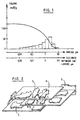
- the distribution of the porosity of the aluminium silicates containing schists is represented in Figure 1. This figure shows the volume (mm 3 /g; as measured by the Hg intrusion method by pressure increase) as well as their respective groups of which the diameter varies between the x and y ⁇ m.
- the total porosity of the schists was about 125-150 mm 3 /g, of which 60 % was formed by pores having a diameter larger than 2 ⁇ m.
- the average diameter of the pores or distance D between two aluminium silicate layers (siloxanes layer X) was about 4 ⁇ m.
- composition percentages by weight of those schists (density of 0.9) is the following:
- These flakes consist of etched aluminium particles with open cavity(ies), of which the circumference is very irregular.
- the average theoretical diameter of this open cavity was about 10-40 ⁇ m.
- the alumino silicate particles provided with a fixed metallic aluminium form a sorbent "Boodtite 1", which can be used for the sanitation of ponds.
- the surface area of the Al flakes is at least for 10 to 15 % free to contain sufficient OH - ions after hydroxylation.
- the alumino silicate particles provided with a fixed metallic aluminium layer were added to an aqueous suspension of a binder substance containing 25 % of Al 2 O 3 , 42 % of SiO 2 , 30 % of CaO + MgO, 3 % of Fe 2 O 3 .
- a strong porous mass or coating (containing aluminium hydroxide) is obtained, so that the thus obtained sorbent "Boodtite 2" has a high buffering capacity at a pH of about 8-10.5 and with a pressure strength of 10-20 N/mm 2 .
- This "Boodtite 2" sorbent is brought into an aqueous solution containing Cu (sulphate salt, chlorine salt) or Zn (sulphate) or Cd (sulphate) or Ni (nitrate) or iron-chromium sulphates, treated to obtain schists of which the surface is provided with flakes that after hydrolysis have reacted with Cu or Zn or Cd or Fe-Cr ions onto which also OH groups are bound.
- the schists obtained in this way are the following:
- the sorbent aggregates are charged with ⁇ 1,000 ppm of Cu sulphate.
- the Al/Si ratio is 0.3.
- Sorbent B
- the sorbent aggregates are charged with ⁇ 1,000 ppm of Cu chloride.
- the Al/Si ratio is 0.3.
- the sorbent aggregates are charged with ⁇ 750 ppm of Zn sulphates.
- the Al/Si ratio is 0.3.
- the sorbent aggregates are charged with ⁇ 750 ppm of Cd sulphates.
- the Al/Si ratio is 0.3.
- Sorbent E
- the sorbent aggregates are charged with ⁇ 750 ppm of Cd sulphates and ⁇ 750 ppm of Cu sulphates.
- the Al/Si ratio is 0.3.
- the sorbent aggregates are charged with ⁇ 750 ppm of Fe-Cr sulphates.
- the Al/Si ratio is 0.3.
- the reduction potential E h of the schists A, B, C, D, E and F is about 25 mV after treatment.
- Solutions containing respectively 10 ppm of ZnSO 4 -7H 2 O, 10 ppm of CuCl 2 -2H 2 O and 10 ppm of CdSO 4 are prepared to serve as a percolate on a bed of sorbent aggregates (Sorbents A through F).
- these solutions are coloured brown, and enriched with 100 to 200 ppm of NaCO 3 .
- the efficiency of the sorbent according to the invention is thus 5 to 50 times higher than the efficiency of beringite.
- compositions are obtained by mixing of different schists A, B, C and D.
- an aqueous solution containing 30 ppm of Cd, 30 ppm of Co, 30 ppm of Cu, 30 ppm of Pb, 30 ppm of Zn (in the form of salts, such as chloride, sulphates and nitrates) was contacted with the sorbent "Boodtite 2" in a proportion of 1 volume unit of "Boodtite 2" to 15 volume units of solution.
- the pH of the solution had an initial value of 3.8.
- the percentage of heavy metals which are fixed onto the Boodtite 2 sorbent is calculated from the residual concentration in the percolate.
- Contact time (hours) Cd Co U Pb Zn 3 96.7 95.0 85.0 89.0 82.0 24 98.5 97.0 94.0 92.0 95.5 72 99.8 99.5 95.0 96.0 > 95
- an aqueous solution containing 30 ppm of Cd, 30 ppm of Co, 30 ppm of Cu, 30 ppm of Pb, 30 ppm of Zn (in the form of salts, such as chloride, sulphates and nitrates) was contacted with the "Boodtite 2" sorbent in a proportion of 1 volume unit of "Boodtite 2" to 15 volume units of solution.
- the pH of the solution has an initial value of 8.9.
- the percentage of heavy metals which are fixed onto the Boodtite 2 sorbent is calculated from the residual concentration in the percolate.
- Contact time (hours) Cd Co U Pb Zn 3 98.0 97.0 96.0 95.0 91.0 24 98.7 98.5 97.0 96.0 98.0 72 99.8 99.9 98.9 98.6 98.2
- Ni was not included in this example, a separate test was set up, which showed that the Ni affinity precedes the Cu affinity. From the examples 3 and 4, it may be noted that the "Boodtite 2" sorbent has a higher affinity for Cd and Co than for Zn and Pb.
- a volume unit of solution containing 10 ppm of ZnSO 4 -7H 2 O and 10 ppm CdSO 4 is percolated through a volume unit of sorbent C. This percolation takes place at a temperature of 15-25°C. It is found that the percolate contains less than 0.07 ppm of Zn and less than 0.002 ppm of Cd. This proves that the adsorption of the heavy metals occurs irrespectively of each other. However, this conclusion could already be drawn from the examples 3 and 4.
- the pH of a solution containing 10 ppm ZnSO 4 -7H 2 O is adjusted to about 9.
- polluted water may be purified both by static contact (precipitation) and dynamic contact (percolation).
- a composition is prepared by the mixing of sorbents A, C and E (fraction with a particle size less than 200 ⁇ m), to which calcium-magnesium carbonates, calcium phosphates and calcium nitrates are added.
- the composition contains 3 % of schists A, 3 % of schists B, 3 % of schists E, 10 % of calcium nitrates, 50 % of calcium phosphates and 31 % of dolomite.
- aluminium flakes were used. These flakes consist of etched aluminium particles with open cavity(ies), of which the circumference is very irregular. The mean theoretical diameter of this open cavity was about 10-40 ⁇ m.
- example 1 The preparation process of example 1 was used to manufacture sorbents containing other metallic flakes.
- metallic flakes For these sorbents, the following metallic flakes have been used. These flakes consist of etched metallic particles with open cavity(ies), of which the circumference is very irregular. The mean theoretical diameter of this open cavity is about 10-40 ⁇ m.
Landscapes
- Chemical & Material Sciences (AREA)
- Analytical Chemistry (AREA)
- Organic Chemistry (AREA)
- Chemical Kinetics & Catalysis (AREA)
- Inorganic Chemistry (AREA)
- Dispersion Chemistry (AREA)
- Life Sciences & Earth Sciences (AREA)
- Geochemistry & Mineralogy (AREA)
- Solid-Sorbent Or Filter-Aiding Compositions (AREA)
- Water Treatment By Sorption (AREA)
Claims (20)
- Absorbierende Zusammensetzung, enthaltend Alumosilikat enthaltende, schieferartige Teilchen mit mindestens teilweise einer Schichtstruktur mit im wesentlichen parallelen Schichten, wobei mindestens für 30 Gew.-% der Alumosilikat enthaltenden, schieferartigen Teilchen der Abstand zwischen zwei strukturell aneinandergrenzenden Schichten mehr als 5 µm, aber weniger als 100 µm beträgt, dadurch gekennzeichnet, daß die Alumosilikat enthaltenden, schieferartigen Teilchen im wesentlichen teilweise aus Aluminium-enthaltenden di-oktaedrischen Schichten bestehen, dadurch gekennzeichnet, daß die Teilchen mit metallischen Plättchen versehen sind, wobei diese metallischen Plättchen mindestens teilweise auf und zwischen zwei strukturell aneinandergrenzenden Schichten der Alumosilikat enthaltenden, schieferartigen Teilchen gebunden sind und dadurch gekennzeichnet, daß mindestens 50 Gew.-% dieser metallischen Plättchen eine Dicke von 2 bis 5 µm, eine maximale Länge oder Durchmesser zwischen 6 und 60 µm und eine spezifische Oberfläche von mehr als 100 m2/g aufweisen.
- Zusammensetzung nach Anspruch 1, dadurch gekennzeichnet, daß mindestens 25 Gew.-% der Alumosilikat enthaltenden, schieferartigen Teilchen aus Aluminium-enthaltenden di-oktahedrischen Schichten bestehen.
- Zusammensetzung nach Anspruch 1 oder 2, dadurch gekennzeichnet, daß mindestens für 30 Gew.-% der Alumosilikat enthaltenden, schieferartigen Teilchen der Abstand zwischen zwei strukturell aneinandergrenzenden Schichten mehr als 5 µm, aber weniger als 10 µm beträgt.
- Zusammensetzung nach einem der Ansprüche 1 bis 3, dadurch gekennzeichnet, daß der mittlere Abstand zwischen zwei strukturell aneinandergrenzenden Schichten der Alumosilikat enthaltenden, schieferartigen Teilchen etwa 10 bis 20 µm beträgt, während die maximale Länge oder Durchmesser der metallischen Teilchen zwischen 10 und 60 µm beträgt.
- Zusammensetzung nach einem der Ansprüche 1 bis 4, dadurch gekennzeichnet, daß mindestens 50 Gew.% der Struktur der Alumosilikat enthaltenden, schieferartigen Teilchen 1,4 nm Alumo-di-oktaedrisch sind.
- Zusammensetzung nach einem der Ansprüche 1 bis 5, dadurch gekennzeichnet, daß auf den metallischen Plättchen OH- lonen vorliegen.
- Zusammensetzung nach Anspruch 6, dadurch gekennzeichnet, daß die OH- lonen der metallischen Plättchen auf einem oder mehreren der folgenden Elemente Fe, Cr, Cu, Ni, Co, Sr, Cd, Pb, Zn oder Mn gebunden sind.
- Zusammensetzung nach einem der vorhergehenden Ansprüche, dadurch gekennzeichnet, daß mindestens 50 Gew.-% der metallischen Plättchen geätzte Teilchen mit einer spezifischen Oberfläche von mehr als 150 m2/g, vorzugsweise mehr als 200 m2/g sind.
- Zusammensetzung nach einem der vorhergehenden Ansprüche, dadurch gekennzeichnet, daß mindestens 50 Gew.-% der Alumosilikat enthaltenden, schieferartigen Teilchen Aluminiumchlorit sind.
- Zusammensetzung nach einem der vorhergehenden Ansprüche, dadurch gekennzeichnet, daß mindestens 50 Gew.-% der Alumosilikat enthaltenden, schieferartigen Teilchen einen Durchmesser von mehr als 500 µm aufweisen.
- Zusammensetzung nach einem der vorhergehenden Ansprüche, dadurch gekennzeichnet, daß die Zusammensetzung poröse Teilchen mit einer schwachen Säure mit einem pKa zwischen 4 und 7 enthält.
- Zusammensetzung nach einem der vorhergehenden Ansprüche, dadurch gekennzeichnet, daß die Zusammensetzung Magnesium-enthaltende Teilchen, Nitratteilchen, Phosphatteilchen oder ein Gemisch davon enthält.
- Zusammensetzung nach einem der vorhergehenden Ansprüche, dadurch gekennzeichnet, daß die metallischen Plättchen Aluminium- oder Aluminiumoxid-Plättchen sind.
- Verfahren zum Absorbieren und Fixieren von einem oder mehreren der folgenden Elemente Fe, Cr, Cu, Ni, Co, Sr, Cd, Pb, Zn oder Mn, welche in einem Medium vorliegen, auf Alumosilikat enthaltende, schieferartige Teilchen, dadurch gekennzeichnet, daß eine absorbierende Zusammensetzung nach einem der vorhergehenden Ansprüche zu dem Medium gegeben wird.
- Verfahren nach Anspruch 14, dadurch gekennzeichnet, daß vor oder während der Zugabe der Zusammensetzung zu dem Medium der pH-Wert des Mediums zwischen 4,5 und 13, vorzugsweise zwischen 4,5 und 8 eingestellt wird.
- Verfahren nach Anspruch 14 oder 15, dadurch gekennzeichnet, daß vor, während oder nach der Zugabe der Zusammensetzung zu dem Medium Fe(OH)3 und/oder (NH4)2HPO4 und/oder Natriumcarbonat zu dem Medium gegeben wird bzw. werden.
- Verfahren nach einem der Ansprüche 14 bis 16, dadurch gekennzeichnet, daß eine wässrige Lösung, die ein oder mehrere Sulfate oder Chloride der folgenden Elemente Fe, Cr, Cu, Ni, Co, Sr, Cd, Pb, Zn oder Mn enthält, in Kontakt mit einer Sorbenszusammensetzung gebracht wird.
- Verfahren nach Anspruch 17, dadurch gekennzeichnet, daß die wässrige Lösung durch die Zusammensetzung durchlaufen gelassen wird.
- Verfahren zur Herstellung einer Zusammensetzung nach einem der Ansprüche 1 bis 13, dadurch gekennzeichnet, daß Phylloalumosilikat enthaltende, schieferartige Teilchen mit mindestens teilweise einer Schichtstruktur mit im wesentlichen parallelen Schichten, wobei für mindestens 30 Gew.-% der Alumosilikat enthaltenden, schieferartigen Teilchen der Abstand zwischen zwei strukturell aneinandergrenzenden Schichten mehr als 5 µm, aber weniger als 100 µm beträgt, und metallische Plättchen mit einer Dicke von 2 bis 5 µm, einer maximalen Länge oder Durchmesser zwischen 6 und 60 µm und einer spezifischen Oberfläche von mehr als 100 m2/g miteinander gemischt werden, wodurch die Phylloalumosilikat-Teilchen mit metallischen Plättchen versehen werden, und dadurch gekennzeichnet, daß gegebenenfalls die Teilchen mit metallischen Plättchen nachfolgend hydrolysiert werden, wodurch OH- lonen auf den metallischen Plättchen erhalten werden.
- Verfahren nach Anspruch 19, dadurch gekennzeichnet, daß die Teilchen mit Aluminium- oder Aluminiumoxid-Plättchen in Gegenwart von mindestens einem der folgenden Elemente Fe, Cr, Cu, Ni, Co, Sr, Cd, Pb, Zn oder Mn hydrolysiert werden.
Applications Claiming Priority (3)
| Application Number | Priority Date | Filing Date | Title |
|---|---|---|---|
| BE9701061 | 1997-12-31 | ||
| BE9701061A BE1011691A4 (nl) | 1997-12-31 | 1997-12-31 | Samenstelling van adsorbent. |
| PCT/BE1998/000205 WO1999034913A1 (en) | 1997-12-31 | 1998-12-24 | Composition of adsorbent |
Publications (2)
| Publication Number | Publication Date |
|---|---|
| EP1044065A1 EP1044065A1 (de) | 2000-10-18 |
| EP1044065B1 true EP1044065B1 (de) | 2002-02-13 |
Family
ID=3890934
Family Applications (1)
| Application Number | Title | Priority Date | Filing Date |
|---|---|---|---|
| EP98965056A Expired - Lifetime EP1044065B1 (de) | 1997-12-31 | 1998-12-24 | Adsorbentzusammenstellung |
Country Status (10)
| Country | Link |
|---|---|
| US (1) | US6339040B1 (de) |
| EP (1) | EP1044065B1 (de) |
| AR (1) | AR014229A1 (de) |
| AT (1) | ATE213179T1 (de) |
| AU (1) | AU2041799A (de) |
| BE (1) | BE1011691A4 (de) |
| CA (1) | CA2316879A1 (de) |
| DE (1) | DE69803884T2 (de) |
| ES (1) | ES2173663T3 (de) |
| WO (1) | WO1999034913A1 (de) |
Cited By (1)
| Publication number | Priority date | Publication date | Assignee | Title |
|---|---|---|---|---|
| CN102641725A (zh) * | 2012-05-11 | 2012-08-22 | 上海绿帝环保科技有限公司 | 一种用于吸附重金属的材料的制备方法 |
Families Citing this family (4)
| Publication number | Priority date | Publication date | Assignee | Title |
|---|---|---|---|---|
| US6533842B1 (en) * | 2000-02-24 | 2003-03-18 | Merck & Co., Inc. | Adsorption powder for removing mercury from high temperature, high moisture gas streams |
| US20070259793A1 (en) * | 2006-05-03 | 2007-11-08 | Matthew Feller | Activated silicon-containing-aluminum complex soil detoxification and method of preparation thereof |
| CN108034428A (zh) * | 2017-11-27 | 2018-05-15 | 林良兵 | 钝化土壤中金属铬的调理剂的制备方法 |
| CN114733515B (zh) * | 2022-04-21 | 2023-03-24 | 福州大学 | 一种多孔锰芬顿催化材料及其制备方法和应用 |
Family Cites Families (17)
| Publication number | Priority date | Publication date | Assignee | Title |
|---|---|---|---|---|
| US4176090A (en) * | 1975-11-18 | 1979-11-27 | W. R. Grace & Co. | Pillared interlayered clay materials useful as catalysts and sorbents |
| US4515633A (en) * | 1980-10-14 | 1985-05-07 | Morca, Inc. | Polymeric materials combined with modified hydrated magnesium aluminosilicates |
| US4400297A (en) * | 1980-10-14 | 1983-08-23 | Morca, Inc. | Modified hydrated magnesium aluminosilicates and method of preparation |
| GB2170839A (en) * | 1985-02-11 | 1986-08-13 | Labofina Sa | Process for consolidating soils |
| US4792539A (en) * | 1985-06-20 | 1988-12-20 | Kao Corporation | Process for producing clay derivatives having a porous structure and novel clay derivatives obtained by the process |
| US4666877A (en) * | 1985-07-19 | 1987-05-19 | Exxon Research And Engineering Company | Multimetallic pillared interlayered clay products and processes of making them |
| US4839318A (en) * | 1987-02-03 | 1989-06-13 | Agency Of Industrial Science And Technology | Method for production of finely porous article using smectite mineral as main component |
| FR2623836B1 (fr) * | 1987-12-01 | 1993-02-19 | Cotentin Sarl Schistes Bleus | Perfectionnements aux elements de couverture et a leurs procedes et dispositifs de fabrication |
| GB8910978D0 (en) * | 1989-05-12 | 1989-06-28 | Alcan Int Ltd | Fillers |
| DE4007036A1 (de) | 1990-03-07 | 1991-09-12 | Merck Patent Gmbh | Verfahren und mittel zur bestimmung von nitrationen |
| EP0455621A1 (de) * | 1990-05-03 | 1991-11-06 | Rijksuniversiteit Gent Fakulteit Landbouwwetenschappen Leerstoel Voor Bodemfysika | Verfahren zum Erhöhen der Sorption von Aluminosilikate enthaltendem Schiefermaterial |
| JP2507903B2 (ja) * | 1991-02-01 | 1996-06-19 | 工業技術院長 | 任意の層間隔を有する層間架橋粘土の製造法 |
| JPH05170429A (ja) * | 1991-12-18 | 1993-07-09 | Mitsubishi Materials Corp | 粘土架橋多孔体及びその製造方法 |
| NL9200322A (nl) * | 1992-02-20 | 1993-09-16 | Agriton Van Den Ham & Co | Adsorbent, afdichtlaag en het gebruik van het adsorbent voor het immobiliseren van zware metalen. |
| NL9301919A (nl) * | 1993-05-27 | 1994-12-16 | Pelt & Hooykaas | Werkwijze voor het afvangen van milieuschadelijke stoffen uit met dergelijke stoffen verontreinigd materiaal. |
| JPH08199491A (ja) * | 1994-09-06 | 1996-08-06 | Scapa Group Plc | ピントルワイヤ |
| GB9519419D0 (en) * | 1995-09-22 | 1995-11-22 | Ecc Int Ltd | Particulate materials |
-
1997
- 1997-12-31 BE BE9701061A patent/BE1011691A4/nl not_active IP Right Cessation
-
1998
- 1998-12-24 AU AU20417/99A patent/AU2041799A/en not_active Abandoned
- 1998-12-24 DE DE69803884T patent/DE69803884T2/de not_active Expired - Fee Related
- 1998-12-24 US US09/582,528 patent/US6339040B1/en not_active Expired - Fee Related
- 1998-12-24 WO PCT/BE1998/000205 patent/WO1999034913A1/en not_active Ceased
- 1998-12-24 EP EP98965056A patent/EP1044065B1/de not_active Expired - Lifetime
- 1998-12-24 AT AT98965056T patent/ATE213179T1/de not_active IP Right Cessation
- 1998-12-24 ES ES98965056T patent/ES2173663T3/es not_active Expired - Lifetime
- 1998-12-24 CA CA002316879A patent/CA2316879A1/en not_active Abandoned
- 1998-12-30 AR ARP980106762A patent/AR014229A1/es not_active Application Discontinuation
Cited By (2)
| Publication number | Priority date | Publication date | Assignee | Title |
|---|---|---|---|---|
| CN102641725A (zh) * | 2012-05-11 | 2012-08-22 | 上海绿帝环保科技有限公司 | 一种用于吸附重金属的材料的制备方法 |
| CN102641725B (zh) * | 2012-05-11 | 2014-01-22 | 上海绿帝环保科技有限公司 | 一种用于吸附重金属的材料的制备方法 |
Also Published As
| Publication number | Publication date |
|---|---|
| WO1999034913A1 (en) | 1999-07-15 |
| BE1011691A4 (nl) | 1999-12-07 |
| AR014229A1 (es) | 2001-02-07 |
| CA2316879A1 (en) | 1999-07-15 |
| ATE213179T1 (de) | 2002-02-15 |
| AU2041799A (en) | 1999-07-26 |
| DE69803884D1 (de) | 2002-03-21 |
| US6339040B1 (en) | 2002-01-15 |
| DE69803884T2 (de) | 2002-11-07 |
| ES2173663T3 (es) | 2002-10-16 |
| EP1044065A1 (de) | 2000-10-18 |
Similar Documents
| Publication | Publication Date | Title |
|---|---|---|
| US5369072A (en) | Granular media for removing contaminants from water and methods for making the same | |
| Aneke et al. | Adsorption of heavy metals from contaminated water using leachate modular tower | |
| US5911882A (en) | Removing contaminants from water using iron oxide coated mineral having olivine structure | |
| CN101486498B (zh) | 用于水处理的吸附床 | |
| Kapoor et al. | Use of immobilized bentonite in removal of heavy metals from wastewater | |
| SK100098A3 (en) | Process for the manufacture of a sorbent, a sorbent and its use for the immobilization of heavy metals in contaminated aqueous or solid phase | |
| EP1044065B1 (de) | Adsorbentzusammenstellung | |
| Elkhatib et al. | Using nano-magnesium oxide/bentonite composite for cadmium removal from industrial wastewater | |
| US5397500A (en) | Compositions for treating waste water which contains heavy metals | |
| Grimal et al. | Maize root mucilage decreases adsorption of phosphate on goethite | |
| JP6989857B2 (ja) | 吸着方法 | |
| JPH0677732B2 (ja) | 水処理用吸着剤およびその製造方法 | |
| WO2010087297A1 (ja) | ヒ素収着材及びヒ素汚染物質の浄化方法 | |
| CA2267159A1 (en) | Light expanded clay aggregates for phosphorus removal | |
| Gerth | Effects of crystal modification on the binding of trace metals and arsenate by goethite (7 pp) | |
| Legese et al. | Assessing the influence of natural zeolite on toxic heavy metals immobilization and their transfer into Zea mays L. | |
| JP2820274B2 (ja) | 水道水用浄化剤 | |
| Boujelben | Sorption of phosphorus, nickel, and lead from aqueous solution using manganese oxide-coated materials | |
| JPS58139784A (ja) | 脱リン剤および脱リン方法 | |
| SK131894A3 (en) | Ecological method of use of acid waste water, sorbent made by this method and its use | |
| Lee et al. | Phosphate sorption characteristics of zirconium meso-structure synthesized under different conditions | |
| JPH0919680A (ja) | 水質浄化剤およびその製造方法 | |
| Kim et al. | Developement of Heavy Metal Adsorbent Utilising Natural Zeolite | |
| WO2003068385A1 (en) | Adsorbent for water treatment advantageously for treatment of potable water | |
| EP4393584A1 (de) | Verfahren zur herstellung eines sorptionsmittels durch karbonisierung |
Legal Events
| Date | Code | Title | Description |
|---|---|---|---|
| PUAI | Public reference made under article 153(3) epc to a published international application that has entered the european phase |
Free format text: ORIGINAL CODE: 0009012 |
|
| 17P | Request for examination filed |
Effective date: 20000719 |
|
| AK | Designated contracting states |
Kind code of ref document: A1 Designated state(s): AT BE DE DK ES FI FR GB GR IE IT LU NL PT SE |
|
| GRAG | Despatch of communication of intention to grant |
Free format text: ORIGINAL CODE: EPIDOS AGRA |
|
| 17Q | First examination report despatched |
Effective date: 20010302 |
|
| GRAG | Despatch of communication of intention to grant |
Free format text: ORIGINAL CODE: EPIDOS AGRA |
|
| GRAH | Despatch of communication of intention to grant a patent |
Free format text: ORIGINAL CODE: EPIDOS IGRA |
|
| GRAG | Despatch of communication of intention to grant |
Free format text: ORIGINAL CODE: EPIDOS AGRA |
|
| GRAH | Despatch of communication of intention to grant a patent |
Free format text: ORIGINAL CODE: EPIDOS IGRA |
|
| RAP3 | Party data changed (applicant data changed or rights of an application transferred) |
Owner name: METAL ADSORBENS PROMOTION COMPANY N.V. - IN HET KO |
|
| GRAH | Despatch of communication of intention to grant a patent |
Free format text: ORIGINAL CODE: EPIDOS IGRA |
|
| GRAA | (expected) grant |
Free format text: ORIGINAL CODE: 0009210 |
|
| REG | Reference to a national code |
Ref country code: GB Ref legal event code: IF02 |
|
| AK | Designated contracting states |
Kind code of ref document: B1 Designated state(s): AT BE DE DK ES FI FR GB GR IE IT LU NL PT SE |
|
| PG25 | Lapsed in a contracting state [announced via postgrant information from national office to epo] |
Ref country code: GR Free format text: LAPSE BECAUSE OF FAILURE TO SUBMIT A TRANSLATION OF THE DESCRIPTION OR TO PAY THE FEE WITHIN THE PRESCRIBED TIME-LIMIT Effective date: 20020213 Ref country code: FI Free format text: LAPSE BECAUSE OF FAILURE TO SUBMIT A TRANSLATION OF THE DESCRIPTION OR TO PAY THE FEE WITHIN THE PRESCRIBED TIME-LIMIT Effective date: 20020213 |
|
| REF | Corresponds to: |
Ref document number: 213179 Country of ref document: AT Date of ref document: 20020215 Kind code of ref document: T |
|
| REF | Corresponds to: |
Ref document number: 69803884 Country of ref document: DE Date of ref document: 20020321 |
|
| PG25 | Lapsed in a contracting state [announced via postgrant information from national office to epo] |
Ref country code: SE Free format text: LAPSE BECAUSE OF FAILURE TO SUBMIT A TRANSLATION OF THE DESCRIPTION OR TO PAY THE FEE WITHIN THE PRESCRIBED TIME-LIMIT Effective date: 20020513 Ref country code: PT Free format text: LAPSE BECAUSE OF FAILURE TO SUBMIT A TRANSLATION OF THE DESCRIPTION OR TO PAY THE FEE WITHIN THE PRESCRIBED TIME-LIMIT Effective date: 20020513 Ref country code: DK Free format text: LAPSE BECAUSE OF FAILURE TO SUBMIT A TRANSLATION OF THE DESCRIPTION OR TO PAY THE FEE WITHIN THE PRESCRIBED TIME-LIMIT Effective date: 20020513 |
|
| NLR4 | Nl: receipt of corrected translation in the netherlands language at the initiative of the proprietor of the patent | ||
| ET | Fr: translation filed | ||
| REG | Reference to a national code |
Ref country code: ES Ref legal event code: FG2A Ref document number: 2173663 Country of ref document: ES Kind code of ref document: T3 |
|
| PGFP | Annual fee paid to national office [announced via postgrant information from national office to epo] |
Ref country code: BE Payment date: 20021127 Year of fee payment: 5 |
|
| PLBE | No opposition filed within time limit |
Free format text: ORIGINAL CODE: 0009261 |
|
| STAA | Information on the status of an ep patent application or granted ep patent |
Free format text: STATUS: NO OPPOSITION FILED WITHIN TIME LIMIT |
|
| 26N | No opposition filed |
Effective date: 20021114 |
|
| PG25 | Lapsed in a contracting state [announced via postgrant information from national office to epo] |
Ref country code: BE Free format text: LAPSE BECAUSE OF NON-PAYMENT OF DUE FEES Effective date: 20031231 |
|
| BERE | Be: lapsed |
Owner name: METAL ADSORBENS PROMOTION CY N.V. *METAPRO Effective date: 20031231 |
|
| PGFP | Annual fee paid to national office [announced via postgrant information from national office to epo] |
Ref country code: FR Payment date: 20051201 Year of fee payment: 8 |
|
| PGFP | Annual fee paid to national office [announced via postgrant information from national office to epo] |
Ref country code: GB Payment date: 20051214 Year of fee payment: 8 |
|
| PGFP | Annual fee paid to national office [announced via postgrant information from national office to epo] |
Ref country code: LU Payment date: 20051220 Year of fee payment: 8 Ref country code: AT Payment date: 20051220 Year of fee payment: 8 |
|
| PGFP | Annual fee paid to national office [announced via postgrant information from national office to epo] |
Ref country code: IE Payment date: 20051222 Year of fee payment: 8 |
|
| PGFP | Annual fee paid to national office [announced via postgrant information from national office to epo] |
Ref country code: NL Payment date: 20051223 Year of fee payment: 8 Ref country code: ES Payment date: 20051223 Year of fee payment: 8 |
|
| PGFP | Annual fee paid to national office [announced via postgrant information from national office to epo] |
Ref country code: DE Payment date: 20051228 Year of fee payment: 8 |
|
| PG25 | Lapsed in a contracting state [announced via postgrant information from national office to epo] |
Ref country code: IE Free format text: LAPSE BECAUSE OF NON-PAYMENT OF DUE FEES Effective date: 20061225 |
|
| PGFP | Annual fee paid to national office [announced via postgrant information from national office to epo] |
Ref country code: IT Payment date: 20061231 Year of fee payment: 9 |
|
| PG25 | Lapsed in a contracting state [announced via postgrant information from national office to epo] |
Ref country code: NL Free format text: LAPSE BECAUSE OF NON-PAYMENT OF DUE FEES Effective date: 20070701 |
|
| PG25 | Lapsed in a contracting state [announced via postgrant information from national office to epo] |
Ref country code: DE Free format text: LAPSE BECAUSE OF NON-PAYMENT OF DUE FEES Effective date: 20070703 |
|
| GBPC | Gb: european patent ceased through non-payment of renewal fee |
Effective date: 20061224 |
|
| NLV4 | Nl: lapsed or anulled due to non-payment of the annual fee |
Effective date: 20070701 |
|
| REG | Reference to a national code |
Ref country code: IE Ref legal event code: MM4A |
|
| REG | Reference to a national code |
Ref country code: FR Ref legal event code: ST Effective date: 20070831 |
|
| PG25 | Lapsed in a contracting state [announced via postgrant information from national office to epo] |
Ref country code: GB Free format text: LAPSE BECAUSE OF NON-PAYMENT OF DUE FEES Effective date: 20061224 Ref country code: AT Free format text: LAPSE BECAUSE OF NON-PAYMENT OF DUE FEES Effective date: 20061224 |
|
| REG | Reference to a national code |
Ref country code: ES Ref legal event code: FD2A Effective date: 20061226 |
|
| PG25 | Lapsed in a contracting state [announced via postgrant information from national office to epo] |
Ref country code: FR Free format text: LAPSE BECAUSE OF NON-PAYMENT OF DUE FEES Effective date: 20070102 Ref country code: ES Free format text: LAPSE BECAUSE OF NON-PAYMENT OF DUE FEES Effective date: 20061226 |
|
| PG25 | Lapsed in a contracting state [announced via postgrant information from national office to epo] |
Ref country code: LU Free format text: LAPSE BECAUSE OF NON-PAYMENT OF DUE FEES Effective date: 20061224 |
|
| PG25 | Lapsed in a contracting state [announced via postgrant information from national office to epo] |
Ref country code: IT Free format text: LAPSE BECAUSE OF NON-PAYMENT OF DUE FEES Effective date: 20071224 |