EP1041196A1 - Walze, insbesondere zum Glätten von Papierbahnen, sowie Verfahren zur Herstellung einer solchen Walze - Google Patents
Walze, insbesondere zum Glätten von Papierbahnen, sowie Verfahren zur Herstellung einer solchen Walze Download PDFInfo
- Publication number
- EP1041196A1 EP1041196A1 EP00105578A EP00105578A EP1041196A1 EP 1041196 A1 EP1041196 A1 EP 1041196A1 EP 00105578 A EP00105578 A EP 00105578A EP 00105578 A EP00105578 A EP 00105578A EP 1041196 A1 EP1041196 A1 EP 1041196A1
- Authority
- EP
- European Patent Office
- Prior art keywords
- layer
- roller
- carbon fibers
- fibers
- matrix material
- Prior art date
- Legal status (The legal status is an assumption and is not a legal conclusion. Google has not performed a legal analysis and makes no representation as to the accuracy of the status listed.)
- Granted
Links
- 238000000034 method Methods 0.000 title claims description 9
- 238000003490 calendering Methods 0.000 title 1
- 239000010410 layer Substances 0.000 claims abstract description 84
- 239000004917 carbon fiber Substances 0.000 claims abstract description 42
- 229920000049 Carbon (fiber) Polymers 0.000 claims abstract description 41
- 239000011159 matrix material Substances 0.000 claims abstract description 35
- 239000003365 glass fiber Substances 0.000 claims abstract description 33
- 239000002346 layers by function Substances 0.000 claims abstract description 33
- 239000000835 fiber Substances 0.000 claims abstract description 28
- 239000004848 polyfunctional curative Substances 0.000 claims abstract description 12
- 239000011347 resin Substances 0.000 claims abstract description 12
- 229920005989 resin Polymers 0.000 claims abstract description 12
- 238000004804 winding Methods 0.000 claims abstract description 10
- 239000002184 metal Substances 0.000 claims abstract description 9
- 229910052751 metal Inorganic materials 0.000 claims abstract description 9
- 239000004033 plastic Substances 0.000 claims abstract description 9
- 229920003023 plastic Polymers 0.000 claims abstract description 9
- 239000000203 mixture Substances 0.000 claims abstract description 5
- 229920001169 thermoplastic Polymers 0.000 claims abstract description 3
- 239000004416 thermosoftening plastic Substances 0.000 claims abstract description 3
- 238000002156 mixing Methods 0.000 claims description 11
- VNWKTOKETHGBQD-UHFFFAOYSA-N methane Chemical compound C VNWKTOKETHGBQD-UHFFFAOYSA-N 0.000 claims description 7
- 238000009499 grossing Methods 0.000 claims description 5
- 238000004519 manufacturing process Methods 0.000 claims description 4
- 229920001187 thermosetting polymer Polymers 0.000 claims description 2
- 239000000853 adhesive Substances 0.000 claims 1
- 230000001070 adhesive effect Effects 0.000 claims 1
- 238000005253 cladding Methods 0.000 abstract 1
- 239000011521 glass Substances 0.000 abstract 1
- 238000009998 heat setting Methods 0.000 abstract 1
- 229910000831 Steel Inorganic materials 0.000 description 8
- 239000010959 steel Substances 0.000 description 8
- 238000005470 impregnation Methods 0.000 description 4
- 238000000576 coating method Methods 0.000 description 3
- 239000011152 fibreglass Substances 0.000 description 3
- 238000013021 overheating Methods 0.000 description 3
- 239000002356 single layer Substances 0.000 description 3
- XEEYBQQBJWHFJM-UHFFFAOYSA-N Iron Chemical compound [Fe] XEEYBQQBJWHFJM-UHFFFAOYSA-N 0.000 description 2
- 239000011248 coating agent Substances 0.000 description 2
- 230000006835 compression Effects 0.000 description 2
- 238000007906 compression Methods 0.000 description 2
- 238000002425 crystallisation Methods 0.000 description 2
- 230000008025 crystallization Effects 0.000 description 2
- 230000006378 damage Effects 0.000 description 2
- 238000009826 distribution Methods 0.000 description 2
- 238000010438 heat treatment Methods 0.000 description 2
- 239000000463 material Substances 0.000 description 2
- 239000006223 plastic coating Substances 0.000 description 2
- OKTJSMMVPCPJKN-UHFFFAOYSA-N Carbon Chemical compound [C] OKTJSMMVPCPJKN-UHFFFAOYSA-N 0.000 description 1
- 229910001018 Cast iron Inorganic materials 0.000 description 1
- 239000012790 adhesive layer Substances 0.000 description 1
- 238000005452 bending Methods 0.000 description 1
- 229910052799 carbon Inorganic materials 0.000 description 1
- 239000002657 fibrous material Substances 0.000 description 1
- 239000000945 filler Substances 0.000 description 1
- 238000007373 indentation Methods 0.000 description 1
- 229910052742 iron Inorganic materials 0.000 description 1
- 239000007788 liquid Substances 0.000 description 1
- 230000007704 transition Effects 0.000 description 1
- 238000010792 warming Methods 0.000 description 1
Images

Classifications
-
- F—MECHANICAL ENGINEERING; LIGHTING; HEATING; WEAPONS; BLASTING
- F16—ENGINEERING ELEMENTS AND UNITS; GENERAL MEASURES FOR PRODUCING AND MAINTAINING EFFECTIVE FUNCTIONING OF MACHINES OR INSTALLATIONS; THERMAL INSULATION IN GENERAL
- F16C—SHAFTS; FLEXIBLE SHAFTS; ELEMENTS OR CRANKSHAFT MECHANISMS; ROTARY BODIES OTHER THAN GEARING ELEMENTS; BEARINGS
- F16C13/00—Rolls, drums, discs, or the like; Bearings or mountings therefor
-
- D—TEXTILES; PAPER
- D21—PAPER-MAKING; PRODUCTION OF CELLULOSE
- D21G—CALENDERS; ACCESSORIES FOR PAPER-MAKING MACHINES
- D21G1/00—Calenders; Smoothing apparatus
- D21G1/02—Rolls; Their bearings
- D21G1/0233—Soft rolls
Definitions
- the present invention relates to a method for producing an elastic Roller with a hard, especially made of metal Roll core and an elastic reference layer, in which to form the Reference layer first a radially inner connection layer the roller core and then a radially outer functional layer is applied to the connection layer. Furthermore, the Invention on a roller, in particular for smoothing paper webs, straightened with a hard roller core consisting in particular of metal, which has an elastic cover layer on the outside is, this reference layer is a radially outer functional layer and a radially inner connection layer for connection the functional layer with the roller core.
- Elastic rolls of this type are used, for example, when satinizing paper webs.
- An elastic roller forms a press nip together with a hard roller through which the paper web to be processed is passed. While the hard roller has a very smooth surface, for example made of steel or chilled cast iron, and is responsible for smoothing the side of the paper web facing it, the elastic roller acting on the opposite side of the paper web causes the paper web to be leveled and compressed in the press nip. The elasticity of this second roller thus prevents excessive compression of the paper web, which would lead to a greasy appearance of the paper web.
- the size of the rollers is 6 to 12 m in length and 800 to 1500 mm in diameter. They withstand line forces up to 600 N / mm and compressive stresses up to 50 N / mm 2 .
- plastic coverings maximum temperature differences of about 20 ° C over the The width of the roller is permissible and on the other hand they are for the coating
- plastics used are much higher Thermal expansion coefficients than those commonly used Steel rollers or chill cast rollers, so that by an increase in temperature high axial tensions between the steel roller or chilled iron roller and the associated plastic coating occur.
- connection layer and / or the Functional layer of glass fibers and carbon fibers on the roller core at the same time be wound the mixing ratio of glass fibers to carbon fibers between about 60/40 and about 90/10, preferably about 70/30 is.
- a corresponding roller is characterized according to the invention in that that the internal connection layer and / or the functional layer consists of a mixture of glass fibers and carbon fibers, which are embedded in a soft matrix material and essentially each are evenly distributed over the length of the roller, the mixing ratio from glass fibers to carbon fibers between approx. 60/40 and is approximately 90/10, preferably approximately 70/30.
- the connecting layer is in such a way that they are both optimal mechanical, tension-optimized connection between the metal roller and the external one Functional layer forms, as well as improved heat conduction and thus a removal of excess thermal energy from Overheating points guaranteed.
- connection layer By the mixing ratio specified according to the invention and the Embedding the fiber mixture in the matrix material of the connection layer becomes an optimal transition layer between the steel roller and the outer functional layer. Since in the connection layer Thermal expansion in the axial direction mainly through the inserted Fibers is determined, the total coefficient of thermal expansion comes the connection layer with fiber material very close to that of the steel roller. Because of the elastic matrix material, the connection layer also has a certain elasticity in the axial direction the stresses that occur during heating in the axial direction between the roller core and the outer functional layer absorbed by the connection layer and the stress loads thus reduced overall.
- connection layer inserted fibers in addition to increasing the rigidity of the connection layer an improvement in thermal conductivity within the tie layer reached. This will improve thermal conductivity achieved in particular by the carbon fibers, so that within the connection layer selectively generated heat over the carbon fibers in the axial Direction can be dissipated before such overheating occurs that a hot spot is created.
- a roving each from a
- connection layer and / or the functional layer preferably wrapped several roving layers on top of each other, so that the Desired thickness of the connecting layer can be easily generated.
- Each of the roving layers basically has that according to the invention stated mixing ratio of glass fibers to carbon fibers, this Mixing ratio as required between individual roving layers within of the values according to the invention can be varied.
- the glass fibers and carbon fibers before winding on the roll core with a soft matrix material, especially with a Resin / hardener combination are surrounded, in particular by a Resin / hardener bath can be drawn.
- the glass fibers and the carbon fibers are essentially dry the roll core and during or after winding with a soft matrix material, especially with a Resin / hardener combination applied, especially completely in the Matrix material can be embedded.
- connection layer receives the required elasticity, whereby the Matrix material at the same time as connecting material between the outside Functional layer and the wall core serves. Basically is however, it is also possible that between the metal outside of the roll core and the connection layer an additional contact layer, for example an adhesive layer is present.
- the matrix material preferably consists of a plastic material, in particular a thermoset or a thermoplastic. Doing so noted that the used in connection with the matrix material The term "soft" only in relation to the outside, which is designated as hard the metal, especially the steel roller is to be understood.
- the fiber content of the connecting layer is approximately 40 to 70% by volume, in particular about 50 to 60% by volume, preferably about 55% by volume. Due to the fiber content the connection layer becomes both its stiffness, thermal conductivity as well as the total expansion coefficient. By the invention Fiber content ensures that the aforementioned optimal mechanical and thermal properties of the connection layer be respected.
- the fiber content is Functional layer preferably about 5 to 20 vol .-%, in particular about 8 to 12 Vol .-%.
- the functional layer maintains due to the reduced fiber content less rigidity than the tie layer, as used for uniformity and compression of the paper web to be treated in the Satinage is required. If due to the reduced fiber content Thermal expansion coefficient of the functional layer can be too large this is achieved by adding fillers to the matrix material the functional layer can be reduced.
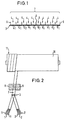
- fiber rovings 4, 5 can be summarized.
- a glass fiber roving 4 or a carbon fiber roving 5 is from each closest roving 4, 5 separated by a tooth 6 of the collecting unit 3, so that a clear mixing ratio of glass fibers too Carbon fibers within the through the fiber and carbon fiber rovings 4.5 formed roving bands 7 and a predetermined distribution of glass fibers and carbon fibers along the width of the roving belt 7 guaranteed is.
- each roving 4, 5 for example 10,000 to 14,000 individual fibers 1, 2 each with a thickness of between 0.1 and 0.3 mm.
- the roving belt 7 comprises ten rovings 4, 5 however, in principle also fewer or more rovings, for example 8 up to 16 rovings.
- rovings 4, 5 are ideally shown in FIG. 1 as single-layer layers roving in practice consists of a large number of fiber layers, each of which has a diameter of approx. 8 to 12 ⁇ m and a Roving has a thickness of approximately 0.1 to 0.3 mm, for example 0.2 mm. It is only essential that the width of a roving 4, 5 in relation to the thickness is significantly larger, so that it is approximately a single layer Has structure.
- Fig. 2 it is shown how the glass fibers 1 and the carbon fibers 2 over the collecting unit 3 is guided and combined to form the roving belt 7 , whereupon they are shown by a schematically represented impregnation device 8 are performed.
- the impregnation device 8 individual rovings 4, 5 coated with a liquid matrix material 9, so that the rovings 4, 5 are essentially completely in the matrix material 9 are embedded.
- the matrix material 9 can be one Plastic, especially a resin / hardener combination.
- This coating process can be repeated several times until a connecting layer 11 with a thickness of, for example, 3 to 10mm is generated.
- connection layer 11 The structure of the connection layer 11 is shown in more detail in FIG. 3. Out 3 it can be seen that the connecting layer 11 consists of a multiplicity consists of radially superimposed roving layers 12, each are embedded in the matrix material 9.
- the proportion of fibers 1, 2 of the Roving layers 12 on the connecting layer 11 is approximately between 40 to 70 vol .-%, so that the mechanical and thermal properties of the Connection layer 11 are mainly determined by the fibers 1, 2.
- To form a reference layer 15 follows radially outwards the connection layer 11 to the actual functional layer 16 which likewise consists of a matrix material 13, which in particular is the same the matrix material 9 can be.
- the functional layer 16 Roving layers 14 corresponding to the roving layers 12 of the connection layer 11 embedded, but here the volume fraction of the roving layers 14th based on the volume of the functional layer 16 is significantly lower and is, for example, 8 to 12% by volume. Due to this reduced fiber content the functional layer 16 is considerably more elastic than the connecting layer 11.
- connection layer 11 Glass fibers 1 and carbon fibers 2 is achieved that the coefficient of thermal expansion the connection layer 11 receives a value that the coefficient of thermal expansion of steel, for example existing roll core 10 comes close.
- An increase in temperature thus occurs in the axial direction
- connection layer 11 is determined by the resin / hardener mixture, expands at a corresponding Warming out significantly more in the axial direction due to the connection between the functional layer 16, the connection layer 11 and the roll core 10 resulting longitudinal stresses are largely due to the elasticity of the connecting layer 11 caught.
- the carbon fibers contained in the roving layers 12 and 14 bring about a very good axial thermal conductivity of the connection layer 11 or the functional layer 16, so that the heat of any arising Overheating points within the connection layer 11 can be quickly derived in the axial direction so that the temperature reliable within the connection layer 11 and the functional layer 16 remains below a critical limit temperature.
- the appearance hot spots can be reliably prevented in this way.
Landscapes
- Engineering & Computer Science (AREA)
- General Engineering & Computer Science (AREA)
- Mechanical Engineering (AREA)
- Rolls And Other Rotary Bodies (AREA)
- Moulding By Coating Moulds (AREA)
Abstract
Description
- Fig. 1
- eine schematische Querschnittsdarstellung einer Vorrichtung zum Separieren von Fasern in Rovings,
- Fig. 2
- eine schematische Darstellung einer erfindungsgemäßen Walze während derer Herstellung und
- Fig. 3
- einen Teillängsschnitt durch eine erfindungsgemäß ausgebildete Walze.
- 1
- Glasfasern
- 2
- Kohlefasern
- 3
- Sammeleinheit
- 4
- Glasfaserroving
- 5
- Kohlefaserroving
- 6
- Zähne
- 7
- Rovingband
- 8
- Imprägniervorrichtung
- 9
- Matrixmaterial
- 10
- Walzenkern
- 11
- Verbindungsschicht
- 12
- Rovinglagen
- 13
- Matrixmaterial
- 14
- Rovinglagen
- 15
- Bezugsschicht
- 16
- Funktionsschicht
Claims (10)
- Verfahren zum Herstellen einer elastischen Walze mit einem insbesondere aus Metall bestehenden haften Walzenkern und einer elastischen Bezugsschicht, bei dem zum Bilden der Bezugsschicht zunächst eine radial innenliegende Verbindungsschicht auf den Walzenkern und anschließend eine radial außenliegende Funktionsschicht auf die Verbindungsschicht aufgebracht wird,
dadurch gekennzeichnet,
daß zum Bilden der Verbindungsschicht und/oder der Funktionsschicht gleichzeitig Glasfasern und Kohlefasern auf den Walzenkern gewickelt werden, wobei das Mischungsverhältnis von Glasfasern zu Kohlefasern zwischen ca. 60/40 und ca. 90/10, bevorzugt ca. 70/30 beträgt. - Verfahren nach Anspruch 1,
dadurch gekennzeichnet,
daß die Glasfasern und die Kohlefasern in sogenannten Glasfaser- und Kohlefaserrovings auf den Walzenkern gewickelt werden, wobei ein Roving jeweils aus einer Vielzahl von nebeneinanderliegenden Fasern der gleichen Art besteht, und daß beim Wickelvorgang eine Vielzahl von nebeneinander liegenden, aneinander angrenzenden Glasfaser- und Kohlefaserrovings zum Bilden einer Rovinglage gleichzeitig auf den Walzenkern aufgewickelt wird. - Verfahren nach Anspruch 2,
dadurch gekennzeichnet,
daß zum Bilden der Verbindungsschicht und/oder der Funktionsschicht mehrere Rovinglagen übereinander gewickelt werden. - Verfahren nach einem der vorhergehenden Ansprüche,
dadurch gekennzeichnet,
daß die Glasfasern und Kohlefasern vor dem Aufwickeln auf den Walzenkern mit einem weichen Matrixmaterial, insbesondere mit einer Harz/Härter-Kombination umgeben werden, insbesondere durch ein Harz/Härter-Bad gezogen werden. - Verfahren nach einem der Ansprüche 1 bis 3,
dadurch gekennzeichnet,
daß die Glasfasern und die Kohlefasern im wesentlichen trocken auf den Walzenkern aufgewickelt werden und während oder nach dem Aufwickeln mit einem weichen Matrixmaterial, insbesondere mit einer Harz/Härter-Kombination beaufschlagt, insbesondere vollständig in das Matrixmaterial eingebettet werden. - Walze, insbesondere zum Glätten von Papierbahnen, mit einem insbesondere aus Metall bestehenden harten Walzenkern (10), der an seiner Außenseite mit einer elastischen Bezugsschicht (15) versehen ist, wobei diese Bezugsschicht (15) eine radial außenliegende Funktionsschicht (16) und eine radial innenliegende Verbindungsschicht (11) zum Verbinden der Funktionsschicht (16) mit dem Walzenkern (10) umfaßt, insbesondere hergestellt gemäß dem Verfahren nach einem der vorhergehenden Ansprüche,
dadurch gekennzeichnet,
daß die innenliegende Verbindungsschicht (11) und/oder die außenliegende Funktionsschicht (16) aus einer Mischung von Glasfasern (1) und Kohlefasern (2) besteht, die in einem weichen Matrixmaterial (9, 13) eingebettet und im wesentlichen jeweils gleichmäßig über die Länge der Walze verteilt sind, wobei das Mischungsverhältnis von Glasfasern (1) zu Kohlefasern (2) zwischen ca. 60/40 und ca. 90/10, bevorzugt ca. 70/30 beträgt. - Walze nach Anspruch 6,
dadurch gekennzeichnet,
daß das Matrixmaterial (9, 13) ein Kunststoff, insbesondere ein Duroplast oder ein Thermoplast ist. - Walze nach Anspruch 6 oder 7,
dadurch gekennzeichnet,
daß das Matrixmaterial (9, 13) eine Harz/Härter-Kombination ist. - Walze nach einem der Ansprüche 6 bis 8,
dadurch gekennzeichnet,
daß der Fasergehalt der Verbindungsschicht (11) ca. 40 bis 70 Vol.-%, insbesondere ca. 50 bis 60 Vol.-%, bevorzugt ca. 55 Vol.-% beträgt. - Walze nach einem der Ansprüche 6 bis 9,
dadurch gekennzeichnet,
daß der Fasergehallt der Funktionsschicht (16) ca. 5 bis 20 Vol.-%, insbesondere ca. 8 bis 12 Vol.-% beträgt.
Applications Claiming Priority (2)
| Application Number | Priority Date | Filing Date | Title |
|---|---|---|---|
| DE19914708A DE19914708B4 (de) | 1999-03-31 | 1999-03-31 | Walze, insbesondere zum Glätten von Papierbahnen, sowie Verfahren zur Herstellung einer solchen Walze |
| DE19914708 | 1999-03-31 |
Publications (2)
| Publication Number | Publication Date |
|---|---|
| EP1041196A1 true EP1041196A1 (de) | 2000-10-04 |
| EP1041196B1 EP1041196B1 (de) | 2003-08-20 |
Family
ID=7903144
Family Applications (1)
| Application Number | Title | Priority Date | Filing Date |
|---|---|---|---|
| EP00105578A Expired - Lifetime EP1041196B1 (de) | 1999-03-31 | 2000-03-16 | Walze, insbesondere zum Glätten von Papierbahnen, sowie Verfahren zur Herstellung einer solchen Walze |
Country Status (3)
| Country | Link |
|---|---|
| US (1) | US6315704B1 (de) |
| EP (1) | EP1041196B1 (de) |
| DE (2) | DE19914708B4 (de) |
Cited By (1)
| Publication number | Priority date | Publication date | Assignee | Title |
|---|---|---|---|---|
| CN113646556A (zh) * | 2019-07-01 | 2021-11-12 | 三菱制钢株式会社 | 具有碳纤维和玻璃纤维层的复合线圈弹簧 |
Families Citing this family (7)
| Publication number | Priority date | Publication date | Assignee | Title |
|---|---|---|---|---|
| DE19928755A1 (de) * | 1999-06-23 | 2000-12-28 | Voith Sulzer Papiertech Patent | Elastische Walze |
| DE19951038A1 (de) * | 1999-10-22 | 2001-04-26 | Voith Paper Patent Gmbh | Elastische Walze |
| DE19952320A1 (de) * | 1999-10-29 | 2001-05-03 | Voith Paper Patent Gmbh | Elastische Walze sowie Verfahren zur Herstellung einer solchen Walze |
| AU2002367127B2 (en) * | 2001-12-26 | 2007-02-15 | Yamauchi Corporation | Fiber-reinforced resin roll and method of manufacturing the roll |
| JP4082680B2 (ja) * | 2003-07-02 | 2008-04-30 | ヤマウチ株式会社 | 樹脂ロールの製造方法 |
| WO2011135156A1 (en) * | 2010-04-30 | 2011-11-03 | Metso Paper, Inc. | A roll for a fiber web machine |
| CN212296178U (zh) * | 2015-05-08 | 2021-01-05 | 路创技术有限责任公司 | 电动窗上用品 |
Citations (4)
| Publication number | Priority date | Publication date | Assignee | Title |
|---|---|---|---|---|
| US3490119A (en) * | 1968-10-23 | 1970-01-20 | Yamauchi Rubber Ind Co Ltd | Polyurethane rubber covered roll |
| GB2057092A (en) * | 1979-08-10 | 1981-03-25 | Yamauchi Rubber Ind Co Ltd | Rollers |
| DE19610949A1 (de) * | 1996-03-20 | 1997-09-25 | Schunk Kohlenstofftechnik Gmbh | Walze und Verfahren zur Herstellung einer solchen |
| WO1998054405A1 (en) * | 1997-05-30 | 1998-12-03 | Valmet Corporation | Thermoplastic-coated roll, method for manufacture of the roll, composition of thermoplastic coating, method of calendering by means of thermoplastic-coated rolls in accordance with the invention, and paper/board manufactured by means of such rolls |
Family Cites Families (19)
| Publication number | Priority date | Publication date | Assignee | Title |
|---|---|---|---|---|
| DE1807331A1 (de) * | 1968-11-06 | 1970-06-11 | Yamauchi Rubber Ind Co Ltd | Mit Polyurethan-Gummi beschichtete Walze und Verfahren zur Herstellung einer solchen Walze |
| DE2128294C2 (de) * | 1971-06-07 | 1982-03-11 | J.C. Ludowici & Son Ltd., Castle Hill | Walzenmantel und Verfahren zu dessen Herstellung |
| JPS5724216A (en) * | 1980-07-21 | 1982-02-08 | Fuji Photo Film Co Ltd | Supercalender |
| FI72765C (fi) * | 1986-02-13 | 1987-07-10 | Valmet Oy | Utbredningsvals eller motsvarande foer vaevnaden i en pappersmaskin samt foerfarande foer framstaellning av denna. |
| US5334124A (en) * | 1991-02-27 | 1994-08-02 | Nippon Oil Co., Ltd. | Guide rolls |
| DE4226789A1 (de) * | 1992-08-13 | 1994-02-17 | Sigri Great Lakes Carbon Gmbh | Faserverstärkte Kunststoffwalze mit äußerer, verschleißfester, füllerhaltiger Kunststoffschicht |
| US5324248A (en) * | 1992-11-03 | 1994-06-28 | Composite Development Corporation | Composite machine roll and method of manufacture |
| DE4339097C1 (de) * | 1993-11-16 | 1994-11-17 | Freudenberg Carl Fa | Verfahren zur Herstellung eines Walzenkörpers |
| JPH0850425A (ja) * | 1994-08-05 | 1996-02-20 | Japan Gore Tex Inc | オイル塗布装置 |
| JP3008009B2 (ja) * | 1994-12-12 | 2000-02-14 | ヤマウチ株式会社 | 磁気記録媒体のカレンダー用樹脂ロールおよびその製造法 |
| JPH08297427A (ja) * | 1995-02-22 | 1996-11-12 | Japan Gore Tex Inc | オイル塗布ロール及びそれに用いる吸油性多孔質材 |
| DE19506301C2 (de) * | 1995-02-23 | 2000-07-13 | Voith Sulzer Finishing Gmbh | Kalander für Papierbahnen |
| DE19511153C2 (de) * | 1995-03-27 | 1997-04-30 | Voith Sulzer Finishing Gmbh | Kalanderwalze, insbesondere für die Papierbehandlung |
| EP0735436B1 (de) * | 1995-03-30 | 2002-06-19 | Canon Kabushiki Kaisha | Aufladungsteil, Prozesskassette und elektrographisches Gerät mit dem Aufladungsteil |
| US5797322A (en) * | 1996-01-31 | 1998-08-25 | Polywest Kunstofftechnik, Sauressig & Partner Gmbh & Co. Kg | Printing sleeve for a flexographic or gravure printing roll |
| DE19603500A1 (de) * | 1996-01-31 | 1997-08-07 | Polywest Kunststofftechnik | Hülse für eine Tiefdruckwalze, Verfahren zu ihrer Herstellung und Arbeitsverfahren der Vorrichtung zur Herstellung |
| DE29701547U1 (de) * | 1997-01-30 | 1997-03-20 | Voith Sulzer Papiermaschinen GmbH, 89522 Heidenheim | Walze für Auftragseinrichtung |
| US6021296A (en) * | 1997-03-06 | 2000-02-01 | Bridgestone Corporation | Magnet roller and manufacturing method thereof |
| DE19736575C5 (de) * | 1997-08-22 | 2007-07-19 | Xperion Gmbh | Kunstoffwalze, Verfahren zur Herstellung derselben und Vorrichtung zur Durchführung des Verfahrens |
-
1999
- 1999-03-31 DE DE19914708A patent/DE19914708B4/de not_active Expired - Fee Related
-
2000
- 2000-03-16 EP EP00105578A patent/EP1041196B1/de not_active Expired - Lifetime
- 2000-03-16 DE DE50003329T patent/DE50003329D1/de not_active Expired - Lifetime
- 2000-03-30 US US09/538,902 patent/US6315704B1/en not_active Expired - Fee Related
Patent Citations (4)
| Publication number | Priority date | Publication date | Assignee | Title |
|---|---|---|---|---|
| US3490119A (en) * | 1968-10-23 | 1970-01-20 | Yamauchi Rubber Ind Co Ltd | Polyurethane rubber covered roll |
| GB2057092A (en) * | 1979-08-10 | 1981-03-25 | Yamauchi Rubber Ind Co Ltd | Rollers |
| DE19610949A1 (de) * | 1996-03-20 | 1997-09-25 | Schunk Kohlenstofftechnik Gmbh | Walze und Verfahren zur Herstellung einer solchen |
| WO1998054405A1 (en) * | 1997-05-30 | 1998-12-03 | Valmet Corporation | Thermoplastic-coated roll, method for manufacture of the roll, composition of thermoplastic coating, method of calendering by means of thermoplastic-coated rolls in accordance with the invention, and paper/board manufactured by means of such rolls |
Cited By (2)
| Publication number | Priority date | Publication date | Assignee | Title |
|---|---|---|---|---|
| CN113646556A (zh) * | 2019-07-01 | 2021-11-12 | 三菱制钢株式会社 | 具有碳纤维和玻璃纤维层的复合线圈弹簧 |
| CN113646556B (zh) * | 2019-07-01 | 2023-06-23 | 三菱制钢株式会社 | 具有碳纤维和玻璃纤维层的复合线圈弹簧 |
Also Published As
| Publication number | Publication date |
|---|---|
| DE50003329D1 (de) | 2003-09-25 |
| DE19914708A1 (de) | 2000-10-05 |
| EP1041196B1 (de) | 2003-08-20 |
| DE19914708B4 (de) | 2009-07-30 |
| US6315704B1 (en) | 2001-11-13 |
Similar Documents
| Publication | Publication Date | Title |
|---|---|---|
| DE4480109C2 (de) | Verfahren zum Herstellen einer Hartwalze | |
| DE69316975T2 (de) | Rohraufbau | |
| DE3029288C2 (de) | Mit einem elastomeren Material bedeckte Walze | |
| EP1057930B1 (de) | Elastische Walze und Verfahren zum Herstellen einer solchen | |
| DE19914709B4 (de) | Walze, insbesondere zum Glätten von Papierbahnen, sowie Verfahren zur Herstellung einer solchen Walze | |
| AT405950B (de) | Pressmantel zur entwässerung einer papierbahn in einem pressspalt einer papiermaschine und verfahren zu seiner herstellung | |
| EP1057931B1 (de) | Elastische Walze und Verfahren zum Herstellen einer solchen | |
| EP1063351B1 (de) | Elastische Walze und Verfahren zum Herstellen einer solchen | |
| EP1041196B1 (de) | Walze, insbesondere zum Glätten von Papierbahnen, sowie Verfahren zur Herstellung einer solchen Walze | |
| EP1094154B1 (de) | Elastische Walze | |
| DE19919569B4 (de) | Elastische Walze und Verfahren zum Herstellen einer solchen | |
| EP1041198B1 (de) | Elastische Walze und Verfahren zum Herstellen einer solchen | |
| EP1057928B1 (de) | Elastische Walze und Verfahren zum Herstellen einer solchen | |
| EP1188859B1 (de) | Elastische Walze | |
| EP1116892B1 (de) | Elastische Walze und Verfahren zum Herstellen einer solchen | |
| EP1096068B1 (de) | Elastische Walze sowie Verfahren zur Herstellung einer solchen Walze | |
| EP1057929B1 (de) | Elastische Walze und Verfahren zum Herstellen einer solchen | |
| DE19928755A1 (de) | Elastische Walze | |
| DE29924899U1 (de) | Elastische Walze | |
| DE19654751A1 (de) | Preßmantel und Verfahren zur Herstellung eines Preßmantels |
Legal Events
| Date | Code | Title | Description |
|---|---|---|---|
| PUAI | Public reference made under article 153(3) epc to a published international application that has entered the european phase |
Free format text: ORIGINAL CODE: 0009012 |
|
| AK | Designated contracting states |
Kind code of ref document: A1 Designated state(s): DE FI FR GB SE |
|
| AX | Request for extension of the european patent |
Free format text: AL;LT;LV;MK;RO;SI |
|
| 17P | Request for examination filed |
Effective date: 20001128 |
|
| AKX | Designation fees paid |
Free format text: DE FI FR GB SE |
|
| RAP1 | Party data changed (applicant data changed or rights of an application transferred) |
Owner name: VOITH PAPER PATENT GMBH |
|
| GRAH | Despatch of communication of intention to grant a patent |
Free format text: ORIGINAL CODE: EPIDOS IGRA |
|
| GRAH | Despatch of communication of intention to grant a patent |
Free format text: ORIGINAL CODE: EPIDOS IGRA |
|
| GRAA | (expected) grant |
Free format text: ORIGINAL CODE: 0009210 |
|
| REG | Reference to a national code |
Ref country code: SE Ref legal event code: TRGR |
|
| AK | Designated contracting states |
Designated state(s): DE FI FR GB SE |
|
| REG | Reference to a national code |
Ref country code: GB Ref legal event code: FG4D Free format text: NOT ENGLISH |
|
| REF | Corresponds to: |
Ref document number: 50003329 Country of ref document: DE Date of ref document: 20030925 Kind code of ref document: P |
|
| GBT | Gb: translation of ep patent filed (gb section 77(6)(a)/1977) |
Effective date: 20031107 |
|
| ET | Fr: translation filed | ||
| PLBE | No opposition filed within time limit |
Free format text: ORIGINAL CODE: 0009261 |
|
| STAA | Information on the status of an ep patent application or granted ep patent |
Free format text: STATUS: NO OPPOSITION FILED WITHIN TIME LIMIT |
|
| 26N | No opposition filed |
Effective date: 20040524 |
|
| PGFP | Annual fee paid to national office [announced via postgrant information from national office to epo] |
Ref country code: GB Payment date: 20050307 Year of fee payment: 6 |
|
| PG25 | Lapsed in a contracting state [announced via postgrant information from national office to epo] |
Ref country code: GB Free format text: LAPSE BECAUSE OF NON-PAYMENT OF DUE FEES Effective date: 20060316 |
|
| GBPC | Gb: european patent ceased through non-payment of renewal fee |
Effective date: 20060316 |
|
| PG25 | Lapsed in a contracting state [announced via postgrant information from national office to epo] |
Ref country code: SE Free format text: LAPSE BECAUSE OF NON-PAYMENT OF DUE FEES Effective date: 20070317 |
|
| EUG | Se: european patent has lapsed | ||
| PGFP | Annual fee paid to national office [announced via postgrant information from national office to epo] |
Ref country code: SE Payment date: 20060314 Year of fee payment: 7 |
|
| PGFP | Annual fee paid to national office [announced via postgrant information from national office to epo] |
Ref country code: FI Payment date: 20110314 Year of fee payment: 12 Ref country code: FR Payment date: 20110404 Year of fee payment: 12 |
|
| PGFP | Annual fee paid to national office [announced via postgrant information from national office to epo] |
Ref country code: DE Payment date: 20120323 Year of fee payment: 13 |
|
| PG25 | Lapsed in a contracting state [announced via postgrant information from national office to epo] |
Ref country code: FI Free format text: LAPSE BECAUSE OF NON-PAYMENT OF DUE FEES Effective date: 20120316 |
|
| REG | Reference to a national code |
Ref country code: FR Ref legal event code: ST Effective date: 20121130 |
|
| PG25 | Lapsed in a contracting state [announced via postgrant information from national office to epo] |
Ref country code: FR Free format text: LAPSE BECAUSE OF NON-PAYMENT OF DUE FEES Effective date: 20120402 |
|
| REG | Reference to a national code |
Ref country code: DE Ref legal event code: R119 Ref document number: 50003329 Country of ref document: DE Effective date: 20131001 |
|
| PG25 | Lapsed in a contracting state [announced via postgrant information from national office to epo] |
Ref country code: DE Free format text: LAPSE BECAUSE OF NON-PAYMENT OF DUE FEES Effective date: 20131001 |