EP1038931A1 - Aqueous glittering ink composition - Google Patents
Aqueous glittering ink composition Download PDFInfo
- Publication number
- EP1038931A1 EP1038931A1 EP00302170A EP00302170A EP1038931A1 EP 1038931 A1 EP1038931 A1 EP 1038931A1 EP 00302170 A EP00302170 A EP 00302170A EP 00302170 A EP00302170 A EP 00302170A EP 1038931 A1 EP1038931 A1 EP 1038931A1
- Authority
- EP
- European Patent Office
- Prior art keywords
- water
- pigment
- ink composition
- glass flake
- glittering
- Prior art date
- Legal status (The legal status is an assumption and is not a legal conclusion. Google has not performed a legal analysis and makes no representation as to the accuracy of the status listed.)
- Granted
Links
- 239000000203 mixture Substances 0.000 title claims abstract description 162
- 239000000049 pigment Substances 0.000 claims abstract description 184
- 239000011521 glass Substances 0.000 claims abstract description 97
- 229920005989 resin Polymers 0.000 claims abstract description 78
- 239000011347 resin Substances 0.000 claims abstract description 78
- 239000000839 emulsion Substances 0.000 claims abstract description 58
- 229920003002 synthetic resin Polymers 0.000 claims abstract description 56
- 239000000057 synthetic resin Substances 0.000 claims abstract description 56
- 239000003960 organic solvent Substances 0.000 claims abstract description 37
- XLYOFNOQVPJJNP-UHFFFAOYSA-N water Substances O XLYOFNOQVPJJNP-UHFFFAOYSA-N 0.000 claims abstract description 26
- 239000011230 binding agent Substances 0.000 claims abstract description 20
- 239000007787 solid Substances 0.000 claims abstract description 16
- 239000004615 ingredient Substances 0.000 claims abstract description 13
- 125000000129 anionic group Chemical group 0.000 claims abstract description 10
- 239000003086 colorant Substances 0.000 claims description 53
- 239000001023 inorganic pigment Substances 0.000 claims description 37
- 229910052751 metal Inorganic materials 0.000 claims description 36
- 239000002184 metal Substances 0.000 claims description 36
- 230000001419 dependent effect Effects 0.000 claims 1
- 239000000976 ink Substances 0.000 description 180
- 230000000052 comparative effect Effects 0.000 description 31
- 230000008719 thickening Effects 0.000 description 26
- 239000013078 crystal Substances 0.000 description 13
- 239000006185 dispersion Substances 0.000 description 13
- 238000000034 method Methods 0.000 description 13
- DNIAPMSPPWPWGF-UHFFFAOYSA-N Propylene glycol Chemical compound CC(O)CO DNIAPMSPPWPWGF-UHFFFAOYSA-N 0.000 description 12
- -1 aluminum-manganese Chemical compound 0.000 description 12
- 229920000591 gum Polymers 0.000 description 12
- XAGFODPZIPBFFR-UHFFFAOYSA-N aluminium Chemical compound [Al] XAGFODPZIPBFFR-UHFFFAOYSA-N 0.000 description 11
- 239000002585 base Substances 0.000 description 11
- 238000007872 degassing Methods 0.000 description 11
- 238000001914 filtration Methods 0.000 description 11
- 239000003795 chemical substances by application Substances 0.000 description 10
- LYCAIKOWRPUZTN-UHFFFAOYSA-N Ethylene glycol Chemical compound OCCO LYCAIKOWRPUZTN-UHFFFAOYSA-N 0.000 description 9
- GWEVSGVZZGPLCZ-UHFFFAOYSA-N Titan oxide Chemical compound O=[Ti]=O GWEVSGVZZGPLCZ-UHFFFAOYSA-N 0.000 description 9
- ZMANZCXQSJIPKH-UHFFFAOYSA-N Triethylamine Chemical compound CCN(CC)CC ZMANZCXQSJIPKH-UHFFFAOYSA-N 0.000 description 9
- 238000004040 coloring Methods 0.000 description 9
- PCHJSUWPFVWCPO-UHFFFAOYSA-N gold Chemical compound [Au] PCHJSUWPFVWCPO-UHFFFAOYSA-N 0.000 description 9
- 229910052737 gold Inorganic materials 0.000 description 9
- 239000010931 gold Substances 0.000 description 9
- 229920001282 polysaccharide Polymers 0.000 description 9
- 239000005017 polysaccharide Substances 0.000 description 9
- 150000004804 polysaccharides Chemical class 0.000 description 9
- 238000002360 preparation method Methods 0.000 description 9
- PEDCQBHIVMGVHV-UHFFFAOYSA-N Glycerine Chemical compound OCC(O)CO PEDCQBHIVMGVHV-UHFFFAOYSA-N 0.000 description 8
- 229910052782 aluminium Inorganic materials 0.000 description 8
- 238000000576 coating method Methods 0.000 description 8
- 238000002156 mixing Methods 0.000 description 8
- 239000002245 particle Substances 0.000 description 8
- BQCADISMDOOEFD-UHFFFAOYSA-N Silver Chemical compound [Ag] BQCADISMDOOEFD-UHFFFAOYSA-N 0.000 description 6
- 239000011248 coating agent Substances 0.000 description 6
- 229920001577 copolymer Polymers 0.000 description 6
- MTHSVFCYNBDYFN-UHFFFAOYSA-N diethylene glycol Chemical compound OCCOCCO MTHSVFCYNBDYFN-UHFFFAOYSA-N 0.000 description 6
- 238000011156 evaluation Methods 0.000 description 6
- 229920000642 polymer Polymers 0.000 description 6
- 229910052709 silver Inorganic materials 0.000 description 6
- 239000004332 silver Substances 0.000 description 6
- 238000013329 compounding Methods 0.000 description 5
- 230000002401 inhibitory effect Effects 0.000 description 5
- 238000003756 stirring Methods 0.000 description 5
- OGIDPMRJRNCKJF-UHFFFAOYSA-N titanium oxide Inorganic materials [Ti]=O OGIDPMRJRNCKJF-UHFFFAOYSA-N 0.000 description 5
- XTXRWKRVRITETP-UHFFFAOYSA-N Vinyl acetate Chemical compound CC(=O)OC=C XTXRWKRVRITETP-UHFFFAOYSA-N 0.000 description 4
- 230000002421 anti-septic effect Effects 0.000 description 4
- 239000011013 aquamarine Substances 0.000 description 4
- 239000010437 gem Substances 0.000 description 4
- 229910001751 gemstone Inorganic materials 0.000 description 4
- 235000011187 glycerol Nutrition 0.000 description 4
- 239000000314 lubricant Substances 0.000 description 4
- 230000000813 microbial effect Effects 0.000 description 4
- 239000001814 pectin Substances 0.000 description 4
- 235000010987 pectin Nutrition 0.000 description 4
- 229920001277 pectin Polymers 0.000 description 4
- 229960000292 pectin Drugs 0.000 description 4
- 241000894007 species Species 0.000 description 4
- 229920001285 xanthan gum Polymers 0.000 description 4
- 235000010493 xanthan gum Nutrition 0.000 description 4
- 239000000230 xanthan gum Substances 0.000 description 4
- 229940082509 xanthan gum Drugs 0.000 description 4
- XYVAYAJYLWYJJN-UHFFFAOYSA-N 2-(2-propoxypropoxy)propan-1-ol Chemical compound CCCOC(C)COC(C)CO XYVAYAJYLWYJJN-UHFFFAOYSA-N 0.000 description 3
- QCAHUFWKIQLBNB-UHFFFAOYSA-N 3-(3-methoxypropoxy)propan-1-ol Chemical compound COCCCOCCCO QCAHUFWKIQLBNB-UHFFFAOYSA-N 0.000 description 3
- 229920000298 Cellophane Polymers 0.000 description 3
- RYGMFSIKBFXOCR-UHFFFAOYSA-N Copper Chemical compound [Cu] RYGMFSIKBFXOCR-UHFFFAOYSA-N 0.000 description 3
- HEMHJVSKTPXQMS-UHFFFAOYSA-M Sodium hydroxide Chemical compound [OH-].[Na+] HEMHJVSKTPXQMS-UHFFFAOYSA-M 0.000 description 3
- 239000000654 additive Substances 0.000 description 3
- 239000001055 blue pigment Substances 0.000 description 3
- 229910052802 copper Inorganic materials 0.000 description 3
- 239000010949 copper Substances 0.000 description 3
- 239000002537 cosmetic Substances 0.000 description 3
- 230000002542 deteriorative effect Effects 0.000 description 3
- 238000001035 drying Methods 0.000 description 3
- 239000000975 dye Substances 0.000 description 3
- 150000002334 glycols Chemical class 0.000 description 3
- WGCNASOHLSPBMP-UHFFFAOYSA-N hydroxyacetaldehyde Natural products OCC=O WGCNASOHLSPBMP-UHFFFAOYSA-N 0.000 description 3
- LIKBJVNGSGBSGK-UHFFFAOYSA-N iron(3+);oxygen(2-) Chemical compound [O-2].[O-2].[O-2].[Fe+3].[Fe+3] LIKBJVNGSGBSGK-UHFFFAOYSA-N 0.000 description 3
- JEIPFZHSYJVQDO-UHFFFAOYSA-N iron(III) oxide Inorganic materials O=[Fe]O[Fe]=O JEIPFZHSYJVQDO-UHFFFAOYSA-N 0.000 description 3
- 239000010445 mica Substances 0.000 description 3
- 229910052618 mica group Inorganic materials 0.000 description 3
- RQAKESSLMFZVMC-UHFFFAOYSA-N n-ethenylacetamide Chemical compound CC(=O)NC=C RQAKESSLMFZVMC-UHFFFAOYSA-N 0.000 description 3
- 239000012860 organic pigment Substances 0.000 description 3
- 238000001556 precipitation Methods 0.000 description 3
- 239000000126 substance Substances 0.000 description 3
- 150000005846 sugar alcohols Polymers 0.000 description 3
- 229920006186 water-soluble synthetic resin Polymers 0.000 description 3
- 239000012463 white pigment Substances 0.000 description 3
- 239000001052 yellow pigment Substances 0.000 description 3
- SBASXUCJHJRPEV-UHFFFAOYSA-N 2-(2-methoxyethoxy)ethanol Chemical compound COCCOCCO SBASXUCJHJRPEV-UHFFFAOYSA-N 0.000 description 2
- XNWFRZJHXBZDAG-UHFFFAOYSA-N 2-METHOXYETHANOL Chemical compound COCCO XNWFRZJHXBZDAG-UHFFFAOYSA-N 0.000 description 2
- SATHPVQTSSUFFW-UHFFFAOYSA-N 4-[6-[(3,5-dihydroxy-4-methoxyoxan-2-yl)oxymethyl]-3,5-dihydroxy-4-methoxyoxan-2-yl]oxy-2-(hydroxymethyl)-6-methyloxane-3,5-diol Chemical compound OC1C(OC)C(O)COC1OCC1C(O)C(OC)C(O)C(OC2C(C(CO)OC(C)C2O)O)O1 SATHPVQTSSUFFW-UHFFFAOYSA-N 0.000 description 2
- 244000215068 Acacia senegal Species 0.000 description 2
- 229920001817 Agar Polymers 0.000 description 2
- 102000009027 Albumins Human genes 0.000 description 2
- 108010088751 Albumins Proteins 0.000 description 2
- 239000001904 Arabinogalactan Substances 0.000 description 2
- 229920000189 Arabinogalactan Polymers 0.000 description 2
- 108010076119 Caseins Proteins 0.000 description 2
- 235000017788 Cydonia oblonga Nutrition 0.000 description 2
- 229920002307 Dextran Polymers 0.000 description 2
- 108010010803 Gelatin Proteins 0.000 description 2
- 229920002907 Guar gum Polymers 0.000 description 2
- 229920000084 Gum arabic Polymers 0.000 description 2
- 229920000161 Locust bean gum Polymers 0.000 description 2
- SJEYSFABYSGQBG-UHFFFAOYSA-M Patent blue Chemical compound [Na+].C1=CC(N(CC)CC)=CC=C1C(C=1C(=CC(=CC=1)S([O-])(=O)=O)S([O-])(=O)=O)=C1C=CC(=[N+](CC)CC)C=C1 SJEYSFABYSGQBG-UHFFFAOYSA-M 0.000 description 2
- 244000090599 Plantago psyllium Species 0.000 description 2
- 235000010451 Plantago psyllium Nutrition 0.000 description 2
- 239000002202 Polyethylene glycol Substances 0.000 description 2
- 239000004373 Pullulan Substances 0.000 description 2
- 229920001218 Pullulan Polymers 0.000 description 2
- NRCMAYZCPIVABH-UHFFFAOYSA-N Quinacridone Chemical compound N1C2=CC=CC=C2C(=O)C2=C1C=C1C(=O)C3=CC=CC=C3NC1=C2 NRCMAYZCPIVABH-UHFFFAOYSA-N 0.000 description 2
- 229920002125 Sokalan® Polymers 0.000 description 2
- 229920002472 Starch Polymers 0.000 description 2
- RTAQQCXQSZGOHL-UHFFFAOYSA-N Titanium Chemical compound [Ti] RTAQQCXQSZGOHL-UHFFFAOYSA-N 0.000 description 2
- 229920001615 Tragacanth Polymers 0.000 description 2
- 235000010489 acacia gum Nutrition 0.000 description 2
- 239000000205 acacia gum Substances 0.000 description 2
- 239000000980 acid dye Substances 0.000 description 2
- 239000008272 agar Substances 0.000 description 2
- 235000010419 agar Nutrition 0.000 description 2
- 229940023476 agar Drugs 0.000 description 2
- 235000010443 alginic acid Nutrition 0.000 description 2
- 239000000783 alginic acid Substances 0.000 description 2
- 229920000615 alginic acid Polymers 0.000 description 2
- 229960001126 alginic acid Drugs 0.000 description 2
- 150000004781 alginic acids Chemical class 0.000 description 2
- 125000001931 aliphatic group Chemical group 0.000 description 2
- 239000000420 anogeissus latifolia wall. gum Substances 0.000 description 2
- 235000019312 arabinogalactan Nutrition 0.000 description 2
- 239000000305 astragalus gummifer gum Substances 0.000 description 2
- 239000000981 basic dye Substances 0.000 description 2
- QRUDEWIWKLJBPS-UHFFFAOYSA-N benzotriazole Chemical compound C1=CC=C2N[N][N]C2=C1 QRUDEWIWKLJBPS-UHFFFAOYSA-N 0.000 description 2
- 239000012964 benzotriazole Substances 0.000 description 2
- 230000015572 biosynthetic process Effects 0.000 description 2
- 239000006229 carbon black Substances 0.000 description 2
- 235000010418 carrageenan Nutrition 0.000 description 2
- 239000000679 carrageenan Substances 0.000 description 2
- 229920001525 carrageenan Polymers 0.000 description 2
- 229940113118 carrageenan Drugs 0.000 description 2
- 239000005018 casein Substances 0.000 description 2
- BECPQYXYKAMYBN-UHFFFAOYSA-N casein, tech. Chemical compound NCCCCC(C(O)=O)N=C(O)C(CC(O)=O)N=C(O)C(CCC(O)=N)N=C(O)C(CC(C)C)N=C(O)C(CCC(O)=O)N=C(O)C(CC(O)=O)N=C(O)C(CCC(O)=O)N=C(O)C(C(C)O)N=C(O)C(CCC(O)=N)N=C(O)C(CCC(O)=N)N=C(O)C(CCC(O)=N)N=C(O)C(CCC(O)=O)N=C(O)C(CCC(O)=O)N=C(O)C(COP(O)(O)=O)N=C(O)C(CCC(O)=N)N=C(O)C(N)CC1=CC=CC=C1 BECPQYXYKAMYBN-UHFFFAOYSA-N 0.000 description 2
- 235000021240 caseins Nutrition 0.000 description 2
- 239000000982 direct dye Substances 0.000 description 2
- 230000000694 effects Effects 0.000 description 2
- 230000008014 freezing Effects 0.000 description 2
- 238000007710 freezing Methods 0.000 description 2
- 239000008273 gelatin Substances 0.000 description 2
- 229920000159 gelatin Polymers 0.000 description 2
- 235000019322 gelatine Nutrition 0.000 description 2
- 235000011852 gelatine desserts Nutrition 0.000 description 2
- 235000010417 guar gum Nutrition 0.000 description 2
- 239000000665 guar gum Substances 0.000 description 2
- 229960002154 guar gum Drugs 0.000 description 2
- 235000019314 gum ghatti Nutrition 0.000 description 2
- 239000003112 inhibitor Substances 0.000 description 2
- 239000007788 liquid Substances 0.000 description 2
- 235000010420 locust bean gum Nutrition 0.000 description 2
- 239000000711 locust bean gum Substances 0.000 description 2
- 239000002932 luster Substances 0.000 description 2
- 239000000463 material Substances 0.000 description 2
- 229910044991 metal oxide Inorganic materials 0.000 description 2
- 150000004706 metal oxides Chemical class 0.000 description 2
- 238000001465 metallisation Methods 0.000 description 2
- 239000000123 paper Substances 0.000 description 2
- 229920003023 plastic Polymers 0.000 description 2
- 239000004033 plastic Substances 0.000 description 2
- 239000004584 polyacrylic acid Substances 0.000 description 2
- 229920001223 polyethylene glycol Polymers 0.000 description 2
- 235000019423 pullulan Nutrition 0.000 description 2
- 239000008107 starch Substances 0.000 description 2
- 235000019698 starch Nutrition 0.000 description 2
- 229940032147 starch Drugs 0.000 description 2
- 239000000758 substrate Substances 0.000 description 2
- 235000010491 tara gum Nutrition 0.000 description 2
- 239000000213 tara gum Substances 0.000 description 2
- 239000004408 titanium dioxide Substances 0.000 description 2
- ZIBGPFATKBEMQZ-UHFFFAOYSA-N triethylene glycol Chemical compound OCCOCCOCCO ZIBGPFATKBEMQZ-UHFFFAOYSA-N 0.000 description 2
- 235000013311 vegetables Nutrition 0.000 description 2
- 230000000007 visual effect Effects 0.000 description 2
- 239000012866 water-soluble synthetic resin Substances 0.000 description 2
- UHVMMEOXYDMDKI-JKYCWFKZSA-L zinc;1-(5-cyanopyridin-2-yl)-3-[(1s,2s)-2-(6-fluoro-2-hydroxy-3-propanoylphenyl)cyclopropyl]urea;diacetate Chemical compound [Zn+2].CC([O-])=O.CC([O-])=O.CCC(=O)C1=CC=C(F)C([C@H]2[C@H](C2)NC(=O)NC=2N=CC(=CC=2)C#N)=C1O UHVMMEOXYDMDKI-JKYCWFKZSA-L 0.000 description 2
- RYHBNJHYFVUHQT-UHFFFAOYSA-N 1,4-Dioxane Chemical compound C1COCCO1 RYHBNJHYFVUHQT-UHFFFAOYSA-N 0.000 description 1
- ARXJGSRGQADJSQ-UHFFFAOYSA-N 1-methoxypropan-2-ol Chemical compound COCC(C)O ARXJGSRGQADJSQ-UHFFFAOYSA-N 0.000 description 1
- QTWJRLJHJPIABL-UHFFFAOYSA-N 2-methylphenol;3-methylphenol;4-methylphenol Chemical compound CC1=CC=C(O)C=C1.CC1=CC=CC(O)=C1.CC1=CC=CC=C1O QTWJRLJHJPIABL-UHFFFAOYSA-N 0.000 description 1
- CMGDVUCDZOBDNL-UHFFFAOYSA-N 4-methyl-2h-benzotriazole Chemical compound CC1=CC=CC2=NNN=C12 CMGDVUCDZOBDNL-UHFFFAOYSA-N 0.000 description 1
- 229910001316 Ag alloy Inorganic materials 0.000 description 1
- 229910001369 Brass Inorganic materials 0.000 description 1
- 229920002134 Carboxymethyl cellulose Polymers 0.000 description 1
- AVXURJPOCDRRFD-UHFFFAOYSA-N Hydroxylamine Chemical compound ON AVXURJPOCDRRFD-UHFFFAOYSA-N 0.000 description 1
- 235000000177 Indigofera tinctoria Nutrition 0.000 description 1
- 229910019142 PO4 Inorganic materials 0.000 description 1
- 229920003171 Poly (ethylene oxide) Polymers 0.000 description 1
- 239000004743 Polypropylene Substances 0.000 description 1
- 240000008042 Zea mays Species 0.000 description 1
- 235000005824 Zea mays ssp. parviglumis Nutrition 0.000 description 1
- 235000002017 Zea mays subsp mays Nutrition 0.000 description 1
- RSWGJHLUYNHPMX-ONCXSQPRSA-N abietic acid Chemical compound C([C@@H]12)CC(C(C)C)=CC1=CC[C@@H]1[C@]2(C)CCC[C@@]1(C)C(O)=O RSWGJHLUYNHPMX-ONCXSQPRSA-N 0.000 description 1
- 239000000853 adhesive Substances 0.000 description 1
- 230000001070 adhesive effect Effects 0.000 description 1
- 150000001298 alcohols Chemical class 0.000 description 1
- 229910052783 alkali metal Inorganic materials 0.000 description 1
- 125000002947 alkylene group Chemical group 0.000 description 1
- 150000001408 amides Chemical class 0.000 description 1
- 150000003863 ammonium salts Chemical class 0.000 description 1
- PYKYMHQGRFAEBM-UHFFFAOYSA-N anthraquinone Natural products CCC(=O)c1c(O)c2C(=O)C3C(C=CC=C3O)C(=O)c2cc1CC(=O)OC PYKYMHQGRFAEBM-UHFFFAOYSA-N 0.000 description 1
- 150000004056 anthraquinones Chemical class 0.000 description 1
- DMSMPAJRVJJAGA-UHFFFAOYSA-N benzo[d]isothiazol-3-one Chemical compound C1=CC=C2C(=O)NSC2=C1 DMSMPAJRVJJAGA-UHFFFAOYSA-N 0.000 description 1
- 239000010951 brass Substances 0.000 description 1
- 125000004432 carbon atom Chemical group C* 0.000 description 1
- OGSYQYXYGXIQFH-UHFFFAOYSA-N chromium molybdenum nickel Chemical compound [Cr].[Ni].[Mo] OGSYQYXYGXIQFH-UHFFFAOYSA-N 0.000 description 1
- XCJYREBRNVKWGJ-UHFFFAOYSA-N copper(II) phthalocyanine Chemical compound [Cu+2].C12=CC=CC=C2C(N=C2[N-]C(C3=CC=CC=C32)=N2)=NC1=NC([C]1C=CC=CC1=1)=NC=1N=C1[C]3C=CC=CC3=C2[N-]1 XCJYREBRNVKWGJ-UHFFFAOYSA-N 0.000 description 1
- 235000005822 corn Nutrition 0.000 description 1
- 229930003836 cresol Natural products 0.000 description 1
- XTVCLFHZFUWECQ-UHFFFAOYSA-O dicyclohexylazanium;nitrate Chemical compound [O-][N+]([O-])=O.C1CCCCC1[NH2+]C1CCCCC1 XTVCLFHZFUWECQ-UHFFFAOYSA-O 0.000 description 1
- 238000007772 electroless plating Methods 0.000 description 1
- 239000003995 emulsifying agent Substances 0.000 description 1
- 239000004744 fabric Substances 0.000 description 1
- 230000002349 favourable effect Effects 0.000 description 1
- GNBHRKFJIUUOQI-UHFFFAOYSA-N fluorescein Chemical compound O1C(=O)C2=CC=CC=C2C21C1=CC=C(O)C=C1OC1=CC(O)=CC=C21 GNBHRKFJIUUOQI-UHFFFAOYSA-N 0.000 description 1
- RBTKNAXYKSUFRK-UHFFFAOYSA-N heliogen blue Chemical compound [Cu].[N-]1C2=C(C=CC=C3)C3=C1N=C([N-]1)C3=CC=CC=C3C1=NC([N-]1)=C(C=CC=C3)C3=C1N=C([N-]1)C3=CC=CC=C3C1=N2 RBTKNAXYKSUFRK-UHFFFAOYSA-N 0.000 description 1
- 229940097275 indigo Drugs 0.000 description 1
- COHYTHOBJLSHDF-UHFFFAOYSA-N indigo powder Natural products N1C2=CC=CC=C2C(=O)C1=C1C(=O)C2=CC=CC=C2N1 COHYTHOBJLSHDF-UHFFFAOYSA-N 0.000 description 1
- 229910001867 inorganic solvent Inorganic materials 0.000 description 1
- 239000003049 inorganic solvent Substances 0.000 description 1
- 238000005342 ion exchange Methods 0.000 description 1
- FSQQTNAZHBEJLS-UPHRSURJSA-N maleamic acid Chemical compound NC(=O)\C=C/C(O)=O FSQQTNAZHBEJLS-UPHRSURJSA-N 0.000 description 1
- 239000000178 monomer Substances 0.000 description 1
- AJDUTMFFZHIJEM-UHFFFAOYSA-N n-(9,10-dioxoanthracen-1-yl)-4-[4-[[4-[4-[(9,10-dioxoanthracen-1-yl)carbamoyl]phenyl]phenyl]diazenyl]phenyl]benzamide Chemical compound O=C1C2=CC=CC=C2C(=O)C2=C1C=CC=C2NC(=O)C(C=C1)=CC=C1C(C=C1)=CC=C1N=NC(C=C1)=CC=C1C(C=C1)=CC=C1C(=O)NC1=CC=CC2=C1C(=O)C1=CC=CC=C1C2=O AJDUTMFFZHIJEM-UHFFFAOYSA-N 0.000 description 1
- DGBWPZSGHAXYGK-UHFFFAOYSA-N perinone Chemical compound C12=NC3=CC=CC=C3N2C(=O)C2=CC=C3C4=C2C1=CC=C4C(=O)N1C2=CC=CC=C2N=C13 DGBWPZSGHAXYGK-UHFFFAOYSA-N 0.000 description 1
- 125000002080 perylenyl group Chemical group C1(=CC=C2C=CC=C3C4=CC=CC5=CC=CC(C1=C23)=C45)* 0.000 description 1
- CSHWQDPOILHKBI-UHFFFAOYSA-N peryrene Natural products C1=CC(C2=CC=CC=3C2=C2C=CC=3)=C3C2=CC=CC3=C1 CSHWQDPOILHKBI-UHFFFAOYSA-N 0.000 description 1
- 235000021317 phosphate Nutrition 0.000 description 1
- 150000003013 phosphoric acid derivatives Chemical class 0.000 description 1
- IEQIEDJGQAUEQZ-UHFFFAOYSA-N phthalocyanine Chemical compound N1C(N=C2C3=CC=CC=C3C(N=C3C4=CC=CC=C4C(=N4)N3)=N2)=C(C=CC=C2)C2=C1N=C1C2=CC=CC=C2C4=N1 IEQIEDJGQAUEQZ-UHFFFAOYSA-N 0.000 description 1
- 229920001155 polypropylene Polymers 0.000 description 1
- 239000002994 raw material Substances 0.000 description 1
- 239000001044 red dye Substances 0.000 description 1
- 150000003839 salts Chemical class 0.000 description 1
- HBMJWWWQQXIZIP-UHFFFAOYSA-N silicon carbide Chemical compound [Si+]#[C-] HBMJWWWQQXIZIP-UHFFFAOYSA-N 0.000 description 1
- 229910010271 silicon carbide Inorganic materials 0.000 description 1
- 235000011121 sodium hydroxide Nutrition 0.000 description 1
- 159000000000 sodium salts Chemical class 0.000 description 1
- 239000010935 stainless steel Substances 0.000 description 1
- 229910001220 stainless steel Inorganic materials 0.000 description 1
- 239000004094 surface-active agent Substances 0.000 description 1
- 239000004753 textile Substances 0.000 description 1
- JOUDBUYBGJYFFP-FOCLMDBBSA-N thioindigo Chemical compound S\1C2=CC=CC=C2C(=O)C/1=C1/C(=O)C2=CC=CC=C2S1 JOUDBUYBGJYFFP-FOCLMDBBSA-N 0.000 description 1
- 239000010936 titanium Substances 0.000 description 1
- 229910052719 titanium Inorganic materials 0.000 description 1
- 239000003021 water soluble solvent Substances 0.000 description 1
- 239000001043 yellow dye Substances 0.000 description 1
Classifications
-
- C—CHEMISTRY; METALLURGY
- C09—DYES; PAINTS; POLISHES; NATURAL RESINS; ADHESIVES; COMPOSITIONS NOT OTHERWISE PROVIDED FOR; APPLICATIONS OF MATERIALS NOT OTHERWISE PROVIDED FOR
- C09D—COATING COMPOSITIONS, e.g. PAINTS, VARNISHES OR LACQUERS; FILLING PASTES; CHEMICAL PAINT OR INK REMOVERS; INKS; CORRECTING FLUIDS; WOODSTAINS; PASTES OR SOLIDS FOR COLOURING OR PRINTING; USE OF MATERIALS THEREFOR
- C09D11/00—Inks
- C09D11/02—Printing inks
- C09D11/03—Printing inks characterised by features other than the chemical nature of the binder
- C09D11/037—Printing inks characterised by features other than the chemical nature of the binder characterised by the pigment
-
- C—CHEMISTRY; METALLURGY
- C09—DYES; PAINTS; POLISHES; NATURAL RESINS; ADHESIVES; COMPOSITIONS NOT OTHERWISE PROVIDED FOR; APPLICATIONS OF MATERIALS NOT OTHERWISE PROVIDED FOR
- C09D—COATING COMPOSITIONS, e.g. PAINTS, VARNISHES OR LACQUERS; FILLING PASTES; CHEMICAL PAINT OR INK REMOVERS; INKS; CORRECTING FLUIDS; WOODSTAINS; PASTES OR SOLIDS FOR COLOURING OR PRINTING; USE OF MATERIALS THEREFOR
- C09D11/00—Inks
- C09D11/16—Writing inks
-
- C—CHEMISTRY; METALLURGY
- C09—DYES; PAINTS; POLISHES; NATURAL RESINS; ADHESIVES; COMPOSITIONS NOT OTHERWISE PROVIDED FOR; APPLICATIONS OF MATERIALS NOT OTHERWISE PROVIDED FOR
- C09D—COATING COMPOSITIONS, e.g. PAINTS, VARNISHES OR LACQUERS; FILLING PASTES; CHEMICAL PAINT OR INK REMOVERS; INKS; CORRECTING FLUIDS; WOODSTAINS; PASTES OR SOLIDS FOR COLOURING OR PRINTING; USE OF MATERIALS THEREFOR
- C09D11/00—Inks
- C09D11/16—Writing inks
- C09D11/18—Writing inks specially adapted for ball-point writing instruments
-
- C—CHEMISTRY; METALLURGY
- C09—DYES; PAINTS; POLISHES; NATURAL RESINS; ADHESIVES; COMPOSITIONS NOT OTHERWISE PROVIDED FOR; APPLICATIONS OF MATERIALS NOT OTHERWISE PROVIDED FOR
- C09D—COATING COMPOSITIONS, e.g. PAINTS, VARNISHES OR LACQUERS; FILLING PASTES; CHEMICAL PAINT OR INK REMOVERS; INKS; CORRECTING FLUIDS; WOODSTAINS; PASTES OR SOLIDS FOR COLOURING OR PRINTING; USE OF MATERIALS THEREFOR
- C09D11/00—Inks
- C09D11/30—Inkjet printing inks
- C09D11/38—Inkjet printing inks characterised by non-macromolecular additives other than solvents, pigments or dyes
-
- C—CHEMISTRY; METALLURGY
- C09—DYES; PAINTS; POLISHES; NATURAL RESINS; ADHESIVES; COMPOSITIONS NOT OTHERWISE PROVIDED FOR; APPLICATIONS OF MATERIALS NOT OTHERWISE PROVIDED FOR
- C09D—COATING COMPOSITIONS, e.g. PAINTS, VARNISHES OR LACQUERS; FILLING PASTES; CHEMICAL PAINT OR INK REMOVERS; INKS; CORRECTING FLUIDS; WOODSTAINS; PASTES OR SOLIDS FOR COLOURING OR PRINTING; USE OF MATERIALS THEREFOR
- C09D5/00—Coating compositions, e.g. paints, varnishes or lacquers, characterised by their physical nature or the effects produced; Filling pastes
- C09D5/36—Pearl essence, e.g. coatings containing platelet-like pigments for pearl lustre
Definitions
- the present invention relates to an aqueous glittering ink composition which can be suitably used for writing tools, printing inks, fields pertaining to coatings, cosmetics, and the like.
- Japanese Unexamined Patent Publication No. 7-118592 proposes an aqueous ink composition using an aluminum powder pigment.
- Japanese Unexamined Patent Publication No. 8-151547 proposes an ink composition using a pearl pigment.
- Japanese Unexamined Patent Publication No. 11-29734 proposes an aqueous metallic ink prepared by coloring an aluminum powder with an organic pigment using a fixer.
- the object of the present invention is to provide aqueous glittering ink compositions which can provide handwritings or coating films having glittering feeling stronger in comparison with aqueous ink compositions using conventional glittering pigments, and moreover having together strong three-dimensional feeling which conventional ink compositions never have.
- the other object of the present invention is to provide aqueous glittering ink compositions which can provide handwritings or coated films having strong glittering feeling without loosing glitter in comparison with aqueous ink compositions using conventional glittering pigments.
- the present inventors have adopted an aqueous glittering ink composition containing, at least, a glass flake pigment, a water-soluble resin, a water-soluble organic solvent and water. Furthermore, the present inventors have adopted an aqueous glittering ink composition containing, at least, a metal coated inorganic pigment, a water-soluble resin, a water-soluble organic solvent and water.
- the "metal coated inorganic pigment” used in the present invention is defined as a general term for inorganic pigments coated with at least one substance of metal and metal oxide.
- the aqueous glittering ink composition containing the glass flake pigment can provide a handwriting or a coated films having glittering feeling and three-dimensional feeling stronger than those achieved by aqueous ink compositions using conventional glittering pigments such as an aluminum powder pigment and a pearl pigment, because of high surface smoothness inherent to glass.
- the aqueous glittering ink composition containing the metal coated inorganic pigment also can provide a handwriting or a coated film having glittering feeling stronger than that achieved by aqueous ink compositions using conventional glittering pigments without loosing glitter, because the inorganic pigment has been colored with metal deposition or the like.
- the glass flake pigment used in the present invention is defined as a pigment which has a structure wherein a flaky glass is coated with metal or the like and has glittering feeling and three-dimensional feeling.
- a glass flake pigment formed of a flaky glass coated with metal by electroless plating can be used.
- ones coated with silver available from Toyo Aluminium CO., LTD. under the trade names of "Metashine REFSX-2015PS", “Metashine REFSX-2025PS” and "REFSX-2040PS" can be mentioned.
- a glass flake pigment formed of a flaky glass coated with metal by spattering can also be used.
- ones coated with silver available from Toyo Aluminium CO., LTD. under the trade names of "Crystal Color GF2125", “Crystal Color GF2125-M”, “Crystal Color GF2140” and “Crystal Color GF2140-M” can be mentioned.
- nickel-chromium-molybdenum available from the same company under the trade names of "Crystal Color GF2525”, “Crystal Color GF2525-M", “Crystal Color GF2540” and “Crystal Color GF2540-M” can be mentioned.
- the glass flake pigment preferably has a median diameter of 5.0 - 100 ⁇ m.
- the median diameter of the glass flake pigment is less than 5.0 ⁇ m, the flake particles are so small that the glittering feeling becomes poor.
- the median diameter of the glass flake pigment of greater than 100 ⁇ m is unfavorable because the ink is difficult to come out of a pen tip.
- the glass flake pigment of the present invention is preferably contained in 0.01 - 40% by weight relative to the total amount of the ink composition.
- the content of the glass flake pigment is less than 0.01% by weight relative to the total amount of the ink composition, only unsatisfactory glittering feeling and three-dimensional feeling can be obtained.
- the content of the glass flake pigment exceeds 40% by weight relative to the total amount of the ink composition, the viscosity of the ink increases so high that the fluidity and writing performance of the ink become poor.
- the optimum content of the glass flake pigment ranges 0.5 - 30% by weight.
- the metal coated inorganic pigment to be used in the present invention comprises, for example, as an inorganic pigment which is coated with metal or metal oxide by means of metal deposition or the like.
- metal coated with iron(III) oxide can be used.
- iron(III) oxide can be used.
- ones available from BASF AG under the trade names of "Paliocrom Gold L2000", “Paliocrom Gold L2002", “Paliocrom Gold L2020”, “Paliocrom Gold L2022", “Paliocrom Gold L2025", and “Paliocrom Orange L2800" can be mentioned.
- mica coated with iron(III) oxide can also be used.
- a median diameter of the aforementioned metal coated inorganic pigment also preferably ranges 5.0 - 100 ⁇ m in common with the glass flake pigment.
- the case in which the median diameter is less than 5.0 ⁇ m is unfavorable because the inorganic pigment particle is so small that the glittering feeling becomes poor.
- the case in which the median diameter exceeds 100 ⁇ m is also unfavorable because when the metal coated inorganic pigment is used in the form of ink for ball-point pens, it is difficult to come out of the pen tip.
- the pigment is preferablly contained in 0.01 - 40% by weight relative to the total amount of the ink composition in common with the glass flake pigment.
- the content of the inorganic pigment is less than 0.01% by weight relative to the total amount of the ink composition, the glittering feeling becomes unsatisfactory.
- the inorganic pigment exceeds 40% by weight relative to the total amount of the ink composition, the viscosity of the ink becomes so high that the fluidity is reduced.
- the optimum content of the inorganic pigment ranges 0.5 - 30% by weight.
- Water-soluble organic solvents capable of preventing both from drying at the pen tip and freezing of the ink are preferably used, which can be exemplified by glycols such as ethylene glycol, diethylene glycol, triethylene glycol, propylene glycol and polyethylene glycol, polyhydric alcohols such as glycerin, glycol ethers such as ethylene glycol monomethyl ether, diethylene glycol monomethyl ether, dipropylene glycol monomethyl ether and dipropylene glycol monopropyl ether. These organic solvents may be used alone or in combination of two or more of them.
- the content of the water-soluble organic solvent is preferably contained 1.00 - 40% by weight relative to the total amount of the ink composition.
- the content of the water-soluble organic solvent is less than 1.00% by weight relative to the total amount of the ink composition, the pen tip becomes susceptible to dry and the ink becomes liable to freeze.
- the content of the water-soluble solvent exceeds 40% by weight relative to the total amount of the ink composition, a handwriting or a coated film is difficult to dry out as well as solubility of the water-soluble organic solvent is affected.
- the optimum content of the water-soluble organic solvent which varies depending on its type, ranges 5.00 - 20% by weight.
- a colorant can be used in the present invention.
- the use of a colorant can adjust the ink colors to a variety of colors. It is important that such a colorant should be used as does not react with the aforementioned glass flake pigment or metal coated inorganic pigment nor does it affect coloring of such a glass flake pigment or metal coated inorganic pigment. Moreover, colorants with high solubility and dispersibility are favorable.
- Examples include water-soluble dyes such as acid dyes, direct dyes and basic dyes, inorganic pigments such as carbon black and titanium oxide, organic pigments such as copper phthalocyanine pigments, threne pigments, azo pigments, quinacridon pigments, anthraquinone pigments, dioxane pigments, indigo pigments, thioindigo pigments, perinone pigments, perylene pigments, indolenone pigments and azomethine pigments, and fluorescent pigments, colored resin emulsions and the like can be mentioned. These may also be used in the form of a pigment dispersion.
- the present invention can use one species of pigment or can use two or more species of pigments in combination.
- the glass flake pigment or metal coated inorganic pigment in the present invention can be used after being mixed with glittering pigments including aluminum powder pigments and pearl pigments. Furthermore, they can be used mixed with opacifying pigments including a variety of inorganic or organic white pigments such as titanium oxide, alkylene bismelamine derivatives, plastic pigments (synthetic resin particle pigments) with opacifying power of various shapes including spherical shapes, oblate shapes and the like.
- the metal coated inorganic pigment can also be used together with the glass flake pigment.
- Such a colorant need not be contained in the aqueous ink composition of the present invention.
- Even aqueous ink compositions containing not colorants but glass flake pigments or metal coated inorganic pigments can provide high glittering feeling and high three-dimensional feeling to handwritings or coated films.
- aqueous ink composition not containing colorants but containing metal coated inorganic pigments can add high glittering feeling to handwritings or coated films.
- the aforementioned aqueous ink compositions containing colorants are extremely preferable because they can provide glittering feeling depending upon the hue or the like of the colorants contained.
- the colorant is preferably contained in 0.01 - 30% by weight relative to the total amount of the ink composition.
- the colorant is less than 0.01% by weight relative to the total amount of the ink composition, coloring by the colorant is difficult to be visually recognized.
- the colorant exceeds 30% by weight in the total amount of the ink composition, the viscosity of the ink becomes so high that the fluidity becomes poor.
- the optimum amount of the colorant to be compounded which varies depending on its type, ranges 0.05 - 20% by weight.
- a water-soluble resin preferably used is the water-soluble thickening resin which is capable of dispersing the glass flake pigment or the metal coated inorganic pigments and of preventing them from precipitation.
- polysaccharides include microbial polysaccharides and derivatives thereof, including pullulan, xanthan gum, whelan gum, rhamsan gum, succinoglucan and dextran; water-soluble vegetable polysaccharides and derivatives thereof including tragacanth gum, guar gum, tara gum, locust bean gum, ghatti gum, arabinogalactan gum, gum arabic, quince seed gum, pectin, starch, psyllium seed gum, pectin, carrageenan, alginic acid, agar and the like; water-soluble animal polysaccharides and derivatives thereof including gelatin, casein and albumin.
- N-vinylacetamide type resins such as N-vinylacetamide resin and crosslinked N-viny
- the microbial polysaccharides and derivatives thereof can specifically and preferably be used among the aforementioned water-soluble resins.
- Such water-soluble resins can be used either alone or in combination of two or more of them.
- the water-soluble resin is preferably contained in 0.01 - 40% by weight relative to the total amount of the ink composition. If the content of the water-soluble resin is less than 0.01% by weight relative to the total amount of the ink composition, effect on preventing the glass flake pigment or the metal coated inorganic pigment from precipitation becomes unsatisfactory. When the water-soluble resin exceeds 40% by weight relative to the total amount of the ink composition, the viscosity of the ink becomes so high that the fluidity becomes poor.
- the optimum amount of the water-soluble resin to be compounded which varies depending on its type, ranges 0.05 - 20% by weight.
- the present inventors have found that in order to obtain handwriting of metallic luster color such as gold and silver and the like, the use of glass flake pigments for ink compositions containing a water-soluble thickening resin, a water-soluble organic solvent and water is preferable.
- the glass flake pigments can provide, to handwritings or coated films, glittering feeling and three-dimensional feeling higher than those with aluminum powder pigments and pearl pigments.
- an aqueous glittering ink composition containing a water-soluble thickening resin can increase fixability of the glass flake pigments by this water-soluble thickening resin, it is difficult to fix firmly to handwritings or coated films since the size of the glass flake pigment is large. Accordingly, in the case of the aqueous ink composition containing glass flake pigments, the glass flake pigments are easily peeled by friction after writing or coating and it is difficult to maintain high glittering feeling and three-dimensional feeling to handwritings or coated films. Therefore, durability of handwritings or coated films having glittering feeling and three-dimensional feeling becomes poor.
- an important problem is to provide aqueous glittering ink compositions which can improve the fixability of glass flake pigments to handwritings or coated films and maintain higher glittering feeling and three-dimensional feeling to the handwritings or coated films without deteriorating ink characteristics or writing characteristics and without inhibiting effects on the high glittering feeling and three-dimensional feeling derived from compounding the glass flake pigments.
- aqueous glittering ink compositions containing, as essential ingredients, a glass flake pigment, a water-soluble thickening resin, a water-soluble organic solvent and water, further containing a binder component which fixes the glass flake pigment to handwritings or coated films.
- the present inventors have made further intensive studies. As a result, they have found that the use of a synthetic resin emulsion as a binder component for fixing the glass flake pigment to handwritings or coated films permits improvement in fixability of the glass flake pigment to handwritings or coated films without affecting solubility of water-soluble thickening resins, dispersibility of colorants, viscoelasticity of ink, and coloring of ink and without inhibiting effects of high glittering feeling and three-dimensional feeling by compounding the glass flake pigment, and they have accomplished the present invention.
- the aqueous ink composition of the present invention which contains a glass flake pigment is capable of improving fixability of the glass flake pigment to handwritings or coated films, forming handwritings or coated films of durability, and maintaining high glittering feeling and three-dimensional feeling to the handwritings or coated films when it is put on a substrate such as paper, metal, plastics and textile fabrics by writing or coating.
- the reason of this is that the film formability of the synthetic resin emulsion is suitable for glass flake pigments having a large-sized flake shape and the glass flake pigment can be fixed firmly to handwritings or coated films without inhibiting effects of high glittering feeling and three-dimensional feeling by compounding the glass flake pigment.
- the binder component used in the present invention is not a water-soluble synthetic resin but a synthetic resin emulsion, it does not affect properties including solubility of the water-soluble thickening resin to be compounded together, dispersibility of the colorant and viscoelasticity of the ink very much.
- the ink composition of the present invention therefore can improve the fixability of the glass flake pigment without affecting the viscoelasticity of the ink, writing characteristics and color of handwritings or coated films.
- the aqueous glittering ink composition of the present invention containing the glass flake pigment can maintain, to handwritings or coated films, glittering feeling and three-dimensional feeling higher than those achieved by the conventional aqueous ink compositions using glittering pigments such as aluminum powder pigments and pearl pigments without deteriorating ink characteristics, writing aptitudes or the like or without inhibiting high surface smoothness inherent to glass.
- the synthetic resin emulsion of the present invention is not specifically restricted and any water-dispersive synthetic resin emulsion is available. Considering the ink characteristics and writing aptitudes however, it is important to use the ones which do not affect solubility of water-soluble thickening resin, viscosity of the ink, dispersibility of the colorant and coloring of the ink. Moreover, it is important not to inhibit the effect on high glittering feeling and three-dimensional feeling caused by the composition of the glass flake pigment.
- the minimum film forming temperature of the synthetic resin emulsion is preferably not higher than 20°C. If the minimum film forming temperature of the synthetic resin emulsion is not higher than 20°C, particularly not higher than 0°C, a film can be formed not only at room temperature (about 25°C) but in a cold district and fixability of handwritings or coated films to substrates can be improved.
- Synthetic resin emulsions having an anionic property or a nonionic property can be preferably used.
- Such synthetic resin emulsions having the anionic property or the nonionic property can be prepared, for example, by producing synthetic resins from anionic or nonionic monomers or using anionic or nonionic emulsifiers. If the synthetic resin emulsion has the anionic property or the nonionic property, stability of the ink composition can be improved.
- Preferred synthetic resin emulsions do not affect dispersibility of colorants or solubility of water-soluble thickening resin when pH of inks are 6 or more.
- acryl based synthetic resin emulsions styrene-acryl based synthetic resin emulsions and vinyl acetate based synthetic resin emulsions
- Preferred examples of the acryl based synthetic resins include acrylate copolymer synthetic resin emulsions.
- Preferred examples of the styrene-acryl based synthetic resin emulsions include styrene-acrylate copolymer synthetic resin emulsions.
- vinyl acetate based synthetic resin emulsions vinyl acetate synthetic resin emulsions and vinyl acetate-acrylate copolymer synthetic resin emulsions, for example, are preferably used.
- the synthetic resin emulsion one species of these synthetic resins can be used and also two or more species of these synthetic resins can be used in combination.
- a content of the synthetic resin emulsion is not particularly specified, a preferable range is 0.01 - 40% by weight in solids relative to the total amount of the ink composition, for example.
- the content of the synthetic resin emulsion of less than 0.01% by weight in solids relative to the total amount of the ink composition results in reduction in fixability of the glass flake pigment to handwritings or coated films. If the content of the synthetic resin emulsion exceeds 40% by weight in solids relative to the total amount of the ink composition, the solids are so much that writing characteristics are deteriorated because of, for example, film formation at the pen tip. In addition, handwritings or coated films are liable to whiten.
- the most desirable content of the synthetic resin emulsion is at least 0.3% by weight in solids relative to the total amount of the ink composition. Moreover, in order to further improve writing characteristics, the most desirable content of the synthetic resin emulsion is 20% by weight in solids relative to the total amount of the ink composition. That is, the optimum content of the synthetic resin emulsion is 0.3 - 20% by weight.
- the ink composition containing the synthetic resin emulsion as a binder component together with the glass flake pigment it is important that resins which can adjust viscosity of the ink and facilitate dispersion of the glass flake pigment and prevent its precipitation.
- Water-soluble thickening resin with a function to form film of handwritings or coated films can be used.
- microbial polysaccharides and derivatives thereof can be used, including pullulan, xanthan gum, whelan gum, rhamsan gum, succinoglucan and dextran.
- Water-soluble vegetable polysaccharides and derivatives thereof can also be used, including tragacanth gum, guar gum, tara gum, locust bean gum, ghatti gum, arabinogalactan gum, gum arabic, quince seed gum, pectin, starch, psyllium seed gum, pectin, carrageenan, alginic acid and agar.
- Water-soluble animal polysaccharides and derivatives thereof can also be used, including gelatin, casein and albumin.
- water-soluble thickening resin salts (sodium salts, ammonium salts and the like) of water-soluble resins (acryl based water-soluble resins, styrene-acryl based resins, styrene-maleic add based resins and the like), water-dispersion type resins and the like can also be used.
- the microbial polysaccharides and derivatives thereof can be used preferably among the aforementioned water-soluble thickening resins.
- Such water-soluble thickening resins can be used either alone or in combination of two or more of them.
- the water-soluble thickening resin is preferably contained in 0.01 - 40% by weight relative to the total amount of the ink composition.
- the water-soluble thickening resin is less than 0.01% by weight relative to the total amount of the ink composition, the glass flake pigment is liable to precipitate. If the water-soluble thickening resin exceeds 40% by weight relative to the total amount of the ink composition in the case of the ink composition containing the synthetic resin emulsion, the viscosity of the ink becomes so high that the fluidity becomes poor and writing characteristics are deteriorated.
- the optimum amount of the water-soluble thickening resin to be compounded somewhat varies depending upon the type of the water-soluble thickening resin, but is 0.05 - 20% by weight.
- water-soluble organic solvents which are capable of preventing both drying at the pen tip and freezing of the ink are preferably used, which can be exemplified by glycols such as ethylene glycol, diethylene glycol, triethylene glycol, propylene glycol and polyethylene glycol, polyhydric alcohols such as glycerin, and glycol ethers such as ethylene glycol monomethyl ether, diethylene glycol monomethyl ether, dipropylene glycol monomethyl ether and dipropylene glycol monopropyl ether, and the like. These organic solvents can be used either alone or in combination of two or more of them.
- aliphatic monohydric alcohols with 1 to 4 carbon atoms aliphatic polyhydric alcohols such as glycerin, glycols such as propylene glycol and glycol ethers such as propylene glycol monomethyl ether and the like are preferably used.
- the content of the water-soluble organic solvent is 1 - 40% by weight relative to the total amount of the ink composition.
- the content of the water-soluble organic resin is less than 1% by weight relative to the total ink composition, a pen tip is liable to dry and the ink becomes liable to freeze.
- the content of the water-soluble organic solvent exceeds 40% by weight relative to the total amount of the ink composition, solubility of the water-soluble thickening resin is affected and handwritings and coated films become hard to dry.
- the optimum amount of the water-soluble organic solvent to be compounded varies depending upon the type of the water-soluble organic solvent, but is 5 - 30% by weight.
- colorants can be used.
- the use of colorants can adjust the color of the ink to various colors. It is important to use colorants which do not react with the glass flake pigments and do not affect coloring of the glass flake pigments. Moreover, the one excellent in solubility and dispersibility are preferable as a colorant.
- water-soluble dyes such as acid dyes, direct dyes and basic dyes (triphenylmethane-type, xanthene-type, anthraquinone-type, metal complex-type, copper phthalocyanine-type and the like), organic pigments or inorganic solvents such as phthalocyanine, quinacridone, carbon black and titanium oxide, or fluorescent pigments, resin emulsions, colored resin emulsion and the like can be used.
- the colorant can also be compounded in the form of a pigment dispersion. The colorants can be used either alone or in combination of two or more of them.
- aqueous ink compositions containing not colorants but glass flake pigments can add high glittering feeling and high three-dimensional feeling to handwritings or coated films.
- Each of the aforementioned aqueous ink compositions containing colorants is extremely preferable because they can provide high brilliance depending upon the hue or the like of the colorants contained.
- the content of the colorant is preferably 0.01 - 30% by weight relative to the total amount of the ink composition.
- the colorant is less than 0.01% by weight relative to the total amount of the ink composition, coloring by the colorant becomes difficult to be visually recognized.
- the colorant exceeds 30% by weight relative to the total amount of the ink composition, the viscosity of the ink becomes so high that the fluidity becomes poor and glittering feeling is deteriorated.
- the optimum amount of the colorant to be compounded which varies depending on its type, is 0.05 - 20% by weight.
- the ink composition of the present invention can be compounded conventional water such as ion-exchange water.
- lubricants such as polyoxyethylene alkali metal salts, dicarboxylic amides, phosphates and N-oleyl sarcosine salts and the like, rust-inhibitors such as benzotriazole and tolyltriazole dicyclohexyl ammonium nitrate and the like, antiseptic mildew-proofing agents such as benzoisothiazoline-type, pentachlorophenol-type and cresol and the like, and various surfactants can be added.
- the preferred viscosity range of the ink composition is 1000 - 10000 mPa ⁇ s.
- the ink composition of the present invention is adjusted to such a viscosity range. These viscosities are measured values by an ELD-type viscometer (3° R14 corn; rotation speed: 0.5 rpm; 20°C).
- the aqueous glittering ink composition can be used in the fields of writing tools, printing, coating and cosmetics and the like. It is useful in a variety of applications as an aqueous glittering ink composition for writing tools (an aqueous glittering ink composition for ball-point pens and the like), an aqueous glittering ink composition for printing, an aqueous glittering ink composition for applicators (an aqueous glittering ink composition for coating and the like) and the like. It is particularly the most desirable as an aqueous glittering ink composition for ball-point pens.
- the aqueous glittering ink composition of the present invention is not specifically restrained but can be obtained, for example, by mixing and stirring ingredients such as water, a water-soluble organic solvent, a glass flake pigment and a colorant or a pigment base to disperse them, and thereafter charging a water-soluble resin and filtering the resulting mixture, and subsequently degassing.
- the ink composition containing the synthetic resin emulsion as a binder component together with the glass flake pigment is preferably prepared by the following process although the preparation is not specifically restrained.
- water, a water-soluble organic solvent, and, as needed, other additives are mixed and stirred; to the mixture is charged the glass flake pigment, and the resulting mixture is stirred; and thereafter a water-soluble thickening resin is added and stirred.
- the mixed liquid is adjusted its pH as needed, and a colorant is added and stirred, as needed.
- the synthetic resin emulsion is added and mixed.
- Aqueous glittering ink compositions of Examples were obtained by mixing and stirring ingredients including water, a water-soluble organic solvent a glass flake pigment and a colorant or a pigment base and the like in the compositions and amounts (parts by weight) given in Table 1 to disperse them, thereafter charging a water-soluble resin and filtering the resulting mixture, and subsequently degassing.
- aqueous glittering ink compositions of Comparative Examples were prepared by mixing and stirring ingredients including water, a water-soluble organic solvent, a glittering pigment and the like to disperse them, thereafter charging a water-soluble resin and filtering the resulting mixture, and subsequently degassing. In every preparation, heretofore known dispersing, degassing, filtering techniques and the like were used.
- aqueous glittering ink compositions of other Examples and Comparative Examples were prepared by mixing and stirring ingredients including water, a water-soluble organic solvent and a glittering pigment and the like in the compositions and amounts (parts by weight) given in Table 2 to disperse them, thereafter charging a water-soluble resin and filtering the resulting mixture, and subsequently degassing.
- ingredients including water, a water-soluble organic solvent and a glittering pigment and the like in the compositions and amounts (parts by weight) given in Table 2 to disperse them, thereafter charging a water-soluble resin and filtering the resulting mixture, and subsequently degassing.
- dispersing, degassing, filtering techniques and the like were used.
- aqueous glittering ink compositions of another Examples and Comparative Examples were prepared by mixing and stirring ingredients including a glass flake pigment or brilliant pigment, water, a water-soluble organic solvent and the like in the compositions and amounts (parts by weight) given in Tables 3 - 8 to disperse them, thereafter charging a water-soluble resin and filtering the resulting mixture, and subsequently degassing.
- ingredients including a glass flake pigment or brilliant pigment, water, a water-soluble organic solvent and the like in the compositions and amounts (parts by weight) given in Tables 3 - 8 to disperse them, thereafter charging a water-soluble resin and filtering the resulting mixture, and subsequently degassing.
- dispersing, degassing, filtering techniques and the like were used.
- a colored emulsion containing a fluorescent pigment is used as a colorant in Examples in Table 6.
- An aqueous glittering ink composition of Example 41 was obtained in the composition and amounts (parts by weight) given in Table 9 by the following method of preparation with regard to compounding of the synthetic resin emulsion. That is, water, a water-soluble organic solvent and, as needed, other additives are mixed and stirred; a glass flake pigment is charged to the resultant and stirred; and thereafter a water-soluble thickening resin is added and stirred. Next, the mixed liquid is, as needed, adjusted its pH and a colorant is added and stirred as needed. Subsequently, a synthetic resin emulsion is added and mixed.
- Aqueous glittering ink compositions of Examples 42 - 49 were prepared in the same manner as Example 41 except for using the compositions and amounts (parts by weight) given in Tables 9 and 10.
- Aqueous glittering ink compositions of Comparative Examples 8 - 14 were prepared in the same manner as Example 41 except for using the compositions and amounts (parts by weight) given in Tables 9 and 10.
- each raw material composition is as follows:
- each of the ink compositions of Examples and Comparative Examples given in Tables 1 - 10 was packed into each of the ink containers made of a hollow polypropylene tube equipped with a ball-point pen tip made of stainless steel (ball material: silicon carbide), and ball-point pens of test samples having the ink containers therein were prepared.
- Glittering feeling and three-dimensional feeling of each ink composition for Examples and Comparative Examples given in Table 1 and glittering feeling of each ink composition for Examples and Comparative Examples given in Table 2 were evaluated by writing on a commercially available loose-leaf sheets with these ball-point pens.
- Glittering feeling and three-dimensional feeling of each ink for Examples and Comparative Examples given in Tables 3 - 4 were evaluated by writing on a commercially available loose-leaf sheets with these ball-point pens.
- Glittering feeling and three-dimensional feeling of each ink for Examples and Comparative Examples given in Tables 3 - 4 glittering feeling of each ink for Examples and Comparative Examples given in Table 5
- glittering feeling and three-dimensional feeling of the ink for Example 28 given in Table 6 and glittering feeling of each ink for Examples 29 and 30 given in Table 6 were evaluated.
- Glittering feeling and three-dimensional feeling of each ink wherein other water-soluble resins were incorporated were evaluated for Examples 31 - 34 given in Table 7.
- Glittering feeling and three-dimensional feeling of each ink were evaluated for Examples 35 - 40 given in Table 8. Also writing performance was evaluated for each Example and each Comparative Example given in Tables 1 - 8. Glittering feeling, three-dimensional feeling and furthermore fixability and writing aptitude were evaluated for each ink of Examples 41 - 49 containing resin emulsions given in Tables 9 and 10.
- Evaluation of the three-dimensional feeling was also conducted by visual observation. Rating criteria were: ⁇ for ones having three-dimensional feeling; X for ones having no three-dimensional feeling.
- the writing performance was evaluated according to feeling in writing. Rating criteria were: ⁇ for ones having good writing performance and permitting smooth writing; X for ones having poor writing performance and not permitting smooth writing very much.
- Tables 9 and 10 were evaluated by writing on commercially available loose-leaf sheets with ball-point pens of test samples according to every Example and Comparative Example, and rating writing feeling according to the following criteria.
- Tables 1 - 10 show results of glittering feeling, three-dimensional feeling and writing performance in each Example and each Comparative Example.
- Example 1 and 2 were obtained handwritings having both strong glittering feeling like sunshine and strong three-dimensional feeling.
- Examples 3 and 4 were obtained handwritings having strong glittering feeling like stars twinkling in the night sky and strong three-dimensional feeling.
- Example 5 were obtained a coated film with glittering feeling and three-dimensional feeling inside and a double-colored red handwriting outside.
- Comparative Examples 1 and 2 were obtained handwritings having weak glittering feeling but having no three-dimensional feeling. Writing performances of the inks of Examples 1 - 5 were good as in Comparative Examples 1 and 2.
- Example 6 containing metal coated inorganic pigments as glittering pigments were obtained golden handwritings with strong glittering feeling.
- Example 10 containing a metal coated inorganic pigment as a glittering pigment were obtained a coated film having glittering feeling inside and a double-colored red handwriting.
- Comparative Example 3 containing an aluminum powder pigment as a glittering pigment was obtained a golden metallic handwriting having poor and weak glittering feeling. Writing performances of the inks of Examples 6 - 10 were good as in Comparative Example 3.
- the ink compositions of Examples 1 - 5 containing glass flake pigments can provide handwritings with unprecedented unique feeling since these ink compositions can provide handwritings with both strong glittering feeling and strong three-dimensional feeling by comprising glass flake pigments and colorants instead of using glittering pigments as in Comparative Examples 1 - 2.
- the ink compositions of Examples 6 - 10 cannot provide strong three-dimensional feeling but can provide handwritings or coated films having strong glittering feeling without loosing glitter in comparison to the ink composition of Comparative Example 3.
- the inks of Examples 11 and 12 provided handwritings having strong glittering feeling like sunshine and strong three-dimensional feeling as in the inks of Examples 1 and 2.
- the inks of Examples 13 and 14 provided handwritings having strong glittering feeling like stars twinkling in the night sky and strong three-dimensional feeling as in the inks of Examples 3 and 4.
- the ink of Example 15 provided a glittering coated film inside and a double-colored red handwriting outside as in the ink of Example 10.
- the inks of these Examples 11 - 15 were also good in writing performance.
- the inks of Examples 16 - 19 containing glass flake pigments in 0.01 - 40% by weight relative to the total amount of the ink compositions provided good writing performances and also provided handwritings having strong glittering feeling and three-dimensional feeling.
- the ink of Comparative Example 4 containing a glass flake pigment in less than 0.01% by weight relative to the total amount of the ink composition did not provide strong glittering feeling and the glittering feeling was poor and weak.
- the ink of Comparative Example 4 also had weak three-dimensional feeling which had been reduced.
- the ink of Comparative Example 5 containing a glass flake pigment in more than 40% by weight relative to the total amount of the ink composition had both strong glittering feeling and strong three-dimensional feeling, but had poor writing characteristics.
- the inks of Examples 20 - 23 containing metal coated inorganic pigments as glittering pigments in 0.01 - 40% by weight relative to the total amount of the ink compositions provided good writing performances and also provided handwritings having strong glittering feeling.
- the ink of Comparative Example 6 containing a metal coated inorganic pigment in less than 0.01% by weight relative to the total amount of the ink composition provided no strong glittering feeling and the glittering feeling was poor and weak.
- the ink of Comparative Example 7 containing a metal coated inorganic pigment in more than 40% by weight relative to the total amount of the ink composition had strong glittering feeling, but had poor writing performance.
- the inks of Examples 24 - 28 provided fluorescent handwritings having strong glittering feeling and three-dimensional feeling.
- the inks of Examples 29 and 30 provided fluorescent golden handwritings having strong glittering feeling. In the case of these inks, writing performance was also good.
- the aqueous glittering ink composition of Examples 41 - 49 exhibited glittering feeling suggestive of a jewel, aquamarine, and provided good fixability and good writing aptitude.
- Comparative Example 8 were obtained glittering feeling and three-dimensional feeling suggestive of a jewel, aquamarine, but no fixability was obtained at all.
- Comparative Example 9 glittering feeling and three-dimensional feeling suggestive of a jewel, aquamarine, were obtained and writing aptitude was good, but no fixability was obtained at all.
- Comparative Example 10 glittering feeling and three-dimensional feeling suggestive of a jewel, aquamarine, were obtained and fixability was good, but writing performance was poor.
- Table 10 shows that the ink compositions of the Examples preferably contain the synthetic resin emulsions in 0.01 - 40% by weight in solids relative to the total amounts of the ink compositions. It also shows that the ink compositions of the Examples preferably contain the glass flake pigments in 0.01 - 40% by weight relative to the total amounts of the ink compositions.
- the present invention is an aqueous glittering ink composition containing a glass flake pigment, a water-soluble resin, a water-soluble organic solvent and water, it can provide an unprecedented unique handwriting or coated film having glittering feeling and three-dimensional feeling stronger than that of aqueous ink composition using conventional glittering pigments.
- the strong glitter depending upon the hue of the colorant can be provided to a handwriting or a coated film.
- the aqueous glittering ink composition wherein a metal coated inorganic pigment is compounded as a glittering pigment and which contains, at least, a water-soluble resin, a water-soluble organic solvent and water can provide a handwriting or a coated film having strong glittering feeling without loosing glittering feeling in comparison to the aqueous ink composition using conventional glittering pigments.
- the strong glitter depending upon the hue of the colorant can be provided to a handwriting or a coated film.
- the aqueous glittering ink composition containing a glass flake pigment, a water-soluble thickening resin, a water-soluble organic solvent and water as essential ingredients and containing a binder component, preferably a synthetic resin emulsion, for fixing the glass flake pigment to a handwriting or a coated film can improve fixability of the glass flake pigment to the handwriting or the coated film and can continue to provide stronger glittering feeling and three-dimensional feeling to the handwriting or the coated film without deteriorating ink characteristics or writing characteristics and without inhibiting effects of the compounding of the glass flake pigment on the strong glittering feeling and three-dimensional feeling.
Landscapes
- Chemical & Material Sciences (AREA)
- Life Sciences & Earth Sciences (AREA)
- Engineering & Computer Science (AREA)
- Materials Engineering (AREA)
- Wood Science & Technology (AREA)
- Organic Chemistry (AREA)
- Chemical Kinetics & Catalysis (AREA)
- General Chemical & Material Sciences (AREA)
- Inks, Pencil-Leads, Or Crayons (AREA)
Abstract
Description
- The present invention relates to an aqueous glittering ink composition which can be suitably used for writing tools, printing inks, fields pertaining to coatings, cosmetics, and the like.
- Heretofore, for the purpose of obtaining a handwriting with metallic luster such as gold and silver, aqueous ink compositions using glittering pigments have been proposed. For example, Japanese Unexamined Patent Publication No. 7-118592 proposes an aqueous ink composition using an aluminum powder pigment. Japanese Unexamined Patent Publication No. 8-151547 proposes an ink composition using a pearl pigment. Japanese Unexamined Patent Publication No. 11-29734 proposes an aqueous metallic ink prepared by coloring an aluminum powder with an organic pigment using a fixer.
- However, in the case of such conventional aqueous ink compositions using glittering pigments such as aluminum powder pigment, pearl pigment and the like, it has been difficult to obtain handwritings or coating films with strong glittering feeling and three-dimensional feeling. Moreover, although in order to obtain metallic color has been adopted a method in which these glittering pigments are colored with coloring materials such as dyes and pigments, there has been a problem that the glittering feeling is lost in the coloring step because of the use of a resin.
- The object of the present invention is to provide aqueous glittering ink compositions which can provide handwritings or coating films having glittering feeling stronger in comparison with aqueous ink compositions using conventional glittering pigments, and moreover having together strong three-dimensional feeling which conventional ink compositions never have.
- The other object of the present invention is to provide aqueous glittering ink compositions which can provide handwritings or coated films having strong glittering feeling without loosing glitter in comparison with aqueous ink compositions using conventional glittering pigments.
- As a result of intensive studies for achieving the aforementioned objects, the present inventors have adopted an aqueous glittering ink composition containing, at least, a glass flake pigment, a water-soluble resin, a water-soluble organic solvent and water. Furthermore, the present inventors have adopted an aqueous glittering ink composition containing, at least, a metal coated inorganic pigment, a water-soluble resin, a water-soluble organic solvent and water. The "metal coated inorganic pigment" used in the present invention is defined as a general term for inorganic pigments coated with at least one substance of metal and metal oxide.
- Accordingly, the aqueous glittering ink composition containing the glass flake pigment can provide a handwriting or a coated films having glittering feeling and three-dimensional feeling stronger than those achieved by aqueous ink compositions using conventional glittering pigments such as an aluminum powder pigment and a pearl pigment, because of high surface smoothness inherent to glass.
- Moreover, the aqueous glittering ink composition containing the metal coated inorganic pigment also can provide a handwriting or a coated film having glittering feeling stronger than that achieved by aqueous ink compositions using conventional glittering pigments without loosing glitter, because the inorganic pigment has been colored with metal deposition or the like.
- The glass flake pigment used in the present invention is defined as a pigment which has a structure wherein a flaky glass is coated with metal or the like and has glittering feeling and three-dimensional feeling. As an example, a glass flake pigment formed of a flaky glass coated with metal by electroless plating can be used. For example, ones coated with silver available from Toyo Aluminium CO., LTD. under the trade names of "Metashine REFSX-2015PS", "Metashine REFSX-2025PS" and "REFSX-2040PS" can be mentioned.
- In addition, a glass flake pigment formed of a flaky glass coated with metal by spattering can also be used. For example, ones coated with silver available from Toyo Aluminium CO., LTD. under the trade names of "Crystal Color GF2125", "Crystal Color GF2125-M", "Crystal Color GF2140" and "Crystal Color GF2140-M" can be mentioned. Also ones coated with nickel-chromium-molybdenum available from the same company under the trade names of "Crystal Color GF2525", "Crystal Color GF2525-M", "Crystal Color GF2540" and "Crystal Color GF2540-M" can be mentioned. Also, one coated with brass available from the same company under the trade name of "Crystal Color GF250", one coated with silver alloy available from the same company under the trade name of "Crystal Color GF1345", one coated with titanium available from the same company under the trade name of "Crystal Color GF1445" can be mentioned.
- In the present invention, the glass flake pigment preferably has a median diameter of 5.0 - 100 µm. When the median diameter of the glass flake pigment is less than 5.0 µm, the flake particles are so small that the glittering feeling becomes poor. On the other hand, the median diameter of the glass flake pigment of greater than 100 µm is unfavorable because the ink is difficult to come out of a pen tip.
- The glass flake pigment of the present invention is preferably contained in 0.01 - 40% by weight relative to the total amount of the ink composition. When the content of the glass flake pigment is less than 0.01% by weight relative to the total amount of the ink composition, only unsatisfactory glittering feeling and three-dimensional feeling can be obtained. When the content of the glass flake pigment exceeds 40% by weight relative to the total amount of the ink composition, the viscosity of the ink increases so high that the fluidity and writing performance of the ink become poor. The optimum content of the glass flake pigment ranges 0.5 - 30% by weight.
- The metal coated inorganic pigment to be used in the present invention comprises, for example, as an inorganic pigment which is coated with metal or metal oxide by means of metal deposition or the like. For example, aluminum coated with iron(III) oxide can be used. For example, ones available from BASF AG under the trade names of "Paliocrom Gold L2000", "Paliocrom Gold L2002", "Paliocrom Gold L2020", "Paliocrom Gold L2022", "Paliocrom Gold L2025", and "Paliocrom Orange L2800" can be mentioned. In addition, mica coated with iron(III) oxide can also be used. For example, ones available from BASF AG under the trade names of "Paliocrom Red Gold L2500" and "Paliocrom Red L4000" can be mentioned. Moreover, mica-like iron(III) oxide coated with aluminum-manganese can be used. For example, ones available from BASF AG under the trade names of "Paliocrom Copper L3000" and "Paliocrom Copper L3001" can be mentioned. Mica coated with reduced titanium dioxide can also be used. For instance, ones available from BASF AG under the trade names of "Paliocrom Blue Silver L6000" and "Paliocrom Blue Silver L6001" can be mentioned. Moreover, mica coated with titanium dioxide can also be used.
- A median diameter of the aforementioned metal coated inorganic pigment also preferably ranges 5.0 - 100 µm in common with the glass flake pigment. The case in which the median diameter is less than 5.0 µm is unfavorable because the inorganic pigment particle is so small that the glittering feeling becomes poor. The case in which the median diameter exceeds 100 µm is also unfavorable because when the metal coated inorganic pigment is used in the form of ink for ball-point pens, it is difficult to come out of the pen tip.
- As for the amount of the metal coated inorganic pigment to be compounded, the pigment is preferablly contained in 0.01 - 40% by weight relative to the total amount of the ink composition in common with the glass flake pigment. When the content of the inorganic pigment is less than 0.01% by weight relative to the total amount of the ink composition, the glittering feeling becomes unsatisfactory. When the inorganic pigment exceeds 40% by weight relative to the total amount of the ink composition, the viscosity of the ink becomes so high that the fluidity is reduced. The optimum content of the inorganic pigment ranges 0.5 - 30% by weight.
- Water-soluble organic solvents capable of preventing both from drying at the pen tip and freezing of the ink are preferably used, which can be exemplified by glycols such as ethylene glycol, diethylene glycol, triethylene glycol, propylene glycol and polyethylene glycol, polyhydric alcohols such as glycerin, glycol ethers such as ethylene glycol monomethyl ether, diethylene glycol monomethyl ether, dipropylene glycol monomethyl ether and dipropylene glycol monopropyl ether. These organic solvents may be used alone or in combination of two or more of them.
- The content of the water-soluble organic solvent is preferably contained 1.00 - 40% by weight relative to the total amount of the ink composition. When the content of the water-soluble organic solvent is less than 1.00% by weight relative to the total amount of the ink composition, the pen tip becomes susceptible to dry and the ink becomes liable to freeze. When the content of the water-soluble solvent exceeds 40% by weight relative to the total amount of the ink composition, a handwriting or a coated film is difficult to dry out as well as solubility of the water-soluble organic solvent is affected. The optimum content of the water-soluble organic solvent, which varies depending on its type, ranges 5.00 - 20% by weight.
- A colorant can be used in the present invention. The use of a colorant can adjust the ink colors to a variety of colors. It is important that such a colorant should be used as does not react with the aforementioned glass flake pigment or metal coated inorganic pigment nor does it affect coloring of such a glass flake pigment or metal coated inorganic pigment. Moreover, colorants with high solubility and dispersibility are favorable.
- Examples include water-soluble dyes such as acid dyes, direct dyes and basic dyes, inorganic pigments such as carbon black and titanium oxide, organic pigments such as copper phthalocyanine pigments, threne pigments, azo pigments, quinacridon pigments, anthraquinone pigments, dioxane pigments, indigo pigments, thioindigo pigments, perinone pigments, perylene pigments, indolenone pigments and azomethine pigments, and fluorescent pigments, colored resin emulsions and the like can be mentioned. These may also be used in the form of a pigment dispersion. The present invention can use one species of pigment or can use two or more species of pigments in combination. Moreover, the glass flake pigment or metal coated inorganic pigment in the present invention can be used after being mixed with glittering pigments including aluminum powder pigments and pearl pigments. Furthermore, they can be used mixed with opacifying pigments including a variety of inorganic or organic white pigments such as titanium oxide, alkylene bismelamine derivatives, plastic pigments (synthetic resin particle pigments) with opacifying power of various shapes including spherical shapes, oblate shapes and the like. The metal coated inorganic pigment can also be used together with the glass flake pigment.
- Such a colorant need not be contained in the aqueous ink composition of the present invention. Even aqueous ink compositions containing not colorants but glass flake pigments or metal coated inorganic pigments can provide high glittering feeling and high three-dimensional feeling to handwritings or coated films. Also even aqueous ink composition not containing colorants but containing metal coated inorganic pigments can add high glittering feeling to handwritings or coated films. The aforementioned aqueous ink compositions containing colorants, however, are extremely preferable because they can provide glittering feeling depending upon the hue or the like of the colorants contained.
- The colorant is preferably contained in 0.01 - 30% by weight relative to the total amount of the ink composition. When the colorant is less than 0.01% by weight relative to the total amount of the ink composition, coloring by the colorant is difficult to be visually recognized. When the colorant exceeds 30% by weight in the total amount of the ink composition, the viscosity of the ink becomes so high that the fluidity becomes poor. The optimum amount of the colorant to be compounded, which varies depending on its type, ranges 0.05 - 20% by weight.
- As a water-soluble resin, preferably used is the water-soluble thickening resin which is capable of dispersing the glass flake pigment or the metal coated inorganic pigments and of preventing them from precipitation. Applicable as polysaccharides are microbial polysaccharides and derivatives thereof, including pullulan, xanthan gum, whelan gum, rhamsan gum, succinoglucan and dextran; water-soluble vegetable polysaccharides and derivatives thereof including tragacanth gum, guar gum, tara gum, locust bean gum, ghatti gum, arabinogalactan gum, gum arabic, quince seed gum, pectin, starch, psyllium seed gum, pectin, carrageenan, alginic acid, agar and the like; water-soluble animal polysaccharides and derivatives thereof including gelatin, casein and albumin. Moreover, N-vinylacetamide type resins such as N-vinylacetamide resin and crosslinked N-vinylacetamide resin can be used as the thickening resin.
- In the present invention, the microbial polysaccharides and derivatives thereof can specifically and preferably be used among the aforementioned water-soluble resins. Such water-soluble resins can be used either alone or in combination of two or more of them.
- The water-soluble resin is preferably contained in 0.01 - 40% by weight relative to the total amount of the ink composition. If the content of the water-soluble resin is less than 0.01% by weight relative to the total amount of the ink composition, effect on preventing the glass flake pigment or the metal coated inorganic pigment from precipitation becomes unsatisfactory. When the water-soluble resin exceeds 40% by weight relative to the total amount of the ink composition, the viscosity of the ink becomes so high that the fluidity becomes poor. The optimum amount of the water-soluble resin to be compounded, which varies depending on its type, ranges 0.05 - 20% by weight.
- As previously mentioned, the present inventors have found that in order to obtain handwriting of metallic luster color such as gold and silver and the like, the use of glass flake pigments for ink compositions containing a water-soluble thickening resin, a water-soluble organic solvent and water is preferable. The glass flake pigments can provide, to handwritings or coated films, glittering feeling and three-dimensional feeling higher than those with aluminum powder pigments and pearl pigments.
- However, they have also found that although an aqueous glittering ink composition containing a water-soluble thickening resin can increase fixability of the glass flake pigments by this water-soluble thickening resin, it is difficult to fix firmly to handwritings or coated films since the size of the glass flake pigment is large. Accordingly, in the case of the aqueous ink composition containing glass flake pigments, the glass flake pigments are easily peeled by friction after writing or coating and it is difficult to maintain high glittering feeling and three-dimensional feeling to handwritings or coated films. Therefore, durability of handwritings or coated films having glittering feeling and three-dimensional feeling becomes poor.
- From the above-mentioned situation, an important problem is to provide aqueous glittering ink compositions which can improve the fixability of glass flake pigments to handwritings or coated films and maintain higher glittering feeling and three-dimensional feeling to the handwritings or coated films without deteriorating ink characteristics or writing characteristics and without inhibiting effects on the high glittering feeling and three-dimensional feeling derived from compounding the glass flake pigments.
- As a result of intensive studies for solving this problem, they have found that the problem can be solved by aqueous glittering ink compositions containing, as essential ingredients, a glass flake pigment, a water-soluble thickening resin, a water-soluble organic solvent and water, further containing a binder component which fixes the glass flake pigment to handwritings or coated films.
- On the other hand, another possible option for fixing such a glass flake pigment to handwritings or coated films is to use a water-soluble synthetic resin as a binder component. However, in the case of some water-soluble synthetic resins, if the contents thereof are set to be high in order to fix the glass flake pigment firmly, solubility of the thickening resin and dispersibility of the colorant are badly affected. Moreover, there may be cases where viscoelasticity of the ink are greatly reduced, which leads to reduction in writing characteristics. Moreover, even if fixability to handwritings or coated films is shown, aqueous ink compositions should not be the ones wherein high glittering feeling and three-dimensional feeling of the glass flake pigment are contained are poor in handwritings or coated films.
- The present inventors have made further intensive studies. As a result, they have found that the use of a synthetic resin emulsion as a binder component for fixing the glass flake pigment to handwritings or coated films permits improvement in fixability of the glass flake pigment to handwritings or coated films without affecting solubility of water-soluble thickening resins, dispersibility of colorants, viscoelasticity of ink, and coloring of ink and without inhibiting effects of high glittering feeling and three-dimensional feeling by compounding the glass flake pigment, and they have accomplished the present invention.
- Accordingly, the aqueous ink composition of the present invention which contains a glass flake pigment is capable of improving fixability of the glass flake pigment to handwritings or coated films, forming handwritings or coated films of durability, and maintaining high glittering feeling and three-dimensional feeling to the handwritings or coated films when it is put on a substrate such as paper, metal, plastics and textile fabrics by writing or coating. The reason of this is that the film formability of the synthetic resin emulsion is suitable for glass flake pigments having a large-sized flake shape and the glass flake pigment can be fixed firmly to handwritings or coated films without inhibiting effects of high glittering feeling and three-dimensional feeling by compounding the glass flake pigment.
- Moreover, since the binder component used in the present invention is not a water-soluble synthetic resin but a synthetic resin emulsion, it does not affect properties including solubility of the water-soluble thickening resin to be compounded together, dispersibility of the colorant and viscoelasticity of the ink very much. The ink composition of the present invention therefore can improve the fixability of the glass flake pigment without affecting the viscoelasticity of the ink, writing characteristics and color of handwritings or coated films.
- From such facts, the aqueous glittering ink composition of the present invention containing the glass flake pigment can maintain, to handwritings or coated films, glittering feeling and three-dimensional feeling higher than those achieved by the conventional aqueous ink compositions using glittering pigments such as aluminum powder pigments and pearl pigments without deteriorating ink characteristics, writing aptitudes or the like or without inhibiting high surface smoothness inherent to glass.
- The synthetic resin emulsion of the present invention is not specifically restricted and any water-dispersive synthetic resin emulsion is available. Considering the ink characteristics and writing aptitudes however, it is important to use the ones which do not affect solubility of water-soluble thickening resin, viscosity of the ink, dispersibility of the colorant and coloring of the ink. Moreover, it is important not to inhibit the effect on high glittering feeling and three-dimensional feeling caused by the composition of the glass flake pigment.
- The minimum film forming temperature of the synthetic resin emulsion is preferably not higher than 20°C. If the minimum film forming temperature of the synthetic resin emulsion is not higher than 20°C, particularly not higher than 0°C, a film can be formed not only at room temperature (about 25°C) but in a cold district and fixability of handwritings or coated films to substrates can be improved.
- Synthetic resin emulsions having an anionic property or a nonionic property can be preferably used. Such synthetic resin emulsions having the anionic property or the nonionic property can be prepared, for example, by producing synthetic resins from anionic or nonionic monomers or using anionic or nonionic emulsifiers. If the synthetic resin emulsion has the anionic property or the nonionic property, stability of the ink composition can be improved.
- Preferred synthetic resin emulsions do not affect dispersibility of colorants or solubility of water-soluble thickening resin when pH of inks are 6 or more.
- From such a viewpoint, for example, acryl based synthetic resin emulsions, styrene-acryl based synthetic resin emulsions and vinyl acetate based synthetic resin emulsions can be used as a synthetic resin emulsion. Preferred examples of the acryl based synthetic resins include acrylate copolymer synthetic resin emulsions. Preferred examples of the styrene-acryl based synthetic resin emulsions include styrene-acrylate copolymer synthetic resin emulsions. As the vinyl acetate based synthetic resin emulsions, vinyl acetate synthetic resin emulsions and vinyl acetate-acrylate copolymer synthetic resin emulsions, for example, are preferably used. As the synthetic resin emulsion, one species of these synthetic resins can be used and also two or more species of these synthetic resins can be used in combination.
- For example, the acryl based synthetic resin emulsion can be exemplified by the trade name "Nikasol FX336" (manufactured by Nippon Carbide Industries Co., Inc.; anionic; pH 7.5; minimum film forming temperature = 0°C), the trade name "Mowinyl DM772" (manufactured by Clariant Polymers Co.,Ltd ; anionic; pH 8.5; minimum film forming temperature = 12 - 14°C) and the trade name "Mowinyl 700" (manufactured by Clariant Polymers Co.,Ltd ; anionic; pH 8.0; minimum film forming temperature = 5°C). The vinyl acetate based synthetic resin emulsion can be exemplified by the trade name "Nikasol TG134A" (manufactured by Nippon Carbide Industries Co., Inc.; pH 7.5; minimum film forming temperature = 0 °C) and the trade name "Mowinyl 507" (manufactured by Clariant polymers Co.,Ltd ; nonionic; pH 6.5; minimum film forming temperature = 0°C).
- Although a content of the synthetic resin emulsion is not particularly specified, a preferable range is 0.01 - 40% by weight in solids relative to the total amount of the ink composition, for example. The content of the synthetic resin emulsion of less than 0.01% by weight in solids relative to the total amount of the ink composition results in reduction in fixability of the glass flake pigment to handwritings or coated films. If the content of the synthetic resin emulsion exceeds 40% by weight in solids relative to the total amount of the ink composition, the solids are so much that writing characteristics are deteriorated because of, for example, film formation at the pen tip. In addition, handwritings or coated films are liable to whiten. In order to further improve the fixability of the glass flake pigment to handwritings or coated films, the most desirable content of the synthetic resin emulsion is at least 0.3% by weight in solids relative to the total amount of the ink composition. Moreover, in order to further improve writing characteristics, the most desirable content of the synthetic resin emulsion is 20% by weight in solids relative to the total amount of the ink composition. That is, the optimum content of the synthetic resin emulsion is 0.3 - 20% by weight.
- In addition, also in the case of the ink composition containing the synthetic resin emulsion as a binder component together with the glass flake pigment, it is important that resins which can adjust viscosity of the ink and facilitate dispersion of the glass flake pigment and prevent its precipitation. Water-soluble thickening resin with a function to form film of handwritings or coated films can be used. For example, microbial polysaccharides and derivatives thereof can be used, including pullulan, xanthan gum, whelan gum, rhamsan gum, succinoglucan and dextran. Water-soluble vegetable polysaccharides and derivatives thereof can also be used, including tragacanth gum, guar gum, tara gum, locust bean gum, ghatti gum, arabinogalactan gum, gum arabic, quince seed gum, pectin, starch, psyllium seed gum, pectin, carrageenan, alginic acid and agar. Water-soluble animal polysaccharides and derivatives thereof can also be used, including gelatin, casein and albumin.
- As the water-soluble thickening resin, salts (sodium salts, ammonium salts and the like) of water-soluble resins (acryl based water-soluble resins, styrene-acryl based resins, styrene-maleic add based resins and the like), water-dispersion type resins and the like can also be used.
- In the case of ink compositions which contain a synthetic resin emulsion as a binder component together with the glass flake pigment, the microbial polysaccharides and derivatives thereof can be used preferably among the aforementioned water-soluble thickening resins. Such water-soluble thickening resins can be used either alone or in combination of two or more of them.
- In the case of ink compositions which contain a synthetic resin emulsion as a binder component together with the glass flake pigment, the water-soluble thickening resin is preferably contained in 0.01 - 40% by weight relative to the total amount of the ink composition. In the case where the water-soluble thickening resin is less than 0.01% by weight relative to the total amount of the ink composition, the glass flake pigment is liable to precipitate. If the water-soluble thickening resin exceeds 40% by weight relative to the total amount of the ink composition in the case of the ink composition containing the synthetic resin emulsion, the viscosity of the ink becomes so high that the fluidity becomes poor and writing characteristics are deteriorated. The optimum amount of the water-soluble thickening resin to be compounded somewhat varies depending upon the type of the water-soluble thickening resin, but is 0.05 - 20% by weight.
- Also in the case of the ink composition containing a synthetic resin emulsion as a binder component, water-soluble organic solvents which are capable of preventing both drying at the pen tip and freezing of the ink are preferably used, which can be exemplified by glycols such as ethylene glycol, diethylene glycol, triethylene glycol, propylene glycol and polyethylene glycol, polyhydric alcohols such as glycerin, and glycol ethers such as ethylene glycol monomethyl ether, diethylene glycol monomethyl ether, dipropylene glycol monomethyl ether and dipropylene glycol monopropyl ether, and the like. These organic solvents can be used either alone or in combination of two or more of them.
- As for a water-soluble organic solvents, aliphatic monohydric alcohols with 1 to 4 carbon atoms, aliphatic polyhydric alcohols such as glycerin, glycols such as propylene glycol and glycol ethers such as propylene glycol monomethyl ether and the like are preferably used.
- Also in the case of the ink composition containing the synthetic resin emulsion as a binder component together with the glass flake pigment, the content of the water-soluble organic solvent is 1 - 40% by weight relative to the total amount of the ink composition. In the case where the content of the water-soluble organic resin is less than 1% by weight relative to the total ink composition, a pen tip is liable to dry and the ink becomes liable to freeze. If the content of the water-soluble organic solvent exceeds 40% by weight relative to the total amount of the ink composition, solubility of the water-soluble thickening resin is affected and handwritings and coated films become hard to dry. In the case of this ink composition, the optimum amount of the water-soluble organic solvent to be compounded varies depending upon the type of the water-soluble organic solvent, but is 5 - 30% by weight.
- Also in the case of the ink composition containing the synthetic resin emulsion as a binder component together with the glass flake pigment, colorants can be used. The use of colorants can adjust the color of the ink to various colors. It is important to use colorants which do not react with the glass flake pigments and do not affect coloring of the glass flake pigments. Moreover, the one excellent in solubility and dispersibility are preferable as a colorant.
- For example, water-soluble dyes such as acid dyes, direct dyes and basic dyes (triphenylmethane-type, xanthene-type, anthraquinone-type, metal complex-type, copper phthalocyanine-type and the like), organic pigments or inorganic solvents such as phthalocyanine, quinacridone, carbon black and titanium oxide, or fluorescent pigments, resin emulsions, colored resin emulsion and the like can be used. The colorant can also be compounded in the form of a pigment dispersion. The colorants can be used either alone or in combination of two or more of them.
- Also in the case of the ink composition containing the synthetic resin emulsion together with the glass flake pigment, colorants need not be contained. Even aqueous ink compositions containing not colorants but glass flake pigments can add high glittering feeling and high three-dimensional feeling to handwritings or coated films. Each of the aforementioned aqueous ink compositions containing colorants, however, is extremely preferable because they can provide high brilliance depending upon the hue or the like of the colorants contained.
- In the case of the ink composition containing the synthetic resin emulsion as a binder component together with the glass flake pigment, the content of the colorant is preferably 0.01 - 30% by weight relative to the total amount of the ink composition. When the colorant is less than 0.01% by weight relative to the total amount of the ink composition, coloring by the colorant becomes difficult to be visually recognized. When the colorant exceeds 30% by weight relative to the total amount of the ink composition, the viscosity of the ink becomes so high that the fluidity becomes poor and glittering feeling is deteriorated. The optimum amount of the colorant to be compounded, which varies depending on its type, is 0.05 - 20% by weight.
- Moreover, to the ink composition of the present invention can be compounded conventional water such as ion-exchange water. In addition, as needed, lubricants such as polyoxyethylene alkali metal salts, dicarboxylic amides, phosphates and N-oleyl sarcosine salts and the like, rust-inhibitors such as benzotriazole and tolyltriazole dicyclohexyl ammonium nitrate and the like, antiseptic mildew-proofing agents such as benzoisothiazoline-type, pentachlorophenol-type and cresol and the like, and various surfactants can be added.
- The preferred viscosity range of the ink composition is 1000 - 10000 mPa·s. The ink composition of the present invention is adjusted to such a viscosity range. These viscosities are measured values by an ELD-type viscometer (3° R14 corn; rotation speed: 0.5 rpm; 20°C).
- The aqueous glittering ink composition can be used in the fields of writing tools, printing, coating and cosmetics and the like. It is useful in a variety of applications as an aqueous glittering ink composition for writing tools (an aqueous glittering ink composition for ball-point pens and the like), an aqueous glittering ink composition for printing, an aqueous glittering ink composition for applicators (an aqueous glittering ink composition for coating and the like) and the like. It is particularly the most desirable as an aqueous glittering ink composition for ball-point pens.
- The aqueous glittering ink composition of the present invention is not specifically restrained but can be obtained, for example, by mixing and stirring ingredients such as water, a water-soluble organic solvent, a glass flake pigment and a colorant or a pigment base to disperse them, and thereafter charging a water-soluble resin and filtering the resulting mixture, and subsequently degassing. In particular, the ink composition containing the synthetic resin emulsion as a binder component together with the glass flake pigment is preferably prepared by the following process although the preparation is not specifically restrained. First, water, a water-soluble organic solvent, and, as needed, other additives are mixed and stirred; to the mixture is charged the glass flake pigment, and the resulting mixture is stirred; and thereafter a water-soluble thickening resin is added and stirred. Next, the mixed liquid is adjusted its pH as needed, and a colorant is added and stirred, as needed. Subsequently, the synthetic resin emulsion is added and mixed.
- As for these preparations, heretofore known dispersing techniques, degassing techniques, filtering techniques and the like can be adopted.
- Aqueous glittering ink compositions of Examples were obtained by mixing and stirring ingredients including water, a water-soluble organic solvent a glass flake pigment and a colorant or a pigment base and the like in the compositions and amounts (parts by weight) given in Table 1 to disperse them, thereafter charging a water-soluble resin and filtering the resulting mixture, and subsequently degassing. For comparison, aqueous glittering ink compositions of Comparative Examples were prepared by mixing and stirring ingredients including water, a water-soluble organic solvent, a glittering pigment and the like to disperse them, thereafter charging a water-soluble resin and filtering the resulting mixture, and subsequently degassing. In every preparation, heretofore known dispersing, degassing, filtering techniques and the like were used.
- Likewise, aqueous glittering ink compositions of other Examples and Comparative Examples were prepared by mixing and stirring ingredients including water, a water-soluble organic solvent and a glittering pigment and the like in the compositions and amounts (parts by weight) given in Table 2 to disperse them, thereafter charging a water-soluble resin and filtering the resulting mixture, and subsequently degassing. In every preparation, heretofore known dispersing, degassing, filtering techniques and the like were used.
- In the same manners as previously mentioned, aqueous glittering ink compositions of another Examples and Comparative Examples were prepared by mixing and stirring ingredients including a glass flake pigment or brilliant pigment, water, a water-soluble organic solvent and the like in the compositions and amounts (parts by weight) given in Tables 3 - 8 to disperse them, thereafter charging a water-soluble resin and filtering the resulting mixture, and subsequently degassing. In every preparation, heretofore known dispersing, degassing, filtering techniques and the like were used.
- For information, a colored emulsion containing a fluorescent pigment is used as a colorant in Examples in Table 6.
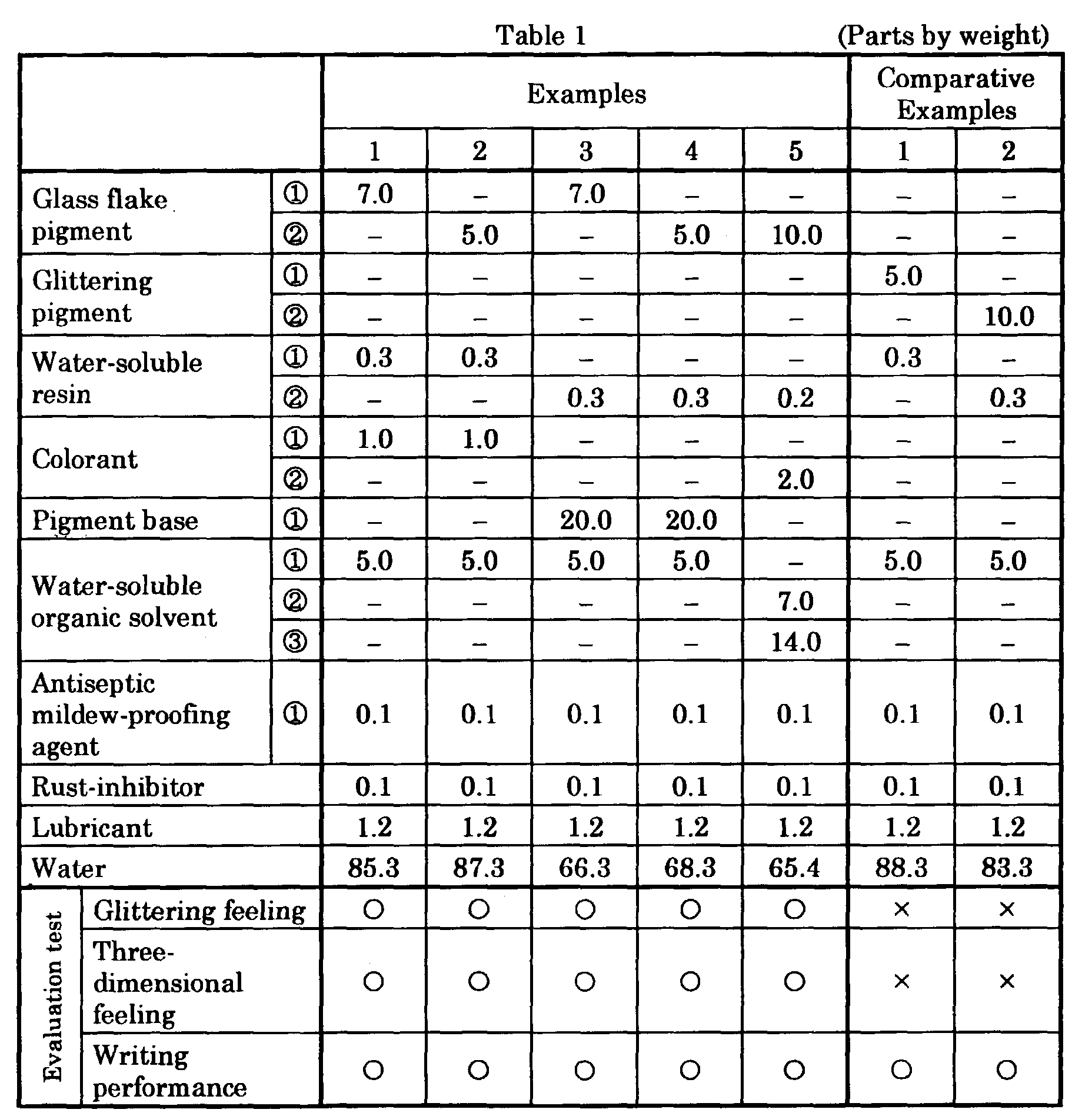


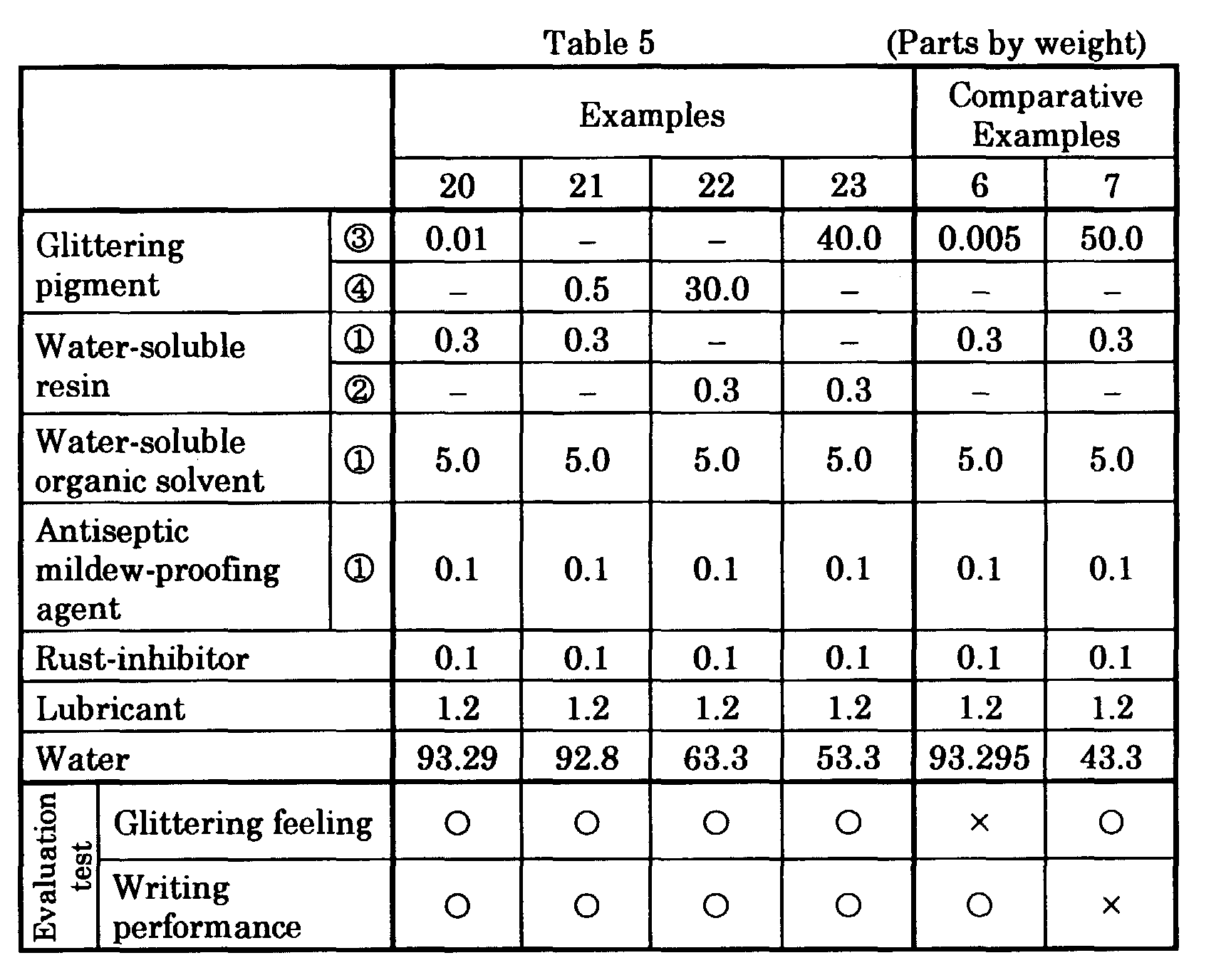
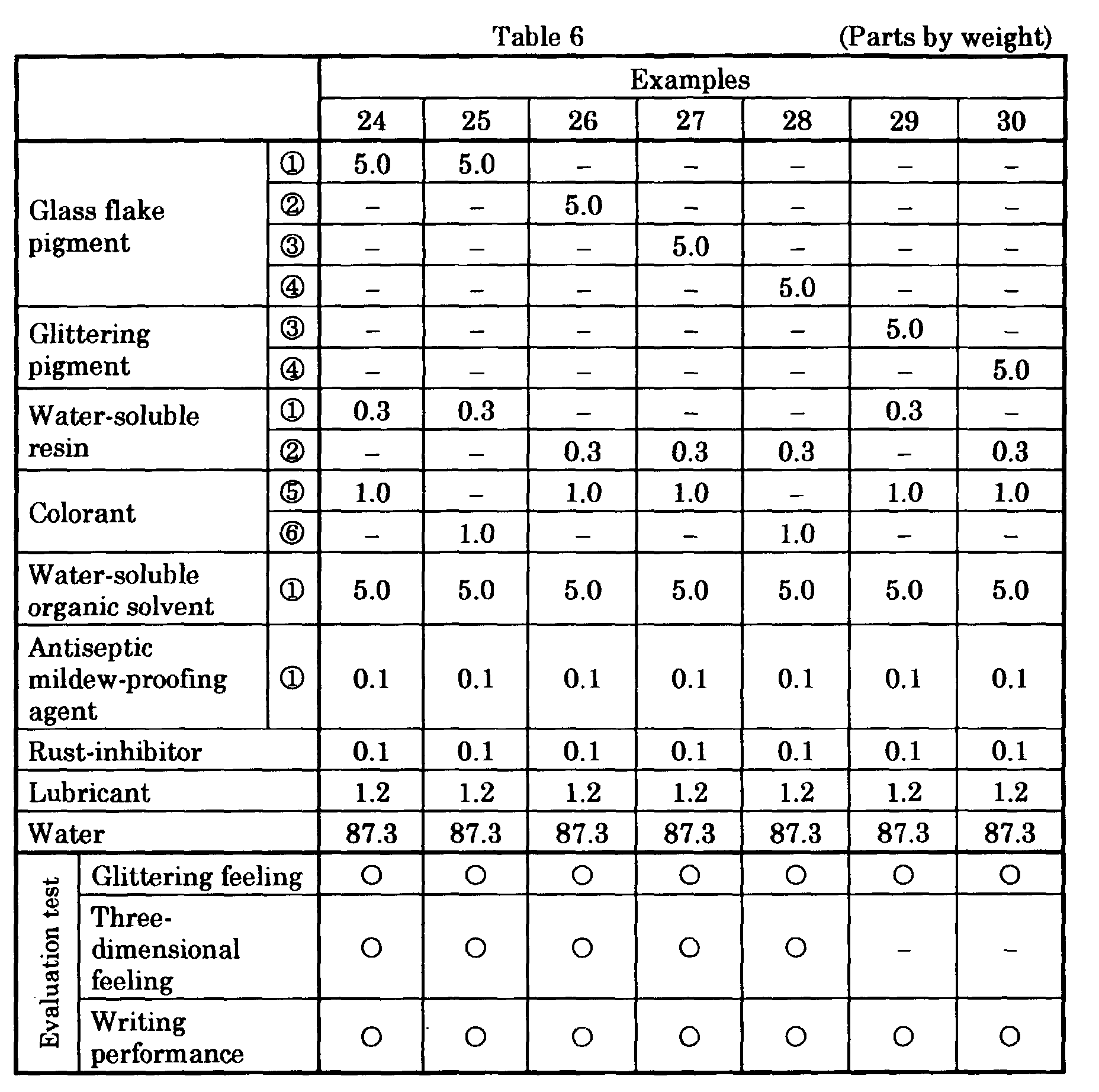

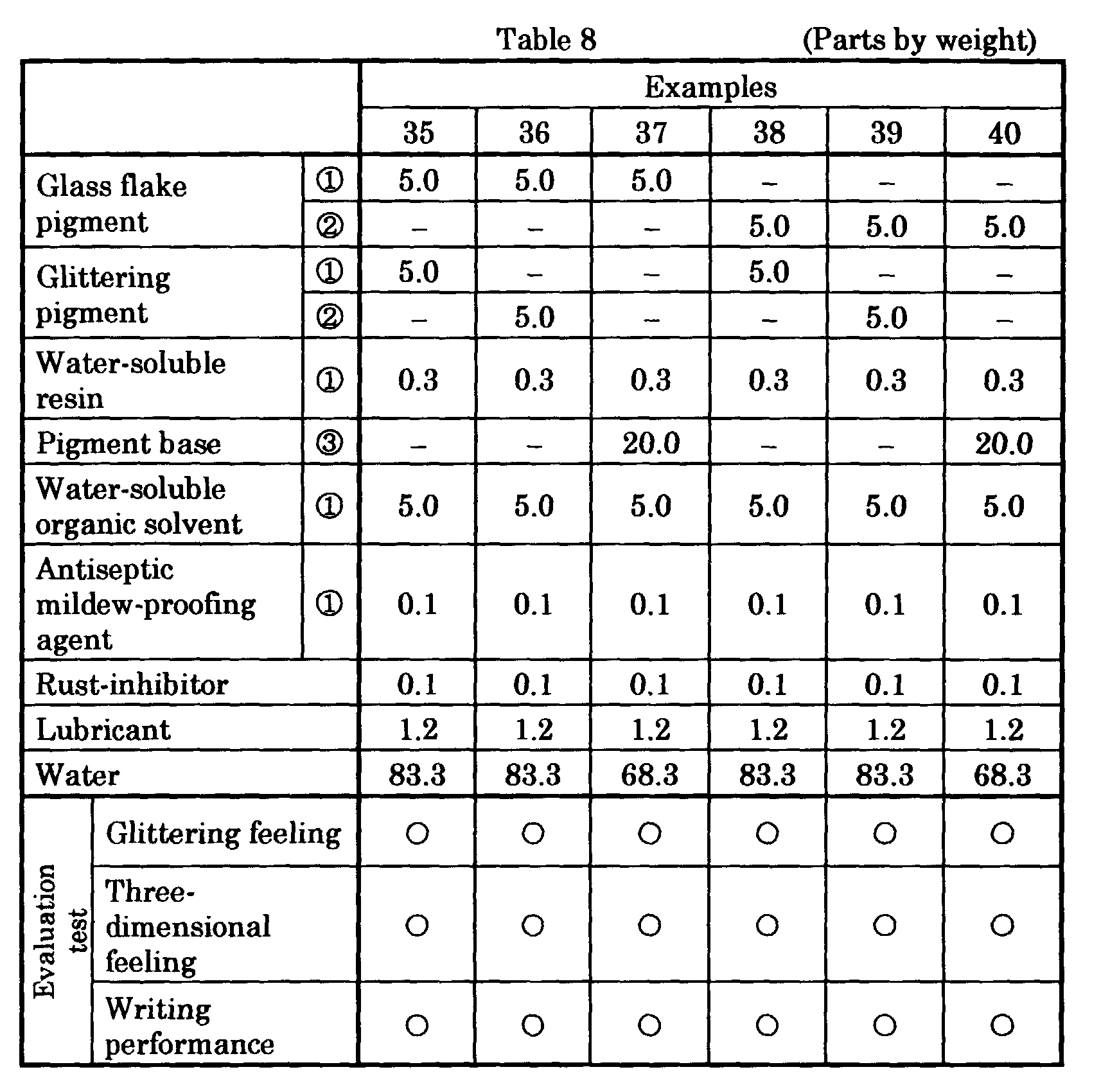
- An aqueous glittering ink composition of Example 41 was obtained in the composition and amounts (parts by weight) given in Table 9 by the following method of preparation with regard to compounding of the synthetic resin emulsion. That is, water, a water-soluble organic solvent and, as needed, other additives are mixed and stirred; a glass flake pigment is charged to the resultant and stirred; and thereafter a water-soluble thickening resin is added and stirred. Next, the mixed liquid is, as needed, adjusted its pH and a colorant is added and stirred as needed. Subsequently, a synthetic resin emulsion is added and mixed.
- In this preparation, heretofore known dispersing, degassing, filtering techniques and the like were adopted. In the foregoing producing process, pH was adjusted to 8.5 with caustic soda.
- Aqueous glittering ink compositions of Examples 42 - 49 were prepared in the same manner as Example 41 except for using the compositions and amounts (parts by weight) given in Tables 9 and 10.
- Aqueous glittering ink compositions of Comparative Examples 8 - 14 were prepared in the same manner as Example 41 except for using the compositions and amounts (parts by weight) given in Tables 9 and 10.
- For information, in Examples 42 -49 and Comparative Examples 8 - 14 used, heretofore known dispersing, degassing, filtering techniques and the like were adopted.
(Parts by weight) Examples Comparative Examples 41 42 43 44 45 8 9 10 Glass flake pigment 4 ○ 5.0 5.0 5.0 5.0 5.0 5.0 5.0 5.0 Water-soluble thickening resin 4 ○ 0.2 0.2 0.2 0.2 0.2 0.2 0.2 0.2 5 ○ 0.1 0.1 0.1 0.1 0.1 0.1 0.1 0.1 Binder component (solids) 1 ○ 7.5 2 ○ 7.5 3 ○ 7.5 4 ○ 7.5 5 ○ 7.5 6 ○ 2.0 15.0 Water-soluble organic solvent 1 ○ 7.0 7.0 7.0 7.0 7.0 7.0 7.0 7.0 4 ○ 15.0 15.0 15.0 15.0 15.0 15.0 15.0 15.0 Pigment base 1 ○ 2.0 2.0 2.0 2.0 2.0 2.0 2.0 2.0 Antiseptic mildew-proofing agent 1 ○ 0.1 0.1 0.1 0.1 0.1 0.1 0.1 0.1 Lubricant 0.1 0.1 0.1 0.1 0.1 0.1 0.1 0.1 Water 63.0 63.0 63.0 63.0 63.0 70.5 68.5 55.5 Fixability ○ ○ ○ ○ ○ X X ○ Writing aptitude ○ ○ ○ ○ ○ ○ ○ X Glittering feeling ○ ○ ○ ○ ○ ○ ○ ○ Three-dimensional feeling ○ ○ ○ ○ ○ ○ ○ ○ Note) The binder component is indicated by a content of solids (parts by weight). (Parts by weight) Examples Comparative Examples 46 47 48 49 11 12 13 14 Glass flake pigment 4 ○ 5.0 0.5 30 5.0 5.0 5.0 0.005 50 Water-soluble thickening resin 4 ○ 0.2 0.2 0.2 0.2 0.2 0.2 0.2 0.2 5 ○ 0.1 0.1 0.1 0.1 0.1 0.1 0.1 0.1 Binder component (solids) 1 ○ 40 0.01 0.005 45 2 ○ 7.5 7.5 7.5 7.5 Water-soluble organic solvent 1 ○ 7.0 7.0 7.0 7.0 7.0 7.0 7.0 7.0 4 ○ 15.0 15.0 15.0 15.0 15.0 15.0 15.0 15.0 Pigment base 1 ○ 2.0 2.0 2.0 2.0 2.0 2.0 2.0 2.0 Antiseptic mildew-proofing agent 1 ○ 0.1 0.1 0.1 0.1 0.1 0.1 0.1 0.1 Lubricant 0.1 0.1 0.1 0.1 0.1 0.1 0.1 0.1 Water 30.5 67.5 38.0 70.49 70.495 25.5 67.995 18.0 Fixability ○ ○ ○ ○ X ○ ○ ○ Writing aptitude ○ ○ ○ ○ ○ X ○ X Glittering feeling ○ ○ ○ ○ ○ X X ○ Three-dimensional feeling ○ ○ ○ ○ ○ X X ○ Note) The binder component is indicated by a content of solids (parts by weight). - In Tables 1 - 10, each raw material composition is as follows:
-
- 1 ○ Trade name "Crystal Color GF2525-M", manufactured by Toyo Aluminium CO., LTD., median diameter = about 25 µm
- 2 ○ Trade name "Crystal Color GF2540", manufactured by Toyo Aluminium CO., LTD., median diameter = about 40 µm
- 3 ○ Trade name "Metashine REFSX-2025PS", manufactured by Toyo Aluminium CO., LTD., median diameter = about 25 µm
- 4 ○ Trade name "Metashine REFSX-2040PS", manufactured by Toyo Aluminium CO., LTD., median diameter = about 40 µm
-
-
- 1 ○ Aluminum powder pigment: trade name "WXM0630", manufactured by Toyo Aluminium CO., LTD., average particle size = about 8 µm
- 2 ○ Pearl pigment: trade name "Iriodin 302", manufactured by Merck Japan Limited, average particle size = about 5 - 20 µm
- 3 ○ Metal coated inorganic pigment (yellow): trade name "Paliocrom Gold L2002", manufactured by BASF AG, median diameter = about 20 µm
- 4 ○ Metal coated inorganic pigment (yellow): trade name "Paliocrom Gold L2022", manufactured by BASF AG, median diameter = about 16 µm
-
-
- 1 ○ Rhamsan gum: trade name "K7C233", manufactured by Sansho Co.,Ltd
- 2 ○ Whelan gum: trade name "K1C376", manufactured by Sansho Co.,Ltd
- 3 ○ Carboxymethyl cellulose (CMC): trade name "Cellogen 7A", number average molecular weight = 27000 - 33000, manufactured by Dai-ichi Kogyo Seiyaku Co., Ltd.
- 4 ○ Xanthan gum: trade name "Kelzan", manufactured by Kelco a unit of Monsanto Company.
- 5 ○ Polyacrylic acid: trade name "Carbopole 940", manufactured by BF Goodrich Co., Ltd.
- 6 ○ Succinoglycan: trade name "Reozan", manufactured by Sansho Co.,Ltd
-
-
- 1 ○ Glycerin
- 2 ○ Dipropylene glycol monopropyl ether
- 3 ○ Dipropylene glycol monomethyl ether
- 4 ○ Propylene glycol
-
-
- 1 ○ Yellow dye: trade name "Yellow 202 (1)", Acid Yellow 73, Aizen Co., Ltd.
- 2 ○ Red dye: trade name "Chugai Aminol First pink R", xanthen-type, manufactured by Chugai Kasei Co., Ltd.
- 3 ○ Blue pigment: trade name "Firstgen Blue TGR", phthalocyanine blue, manufactured by Dainippon Ink & Chemicals, Inc.
- 4 ○ Yellow pigment: trade name "Seikafast Yellow A-3", azo-type, manufactured by Dainichiseika Color & Chemicals Mfg. Co., Ltd.
- 5 ○ Yellow resin emulsion: trade name "LUMIKOL NKW-2105", yellow fluorescent pigment, manufactured by Nippon Keiko Kagaku CO., Ltd.
- 6 ○ Blue resin emulsion: trade name "LUMIKOL NKW-2108", blue fluorescent pigment, manufactured by Nippon Keiko Kagaku CO., Ltd.
- 7 ○ White pigment: trade name "Kronos-KR380", titanium oxide, manufactured by Titan Kogyo CO., LTD.
-
-
- 1 ○ Pigment base: A pigment dispersion of a pigment base was
obtained, in the form of a water dispersion of pigment (average particle size =
0.08 µm; solid content = 10% by weight), by adding and dissolving
triethylamine to a mixture obtained by mixing the above-mentioned blue
pigment 3 ○ and the following resin for dispersing pigment in the following
proportion, and thereafter conducting dispersion with a ball mill. As the
resin for dispersing pigment was used a styrene-acryl copolymer (trade name
"JOHNCRYL J683", Johnson Polymer Co., Ltd., weight average molecular
weight = 8000).
- Blue pigment 3 ○
- 5 parts by weight
- Resin for dispersing pigment
- 1 part by weight
- 2 ○ Pigment base: A pigment dispersion of a pigment base was
obtained, in the form of a water dispersion of pigment (average particle size =
0.08 µm; solid content = 10% by weight), by adding and dissolving
triethylamine to a mixture obtained by mixing the above-mentioned yellow
pigment 4 ○ and the following resin for dispersing pigment in the following
proportion, and thereafter conducting dispersion with a ball mill. As the
resin for dispersing pigment was used a styrene-acryl copolymer (trade name
"JOHNCRYL J683", Johnson Polymer Co., Ltd., weight average molecular
weight = 8000).
- Yellow pigment 4 ○
- 5 parts by weight
- Resin for dispersing pigment
- 1 part by weight
- 3 ○ Pigment base: A pigment dispersion of a pigment base was
obtained, in the form of a water dispersion of pigment (average particle size =
0.4 µm; solid content = 10% by weight), by adding and dissolving
triethylamine to a mixture obtained by mixing the above-mentioned white
pigment 7 ○ and the following resin for dispersing pigment in the following
proportion, and thereafter conducting dispersion with a ball mill. As the
resin for dispersing pigment is used a styrene-acryl copolymer (trade mane
"JOHNCRYL J683", Johnson Polymer Co., Ltd., weight average molecular
weight = 8000).
- White pigment 7 ○
- 5 parts by weight
- Resin for dispersing pigment
- 1 part by weight
-
-
- 1 ○ 1,2-Benzoisothiazolin-3-one (trade name "Proxell GXL", Hoechst Synthesis Co., Ltd.)
-
-
- Benzotriazole
-
-
- Maleic monoamide
-
- Next, each of the ink compositions of Examples and Comparative Examples given in Tables 1 - 10 was packed into each of the ink containers made of a hollow polypropylene tube equipped with a ball-point pen tip made of stainless steel (ball material: silicon carbide), and ball-point pens of test samples having the ink containers therein were prepared.
- Glittering feeling and three-dimensional feeling of each ink composition for Examples and Comparative Examples given in Table 1 and glittering feeling of each ink composition for Examples and Comparative Examples given in Table 2 were evaluated by writing on a commercially available loose-leaf sheets with these ball-point pens. Glittering feeling and three-dimensional feeling of each ink for Examples and Comparative Examples given in Tables 3 - 4, glittering feeling of each ink for Examples and Comparative Examples given in Table 5, glittering feeling and three-dimensional feeling of the ink for Example 28 given in Table 6 and glittering feeling of each ink for Examples 29 and 30 given in Table 6 were evaluated. Glittering feeling and three-dimensional feeling of each ink wherein other water-soluble resins were incorporated were evaluated for Examples 31 - 34 given in Table 7. Glittering feeling and three-dimensional feeling of each ink were evaluated for Examples 35 - 40 given in Table 8. Also writing performance was evaluated for each Example and each Comparative Example given in Tables 1 - 8. Glittering feeling, three-dimensional feeling and furthermore fixability and writing aptitude were evaluated for each ink of Examples 41 - 49 containing resin emulsions given in Tables 9 and 10.
- Evaluation of the glittering feeling was conducted by visual observation of writing conditions. Rating criteria were: ○ for ones having strong glittering feeling; X for ones having little or no glittering feeling.
- Evaluation of the three-dimensional feeling was also conducted by visual observation. Rating criteria were: ○ for ones having three-dimensional feeling; X for ones having no three-dimensional feeling.
- The writing performance was evaluated according to feeling in writing. Rating criteria were: ○ for ones having good writing performance and permitting smooth writing; X for ones having poor writing performance and not permitting smooth writing very much.
- The fixability shown in Tables 9 and 10 was evaluated according to the following criteria by writing on commercially available loose-leaf sheets with ball-point pens of test samples according to every Example and Comparative Example, drying the handwritings, thereafter adhering commercially available adhesive cellophane tapes thereon, and then visually observing conditions after peeling the tapes.
- ○ : A glass flake pigment remains on the handwriting and the glittering feeling before peeling of the cellophane tape has not been lost.
- X: A glass flake pigment is peeled from the handwriting and the glittering feeling before peeling of the cellophane tape has been lost.
- The writing characteristics shown in Tables 9 and 10 were evaluated by writing on commercially available loose-leaf sheets with ball-point pens of test samples according to every Example and Comparative Example, and rating writing feeling according to the following criteria.
- ○ : Writing feeling is smooth.
- X: Writing feeling is heavy and the ink does not follow. A double-line handwriting was obtained.
- Tables 1 - 10 show results of glittering feeling, three-dimensional feeling and writing performance in each Example and each Comparative Example.
- From Table 1, in Examples 1 and 2 were obtained handwritings having both strong glittering feeling like sunshine and strong three-dimensional feeling. In Examples 3 and 4 were obtained handwritings having strong glittering feeling like stars twinkling in the night sky and strong three-dimensional feeling. In Example 5 were obtained a coated film with glittering feeling and three-dimensional feeling inside and a double-colored red handwriting outside. On the other hand, in Comparative Examples 1 and 2 were obtained handwritings having weak glittering feeling but having no three-dimensional feeling. Writing performances of the inks of Examples 1 - 5 were good as in Comparative Examples 1 and 2.
- From Table 2, in Examples 6 -9 containing metal coated inorganic pigments as glittering pigments were obtained golden handwritings with strong glittering feeling. Likewise, in Example 10 containing a metal coated inorganic pigment as a glittering pigment were obtained a coated film having glittering feeling inside and a double-colored red handwriting. On the other hand, in Comparative Example 3 containing an aluminum powder pigment as a glittering pigment was obtained a golden metallic handwriting having poor and weak glittering feeling. Writing performances of the inks of Examples 6 - 10 were good as in Comparative Example 3.
- The ink compositions of Examples 1 - 5 containing glass flake pigments can provide handwritings with unprecedented unique feeling since these ink compositions can provide handwritings with both strong glittering feeling and strong three-dimensional feeling by comprising glass flake pigments and colorants instead of using glittering pigments as in Comparative Examples 1 - 2.
- The ink compositions of Examples 6 - 10 cannot provide strong three-dimensional feeling but can provide handwritings or coated films having strong glittering feeling without loosing glitter in comparison to the ink composition of Comparative Example 3.
- From Table 3, the inks of Examples 11 and 12 provided handwritings having strong glittering feeling like sunshine and strong three-dimensional feeling as in the inks of Examples 1 and 2. The inks of Examples 13 and 14 provided handwritings having strong glittering feeling like stars twinkling in the night sky and strong three-dimensional feeling as in the inks of Examples 3 and 4. The ink of Example 15 provided a glittering coated film inside and a double-colored red handwriting outside as in the ink of Example 10. The inks of these Examples 11 - 15 were also good in writing performance.
- From Table 4, the inks of Examples 16 - 19 containing glass flake pigments in 0.01 - 40% by weight relative to the total amount of the ink compositions provided good writing performances and also provided handwritings having strong glittering feeling and three-dimensional feeling. On the other hand, the ink of Comparative Example 4 containing a glass flake pigment in less than 0.01% by weight relative to the total amount of the ink composition did not provide strong glittering feeling and the glittering feeling was poor and weak. Moreover, the ink of Comparative Example 4 also had weak three-dimensional feeling which had been reduced. On the other hand, the ink of Comparative Example 5 containing a glass flake pigment in more than 40% by weight relative to the total amount of the ink composition had both strong glittering feeling and strong three-dimensional feeling, but had poor writing characteristics.
- From Table 5, the inks of Examples 20 - 23 containing metal coated inorganic pigments as glittering pigments in 0.01 - 40% by weight relative to the total amount of the ink compositions provided good writing performances and also provided handwritings having strong glittering feeling. On the other hand, the ink of Comparative Example 6 containing a metal coated inorganic pigment in less than 0.01% by weight relative to the total amount of the ink composition provided no strong glittering feeling and the glittering feeling was poor and weak. On the other hand, the ink of Comparative Example 7 containing a metal coated inorganic pigment in more than 40% by weight relative to the total amount of the ink composition had strong glittering feeling, but had poor writing performance.
- From Table 6, the inks of Examples 24 - 28 provided fluorescent handwritings having strong glittering feeling and three-dimensional feeling. The inks of Examples 29 and 30 provided fluorescent golden handwritings having strong glittering feeling. In the case of these inks, writing performance was also good.
- From Table 7, also the inks of Examples 31 to 34 wherein water-soluble resins including xanthan gum, polyacrylic acid and succinoglycan are compounded provided handwritings having strong glittering feeling and three-dimensional feeling. Moreover, from Table 8, in the case of the inks of Examples 35 - 40 containing an aluminum powder pigment, titanium oxide and the like, the colors of the handwritings were clearly shown up even on a black paper because of their sufficient opacifying power, and glittering handwritings having strong glittering feeling and three-dimensional feeling were obtained.
- From Tables 9 and 10, the aqueous glittering ink composition of Examples 41 - 49 exhibited glittering feeling suggestive of a jewel, aquamarine, and provided good fixability and good writing aptitude.
- On the other hand, in Comparative Example 8 were obtained glittering feeling and three-dimensional feeling suggestive of a jewel, aquamarine, but no fixability was obtained at all. In Comparative Example 9, glittering feeling and three-dimensional feeling suggestive of a jewel, aquamarine, were obtained and writing aptitude was good, but no fixability was obtained at all. Moreover, in Comparative Example 10, glittering feeling and three-dimensional feeling suggestive of a jewel, aquamarine, were obtained and fixability was good, but writing performance was poor.
- Furthermore, Table 10 shows that the ink compositions of the Examples preferably contain the synthetic resin emulsions in 0.01 - 40% by weight in solids relative to the total amounts of the ink compositions. It also shows that the ink compositions of the Examples preferably contain the glass flake pigments in 0.01 - 40% by weight relative to the total amounts of the ink compositions.
- Moreover, although each of the above-mentioned Examples applied the ink compositions for those for ball-point pens, it can be used for other writing tools, printing inks, fields pertaining to coatings, to cosmetics, and the like.
- Since the present invention is an aqueous glittering ink composition containing a glass flake pigment, a water-soluble resin, a water-soluble organic solvent and water, it can provide an unprecedented unique handwriting or coated film having glittering feeling and three-dimensional feeling stronger than that of aqueous ink composition using conventional glittering pigments. In particular, in the case of the foregoing aqueous glittering ink composition containing a colorant together with a glass flake pigment, the strong glitter depending upon the hue of the colorant can be provided to a handwriting or a coated film.
- Furthermore, the aqueous glittering ink composition wherein a metal coated inorganic pigment is compounded as a glittering pigment and which contains, at least, a water-soluble resin, a water-soluble organic solvent and water can provide a handwriting or a coated film having strong glittering feeling without loosing glittering feeling in comparison to the aqueous ink composition using conventional glittering pigments. Moreover, in the case of the above-mentioned aqueous glittering ink composition containing a colorant together with a metal coated inorganic pigment, the strong glitter depending upon the hue of the colorant can be provided to a handwriting or a coated film.
- Moreover, the aqueous glittering ink composition containing a glass flake pigment, a water-soluble thickening resin, a water-soluble organic solvent and water as essential ingredients and containing a binder component, preferably a synthetic resin emulsion, for fixing the glass flake pigment to a handwriting or a coated film can improve fixability of the glass flake pigment to the handwriting or the coated film and can continue to provide stronger glittering feeling and three-dimensional feeling to the handwriting or the coated film without deteriorating ink characteristics or writing characteristics and without inhibiting effects of the compounding of the glass flake pigment on the strong glittering feeling and three-dimensional feeling.
Claims (16)
- An aqueous glittering ink composition containing a glass flake pigment, a water-soluble resin, a water-soluble organic solvent and water as essential ingredients.
- An aqueous glittering ink composition containing a metal coated inorganic pigment, a water-soluble resin, a water-soluble organic solvent and water as essential ingredients.
- An aqueous glittering ink composition containing a glass flake pigment, a water-soluble resin, a water-soluble organic solvent, water and a colorant as essential ingredients.
- An aqueous glittering ink composition containing a metal coated inorganic pigment, a water-soluble resin, a water-soluble organic solvent, water and a colorant as essential ingredients.
- A composition as claimed in claim 1 or claim 3, wherein the content of the glass flake pigment is 0.01 - 40% by weight relative to the total amount of the ink composition.
- A composition as claimed in claim 2 or claim 4, wherein the metal coated inorganic pigment is contained in 0.01 - 40% by weight relative to the total amount of the ink composition.
- A composition as claimed in any one of claims 1, 3 and 5, wherein the glass flake pigment has a median diameter of 5 - 100 µm.
- A composition as claimed in any one of claims 2, 4 and 6, wherein the metal coated inorganic pigment has a median diameter of 5 - 100 µm.
- A composition as claimed in any one of claims 1 to 8, wherein the water-soluble resin is contained in 0.01 - 40% by weight relative to the total amount of the ink composition.
- A composition as claimed in any one of claims 1 to 9, further containing a colorant in 0.01 - 30% by weight relative to the total amount of the ink composition.
- A composition as claimed in any one of claims 1 to 10, further containing an opacifying pigment.
- A composition as claimed in claim 1 or claim 3, or any claim dependent on claim 1 or claim 3, containing, as an essential ingredient, a binder component for fixing the glass flake pigment to a handwriting or a coated film.
- A composition as claimed in claim 12, containing a synthetic resin emulsion as the binder component.
- A composition as claimed in claim 13, wherein the synthetic resin emulsion is contained in 0.01 - 40% by weight in solids relative to the total amount of the ink composition.
- A composition as claimed in claim 13 or claim 14, wherein the content of the glass flake pigment is 0.01 - 40% by weight, the water-soluble resin is 0.01 - 40% by weight and the water-soluble organic solvent is 1 to 40% by weight, relative to the total amount of the ink composition.
- A composition as claimed in any one of claims 13 to 15, wherein the synthetic resin emulsion has an anionic property or a nonionic property and its minimum film forming temperature is not higher than 20°C.
Applications Claiming Priority (8)
| Application Number | Priority Date | Filing Date | Title |
|---|---|---|---|
| JP7686899 | 1999-03-19 | ||
| JP7686899 | 1999-03-19 | ||
| JP36018799 | 1999-12-20 | ||
| JP36018799 | 1999-12-20 | ||
| JP2000002370 | 2000-01-11 | ||
| JP2000002344 | 2000-01-11 | ||
| JP2000002370 | 2000-01-11 | ||
| JP2000002344 | 2000-01-11 |
Publications (2)
| Publication Number | Publication Date |
|---|---|
| EP1038931A1 true EP1038931A1 (en) | 2000-09-27 |
| EP1038931B1 EP1038931B1 (en) | 2005-08-10 |
Family
ID=27465978
Family Applications (1)
| Application Number | Title | Priority Date | Filing Date |
|---|---|---|---|
| EP00302170A Expired - Lifetime EP1038931B1 (en) | 1999-03-19 | 2000-03-16 | Aqueous glittering ink composition |
Country Status (7)
| Country | Link |
|---|---|
| US (2) | US6730717B2 (en) |
| EP (1) | EP1038931B1 (en) |
| KR (1) | KR100371576B1 (en) |
| CN (1) | CN100340621C (en) |
| AT (1) | ATE301694T1 (en) |
| DE (1) | DE60021788T2 (en) |
| TW (1) | TWI262207B (en) |
Cited By (8)
| Publication number | Priority date | Publication date | Assignee | Title |
|---|---|---|---|---|
| FR2789895A1 (en) * | 1999-02-23 | 2000-08-25 | Mitsubishi Pencil Co | Water-based liquid cosmetic preparation for application with a brush e.g. as eye make-up, contains a composite pearl pigment based on mica |
| WO2003066745A1 (en) * | 2002-02-05 | 2003-08-14 | Sakura Color Products Corporation | Water-based bright colorant composition |
| US6663704B2 (en) | 2000-07-03 | 2003-12-16 | Berol Corporation | Pearlescent inks, writing instruments, and methods |
| US6749676B2 (en) | 2000-07-03 | 2004-06-15 | Berol Corporation | Erasable inks, writing instruments, and methods |
| EP1249222A4 (en) * | 2000-01-18 | 2006-04-26 | Sakura Color Prod Corp | Brilliant cosmetics |
| EP2641740A1 (en) * | 2012-03-23 | 2013-09-25 | Seiko Epson Corporation | Ink jet recording apparatus and recorded matter |
| WO2014150453A1 (en) * | 2013-03-15 | 2014-09-25 | Sanford, L.P. | Metallic ink composition and writing instruument containing same |
| EP3075791A1 (en) * | 2015-04-02 | 2016-10-05 | Bollig & Kemper GmbH & Co. KG | Sparkling clear coat composition |
Families Citing this family (18)
| Publication number | Priority date | Publication date | Assignee | Title |
|---|---|---|---|---|
| TWI262207B (en) * | 1999-03-19 | 2006-09-21 | Sakura Color Prod Corp | Aqueous glittering ink composition |
| KR20010025283A (en) * | 2000-12-05 | 2001-04-06 | 김영훈 | composite of high glossy water ink used for writing implements |
| KR100416941B1 (en) * | 2001-02-13 | 2004-01-31 | 동아연필 주식회사 | Aqueous ink composition with metallic glittering |
| KR20030082108A (en) * | 2002-04-16 | 2003-10-22 | 현대자동차주식회사 | A paint and varnish composition for an automobile |
| ATE381592T1 (en) * | 2002-10-17 | 2008-01-15 | Ciba Sc Holding Ag | METHOD FOR PRINTING SUBSTRATES USING THE INKJET PRINTING METHOD |
| DE10323374A1 (en) * | 2003-05-21 | 2004-12-09 | Basf Drucksysteme Gmbh | Metallic printing ink and its use for finishing prints |
| JP4670069B2 (en) * | 2003-05-30 | 2011-04-13 | 本田技研工業株式会社 | Glittering film forming method and painted product |
| CN1882440A (en) * | 2003-09-19 | 2006-12-20 | 桑福德有限合伙人公司 | Glitter marker pen of capillary action type and ink composition therefor |
| JP5270814B2 (en) * | 2005-08-11 | 2013-08-21 | 東京応化工業株式会社 | Colorant dispersion for photosensitive composition |
| US8298987B2 (en) | 2005-10-24 | 2012-10-30 | Mitsui Chemicals, Inc. | Heat-sensitive recording materials |
| US8133313B2 (en) * | 2008-02-28 | 2012-03-13 | Kabushiki Kaisha Toshiba | Aqueous inkjet ink and inkjet recording method |
| KR101026792B1 (en) | 2008-09-19 | 2011-04-04 | (주)그린교구 | Oily ink composition for whiteboard marker pen and manufacturing method thereof |
| US9308761B2 (en) * | 2010-08-11 | 2016-04-12 | Seiko Epson Corporation | Ink jet printing method, ink set, and printed matter |
| US8617646B2 (en) | 2011-12-29 | 2013-12-31 | Sanford, L.P. | Metallic ink composition and writing instrument containing same |
| US8846797B2 (en) | 2012-12-31 | 2014-09-30 | Sanford, L.P. | Metallic ink composition and writing instrument containing same |
| JP6550792B2 (en) * | 2014-03-13 | 2019-07-31 | 株式会社リコー | Ink, inkjet recording method, recorded matter |
| GB201703777D0 (en) * | 2017-03-09 | 2017-04-26 | Pilkington Group Ltd | Conductive ink composition |
| CN111548674A (en) * | 2020-05-08 | 2020-08-18 | 宁波佐图文化用品有限公司 | Water-based ink with three-dimensional effect and preparation method thereof |
Citations (3)
| Publication number | Priority date | Publication date | Assignee | Title |
|---|---|---|---|---|
| EP0600205A1 (en) * | 1992-12-01 | 1994-06-08 | ROTRING INTERNATIONAL GMBH & Co KG | Iridescent ink |
| US5445671A (en) * | 1993-07-09 | 1995-08-29 | Merck Patent Gesellschaft Mit Beschrankter Haftung | Offset printing ink |
| US5556527A (en) * | 1994-07-05 | 1996-09-17 | Honda Giken Kogyo Kabushiki Kaisha | Process for formation of multilayer film |
Family Cites Families (22)
| Publication number | Priority date | Publication date | Assignee | Title |
|---|---|---|---|---|
| CA871034A (en) * | 1971-05-18 | E.I. Du Pont De Nemours And Company | Golden flake pigments coated with silver and hydrous oxides | |
| US3053683A (en) * | 1958-09-19 | 1962-09-11 | Du Pont | Pigment, method of making same, and coating compositions containing same |
| US3087828A (en) * | 1961-06-28 | 1963-04-30 | Du Pont | Nacreous pigment compositions |
| US4606992A (en) * | 1985-10-17 | 1986-08-19 | Eastman Kodak Company | Reflecting layer for image transfer prints |
| JPH03239769A (en) * | 1990-02-16 | 1991-10-25 | Kansai Paint Co Ltd | Metallic paint and method for coating therewith |
| DE4209242A1 (en) * | 1992-03-21 | 1993-09-23 | Basf Ag | MIXTURES SUITABLE AS GLOSS PIGMENTS |
| US5510397A (en) * | 1993-04-23 | 1996-04-23 | Sakura Color Products Corporation | Aqueous pigment ink composition for writing utensils |
| JP3312308B2 (en) * | 1993-10-27 | 2002-08-05 | ぺんてる株式会社 | Aqueous metallic glossy ink for ballpoint pens |
| JPH0818592A (en) * | 1994-06-30 | 1996-01-19 | Fujitsu Ltd | Optical fiber transmission system with ring protection by optical switching |
| US5584922A (en) * | 1994-09-14 | 1996-12-17 | Ciba-Geigy Corporation | Stir-in organic pigments |
| US5714526A (en) * | 1995-03-02 | 1998-02-03 | Henkel Corporation | Method of preparing resin/pigment compositions for printing inks |
| JPH09255908A (en) * | 1996-03-26 | 1997-09-30 | Riso Kagaku Corp | Emulsion ink for stencil printing |
| US6099629A (en) * | 1996-03-27 | 2000-08-08 | Mitsubishi Pencil Kabushiki Kaisha | Water based ink and water based pigment ink having metallic lustrous color for ballpoint pen |
| JPH09268270A (en) * | 1996-03-29 | 1997-10-14 | Tombow Pencil Co Ltd | Aqueous ink composition for ballpoint pens |
| JP3737219B2 (en) * | 1996-09-03 | 2006-01-18 | パイロットインキ株式会社 | Aqueous metallic glossy ink composition for ballpoint pens |
| WO1998040441A1 (en) * | 1997-03-11 | 1998-09-17 | Kabushiki Kaisha Pilot | Direct filling type water-base ball-point ink having metallic sheen |
| DE69835049T2 (en) * | 1997-03-28 | 2006-11-09 | Seiko Epson Corp. | Ink composition for ink jet recording |
| ID20406A (en) * | 1997-06-03 | 1998-12-10 | Binney & Smith Inc | LOW-OUT OUTDOOR COMPOSITION |
| EP0887391A1 (en) * | 1997-06-26 | 1998-12-30 | Seiko Epson Corporation | Ink jet recording ink and method |
| US6770689B1 (en) * | 1999-03-19 | 2004-08-03 | Sakura Color Products Corp. | Aqueous glittering ink |
| TWI262207B (en) * | 1999-03-19 | 2006-09-21 | Sakura Color Prod Corp | Aqueous glittering ink composition |
| JP2001080263A (en) * | 1999-09-13 | 2001-03-27 | Sakura Color Prod Corp | Ballpoint pen |
-
2000
- 2000-03-15 TW TW089104702A patent/TWI262207B/en not_active IP Right Cessation
- 2000-03-16 DE DE60021788T patent/DE60021788T2/en not_active Expired - Lifetime
- 2000-03-16 EP EP00302170A patent/EP1038931B1/en not_active Expired - Lifetime
- 2000-03-16 AT AT00302170T patent/ATE301694T1/en not_active IP Right Cessation
- 2000-03-18 KR KR10-2000-0013818A patent/KR100371576B1/en not_active Expired - Fee Related
- 2000-03-20 CN CNB001043714A patent/CN100340621C/en not_active Expired - Fee Related
-
2002
- 2002-03-06 US US10/091,883 patent/US6730717B2/en not_active Expired - Lifetime
-
2004
- 2004-12-17 US US11/016,368 patent/US7468400B2/en not_active Expired - Fee Related
Patent Citations (3)
| Publication number | Priority date | Publication date | Assignee | Title |
|---|---|---|---|---|
| EP0600205A1 (en) * | 1992-12-01 | 1994-06-08 | ROTRING INTERNATIONAL GMBH & Co KG | Iridescent ink |
| US5445671A (en) * | 1993-07-09 | 1995-08-29 | Merck Patent Gesellschaft Mit Beschrankter Haftung | Offset printing ink |
| US5556527A (en) * | 1994-07-05 | 1996-09-17 | Honda Giken Kogyo Kabushiki Kaisha | Process for formation of multilayer film |
Cited By (14)
| Publication number | Priority date | Publication date | Assignee | Title |
|---|---|---|---|---|
| FR2789895A1 (en) * | 1999-02-23 | 2000-08-25 | Mitsubishi Pencil Co | Water-based liquid cosmetic preparation for application with a brush e.g. as eye make-up, contains a composite pearl pigment based on mica |
| EP1249222A4 (en) * | 2000-01-18 | 2006-04-26 | Sakura Color Prod Corp | Brilliant cosmetics |
| US6663704B2 (en) | 2000-07-03 | 2003-12-16 | Berol Corporation | Pearlescent inks, writing instruments, and methods |
| US6749676B2 (en) | 2000-07-03 | 2004-06-15 | Berol Corporation | Erasable inks, writing instruments, and methods |
| US6986809B2 (en) | 2000-07-03 | 2006-01-17 | Berol Corporation | Erasable inks, writing instruments, and methods |
| US7160375B2 (en) | 2002-02-05 | 2007-01-09 | Sakura Color Products Corporation | Aqueous glittering color material composition |
| WO2003066745A1 (en) * | 2002-02-05 | 2003-08-14 | Sakura Color Products Corporation | Water-based bright colorant composition |
| EP2641740A1 (en) * | 2012-03-23 | 2013-09-25 | Seiko Epson Corporation | Ink jet recording apparatus and recorded matter |
| US8979245B2 (en) | 2012-03-23 | 2015-03-17 | Seiko Epson Corporation | Ink jet recording apparatus and recorded matter |
| WO2014150453A1 (en) * | 2013-03-15 | 2014-09-25 | Sanford, L.P. | Metallic ink composition and writing instruument containing same |
| US9163153B2 (en) | 2013-03-15 | 2015-10-20 | Sanford, L.P. | Metallic ink composition and writing instrument containing same |
| USRE49400E1 (en) | 2013-03-15 | 2023-01-31 | Sanford, L.P. | Metallic ink composition and writing instrument containing same |
| EP3075791A1 (en) * | 2015-04-02 | 2016-10-05 | Bollig & Kemper GmbH & Co. KG | Sparkling clear coat composition |
| WO2016156603A1 (en) * | 2015-04-02 | 2016-10-06 | Bollig & Kemper Gmbh & Co.Kg | Sparkling clear coat composition |
Also Published As
| Publication number | Publication date |
|---|---|
| US6730717B2 (en) | 2004-05-04 |
| ATE301694T1 (en) | 2005-08-15 |
| CN100340621C (en) | 2007-10-03 |
| EP1038931B1 (en) | 2005-08-10 |
| DE60021788D1 (en) | 2005-09-15 |
| CN1267689A (en) | 2000-09-27 |
| KR100371576B1 (en) | 2003-02-06 |
| DE60021788T2 (en) | 2006-05-18 |
| KR20000062951A (en) | 2000-10-25 |
| US7468400B2 (en) | 2008-12-23 |
| TWI262207B (en) | 2006-09-21 |
| US20020128350A1 (en) | 2002-09-12 |
| US20050159505A1 (en) | 2005-07-21 |
Similar Documents
| Publication | Publication Date | Title |
|---|---|---|
| EP1038931B1 (en) | Aqueous glittering ink composition | |
| US6544323B2 (en) | Aqueous ink composition with metallic glittering | |
| KR100364178B1 (en) | Water-base ballpoint ink having metallic glossy color | |
| US6730154B2 (en) | Polychromic ink composition depending on viewing angle | |
| US6770689B1 (en) | Aqueous glittering ink | |
| US7173077B2 (en) | Aqueous glittering ink composition | |
| EP1111018A1 (en) | Aqueous glittering ink | |
| JP5155933B2 (en) | Bright water-based ink composition for ballpoint pens | |
| KR100463440B1 (en) | Aqueous glittering ink composition | |
| JP3804241B2 (en) | Water-based glossy ink composition | |
| JP4232932B2 (en) | Bright water-based ink composition | |
| JP7151971B2 (en) | Water-based metallic color ink | |
| JP5543695B2 (en) | Water-based glitter ink composition | |
| JP4346000B2 (en) | Bright water-based ink composition for ballpoint pens | |
| JP2009046660A (en) | Water-based glorious ink composition | |
| JP4327321B2 (en) | Bright water-based ink composition for ballpoint pens | |
| JP3429721B2 (en) | Metallic glossy aqueous stamp ink composition | |
| JP2001329201A (en) | Bright aqueous ink | |
| JP5295473B2 (en) | Bright water-based ink composition | |
| JPH06313142A (en) | Metallic gloss aqueous ink composition | |
| JP2002097402A (en) | Glittering aqueous ink composition | |
| JP3359275B2 (en) | Pearl water-based gel ink for ballpoint pens | |
| JP2002155224A (en) | Discolorable glossy ink composition | |
| JPWO1998026014A1 (en) | Water-based ink for ballpoint pens with metallic luster |
Legal Events
| Date | Code | Title | Description |
|---|---|---|---|
| PUAI | Public reference made under article 153(3) epc to a published international application that has entered the european phase |
Free format text: ORIGINAL CODE: 0009012 |
|
| 17P | Request for examination filed |
Effective date: 20000403 |
|
| AK | Designated contracting states |
Kind code of ref document: A1 Designated state(s): AT BE CH CY DE DK ES FI FR GB GR IE IT LI LU MC NL PT SE |
|
| AX | Request for extension of the european patent |
Free format text: AL;LT;LV;MK;RO;SI |
|
| AKX | Designation fees paid |
Free format text: AT BE CH CY DE DK ES FI FR GB GR IE IT LI LU MC NL PT SE |
|
| 17Q | First examination report despatched |
Effective date: 20030324 |
|
| GRAP | Despatch of communication of intention to grant a patent |
Free format text: ORIGINAL CODE: EPIDOSNIGR1 |
|
| GRAS | Grant fee paid |
Free format text: ORIGINAL CODE: EPIDOSNIGR3 |
|
| GRAA | (expected) grant |
Free format text: ORIGINAL CODE: 0009210 |
|
| AK | Designated contracting states |
Kind code of ref document: B1 Designated state(s): AT BE CH CY DE DK ES FI FR GB GR IE IT LI LU MC NL PT SE |
|
| PG25 | Lapsed in a contracting state [announced via postgrant information from national office to epo] |
Ref country code: LI Free format text: LAPSE BECAUSE OF FAILURE TO SUBMIT A TRANSLATION OF THE DESCRIPTION OR TO PAY THE FEE WITHIN THE PRESCRIBED TIME-LIMIT Effective date: 20050810 Ref country code: CH Free format text: LAPSE BECAUSE OF FAILURE TO SUBMIT A TRANSLATION OF THE DESCRIPTION OR TO PAY THE FEE WITHIN THE PRESCRIBED TIME-LIMIT Effective date: 20050810 Ref country code: FI Free format text: LAPSE BECAUSE OF FAILURE TO SUBMIT A TRANSLATION OF THE DESCRIPTION OR TO PAY THE FEE WITHIN THE PRESCRIBED TIME-LIMIT Effective date: 20050810 Ref country code: AT Free format text: LAPSE BECAUSE OF FAILURE TO SUBMIT A TRANSLATION OF THE DESCRIPTION OR TO PAY THE FEE WITHIN THE PRESCRIBED TIME-LIMIT Effective date: 20050810 |
|
| REG | Reference to a national code |
Ref country code: GB Ref legal event code: FG4D |
|
| REG | Reference to a national code |
Ref country code: CH Ref legal event code: EP |
|
| REG | Reference to a national code |
Ref country code: IE Ref legal event code: FG4D |
|
| REF | Corresponds to: |
Ref document number: 60021788 Country of ref document: DE Date of ref document: 20050915 Kind code of ref document: P |
|
| PG25 | Lapsed in a contracting state [announced via postgrant information from national office to epo] |
Ref country code: SE Free format text: LAPSE BECAUSE OF FAILURE TO SUBMIT A TRANSLATION OF THE DESCRIPTION OR TO PAY THE FEE WITHIN THE PRESCRIBED TIME-LIMIT Effective date: 20051110 Ref country code: GR Free format text: LAPSE BECAUSE OF FAILURE TO SUBMIT A TRANSLATION OF THE DESCRIPTION OR TO PAY THE FEE WITHIN THE PRESCRIBED TIME-LIMIT Effective date: 20051110 Ref country code: DK Free format text: LAPSE BECAUSE OF FAILURE TO SUBMIT A TRANSLATION OF THE DESCRIPTION OR TO PAY THE FEE WITHIN THE PRESCRIBED TIME-LIMIT Effective date: 20051110 |
|
| PG25 | Lapsed in a contracting state [announced via postgrant information from national office to epo] |
Ref country code: ES Free format text: LAPSE BECAUSE OF FAILURE TO SUBMIT A TRANSLATION OF THE DESCRIPTION OR TO PAY THE FEE WITHIN THE PRESCRIBED TIME-LIMIT Effective date: 20051121 |
|
| PG25 | Lapsed in a contracting state [announced via postgrant information from national office to epo] |
Ref country code: PT Free format text: LAPSE BECAUSE OF FAILURE TO SUBMIT A TRANSLATION OF THE DESCRIPTION OR TO PAY THE FEE WITHIN THE PRESCRIBED TIME-LIMIT Effective date: 20060110 |
|
| REG | Reference to a national code |
Ref country code: CH Ref legal event code: PL |
|
| PG25 | Lapsed in a contracting state [announced via postgrant information from national office to epo] |
Ref country code: IE Free format text: LAPSE BECAUSE OF NON-PAYMENT OF DUE FEES Effective date: 20060316 |
|
| PG25 | Lapsed in a contracting state [announced via postgrant information from national office to epo] |
Ref country code: LU Free format text: LAPSE BECAUSE OF NON-PAYMENT OF DUE FEES Effective date: 20060331 Ref country code: MC Free format text: LAPSE BECAUSE OF NON-PAYMENT OF DUE FEES Effective date: 20060331 |
|
| PGFP | Annual fee paid to national office [announced via postgrant information from national office to epo] |
Ref country code: IT Payment date: 20060331 Year of fee payment: 7 |
|
| ET | Fr: translation filed | ||
| PLBE | No opposition filed within time limit |
Free format text: ORIGINAL CODE: 0009261 |
|
| STAA | Information on the status of an ep patent application or granted ep patent |
Free format text: STATUS: NO OPPOSITION FILED WITHIN TIME LIMIT |
|
| 26N | No opposition filed |
Effective date: 20060511 |
|
| REG | Reference to a national code |
Ref country code: IE Ref legal event code: MM4A |
|
| PG25 | Lapsed in a contracting state [announced via postgrant information from national office to epo] |
Ref country code: CY Free format text: LAPSE BECAUSE OF FAILURE TO SUBMIT A TRANSLATION OF THE DESCRIPTION OR TO PAY THE FEE WITHIN THE PRESCRIBED TIME-LIMIT Effective date: 20050810 |
|
| PG25 | Lapsed in a contracting state [announced via postgrant information from national office to epo] |
Ref country code: IT Free format text: LAPSE BECAUSE OF NON-PAYMENT OF DUE FEES Effective date: 20070316 |
|
| PGFP | Annual fee paid to national office [announced via postgrant information from national office to epo] |
Ref country code: BE Payment date: 20120328 Year of fee payment: 13 |
|
| PGFP | Annual fee paid to national office [announced via postgrant information from national office to epo] |
Ref country code: NL Payment date: 20120321 Year of fee payment: 13 |
|
| PGFP | Annual fee paid to national office [announced via postgrant information from national office to epo] |
Ref country code: FR Payment date: 20130325 Year of fee payment: 14 Ref country code: GB Payment date: 20130313 Year of fee payment: 14 |
|
| BERE | Be: lapsed |
Owner name: *SAKURA COLOR PRODUCTS CORP. Effective date: 20130331 |
|
| REG | Reference to a national code |
Ref country code: NL Ref legal event code: V1 Effective date: 20131001 |
|
| PG25 | Lapsed in a contracting state [announced via postgrant information from national office to epo] |
Ref country code: BE Free format text: LAPSE BECAUSE OF NON-PAYMENT OF DUE FEES Effective date: 20130331 |
|
| PG25 | Lapsed in a contracting state [announced via postgrant information from national office to epo] |
Ref country code: NL Free format text: LAPSE BECAUSE OF NON-PAYMENT OF DUE FEES Effective date: 20131001 |
|
| GBPC | Gb: european patent ceased through non-payment of renewal fee |
Effective date: 20140316 |
|
| REG | Reference to a national code |
Ref country code: FR Ref legal event code: ST Effective date: 20141128 |
|
| PG25 | Lapsed in a contracting state [announced via postgrant information from national office to epo] |
Ref country code: GB Free format text: LAPSE BECAUSE OF NON-PAYMENT OF DUE FEES Effective date: 20140316 Ref country code: FR Free format text: LAPSE BECAUSE OF NON-PAYMENT OF DUE FEES Effective date: 20140331 |
|
| PGFP | Annual fee paid to national office [announced via postgrant information from national office to epo] |
Ref country code: DE Payment date: 20150310 Year of fee payment: 16 |
|
| REG | Reference to a national code |
Ref country code: DE Ref legal event code: R119 Ref document number: 60021788 Country of ref document: DE |
|
| PG25 | Lapsed in a contracting state [announced via postgrant information from national office to epo] |
Ref country code: DE Free format text: LAPSE BECAUSE OF NON-PAYMENT OF DUE FEES Effective date: 20161001 |