EP1035878B1 - Künstliches gelenk einer prothese - Google Patents
Künstliches gelenk einer prothese Download PDFInfo
- Publication number
- EP1035878B1 EP1035878B1 EP98964460A EP98964460A EP1035878B1 EP 1035878 B1 EP1035878 B1 EP 1035878B1 EP 98964460 A EP98964460 A EP 98964460A EP 98964460 A EP98964460 A EP 98964460A EP 1035878 B1 EP1035878 B1 EP 1035878B1
- Authority
- EP
- European Patent Office
- Prior art keywords
- joint
- oxide
- artificial
- zirconium oxide
- ball
- Prior art date
- Legal status (The legal status is an assumption and is not a legal conclusion. Google has not performed a legal analysis and makes no representation as to the accuracy of the status listed.)
- Revoked
Links
- 239000000463 material Substances 0.000 claims abstract description 40
- RVTZCBVAJQQJTK-UHFFFAOYSA-N oxygen(2-);zirconium(4+) Chemical compound [O-2].[O-2].[Zr+4] RVTZCBVAJQQJTK-UHFFFAOYSA-N 0.000 claims description 28
- 229910001928 zirconium oxide Inorganic materials 0.000 claims description 28
- PNEYBMLMFCGWSK-UHFFFAOYSA-N Alumina Chemical compound [O-2].[O-2].[O-2].[Al+3].[Al+3] PNEYBMLMFCGWSK-UHFFFAOYSA-N 0.000 claims description 25
- 210000004394 hip joint Anatomy 0.000 claims description 12
- 239000000919 ceramic Substances 0.000 claims description 10
- 239000000203 mixture Substances 0.000 claims description 7
- 239000003381 stabilizer Substances 0.000 claims description 2
- 229940043774 zirconium oxide Drugs 0.000 claims 9
- TWNQGVIAIRXVLR-UHFFFAOYSA-N oxo(oxoalumanyloxy)alumane Chemical compound O=[Al]O[Al]=O TWNQGVIAIRXVLR-UHFFFAOYSA-N 0.000 abstract description 18
- 229910010293 ceramic material Inorganic materials 0.000 abstract description 7
- 241001465754 Metazoa Species 0.000 abstract description 3
- 229910052845 zircon Inorganic materials 0.000 abstract 2
- GFQYVLUOOAAOGM-UHFFFAOYSA-N zirconium(iv) silicate Chemical compound [Zr+4].[O-][Si]([O-])([O-])[O-] GFQYVLUOOAAOGM-UHFFFAOYSA-N 0.000 abstract 2
- MCMNRKCIXSYSNV-UHFFFAOYSA-N Zirconium dioxide Chemical compound O=[Zr]=O MCMNRKCIXSYSNV-UHFFFAOYSA-N 0.000 description 10
- 210000001503 joint Anatomy 0.000 description 4
- 239000004698 Polyethylene Substances 0.000 description 3
- 239000011224 oxide ceramic Substances 0.000 description 3
- -1 polyethylene Polymers 0.000 description 3
- 229920000573 polyethylene Polymers 0.000 description 3
- 238000005299 abrasion Methods 0.000 description 2
- 210000000988 bone and bone Anatomy 0.000 description 2
- 239000007943 implant Substances 0.000 description 2
- 210000001519 tissue Anatomy 0.000 description 2
- 229910000531 Co alloy Inorganic materials 0.000 description 1
- 229910000684 Cobalt-chrome Inorganic materials 0.000 description 1
- GWEVSGVZZGPLCZ-UHFFFAOYSA-N Titan oxide Chemical compound O=[Ti]=O GWEVSGVZZGPLCZ-UHFFFAOYSA-N 0.000 description 1
- RTAQQCXQSZGOHL-UHFFFAOYSA-N Titanium Chemical compound [Ti] RTAQQCXQSZGOHL-UHFFFAOYSA-N 0.000 description 1
- WGLPBDUCMAPZCE-UHFFFAOYSA-N Trioxochromium Chemical compound O=[Cr](=O)=O WGLPBDUCMAPZCE-UHFFFAOYSA-N 0.000 description 1
- 229910000287 alkaline earth metal oxide Inorganic materials 0.000 description 1
- 229910045601 alloy Inorganic materials 0.000 description 1
- 239000000956 alloy Substances 0.000 description 1
- 239000012620 biological material Substances 0.000 description 1
- 210000001124 body fluid Anatomy 0.000 description 1
- 239000010839 body fluid Substances 0.000 description 1
- 229910000423 chromium oxide Inorganic materials 0.000 description 1
- 239000010952 cobalt-chrome Substances 0.000 description 1
- 229910000449 hafnium oxide Inorganic materials 0.000 description 1
- WIHZLLGSGQNAGK-UHFFFAOYSA-N hafnium(4+);oxygen(2-) Chemical compound [O-2].[O-2].[Hf+4] WIHZLLGSGQNAGK-UHFFFAOYSA-N 0.000 description 1
- 210000001624 hip Anatomy 0.000 description 1
- 238000002513 implantation Methods 0.000 description 1
- 229910052751 metal Inorganic materials 0.000 description 1
- 239000002184 metal Substances 0.000 description 1
- 239000007769 metal material Substances 0.000 description 1
- 229910052574 oxide ceramic Inorganic materials 0.000 description 1
- 239000002245 particle Substances 0.000 description 1
- 239000004033 plastic Substances 0.000 description 1
- 229920003023 plastic Polymers 0.000 description 1
- 229910001404 rare earth metal oxide Inorganic materials 0.000 description 1
- 230000006641 stabilisation Effects 0.000 description 1
- 238000011105 stabilization Methods 0.000 description 1
- 239000000126 substance Substances 0.000 description 1
- 229910052719 titanium Inorganic materials 0.000 description 1
- 239000010936 titanium Substances 0.000 description 1
- OGIDPMRJRNCKJF-UHFFFAOYSA-N titanium oxide Inorganic materials [Ti]=O OGIDPMRJRNCKJF-UHFFFAOYSA-N 0.000 description 1
- 238000010792 warming Methods 0.000 description 1
Images
Classifications
-
- A—HUMAN NECESSITIES
- A61—MEDICAL OR VETERINARY SCIENCE; HYGIENE
- A61L—METHODS OR APPARATUS FOR STERILISING MATERIALS OR OBJECTS IN GENERAL; DISINFECTION, STERILISATION OR DEODORISATION OF AIR; CHEMICAL ASPECTS OF BANDAGES, DRESSINGS, ABSORBENT PADS OR SURGICAL ARTICLES; MATERIALS FOR BANDAGES, DRESSINGS, ABSORBENT PADS OR SURGICAL ARTICLES
- A61L27/00—Materials for grafts or prostheses or for coating grafts or prostheses
- A61L27/02—Inorganic materials
- A61L27/10—Ceramics or glasses
-
- A—HUMAN NECESSITIES
- A61—MEDICAL OR VETERINARY SCIENCE; HYGIENE
- A61F—FILTERS IMPLANTABLE INTO BLOOD VESSELS; PROSTHESES; DEVICES PROVIDING PATENCY TO, OR PREVENTING COLLAPSING OF, TUBULAR STRUCTURES OF THE BODY, e.g. STENTS; ORTHOPAEDIC, NURSING OR CONTRACEPTIVE DEVICES; FOMENTATION; TREATMENT OR PROTECTION OF EYES OR EARS; BANDAGES, DRESSINGS OR ABSORBENT PADS; FIRST-AID KITS
- A61F2/00—Filters implantable into blood vessels; Prostheses, i.e. artificial substitutes or replacements for parts of the body; Appliances for connecting them with the body; Devices providing patency to, or preventing collapsing of, tubular structures of the body, e.g. stents
- A61F2/02—Prostheses implantable into the body
- A61F2/30—Joints
- A61F2/32—Joints for the hip
-
- A—HUMAN NECESSITIES
- A61—MEDICAL OR VETERINARY SCIENCE; HYGIENE
- A61L—METHODS OR APPARATUS FOR STERILISING MATERIALS OR OBJECTS IN GENERAL; DISINFECTION, STERILISATION OR DEODORISATION OF AIR; CHEMICAL ASPECTS OF BANDAGES, DRESSINGS, ABSORBENT PADS OR SURGICAL ARTICLES; MATERIALS FOR BANDAGES, DRESSINGS, ABSORBENT PADS OR SURGICAL ARTICLES
- A61L27/00—Materials for grafts or prostheses or for coating grafts or prostheses
- A61L27/02—Inorganic materials
- A61L27/10—Ceramics or glasses
- A61L27/105—Ceramics or glasses containing Al2O3
-
- C—CHEMISTRY; METALLURGY
- C04—CEMENTS; CONCRETE; ARTIFICIAL STONE; CERAMICS; REFRACTORIES
- C04B—LIME, MAGNESIA; SLAG; CEMENTS; COMPOSITIONS THEREOF, e.g. MORTARS, CONCRETE OR LIKE BUILDING MATERIALS; ARTIFICIAL STONE; CERAMICS; REFRACTORIES; TREATMENT OF NATURAL STONE
- C04B35/00—Shaped ceramic products characterised by their composition; Ceramics compositions; Processing powders of inorganic compounds preparatory to the manufacturing of ceramic products
- C04B35/01—Shaped ceramic products characterised by their composition; Ceramics compositions; Processing powders of inorganic compounds preparatory to the manufacturing of ceramic products based on oxide ceramics
- C04B35/48—Shaped ceramic products characterised by their composition; Ceramics compositions; Processing powders of inorganic compounds preparatory to the manufacturing of ceramic products based on oxide ceramics based on zirconium or hafnium oxides, zirconates, zircon or hafnates
- C04B35/486—Fine ceramics
- C04B35/488—Composites
- C04B35/4885—Composites with aluminium oxide
-
- A—HUMAN NECESSITIES
- A61—MEDICAL OR VETERINARY SCIENCE; HYGIENE
- A61F—FILTERS IMPLANTABLE INTO BLOOD VESSELS; PROSTHESES; DEVICES PROVIDING PATENCY TO, OR PREVENTING COLLAPSING OF, TUBULAR STRUCTURES OF THE BODY, e.g. STENTS; ORTHOPAEDIC, NURSING OR CONTRACEPTIVE DEVICES; FOMENTATION; TREATMENT OR PROTECTION OF EYES OR EARS; BANDAGES, DRESSINGS OR ABSORBENT PADS; FIRST-AID KITS
- A61F2/00—Filters implantable into blood vessels; Prostheses, i.e. artificial substitutes or replacements for parts of the body; Appliances for connecting them with the body; Devices providing patency to, or preventing collapsing of, tubular structures of the body, e.g. stents
- A61F2/02—Prostheses implantable into the body
- A61F2/30—Joints
- A61F2/32—Joints for the hip
- A61F2/34—Acetabular cups
-
- A—HUMAN NECESSITIES
- A61—MEDICAL OR VETERINARY SCIENCE; HYGIENE
- A61F—FILTERS IMPLANTABLE INTO BLOOD VESSELS; PROSTHESES; DEVICES PROVIDING PATENCY TO, OR PREVENTING COLLAPSING OF, TUBULAR STRUCTURES OF THE BODY, e.g. STENTS; ORTHOPAEDIC, NURSING OR CONTRACEPTIVE DEVICES; FOMENTATION; TREATMENT OR PROTECTION OF EYES OR EARS; BANDAGES, DRESSINGS OR ABSORBENT PADS; FIRST-AID KITS
- A61F2/00—Filters implantable into blood vessels; Prostheses, i.e. artificial substitutes or replacements for parts of the body; Appliances for connecting them with the body; Devices providing patency to, or preventing collapsing of, tubular structures of the body, e.g. stents
- A61F2/02—Prostheses implantable into the body
- A61F2/30—Joints
- A61F2/32—Joints for the hip
- A61F2/36—Femoral heads ; Femoral endoprostheses
-
- A—HUMAN NECESSITIES
- A61—MEDICAL OR VETERINARY SCIENCE; HYGIENE
- A61F—FILTERS IMPLANTABLE INTO BLOOD VESSELS; PROSTHESES; DEVICES PROVIDING PATENCY TO, OR PREVENTING COLLAPSING OF, TUBULAR STRUCTURES OF THE BODY, e.g. STENTS; ORTHOPAEDIC, NURSING OR CONTRACEPTIVE DEVICES; FOMENTATION; TREATMENT OR PROTECTION OF EYES OR EARS; BANDAGES, DRESSINGS OR ABSORBENT PADS; FIRST-AID KITS
- A61F2/00—Filters implantable into blood vessels; Prostheses, i.e. artificial substitutes or replacements for parts of the body; Appliances for connecting them with the body; Devices providing patency to, or preventing collapsing of, tubular structures of the body, e.g. stents
- A61F2/02—Prostheses implantable into the body
- A61F2/30—Joints
- A61F2/32—Joints for the hip
- A61F2/36—Femoral heads ; Femoral endoprostheses
- A61F2/3662—Femoral shafts
-
- A—HUMAN NECESSITIES
- A61—MEDICAL OR VETERINARY SCIENCE; HYGIENE
- A61F—FILTERS IMPLANTABLE INTO BLOOD VESSELS; PROSTHESES; DEVICES PROVIDING PATENCY TO, OR PREVENTING COLLAPSING OF, TUBULAR STRUCTURES OF THE BODY, e.g. STENTS; ORTHOPAEDIC, NURSING OR CONTRACEPTIVE DEVICES; FOMENTATION; TREATMENT OR PROTECTION OF EYES OR EARS; BANDAGES, DRESSINGS OR ABSORBENT PADS; FIRST-AID KITS
- A61F2/00—Filters implantable into blood vessels; Prostheses, i.e. artificial substitutes or replacements for parts of the body; Appliances for connecting them with the body; Devices providing patency to, or preventing collapsing of, tubular structures of the body, e.g. stents
- A61F2/02—Prostheses implantable into the body
- A61F2/30—Joints
- A61F2002/30001—Additional features of subject-matter classified in A61F2/28, A61F2/30 and subgroups thereof
- A61F2002/30316—The prosthesis having different structural features at different locations within the same prosthesis; Connections between prosthetic parts; Special structural features of bone or joint prostheses not otherwise provided for
- A61F2002/30329—Connections or couplings between prosthetic parts, e.g. between modular parts; Connecting elements
- A61F2002/30331—Connections or couplings between prosthetic parts, e.g. between modular parts; Connecting elements made by longitudinally pushing a protrusion into a complementarily-shaped recess, e.g. held by friction fit
- A61F2002/30332—Conically- or frustoconically-shaped protrusion and recess
-
- A—HUMAN NECESSITIES
- A61—MEDICAL OR VETERINARY SCIENCE; HYGIENE
- A61F—FILTERS IMPLANTABLE INTO BLOOD VESSELS; PROSTHESES; DEVICES PROVIDING PATENCY TO, OR PREVENTING COLLAPSING OF, TUBULAR STRUCTURES OF THE BODY, e.g. STENTS; ORTHOPAEDIC, NURSING OR CONTRACEPTIVE DEVICES; FOMENTATION; TREATMENT OR PROTECTION OF EYES OR EARS; BANDAGES, DRESSINGS OR ABSORBENT PADS; FIRST-AID KITS
- A61F2/00—Filters implantable into blood vessels; Prostheses, i.e. artificial substitutes or replacements for parts of the body; Appliances for connecting them with the body; Devices providing patency to, or preventing collapsing of, tubular structures of the body, e.g. stents
- A61F2/02—Prostheses implantable into the body
- A61F2/30—Joints
- A61F2/3094—Designing or manufacturing processes
- A61F2002/30968—Sintering
-
- A—HUMAN NECESSITIES
- A61—MEDICAL OR VETERINARY SCIENCE; HYGIENE
- A61F—FILTERS IMPLANTABLE INTO BLOOD VESSELS; PROSTHESES; DEVICES PROVIDING PATENCY TO, OR PREVENTING COLLAPSING OF, TUBULAR STRUCTURES OF THE BODY, e.g. STENTS; ORTHOPAEDIC, NURSING OR CONTRACEPTIVE DEVICES; FOMENTATION; TREATMENT OR PROTECTION OF EYES OR EARS; BANDAGES, DRESSINGS OR ABSORBENT PADS; FIRST-AID KITS
- A61F2/00—Filters implantable into blood vessels; Prostheses, i.e. artificial substitutes or replacements for parts of the body; Appliances for connecting them with the body; Devices providing patency to, or preventing collapsing of, tubular structures of the body, e.g. stents
- A61F2/02—Prostheses implantable into the body
- A61F2/30—Joints
- A61F2/32—Joints for the hip
- A61F2/36—Femoral heads ; Femoral endoprostheses
- A61F2/3609—Femoral heads or necks; Connections of endoprosthetic heads or necks to endoprosthetic femoral shafts
- A61F2002/3611—Heads or epiphyseal parts of femur
-
- A—HUMAN NECESSITIES
- A61—MEDICAL OR VETERINARY SCIENCE; HYGIENE
- A61F—FILTERS IMPLANTABLE INTO BLOOD VESSELS; PROSTHESES; DEVICES PROVIDING PATENCY TO, OR PREVENTING COLLAPSING OF, TUBULAR STRUCTURES OF THE BODY, e.g. STENTS; ORTHOPAEDIC, NURSING OR CONTRACEPTIVE DEVICES; FOMENTATION; TREATMENT OR PROTECTION OF EYES OR EARS; BANDAGES, DRESSINGS OR ABSORBENT PADS; FIRST-AID KITS
- A61F2/00—Filters implantable into blood vessels; Prostheses, i.e. artificial substitutes or replacements for parts of the body; Appliances for connecting them with the body; Devices providing patency to, or preventing collapsing of, tubular structures of the body, e.g. stents
- A61F2/02—Prostheses implantable into the body
- A61F2/30—Joints
- A61F2/32—Joints for the hip
- A61F2/36—Femoral heads ; Femoral endoprostheses
- A61F2/3609—Femoral heads or necks; Connections of endoprosthetic heads or necks to endoprosthetic femoral shafts
- A61F2002/3625—Necks
-
- A—HUMAN NECESSITIES
- A61—MEDICAL OR VETERINARY SCIENCE; HYGIENE
- A61F—FILTERS IMPLANTABLE INTO BLOOD VESSELS; PROSTHESES; DEVICES PROVIDING PATENCY TO, OR PREVENTING COLLAPSING OF, TUBULAR STRUCTURES OF THE BODY, e.g. STENTS; ORTHOPAEDIC, NURSING OR CONTRACEPTIVE DEVICES; FOMENTATION; TREATMENT OR PROTECTION OF EYES OR EARS; BANDAGES, DRESSINGS OR ABSORBENT PADS; FIRST-AID KITS
- A61F2/00—Filters implantable into blood vessels; Prostheses, i.e. artificial substitutes or replacements for parts of the body; Appliances for connecting them with the body; Devices providing patency to, or preventing collapsing of, tubular structures of the body, e.g. stents
- A61F2/02—Prostheses implantable into the body
- A61F2/30—Joints
- A61F2/32—Joints for the hip
- A61F2/36—Femoral heads ; Femoral endoprostheses
- A61F2/3609—Femoral heads or necks; Connections of endoprosthetic heads or necks to endoprosthetic femoral shafts
- A61F2002/365—Connections of heads to necks
-
- A—HUMAN NECESSITIES
- A61—MEDICAL OR VETERINARY SCIENCE; HYGIENE
- A61F—FILTERS IMPLANTABLE INTO BLOOD VESSELS; PROSTHESES; DEVICES PROVIDING PATENCY TO, OR PREVENTING COLLAPSING OF, TUBULAR STRUCTURES OF THE BODY, e.g. STENTS; ORTHOPAEDIC, NURSING OR CONTRACEPTIVE DEVICES; FOMENTATION; TREATMENT OR PROTECTION OF EYES OR EARS; BANDAGES, DRESSINGS OR ABSORBENT PADS; FIRST-AID KITS
- A61F2220/00—Fixations or connections for prostheses classified in groups A61F2/00 - A61F2/26 or A61F2/82 or A61F9/00 or A61F11/00 or subgroups thereof
- A61F2220/0025—Connections or couplings between prosthetic parts, e.g. between modular parts; Connecting elements
- A61F2220/0033—Connections or couplings between prosthetic parts, e.g. between modular parts; Connecting elements made by longitudinally pushing a protrusion into a complementary-shaped recess, e.g. held by friction fit
-
- A—HUMAN NECESSITIES
- A61—MEDICAL OR VETERINARY SCIENCE; HYGIENE
- A61F—FILTERS IMPLANTABLE INTO BLOOD VESSELS; PROSTHESES; DEVICES PROVIDING PATENCY TO, OR PREVENTING COLLAPSING OF, TUBULAR STRUCTURES OF THE BODY, e.g. STENTS; ORTHOPAEDIC, NURSING OR CONTRACEPTIVE DEVICES; FOMENTATION; TREATMENT OR PROTECTION OF EYES OR EARS; BANDAGES, DRESSINGS OR ABSORBENT PADS; FIRST-AID KITS
- A61F2310/00—Prostheses classified in A61F2/28 or A61F2/30 - A61F2/44 being constructed from or coated with a particular material
- A61F2310/00005—The prosthesis being constructed from a particular material
- A61F2310/00011—Metals or alloys
-
- A—HUMAN NECESSITIES
- A61—MEDICAL OR VETERINARY SCIENCE; HYGIENE
- A61F—FILTERS IMPLANTABLE INTO BLOOD VESSELS; PROSTHESES; DEVICES PROVIDING PATENCY TO, OR PREVENTING COLLAPSING OF, TUBULAR STRUCTURES OF THE BODY, e.g. STENTS; ORTHOPAEDIC, NURSING OR CONTRACEPTIVE DEVICES; FOMENTATION; TREATMENT OR PROTECTION OF EYES OR EARS; BANDAGES, DRESSINGS OR ABSORBENT PADS; FIRST-AID KITS
- A61F2310/00—Prostheses classified in A61F2/28 or A61F2/30 - A61F2/44 being constructed from or coated with a particular material
- A61F2310/00005—The prosthesis being constructed from a particular material
- A61F2310/00011—Metals or alloys
- A61F2310/00029—Cobalt-based alloys, e.g. Co-Cr alloys or Vitallium
-
- A—HUMAN NECESSITIES
- A61—MEDICAL OR VETERINARY SCIENCE; HYGIENE
- A61F—FILTERS IMPLANTABLE INTO BLOOD VESSELS; PROSTHESES; DEVICES PROVIDING PATENCY TO, OR PREVENTING COLLAPSING OF, TUBULAR STRUCTURES OF THE BODY, e.g. STENTS; ORTHOPAEDIC, NURSING OR CONTRACEPTIVE DEVICES; FOMENTATION; TREATMENT OR PROTECTION OF EYES OR EARS; BANDAGES, DRESSINGS OR ABSORBENT PADS; FIRST-AID KITS
- A61F2310/00—Prostheses classified in A61F2/28 or A61F2/30 - A61F2/44 being constructed from or coated with a particular material
- A61F2310/00005—The prosthesis being constructed from a particular material
- A61F2310/00179—Ceramics or ceramic-like structures
- A61F2310/00185—Ceramics or ceramic-like structures based on metal oxides
- A61F2310/00203—Ceramics or ceramic-like structures based on metal oxides containing alumina or aluminium oxide
-
- A—HUMAN NECESSITIES
- A61—MEDICAL OR VETERINARY SCIENCE; HYGIENE
- A61F—FILTERS IMPLANTABLE INTO BLOOD VESSELS; PROSTHESES; DEVICES PROVIDING PATENCY TO, OR PREVENTING COLLAPSING OF, TUBULAR STRUCTURES OF THE BODY, e.g. STENTS; ORTHOPAEDIC, NURSING OR CONTRACEPTIVE DEVICES; FOMENTATION; TREATMENT OR PROTECTION OF EYES OR EARS; BANDAGES, DRESSINGS OR ABSORBENT PADS; FIRST-AID KITS
- A61F2310/00—Prostheses classified in A61F2/28 or A61F2/30 - A61F2/44 being constructed from or coated with a particular material
- A61F2310/00005—The prosthesis being constructed from a particular material
- A61F2310/00179—Ceramics or ceramic-like structures
- A61F2310/00185—Ceramics or ceramic-like structures based on metal oxides
- A61F2310/00239—Ceramics or ceramic-like structures based on metal oxides containing zirconia or zirconium oxide ZrO2
Definitions
- the invention relates to a ceramic sintered material for prostheses or Implants and an artificial joint of a prosthesis, in which at least one Joint partner made of this ceramic material.
- Pairings of joint partners have proven particularly useful in joints Aluminum oxide, as is the case, for example, in hip joint endoprostheses. Both the ball and the pan are made of the same ceramic material manufactured. As stated in the publication "Wear characteristics of ceramic-on-ceramic for hip endoprostheses "by WhatsApp, Willmann and Pfaff from” Biomaterials ", 18 (1997), No. 12, pages 873 to 876, is known, joint partners from Aluminum oxide and zirconium oxide cannot be paired together because of this wear is intolerable. Also a pairing of Joint partners made of zirconium oxide are not possible due to wear.
- zirconium oxide ceramics workpieces can be produced comparable dimensions a higher security especially against higher Have alternating loads. For this reason, for example, it is not sensible, the ball head diameter of hip joint endoprostheses below 28 mm diameter from aluminum oxide. Diameter less than 28 mm but are easily made of zirconium oxide ceramics with the required strength and fatigue strength can be achieved.
- the disadvantage is that Balls made of zirconia ceramic not against pans made of alumina and Zirconia can be stored. It is therefore common to use zirconium oxide balls to be stored in pans of polyethylene, which however causes particle abrasion from polyethylene causes medical problems.
- US Pat. No. 4,950,294 is a material for artificial bones or implants known, mainly made of zirconium oxide with a proportion of aluminum oxide consists. The proportions of the two materials can be used for each To be optimally coordinated with each other. From this Publication it is not known components made of the named materials as a joint partner to form a joint with wear.
- the material pairings according to the invention enable artificial ones Joints of prostheses, for example, due to wear and tear not previously realized.
- the material made of zirconium oxide with an addition of 0.1 to 40 Weight percent alumina also offers the ability to measure the dimensions To realize joint partners, for example the diameter of Ball diameters of the hip joint endoprostheses that are less than 28 mm, whereby the good thermal and mechanical properties of the zirconium oxide with the excellent tribological properties of the aluminum oxide combined become.
- Stabilization of the zirconium oxide phases is advantageously achieved if the proportion of the known stabilizers, for example rare earth oxides, Alkaline earth oxides, titanium oxide, chromium oxide or hafnium oxide, below 10 percent by weight lies.
- the proportion of the known stabilizers for example rare earth oxides, Alkaline earth oxides, titanium oxide, chromium oxide or hafnium oxide, below 10 percent by weight lies.
- both joint partners are the same Have substance composition. This makes the sliding partners in the Abrasion behavior identical. With increasing proportion of aluminum oxide the Resistance to wear.
- composition of the material also makes it possible for a joint partner made of zirconium oxide with an aluminum oxide content of over 5 Weight percent paired with a joint partner made of pure aluminum oxide can be. This allows the good tribological properties of the Alumina can be largely used.
- the properties of the material composition can be advantageously combined in one Take advantage of artificial hip joint, the ball of the joint from the Material with the higher zirconium oxide content. Because especially the Ball is the most heavily loaded joint partner, with such Material composition the good tribological properties of the Aluminum oxide with the good thermal and mechanical properties of the Zirconium oxide combined.
- zirconium oxide balls Due to the mechanical and thermal material properties of the It is advantageously possible to use zirconium oxide balls with a hip joint prosthesis Diameter less than 28 mm and with a pan from one Pairing alumina ceramics to ensure optimal wear behavior enable.
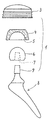
- the figure shows schematically a modular hip joint endoprosthesis from the material according to the invention in its individual parts.
- the hip joint endoprosthesis 1 consists of a two-part socket 2, which with their metallic socket housing 3 is anchored in the bone and one ceramic pan insert 4, in its hollow spherical bearing surface 5 the ball 6 can move.
- the ball 6 is also made of ceramic and has a conical bore 7.
- the shaft 8 made of a bionized metal, for example made of the cobalt alloy CoCrMo, has a pin 9, the Taper corresponds to the taper of the bore 7 in the ball 6.
- the cone 9 is anchored by a press fit in the bore 7 of the ball 6.
- the pan insert 4 consists of a Alumina ceramics in the known composition.
- the ball 6 has a diameter that is less than 28 mm.
- the invention Material composition enables a much smaller one Ball diameter than possible with a material made of pure aluminum oxide is. A ball made of the specified material can be safely used with a Put the pan insert made of aluminum oxide together to form a joint, without abrasive and corrosive damage.
Landscapes
- Chemical & Material Sciences (AREA)
- Health & Medical Sciences (AREA)
- Engineering & Computer Science (AREA)
- Ceramic Engineering (AREA)
- Animal Behavior & Ethology (AREA)
- Veterinary Medicine (AREA)
- Public Health (AREA)
- Oral & Maxillofacial Surgery (AREA)
- Transplantation (AREA)
- General Health & Medical Sciences (AREA)
- Life Sciences & Earth Sciences (AREA)
- Medicinal Chemistry (AREA)
- Epidemiology (AREA)
- Dermatology (AREA)
- Inorganic Chemistry (AREA)
- Orthopedic Medicine & Surgery (AREA)
- Composite Materials (AREA)
- Heart & Thoracic Surgery (AREA)
- Biomedical Technology (AREA)
- Vascular Medicine (AREA)
- Cardiology (AREA)
- Manufacturing & Machinery (AREA)
- Materials Engineering (AREA)
- Structural Engineering (AREA)
- Organic Chemistry (AREA)
- Materials For Medical Uses (AREA)
- Prostheses (AREA)
Description
Claims (10)
- Künstliches Gelenk einer Prothese, bei dem die Gelenkpartner aus keramischen Sinterwerkstoffen bestehen, dadurch gekennzeichnet, daß die Sinterwerkstoffe im wesentlichen Aluminiumoxid und Zirkonoxid sind und daß mindestens einer (6) der Gelenkpartner (4, 6) aus einem Sinterwerkstoff aus Zirkonoxid mit einem Zusatz von 0,1 bis 40 Gewichtsprozent Aluminiumoxid besteht.
- Künstliches Gelenk nach Anspruch 1, dadurch gekennzeichnet, daß der Sinterwerkstoff aus Zirkonoxid mit einem Zusatz von vorzugsweise 15 bis 25 Gewichtsprozent Aluminiumoxid besteht.
- Künstliches Gelenk nach Anspruch 1 oder 2, dadurch gekennzeichnet, daß bei einem Gelenkpartner (6) mit einem Werkstoff aus Zirkonoxid und Aluminiumoxid der Werkstoff einen bekannten Stabilisator für die Zirkonoxid-Phase in einem Anteil von unter 10 Gewichtsprozent aufweist.
- Künstliches Gelenk nach einem der Ansprüche 1 bis 3, dadurch gekennzeichnet, daß beide Gelenkpartner die selbe Werkstoffzusammensetzung aufweisen.
- Künstliches Gelenk nach einem der Ansprüche 1 bis 3, dadurch gekennzeichnet, daß der Werkstoff des einen Gelenkpartners einen höheren Zirkonoxidanteil aufweist als der Werkstoff des anderen Gelenkpartners.
- Künstliches Gelenk nach einem der Ansprüche 1 bis 3, dadurch gekennzeichnet, daß einem Gelenkpartner (6) aus Zirkonoxid mit einem Aluminiumoxid-Anteil von über 5 Gewichtsprozent ein Gelenkpartner (4) aus Aluminiumoxid zugeordnet ist.
- Künstliches Gelenk nach einem der Ansprüche 1 bis 6, dadurch gekennzeichnet, daß das Gelenk ein künstliches Hüftgelenk (1) ist.
- Künstliches Gelenk nach Anspruch 7, dadurch gekennzeichnet, daß der Werkstoff der Kugel (6) des Gelenks (1) einen höheren Zirkonoxid-Anteil aufweist als der Werkstoff des keramischen Pfanneneinsatzes (4).
- Künstliches Gelenk nach Anspruch 7, dadurch gekennzeichnet, daß ausschließlich der Werkstoff der Kugel (6) des Gelenks (1) einen Zirkonoxid-Anteil aufweist.
- Künstliches Gelenk nach Anspruch 8 oder 9, dadurch gekennzeichnet, daß der Durchmesser der Kugel (6) des Gelenks (1) kleiner als 28 mm ist.
Applications Claiming Priority (3)
| Application Number | Priority Date | Filing Date | Title |
|---|---|---|---|
| DE19752674A DE19752674B4 (de) | 1997-11-28 | 1997-11-28 | Künstliches Gelenk einer Prothese |
| DE19752674 | 1997-11-28 | ||
| PCT/EP1998/007709 WO1999027871A2 (de) | 1997-11-28 | 1998-11-30 | Künstliches gelenk einer prothese |
Publications (2)
| Publication Number | Publication Date |
|---|---|
| EP1035878A2 EP1035878A2 (de) | 2000-09-20 |
| EP1035878B1 true EP1035878B1 (de) | 2001-10-10 |
Family
ID=7850029
Family Applications (1)
| Application Number | Title | Priority Date | Filing Date |
|---|---|---|---|
| EP98964460A Revoked EP1035878B1 (de) | 1997-11-28 | 1998-11-30 | Künstliches gelenk einer prothese |
Country Status (8)
| Country | Link |
|---|---|
| US (1) | US6387132B1 (de) |
| EP (1) | EP1035878B1 (de) |
| JP (1) | JP4138242B2 (de) |
| AT (1) | ATE206624T1 (de) |
| DE (2) | DE19752674B4 (de) |
| DK (1) | DK1035878T3 (de) |
| ES (1) | ES2163904T3 (de) |
| WO (1) | WO1999027871A2 (de) |
Cited By (1)
| Publication number | Priority date | Publication date | Assignee | Title |
|---|---|---|---|---|
| DE10244439A1 (de) * | 2002-09-24 | 2004-03-25 | Mathys Orthopädie GmbH | Keramische Endoprothesenkomponenten und Verfahren zu ihrer Herstellung |
Families Citing this family (15)
| Publication number | Priority date | Publication date | Assignee | Title |
|---|---|---|---|---|
| WO2001049218A2 (en) * | 2000-01-03 | 2001-07-12 | Orthoscope Ltd. | Improved prosthesis |
| WO2001049193A1 (en) | 2000-01-03 | 2001-07-12 | Orthoscope Ltd. | Intramedullary support strut |
| CN1226053C (zh) * | 2000-08-07 | 2005-11-09 | 松下电工株式会社 | 用氧化锆-氧化铝复合陶瓷制成的人工关节 |
| US6726725B2 (en) | 2001-06-01 | 2004-04-27 | Smith & Nephew, Inc. | Prosthetic devices employing contacting oxidized zirconium surfaces |
| US6837235B2 (en) * | 2002-03-14 | 2005-01-04 | Ssw Holdings Company, Inc. | Porcelain oven rack |
| US20050261776A1 (en) * | 2004-05-19 | 2005-11-24 | Howmedica Osteonics Corp. | Prosthetic joint with annular contact bearing surface |
| US9078754B1 (en) * | 2005-04-29 | 2015-07-14 | Signal Medical Corporation | Harder-softer hard substance articulation for arthroplasty |
| US20070272231A1 (en) * | 2006-05-25 | 2007-11-29 | Ssw Holding Company, Inc. | Oven rack having an integral lubricious, dry porcelain surface |
| US8123815B2 (en) | 2008-11-24 | 2012-02-28 | Biomet Manufacturing Corp. | Multiple bearing acetabular prosthesis |
| US8308810B2 (en) | 2009-07-14 | 2012-11-13 | Biomet Manufacturing Corp. | Multiple bearing acetabular prosthesis |
| EP2382998A1 (de) | 2010-04-27 | 2011-11-02 | Sandvik Intellectual Property AB | Gelenkprothese |
| US9353010B2 (en) | 2013-03-14 | 2016-05-31 | Amedica Corporation | Alumina-zirconia ceramic implants and related materials, apparatus, and methods |
| US9353012B2 (en) | 2013-03-15 | 2016-05-31 | Amedica Corporation | Charge-compensating dopant stabilized alumina-zirconia ceramic materials and related materials, apparatus, and methods |
| US10501373B1 (en) | 2014-01-24 | 2019-12-10 | United States Of America As Represented By The Administrator Of National Aeronautics And Space Administration | Multi-phase ceramic system |
| DE102020213508A1 (de) | 2020-10-27 | 2022-04-28 | Karl Leibinger Medizintechnik Gmbh & Co. Kg | Implantierbare Kiefergelenksteilprothese, entsprechendes Herstellungsverfahren und Kiefergelenksprothese |
Family Cites Families (29)
| Publication number | Priority date | Publication date | Assignee | Title |
|---|---|---|---|---|
| JPS5223514B2 (de) | 1974-09-25 | 1977-06-24 | ||
| US4155124A (en) * | 1975-01-31 | 1979-05-22 | Kyoto Ceramic Co., Ltd. | Burnt ceramic bone implant |
| DE7808081U1 (de) * | 1978-03-17 | 1984-01-26 | M.A.N. Maschinenfabrik Augsburg-Nürnberg AG, 8000 München | Endoprothese für Gelenke des menschlichen Bewegungsapparates |
| FR2429009A1 (fr) * | 1978-06-21 | 1980-01-18 | Roux Christiane | Prothese pour articulation, en particulier coxo-femorale, artificielle |
| US4316964A (en) * | 1980-07-14 | 1982-02-23 | Rockwell International Corporation | Al2 O3 /ZrO2 ceramic |
| DE3345659A1 (de) * | 1983-06-16 | 1984-12-20 | Max-Planck-Gesellschaft zur Förderung der Wissenschaften e.V., 3400 Göttingen | Keramikkoerper aus zirkoniumdioxid (zro(pfeil abwaerts)2(pfeil abwaerts)) und verfahren zu seiner herstellung |
| DE3415803A1 (de) * | 1984-04-27 | 1985-10-31 | Max-Planck-Gesellschaft zur Förderung der Wissenschaften e.V., 3400 Göttingen | Hochfester und temperaturbestaendiger formkoerper aus zirkoniumdioxid (zro(pfeil abwaerts)2(pfeil abwaerts)) und verfahren zu seiner herstellung |
| JPS61201683A (ja) * | 1985-03-06 | 1986-09-06 | オリンパス光学工業株式会社 | 人工骨用複合材料 |
| FR2579199B1 (fr) * | 1985-03-22 | 1992-08-21 | Noritake Co Ltd | Ceramique a base de zircone |
| JPH0712365B2 (ja) * | 1985-04-04 | 1995-02-15 | オリンパス光学工業株式会社 | 人工歯根 |
| JPS63119749A (ja) * | 1985-11-27 | 1988-05-24 | 川原 春幸 | 多重毛管構造を有するインプラント部材 |
| DE3543802A1 (de) * | 1985-12-12 | 1987-06-19 | Bbc Brown Boveri & Cie | Hochtemperatur-schutzschicht und verfahren zu ihrer herstellung |
| US4840630A (en) * | 1986-06-05 | 1989-06-20 | Kyocera Corporation | Artificial hip joint |
| DE3841704A1 (de) * | 1988-12-10 | 1990-06-21 | Imz Fertigung Vertrieb | Implantierbares befestigungsmittel fuer extra-orale applikationen |
| JPH02296771A (ja) * | 1989-05-11 | 1990-12-07 | Isuzu Ceramics Kenkyusho:Kk | 複合セラミックスとその製造方法 |
| DE3928845A1 (de) * | 1989-08-31 | 1991-03-07 | Boehler Ag | Prothese |
| FR2656217B1 (fr) * | 1989-12-26 | 1997-04-25 | Kyocera Corp | Articulation artificielle de genou. |
| DE4024148A1 (de) * | 1990-07-30 | 1992-02-06 | Merck Patent Gmbh | Schrauben fuer gelenkoperationen |
| DE4029714A1 (de) * | 1990-09-19 | 1992-03-26 | Klaus Draenert | Implantationsmaterial und verfahren zu seiner herstellung |
| US5425773A (en) * | 1992-01-06 | 1995-06-20 | Danek Medical, Inc. | Intervertebral disk arthroplasty device |
| AU683050B2 (en) * | 1993-06-24 | 1997-10-30 | Dentsply Gmbh | Dental prosthesis |
| CH687740A5 (de) * | 1993-06-24 | 1997-02-14 | Metoxit Ag | Verfahren zur Herstellung von Prothesen. |
| US5549700A (en) * | 1993-09-07 | 1996-08-27 | Ortho Development Corporation | Segmented prosthetic articulation |
| GB2287654B (en) * | 1994-03-08 | 1998-09-02 | Asahi Optical Co Ltd | The use of a shaped composition to increase bone density for use in replacement surgery relating to artificial joints |
| DE4423794C1 (de) * | 1994-07-01 | 1996-02-08 | Ivoclar Ag | Zr0¶2¶-haltige Glaskeramik, Verfahren zu deren Herstellung sowie deren Verwendung |
| JPH09102666A (ja) * | 1995-07-31 | 1997-04-15 | Ngk Insulators Ltd | 膜形成方法 |
| US5871547A (en) * | 1996-03-01 | 1999-02-16 | Saint-Gobain/Norton Industrial Ceramics Corp. | Hip joint prosthesis having a zirconia head and a ceramic cup |
| DE19718615A1 (de) * | 1996-07-06 | 1998-01-08 | Cerasiv Gmbh | Verfahren zum Prüfen von keramischen Pfannen für Hüftgelenkendoprothesen |
| US6066176A (en) * | 1996-07-11 | 2000-05-23 | Oshida; Yoshiki | Orthopedic implant system |
-
1997
- 1997-11-28 DE DE19752674A patent/DE19752674B4/de not_active Expired - Fee Related
-
1998
- 1998-11-30 ES ES98964460T patent/ES2163904T3/es not_active Expired - Lifetime
- 1998-11-30 US US09/555,253 patent/US6387132B1/en not_active Expired - Lifetime
- 1998-11-30 WO PCT/EP1998/007709 patent/WO1999027871A2/de not_active Ceased
- 1998-11-30 JP JP2000522860A patent/JP4138242B2/ja not_active Expired - Fee Related
- 1998-11-30 DE DE59801720T patent/DE59801720D1/de not_active Revoked
- 1998-11-30 EP EP98964460A patent/EP1035878B1/de not_active Revoked
- 1998-11-30 AT AT98964460T patent/ATE206624T1/de not_active IP Right Cessation
- 1998-11-30 DK DK98964460T patent/DK1035878T3/da active
Cited By (1)
| Publication number | Priority date | Publication date | Assignee | Title |
|---|---|---|---|---|
| DE10244439A1 (de) * | 2002-09-24 | 2004-03-25 | Mathys Orthopädie GmbH | Keramische Endoprothesenkomponenten und Verfahren zu ihrer Herstellung |
Also Published As
| Publication number | Publication date |
|---|---|
| EP1035878A2 (de) | 2000-09-20 |
| JP4138242B2 (ja) | 2008-08-27 |
| WO1999027871A3 (de) | 1999-08-12 |
| JP2001524348A (ja) | 2001-12-04 |
| ATE206624T1 (de) | 2001-10-15 |
| ES2163904T3 (es) | 2002-02-01 |
| DE19752674A1 (de) | 1999-06-02 |
| DK1035878T3 (da) | 2002-02-11 |
| DE19752674B4 (de) | 2006-12-14 |
| US6387132B1 (en) | 2002-05-14 |
| WO1999027871A2 (de) | 1999-06-10 |
| DE59801720D1 (de) | 2001-11-15 |
Similar Documents
| Publication | Publication Date | Title |
|---|---|---|
| DE19752674B4 (de) | Künstliches Gelenk einer Prothese | |
| EP0495341B1 (de) | Implantat aus zwei Gleitpartnern | |
| DE2524923C2 (de) | Hueftgelenkprothese | |
| DE10304102A1 (de) | Hüftgelenkprothese | |
| DE2914737A1 (de) | Hueftkopfkappe fuer endoprothese | |
| EP1195150A1 (de) | Fingergrundgelenksimplantat | |
| DE2714387A1 (de) | Trisphaerische schultergelenkprothese | |
| DE2313678A1 (de) | Prothesenverbundwerkstoff und verfahren zu seiner herstellung | |
| DE3917285A1 (de) | Schulterprothese | |
| DE2732923A1 (de) | Gelenkendoprothesen aus nichtmetallischen materialien | |
| WO2000045749A1 (de) | Hüftgelenkpfanne mit kopplungselement zwischen pfannengehäuse und pfanneneinsatz | |
| EP3226811A1 (de) | Keramische platzhalter ("spacer") für den zweiseitigen wechsel von implantaten in schulter, knie und hüfte infolge von infektionen | |
| EP2049045A2 (de) | Asymmetrische gestaltung von pfannen und/oder pfanneneinsätzen zur manipulation und unterdrückung der eigenfrequenzen | |
| DE19915814A1 (de) | Gelenk-Endoprothese mit verschleißarmer Gleitpaarung | |
| DE102008047009B4 (de) | Gelenkpfanne mit physiologischer Lastübertragung | |
| EP3397211A1 (de) | Orthopädisches implantat | |
| DE19904126A1 (de) | Hüftendoprothese, in der mindestens die Artikulationsfläche des Femurkopfes ersetzt ist | |
| DE102005025686B4 (de) | Hüftgelenk-Endoprothese | |
| DE3033227A1 (de) | Federnde oberschenkelhalsprothese | |
| DE102011015300A1 (de) | Keramik-Einsatz für Knieendoprothesen | |
| DE19640747A1 (de) | Hüftgelenkendoprothese mit geteilter Metallschale | |
| DE7436033U (de) | Künstlicher Gelenkersatz | |
| EP2049047A1 (de) | Asymmetrische gestaltung von prothesenkomponenten zur manipulation und unterdrückung der eigenfrequenzen | |
| DE102005027427A1 (de) | Hüftgelenk-Endoprothese mit modularer Gelenkpfanne | |
| EP0938279A1 (de) | Prothese aus keramischen werkstoffen |
Legal Events
| Date | Code | Title | Description |
|---|---|---|---|
| PUAI | Public reference made under article 153(3) epc to a published international application that has entered the european phase |
Free format text: ORIGINAL CODE: 0009012 |
|
| 17P | Request for examination filed |
Effective date: 20000628 |
|
| AK | Designated contracting states |
Kind code of ref document: A2 Designated state(s): AT BE CH CY DE DK ES FI FR GB GR IE IT LI LU MC NL PT SE |
|
| GRAG | Despatch of communication of intention to grant |
Free format text: ORIGINAL CODE: EPIDOS AGRA |
|
| 17Q | First examination report despatched |
Effective date: 20001106 |
|
| GRAG | Despatch of communication of intention to grant |
Free format text: ORIGINAL CODE: EPIDOS AGRA |
|
| GRAH | Despatch of communication of intention to grant a patent |
Free format text: ORIGINAL CODE: EPIDOS IGRA |
|
| GRAH | Despatch of communication of intention to grant a patent |
Free format text: ORIGINAL CODE: EPIDOS IGRA |
|
| ITF | It: translation for a ep patent filed | ||
| GRAA | (expected) grant |
Free format text: ORIGINAL CODE: 0009210 |
|
| AK | Designated contracting states |
Kind code of ref document: B1 Designated state(s): AT BE CH CY DE DK ES FI FR GB GR IE IT LI LU MC NL PT SE |
|
| PG25 | Lapsed in a contracting state [announced via postgrant information from national office to epo] |
Ref country code: IE Free format text: LAPSE BECAUSE OF FAILURE TO SUBMIT A TRANSLATION OF THE DESCRIPTION OR TO PAY THE FEE WITHIN THE PRESCRIBED TIME-LIMIT Effective date: 20011010 Ref country code: FI Free format text: LAPSE BECAUSE OF FAILURE TO SUBMIT A TRANSLATION OF THE DESCRIPTION OR TO PAY THE FEE WITHIN THE PRESCRIBED TIME-LIMIT Effective date: 20011010 Ref country code: CY Free format text: LAPSE BECAUSE OF NON-PAYMENT OF DUE FEES Effective date: 20011010 |
|
| REF | Corresponds to: |
Ref document number: 206624 Country of ref document: AT Date of ref document: 20011015 Kind code of ref document: T |
|
| REG | Reference to a national code |
Ref country code: CH Ref legal event code: NV Representative=s name: ISLER & PEDRAZZINI AG Ref country code: CH Ref legal event code: EP |
|
| GBT | Gb: translation of ep patent filed (gb section 77(6)(a)/1977) |
Effective date: 20011011 |
|
| REG | Reference to a national code |
Ref country code: IE Ref legal event code: FG4D Free format text: GERMAN |
|
| REF | Corresponds to: |
Ref document number: 59801720 Country of ref document: DE Date of ref document: 20011115 |
|
| PG25 | Lapsed in a contracting state [announced via postgrant information from national office to epo] |
Ref country code: MC Free format text: LAPSE BECAUSE OF NON-PAYMENT OF DUE FEES Effective date: 20011130 Ref country code: LU Free format text: LAPSE BECAUSE OF NON-PAYMENT OF DUE FEES Effective date: 20011130 |
|
| REG | Reference to a national code |
Ref country code: GB Ref legal event code: IF02 |
|
| PG25 | Lapsed in a contracting state [announced via postgrant information from national office to epo] |
Ref country code: SE Free format text: LAPSE BECAUSE OF FAILURE TO SUBMIT A TRANSLATION OF THE DESCRIPTION OR TO PAY THE FEE WITHIN THE PRESCRIBED TIME-LIMIT Effective date: 20020110 Ref country code: PT Free format text: LAPSE BECAUSE OF FAILURE TO SUBMIT A TRANSLATION OF THE DESCRIPTION OR TO PAY THE FEE WITHIN THE PRESCRIBED TIME-LIMIT Effective date: 20020110 |
|
| PG25 | Lapsed in a contracting state [announced via postgrant information from national office to epo] |
Ref country code: GR Free format text: LAPSE BECAUSE OF FAILURE TO SUBMIT A TRANSLATION OF THE DESCRIPTION OR TO PAY THE FEE WITHIN THE PRESCRIBED TIME-LIMIT Effective date: 20020111 |
|
| REG | Reference to a national code |
Ref country code: ES Ref legal event code: FG2A Ref document number: 2163904 Country of ref document: ES Kind code of ref document: T3 |
|
| REG | Reference to a national code |
Ref country code: DK Ref legal event code: T3 |
|
| ET | Fr: translation filed | ||
| REG | Reference to a national code |
Ref country code: IE Ref legal event code: FD4D |
|
| PLBQ | Unpublished change to opponent data |
Free format text: ORIGINAL CODE: EPIDOS OPPO |
|
| PLBI | Opposition filed |
Free format text: ORIGINAL CODE: 0009260 |
|
| PLBQ | Unpublished change to opponent data |
Free format text: ORIGINAL CODE: EPIDOS OPPO |
|
| 26 | Opposition filed |
Opponent name: KERAMED MEDIZINTECHNIK GMBH Effective date: 20020710 Opponent name: METOXIT AG Effective date: 20020708 |
|
| PLBF | Reply of patent proprietor to notice(s) of opposition |
Free format text: ORIGINAL CODE: EPIDOS OBSO |
|
| NLR1 | Nl: opposition has been filed with the epo |
Opponent name: KERAMED MEDIZINTECHNIK GMBH Opponent name: METOXIT AG |
|
| PLBF | Reply of patent proprietor to notice(s) of opposition |
Free format text: ORIGINAL CODE: EPIDOS OBSO |
|
| PLAB | Opposition data, opponent's data or that of the opponent's representative modified |
Free format text: ORIGINAL CODE: 0009299OPPO |
|
| R26 | Opposition filed (corrected) |
Opponent name: MATHYS ORTHOPAEDIE GMBH Effective date: 20020710 Opponent name: METOXIT AG Effective date: 20020708 |
|
| NLR1 | Nl: opposition has been filed with the epo |
Opponent name: MATHYS ORTHOPAEDIE GMBH Opponent name: METOXIT AG |
|
| RDAF | Communication despatched that patent is revoked |
Free format text: ORIGINAL CODE: EPIDOSNREV1 |
|
| APBP | Date of receipt of notice of appeal recorded |
Free format text: ORIGINAL CODE: EPIDOSNNOA2O |
|
| APBQ | Date of receipt of statement of grounds of appeal recorded |
Free format text: ORIGINAL CODE: EPIDOSNNOA3O |
|
| APAA | Appeal reference recorded |
Free format text: ORIGINAL CODE: EPIDOS REFN |
|
| APAH | Appeal reference modified |
Free format text: ORIGINAL CODE: EPIDOSCREFNO |
|
| APAH | Appeal reference modified |
Free format text: ORIGINAL CODE: EPIDOSCREFNO |
|
| APAH | Appeal reference modified |
Free format text: ORIGINAL CODE: EPIDOSCREFNO |
|
| PGFP | Annual fee paid to national office [announced via postgrant information from national office to epo] |
Ref country code: DE Payment date: 20060201 Year of fee payment: 8 |
|
| PLAB | Opposition data, opponent's data or that of the opponent's representative modified |
Free format text: ORIGINAL CODE: 0009299OPPO |
|
| R26 | Opposition filed (corrected) |
Opponent name: MATHYS ORTHOPAEDIE GMBH Effective date: 20020710 Opponent name: METOXIT AG Effective date: 20020708 |
|
| NLR1 | Nl: opposition has been filed with the epo |
Opponent name: MATHYS ORTHOPAEDIE GMBH Opponent name: METOXIT AG |
|
| PGFP | Annual fee paid to national office [announced via postgrant information from national office to epo] |
Ref country code: NL Payment date: 20061110 Year of fee payment: 9 |
|
| PGFP | Annual fee paid to national office [announced via postgrant information from national office to epo] |
Ref country code: AT Payment date: 20061113 Year of fee payment: 9 |
|
| APBU | Appeal procedure closed |
Free format text: ORIGINAL CODE: EPIDOSNNOA9O |
|
| PGFP | Annual fee paid to national office [announced via postgrant information from national office to epo] |
Ref country code: DK Payment date: 20061114 Year of fee payment: 9 Ref country code: CH Payment date: 20061114 Year of fee payment: 9 |
|
| PGFP | Annual fee paid to national office [announced via postgrant information from national office to epo] |
Ref country code: FR Payment date: 20061124 Year of fee payment: 9 |
|
| PGFP | Annual fee paid to national office [announced via postgrant information from national office to epo] |
Ref country code: GB Payment date: 20061127 Year of fee payment: 9 |
|
| PGFP | Annual fee paid to national office [announced via postgrant information from national office to epo] |
Ref country code: ES Payment date: 20061129 Year of fee payment: 9 |
|
| PGFP | Annual fee paid to national office [announced via postgrant information from national office to epo] |
Ref country code: IT Payment date: 20061130 Year of fee payment: 9 |
|
| PGFP | Annual fee paid to national office [announced via postgrant information from national office to epo] |
Ref country code: BE Payment date: 20061214 Year of fee payment: 9 |
|
| RDAG | Patent revoked |
Free format text: ORIGINAL CODE: 0009271 |
|
| STAA | Information on the status of an ep patent application or granted ep patent |
Free format text: STATUS: PATENT REVOKED |
|
| REG | Reference to a national code |
Ref country code: CH Ref legal event code: PL |
|
| 27W | Patent revoked |
Effective date: 20061110 |
|
| GBPR | Gb: patent revoked under art. 102 of the ep convention designating the uk as contracting state |
Free format text: 20061110 |
|
| NLR2 | Nl: decision of opposition |
Effective date: 20061110 |