EP1028562A2 - Taktrückgewinnung in Mehrträgerverfahren - Google Patents
Taktrückgewinnung in Mehrträgerverfahren Download PDFInfo
- Publication number
- EP1028562A2 EP1028562A2 EP00200488A EP00200488A EP1028562A2 EP 1028562 A2 EP1028562 A2 EP 1028562A2 EP 00200488 A EP00200488 A EP 00200488A EP 00200488 A EP00200488 A EP 00200488A EP 1028562 A2 EP1028562 A2 EP 1028562A2
- Authority
- EP
- European Patent Office
- Prior art keywords
- circuit
- signal
- estimate
- timing
- receiver
- Prior art date
- Legal status (The legal status is an assumption and is not a legal conclusion. Google has not performed a legal analysis and makes no representation as to the accuracy of the status listed.)
- Granted
Links
- 238000011084 recovery Methods 0.000 title claims abstract description 13
- 238000000034 method Methods 0.000 claims abstract description 17
- 238000012935 Averaging Methods 0.000 claims abstract 4
- 238000004891 communication Methods 0.000 description 10
- 238000005070 sampling Methods 0.000 description 9
- 230000003111 delayed effect Effects 0.000 description 7
- 238000012546 transfer Methods 0.000 description 4
- 241000282994 Cervidae Species 0.000 description 3
- 238000012937 correction Methods 0.000 description 3
- 239000013598 vector Substances 0.000 description 3
- 230000003044 adaptive effect Effects 0.000 description 2
- 230000000694 effects Effects 0.000 description 2
- 230000004075 alteration Effects 0.000 description 1
- 239000000969 carrier Substances 0.000 description 1
- 239000013078 crystal Substances 0.000 description 1
- 238000011161 development Methods 0.000 description 1
- 238000010586 diagram Methods 0.000 description 1
- 238000000605 extraction Methods 0.000 description 1
- 238000009434 installation Methods 0.000 description 1
- 238000005259 measurement Methods 0.000 description 1
- 230000003595 spectral effect Effects 0.000 description 1
- 238000006467 substitution reaction Methods 0.000 description 1
- 230000001360 synchronised effect Effects 0.000 description 1
- 230000001052 transient effect Effects 0.000 description 1
Images
Classifications
-
- H—ELECTRICITY
- H04—ELECTRIC COMMUNICATION TECHNIQUE
- H04L—TRANSMISSION OF DIGITAL INFORMATION, e.g. TELEGRAPHIC COMMUNICATION
- H04L27/00—Modulated-carrier systems
- H04L27/26—Systems using multi-frequency codes
- H04L27/2601—Multicarrier modulation systems
- H04L27/2647—Arrangements specific to the receiver only
- H04L27/2655—Synchronisation arrangements
- H04L27/2662—Symbol synchronisation
-
- H—ELECTRICITY
- H04—ELECTRIC COMMUNICATION TECHNIQUE
- H04L—TRANSMISSION OF DIGITAL INFORMATION, e.g. TELEGRAPHIC COMMUNICATION
- H04L25/00—Baseband systems
- H04L25/02—Details ; arrangements for supplying electrical power along data transmission lines
- H04L25/0202—Channel estimation
- H04L25/024—Channel estimation channel estimation algorithms
- H04L25/025—Channel estimation channel estimation algorithms using least-mean-square [LMS] method
-
- H—ELECTRICITY
- H04—ELECTRIC COMMUNICATION TECHNIQUE
- H04L—TRANSMISSION OF DIGITAL INFORMATION, e.g. TELEGRAPHIC COMMUNICATION
- H04L27/00—Modulated-carrier systems
- H04L27/26—Systems using multi-frequency codes
- H04L27/2601—Multicarrier modulation systems
- H04L27/2647—Arrangements specific to the receiver only
- H04L27/2655—Synchronisation arrangements
- H04L27/2657—Carrier synchronisation
-
- H—ELECTRICITY
- H04—ELECTRIC COMMUNICATION TECHNIQUE
- H04L—TRANSMISSION OF DIGITAL INFORMATION, e.g. TELEGRAPHIC COMMUNICATION
- H04L27/00—Modulated-carrier systems
- H04L27/26—Systems using multi-frequency codes
- H04L27/2601—Multicarrier modulation systems
- H04L27/2647—Arrangements specific to the receiver only
- H04L27/2655—Synchronisation arrangements
- H04L27/2668—Details of algorithms
- H04L27/2673—Details of algorithms characterised by synchronisation parameters
- H04L27/2676—Blind, i.e. without using known symbols
- H04L27/2679—Decision-aided
-
- H—ELECTRICITY
- H04—ELECTRIC COMMUNICATION TECHNIQUE
- H04L—TRANSMISSION OF DIGITAL INFORMATION, e.g. TELEGRAPHIC COMMUNICATION
- H04L27/00—Modulated-carrier systems
- H04L27/26—Systems using multi-frequency codes
- H04L27/2601—Multicarrier modulation systems
- H04L27/2647—Arrangements specific to the receiver only
- H04L27/2655—Synchronisation arrangements
- H04L27/2689—Link with other circuits, i.e. special connections between synchronisation arrangements and other circuits for achieving synchronisation
- H04L27/2695—Link with other circuits, i.e. special connections between synchronisation arrangements and other circuits for achieving synchronisation with channel estimation, e.g. determination of delay spread, derivative or peak tracking
Definitions
- the present application relates generally to the technical field of digital communication systems and more particularly to a method and apparatus for riming recovery in multi-carrier modulation in such a digital communication system.
- Receivers in digital communication systems are usually operable to estimate and track the phase of a clock that generates a transmit signal, so that the receiver sampling is synchronous with the transmit signal. Better efficiency (in terms of channel bandwidth) is obtained when the receiver can extract this timing phase from the information-bearing signal.
- multi-carrier modulation See “A Multicarrier Primer", ANSI T1E1.4/91-157, John M. Cioffi, November, 1991, herein incorporated by reference and, hereinafter referred to as "Cioffi"
- the information is transferred over a number of subchannels, typically 64-1024.
- a specific subchannel called a pilot
- the pilot is reserved for this purpose only, however in others the pilot is also used to transfer information.
- VDSL Very High Rate Digital Subscriber Line
- UDP unshielded twisted pair
- ADSL Asymmetric Digital Subscriber Line
- AM radio AM radio
- multi-carrier modulation is a flexible and adaptable method for use in this environment because the modulation scheme adapts to the specific signal, noise and interference conditions present at the time the connection is made.
- the choice of pilot subchannel must be made carefully because if strong interference is encountered in this subchannel, further communication may be impossible.
- Timing recovery involves two parts. During the initialization process, the characteristics of the channel, noise and interference are not known, however the signals transmitted are arranged in advance. Using these prearranged signals, the receiver must learn the timing phase and frequency of the transmitter. This is known as acquisition.
- the receiver can use supplementary information to maintain phase lock - this is known as tracking.
- the method and apparatus disclosed by the present application extract timing phase from signals received over multiple subchannels using a technique that weighs them according to the signal quality at that frequency. Further, the method and apparatus may obviate the nomination of a pilot sub-channel and preferably require no negotiation process.
- An acquisition signal (1 symbol) is transmitted repeatedly.
- the exact signal need not be known at the receiver, although it is preferred that it is uniform p.s.d. over the signal band being used. The only requirement is that it is repeated.
- An estimate of frequency error is derived from the received signal. This estimate is used to adjust a Numerically Controlled Oscillator at the receiver, which in turn determines the sampling phase.
- timing phase is maintained by using the received signal, together with estimates of the transmitted signal to develop an estimate of the phase error. This information is used to adjust a Numerically Controlled Oscillator at the receiver, which in turn determines the sampling phase.
- sampling frequency error is ⁇ f
- the effect of sampling instant shift is predicted by the time-shift theorem of Fourier Theory (see "The Fourier Transform and its Applications,” R.N. Bracewell, 2 nd Ed., McGraw-Hill, 1965, herein incorporated by reference).
- Time shift ⁇ causes phase rotation in the frequency domain 2 ⁇ f.
- each of these estimates will have the same expected value, but their variances will vary widely due to the underlying channel attenuation variation with frequency. It seems reasonable to form a weighted sum of these estimates, in which the weights w n are proportional to the signal to noise ratio in the channel.
- the channel signal-to-noise ratio SNR
- the transmitted signal is computed with certain subcarriers not used (turned “OFF"), the energy detected at the receiver in those subcarriers represents noise and interference.
- the SNR may be estimated by computing the ratio between these unused subcarriers and neighboring frequencies.
- Timing recovery/frequency error estimation usually involves computation of the angle between two complex numbers (vectors).
- vectors In acquisition, we force the data symbol to be repeated, and we measure the angle between successive symbols and attribute that o sampling frequency offset.
- the problem in tracking mode is that the data symbol X k is unknown, and is different each symbol-time.
- SNR Signal to Noise Ratio
- a phase rotation between Y k (n) and U k (n) will be due to sampling phase error, or from errors in the estimates H ⁇ or X ⁇ k . If we assume that these estimation errors are insignificant - the channel estimate is good enough, and symbol decision errors are infrequent - then the expectation of the angle between Y k (n) and U k (n) will represent the phase error, and we can use an estimate of it to drive the tracking phase-lock loop.
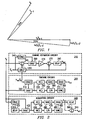
- FIG. 2 shows a preferred embodiment of a timing recovery system 200 in accordance with the present invention.
- the timing recovery system 200 in Fig. 2 includes a channel estimation circuitry 210, tracking circuitry 300, and acquisition circuitry 400.
- the channel estimation circuitry 210 accepts as input received symbol Y k and transmitted signal estimate X ⁇ k .
- Transmitted signal estimate X ⁇ k is input into conjugate circuit 240 and complex multiplier circuit 250.
- the output of the complex multiplier circuit 250 is summed with the received symbol Y k at summer 245 and input into complex multiplier circuit 260 along with the output of conjugate circuit 240.
- the output of the complex multiplier circuit 260 in then scaled by an adaptive update gain, ⁇ , at scaler circuit 270.
- the output of scaler circuit 270 is then summed at summer 280 with delayed channel estimate H est .
- the delayed channel estimate H est is the delayed output of summer 280.
- the delayed channel estimate H est is also input into complex multiplier circuit 250 and multiplied with the transmitted signal estimate X ⁇ k which, during a tracking phase of the timing recovery system 200, is input into conjugate circuit 310.
- the output of the conjugate circuit 310 is then input, along with the received symbol Y k , into complex multiplier circuit 300.
- the real portion of the output of the complex multiplier circuit 320 is then generated at circuit 330 and provided as input to summer 350.
- the imaginary portion of the output of the complex multiplier circuit 320 is generated at circuit 340 and then input into the divide-by-n circuit 360.
- the output of the divide-by-n circuit is input into summer 380.
- the outputs of summer 350 and summer 380 are then input into divide circuit 370.
- the output of divide circuit 370 is an estimated timing phase ⁇ t
- the received symbol Y k is input into conjugate circuit 410.
- the output of the conjugate circuit 410 input into delay circuit 420.
- the delayed output of delay circuit 420 in multiplied in complex multiplier circuit 430 with the received symbol Y k .
- the real portion of the output of the complex multiplier circuit 430 is generated by circuit 440 and provided as input to summer circuit 460.
- the imaginary portion of the output of the complex multiplier circuit 430 is generated by circuit 450 and then input into the divide-by-n circuit 470.
- the output of the divide-by-n circuit 470 is input into summer circuit 490.
- the outputs of summer circuits 480 and 490 are then input into divide circuit 480.
- the output of divide circuit 480 is an estimated error ⁇ a,k which is input into delay circuit 500 and summation 510.
- a delayed version of the estimated error signal ⁇ a,k is output from the delay circuit 500 and is also provided as input into summation 510.
- the sum of the error signal ⁇ a,k output from the divide circuit 480 and the delayed error signal output from the delay circuit 500 generates timing phase ⁇ a,k for use by the timing recovery system 200 during acquisition mode.
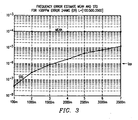
- Fig. 3 shows a graph illustrating frequency error estimate mean and standard deviation for one embodiment of a timing recovery system according to the present teachings.
Landscapes
- Engineering & Computer Science (AREA)
- Computer Networks & Wireless Communication (AREA)
- Signal Processing (AREA)
- Power Engineering (AREA)
- Synchronisation In Digital Transmission Systems (AREA)
- Color Television Systems (AREA)
Applications Claiming Priority (2)
| Application Number | Priority Date | Filing Date | Title |
|---|---|---|---|
| US11983299P | 1999-02-12 | 1999-02-12 | |
| US119832P | 1999-02-12 |
Publications (3)
| Publication Number | Publication Date |
|---|---|
| EP1028562A2 true EP1028562A2 (de) | 2000-08-16 |
| EP1028562A3 EP1028562A3 (de) | 2003-10-08 |
| EP1028562B1 EP1028562B1 (de) | 2008-07-02 |
Family
ID=22386655
Family Applications (1)
| Application Number | Title | Priority Date | Filing Date |
|---|---|---|---|
| EP00200488A Expired - Lifetime EP1028562B1 (de) | 1999-02-12 | 2000-02-14 | Taktrückgewinnung in Mehrträgerverfahren |
Country Status (3)
| Country | Link |
|---|---|
| EP (1) | EP1028562B1 (de) |
| DE (1) | DE60039320D1 (de) |
| TW (1) | TW490958B (de) |
Cited By (3)
| Publication number | Priority date | Publication date | Assignee | Title |
|---|---|---|---|---|
| WO2007114963A3 (en) * | 2006-01-03 | 2008-01-03 | Qualcomm Inc | Methods and apparatus for noise estimation in a communication system |
| EP2224657A1 (de) | 2009-02-27 | 2010-09-01 | Research In Motion Limited | Verfahren und System zur Optimierung der automatischen Trägerregulierung |
| US8090319B2 (en) | 2009-02-27 | 2012-01-03 | Research In Motion Limited | Method and system for automatic frequency control optimization |
Family Cites Families (1)
| Publication number | Priority date | Publication date | Assignee | Title |
|---|---|---|---|---|
| US5732113A (en) * | 1996-06-20 | 1998-03-24 | Stanford University | Timing and frequency synchronization of OFDM signals |
-
2000
- 2000-02-14 EP EP00200488A patent/EP1028562B1/de not_active Expired - Lifetime
- 2000-02-14 DE DE60039320T patent/DE60039320D1/de not_active Expired - Lifetime
- 2000-03-21 TW TW089102576A patent/TW490958B/zh not_active IP Right Cessation
Cited By (7)
| Publication number | Priority date | Publication date | Assignee | Title |
|---|---|---|---|---|
| WO2007114963A3 (en) * | 2006-01-03 | 2008-01-03 | Qualcomm Inc | Methods and apparatus for noise estimation in a communication system |
| US7724849B2 (en) | 2006-01-03 | 2010-05-25 | Qualcomm Incorporated | Methods and apparatus for noise estimation in a communication system |
| KR100993748B1 (ko) | 2006-01-03 | 2010-11-11 | 퀄컴 인코포레이티드 | 통신 시스템에서 잡음 추정을 위한 방법 및 장치 |
| RU2411679C2 (ru) * | 2006-01-03 | 2011-02-10 | Квэлкомм Инкорпорейтед | Способы и устройство для оценки шума в системе связи |
| EP2224657A1 (de) | 2009-02-27 | 2010-09-01 | Research In Motion Limited | Verfahren und System zur Optimierung der automatischen Trägerregulierung |
| US8090319B2 (en) | 2009-02-27 | 2012-01-03 | Research In Motion Limited | Method and system for automatic frequency control optimization |
| US8452237B2 (en) | 2009-02-27 | 2013-05-28 | Research In Motion Limited | Method and system for automatic frequency control optimization |
Also Published As
| Publication number | Publication date |
|---|---|
| EP1028562B1 (de) | 2008-07-02 |
| DE60039320D1 (de) | 2008-08-14 |
| TW490958B (en) | 2002-06-11 |
| EP1028562A3 (de) | 2003-10-08 |
Similar Documents
| Publication | Publication Date | Title |
|---|---|---|
| EP1072138B1 (de) | Verfahren und einrichtung zur feinen frequenzsynchronisierung in mehrträgerdemodulationssystemen | |
| US8300743B1 (en) | Method and apparatus for acquisition and tracking of orthogonal frequency division multiplexing symbol timing, carrier frequency offset and phase noise | |
| Schmidl et al. | Low-overhead, low-complexity [burst] synchronization for OFDM | |
| US7668252B2 (en) | Frequency offset tracking | |
| US7894325B2 (en) | Receiver architecture for pilot based OFDM systems | |
| US7139340B2 (en) | Robust OFDM carrier recovery methods and apparatus | |
| US7313203B2 (en) | Method and system for estimating and compensating IQ imbalance | |
| US6549583B2 (en) | Optimum phase error metric for OFDM pilot tone tracking in wireless LAN | |
| US7457366B2 (en) | System and method for adaptive phase compensation of OFDM signals | |
| EP1072135B1 (de) | Rahmenstruktur und -synchronisation für mehrträgersysteme | |
| US6584164B1 (en) | Method for forming a training sequence | |
| KR100263372B1 (ko) | 직교분할대역 시스템의 간략 주파수 획득 방법 및 그 장치 | |
| US7286614B2 (en) | Pilotless, wireless, telecommunications apparatus, systems and methods | |
| JPH11503583A (ja) | 信号を復号化する方法およびそのための電子回路 | |
| KR100341200B1 (ko) | 직교 주파수 분할 다중 신호 복조 장치 | |
| US8675744B1 (en) | Channel tracking in an orthogonal frequency-division multiplexing system | |
| EP1028562B1 (de) | Taktrückgewinnung in Mehrträgerverfahren | |
| US7302016B1 (en) | Phase estimator with bias correction | |
| US8223865B2 (en) | Method for the blind estimation of OFDM signal parameters by adapted filtering | |
| US8929487B1 (en) | Channel estimator for updating channel estimates and carrier frequency offsets | |
| Zhuravlev | Synchronization algorithm for a satellite communication signals demodulator in high carrier shift conditions | |
| Sands et al. | Pilotless timing recovery for baseband multicarrier modulation | |
| RU2803194C1 (ru) | Устройство приема и передачи сигналов фазовой манипуляции в командной радиолинии управления с использованием технологии OFDM, выполненное с возможностью работы в экономичном режиме | |
| Webber et al. | Performance of frequency recovery algorithms for a poly-polarization multiplexing satellite system | |
| JP2002335225A (ja) | Ofdm受信装置及び方法 |
Legal Events
| Date | Code | Title | Description |
|---|---|---|---|
| PUAI | Public reference made under article 153(3) epc to a published international application that has entered the european phase |
Free format text: ORIGINAL CODE: 0009012 |
|
| AK | Designated contracting states |
Kind code of ref document: A2 Designated state(s): AT BE CH CY DE DK ES FI FR GB GR IE IT LI LU MC NL PT SE |
|
| AX | Request for extension of the european patent |
Free format text: AL;LT;LV;MK;RO;SI |
|
| PUAL | Search report despatched |
Free format text: ORIGINAL CODE: 0009013 |
|
| AK | Designated contracting states |
Kind code of ref document: A3 Designated state(s): AT BE CH CY DE DK ES FI FR GB GR IE IT LI LU MC NL PT SE |
|
| AX | Request for extension of the european patent |
Extension state: AL LT LV MK RO SI |
|
| 17P | Request for examination filed |
Effective date: 20040408 |
|
| AKX | Designation fees paid |
Designated state(s): DE FR GB |
|
| 17Q | First examination report despatched |
Effective date: 20060207 |
|
| RTI1 | Title (correction) |
Free format text: METHOD OF TIMING RECOVERY IN MULTICARRIER SYSTEMS |
|
| GRAP | Despatch of communication of intention to grant a patent |
Free format text: ORIGINAL CODE: EPIDOSNIGR1 |
|
| GRAS | Grant fee paid |
Free format text: ORIGINAL CODE: EPIDOSNIGR3 |
|
| GRAA | (expected) grant |
Free format text: ORIGINAL CODE: 0009210 |
|
| AK | Designated contracting states |
Kind code of ref document: B1 Designated state(s): DE FR GB |
|
| REG | Reference to a national code |
Ref country code: GB Ref legal event code: FG4D |
|
| REF | Corresponds to: |
Ref document number: 60039320 Country of ref document: DE Date of ref document: 20080814 Kind code of ref document: P |
|
| PLBE | No opposition filed within time limit |
Free format text: ORIGINAL CODE: 0009261 |
|
| STAA | Information on the status of an ep patent application or granted ep patent |
Free format text: STATUS: NO OPPOSITION FILED WITHIN TIME LIMIT |
|
| 26N | No opposition filed |
Effective date: 20090403 |
|
| REG | Reference to a national code |
Ref country code: FR Ref legal event code: PLFP Year of fee payment: 16 |
|
| PGFP | Annual fee paid to national office [announced via postgrant information from national office to epo] |
Ref country code: DE Payment date: 20150227 Year of fee payment: 16 |
|
| PGFP | Annual fee paid to national office [announced via postgrant information from national office to epo] |
Ref country code: FR Payment date: 20150126 Year of fee payment: 16 |
|
| PGFP | Annual fee paid to national office [announced via postgrant information from national office to epo] |
Ref country code: GB Payment date: 20160127 Year of fee payment: 17 |
|
| REG | Reference to a national code |
Ref country code: DE Ref legal event code: R119 Ref document number: 60039320 Country of ref document: DE |
|
| REG | Reference to a national code |
Ref country code: FR Ref legal event code: ST Effective date: 20161028 |
|
| PG25 | Lapsed in a contracting state [announced via postgrant information from national office to epo] |
Ref country code: FR Free format text: LAPSE BECAUSE OF NON-PAYMENT OF DUE FEES Effective date: 20160229 Ref country code: DE Free format text: LAPSE BECAUSE OF NON-PAYMENT OF DUE FEES Effective date: 20160901 |
|
| GBPC | Gb: european patent ceased through non-payment of renewal fee |
Effective date: 20170214 |
|
| PG25 | Lapsed in a contracting state [announced via postgrant information from national office to epo] |
Ref country code: GB Free format text: LAPSE BECAUSE OF NON-PAYMENT OF DUE FEES Effective date: 20170214 |