EP1028513B1 - Polschenkelträger - Google Patents
Polschenkelträger Download PDFInfo
- Publication number
- EP1028513B1 EP1028513B1 EP20000102552 EP00102552A EP1028513B1 EP 1028513 B1 EP1028513 B1 EP 1028513B1 EP 20000102552 EP20000102552 EP 20000102552 EP 00102552 A EP00102552 A EP 00102552A EP 1028513 B1 EP1028513 B1 EP 1028513B1
- Authority
- EP
- European Patent Office
- Prior art keywords
- pole
- insulating body
- machine according
- stator
- previous
- Prior art date
- Legal status (The legal status is an assumption and is not a legal conclusion. Google has not performed a legal analysis and makes no representation as to the accuracy of the status listed.)
- Expired - Lifetime
Links
- 238000004804 winding Methods 0.000 claims description 46
- 238000004519 manufacturing process Methods 0.000 claims description 12
- 238000000034 method Methods 0.000 claims description 10
- 238000009413 insulation Methods 0.000 claims description 7
- 238000006073 displacement reaction Methods 0.000 claims description 5
- 239000004033 plastic Substances 0.000 claims description 4
- 230000008569 process Effects 0.000 claims description 4
- 238000002347 injection Methods 0.000 claims 2
- 239000007924 injection Substances 0.000 claims 2
- 239000002184 metal Substances 0.000 claims 1
- 210000002414 leg Anatomy 0.000 description 44
- 239000012212 insulator Substances 0.000 description 8
- 238000012856 packing Methods 0.000 description 4
- 230000008901 benefit Effects 0.000 description 3
- 230000004907 flux Effects 0.000 description 2
- 238000010438 heat treatment Methods 0.000 description 2
- 238000003780 insertion Methods 0.000 description 2
- 230000037431 insertion Effects 0.000 description 2
- 239000002991 molded plastic Substances 0.000 description 2
- 238000004080 punching Methods 0.000 description 2
- 238000005299 abrasion Methods 0.000 description 1
- 238000001816 cooling Methods 0.000 description 1
- 238000006056 electrooxidation reaction Methods 0.000 description 1
- 230000017525 heat dissipation Effects 0.000 description 1
- 238000009434 installation Methods 0.000 description 1
- 238000005304 joining Methods 0.000 description 1
- 235000015095 lager Nutrition 0.000 description 1
- 239000000463 material Substances 0.000 description 1
- 238000003825 pressing Methods 0.000 description 1
- 230000009467 reduction Effects 0.000 description 1
- 238000000926 separation method Methods 0.000 description 1
- 238000003860 storage Methods 0.000 description 1
- 210000000689 upper leg Anatomy 0.000 description 1
Images


Classifications
-
- H—ELECTRICITY
- H02—GENERATION; CONVERSION OR DISTRIBUTION OF ELECTRIC POWER
- H02K—DYNAMO-ELECTRIC MACHINES
- H02K5/00—Casings; Enclosures; Supports
- H02K5/04—Casings or enclosures characterised by the shape, form or construction thereof
- H02K5/16—Means for supporting bearings, e.g. insulating supports or means for fitting bearings in the bearing-shields
- H02K5/161—Means for supporting bearings, e.g. insulating supports or means for fitting bearings in the bearing-shields radially supporting the rotary shaft at both ends of the rotor
-
- H—ELECTRICITY
- H02—GENERATION; CONVERSION OR DISTRIBUTION OF ELECTRIC POWER
- H02K—DYNAMO-ELECTRIC MACHINES
- H02K1/00—Details of the magnetic circuit
- H02K1/06—Details of the magnetic circuit characterised by the shape, form or construction
- H02K1/12—Stationary parts of the magnetic circuit
- H02K1/14—Stator cores with salient poles
- H02K1/146—Stator cores with salient poles consisting of a generally annular yoke with salient poles
- H02K1/148—Sectional cores
-
- H—ELECTRICITY
- H02—GENERATION; CONVERSION OR DISTRIBUTION OF ELECTRIC POWER
- H02K—DYNAMO-ELECTRIC MACHINES
- H02K3/00—Details of windings
- H02K3/46—Fastening of windings on the stator or rotor structure
- H02K3/52—Fastening salient pole windings or connections thereto
- H02K3/521—Fastening salient pole windings or connections thereto applicable to stators only
- H02K3/524—Fastening salient pole windings or connections thereto applicable to stators only for U-shaped, E-shaped or similarly shaped cores
-
- H—ELECTRICITY
- H02—GENERATION; CONVERSION OR DISTRIBUTION OF ELECTRIC POWER
- H02K—DYNAMO-ELECTRIC MACHINES
- H02K5/00—Casings; Enclosures; Supports
- H02K5/04—Casings or enclosures characterised by the shape, form or construction thereof
- H02K5/12—Casings or enclosures characterised by the shape, form or construction thereof specially adapted for operating in liquid or gas
- H02K5/128—Casings or enclosures characterised by the shape, form or construction thereof specially adapted for operating in liquid or gas using air-gap sleeves or air-gap discs
Definitions
- the invention relates to an electric motor for operating a pump, having a stator which has pole legs surrounded by windings, and having a pole ring which surrounds the pole legs and to which the pole legs are releasably secured, wherein all pole legs (3) are arranged in a common insulating body (3). 1) are held, which remains after assembly of the pole legs (3) in the stator.
- the invention also relates to a method for producing the stator of such an electric motor.
- electric motors which have a pole ring with molded-on pole legs, wherein the pole ring can be divided into a number of pole legs corresponding number of segments. Since pole ring and pole legs form a unit, such stator packets consisting of pole ring and pole legs must be wound with so-called needle winders. In this case, needles are guided by a front side of the stator between the pole leg and thereby put the wire around a pole leg.
- This type of winding has the disadvantage that the turns of the wire within the winding have a large number of crossing points, which leads to a correspondingly reduced packing density and thus to increasing the winding length (mean coil length). At the same time, the correspondingly greater length of the winding wire increases the manufacturing costs of the motor, which is particularly significant in the case of small motors.
- the European patent application EP 0 910 152 A1 describes an electric motor having a stator core with stator windings supported by pole legs, the pole legs being surrounded by a pole ring in which they are releasably secured by dovetail connections.
- the pole legs are held in a common insulating body.
- such an electric motor is also from the U.S. Patent 4,818,911 known. It also discloses pole legs, which are held in a common insulating body, wherein the insulating body consists of two half-shells, which are joined together axially.
- known electric motors are not suitable for operating a pump, since no measures to separate the hydraulic part of the electrical part of the pump are taught.
- Object of the present invention is therefore to provide an electric motor for operating a pump, the stator pack can be easily and inexpensively machined with a small size and high efficiency. At the same time it is an object of the invention to provide a method for producing a stator of the motor according to the invention.
- the essence of the invention is that all pole legs are held by a common insulating body formed as Polschenkelraj, which remains after the assembly of the pole legs in the stator and thus in the electric machine, in particular the electric motor and at the same time forms a containment shell.
- This insulating body offers great advantages in the production of motors, as now the individual pole legs of coil winders, especially suitable for a layered winding suitable flyers, can now be wound before the package held by the insulating pole leg is used as a whole in the pole ring ,
- the winding by Flyerwickler is in contrast to the known needle winder particularly advantageous because the windings can be applied in layers and without intersections, so that a compact winding with low application arises.
- the insulating body according to the invention as a rotor completely surrounding and in particular injection-molded plastic sleeve is formed which has in its wall recesses for insertion or insertion of the individual pole legs.
- the pole legs are held in the correct position, wherein the base to be wound, the winding sections, the pole leg protrude radially from the outer surface of the shell.
- the storage in the sleeve-shaped insulating ensures on the one hand good access of the winding machine to the winding sections and on the other hand, the pole legs in the correct position for later installation.
- the introduction of the pole legs in the insulating body is particularly simple if this is composed of two axially joinable half shells. Then the pole legs can be inserted into one half-shell before the other half-shell is placed on the final support of the pole legs.
- brackets surrounding the pole legs are provided on the outside facing away from the rotor. These brackets are designed so that they surround the winding sections of the pole legs and form templates, on which the stator windings are wound up.
- the insulating body with the brackets is integrally molded from plastic.
- the insulating body has additional functions.
- receiving parts can be provided on one end side, into which insulation displacement contacts for contacting the stator windings can be inserted.
- the receiving parts can be molded or plugged.
- the plug contacts thus created ensure a fully automatic assembly of all components in the axial direction.
- the insulating body can have further components for optimizing the guidance and contacting of the coil ends.
- the insulating body may also include means for receiving a bearing for the shaft. In the form in which it forms a containment shell, a bearing plate can be provided on one end face and a receptacle for a sliding bearing on the other end face.
- the advantage of a smaller size of the motors results in lower manufacturing and material costs and higher efficiency because of the lower required wire length.
- the increased packing density also reduces the risk of generating noise in the winding.
- the large packing density reduces the amount of trapped air and thus the risk of electrochemical corrosion. This is accompanied by a higher insulation resistance and better heat dissipation.
- the pole ring and the pole legs are produced in the technique of so-called "punching packetizing".
- the punching makes it possible to produce poles of any cross-section in high precision.
- the accuracy of the sheets is transferred to the contour of the component.
- Particularly advantageous in the method is that now closed pole rings can be made with pole legs to be mounted separately.
- the closed pole rings have no magnetic flux obstructing gaps, so that vibrations are excluded.
- pole rings and pole legs can be produced in this way, which are equipped with very precise linear guides.
- the tolerances of the guides can be dimensioned so that the pole legs can be permanently pressed into the pole ring, wherein the air gap between the pole ring and the foot of a pole leg has a width of a few micrometers. This air gap is too small in relation to the air gap between the rotor and the stator to affect the magnetic flux to the pole ring.
- the stators according to the invention can be used in all electrical machines, it is particularly advantageous to provide the stator packages according to the invention in fan motors or in canned motors, which are used in particular in centrifugal pumps for heating or cooling systems.
- a dovetail guide is particularly advantageous because it provides a positive fit in the radial and circumferential direction and far they can be easily produced by the process of Stanzpierens with such tolerances so that the slide well on or press into the bed of the guide. It is this type of leadership relatively insensitive to manufacturing tolerances.
- the pole legs in the pole ring by means of an axially disposed linear guide, in particular a dovetail guide, inserted, it being particularly advantageous to form the linear guide so that the pole legs can be pressed as a package summarized in the insulator in the guide grooves. Since the pressing can be done completely by machine, a simple and cost-effective production is guaranteed.
- FIG. 1 is a molded plastic insulator 1 is shown.
- the insulating body is designed cylindrical in the form of a sleeve, not shown, surrounding the rotor of an electric machine sleeve and has in its wall recesses 2 for use in FIG. 3 shown pole leg 3 on.
- the insulating body 1 is constructed in two parts of two halves (half shells) 4 and 5, which are assembled in the axial direction at the joint 6.
- frame-shaped brackets 7 are formed, which surround the recesses 2.
- the brackets 7 are provided with collar 8, which cause an axial boundary of the stator windings, not shown, which are wound on the holder.
- the cross section of the holders 7, in particular the angle of the molded collar 8, is designed to support the stator windings in layered winding.
- the pole pieces 3, in particular produced in the stamping packetization process, are inserted into the receptacles 2 of the one half-shell 4 before the second half-shell 5 is put on.
- the two half-shells are held together with latching connections 9.
- the windings are not shown, but only the winding ends 11 are shown.
- two opposite of the six windings are combined to form a pair of windings. The winding of a pair is made such that first one of the windings is made before the Flyerkopf moves with entrainment of the wire on the front side of the insulator to the opposite bracket and there applies the second winding.
- Both windings are thus coupled by the connecting wire section 10 to the pair.
- the wire section 10 is guided on the front side of the insulating body 1 in guides 12 or around pin 13.
- the insulator after FIG. 1 has in its front side a bore 22 which is suitable for receiving a bearing.
- the remaining six wire ends 11 are inserted into receptacles 14, which are arranged on the end face of the insulating body and in which insulation displacement contacts 15 are used.
- the insulation displacement contacts 15 serve on the one hand for fixing the wire ends 11 and on the other hand for contacting to the outside.
- the in FIG. 2 insulating body 1 shown forms the complete containment shell of a split pot motor, for example, a heating pump, which produces a hydraulic separation between the stator and the rotor.
- the insulating body 1 at its one end face a molded bearing plate 16 and at its other end face a receptacle 17 for a sliding bearing.
- the insulating body 1 is in two parts.
- the one part 18 is from the containment shell with integrally formed end plate 16 and Receiving 17 formed
- the other part 19 is a ring which carries the remaining halves of the frame 7 and which is pushed onto the part 18.
- the ring holds the pole piece mounted on the first part. Both parts 18 and 19 are joined together at the joint 20.
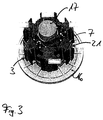
- FIG. 3 is the insulator after FIG. 2 shown with inserted pole legs 3. Clearly visible are the poles of the pole leg 3 opposite foot areas, which are provided with a dovetail 21. After the winding of the pole thighs 3, the in FIG. 3 shown package pressed into a pole ring, not shown, with corresponding guides.
- the process for producing a stator assembly for an electrical machine proceeds with the following steps. First, the pole pieces 3 are inserted into the recesses 2 of the insulating body 1, in particular a part of the insulating body 1. Then, the second part of the insulating body 1 is placed and the pole legs directly or the holders 7 wrapped with flyer coils. Finally, this package is pressed into the pole ring.
Landscapes
- Engineering & Computer Science (AREA)
- Power Engineering (AREA)
- Manufacture Of Motors, Generators (AREA)
- Insulation, Fastening Of Motor, Generator Windings (AREA)
- Iron Core Of Rotating Electric Machines (AREA)
- Motor Or Generator Frames (AREA)
Description
- Die Erfindung betrifft einen Elektromotor zum Betrieb einer Pumpe, mit einem Stator, der von Wicklungen umgebene Polschenkel aufweist, und mit einem Polring, der die Polschenkel umgibt und an dem die Polschenkel lösbar befestigt sind, wobei alle Polschenkel (3) in einem gemeinsamen Isolierkörper (1) gehalten sind, der nach der Montage der Polschenkel (3) im Statorpaket verbleibt. Die Erfindung betrifft gleichfalls ein Verfahren zur Herstellung des Statorpaketes eines derartigen Elektromotors.
- Generell sind Elektromotoren bekannt, die einen Polring mit angeformten Polschenkeln aufweisen, wobei der Polring in eine der Anzahl der Polschenkel entsprechende Zahl von Segmenten aufgeteilt sein kann. Da Polring und Polschenkel eine Einheit bilden, müssen derartige aus Polring und Polschenkeln bestehende Statorpakete mit sogenannten Nadelwicklern bewickelt werden. Dabei werden Nadeln von einer Stirnseite des Statorpaketes zwischen die Polschenkel geführt und dabei der Draht um einen Polschenkel gelegt. Diese Art des Wickelns hat den Nachteil, dass die Windungen des Drahtes innerhalb der Wicklung eine große Zahl von Kreuzungspunkten aufweisen, was zu einer entsprechend geminderten Packungsdichte und damit zur Vergrößerung der Wicklungslänge (mittlere Spulenlänge) führt. Gleichzeitig erhöht die entsprechend größere Länge des Wickeldrahtes die Herstellungskosten des Motors, was gerade bei kleinen Motoren besonders ins Gewicht fällt.
- Bei größeren Motoren ist es bekannt, die Polschenkel einzeln mit Spulenwicklern zu wickeln und sie im gewickelten Zustand im Inneren des Polringes zu verschrauben. Diese Methode ist aufwendig und teuer, da manuelle Fertigungsschritte notwendig sind. Polschenkel im Polring zu verschrauben ist bei der Fertigung von kleinen Motoren zwischen 100 und 1000 Watt, die in Serie massenweise hergestellt werden, nicht praktikabel.
- Die
europäische Patentanmeldung EP 0 910 152 A1 beschreibt einen Elektromotor mit einem Statorpaket mit Statorwicklungen, die von Polschenkeln getragen werden, wobei die Polschenkel von einem Polring umgeben sind, in welchem sie mittels Schwalbenschwanz-Verbindungen lösbar befestigt sind. Die Polschenkel sind in einem gemeinsamen Isolierkörper gehalten. Ferner ist ein derartiger Elektromotors auch aus derUS-Patentschrift 4,818,911 bekannt. Sie offenbart ebenfalls Polschenkel, die in einem gemeinsamen Isolierkörper gehalten sind, wobei der Isolierkörper aus zwei Halbschalen besteht, die axial zusammengefügt sind. Die aus den SchriftenEP 0 910 152 A1 undUS 4,818,911 bekannten Elektromotoren eignen sich jedoch nicht zum Betrieb einer Pumpe, da keine Maßnahmen zur Trennung des hydraulischen Teils von dem elektrischen Teil der Pumpe gelehrt werden. - Aufgabe der vorliegenden Erfindung ist es daher, einen Elektromotor zum Betrieb einer Pumpe zu schaffen, dessen Statorpaket sich bei geringer Baugröße und großem Wirkungsgrad einfach und kostengünstig maschinell fertigen lässt. Gleichzeitig ist es Aufgabe der Erfindung ein Verfahren zur Herstellung eines Statorpaketes des erfindungsgemäßen Motors zu schaffen.
- Diese Aufgabe wird durch eine elektrische Maschine nach Anspruch 1 und ein Verfahren nach Anspruch 13 gelöst.
- Der Kern der Erfindung ist, dass alle Polschenkel von einem gemeinsamen als Polschenkelträger ausgebildeten Isolierkörper gehalten werden, der nach der Montage der Polschenkel im Statorpaket und damit in der elektrischen Maschine insbesondere dem Elektromotor verbleibt und gleichzeitig einen Spalttopf bildet.
- Dieser Isolierkörper bietet insofern große Vorteile bei der Fertigung der Motoren, als nunmehr zunächst die einzelnen Polschenkel von Spulenwicklern, insbesondere von speziell für ein lagenweises Wickeln geeigneten Flyerwicklern, bewickelt werden können, bevor das Paket der vom Isolierkörper gehaltenen Polschenkel als Ganzes in den Polring eingesetzt wird. Die Bewickelung durch Flyerwickler ist im Gegensatz zu den bekannten Nadelwicklern besonders vorteilhaft, da sich die Wicklungen lagenweise und ohne Kreuzungen aufbringen lassen, so dass eine kompakte Wicklung mit geringer Auftragung entsteht. Außerdem ist es möglich mit großen Drahtquerschnitten zu wickeln, so dass die Wicklungen für hohe Ströme ausgelegt werden können.
- Vorteilhafterweise ist der erfindungsgemäße Isolierkörper als eine den Rotor vollständig umgebende und insbesondere aus Kunststoff gespritzte Hülse ausgebildet, die in ihrer Wandung Ausnehmungen zum Einstecken oder Einschieben der einzelnen Polschenkel aufweist. Durch die Hülse sind, die Polschenkel in der richtigen Lage gehalten, wobei die zu bewickelnden Sockel, die Wicklungsabschnitte, der Polschenkel radial von der Außenfläche des Mantels abstehen. Die Lagerung in dem hülsenförmigen Isolierkörper gewährleistet einerseits einen guten Zugang der Wickelmaschine zu den Wicklungsabschnitten und richtet andererseits die Polschenkel in der richtigen Lage für den späteren Einbau aus. Das Einbringen der Polschenkel in den Isolierkörper ist dabei besonders einfach, wenn dieser aus zwei axial zusammenfügbaren Halbschalen aufgebaut ist. Dann können die Polschenkel in die eine Halbschale eingesetzt werden, bevor die andere Halbschale zur endgültigen Halterung der Polschenkel aufgesetzt wird.
- In einer weiteren vorteilhaften Ausführungsform der Isolierkörper sind an dessen dem Rotor abgewandten Außenseite rahmenförmige die Polschenkel umgebende Halterungen vorgesehen. Diese Halterungen sind so konzipiert, dass sie die Wicklungsabschnitte der Polschenkel einfassen und Schablonen bilden, auf die die Statorwicklungen aufwickelbar sind. Vorteilhafterweise ist der Isolierkörper mit den Halterungen einteilig aus Kunststoff gespritzt. Damit ist einerseits die kostengünstige Herstellung der Isolierkörper gewährleistet, während andererseits die mit abgerundeten Ecken und Kanten versehenen Kunststoffbauteile den Wicklungsdrähten einen guten Schutz vor Abrieb der Isolierung bieten.
- In einer vorteilhaften Ausführungsform hat der Isolierkörper zusätzliche Funktionen. So können beispielsweise an einer Stirnseite Aufnahmeteile vorgesehen werden, in die Schneid-Klemm-Kontakte zur Kontaktierung der Statorwicklungen einsetzbar sind. Die Aufnahmeteile können dabei angespritzt oder aufsteckbar sein. Die so geschaffenen Steckkontakte gewährleisten eine vollständig automatische Montage aller Komponenten in axialer Richtung. Zudem kann der Isolierkörper weitere Komponenten zur Optimierung der Führung und Kontaktierung der Wicklungsenden aufweisen. Der Isolierkörper kann auch Mittel zur Aufnahme eines Lagers für die Welle aufweisen. In der Form, in der er einen Spalttopf bildet, kann an einer Stirnseite ein Lagerschild und an der anderen Stirnseite eine Aufnahme für ein Gleitlager vorgesehen sein.
- Aus der großen Packungsdichte ergibt sich der Vorteil einer kleineren Baugröße der Motoren bei geringeren Fertigungs- und Materialkosten und höherem Wirkungsgrad wegen der geringeren benötigten Drahtlänge. Die erhöhte Packungsdichte reduziert gleichfalls die Gefahr des Entstehens von Geräuschen in der Wicklung. Außerdem wird durch die große Packungsdichte die Menge der eingeschlossenen Luft und damit die Gefahr elektrochemischer Korrosion reduziert. Das geht einher mit einer höheren Isolationsfestigkeit und einer besseren Wärmeabfuhr.
- Ein weiterer sehr großer Vorteil ist, dass insbesondere bei Mehrphasensystemen wie Drehstrommaschinen jeweils Paare von gegenüberliegenden Wicklungen mit einem durchgehenden Draht gewickelt werden können, so dass auf eine Kontaktverbindung zwischen den beiden Wicklungen eines Paares verzichtet werden kann. Durch das endlose Bewickeln eines Spulenpaares werden die Hälfte aller Wicklungsenden vermieden, was zu einer beträchtlichen Vereinfachung in der Produktion und, mit der zusätzlichen Ersparnis der Kontaktelemente, zu einer Reduzierung der Kosten führt. Durch den Einsatz des von Außen an den Isolierkörper herangeführten Flyerwicklers ist jedoch jede beliebige andere Systematik der Bewicklung der radial vom Isolierkörper nach Außen ragenden Wicklungsabschnitte der Polschenkel möglich.
- In einer besonders vorteilhaften Ausführungsform werden der Polring und die Polschenkel in der Technik des sogenannten "Stanzpaketierens" hergestellt. Das Stanzen erlaubt es, Polschenkel beliebigen Querschnittes in hoher Präzision herzustellen. Nach dem Zusammenfügen der Bleche zu einem geblechten Bauteil überträgt sich die Genauigkeit der Bleche auf die Kontur des Bauteils. Besonders vorteilhaft an dem Verfahren ist, dass nunmehr geschlossene Polringe mit getrennt zu montierenden Polschenkeln gefertigt werden können. Die geschlossenen Polringe weisen keine den magnetischen Fluss behindernden Spalte auf, so dass Vibrationen ausgeschlossen sind.
- Im Falle der Statorpakete können auf diese Art Polringe und Polschenkel gefertigt werden, die mit sehr präzisen Linearführungen ausgestattet sind. Die Toleranzen der Führungen lassen sich dabei so dimensionieren, dass die Polschenkel in den Polring dauerhaft eingepresst werden können, wobei der Luftspalt zwischen dem Polring und dem Fuß eines Polschenkels eine Weite von wenigen Mikrometern aufweist. Dieser Luftspalt ist im Verhältnis zum Luftspalt zwischen dem Rotor und dem Stator zu klein, als dass er den magnetischen Fluss zum Polring beeinträchtigen könnte. Auch wenn die erfindungsgemäßen Statoren in allen elektrischen Maschinen einsetzbar sind, so ist es besonders vorteilhaft, die erfindungsgemäßen Statorpakete bei Lüftermotoren oder bei Spaltrohrmotoren vorzusehen, die insbesondere in Kreiselpumpen für Heiz- oder Kühlsysteme eingesetzt werden.
- Auch wenn Linearführungen beliebigen Querschnittes denkbar sind, so ist eine Schwalbenschwanzführung besonders vorteilhaft, weil sie einen formschlüssigen Halt in radialer und in Umfangsrichtung bietet und weit sie sich durch das Verfahren des Stanzpaketierens einfach mit solchen Toleranzen so herstellen lässt, dass sich das Schlittenteil gut auf oder in das Bett der Führung einpressen lässt. Dabei ist diese Art der Führung vergleichsweise unempfindlich gegenüber Fertigungstoleranzen.
- In einer vorteilhaften Ausführungsform sind die Polschenkel in den Polring mittels einer axial angeordneten Linearführung, insbesondere einer Schwalbenschwanzführung, einsteckbar, wobei es besonders vorteilhaft ist, die Linearführung so auszubilden, dass die Polschenkel als im Isolierkörper zusammengefasstes Paket in die Führungsnuten einpressbar sind. Da das Einpressen vollständig maschinell geschehen kann, ist eine einfache und kostengünstige Fertigung gewährleistet.
- Eine Ausführungsform eines erfindungsgemäßen Statorpaketes ist in den Zeichnungen 1 und 2 dargestellt und wird im folgenden näher beschrieben. Es zeigen
- Figur 1
- einen für die Aufnahme eines Lagers oder für das Aufsetzen auf einen Spalttopf geeigneten Isolierkörper, welcher nicht Gegenstand der Erfindung ist,
- Figur 2
- einen als Spalttopf ausgebildeten Isolierkörper und
- Figur 3
- einen Isolierkörper mit eingesetzten Polschenkeln.
- In
Figur 1 ist ein aus Kunststoff gespritzter Isolierkörper 1 gezeigt. Der Isolierkörper ist zylindrisch in Form einer den nicht gezeigten Rotor einer elektrischen Maschine umgebenden Hülse gestaltet und weist in seiner Wandung Ausnehmungen 2 für den Einsatz inFigur 3 dargestellter Polschenkel 3 auf. In diesem Ausführungsbeispiel ist der Isolierkörper 1 zweiteilig aus zwei Hälften (Halbschalen) 4 und 5 aufgebaut, die in axialer Richtung an der Stoßstelle 6 zusammengesetzt sind. Am Außenmantel des Isolierkörpers 1 sind rahmenförmige Halterungen 7 angeformt, welche die Ausnehmungen 2 umgeben. Die Halterungen 7 sind mit Kragen 8 versehen, die eine axiale Begrenzung der nicht dargestellten Statorwicklungen, die auf die Halterung aufgewickelt sind, bewirken. Der Querschnitt der Halterungen 7, insbesondere die Winkel der angeformten Kragen 8, ist so konzipiert, dass die Statorwicklungen bei lagenweiser Wicklung unterstützt werden. - In dieser Ausführungsform werden die insbesondere im Stanzpaketierverfahren hergestellten Polschenkel 3 in die Aufnahmen 2 der einen Halbschale 4 eingeschoben bevor die zweite Halbschale 5 aufgesetzt wird. Die beiden Halbschalen sind dabei mit Rastverbindungen 9 aneinander gehalten. Nach dem Einfassen der Polschenkel 3, deren Wicklungsabschnitte von den Halterungen 7 umgeben sind, werden diese von Flyerwicklern bewickelt. In den Figuren sind die Wicklungen nicht dargestellt, sondern lediglich die Wicklungsenden 11 gezeigt. In diesem Beispiel sind je zwei gegenüberliegende der sechs Wicklungen zu einem Wicklungspaar zusammengefasst. Die Bewicklung eines Paares wird dabei derart vorgenommen, dass zunächst eine der Wicklungen angefertigt wird, bevor der Flyerkopf unter Mitnahme des Drahtes über die Stirnseite des Isolierkörpers zur gegenüberliegenden Halterung wechselt und dort die zweite Wicklung aufbringt. Beide Wicklungen sind somit durch den verbindenden Drahtabschnitt 10 zu dem Paar gekoppelt. Der Drahtabschnitt 10 wird auf der Stirnseite des Isolierkörpers 1 in Führungen 12 oder um Zapfen 13 geführt. Der Isolierkörper nach
Figur 1 weist in seiner Stirnseite eine Bohrung 22 auf, die zur Aufnahme eines Lagers geeignet ist. - Die verbleibenden sechs Drahtenden 11 werden in Aufnahmen 14 eingebracht, die auf der Stirnseite des Isolierkörpers angeordnet sind und in denen Schneid-Klemm-Kontakte 15 eingesetzt sind. Die Schneid-Klemm-Kontakte 15 dienen einerseits zur Fixierung der Drahtenden 11 und andererseits zur Kontaktierung nach Außen.
- Der in
Figur 2 gezeigte Isolierkörper 1 bildet den kompletten Spalttopf eines Spalttopfmotors beispielsweise einer Heizungspumpe, der eine hydraulische Trennung zwischen dem Stator und dem Rotor herstellt. Neben den unterFigur 1 beschriebenen Komponenten weist der Isolierkörper 1 an seiner einen Stirnseite einen angeformten Lagerschild 16 und an seiner anderen Stirnseite eine Aufnahme 17 für ein Gleitlager auf. Auch in diesem Beispiel ist der Isolierkörper 1 zweiteilig. Der eine Teil 18 wird von dem Spalttopf mit angeformtem Lagerschild 16 und Aufnahme 17 gebildet, der andere Teil 19 ist ein Ring, der die verbleibenden Hälften der Rahmen 7 trägt und der auf das Teil 18 aufschiebbar ist. Dabei hält der Ring die am ersten Teil montierten Polschenkel. Beide Teile 18 und 19 sind an dem Stoß 20 zusammengefügt. - In
Figur 3 ist der Isolierkörper nachFigur 2 mit eingesetzten Polschenkeln 3 gezeigt. Deutlich zu erkennen sind die den Polen der Polschenkel 3 gegenüberliegenden Fußbereiche, die mit einem Schwalbenschwanz 21 versehen sind. Nach der Bewicklung der Polschenkel 3 wird das inFigur 3 gezeigte Paket in einen nicht dargestellten Polring mit entsprechenden Führungen eingepresst. - Das Verfahren zur Herstellung eines Statorpaketes für eine elektrische Maschine läuft dabei mit folgenden Schritten ab. Zunächst werden die Polschenkel 3 in die Ausnehmungen 2 des Isolierkörpers 1, insbesondere eines Teiles des Isolierkörpers 1 eingesetzt. Dann wird der zweite Teil des Isolierkörpers 1 aufgesetzt und die Polschenkel direkt oder die Halterungen 7 mit Flyerwicklungen umwickelt. Zuletzt wird dieses Paket in den Polring eingepresst.
Claims (15)
- Elektromotor zum Betrieb einer Pumpe, mit einem Statorpaket, das von Statorwicklungen umgebene Polschenkel (3) aufweist, wobei die Polschenkel (3) von einem Polring umgeben sind, an dem die Polschenkel (3) lösbar befestigt sind, wobei alle Polschenkel (3) in einem gemeinsamen Isolierkörper (1) gehalten sind, der nach der Montage der Polschenkel (3) im Statorpaket verbleibt dadurch gekennzeichnet, dass der Isolierkörper (1) einen Spalttopf zwischen dem Stator und dem Rotor bildet.
- Maschine nach Anspruch 1, dadurch gekennzeichnet, dass die Polschenkel (3) jeweils über eine axial angeordnete Linearführung (21), insbesondere über eine Schwalbenschwanzführung, mit dem Polring in axialer Richtung kraftschlüssig und in Umfangsrichtung formschlüssig verbindbar sind.
- Maschine nach Anspruch 1 oder 2, dadurch gekennzeichnet, dass der Isolierkörper (1) eine den Rotor vollständig umgebende, insbesondere aus Kunststoff gespritzte, Hülse aufweist.
- Maschine nach einem der vorherigen Ansprüche, dadurch gekennzeichnet, dass der Isolierkörper (1) Ausnehmungen (2) zur Aufnahme der Polschenkel (3) aufweist.
- Maschine nach einem der vorherigen Ansprüche, dadurch gekennzeichnet, dass der Isolierkörper (1) aus zwei axial zusammenfügbaren Halbschalen (4, 5) aufgebaut ist.
- Maschine nach einem der vorherigen Ansprüche, dadurch gekennzeichnet, dass der Isolierkörper (1) an seiner dem Rotor abgewandten Außenseite rahmenförmige, die Polschenkel umgebende Halterungen (7) aufweist, auf welche die Statorwicklungen aufwickelbar sind.
- Maschine nach Anspruch 6, dadurch gekennzeichnet, dass der Isolierkörper (1) und die Halterungen (7) einteilig aus Kunststoff gespritzt sind.
- Maschine nach einem der vorherigen Ansprüche, dadurch gekennzeichnet, dass der Isolierkörper (1) auf einer Stirnseite Aufnahmen (14) aufweist, in die Schneid-Klemm-Kontakte (15) zur Kontaktierung der Statorwicklungen einsetzbar sind.
- Maschine nach, einem der vorherigen Ansprüche, dadurch gekennzeichnet, dass der Isolierkörper (1) einen Lagerträger (22) für den Halt eines Lagers der Welle aufweist.
- Maschine nach einem der vorherigen Ansprüche, dadurch gekennzeichnet,-dass Statorwicklungen zu Wicklungspaaren zusammengefasst sind, wobei ein Wicklungspaar aus einem endlosen Draht gewickelt ist.
- Maschine nach einem der vorherigen Ansprüche, dadurch gekennzeichnet, dass die Statorwicklungen lagenweise gewickelt sind.
- Maschine nach einem der vorherigen Ansprüche, dadurch gekennzeichnet,dass die Polschenkel (3) und der Polring durch Aufeinanderlegen einzelner Bleche im Stanzpaketierverfahren hergestellt sind.
- Verfahren zur Herstellung eines Statorpaketes für einen Elektromotor nach den Ansprüchen 1 bis 12, dadurch gekennzeichnet,- dass die Polschenkel (3) in die Ausnehmungen (2) des Isolierkörpers (1) eingesetzt werden,- dass die Polschenkel (3) oder die Halterungen (7) mit Wicklungen, insbesondere von einem Flyerwickler, umwickelt werden und- dass der die Polschenkel (3) und die Wicklungen tragende Isolierkörper (1) in den Polring haltend eingesetzt wird, wobei der Isolierkörper (1) einen Spalttopf zwischen dem Stator und dem Rotor bildet.
- Verfahren nach Anspruch 13, dadurch gekennzeichnet, dass die Polschenkel (3) in die Linearführungen (21) des Polringes eingepresst werden.
- Verfahren nach Anspruch 13 oder 14, dadurch gekennzeichnet, dass die Enden der Wicklungen (11) zu den stirnseitig vorgesehenen Aufnahmen (14) geführt und mit einem Schneid-Klemm-Kontakt (15) versehen werden.
Applications Claiming Priority (2)
| Application Number | Priority Date | Filing Date | Title |
|---|---|---|---|
| DE19905948 | 1999-02-12 | ||
| DE1999105948 DE19905948A1 (de) | 1999-02-12 | 1999-02-12 | Polschenkelträger |
Publications (3)
| Publication Number | Publication Date |
|---|---|
| EP1028513A2 EP1028513A2 (de) | 2000-08-16 |
| EP1028513A3 EP1028513A3 (de) | 2000-12-20 |
| EP1028513B1 true EP1028513B1 (de) | 2008-05-28 |
Family
ID=7897340
Family Applications (1)
| Application Number | Title | Priority Date | Filing Date |
|---|---|---|---|
| EP20000102552 Expired - Lifetime EP1028513B1 (de) | 1999-02-12 | 2000-02-07 | Polschenkelträger |
Country Status (2)
| Country | Link |
|---|---|
| EP (1) | EP1028513B1 (de) |
| DE (2) | DE19905948A1 (de) |
Cited By (1)
| Publication number | Priority date | Publication date | Assignee | Title |
|---|---|---|---|---|
| DE202014005789U1 (de) | 2014-07-17 | 2015-10-23 | Brose Fahrzeugteile Gmbh & Co. Kommanditgesellschaft, Coburg | Stator eines Elektromotors sowie Kontaktsystem hierfür |
Families Citing this family (3)
| Publication number | Priority date | Publication date | Assignee | Title |
|---|---|---|---|---|
| DE10212425A1 (de) * | 2002-03-21 | 2003-10-02 | Bosch Gmbh Robert | Stator für eine elektrische Maschine |
| DE50303111D1 (de) * | 2003-07-12 | 2006-06-01 | Grundfos As | Segmentierter Stator |
| DE102008019608A1 (de) * | 2008-04-18 | 2009-10-22 | Continental Automotive Gmbh | Isolationsträger für einen Stator eines Elektromotors zum Antreiben von Flüssigkeitspumpen |
Family Cites Families (7)
| Publication number | Priority date | Publication date | Assignee | Title |
|---|---|---|---|---|
| DE3172692D1 (en) * | 1981-05-06 | 1985-11-28 | Amp Inc | Electric motor stator and a method of manufacturing the stator |
| GB2172444B (en) * | 1985-03-09 | 1988-08-17 | Asmo Co Ltd | Stator for an electric motor |
| DE3843477A1 (de) * | 1988-12-23 | 1990-06-28 | Oplaender Wilo Werk Gmbh | Spaltrohr-elektromotor |
| JPH0775270A (ja) * | 1993-09-03 | 1995-03-17 | Canon Electron Inc | 電磁回転機用の回転磁界発生ユニット |
| DE19740937A1 (de) * | 1997-09-17 | 1999-03-18 | Trw Fahrzeugelektrik | Stator und Verfahren zum Bewickeln eines Stators für einen bürstenlosen Gleichstrommotor |
| DE19740938A1 (de) * | 1997-09-17 | 1999-03-18 | Trw Fahrzeugelektrik | Stator für einen Elektromotor, insbesondere bürstenlosen Gleichstrommotor |
| IT1296730B1 (it) * | 1997-10-16 | 1999-07-15 | Bitron Spa | Statore per motori elettrici con rivestimento costampato elettricamente isolante. |
-
1999
- 1999-02-12 DE DE1999105948 patent/DE19905948A1/de not_active Withdrawn
-
2000
- 2000-02-07 EP EP20000102552 patent/EP1028513B1/de not_active Expired - Lifetime
- 2000-02-07 DE DE50015176T patent/DE50015176D1/de not_active Expired - Lifetime
Cited By (2)
| Publication number | Priority date | Publication date | Assignee | Title |
|---|---|---|---|---|
| DE202014005789U1 (de) | 2014-07-17 | 2015-10-23 | Brose Fahrzeugteile Gmbh & Co. Kommanditgesellschaft, Coburg | Stator eines Elektromotors sowie Kontaktsystem hierfür |
| WO2016008827A2 (de) | 2014-07-17 | 2016-01-21 | Brose Fahrzeugteile Gmbh & Co. Kommanditgesellschaft, Coburg | Stator eines elektromotors sowie kontaktsystem hierfür |
Also Published As
| Publication number | Publication date |
|---|---|
| DE19905948A1 (de) | 2000-08-17 |
| DE50015176D1 (de) | 2008-07-10 |
| EP1028513A2 (de) | 2000-08-16 |
| EP1028513A3 (de) | 2000-12-20 |
Similar Documents
| Publication | Publication Date | Title |
|---|---|---|
| DE112008002806B4 (de) | Drehende elektrische Maschine | |
| DE69504318T2 (de) | Elektrische maschinen und ihre komponenten die folienwellenlager enthalten | |
| DE19643561C1 (de) | Elektrische Maschine mit einer Einzelpolwicklung | |
| DE102004016655A1 (de) | Stator-Baugruppe mit einem Spulenträger-Einsatz für Schlitze im Kern | |
| DE10056555A1 (de) | Stator für dynamo-elektrische Maschinen | |
| WO2007137656A1 (de) | Verfahren zur herstellung eines stators und zugehöriger stator | |
| DE69014642T2 (de) | Läufer mit reduzierten ventilationsverlusten. | |
| DE102009010475A1 (de) | Wicklungsfixierungsbauteil und damit ausgerüstete rotierende elektrische Maschine | |
| WO2018192817A1 (de) | Polzahnmodul für eine elektrische maschine, aktivteil mit einem polzahnmodul und elektrische maschine | |
| EP3352341B1 (de) | Statorpaket und verfahren zum herstellen eines statorpakets | |
| DE19503610C2 (de) | Mehrphasige und vielpolige, elektrisch kommutierbare Maschine und Verfahren zur Herstellung des Ständers | |
| DE102007029739A1 (de) | Stator mit Isolierung für einen Elektromotor und Isolierung für einen Stator sowie Elektrowerkzeugmaschine | |
| DE112013001643T5 (de) | Elektrische rotierende Maschine | |
| EP3488516B1 (de) | Ständer einer drehfeldmaschine | |
| EP1024581B1 (de) | Kontaktierung von Motorwicklungen | |
| EP1041697B1 (de) | Reluktanzmaschine mit wenigstens zwei, je mit einer Erregerwicklung versehenen ausgeprägten Statorpolen und Verfahren zur Herstellung des Stators einer solchen Reluktanzmaschine | |
| EP1524751B1 (de) | Bürstenloser Elektromotor | |
| EP1028513A2 (de) | Polschenkelträger | |
| DE4436257A1 (de) | Dynamoelektrische Maschine mit Schenkelpolläufer | |
| EP2342799B1 (de) | Elektrische maschine mit einem kontaktelement zur elektrischen verbindung elektrischer bauteile | |
| DE102023203573A1 (de) | Elektrische Maschine, Stator für eine elektrische Maschine, sowie Verfahren zur Herstellung eines solchen | |
| DE69736028T2 (de) | Gerät und Verfahren zur Herstellung eines nutenlosen Stators | |
| DE8905353U1 (de) | Synchronmaschine | |
| DE102020117056A1 (de) | Bewickeltes teil für eine rotierende elektrische maschine, die für ein kraftfahrzeug bestimmt ist | |
| DE10245015A1 (de) | Elektromotor und Umwälzpumpe |
Legal Events
| Date | Code | Title | Description |
|---|---|---|---|
| PUAI | Public reference made under article 153(3) epc to a published international application that has entered the european phase |
Free format text: ORIGINAL CODE: 0009012 |
|
| AK | Designated contracting states |
Kind code of ref document: A2 Designated state(s): DE FR GB IT |
|
| AX | Request for extension of the european patent |
Free format text: AL;LT;LV;MK;RO;SI |
|
| PUAL | Search report despatched |
Free format text: ORIGINAL CODE: 0009013 |
|
| AK | Designated contracting states |
Kind code of ref document: A3 Designated state(s): AT BE CH CY DE DK ES FI FR GB GR IE IT LI LU MC NL PT SE |
|
| AX | Request for extension of the european patent |
Free format text: AL;LT;LV;MK;RO;SI |
|
| 17P | Request for examination filed |
Effective date: 20010620 |
|
| AKX | Designation fees paid |
Free format text: DE FR GB IT |
|
| RAP1 | Party data changed (applicant data changed or rights of an application transferred) |
Owner name: WILO AG |
|
| GRAP | Despatch of communication of intention to grant a patent |
Free format text: ORIGINAL CODE: EPIDOSNIGR1 |
|
| RIN1 | Information on inventor provided before grant (corrected) |
Inventor name: SCHRECKENBERG, STEPHAN Inventor name: GENSTER, ALBERT Inventor name: KECH, HANSJUERGEN Inventor name: LUETKENHAUS, NORBERT |
|
| GRAS | Grant fee paid |
Free format text: ORIGINAL CODE: EPIDOSNIGR3 |
|
| GRAA | (expected) grant |
Free format text: ORIGINAL CODE: 0009210 |
|
| AK | Designated contracting states |
Kind code of ref document: B1 Designated state(s): DE FR GB IT |
|
| REG | Reference to a national code |
Ref country code: GB Ref legal event code: FG4D Free format text: NOT ENGLISH |
|
| REF | Corresponds to: |
Ref document number: 50015176 Country of ref document: DE Date of ref document: 20080710 Kind code of ref document: P |
|
| PLBE | No opposition filed within time limit |
Free format text: ORIGINAL CODE: 0009261 |
|
| STAA | Information on the status of an ep patent application or granted ep patent |
Free format text: STATUS: NO OPPOSITION FILED WITHIN TIME LIMIT |
|
| 26N | No opposition filed |
Effective date: 20090303 |
|
| REG | Reference to a national code |
Ref country code: FR Ref legal event code: PLFP Year of fee payment: 16 |
|
| PGFP | Annual fee paid to national office [announced via postgrant information from national office to epo] |
Ref country code: DE Payment date: 20150203 Year of fee payment: 16 Ref country code: IT Payment date: 20150213 Year of fee payment: 16 |
|
| PGFP | Annual fee paid to national office [announced via postgrant information from national office to epo] |
Ref country code: FR Payment date: 20150210 Year of fee payment: 16 Ref country code: GB Payment date: 20150204 Year of fee payment: 16 |
|
| REG | Reference to a national code |
Ref country code: DE Ref legal event code: R119 Ref document number: 50015176 Country of ref document: DE |
|
| GBPC | Gb: european patent ceased through non-payment of renewal fee |
Effective date: 20160207 |
|
| REG | Reference to a national code |
Ref country code: FR Ref legal event code: ST Effective date: 20161028 |
|
| PG25 | Lapsed in a contracting state [announced via postgrant information from national office to epo] |
Ref country code: IT Free format text: LAPSE BECAUSE OF NON-PAYMENT OF DUE FEES Effective date: 20160207 |
|
| PG25 | Lapsed in a contracting state [announced via postgrant information from national office to epo] |
Ref country code: GB Free format text: LAPSE BECAUSE OF NON-PAYMENT OF DUE FEES Effective date: 20160207 Ref country code: FR Free format text: LAPSE BECAUSE OF NON-PAYMENT OF DUE FEES Effective date: 20160229 Ref country code: DE Free format text: LAPSE BECAUSE OF NON-PAYMENT OF DUE FEES Effective date: 20160901 |