EP1027339B1 - Verfahren und reagens fur n-alkylierte ureide - Google Patents
Verfahren und reagens fur n-alkylierte ureide Download PDFInfo
- Publication number
- EP1027339B1 EP1027339B1 EP98949706A EP98949706A EP1027339B1 EP 1027339 B1 EP1027339 B1 EP 1027339B1 EP 98949706 A EP98949706 A EP 98949706A EP 98949706 A EP98949706 A EP 98949706A EP 1027339 B1 EP1027339 B1 EP 1027339B1
- Authority
- EP
- European Patent Office
- Prior art keywords
- methoxymethyl
- process according
- ureide
- methanesulfonate
- acid
- Prior art date
- Legal status (The legal status is an assumption and is not a legal conclusion. Google has not performed a legal analysis and makes no representation as to the accuracy of the status listed.)
- Expired - Lifetime
Links
- 150000007945 N-acyl ureas Chemical class 0.000 title claims abstract description 43
- 238000000034 method Methods 0.000 title claims description 49
- 239000003153 chemical reaction reagent Substances 0.000 title description 12
- 229960002767 ethosuximide Drugs 0.000 claims abstract description 5
- 229960002972 glutethimide Drugs 0.000 claims abstract description 5
- -1 methoxylbenzylidene methanesulfonate Chemical compound 0.000 claims description 16
- LSNNMFCWUKXFEE-UHFFFAOYSA-M Bisulfite Chemical compound OS([O-])=O LSNNMFCWUKXFEE-UHFFFAOYSA-M 0.000 claims description 15
- IKVPZYAOGOJTLK-UHFFFAOYSA-N 5,5-diphenyl-1,3-diazinane-2,4,6-trione Chemical compound O=C1NC(=O)NC(=O)C1(C=1C=CC=CC=1)C1=CC=CC=C1 IKVPZYAOGOJTLK-UHFFFAOYSA-N 0.000 claims description 14
- 150000002148 esters Chemical class 0.000 claims description 14
- PBBMSAIQHFNRCR-UHFFFAOYSA-N methoxymethyl methanesulfonate Chemical compound COCOS(C)(=O)=O PBBMSAIQHFNRCR-UHFFFAOYSA-N 0.000 claims description 14
- 150000001412 amines Chemical class 0.000 claims description 13
- ZMXDDKWLCZADIW-UHFFFAOYSA-N N,N-Dimethylformamide Chemical compound CN(C)C=O ZMXDDKWLCZADIW-UHFFFAOYSA-N 0.000 claims description 12
- ZMANZCXQSJIPKH-UHFFFAOYSA-N Triethylamine Chemical compound CCN(CC)CC ZMANZCXQSJIPKH-UHFFFAOYSA-N 0.000 claims description 12
- 239000003054 catalyst Substances 0.000 claims description 12
- 229910000104 sodium hydride Inorganic materials 0.000 claims description 11
- JGFZNNIVVJXRND-UHFFFAOYSA-N N,N-Diisopropylethylamine (DIPEA) Chemical group CCN(C(C)C)C(C)C JGFZNNIVVJXRND-UHFFFAOYSA-N 0.000 claims description 10
- 239000002168 alkylating agent Substances 0.000 claims description 9
- 229940100198 alkylating agent Drugs 0.000 claims description 9
- KEAYESYHFKHZAL-UHFFFAOYSA-N Sodium Chemical compound [Na] KEAYESYHFKHZAL-UHFFFAOYSA-N 0.000 claims description 8
- 239000012312 sodium hydride Substances 0.000 claims description 8
- 238000011065 in-situ storage Methods 0.000 claims description 7
- UFBZRCZCQXFLFX-UHFFFAOYSA-N methoxymethyl 4-methylbenzenesulfonate Chemical compound COCOS(=O)(=O)C1=CC=C(C)C=C1 UFBZRCZCQXFLFX-UHFFFAOYSA-N 0.000 claims description 7
- QTBSBXVTEAMEQO-UHFFFAOYSA-N Acetic acid Chemical compound CC(O)=O QTBSBXVTEAMEQO-UHFFFAOYSA-N 0.000 claims description 6
- 150000001875 compounds Chemical class 0.000 claims description 6
- JMBQKKAJIKAWKF-UHFFFAOYSA-N Glutethimide Chemical compound C=1C=CC=CC=1C1(CC)CCC(=O)NC1=O JMBQKKAJIKAWKF-UHFFFAOYSA-N 0.000 claims description 5
- CXOFVDLJLONNDW-UHFFFAOYSA-N Phenytoin Chemical compound N1C(=O)NC(=O)C1(C=1C=CC=CC=1)C1=CC=CC=C1 CXOFVDLJLONNDW-UHFFFAOYSA-N 0.000 claims description 5
- HAPOVYFOVVWLRS-UHFFFAOYSA-N ethosuximide Chemical compound CCC1(C)CC(=O)NC1=O HAPOVYFOVVWLRS-UHFFFAOYSA-N 0.000 claims description 5
- XWTJVHNBWARMEZ-UHFFFAOYSA-N methoxymethyl benzenesulfonate Chemical compound COCOS(=O)(=O)C1=CC=CC=C1 XWTJVHNBWARMEZ-UHFFFAOYSA-N 0.000 claims description 5
- BBLBEOHNXVJDBT-UHFFFAOYSA-N methoxymethyl ethanesulfonate Chemical compound CCS(=O)(=O)OCOC BBLBEOHNXVJDBT-UHFFFAOYSA-N 0.000 claims description 5
- 239000002904 solvent Substances 0.000 claims description 5
- FTOAOBMCPZCFFF-UHFFFAOYSA-N 5,5-diethylbarbituric acid Chemical compound CCC1(CC)C(=O)NC(=O)NC1=O FTOAOBMCPZCFFF-UHFFFAOYSA-N 0.000 claims description 4
- IAZDPXIOMUYVGZ-UHFFFAOYSA-N Dimethylsulphoxide Chemical compound CS(C)=O IAZDPXIOMUYVGZ-UHFFFAOYSA-N 0.000 claims description 4
- 125000000217 alkyl group Chemical group 0.000 claims description 4
- 150000008064 anhydrides Chemical class 0.000 claims description 4
- 125000003118 aryl group Chemical group 0.000 claims description 4
- 229960002036 phenytoin Drugs 0.000 claims description 4
- 239000002253 acid Substances 0.000 claims description 3
- 239000001961 anticonvulsive agent Substances 0.000 claims description 3
- VSTNWGDUOQBJLG-UHFFFAOYSA-N ethoxymethyl methanesulfonate Chemical compound CCOCOS(C)(=O)=O VSTNWGDUOQBJLG-UHFFFAOYSA-N 0.000 claims description 3
- 150000004678 hydrides Chemical class 0.000 claims description 3
- 125000001997 phenyl group Chemical group [H]C1=C([H])C([H])=C(*)C([H])=C1[H] 0.000 claims description 3
- OJPOKZSVSFQJNC-UHFFFAOYSA-N phenylmethoxymethyl methanesulfonate Chemical compound CS(=O)(=O)OCOCC1=CC=CC=C1 OJPOKZSVSFQJNC-UHFFFAOYSA-N 0.000 claims description 3
- 150000003512 tertiary amines Chemical group 0.000 claims description 3
- QCUPYFTWJOZAOB-HWKANZROSA-N (e)-n-carbamoyl-2-ethylbut-2-enamide Chemical compound CC\C(=C/C)C(=O)NC(N)=O QCUPYFTWJOZAOB-HWKANZROSA-N 0.000 claims description 2
- FXHOOIRPVKKKFG-UHFFFAOYSA-N N,N-Dimethylacetamide Chemical compound CN(C)C(C)=O FXHOOIRPVKKKFG-UHFFFAOYSA-N 0.000 claims description 2
- SECXISVLQFMRJM-UHFFFAOYSA-N N-Methylpyrrolidone Chemical compound CN1CCCC1=O SECXISVLQFMRJM-UHFFFAOYSA-N 0.000 claims description 2
- SAZUGELZHZOXHB-UHFFFAOYSA-N acecarbromal Chemical compound CCC(Br)(CC)C(=O)NC(=O)NC(C)=O SAZUGELZHZOXHB-UHFFFAOYSA-N 0.000 claims description 2
- 229960001409 acecarbromal Drugs 0.000 claims description 2
- KSUUMAWCGDNLFK-UHFFFAOYSA-N apronal Chemical compound C=CCC(C(C)C)C(=O)NC(N)=O KSUUMAWCGDNLFK-UHFFFAOYSA-N 0.000 claims description 2
- 229960004459 apronal Drugs 0.000 claims description 2
- 125000003710 aryl alkyl group Chemical group 0.000 claims description 2
- 229940125717 barbiturate Drugs 0.000 claims description 2
- 150000007656 barbituric acids Chemical class 0.000 claims description 2
- HLSLSXBFTXUKCY-UHFFFAOYSA-N capuride Chemical compound CCC(C)C(CC)C(=O)NC(N)=O HLSLSXBFTXUKCY-UHFFFAOYSA-N 0.000 claims description 2
- 229950003152 capuride Drugs 0.000 claims description 2
- OPNPQXLQERQBBV-UHFFFAOYSA-N carbromal Chemical compound CCC(Br)(CC)C(=O)NC(N)=O OPNPQXLQERQBBV-UHFFFAOYSA-N 0.000 claims description 2
- 229960001658 carbromal Drugs 0.000 claims description 2
- 229950008272 ectylurea Drugs 0.000 claims description 2
- 150000001469 hydantoins Chemical class 0.000 claims description 2
- 230000000147 hypnotic effect Effects 0.000 claims description 2
- SIAPCJWMELPYOE-UHFFFAOYSA-N lithium hydride Chemical compound [LiH] SIAPCJWMELPYOE-UHFFFAOYSA-N 0.000 claims description 2
- 229910000103 lithium hydride Inorganic materials 0.000 claims description 2
- 150000001475 oxazolidinediones Chemical class 0.000 claims description 2
- DDBREPKUVSBGFI-UHFFFAOYSA-N phenobarbital Chemical compound C=1C=CC=CC=1C1(CC)C(=O)NC(=O)NC1=O DDBREPKUVSBGFI-UHFFFAOYSA-N 0.000 claims description 2
- KNCYXPMJDCCGSJ-UHFFFAOYSA-N piperidine-2,6-dione Chemical class O=C1CCCC(=O)N1 KNCYXPMJDCCGSJ-UHFFFAOYSA-N 0.000 claims description 2
- NTTOTNSKUYCDAV-UHFFFAOYSA-N potassium hydride Chemical compound [KH] NTTOTNSKUYCDAV-UHFFFAOYSA-N 0.000 claims description 2
- 229910000105 potassium hydride Inorganic materials 0.000 claims description 2
- 239000012429 reaction media Substances 0.000 claims description 2
- KZNICNPSHKQLFF-UHFFFAOYSA-N succinimide Chemical class O=C1CCC(=O)N1 KZNICNPSHKQLFF-UHFFFAOYSA-N 0.000 claims description 2
- HXJUTPCZVOIRIF-UHFFFAOYSA-N sulfolane Chemical compound O=S1(=O)CCCC1 HXJUTPCZVOIRIF-UHFFFAOYSA-N 0.000 claims description 2
- YFTHZRPMJXBUME-UHFFFAOYSA-N tripropylamine Chemical compound CCCN(CCC)CCC YFTHZRPMJXBUME-UHFFFAOYSA-N 0.000 claims description 2
- 230000001773 anti-convulsant effect Effects 0.000 claims 1
- 229960003965 antiepileptics Drugs 0.000 claims 1
- 239000004305 biphenyl Substances 0.000 claims 1
- 229940086542 triethylamine Drugs 0.000 claims 1
- SQCVEQVZGPHNTJ-UHFFFAOYSA-N 1-(methoxymethyl)-5,5-diphenyl-1,3-diazinane-2,4,6-trione Chemical compound O=C1N(COC)C(=O)NC(=O)C1(C=1C=CC=CC=1)C1=CC=CC=C1 SQCVEQVZGPHNTJ-UHFFFAOYSA-N 0.000 abstract description 3
- 230000001225 therapeutic effect Effects 0.000 abstract 1
- XEKOWRVHYACXOJ-UHFFFAOYSA-N Ethyl acetate Chemical compound CCOC(C)=O XEKOWRVHYACXOJ-UHFFFAOYSA-N 0.000 description 12
- YXFVVABEGXRONW-UHFFFAOYSA-N Toluene Chemical compound CC1=CC=CC=C1 YXFVVABEGXRONW-UHFFFAOYSA-N 0.000 description 12
- 238000006243 chemical reaction Methods 0.000 description 12
- RRFBTKHQZRCRSS-UHFFFAOYSA-N 1,3-bis(methoxymethyl)-5,5-diphenyl-1,3-diazinane-2,4,6-trione Chemical compound O=C1N(COC)C(=O)N(COC)C(=O)C1(C=1C=CC=CC=1)C1=CC=CC=C1 RRFBTKHQZRCRSS-UHFFFAOYSA-N 0.000 description 8
- 239000000047 product Substances 0.000 description 8
- 238000005804 alkylation reaction Methods 0.000 description 6
- 229910052757 nitrogen Inorganic materials 0.000 description 6
- 239000000758 substrate Substances 0.000 description 6
- 239000000010 aprotic solvent Substances 0.000 description 5
- 230000002152 alkylating effect Effects 0.000 description 4
- 230000029936 alkylation Effects 0.000 description 4
- 238000002425 crystallisation Methods 0.000 description 4
- 230000008025 crystallization Effects 0.000 description 4
- ZYKVCFGIFGTEPR-UHFFFAOYSA-M 2-oxopropane-1-sulfonate Chemical compound CC(=O)CS([O-])(=O)=O ZYKVCFGIFGTEPR-UHFFFAOYSA-M 0.000 description 3
- XJUZRXYOEPSWMB-UHFFFAOYSA-N Chloromethyl methyl ether Chemical compound COCCl XJUZRXYOEPSWMB-UHFFFAOYSA-N 0.000 description 3
- HEMHJVSKTPXQMS-UHFFFAOYSA-M Sodium hydroxide Chemical compound [OH-].[Na+] HEMHJVSKTPXQMS-UHFFFAOYSA-M 0.000 description 3
- HNYOPLTXPVRDBG-UHFFFAOYSA-N barbituric acid Chemical compound O=C1CC(=O)NC(=O)N1 HNYOPLTXPVRDBG-UHFFFAOYSA-N 0.000 description 3
- 229940061627 chloromethyl methyl ether Drugs 0.000 description 3
- NKDDWNXOKDWJAK-UHFFFAOYSA-N dimethoxymethane Chemical compound COCOC NKDDWNXOKDWJAK-UHFFFAOYSA-N 0.000 description 3
- 150000003949 imides Chemical class 0.000 description 3
- FWBPVYYVRQVKDO-UHFFFAOYSA-N 1,3-bis(ethoxymethyl)-5,5-diphenyl-1,3-diazinane-2,4,6-trione Chemical compound O=C1N(COCC)C(=O)N(COCC)C(=O)C1(C=1C=CC=CC=1)C1=CC=CC=C1 FWBPVYYVRQVKDO-UHFFFAOYSA-N 0.000 description 2
- IJGRMHOSHXDMSA-UHFFFAOYSA-N Atomic nitrogen Chemical compound N#N IJGRMHOSHXDMSA-UHFFFAOYSA-N 0.000 description 2
- 206010010904 Convulsion Diseases 0.000 description 2
- VYPSYNLAJGMNEJ-UHFFFAOYSA-N Silicium dioxide Chemical compound O=[Si]=O VYPSYNLAJGMNEJ-UHFFFAOYSA-N 0.000 description 2
- FAPWRFPIFSIZLT-UHFFFAOYSA-M Sodium chloride Chemical compound [Na+].[Cl-] FAPWRFPIFSIZLT-UHFFFAOYSA-M 0.000 description 2
- 150000001298 alcohols Chemical class 0.000 description 2
- BNZXJGMVVSASQT-UHFFFAOYSA-N benzenesulfonyl acetate Chemical compound CC(=O)OS(=O)(=O)C1=CC=CC=C1 BNZXJGMVVSASQT-UHFFFAOYSA-N 0.000 description 2
- 230000000711 cancerogenic effect Effects 0.000 description 2
- 239000003795 chemical substances by application Substances 0.000 description 2
- 238000007796 conventional method Methods 0.000 description 2
- 239000012043 crude product Substances 0.000 description 2
- 238000002955 isolation Methods 0.000 description 2
- 125000004184 methoxymethyl group Chemical group [H]C([H])([H])OC([H])([H])* 0.000 description 2
- 239000000203 mixture Substances 0.000 description 2
- 230000004048 modification Effects 0.000 description 2
- 238000012986 modification Methods 0.000 description 2
- 239000000376 reactant Substances 0.000 description 2
- 239000011541 reaction mixture Substances 0.000 description 2
- 150000003839 salts Chemical class 0.000 description 2
- 241000894007 species Species 0.000 description 2
- 239000012970 tertiary amine catalyst Substances 0.000 description 2
- XLYOFNOQVPJJNP-UHFFFAOYSA-N water Substances O XLYOFNOQVPJJNP-UHFFFAOYSA-N 0.000 description 2
- 208000019901 Anxiety disease Diseases 0.000 description 1
- WSNMPAVSZJSIMT-UHFFFAOYSA-N COc1c(C)c2COC(=O)c2c(O)c1CC(O)C1(C)CCC(=O)O1 Chemical compound COc1c(C)c2COC(=O)c2c(O)c1CC(O)C1(C)CCC(=O)O1 WSNMPAVSZJSIMT-UHFFFAOYSA-N 0.000 description 1
- 241000124008 Mammalia Species 0.000 description 1
- AFVFQIVMOAPDHO-UHFFFAOYSA-N Methanesulfonic acid Chemical class CS(O)(=O)=O AFVFQIVMOAPDHO-UHFFFAOYSA-N 0.000 description 1
- 206010052904 Musculoskeletal stiffness Diseases 0.000 description 1
- 238000007126 N-alkylation reaction Methods 0.000 description 1
- 238000005481 NMR spectroscopy Methods 0.000 description 1
- 206010029216 Nervousness Diseases 0.000 description 1
- PMZURENOXWZQFD-UHFFFAOYSA-L Sodium Sulfate Chemical compound [Na+].[Na+].[O-]S([O-])(=O)=O PMZURENOXWZQFD-UHFFFAOYSA-L 0.000 description 1
- 230000036506 anxiety Effects 0.000 description 1
- 230000015572 biosynthetic process Effects 0.000 description 1
- 239000006227 byproduct Substances 0.000 description 1
- 231100000357 carcinogen Toxicity 0.000 description 1
- 231100000315 carcinogenic Toxicity 0.000 description 1
- 239000003183 carcinogenic agent Substances 0.000 description 1
- 239000007795 chemical reaction product Substances 0.000 description 1
- WORJEOGGNQDSOE-UHFFFAOYSA-N chloroform;methanol Chemical compound OC.ClC(Cl)Cl WORJEOGGNQDSOE-UHFFFAOYSA-N 0.000 description 1
- 238000004587 chromatography analysis Methods 0.000 description 1
- 230000002860 competitive effect Effects 0.000 description 1
- 230000000295 complement effect Effects 0.000 description 1
- 230000036461 convulsion Effects 0.000 description 1
- 125000004122 cyclic group Chemical group 0.000 description 1
- 239000000539 dimer Substances 0.000 description 1
- 239000006185 dispersion Substances 0.000 description 1
- 238000004821 distillation Methods 0.000 description 1
- 239000003937 drug carrier Substances 0.000 description 1
- KLKFAASOGCDTDT-UHFFFAOYSA-N ethoxymethoxyethane Chemical compound CCOCOCC KLKFAASOGCDTDT-UHFFFAOYSA-N 0.000 description 1
- 238000004128 high performance liquid chromatography Methods 0.000 description 1
- 239000003326 hypnotic agent Substances 0.000 description 1
- 230000002452 interceptive effect Effects 0.000 description 1
- 238000004519 manufacturing process Methods 0.000 description 1
- 238000002844 melting Methods 0.000 description 1
- 230000008018 melting Effects 0.000 description 1
- WMUQLHIITDJQHZ-UHFFFAOYSA-M methoxymethanesulfonate Chemical compound COCS([O-])(=O)=O WMUQLHIITDJQHZ-UHFFFAOYSA-M 0.000 description 1
- 239000002480 mineral oil Substances 0.000 description 1
- 235000010446 mineral oil Nutrition 0.000 description 1
- 239000012044 organic layer Substances 0.000 description 1
- 239000002243 precursor Substances 0.000 description 1
- 150000003141 primary amines Chemical class 0.000 description 1
- 238000000746 purification Methods 0.000 description 1
- 238000010992 reflux Methods 0.000 description 1
- 230000001105 regulatory effect Effects 0.000 description 1
- 229920006395 saturated elastomer Polymers 0.000 description 1
- 150000003335 secondary amines Chemical class 0.000 description 1
- 238000007086 side reaction Methods 0.000 description 1
- 239000000377 silicon dioxide Substances 0.000 description 1
- 239000011780 sodium chloride Substances 0.000 description 1
- 239000000126 substance Substances 0.000 description 1
- 238000006467 substitution reaction Methods 0.000 description 1
- BDHFUVZGWQCTTF-UHFFFAOYSA-M sulfonate Chemical compound [O-]S(=O)=O BDHFUVZGWQCTTF-UHFFFAOYSA-M 0.000 description 1
- 150000003871 sulfonates Chemical class 0.000 description 1
- 230000002459 sustained effect Effects 0.000 description 1
- 238000003786 synthesis reaction Methods 0.000 description 1
- 231100000331 toxic Toxicity 0.000 description 1
- 230000002588 toxic effect Effects 0.000 description 1
Classifications
-
- C—CHEMISTRY; METALLURGY
- C07—ORGANIC CHEMISTRY
- C07D—HETEROCYCLIC COMPOUNDS
- C07D207/00—Heterocyclic compounds containing five-membered rings not condensed with other rings, with one nitrogen atom as the only ring hetero atom
- C07D207/02—Heterocyclic compounds containing five-membered rings not condensed with other rings, with one nitrogen atom as the only ring hetero atom with only hydrogen or carbon atoms directly attached to the ring nitrogen atom
- C07D207/30—Heterocyclic compounds containing five-membered rings not condensed with other rings, with one nitrogen atom as the only ring hetero atom with only hydrogen or carbon atoms directly attached to the ring nitrogen atom having two double bonds between ring members or between ring members and non-ring members
- C07D207/34—Heterocyclic compounds containing five-membered rings not condensed with other rings, with one nitrogen atom as the only ring hetero atom with only hydrogen or carbon atoms directly attached to the ring nitrogen atom having two double bonds between ring members or between ring members and non-ring members with hetero atoms or with carbon atoms having three bonds to hetero atoms with at the most one bond to halogen, e.g. ester or nitrile radicals, directly attached to ring carbon atoms
- C07D207/36—Oxygen or sulfur atoms
- C07D207/40—2,5-Pyrrolidine-diones
- C07D207/404—2,5-Pyrrolidine-diones with only hydrogen atoms or radicals containing only hydrogen and carbon atoms directly attached to other ring carbon atoms, e.g. succinimide
- C07D207/408—Radicals containing only hydrogen and carbon atoms attached to ring carbon atoms
-
- A—HUMAN NECESSITIES
- A61—MEDICAL OR VETERINARY SCIENCE; HYGIENE
- A61P—SPECIFIC THERAPEUTIC ACTIVITY OF CHEMICAL COMPOUNDS OR MEDICINAL PREPARATIONS
- A61P21/00—Drugs for disorders of the muscular or neuromuscular system
- A61P21/02—Muscle relaxants, e.g. for tetanus or cramps
-
- A—HUMAN NECESSITIES
- A61—MEDICAL OR VETERINARY SCIENCE; HYGIENE
- A61P—SPECIFIC THERAPEUTIC ACTIVITY OF CHEMICAL COMPOUNDS OR MEDICINAL PREPARATIONS
- A61P25/00—Drugs for disorders of the nervous system
-
- A—HUMAN NECESSITIES
- A61—MEDICAL OR VETERINARY SCIENCE; HYGIENE
- A61P—SPECIFIC THERAPEUTIC ACTIVITY OF CHEMICAL COMPOUNDS OR MEDICINAL PREPARATIONS
- A61P25/00—Drugs for disorders of the nervous system
- A61P25/08—Antiepileptics; Anticonvulsants
-
- A—HUMAN NECESSITIES
- A61—MEDICAL OR VETERINARY SCIENCE; HYGIENE
- A61P—SPECIFIC THERAPEUTIC ACTIVITY OF CHEMICAL COMPOUNDS OR MEDICINAL PREPARATIONS
- A61P25/00—Drugs for disorders of the nervous system
- A61P25/22—Anxiolytics
-
- C—CHEMISTRY; METALLURGY
- C07—ORGANIC CHEMISTRY
- C07D—HETEROCYCLIC COMPOUNDS
- C07D207/00—Heterocyclic compounds containing five-membered rings not condensed with other rings, with one nitrogen atom as the only ring hetero atom
- C07D207/02—Heterocyclic compounds containing five-membered rings not condensed with other rings, with one nitrogen atom as the only ring hetero atom with only hydrogen or carbon atoms directly attached to the ring nitrogen atom
- C07D207/30—Heterocyclic compounds containing five-membered rings not condensed with other rings, with one nitrogen atom as the only ring hetero atom with only hydrogen or carbon atoms directly attached to the ring nitrogen atom having two double bonds between ring members or between ring members and non-ring members
- C07D207/34—Heterocyclic compounds containing five-membered rings not condensed with other rings, with one nitrogen atom as the only ring hetero atom with only hydrogen or carbon atoms directly attached to the ring nitrogen atom having two double bonds between ring members or between ring members and non-ring members with hetero atoms or with carbon atoms having three bonds to hetero atoms with at the most one bond to halogen, e.g. ester or nitrile radicals, directly attached to ring carbon atoms
- C07D207/36—Oxygen or sulfur atoms
- C07D207/40—2,5-Pyrrolidine-diones
-
- C—CHEMISTRY; METALLURGY
- C07—ORGANIC CHEMISTRY
- C07D—HETEROCYCLIC COMPOUNDS
- C07D211/00—Heterocyclic compounds containing hydrogenated pyridine rings, not condensed with other rings
- C07D211/04—Heterocyclic compounds containing hydrogenated pyridine rings, not condensed with other rings with only hydrogen or carbon atoms directly attached to the ring nitrogen atom
- C07D211/80—Heterocyclic compounds containing hydrogenated pyridine rings, not condensed with other rings with only hydrogen or carbon atoms directly attached to the ring nitrogen atom having two double bonds between ring members or between ring members and non-ring members
- C07D211/84—Heterocyclic compounds containing hydrogenated pyridine rings, not condensed with other rings with only hydrogen or carbon atoms directly attached to the ring nitrogen atom having two double bonds between ring members or between ring members and non-ring members with hetero atoms or with carbon atoms having three bonds to hetero atoms, with at the most one bond to halogen directly attached to ring carbon atoms
- C07D211/86—Oxygen atoms
- C07D211/88—Oxygen atoms attached in positions 2 and 6, e.g. glutarimide
-
- C—CHEMISTRY; METALLURGY
- C07—ORGANIC CHEMISTRY
- C07D—HETEROCYCLIC COMPOUNDS
- C07D233/00—Heterocyclic compounds containing 1,3-diazole or hydrogenated 1,3-diazole rings, not condensed with other rings
- C07D233/54—Heterocyclic compounds containing 1,3-diazole or hydrogenated 1,3-diazole rings, not condensed with other rings having two double bonds between ring members or between ring members and non-ring members
- C07D233/66—Heterocyclic compounds containing 1,3-diazole or hydrogenated 1,3-diazole rings, not condensed with other rings having two double bonds between ring members or between ring members and non-ring members with hetero atoms or with carbon atoms having three bonds to hetero atoms with at the most one bond to halogen, e.g. ester or nitrile radicals, directly attached to ring carbon atoms
- C07D233/72—Two oxygen atoms, e.g. hydantoin
- C07D233/74—Two oxygen atoms, e.g. hydantoin with only hydrogen atoms or radicals containing only hydrogen and carbon atoms, attached to other ring members
-
- C—CHEMISTRY; METALLURGY
- C07—ORGANIC CHEMISTRY
- C07D—HETEROCYCLIC COMPOUNDS
- C07D239/00—Heterocyclic compounds containing 1,3-diazine or hydrogenated 1,3-diazine rings
- C07D239/02—Heterocyclic compounds containing 1,3-diazine or hydrogenated 1,3-diazine rings not condensed with other rings
- C07D239/24—Heterocyclic compounds containing 1,3-diazine or hydrogenated 1,3-diazine rings not condensed with other rings having three or more double bonds between ring members or between ring members and non-ring members
- C07D239/28—Heterocyclic compounds containing 1,3-diazine or hydrogenated 1,3-diazine rings not condensed with other rings having three or more double bonds between ring members or between ring members and non-ring members with hetero atoms or with carbon atoms having three bonds to hetero atoms with at the most one bond to halogen, directly attached to ring carbon atoms
- C07D239/46—Two or more oxygen, sulphur or nitrogen atoms
- C07D239/60—Three or more oxygen or sulfur atoms
- C07D239/62—Barbituric acids
-
- C—CHEMISTRY; METALLURGY
- C07—ORGANIC CHEMISTRY
- C07D—HETEROCYCLIC COMPOUNDS
- C07D263/00—Heterocyclic compounds containing 1,3-oxazole or hydrogenated 1,3-oxazole rings
- C07D263/02—Heterocyclic compounds containing 1,3-oxazole or hydrogenated 1,3-oxazole rings not condensed with other rings
- C07D263/30—Heterocyclic compounds containing 1,3-oxazole or hydrogenated 1,3-oxazole rings not condensed with other rings having two or three double bonds between ring members or between ring members and non-ring members
- C07D263/34—Heterocyclic compounds containing 1,3-oxazole or hydrogenated 1,3-oxazole rings not condensed with other rings having two or three double bonds between ring members or between ring members and non-ring members with hetero atoms or with carbon atoms having three bonds to hetero atoms with at the most one bond to halogen, e.g. ester or nitrile radicals, directly attached to ring carbon atoms
- C07D263/44—Two oxygen atoms
Definitions
- the invention relates to a new means for N-alkylating ureides that is higher yielding, more convenient, and safer to use than techniques practiced heretofore.
- This approach is particularly suited to preparing N-(alkoxyalkylene) ureides, which include anti-convulsant drugs of the N-substituted barbituric acid class.
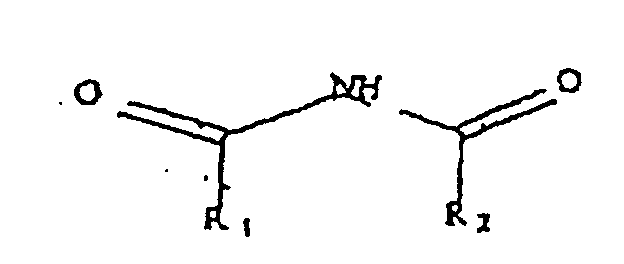
- Ureides are a class of imides of general structure I: Examples include hypnotics, such as acecarbromal, apronalide, bromisolvalum, capuride, carbromal, and ectylurea; and anticonvulsant drugs such as hydantoins, glutarimides, oxazolidinediones, succinimides, and barbiturates such as barbituric acid (structure II).
- hypnotics such as acecarbromal, apronalide, bromisolvalum, capuride, carbromal, and ectylurea
- anticonvulsant drugs such as hydantoins, glutarimides, oxazolidinediones, succinimides, and barbiturates such as barbituric acid (structure II).
- U.S. Patent 4,628,056 teaches a method of making 1,3 bis(methoxymethyl)-5,5-diphenyl barbituric acid (also called N,N'-bis(methoxymethyl)-5,5-diphenyl barbituric acid) by dissolving diphenyl barbituric acid in cooled dimethylformamide, adding sodium hydride, then adding chloromethyl methyl ether.
- Chloromethyl methyl ether has been widely used to alkylate with a methoxymethylene function. However, it is highly toxic and regulated as a carcinogen. It is extremely volatile and flammable under exothermic reaction conditions, and alternatives to its use are strongly desirable.
- the inventive method avoids the use of volatile, carcinogenic chloromethyl methyl ether, replacing that reagent with a more reactive, less volatile alternative which may be generated in situ (without risk to the operator).
- the invention solves a previously unrecognized problem limiting the applicability of methoxymethanesulfonate alkylation to alcohols and amines. Ureides are much less basic than amines, so a different method for oxyalkylation is required.
- This invention differs from the method of Karger et al. by using a ureide, a non-aqueous basic catalyst, and an aprotic solvent, modifications which were not previously known or suggested.
- the inventive method allows use of a variety of sulfonates to prepare a broad variety of oxyalkylated ureides, some not previously known. The simplicity and convenience of the invention provide advantages that were not previously appreciated.
- a method of N-alkoxyalkylating ureides according to the invention comprises reacting a ureide of structure I with an alkylating agent selected from an ester of a sulfonic acid chosen from methoxymethylmethanesulfonate, ethoxymethyl methanesulfonate, benzyloxymethyl methanesulfonate, methoxymethyl ethanesulfonate, methoxymethyl benzenesulfonate, methoxymethyl p-toluenesulfonate, methoxylbenzylidene methanesulfonate, and methoxyethylidene methanesulfonate, in the presence of a non-aqueous basic catalyst in a solution of a dipolar aprotic reaction medium.
- an alkylating agent selected from an ester of a sulfonic acid chosen from methoxymethylmethanesulfonate, ethoxymethyl methanesul
- the alkylating agent may be combined directly with the ureide, or the method may include reacting in situ a mixed anhydride of acetic acid and a sulfonic acid with a dialkoxymethane to provide the alkylating agent.
- the method preferably involves isolating the resultant N-alkoxyalkylated ureide.
- the ureide is a 5,5-disubstituted barbiturie acid, phenytoin, glutethimide, or ethosuximide.
- the alkylating agent may be methoxymethyl methanesulfonate, methoxymethyl beuzenesulfonate, or methoxymethyl p-toluenesulfonate.
- the base may be selected from sodium hydride, triéthyl amine, and di-isopropyl ethyl amine.
- the process includes the step of reacting a dialkoxymethane and a mixed acetic sulfonic anhydride to produce the resulting ester of the sulfonic acid, that reaction may be carried out in the same vessel as the following reaction with the ureide (done sequentially).
- a preferred process comprises N-alkylating 5,5-diphenyl-barbituric acid with a reagent selected from the group consisting of methoxymethyl methanesulfonate, methoxymethyl benezenesulfonate, and methoxymethyl p-toluenesulfonate, in the presence of di-isopropyl ethyl amine and isolating the resultant N,N'-bismethoxymethyl-5,5-diphenyl-barbituric acid.
- a reagent selected from the group consisting of methoxymethyl methanesulfonate, methoxymethyl benezenesulfonate, and methoxymethyl p-toluenesulfonate
- the reagent class which possesses the desirable N-alkylating properties are listed in Table 1:
- a particularly preferred reagent is methoxymethyl methanesulfonate.
- ureides which have been shown to be alkylated belong to the family of compounds having structure I: which may be linear (with R 1 and R 2 being alkyl, aryl, or arylalkyl), or cyclic (R 1 and R 2 bonded to form a ring). Examples of these ureides include those listed above and:
- the preferred family of reactant ureides is the barbituric acids disubstituted at 5, as in structure IV with the R groups preferably being the same or different alkyl or aryl groups, and most preferably with both R groups being phenyl.
- Analogous products resulting from the process of the invention, where 5,5-diphenylbarbituric acid is a substrate include:
- N-methoxymethyl derivative of 5,5-diphenylbarbituric acid (Formula IX) may be prepared by the process of this invention.
- the substrate 5,5-diphenylbarbituric acid is converted to its di-anion salt with a very strong base (as strong as a hydride, e.g. NaH) and then one equivalent is added of the alkoxyalkylating agent, reagent 1 of Table 1.
- a very strong base as strong as a hydride, e.g. NaH
- reagent 1 of Table 1 one equivalent is added of the alkoxyalkylating agent, reagent 1 of Table 1.
- N-methoxymethyl-5,5-diphenylbarbituric acid is obtained by optimizing the reaction to favor monosubstitution. For example, an excess of the very strong base NaH is used, greater than two molar equivalents per mole of the ureide.
- the monosubstituted product is separated by chromatography or other conventional methods and may be characterized by melting point and nuclear magnetic resonance.
- stoichiometric amounts of the components are used. That is, for monoalkylation, the ratio of ureide:alkylating agent:base is about 1:1.2; for di-substitution, the ratio is about 1:2:2, and so on. Different ratios may be appropriate depending on the reaction conditions. A person of ordinary skill will recognize that by varying these ratios, the reaction may proceed faster or slower and have higher or lower yield of end products. For example, as discussed above, monosubstitution of a ureide of the barbituric acid family is favored by using excess base.
- the base may be as strong as sodium hydride or as weak as a tertiary amine.
- the basic catalyst is preferably an amine that does not compete with the substrate ureide (or imide). To this end primary and secondary amine catalysts are excluded. Tertiary amines, which react more slowly with the alkylating species, are preferred to minimize the competing reaction through steric hindrance (branching in the amine substituents). Especially preferred for this attribute are highly hindered amines, such as the readily available amine, ethyl di-isopropyl amine.
- the hindrance inhibits quarternization of the catalyst amine by the alkylating agent in competition with the ureide substrate, while not interfering significantly with ability of the amine to act as a base (accept a proton).
- Useful bases include sodium hydride, potassium hydride, lithium hydride, triethylamine, tri-n-propylamine, and di-isopropyl ethyl amine.
- the solvent is chosen so as not to compete with the substrate and to maximize the rate of alkylation.
- dipolar aprotic solvents such as dimethyl formamide, dimethyl sulfoxide, dimethylacetamide, sulfolane, N-methylpyrrolidone, etc., appears to optimize these attributes. Otherwise, any dipolar aprotic solvent may be selected by the person of ordinary skill so long as the solvent is capable of bringing the reactants into solution.
- the preferred temperature range for the alkylation process is at or near ambient temperature (25 ⁇ 5°C). Higher temperatures tend to stimulate competitive side-reactions between the alkylating agent and the tertiary amine catalyst (where the latter is being used).
- Yields according to the invention are at least as high as with prior art methods.
- the high yields complement the other advantages of the inventive method including the facts that it is much safer, more convenient, and economical, and allows for ready synthesis of new compounds.
- a preferred embodiment of the inventive alkylation process (which employs the preferred substrate and preferred reagent illustrated above) affords the N,N' disubstituted barbituric acid depicted as structure V where the R groups are phenyl.
- the alkylation preferably takes place in a solvent which is usually a dipolar aprotic solvent like an N,N - dialkylamide.
- a solvent which is usually a dipolar aprotic solvent like an N,N - dialkylamide.
- aprotic solvents may also be employed, so long as they are compatible with the base.
- This alkylating technique is particularly novel and convenient in that the active alkylating species may also be generated in situ by employing precursor substances without isolation of the sulfonate reagent itself.
- Dimethoxymethane (10.85 g) was added at 0°C to 19.7 g of acetylmethanesulfonate. The reaction was stirred at 25°C for 2 hours. The resultant solution was then added gradually over 45 minutes to a mixture of 10 g of 5,5 - diphenylbarbituric acid and 13.85 g of N,N-diisopropyl ethyl amine in 60 ml of dry dimethylformamide. The resultant reaction mixture was stirred for about 15 minutes and then diluted with 180 ml of 2 N HCl, followed by 300 mi of ethyl acetate.
- Completion of the reaction may be checked using conventional methods such as by TLC on silica (mobile phase chloroform methanol 98:2).
- the reaction mixture is diluted with 360ml of water and extracted with 480ml of ethyl acetate.
- the organic layer is separated and washed twice with 150ml of water.
- the solvent is removed by distillation under reduced pressure in order to obtain crude product.
- the crude product may be purified by crystallization from 4 parts of toluene.
- the mixture is heated to reflux to disolve and cooled to room temperature. According to HPLC the product of the inventive method has 98-100% purity, and yields of about 60-80 % may be expected.
- the monosubstituted methoxymethyl derivative is obtained by optimizing the procedure of Example 1A to favor monosubstitution, using an excess of NaH and one equivalent of alkylating agent per equivalent of ureide.
- the monosubstituted product is separated and characterized.
- the compounds of examples 2-6 have advantageous pharmaceutical properties over a sustained period of time. They may be used to treat mammals including humans for convulsions, seizures, muscle stiffness, nervous strain or anxiety, by administering an effective amount of the compound in a pharmaceutically acceptable carrier to the patient.
Landscapes
- Chemical & Material Sciences (AREA)
- Organic Chemistry (AREA)
- Health & Medical Sciences (AREA)
- Public Health (AREA)
- Nuclear Medicine, Radiotherapy & Molecular Imaging (AREA)
- Veterinary Medicine (AREA)
- Neurology (AREA)
- Chemical Kinetics & Catalysis (AREA)
- General Chemical & Material Sciences (AREA)
- Medicinal Chemistry (AREA)
- Engineering & Computer Science (AREA)
- Bioinformatics & Cheminformatics (AREA)
- Pharmacology & Pharmacy (AREA)
- Life Sciences & Earth Sciences (AREA)
- Animal Behavior & Ethology (AREA)
- General Health & Medical Sciences (AREA)
- Biomedical Technology (AREA)
- Neurosurgery (AREA)
- Pain & Pain Management (AREA)
- Orthopedic Medicine & Surgery (AREA)
- Physical Education & Sports Medicine (AREA)
- Pharmaceuticals Containing Other Organic And Inorganic Compounds (AREA)
- Organic Low-Molecular-Weight Compounds And Preparation Thereof (AREA)
- Plural Heterocyclic Compounds (AREA)
- Heterocyclic Carbon Compounds Containing A Hetero Ring Having Nitrogen And Oxygen As The Only Ring Hetero Atoms (AREA)
- Nitrogen Condensed Heterocyclic Rings (AREA)
- Pyrrole Compounds (AREA)
- Catalysts (AREA)
- Hydrogenated Pyridines (AREA)
- Peptides Or Proteins (AREA)
- Agricultural Chemicals And Associated Chemicals (AREA)
- Fats And Perfumes (AREA)
- Saccharide Compounds (AREA)
- Medicines Containing Plant Substances (AREA)
Claims (21)
- Ein Verfahren zum N-Alkoxyalkylieren von Ureiden, das das Umsetzen eines Ureids der Formel Imit einem Alkylierungsmittel umfasst, das ausgewählt ist aus einem Ester einer Sulfonsäure, ausgewählt aus Methoxymethyl-methansulfonat, Ethoxymethyl-methansulfonat, Benzyloxymethyl-methansulfonat, Methoxymethyl-ethansulfonat, Methoxymethyl-benzensulfonat, Methoxymethyl-p-toluensulfonat, Methoxylbenzylidenmethansulfonat und Methoxyethyliden-methansulfonat, in der Gegenwart eines nicht wässrigen basischen Katalysators in Lösung eines dipolaren aprotischen Reaktionsmediums, um ein entsprechendes alkyliertes Ureid bereitzustellen, worin R1 und R2 Alkyl, Aryl oder Arylalkyl oder R1 und R2 zusammen, um einen Ring auszubilden, verbunden sind.
- Das Verfahren nach Anspruch 1, worin das Ureid der Formel I ein Hypnotikum ist, das aus der Gruppe von Acecarbromal, Apronalid, Bromisolvalum, Capurid, Carbromal und Ektylharnstoff ausgewählt ist.
- Das Verfahren nach Anspruch 1, worin das Ureid der Formel I ein Antikonvulsivum ist, das aus der Gruppe der Hydantoine, Glutarimide, Oxazolidindione, Succinimide und Barbiturate ausgewählt ist.
- Das Verfahren nach Anspruch 1, worin das Ureid der Formel I eine Verbindung der Formel IV istworin R6 und R7 gleich oder verschieden sind und Alkyl-, Aryl- oder Phenylgruppen sind.

- Das Verfahren nach Anspruch 1, worin das Ureid der Formel I eine 5,5-disubstituierte Barbitursäure ist.
- Das Verfahren nach Anspruch 1, worin das Ureid der Formel I 5,5-Diphenylbarbitursäure ist, der Ester einer Sulfonsäure aus der Gruppe ausgewählt ist, die aus Methoxymethyl-methansulfonat, Methoxymethyl-ethansulfonat, Methoxymethyl-benzensulfonat, Methoxymethyl-p-toluensulfonat besteht, die Base Diisopropylethylamin ist und das resultierende Ureid N,N'-Bismethoxymethyl-5,5-diphenylbarbitursäure ist.
- Das Verfahren nach Anspruch 1, worin das Ureid der Formel I aus der Gruppe ausgewählt ist, die aus 5,5-Diphenylbarbitursäure, Phenytoin, Glutethimid, Ethosuximid, 5-Phenyl-5-ethylbarbitursäure und 5,5-Diethylbarbitursäure besteht.
- Das Verfahren nach Anspruch 1, worin der Ester einer Sulfonsäure Methoxymethyl-methansulfonat ist.
- Das Verfahren nach Anspruch 1, worin der basische Katalysator ein tertiäres Amin ist.
- Das Verfahren nach Anspruch 1, worin der basische Katalysator aus der Gruppe ausgewählt ist, die aus Natriumhydrid, Kaliumhydrid, Lithiumhydrid, Triethylamin, Tri-n-propylamin und Diisopropyl-ethylamin besteht.
- Das Verfahren nach Anspruch 1, worin der Ester einer Sulfonsäure in situ erzeugt wird und direkt mit dem Ureid der Formel I, ohne Isolieren des Esters einer Sulfonsäure, kombiniert wird.
- Das Verfahren nach Anspruch 1, das weiter das Umsetzen eines gemischten Anhydrids der Essigsäure und einer Sulfonsäure mit einem Dialkoxymethan umfasst, um den Ester der Sulfonsäure in situ bereitzustellen und mit dem Ureid der Formel I, ohne Isolieren des Esters der Sulfonsäure, zu kombinieren.
- Das Verfahren nach Anspruch 1, worin das Ureid 5,5-disubstituierte Barbitursäure ist, die mit einer starken Base zu dessen Dianion umgewandelt wird und ein Äquivalent des Esters einer Sulfonsäure hinzugefügt wird, um die entsprechende monoalkylierte Barbitursäure bereitzustellen.
- Das Verfahren nach Anspruch 1, worin das dipolare Lösungsmittel aus der Gruppe ausgewählt ist, die aus Dimethylformamid, Dimethylsulfoxid, Dimethylacetamid, Sulfolan und N-Methylpyrrolidon besteht.
- Das Verfahren nach Anspruch 1, worin das Ureid der Formel I 5,5-Diphenylbarbitursäure ist, der Ester einer Sulfonsäure aus der Gruppe ausgewählt ist, die aus Methoxymethyl-methansulfonat, Ethoxymethyl-methansulfonat, Benzyloxymethyl-methansulfonat, Methoxymethyl-ethansulfonat, Methoxymethyl-benzensulfonat, Methoxymethyl-p-toluensulfonat, Methoxylbenzylidenmethansulfonat, Methoxyethyliden-methansulfonat besteht, die Base eine nicht wässrige Base ist, die aus einem Hydrid oder einem Amin ausgewählt ist und das Verfahren weiter das Isolieren der resultierenden alkoxyalkylierten 5,5-Diphenylbarbitursäure umfasst.
- Das Verfahren nach Anspruch 15, worin das Ureid der Formel I an eine N-monoalkoxyalkylierte 5,5-Diphenylbarbitursäure alkoxyalkyliert ist.
- Das Verfahren nach Anspruch 15, worin der Ester ein Methoxymethylester ist, die Base im Überschuss vorliegt und die isolierte Verbindung N-Methoxymethyl-5,5-diphenylbarbitursäure ist.
- Das Verfahren nach Anspruch 1, worin das Ureid der Formel I 5,5-Diphenylbarbitursäure ist, der Ester einer Sulfonsäure aus der Gruppe ausgewählt ist, die aus Methoxymethyl-methansulfonat, Methoxymethyl-ethansulfonat, Methoxymethyl-benzensulfonat und Methoxymethyl-p-toluensulfonat besteht, die Base eine nicht wässrige Base ist, die aus einem Hydrid oder einem Amin ausgewählt ist und das Verfahren weiter das Isolieren von N-Methoxymethyl-5,5-diphenylbarbitursäure umfasst.
- Das Verfahren nach Anspruch 18, worin die Base Natriumhydrid ist.
- Das Verfahren nach Anspruch 19, worin der Sulfonsäureester Methoxymethyl-methansulfonat ist.
- Das Verfahren nach Anspruch 20, worin das Methoxymethyl-methansulfonat in situ erzeugt wird und direkt mit dem Ureid der Formel I, ohne Isolieren des Methoxymethylmethansulfonates, kombiniert wird.
Priority Applications (2)
| Application Number | Priority Date | Filing Date | Title |
|---|---|---|---|
| EP03011817A EP1342718B1 (de) | 1997-10-02 | 1998-10-02 | N-Alkylierte Ureide |
| DK03011817T DK1342718T3 (da) | 1997-10-02 | 1998-10-02 | N-alkylerede ureider |
Applications Claiming Priority (3)
| Application Number | Priority Date | Filing Date | Title |
|---|---|---|---|
| US942636 | 1997-10-02 | ||
| US08/942,636 US6093820A (en) | 1997-10-02 | 1997-10-02 | Method and reagents for N-alkylating ureides |
| PCT/US1998/020665 WO1999018084A1 (en) | 1997-10-02 | 1998-10-02 | Method and reagents for n-alkylating ureides |
Related Child Applications (1)
| Application Number | Title | Priority Date | Filing Date |
|---|---|---|---|
| EP03011817A Division EP1342718B1 (de) | 1997-10-02 | 1998-10-02 | N-Alkylierte Ureide |
Publications (2)
| Publication Number | Publication Date |
|---|---|
| EP1027339A1 EP1027339A1 (de) | 2000-08-16 |
| EP1027339B1 true EP1027339B1 (de) | 2004-01-02 |
Family
ID=25478386
Family Applications (2)
| Application Number | Title | Priority Date | Filing Date |
|---|---|---|---|
| EP03011817A Expired - Lifetime EP1342718B1 (de) | 1997-10-02 | 1998-10-02 | N-Alkylierte Ureide |
| EP98949706A Expired - Lifetime EP1027339B1 (de) | 1997-10-02 | 1998-10-02 | Verfahren und reagens fur n-alkylierte ureide |
Family Applications Before (1)
| Application Number | Title | Priority Date | Filing Date |
|---|---|---|---|
| EP03011817A Expired - Lifetime EP1342718B1 (de) | 1997-10-02 | 1998-10-02 | N-Alkylierte Ureide |
Country Status (13)
| Country | Link |
|---|---|
| US (4) | US6093820A (de) |
| EP (2) | EP1342718B1 (de) |
| JP (2) | JP4061018B2 (de) |
| CN (2) | CN1193019C (de) |
| AT (2) | ATE299500T1 (de) |
| AU (1) | AU758506B2 (de) |
| CA (1) | CA2304970C (de) |
| DE (2) | DE69820895T2 (de) |
| DK (2) | DK1342718T3 (de) |
| ES (2) | ES2214736T3 (de) |
| IL (2) | IL135284A (de) |
| PT (2) | PT1342718E (de) |
| WO (1) | WO1999018084A1 (de) |
Families Citing this family (18)
| Publication number | Priority date | Publication date | Assignee | Title |
|---|---|---|---|---|
| US6093820A (en) * | 1997-10-02 | 2000-07-25 | Taro Pharmaceutical Industries Ltd. | Method and reagents for N-alkylating ureides |
| US6756379B2 (en) | 2001-07-26 | 2004-06-29 | Taro Pharmaceutical Industries Ltd. | Non-sedating barbiturate compounds as neuroprotective agents |
| US7683071B2 (en) * | 2000-07-26 | 2010-03-23 | Taro Pharmaceuticals Industries Ltd. | Composition and method for improved bioavailability and enhanced brain delivery of 5,5-diphenyl barbituric acid |
| US6939873B2 (en) * | 2000-07-26 | 2005-09-06 | Taro Pharmaceuticals Industries Limited | Non-sedating barbituric acid derivatives |
| CN1291720C (zh) * | 2002-01-30 | 2006-12-27 | 塔罗制药工业有限公司 | 非镇静性巴比土酸衍生物 |
| TWI329105B (en) | 2002-02-01 | 2010-08-21 | Rigel Pharmaceuticals Inc | 2,4-pyrimidinediamine compounds and their uses |
| AR042444A1 (es) | 2002-12-11 | 2005-06-22 | Taro Pharmaceuticals Ireland L | Metodo para el tratamiento de desordenes del movimiento mediante la utilizacion de acido barbiturico |
| HRP20130602T1 (en) * | 2003-07-30 | 2013-07-31 | Rigel Pharmaceuticals, Inc. | 2,4-pyrimidinediamine compounds for use in the treatment or prevention of autoimmune diseases |
| CA2572797A1 (en) | 2004-07-02 | 2006-01-12 | Daniella Gutman | A process for preparing 1-methoxymethyl-5,5-diphenylbarbituric acid |
| EP1625848A1 (de) * | 2004-08-10 | 2006-02-15 | Taro Pharmaceuticals North America, Inc. | Zusammensetzung und Verfahren zur verbesserten Abgabe von 5,5-Diphenylbarbitursäure |
| DE602006010979D1 (de) | 2005-01-19 | 2010-01-21 | Rigel Pharmaceuticals Inc | Prodrugs aus 2,4-pyrimidindiamin-verbindungen und ihre verwendungen |
| CA2630368A1 (en) * | 2005-11-21 | 2007-05-24 | Mordechai Sharir | Succinimide derivatives as ocular hypotensive agents |
| US8853257B2 (en) | 2005-11-21 | 2014-10-07 | Mordechai Sharir | Succinimide derivatives as ocular hypotensive agents |
| WO2008066704A2 (en) * | 2006-11-14 | 2008-06-05 | Taro Pharmaceuticals North America, Inc. | Method of improving bioavailability for non-sedating barbiturates |
| MX2013004696A (es) | 2010-10-27 | 2013-06-12 | Gillette Co | Dispositivo dosificador de composiciones que comprende una composicion hidratante no espumante. |
| US20120278179A1 (en) | 2011-04-28 | 2012-11-01 | Ray Campbell | Systems and methods for deducing user information from input device behavior |
| BR112014003344A2 (pt) | 2011-08-16 | 2017-01-17 | Gillette Co | dispositivo dispensador de composição compreendendo uma composição umectante |
| RU2640510C2 (ru) | 2013-11-01 | 2018-01-09 | Дзе Жиллетт Компани | Композиция для ухода за кожей при бритье для бритвенного прибора с дозированием жидкости |
Citations (1)
| Publication number | Priority date | Publication date | Assignee | Title |
|---|---|---|---|---|
| US4628056A (en) * | 1983-09-14 | 1986-12-09 | Taro Pharmaceutical Industries Ltd. | Novel oxopyrimidine derivatives, pharmaceutical compositions containing them and their use as anticonvulsant, antianxiety and muscle relaxant agents |
Family Cites Families (11)
| Publication number | Priority date | Publication date | Assignee | Title |
|---|---|---|---|---|
| US2673205A (en) | 1951-02-13 | 1954-03-23 | Ciba Pharm Prod Inc | 3-disubstituted dioxopiperidines and the manufacture thereof |
| AR204518A1 (es) * | 1973-02-28 | 1976-02-12 | Kendall & Co | Procedimiento para preparar n-mono(alcoximetil)fenobarbital |
| DE2622981A1 (de) * | 1976-05-21 | 1977-12-08 | Unisearch Ltd | Verfahren zur herstellung von halogenalkylierten verbindungen |
| DE4028040A1 (de) * | 1990-09-05 | 1992-03-12 | Chemie Linz Deutschland | Verfahren zur n-alkylierung von harnstoffen |
| DE19504623A1 (de) | 1995-02-13 | 1996-08-14 | Bayer Ag | Verfahren zur Herstellung von N-substituierten cyclischen Imiden |
| EP0949259B1 (de) | 1996-12-26 | 2001-06-20 | Nikken Chemicals Company, Limited | N-hydroxyharnstoffderivate und sie enthaltende medizinische zubereitungen |
| US6093820A (en) | 1997-10-02 | 2000-07-25 | Taro Pharmaceutical Industries Ltd. | Method and reagents for N-alkylating ureides |
| DE69906960T2 (de) | 1998-05-08 | 2004-01-29 | Smithkline Beecham Plc | Phenylurea und phenylthio urea derivate |
| IL139884A0 (en) | 1998-05-26 | 2002-02-10 | Natural Drug Sciences Llc | N-substituted derivatives of 5-oximinobarbituric acid |
| CA2306170A1 (en) | 2000-04-18 | 2001-10-18 | Kenneth Curry | Novel amino, carboxy derivatives of barbituric acid |
| AU2001280778B2 (en) | 2000-07-26 | 2004-09-02 | Taro Pharmaceutical Industries Ltd. | Non-sedating barbiturate compounds as neuroprotective agents |
-
1997
- 1997-10-02 US US08/942,636 patent/US6093820A/en not_active Ceased
-
1998
- 1998-10-02 AT AT03011817T patent/ATE299500T1/de active
- 1998-10-02 AT AT98949706T patent/ATE257153T1/de active
- 1998-10-02 EP EP03011817A patent/EP1342718B1/de not_active Expired - Lifetime
- 1998-10-02 WO PCT/US1998/020665 patent/WO1999018084A1/en not_active Ceased
- 1998-10-02 CA CA2304970A patent/CA2304970C/en not_active Expired - Fee Related
- 1998-10-02 CN CNB988098342A patent/CN1193019C/zh not_active Expired - Fee Related
- 1998-10-02 ES ES98949706T patent/ES2214736T3/es not_active Expired - Lifetime
- 1998-10-02 EP EP98949706A patent/EP1027339B1/de not_active Expired - Lifetime
- 1998-10-02 JP JP2000514895A patent/JP4061018B2/ja not_active Expired - Fee Related
- 1998-10-02 DE DE69820895T patent/DE69820895T2/de not_active Expired - Lifetime
- 1998-10-02 IL IL13528498A patent/IL135284A/xx not_active IP Right Cessation
- 1998-10-02 PT PT03011817T patent/PT1342718E/pt unknown
- 1998-10-02 ES ES03011817T patent/ES2243833T3/es not_active Expired - Lifetime
- 1998-10-02 DK DK03011817T patent/DK1342718T3/da active
- 1998-10-02 CN CNA2005100026661A patent/CN1699349A/zh active Pending
- 1998-10-02 DK DK98949706T patent/DK1027339T3/da active
- 1998-10-02 AU AU95976/98A patent/AU758506B2/en not_active Ceased
- 1998-10-02 DE DE69830860T patent/DE69830860T2/de not_active Expired - Lifetime
- 1998-10-02 PT PT98949706T patent/PT1027339E/pt unknown
-
2002
- 2002-02-12 US US10/073,051 patent/US6664262B2/en not_active Expired - Fee Related
-
2003
- 2003-02-27 US US10/375,340 patent/USRE38934E1/en not_active Expired - Lifetime
- 2003-10-17 US US10/687,712 patent/US6906079B2/en not_active Expired - Fee Related
-
2004
- 2004-11-07 IL IL16508004A patent/IL165080A0/xx unknown
-
2007
- 2007-10-23 JP JP2007275316A patent/JP2008101002A/ja active Pending
Patent Citations (1)
| Publication number | Priority date | Publication date | Assignee | Title |
|---|---|---|---|---|
| US4628056A (en) * | 1983-09-14 | 1986-12-09 | Taro Pharmaceutical Industries Ltd. | Novel oxopyrimidine derivatives, pharmaceutical compositions containing them and their use as anticonvulsant, antianxiety and muscle relaxant agents |
Non-Patent Citations (1)
| Title |
|---|
| KARGER M.H.; MAZUR Y.: "Methoxymethyl Methanesulfonate. A Novel Active Oxyalkylating Agent", JOURNAL OF THE AMERICAN CHEMICAL SOCIETY, vol. 91, no. 20, 1969, pages 5663 - 5665 * |
Also Published As
| Publication number | Publication date |
|---|---|
| ATE257153T1 (de) | 2004-01-15 |
| IL165080A0 (en) | 2005-12-18 |
| EP1027339A1 (de) | 2000-08-16 |
| US20030018080A1 (en) | 2003-01-23 |
| EP1342718B1 (de) | 2005-07-13 |
| DK1027339T3 (da) | 2004-05-03 |
| CN1273581A (zh) | 2000-11-15 |
| US6906079B2 (en) | 2005-06-14 |
| AU9597698A (en) | 1999-04-27 |
| US20040167358A1 (en) | 2004-08-26 |
| EP1342718A1 (de) | 2003-09-10 |
| IL135284A (en) | 2005-11-20 |
| DE69820895D1 (de) | 2004-02-05 |
| DE69830860T2 (de) | 2006-04-27 |
| JP2001519334A (ja) | 2001-10-23 |
| CN1193019C (zh) | 2005-03-16 |
| PT1342718E (pt) | 2005-11-30 |
| DE69830860D1 (de) | 2005-08-18 |
| USRE38934E1 (en) | 2006-01-10 |
| CA2304970C (en) | 2010-07-13 |
| ATE299500T1 (de) | 2005-07-15 |
| US6093820A (en) | 2000-07-25 |
| DK1342718T3 (da) | 2005-09-26 |
| US6664262B2 (en) | 2003-12-16 |
| CN1699349A (zh) | 2005-11-23 |
| AU758506B2 (en) | 2003-03-20 |
| ES2214736T3 (es) | 2004-09-16 |
| JP2008101002A (ja) | 2008-05-01 |
| JP4061018B2 (ja) | 2008-03-12 |
| PT1027339E (pt) | 2004-05-31 |
| ES2243833T3 (es) | 2005-12-01 |
| DE69820895T2 (de) | 2004-10-28 |
| WO1999018084A1 (en) | 1999-04-15 |
| CA2304970A1 (en) | 1999-04-15 |
Similar Documents
| Publication | Publication Date | Title |
|---|---|---|
| EP1027339B1 (de) | Verfahren und reagens fur n-alkylierte ureide | |
| SK283895B6 (sk) | Spôsob výroby 5[2-etoxy-5-(4-metylpiperazinu-1-ylsulfonyl)- fenyl]-1-metyl-3-n-propyl-1,6-dihydro-7H-pyrazolo[4,3- d]pyrimidin-7-ónu | |
| EP0205879B1 (de) | Verfahren zur Herstellung herbizider 2-(4,4-disubstituierter-5-Oxo-2-imidazolin-2yl)benzoesäuren, -nicotinsäuren und Chinolin-3-carbonsäuren, Ester und Salze | |
| JP2001519334A5 (de) | ||
| CZ20031692A3 (cs) | Způsob výroby sulfonamid-substituovaných imidazotriazinonů | |
| KR100535450B1 (ko) | 피리미딘유도체의제조방법 | |
| SK158094A3 (en) | Method of production 1-(alkoxymethyl) pyrole compounds | |
| HK1000096B (en) | Process for the preparation of herbicidal 2-(4,4-disubstituted 5-oxo-2-imidazolin-2-yl)benzoic, nicotinic and quinoline-3-carboxylic acids, esters and salts | |
| IL153509A (en) | Process for making zylates from piperazine derivatives | |
| EP0491136A2 (de) | Verfahren zur Herstellung von pestiziden 1-(Alkoxymethyl)pyrrolen | |
| CA1271769A (en) | 4-alkoxy-3-pyrrolin-2-on-1-yl acetic acid alkyl esters and their production | |
| HU200446B (en) | Process for production of 1-alkyl-5-nitro-imidasoles | |
| EP0142718A1 (de) | Verfahren zur Herstellung von substituierten und unsubstituierten 2-[(1-Carbamoyl-1,2-dimethylpropyl)-carbamoyl]-3-chinolincarbonsäuren, -nicotinsäuren und -benzoesäuren | |
| JP3716434B2 (ja) | 2−置換−5−クロロイミダゾール | |
| JP3716435B2 (ja) | 2−置換−5−クロロイミダゾール−4−カルバルデヒドの製造方法 | |
| EP0143768A1 (de) | Herstellung von ortho-(Akylthiomethyl)-anilinen durch katalytische Umlagerung von Sulfimiden | |
| US4470929A (en) | Condensation of substituted phenylacetonitriles with dicarboxylic anhydrides | |
| JPS6326759B2 (de) |
Legal Events
| Date | Code | Title | Description |
|---|---|---|---|
| PUAI | Public reference made under article 153(3) epc to a published international application that has entered the european phase |
Free format text: ORIGINAL CODE: 0009012 |
|
| 17P | Request for examination filed |
Effective date: 20000502 |
|
| AK | Designated contracting states |
Kind code of ref document: A1 Designated state(s): AT BE CH DE DK ES FI FR GB GR IE IT LI LU MC NL PT SE |
|
| 17Q | First examination report despatched |
Effective date: 20010219 |
|
| GRAH | Despatch of communication of intention to grant a patent |
Free format text: ORIGINAL CODE: EPIDOS IGRA |
|
| GRAS | Grant fee paid |
Free format text: ORIGINAL CODE: EPIDOSNIGR3 |
|
| GRAA | (expected) grant |
Free format text: ORIGINAL CODE: 0009210 |
|
| AK | Designated contracting states |
Kind code of ref document: B1 Designated state(s): AT BE CH DE DK ES FI FR GB GR IE IT LI LU MC NL PT SE |
|
| REG | Reference to a national code |
Ref country code: GB Ref legal event code: FG4D |
|
| REG | Reference to a national code |
Ref country code: CH Ref legal event code: EP |
|
| REG | Reference to a national code |
Ref country code: IE Ref legal event code: FG4D |
|
| REG | Reference to a national code |
Ref country code: CH Ref legal event code: NV Representative=s name: A. BRAUN, BRAUN, HERITIER, ESCHMANN AG PATENTANWAE |
|
| REF | Corresponds to: |
Ref document number: 69820895 Country of ref document: DE Date of ref document: 20040205 Kind code of ref document: P |
|
| REG | Reference to a national code |
Ref country code: SE Ref legal event code: TRGR |
|
| REG | Reference to a national code |
Ref country code: GR Ref legal event code: EP Ref document number: 20040400817 Country of ref document: GR |
|
| REG | Reference to a national code |
Ref country code: DK Ref legal event code: T3 |
|
| REG | Reference to a national code |
Ref country code: PT Ref legal event code: SC4A Free format text: AVAILABILITY OF NATIONAL TRANSLATION Effective date: 20040316 |
|
| ET | Fr: translation filed | ||
| REG | Reference to a national code |
Ref country code: ES Ref legal event code: FG2A Ref document number: 2214736 Country of ref document: ES Kind code of ref document: T3 |
|
| PLBE | No opposition filed within time limit |
Free format text: ORIGINAL CODE: 0009261 |
|
| STAA | Information on the status of an ep patent application or granted ep patent |
Free format text: STATUS: NO OPPOSITION FILED WITHIN TIME LIMIT |
|
| 26N | No opposition filed |
Effective date: 20041005 |
|
| PGFP | Annual fee paid to national office [announced via postgrant information from national office to epo] |
Ref country code: NL Payment date: 20050916 Year of fee payment: 8 |
|
| PG25 | Lapsed in a contracting state [announced via postgrant information from national office to epo] |
Ref country code: NL Free format text: LAPSE BECAUSE OF NON-PAYMENT OF DUE FEES Effective date: 20070501 |
|
| PGFP | Annual fee paid to national office [announced via postgrant information from national office to epo] |
Ref country code: SE Payment date: 20070528 Year of fee payment: 10 |
|
| NLV4 | Nl: lapsed or anulled due to non-payment of the annual fee |
Effective date: 20070501 |
|
| REG | Reference to a national code |
Ref country code: CH Ref legal event code: PFA Owner name: TARO PHARMACEUTICAL INDUSTRIES LIMITED Free format text: TARO PHARMACEUTICAL INDUSTRIES LIMITED#P.O. BOX 2043#HERZLIA PITUACH 46120 (IL) -TRANSFER TO- TARO PHARMACEUTICAL INDUSTRIES LIMITED#P.O. BOX 2043#HERZLIA PITUACH 46120 (IL) |
|
| PG25 | Lapsed in a contracting state [announced via postgrant information from national office to epo] |
Ref country code: SE Free format text: LAPSE BECAUSE OF NON-PAYMENT OF DUE FEES Effective date: 20061003 |
|
| PGFP | Annual fee paid to national office [announced via postgrant information from national office to epo] |
Ref country code: MC Payment date: 20101014 Year of fee payment: 13 Ref country code: IE Payment date: 20101021 Year of fee payment: 13 Ref country code: DK Payment date: 20101015 Year of fee payment: 13 Ref country code: AT Payment date: 20101014 Year of fee payment: 13 |
|
| PGFP | Annual fee paid to national office [announced via postgrant information from national office to epo] |
Ref country code: PT Payment date: 20101001 Year of fee payment: 13 Ref country code: LU Payment date: 20101025 Year of fee payment: 13 Ref country code: FI Payment date: 20101014 Year of fee payment: 13 Ref country code: CH Payment date: 20101025 Year of fee payment: 13 |
|
| PGFP | Annual fee paid to national office [announced via postgrant information from national office to epo] |
Ref country code: BE Payment date: 20101013 Year of fee payment: 13 Ref country code: GR Payment date: 20101018 Year of fee payment: 13 |
|
| REG | Reference to a national code |
Ref country code: PT Ref legal event code: MM4A Free format text: LAPSE DUE TO NON-PAYMENT OF FEES Effective date: 20120402 |
|
| BERE | Be: lapsed |
Owner name: *TARO PHARMACEUTICAL INDUSTRIES LTD Effective date: 20111031 |
|
| PG25 | Lapsed in a contracting state [announced via postgrant information from national office to epo] |
Ref country code: MC Free format text: LAPSE BECAUSE OF NON-PAYMENT OF DUE FEES Effective date: 20111031 |
|
| REG | Reference to a national code |
Ref country code: CH Ref legal event code: PL |
|
| REG | Reference to a national code |
Ref country code: GR Ref legal event code: ML Ref document number: 20040400817 Country of ref document: GR Effective date: 20120503 |
|
| REG | Reference to a national code |
Ref country code: DK Ref legal event code: EBP |
|
| PG25 | Lapsed in a contracting state [announced via postgrant information from national office to epo] |
Ref country code: BE Free format text: LAPSE BECAUSE OF NON-PAYMENT OF DUE FEES Effective date: 20111031 Ref country code: CH Free format text: LAPSE BECAUSE OF NON-PAYMENT OF DUE FEES Effective date: 20111031 Ref country code: LI Free format text: LAPSE BECAUSE OF NON-PAYMENT OF DUE FEES Effective date: 20111031 |
|
| REG | Reference to a national code |
Ref country code: IE Ref legal event code: MM4A |
|
| PG25 | Lapsed in a contracting state [announced via postgrant information from national office to epo] |
Ref country code: FI Free format text: LAPSE BECAUSE OF NON-PAYMENT OF DUE FEES Effective date: 20111002 Ref country code: PT Free format text: LAPSE BECAUSE OF NON-PAYMENT OF DUE FEES Effective date: 20120402 Ref country code: GR Free format text: LAPSE BECAUSE OF NON-PAYMENT OF DUE FEES Effective date: 20120503 |
|
| REG | Reference to a national code |
Ref country code: AT Ref legal event code: MM01 Ref document number: 257153 Country of ref document: AT Kind code of ref document: T Effective date: 20111002 |
|
| PG25 | Lapsed in a contracting state [announced via postgrant information from national office to epo] |
Ref country code: IE Free format text: LAPSE BECAUSE OF NON-PAYMENT OF DUE FEES Effective date: 20111002 Ref country code: DK Free format text: LAPSE BECAUSE OF NON-PAYMENT OF DUE FEES Effective date: 20111031 |
|
| PG25 | Lapsed in a contracting state [announced via postgrant information from national office to epo] |
Ref country code: AT Free format text: LAPSE BECAUSE OF NON-PAYMENT OF DUE FEES Effective date: 20111002 |
|
| PGFP | Annual fee paid to national office [announced via postgrant information from national office to epo] |
Ref country code: DE Payment date: 20121023 Year of fee payment: 15 Ref country code: FR Payment date: 20121031 Year of fee payment: 15 |
|
| PGFP | Annual fee paid to national office [announced via postgrant information from national office to epo] |
Ref country code: GB Payment date: 20121019 Year of fee payment: 15 Ref country code: IT Payment date: 20121022 Year of fee payment: 15 Ref country code: ES Payment date: 20121019 Year of fee payment: 15 |
|
| PG25 | Lapsed in a contracting state [announced via postgrant information from national office to epo] |
Ref country code: LU Free format text: LAPSE BECAUSE OF NON-PAYMENT OF DUE FEES Effective date: 20111002 |
|
| GBPC | Gb: european patent ceased through non-payment of renewal fee |
Effective date: 20131002 |
|
| PG25 | Lapsed in a contracting state [announced via postgrant information from national office to epo] |
Ref country code: GB Free format text: LAPSE BECAUSE OF NON-PAYMENT OF DUE FEES Effective date: 20131002 |
|
| REG | Reference to a national code |
Ref country code: DE Ref legal event code: R119 Ref document number: 69820895 Country of ref document: DE Effective date: 20140501 |
|
| REG | Reference to a national code |
Ref country code: FR Ref legal event code: ST Effective date: 20140630 |
|
| PG25 | Lapsed in a contracting state [announced via postgrant information from national office to epo] |
Ref country code: DE Free format text: LAPSE BECAUSE OF NON-PAYMENT OF DUE FEES Effective date: 20140501 Ref country code: IT Free format text: LAPSE BECAUSE OF NON-PAYMENT OF DUE FEES Effective date: 20131002 Ref country code: FR Free format text: LAPSE BECAUSE OF NON-PAYMENT OF DUE FEES Effective date: 20131031 |
|
| REG | Reference to a national code |
Ref country code: ES Ref legal event code: FD2A Effective date: 20141107 |
|
| PG25 | Lapsed in a contracting state [announced via postgrant information from national office to epo] |
Ref country code: ES Free format text: LAPSE BECAUSE OF NON-PAYMENT OF DUE FEES Effective date: 20131003 |
|
| REG | Reference to a national code |
Ref country code: SE Ref legal event code: EUG |