EP1025839B1 - Kosmetische Zusammensetzung enthaltend ein anionisches und amphoteres Tensid, ein Polyolefin, ein kationisches Polymer und ein Salz oder einen wasserlöslichen Alkohol, Verwendung und Verfahren - Google Patents
Kosmetische Zusammensetzung enthaltend ein anionisches und amphoteres Tensid, ein Polyolefin, ein kationisches Polymer und ein Salz oder einen wasserlöslichen Alkohol, Verwendung und Verfahren Download PDFInfo
- Publication number
- EP1025839B1 EP1025839B1 EP00400052A EP00400052A EP1025839B1 EP 1025839 B1 EP1025839 B1 EP 1025839B1 EP 00400052 A EP00400052 A EP 00400052A EP 00400052 A EP00400052 A EP 00400052A EP 1025839 B1 EP1025839 B1 EP 1025839B1
- Authority
- EP
- European Patent Office
- Prior art keywords
- weight
- radical
- composition according
- composition
- bis
- Prior art date
- Legal status (The legal status is an assumption and is not a legal conclusion. Google has not performed a legal analysis and makes no representation as to the accuracy of the status listed.)
- Expired - Lifetime
Links
Classifications
-
- A—HUMAN NECESSITIES
- A61—MEDICAL OR VETERINARY SCIENCE; HYGIENE
- A61K—PREPARATIONS FOR MEDICAL, DENTAL OR TOILETRY PURPOSES
- A61K8/00—Cosmetics or similar toiletry preparations
- A61K8/18—Cosmetics or similar toiletry preparations characterised by the composition
- A61K8/72—Cosmetics or similar toiletry preparations characterised by the composition containing organic macromolecular compounds
- A61K8/81—Cosmetics or similar toiletry preparations characterised by the composition containing organic macromolecular compounds obtained by reactions involving only carbon-to-carbon unsaturated bonds
- A61K8/8105—Compositions of homopolymers or copolymers of unsaturated aliphatic hydrocarbons having only one carbon-to-carbon double bond; Compositions of derivatives of such polymers
- A61K8/8111—Homopolymers or copolymers of aliphatic olefines, e.g. polyethylene, polyisobutene; Compositions of derivatives of such polymers
-
- A—HUMAN NECESSITIES
- A61—MEDICAL OR VETERINARY SCIENCE; HYGIENE
- A61K—PREPARATIONS FOR MEDICAL, DENTAL OR TOILETRY PURPOSES
- A61K8/00—Cosmetics or similar toiletry preparations
- A61K8/18—Cosmetics or similar toiletry preparations characterised by the composition
- A61K8/30—Cosmetics or similar toiletry preparations characterised by the composition containing organic compounds
- A61K8/40—Cosmetics or similar toiletry preparations characterised by the composition containing organic compounds containing nitrogen
- A61K8/44—Aminocarboxylic acids or derivatives thereof, e.g. aminocarboxylic acids containing sulfur; Salts; Esters or N-acylated derivatives thereof
-
- A—HUMAN NECESSITIES
- A61—MEDICAL OR VETERINARY SCIENCE; HYGIENE
- A61K—PREPARATIONS FOR MEDICAL, DENTAL OR TOILETRY PURPOSES
- A61K8/00—Cosmetics or similar toiletry preparations
- A61K8/18—Cosmetics or similar toiletry preparations characterised by the composition
- A61K8/30—Cosmetics or similar toiletry preparations characterised by the composition containing organic compounds
- A61K8/46—Cosmetics or similar toiletry preparations characterised by the composition containing organic compounds containing sulfur
- A61K8/463—Cosmetics or similar toiletry preparations characterised by the composition containing organic compounds containing sulfur containing sulfuric acid derivatives, e.g. sodium lauryl sulfate
-
- A—HUMAN NECESSITIES
- A61—MEDICAL OR VETERINARY SCIENCE; HYGIENE
- A61K—PREPARATIONS FOR MEDICAL, DENTAL OR TOILETRY PURPOSES
- A61K8/00—Cosmetics or similar toiletry preparations
- A61K8/18—Cosmetics or similar toiletry preparations characterised by the composition
- A61K8/72—Cosmetics or similar toiletry preparations characterised by the composition containing organic macromolecular compounds
- A61K8/81—Cosmetics or similar toiletry preparations characterised by the composition containing organic macromolecular compounds obtained by reactions involving only carbon-to-carbon unsaturated bonds
- A61K8/817—Compositions of homopolymers or copolymers of compounds having one or more unsaturated aliphatic radicals, each having only one carbon-to-carbon double bond, and at least one being terminated by a single or double bond to nitrogen or by a heterocyclic ring containing nitrogen; Compositions or derivatives of such polymers, e.g. vinylimidazol, vinylcaprolactame, allylamines (Polyquaternium 6)
-
- A—HUMAN NECESSITIES
- A61—MEDICAL OR VETERINARY SCIENCE; HYGIENE
- A61Q—SPECIFIC USE OF COSMETICS OR SIMILAR TOILETRY PREPARATIONS
- A61Q19/00—Preparations for care of the skin
- A61Q19/10—Washing or bathing preparations
-
- A—HUMAN NECESSITIES
- A61—MEDICAL OR VETERINARY SCIENCE; HYGIENE
- A61Q—SPECIFIC USE OF COSMETICS OR SIMILAR TOILETRY PREPARATIONS
- A61Q5/00—Preparations for care of the hair
- A61Q5/02—Preparations for cleaning the hair
Definitions
- the present invention relates to new cosmetic compositions containing improved properties intended simultaneously for cleaning and conditioning of keratin materials such as the hair, and comprising, in a cosmetically acceptable aqueous carrier, at least one anionic surfactant, at least one amphoteric surfactant and at least one polyolefin type, at least one cationic polymer and at least one salt or one water-soluble alcohol, the weight ratio anionic surfactant / surfactant amphoteric being less than or equal to 3.
- the invention also relates to the use said compositions in the above-mentioned cosmetic application.
- detergent compositions for cleaning and / or washing keratin materials such as hair, the use of detergent compositions (such as shampoos) to essentially based on conventional surfactants such as anionic, nonionic and / or amphoteric, but more particularly of the type anionic, is common.
- surfactants such as anionic, nonionic and / or amphoteric, but more particularly of the type anionic, is common.
- insoluble conditioning agents For this purpose, it has already been proposed to use insoluble conditioning agents. These insoluble compounds have the disadvantage of being difficult to maintain in regular dispersion in the medium.
- esters or long chain ethers pearlescent agents
- polysaccharides such as xanthan gum
- pearlescent agents present crystallization problems which sometimes lead to an evolution (increase) in the viscosity of the compositions over time; the agents gelling agents also have drawbacks, namely on the one hand that the foam detergent compositions containing polysaccharides are develops with difficulty (poor foam start-up) and, on the other hand, compositions do not have a smooth texture and flow in bundles, which is not very appreciated by users.
- these various suspending agents do not not allow transparent or clear compositions to be obtained.
- the object of the present invention is to provide compositions which do not have not the disadvantages of the compositions mentioned above.
- Polyolefin type conditioning agents must also be transported on the keratin materials treated with a view to imparting them, according to application, softness, shine and detangling properties without inducing bold.
- compositions obtained are stable on storage, without requiring the addition agent for dispersing and / or suspending the oil according to the invention.
- compositions obtained are also transparent. They may contain significant amounts polyolefin type oil while retaining good transparency and having good cosmetic properties.
- compositions according to the invention give the hair, after rinsing, a remarkable treatment effect which manifests in particular by an ease of detangling, as well as a contribution of smoothness, softness and flexibility without no greasy feeling.
- the subject of the present invention is new cosmetic compositions.
- detergents and conditioning characterized by the fact that they include, in a cosmetically acceptable aqueous medium, (A) a washing base comprising, at least one anionic surfactant, at least one surfactant amphoteric, (B) at least one polyolefin type oil of molecular weight less than 450, (C) at least one cationic polymer, (D) at least one salt water-soluble and / or a mono or polyhydroxylated water-soluble alcohol, the ratio in anionic surfactant / amphoteric surfactant weight being less than or equal to 3.
- a subject of the invention is also the use in cosmetics of the above compositions for cleaning and / or removing make-up and / or conditioning keratin materials such as hair and skin.
- the washing base comprises one or more anionic surfactants and one or more several amphoteric surfactants.
- anionic surfactants which can be used, alone or in mixtures, in the context of the present invention, mention may be made in particular (non-limiting list) of the salts (in particular alkali salts, in particular sodium salts, ammonium salts , amine salts, amino alcohol salts or magnesium salts) of the following compounds: alkylsulphates, alkylethersulphates, alkylamidoethersulphates, alkylarylpolyethersulphates, monoglycerides sulphates; alkylsulfonates, alkylphosphates, alkylamidesulfonates, alkylarylsulfonates, ⁇ -olefin-sulfonates, paraffin-sulfonates; alkylsulfosuccinates, alkylethersulfosuccinates, alkylamidesulfosuccinates; alkyl sulfosuccinamates; alkyl sulfoa
- anionic surfactants which can still be used, mention may also be made of the salts of fatty acids such as the salts of oleic, ricinoleic, palmitic, stearic acids, coconut oil or hydrogenated coconut oil acids; acyl-lactylates whose acyl radical contains 8 to 20 carbon atoms.
- Weakly anionic surfactants can also be used, such as alkyl D galactoside uronic acids and their salts as well as polyoxyalkylenated (C 6 -C 24 ) alkyl ether acids, (C 6 -C 24 ) aryl ether carboxylic acids. polyoxyalkylenated, (C 6 -C 24 ) alkyl amido ether polyoxyalkylenated carboxylic acids and their salts, in particular those comprising from 2 to 50 ethylene oxide groups, and their mixtures.
- an anionic surfactant selected from alkyl (C 12 -C 14) alkyl sulphates of sodium, triethanolamine or ammonium alkyl (C 12 -C 14) ether sodium oxyethylenated with 2.2 moles of ethylene oxide, sodium cocoyl isethionate and alpha olefin (C 14 -C 16 ) sodium sulfonate.
- anionic surfactants it is preferred to use, according to the invention, the salts of alkyl sulfates and alkyl ether sulfates and mixtures thereof.
- Amphoteric surfactants may in particular be (non-limiting list) derivatives of aliphatic secondary or tertiary amines, in which the aliphatic radical is a linear chain or branched having 8 to 22 carbon atoms and containing at least one water-soluble anionic group (for example carboxylate, sulfonate, sulfate, phosphate or phosphonate); Mention may also be made of (C 8 -C 20 ) alkyl betaines, sulfobetaines, (C 8 -C 20 ) alkyl amidoalkyl (C 1 -C 6 ) betaines or (C 8 -C 20 ) alkyl amidoalkyl (C 1 -C 6 ) sulfobetaines.
- agents amphoteric surfactants belonging to the betaine group such as alkylbetaines in particular cocoylbetaine marketed under the name “DEHYTON AB 30” in aqueous solution at 30% of MA by the HENKEL or alkylamidobetaines such as TEGOBETAINE® F50 marketed by the company GLODSCHMIDT.
- the minimum amount of washing base is that just sufficient to give the final composition satisfactory foaming and / or detergent power, and too much washing base does not provide much benefit additional.
- the washing base can represent from 4% to 50% by weight, preferably from 6% to 35% by weight, and even more preferably from 8% at 25% by weight, of the total weight of the final composition.
- the weight ratio of anionic surfactant / amphoteric surfactant is preferably between 0.2 and 3, more particularly between 0.4 and 2.5.
- compositions according to the invention necessarily comprise an oil of polyolefin type of molecular weight less than 450, preferably between 150 and 350.
- the polyolefin type oil or oils can be used in the compositions in accordance with the invention in concentrations generally between 0.5 and 15%, and preferably between 1 and 10% by weight relative to the total weight of the composition and even more particularly from 2 to 8% by weight.
- the cationic polymers which can be used in accordance with the present invention can be chosen from among all those already known per se as improving the cosmetic properties of hair treated with detergent compositions, to know in particular those described in patent application EP-A-0 337 354 and in French patent applications FR-A-2 270 846, 2 383 660, 2 598 611, 2,470,596 and 2,519,863.
- Cationic polymer means any polymer containing groups cationic and / or ionizable groups into cationic groups.
- the cationic polymers which can be used according to the invention generally have a cationic charge density greater than 0.2 meq./g.
- the preferred cationic polymers are chosen from those which contain units comprising primary, secondary, tertiary and / or amine groups quaternaries can either be part of the main polymer chain, or be carried by a lateral substituent directly connected to it.
- the cationic polymers used generally have a number average molecular mass of between 500 and 5.10 6 approximately, and preferably between 10 3 and 3.10 6 approximately.
- cationic polymers there may be mentioned more particularly the polymers of the polyamine, polyaminoamide and quaternary polyammonium type. This are known products.
- a crosslinked acrylamide / methacryloyloxyethyltrimethylammonium chloride copolymer (20/80 by weight) may more particularly be used in the form of a dispersion containing 50% by weight of said copolymer in mineral oil.
- This dispersion is marketed under the name of “SALCARE® SC 92” by the company ALLIED COLLOIDS.
- These dispersions are marketed under the names of “SALCARE® SC 95 and SC96” by the company ALLIED COLLOIDS.
- cationic polymers which can be used in the context of the invention are polyalkyleneimines, in particular polyethyleneimines, polymers containing vinylpyridine or vinylpyridinium units, condensates of polyamines and epichlorohydrin, quaternary polyureylenes and derivatives of chitin.
- cationic polymers capable of being used in the context of the present invention, it is preferred to use the cyclopolymers, in in particular homopolymers of diallyldimethylammonium salt and copolymers of diallyldimethylammonium salt and of acrylamide in particular the chlorides, marketed under the names "MERQUAT 100", “MERQUAT 550" and “MERQUAT S” by MERCK, the homopolymers and optionally crosslinked copolymers of (meth) acryloyloxyethyltrimethylammonium, sold by the company ALLIED COLLOIDS in 50% solution in mineral oil under the names SALCARE SC92 (crosslinked copolymer of chloride methacryloyloxyethyltrimethylammonium and acrylamide) and SALCARE SC95 (crosslinked homopolymer of methacryloyloxyethyl trimethylammonium chloride), copolymers of vinylpyrrolidone and of vinyl imidazoline salt such as
- R 1 , R 2 , R 3 and R 4 identical or different, denote an alkyl or hydroxyalkyl radical having from 1 to 4 carbon atoms approximately, n and p are whole numbers varying from 2 to approximately 20 and, X - is an anion derived from a mineral or organic acid.
- the cationic polymer (s) can represent from 0.05% at 10% by weight, preferably from 0.1% to 5% by weight, and even more preferably from 0.25% to 3% by weight, of the total weight of the composition final.
- the water-soluble salts according to the invention are preferably the salts of mono or divalent metals and of a mineral or organic acid. Mention may in particular be made of sodium chloride, potassium chloride, calcium chloride, magnesium sulfate, sodium citrate, sodium salts of phosphoric acid. Preferably, monovalent metal salts are used. Sodium chloride is particularly preferred
- Water-soluble salts are generally present at concentrations between 0.1 and 10% by weight and preferably between 0.5 and 5% by weight relative to the total weight of the composition.
- the mono or polyhydroxylated water-soluble alcohols are in particular the lower C 1 -C 6 alcohols, such as ethanol, isopropanol, tert-butanol, n-butanol, polyols such as alkylene glycols such as propylene glycol, glycerin and polyalkylene glycols ; glycol ethers.
- the lower C 1 -C 6 alcohols such as ethanol, isopropanol, tert-butanol, n-butanol
- polyols such as alkylene glycols such as propylene glycol, glycerin and polyalkylene glycols ; glycol ethers.
- the water-soluble alcohol (s) may be used in concentrations generally between 0.1 and 20% by weight and more particularly between 0.2 and 10% by weight relative to the total weight of the composition.
- the detergent compositions according to the invention have a final pH generally between 3 and 8. Preferably, this pH is between 4 and 6.5. Adjusting the pH to the desired value can be done conventionally by adding a base (organic or mineral) in the composition, for example soda, ammonia or a primary, secondary or tertiary (poly) amine such as monoethanolamine, diethanolamine, triethanolamine, isopropanolamine or propanediamine-1,3, or by addition of an acid mineral or organic, preferably citric acid or hydrochloric acid.
- a base organic or mineral
- a base for example soda, ammonia or a primary, secondary or tertiary (poly) amine
- an acid mineral or organic preferably citric acid or hydrochloric acid.
- the cosmetically acceptable aqueous medium can consist solely of water or a mixture of water and a cosmetically acceptable solvent.
- compositions in accordance with the invention may contain, in addition to the combination defined above, viscosity regulating agents such as electrolytes, or thickening agents. Mention may in particular be made of sodium xylene sulfonate, scleroglucans, xanthan gums, fatty acid alkanolamides, alkyl ether carboxylic acid alkanolamides optionally oxyethylenated with up to 5 moles of ethylene oxide such as the product sold under the name "AMINOL A15" by the company CHEM Y, crosslinked polyacrylic acids and acrylic acid / crosslinked C 10 -C 30 alkyl acrylate copolymers. These viscosity regulating agents are used in the compositions according to the invention in proportions which can range up to 10% by weight relative to the total weight of the composition.
- compositions according to the invention can also contain up to 5% pearlescent or opacifying agents well known in the art such as for example fatty alcohols, sodium or magnesium palmitates, sodium or magnesium stearates and hydroxystearates, fatty alcohols, fatty acylated derivatives such as monostearates or distearates ethylene glycol or polyethylene glycol, fatty chain ethers such as for example distearyl ether or 1- (hexadecyloxy) -2-octadecanol.
- pearlescent or opacifying agents well known in the art such as for example fatty alcohols, sodium or magnesium palmitates, sodium or magnesium stearates and hydroxystearates, fatty alcohols, fatty acylated derivatives such as monostearates or distearates ethylene glycol or polyethylene glycol, fatty chain ethers such as for example distearyl ether or 1- (hexadecyloxy) -2-octadecanol
- compositions in accordance with the invention may optionally also contain other agents having the effect of improving the cosmetic properties of the hair or of the skin without, however, altering the stability of the compositions.
- compositions according to the invention may also contain foam synergists such as C 10 -C 18 1,2-alkanediols or fatty alkanolamides derived from mono or diethanolamine.
- foam synergists such as C 10 -C 18 1,2-alkanediols or fatty alkanolamides derived from mono or diethanolamine.
- compositions according to the invention are not, or not substantially, altered by the planned addition (s).
- Transparency can be measured by turbidity using the HACH turbidimeter - Model 2100 P at 25 ° C (The device is calibrated with formazine).
- the turbidity of compositions according to the invention is then generally between 0.05 and 50 NTU and preferably less than 25 NTU.
- the size of these oil globules is preferably less than 5 nanometers.
- the foaming power of the compositions according to the invention is generally greater than 75 mm; preferably greater than 100 mm measured according to the ROSS-MILES method (NF T 73-404 / ISO696) modified.
- the method changes are as follows: The measurement is made at a temperature of 22 ° C with osmosis water. The concentration of the solution is 2g / l. The height of the fall is 1m. The amount of composition that drops is 200 ml. These 200 ml of composition fall into a test tube having a diameter of 50 mm and containing 50 ml of the composition to be tested. The measurement is made 5 minutes after the flow of the composition has stopped.
- compositions can be presented in the form of liquids more or less thickened, creams or gels and they are mainly suitable for washing, care of keratin materials, in particular hair and skin and more especially hair.
- the invention also relates to a method of washing and conditioning keratin materials such as in particular the hair consisting of applying to said wet materials an effective amount of a composition as defined above, then rinse with water after a possible break time.
- compositions according to the invention are preferably used as shampoos for washing and conditioning the hair and they are applied in this case to damp hair in effective amounts to wash them, and the foam generated by massage or friction with the hands is then eliminated after a possible pause time, by rinsing with water, the operation can be repeated one or more times.
- compositions according to the invention can also be used as gels shower for washing and conditioning hair and / or skin, in which case they are applied to damp skin and / or hair and are rinsed after application.
- composition A Two shampoo compositions were produced, one in accordance with the invention (composition A) and the other comparative (composition B):
- Shampooing was carried out by applying approximately 1 g of composition A to strands of sensitized hair (2.5 g) previously wet. The shampoo is lathered, left to stand for 10 minutes and then rinsed thoroughly with water. We spin the wicks. The procedure is the same as above with the comparative composition B.
- composition A detangles more easily, is softer and smoother than hair treated with composition B.
- composition A Comparative A Invention -Auryl ether carboxylic acid polyoxyethylenated in aqueous solution at 90% of MA
- composition B Comparative A Invention -Auryl ether carboxylic acid polyoxyethylenated in aqueous solution at 90% of MA
- AKYPO RLM 45 CA of KAO 8 gMA 8 gMA - Sodium cocoamphocarboxyglycinate in an aqueous solution containing 38% of MA MIRANOL C2M Conc.
- Shampooing was carried out by applying approximately 1 g of composition A to strands of sensitized hair (2.5 g) previously wet. The shampoo is lathered, left to stand for 10 minutes and then rinsed thoroughly with water. We spin the wicks. The procedure is the same as above with the comparative composition B.
- composition A A panel of experts evaluated the appearance of hair dried for 10 minutes at 60 ° C. All the experts indicate that the hair treated with composition A according to the invention detangles more easily, is softer and smoother than hair treated with composition B.
- composition A Two shampoo compositions were produced, one in accordance with the invention (composition A) and the other comparative (composition B):
- B Comparative
- A Invention
- MA Ammonium laurylethersulfate with 3 moles of ethylene oxide in aqueous solution at 70% of MA
- MA active ingredient
- MA active ingredient
- MA active ingredient
- MA active ingredient
- MA active ingredient
- Shampooing was carried out by applying approximately 1 g of composition A to strands of sensitized hair (2.5 g) previously wet. The shampoo is lathered, left to stand for 10 minutes and then rinsed thoroughly with water. We spin the wicks. The procedure is the same as above with the comparative composition B.
- composition A A panel of experts evaluated the appearance of hair dried for 10 minutes at 60 ° C. 90% of the experts indicate that the hair treated with composition A according to the invention is softer and smoother than the hair treated with composition B.
Landscapes
- Health & Medical Sciences (AREA)
- Life Sciences & Earth Sciences (AREA)
- Animal Behavior & Ethology (AREA)
- General Health & Medical Sciences (AREA)
- Public Health (AREA)
- Veterinary Medicine (AREA)
- Birds (AREA)
- Epidemiology (AREA)
- Dermatology (AREA)
- Cosmetics (AREA)
- Detergent Compositions (AREA)
Claims (20)
- Reinigende und konditionierende kosmetische Zusammensetzung, dadurch gekennzeichnet, dass sie in einem kosmetisch akzeptablen Medium (A) eine reinigende Basisformulierung, die mindestens einen anionischen grenzflächenaktiven Stoff und mindestens einem amphoteren grenzflächenaktiven Stoff enthält, (B) mindestens ein Öl vom Polyolefintyp mit einer Molmasse unter 450, (C) mindestens ein kationisches Polymer und (D) mindestens ein wasserlösliches Salz und/oder mindestens einen ein- oder mehrwertigen, wasserlöslichen Alkohol enthält, wobei das Verhältnis anionischer grenzflächenaktiver Stoff/amphoterer grenzflächenaktiver Stoff höchstens 3 beträgt.
- Zusammensetzung nach Anspruch 1, dadurch gekennzeichnet, dass die reinigende Basisformulierung in einem Gewichtsanteil von 4 bis 50 Gew.-%, bezogen auf das Gesamtgewicht der Zusammensetzung, vorzugsweise 6 bis 35 Gew.-% und besonders bevorzugt 8 bis 25 Gew.-% enthalten ist.
- Zusammensetzung nach einem der Ansprüche 1 oder 2, dadurch gekennzeichnet, dass der oder die anionische(n) grenzflächenaktive(n) Stoff(e) in Konzentrationen von 1 bis 30 Gew.-% und vorzugsweise 5 bis 20 Gew.-%, bezogen auf das Gesamtgewicht der Zusammensetzung, enthalten sind.
- Zusammensetzung nach einem der Ansprüche 1 bis 3, dadurch gekennzeichnet, dass der oder die amphotere(n) grenzflächenaktive(n) Stoff(e) in Konzentrationen von 0,15 bis 20 Gew.-% und vorzugsweise 1,5 bis 15 Gew.-%, bezogen auf das Gesamtgewicht der Zusammensetzung, enthalten sind.
- Zusammensetzung nach einem der Ansprüche 1 bis 4, dadurch gekennzeichnet, dass das Gewichtsverhältnis anionischer grenzflächenaktiver Stoff/amphoterer grenzflächenaktiver Stoff im Bereich von 0,2 bis 3 und insbesondere 0,4 bis 2,5 liegt.
- Zusammensetzung nach einem der Ansprüche 1 bis 5, dadurch gekennzeichnet, dass das Öl vom Polyolefintyp eine Molmasse von 150 bis 350 besitzt.
- Zusammensetzung nach einem der Ansprüche 1 bis 6, dadurch gekennzeichnet, dass das Öl vom Polyolefintyp ein Poly-α-olefin ist.
- Zusammensetzung nach Anspruch 7, dadurch gekennzeichnet, dass das Öl vom Poly-α-olefintyp unter den Ölen des folgenden Typs ausgewählt ist:vom Typ Polybuten, hydriert oder nicht hydriert, vorzugsweise vom Typ Polyisobuten, hydriert oder nicht hydriert,vom Typ Polydecen, hydriert oder nicht hydriert.
- Zusammensetzung nach einem der Ansprüche 1 bis 8, dadurch gekennzeichnet, dass das Öl vom Polyolefintyp in Konzentrationen von 0,5 bis 15 Gew.-% und vorzugsweise 1 bis 10 Gew.-%, bezogen auf das Gesamtgewicht der Zusammensetzung, enthalten sind.
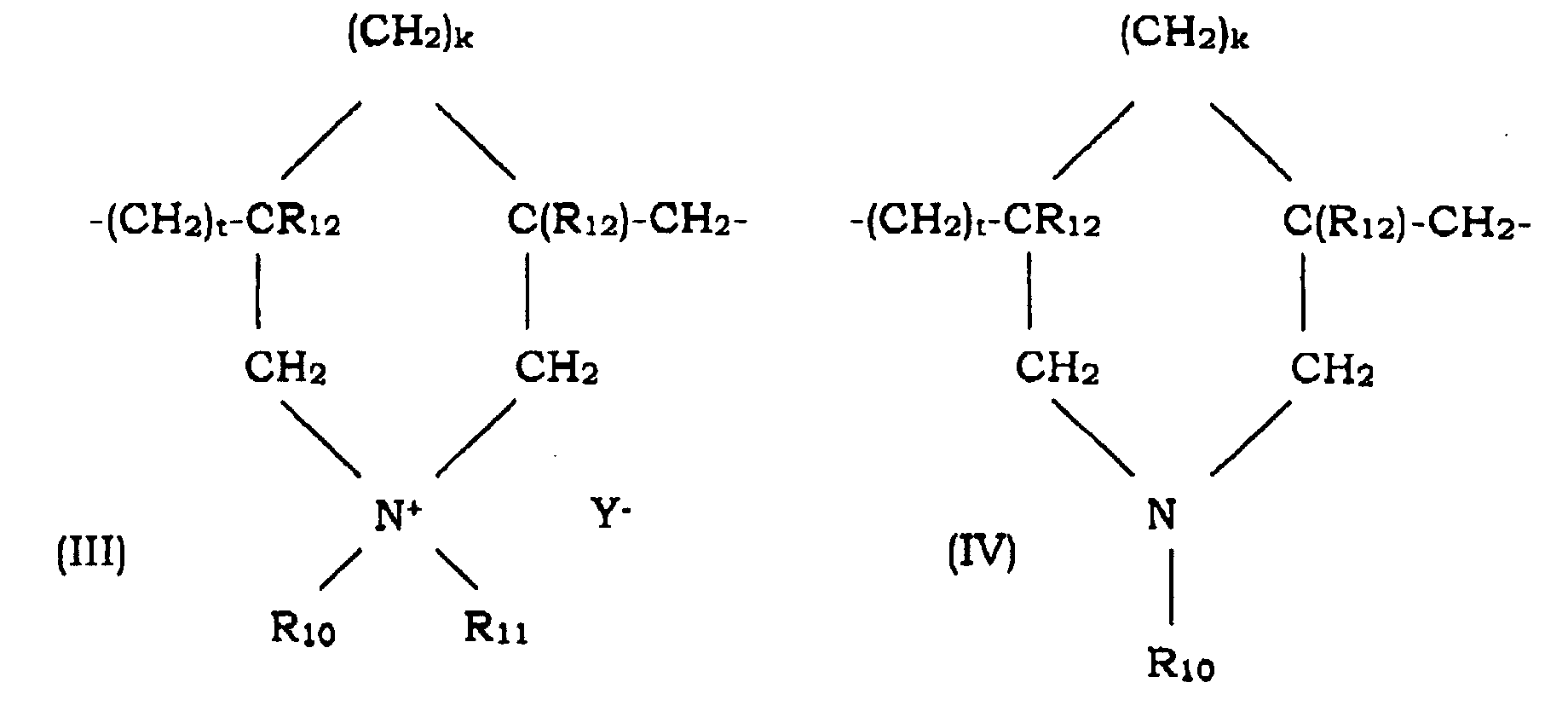
- Zusammensetzung nach einem der Ansprüche 1 bis 9, dadurch gekennzeichnet, dass das kationische Polymer ausgewählt ist unter:(1) Copolymeren von Vinylpyrrolidon und Dialkylaminoalkylacrylat oder Dialkylaminoalkylmethacrylat, die gegebenenfalls quaternisiert sind;(2) Derivaten von Celluloseethern, die quartäre Ammoniumgruppen enthalten;(3) Kationischen Cellulosederivaten, wie Cellulosecopolymeren oder Cellulosederivaten, die mit einem wasserlöslichen quartären Ammoniummonomer gepfropft sind;(4) Polysacchariden, beispielsweise Guargummen mit kationischen Trialkylammoniumgruppen;(5) Polymeren, die aus Piperazinyleinheiten und zweiwertigen Alkylen- oder Hydroxyalkylengruppen mit geraden oder verzweigten Ketten bestehen, die gegebenenfalls durch Sauerstoffatome, Schwefelatome, Stickstoffatome oder aromatische oder heterocyclische Ringe unterbrochen sind, sowie den Oxidationsprodukten und/ oder Quaternisierungsprodukten dieser Polymere;(6) Wasserlöslichen Polyaminoamiden, die insbesondere durch Polykondensation einer sauren Verbindung mit einem Polyamin hergestellt sind; diese Polyaminoamide können mit einem Epihalohydrin, Diepoxid, Dianhydrid, ungesättigten Dianhydrid, zweifach ungesättigten Derivat, Bis-halohydrin, Bis-azetidinium, Bis-haloacyldiamin, Alkyl-bis-halogenid oder auch einem Oligomer vernetzt sein, das bei der Umsetzung einer bifunktionell reagierenden Verbindung entsteht, die gegenüber einem Bis-halohydrin, Bis-azetidinium, Bis-haloacyldiamin, Alkyl-bis-halogenid, Epihalohydrin, Diepoxid oder zweifach ungesättigten Derivat reaktiv ist, wobei das Vernetzungsmittel in Mengenanteilen von 0,025 bis 0,35 mol pro Aminogruppe des Polyaminoamids eingesetzt wird; diese Polyaminoamide können alkyliert oder, wenn sie eine oder mehrere tertiäre Aminogruppen enthalten, quaternisiert sein;(7) Derivaten von Polyaminoamiden, die bei der Kondensation von Polyalkylenpolyaminen mit Polycarbonsäuren und anschließender Alkylierung mit bifunktionellen Mitteln entstehen;(8) Polymeren, die durch Umsetzung eines Polyalkylenpolyamins, das zwei primäre Aminogruppen und mindestens eine sekundäre Aminogruppe aufweist, mit einer Dicarbonsäure hergestellt sind, welche unter Diglykolsäure und den gesättigten, aliphatischen Dicarbonsäuren mit 3 bis 8 Kohlenstoffatomen ausgewählt ist, wobei das Molverhältnis von Polyalkylenpolyamin und Dicarbonsäure im Bereich von 0,8 : 1 bis 1,4 : 1 liegt und das resultierende Polyaminoamid mit Epichlorhydrin in einem Molverhältnis von Epichlorhydrin zu den sekundären Aminogruppen des Polyaminoamids im Bereich von 0,5 : 1 bis 1,8 : 1 umgesetzt wird;(9) Methyldiallylamin- oder Dimethyldiallylammonium-Cyclopolymeren, beispielsweise den Polymeren, die als Hauptbestandteil der Kette Einheiten der Formeln (III) oder (IV) aufweisen:worin k und t 0 oder 1 bedeuten und die Summe k + t l ist; R12 Wasserstoff oder Methyl bedeutet; die Gruppen R10 und R11 unabhängig voneinander eine Alkylgruppe mit 1 bis 22 Kohlenstoffatomen, eine Hydroxyalkylgruppe, worin die Alkylgruppe vorzugsweise 1 bis 5 Kohlenstoffatome aufweist, oder eine niedere Amidoalkylgruppe bedeuten oder R10 und R11 gemeinsam mit dem Stickstoffatom, an das sie gebunden sind, heterocyclische Gruppen, wie Piperidinyl oder Morpholinyl, bilden können; und Y- ein Anion ist, beispielsweise Bromid, Chlorid, Acetat, Borat, Citrat, Tartrat, Bisulfat, Bisulfit, Sulfat oder Phosphat;
 (10) Quartären Diammoniumpolymere mit wiederkehrenden Einheiten der folgenden Formel:wobei in der Formel (V) die Gruppen R13, R14, R15 und R16, die identisch oder voneinander verschieden sind, aliphatische, alicyclische oder arylaliphatische Gruppen mit 1 bis 20 Kohlenstoffatomen oder niedere hydroxyalkylaliphatische Gruppen bedeuten oder worin die Gruppen R13, R14, R15 und R16 gemeinsam oder unabhängig voneinander mit den Stickstoffatomen, an die sie gebunden sind, Heterocyclen bilden, die gegebenenfalls ein zweites, von Stickstoff verschiedenes Heteroatom enthalten, oder worin die Gruppen R13, R14, R15 und R16 eine geradkettige oder verzweigte C1-6-Alkylgruppe bedeuten, die mit einer Nitril-, Ester-, Acyl- oder Amidgruppe oder -CO-O-R17-D oder -CO-NH-R17-D substituiert ist,
worin R17 eine Alkylengruppe und D eine quartäre Ammoniumgruppe bedeutet;
die Gruppen A1 und B1 bedeuten Polymethylengruppen mit 2 bis 20 Kohlenstoffatomen, die geradkettig oder verzweigt, gesättigt oder ungesättigt vorliegen können und die an die Hauptkette gebunden oder in der Hauptkette einen oder mehrere aromatische Ringe oder ein oder mehrere Sauerstoffatome oder Schwefelatome oder eine oder mehrere der folgenden Gruppen enthalten können: Sulfoxid, Sulfon, Disulfid, Amino, Alkylamino, Hydroxy, quartäre Ammoniumgruppen, Ureido, Amid oder Ester, und
X- bedeutet ein Anion, das von einer anorganischen oder organischen Säure abgeleitet ist,
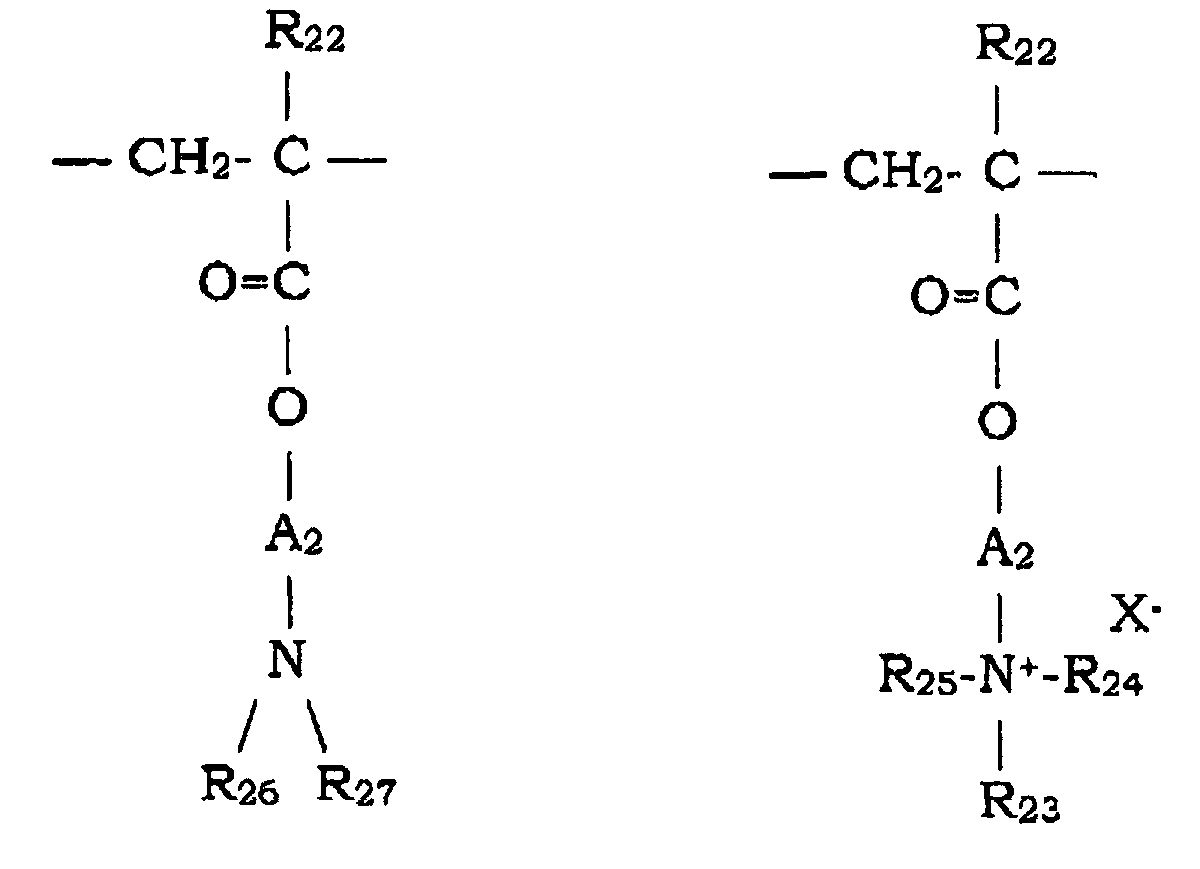
wobei die Gruppen A1 und R13 und R15 mit den beiden Stickstoffatomen, an die sie gebunden sind, einen Piperazinring bilden können; wenn A1 eine geradkettige oder verzweigte, gesättigte oder ungesättigte Alkylen- oder Hydroxyalkylengruppe bedeutet, kann die Gruppe B1 auch eine Gruppe (CH2)n-CO-D-OC-(CH2)n- bedeuten, worin D bedeutet:a) eine Glykolgruppe der Formel -O-Z-O-, worin Z eine geradkettige oder verzweigte Kohlenwasserstoffgruppe oder eine Gruppe der folgenden Formeln bedeutet:b) ein bis-sekundäres Diamin, beispielsweise ein Piperazinderivat;c) ein bis-primäres Diamin der Formel -NH-Y-NH-, worin Y eine geradkettige oder verzweigte Kohlenwasserstoffgruppe oder die zweiwertige Gruppe -CH2-CH2-S-S-CH2-CH2- bedeutet;d) die Ureylengruppe der Formel -NH-CO-NH-;(11) Quartären Polyammoniumpolymeren, die aus Einheiten der Formel (VI) bestehen:worin bedeuten: die Gruppen R18, R19, R20 und R21, die identisch oder voneinander verschieden sind, Wasserstoff oder Methyl, Ethyl, Propyl, β-Hydroxyethyl, β-Hydroxypropyl oder -CH2CH2(OCH2CH2)pOH, worin p 0 oder eine ganze Zahl im Bereich von 1 bis 6 bedeutet, mit der Maßgabe, dass R18, R19, R20 und R21 nicht gleichzeitig ein Wasserstoffatom bedeuten;r und s, die identisch oder voneinander verschieden sind, ganze Zahlen im Bereich von 1 bis 6;q 0 oder eine ganze Zahl im Bereich von 1 bis 34;X ein Halogenatom;A eine Dihalogenidgruppe oder vorzugsweise -CH2-CH2-O-CH2-CH2-;(12) Homo- oder Copolymeren, die von Acrylsäure oder Methacrylsäure abgeleitet sind und die folgenden Einheiten enthalten:
 worin bedeuten:
 die Gruppen R22 unabhängig H oder CH3;die Gruppen A2 unabhängig eine geradkettige oder verzweigte Alkylgruppe mit 1 bis 6 Kohlenstoffatomen oder eine Hydroxyalkylgruppe mit 1 bis 4 Kohlenstoffatomen;die Gruppen R23, R24 und R25, die identisch oder voneinander verschieden sind, unabhängig eine Alkylgruppe mit 1 bis 18 Kohlenstoffatomen oder Benzyl;die Gruppen R26 und R27 Wasserstoff oder eine Alkylgruppe mit 1 bis 6 Kohlenstoffatomen;X- ein Anion, beispielsweise Methosulfat oder ein Halogenid, wie Chlorid oder Bromid;(13) Quartären Polymeren von Vinylpyrrolidon und Vinylimidazol;(14) Polyaminen;(15) Vernetzten Polymeren von Methacryloyloxyalkyl(C1-4)trialkyl(C1-4)ammoniumsalzen, wie den Polymeren, die durch Homopolymerisation von Dimethylaminoethylmethacrylat, das mit Methylchlorid quaternisiert ist, oder durch Copolymerisation von Acrylamid mit Dimethylaminoethylmethacrylat, das mit Methylchlorid quaternisiert ist, erhalten werden, wobei im Anschluss an die Homopolymerisation oder Copolymerisation mit einer Verbindung mit olefinischer Doppelbindung vernetzt wird, insbesondere mit Methylenbis-acrylamid;(16) Polyalkyleniminen, insbesondere Polyethyleniminen, Polymeren, die Vinylpyridin- oder Vinylpyridinium-Einheiten enthalten, Kondensaten von Polyaminen und Epichlorhydrin, quartären Polyureylenen und Chitinderivaten.
 - Zusammensetzung nach Anspruch 10, dadurch gekennzeichnet, dass das kationische Polymer ausgewählt ist unter:Cyclopolymeren, insbesondere Diallyldimethylammoniumsalz-Homopolymeren und Diallyldimethylammoniumsalz/Acrylamid-Copolymeren,gegebenenfalls vernetzten Homopolymeren und Copolymeren von (Meth)acryloyloxyethyltrimethylammoniumsalzen,Copolymeren von Vinylpyrrolidon und Vinylimidazolsalzen,Polymeren, die aus wiederkehrenden Einheiten der folgenden Formel bestehen:wobei die Gruppen R1, R2, R3 und R4, die gleich oder verschieden sind, Alkyl- oder Hydroxyalkylgruppen mit etwa 1 bis 4 Kohlenstoffatomen bedeuten, n und p ganze Zahlen sind, die im Bereich von etwa 2 bis 20 liegen, und X- ein von einer anorganischen oder organischen Säure abgeleitetes Anion ist.

- Zusammensetzung nach einem der Ansprüche 1 bis 11, dadurch gekennzeichnet, dass das kationische Polymer 0,05 bis 10 Gew.-%, vorzugsweise 0,1 bis 5 Gew.-% und noch bevorzugter 0,25 bis 3 Gew.-% des Gesamtgewichts der Zusammensetzung ausmacht.
- Zusammensetzung nach einem der Ansprüche 1 bis 12, dadurch gekennzeichnet, dass die wasserlöslichen Salze ein- oder mehrwertige Metallsalze von anorganischen oder organischen Säuren sind.
- Zusammensetzung nach Anspruch 13, dadurch gekennzeichnet, dass die wasserlöslichen Salze unter Natriumchlorid, Kaliumchlorid, Calciumchlorid, Magnesiumsulfat, Natriumcitrat und den Natriumsalzen von Phosphorsäure ausgewählt sind.
- Zusammensetzung nach einem der Ansprüche 1 bis 14, dadurch gekennzeichnet, dass die wasserlöslichen Salze in Konzentrationen von 0,1 bis 10 Gew.-% und vorzugsweise 0,5 bis 5 Gew.-%, bezogen auf das Gesamtgewicht der Zusammensetzung, enthalten sind.
- Zusammensetzung nach einem der Ansprüche 1 bis 15, dadurch gekennzeichnet, dass es sich bei den ein- oder mehrwertigen wasserlöslichen Alkoholen um niedere Alkohole mit 1 bis 6 Kohlenstoffatomen, wie Ethanol, Isopropanol, t-Butanol, n-Butanol, Polyole, wie Alkylenglykole, beispielsweise Propylenglykol, Glycerin und Polyalkylenglykole, und Glykolether handelt.
- Zusammensetzung nach einem der Ansprüche 1 bis 16, dadurch gekennzeichnet, dass die wasserlöslichen Alkohole in Konzentrationen im Allgemeinen von 0,1 bis 20 Gew.-% und vorzugsweise 0,2 bis 10 Gew.-%, bezogen auf das Gesamtgewicht der Zusammensetzung, enthalten sind.
- Zusammensetzung nach einem der Ansprüche 1 bis 17, dadurch gekennzeichnet, dass sie ferner einen oder mehrere Zusatzstoffe enthält, die unter den kationischen grenzflächenaktiven Stoffen, anionischen, nichtionischen oder amphoteren Polymeren, Proteinen, Proteinhydrolysaten, Ceramiden, Pseudoceramiden, Fettsäuren mit linearen oder verzweigten C16-40-Fettketten, wie 18-Methyleicosansäure, Hydroxysäuren, Vitaminen, Panthenol, flüchtigen oder nicht flüchtigen Siliconen, die in dem Medium löslich oder unlöslich sind, UV-Filtern, Hydratisierungsmitteln, Wirkstoffen gegen Schuppen oder gegen Seborrhoe, Radikalfängern für freie Radikale und deren Gemischen ausgewählt sind.
- Verwendung einer Zusammensetzung nach einem der Ansprüche 1 bis 18 zur Reinigung und/oder zum Abschminken und/ oder zum Konditionieren von Keratinsubstanzen.
- Verfahren zur Reinigung und/oder Konditionierung von Keratinsubstanzen, wie der Haare, das darin besteht, auf die feuchten Keratinsubstanzen eine wirksame Menge einer Zusammensetzung nach einem der Ansprüche 1 bis 18 aufzutragen und anschleißend gegebenenfalls nach einer Einwirkzeit mit Wasser zu spülen.
Applications Claiming Priority (2)
| Application Number | Priority Date | Filing Date | Title |
|---|---|---|---|
| FR9901239 | 1999-02-03 | ||
| FR9901239A FR2788973B1 (fr) | 1999-02-03 | 1999-02-03 | Composition cosmetique comprenant un tensioactif anionique, un tensioactif amphotere, une huile de type polyolefine, un polymere cationique et un sel ou un alcool hydrosoluble, utilisation et procede |
Publications (2)
| Publication Number | Publication Date |
|---|---|
| EP1025839A1 EP1025839A1 (de) | 2000-08-09 |
| EP1025839B1 true EP1025839B1 (de) | 2004-07-21 |
Family
ID=9541548
Family Applications (1)
| Application Number | Title | Priority Date | Filing Date |
|---|---|---|---|
| EP00400052A Expired - Lifetime EP1025839B1 (de) | 1999-02-03 | 2000-01-11 | Kosmetische Zusammensetzung enthaltend ein anionisches und amphoteres Tensid, ein Polyolefin, ein kationisches Polymer und ein Salz oder einen wasserlöslichen Alkohol, Verwendung und Verfahren |
Country Status (6)
| Country | Link |
|---|---|
| US (1) | US6338842B1 (de) |
| EP (1) | EP1025839B1 (de) |
| AT (1) | ATE271375T1 (de) |
| DE (1) | DE60012238T2 (de) |
| ES (1) | ES2225032T3 (de) |
| FR (1) | FR2788973B1 (de) |
Families Citing this family (32)
| Publication number | Priority date | Publication date | Assignee | Title |
|---|---|---|---|---|
| FR2833959B1 (fr) * | 2001-12-20 | 2004-03-19 | Oreal | Polymeres radicalaires cationiques ou amphoteres auto-adhesifs et leur utilisation en cosmetique |
| US20030198654A1 (en) * | 2002-04-22 | 2003-10-23 | Palazzolo Christopher L. | Cosmetic formulation that provides for a suspension of beads |
| US20030204180A1 (en) * | 2002-04-30 | 2003-10-30 | Kimberly-Clark Worldwide, Inc. | Temperature responsive delivery systems |
| GB2391810A (en) | 2002-08-14 | 2004-02-18 | Reckitt Benckiser Inc | Disinfectant with residual antimicrobial activity |
| EP1603518A4 (de) * | 2003-03-14 | 2006-11-22 | Oreal | Poss und eposs enthaltende kosmetika und produkte für die körperpflege |
| DE10350425A1 (de) * | 2003-10-29 | 2005-07-14 | Beiersdorf Ag | Zähflüssiges Duschöl |
| FR2864776B1 (fr) * | 2004-01-05 | 2006-06-23 | Oreal | Composition cosmetique de type emulsion eau-dans-eau a base de tensioactifs et de polymeres cationiques |
| FR2864777B1 (fr) * | 2004-01-05 | 2008-02-01 | Oreal | Composition cosmetique detergente comprenant des tensioactifs anioniques et amphoteres, un polymere cationique fortement charge et un sel hydrosoluble |
| US20050158269A1 (en) * | 2004-01-05 | 2005-07-21 | L'oreal | Detergent cosmetic composition comprising anionic and amphoteric surfactants, a highly charged cationic polymer and a water-soluble salt |
| EP1552811A1 (de) * | 2004-01-07 | 2005-07-13 | L'oreal | Kosmetische Reiningungsmittel enthaltend ein Tensid, einen spinnenden Polymer mit hohem Molekulargewicht und ein Konditioniermittel und deren Verwendung |
| US20050175569A1 (en) * | 2004-01-07 | 2005-08-11 | Geraldine Fack | Cosmetic compositions comprising a cation, a drawing polymer and a thickener, and cosmetic treatment processes |
| FR2864767B1 (fr) * | 2004-01-07 | 2008-01-11 | Oreal | Compositions cosmetiques detergentes comprenant un tensioactif, un polymere de haut poids moleculaire et un agent conditionneur et utilisation de ces dernieres |
| FR2864772B1 (fr) * | 2004-01-07 | 2007-12-21 | Oreal | Compositions cosmetiques detergentes comprenant un tensioactif, un polymere filant et un agent conditionneur et utilisation de ces dernieres |
| CN100584876C (zh) | 2004-03-19 | 2010-01-27 | 巴斯福股份公司 | 改性聚氨基酰胺 |
| JP2008512498A (ja) * | 2004-09-13 | 2008-04-24 | ロレアル | 改善された付着性及び/又は柔軟性を有するposs含有化粧品用組成物と改善された化粧品用組成物の製造方法 |
| DE102005005016A1 (de) * | 2005-02-03 | 2006-08-10 | Basf Ag | Polymere hydrophobe Aminonitrilquats zur Bleichaktivierung |
| DE102005006104A1 (de) * | 2005-02-10 | 2006-08-24 | Merz Pharma Gmbh & Co. Kgaa | Verschäumbare alkoholische Mittel mit Desinfektions- und Reinigungswirkung auf (Erd)Alkali- Basis und deren Verwendung |
| TW200743385A (en) * | 2006-05-05 | 2007-11-16 | Amtran Technology Co Ltd | Method of audio-visual communication using television and television using the same |
| US20070270321A1 (en) * | 2006-05-16 | 2007-11-22 | Barnhart Ronald A | Antimicrobial hand wash formulations |
| DE102007062427A1 (de) * | 2007-12-20 | 2009-06-25 | Beiersdorf Ag | Rasierduschzubereitung |
| JP5952738B2 (ja) | 2009-11-27 | 2016-07-13 | ビーエーエスエフ ソシエタス・ヨーロピアBasf Se | 平滑化剤を含む金属電気メッキのための組成物 |
| US8329626B2 (en) * | 2010-06-24 | 2012-12-11 | Johnson & Johnson Consumer Companies, Inc. | Low-irritating, clear cleansing compositions with relatively low pH |
| EP2978831B1 (de) | 2013-03-28 | 2020-12-02 | The Procter and Gamble Company | Reinigungszusammensetzungen mit einem polyetheramin, einem schmutzabweisenden polymer und carboxymethylcellulose |
| WO2015148360A1 (en) | 2014-03-27 | 2015-10-01 | The Procter & Gamble Company | Cleaning compositions containing a polyetheramine |
| WO2015148361A1 (en) | 2014-03-27 | 2015-10-01 | The Procter & Gamble Company | Cleaning compositions containing a polyetheramine |
| WO2015187757A1 (en) | 2014-06-06 | 2015-12-10 | The Procter & Gamble Company | Detergent composition comprising polyalkyleneimine polymers |
| EP3186349B1 (de) | 2014-08-27 | 2019-09-25 | The Procter and Gamble Company | Waschmittelzusammensetzung mit einem kationischen polymer |
| US9809782B2 (en) | 2014-08-27 | 2017-11-07 | The Procter & Gamble Company | Detergent composition comprising a cationic polymer and anionic/nonionic surfactant mixture |
| WO2016032993A1 (en) | 2014-08-27 | 2016-03-03 | The Procter & Gamble Company | Detergent composition comprising a cationic polymer |
| WO2016032995A1 (en) | 2014-08-27 | 2016-03-03 | The Procter & Gamble Company | Method of treating a fabric |
| US9850452B2 (en) | 2014-09-25 | 2017-12-26 | The Procter & Gamble Company | Fabric care compositions containing a polyetheramine |
| CA3228918A1 (en) | 2021-08-10 | 2023-02-16 | Nippon Shokubai Co., Ltd. | Polyalkylene-oxide-containing compound |
Family Cites Families (54)
| Publication number | Priority date | Publication date | Assignee | Title |
|---|---|---|---|---|
| US2271378A (en) | 1939-08-30 | 1942-01-27 | Du Pont | Pest control |
| US2273780A (en) | 1939-12-30 | 1942-02-17 | Du Pont | Wax acryalte ester blends |
| US2261002A (en) | 1941-06-17 | 1941-10-28 | Du Pont | Organic nitrogen compounds |
| US2388614A (en) | 1942-05-05 | 1945-11-06 | Du Pont | Disinfectant compositions |
| US2375853A (en) | 1942-10-07 | 1945-05-15 | Du Pont | Diamine derivatives |
| US2454547A (en) | 1946-10-15 | 1948-11-23 | Rohm & Haas | Polymeric quaternary ammonium salts |
| US2528378A (en) | 1947-09-20 | 1950-10-31 | John J Mccabe Jr | Metal salts of substituted quaternary hydroxy cycloimidinic acid metal alcoholates and process for preparation of same |
| US2781354A (en) | 1956-03-26 | 1957-02-12 | John J Mccabe Jr | Imidazoline derivatives and process |
| US2961347A (en) | 1957-11-13 | 1960-11-22 | Hercules Powder Co Ltd | Process for preventing shrinkage and felting of wool |
| US3227615A (en) | 1962-05-29 | 1966-01-04 | Hercules Powder Co Ltd | Process and composition for the permanent waving of hair |
| US3206462A (en) | 1962-10-31 | 1965-09-14 | Dow Chemical Co | Quaternary poly(oxyalkylene)alkylbis(diethylenetriamine) compounds |
| FR1492597A (fr) | 1965-09-14 | 1967-08-18 | Union Carbide Corp | Nouveaux éthers cellulosiques contenant de l'azote quaternaire |
| CH491153A (de) | 1967-09-28 | 1970-05-31 | Sandoz Ag | Verfahren zur Herstellung von neuen kationaktiven, wasserlöslichen Polyamiden |
| DE1638082C3 (de) | 1968-01-20 | 1974-03-21 | Fa. A. Monforts, 4050 Moenchengladbach | Verfahren zum Entspannen einer zur Längenmessung geführten, dehnbaren Warenbahn |
| SE375780B (de) | 1970-01-30 | 1975-04-28 | Gaf Corp | |
| IT1035032B (it) | 1970-02-25 | 1979-10-20 | Gillette Co | Composizione cosmetica e confezione che la contiente |
| LU64371A1 (de) | 1971-11-29 | 1973-06-21 | ||
| FR2280361A2 (fr) | 1974-08-02 | 1976-02-27 | Oreal | Compositions de traitement et de conditionnement de la chevelure |
| GB1394353A (en) | 1972-06-29 | 1975-05-14 | Gillette Co | Hair treating composition |
| LU68901A1 (de) | 1973-11-30 | 1975-08-20 | ||
| FR2368508A2 (fr) | 1977-03-02 | 1978-05-19 | Oreal | Composition de conditionnement de la chevelure |
| US3929990A (en) | 1973-12-18 | 1975-12-30 | Millmaster Onyx Corp | Microbiocidal polymeric quaternary ammonium compounds |
| US3874870A (en) | 1973-12-18 | 1975-04-01 | Mill Master Onyx Corp | Microbiocidal polymeric quarternary ammonium compounds |
| US4025627A (en) | 1973-12-18 | 1977-05-24 | Millmaster Onyx Corporation | Microbiocidal polymeric quaternary ammonium compounds |
| DK659674A (de) | 1974-01-25 | 1975-09-29 | Calgon Corp | |
| CH611156A5 (de) | 1974-05-16 | 1979-05-31 | Oreal | |
| US4005193A (en) | 1974-08-07 | 1977-01-25 | Millmaster Onyx Corporation | Microbiocidal polymeric quaternary ammonium compounds |
| US4026945A (en) | 1974-10-03 | 1977-05-31 | Millmaster Onyx Corporation | Anti-microbial quaternary ammonium co-polymers |
| US3966904A (en) | 1974-10-03 | 1976-06-29 | Millmaster Onyx Corporation | Quaternary ammonium co-polymers for controlling the proliferation of bacteria |
| US4025617A (en) | 1974-10-03 | 1977-05-24 | Millmaster Onyx Corporation | Anti-microbial quaternary ammonium co-polymers |
| US4001432A (en) | 1974-10-29 | 1977-01-04 | Millmaster Onyx Corporation | Method of inhibiting the growth of bacteria by the application thereto of capped polymers |
| US4027020A (en) | 1974-10-29 | 1977-05-31 | Millmaster Onyx Corporation | Randomly terminated capped polymers |
| US4025653A (en) | 1975-04-07 | 1977-05-24 | Millmaster Onyx Corporation | Microbiocidal polymeric quaternary ammonium compounds |
| AT365448B (de) | 1975-07-04 | 1982-01-11 | Oreal | Kosmetische zubereitung |
| CH1669775A4 (de) | 1975-12-23 | 1977-06-30 | ||
| US4031307A (en) | 1976-05-03 | 1977-06-21 | Celanese Corporation | Cationic polygalactomannan compositions |
| LU76955A1 (de) | 1977-03-15 | 1978-10-18 | ||
| CA1091160A (en) | 1977-06-10 | 1980-12-09 | Paritosh M. Chakrabarti | Hair preparation containing vinyl pyrrolidone copolymer |
| LU78153A1 (fr) | 1977-09-20 | 1979-05-25 | Oreal | Compositions cosmetiques a base de polymeres polyammonium quaternaires et procede de preparation |
| US4131576A (en) | 1977-12-15 | 1978-12-26 | National Starch And Chemical Corporation | Process for the preparation of graft copolymers of a water soluble monomer and polysaccharide employing a two-phase reaction system |
| FR2470596A1 (fr) | 1979-11-28 | 1981-06-12 | Oreal | Composition destinee au traitement des fibres keratiniques a base de polymeres amphoteres et de polymeres cationiques |
| LU83349A1 (fr) | 1981-05-08 | 1983-03-24 | Oreal | Composition sous forme de mousse aerosol a base de polymere cationique et de polymere anionique |
| LU83876A1 (fr) | 1982-01-15 | 1983-09-02 | Oreal | Composition cosmetique destinee au traitement des fibres keratiniques et procede de traitement de celles-ci |
| LU84708A1 (fr) | 1983-03-23 | 1984-11-14 | Oreal | Composition epaissie ou gelifiee de conditionnement des cheveux contenant au moins un polymere cationique,au moins un polymere anionique et au moins une gomme de xanthane |
| DE3375135D1 (en) | 1983-04-15 | 1988-02-11 | Miranol Inc | Polyquaternary ammonium compounds and cosmetic compositions containing them |
| LU86429A1 (fr) | 1986-05-16 | 1987-12-16 | Oreal | Compositions cosmetiques renfermant un polymere cationique et un polymere anionique comme agent epaississant |
| US4832872A (en) * | 1988-01-22 | 1989-05-23 | Richardson-Vicks Inc. | Hair conditioning shampoo |
| MY105119A (en) | 1988-04-12 | 1994-08-30 | Kao Corp | Low irritation detergent composition. |
| DK0413417T3 (da) * | 1989-06-21 | 1995-07-17 | Colgate Palmolive Co | Hårkonditionerende shampoo |
| US5011681A (en) * | 1989-10-11 | 1991-04-30 | Richardson-Vicks, Inc. | Facial cleansing compositions |
| US5853708A (en) * | 1993-06-01 | 1998-12-29 | L'oreal | Cosmetic compositions containing at least one anionic surfactant of alkylgalactoside uronate type and at least one synthetic hydrocarbon oil |
| US6221817B1 (en) * | 1996-03-27 | 2001-04-24 | The Procter & Gamble Company | Conditioning shampoo composition |
| KR20000005084A (ko) * | 1996-03-27 | 2000-01-25 | 레이서 제이코버스 코넬리스 | 폴리알파올레핀 콘디셔너를 함유하는 콘디셔닝 샴푸 조성물 |
| FR2748203B1 (fr) * | 1996-05-06 | 1998-06-19 | Oreal | Compositions cosmetiques detergentes a usage capillaire et utilisation |
-
1999
- 1999-02-03 FR FR9901239A patent/FR2788973B1/fr not_active Expired - Fee Related
-
2000
- 2000-01-11 AT AT00400052T patent/ATE271375T1/de not_active IP Right Cessation
- 2000-01-11 DE DE60012238T patent/DE60012238T2/de not_active Expired - Lifetime
- 2000-01-11 ES ES00400052T patent/ES2225032T3/es not_active Expired - Lifetime
- 2000-01-11 EP EP00400052A patent/EP1025839B1/de not_active Expired - Lifetime
- 2000-02-03 US US09/496,916 patent/US6338842B1/en not_active Expired - Fee Related
Also Published As
| Publication number | Publication date |
|---|---|
| DE60012238D1 (de) | 2004-08-26 |
| FR2788973B1 (fr) | 2002-04-05 |
| EP1025839A1 (de) | 2000-08-09 |
| DE60012238T2 (de) | 2005-07-21 |
| ATE271375T1 (de) | 2004-08-15 |
| FR2788973A1 (fr) | 2000-08-04 |
| ES2225032T3 (es) | 2005-03-16 |
| US6338842B1 (en) | 2002-01-15 |
Similar Documents
| Publication | Publication Date | Title |
|---|---|---|
| EP0974335B1 (de) | Kosmetische Tensid Zusammensetzung sowie ihre Verwendung | |
| EP1025839A1 (de) | Kosmetische Zusammensetzung enthaltend ein anionisches und amphoteres Tensid, ein Polyolefin, ein kationisches Polymer und ein Salz oder einen wasserlöslichen Alkohol, Verwendung und Verfahren | |
| EP1029533B1 (de) | Kosmetische Zusammensetzungen enthaltend ein Hydroxyalkylether-Aniontensid und ein kationisches Polymer, und ihre Verwendungen | |
| EP1291001B2 (de) | Ein Copolymer aus Methacrylsäure und ein Öl enthaltende kosmetische Zusammensetzungen und deren Verwendungen | |
| EP0918506B1 (de) | Konditionierende und waschende mittel auf basis von silikon und dialkylether | |
| EP1120104B1 (de) | Kosmetische Reinigungszusammensetzungen, die eine besondere amphotere Stärke enthalten, und deren Verwendung | |
| CA2332474C (fr) | Composition de lavage des matieres keratiniques a base d'ester de sorbitan faiblement ethoxyle | |
| EP0906082B1 (de) | Kosmetische waschmittelzusammensetzungen und deren verwendung | |
| EP1148863B1 (de) | Reinigende kosmetische zusammensetzungen und ihre verwendung | |
| EP0966945A1 (de) | Reinigende kosmetische Zusammensetzungen und ihre Anwendung | |
| EP1021156B1 (de) | Reinigende kosmetische zusammensetzung und verwendung | |
| EP1380284B1 (de) | Kosmetische Reinigungszusammensetzungen, die ein anionisches, ein amphoterisches oder nichtionischesTensid und ein Polysaccharid enthalten, und deren Verwendung | |
| EP1726293B1 (de) | Kosmetische Waschmittelzusammensetzungen enthaltend ein Aminosilikon und ihre Verwendung | |
| FR3060381A1 (fr) | Composition cosmetique comprenant un organosilane, au moins un polymere cationique et une association particuliere de tensioactifs | |
| FR3136978A1 (fr) | Composition lavante pour les fibres keratiniques comprenant au moins un glucamide, un ester de (poly)glycerol et un alkyl(poly)glycoside | |
| EP1064927A1 (de) | Reinigende kosmetische Zusammensetzung enthaltend ein silikon und amphoteren Polymeren mit Fettketten, sowie ihren verwendung | |
| EP1004291A1 (de) | Konditionierungs- und Reinigungsmittelzusammensetzung, deren Verwendung | |
| EP1047403B1 (de) | Kosmetische zusammensetzungen enthaltend einen anionischen tensid vom typ alkylpoyglykosidester und ein kationisches polymer sowie deren verwendungen | |
| WO2005092275A1 (fr) | Composition cosmetique comprenant un dendrimere a chaînes grasses peripheriques, un tensioactif et un agent cosmetique, et ses utilisations | |
| FR3136977A1 (fr) | Composition lavante pour les fibres keratiniques comprenant au moins un tensioactif anionique, au moins un tensioactif amphotere ou zwitterionique et au moins un compose glucamide | |
| EP1726295B1 (de) | Kosmetische Waschmittelzusammensetzungen enthaltend ein Amino Piperidin Silikon und drei Tenside und ihre Verwendung | |
| FR2848848A1 (fr) | Composition de lavage des matieres keratiniques a base de tensioactif amphotere et de peg modifie par un groupe hydrophobe | |
| FR2822682A1 (fr) | Composition cosmetique comprenant des particules de sulfate de baryum et une association de tensioactifs |
Legal Events
| Date | Code | Title | Description |
|---|---|---|---|
| PUAI | Public reference made under article 153(3) epc to a published international application that has entered the european phase |
Free format text: ORIGINAL CODE: 0009012 |
|
| AK | Designated contracting states |
Kind code of ref document: A1 Designated state(s): AT BE CH CY DE DK ES FI FR GB GR IE IT LI LU MC NL PT SE |
|
| AX | Request for extension of the european patent |
Free format text: AL;LT;LV;MK;RO;SI |
|
| 17P | Request for examination filed |
Effective date: 20010209 |
|
| AKX | Designation fees paid |
Free format text: AT BE CH CY DE DK ES FI FR GB GR IE IT LI LU MC NL PT SE |
|
| 17Q | First examination report despatched |
Effective date: 20030701 |
|
| GRAP | Despatch of communication of intention to grant a patent |
Free format text: ORIGINAL CODE: EPIDOSNIGR1 |
|
| GRAS | Grant fee paid |
Free format text: ORIGINAL CODE: EPIDOSNIGR3 |
|
| GRAA | (expected) grant |
Free format text: ORIGINAL CODE: 0009210 |
|
| AK | Designated contracting states |
Kind code of ref document: B1 Designated state(s): AT BE CH CY DE DK ES FI FR GB GR IE IT LI LU MC NL PT SE |
|
| PG25 | Lapsed in a contracting state [announced via postgrant information from national office to epo] |
Ref country code: NL Free format text: LAPSE BECAUSE OF FAILURE TO SUBMIT A TRANSLATION OF THE DESCRIPTION OR TO PAY THE FEE WITHIN THE PRESCRIBED TIME-LIMIT Effective date: 20040721 Ref country code: AT Free format text: LAPSE BECAUSE OF FAILURE TO SUBMIT A TRANSLATION OF THE DESCRIPTION OR TO PAY THE FEE WITHIN THE PRESCRIBED TIME-LIMIT Effective date: 20040721 Ref country code: IE Free format text: LAPSE BECAUSE OF FAILURE TO SUBMIT A TRANSLATION OF THE DESCRIPTION OR TO PAY THE FEE WITHIN THE PRESCRIBED TIME-LIMIT Effective date: 20040721 Ref country code: FI Free format text: LAPSE BECAUSE OF FAILURE TO SUBMIT A TRANSLATION OF THE DESCRIPTION OR TO PAY THE FEE WITHIN THE PRESCRIBED TIME-LIMIT Effective date: 20040721 |
|
| REG | Reference to a national code |
Ref country code: GB Ref legal event code: FG4D Free format text: NOT ENGLISH |
|
| REG | Reference to a national code |
Ref country code: CH Ref legal event code: EP |
|
| REG | Reference to a national code |
Ref country code: IE Ref legal event code: FG4D Free format text: FRENCH |
|
| REF | Corresponds to: |
Ref document number: 60012238 Country of ref document: DE Date of ref document: 20040826 Kind code of ref document: P |
|
| PG25 | Lapsed in a contracting state [announced via postgrant information from national office to epo] |
Ref country code: SE Free format text: LAPSE BECAUSE OF FAILURE TO SUBMIT A TRANSLATION OF THE DESCRIPTION OR TO PAY THE FEE WITHIN THE PRESCRIBED TIME-LIMIT Effective date: 20041021 Ref country code: DK Free format text: LAPSE BECAUSE OF FAILURE TO SUBMIT A TRANSLATION OF THE DESCRIPTION OR TO PAY THE FEE WITHIN THE PRESCRIBED TIME-LIMIT Effective date: 20041021 Ref country code: GR Free format text: LAPSE BECAUSE OF FAILURE TO SUBMIT A TRANSLATION OF THE DESCRIPTION OR TO PAY THE FEE WITHIN THE PRESCRIBED TIME-LIMIT Effective date: 20041021 |
|
| GBT | Gb: translation of ep patent filed (gb section 77(6)(a)/1977) | ||
| NLV1 | Nl: lapsed or annulled due to failure to fulfill the requirements of art. 29p and 29m of the patents act | ||
| PG25 | Lapsed in a contracting state [announced via postgrant information from national office to epo] |
Ref country code: CY Free format text: LAPSE BECAUSE OF FAILURE TO SUBMIT A TRANSLATION OF THE DESCRIPTION OR TO PAY THE FEE WITHIN THE PRESCRIBED TIME-LIMIT Effective date: 20050111 |
|
| PGFP | Annual fee paid to national office [announced via postgrant information from national office to epo] |
Ref country code: IE Payment date: 20050112 Year of fee payment: 6 |
|
| REG | Reference to a national code |
Ref country code: ES Ref legal event code: FG2A Ref document number: 2225032 Country of ref document: ES Kind code of ref document: T3 |
|
| REG | Reference to a national code |
Ref country code: IE Ref legal event code: FD4D |
|
| PLBE | No opposition filed within time limit |
Free format text: ORIGINAL CODE: 0009261 |
|
| STAA | Information on the status of an ep patent application or granted ep patent |
Free format text: STATUS: NO OPPOSITION FILED WITHIN TIME LIMIT |
|
| 26N | No opposition filed |
Effective date: 20050422 |
|
| PGFP | Annual fee paid to national office [announced via postgrant information from national office to epo] |
Ref country code: MC Payment date: 20051228 Year of fee payment: 7 |
|
| PGFP | Annual fee paid to national office [announced via postgrant information from national office to epo] |
Ref country code: CH Payment date: 20060113 Year of fee payment: 7 |
|
| PGFP | Annual fee paid to national office [announced via postgrant information from national office to epo] |
Ref country code: LU Payment date: 20060127 Year of fee payment: 7 |
|
| PGFP | Annual fee paid to national office [announced via postgrant information from national office to epo] |
Ref country code: IT Payment date: 20060131 Year of fee payment: 7 |
|
| PGFP | Annual fee paid to national office [announced via postgrant information from national office to epo] |
Ref country code: ES Payment date: 20060215 Year of fee payment: 7 |
|
| PGFP | Annual fee paid to national office [announced via postgrant information from national office to epo] |
Ref country code: BE Payment date: 20060308 Year of fee payment: 7 |
|
| PG25 | Lapsed in a contracting state [announced via postgrant information from national office to epo] |
Ref country code: LI Free format text: LAPSE BECAUSE OF NON-PAYMENT OF DUE FEES Effective date: 20070131 Ref country code: MC Free format text: LAPSE BECAUSE OF NON-PAYMENT OF DUE FEES Effective date: 20070131 Ref country code: CH Free format text: LAPSE BECAUSE OF NON-PAYMENT OF DUE FEES Effective date: 20070131 |
|
| REG | Reference to a national code |
Ref country code: CH Ref legal event code: PL |
|
| GBPC | Gb: european patent ceased through non-payment of renewal fee |
Effective date: 20070111 |
|
| PG25 | Lapsed in a contracting state [announced via postgrant information from national office to epo] |
Ref country code: GB Free format text: LAPSE BECAUSE OF NON-PAYMENT OF DUE FEES Effective date: 20070111 |
|
| BERE | Be: lapsed |
Owner name: L'*OREAL Effective date: 20070131 |
|
| PG25 | Lapsed in a contracting state [announced via postgrant information from national office to epo] |
Ref country code: PT Free format text: LAPSE BECAUSE OF NON-PAYMENT OF DUE FEES Effective date: 20041221 Ref country code: BE Free format text: LAPSE BECAUSE OF NON-PAYMENT OF DUE FEES Effective date: 20070131 |
|
| REG | Reference to a national code |
Ref country code: ES Ref legal event code: FD2A Effective date: 20070112 |
|
| PG25 | Lapsed in a contracting state [announced via postgrant information from national office to epo] |
Ref country code: ES Free format text: LAPSE BECAUSE OF NON-PAYMENT OF DUE FEES Effective date: 20070112 |
|
| PGFP | Annual fee paid to national office [announced via postgrant information from national office to epo] |
Ref country code: GB Payment date: 20060111 Year of fee payment: 7 |
|
| PG25 | Lapsed in a contracting state [announced via postgrant information from national office to epo] |
Ref country code: LU Free format text: LAPSE BECAUSE OF NON-PAYMENT OF DUE FEES Effective date: 20070111 |
|
| PG25 | Lapsed in a contracting state [announced via postgrant information from national office to epo] |
Ref country code: IT Free format text: LAPSE BECAUSE OF NON-PAYMENT OF DUE FEES Effective date: 20070111 |
|
| PGFP | Annual fee paid to national office [announced via postgrant information from national office to epo] |
Ref country code: DE Payment date: 20110105 Year of fee payment: 12 Ref country code: FR Payment date: 20110128 Year of fee payment: 12 |
|
| REG | Reference to a national code |
Ref country code: FR Ref legal event code: ST Effective date: 20120928 |
|
| PG25 | Lapsed in a contracting state [announced via postgrant information from national office to epo] |
Ref country code: DE Free format text: LAPSE BECAUSE OF NON-PAYMENT OF DUE FEES Effective date: 20120801 |
|
| REG | Reference to a national code |
Ref country code: DE Ref legal event code: R119 Ref document number: 60012238 Country of ref document: DE Effective date: 20120801 |
|
| PG25 | Lapsed in a contracting state [announced via postgrant information from national office to epo] |
Ref country code: FR Free format text: LAPSE BECAUSE OF NON-PAYMENT OF DUE FEES Effective date: 20120131 |