EP1024897B1 - Verfahren für eine chemische katalytische reaktion - Google Patents
Verfahren für eine chemische katalytische reaktion Download PDFInfo
- Publication number
- EP1024897B1 EP1024897B1 EP98949036A EP98949036A EP1024897B1 EP 1024897 B1 EP1024897 B1 EP 1024897B1 EP 98949036 A EP98949036 A EP 98949036A EP 98949036 A EP98949036 A EP 98949036A EP 1024897 B1 EP1024897 B1 EP 1024897B1
- Authority
- EP
- European Patent Office
- Prior art keywords
- catalyst
- palladium
- state
- silicon nitride
- catalysts
- Prior art date
- Legal status (The legal status is an assumption and is not a legal conclusion. Google has not performed a legal analysis and makes no representation as to the accuracy of the status listed.)
- Expired - Lifetime
Links
Images

Classifications
-
- B—PERFORMING OPERATIONS; TRANSPORTING
- B01—PHYSICAL OR CHEMICAL PROCESSES OR APPARATUS IN GENERAL
- B01J—CHEMICAL OR PHYSICAL PROCESSES, e.g. CATALYSIS OR COLLOID CHEMISTRY; THEIR RELEVANT APPARATUS
- B01J27/00—Catalysts comprising the elements or compounds of halogens, sulfur, selenium, tellurium, phosphorus or nitrogen; Catalysts comprising carbon compounds
- B01J27/24—Nitrogen compounds
Definitions
- the present invention relates to a method of high temperature catalytic chemical reaction, which uses a solid catalyst comprising a phase active metal, and a refractory catalytic support non-oxidized on which the active phase is deposited.
- the catalytic support is based on silicon nitride (Si 3 N 4 ).
- Silicon nitride exists in two crystalline forms, the ⁇ form ( ⁇ -Si 3 N 4 ) called the low temperature form ( ⁇ 1200 ° C) and the ⁇ form ( ⁇ -Si 3 N 4 ) called the high temperature form (> 1500 ° C). Between 1200 ° C and 1500 ° C, the two forms coexist.
- the structures of each of these forms are essentially distinguished by a different arrangement of the SiN 4 tetrahedra.
- VI Simagina et al [1] described the use of a catalyst comprising, as catalytic support, porous ⁇ -Si 3 N 4 on which nickel oxide is dispersed, for the oxidation reaction of methane.
- the reaction temperature must reach 850 ° C.
- the stability of the methane molecule requires high initiation temperatures for the reaction.
- the use of high temperatures leads to the undesirable production of pollutants such as carbon monoxide from the decomposition of carbon dioxide and / or the partial oxidation of methane, and nitrogen oxides from the oxidation of l air nitrogen.
- US-A-5 004 709 describes a process for obtaining a support catalytic based on silicon nitride further comprising iron and a rare earth oxide.
- GB-1 426 216 teaches a catalyst for the treatment of exhaust gas whose support is made of silicon nitride.
- the authors of the present invention have sought a sufficiently active catalyst to catalyze reactions of the aforementioned type, but making it possible to lower them temperature to remove the drawbacks mentioned above, while having great stability and strong reactivity under particularly conditions severe, i.e. strong oxidizing atmosphere exothermicity.
- a solid catalyst comprising a phase active metal, and a refractory catalytic support mainly comprising silicon nitride in its ⁇ form, allows to lower and control the temperature of reaction at a value between 200 ° C and 800 ° C, and preferably between 200 ° C and 600 ° C.
- the silicon nitride is at the non-porous and powdery state.
- non-porous is meant a material that does not have a hysteresis cycle in nitrogen adsorption / desorption isotherms at liquid nitrogen temperature.
- the support comprises mainly silicon nitride in its ⁇ form; this means that it is made up of at least 90% of said form, the rest possibly being in particular the ⁇ form silicon nitride.
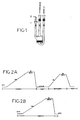
- Figure 1 shows a decomposition in which the support impregnated with precursors of the active metallic phase undergoes a activation heat treatment.
- Figure 2 shows the diagrams of the different temperature programs used for the stage activation of the catalyst;
- Figure 2A corresponds to a calcination-reduction treatment and
- Figure 2B corresponds to a decomposition under argon.
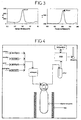
- FIG. 3 represents the spectra obtained by X-ray photoemission spectroscopy of the tested silicon nitride;
- FIG. 3A corresponds to the level Si2p of Si 3 N 4 and
- FIG. 3B corresponds to the level N1s of Si 3 N 4 .
- Figure 4 is a diagram of the device experimental used to perform combustion methane catalytic during which the catalyst of the invention is tested.
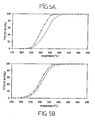
- FIG. 5 shows the methane conversion curves as a function of the temperature in state 1 ( ⁇ ) or state 2 ( ⁇ ) of the Pd / Si 3 N 4 catalyst, depending on whether the catalyst has been activated under argon (FIG. 5A) or by calcination-reduction (Figure 5B); states 1 and 2 are defined in example 4.
- Figure 6 shows the curves of methane conversion as a function of temperature for the catalysts Pd (1.05%) / ⁇ -Al 2 O 3 ( Figure 6A) and Pd (0.75%) / Si 3 N 4 ( Figure 6B) in state 1 ( ⁇ ) or in state 2 ( ⁇ ) defined in example 4.
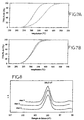
- Figure 7 shows the curves of methane conversion as a function of temperature for the catalysts Pd (1.05%) / ⁇ -Al 2 O 3 ( Figure 7A) and Pd (0.75%) / Si 3 N 4 ( Figure 7B) in state 1 ( ⁇ ) or in state 3 ( ⁇ ) defined in example 4.
- FIG. 8 shows the energy spectra of the electrons 2p of the silicon for the catalyst Pd (0.75%) / Si 3 N 4 having undergone different treatments defined in example 4.
- the BET measurement was used to measure the specific surface area of silicon nitrides using nitrogen as an adsorbate at 77K using a volumetric technique using an automated and computerized device, developed at the Institut de Research on Catalysis (Villeurbanne, France). Before each measurement, the samples are treated under secondary vacuum (approximately 10 -5 Torr) at 300 ° C in order to degas them.
- the X-ray diffraction allows in the first place to identify the crystalline phases.
- Powder diffractograms are performed on a PHILIPS PW 1050/81 goniometer controlled by a microcomputer.
- the data is then processed using software associated with the database ICCD-JCPDS data.
- the apparatus used is a type microscope JEOL 2010 with a point resolution of 0.19 nm.
- the powders to be analyzed are suspended in ethanol and dispersed with ultrasound. A drop of this suspension is placed on an object grid constituted by a copper sieve covered with a film thin carbon ( ⁇ 10 nm).
- High resolution observation involves creating interference between the transmitted electrons and diffracted by the sample. These interferences translate on the clichés by the appearance of fringes parallels corresponding to families of planes reticular in diffraction position (almost planes parallel to the beam in the case of diffraction electronic).
- a diaphragm allows you to select the waves which will be used for the formation of the high image resolution. In general, just take the wave transmitted and two diffracted waves.
- This technique will in some cases allow determine the nature of the interaction between the support and the active phase, and the location of the detected phases by X-ray diffraction.
- the dispersion of a metal catalyst is the ratio of the number of metallic atoms on the surface to total number of metallic atoms present on the catalyst. It therefore makes it possible to report the activity of the catalyst to that of surface atoms and therefore accessible to gas.
- this technique makes it possible to determine the quantity of hydrogen chemisorbed per unit mass of catalyst. It measures the dispersion by reference to a known dispersion catalyst.
- the solids After reduction to 400 ° C., the solids are carefully degassed at this temperature and then brought back to the hydrogen adsorption temperature which is 25 ° C. After adsorption of hydrogen at saturation, the solids are removed at room temperature until a vacuum of the order of 10 -8 Torr is obtained in order to eliminate the phase which is simply physisorbed and the palladium hydride phase. The catalyst is then heated in linear temperature programming (400 C.min -1 ) and the thermosorbed hydrogen, which corresponds to the chemisorbed hydrogen, is analyzed continuously by mass spectrometry.
- linear temperature programming 400 C.min -1
- the hydrogen thermoresorption results are expressed by the N H / N Pd ratio corresponding to the ratio of the number of hydrogen atoms desorbed from the catalyst to the total number of palladium atoms present on the catalyst.
- the apparatus used is the same as that of the high resolution described in 2.2).
- the electron microscopy allowed us a statistical determination of the size of the metallic particles.
- the quantification of the population of palladium particles was made by size category (size histogram).
- We deduce the diameters d s of the metal particles weighted on the surface according to the relation: d s ⁇ n i d i 3 ⁇ n i d i 2 ni representing the number of particles of diameter d i .
- X or XPS photoemission spectroscopy allows direct access to the binding energy of the levels heart electronics, this energy being specific to the atom considered.
- the sample to be analyzed is bombarded by a stream of X photons of h ⁇ energy.
- the electrons torn from the material are emitted with kinetic energy Ec, which makes it possible to go back to the binding energy El of the element considered, according to the principle of conservation of energy:
- h ⁇ Ec + El + ⁇ sp with ⁇ sp : work to extract the spectrometer determined by calibration on the 3d 5/2 line of silver which has a binding energy of 368.2 eV.
- the XPS also allows a determination of relative concentrations of different elements in surface layers.
- the source of excitation is the K ⁇ 1.2 radiation of magnesium (1253.6 eV). Thanks to a transfer case, the catalysts can be analyzed after reduction in a specific reactor without return to the air.
- methane is the most difficult to oxidize [4] . Indeed, the binding energy of the CH bond in methane is 435 kJ / mole, while that of a CC bond in other hydrocarbons is lower and is worth 300 to 350 kJ / mole [5] . This stability of the methane molecule results in higher combustion initiation temperatures for methane than those of other alkanes.
- heterogeneous catalyst allows lower the reaction temperature, which consequence of limiting the formation of undesirable gases: carbon monoxide and nitrogen oxides.
- the carbon monoxide basically comes from process taking place at high temperature such as decomposition carbon dioxide or partial oxidation of methane.
- the oxidation of nitrogen in the air by oxygen is a strongly endothermic reaction that does not occur in the event that the catalytic reaction takes place at sufficiently low temperature.
- the reactions take place under pressure atmospheric in a fixed bed reactor crossed in steady state by the reaction gas mixture.
- Catalytic activity is measured for small masses catalyst (300 mg), in the presence of a medium reaction consisting of 1% methane, 4% oxygen and 95% nitrogen.
- the use of small masses of catalyst and a strong dilution of the reactants in a inert gas helps minimize phenomena thermal runaway linked to the high exothermicity of the methane combustion reaction.
- the catalytic test is shown schematically in Figure 4.
- the distribution center gas includes: nitrogen, oxygen, methane and hydrogen.
- Hydrogen is used both as a pre-treatment gas for catalysts and as the carrier gas for the column of the chromatograph. Nitrogen, oxygen and methane constitute the reaction mixture.
- the gas flows are controlled by “BROOKS” mass flow meters working under pressure constant.
- the system pressure is maintained by a pressure gauge located at the outlet of the chromatographs.
- the reaction system consists of the gas mixer, 4-way valve, bed reactor fixed, the oven with programmer and control of temperature.
- the 2 cm quartz fixed bed U-shaped reactor diameter includes a sinter on which the catalyst. Temperature measurements in the oven and at level of the catalytic bed are carried out by means of thermocouples.
- a trap maintained at -78 ° C with an acetone-dry ice mixture allows retain the water formed during the reaction which can damage the column of the chromatograph.
- reaction mixture is injected at intervals of regular times in the column of a chromatograph at flame ionization (FID). Injections are performed automatically.
- FID flame ionization
- the FID chromatograph has a “Carbosieve S” column allowing good separation and resolution of methane.
- the carbon oxides, CO and CO 2 are detected by transforming them beforehand into methane in an oven to be anaerobic digested by passage over a Mi / MgO catalyst. This operation carried out after separation of the various gases in the column makes it possible to obtain good sensitivity for the detection of the reaction products CO and CO 2 .
- the chromatogram is obtained on a recorder.
- the peak area of the different products is determined thanks to an integration program contained in the unit SP4000 central unit. Quantitative analysis of the different products is performed after calibration on a mixture of known composition.
- the reactor is loaded with a mass of 0.3 g of catalyst.
- An analysis of the gases at the start of the reaction is always performed by short-circuiting the reactor. After stabilization of the mixture, the gases are sent to the preheated catalyst and product analysis is performed by automatic injection to the chromatograph at intervals of 15 to 30 min.
- the catalytic test conditions are as follows: Temperature range 200 ° C-800 ° C Partial pressure CH 4 7.64 Torr or 10 -2 atm Partial pressure O 2 30.6 Torr i.e. 4.10 -2 atm Partial pressure N 2 complement to 1 atm or 0.95 atm Total flow 6.5 l / h Mass of catalyst 300 mg
- TTG P (CO 2 ) + P (CO) P 0 (CH 4 ) x 100 TTG being expressed as% of methane converted.
- TTG (in%) P (CO 2 ) + P (CO) P (CH 4 ) + P (CO 2 ) + P (CO) x 100
- TOF The activity per surface site or "Turn Over Frequency (TOF)" is defined as the number of methane molecules that reacted per unit of time and per atom of surface metal.
- the original definition [6] refers to the number of surface sites.
- the active site in the methane oxidation reaction is not yet well known: this is why we choose to calculate the TOF relative to the number of surface metal atoms.
- TOF (in h -1 ) ⁇ 2 D D representing the dispersion of the catalyst determined by microscopy or thermoresorption of hydrogen
- the silicon nitride used (Si 3 N 4 , GOODFELLOW) is in pulverulent form, non-porous, and has a specific surface area determined by the BET method described in example 1, 1), of 8.8 m 2 / g.
- the silicon nitride used being a bad electrical conductor, a shift of a few eV towards the high energies have been observed on all lines of each spectrum. This overall charge effect is due to the poor conduction of electrons in the sample analysis. The charges then created during the photoemissions are not neutralized and there are accumulation of charges on the surface of the material.
- the load effect corrections are made by taking, as a reference, the binding energy of the level N1s at 397.6 eV for Si 3 N 4 (energy characteristic of nitrogen in Si 3 N 4 [7] ) .
- the levels Si2p and N1s of Si 3 N 4 are shown respectively in FIGS. 2A and 2B.
- the very narrow Si2p peak indicates a single state of the silicon corresponding to the silicon of the nitride at 101.9 eV. A small amount of oxygen is observed whose level 1s comes out at 532.4 eV.
- the ratio [Os] / [Si s ] is 0.2.
- the ratio [N s ] / [Si s ] is close to 1.
- the global stoichiometry ([O s ] + [N s ]) / [Si s ] is 1.2, therefore very close to the theoretical stoichiometry of 1 33.
- the stoichiometry of the surface is generally considered to be identical to that of the volume [8] .
- the oxygen detected in XPS therefore belongs to the structure of the ⁇ phase of the silicon nitride and there is no SiO 2 .
- the catalysts were prepared according to the technique which uses palladium acetylacetonate Pd (C 5 H 7 O 2 ) 2 as precursor.
- the silicon nitride support is initially impregnated with metal salts. Following the impregnation step, a heat treatment is necessary, on the one hand to remove the ligand and on the other hand to obtain the reduced metal. For this purpose, three heat treatments have been selected and the conditions of which have been fixed by the literature and by a study carried out in the laboratory on the decomposition of palladium acetylacetonate [9] .
- the support impregnated with the precursors must undergo a activation heat treatment required to removing the ligand and obtaining the reduced metal. This step is the most important because it conditions the growth of palladium particles on the surface of the support and therefore defines the characteristics catalyst final.
- Argon also allows the decomposition and reduction step to be carried out simultaneously.
- the reduction of the metal in this condition is explained by the presence of numerous hydrogen atoms in the Pd (C 5 H 7 O 2 ) 2 molecule, which, during decomposition, recombine and thus create a strongly reducing medium. in the metal environment (see Figure 2B).
- a 3-branch quartz cell represented in FIG. 1, where the reference (1) indicates the branch of gas inlet, the reference (2) indicates the branch of gas outlet or vacuum and the reference (3) indicates the branch of introduction of the sample.
- the gas flow rate is 2 cm 3 / s creating a fluidized bed from bottom to top.
- the various gases used are dried beforehand on a zeolite.
- the cell under scanning is positioned in a thermostatically controlled oven with a programmable temperature rise.
- FIG. 2 The different temperature programs used are shown diagrammatically in FIG. 2 in which FIG. 2A corresponds to the calcination-reduction treatment and the Figure 2B on decomposition under argon.
- the calcination-reduction treatment leads to a wide particle size distribution of palladium. However a large proportion of the particles has a diameter less than 4 nm. The largest size observed for this catalyst reaches approximately 20 nm.
- the palladium After decomposition under argon, the palladium is much more uniform in size.
- the range is included between 1 and 7 nm and the average size remains close to that obtained after calcination-reduction.
- the catalysts After calcination-reduction, the catalysts have a greater ability to chemisorb hydrogen.
- the N H / N Pd ratio is greater than the theoretical dispersion of the catalyst determined by microscopy. It can nevertheless be considered that the NH / NPd ratio is representative of the dispersion of the catalyst.
- the bond energies presented have been corrected for the charge effect, induced by the insulating nature of silicon nitride, by referring to the bond energy of the 1s electrons of the nitrogen in Si 3 N 4 at 397.6 eV [7] .
- the binding energy of the 2p electrons in silicon at 101.9 eV after impregnation and calcination-reduction is identical to that of metal-free silicon nitride. We does not observe a second state due to silicon oxide.
- decomposition under argon does not entail no modification of the surface of the silicon nitride.
- the concentration ratio [Pd s ] / [Si s ] deduced from the photoemission measurements (XPS) is close to 0.05 for the two modes of activation of the catalysts, and on the other hand that it changes little. when the mass percentage of palladium is increased from 0.75 to 1.43%.
- the silicon signal remains constant knowing that the palladium coverage rate is low in all cases (we have the equivalent of 0.4 monolayer in the case of catalyst 0.75% palladium and 0 , 7 monolayer for that at 1.43%).
- Table 3 shows the binding energies of the palladium of the various catalysts studied. AT except the catalyst with a high percentage of palladium decomposed under argon, the binding energies of 3d5 / 2 electrons in palladium are greater than those usually reported in the literature for metallic palladium, either 335.2 eV or 335.3 eV.
- the catalysts being stored in the open air we have first checked on the catalyst having strongest binding energy (calcined-reduced catalyst 0.75% palladium), if the palladium is good reduced.
- the mean diameter is greater than 3 nm, it would seem that the increase in bond energy is not entirely due to a size effect.
- Another phenomenon to explain displacement could be a mechanical interaction effect between the silicon nitride and palladium which would lead to a structural modification of the latter, which could cause changes in its properties e.
- Table 4 below presents the bonding energies of the C1s electrons and the relative carbon concentrations at the surface of the various catalysts. Bonding energies of 1s electrons from carbon and concentration ratio [C s ] / [Si s ] detected in XPS Heat treatment % Pd Binding energy (1s electrons) [C s ] / [If s ] calcination-reduction 0.75% / 1.43% 284.7 eV / 284.7 eV 0.083 / 0.087 decomposition under argon 0.75% / 1.43% 284.6 eV / 284.7 eV 0.14 / 0.37
- the two materials decomposed under argon have a higher carbon content than calcine-reduced. This result confirms that the activation of the catalysts under argon leaves a carbon deposit on the surface.
- the amount of carbon depends on the amount palladium acetylacetonate involved in the preparation. This carbonaceous deposit leads to a decrease in the number of active sites on the surface of the catalyst such as observed thanks to the thermoresorption of hydrogen.
- the catalytic activity is measured as a function of the temperature in state 1 and 2 on the solids presenting 0.75% palladium.
- Figure 5 shows the conversion as a function of the temperature of the activated catalyst under argon (FIG. 5A) and calcined-reduced catalyst (Figure 5B).
- Methane conversion is significantly higher in state 1 for the calcined-reduced catalyst. he has a half-conversion temperature of 314 ° C while the catalyst activated under argon reaches half conversion at 329 ° C.
- state 2 the two catalysts are more active with respect to state 1 and their half-conversion temperature, of the order of 300 ° C, is identical.
- alumina catalyst support widely used in the combustion field
- ⁇ which is the most stable form, to overcome the problems of phase transitions that can take place at temperatures of l order of reaction temperatures.
- this material makes it possible to be placed under the same specific surface conditions as those of silicon nitride.
- the alumina used is a Rhône Poulenc product with a specific surface of 10.5 m 2 / g.
- the Pd / ⁇ -Al 2 O 3 catalyst was prepared under the same conditions as the catalysts tested, namely, by impregnation with palladium acetylacetonate and the activation was carried out by a conventional calcination-reduction treatment, such as as described in Example 3. All of the characteristics of the catalyst are summarized in Table 5 where, for comparison, the characteristics of the Pd (0.75%) / Si 3 N 4 calcined-reduced catalyst are also reported. .
- the Pd / ⁇ -Al 2 O 3 catalyst has a dispersion significantly greater than Pd / Si 3 N 4 .
- the 3d5 / 2 electron energy of palladium measured in XPS is characteristic of palladium in the zerovalent state.
- the electronic properties of palladium are probably modified by interaction effects with the support.
- FIG. 6 shows the conversion of methane as a function of temperature for the catalysts Pd / ⁇ -Al 2 O 3 and Pd / Si 3 N 4 in state 1 and 2.
- the two catalysts behave differently. Indeed, the catalyst supported on silicon nitride is more active when it is in state 2, while the solid Pd / ⁇ -Al 2 O 3 exhibits deactivation after treatment under the reaction mixture up to 600 ° C.
- the half-conversion temperatures for Pd / ⁇ -Al 2 O 3 are 310 ° C and 325 ° C respectively in state 1 and 2.
- Those for Pd / Si 3 N 4 are 314 ° C and 300 ° C.
- Figure 7 shows the conversion of methane to temperature function for catalysts in state 1 and 3.
- the Pd / ⁇ -Al 2 O 3 and Pd / Si 3 N 4 catalysts have respective half-conversion temperatures in state 3 of 375 ° C and 307 ° C.
- the activity per surface site as a function of the temperature determined as a function of the temperature of the two solids for the three states shows that the surface metal atoms of the catalyst supported on silicon nitride are more active than those of the solid Pd / ⁇ -Al 2 O 3 whatever the state.
- Table 7 reports the activities at 250 ° C of the two solids for each state. We see that the catalyst supported on alumina exhibits substantially the same activity in state 1, 2 and 3. The decrease in quantity of methane converted to state 2 and 3 compared to fresh solid is simply explained by the loss of surface metallic by sintering.
- the two catalysts In the temperature range where is measured activity, the two catalysts have 100% selectivity carbon dioxide, regardless of the treatment initial that we apply to them.
- Table 8 shows the half-conversion temperatures methane for each of the catalysts in all states.
- the solid Pd / ⁇ -Al 2 O 3 has less ability than the Pd / Si 3 N 4 to carry out the methane oxidation reaction.
- the two catalysts Pd / ⁇ -Al 2 O 3 and Pd / Si 3 N 4 are characterized after the reactivity tests in state 2 and in state 3.
- Size distribution of supported palladium on alumina extends beyond 30 nm and the diameter maximum observed is of the order of 50 nm.
- the sintering is almost identical for the two catalysts. After aging up to 800 ° C, the palladium supported on silicon nitride has better resistance to sintering. In fact, unlike the solid Pd / ⁇ -Al 2 O 3 , no particles with a diameter greater than 30 nm are observed.
- the energy spectra of the 2p electrons of the silicon for the catalysts which have undergone the various aging treatments are presented in FIG. 8.
- the charge effect has been corrected by taking as reference the energy of the 1s electrons from nitrogen in Si 3 N 4 at 397.6 eV.
- the silicon nitride resists oxidation well.
- Table 10 shows the binding energies of 3d5 / 2 palladium electrons and half-widths Pd3d5 / 2 peaks in the different states of the two catalysts. Load effects are corrected by taking as a reference the energy of the 1s electrons from nitrogen to 397.6 eV for silicon nitride and 2p for aluminum at 74 eV for alumina.
- the binding energy is almost identical whatever the treatment applied to the catalyst. Palladium therefore remains in the zerovalent state. However, a non-negligible widening is observed in state 3 which probably reflects the presence of oxidized palladium.
- the binding energy of 336.1 eV on the fresh catalyst decreases after aging under the reaction mixture.
- the return of the binding energy from the Pd3d5 / 2 level to a value characterizing zerovalent palladium can be explained by the sintering of the particles. Indeed, the electronic displacement on the fresh catalyst, probably induced by a support effect, would no longer be visible on the surface of larger particles.
- the Pd / Si 3 N 4 catalyst is more active than the Pd / ⁇ -Al 2 O 3 catalyst with respect to the methane oxidation reaction, whatever the treatments. of aging applied to the two solids. There is therefore a very marked support effect.
- Silicon nitride has shown in particular by report to tests carried out on silicon carbide excellent oxidation resistance properties to during the reaction. Indeed, even after a aging up to 800 ° C under the reaction mixture surface oxidation remains moderate, which prevents deactivation by coating the active phase with silica.
- Photo-emission measurements show differences between the two catalysts for the properties electronic and for particle morphology palladium. With the same exposed surface, the quantity relative of palladium measured in photoemission is in different effect and seems to indicate a sintering leading to particles not having the same shape on one or the other of the supports.
Landscapes
- Chemical & Material Sciences (AREA)
- Engineering & Computer Science (AREA)
- Materials Engineering (AREA)
- Organic Chemistry (AREA)
- Chemical Kinetics & Catalysis (AREA)
- Catalysts (AREA)
- Organic Low-Molecular-Weight Compounds And Preparation Thereof (AREA)
- Physical Or Chemical Processes And Apparatus (AREA)
Claims (10)
- Verfahren zum Verbrennen eines Kohlenwasserstoffes, bei dem ein fester Katalysator, der eine aktive metallische Phase aufweist, bereitgestellt wird, und ferner ein hitzebeständiger katalytischer Träger auf Basis von Siliciumnitrid, auf dem die aktive Phase aufgebracht ist,
dadurch gekennzeichnet, dass der katalytische Träger zumindest 90 % an nicht porösem und pulverförmigem Siliciumnitrid in seiner α-Modifikation aufweist, und dass die Reaktionstemperatur auf einen Wert zwischen 200°C und 800°C geregelt wird. - Verfahren nach Anspruch 1, dadurch gekennzeichnet, dass der Kohlenwasserstoff ein Alkan ist.
- Verfahren nach Anspruch 2, dadurch gekennzeichnet, dass der Kohlenwasserstoff Methan ist.
- Verfahren nach einem der Ansprüche 1 bis 3, dadurch gekennzeichnet, dass der Träger in Teilchenform vorliegt, wobei die Teilchengröße zwischen 0,1 und 1 µm liegt.
- Verfahren nach einem der Ansprüche 1 bis 4, dadurch gekennzeichnet, dass die aktive metallische Phase zumindest ein Übergangsmetall enthält.
- Verfahren nach Anspruch 5, dadurch gekennzeichnet, dass die aktive metallische Phase Palladium ist.
- Verfahren nach einem der vorhergehenden Ansprüche, dadurch gekennzeichnet, dass der katalytische Träger eine spezifische Oberfläche zwischen 5 und 20 m2/g aufweist.
- Verfahren nach einem der vorhergehenden Ansprüche, dadurch gekennzeichnet, dass der Gewichtsanteil des Metalls der aktiven Phase bezüglich des Siliciums des Trägers zwischen 0,5 und 2 Gew.-% liegt.
- Verfahren nach einem der vorhergehenden Ansprüche, dadurch gekennzeichnet, dass der Katalysator durch Imprägnieren des Trägers durch metallische Salze gefolgt von einer Aktivierung erhalten wird.
- Verfahren nach Anspruch 9, dadurch gekennzeichnet, dass die Metallsalze Acetylacetonatsalze sind.
Applications Claiming Priority (3)
| Application Number | Priority Date | Filing Date | Title |
|---|---|---|---|
| FR9713194 | 1997-10-16 | ||
| FR9713194A FR2769857B1 (fr) | 1997-10-16 | 1997-10-16 | Procede de reaction chimique catalytique et catalyseur |
| PCT/FR1998/002175 WO1999020390A1 (fr) | 1997-10-16 | 1998-10-09 | Procede de reaction chimique catalytique et catalyseur |
Publications (2)
| Publication Number | Publication Date |
|---|---|
| EP1024897A1 EP1024897A1 (de) | 2000-08-09 |
| EP1024897B1 true EP1024897B1 (de) | 2003-03-05 |
Family
ID=9512486
Family Applications (1)
| Application Number | Title | Priority Date | Filing Date |
|---|---|---|---|
| EP98949036A Expired - Lifetime EP1024897B1 (de) | 1997-10-16 | 1998-10-09 | Verfahren für eine chemische katalytische reaktion |
Country Status (9)
| Country | Link |
|---|---|
| US (1) | US6447285B1 (de) |
| EP (1) | EP1024897B1 (de) |
| JP (1) | JP2001520115A (de) |
| AT (1) | ATE233597T1 (de) |
| DE (1) | DE69811925T2 (de) |
| DK (1) | DK1024897T3 (de) |
| ES (1) | ES2193561T3 (de) |
| FR (1) | FR2769857B1 (de) |
| WO (1) | WO1999020390A1 (de) |
Families Citing this family (4)
| Publication number | Priority date | Publication date | Assignee | Title |
|---|---|---|---|---|
| FR2842125B1 (fr) * | 2002-07-09 | 2006-03-31 | Sicat | Methode de preparation par impregnation biphasique de nouveaux catalyseurs pour catalyse heterogene, et utilisation desdits catalyseurs |
| US7507495B2 (en) | 2004-12-22 | 2009-03-24 | Brookhaven Science Associates, Llc | Hydrogen absorption induced metal deposition on palladium and palladium-alloy particles |
| CN101767022B (zh) * | 2008-12-29 | 2012-07-25 | 中国科学院大连化学物理研究所 | 一种以非氧化物为载体的催化剂及其应用 |
| EP2794105A4 (de) * | 2011-12-21 | 2016-03-09 | 3M Innovative Properties Co | Katalysatorsysteme |
Citations (1)
| Publication number | Priority date | Publication date | Assignee | Title |
|---|---|---|---|---|
| GB1426216A (en) * | 1972-10-02 | 1976-02-25 | Ford Motor Co | Catalytic converter and method of making it |
Family Cites Families (7)
| Publication number | Priority date | Publication date | Assignee | Title |
|---|---|---|---|---|
| FR2364061A1 (fr) * | 1976-09-14 | 1978-04-07 | Rhone Poulenc Ind | Nouveau catalyseur pour la preparation d'aldehydes a-b insatures par oxydation d'olefines en phase gazeuse et son procede de preparation |
| JPH0622680B2 (ja) * | 1987-09-28 | 1994-03-30 | 工業技術院長 | 触媒及びその製造方法 |
| US5004709A (en) * | 1989-03-16 | 1991-04-02 | Allied-Signal Inc. | High surface area silicon nitride and use thereof |
| US5307772A (en) * | 1992-12-16 | 1994-05-03 | Ford Motor Company | Redox catalysis of NOx in internal combustion engines |
| JPH08133857A (ja) * | 1994-11-08 | 1996-05-28 | Sumitomo Electric Ind Ltd | セラミックス多孔体及びその製造方法 |
| JP3672601B2 (ja) * | 1994-11-15 | 2005-07-20 | 千代田化工建設株式会社 | 触媒燃焼法 |
| JPH09100179A (ja) * | 1995-07-26 | 1997-04-15 | Sumitomo Electric Ind Ltd | 窒化ケイ素質多孔体およびその製造方法 |
-
1997
- 1997-10-16 FR FR9713194A patent/FR2769857B1/fr not_active Expired - Fee Related
-
1998
- 1998-10-09 AT AT98949036T patent/ATE233597T1/de not_active IP Right Cessation
- 1998-10-09 US US09/529,504 patent/US6447285B1/en not_active Expired - Fee Related
- 1998-10-09 WO PCT/FR1998/002175 patent/WO1999020390A1/fr not_active Ceased
- 1998-10-09 ES ES98949036T patent/ES2193561T3/es not_active Expired - Lifetime
- 1998-10-09 JP JP2000516773A patent/JP2001520115A/ja not_active Ceased
- 1998-10-09 DE DE69811925T patent/DE69811925T2/de not_active Expired - Lifetime
- 1998-10-09 DK DK98949036T patent/DK1024897T3/da active
- 1998-10-09 EP EP98949036A patent/EP1024897B1/de not_active Expired - Lifetime
Patent Citations (1)
| Publication number | Priority date | Publication date | Assignee | Title |
|---|---|---|---|---|
| GB1426216A (en) * | 1972-10-02 | 1976-02-25 | Ford Motor Co | Catalytic converter and method of making it |
Also Published As
| Publication number | Publication date |
|---|---|
| FR2769857B1 (fr) | 1999-12-24 |
| DK1024897T3 (da) | 2003-06-30 |
| US6447285B1 (en) | 2002-09-10 |
| EP1024897A1 (de) | 2000-08-09 |
| WO1999020390A1 (fr) | 1999-04-29 |
| FR2769857A1 (fr) | 1999-04-23 |
| ES2193561T3 (es) | 2003-11-01 |
| JP2001520115A (ja) | 2001-10-30 |
| DE69811925D1 (de) | 2003-04-10 |
| ATE233597T1 (de) | 2003-03-15 |
| DE69811925T2 (de) | 2003-12-18 |
Similar Documents
| Publication | Publication Date | Title |
|---|---|---|
| Volynsky | Mechanisms of action of platinum group modifiers in electrothermal atomic absorption spectrometry | |
| Veith et al. | Thermal stability and catalytic activity of gold nanoparticles supported on silica | |
| EP0152314B2 (de) | Verfahren zur Herstellung von Kupfer, Zink und Aluminium enthaltenden Katalysatoren, verwendbar für die Produktion von Methanol aus Synthesegas | |
| CA1191829A (fr) | Catalyseur supporte presentant une resistance accrue aux poisons et son utilisation en particulier pour l'hydrotraitement de fractions petrolieres contenant des metaux | |
| Rainer et al. | Metal clusters on ultrathin oxide films: model catalysts for surface science studies | |
| Otto | Methane oxidation over Pt on. gamma.-alumina: kinetics and structure sensitivity | |
| Stonkus et al. | Thermally induced structural evolution of palladium‐ceria catalysts. Implication for CO oxidation | |
| García-Peña et al. | Solventless synthesis of ruthenium nanoparticles | |
| Sá et al. | Effect of the reducing step on the properties of Pd-Cu bimetallic catalysts used for denitration | |
| Choi | The influence of surface properties on catalytic activities of tantalum carbides | |
| Wang et al. | Carbonylation of methanol catalyzed by polymer-protected rhodium colloid | |
| Bukhtiyarov et al. | Deliberate control of the structure-specific active sites in PdIn bimetallic catalysts using adsorbate induced segregation effects | |
| EP1024897B1 (de) | Verfahren für eine chemische katalytische reaktion | |
| Benkhaled et al. | Synthesis of highly dispersed palladium alumina supported particles: Influence of the particle surface density on physico-chemical properties | |
| Villagrán-Olivares et al. | Hydrogen production from ethanol: Synthesis of Ni catalysts assisted by chelating agents | |
| Miñambres et al. | Activity and deactivation of catalysts based on zirconium oxide modified with metal chlorides in the MPV reduction of crotonaldehyde | |
| Mashkovsky et al. | Catalytic performance of a single atom Pd1Ag10/Al2O3 catalyst for the selective hydrogenation of acetylene: The role of CO-induced segregation | |
| Fernández et al. | Insights in the mechanism of deposition and growth of RuO2 colloidal nanoparticles over alumina. Implications on the activity for ammonia synthesis | |
| Sun et al. | Copper-based catalysts synthesized during hydrogenation | |
| Semyannikov et al. | Chemical vapor infiltration method for deposition of gold nanoparticles on porous alumina supports | |
| EP1715949A1 (de) | Auf gold und reduzierbarem oxid basierende zusammensetzung, herstellungsverfahren dafür und verwendung davon in form eines katalysators, insbesondere für die oxidation von kohlenmonoxid | |
| Di et al. | Why nitrogen oxide inhibits CO oxidation over highly dispersed platinum ceria catalysts | |
| FR2866249A1 (fr) | Composition a base d'or et d'oxyde de cerium, procede de preparation et utilisation comme catalyseur, notamment pour l'oxydation du monoxyde de carbone | |
| Sheu et al. | Adsorption and decomposition of methanol on NiAl (110) | |
| Antuña‐Hörlein et al. | Cobalt Nanoparticles Formed upon Reaction of Cp* Co (III) Metallacycles with Na [BHEt3] Show Catalytic Activity in the Hydrosilylation of Aryl Ketones, Aldehydes and Nitriles |
Legal Events
| Date | Code | Title | Description |
|---|---|---|---|
| PUAI | Public reference made under article 153(3) epc to a published international application that has entered the european phase |
Free format text: ORIGINAL CODE: 0009012 |
|
| 17P | Request for examination filed |
Effective date: 20000411 |
|
| AK | Designated contracting states |
Kind code of ref document: A1 Designated state(s): AT BE CH CY DE DK ES FI FR GB GR IE IT LI LU MC NL PT SE |
|
| 17Q | First examination report despatched |
Effective date: 20000828 |
|
| GRAG | Despatch of communication of intention to grant |
Free format text: ORIGINAL CODE: EPIDOS AGRA |
|
| RTI1 | Title (correction) |
Free format text: METHOD FOR CATALYTIC CHEMICAL REACTION |
|
| GRAG | Despatch of communication of intention to grant |
Free format text: ORIGINAL CODE: EPIDOS AGRA |
|
| GRAH | Despatch of communication of intention to grant a patent |
Free format text: ORIGINAL CODE: EPIDOS IGRA |
|
| GRAH | Despatch of communication of intention to grant a patent |
Free format text: ORIGINAL CODE: EPIDOS IGRA |
|
| GRAA | (expected) grant |
Free format text: ORIGINAL CODE: 0009210 |
|
| AK | Designated contracting states |
Designated state(s): AT BE CH CY DE DK ES FI FR GB GR IE IT LI LU MC NL PT SE |
|
| PG25 | Lapsed in a contracting state [announced via postgrant information from national office to epo] |
Ref country code: IE Free format text: LAPSE BECAUSE OF FAILURE TO SUBMIT A TRANSLATION OF THE DESCRIPTION OR TO PAY THE FEE WITHIN THE PRESCRIBED TIME-LIMIT Effective date: 20030305 Ref country code: GR Free format text: LAPSE BECAUSE OF FAILURE TO SUBMIT A TRANSLATION OF THE DESCRIPTION OR TO PAY THE FEE WITHIN THE PRESCRIBED TIME-LIMIT Effective date: 20030305 Ref country code: AT Free format text: LAPSE BECAUSE OF FAILURE TO SUBMIT A TRANSLATION OF THE DESCRIPTION OR TO PAY THE FEE WITHIN THE PRESCRIBED TIME-LIMIT Effective date: 20030305 |
|
| REG | Reference to a national code |
Ref country code: GB Ref legal event code: FG4D Free format text: NOT ENGLISH |
|
| REG | Reference to a national code |
Ref country code: CH Ref legal event code: EP |
|
| REG | Reference to a national code |
Ref country code: IE Ref legal event code: FG4D Free format text: FRENCH |
|
| REF | Corresponds to: |
Ref document number: 69811925 Country of ref document: DE Date of ref document: 20030410 Kind code of ref document: P |
|
| REG | Reference to a national code |
Ref country code: SE Ref legal event code: TRGR |
|
| PG25 | Lapsed in a contracting state [announced via postgrant information from national office to epo] |
Ref country code: PT Free format text: LAPSE BECAUSE OF FAILURE TO SUBMIT A TRANSLATION OF THE DESCRIPTION OR TO PAY THE FEE WITHIN THE PRESCRIBED TIME-LIMIT Effective date: 20030605 |
|
| GBT | Gb: translation of ep patent filed (gb section 77(6)(a)/1977) | ||
| REG | Reference to a national code |
Ref country code: DK Ref legal event code: T3 |
|
| PG25 | Lapsed in a contracting state [announced via postgrant information from national office to epo] |
Ref country code: LU Free format text: LAPSE BECAUSE OF NON-PAYMENT OF DUE FEES Effective date: 20031009 Ref country code: CY Free format text: LAPSE BECAUSE OF FAILURE TO SUBMIT A TRANSLATION OF THE DESCRIPTION OR TO PAY THE FEE WITHIN THE PRESCRIBED TIME-LIMIT Effective date: 20031009 |
|
| REG | Reference to a national code |
Ref country code: IE Ref legal event code: FD4D Ref document number: 1024897E Country of ref document: IE |
|
| PG25 | Lapsed in a contracting state [announced via postgrant information from national office to epo] |
Ref country code: MC Free format text: LAPSE BECAUSE OF NON-PAYMENT OF DUE FEES Effective date: 20031031 Ref country code: LI Free format text: LAPSE BECAUSE OF NON-PAYMENT OF DUE FEES Effective date: 20031031 Ref country code: CH Free format text: LAPSE BECAUSE OF NON-PAYMENT OF DUE FEES Effective date: 20031031 |
|
| REG | Reference to a national code |
Ref country code: ES Ref legal event code: FG2A Ref document number: 2193561 Country of ref document: ES Kind code of ref document: T3 |
|
| PLBE | No opposition filed within time limit |
Free format text: ORIGINAL CODE: 0009261 |
|
| STAA | Information on the status of an ep patent application or granted ep patent |
Free format text: STATUS: NO OPPOSITION FILED WITHIN TIME LIMIT |
|
| 26N | No opposition filed |
Effective date: 20031208 |
|
| REG | Reference to a national code |
Ref country code: CH Ref legal event code: PL |
|
| PGFP | Annual fee paid to national office [announced via postgrant information from national office to epo] |
Ref country code: DK Payment date: 20090925 Year of fee payment: 12 |
|
| PGFP | Annual fee paid to national office [announced via postgrant information from national office to epo] |
Ref country code: SE Payment date: 20090924 Year of fee payment: 12 Ref country code: GB Payment date: 20090928 Year of fee payment: 12 Ref country code: FI Payment date: 20090923 Year of fee payment: 12 |
|
| PGFP | Annual fee paid to national office [announced via postgrant information from national office to epo] |
Ref country code: ES Payment date: 20091006 Year of fee payment: 12 Ref country code: DE Payment date: 20091118 Year of fee payment: 12 |
|
| PGFP | Annual fee paid to national office [announced via postgrant information from national office to epo] |
Ref country code: NL Payment date: 20091002 Year of fee payment: 12 |
|
| PGFP | Annual fee paid to national office [announced via postgrant information from national office to epo] |
Ref country code: IT Payment date: 20091007 Year of fee payment: 12 Ref country code: FR Payment date: 20091201 Year of fee payment: 12 |
|
| PGFP | Annual fee paid to national office [announced via postgrant information from national office to epo] |
Ref country code: BE Payment date: 20091001 Year of fee payment: 12 |
|
| BERE | Be: lapsed |
Owner name: CENTRE NATIONAL DE LA *RECHERCHE SCIENTIFIQUE Effective date: 20101031 |
|
| REG | Reference to a national code |
Ref country code: NL Ref legal event code: V1 Effective date: 20110501 |
|
| REG | Reference to a national code |
Ref country code: DK Ref legal event code: EBP |
|
| GBPC | Gb: european patent ceased through non-payment of renewal fee |
Effective date: 20101009 |
|
| PG25 | Lapsed in a contracting state [announced via postgrant information from national office to epo] |
Ref country code: FR Free format text: LAPSE BECAUSE OF NON-PAYMENT OF DUE FEES Effective date: 20101102 |
|
| REG | Reference to a national code |
Ref country code: FR Ref legal event code: ST Effective date: 20110630 |
|
| REG | Reference to a national code |
Ref country code: DE Ref legal event code: R119 Ref document number: 69811925 Country of ref document: DE Effective date: 20110502 |
|
| PG25 | Lapsed in a contracting state [announced via postgrant information from national office to epo] |
Ref country code: FI Free format text: LAPSE BECAUSE OF NON-PAYMENT OF DUE FEES Effective date: 20101009 Ref country code: GB Free format text: LAPSE BECAUSE OF NON-PAYMENT OF DUE FEES Effective date: 20101009 Ref country code: BE Free format text: LAPSE BECAUSE OF NON-PAYMENT OF DUE FEES Effective date: 20101031 Ref country code: NL Free format text: LAPSE BECAUSE OF NON-PAYMENT OF DUE FEES Effective date: 20110501 |
|
| PG25 | Lapsed in a contracting state [announced via postgrant information from national office to epo] |
Ref country code: SE Free format text: LAPSE BECAUSE OF NON-PAYMENT OF DUE FEES Effective date: 20101010 |
|
| PG25 | Lapsed in a contracting state [announced via postgrant information from national office to epo] |
Ref country code: DK Free format text: LAPSE BECAUSE OF NON-PAYMENT OF DUE FEES Effective date: 20101031 |
|
| REG | Reference to a national code |
Ref country code: ES Ref legal event code: FD2A Effective date: 20111118 |
|
| PG25 | Lapsed in a contracting state [announced via postgrant information from national office to epo] |
Ref country code: IT Free format text: LAPSE BECAUSE OF NON-PAYMENT OF DUE FEES Effective date: 20101009 |
|
| PG25 | Lapsed in a contracting state [announced via postgrant information from national office to epo] |
Ref country code: ES Free format text: LAPSE BECAUSE OF NON-PAYMENT OF DUE FEES Effective date: 20101010 |
|
| PG25 | Lapsed in a contracting state [announced via postgrant information from national office to epo] |
Ref country code: DE Free format text: LAPSE BECAUSE OF NON-PAYMENT OF DUE FEES Effective date: 20110502 |