EP1021263B1 - Multivariate statistical model-based system for monitoring the operation of a continuous caster and detecting the onset of impending breakouts - Google Patents
Multivariate statistical model-based system for monitoring the operation of a continuous caster and detecting the onset of impending breakouts Download PDFInfo
- Publication number
- EP1021263B1 EP1021263B1 EP99928977A EP99928977A EP1021263B1 EP 1021263 B1 EP1021263 B1 EP 1021263B1 EP 99928977 A EP99928977 A EP 99928977A EP 99928977 A EP99928977 A EP 99928977A EP 1021263 B1 EP1021263 B1 EP 1021263B1
- Authority
- EP
- European Patent Office
- Prior art keywords
- process parameters
- caster
- mould
- continuous caster
- measurements
- Prior art date
- Legal status (The legal status is an assumption and is not a legal conclusion. Google has not performed a legal analysis and makes no representation as to the accuracy of the status listed.)
- Expired - Lifetime
Links
- 238000012544 monitoring process Methods 0.000 title claims abstract description 33
- 238000013179 statistical model Methods 0.000 title claims abstract description 23
- 238000000034 method Methods 0.000 claims abstract description 137
- 230000008569 process Effects 0.000 claims abstract description 88
- 238000012360 testing method Methods 0.000 claims abstract description 48
- 238000005259 measurement Methods 0.000 claims abstract description 30
- 239000013598 vector Substances 0.000 claims abstract description 22
- 230000009471 action Effects 0.000 claims abstract description 19
- 238000001514 detection method Methods 0.000 claims description 30
- 238000005266 casting Methods 0.000 claims description 29
- 238000012549 training Methods 0.000 claims description 20
- 230000000007 visual effect Effects 0.000 claims description 12
- 230000002159 abnormal effect Effects 0.000 claims description 11
- 239000000498 cooling water Substances 0.000 claims description 10
- 238000011161 development Methods 0.000 claims description 10
- 239000011159 matrix material Substances 0.000 claims description 10
- 238000009749 continuous casting Methods 0.000 claims description 8
- 238000013480 data collection Methods 0.000 claims description 8
- 238000001914 filtration Methods 0.000 claims description 6
- 239000002184 metal Substances 0.000 claims description 6
- 229910052751 metal Inorganic materials 0.000 claims description 6
- 238000000513 principal component analysis Methods 0.000 claims description 6
- 230000008859 change Effects 0.000 claims description 5
- 238000000528 statistical test Methods 0.000 claims description 4
- 230000007774 longterm Effects 0.000 claims description 2
- 230000010355 oscillation Effects 0.000 claims description 2
- 230000002085 persistent effect Effects 0.000 claims description 2
- 238000000926 separation method Methods 0.000 claims description 2
- 230000000977 initiatory effect Effects 0.000 claims 1
- 238000005192 partition Methods 0.000 claims 1
- 230000001960 triggered effect Effects 0.000 claims 1
- 229910000831 Steel Inorganic materials 0.000 description 21
- 239000010959 steel Substances 0.000 description 21
- 239000007788 liquid Substances 0.000 description 7
- 238000013459 approach Methods 0.000 description 5
- 238000009826 distribution Methods 0.000 description 5
- 238000007781 pre-processing Methods 0.000 description 5
- XEEYBQQBJWHFJM-UHFFFAOYSA-N Iron Chemical compound [Fe] XEEYBQQBJWHFJM-UHFFFAOYSA-N 0.000 description 4
- 238000004458 analytical method Methods 0.000 description 4
- 230000000694 effects Effects 0.000 description 4
- 238000007596 consolidation process Methods 0.000 description 3
- 238000004519 manufacturing process Methods 0.000 description 3
- 238000012821 model calculation Methods 0.000 description 3
- 238000000491 multivariate analysis Methods 0.000 description 3
- 238000005070 sampling Methods 0.000 description 3
- 238000004088 simulation Methods 0.000 description 3
- 239000007787 solid Substances 0.000 description 3
- 238000007711 solidification Methods 0.000 description 3
- 230000008023 solidification Effects 0.000 description 3
- RYGMFSIKBFXOCR-UHFFFAOYSA-N Copper Chemical compound [Cu] RYGMFSIKBFXOCR-UHFFFAOYSA-N 0.000 description 2
- 238000004422 calculation algorithm Methods 0.000 description 2
- 238000001816 cooling Methods 0.000 description 2
- 229910052802 copper Inorganic materials 0.000 description 2
- 239000010949 copper Substances 0.000 description 2
- 229910052742 iron Inorganic materials 0.000 description 2
- 239000000463 material Substances 0.000 description 2
- 238000011112 process operation Methods 0.000 description 2
- 238000012545 processing Methods 0.000 description 2
- 230000009467 reduction Effects 0.000 description 2
- 238000000638 solvent extraction Methods 0.000 description 2
- 238000009628 steelmaking Methods 0.000 description 2
- 230000001052 transient effect Effects 0.000 description 2
- OKTJSMMVPCPJKN-UHFFFAOYSA-N Carbon Chemical compound [C] OKTJSMMVPCPJKN-UHFFFAOYSA-N 0.000 description 1
- 241001125831 Istiophoridae Species 0.000 description 1
- 208000029154 Narrow face Diseases 0.000 description 1
- 230000002411 adverse Effects 0.000 description 1
- 238000004364 calculation method Methods 0.000 description 1
- 229910052799 carbon Inorganic materials 0.000 description 1
- 238000005516 engineering process Methods 0.000 description 1
- 230000001747 exhibiting effect Effects 0.000 description 1
- 231100001261 hazardous Toxicity 0.000 description 1
- 230000006872 improvement Effects 0.000 description 1
- 230000010354 integration Effects 0.000 description 1
- 238000012423 maintenance Methods 0.000 description 1
- 238000013178 mathematical model Methods 0.000 description 1
- 239000000203 mixture Substances 0.000 description 1
- 230000008450 motivation Effects 0.000 description 1
- 238000005204 segregation Methods 0.000 description 1
- 230000003068 static effect Effects 0.000 description 1
- 230000009466 transformation Effects 0.000 description 1
- 230000007704 transition Effects 0.000 description 1
- XLYOFNOQVPJJNP-UHFFFAOYSA-N water Substances O XLYOFNOQVPJJNP-UHFFFAOYSA-N 0.000 description 1
Images


Classifications
-
- G—PHYSICS
- G05—CONTROLLING; REGULATING
- G05B—CONTROL OR REGULATING SYSTEMS IN GENERAL; FUNCTIONAL ELEMENTS OF SUCH SYSTEMS; MONITORING OR TESTING ARRANGEMENTS FOR SUCH SYSTEMS OR ELEMENTS
- G05B23/00—Testing or monitoring of control systems or parts thereof
- G05B23/02—Electric testing or monitoring
- G05B23/0205—Electric testing or monitoring by means of a monitoring system capable of detecting and responding to faults
- G05B23/0218—Electric testing or monitoring by means of a monitoring system capable of detecting and responding to faults characterised by the fault detection method dealing with either existing or incipient faults
- G05B23/0224—Process history based detection method, e.g. whereby history implies the availability of large amounts of data
- G05B23/024—Quantitative history assessment, e.g. mathematical relationships between available data; Functions therefor; Principal component analysis [PCA]; Partial least square [PLS]; Statistical classifiers, e.g. Bayesian networks, linear regression or correlation analysis; Neural networks
-
- B—PERFORMING OPERATIONS; TRANSPORTING
- B22—CASTING; POWDER METALLURGY
- B22D—CASTING OF METALS; CASTING OF OTHER SUBSTANCES BY THE SAME PROCESSES OR DEVICES
- B22D11/00—Continuous casting of metals, i.e. casting in indefinite lengths
- B22D11/16—Controlling or regulating processes or operations
Definitions
- This invention relates to a method and system of monitoring specific continuous steel casting machine parameters and using this information to predict the possibility for a rupture to occur in a solidified steel shell prior to actual occurrence such that action can be taken to avoid the rupture.
- Continuous steel casting in the iron and steel industry, is the process of converting liquid steel into solid steel slabs or strands. This transformation of state from liquid to solid is achieved through a process known as continuous casting.
- the liquid steel is continuously poured into an open copper mould. Cooling water is supplied internally to the mould walls so that liquid steel in contact with the copper mould solidifies forming a solid shell that contains liquid steel within the interior of the cast strand.
- the solidified steel shell is continuously withdrawn from the mould into additional cooling chambers of the caster, where the remaining internal liquid steel solidifies under controlled cooling conditions.
- Casters in the steel-making industry typically use breakout detection systems that look for specific patterns in the mould temperature readings. These pattern-matching systems are based on past caster breakout experience. Rules are developed that characterize the patterns in the temperatures prior to the incidence of a breakout. If patterns in the mould temperature readings follow these rules, there is a high likelihood that a breakout will occur. If the conditions of these rules are met, the typical breakout systems output an alarm to the operator to take the necessary action to prevent the breakout or take the action automatically. This normally means slowing down the casting speed. However, only a subset of all process data from the caster operation is used in developing these rules. These rules typically involve finding specific differences and rate of change variations for specific mould temperature readings. Typical rules are of the following style:
- Pattern-matching detection systems of this type are described by Yamamoto et al in US 4,556,099, Blazek et al in US 5,020,585, Nakamura et al in US 5,548,520, and by Adamy in US 5,904,202.
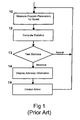
- FIG. 1 A flowchart of a generic monitoring system as described by the published prior art is shown in Fig. 1.
- Block 12 provides for the computation of test statistics at the next sample interval, but, if the likelihood is sufficiently low, a signal is issued to take corrective action on the process, either manually or automatically.
- Block 14 provides for determining contributions to the test statistics. Information to direct appropriate actions is displayed. The final block shown in the figure, Block 15, provides for corrective action to be taken to avert or mitigate the fault detected above. The system continues to loop through the algorithm starting again at Block 10.
- the invention is an on-line monitoring and fault detection method and system for a continuous casting process based on the application of a multivariate model of normal process operation as specified in claims 1 and 35 respectively. Additional aspects of the invention deal specifically with on-line system implementation and model development not found in the prior art.
- the invention relates to predicting the occurrence of improper solidification of the steel in a caster mould.
- This prediction process is based on a multivariate statistical model of normal caster operation.
- the model is developed using the statistical modelling technique, Principal Components Analysis (PCA).
- PCA is a method of decomposing a matrix of data into a set of vectors and scalars. This method yields a model that projects the original data onto fewer variables without loss of information.
- the model results are then used to calculate test statistics from which the condition of the caster may be inferred. If the condition warrants, the system will generate warnings and alarms so that corrective action may be taken. This action may be taken manually by the operator or may be automatically controlled by output signals from the system.
- the invention includes the following aspects that arise solely in the case of on-line implementation;
- the invention includes the process used to develop a model for the system, a prerequisite for successful on-line implementation.
- This process includes the process used to develop a model for the system, a prerequisite for successful on-line implementation.
- aspects to this process that are critical to the performance of the system, including:
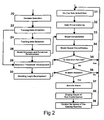
- FIG. 2 A flowchart specific to this system and including the points described above is shown in Fig. 2. Notable differences from Fig. 1 include model development and system implementation features.
- the monitoring system implementation portion of the flowchart in Fig. 2 differs from the generic case as described in prior art and seen in Fig. 1, with the addition of the following steps:
- the invention is an on-line monitoring and fault detection system for a continuous casting process based on the application of a multivariate model of normal process operation.
- additional aspects of the invention include the process by which the model is developed.
- the first step in this process identified by numeral 20 in Fig. 2, is determining which variables to include in the model.
- the calculated clogging index is the only input that is not directly measured. It is derived from the ratio of the actual position to the predicted position of the control valve controlling the flow of hot metal from the tundish into the mould to regulate the mould level.
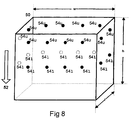
- Fig. 8 shows a typical mould thermocouple configuration.
- a mould 50 is drawn having a variable width w, a fixed length l, and a fixed height h, the resulting casting having a cross-section defined by the width w and length l, and the casting direction from the top of the mould to the bottom of the mould being indicated by arrow 52, parallel to the height h of the mould.
- thermocouples 54 are distributed around the mould 50 in two rings, thermocouples in an upper ring are indicated as 54u and thermocouples in a lower ring are indicated as 54l.
- thermocouples 54u in the upper ring are equally spaced from each other along the width and length of the mould 50 at a predetermined upper height and the thermocouples 54l in the lower ring are equally spaced from each other along the width and length of the mould 50 at a predetermined lower height, approximately 150 mm below the thermocouples 54u in the upper ring.
- the lower thermocouples 54l are placed directly below the upper ones 54u to form vertical pairs.
- the sampling rate of the data is no less than once per second for the on-line system to be effective, and preferably no less than twice per second.
- PCA Principal Component Analysis
- the width of the mould (50) is modified by moving the narrow faces in and out.
- the relevance of the signals provided by the outer thermocouples on the broad faces of the mould depends on the mould width.
- the grade of steel or recipe determines the process behaviour due to changes in material properties.
- the main concern is the effect of casting peritectic grades (Medium Carbon) on process stability and how these grades affect the variability of the process signals.
- thermocouples Since the number of active thermocouples changes with cast width, i.e., more thermocouples are active on the widest product than when cast width is small, this effectively changes the number of inputs to the model and affects the structure of the model. Hence, separate PCA models are required for each predetermined cast width range. The number of models is determined by the number of operating regimes, each with a distinct number of active thermocouples.
- the number of models required for the system is determined by the number of models required to cover distinct operating regimes over the width range of the caster.
- the # 1 Caster at the premises of Dofasco Inc., Hamilton, Ontario, Canada, two models are required, one for wide slabs and one for narrow slabs, each covering the range of operating speed.
- Model selection in the on-line system is based on the measured mould width.
- Off-line data collection identified by numeral 22 in Fig. 2 and pre-processing to create a training data set identified by numeral 24 in Fig. 2 are required to develop the models identified by numeral 26 in Fig. 2 characterizing normal casting conditions.
- Partitioning of the data refers to categorizing the data 22 into periods of normal and abnormal operation. Numerous periods of trouble-free operation are included to determine the model for normal operation. Several specific criteria for normal operation are used for partitioning. These include:
- the training data set is selected 24 such that it spans the range of operation i.e., data are included from the entire range of width and speed conditions, unlike the restricted subset of data considered in previous work.
- the data must also be balanced over the range of operation. This ensures that the model fits equally well over the entire operating window and is not biased to specific conditions.
- the width range spans 800 mm to 1200 mm; for the wide model, the range is from 1200 mm to 1630 mm.
- the speed range is from 600 mm/min to the maximum recorded speed for the given width range.
- data from both stable and transient operation are included to cover both static and dynamic operating conditions. Including data from periods of operation where the cast speed was ramping up or down, provides additional information on process behavior and allows the system to recognize this as normal variation. Similarly, data from periods of operation where the mould width was changing, were included in the training data set. This is in keeping with the underlying point that the training set contains only data characteristic of normal operation, i.e., data that should not generate an alarm in the monitoring system.
- the individual data sets that meet the criteria outlined above contain 300 samples taken over a 150-second window of operation. These sets are then concatenated to construct a large matrix of observations used for model development.
- the selection of the number of significant components in the output vector T of scores from the PCA model determines the performance of the system.
- the objective in selecting the number of components is to maximize the information content of the model with the fewest number of components.
- the number of significant components is determined by the training data 24 but is selected such that the model explains at least 80% of the variation in the data. A choice was made to select five components for the on-line system and this was based on the fact that over 80% of the variation was explained and adding more components would not increase that number significantly.
- the detection thresholds identified by numeral 28 in Fig. 1 for the test statistics are determined by the process data 22.
- the test statistics follow a known distribution, but, if the theoretical value is used, the system tends to alarm excessively.
- the detection values are derived using off-line simulation. For the purposes of simulation, it is required to distinguish between normal and abnormal operation and identify the data as such.
- the data are then used to simulate the operation of the caster and generate model outputs and subsequently test statistics.
- the simulation results indicate the levels of the test statistics and allow for the selection of threshold levels. The goal is to find levels such that the system does not alarm under normal operating conditions and always alarms under abnormal operation. Practically, this is not achievable but an optimal level can be determined based on the relative costs of erring on either side.
- the present thresholds provide a long-term alarm rate of under 2% for all of the test statistics.
- On-line implementation includes the integration of the off-line models in a monitoring system that runs on a computer that has access to process data 31 of the kind described above, in real time at a sampling rate of twice per second.
- the process data 31 is pre-processed at step 32 to provide filtered values, lagged and computed data.
- the monitoring system computes score values in step 33 with the model 26 developed using the training data set 24. It then takes the results of the model calculations 33 and calculates tests statistics in step 34.
- the statistics provide information on how the present operation conforms to the model, or the training data set 24 and, hence, infers the condition of the caster.
- the results are presented graphically in step 37 on a computer screen and provide visible and audible signals to the equipment operator.
- FIG. 7 The physical components for such a system 60 are shown schematically in Fig. 7.
- a continuous caster is indicated generally by reference numeral 62 and is coupled to diagnostic instruments which include inter alia thermocouples 54, water flow gauges, and the like to provide process data 31 which is input into a monitoring system computer 64.
- the monitoring system computer 64 has a data collection device to acquire both off-line measurements of process parameters 22 used to create the multivariate statistical model 26 and to acquire on-line measurements of process data 31.
- the computer 64 has computational devices configured to calculate a matrix P of coefficients using principal components analysis (PCA), to generate a vector T of scores, and to define a selected number n of significant components in said vector T. Further computations are done using the computer 64 to generate detection thresholds 28, to calculate test statistics 34 from the on-line process data 31 and to make comparisons 35 of the test statistics to the detection thresholds 28.
- the computer 64 is configured to generate an alarm in accordance with predefined criteria developed off-line 30, as indicated by step 36 in Fig. 2, and the alarm comprises a visual display unit 66 and a horn 68 coupled to the computer 64.
- Data are continuously sampled and input to the computer 64 which is also configured to store past readings which may be used in the model calculations, and to filter data, as required.
- the computer 64 will provide data to the visual display unit 66 which includes graphical, diagnostic information to allow an operator to monitor the system 60 and take corrective action, as required.
- the computer 64 also has control means whereby the caster speed may be automatically adjusted in accordance with pre-determined alarming thresholds without any operator intervention being required.
- Pre-processing 32 is done in the form of filtering specific signals to address non-stationary or shifts in the process.
- a method of compensating for shifts in absolute temperature in the thermocouples was required for on-line implementation.
- the method devised to address this employs an Exponentially Weighted Moving Average, EWMA, filter to dynamically calculate the mean of the thermocouple readings.
- EWMA Exponentially Weighted Moving Average
- This calculated mean is then extracted from the thermocouple temperatures to generate a deviation signal used by the model.
- This method is also employed on the cooling water flows and temperatures.
- the signals above are the only ones exhibiting shifts and have the filtering applied. The other signals are not filtered as this would lead to loss of information.
- the system 60 can tag the input as missing and work with the balance of the inputs to provide monitoring and alarming as usual without the annoyance of false alarms. This is done in the model by modifying the model parameters to ignore the contribution of the missing data and increase the contribution from the valid data to provide results that are consistent with a full set of data.
- the method for compensating for the missing or invalid element in the input data vector involves setting the corresponding model coefficients to zero for each component.
- the remaining coefficients for each component are then inflated so that the sum of their squared values equals 1. This can be thought of as using the model to predict the missing value, then using that predicted value in place of the missing value in the monitoring system. Once the signal is restored to its normal state, it will be tagged as such and used in the monitoring system. This can be done for any of the input signals and it is mostly used for thermocouples that have failed in service. Other instances for use include treating the mould level signal as missing when the sensor is being calibrated and at the start of a cast sequence prior to receiving a valid tundish temperature, when the signal is marked as missing.
- the model to be used by the system at any given time is determined by the actual width of the strand. In fact, all models are continuously calculated, the width determines which of the outputs will be selected for detection, display, and alarming. This method provides a smooth transition between the two distinct operating regimes. In keeping with the definition of the training tests, the model switches between wide and narrow at a cast width of 1200 mm.
- the scores in vector T have known statistical properties and can be used to test for probability or likelihood of an abnormal occurrence.
- the first score contains most of the information and, hence, is tested on its own using a univariate statistical test, the Hotelling T test for univariate distributions.
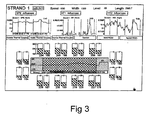
- This signal is depicted as HT1 in the monitoring system and can be seen as the middle plot in the upper third of the main display screen shown in Fig. 3.
- the subsequent significant scores are combined to form a multivariate statistic that is tested against a single multivariate statistical distribution using another Hotelling T test adapted tor multivariate distributions.
- This signal is depicted as HT2 in the system and can be seen as the right-most plot in the upper third of the main display screen shown in Fig. 3.
- SPE Squared Prediction Error
- the on-line monitoring system generates a vector of scores 33 from a large number of variables in the input data 31, based on the PCA model parameters 26. From those scores and other internal model calculations, the monitoring system then generates univariate and multivariate summary statistics (step 34) that are tested in step 35 against thresholds developed (step 28) during model development using historical data 20.
- step 35 The detection results from step 35 described above are passed along to the alarm screens for further processing in step 36, if minimum thresholds of normal behaviour are not met. Filtering logic is applied to the detection results to ensure the validity of the alarm.
- the alarming logic determines if the alarm is persistent before issuing a visual and/or audible warning. Any alarm condition has to persist for at least five samples (2.5 seconds) prior to any indication of an alarm on a system operator screen.
- the system provides a quantitative signal of a range of casting conditions from "normal” to "breakout highly likely”. This gives the operator the maximum amount of information on the casting process and the maximum amount of lead time to take appropriate action when required.
- the system may be tuned to provide three specific alarm levels based on the results of the model, as follows:
- the system operator screen has a hierarchy of displays.
- the highest level of which an example is shown in Fig. 3, includes plots of the test statistics HT1, HT2 and SPE along with some operating parameters.
- the screen layout is such that the three summary statistics are plotted on the upper third of the screen in separate line charts.
- Above each chart is a selection area that provides access to the respective second level screens as described with reference to subsequent figures.
- the bottom two thirds of the screen are dedicated to displaying information from the mould level sensor in the form of a line chart and the individual mould thermocouples in the form of bar charts distributed in pairs around the perimeter of the mould.
- other data are displayed at the top of the screen numerically. These data include casting speed, strand width, mould level, cast length.
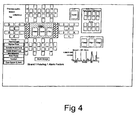
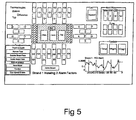
- the next second level screens includes the diagnostic screens for each of the test statistics, Figs. 4, 5, and 6, that show the contribution of the process variables used as input to the model.
- the contributions are shown in the form of colour coded bar charts that indicate the level and sense of contribution.
- the screen layout is such that the mould thermocouples and the differences between vertical pairs are distributed around the perimeter of a schematic of the mould. Other variables are grouped on the screens to provide an organized presentation.
- the second level screens also include a selection area to return to the first level alarm screen shown in Fig. 3. Selection areas are also included to provide access to trend plots of the process variables.
- the following third level (not shown) is comprised of time traces of the process variables, either grouped or individually.
- each of the test statistics is displayed as a graphical trend plot on the upper third of the computer screen.
- These plots show past values of the statistics and provide an indication of the evolution of the signal over time.
- the plots have been normalized such that a value of 1.0 corresponds to the individual threshold.
- SPE, HT1 and HT2 if the value is between 0 and 0.8, the condition of the caster is considered normal. If the value falls between 0.8 and 1.0, a warning is issued and the plot background changes to amber. If the value is over 1.0, the plot background turns red and an audible alarm message is issued.
- contribution plots are generated in step 38 for each of the three statistics. These plots form the second level of the hierarchy of screens and indicate which of the original process variables contribute to the warning or alarm condition. This information is displayed graphically and is accessed by selecting the plot of the offending statistic. Figs. 4 through 6 show examples of contribution plots for HT1, HT2 and SPE respectively. This information is very helpful in isolating the location of an impending breakout and in determining the cause of an abnormal condition. This information is used to direct the operator to the appropriate trend plot of the original variables in the next level of the screen hierarchy, and to take corrective action, as necessary, by slowing the speed of the casting machine to avoid the incidence of a shell rupture leaving the mould (step 39).
- the system may also generate output signals automatically to avert or mitigate the alarm condition, typically, by controlling the speed of the caster.
- a caster breakout prediction system using a multivariate model of the process requires the availability of the process measurements described above to a computer.
- the computer is used to calculate model outputs and statistics that are compared to thresholds to generate an output that can be used to take evasive action to avoid the breakout.
- An example of such a system, and the steps required to develop it, are shown in Fig. 2.
- Model development is done off-line using historical data. Alarming thresholds are also determined during this development (step 30).
- the system that monitors the caster uses the model developed above to calculate values that are checked against the alarming thresholds and generates the appropriate output.
- a data matrix, X is constructed with each row containing an observation, i.e., values of the process variables for the same instant in time. These observations are taken from various periods of normal operation. PCA is then used to decompose the matrix X, T X and determine the number of significant components. A wide range of normal operating data, including different casting speeds and steel slab widths are used to generate the model. The resultant model provides sets of weightings that are used to generate principal component values for each multivariate observation.
- the multivariate statistical model-based breakout prediction system operates as follows. Process measurements are read every half-second. Using these and previous process measurements, the data are used as input to the multivariate statistical model. The model output is used to calculate statistics and provide a quantitative measure of the status of casting conditions. The results are graphically displayed to the operator as continuous trends. These trends provide a quantitative signal on the status of casting conditions over a period of time as shown in Fig. 3.
- Figs. 4, 5, and 6 show the graphical diagnostic displays for the three test statistics. These diagnostic displays are accessed by selecting the appropriate option on the main alarm screen, shown in Fig. 3.
- the system may also generate output signals to automatically avert or mitigate an alarm condition, typically, by controlling the speed of the caster.
- monitoring of a continuous caster may be done in order to take corrective action to prevent a breakout but could also be done in order to allow analysis of the effect of changing input parameters such as steel composition and to thereby allow the operation to be performed without undue experimentation.
Landscapes
- Engineering & Computer Science (AREA)
- Physics & Mathematics (AREA)
- Automation & Control Theory (AREA)
- Evolutionary Computation (AREA)
- Mathematical Physics (AREA)
- General Physics & Mathematics (AREA)
- Artificial Intelligence (AREA)
- Mechanical Engineering (AREA)
- Testing And Monitoring For Control Systems (AREA)
- Continuous Casting (AREA)
- Measuring Temperature Or Quantity Of Heat (AREA)
- Pharmaceuticals Containing Other Organic And Inorganic Compounds (AREA)
- Management, Administration, Business Operations System, And Electronic Commerce (AREA)
Applications Claiming Priority (3)
| Application Number | Priority Date | Filing Date | Title |
|---|---|---|---|
| US9358398P | 1998-07-21 | 1998-07-21 | |
| US93583P | 1998-07-21 | ||
| PCT/CA1999/000647 WO2000005013A1 (en) | 1998-07-21 | 1999-07-20 | Multivariate statistical model-based system for monitoring the operation of a continuous caster and detecting the onset of impending breakouts |
Publications (2)
| Publication Number | Publication Date |
|---|---|
| EP1021263A1 EP1021263A1 (en) | 2000-07-26 |
| EP1021263B1 true EP1021263B1 (en) | 2004-11-03 |
Family
ID=22239727
Family Applications (1)
| Application Number | Title | Priority Date | Filing Date |
|---|---|---|---|
| EP99928977A Expired - Lifetime EP1021263B1 (en) | 1998-07-21 | 1999-07-20 | Multivariate statistical model-based system for monitoring the operation of a continuous caster and detecting the onset of impending breakouts |
Country Status (9)
| Country | Link |
|---|---|
| US (1) | US6564119B1 (enExample) |
| EP (1) | EP1021263B1 (enExample) |
| JP (1) | JP2002521201A (enExample) |
| AT (1) | ATE281260T1 (enExample) |
| AU (1) | AU747265B2 (enExample) |
| CA (1) | CA2301829C (enExample) |
| DE (1) | DE69921602T2 (enExample) |
| MX (1) | MXPA00002784A (enExample) |
| WO (1) | WO2000005013A1 (enExample) |
Cited By (4)
| Publication number | Priority date | Publication date | Assignee | Title |
|---|---|---|---|---|
| EP1979794A4 (en) * | 2006-02-03 | 2010-03-17 | Rech 2000 Inc | INTELLIGENT MONITORING SYSTEM AND METHOD FOR BUILDING PREDICTIVE MODELS AND DETECTING ANOMALIES |
| CN101344460B (zh) * | 2007-08-10 | 2010-05-19 | 上海海事大学 | 水下机器人传感器故障诊断方法及系统 |
| CN109570464A (zh) * | 2019-01-21 | 2019-04-05 | 中南大学 | 一种模拟薄带连铸结晶器初始凝固的装置及方法 |
| EP3547057B1 (en) * | 2018-03-30 | 2025-11-26 | Omron Corporation | Abnormality detection system, support device, and abnormality detection method |
Families Citing this family (59)
| Publication number | Priority date | Publication date | Assignee | Title |
|---|---|---|---|---|
| ATE377209T1 (de) * | 2001-05-25 | 2007-11-15 | Parametric Optimization Soluti | Verbesserte prozesssteuerung |
| JP2004047885A (ja) * | 2002-07-15 | 2004-02-12 | Matsushita Electric Ind Co Ltd | 半導体製造装置のモニタリングシステム及びモニタリング方法 |
| CA2414167A1 (en) * | 2002-12-12 | 2004-06-12 | Dofasco Inc. | Method and online system for monitoring continuous caster start-up operation and predicting start cast breakouts |
| EP1639632B1 (en) * | 2003-05-16 | 2017-06-07 | Tokyo Electron Limited | Method of monitoring a processing system |
| US7729789B2 (en) * | 2004-05-04 | 2010-06-01 | Fisher-Rosemount Systems, Inc. | Process plant monitoring based on multivariate statistical analysis and on-line process simulation |
| US7444197B2 (en) | 2004-05-06 | 2008-10-28 | Smp Logic Systems Llc | Methods, systems, and software program for validation and monitoring of pharmaceutical manufacturing processes |
| US7799273B2 (en) | 2004-05-06 | 2010-09-21 | Smp Logic Systems Llc | Manufacturing execution system for validation, quality and risk assessment and monitoring of pharmaceutical manufacturing processes |
| US6885907B1 (en) * | 2004-05-27 | 2005-04-26 | Dofasco Inc. | Real-time system and method of monitoring transient operations in continuous casting process for breakout prevention |
| CA2469975C (en) * | 2004-06-04 | 2013-09-17 | Falconbridge Limited | System and method for furnace monitoring and control |
| US20060047351A1 (en) * | 2004-08-27 | 2006-03-02 | Alan Hugo | Process controller output and alarm setting evaluation |
| US7349746B2 (en) * | 2004-09-10 | 2008-03-25 | Exxonmobil Research And Engineering Company | System and method for abnormal event detection in the operation of continuous industrial processes |
| US7567887B2 (en) * | 2004-09-10 | 2009-07-28 | Exxonmobil Research And Engineering Company | Application of abnormal event detection technology to fluidized catalytic cracking unit |
| US20060074598A1 (en) * | 2004-09-10 | 2006-04-06 | Emigholz Kenneth F | Application of abnormal event detection technology to hydrocracking units |
| US7424395B2 (en) * | 2004-09-10 | 2008-09-09 | Exxonmobil Research And Engineering Company | Application of abnormal event detection technology to olefins recovery trains |
| US7680549B2 (en) * | 2005-04-04 | 2010-03-16 | Fisher-Rosemount Systems, Inc. | Diagnostics in industrial process control system |
| KR20080040694A (ko) * | 2005-07-07 | 2008-05-08 | 엠케이에스 인스트루먼츠, 인코포레이티드 | 공정 환경에서 동적 파라미터를 모니터하기 위한 자기 보정다변량 분석 |
| CN100402190C (zh) * | 2005-11-03 | 2008-07-16 | 上海梅山钢铁股份有限公司 | 一种连铸坯表面目标温度监控分析方法及其装置 |
| DE102006002602A1 (de) | 2006-01-13 | 2007-07-19 | Fraunhofer-Gesellschaft zur Förderung der angewandten Forschung e.V. | Kalibrierungsverfahren und Kalibrierungssystem |
| US7761172B2 (en) * | 2006-03-21 | 2010-07-20 | Exxonmobil Research And Engineering Company | Application of abnormal event detection (AED) technology to polymers |
| US7720641B2 (en) * | 2006-04-21 | 2010-05-18 | Exxonmobil Research And Engineering Company | Application of abnormal event detection technology to delayed coking unit |
| WO2008042739A2 (en) * | 2006-09-29 | 2008-04-10 | Fisher-Rosemount Systems, Inc. | On-line monitoring and diagnostics of a process using multivariate statistical analysis |
| US7853431B2 (en) * | 2006-09-29 | 2010-12-14 | Fisher-Rosemount Systems, Inc. | On-line monitoring and diagnostics of a process using multivariate statistical analysis |
| WO2008042758A2 (en) * | 2006-09-29 | 2008-04-10 | Fisher-Rosemount Systems, Inc. | Multivariate monitoring and diagnostics of process variable data |
| EP2097794B2 (en) * | 2006-11-03 | 2017-03-08 | Air Products and Chemicals, Inc. | System and method for process monitoring |
| US7680553B2 (en) * | 2007-03-08 | 2010-03-16 | Smp Logic Systems Llc | Methods of interfacing nanomaterials for the monitoring and execution of pharmaceutical manufacturing processes |
| WO2008137544A1 (en) | 2007-05-02 | 2008-11-13 | Mks Instruments, Inc. | Automated model building and model updating |
| CN101332499B (zh) * | 2007-06-28 | 2011-01-19 | 上海梅山钢铁股份有限公司 | 一种板坯连铸漏钢预报控制方法 |
| WO2009012354A1 (en) * | 2007-07-17 | 2009-01-22 | Clemson University | System and method to assess signal similarity with applications to diagnostics and prognostics |
| CN101842756A (zh) * | 2007-08-14 | 2010-09-22 | 国际壳牌研究有限公司 | 用于化工厂或精炼厂的连续、在线监视的系统与方法 |
| GB0717991D0 (en) * | 2007-09-15 | 2007-10-24 | Curvaceous Software Ltd | Multi-variable operations |
| DE102008028481B4 (de) | 2008-06-13 | 2022-12-08 | Sms Group Gmbh | Verfahren zur Vorhersage der Entstehung von Längsrissen beim Stranggießen |
| US8494798B2 (en) * | 2008-09-02 | 2013-07-23 | Mks Instruments, Inc. | Automated model building and batch model building for a manufacturing process, process monitoring, and fault detection |
| US8090676B2 (en) * | 2008-09-11 | 2012-01-03 | Honeywell International Inc. | Systems and methods for real time classification and performance monitoring of batch processes |
| US20110213486A1 (en) * | 2008-11-04 | 2011-09-01 | Sms Siemag Aktiengesellschaft | Method and device for controlling the solidification of a cast strand in a strand casting plant in startup of the injection process |
| WO2010075166A1 (en) * | 2008-12-23 | 2010-07-01 | Shell Oil Company | System and method for monitoring an industrial production process |
| US9069345B2 (en) * | 2009-01-23 | 2015-06-30 | Mks Instruments, Inc. | Controlling a manufacturing process with a multivariate model |
| CN102971755A (zh) * | 2010-01-21 | 2013-03-13 | 阿斯玛西格诺斯公司 | 用于慢性病管理的早期告警方法和系统 |
| US8862250B2 (en) | 2010-05-07 | 2014-10-14 | Exxonmobil Research And Engineering Company | Integrated expert system for identifying abnormal events in an industrial plant |
| TWI405627B (zh) * | 2010-05-07 | 2013-08-21 | China Steel Corp | Casting abnormal monitoring method |
| EP2453330A1 (de) | 2010-11-13 | 2012-05-16 | ABB Technology AG | Intelligente Visualisierung der Überwachung von Prozess- und/oder Anlagegrössen |
| US8855804B2 (en) | 2010-11-16 | 2014-10-07 | Mks Instruments, Inc. | Controlling a discrete-type manufacturing process with a multivariate model |
| US9541471B2 (en) | 2012-04-06 | 2017-01-10 | Mks Instruments, Inc. | Multivariate prediction of a batch manufacturing process |
| US9429939B2 (en) | 2012-04-06 | 2016-08-30 | Mks Instruments, Inc. | Multivariate monitoring of a batch manufacturing process |
| CN103984324B (zh) * | 2014-05-26 | 2017-01-18 | 中冶南方工程技术有限公司 | 一种基于启发式算法簇的炼钢连铸动态调度方法 |
| FR3023628A1 (fr) * | 2014-07-10 | 2016-01-15 | Airbus Helicopters | Procede et systeme de fusion d'indicateurs de surveillance d'un dispositif |
| US10606251B2 (en) * | 2015-01-24 | 2020-03-31 | Abb Schweiz Ag | Method for controlling a process plant using transition data |
| US10228685B2 (en) * | 2015-10-22 | 2019-03-12 | Globalfoundries Inc. | Use of multivariate models to control manufacturing operations |
| KR102384742B1 (ko) * | 2015-10-27 | 2022-04-07 | 삼성에스디에스 주식회사 | 센서 데이터를 이용한 이상 감지 장치 및 방법 |
| JP7009438B2 (ja) * | 2016-07-07 | 2022-01-25 | アスペン テクノロジー インコーポレイテッド | 時系列パターンモデルを用いて主要パフォーマンス指標(kpi)を監視するコンピュータシステム及び方法 |
| US20180017959A1 (en) * | 2016-07-13 | 2018-01-18 | Yokogawa Electric Corporation | Methods and systems for context based operator assistance for control systems |
| US10712733B2 (en) * | 2016-12-12 | 2020-07-14 | Mitsubishi Electric Research Laboratories, Inc. | Methods and systems for discovery of prognostic subsequences in time series |
| WO2018229870A1 (ja) * | 2017-06-13 | 2018-12-20 | 三菱電機株式会社 | 工具寿命検出装置および工具寿命検出方法 |
| CN113319259B (zh) * | 2021-06-07 | 2022-09-20 | 东北电力大学 | 一种基于空间-时序特征的黏结漏钢逻辑判断方法 |
| CN114871395B (zh) * | 2022-04-20 | 2024-04-02 | 河北敬业高品钢科技有限公司 | 薄带连铸中设备参数的控制方法及装置 |
| JP7871628B2 (ja) * | 2022-06-20 | 2026-06-09 | 大同特殊鋼株式会社 | 教師データ作成方法 |
| CN116449788A (zh) * | 2023-05-30 | 2023-07-18 | 湖南科技大学 | 一种钢厂铸坯生产过程故障检测与产能优化的方法 |
| CN116944446B (zh) * | 2023-07-27 | 2024-02-09 | 常州润来科技有限公司 | 一种水平连铸铜管坯工艺参数异常监测方法 |
| CN117077944A (zh) * | 2023-08-14 | 2023-11-17 | 同济大学 | 钢铁工艺及合同匹配动态调整方法、装置、电子设备及存储介质 |
| WO2025069984A1 (ja) * | 2023-09-27 | 2025-04-03 | Jfeスチール株式会社 | ブレークアウト予知方法及び連続鋳造機の操業方法 |
Family Cites Families (16)
| Publication number | Priority date | Publication date | Assignee | Title |
|---|---|---|---|---|
| US3478808A (en) * | 1964-10-08 | 1969-11-18 | Bunker Ramo | Method of continuously casting steel |
| US4235276A (en) * | 1979-04-16 | 1980-11-25 | Bethlehem Steel Corporation | Method and apparatus for controlling caster heat removal by varying casting speed |
| JPS6054138B2 (ja) * | 1981-01-08 | 1985-11-28 | 新日本製鐵株式会社 | 連続鋳造鋳型における鋳造鋼の介在物検出方法 |
| US4949777A (en) * | 1987-10-02 | 1990-08-21 | Kawasaki Steel Corp. | Process of and apparatus for continuous casting with detection of possibility of break out |
| US5020585A (en) | 1989-03-20 | 1991-06-04 | Inland Steel Company | Break-out detection in continuous casting |
| JPH04238662A (ja) * | 1991-01-09 | 1992-08-26 | Toshiba Mach Co Ltd | ダイカストマシンの鋳造データ表示方法 |
| US5257206A (en) * | 1991-04-08 | 1993-10-26 | Praxair Technology, Inc. | Statistical process control for air separation process |
| DE4338607B4 (de) | 1993-11-11 | 2005-10-06 | Siemens Ag | Verfahren und Vorrichtung zur Führung eines Prozesses in einem geregelten System |
| SE9304246L (sv) * | 1993-12-22 | 1995-06-23 | Asea Brown Boveri | Förfarande vid övervakning av multivariata processer |
| JP3035688B2 (ja) * | 1993-12-24 | 2000-04-24 | トピー工業株式会社 | 連続鋳造におけるブレークアウト予知システム |
| US5659667A (en) | 1995-01-17 | 1997-08-19 | The Regents Of The University Of California Office Of Technology Transfer | Adaptive model predictive process control using neural networks |
| DE59600581D1 (de) | 1995-04-03 | 1998-10-22 | Siemens Ag | Einrichtung zur durchbruch-früherkennung beim stranggiessen |
| US5859964A (en) * | 1996-10-25 | 1999-01-12 | Advanced Micro Devices, Inc. | System and method for performing real time data acquisition, process modeling and fault detection of wafer fabrication processes |
| US5819258A (en) | 1997-03-07 | 1998-10-06 | Digital Equipment Corporation | Method and apparatus for automatically generating hierarchical categories from large document collections |
| DE19718262A1 (de) * | 1997-04-30 | 1998-11-05 | Schenck Panel Production Syste | Verfahren und System zur Generierung eines Prozeßmodells eines technischen Problems |
| DE19725433C1 (de) * | 1997-06-16 | 1999-01-21 | Schloemann Siemag Ag | Verfahren und Vorrichtung zur Durchbruchfrüherkennung beim Stranggießen von Stahl mit einer oszillierenden Kokille |
-
1999
- 1999-07-20 CA CA002301829A patent/CA2301829C/en not_active Expired - Lifetime
- 1999-07-20 AU AU45978/99A patent/AU747265B2/en not_active Ceased
- 1999-07-20 JP JP2000560993A patent/JP2002521201A/ja active Pending
- 1999-07-20 US US09/508,969 patent/US6564119B1/en not_active Expired - Lifetime
- 1999-07-20 DE DE69921602T patent/DE69921602T2/de not_active Expired - Fee Related
- 1999-07-20 EP EP99928977A patent/EP1021263B1/en not_active Expired - Lifetime
- 1999-07-20 AT AT99928977T patent/ATE281260T1/de not_active IP Right Cessation
- 1999-07-20 WO PCT/CA1999/000647 patent/WO2000005013A1/en not_active Ceased
- 1999-07-20 MX MXPA00002784A patent/MXPA00002784A/es not_active IP Right Cessation
Non-Patent Citations (1)
| Title |
|---|
| SIVESSON P. ET AL: "Improvement of inner quality in continuously cast billets", IRONMAKING AND STEELMAKING, vol. 23, no. 6, 1996, pages 504 - 511 * |
Cited By (4)
| Publication number | Priority date | Publication date | Assignee | Title |
|---|---|---|---|---|
| EP1979794A4 (en) * | 2006-02-03 | 2010-03-17 | Rech 2000 Inc | INTELLIGENT MONITORING SYSTEM AND METHOD FOR BUILDING PREDICTIVE MODELS AND DETECTING ANOMALIES |
| CN101344460B (zh) * | 2007-08-10 | 2010-05-19 | 上海海事大学 | 水下机器人传感器故障诊断方法及系统 |
| EP3547057B1 (en) * | 2018-03-30 | 2025-11-26 | Omron Corporation | Abnormality detection system, support device, and abnormality detection method |
| CN109570464A (zh) * | 2019-01-21 | 2019-04-05 | 中南大学 | 一种模拟薄带连铸结晶器初始凝固的装置及方法 |
Also Published As
| Publication number | Publication date |
|---|---|
| CA2301829A1 (en) | 2000-02-03 |
| CA2301829C (en) | 2008-07-08 |
| AU4597899A (en) | 2000-02-14 |
| DE69921602T2 (de) | 2005-12-01 |
| JP2002521201A (ja) | 2002-07-16 |
| EP1021263A1 (en) | 2000-07-26 |
| MXPA00002784A (es) | 2005-08-16 |
| ATE281260T1 (de) | 2004-11-15 |
| WO2000005013A1 (en) | 2000-02-03 |
| US6564119B1 (en) | 2003-05-13 |
| DE69921602D1 (de) | 2004-12-09 |
| AU747265B2 (en) | 2002-05-09 |
Similar Documents
| Publication | Publication Date | Title |
|---|---|---|
| CA2301829C (en) | Multivariate statistical model-based system for monitoring the operation of a continuous caster and detecting the onset of impending breakouts | |
| EP1428598B1 (en) | Method and online system for monitoring continuous caster start-up operation and predicting start cast breakouts | |
| JP2019067461A (ja) | 動作プロセスを監視するシステム、方法、およびコンピュータ可読記憶媒体 | |
| CA2497489A1 (en) | Real-time system and method of monitoring transient operations in continuous casting process for breakout prevention | |
| CN112805561A (zh) | 炼钢-连铸工艺设备控制和状态分析方法及利用其的系统 | |
| US20150314368A1 (en) | Monitoring method for a continuous casting mould including building up a database | |
| Hore et al. | Neural network modelling to characterize steel continuous casting process parameters and prediction of casting defects | |
| KR20030020979A (ko) | 금속, 특히 강 연속 주조 장치의 지지 롤 스탠드에 장착된연속 주조 지지 롤의 피벗 베어링, 특히 롤러 베어링을감시하는 방법 및 장치 | |
| Zhang et al. | Integrated monitoring solution to start-up and run-time operations for continuous casting | |
| KR101840419B1 (ko) | 조질압연기 및 형상교정기 설비장애 예지 정비 시스템 및 방법 | |
| JP2023115740A (ja) | 異常検知装置、異常検知方法およびプログラム | |
| Normanton et al. | Mould thermal monitoring: a window on the mould | |
| JP6686947B2 (ja) | 高炉炉況状態判定装置及び高炉の操業方法 | |
| MXPA00000568A (es) | Compuestos absorbentes que comprenden materiales superabsorbentes. | |
| JP5055544B2 (ja) | プラント運転の時系列分析シートの表示方法およびプラント運転支援装置 | |
| Haapamäki et al. | Data Mining Methods in Hot Steel Rolling for Scale Defect Prediction. | |
| JPH06154982A (ja) | 連続鋳造の鋳型温度監視方法および装置 | |
| US6618691B1 (en) | Evaluation of alarm settings | |
| Marquez et al. | Automatic inspection system for rhomboidity in billets with artificial vision | |
| Korzi et al. | HD mold-A wide variety of caster assistance tools for enhanced product quality | |
| Zhang et al. | Start cast breakouts preventative prediction using multi-way PCA technology | |
| SOUZA et al. | Procedure to Evaluate Multivariate Statistical Process Control using ARIMA-ARCH Models (Theory and Methodology) | |
| Dudzic et al. | Multivariate statistical monitoring of a continuous steel slab caster | |
| Zhang et al. | Industrial Experience on Process Transition Monitoring for Continuous Steel Casting Operation | |
| JP7768462B1 (ja) | 連続鋳造機の異常診断方法及び異常診断装置 |
Legal Events
| Date | Code | Title | Description |
|---|---|---|---|
| PUAI | Public reference made under article 153(3) epc to a published international application that has entered the european phase |
Free format text: ORIGINAL CODE: 0009012 |
|
| 17P | Request for examination filed |
Effective date: 20000304 |
|
| AK | Designated contracting states |
Kind code of ref document: A1 Designated state(s): AT BE CH CY DE DK ES FI FR GB GR IE IT LI LU MC NL PT SE |
|
| 17Q | First examination report despatched |
Effective date: 20021029 |
|
| GRAP | Despatch of communication of intention to grant a patent |
Free format text: ORIGINAL CODE: EPIDOSNIGR1 |
|
| GRAS | Grant fee paid |
Free format text: ORIGINAL CODE: EPIDOSNIGR3 |
|
| GRAA | (expected) grant |
Free format text: ORIGINAL CODE: 0009210 |
|
| AK | Designated contracting states |
Kind code of ref document: B1 Designated state(s): AT BE CH CY DE DK ES FI FR GB GR IE IT LI LU MC NL PT SE |
|
| PG25 | Lapsed in a contracting state [announced via postgrant information from national office to epo] |
Ref country code: NL Free format text: LAPSE BECAUSE OF FAILURE TO SUBMIT A TRANSLATION OF THE DESCRIPTION OR TO PAY THE FEE WITHIN THE PRESCRIBED TIME-LIMIT Effective date: 20041103 Ref country code: LI Free format text: LAPSE BECAUSE OF FAILURE TO SUBMIT A TRANSLATION OF THE DESCRIPTION OR TO PAY THE FEE WITHIN THE PRESCRIBED TIME-LIMIT Effective date: 20041103 Ref country code: IT Free format text: LAPSE BECAUSE OF FAILURE TO SUBMIT A TRANSLATION OF THE DESCRIPTION OR TO PAY THE FEE WITHIN THE PRESCRIBED TIME-LIMIT;WARNING: LAPSES OF ITALIAN PATENTS WITH EFFECTIVE DATE BEFORE 2007 MAY HAVE OCCURRED AT ANY TIME BEFORE 2007. THE CORRECT EFFECTIVE DATE MAY BE DIFFERENT FROM THE ONE RECORDED. Effective date: 20041103 Ref country code: FR Free format text: LAPSE BECAUSE OF FAILURE TO SUBMIT A TRANSLATION OF THE DESCRIPTION OR TO PAY THE FEE WITHIN THE PRESCRIBED TIME-LIMIT Effective date: 20041103 Ref country code: FI Free format text: LAPSE BECAUSE OF FAILURE TO SUBMIT A TRANSLATION OF THE DESCRIPTION OR TO PAY THE FEE WITHIN THE PRESCRIBED TIME-LIMIT Effective date: 20041103 Ref country code: CH Free format text: LAPSE BECAUSE OF FAILURE TO SUBMIT A TRANSLATION OF THE DESCRIPTION OR TO PAY THE FEE WITHIN THE PRESCRIBED TIME-LIMIT Effective date: 20041103 Ref country code: BE Free format text: LAPSE BECAUSE OF FAILURE TO SUBMIT A TRANSLATION OF THE DESCRIPTION OR TO PAY THE FEE WITHIN THE PRESCRIBED TIME-LIMIT Effective date: 20041103 |
|
| REG | Reference to a national code |
Ref country code: GB Ref legal event code: FG4D |
|
| REG | Reference to a national code |
Ref country code: CH Ref legal event code: EP |
|
| REF | Corresponds to: |
Ref document number: 69921602 Country of ref document: DE Date of ref document: 20041209 Kind code of ref document: P |
|
| REG | Reference to a national code |
Ref country code: IE Ref legal event code: FG4D |
|
| PG25 | Lapsed in a contracting state [announced via postgrant information from national office to epo] |
Ref country code: SE Free format text: LAPSE BECAUSE OF FAILURE TO SUBMIT A TRANSLATION OF THE DESCRIPTION OR TO PAY THE FEE WITHIN THE PRESCRIBED TIME-LIMIT Effective date: 20050203 Ref country code: GR Free format text: LAPSE BECAUSE OF FAILURE TO SUBMIT A TRANSLATION OF THE DESCRIPTION OR TO PAY THE FEE WITHIN THE PRESCRIBED TIME-LIMIT Effective date: 20050203 Ref country code: DK Free format text: LAPSE BECAUSE OF FAILURE TO SUBMIT A TRANSLATION OF THE DESCRIPTION OR TO PAY THE FEE WITHIN THE PRESCRIBED TIME-LIMIT Effective date: 20050203 |
|
| PG25 | Lapsed in a contracting state [announced via postgrant information from national office to epo] |
Ref country code: ES Free format text: LAPSE BECAUSE OF FAILURE TO SUBMIT A TRANSLATION OF THE DESCRIPTION OR TO PAY THE FEE WITHIN THE PRESCRIBED TIME-LIMIT Effective date: 20050214 |
|
| NLV1 | Nl: lapsed or annulled due to failure to fulfill the requirements of art. 29p and 29m of the patents act | ||
| REG | Reference to a national code |
Ref country code: CH Ref legal event code: PL |
|
| PG25 | Lapsed in a contracting state [announced via postgrant information from national office to epo] |
Ref country code: LU Free format text: LAPSE BECAUSE OF NON-PAYMENT OF DUE FEES Effective date: 20050720 Ref country code: IE Free format text: LAPSE BECAUSE OF NON-PAYMENT OF DUE FEES Effective date: 20050720 Ref country code: GB Free format text: LAPSE BECAUSE OF NON-PAYMENT OF DUE FEES Effective date: 20050720 Ref country code: CY Free format text: LAPSE BECAUSE OF FAILURE TO SUBMIT A TRANSLATION OF THE DESCRIPTION OR TO PAY THE FEE WITHIN THE PRESCRIBED TIME-LIMIT Effective date: 20050720 |
|
| PG25 | Lapsed in a contracting state [announced via postgrant information from national office to epo] |
Ref country code: MC Free format text: LAPSE BECAUSE OF NON-PAYMENT OF DUE FEES Effective date: 20050731 |
|
| PLBE | No opposition filed within time limit |
Free format text: ORIGINAL CODE: 0009261 |
|
| STAA | Information on the status of an ep patent application or granted ep patent |
Free format text: STATUS: NO OPPOSITION FILED WITHIN TIME LIMIT |
|
| 26N | No opposition filed |
Effective date: 20050804 |
|
| EN | Fr: translation not filed | ||
| GBPC | Gb: european patent ceased through non-payment of renewal fee |
Effective date: 20050720 |
|
| REG | Reference to a national code |
Ref country code: IE Ref legal event code: MM4A |
|
| PG25 | Lapsed in a contracting state [announced via postgrant information from national office to epo] |
Ref country code: PT Free format text: LAPSE BECAUSE OF NON-PAYMENT OF DUE FEES Effective date: 20050403 |
|
| PGFP | Annual fee paid to national office [announced via postgrant information from national office to epo] |
Ref country code: AT Payment date: 20090723 Year of fee payment: 11 |
|
| PGFP | Annual fee paid to national office [announced via postgrant information from national office to epo] |
Ref country code: DE Payment date: 20090923 Year of fee payment: 11 |
|
| PG25 | Lapsed in a contracting state [announced via postgrant information from national office to epo] |
Ref country code: DE Free format text: LAPSE BECAUSE OF NON-PAYMENT OF DUE FEES Effective date: 20110201 |
|
| REG | Reference to a national code |
Ref country code: DE Ref legal event code: R119 Ref document number: 69921602 Country of ref document: DE Effective date: 20110201 |
|
| PG25 | Lapsed in a contracting state [announced via postgrant information from national office to epo] |
Ref country code: AT Free format text: LAPSE BECAUSE OF NON-PAYMENT OF DUE FEES Effective date: 20100720 |