EP1017888B1 - Melt spinning colored polycondensation polymers - Google Patents
Melt spinning colored polycondensation polymers Download PDFInfo
- Publication number
- EP1017888B1 EP1017888B1 EP98944857A EP98944857A EP1017888B1 EP 1017888 B1 EP1017888 B1 EP 1017888B1 EP 98944857 A EP98944857 A EP 98944857A EP 98944857 A EP98944857 A EP 98944857A EP 1017888 B1 EP1017888 B1 EP 1017888B1
- Authority
- EP
- European Patent Office
- Prior art keywords
- polyester
- filament
- liquid
- polymer
- dispersion
- Prior art date
- Legal status (The legal status is an assumption and is not a legal conclusion. Google has not performed a legal analysis and makes no representation as to the accuracy of the status listed.)
- Expired - Lifetime
Links
- 229920000642 polymer Polymers 0.000 title claims abstract description 58
- 238000002074 melt spinning Methods 0.000 title description 4
- 238000006068 polycondensation reaction Methods 0.000 title description 4
- 238000000034 method Methods 0.000 claims abstract description 56
- 239000007788 liquid Substances 0.000 claims abstract description 45
- 229920000728 polyester Polymers 0.000 claims abstract description 39
- 239000006185 dispersion Substances 0.000 claims abstract description 30
- 239000003086 colorant Substances 0.000 claims abstract description 26
- 238000009833 condensation Methods 0.000 claims abstract description 25
- 230000005494 condensation Effects 0.000 claims abstract description 25
- 238000004040 coloring Methods 0.000 claims abstract description 22
- 239000000155 melt Substances 0.000 claims abstract description 20
- -1 polyethylene terephthalate Polymers 0.000 claims abstract description 17
- 238000009987 spinning Methods 0.000 claims abstract description 16
- 229920000139 polyethylene terephthalate Polymers 0.000 claims abstract description 12
- 239000005020 polyethylene terephthalate Substances 0.000 claims abstract description 12
- 238000009835 boiling Methods 0.000 claims abstract description 9
- 230000015556 catabolic process Effects 0.000 claims abstract description 5
- 238000006731 degradation reaction Methods 0.000 claims abstract description 5
- 230000003301 hydrolyzing effect Effects 0.000 claims abstract description 5
- 239000000835 fiber Substances 0.000 claims description 22
- 239000004744 fabric Substances 0.000 claims description 13
- 239000000049 pigment Substances 0.000 claims description 11
- 239000000203 mixture Substances 0.000 claims description 7
- 239000004215 Carbon black (E152) Substances 0.000 claims description 5
- 229930195733 hydrocarbon Natural products 0.000 claims description 5
- 150000002430 hydrocarbons Chemical class 0.000 claims description 5
- 229920002292 Nylon 6 Polymers 0.000 claims description 4
- 238000001125 extrusion Methods 0.000 claims description 4
- 229920002302 Nylon 6,6 Polymers 0.000 claims description 3
- 239000000986 disperse dye Substances 0.000 claims description 3
- 238000002844 melting Methods 0.000 claims description 3
- 230000008018 melting Effects 0.000 claims description 3
- 238000001035 drying Methods 0.000 claims description 2
- 229920002215 polytrimethylene terephthalate Polymers 0.000 claims description 2
- 238000009736 wetting Methods 0.000 claims description 2
- 238000004804 winding Methods 0.000 claims 1
- 239000004594 Masterbatch (MB) Substances 0.000 description 28
- 230000008569 process Effects 0.000 description 14
- 239000000975 dye Substances 0.000 description 13
- 239000004753 textile Substances 0.000 description 10
- 230000008901 benefit Effects 0.000 description 6
- 230000000704 physical effect Effects 0.000 description 6
- 239000000654 additive Substances 0.000 description 5
- 230000000996 additive effect Effects 0.000 description 5
- 238000006243 chemical reaction Methods 0.000 description 5
- 238000005516 engineering process Methods 0.000 description 5
- 238000004519 manufacturing process Methods 0.000 description 5
- 239000003921 oil Substances 0.000 description 5
- XLYOFNOQVPJJNP-UHFFFAOYSA-N water Substances O XLYOFNOQVPJJNP-UHFFFAOYSA-N 0.000 description 5
- 235000004879 dioscorea Nutrition 0.000 description 3
- 231100000647 material safety data sheet Toxicity 0.000 description 3
- 239000011159 matrix material Substances 0.000 description 3
- 238000012545 processing Methods 0.000 description 3
- 238000010586 diagram Methods 0.000 description 2
- 230000000694 effects Effects 0.000 description 2
- 231100001261 hazardous Toxicity 0.000 description 2
- 239000004615 ingredient Substances 0.000 description 2
- 239000000463 material Substances 0.000 description 2
- 238000002156 mixing Methods 0.000 description 2
- 238000006116 polymerization reaction Methods 0.000 description 2
- RZVAJINKPMORJF-UHFFFAOYSA-N Acetaminophen Chemical compound CC(=O)NC1=CC=C(O)C=C1 RZVAJINKPMORJF-UHFFFAOYSA-N 0.000 description 1
- 229920013683 Celanese Polymers 0.000 description 1
- LFQSCWFLJHTTHZ-UHFFFAOYSA-N Ethanol Chemical compound CCO LFQSCWFLJHTTHZ-UHFFFAOYSA-N 0.000 description 1
- OFOBLEOULBTSOW-UHFFFAOYSA-N Malonic acid Chemical compound OC(=O)CC(O)=O OFOBLEOULBTSOW-UHFFFAOYSA-N 0.000 description 1
- 240000007817 Olea europaea Species 0.000 description 1
- 239000004721 Polyphenylene oxide Substances 0.000 description 1
- 230000002411 adverse Effects 0.000 description 1
- 238000003915 air pollution Methods 0.000 description 1
- 125000001931 aliphatic group Chemical group 0.000 description 1
- 229920003232 aliphatic polyester Polymers 0.000 description 1
- 238000004458 analytical method Methods 0.000 description 1
- 238000013459 approach Methods 0.000 description 1
- 229920005601 base polymer Polymers 0.000 description 1
- IISBACLAFKSPIT-UHFFFAOYSA-N bisphenol A Chemical class C=1C=C(O)C=CC=1C(C)(C)C1=CC=C(O)C=C1 IISBACLAFKSPIT-UHFFFAOYSA-N 0.000 description 1
- 231100000481 chemical toxicant Toxicity 0.000 description 1
- 238000004891 communication Methods 0.000 description 1
- 230000000052 comparative effect Effects 0.000 description 1
- 238000007796 conventional method Methods 0.000 description 1
- 229920001577 copolymer Polymers 0.000 description 1
- 238000012937 correction Methods 0.000 description 1
- 230000001186 cumulative effect Effects 0.000 description 1
- 230000003247 decreasing effect Effects 0.000 description 1
- 230000001419 dependent effect Effects 0.000 description 1
- OEBRKCOSUFCWJD-UHFFFAOYSA-N dichlorvos Chemical compound COP(=O)(OC)OC=C(Cl)Cl OEBRKCOSUFCWJD-UHFFFAOYSA-N 0.000 description 1
- 239000002270 dispersing agent Substances 0.000 description 1
- 150000002148 esters Chemical class 0.000 description 1
- RTZKZFJDLAIYFH-UHFFFAOYSA-N ether Substances CCOCC RTZKZFJDLAIYFH-UHFFFAOYSA-N 0.000 description 1
- LYCAIKOWRPUZTN-UHFFFAOYSA-N ethylene glycol Natural products OCCO LYCAIKOWRPUZTN-UHFFFAOYSA-N 0.000 description 1
- 230000002349 favourable effect Effects 0.000 description 1
- 230000005484 gravity Effects 0.000 description 1
- WGCNASOHLSPBMP-UHFFFAOYSA-N hydroxyacetaldehyde Natural products OCC=O WGCNASOHLSPBMP-UHFFFAOYSA-N 0.000 description 1
- 230000006872 improvement Effects 0.000 description 1
- 239000011256 inorganic filler Substances 0.000 description 1
- 229910003475 inorganic filler Inorganic materials 0.000 description 1
- 238000009940 knitting Methods 0.000 description 1
- 238000005259 measurement Methods 0.000 description 1
- 229910052751 metal Inorganic materials 0.000 description 1
- 239000002184 metal Substances 0.000 description 1
- 150000002739 metals Chemical class 0.000 description 1
- 239000000178 monomer Substances 0.000 description 1
- 230000009972 noncorrosive effect Effects 0.000 description 1
- 231100000252 nontoxic Toxicity 0.000 description 1
- 230000003000 nontoxic effect Effects 0.000 description 1
- 239000007800 oxidant agent Substances 0.000 description 1
- 238000004806 packaging method and process Methods 0.000 description 1
- 229920001707 polybutylene terephthalate Polymers 0.000 description 1
- 229920000570 polyether Polymers 0.000 description 1
- 238000004886 process control Methods 0.000 description 1
- 239000001044 red dye Substances 0.000 description 1
- 230000009467 reduction Effects 0.000 description 1
- 230000009291 secondary effect Effects 0.000 description 1
- 239000000126 substance Substances 0.000 description 1
- 229920002994 synthetic fiber Polymers 0.000 description 1
- 239000012209 synthetic fiber Substances 0.000 description 1
- 229920001059 synthetic polymer Polymers 0.000 description 1
- 239000003440 toxic substance Substances 0.000 description 1
- 238000011144 upstream manufacturing Methods 0.000 description 1
- 238000003911 water pollution Methods 0.000 description 1
- 238000009941 weaving Methods 0.000 description 1
Images


Classifications
-
- D—TEXTILES; PAPER
- D01—NATURAL OR MAN-MADE THREADS OR FIBRES; SPINNING
- D01F—CHEMICAL FEATURES IN THE MANUFACTURE OF ARTIFICIAL FILAMENTS, THREADS, FIBRES, BRISTLES OR RIBBONS; APPARATUS SPECIALLY ADAPTED FOR THE MANUFACTURE OF CARBON FILAMENTS
- D01F6/00—Monocomponent artificial filaments or the like of synthetic polymers; Manufacture thereof
- D01F6/58—Monocomponent artificial filaments or the like of synthetic polymers; Manufacture thereof from homopolycondensation products
- D01F6/60—Monocomponent artificial filaments or the like of synthetic polymers; Manufacture thereof from homopolycondensation products from polyamides
-
- D—TEXTILES; PAPER
- D01—NATURAL OR MAN-MADE THREADS OR FIBRES; SPINNING
- D01F—CHEMICAL FEATURES IN THE MANUFACTURE OF ARTIFICIAL FILAMENTS, THREADS, FIBRES, BRISTLES OR RIBBONS; APPARATUS SPECIALLY ADAPTED FOR THE MANUFACTURE OF CARBON FILAMENTS
- D01F1/00—General methods for the manufacture of artificial filaments or the like
- D01F1/02—Addition of substances to the spinning solution or to the melt
- D01F1/04—Pigments
-
- D—TEXTILES; PAPER
- D01—NATURAL OR MAN-MADE THREADS OR FIBRES; SPINNING
- D01F—CHEMICAL FEATURES IN THE MANUFACTURE OF ARTIFICIAL FILAMENTS, THREADS, FIBRES, BRISTLES OR RIBBONS; APPARATUS SPECIALLY ADAPTED FOR THE MANUFACTURE OF CARBON FILAMENTS
- D01F1/00—General methods for the manufacture of artificial filaments or the like
- D01F1/02—Addition of substances to the spinning solution or to the melt
- D01F1/06—Dyes
-
- D—TEXTILES; PAPER
- D01—NATURAL OR MAN-MADE THREADS OR FIBRES; SPINNING
- D01F—CHEMICAL FEATURES IN THE MANUFACTURE OF ARTIFICIAL FILAMENTS, THREADS, FIBRES, BRISTLES OR RIBBONS; APPARATUS SPECIALLY ADAPTED FOR THE MANUFACTURE OF CARBON FILAMENTS
- D01F6/00—Monocomponent artificial filaments or the like of synthetic polymers; Manufacture thereof
- D01F6/58—Monocomponent artificial filaments or the like of synthetic polymers; Manufacture thereof from homopolycondensation products
- D01F6/62—Monocomponent artificial filaments or the like of synthetic polymers; Manufacture thereof from homopolycondensation products from polyesters
-
- Y—GENERAL TAGGING OF NEW TECHNOLOGICAL DEVELOPMENTS; GENERAL TAGGING OF CROSS-SECTIONAL TECHNOLOGIES SPANNING OVER SEVERAL SECTIONS OF THE IPC; TECHNICAL SUBJECTS COVERED BY FORMER USPC CROSS-REFERENCE ART COLLECTIONS [XRACs] AND DIGESTS
- Y10—TECHNICAL SUBJECTS COVERED BY FORMER USPC
- Y10T—TECHNICAL SUBJECTS COVERED BY FORMER US CLASSIFICATION
- Y10T428/00—Stock material or miscellaneous articles
- Y10T428/29—Coated or structually defined flake, particle, cell, strand, strand portion, rod, filament, macroscopic fiber or mass thereof
- Y10T428/2913—Rod, strand, filament or fiber
- Y10T428/2915—Rod, strand, filament or fiber including textile, cloth or fabric
-
- Y—GENERAL TAGGING OF NEW TECHNOLOGICAL DEVELOPMENTS; GENERAL TAGGING OF CROSS-SECTIONAL TECHNOLOGIES SPANNING OVER SEVERAL SECTIONS OF THE IPC; TECHNICAL SUBJECTS COVERED BY FORMER USPC CROSS-REFERENCE ART COLLECTIONS [XRACs] AND DIGESTS
- Y10—TECHNICAL SUBJECTS COVERED BY FORMER USPC
- Y10T—TECHNICAL SUBJECTS COVERED BY FORMER US CLASSIFICATION
- Y10T428/00—Stock material or miscellaneous articles
- Y10T428/29—Coated or structually defined flake, particle, cell, strand, strand portion, rod, filament, macroscopic fiber or mass thereof
- Y10T428/2913—Rod, strand, filament or fiber
- Y10T428/2933—Coated or with bond, impregnation or core
- Y10T428/2964—Artificial fiber or filament
- Y10T428/2967—Synthetic resin or polymer
- Y10T428/2969—Polyamide, polyimide or polyester
-
- Y—GENERAL TAGGING OF NEW TECHNOLOGICAL DEVELOPMENTS; GENERAL TAGGING OF CROSS-SECTIONAL TECHNOLOGIES SPANNING OVER SEVERAL SECTIONS OF THE IPC; TECHNICAL SUBJECTS COVERED BY FORMER USPC CROSS-REFERENCE ART COLLECTIONS [XRACs] AND DIGESTS
- Y10—TECHNICAL SUBJECTS COVERED BY FORMER USPC
- Y10T—TECHNICAL SUBJECTS COVERED BY FORMER US CLASSIFICATION
- Y10T428/00—Stock material or miscellaneous articles
- Y10T428/31504—Composite [nonstructural laminate]
- Y10T428/31786—Of polyester [e.g., alkyd, etc.]
Definitions
- the present invention relates to methods of coloring synthetic polymer filament to form respective colored yarns and fabrics, and in particular relates to a method of melt spinning polycondensation polymers that are colored using liquid colored dispersions, and to the resulting colored polymer filament, yarns and fabrics.
- Synthetic fibers are used in a wide variety of textile applications including clothing and other fabric items which, although desirably white or natural in color in many circumstances, are also desirably manufactured and marketed in a variety of colors and patterns in other circumstances.
- polyester particularly polyethylene terephthalate (“PET)
- PET polyethylene terephthalate
- coloring yarns and fabrics are advantageous or desirable under some circumstances, coloring the initial fiber offers certain performance benefits such as improved fastness.
- coloring filament rather than yarns and fabrics tends to reduce secondary effects that must be dealt with to prevent air and water pollution that would otherwise be associated with various coloring processes.
- a "masterbatch” approach has been used to color fibers (or filaments) during the melt spinning process.
- the desired colorant is dispersed at a relatively highly concentrated level within a carrier polymer.
- the masterbatch of highly concentrated colored polymer is introduced to the melt spinning system of the polymer and blended with virgin polymer at a ratio that hopefully achieves the desired color.
- Condensation polymers offer particular challenges to the masterbatch system.
- a condensation polymer results from a reaction in which two monomers or oligomers react to form a polymer and water molecule. Because such reactions produce water, they are referred to as "condensation" reactions. Because of chemical equilibrium, however, the water must be continually removed from the polycondensation reaction, otherwise it tends to drive the reaction in the other direction; i.e., depolymerize the polymer. This results in a loss of molecular weight in the polymer which is referred to as hydrolytic degradation.
- the molecular weight (measured by the intrinsic viscosity or "IV") of polyester can easily be decreased by as much as 0.15dl/g (0.55-0.75 dl/g is considered a good viscosity for filament).
- IV intrinsic viscosity
- Masterbatch "chip” is generally introduced into the spinning process using several options each of which tends to provide an extra source of variation for the resulting molecular weight. Because there are several process steps during which molecular weight can be lost, the effect tends to be cumulative and significant. The overall effect is a significant reduction in the molecular weight of the filament that manifests itself as an orientation variability in the resulting yarn. In turn, the orientation variability produces a resulting variability in the physical properties of the yam such as elongation, tenacity, and draw force.
- EP 794222 discloses a dispersible additive for polymeric materials that comprises dispersant-coated pigments in a liquid non-aqueous polymeric carrier.
- EP 794222 also discloses an additive-containing polymer composition comprising a polymeric host and an additive system as above dispersed throughout the polymeric host.
- EP 794222 discloses a method of making a pigmented filaments comprising (i) supplying a melt flow of a melt-spinnable polymeric host to spinneret orifices; (ii) incorporating an additive as above in the melt of host upstream of the spinneret orifices; and (iii) extruding a melt of the mixture through the spinneret orifices to form pigmented filaments; and a method of continuously producing sequential lengths of different additive-containing, melt-spun filaments.
- EP 266754 discloses compositions for mass coloration of polyesters.
- the compositions comprise 100 parts by weight of a pigment and/or dye and 42-2000 parts by weight of a dispersing medium with an OH no. of not more than 25 mg KOH/g.
- the dispersing medium is (a) a liquid with a molecular weight of at least 700 and a viscosity of up to 150 Poise at 25°C and/or (b) a liquid polyester.
- the compositions contain 100-1500 parts by weight of the dispersing medium and 0-1400 parts by weight of an inorganic filler.
- the dispersing medium is (a) a polyether, a bisphenol A derivative, a polyester-ether, or an OH-terminal liquid polyester crosslinked with an aliphatic diisocyanate; or (b) a copolymer of an aliphatic dicarboxylic acid and an alkylene glycol, or an aliphatic polyester with at least one terminal group blocked with a monohydric alcohol.
- the present invention consists in a method of colouring melt spun condensation polymers while avoiding hydrolytic degradation and maintaining the melt viscosity of the polymer, the method comprising the steps of:
- colorant can be added to polyester and other condensation polymers while they are in the melt phase, without adversely reducing the molecular weight and resulting properties in the manner in which they are reduced by conventional processes.
- polyester filament comprising:
- the present invention is a method of coloring a melt-spun condensation polymer while avoiding the hydrolytic degradation and maintaining the melt viscosity of the polymer, and represents a significant improvement over conventional masterbatch processes. Such processes are schematically illustrated in Figures 1 and 2.
- FIG. 1 schematically illustrates the manufacture of the masterbatch chip.
- Chip from a dryer 10 and pigments or dyes from a hopper or other source 11 are added in a desired blend using an appropriate blender 12 or similar device to an extruder 13 which is conventionally a single or twin screw extruder.
- the source chips from the dryer 10 are the same as the polymer from which the eventual filament is to be made.
- polyester chips are used to form the masterbatch for polyester filaments and nylon 6 or nylon 66 chips are used as the masterbatch chips for those polymers.
- the coloring source whether pigment, dye or something else, is typically mixed with polymer chip in a fairly high proportion to form a relatively high color concentration.
- the polymer that is extruded is then quenched and pelletized in appropriate equipment designated at 14 to produce a masterbatch chip which is concentrated with the pigment or dye in amounts of between about 10 and 50% by weight.
- FIG 2 illustrates the manner in which the masterbatch chip is added to virgin polymer to form the final colored filament.
- the masterbatch chip produced in figure 1 is designated at 15 in Figure 2 and is typically distributed from a dryer 17.
- the "base" polymer chip is distributed from another dryer 16 from which it is blended from the masterbatch chip.
- the masterbatch chip and the base chip are mixed in the extruder from which they proceed to a manifold system broadly designated at 23 and then to an appropriate block, pack and spinneret designated together at 24, from which the polymer is spun into filaments 25 and then forwarded to an appropriate take-up system 26.
- the masterbatch chip from the dryer 17 can be forwarded to a side stream extruder 27 and thereafter pumped by the pump 28 to be mixed with the base polymer extruded just prior to the manifold system 23.
- Figure 3 illustrates the contrasting method of the present invention.
- the base chip is again taken from a dryer 30 and forwarded directly to the extruder 31.
- the method of the invention comprises adding a liquid dispersion 32 of the colorant directly to the base chip polymer either in the extruder or just prior to the manifold system.
- the liquid dispersion 32 can be pumped by pump 33 either to the extruder 31 or to a point just prior to the manifold system that is broadly designated at 34.
- the colored melt phase condensation polymer is spun into filament form using a block, pack, and spinneret broadly designated at 35 from which the filaments 36 are forwarded to appropriate take-up system 37 that typically includes various finishing and packaging steps.
- the invention is, of course, similarly useful in direct-coupled continuous polymerization and spinning systems that omit the chip-making and extrusion steps and instead direct the polymerized melt directly to the spinneret.
- the liquid dispersion of colorant can be added to a manifold system prior to the spinneret such as is illustrated at 34 in Figure 3.
- spinning refers to the manufacture of melt phase polymer into filament. In its other sense, “spinning” refers to the process of manufacturing yarns from staple fibers or sliver. Both senses of “spinning” are used herein, and will be easily recognized in context by those of ordinary skill in the art.
- the step of adding the liquid dispersion of colorant comprises adding an dispersion in which the liquid is organic, non-aqueous, soluble in polyester, and has a boiling point greater than the melting point of polyester (or other condensation polymer).
- the liquid preferably has a boiling point greater than about 300° C.
- the high boiling point of the dispersion liquid helps avoid generating gas in the polymer stream at the melt viscosity temperatures.
- the condensation polymers that can be colored according to the present invention can include polyethylene terephthalate, polybutylene terephthalate, poly(trimethylene terephthalate), other polyesters, nylon 6, and nylon 66.
- the colorant preferably comprises a thermally stable disperse dye or thermally stable pigment, and the combination of colorant and liquid in the dispersion are selected to have good wetting properties with respect to each other.
- Table 1 and Table 2 are related in that Table 1 summarizes the more detailed information presented in Table 2.
- Table 1 demonstrates, six types of examples of polyester filament that were colored according to the invention using red dye were compared against control standard filaments. The yarns were compared as partially oriented yarn (POY), flat drawn yarn, and draw textured (DTX) yarn. When compared as POY, the Dynafil and ⁇ E Lab results were both very favorable. As Table 1 demonstrates, the largest ⁇ E Lab was 0.58. Although color comparisons are necessarily somewhat subjective, those familiar with coloring processes are aware that a ⁇ E Lab of 1.0 or less is generally considered a very good color match.
- the breaking strengths are all very similar and indeed the difference is between the standard and the samples according to the invention are almost statistically negligible.
- elongation at break and tenacity for the flat drawn yarn according to the invention is favorably comparable with, and indeed almost identical to, that of standard uncolored yarn.
- the draw textured yarn showed similar consistent properties among breaking strength, elongation, and tenacity.
- Table 3 shows some properties for yams colored conventionally rather than according to the present invention.
- Table 4 compares the data of the conventionally colored yarn of Table 3 with yam colored according to the present invention of Tables 1 and 2. It will be noted that in each case the pre-aggregate tension (TI) of the yarn formed according to the invention is significantly superior to that of conventionally colored yarn. More importantly, the standard deviation and range of differences from the average is quite small for the liquid matrix technology of the present invention as compared to that for conventionally colored yarns.
- This uniformity among yarns produced according to the present invention is one of the significant advantages of the present invention in that various types of spinning, weaving and knitting machinery do not need to be continually readjusted to account for the differences in mechanical properties among yarns colored conventionally. Instead, the uniform physical properties in colored yarns offered by the present invention offers the end user the opportunity to use a variety of different colors of the same yarn with the knowledge that the yarn will behave consistently from color to color.
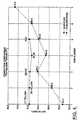
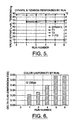
- Figures 4 through 9 are plots of certain of the data in Tables 1-4.
- Figure 4 plots pre-aggregate tensions for five yarns colored according to the present invention and seven colored conventionally.
- the tensions of yarns according to the present invention are remarkably consistent, while the tensions of the conventionally colored yarns vary over an undesirably wide range.
- Figure 5 shows the consistency in Dynafil measurements, post-aggregate tension, and the ratio of pre- and post-aggregate tensions as well as the consistency in pre-aggregate tension.
- Figure 6 plots the color uniformity data of Table 3.
- Figures 7, 8 and 9 respectively demonstrate the excellent yarn performance in terms of Breaking Strength, Elongation, and Tenacity, all of which are also summarized in the Tables.
- the liquid dispersion (also referred to as a "liquid matrix”) is that available from Colormatrix Corporation, 3005 Chester Avenue, Cleveland, Ohio 44114 and designated as Colormatrix LCPY-1: 82-89 Series.
- the preferred embodiment comprises various oils, esters, pigments and dyes of which the main named ingredient is refined hydrocarbon oil with various nontoxic pigments and dyes.
- the product does not contain reportable hazardous ingredients as defined by the OSHA hazard communication standard (29 CFR 1910.1200).
- the preferred liquid has a boiling range at atmospheric pressure of at least 260°C (500°F), negligible vapor pressure under the same conditions, a specific gravity of between 0.98 and 2.12 kg/l (8 to 18lbs per US gallon) and is insoluble in water.
- the liquid is chemically stable and hazardous polymerization does not occur.
- the liquid is non-corrosive with respect to metals, but is an oxidizer.
- the product is considered as an "oil" under the Clean Water Act. The product does not contain any toxic chemicals that would be subject to the reporting requirements of SARA Title III Section 313 and 40 CFR Part 372.
- the invention comprises the resorting polyester filament that includes polyethylene terephthalate, the coloring agent, and the non-aqueous organic liquid.
- the resulting filament is essentially identical in its physical properties to uncolored polyester (or other condensation polymer) filament.
- the filament properties are advantageously consistent with those of other polyesters, and indeed more consistent that those of polyester filaments colored using masterbatch processes.
- the filament does contain the non-aqueous organic liquid from the original liquid dispersion.
- the liquid's nature is such that it remains in the polymer matrix, but otherwise does not interfere with or modify the polymer chain. Accordingly, an appropriate analysis of the filament according to the present invention demonstrates that it includes polyethylene terephthalate, a colorant, and the non-aqueous organic liquid.
- the invention comprises staple fiber cut from the filament of the present invention and yarns formed from the cut staple fiber.
- the filament and fiber can be textured and the fiber can be blended with the fibers other than polyethylene terephthalate in otherwise conventional fashion to form fabrics, typically woven or knitted fabrics, from these yarns and fibers.
Landscapes
- Engineering & Computer Science (AREA)
- Chemical & Material Sciences (AREA)
- Chemical Kinetics & Catalysis (AREA)
- General Chemical & Material Sciences (AREA)
- Textile Engineering (AREA)
- Manufacturing & Machinery (AREA)
- Artificial Filaments (AREA)
- Spinning Methods And Devices For Manufacturing Artificial Fibers (AREA)
- Polyesters Or Polycarbonates (AREA)
- Polyoxymethylene Polymers And Polymers With Carbon-To-Carbon Bonds (AREA)
- Compositions Of Macromolecular Compounds (AREA)
- Multicomponent Fibers (AREA)
- Macromolecular Compounds Obtained By Forming Nitrogen-Containing Linkages In General (AREA)
Applications Claiming Priority (3)
| Application Number | Priority Date | Filing Date | Title |
|---|---|---|---|
| US929831 | 1997-09-15 | ||
| US08/929,831 US6110405A (en) | 1997-09-15 | 1997-09-15 | Melt spinning colored polycondensation polymers |
| PCT/US1998/019018 WO1999014407A1 (en) | 1997-09-15 | 1998-09-14 | Melt spinning colored polycondensation polymers |
Publications (2)
| Publication Number | Publication Date |
|---|---|
| EP1017888A1 EP1017888A1 (en) | 2000-07-12 |
| EP1017888B1 true EP1017888B1 (en) | 2003-11-12 |
Family
ID=25458526
Family Applications (1)
| Application Number | Title | Priority Date | Filing Date |
|---|---|---|---|
| EP98944857A Expired - Lifetime EP1017888B1 (en) | 1997-09-15 | 1998-09-14 | Melt spinning colored polycondensation polymers |
Country Status (9)
| Country | Link |
|---|---|
| US (2) | US6110405A (enExample) |
| EP (1) | EP1017888B1 (enExample) |
| JP (1) | JP2001516813A (enExample) |
| AT (1) | ATE254194T1 (enExample) |
| AU (1) | AU9230198A (enExample) |
| CA (1) | CA2304193A1 (enExample) |
| DE (1) | DE69819761D1 (enExample) |
| TW (1) | TW438916B (enExample) |
| WO (1) | WO1999014407A1 (enExample) |
Families Citing this family (27)
| Publication number | Priority date | Publication date | Assignee | Title |
|---|---|---|---|---|
| US6110405A (en) * | 1997-09-15 | 2000-08-29 | Wellman, Inc. | Melt spinning colored polycondensation polymers |
| TW522179B (en) * | 1999-07-12 | 2003-03-01 | Asahi Chemical Ind | Polyester yarn and producing method thereof |
| US6572803B1 (en) | 1999-09-21 | 2003-06-03 | Burke Mills, Inc. | Liquid color feed system for synthetic yarns |
| US6287688B1 (en) * | 2000-03-03 | 2001-09-11 | E. I. Du Pont De Nemours And Company | Partially oriented poly(trimethylene terephthalate) yarn |
| US6569991B2 (en) | 2000-12-15 | 2003-05-27 | Wellman, Inc. | Methods of post-polymerization extruder injection in polyethylene terephthalate production |
| US6500890B2 (en) | 2000-12-15 | 2002-12-31 | Wellman, Inc. | Polyester bottle resins having reduced frictional properties and methods for making the same |
| US6590069B2 (en) | 2000-12-15 | 2003-07-08 | Wellman, Inc. | Methods of post-polymerization extruder injection in condensation polymer production |
| US7759449B2 (en) * | 2000-12-15 | 2010-07-20 | Wellman, Inc. | Methods for introducing additives into polyethylene terephthalate |
| AU2002232590A1 (en) | 2000-12-15 | 2002-06-24 | Wellman, Inc. | Methods of post-polymerization injection in condensation polymer production |
| US6599596B2 (en) | 2000-12-15 | 2003-07-29 | Wellman, Inc. | Methods of post-polymerization injection in continuous polyethylene terephthalate production |
| GB2373256B (en) | 2001-03-14 | 2005-03-30 | Du Pont | Fabrics comprising melt spun yarns having high lustre |
| US20030039783A1 (en) * | 2001-03-30 | 2003-02-27 | Stafford Steven Lee | Polyesters and polyester containers having a reduced coefficient of friction and improved clarity |
| US20050046065A1 (en) * | 2003-08-30 | 2005-03-03 | Cowan Martin E. | Thermoplastic fibers exhibiting durable high color strength characteristics |
| DE102004039183B4 (de) * | 2004-08-12 | 2009-11-05 | Schill + Seilacher Ag | Trägerflüssigkeit für Wirkstoffkonzentrate und deren Verwendung |
| CN102400236B (zh) * | 2011-05-13 | 2014-08-27 | 上海容志材料科技有限公司 | 一种固体色母粒组合物、其制备方法及应用 |
| US10128090B2 (en) | 2012-02-22 | 2018-11-13 | Lam Research Corporation | RF impedance model based fault detection |
| US10157729B2 (en) | 2012-02-22 | 2018-12-18 | Lam Research Corporation | Soft pulsing |
| US9155182B2 (en) | 2013-01-11 | 2015-10-06 | Lam Research Corporation | Tuning a parameter associated with plasma impedance |
| CN103255498B (zh) * | 2013-04-25 | 2015-02-18 | 绍兴中纺院江南分院有限公司 | 一种原液着色制备有色聚酯纤维的方法 |
| US20150068254A1 (en) * | 2013-09-06 | 2015-03-12 | Paul Urban Geiwald | Environmentally friendly non-bleed polyester fabric and method of manufacturing the same |
| US10950421B2 (en) | 2014-04-21 | 2021-03-16 | Lam Research Corporation | Using modeling for identifying a location of a fault in an RF transmission system for a plasma system |
| US12163260B1 (en) | 2017-02-21 | 2024-12-10 | Winds Enterprises Limited | Heather spun polyester yarn and fabric, and method for producing the same |
| US12258686B1 (en) | 2017-04-27 | 2025-03-25 | Winds Enterprises Limited | Heather spun yarns and fabrics, and methods for producing the same |
| US12392058B1 (en) | 2017-04-27 | 2025-08-19 | Winds Enterprises Limited | Heather filament yarns and fabrics, and methods for producing the same |
| EP3771754A1 (en) * | 2019-07-29 | 2021-02-03 | Iqap Masterbatch Group, S.L. | Method for modifying the color-hue of colored synthetic yarns and filaments, and system for carrying it out |
| CN119800528B (zh) * | 2022-08-11 | 2026-09-01 | 浙江古纤道绿色纤维有限公司 | 一种抗静电荧光多功能聚酯纤维的制备方法 |
| CN115369499A (zh) * | 2022-08-11 | 2022-11-22 | 浙江古纤道绿色纤维有限公司 | 一种有色涤纶工业丝制备方法 |
Family Cites Families (23)
| Publication number | Priority date | Publication date | Assignee | Title |
|---|---|---|---|---|
| NL122901C (enExample) * | 1961-03-13 | |||
| NL136129C (enExample) * | 1967-07-06 | |||
| US3666713A (en) * | 1967-11-24 | 1972-05-30 | Minnesota Mining & Mfg | Ultraviolet light inhibitors |
| US3923726A (en) * | 1969-06-09 | 1975-12-02 | Minnesota Mining & Mfg | Process of making colored high temperature polymers |
| GB1326941A (en) * | 1970-07-10 | 1973-08-15 | Ici Ltd | Coloured filaments |
| US3879341A (en) * | 1972-08-31 | 1975-04-22 | Eastman Kodak Co | Dyeing polyesters |
| US4016132A (en) * | 1972-10-09 | 1977-04-05 | Imperial Chemical Industries Limited | Coloration of polyolefine articles |
| US4208318A (en) * | 1977-06-16 | 1980-06-17 | Dainippon Ink And Chemicals, Inc. | Method for coloring thermoplastic resins |
| FR2398094A1 (fr) * | 1977-07-22 | 1979-02-16 | Ugine Kuhlmann | Nouveaux colorants de dispersion, leur preparation et leur application a la coloration des matieres artificielles ou synthetiques |
| US4167503A (en) * | 1977-11-28 | 1979-09-11 | Cipriano Cipriani | Liquid colorant/additive carrier for use in compounding polymers |
| US4443573A (en) * | 1981-04-15 | 1984-04-17 | Allied Corporation | Additive dispersions and process for their incorporation with fiber-forming polymers |
| JPS58149311A (ja) * | 1982-02-25 | 1983-09-05 | Toyo Ink Mfg Co Ltd | ポリエステル繊維原着用着色剤 |
| US4842781A (en) * | 1984-02-29 | 1989-06-27 | Mitsui Toatsu Chemicals, Inc. | Colored polarizing film and method of making same |
| EP0266754A3 (en) * | 1986-11-05 | 1989-02-22 | Nippon Ester Company Ltd. | Colorants and polyester shaped articles mass-colored therewith |
| US4802886A (en) * | 1987-09-25 | 1989-02-07 | Du Pont Canada Inc. | Continuous process for the dyeing of polymers |
| JPH0696804B2 (ja) * | 1988-11-21 | 1994-11-30 | 株式会社クラレ | 易セット性人工毛髪及びその製造方法 |
| JP2585841B2 (ja) * | 1990-06-20 | 1997-02-26 | 帝人株式会社 | ポリアミド原着用リキッド顔料およびそれを用いたポリアミド原着糸 |
| US5157067A (en) * | 1990-06-27 | 1992-10-20 | Ferro Corporation | Liquid colorant/additive concentrate for incorporation into plastics |
| US5205370A (en) | 1991-07-17 | 1993-04-27 | Adrian J. Paul Co. | Torque bar suspension scale with strap assemblies |
| US5389327A (en) * | 1993-04-13 | 1995-02-14 | E. I. Du Pont De Nemours And Company | Polyamide pigment dispersion |
| DE59501289D1 (de) * | 1994-02-21 | 1998-02-19 | Degussa | Verfahren zum anfärben von fasern des polytrimethylenterephthalats sowie verwendung von nach diesem verfahren erhältlichen gefärbten fasern |
| EP0794222B1 (en) * | 1996-03-04 | 2006-05-17 | Honeywell International Inc. | Methods for making additives for synthetic filaments and incorporating such additives in thermoplastic filament-forming polymeric materials |
| US6110405A (en) * | 1997-09-15 | 2000-08-29 | Wellman, Inc. | Melt spinning colored polycondensation polymers |
-
1997
- 1997-09-15 US US08/929,831 patent/US6110405A/en not_active Expired - Lifetime
-
1998
- 1998-09-14 EP EP98944857A patent/EP1017888B1/en not_active Expired - Lifetime
- 1998-09-14 JP JP2000511939A patent/JP2001516813A/ja active Pending
- 1998-09-14 AT AT98944857T patent/ATE254194T1/de not_active IP Right Cessation
- 1998-09-14 DE DE69819761T patent/DE69819761D1/de not_active Expired - Lifetime
- 1998-09-14 CA CA 2304193 patent/CA2304193A1/en not_active Abandoned
- 1998-09-14 AU AU92301/98A patent/AU9230198A/en not_active Abandoned
- 1998-09-14 WO PCT/US1998/019018 patent/WO1999014407A1/en not_active Ceased
- 1998-09-15 TW TW87115331A patent/TW438916B/zh not_active IP Right Cessation
-
1999
- 1999-08-31 US US09/386,812 patent/US6383635B1/en not_active Expired - Fee Related
Also Published As
| Publication number | Publication date |
|---|---|
| CA2304193A1 (en) | 1999-03-25 |
| AU9230198A (en) | 1999-04-05 |
| DE69819761D1 (de) | 2003-12-18 |
| JP2001516813A (ja) | 2001-10-02 |
| US6383635B1 (en) | 2002-05-07 |
| EP1017888A1 (en) | 2000-07-12 |
| WO1999014407A1 (en) | 1999-03-25 |
| ATE254194T1 (de) | 2003-11-15 |
| TW438916B (en) | 2001-06-07 |
| US6110405A (en) | 2000-08-29 |
Similar Documents
| Publication | Publication Date | Title |
|---|---|---|
| US6383635B1 (en) | Melt spinning colored polycondensation polymers | |
| US8021584B2 (en) | Process for preparing polymeric fibers based on blends of at least two polymers | |
| EP1299582B1 (en) | A process to prepare melt-colored polymeric fibers | |
| EP0984086B1 (en) | Process for producing polyester fiber and polyester fiber therefrom | |
| CA2095866C (en) | Polyamide pigment dispersion | |
| KR20120040234A (ko) | 방적가능하고 염색가능한 폴리에스테르 섬유의 제조 방법 | |
| EP0491947B1 (en) | Polyester fiber | |
| WO2005064049A2 (en) | Polyamide composition comprising optical brightener, yarns made therefrom and process for heat setting such yarns | |
| AU1977595A (en) | Method for preparing colored polyamide fibers which contain polycarbonates and resultant fibers | |
| US3734986A (en) | Method for producing polyamide fiber having improved silky feel and lustre | |
| US5389327A (en) | Polyamide pigment dispersion | |
| CA2461945A1 (en) | Improved polyolefin-based synthetic fibers and method therefor | |
| EP0330766A1 (en) | Multi-layered conjugated acrylic fibers and the method for their production | |
| US5614142A (en) | Process for spinning thermoplastic fibers on a grid spinning system | |
| MXPA00002650A (en) | Melt spinning colored polycondensation polymers | |
| US20240239955A1 (en) | Blended textile composition with improved dyeing properties | |
| AU446072B2 (en) | Polyamide fibre having improved silky feel and lustre and method of producing same | |
| HK1026006B (en) | Process for producing polyester fiber and polyester fiber therefrom | |
| JP2019014989A (ja) | 海島型複合繊維およびそれからなる布帛 | |
| JPS6221818A (ja) | ポリエステル異繊度混繊糸の製造方法 | |
| JPS63309618A (ja) | 高強力低伸度ポリエステル繊維 | |
| WO1998018999A1 (en) | Polyolefin-based pigment carrier system and method for coloring fiber |
Legal Events
| Date | Code | Title | Description |
|---|---|---|---|
| PUAI | Public reference made under article 153(3) epc to a published international application that has entered the european phase |
Free format text: ORIGINAL CODE: 0009012 |
|
| 17P | Request for examination filed |
Effective date: 20000413 |
|
| AK | Designated contracting states |
Kind code of ref document: A1 Designated state(s): AT BE CH CY DE DK ES FI FR GB GR IE IT LI LU MC NL PT SE |
|
| 17Q | First examination report despatched |
Effective date: 20020213 |
|
| GRAH | Despatch of communication of intention to grant a patent |
Free format text: ORIGINAL CODE: EPIDOS IGRA |
|
| GRAS | Grant fee paid |
Free format text: ORIGINAL CODE: EPIDOSNIGR3 |
|
| GRAA | (expected) grant |
Free format text: ORIGINAL CODE: 0009210 |
|
| AK | Designated contracting states |
Kind code of ref document: B1 Designated state(s): AT BE CH CY DE DK ES FI FR GB GR IE IT LI LU MC NL PT SE |
|
| PG25 | Lapsed in a contracting state [announced via postgrant information from national office to epo] |
Ref country code: NL Free format text: LAPSE BECAUSE OF FAILURE TO SUBMIT A TRANSLATION OF THE DESCRIPTION OR TO PAY THE FEE WITHIN THE PRESCRIBED TIME-LIMIT Effective date: 20031112 Ref country code: LI Free format text: LAPSE BECAUSE OF FAILURE TO SUBMIT A TRANSLATION OF THE DESCRIPTION OR TO PAY THE FEE WITHIN THE PRESCRIBED TIME-LIMIT Effective date: 20031112 Ref country code: IT Free format text: LAPSE BECAUSE OF FAILURE TO SUBMIT A TRANSLATION OF THE DESCRIPTION OR TO PAY THE FEE WITHIN THE PRESCRIBED TIME-LIMIT;WARNING: LAPSES OF ITALIAN PATENTS WITH EFFECTIVE DATE BEFORE 2007 MAY HAVE OCCURRED AT ANY TIME BEFORE 2007. THE CORRECT EFFECTIVE DATE MAY BE DIFFERENT FROM THE ONE RECORDED. Effective date: 20031112 Ref country code: FR Free format text: LAPSE BECAUSE OF FAILURE TO SUBMIT A TRANSLATION OF THE DESCRIPTION OR TO PAY THE FEE WITHIN THE PRESCRIBED TIME-LIMIT Effective date: 20031112 Ref country code: FI Free format text: LAPSE BECAUSE OF FAILURE TO SUBMIT A TRANSLATION OF THE DESCRIPTION OR TO PAY THE FEE WITHIN THE PRESCRIBED TIME-LIMIT Effective date: 20031112 Ref country code: ES Free format text: LAPSE BECAUSE OF FAILURE TO SUBMIT A TRANSLATION OF THE DESCRIPTION OR TO PAY THE FEE WITHIN THE PRESCRIBED TIME-LIMIT Effective date: 20031112 Ref country code: CY Free format text: LAPSE BECAUSE OF FAILURE TO SUBMIT A TRANSLATION OF THE DESCRIPTION OR TO PAY THE FEE WITHIN THE PRESCRIBED TIME-LIMIT Effective date: 20031112 Ref country code: CH Free format text: LAPSE BECAUSE OF FAILURE TO SUBMIT A TRANSLATION OF THE DESCRIPTION OR TO PAY THE FEE WITHIN THE PRESCRIBED TIME-LIMIT Effective date: 20031112 Ref country code: BE Free format text: LAPSE BECAUSE OF FAILURE TO SUBMIT A TRANSLATION OF THE DESCRIPTION OR TO PAY THE FEE WITHIN THE PRESCRIBED TIME-LIMIT Effective date: 20031112 Ref country code: AT Free format text: LAPSE BECAUSE OF FAILURE TO SUBMIT A TRANSLATION OF THE DESCRIPTION OR TO PAY THE FEE WITHIN THE PRESCRIBED TIME-LIMIT Effective date: 20031112 |
|
| REG | Reference to a national code |
Ref country code: GB Ref legal event code: FG4D |
|
| REG | Reference to a national code |
Ref country code: CH Ref legal event code: EP |
|
| REF | Corresponds to: |
Ref document number: 69819761 Country of ref document: DE Date of ref document: 20031218 Kind code of ref document: P |
|
| REG | Reference to a national code |
Ref country code: IE Ref legal event code: FG4D |
|
| PG25 | Lapsed in a contracting state [announced via postgrant information from national office to epo] |
Ref country code: SE Free format text: LAPSE BECAUSE OF FAILURE TO SUBMIT A TRANSLATION OF THE DESCRIPTION OR TO PAY THE FEE WITHIN THE PRESCRIBED TIME-LIMIT Effective date: 20040212 Ref country code: GR Free format text: LAPSE BECAUSE OF FAILURE TO SUBMIT A TRANSLATION OF THE DESCRIPTION OR TO PAY THE FEE WITHIN THE PRESCRIBED TIME-LIMIT Effective date: 20040212 Ref country code: DK Free format text: LAPSE BECAUSE OF FAILURE TO SUBMIT A TRANSLATION OF THE DESCRIPTION OR TO PAY THE FEE WITHIN THE PRESCRIBED TIME-LIMIT Effective date: 20040212 |
|
| PG25 | Lapsed in a contracting state [announced via postgrant information from national office to epo] |
Ref country code: DE Free format text: LAPSE BECAUSE OF FAILURE TO SUBMIT A TRANSLATION OF THE DESCRIPTION OR TO PAY THE FEE WITHIN THE PRESCRIBED TIME-LIMIT Effective date: 20040213 |
|
| NLV1 | Nl: lapsed or annulled due to failure to fulfill the requirements of art. 29p and 29m of the patents act | ||
| REG | Reference to a national code |
Ref country code: CH Ref legal event code: PL |
|
| PLBQ | Unpublished change to opponent data |
Free format text: ORIGINAL CODE: EPIDOS OPPO |
|
| PLBI | Opposition filed |
Free format text: ORIGINAL CODE: 0009260 |
|
| PG25 | Lapsed in a contracting state [announced via postgrant information from national office to epo] |
Ref country code: LU Free format text: LAPSE BECAUSE OF NON-PAYMENT OF DUE FEES Effective date: 20040914 |
|
| PLAX | Notice of opposition and request to file observation + time limit sent |
Free format text: ORIGINAL CODE: EPIDOSNOBS2 |
|
| PG25 | Lapsed in a contracting state [announced via postgrant information from national office to epo] |
Ref country code: MC Free format text: LAPSE BECAUSE OF NON-PAYMENT OF DUE FEES Effective date: 20040930 |
|
| 26 | Opposition filed |
Opponent name: COLORMATRIX EUROPE LTD. Effective date: 20040810 |
|
| EN | Fr: translation not filed | ||
| PLAX | Notice of opposition and request to file observation + time limit sent |
Free format text: ORIGINAL CODE: EPIDOSNOBS2 |
|
| PLBB | Reply of patent proprietor to notice(s) of opposition received |
Free format text: ORIGINAL CODE: EPIDOSNOBS3 |
|
| PLAB | Opposition data, opponent's data or that of the opponent's representative modified |
Free format text: ORIGINAL CODE: 0009299OPPO |
|
| PLCK | Communication despatched that opposition was rejected |
Free format text: ORIGINAL CODE: EPIDOSNREJ1 |
|
| PLBN | Opposition rejected |
Free format text: ORIGINAL CODE: 0009273 |
|
| STAA | Information on the status of an ep patent application or granted ep patent |
Free format text: STATUS: OPPOSITION REJECTED |
|
| 27O | Opposition rejected |
Effective date: 20060208 |
|
| PGFP | Annual fee paid to national office [announced via postgrant information from national office to epo] |
Ref country code: IE Payment date: 20070913 Year of fee payment: 10 |
|
| PG25 | Lapsed in a contracting state [announced via postgrant information from national office to epo] |
Ref country code: PT Free format text: LAPSE BECAUSE OF NON-PAYMENT OF DUE FEES Effective date: 20040412 |
|
| PGFP | Annual fee paid to national office [announced via postgrant information from national office to epo] |
Ref country code: GB Payment date: 20070912 Year of fee payment: 10 |
|
| GBPC | Gb: european patent ceased through non-payment of renewal fee |
Effective date: 20080914 |
|
| REG | Reference to a national code |
Ref country code: IE Ref legal event code: MM4A |
|
| PG25 | Lapsed in a contracting state [announced via postgrant information from national office to epo] |
Ref country code: IE Free format text: LAPSE BECAUSE OF NON-PAYMENT OF DUE FEES Effective date: 20080915 |
|
| PG25 | Lapsed in a contracting state [announced via postgrant information from national office to epo] |
Ref country code: GB Free format text: LAPSE BECAUSE OF NON-PAYMENT OF DUE FEES Effective date: 20080914 |